
The Technical Account (Royal Decree 813/2026): A New Route for Depositing Securities with DTC That May Facilitate Dual Listings of Spanish Issuers in the U.S.
Client Alert | November 25, 2026
Royal Decree 813/2026 of 7 October, in force since 28 October 2026, allows the balance of a Spanish issue deposited with DTC to be recorded in a “technical account” at Iberclear, without conferring a title of legitimation (título de legitimación). It thereby gives express backing to a model whose purpose is to make it easier for the shares of a Spanish listed company to also trade in the U.S. without moving the book-entry register of the issue out of Spain, and with greater legal certainty and operational clarity than the route available until now.
The reform does not by itself resolve all the issues raised by a dual listing —DTC continues to decide on a case-by-case basis whether each security is eligible— but it removes some of the registry obstacles that existed in Spain. This note explains the Spanish registry system, how it fits with DTC before and after the reform, what it requires of the issuer, who may be interested in it and what other requirements come with a U.S. listing. Although this note focuses on DTC, its content applies equally to securities deposited with CSDs outside the EU (such as CREST) for trading on another market.
Background
The reform stems from the perception that the shares of companies listed on Spanish regulated markets (the Spanish issuers) could only reach the U.S. market through American depositary shares, evidenced by depositary certificates known as American depositary receipts (ADR). In an ADR programme, a U.S. depositary bank appears as registered shareholder in the registry system of Iberclear, the Spanish central securities depository (CSD), and its participating entities, directly or through another entity with which it has a custody relationship. The depositary bank issues the ADRs representing those shares, and these are held through The Depository Trust Company (DTC), the U.S. CSD. The ADRs, and not the underlying shares, are traded and settled like any U.S. security, while the shares remain registered at Iberclear in the name of the depositary bank, which manages the operations.
No rule prevents the shares of Spanish issuers from also being traded on other markets, including the U.S. market. In a note dated 5 April 2023, prepared in connection with the reverse cross-border merger of Ferrovial into its Dutch subsidiary, the Spanish Securities Market Commission (Comisión Nacional del Mercado de Valores, the CNMV) described how Spanish shares originally issued and registered with Iberclear would be registered in DTC: a transfer agent authorised by DTC issues a balance certificate evidencing a balance of shares, immobilised in Spain, in the name of Cede & Co., DTC’s nominee; with that certificate the balance is credited in DTC and the shares can be admitted to trading in the U.S. The CNMV found no legal, regulatory or operational obstacles to carrying out this process, although it cautioned that certainty would only come with a formal application to DTC by a specific issuer.
One of the main obstacles to the shares of Spanish issuers being listed directly in the U.S. is getting DTC to declare them eligible for its services, a prerequisite for listing on the NYSE or Nasdaq. DTC analyses and decides on a case-by-case basis whether securities of foreign issuers may be brought into its systems and receive its services.
What is distinctive about Spanish issuers lies not so much in the form of representation of their shares (book entries, which DTC accepts) as in the organisation of their book-entry register, the maintenance of which, under Spanish rules, falls to a single entity (Iberclear), and in the meaning of the register entries, which confer on their holder a right in rem of ownership over the shares. Under the scheme analysed by the CNMV before the reform, the shares intended for the U.S. tranche would remain recorded at Iberclear, immobilised, and the transfer agent could not act, unlike in other jurisdictions, as registrar of the U.S. tranche: it would have to limit itself to certifying to DTC a balance immobilised in the Spanish register. That configuration, in which the U.S. tranche remains registered at Iberclear and the transfer agent merely reflects in its register a balance already recorded in Spain, could complicate the procedure for demonstrating the eligibility of the shares to DTC.
There are precedents of European companies whose shares are listed directly in the U.S. while continuing to trade on their home market. No Spanish issuer, however, has completed that process to date and this is why it is the focus of the reform.
The debate that arose in 2023 and the OECD’s recommendation —in its December 2024 review of the Spanish capital market— to examine whether CSD procedures constituted an obstacle highlighted the practical difficulties that the Spanish registry system (different from that of other European countries) posed for securities initially registered at Iberclear to pass DTC’s eligibility process and, therefore, for the issuer to achieve a dual listing in the U.S.
This issue does not arise for Spanish companies seeking their first admission to trading in the U.S. because they could issue the shares in the form of representation and with the documentation required in the U.S. and structure the registration of the shares from the outset in accordance with DTC’s requirements. Nor does it arise for Spanish companies listed on another market in the European Economic Area (EEA) but not in Spain that seek a dual listing in the U.S., as they would start the eligibility process on the basis of the rules and systems applicable in those markets.
Companies from some European countries, such as the Netherlands or Ireland, start with an advantage in that eligibility review: DTC is already familiar with the legal and operational elements of those jurisdictions thanks to companies that have completed the eligibility and direct listing process.
In this context, Royal Decree 813/2026 seeks to make it easier for Spanish issuers interested in a second listing outside the European Union not to have to move the main book-entry register of the issue out of Spain, which could require re-domiciling the company in a jurisdiction whose rules make it easier for DTC to declare the securities eligible, or excluding those securities from trading on the Spanish market.
The Spanish registry system
In Spain, the shares of Spanish issuers must be represented in book-entry form, that is, by entries made in accounts opened with CSDs and their participating entities, which form part of the market infrastructure.
The rules require the book-entry register of each issue to be assigned to a single entity: the CSD within the European Union designated by the issuer. In practice, Iberclear is the CSD that maintains the book-entry register of the shares of all Spanish issuers. It performs these functions together with its participating entities, the financial institutions that maintain the direct legal and commercial relationship with investors.
The CSD’s initial service, once designated by the issuer, is the initial registration of the shares: recording them on an original basis in its IT systems. From then on, the CSD must safeguard the integrity of the issue, that is, ensure that the number of shares recorded in its systems matches the number of shares issued at all times, with no securities being created or cancelled without justification.
The Spanish registry system has two tiers, as illustrated by the recording of newly issued shares in favour of their subscribers. In the first tier, the shares are recorded in the general third-party accounts that each participating entity holds in Iberclear’s IT systems, which reflect, by security code, the aggregate balance that the entity holds on behalf of its third parties (that is, the participating entity’s own clients or those of a third-party entity that has entrusted it with the detail register and the custody of its securities). These accounts form part of the Central Register, which also includes other types of accounts (proprietary and individual). Since Royal Decree 813/2026, Iberclear may also maintain, separately from those accounts, the new technical account described below. In the second tier, the shares are recorded in the accounts opened in the name of each holder in the IT systems of the participating entities, which constitute the Detail Register and must reflect at all times all transactions affecting the ownership or availability of the securities, including immobilisations by reason of rights in rem or other encumbrances.
Once the securities have been recorded, Iberclear and the participating entities hold them in custody, which involves maintaining their register and processing corporate events (dividends, shareholder meetings or capital increases).
The differences between the Spanish and U.S. holding systems are summarised in Table 1 below.
Table 1. Differences between the Spanish and U.S. holding systems
Spain |
U.S. |
|
| Who maintains the register | Iberclear (Central Register) and its participating entities (Detail Register), as market infrastructures | The issuer’s transfer agent, a U.S. entity registered with the SEC that operates under contract with DTC |
| Who appears as registered holder | The investor, in the detail register of its participating entity | Cede & Co., nominee of DTC, as holder of record |
| What right the investor has | A right in rem of ownership over the shares; registration legitimises the investor vis-à-vis the company | A contractual claim (security entitlement) against the intermediary through which it invests (and not a right in rem over specific shares); it is the beneficial owner, not the registered holder |
| How it exercises its rights | Directly against the company (attending the shareholder meeting, voting, collecting dividends) | Through its intermediary, which is a DTC participant, to which DTC grants voting authority and remits distributions in accordance with the agreements between them |
| Control of the integrity of the issue | Iberclear: the sum of the Central Register balances equals the total issue; daily reconciliation with the detail registers | The transfer agent reconciles daily with DTC the balance registered in the name of Cede & Co. |
.
Fit with DTC before the reform
Under the registry system in place before Royal Decree 813/2026, the process for shares of Spanish issuers originally registered at Iberclear to access DTC was the one described by the CNMV in its 2023 note referred to in the Background section, prepared with the cooperation of Iberclear and after contacts with DTCC, DTC’s parent.
The route analysed by the CNMV (Figure 1) requires registering the U.S. tranche in the name of Cede & Co., the nominee of DTC, in the book-entry registers maintained by Iberclear and its participating entities, where Cede & Co. appears as holder of those shares for all purposes (voting, dividends, taxation, corporate events and communications). Although the CNMV did not mention it in its analysis, it would also be possible to structure the registration of the U.S. tranche shares in favour of Cede & Co. so that the registered holder in the book-entry registers of Iberclear and its participating entities were an entity acting as custodian for Cede & Co.
For the balance registered in DTC to match at all times the balance recorded in the name of Cede & Co. in Spain, those shares must be immobilised through the issuance of the certificates provided for in the rules, which Iberclear or its participating entities issue with limited validity (six months at most; three if no term is set) and which, in practice, DTC and the transfer agent require in physical form. In addition, DTC, Iberclear, the issuer and the other entities involved (such as the transfer agent and the financial intermediaries) have to agree daily reconciliation procedures between the two balances.
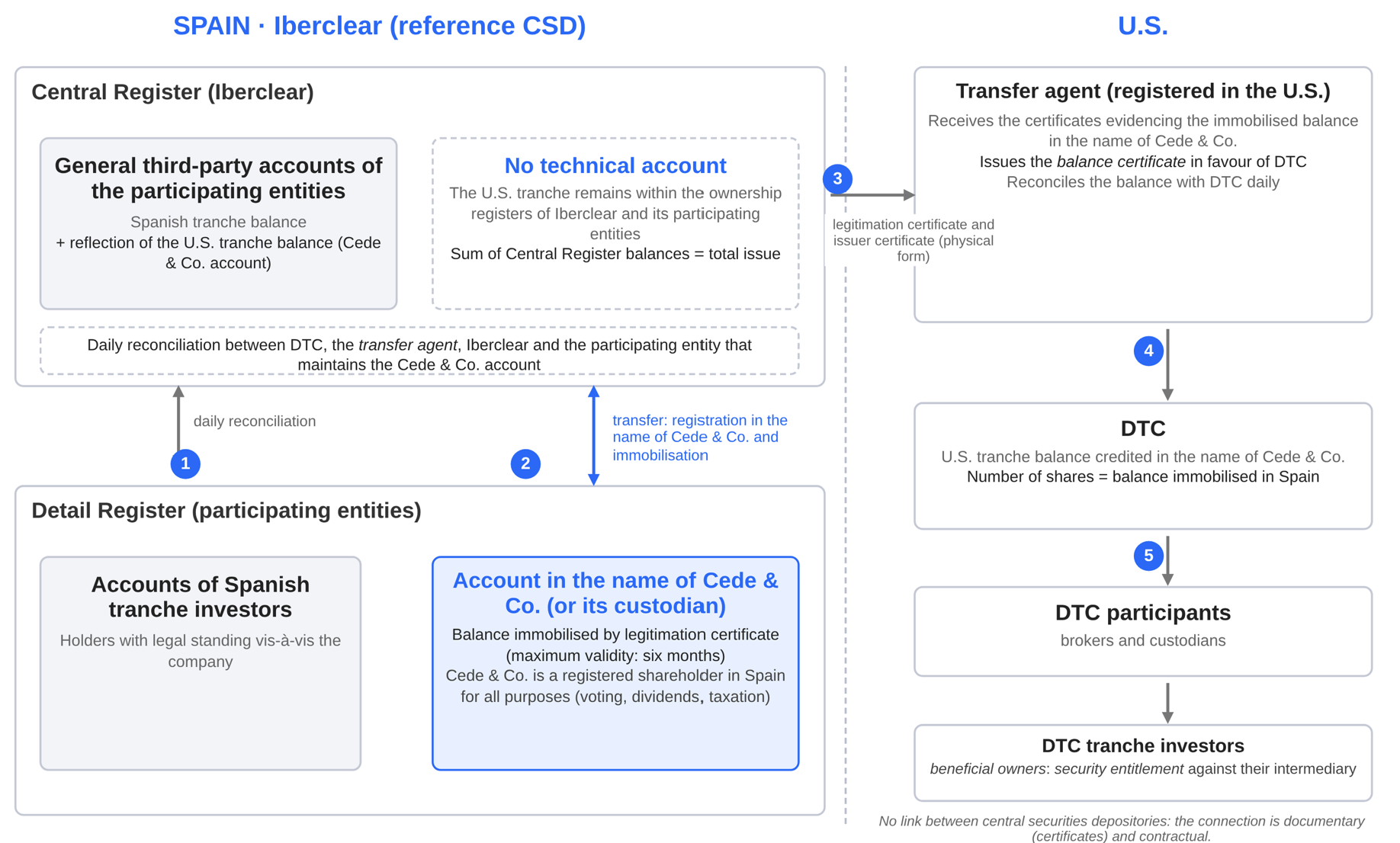
Figure 1. The route described by the CNMV before the reform. Transfer of shares to the U.S. tranche: (1) the investor instructs its participating entity to carry out the transfer; (2) the entity registers the shares in the name of Cede & Co. (or its custodian) and immobilises them by means of a legitimation certificate; (3) the issuer evidences the balance to the transfer agent with that certificate and its own, in physical form; (4) the transfer agent issues the balance certificate and credits the balance in DTC in the name of Cede & Co.; (5) DTC credits it to the investor’s participant. Cede & Co. is a registered shareholder in Spain for all purposes.
Finally, there is currently no direct link between the U.S. and Spanish CSDs that would allow shares to be registered in the systems of Iberclear and its participating entities in the name of DTC (through its nominee, Cede & Co.). On paper, such a link would require an agreement under which DTC would open an account at Iberclear reflecting the balance of shares of Spanish issuers that DTC holds on behalf of its participants. However, DTC maintains links of this kind only with the Canadian CSD (CDS) and, in practice, expects foreign issuers to access its systems through a U.S.-registered transfer agent and, to date, has not been willing to assume the responsibilities of linking with other CSDs and becoming a participant in their systems.
The alternative introduced by the reform: the technical account
The route described by the CNMV remains available, but Royal Decree 813/2026, in force since 28 October 2026, offers Spanish issuers that so wish an alternative channel, with express regulatory backing, for depositing shares with DTC when they pursue a second listing in the U.S.
This is a “technical account”, maintained by Iberclear, “in which the balance of securities of an issue for which it has been assigned the book-entry register and which, at any time, has been deposited with a central securities depository located outside the European Union is recorded on an aggregate basis”. The account “will not confer title of legitimation over the balances recorded in it” and will be maintained “for the sole purpose of monitoring the integrity of the issue” (article 34.4 of Royal Decree 814/2023 of 8 November, introduced by Royal Decree 813/2026).
Although it can be argued that Iberclear could open an account of this kind for operational purposes, to facilitate the transfer of positions or reconciliation with CSDs outside the European Union, without the need for an express regulatory authorisation, the key part of the reform is the provision that balances recorded in the technical account do not confer title of legitimation. This aspect is the one that should provide greater clarity and legal certainty when designing the securities register for a dual listing in the U.S.; in particular, because it dispels doubts as to whether the U.S. tranche shares, once registered at Iberclear and recorded on an aggregate basis in the technical account, may appear in the name of no holder in the registers of Iberclear and its participating entities, their ownership instead being recorded directly in favour of Cede & Co., as holder of record under U.S. practice, in the register maintained by the transfer agent on behalf of the issuer.
Iberclear will remain the CSD in charge of maintaining the book-entry register of the entire issue, including the shares registered in favour of Cede & Co., but, as regards the latter, solely for the purpose of ensuring the integrity of the issue and not of reflecting their registered holder. The separation, within Iberclear, of the notary service (initial registration and monitoring of the integrity of the issue) from the maintenance of the ownership register is one of the main contributions of the reform and is expected to ease DTC’s eligibility review, since it supports keeping the ownership register of the U.S. tranche outside Iberclear (with the transfer agent) and depositing the shares with DTC by a more direct route.
In this way, the issuance and registration of new shares to be listed in Spain and the U.S. will be governed by Spanish rules and Iberclear’s procedures, Iberclear remaining in charge of the book-entry register of the issue, but, for shares intended for the U.S. tranche, the process for recording them in favour of the investors who subscribe for them will be carried out under DTC’s systems, provided they meet the requirements to be eligible for and access them, in line with the route offered by other European jurisdictions.
Iberclear will remain responsible for verifying the integrity of the issue, so that the sum of the securities recorded in the technical account (held by their holders through DTC) and of the securities with the same security code registered in the accounts of the book-entry register maintained by Iberclear and its participating entities in favour of their holders remains equal to the total issue. Another advantage of the reform is that daily reconciliation can be expected to be arranged with simpler procedures than the issuance of legitimation certificates with registry immobilisation, and that can absorb movements between markets more dynamically, in line with the route offered by other European jurisdictions.
Book-entry representation, which is mandatory for Spanish issuers, should not in itself be an impediment to accessing DTC, since this form of representation allows the shares to be recorded in favour of a specific registered holder (Cede & Co.) and the U.S. system does not require physical certificates as an eligibility criterion.
The participating entity in Iberclear that has signed a prior agreement with the issuer may ask Iberclear to open the technical account and must manage the balance recorded in that account. It will also be responsible for ensuring that the balance of securities included in this account corresponds to the balance of U.S. tranche securities registered in the name of Cede & Co. and deposited with DTC. To that end, it must coordinate with the transfer agent and put in place the control mechanisms necessary to ensure that this equivalence is maintained at all times.
In essence, the model works as follows (Figure 2). On the Spanish side, Iberclear records in the technical account the aggregate balance of the issue deposited with DTC at any time, and each transfer to or from the U.S. tranche goes through an Iberclear participating entity, which debits (or credits) the shares in its account against the corresponding entry in the technical account. On the U.S. side, a transfer agent bound by contract to the issuer maintains the register of the tranche, in which Cede & Co. appears as holder of record, and, under its contract with DTC, evidences and reconciles that balance with DTC daily. The bridge between the two sides is the reconciliation between the balance of the technical account and the register of the transfer agent, with the documentation that DTC and the transfer agent require from the issuer (or from the participating entity designated by it).
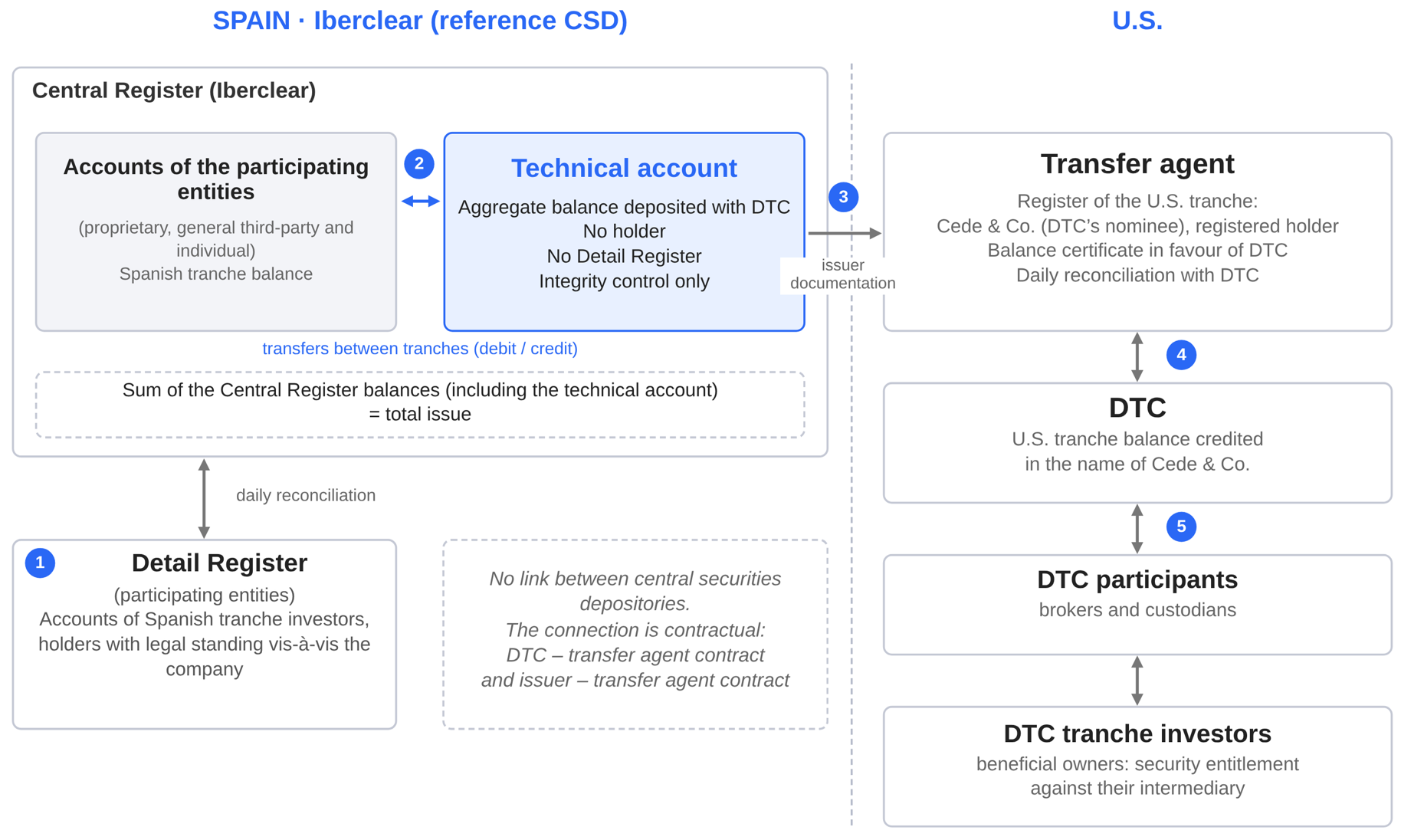
Figure 2. The technical account in the registry system. Transfer of shares from the Spanish tranche to the U.S. tranche: (1) the investor instructs its participating entity to carry out the transfer; (2) the entity debits the shares from its account and Iberclear records them in the technical account, so that the sum of the balances of the Central Register and the technical account does not change; (3) the issuer —or the participating entity designated by it— evidences the balance to the transfer agent with the documentation agreed with DTC; (4) the transfer agent credits the balance in DTC in the name of Cede & Co. and reconciles it daily; (5) DTC credits it to the investor’s participant. The reverse transfer follows the opposite path.
Table 2 below summarises the differences between the route described by the CNMV and the technical account expressly enabled after the reform.
Table 2. Route described by the CNMV (2023) and technical account (RD 813/2026)
| Route described by the CNMV (2023) | Technical account (RD 813/2026) | |
| Where the U.S. tranche is recorded in Spain | Registered in the name of Cede & Co. (or its custodian) in the Detail Register of a participating entity, reflected in that entity’s account in the Central Register | As an aggregate balance in Iberclear’s technical account, with no registered holder in Spain (neither in the central register nor in the detail registers) |
| Immobilisation | Required: legitimation certificates (which immobilise the securities) issued by Iberclear or its participating entities, valid for a maximum of six months (three if no term is set) | No immobilisation or legitimation certificates: the shares leave the participants’ accounts when recorded in the technical account |
| Documentation for the transfer agent | Legitimation certificate and issuer certificate (required in physical form under DTC practice), on which the balance certificate in favour of DTC is based | Documentation from the issuer (and, where applicable, from the participating entity designated by it or from Iberclear) on the technical account balance, on the terms DTC requires for the transfer agent to issue the balance certificate (the documentation being a priori simpler, since the shares are registered directly in favour of Cede & Co. in the register maintained by the transfer agent) |
| Transfers and encumbrances of the U.S. tranche in Spain | In principle possible, hence the need to block the balance at Iberclear | As there is no registered holder, they are not possible at Iberclear. They are only possible within DTC under U.S. law |
| Reconciliation | Daily between DTC, the transfer agent, Iberclear and the participating entity that maintains the Cede & Co. account | Daily between the technical account balance, the balances of the book-entry register accounts maintained by Iberclear and its participating entities, and the register of the transfer agent. The sum of the Central Register and technical account balances remains equal to the total issue |
| Legitimation of investors in the U.S. tranche | Cede & Co. is a registered shareholder in Spain for all purposes | No one is registered in Spain; Cede & Co. is holder of record in the register of the transfer agent, and proof of shareholder status is established in the by-laws and in the contract with the transfer agent |
| Regulatory basis | CNMV note of 5 April 2023 and certificates designed for another purpose | Article 34.4 of Royal Decree 814/2023, introduced by Royal Decree 813/2026 |
.
Common to both routes: Iberclear remains the reference CSD, DTC decides eligibility on a case-by-case basis, the transfer agent issues the balance certificate (or the certificate DTC requires) and there is no link between the CSDs.
Points an issuer should bear in mind regarding the new alternative
The technical account eases the registry fit of a dual listing in the U.S., but shifts to the issuer and its transfer agent functions that until now were performed by Iberclear and its participating entities. In designing the transaction, at least the following points will need to be considered:
- Legitimation of the DTC tranche. The technical account does not confer title of legitimation, and Spanish law recognises shareholder status in the person registered as holder in the book-entry register. Under U.S. principles, DTC’s nominee (Cede & Co.) would be the registered shareholder and, therefore, the holder of all voting and economic rights attached to the shares deposited with DTC. Under its customary procedures, DTC grants voting authority to its participants when a shareholder meeting is called, and they vote in accordance with their agreements with their clients, normally following the instructions of the ultimate beneficial owners. In addition, DTC remits distributions to its participants, once received from the issuer, in accordance with the contracts entered into with them, and each participant is responsible for payment to its own clients in accordance with its agreements with them.
Consequently, the issuer will need to provide for measures regarding legitimation and the exercise of the rights attached to the DTC tranche. Table 3 below includes some examples:
Table 3. Issuer measures for legitimation and the exercise of rights of the DTC tranche
| Measure | Purpose | Where regulated / who is involved |
| Recognise registration in the U.S. registers as proof of shareholder status | Enable investors in the DTC tranche to evidence their status and exercise their rights, even though the technical account does not confer title of legitimation | By-laws and contract with the transfer agent |
| Set an early notice date for the shareholder meeting | Ensure the notice reaches DTC tranche investors in time through DTC and its participants, without altering the five-day record date (fecha de legitimación) that applies to listed companies | By-laws or shareholder meeting regulations; DTC procedures |
| Appoint a proxy agent | Receive and channel the voting instructions of DTC participants, to which DTC grants voting authority when the meeting is called | Contract with the proxy agent; DTC procedures |
| Set specific record and payment dates for distributions on the DTC tranche | Adapt to DTC’s timetables and operations; they need not coincide with those of the Spanish tranche | Resolutions on each distribution; contract with the transfer agent; DTC |
| Define a U.S. dollar conversion methodology | Pay distributions in U.S. dollars to DTC tranche investors | Contract with the transfer agent or with the paying agent |
| Offer the transfer of shares to an Iberclear participating entity before the record date | Allow shareholders who need to do so to exercise their rights in Spain | Transfer procedures agreed with Iberclear, the designated participating entity and the transfer agent |
.
- Corporate events and taxation. The issuer will manage capital increases, scrip dividends and other corporate events in both systems (Iberclear and DTC). These transactions must comply with the applicable Spanish and U.S. rules and procedures. In addition, the issuer will need to facilitate tax compliance in respect of the U.S. tranche (exemptions, reduced rates and refunds of withholding tax), which is usually arranged through Iberclear participating entities; this will require specific analysis and adaptation of the procedures of DTC and the transfer agent.
- Transfers between markets. The procedure, timing and costs of transfers will be agreed by the issuer with Iberclear, the participating entity designated by the issuer and the transfer agent, taking into account the different settlement cycles (T+1 in the U.S. versus T+2 in the EU) until the EU moves to T+1 on 11 October 2027, the blocking periods that may be necessary around corporate events and the daily reconciliation obligations.
- Transition from an ADR programme. An issuer with ADRs will need to plan for the termination of the programme (with the notice required under the deposit agreement), the delivery of the shares to ADR holders and the reallocation of the functions performed by the depositary bank (voting, dividends, taxation, corporate events and communications with investors).
As part of a dual listing process, the issuer, Iberclear, the participating entity designated by the issuer, the CNMV, the transfer agent and DTC will need to examine all these points carefully.
Who may be interested in the new model
The reform is of interest to Spanish issuers that want their own shares to also trade in the U.S. It may also be of interest to Spanish issuers that have an ADR programme and prefer their shares to be listed directly on the NYSE or Nasdaq (without ADRs).
There are three levels of ADR programme for a foreign private issuer:
- Level I. ADRs trade only on the OTC market and are registered with the SEC on Form F-6. The depositary bank and the issuer usually rely on the Rule 12g3-2(b) exemption in respect of the underlying shares, which requires, among other conditions, that the principal trading market for the shares be outside the U.S. and that the issuer publish certain material information in English. The programme is sponsored if it is promoted by the company and unsponsored if it is created by a depositary bank on its own initiative.
- Level II. ADRs are listed on the NYSE or Nasdaq without raising capital through the programme. In addition to the F-6 for the ADRs, the issuer registers the shares underlying the programme with the SEC on Form 20-F under the Exchange Act. From then on, the issuer files an annual report on Form 20-F within four months after the end of the financial year and furnishes on Form 6-K the material information that it makes public under its home-country rules, files with its stock exchanges (which in turn publish it) or distributes to its shareholders.
- Level III. The issuer raises capital through a public offering of ADRs in the U.S., often after having established a Level II programme. In addition to the F-6 registration and the reporting obligations on Forms 20-F and 6-K, the foreign issuer files Form F-1 to register the public offering of the shares represented by the ADRs under the Securities Act. Newly issued ADRs are also listed on the NYSE or Nasdaq.
Depending on each issuer’s starting point, the path for its own shares to be traded directly on the NYSE or Nasdaq is different:
- Issuers with ADRs (Level I). These issuers, which already have a certain U.S. investor base, can make it easier for holders to exchange their ADRs for the shares underlying the programme. For the shares to be listed on the NYSE or Nasdaq, the issuer would need to coordinate the cancellation of the ADRs and the delivery of the shares with their eligibility at DTC, their registration under the Exchange Act and their admission to trading. The fulfilment of Level I requirements does not by itself permit such a listing (see “Other considerations for listing in the U.S.”).
- Issuers with ADRs listed on the NYSE or Nasdaq (Levels II and III). These issuers, which are already registered with the SEC and subject to its reporting obligations, would face lighter regulatory burdens. To have their shares listed directly, they would need to apply for DTC eligibility for the shares underlying the programme and for admission to trading on the NYSE or Nasdaq. They could then (i) maintain the ADR programme, so that ADRs and shares are listed at the same time, or (ii) replace the ADRs with the shares. In the second case, they would also need to coordinate the termination of the programme and the necessary steps before the SEC, and deliver the shares in exchange for holders’ ADRs. The timetable for this latter option depends mainly on the notice required under the deposit agreement and on regulatory and operational readiness. For example, in the case of TotalEnergies, less than six weeks elapsed between the announcement of the termination of the programme on 30 October 2025 and the start of trading of the shares on 8 December 2025.
- Issuers with no ADRs or U.S. presence. These issuers are not registered with the SEC, so they can apply directly for admission of their shares without first establishing an ADR programme. If they do not carry out an offering subject to registration under the Securities Act, they can register the class of shares on Form 20-F under the Exchange Act. If they carry out an offering subject to registration, they must also file Form F-1. SEC registration, DTC eligibility and admission to trading must be prepared in a coordinated manner (see “Other considerations for listing in the U.S.”).
Two considerations affect any foreign issuer contemplating a U.S. listing:
- Investor interest. Admission does not by itself guarantee liquidity. After trading begins, it is common to carry out a non-deal roadshow with U.S. investors, which can generate more interest than mere admission. In addition, a share placement may be necessary to meet the minimum free float requirements of the NYSE or Nasdaq.
- Share placement. A public offering in the U.S., whether of existing or new shares, requires, unless an exemption applies, registration under the Securities Act (Form F-1 or F-3, as applicable) and entails disclosure obligations and prospectus liability under U.S. law. Underwriting banks are usually involved and due diligence is carried out. A private placement requires identifying an applicable exemption and does not by itself allow the shares to be freely traded on an exchange. Rule 144A facilitates certain resales to qualified institutional buyers.
Other considerations for listing in the U.S.
Four main workstreams are worth highlighting:
- DTC eligibility. Under the pre-reform model, the shares of the U.S. tranche must be immobilised in Spain in order to apply to DTC for eligibility of a number of shares equal to the immobilised balance. After the reform, there is the alternative of depositing the shares with DTC, reflecting that balance in Iberclear’s technical account without DTC or its nominee appearing as holders in the Spanish register. In both cases, DTC decides on a case-by-case basis on the eligibility of the shares and, in that context, may require the foreign issuer to provide specific representations and legal opinions on its legal, regulatory, operational and corporate regime, issued by counsel in its jurisdiction in a form whose content DTC does not negotiate. The application is channelled through a DTC participant and requires coordinating the actions of the transfer agent, the identification of the securities (CUSIP and ISIN codes) and the documentation evidencing their suitability for the services requested. The reform does not guarantee DTC’s acceptance of the new scheme.
- SEC registration. The SEC staff’s review of the applicable forms (see “Who may be interested in the new model”) focuses on compliance with U.S. disclosure requirements, which may require additional or different content from that of a European prospectus. The registration timetable depends on the comments received and on the readiness of the financial information. The SEC accepts without reconciliation to U.S. GAAP financial statements prepared in accordance with IFRS as issued by the IASB; the issuer must verify and expressly state such compliance, and the accounts must be audited in accordance with PCAOB standards by a firm registered with that body. A first-time registrant should allow several months from submission of the first draft of the registration statement to the first day of trading.
- Admission to trading. The application for admission is processed in parallel with the SEC review and requires the foreign issuer to meet the exchange’s initial listing standards, both financial (market capitalisation, revenue or cash flow) and distribution (a minimum number of shareholders and shares in public hands), as well as minimum share price and corporate governance requirements.
Post-admission obligations. In addition to Forms 20-F and 6-K, the issuer will need to implement the internal controls and prepare the certifications required by the Sarbanes-Oxley Act, subject to the applicable exemptions and transition periods. Listing also entails exposure to the U.S. regime on liability for market disclosure, even without a share offering. Since 18 March 2026, Section 16(a) of the Exchange Act applies to directors and officers of foreign issuers, although, by an order dated 5 March 2026, the SEC has exempted directors and officers of EEA issuers who report their transactions under Article 19 of Regulation (EU) No 596/2014 on market abuse (MAR), provided that those notifications are made available to the public in English within two business days of their publication.
Gibson Dunn lawyers are available to address any questions you may have about these matters. You may contact the Gibson Dunn lawyer with whom you usually work, the authors, or any leader or member of the firm’s Capital Markets practice group:
Armando Albarrán – Madrid (+34 919 340 801, aalbarran@gibsondunn.com)
Alfonso Bernar – Madrid (+34 919 340 802, abernar@gibsondunn.com)
Lucía Berrícano – Madrid (+34 919 340 809, lberricanobayon@gibsondunn.com)
Eric Scarazzo – New York (+1 212 351 2389, escarazzo@gibsondunn.com)
Hugo Hernández-Mancha – London (+44 20 7071 4267, hhernandez-mancha@gibsondunn.com)
HOW WE CAN HELP
At Gibson Dunn we work in an integrated way across Madrid, London and the United States on cross-border equity transactions, advising issuers, investors and financial institutions on some of the most complex and significant transactions in the market. From Madrid, we have in-depth knowledge of the Spanish registry system, the operating practices of Iberclear and the CNMV, and the corporate adjustments that a U.S. dual listing requires. From New York and our other U.S. offices, we have a team, including numerous former SEC professionals, with first-hand knowledge of the process of registering transactions with the SEC, the admission of securities to the NYSE and Nasdaq, and the approval of their DTC eligibility. That combination allows us to help our clients in Spain to analyse a U.S. dual listing and, where appropriate, to carry it out efficiently and with legal certainty.
© 2026 Gibson, Dunn & Crutcher LLP. All rights reserved. For contact and other information, please visit us at www.gibsondunn.com.
Attorney Advertising: These materials were prepared for general informational purposes only based on information available at the time of publication and are not intended as, do not constitute, and should not be relied upon as, legal advice or a legal opinion on any specific facts or circumstances. Gibson Dunn (and its affiliates, attorneys, and employees) shall not have any liability in connection with any use of these materials. The sharing of these materials does not establish an attorney-client relationship with the recipient and should not be relied upon as an alternative for advice from qualified counsel. Please note that facts and circumstances may vary, and prior results do not guarantee a similar outcome.