
The DIFCA published a consultation paper on 30 April 2026 seeking public comment on certain proposed amendments to the DIFC Prescribed Company Regulations. The public consultation is open until 2 June 2026.
The Dubai International Financial Centre Authority (the DIFCA) has published Consultation Paper No. 1 of 2026 (the Consultation Paper) outlining certain proposed amendments to the DIFC Prescribed Company Regulations (the PC Regulations). The PC Regulations were enacted in 2019 (repealing and replacing the DIFC Special Purpose Company Regulations) and were most recently amended on 15 July 2024 (please refer to our analysis of such amendments here).
The proposed amendments to the PC Regulations as described in the Consultation Paper (the Proposed Amendments) seek to ensure enhanced oversight of prescribed companies (PCs) and remove the remaining qualifying purpose, applicant and nexus-based eligibility requirements in the PC Regulations.
These Proposed Amendments intend to broaden applicants’ access to the PC regime in the DIFC and the DIFCA has noted that in light of the UAE’s corporate tax regime and the UAE’s adherence to global tax reporting standards, such objective is now appropriate from a risk perspective.
Unless the context requires otherwise, capitalised terms used in this article have the meaning given to them in the PC Regulations (as proposed to be amended pursuant to the Proposed Amendments).
Summary of the Key Proposed Amendments
1. Removal of “Qualifying Purpose” Restriction
The Proposed Amendments seek to remove the requirement for a PC to be established for a Qualifying Purpose. Under the existing PC Regulations, the list of Qualifying Purposes includes the following:
- an Aviation Structure;
- a Crowdfunding Structure;
- an Intellectual Property Structure;
- a Maritime Structure; or
- a Structured Financing.
This proposed change to the PC Regulations would make the regime available to a wider universe of persons who wish to facilitate business in or from the DIFC via holding company vehicles that benefit from lower incorporation and licensing fees.
2. Increased Oversight through Corporate Service Providers
The Proposed Amendments aim to increase the oversight of PCs by mandating the appointment of a Corporate Service Provider (a CSP), unless a PC falls within the category of being an Exempt PC.
The Proposed Amendments introduce a new definition of an Exempt PC, being any PC where the person Controlling such PC is either:
- a Registered Person;
- an Authorised Firm;
- a Government Entity (which is intended to include governments of any Recognised Jurisdiction pursuant to the Proposed Amendments); or
- a Publicly Listed Entity (which is a new definition intended to be introduced by the Proposed Amendments and which purports to include any body corporate with any class of securities listed on a securities exchange in a Recognised Jurisdiction).
For PCs which have been incorporated prior to the date the Proposed Amendments come into force (the Enactment Date) and do not fall within the category of being an Exempt PC, the Proposed Amendments provide that such PCs will have a period of six (6) months following the Enactment Date to appoint a CSP.
The Proposed Amendments seek to enhance the CSP’s role by requiring a CSP to, without limitation:
- maintain a copy of all records that a PC is required to keep pursuant to the PC Regulations; and
- keep such records up to date and readily accessible for the Registrar.
The Proposed Amendments further demonstrate the importance of procuring enhanced regulatory compliance by and oversight of PCs by stating that failure to appoint a CSP could result in a PC being liable to a fine up to USD 20,000. In addition, any failure by a PC to make required documents and information available to its CSP could result in a PC being liable to a fine up to USD 100,000.
3. Ability for PCs to Hold Assets for Funds and Family Offices
The Proposed Amendments provide that, as a general rule, a PC shall not be used by any Authorised Firm (being a person that holds a licence from the Dubai Financial Services Authority (the DFSA) or another Recognised Financial Services Regulator) in the provision of a Financial Service in or from the DIFC, or to establish a Fund, unless expressly permitted by the DFSA.
Notwithstanding the above, the Proposed Amendments would permit a PC to hold assets for:
- a Crowdfunding Structure;
- a Fund; and
- a Family Office providing Family Office Services.
As noted above, under the existing PC Regulations, a Qualifying Purpose includes a Crowdfunding Structure. However, the ability for a PC to hold assets for a Fund or a Family Office pursuant to the Proposed Amendments would broaden a PC’s purpose.
4. Employment Prohibitions
The existing PC Regulations provide that PCs are not permitted to employ any Employees. The Proposed Amendments look to expand on this prohibition by also referring to any other form of workers.
However, this additional prohibition would not prevent a PC from appointing directors or hiring third-party service providers (such as advisory firms).
Conclusion
Whilst the outcome of the public consultation and the enactment of any amendments to the PC Regulations remains to be seen, the scope of the Proposed Amendments demonstrate the DIFCA’s appetite to both: (1) encourage more companies to apply under the PC regime and facilitate business in or from the DIFC via holding company vehicles that benefit from lower incorporation and licensing fees; and (2) enhance compliance and oversight of existing PCs.
Existing PCs should be mindful of the scope of the Proposed Amendments, namely the requirement to appoint a CSP, to ensure any additional compliance obligations can be satisfied within the prescribed timeframes.
Gibson Dunn’s lawyers are available to assist in addressing any questions you may have regarding these issues. For additional information about how we may assist you, please contact the Gibson Dunn lawyer with whom you usually work, any leader or member of the firm’s Mergers & Acquisitions or Private Equity practice groups, or the authors:
Andrew Steele – Abu Dhabi (+971 2 234 2621, asteele@gibsondunn.com)
Krishna Parikh – Dubai (+971 4 318 4609, kparikh@gibsondunn.com)
© 2026 Gibson, Dunn & Crutcher LLP. All rights reserved. For contact and other information, please visit us at www.gibsondunn.com.
Attorney Advertising: These materials were prepared for general informational purposes only based on information available at the time of publication and are not intended as, do not constitute, and should not be relied upon as, legal advice or a legal opinion on any specific facts or circumstances. Gibson Dunn (and its affiliates, attorneys, and employees) shall not have any liability in connection with any use of these materials. The sharing of these materials does not establish an attorney-client relationship with the recipient and should not be relied upon as an alternative for advice from qualified counsel. Please note that facts and circumstances may vary, and prior results do not guarantee a similar outcome.
By establishing a comprehensive framework addressing product safety, performance standards, and regulatory oversight, the Regulations meaningfully enhance legal certainty for market participants.
Background
Saudi Arabia has taken material steps towards establishing the regulatory framework for autonomous vehicles as part of its National Transport and Logistics Strategy. These steps include the issuance of: (i) the technical regulations for autonomous vehicles by the Saudi Standards, Metrology and Quality Organization (SASO) (the Regulations); and (ii) Volume 801 of the Saudi Highway Code (SHC 801) by the General Authority for Roads (RGA).
The Regulations, together with SHC 801, form the core regulatory framework governing on-road use of fully and partially autonomous vehicles. The Regulations set out the technical requirements applicable to autonomous vehicles in Saudi Arabia and define the roles and responsibilities of the relevant market participants, including economic operators, while SHC 801 sets the requirements relating to infrastructure readiness and safety oversight.
Though the Regulations are due to enter into force in April 2026, the Transport General Authority (TGA) has already applied the regulatory framework through controlled pilot deployment. To obtain authorization to deploy autonomous vehicles, operators were required to demonstrate compliance with the requirements of the Regulations and SHC 801, including participation in a pilot and regulatory sandbox program conducted under TGA oversight.
The sandbox program involved supervised testing, self-assessments, and technology validation designed to ensure that deployed vehicles meet applicable safety and performance standards. This approach included the issuance of the first autonomous driving permit to WeRide and conducting pilot operations in partnership with Uber and Ai Driver. In late October of last year, the TGA reported the successful completion of the pilot involving more than 1,000 users, providing a meaningful point of reference as the Regulations approach formal entry into force.
Scope of Application
The Regulations apply to autonomous vehicles and to economic operators involved in the placing of such vehicles on the market, including: manufacturers, authorized representatives, importers and distributors. In particular, the Regulations apply to vehicles equipped with high and full driving automation (SAE levels 4 and 5) for both passenger and goods vehicles (categories M and N). The Regulations equally apply to vehicles that are locally manufactured or imported into the Kingdom. Such vehicles include: (i) fully autonomous vehicles, and dual mode vehicles designed for transport of passengers and goods; (ii) fully autonomous hub-to-hub vehicles; and (iii) vehicles with autonomous parking features.
Obligations on Economic Operators
The Regulations establish general obligations applicable to all economic operators, alongside role‑specific requirements that apply to manufacturers, importers, distributors and authorized representatives who may be appointed by manufacturers established outside of the Kingdom to support compliance and liaison activities. The general obligations include: (i) ensuring compliance with the requirements of the Regulations; (ii) cooperating with competent authorities, including by providing documentation and information upon request; (iii) ensuring that transportation and storage conditions do not compromise product safety or conformity; and (iv) where non‑compliance or a safety risk is identified, acting promptly to implement appropriate corrective measures, which may include withdrawing or recalling products.
Beyond the baseline obligations applicable to all economic operators, the Regulations impose specific obligations that vary by the role performed, including obligations applicable to manufacturers, importers, distributors, and authorized representatives.
- Manufacturers are responsible for complying with technical requirements, conducting conformity assessments and issuing declarations of conformity, as well as maintaining ongoing compliance for serial production. They must also manage product risks through testing, handling complaints, and taking corrective actions when necessary. Additionally, manufacturers must provide product identification, including safety and usage instructions in Arabic, supply required documentation to authorities upon request, and cooperate with authorities to address any risks associated with the products.
- Importers must ensure that the vehicle placed on the market has undergone the applicable assessment procedures, that handling and storage conditions do not adversely affect product conformity, and that appropriate corrective measures are taken where the vehicle does not comply with applicable requirement or presents a safety risk.
- Distributors are required to verify that products placed on the market conform with the applicable requirements under the Regulations. They must also ensure that, while the products are under their responsibility, storage and transport conditions do not adversely affect product conformity.
- Authorized Representatives must carry out the tasks specified in the authorization granted by the manufacturer, however core manufacturer responsibilities such as ensuring soundness of the product from a design and manufacturing perspective remain with the manufacturer.
Vehicle-level Requirements and Exceptions
The Regulations introduce vehicle-level requirements addressing safety, operational and environmental requirements. Article (10) of the Regulations sets out the essential safety requirements intended to ensure that the vehicles do not pose unreasonable risks to users, property, or the environment. These requirements are further elaborated through three annexes, which address testing and operational requirements and provide for limited technical exceptions applicable to certain categories of autonomous vehicles.
Annex (1) specifies the safety, operational, and environmental criteria that the Autonomous Driving System (ADS) must satisfy. It also sets out a series of tests through which compliance with essential safety requirements is demonstrated. These tests include track testing, consisting of physical tests conducted either on-road or at designated facilities to simulate the conditions of the design domain as defined by the manufacturer, and real-world testing, which involves testing on public roads in accordance with local traffic regulations.
Annex (2) introduces performance requirements that specify the functional capabilities an ADS must demonstrate, including sensing and perception, decision‑making, and vehicle control across both normal and critical driving scenarios. These requirements also address system behavior in the event of faults or unexpected conditions, with a view to ensuring that the ADS can respond safely and maintain acceptable risk levels.
Annex (3) provides for a limited set of technical exceptions, under which certain requirements may be waived for particular types of autonomous vehicles, subject to the conditions set out in the Regulations.
Conclusion
The introduction of the Regulations marks an important milestone in the Kingdom’s approach to emerging mobility technologies. By establishing a comprehensive framework addressing product safety, performance standards, and regulatory oversight, the Regulations meaningfully enhance legal certainty for market participants. From an industry perspective, the Regulations are expected to catalyze investment and innovation, while supporting the development infrastructure and supply chains. Taken together, these developments are perceived as constructive steps toward advancing the Kingdom’s broader Vision 2030 objectives.
To learn more, please contact the Gibson Dunn lawyer with whom you usually work, or the authors in Riyadh:
Mohamed A. Hasan (+966 11 211 9014, malhasan@gibsondunn.com)
Mohammed M. Bashir (+966 11 211 9011, mbashir@gibsondunn.com)
Megren Al-Shaalan (+966 11 211 9001, malshaalan@gibsondunn.com)
Lojain AlMouallimi (+966 11 211 9026, lalmouallimi@gibsondunn.com)
© 2026 Gibson, Dunn & Crutcher LLP. All rights reserved. For contact and other information, please visit us at www.gibsondunn.com.
Attorney Advertising: These materials were prepared for general informational purposes only based on information available at the time of publication and are not intended as, do not constitute, and should not be relied upon as, legal advice or a legal opinion on any specific facts or circumstances. Gibson Dunn (and its affiliates, attorneys, and employees) shall not have any liability in connection with any use of these materials. The sharing of these materials does not establish an attorney-client relationship with the recipient and should not be relied upon as an alternative for advice from qualified counsel. Please note that facts and circumstances may vary, and prior results do not guarantee a similar outcome.
Gibson Dunn continues to monitor developments and is available to assist clients in evaluating contractual remedies, sanctions implications, dispute risk, and arbitration or litigation claims arising from the evolving conflict.
I. Introduction
The recent escalation of armed conflict involving the United States, Israel, Iran, and the Gulf States has rapidly transformed the Strait of Hormuz—one of the world’s most critical trade corridors—into a zone of acute commercial risk. Businesses with exposure to maritime shipping, energy markets, aviation logistics, and contracts tied to delivery timing should assess immediate and downstream implications for contract performance, operational continuity, and legal rights and continue to closely monitor developments.
2. Escalating Maritime Risk in the Strait of Hormuz
Following coordinated U.S.-Israeli strikes on Iranian targets on 28 February 2026 and Iran’s retaliatory strikes against multiple Gulf states, regional tensions intensified. Iran’s Revolutionary Guard Corps (IRGC) has declared the Strait of Hormuz closed,[1] and warned vessels against transiting the Strait. Commercial shipping activity has declined sharply as insurers withdraw coverage and vessels delay passage.[2]
The Strait of Hormuz is a critical chokepoint for global trade. It carries approximately 15–20 million barrels per day of crude oil—roughly one-fifth of the world’s oil supply—and more than one-fifth of global liquefied natural gas (LNG) supply, much of which lacks alternative routing.[3] Reports indicate that multiple vessels have delayed or suspended transit through the Gulf, and certain carriers have temporarily halted operations pending further risk assessments.[4] Multiple tankers have reportedly been damaged, with dozens of vessels diverting or awaiting clearance.[5] Roughly ten days’ worth of shipments are now stranded in the Gulf.[6] According to some reports, the Strait is fast becoming unnavigable.[7]
On 4 March 2026, Gas giant QatarEnergy, responsible for 20% of global LNG supply, declared force majeure on all LNG shipments, after Iranian attacks on its facilities and the closure of the Strait of Hormuz.[8] Others are expected to follow suit.
The disruption is not confined to maritime shipping. Freight forwarders and logistics providers are warning of broader supply chain implications (beyond the Middle East region), including congestion, schedule unreliability, and cost increases as a result of aircraft redeployments, route extensions, service suspensions, and a tightening of available capacity across key trade lanes.[9]
III. Cancellation of War-Risk Coverage and Insurance Market Volatility
One of the earliest commercial consequences has been the suspension or cancellation of war-risk coverage by marine insurers operating in the region.[10] Insurers have reportedly withdrawn coverage for vessels transiting Iranian, Israeli, and/or adjacent Gulf waters or imposed sharply increased premiums—some rising by 50% or more.[11] Premium increases may directly affect delivered costs.
Marine war-risk insurance—often an add-on to standard hull and cargo policies—may cover loss or damage resulting from acts of war, hostilities, terrorism, or related perils (depending on the policy language). Conventional marine policies do not generally insure these risks. The withdrawal of war-risk coverage may have immediate contractual and operational consequences.
For example, many charterparties and financing arrangements require vessels to be insured to specified levels. Where war-risk coverage is withdrawn or becomes prohibitively expensive, owners and charterers may face decisions regarding whether trips can proceed in accordance with contractual and financing obligations. In certain cases, a failure to maintain required insurance could constitute a breach under charter, loan, or sale agreements.
Businesses should carefully review their policies (including notice requirements, navigation warranties, and geographic exclusions) and stay apprised of rapidly changing military conditions.
IV. Downstream Effects on Contract Performance and Commercial Risk Allocation
Beyond immediate shipping and insurance implications, the Gulf Region conflict is likely to generate secondary effects across global supply chains. Freight forwarders have warned that rerouting, suspended services, and capacity constraints could disrupt delivery schedules and increase transit times.[12] In addition, carriers have introduced war-risk surcharges and other pricing adjustments to reflect elevated operating costs.[13]
These developments may place pressure on contractual performance in several respects:
- First, parties should closely review force majeure and hardship provisions (which has already been invoked by QatarEnergy, as noted above). Whether the current situation qualifies as a force majeure event will depend on the governing law and the specific contractual language. Clauses referencing “acts of war,” “hostilities,” “blockades,” or “governmental actions” may be implicated. Even where performance remains technically possible, sharply increased costs or the unavailability of required insurance could trigger renegotiation rights or commercial impracticability arguments in certain jurisdictions.
- Second, contracts with fixed delivery deadlines or liquidated damages provisions may be strained by transit delays, port congestion, or airspace restrictions.
- Third, the introduction of war-risk surcharges and rising shipping costs may generate disputes over cost allocation where pricing mechanisms did not contemplate volatility in insurance premiums or routing expenses.
- Fourth, letters of credit, trade finance facilities, and commodity sale contracts often incorporate documentary requirements tied to shipment dates, routes, or insurance coverage. Parties should assess whether compliance remains feasible under revised routing arrangements or modified insurance programs.
V. Impact on Energy Markets and Broader Economic Effects
The widening regional conflict has numerous knock-on effects across different economic sectors. Energy-intensive sectors—manufacturing, transport, aviation, chemicals, aluminum, and fertilizers—are particularly exposed.
Hydrocarbons
The concentration of global hydrocarbon flows through the Strait of Hormuz heightens systemic risk, as even temporary or partial disruptions can introduce price volatility and downstream cost increases affecting manufacturers, transportation providers, and energy-intensive industries worldwide.[14] These macroeconomic effects may compound contractual disputes in supply chains that are already sensitive to geopolitical shocks.
Oil prices rose because of a nearly complete halt of shipments through the Strait of Hormuz.[15] As the war spreads, experts expect that the price could go much higher.[16]
In addition, as Qatar halted LNG production following Iranian drone attacks on facilities, the price of natural gas increased by almost 50%.[17] Given Europe’s reliance on LNG imports following the reduction of Russian LNG flows, a prolonged disruption of Qatari supply could limit the region’s LNG supply and unleash competition with Asian importers, including India and China, for replacement cargoes.[18] For companies with LNG-linked supply contracts, this raises risks relating to, inter alia, cargo cancellation and delay; price revisions tied to benchmarks; and, force majeure notices by upstream producers.
In parallel, to make up for oil shortfalls, relax the pressure on prices, and stabilize markets, governments may adjust their existing sanctions regimes to facilitate alternative supply flows from jurisdictions such as Venezuela or, potentially, Russia. Any such policy shifts would likely be incremental and politically sensitive. Companies should continue to closely monitor sanctions developments and exercise caution before relying on potential relaxations, as compliance obligations may shift rapidly and inconsistently across jurisdictions.
Shipping Logistics
Container lines have suspended Gulf and Red Sea routes and, in some cases, resumed diversions around the Cape of Good Hope. A large-scale return of container ships to the Red Sea and Suez Canal routings, previously projected for 2026, is now reportedly unlikely in the near term.[19] Rerouting around the Cape of Good Hope can add up to two weeks to voyage times and materially increase freight rates.[20]
Costs of shipping oil from the Middle East to Asia (already at six-year high) are set to rise further as the widening of the conflict deters shipowners from sending vessels to the region.[21]
Freight forwarders have warned of tightening capacity across key trade lanes as aircraft redeploy and vessels avoid high-risk corridors. These conditions can create exposure under time-sensitive delivery contracts and just-in-time manufacturing supply chains.
Aluminum
Aluminum markets are likely to be affected by disruption of shipping through the Strait of Hormuz. The Middle East produces approximately 22% of global refined aluminum (excluding China) and exports about 75% of its output.[22]
Aviation
The Gulf conflict has also disrupted aviation across the Middle East and beyond as countries imposed prolonged airspace restrictions and suspended operations at major global transfer hubs such as Abu Dhabi, Doha, and Dubai—the busiest airport in the world. For passenger and freight airlines operating along the critical East-West corridor, rerouting around restricted airspace—on top of existing regional constraints and closed Russian airspace—can materially lengthen flight times, increase fuel and crew costs, and reduce aircraft and cargo capacity, leading to downstream price increases and consequences for time-sensitive freight and just-in-time supply chains, as demonstrated during prior regional airspace closures.[23] In a prolonged conflict, further operational impacts could give rise to contractual, force majeure, and insurance issues across both passenger and cargo operations.
VI. Conclusion
In light of these developments, companies with exposure to Gulf transit or related supply chains may wish to consider the following steps:
- Contract Review: Conduct a targeted review of force majeure, insurance, routing, and cost-allocation provisions in key supply, charter, and logistics agreements.
- Insurance Audit: Evaluate existing marine, cargo, and political risk policies, with particular attention to war-risk exclusions, cancellation rights, and notice obligations.
- Operational Contingency Planning: Assess alternative routing options, inventory buffers, and supplier diversification strategies to mitigate potential delays.
- Proactive Communications: Provide timely contractual notices to counterparties where required and maintain dialogue regarding potential delays or cost impacts.
Given the fluidity of the situation, businesses can anticipate continued volatility in insurance markets, shipping availability, and energy products. Early coordination among legal, risk management, and logistics teams will be critical to preserving contractual rights and minimizing exposure.
Gibson Dunn continues to monitor developments and is available to assist clients in evaluating contractual remedies, sanctions implications, dispute risk, and arbitration or litigation claims arising from the evolving conflict.
[1] See Al Jazeera, Shutdown of Hormuz Strait raises fears of soaring oil prices (Mar. 3, 2026).
[2] See Reuters, Ship insurers cancel war risk cover due to Iran conflict (Mar. 2, 2026).
[3] See id. See also The Economist, War in Iran could cause the biggest oil shock in years (Mar. 1, 2026); Reuters, Gas giant QatarEnergy throttles LNG supply by declaring force majeure (Mar. 4, 2026).
[4] See Reuters, Ship insurers cancel war risk cover due to Iran conflict (Mar. 2, 2026).
[5] See The Economist, War in Iran could cause the biggest oil shock in years (Mar. 1, 2026); Financial Times, For Insurers, Gulf Will Be “Just Too Dangerous” (Iran Conflict Day 2 as it Happened: Oil Flows Through Strait of Hormuz Dry Up ) (Mar. 1, 2026).
[6] See The Economist, War in Iran could cause the biggest oil shock in years (Mar. 1, 2026).
[7] See id.
[8] See Reuters, Gas giant QatarEnergy throttles LNG supply by declaring force majeure (Mar. 4, 2026).
[9] See Air Cargo News, Forwarders warn of supply chain disruption following Iran strikes (Mar. 2026).
[10] See Reuters, Ship insurers cancel war risk cover due to Iran conflict (Mar. 2, 2026).
[11] See id.
[12] See Air Cargo News, Forwarders warn of supply chain disruption following Iran strikes (Mar. 2026).
[13] See id.
[14] See Reuters, Ship insurers cancel war risk cover due to Iran conflict (Mar. 2, 2026).
[15] See The Economist, War in Iran could cause the biggest oil shock in years (Mar. 1, 2026).
[16] See id.
[17] See Financial Times, Gas Prices Soar as Iranian Attacks Force Shutdown of Qatari Production (Mar. 2, 2026).
[18] See Financial Times, Gas Prices Soar as Iranian Attacks Force Shutdown of Qatari Production (Mar. 2, 2026).
[19] See Air Cargo News, Box lines unlikely to return to Suez Canal in 2026 following Middle East strikes (Mar. 2, 2026).
[20] See Financial Times, Iran Conflict Day 2 as it Happened: Oil Flows Through Strait of Hormuz Dry Up (Mar. 1, 2026).
[21] See Reuters, Ship insurers cancel war risk cover due to Iran conflict (Mar. 2, 2026); Financial Times, Gas Prices Soar as Iranian Attacks Force Shutdown of Qatari Production (Mar. 2, 2026).
[22] See Financial Times, Iran Conflict Day 2 as it Happened: Oil Flows Through Strait of Hormuz Dry Up (Mar. 1, 2026).
[23] See The Guardian, Airlines Pay the Price as ‘No-Go’ Airspace Increases Due to Global Conflicts (June 23, 2025); Freightwaves, Air Freight Rates Expected to Spike as Iran War Escalates (Mar. 2026).
Gibson Dunn’s lawyers are available to assist in addressing any questions you may have regarding these issues. For additional information about how we may assist you, please contact the Gibson Dunn lawyer with whom you usually work, any leader or member of the firm’s International Arbitration or International Trade Advisory & Enforcement practice groups, or the authors:
International Arbitration:
Rahim Moloo – Co-Chair, New York (+1 212.351.2413, rmoloo@gibsondunn.com)
Nooree Moola – Dubai (+971 4 318 4643, nmoola@gibsondunn.com)
Maria L. Banda – Washington, D.C. (+1 202.887.3678, mbanda@gibsondunn.com)
International Trade Advisory & Enforcement:
Adam M. Smith – Co-Chair, Washington, D.C. (+1 202.887.3547, asmith@gibsondunn.com)
Christopher T. Timura – Washington, D.C. (+1 202.887.3690, ctimura@gibsondunn.com)
© 2026 Gibson, Dunn & Crutcher LLP. All rights reserved. For contact and other information, please visit us at www.gibsondunn.com.
Attorney Advertising: These materials were prepared for general informational purposes only based on information available at the time of publication and are not intended as, do not constitute, and should not be relied upon as, legal advice or a legal opinion on any specific facts or circumstances. Gibson Dunn (and its affiliates, attorneys, and employees) shall not have any liability in connection with any use of these materials. The sharing of these materials does not establish an attorney-client relationship with the recipient and should not be relied upon as an alternative for advice from qualified counsel. Please note that facts and circumstances may vary, and prior results do not guarantee a similar outcome.
Effective 1 February 2026, the Saudi Capital Market Authority (CMA) will open the Saudi capital market to all categories of foreign investors, eliminating the Qualified Foreign Investor (QFI) and swap-based access frameworks. These reforms, together with updated controls on real estate ownership by listed vehicles, mark a significant step in the continued liberalization and international integration of the Saudi capital markets.
The Capital Market Authority of the Kingdom of Saudi Arabia (CMA) has announced amended Rules for Foreign Investment in Listed Securities (the Rules) that will take effect on 1 February 2026, and will open the Saudi capital market to all categories of foreign investors and enable them to invest directly in listed securities. The amended Rules eliminate the Qualified Foreign Investor (QFI) construct for the Main Market and remove the swap-agreement framework previously used to provide synthetic economic exposure to Saudi listed securities, replacing these mechanisms with a unified regime for direct foreign participation.
Historical Background
Saudi Arabia has moved steadily from a tightly controlled foreign participation model toward broader market access, with foreign investment expanding in a phased and deliberately calibrated manner since the introduction of the QFI framework in 2015. Early inflows were modest, reflecting stringent eligibility requirements, foreign ownership caps and reliance on indirect exposure mechanisms (swap agreements), which together kept foreign ownership levels below those of global peers despite the size of the Saudi market. Foreign investor participation gained momentum following Saudi equities’ inclusion in major global indices (including MSCI, FTSE Russell and S&P Dow Jones), anchoring more durable, index-linked foreign allocations, particularly into large-cap, liquid issuers. In recent years, the CMA continued to ease access through incremental regulatory and operational reforms, supporting steady growth in foreign ownership; by end of Q3-2025, foreign investors held over SAR 590 billion (approximately USD 157 billion) of Saudi equities.
Opening the Market: Key Features of the Amended Foreign Investment Rules
Pursuant to the amended Rules, the CMA has eliminated the QFI framework and removed the swap-based access model, allowing a broader category of foreign investors to hold listed securities directly. Under the QFI framework, foreign investors had to go through an assessment by a licensed capital market institution to ensure eligibility and compliance on an ongoing basis with eligibility requirements, which included having a minimum of SAR 1.875 billion (US$500 million) of assets under management. The previous reliance on status-based access channels has been replaced by a unified framework under which all foreign investors may participate directly, subject to certain continuing ownership limits, while preserving a separate route for Foreign Strategic Investors (FSIs).
Existing foreign ownership limits remain in force, including the following:
- Non-resident foreign investors (other than FSIs) may not own 10% or more of any listed issuer’s shares or convertible debt instruments.
- Aggregate foreign ownership (all categories of resident and non-resident foreign investors, excluding FSIs) of any listed issuer’s shares or convertible debt instruments may not exceed 49%.
- Company constitutional limits, sector-specific restrictions and other regulatory caps continue to apply.
The Rules preserve a distinct regime for FSIs, but still condition the FSI’s investment in a listed company’s shares by a longer-term investment horizon (i.e., minimum of two years with a corresponding lock-up period) with the purpose of contributing in promoting the company’s financial or operational performance. However, the Rules do not set any minimum or maximum targeted ownership thresholds for FSIs.
The CMA has also clarified that capital market institutions holding the portfolio accounts of foreign investors, as well as foreign investors share responsibility for monitoring compliance with lock-up periods and ownership limits, and that breaches may result in corrective measures and sanctions under the Capital Market Law, including orders to remedy or unwind non-compliant holdings.
Real Estate Controls: Parameters for Foreign Ownership by Listed companies, Funds, and Special Purpose Entities (SPEs)
Saudi Arabia has recently enacted a new Law of Real Estate Ownership by Non-Saudis, modernizing and liberalizing the framework for foreign ownership of real estate in the Kingdom by permitting non-Saudi individuals and entities to own property subject to defined conditions and regulatory oversight. This represents a notable shift from historically restrictive ownership regimes.
Against this backdrop, the CMA has approved Controls on the Ownership of Real Estate in the Kingdom by Listed Companies, Investment Funds and Special Purpose Entities (the Controls). The Controls establish the conditions under which listed companies, investment funds and special purpose entities may own real estate or other rights in real estate in the Kingdom, including in Makkah and Madinah, subject to specific safeguards. In particular:
- As a general rule, where listed companies own real estate in Makkah or Madinah, such properties must be used as the company’s headquarters or branch headquarters.
- Exceptionally, listed companies may own such properties for other purposes provided that (i) no FSI holds any shares or convertible debt instruments at any time, and (ii) aggregate ownership by non-Saudi natural and legal persons does not exceed 49% of the company’s shares or convertible debt instruments.
The Controls also permit capital market institutions to accept subscriptions from non-Saudis in investment funds that invest partly or wholly in Saudi real estate, including in Makkah and Madinah, subject to compliance with the Real Estate Ownership by Non-Saudis Law and its implementing regulations, including upon in-kind redemptions, termination or liquidation.
Expected Effect on the Saudi Capital Market
The CMA’s recent reforms form part of a broader, long-term program to attract international capital, enhance global index inclusion and deepen liquidity in the Saudi capital markets. In particular:
- Strategic policy alignment: The market opening closely aligns with Vision 2030’s objective of positioning Saudi Arabia as a global investment hub, strengthening the depth, competitiveness and international integration of the Saudi Exchange.
- Improved market liquidity: Broader direct access is intended to expand the investable foreign base, supporting increased capital inflows, enhanced liquidity and greater market depth, with potential positive effects on price discovery and execution efficiency.
- Simplified market access: By removing the QFI gateway and swap-based access models, the CMA has materially simplified foreign entry into the market, reducing operational, regulatory and compliance hurdles for global asset managers, custodians and intermediaries.
- Greater index and institutional appeal: The simplified access framework is expected to improve the market’s “indexability” and attractiveness to large institutional and benchmark-driven investors, reinforcing Saudi Arabia’s standing within global equity indices and facilitating more scalable, stable and durable foreign participation over time.
In parallel, the CMA has continued to expand the range of investable products available in the Kingdom. In July 2025, the CMA approved a framework for the issuance of Saudi Depositary Receipts (SDRs), enabling foreign companies to register and offer depositary receipts representing shares listed abroad on the Saudi Exchange. SDR issuers are subject to ongoing disclosure and continuing obligations, creating a regulated mechanism for international issuers to access Saudi capital without pursuing a primary listing in the Kingdom. Together with the January 2026 market-opening reforms, the SDR framework supports deeper capital markets, diversified product offerings and enhanced cross-border investment flows.
Looking Ahead
The CMA has also publicly indicated that the foreign ownership limits will be reviewed in 2026, signaling the potential for further liberalization following the initial market opening. We expect these measures to continue enhancing Saudi Arabia’s capital formation environment, while preserving safeguards designed to protect market integrity and national regulatory priorities.
Gibson Dunn’s lawyers are available to assist in addressing any questions you may have regarding these developments. If you wish to discuss any of the matters set out above, please contact the Gibson Dunn lawyer with whom you work or any member of Gibson Dunn’s Capital Markets team, including the following members in Riyadh:
Najla Al-Gadi (+966 53 993 9069, nalgadi@gibsondunn.com)
Ibrahim Soumrany (+966 55 798 9799, isoumrany@gibsondunn.com)
© 2026 Gibson, Dunn & Crutcher LLP. All rights reserved. For contact and other information, please visit us at www.gibsondunn.com.
Attorney Advertising: These materials were prepared for general informational purposes only based on information available at the time of publication and are not intended as, do not constitute, and should not be relied upon as, legal advice or a legal opinion on any specific facts or circumstances. Gibson Dunn (and its affiliates, attorneys, and employees) shall not have any liability in connection with any use of these materials. The sharing of these materials does not establish an attorney-client relationship with the recipient and should not be relied upon as an alternative for advice from qualified counsel. Please note that facts and circumstances may vary, and prior results do not guarantee a similar outcome.
This update explains the main changes to the CCL brought about by the Amendment and considers some of the implications which should be assessed by companies and investors.
UAE Federal Decree-Law No. (32) of 2021 Concerning Commercial Companies (the CCL) has recently been amended pursuant to Federal Decree-Law No. (20) of 2025 (the Amendment). The Amendment was issued on 1 October 2025 and took effect the day following publication in the Official Gazette (which occurred on 14 October 2025).
This update explains the main changes to the CCL brought about by the Amendment and considers some of the implications which should be assessed by companies and investors.
The Amendment introduces several noteworthy concepts and clarifications to the CCL whilst preserving its core structure and is, overall, a welcome development. A number of the concepts introduced in the Amendment will be subject to more detailed implementing regulations that will elaborate upon, and operationalize, the key provisions. Until those new implementing regulations are released, the existing regulations enacted under the CCL will continue to apply insofar as they do not conflict with the Amendment.
Revised articles 3 and 5 clarify that companies incorporated in the UAE’s free zones (including the financial free zones in the ADGM and DIFC) may establish branches and representative offices onshore if permitted to do so under the relevant free zone’s legislation, in which case the CCL now expressly applies to their onshore presence. This codifies the ‘dual licence’ regime which had begun to develop. The amendment to article 9 also expressly specifies that any company incorporated in the free zones will carry UAE nationality.
Amended article 8 contemplates the incorporation of ‘onshore’ non-profit companies, allowing relevant entities to reinvest net profits to achieve their objectives. Previously, the CCL defined a company by reference to aim of making a profit, and we expect this Amendment to further broaden the UAE’s corporate landscape. This specific change is subject to the UAE Cabinet issuing a decision setting out the permitted purposes for which a non-profit company may be established, along with further details regarding the form of these companies and how the CCL will apply to them. At this stage, therefore, it is very much ‘wait and see’ on this front.
Updated article 14 permits, for the first time, statutory recognition of commonly deployed joint venture mechanics which might take the form of drag-along and tag-along rights. It also allows the articles of a JV to provide for the right of a shareholder to compel other shareholders in the joint venture to sell their shares to a third party if pre-determined conditions are met. This is likely to bolster enforceability of such commercial arrangements, allowing these concepts to be added to the companies’ constitutional documents instead of investors being required to rely solely on a private joint venture agreement. The amendments to article 14 also contemplate that a company’s constitutional documents may include rules concerning the transfer of shares upon the death of a shareholder. We presume this has been included to help companies and shareholders reduce the risk of disputes relating to inheritance matters – and, interestingly, the Amendment specifically contemplates that the company could actually acquire the relevant shares itself by including a provision permitting this in its constitutional documents. We anticipate these changes will help strengthen shareholder protection, facilitate corporate continuity and enhance procedural efficiency. Companies with these concepts that are currently regulated via a private shareholders’ agreement should consider whether they wish to update their constitutional documents to benefit from these latest amendments to the CCL.
Article 32 has been expanded to allow private joint stock companies, with approval from the Securities & Commodities Authority (SCA), to offer securities via private placement. The Amendment does not define a private placement (for example, by reference to maximum number of shareholders) and leaves this detail for subsequent regulation by the SCA. On a related note, amended article 266 continues to apply a one-year lock-up period for private joint stock companies (with this period commencing on the date of registration in the commercial register). However, this lock-up period does not apply to private joint stock companies that have offered shares through private placement.
Article 208 has been revised but, conceptually, it continues to allow public joint stock companies to issue different classes of shares, provided this is done in accordance with secondary legislation to be issued by the UAE Cabinet. Importantly, however, article 76 extends the concept of different classes of shares to limited liability companies (LLCs) (e.g. Class A Shares and Class B Shares), with differential rights regarding matters such as voting, redemption, entitlement to profits and liquidation preferences all being referenced (although, as with many other aspects of the Amendment, article 76 reserves the detailed rules for a future Cabinet decision). Depending on the timing and content of such future decision, these changes have the potential to enhance investment attractiveness, particularly for venture capital and private equity arrangements.
Updated article 275 simplifies some of the administrative requirements which formerly applied when a company converted from one legal form to another. For example, when a company converts into a joint stock company, there is no longer a need to submit an application to incorporate a new company nor a requirement to constitute a founders’ committee.
Finally, a new article 15 (bis) has been inserted. This is a broad re-domiciliation and continuation provision, allowing companies to transfer their registration between competent authorities (for example, from one Emirate to another) or from the free zones to the mainland, and vice versa. Crucially, this would not impact the company’s continuity or legal personality. Further implementing regulations have yet to be issued to specify the process and other applicable controls, and the ability to migrate to and from any particular Emirate or free zone will depend on various matters, such as the relevant rules in both locations allowing the re-domiciliation and regulatory approvals. Companies assessing their group structure and potential optimization should consider new article 15 (bis) is that light.
Gibson Dunn’s lawyers are available to assist in addressing any questions you may have regarding these issues. For additional information about how we may assist you, please contact the Gibson Dunn lawyer with whom you usually work, any leader or member of the firm’s Mergers & Acquisitions or Private Equity practice groups, or the authors:
Andrew Steele – Abu Dhabi (+971 2 234 2621, asteele@gibsondunn.com)
Hazim Alfreahat – Abu Dhabi (+971 2 234 2606, halfreahat@gibsondunn.com)
© 2025 Gibson, Dunn & Crutcher LLP. All rights reserved. For contact and other information, please visit us at www.gibsondunn.com.
Attorney Advertising: These materials were prepared for general informational purposes only based on information available at the time of publication and are not intended as, do not constitute, and should not be relied upon as, legal advice or a legal opinion on any specific facts or circumstances. Gibson Dunn (and its affiliates, attorneys, and employees) shall not have any liability in connection with any use of these materials. The sharing of these materials does not establish an attorney-client relationship with the recipient and should not be relied upon as an alternative for advice from qualified counsel. Please note that facts and circumstances may vary, and prior results do not guarantee a similar outcome.
This update summarises the most significant reforms introduced by the New CBUAE Law and the implications for financial institutions operating in the UAE.
On 15 September 2025, the Federal-Decree Law No. 6 of 2025 Regarding the Central Bank Regulation of Financial Institutions and Activities and Insurance Business (the New CBUAE Law) was issued in the Official Gazette and became legally effective as of 16 September 2025 (Art.188). The New CBUAE Law repeals and replaces both Federal Decree Law No. 14 of 2018 (the “2018 Law”), which previously governed the Central Bank of the United Arab Emirates (CBUAE) and onshore financial institutions, and Federal Decree Law No. 48 of 2023, which regulated insurance activities.
The New CBUAE Law represents a significant overhaul of the financial regulatory framework of the United Arab Emirates (UAE). It consolidates the regulation of banks, payment service providers, and insurers under a single legislative umbrella, introduces new licensing requirements for emerging-technology providers, and imposes enhanced penalty and enforcement provisions.
We have summarised below the most significant reforms introduced by the New CBUAE Law and the implications for financial institutions operating in the UAE.
Criminal Sanctions Introduced for Unlicensed Financial Activities
Under the 2018 Law, the prohibition on carrying out financial activities without a license lacked corresponding sanctions. While the previous law established that no person could engage in regulated financial activities without a license from the CBUAE, it did not specify criminal penalties for breaches. The New CBUAE Law addresses this and the approach is now consistent with what we see in other jurisdictions, where engaging in regulated financial activities without authorisation constitutes a criminal offence.
Article 60 reaffirms the general prohibition on conducting any regulated activities without an appropriate license. It provides that only persons or entities duly licensed in accordance with the Law, together with its implementing regulations and decisions, may engage in or offer such activities within the State.
The key development lies in Article 170, which now expressly criminalises the conduct of carrying out unlicensed financial activities. Article 168 provides that, without prejudice to other penalties or measures, the CBUAE may impose administrative penalties and fines where a person is engaged in any of the activities specified in the law without a license.
Article 170 introduces a new criminal penalty for such conduct. Persons that engage in a licensed financial activity without a license may face imprisonment and/or a fine between AED 50,000 and AED 500 million, representing a significant increase over the penalties available under the 2018 Law. This is a notable development, and we may see increased enforcement in light of this new framework. Importantly, this change reflects the UAE’s commitment to strengthening the deterrent framework for unlicensed financial activities.
The prohibition on engaging in financial activities without a license applies to those entities operating outside the UAE and to those operating in the financial free zones such as the Dubai International Finance Centre and Abu Dhabi Global Market. Accordingly, any firm targeting UAE retail customers — even if licensed by a financial free zone regulator— may be subject to criminal sanctions under the Federal framework. Pursuant to Article 4 of Federal Decree Law No. 8 of 2004 such financial free zones remain subject to all federal laws (with the exception of federal civil and commercial laws) and the New CBUAE Law shall take precedence in the event of any conflict.
Express Prohibition on Unlicensed Communications Extends CBUAE’s Regulatory Perimeter
The New CBUAE Law also introduces some entirely new provisions, one of which is an express prohibition on conducting, or communicating in relation to, licensed financial activities without proper authorisation. This is a significant development that materially broadens the CBUAE’s regulatory perimeter to include promotional and marketing communications directed at UAE residents.
By virtue of Article 61(1)(h), advertising, marketing or promoting a licensable financial activity is expressly defined as a licensed financial activity in its own right. Accordingly, any person engaging in such activities must hold an appropriate license from the CBUAE. Article 60(3) reinforces this principle by stipulating that licensed financial activities and products may only be offered or conducted from within the UAE in compliance with the provisions of the Law and its implementing regulations.
The New CBUAE Law defines “communication” broadly, encompassing any form of communication or invitation, including by telephone, fax, email, internet or mobile phone, as well as invitations to enter into or conclude transactions relating to licensed activities.
Given this expansive definition, the New CBUAE Law captures not only conduct taking place within the UAE, but also communications made from abroad to persons in the UAE. As a result, unlicensed foreign firms that market or promote financial products or services to UAE residents, whether through online platforms or other digital means, now fall within the regulatory perimeter and risk breaching the New CBUAE Law’s prohibitions. Firms operating outside the UAE should therefore assess whether their remote or online communications could constitute the carrying on of a licensed activity into the State and whether local licensing or authorisation is required.
Regulatory Perimeter Extended to Virtual Assets and Facilitation of Decentralised Platforms
Another entirely new provision is Article 62, which expands the CBUAE’s regulatory perimeter to capture activities conducted through emerging technologies, including virtual assets and decentralised finance (DeFi) models.
Article 62 extends the scope of the licensing framework by providing that, subject to existing licensed activities, any person who engages in, offers, issues, or facilitates a licensed financial activity – by any means or through any medium – is subject to the licensing, regulatory, and supervisory authority of the CBUAE.
Importantly, this goes beyond simply prohibiting the carrying out of regulated activities without a license; it now expressly captures the facilitation of such activities, either directly or indirectly. This means that entities providing technological infrastructure, platforms, protocols, or digital tools that enable or support the delivery of financial services may themselves fall within the regulatory perimeter, even if they do not directly offer the underlying financial products or services.
By explicitly capturing facilitation, the New CBUAE Law ensures that firms cannot avoid regulatory oversight by characterising themselves solely as technology providers. Going forward, technology companies, payment processors, and DeFi operators will need to evaluate whether their business models could be deemed to facilitate licensed activities and therefore trigger a licensing requirement under the new framework.
Expanded Obligations for Licensed Financial Institutions (LFIs)
The New CBUAE Law also sets out an integrated framework of prudential, conduct, and consumer protection obligations for all LFIs.
Under Articles 114 and 130, LFIs must comply with all regulations, standards, and circulars issued by the CBUAE, including those governing capital adequacy, liquidity, governance, risk management, and related-party exposures. The CBUAE has authority to issue detailed governance and fit-and-proper rules for board members and senior management, strengthening accountability and oversight across the sector. The New CBUAE Law makes clear that the CBUAE may take all necessary measures and procedures and use all means necessary to ensure the proper functioning of LFIs.
On the conduct side, Articles 148 through 152 introduce a dedicated consumer protection regime, requiring LFIs to handle customer complaints through independent channels, maintain transparent product disclosures, implement anti-fraud measures, and promote financial literacy and inclusion.
Articles 183 and 184 confirm that during the transitional period, existing prudential and conduct regulations issued under the repealed 2018 Law continue to apply until replaced, ensuring regulatory continuity while the CBUAE phases in new standards under the updated framework (please refer to “Transitional Provisions and Legal Continuity” below).
Enhanced Resolution and Recovery Framework
Articles 142 through 146 of the New CBUAE Law introduce a comprehensive resolution and recovery regime for LFIs and insurers, positioning the UAE in line with leading international standards on financial stability and systemic risk mitigation. Under these provisions, the CBUAE is empowered to intervene early in cases of financial distress, impose corrective measures, and, where necessary, initiate resolution proceedings through a newly established Settlement and Resolution Authority. The framework provides the CBUAE with extensive tools, ranging from management replacement and capital restructuring to the transfer or sale of assets and liabilities, in order to ensure the orderly continuity of critical functions and protect depositors and policyholders. Article 144 codifies a clear creditor priority and loss allocation system whilst Articles 145 to 146 establish transparency obligations and oversight until full wind down. Any resolution, dissolution, or liquidation decision requires public notification through official channels, including publication in the Official Gazette and local newspapers, with a minimum three-month notice period to allow customers and creditors to safeguard their interests. The provisions also mandate the appointment and disclosure of the designated resolution or liquidation administrator, who is responsible for implementing the resolution plan and coordinating with affected stakeholders. The CBUAE retains supervisory authority over institutions throughout the resolution and liquidation process.
Collectively, these reforms mark a major step toward a risk based, internationally aligned resolution framework that underpins confidence in the UAE’s financial system.
Enforcement and Settlement
The New CBUAE Law introduces, for the first time, a negotiated settlement mechanism within the CBUAE’s enforcement framework. Under Article 168(6), the CBUAE may, at its discretion, enter into settlements with regulated entities or individuals in respect of administrative penalties and fines, in accordance with procedures and regulations to be issued in due course. We expect that the implementing regulations (once issued) will set out the criteria, documentation, and approval process for such settlements.
This provision creates a formal legal basis for the CBUAE to resolve supervisory breaches through proportionate, risk-based settlements, rather than solely through the imposition of fixed penalties. The new approach aligns the UAE’s enforcement framework with international best practice, allowing the regulator to recognise cooperation, remedial action, and the scale of impact when determining outcomes, while still preserving regulatory deterrence.
Transitional Provisions and Legal Continuity
Articles 183 to 185 of the New CBUAE Law establish a clear framework to ensure regulatory continuity and an orderly transition from the repealed legislation. All regulations, circulars, guidelines and decisions issued under the previous frameworks shall remain in full force and effect until expressly replaced by new instruments issued under the New CBUAE Law, with existing definitions and technical terms retaining their meaning during the interim period. Regulated institutions must regularise their position within one year from the Law’s effective date to align with the new requirements (although note that this one year period is extendable at the CBUAE’s discretion). At the same time, any provisions under the old framework that are inconsistent with the New CBUAE Law are repealed.
Collectively, these articles safeguard legal certainty and market stability while the CBUAE implements the new regulatory framework and issues updated prudential and conduct regulations.
Conclusion
Entities captured under the New CBUAE Law have one year from 16 September 2025 to bring their operations into compliance, and this one year may be extended as CBUAE deems appropriate. The new framework marks a significant shift in the UAE’s regulatory landscape, underscoring that the CBUAE and UAE authorities are taking enforcement and supervision seriously across all segments of the financial sector, ranging from unlicensed financial activities to emerging technologies.
If you have any concerns about how the New CBUAE Law may affect your business, please contact your regular Gibson Dunn advisor or any member of our UAE team.
Gibson Dunn’s lawyers are available to assist in addressing any questions you may have regarding these developments. If you wish to discuss any of the matters set out above, please contact any member of Gibson Dunn’s Financial Regulatory team, including the following members in Dubai:
Sameera Kimatrai (+971 4 318 4616, skimatrai@gibsondunn.com)
Aliya Padhani (+971 4 318 4625, apadhani@gibsondunn.com)
© 2025 Gibson, Dunn & Crutcher LLP. All rights reserved. For contact and other information, please visit us at www.gibsondunn.com.
Attorney Advertising: These materials were prepared for general informational purposes only based on information available at the time of publication and are not intended as, do not constitute, and should not be relied upon as, legal advice or a legal opinion on any specific facts or circumstances. Gibson Dunn (and its affiliates, attorneys, and employees) shall not have any liability in connection with any use of these materials. The sharing of these materials does not establish an attorney-client relationship with the recipient and should not be relied upon as an alternative for advice from qualified counsel. Please note that facts and circumstances may vary, and prior results do not guarantee a similar outcome.
The establishment of the Real Property Division under the new ADGM Court Rules is a significant step toward supporting Abu Dhabi’s growing real estate market and addressing end-user requirements, with the Fast Track offering a route for the quick resolution of claims, providing parties with certainty and a way to resolve disputes efficiently.
Introduction
Gibson Dunn is proud to have partnered with the Abu Dhabi Global Market (ADGM) Courts for the Courts’ most significant reform project yet: the introduction of a new Real Property Division (including a simplified Short-Term Residential Lease procedure) and a Fast Track in the Commercial and Civil Division.
On 17 October 2025, the ADGM Courts published a series of amendments to their legislative and civil procedure framework, following the ten-fold geographical increase of the Court’s jurisdiction with the ADGM’s territorial expansion to Al Reem Island. The amendments introduce new Court rules and procedures designed to expedite and streamline court processes. These changes will allow the Court to more efficiently resolve real property and commercial disputes, and to implement an armoury of real property-specific remedies, for the benefit of practitioners and Court users.
Gibson Dunn is proud to have led this reform project, with an international team spanning our UAE, London, New York and Paris offices. The team, led by Nooree Moola, Lord Falconer, Robert Spano, Helen Elmer, and Praharsh Johorey, brought diverse experience which allowed the ADGM to benchmark against international best practices from a variety of jurisdictions.
The changes include:
- a new Real Property Division, which will hear all real property claims. These changes create bespoke procedural rules that operate on a fast-track basis. They also provide for a range of important real property-specific remedies.
- a new “Fast Track” for the Commercial and Civil Claims Division, which ensures that certain straightforward commercial and civil claims can be resolved efficiently and expeditiously, while also making the Court procedures more accessible and manageable.
- a new practice direction for short-term residential lease claims, which sets out clear, user-friendly guidelines for resolving disputes relating to residential leases with a term of less than four years.
A summary of the amendments made in these instruments is set out below.
The Real Property Division
The ADGM’s geographical expansion into Al Reem Island in 2023 gave rise to a tenfold increase in its jurisdiction, and, unsurprisingly, larger volumes and new categories of claims and disputes bespoke to the residential and commercial property sector. Following this, the ADGM issued its “New Real Property Framework” in 2024, which expanded upon the types of property-specific claims and applications that could be made to the Court.[1]
To efficiently resolve these disputes, the updated ADGM Court Rules now establish a “Real Property Division” within the Court, which seeks to provide a streamlined and efficient service to the approximately 30,000 residents and 1,500 businesses that will need access to residential and commercial property dispute resolution. It provides bespoke and user-friendly procedures, practice directions and court forms.
Disputes that will be heard in the Real Property Division include:
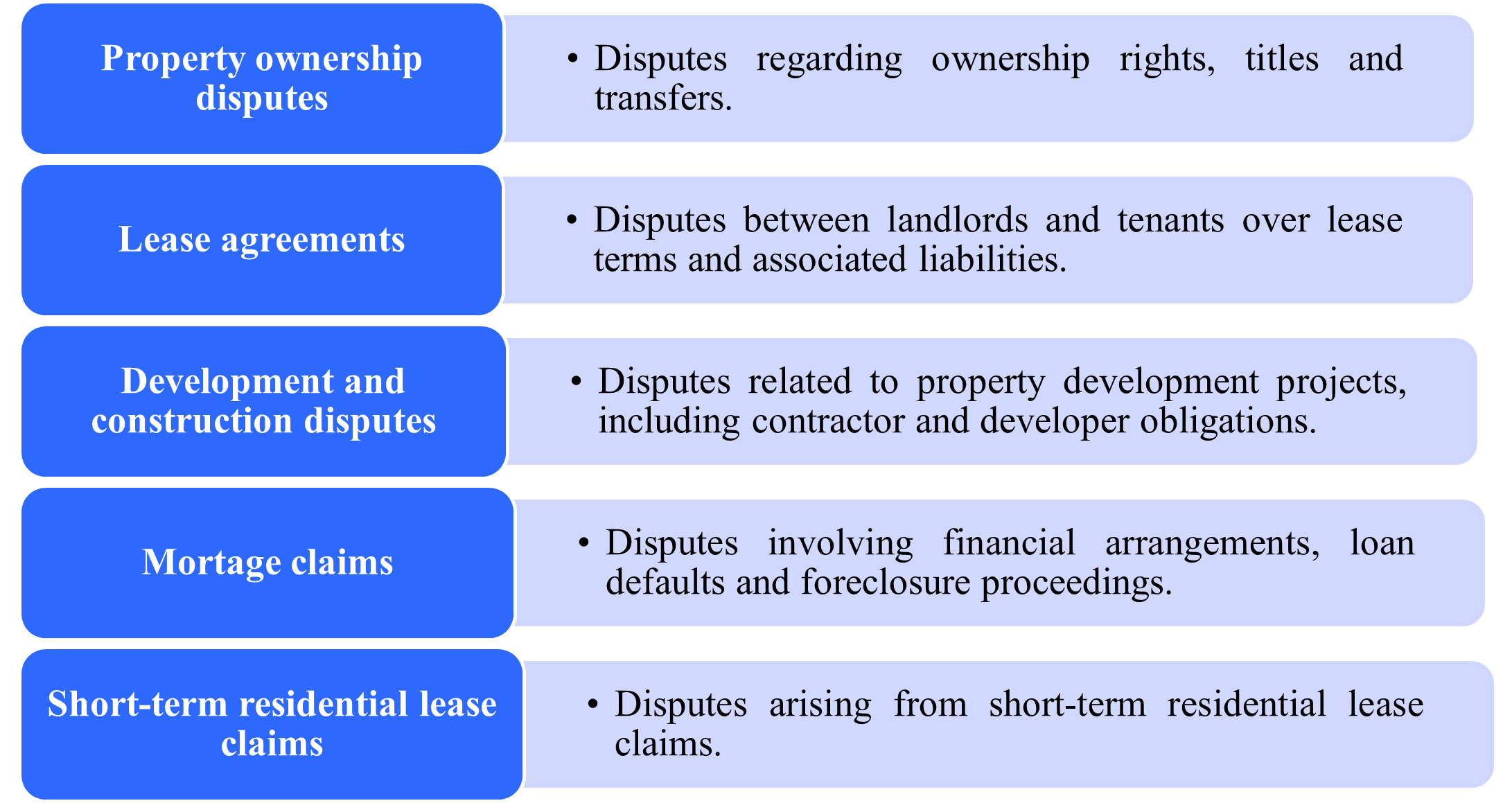 |
The ADGM Courts did not previously have a specific procedural framework for real property claims and applications. With the current changes, a new Real Property Division has been introduced within the ADGM Court of First Instance, which has exclusive jurisdiction over all ADGM real property claims. This will serve as a “one-stop-shop” for resolving real property claims, allowing users to easily identify the procedures applicable to their real property claim. The Division has an inherently fast-tracked and easy-to-understand process, with procedures tailored specifically for real property claims and remedies.
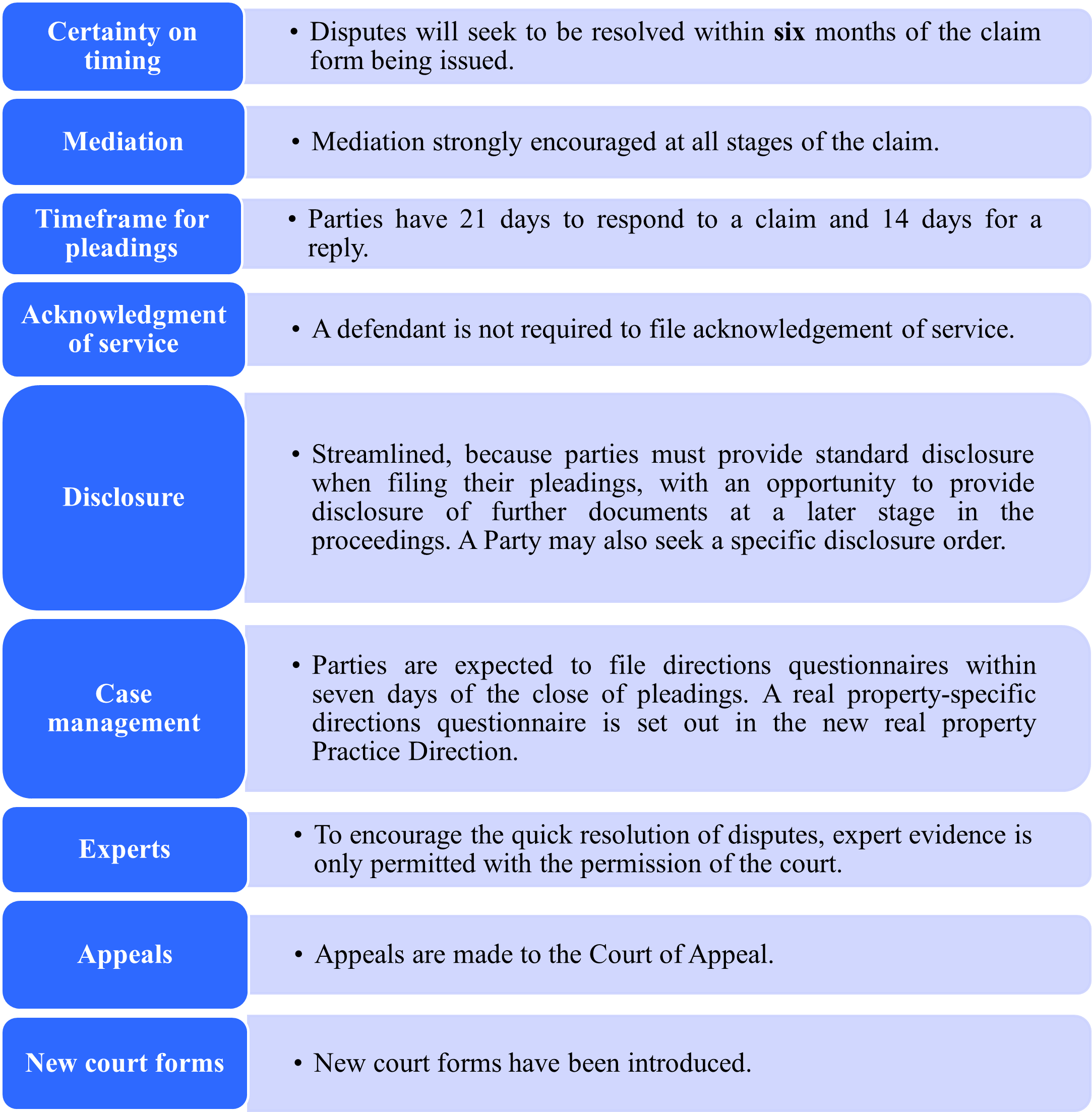
Some of the key features of the Real Property Division are:
 |
Short-Term Residential Lease Claims
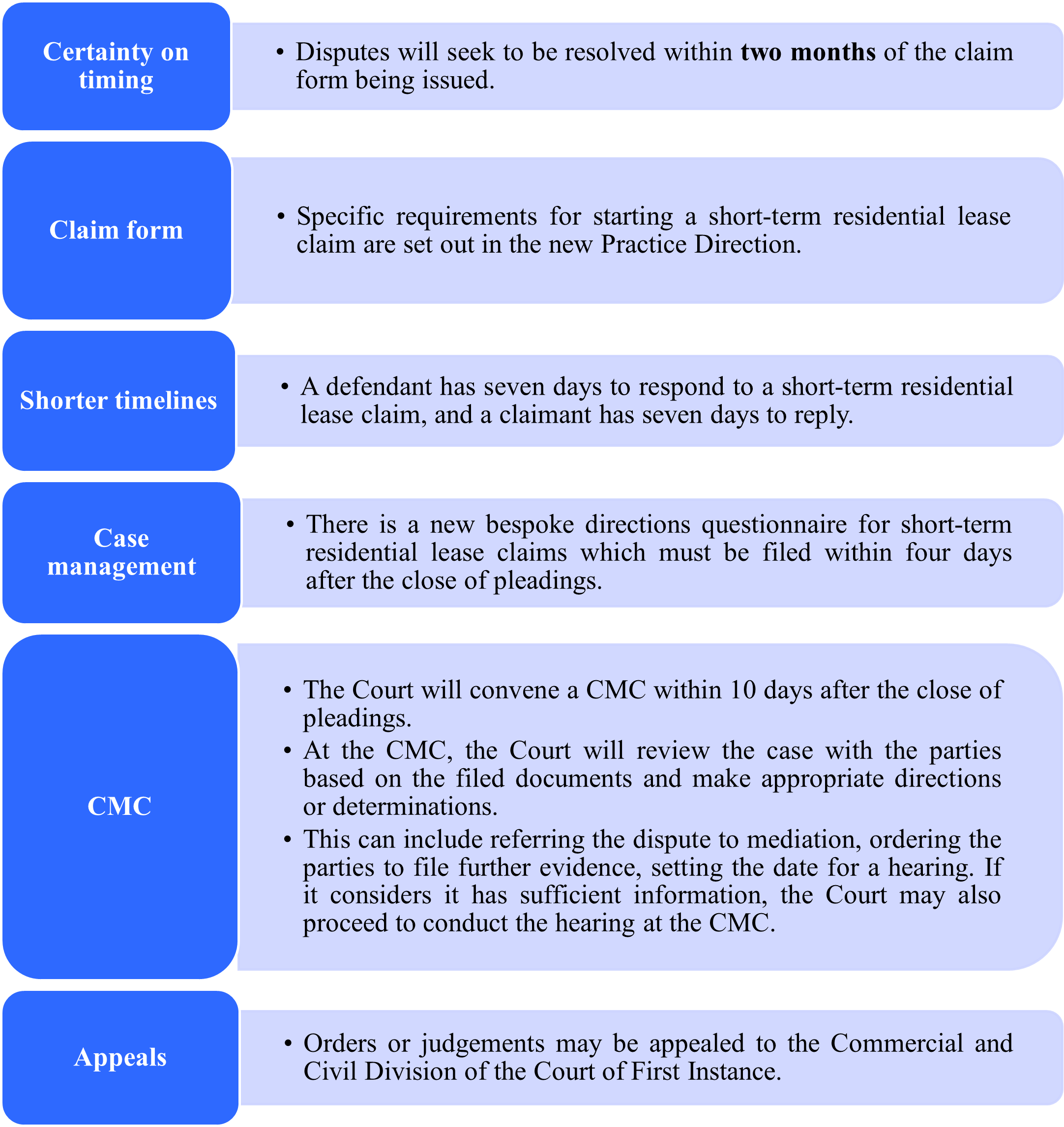
The ADGM Courts have also introduced a bespoke, user-friendly process for “short-term residential lease claims”, i.e., claims arising from leases of residential property with a term of less than four years. These changes recognise the need to cater for higher volumes of relatively low-value disputes, as well as litigants-in-person. The framework is significantly streamlined, in that claims are intended to be disposed of within two months from start to finish. The framework also allows litigants to represent themselves with ease.
The key features are as follows:
 |
“Fast Track” Procedure for Commercial and Civil Claims
New procedures have also been introduced in the Commercial and Civil Division. Key among these changes is the introduction of a “Fast Track” procedure, which will expedite the resolution of more straightforward commercial and civil claims.
The key features of the Fast Track procedure are set out in the Court Procedure Rules and the updated Practice Direction 2 and include:
- Party choice: Parties can opt in to the Fast Track when filing their claim form or the acknowledgment of service, with the other Party having the opportunity to contest the allocation.
- Flexible eligibility criteria: the amended PD 2 sets out detailed guidance on what cases might be suitable for the Fast Track, summarized below:
- A case may be suitable for the Fast Track where, in the opinion of the party proposing the Fast Track, the case will require: a hearing of two days or fewer; no expert evidence; two fact witnesses or fewer per party; limited disclosure; and limited, if any, interlocutory applications.
- A case that is suitable for the Fast Track may also have one or more of the following features (i) the case has a financial value of between US$ 100,000 and US$ 500,000, excluding interest; (ii) the case is straightforward, does not involve a substantial dispute of fact, and does not fall under the Small Claims, Employment or Real Property Divisions; (iii) and/or the case is urgent.
- A case is also likely to be suitable for the Fast Track where it is a liquidated debt claim; an arbitration claim; a claim for declaratory or other relief which is unlikely to involve a substantial dispute of fact; an application for contempt of court; an application for extension of period for delivery of a charge; or an application for a freezing injunction, search order or interim remedy.
- Certainty on timing: the Fast Track aims to resolve cases within six months of allocation, with specific timelines for filing pleadings, disclosure and witness statements.
- Case management: the Fast Track includes provisions for CMCs, progress monitoring and pre-trial reviews to ensure efficient case progression. It also introduces a directions questionnaire and proposed directions tailored to Fast Track claims.
- Document production: Parties must provide standard disclosure when filing their pleadings and parties may also seek specific disclosure. The procedure for the disclosure on the Fast Track dispenses with Redfern Schedules.
- Mediation continues to be strongly encouraged at all stages of the claim.
Comparison of the Rule 27 and Fast Track Procedures
The Fast Track will result in case management on a significantly faster timescale than the traditional Rule 27 procedure. The Fast Track also effectively replaces the streamlined Rule 30 procedure, which has been repealed as part of the reforms. Below, we compare the Fast Track Procedure against the Rule 27 procedure:
| Process | Rule 27 procedure | Fast Track procedure |
| ADR | ADR continues to be encouraged but not mandatory. | |
| Claim form issued | Claimant requests that the Court issues claim form. | Claimant opts into Fast Track in claim form. The Court confirms the allocation when issuing the claim form.
Parties must make standard disclosure when filing their pleadings. |
| AoS and ‘opt in’ to Fast Track | AoS must be filed within 14 days of service of claim form. | AoS must be filed within 7 days if the claim has been placed on the Fast Track.
Defendant may agree or object to proposed Fast Track allocation in its AoS (or propose the Fast Track if not already proposed by Claimant). If there is party disagreement on Fast Track, the Court will determine the correct allocation on the papers. |
| Defence and Counterclaim | Filed within 28 days of claim form. Extendable by agreement by up to 28 days, or further with the Court’s permission. | To be filed within 21 days of claim form (extendable only by up to 14 days).
Where the Court has reserved its decision on the allocation of the case to the Fast Track until after the defendant has answered the claim, the defendant must file and serve an answer to the claim within 28 days of being served with the claim form. |
| Reply and defence to Counterclaim | To be filed within 21 days of service of the defence. | To be filed within 14 days of service of the defence. |
| CMC | CMC convened within 14 days of close of pleadings. | CMC to be scheduled within 10 days of close of pleadings. |
| Trial timetable | Court sets trial timetable as soon as practicable after receiving the parties’ pre-trial checklist. | Fast Track claims will seek to be disposed of within 6 months from allocation of the case to the Fast Track. |
| Disclosure | Standard disclosure but with the ability to request Specific Disclosure. | Parties provide standard disclosure with their pleadings. Parties may make applications for specific disclosure. |
| Evidence | Evidence is served in accordance with timetable agreed in the CMC. Expert evidence with the permission of the Court. | Maximum 2 fact witnesses each, unless the Court directs otherwise.
No expert evidence, unless the Court directs otherwise. |
| Option to decide the claim on the papers | At the Court’s general discretion. | At the Court’s general discretion. |
| The Hearing | At the Court’s general discretion. | Fast Tracked trials should generally be no more than 2 hearing days. |
| Costs and Appeals | The usual rules on costs and appeals for cases in the Commercial and Civil Division apply. | |
.
Other Changes in the Commercial and Civil Division
The updated CPR and Practice Direction 2 also provide several other key changes for Court users. Key among these are the following:
- Removal of the Rule 30 procedure: the Rule 30 process has been removed. It is likely that any claim previously brought under the Rule 30 procedure can now be dealt with using the Fast Track process.
- Removal of page limits: while claim forms in the Commercial and Civil Division were previously limited to 50 pages, this requirement has been removed. This does not reflect an intention that claim forms be longer than 50 pages; however the Court will not prescribe strict limits.
- Extensions of time: the amendments provide greater certainty for parties when applying for an extension of time.
Commentary
The changes to the CPR and Practice Directions reflect the ADGM’s commitment to not only meet but surpass international best practices. They provide a robust and efficient legal framework for the resolution of disputes, particularly in the realm of real property and commercial claims, for the benefit of all Court users. The establishment of the Real Property Division under the new ADGM Court Rules is a significant step toward supporting Abu Dhabi’s growing real estate market and addressing end-user requirements, with the Fast Track offering a route for the quick resolution of claims, providing parties with certainty and a way to resolve disputes efficiently.
The Court has published Guidance Notes for the: (i) Fast Track; (ii) Real Property Division (other than Short-Term Residential Lease Claims); and (iii) Short-Term Residential Lease Claims. These Guidance Notes are on the Court’s website and can be accessed here.
[1] See primarily (i) Real Property Regulations 2024; (ii) Off-Plan Development Regulations 2024; (iii) Off-Plan and Real Property Professionals Regulations 2024; (iv) Off-Plan Development Regulations (Project Account) Rules 2024. Other disputes, claims and applications concerning real property (including commercial leases) are set out in the ADGM Courts, Civil Evidence, Judgments, Enforcement and Judicial Appointments Regulations 2015 as well as the Taking Control of Goods and Commercial Rent Arrears Recovery Rules 2015.
Gibson Dunn’s lawyers are available to assist in addressing any questions you may have. Please contact the Gibson Dunn lawyer with whom you usually work, the authors, or any of the following practice leaders and members of Gibson Dunn’s global Litigation, Transnational Litigation, or International Arbitration practice groups:
Nooree Moola – Dubai (+971 4 318 4643, nmoola@gibsondunn.com)
Lord Falconer – London (+44 20 7071 4270, cfalconer@gibsondunn.com)
Robert Spano – London/Paris (+33 1 56 43 13 00, rspano@gibsondunn.com)
© 2025 Gibson, Dunn & Crutcher LLP. All rights reserved. For contact and other information, please visit us at www.gibsondunn.com.
Attorney Advertising: These materials were prepared for general informational purposes only based on information available at the time of publication and are not intended as, do not constitute, and should not be relied upon as, legal advice or a legal opinion on any specific facts or circumstances. Gibson Dunn (and its affiliates, attorneys, and employees) shall not have any liability in connection with any use of these materials. The sharing of these materials does not establish an attorney-client relationship with the recipient and should not be relied upon as an alternative for advice from qualified counsel. Please note that facts and circumstances may vary, and prior results do not guarantee a similar outcome.
This update provides a summary of the key features of the regime as currently set out in the Draft Regulations.
The Dubai International Financial Centre Authority (DIFCA) has published a draft of the Variable Capital Company Regulations (the Draft Regulations) for public consultation, proposing a novel corporate structure aimed at enhancing the DIFC’s attractiveness as a jurisdiction for structuring investment platforms, including for family offices, asset holding, and private investment purposes.
The new regime introduces the Variable Capital Company (VCC), which offers a flexible framework for segregating assets and liabilities through the creation of “Cells” within a single legal entity.
The consultation process remains ongoing, and the final form of the regulations may change depending on feedback received. This update provides a summary of the key features of the regime as currently set out in the Draft Regulations.
Background and Context
The DIFC currently offers a limited cell regime under its existing Protected Cell Company framework, which is available only to certain types of investment companies. However, this framework does not include features such as segregated cells (described below). The proposed VCC regime introduces a more versatile and commercially attractive vehicle, offering structuring options that go beyond what is currently available under the DIFC’s existing framework.
Similar vehicles are available in only a few other jurisdictions, such as Singapore and Mauritius, which have implemented their own VCC regimes in recent years. By introducing a comparable structure, the DIFC aims to enhance its competitiveness and appeal to global investors, family offices, and asset managers seeking flexible and cost-effective structuring options.
Overview of the VCC Structure
A VCC is a private company that may be established in the DIFC either with one or more Segregated Cells or Incorporated Cells (each, a Cell) but not both, which may hold assets and liabilities separately from those of the VCC and other Cells. A VCC may have any number of Segregated Cells or Incorporated Cells, or none, in each case as provided for in its Articles of Association. This allows for ring-fencing of liabilities and targeted investment structuring.
Notably:
- A Segregated Cell does not have separate legal personality but is treated as segregated for asset and liability purposes.
- An Incorporated Cell is itself a private company with separate legal personality but cannot own shares in other Cells or the VCC.
The VCC structure is modelled to appeal to family offices, private funds, and other investment vehicles seeking to consolidate multiple investments within a single corporate structure, while maintaining legal separation between them.
Qualifying Criteria
Applicants must satisfy one of the following conditions:
- The VCC will be controlled by GCC Persons, Registered Persons or Authorised Firms; or
- It is established, or continued in the DIFC for purposes of holding legal title to, or controlling, one or more GCC Registrable Assets;
- It is established for a Qualifying Purpose, defined to include Aviation Structures (persons having the sole purpose of facilitating the owning, financing, securing, leasing or operating an interest in aircrafts), Crowdfunding Structures (persons established for the purpose of holding the asset(s) invested through a crowdfunding platform), Intellectual Property Structures (persons established for the sole purpose of holding intellectual property for commercial purposes), Maritime Structures (persons having the sole purpose of facilitating the owning, financing, securing, chartering, managing or operating of an interest in maritime vessels or maritime units), Structured Financing (persons having the sole purpose of holding assets to leverage and/or manage risk in financial transactions), or Secondaries Structures (vehicles facilitating the transfer of investment assets to secondary investors); or
- It is established or continued in the DIFC has a Director that is an Employee of a Corporate Service Provider and that Corporate Service Provider has an arrangement with the DIFC Registrar pursuant to the relevant provisions in the Draft Regulations.
Key Features
1. Regulatory Oversight
- VCCs are subject to the DIFC Companies Law and other Relevant Laws, unless otherwise provided.
- The DFSA must authorise any VCC providing financial services.
- The license of the VCC established for a Qualifying Purpose shall be restricted to the activities specific to the Qualifying Purpose stated in its application to incorporate or continue in the VCC in the DIFC, or any other permitted purpose shall be restricted to the activity of Holding Company. A VCC shall not be permitted to employ any employees.
2. Share Capital and Distributions
- VCCs may issue and redeem shares based on the net asset of the company or individual Cells.
- Cellular distributions must relate solely to the assets and liabilities of the relevant Cell, and must not impact other Cells or the VCC’s general assets.
3. Asset Segregation and Liability Protection
- Officers may incur personal liability if they breach their duties regarding segregation and disclosure of cell identity in transactions.
- The regulations include detailed provisions governing the consequences of unlawful inter-Cell transfers and creditor protections.
- Each transaction with third parties must clearly specify the relevant Cell and limit recourse accordingly.
4. Conversions, Mergers, and Transfers
The framework allows for:
- Conversion of existing DIFC companies into VCCs and vice-versa;
- Transfer of incorporated cells between VCCs, subject to Registrar approval and creditor protection mechanisms;
- Merger or consolidation of Segregated Cells, with prior written notice and creditor opt-out rights.
5. Licensing and Naming
- VCCs must end their names with “VCC Limited” or “VCC Ltd.”
- Segregated Cells and Incorporated Cells must have unique identifiers (e.g., “VCC SC” or “VCC IC”).
- Licences are limited to the specific activities of the Qualifying Purpose, though VCCs controlled by Qualifying Applicants may be licensed for broader purposes.
6. Shareholder Transparency and AML Compliance
- VCCs must maintain separate registers of shareholders for each Cell.
- Ultimate beneficial ownership disclosure obligations apply in line with DIFC UBO Regulations.
7. Fees and Incorporation Process
The proposed incorporation and licensing fees are aligned with the DIFC’s broader cost-efficient regime:
- USD 100 for incorporation;
- USD 1,000 for an annual licence;
- USD 300 for lodging a Confirmation Statement.
Key Topics
Some of the key topics included in the consultation paper include questions around:
- the scope and breadth of the proposed qualifying-requirements test, including whether proprietary investment access is too wide or too narrow;
- appropriateness of allowing both Segregated Cells and Incorporated Cells within a single regime, and the implications of prohibiting a VCC from having both types concurrently; and
- adequacy of creditor-protection measures, notice, publication and court-application rights on conversion of a VCC into a standard DIFC company and vice versa.
Practical Implications
The proposed introduction of the VCC regime provides a robust framework for private clients and investment entities to achieve structural and operational flexibility within a regulated DIFC environment. Key advantages include:
- Legal segregation of assets/liabilities for risk mitigation.
- Simplified investment platform management.
- Suitability for private wealth structuring, crowdfunding, and secondary market transactions.
Gibson Dunn’s lawyers are available to assist in addressing any questions you may have regarding these issues. For additional information about how we may assist you, please contact the Gibson Dunn lawyer with whom you usually work, any leader or member of the firm’s Mergers & Acquisitions or Private Equity practice groups, or the authors:
Andrew Steele – Abu Dhabi (+971 2 234 2621, asteele@gibsondunn.com)
Omar Morsy – Dubai (+971 4 318 4608, omorsy@gibsondunn.com)
© 2025 Gibson, Dunn & Crutcher LLP. All rights reserved. For contact and other information, please visit us at www.gibsondunn.com.
Attorney Advertising: These materials were prepared for general informational purposes only based on information available at the time of publication and are not intended as, do not constitute, and should not be relied upon as, legal advice or a legal opinion on any specific facts or circumstances. Gibson Dunn (and its affiliates, attorneys, and employees) shall not have any liability in connection with any use of these materials. The sharing of these materials does not establish an attorney-client relationship with the recipient and should not be relied upon as an alternative for advice from qualified counsel. Please note that facts and circumstances may vary, and prior results do not guarantee a similar outcome.
The Civil Transactions Law codifies the rules governing liquidated damages clauses under Saudi law. This client alert outlines key considerations for contracting parties when adopting such clauses, and how courts may approach them in practice.
How Liquidated Damages Clauses are Recognized in Saudi Arabia
The Saudi legal framework recognizes liquidated damages as pre-agreed estimates of losses incurred by one party due to the other party’s breach of contract, including non-performance or delay in fulfilling contractual obligations.
Historical Context
Even prior to the Civil Transactions Law, Saudi courts recognized liquidated damages clauses based on Sharia principles. Such clauses have been upheld as valid and enforceable, except in cases where:
- the breaching party had a legitimate excuse for non-performance or delay; or
- the agreed amount was deemed excessively high, amounting to financial coercion, in which cases courts have assessed excessiveness based on prevailing customs and practices.[1]
How Liquidated Damages Operate Today
- Validity:Parties can agree on liquidated damages, either in the original contract or a later agreement.[2]
- Simplified Burden of Proof:Liquidated damages clauses render the occurrence of damages presumed. To enforce such a clause, the aggrieved party is not required to prove damage or causation – merely that a breach has occurred.[3]
- Avoiding Liquidated Damages:A party may avoid liability under a liquidated damages clause by proving either:
- that the other party did not suffer any damage;[4] or
- that the damage was not caused by the party’s breach, but rather by the other party’s acts, omissions, or a force majeure event.
- Reducing Liquidated Damages:The breaching party may be successful in reducing the sum of liquidated damages by proving either:
- that the pre-agreed amount is grossly exaggerated, thereby allowing the court to rule in accordance with the general principles of liability under Saudi law;[5] or
- that the breaching party has partially performed their obligations, thereby allowing the court to assess the extent of unperformed obligations and apply the liquidated damages clause accordingly.[6]
- Court Discretion:Courts cannot freely adjust liquidated damages clauses. Their discretion is limited to:
- reducing the amount in cases of gross exaggeration or partial performance. A mere discrepancy between the damages incurred and the agreed sum is insufficient to warrant reduction[7]; or
- increasing the sum if the non-breaching party proves that deceit or gross negligence by the debtor caused the damage to exceed the agreed sum.[8]
- Prohibition on Payment Obligations:In line with Saudi Arabia’s strict prohibition of interest payments[9], it is impermissible as a matter of public policy for liquidated damages to apply to payment obligations.[10]
- How Saudi Arabia Compares to Neighboring Jurisdictions:Saudi Arabia’s approach towards liquidated damages clauses shares similarities with the approaches of UAE and Egypt, but there are some differences. For example:
| Element | Saudi Arabi | UAE | Egypt |
| Default position on prior notice of imposition | No prior notice required.[11] | Prior notice required.[12] | Prior notice required.[13] |
| Court discretion to adjust liquidated damages | Relatively limited.[14] | Relatively broad.[15] | Relatively limited.[16] |
Points to Consider When Drafting a Liquidated Damages Clause
- Be specific. Clearly define what triggers the liquidated damages (delays, quality issues, etc.).
- Consider industry benchmarks. Base estimates on market standards or historical data to avoid claims of exaggeration.
- Expressly address partial performance. Specify how damages will be calculated if some of the triggering obligations are met.
- Follow notice requirements. While Saudi law does not by default require notice to enforce liquidated damages, your specific contract might.
- Understand burden of proof requirements. Know who bears the burden of proof in different scenarios to claim or defend tactically.
- Consider all available remedies and seek them tactically. Parties may be precluded from enforcing liquidated damages clauses in conjunction with other contractual remedies.
[1] Resolution No. 25 dated 31/08/1394H by the Council of Senior Scholars: “The Council unanimously decides that the penalty clause stipulated in contracts is valid and legally binding, and must be upheld unless there is a legitimate excuse for the breach of the obligation that justifies it under Sharia. In such a case, the excuse nullifies the obligation until it ceases. If the penalty clause is, by customary standards, excessive to the extent that it serves as a financial threat and deviates significantly from the principles of Sharia, then fairness and equity must prevail, based on the actual loss of benefit or incurred harm.” Cases in which Saudi courts upheld the Council of Senior Scholar’s Resolution No. 25 include the General Court’s Decision No. 1 of 1439H: “The liquidated damages clause included in contracts is a valid and enforceable condition which must be upheld, unless there is a legitimate excuse for breaching the obligation that is recognized under Shari’a, in which case the excuse suspends the obligation until it ceases. If the amount of liquidated damages is excessive by customary standards, to the point that it constitutes financial coercion and departs from the principles of Shari’a, then recourse must be had to justice and fairness, based on the actual harm incurred or the benefit lost. The determination of such matters in case of dispute is to be made by the competent court with the assistance of experts and professionals.”
[2] Civil Transactions Law, Article 178: “The contracting parties may specify in advance the amount of compensation whether in the contract or in a subsequent agreement, unless the subject of the obligation is a cash amount. The right to compensation shall not require notification.”
[3] For example: Board of Grievance’s decision in Case No. 20 of 1430H (predating the enactment of the Civil Transactions Law): “…and the administrative authority is not required to prove that it has suffered harm, given that [the liquidated damages] constitute an agreed-upon compensation for presumed harm, including harm resulting merely from delay.” Commercial Court in Riyadh’s decision in Case No. 4530906759 of 1445H: “The Law expressly provides that liquidated damages are not due to the creditor if the debtor proves that the creditor has suffered no harm. This is specifically stated in paragraph (1) of Article (179) of the same Law mentioned above,” presuming that liquidated damages are initially owed to the creditor upon breach, and it is the debtor’s burden to rebut this presumption by proving the absence of harm. This position is consistent with the literature of leading scholars in the region. For example, A. Sanhouri, ‘Al Waseet on the Explanation of the Civil Code’, Part Two, p. 817, concerning a similarly formulated legal provision in Egypt’s Civil Code: “[…] the presence of a Liquidated Damages Clause renders the occurrence of damage presumed, and the creditor would not be required to prove it. Therefore, if the debtor alleges that the creditor has not incurred damage, it is he who would bear the burden of proof, and not the creditor.”
[4] Civil Transactions Law, Article 179: “Compensation that is contractually agreed upon by the parties shall not be payable if the debtor proves that the creditor has sustained no harm.”
[5] Civil Transactions Law, Article 179(2): “The court may, upon a petition by the debtor, reduce the compensation if the debtor establishes that the agreed-upon compensation was excessive or that the original obligation was partially performed.” A. Almarjah, ‘Explanation of the Saudi Civil Transactions law,’ 1445H, Part One, p. 297: “Judicial intervention is limited to removing exaggeration in the liquidated damages clause, not to assessing its proportionality to the actual harm. Accordingly, if the agreed liquidated damages exceed the actual harm, but the excess is not deemed gross, the judge may not reduce the amount.”
[6] Civil Transactions Law, Article 179(2): “The court may, upon a petition by the debtor, reduce the compensation if the debtor establishes that the agreed-upon compensation was excessive or that the original obligation was partially performed.”
[7] A. Sultan, ‘A Brief on the General Theory of Obligation’, 1983, Section 2, p. 78, concerning a similarly formulated legal provision in Egypt’s Civil Code: “…if there is excess in the quantification, but it is not exaggerated, it is impermissible to reduce it, as the fundamental principle is that the Judge orders in accordance with what has been agreed-upon by the parties, and absent one of the conditions of the exception, it is obligatory to resort to the fundamental principle.” A similar opinion has been given by a Saudi scholar; A. Almarjah, ‘Explanation of the Saudi Civil Transactions law,’ 1445H, Part One, p. 297: “Judicial intervention is limited to removing exaggeration in the liquidated damages clause, not to assessing its proportionality to the actual harm. Accordingly, if the agreed liquidated damages exceed the actual harm, but the excess is not deemed gross, the judge may not reduce the amount.”
[8] Civil Transactions Law, Article 179(3): “The court may, upon a petition by the creditor, increase the amount of compensation to the extent necessary to cover the harm if the creditor establishes that an act of fraud or gross negligence by the debtor is what caused the harm to exceed the agreed-upon compensation.”
[9] Commercial Court in Jeddah, Case No. 4531041638 of 1445H: “…it is impermissible to agree on compensation where the subject of the obligation is a monetary amount. Given that this Article pertains to public order (public policy), the parties may not contract out of or override its provisions…”
[10] See, Resolution No. (109) (12/3) of the International Islamic Fiqh Academy: “It is permissible to stipulate a penalty clause in all financial contracts, except in contracts where the primary obligation is a debt, as this would constitute explicit riba (usury),” upheld by the Commercial Court in Jeddah in Case No. 433665897 of 1443H.
[11] Civil Transactions Law, Article 178: “The contracting parties may specify in advance the amount of compensation […] The right to compensation shall not require notification.”
[12] UAE’s Civil Transactions Law, Article 387: “Compensation is not due without the debtor being notified, unless otherwise provided by law or agreed upon in the contract.”
[13] Egypt’s Civil Code, Article 218: “Unless otherwise specified, compensation is not due without the debtor being notified.”
[14] Civil Transactions Law, Article 179(2): “The court may, upon a petition by the debtor, reduce the compensation if the debtor establishes that the agreed-upon compensation was excessive or that the original obligation was partially performed.” Id, Article 179(3): “The court may, upon a petition by the creditor, increase the amount of compensation to the extent necessary to cover the harm if the creditor establishes that an act of fraud or gross negligence by the debtor is what caused the harm to exceed the agreed-upon compensation.”
[15] There are some inconsistent court decisions noted across and within each of the jurisdictions. UAE’s Civil Transactions Law, Article 390(2): “The judge may, in all cases, at the request of one of the parties, amend such an agreement, in order to make the amount assessed equal to the damage. Any agreement to the contrary is void.”
[16] Egypt’s Civil Code, Article 224: “(1) Damages fixed by agreement are not due, if the debtor establishes that the creditor has not suffered any loss. (2) The judge may reduce the amount of these damages, if the debtor establishes that the amount fixed was grossly exaggerated or that the principal obligation has been partially performed. (3) Any agreement contrary to the provisions of the two preceding paragraphs is void.”
Gibson Dunn’s lawyers are available to assist in addressing any questions you may have regarding these issues. Please contact the Gibson Dunn lawyer with whom you usually work, any member of the firm’s International Arbitration, Judgment and Arbitral Award Enforcement, or practice groups, or the following authors in Riyadh:
Mahmoud Abdel-Baky (+966 55 056 6323, mabdel-baky@gibsondunn.com)
Rashed Z. Khalifah (+966 55 236 0511, rkhalifah@gibsondunn.com)
*Hamzeh Zu’bi is a trainee associate in Riyadh and not admitted to practice law.
© 2025 Gibson, Dunn & Crutcher LLP. All rights reserved. For contact and other information, please visit us at www.gibsondunn.com.
Attorney Advertising: These materials were prepared for general informational purposes only based on information available at the time of publication and are not intended as, do not constitute, and should not be relied upon as, legal advice or a legal opinion on any specific facts or circumstances. Gibson Dunn (and its affiliates, attorneys, and employees) shall not have any liability in connection with any use of these materials. The sharing of these materials does not establish an attorney-client relationship with the recipient and should not be relied upon as an alternative for advice from qualified counsel. Please note that facts and circumstances may vary, and prior results do not guarantee a similar outcome.
In a transformative step to enhance and better protect its business environment, Saudi Arabia has enacted a new Trade Name Law, which was published in the Official Gazette (Um AlQura) on October 4, 2024, and has come into effect on April 3, 2025.
Introduction
The law came into effect on April 3, 2025, replacing the previous legislation that had been in force since November 23, 1999. The implementing regulations were published on March 30, 2025, and took effect concurrently with the new law.
This law reform marks yet another significant step in the modernization of Saudi’s legal framework, streamlining processes and fostering a transparent, efficient business landscape. Below, we outline the key features of the new law and its practical implications in Saudi Arabia.
Key Features of the New Trade Name Law
1. Simplified Trade Name Selection
The updated Trade Name Law offers businesses greater flexibility in reserving and registering trade names. Trade names can be reserved for an initial period of 60 days, with the possibility of extending for an additional 60 days. Further extensions may be granted but are subject to specific registration circumstances. Given the exclusivity associated with registered/reserved trade names, there is a greater practical need to register desired trade names ahead of time. If the reservation period expires and the procedures for the issuance of a commercial register certificate are not complete, the reservation will lapse, and the trade name will become available for reservation by any person. All reservations and extensions will be subject to payment of fees.
2. Linguistic Flexibility
The old trade names regime was renowned for its strict restrictions on the use of foreign trade names with only a few exceptions being permitted for certain foreign companies or as determined on a case-by-case basis by the Minister of Commerce. The new Trade Name Law ushers in a new era as trade names can now be registered in Arabic, transliterated Arabic (i.e., Arabic words or text that have been written using the Latin (Roman) alphabet instead of the Arabic script), English, or combinations of letters and numbers (with a maximum of 9 digits).
It is recommended that all businesses ensure linguistic consistency in branding to maximize recognition. Foreign investors will need to ensure that the foreign trade name is writable in English and is capable of being translated into Arabic.
3. Independent Trade Name Ownership
Trade names are capable of being owned, sold, or assigned to other persons, which enhances their commercial value. Given that trade names are exclusive and cannot be replicated, registering and owning a trade name provides businesses with a potentially valuable asset.
What Else Has Changed? A Deeper Look at the New Trade Name Law
Trade Name Registration Process
Article 5 of the new law provides a clearer process regarding the trade name application process, including clearer decision-making timelines of up to 10 days from the date of submission of the application, compared to the old timeline which took up to 30 days (see Article 7 of the old regulation). The decision timeline is extendable in certain cases to 30 days when external approval of a trade name is required.
The Ministry of Commerce has integrated the trade name reservation service into the Saudi Business Center portal, which now manages all trade name applications. After a trade name application is accepted, publication is now mandatory, with applicants bearing associated costs.
Priority is given to the first applicant i.e. first in time to submit an application, if multiple applications for the same name exist. If the registrar rejects an application, applicants will have 60 days to appeal to the Ministry.
Trade Name Protection Against Unauthorized Use
The new law, under its Article 6, strengthens protection against unauthorized use such that no person is entitled to use a trade name registered that belongs to someone else. A fine of SAR 10,000 is now imposed as per Article 15 of the implementing regulations to strengthen adherence to the law and limit unauthorized use of registered or reserved trade names. Businesses with registered names in the Commercial Register have the right to seek compensation for damages caused by unauthorized use. This means that the commercial register serves as proof of ownership, and any person who makes any unauthorized use of a registered trade name will have committed a violation and may be liable to pay compensation to the registered owner of the trade name.
Prohibited Trade Names
Article 7 of the new law outlines the following prohibitions:
- Trade names must not violate public order or morality.
- Names that are misleading, deceptive, or resemble an already registered trade name (regardless of activity type) are not allowed.
- Names similar to famous trademarks are restricted unless owned by the applicant.
- Names containing political, military, or religious references are prohibited.
- Trade names must not resemble symbols of local, regional, or international organizations.
The Ministry of Commerce will also maintain and update a public list of prohibited names regularly, for transparency. Some of the prohibitions introduced by the Trade Names Law are quite broad in nature (particularly the prohibitions relating to “public order or morality” and “famous trademarks”).
It remains unclear how broadly these prohibitions will be interpreted and applied by the Registrar, and the practical challenges such prohibitions may create for applicants wishing to register their trade names. It also remains to be seen whether other restrictions will be unilaterally imposed by the Ministry by way of practice or by way of circumstance and how far the Ministry may go in enforcing these restrictions. To date, the Ministry has already started to reject applications containing the word “company” or that otherwise include a description of an ordinary business activity such as “regional headquarter”.
Monetary Fees for Name Reservations
Article 14 of the implementing regulation introduces the following new fee structure for trade name reservations:
- SAR 200 for an Arabic trade name.
- SAR 500 for an English trade name.
- SAR 100 to extend reservation duration.
- SAR 100 to dispose of the trade name.
New Guidelines for Trade Names Similarity Criteria
Article 5 of the implementing regulation stipulates a formal set of criteria and guidelines that will be used to determine whether a trade name is deemed too similar to an existing one, reducing ambiguity. Under these guidelines, a trade name will be considered like another if its written form closely resembles that of a registered, famous, or reserved trade name. This includes:
- Identical spelling with different word arrangements.
- Identical spelling with a one-letter difference.
- Identical spelling with minor changes, such as adding, removing, or altering pronouns, definite articles, pluralization, or diminutives.
- Identical pronunciation despite differences in spelling or numbers replacing letters, and vice versa.
Criteria mentioned above shall apply to English trade names and their corresponding wording with the use of Arabic letters.
Use of ‘Saudi’ or names of Saudi Cities and Regions in Trade Names
As per Article 4 of the implementing regulation, businesses can now reserve names containing ‘Saudi’ or the name of a Saudi city or region, subject to the following conditions:
- The name must not be identical or similar to any governmental entity.
- The main component or essential element of the name must not be ‘Saudi’ or a Saudi city or region.
- The name must not be used in a manner that would cause harm to the reputation of the Kingdom of Saudi Arabia.
- For both Makkah and Madinah regions, approval from the Royal Commission for Makkah and the Holy Sites or the Madinah Development Authority is required.
Practical Considerations for Businesses
Saudi Arabia’s new Trade Name Law enhances transparency, secures commercial identities, and increases business interests in Saudi. In line with this, businesses should consider the following:
- Ensure Distinctiveness: With stricter rules on name similarity and given the relative ease of reserving/registering a trade name, applicants should conduct comprehensive trade name searches and check the Ministry’s prohibited names list before applying to avoid getting rejected.
- Understand New Protections: Trade names are now valuable commercial assets—businesses should actively monitor for unauthorized use and take prompt legal action if necessary.
- Consider Linguistic Strategy: With increased linguistic flexibility, businesses can choose names that enhance global branding while remaining compliant with local regulations.
For Tailored Legal Guidance
For expert legal advice on trade name registration and compliance, contact our team below.
Gibson Dunn’s lawyers are available to assist with any questions you may have regarding these developments. To learn more, please contact the Gibson Dunn lawyer with whom you usually work, or the authors in Riyadh:
Mohamed A. Hasan (+966 55 867 5974, malhasan@gibsondunn.com)
Hadeel Tayeb (+966 53 944 3329, htayeb@gibsondunn.com)
© 2025 Gibson, Dunn & Crutcher LLP. All rights reserved. For contact and other information, please visit us at www.gibsondunn.com.
Attorney Advertising: These materials were prepared for general informational purposes only based on information available at the time of publication and are not intended as, do not constitute, and should not be relied upon as, legal advice or a legal opinion on any specific facts or circumstances. Gibson Dunn (and its affiliates, attorneys, and employees) shall not have any liability in connection with any use of these materials. The sharing of these materials does not establish an attorney-client relationship with the recipient and should not be relied upon as an alternative for advice from qualified counsel. Please note that facts and circumstances may vary, and prior results do not guarantee a similar outcome.
The new Rules come into effect from 3 April 2025.
Background:
On 21 February 2025, the Minister of Commerce officially decreed and published into law the Ultimate Beneficial Ownership Rules (UBO Rules). In line with steps taken by other financial centers and leading jurisdictions around the world, the UBO Rules require all companies in KSA, other than companies publicly listed in KSA, to disclose and maintain accurate information about their ultimate beneficial owners. The UBO Rules come into effect from 3 April 2025.
How does the UBO Rules define an Ultimate Beneficial Owner?
- The UBO Rules define an “ultimate beneficial owner” as any natural person who meets the following criteria:
- owns at least 25% of the company’s share capital whether directly or indirectly;
- controls at least 25% o the voting shares in the company, whether directly or indirectly;
- is entitled to appoint or remove a majority of the company’s board of directors, its manager or president, whether directly or indirectly;
- ability to influence decision-making or the business of the company whether directly or indirectly; or
- is a representative of any legal person to which any of above criteria applies.
- The UBO Rules clarify that if an ultimate beneficial owner cannot be identified by applying the foregoing criteria, then the company’s manager or members of its board of directors or its president will be regarded as its ultimate beneficial owner.
Key obligations under the UBO Rules:
Some of the key obligations under the UBO Rules include the following:
- Incorporation: The Ministry of Commerce will now require applicants to disclose information on their ultimate beneficial owners as part of the application process for incorporation of companies in KSA.
- Annual Filings: In relation to those companies already established at the time the UBO Rules come into effect, such companies will be required to make annual filings disclosing their ultimate beneficial owners. Such filings are due on the anniversary of the date on which companies were registered with the Ministry’s commercial register.
- Maintenance & Updates: All existing companies will be required to maintain an ultimate beneficial owner register and notify the Ministry of any changes in the identity of an ultimate beneficial owner.
- Required Information: It remains unclear what information will be requested by the Ministry to validate the identity of an ultimate beneficial owner in a relevant KSA company. Unsurprisingly, the UBO Rules grant the Ministry with broad authority to require disclosure. The UBO Rules state that the Ministry will publish guidelines with respect to its procedures and requirements for the identification of ultimate beneficial owners.
Exemption from UBO Rules:
The following entities are exempted from the application of the UBO Rules:
- Companies wholly owned by the state or any state-owned authorities whether directly or indirectly; and
- Companies undergoing insolvency proceedings in accordance with the Bankruptcy Law.
Additionally, the Minister of Commerce may issue exemptions on a case-by-case basis. All companies exempted from the UBO Rules are nevertheless required to prove to the Ministry that they enjoy such an exempted status.
Penalties for Non-Compliance:
A person that is required to comply with the UBO Rules but fails to do so, including its obligations to disclose/update information to the Ministry with respect to ultimate beneficial ownership, may face a fine of SAR 500,000.
Investors with complex shareholding structures in KSA should be wary of these UBO Rules as indirect changes in their shareholding structures could trigger disclosure obligations with the Ministry in KSA. All investors in KSA must start thinking about introducing appropriate internal protocols to ensure full compliance with the UBO Rules.
Gibson Dunn’s lawyers are available to assist with any questions you may have regarding these developments. To learn more, please contact the Gibson Dunn lawyer with whom you usually work, or the authors in Riyadh:
Mohamed A. Hasan (+966 55 867 5974, malhasan@gibsondunn.com)
Lojain AlMouallimi (+966 11 827 4046, lalmouallimi@gibsondunn.com)
© 2025 Gibson, Dunn & Crutcher LLP. All rights reserved. For contact and other information, please visit us at www.gibsondunn.com.
Attorney Advertising: These materials were prepared for general informational purposes only based on information available at the time of publication and are not intended as, do not constitute, and should not be relied upon as, legal advice or a legal opinion on any specific facts or circumstances. Gibson Dunn (and its affiliates, attorneys, and employees) shall not have any liability in connection with any use of these materials. The sharing of these materials does not establish an attorney-client relationship with the recipient and should not be relied upon as an alternative for advice from qualified counsel. Please note that facts and circumstances may vary, and prior results do not guarantee a similar outcome.
This update explores how the concept of loss of profit in contractual liability has evolved in light of the enactment the Saudi Civil Transactions Law.
Recent developments, including the enactment of the Civil Transactions Law,[1] have clarified certain aspects of recoverable damages in contractual liability, particularly regarding the permissibility of loss of profit claims under Saudi law. This article explores how the concept of loss of profit in contractual liability has evolved in light of the enactment of the Civil Transactions Law.
A. Historical Stance on Loss of Profit Claims
Previously, Saudi courts generally excluded the recovery of loss of profits in breach of contract claims. This was based on the prevailing Islamic Shari’a principle that compensation must be certain, rather than speculative. Courts viewed claims for lost profits as speculative, and thus were routinely rejected.[2] However, there have been some court decisions that granted loss of profit claims, although these were exceptional and not part of a consistent judicial trend.[3]
While these outlier court decisions did not clearly articulate a consistent standard for when loss of profits can be compensated, they referred to Islamic Shari’a principles that suggest loss of profits may be compensated where the loss is ‘certain.’ Article 5 of Resolution No. 109/3/12 of the International Islamic Fiqh Academy asserts that “…the damages that may be compensated include actual financial damages, true losses, and certain loss of profit.” The key element here is the element of “certainty.” Although the courts have not articulated a clear threshold for certainty in these decisions, they implied that the loss of profit must be capable of being verified to avoid speculation.
B. Interpretation of Loss of Profit Claims Under the Civil Transactions Law
In June 2023, the Civil Transactions Law was promulgated by Royal Decree No. 191/D, dated 29/11/1444H. The enactment of the Civil Transactions Law has clarified the legal treatment of loss of profit claims, expressly permitting them.
However, the Civil Transactions Law does not provide specific criteria or standards for assessing such claims. This gave rise to uncertainty regarding how Saudi courts will approach claims for lost profits in breach of contract claims under the Civil Transactions Law. Therefore, claims for lost profits will most likely be assessed according to the general rules of contractual liability under the Civil Transactions Law. These include:
- Contractual liability must be established: All elements of contractual liability, namely breach, damages, and causation, must be proven by the claimant.[4] Saudi courts have upheld this rule in multiple judgments, ensuring that a breach of contract claim is only successful when all three elements are satisfactorily established.[5]
- Quantum must be proven: Establishing the occurrence of loss in not enough. The claimant must also prove quantum. In straightforward cases, such as those involving documentary evidence like invoices, proving the quantum of damages can be a relatively simple process. However, in more complex cases, expert evidence is typically required to establish the quantum of damages. This has been the standard practice in Saudi courts.
- Recoverable losses must be typically foreseeable: If compensation is not specified in the contract, the court will determine it. If the obligation arises from the contract and there is no fraud or gross negligence, damages are limited to those damages that are foreseeable at the time of the contract.[6]
- The loss must be a natural consequence of the breach: As a general rule, recoverable damages include moral and material damages naturally arising from the breach, including loss of profit. The Civil Transactions Law uses an objective standard to determine this. Damages are considered a natural consequence if the aggrieved party could not have avoided them by exercising reasonable care.[7]
- The award must not enrich the creditor: The goal of awarding damages in breach of contract cases is to restore the non-defaulting party to the position they would have occupied if the contract had been properly performed. In other words, compensation is intended to “fully cover the loss” and restore the aggrieved party to their original position – or to the position they would have been in – had the loss not occurred.[8]
It is noteworthy that Article 1 of the Civil Transactions Law mandates that, in the absence of specific legal provisions, the courts must apply Islamic Shari’a principles that are consistent with the general provisions of the Civil Transactions Law. This means that, despite the Civil Transactions Law’s explicit allowance for loss of profit claims, the courts may still turn to Shari’a principles requiring certainty in such claims.
C. Conclusion
The treatment of loss of profit claims in Saudi Arabia has evolved with the introduction of the Civil Transactions Law, representing a significant shift in the legal landscape. While Saudi law now permits the recovery of lost profits, the courts have yet to establish clear guidelines on how such claims will be assessed. In the absence of detailed court decisions, the general rules of contractual liability will be controlling, and the courts may rely on Islamic Shari’a principles and the requirement for certainty in determining whether loss of profit claims are compensable. As the legal framework continues to develop, a clearer standard for these claims is likely to emerge.
[1] The Civil Transactions Law, promulgated by Royal Decree No. 191/D, dated 29/11/1444H.
[2] This position was upheld in multiple cases. See, for example, the Commercial Court of Appeal in Riyadh’s Decision No. 4655 of 1442H and the Court of Appeal in Mecca’s Decision No. 430329136 of 1443H.
[3] Court of Appeal of Board of Grievances’ Decision No. 2454 of 1437 and Jeddah Commercial Court of First Instance’s Decision No. 2393 of 1437H are examples of cases in which courts allowed claims for lost profits, citing Islamic Shari’a authorities that permit such claims if the loss is “certain.”
[4] Article 2(1) of the Evidence Law, promulgated by Royal Decree No. D/43, dated 25/5/1443: ((A claimant shall have the burden of proof and a defendant shall have the burden of defense.))
[5] For instance, the Commercial Court of Appeal in Riyadh’s Decision No. 4530050546 of 1445H: ((…if the three elements are satisfied, the claimant would be entitled to fair compensation for all damages; if one of those elements is not satisfied, the entitlement to compensation would terminate completely.))
[6] Article 180 of the Civil Transactions Law: ((If the amount of compensation is not specified in a contract or a legal provision, it shall be determined by the court in accordance with the provisions of Articles 136, 137, 138, and 139 of this Law. However, if the obligation arises from the contract, the debtor who has not committed any act of fraud or gross negligence shall be liable only for compensating harm that could have been anticipated at the time of contracting.))
[7] Article 137 of the Civil Transactions Law: ((The harm for which a person is liable for compensation shall be determined according to the aggrieved party’s loss, whether the loss is incurred or in the form of lost profits, if such loss is a natural result of the harmful act. Such loss shall be deemed a natural result of the harmful act if the aggrieved party is unable to avoid such harm by exercising the level of care a reasonable person would exercise under similar circumstances.))
[8] Article 136 of the Civil Transactions Law: ((Compensation shall fully cover the harm; it shall restore the aggrieved party to his original position or the position he would have been in had the harm not occurred.))
© 2024 Gibson, Dunn & Crutcher LLP. All rights reserved. For contact and other information, please visit us at www.gibsondunn.com.
Attorney Advertising: These materials were prepared for general informational purposes only based on information available at the time of publication and are not intended as, do not constitute, and should not be relied upon as, legal advice or a legal opinion on any specific facts or circumstances. Gibson Dunn (and its affiliates, attorneys, and employees) shall not have any liability in connection with any use of these materials. The sharing of these materials does not establish an attorney-client relationship with the recipient and should not be relied upon as an alternative for advice from qualified counsel. Please note that facts and circumstances may vary, and prior results do not guarantee a similar outcome.
The Court’s decision also distinguishes the ADGM and DIFC’s approaches to English law.
A unique feature of the ADGM—certainly within the region—is that the English common law, as it stands from time to time, not only applies and has legal force in the jurisdiction, but also forms part of the ADGM’s laws. This is enshrined in Article 1(1) of the Application of English Law Regulations 2015 (“Regulations”).
On 17 November 2023, the ADGM Court of Appeal published an important decision in AC Network Holding Ltd. v. Polymath Ekar SPV1, confirming, among other things, that whilst ADGM judges “are not sitting as English law judges”, “they are bound to apply the rule laid down by the [Regulations]”. Lord Hope contrasted this with the position in the Dubai International Financial Center (“DIFC”): “The position in the Dubai International Financial Centre is different. Common law rules in various areas have been codified, and it is only if those rules or the laws of other relevant legal systems do not provide an answer that the laws of England and Wales are applied.”
This decision provides clarity to parties contracted to resolve disputes before the ADGM courts, and emphasises the unique position of English law in the ADGM, which the Court of Appeal observed “lies at the heart of the system of law that was created for the ADGM”.
Context and Factual Background
With the adoption of the Regulations in 2015, the ADGM opted to fully transplant English law as its applicable private law.[1] The result is that the entire, constantly updated, corpus of English common law applies in the ADGM. However, as the AC case demonstrates, there remained some doubts as to the full effect of this legal transplant.
AC concerned the sale of shares in a car-sharing company operating in Dubai, Abu Dhabi and Saudi Arabia. In 2020, the company’s minority shareholders were compelled, pursuant to a “Drag Along Notice” (“Notice”) issued by the majority shareholders, to sell their shareholding to a third party.
The minority shareholders challenged the validity of the Notice on the ground that the third party purchaser was not a ‘bona fide purchaser’ as required by the Shareholders’ Agreement (“Agreement”). Rather, they claimed that the purchaser was actually the majority shareholder himself, merely acting through a corporate veil. The minority shareholders sued the majority for the economic torts of intentionally procuring a breach of the Agreement as well as of conspiracy to use unlawful means to breach the Agreement. The Agreement was governed by English Law and any disputes arising under the Agreement were subject to the exclusive jurisdiction of the ADGM courts.
Court of First Instance
The ADGM Court of First Instance agreed with the minority shareholders that the Notice was invalid, insofar as the majority shareholder, by standing on “both sides of the fence,” had effectively expropriated the company’s shares in bad faith. However, the Court did not find that this breach was intentional, with the majority shareholder having received assurance from its legal counsel that the transfer was lawful.[2] In considering the unlawful means conspiracy claim, the Court was faced with a question of English law: did this claim also require knowledge of the unlawfulness of the conduct?
In answering this question, the minority shareholders pointed to a 2021 decision of the English Court of Appeal in Racing Partnership, where a majority of judges held that such knowledge was not required.[3] However, the ADGM Court of First Instance declined to follow this decision, holding that while Article 1(1) of the Regulations made English court decisions and precedent “highly relevant,” it did not bind ADGM courts.[4] Instead, it was the ADGM Court of First Instance’s duty to ascertain the “correct position” in English law, which may not be reflected in the latest case law.[5]
In this analysis, the ADGM Court of First Instance found that Racing Partnership confused rather than settled English law, with the correct position being that knowledge was, in fact, a requirement to establish the tort of conspiracy by unlawful means. Having already found that the majority shareholder lacked knowledge that his conduct was unlawful, the minority shareholders’ claims were dismissed.[6]
Court of Appeal
On appeal, the minority shareholders claimed that the Court of First Instance had erred in its application of English law, and consequently, the Regulations. They argued that Article 1(1) of the Regulations required that the ADGM courts apply English law including respecting the doctrine of precedent, the principle that within a single legal system, lower courts are bound by the prior decisions of higher courts.
The ADGM Court of Appeal agreed. In its reading, Article 1(1) of the Regulations required ADGM courts to apply English law principles, which would necessarily include the bedrock doctrine of precedent.[7] With some exceptions, a lower court would thus be required to apply decisions of higher courts even if they felt that the decision was faultily reasoned or had an unjust result.[8] In this context, the ADGM Court of Appeal found that the English Court of Appeal’s decision Racing Partnership was binding authority in the ADGM.[9] With knowledge of the illegality of its conduct no longer required, the ADGM Court of Appeal found the majority shareholder was liable for conspiracy to use unlawful means to breach the Agreement.[10]
Implications
The ADGM Court of Appeal’s decision in AC has profound implications in the ADGM. As the decision recognises, respect for the doctrine of precedent injects predictability into the ADGM’s application of English law, which was the primary reason for the Regulations in the first place. No longer will ADGM judges be encouraged (or permitted) to depart from latest English case law to undertake novel (and potentially complex) analyses of the ‘correct’ position under English law. Instead, the practice before the ADGM courts will be greatly synthesised with that before English courts, providing relief to clients and lawyers already familiar with these courts and their rulings.
AC also has the notable effect of further entrenching the ADGM’s wholesale adoption of English common law, which stands in contrast to other special economic zones and financial zones in the region (including in the UAE). For example, the DIFC explicitly codified various common law rules as DIFC law with adjustments, with English common law only applied to fill gaps in these existing DIFC codes.[11] The merit of the ADGM model—evidenced by the ADGM’s growing attractiveness to foreign investors worldwide—is its immediate familiarity to clients and lawyers well-versed with English law. The AC decision is another welcome step in the right direction.
__________
[1] Application of English Law Regulations 2015, art. 1(1) (“The common law of England (including the principles and rules of equity), as it stands from time to time, shall apply and have legal force in, and form part of the law of the Abu Dhabi Global Market”.)
[2] AC Network Holding Ltd. v. Polymath Ekar SPV1 [2023] ADGMCA 0002, ¶ 16.
[3] Racing Partnership v. Done Bros Ltd. [2021] Ch 233
[4] AC Network Holding Ltd. v. Polymath Ekar SPV1 [2023] ADGMCA 0002, ¶ 18.
[5] AC Network Holding Ltd. v. Polymath Ekar SPV1 [2023] ADGMCA 0002, ¶ 19.
[6] AC Network Holding Ltd. v. Polymath Ekar SPV1 [2023] ADGMCA 0002, ¶ 19.
[7] AC Network Holding Ltd. v. Polymath Ekar SPV1 [2023] ADGMCA 0002, ¶ 25.
[8] AC Network Holding Ltd. v. Polymath Ekar SPV1 [2023] ADGMCA 0002, ¶¶ 32-33.
[9] AC Network Holding Ltd. v. Polymath Ekar SPV1 [2023] ADGMCA 0002, ¶ 45.
[10] AC Network Holding Ltd. v. Polymath Ekar SPV1 [2023] ADGMCA 0002, ¶ 46.
[11] AC Network Holding Ltd. v. Polymath Ekar SPV1 [2023] ADGMCA 0002, ¶ 2.
Gibson Dunn’s lawyers are available to assist in addressing any questions you may have regarding these issues. Please contact the Gibson Dunn lawyer with whom you usually work, the authors, or any of the following leaders and members of the firm’s global Litigation, International Arbitration, or Mergers and Acquisitions practice groups:
Renad Younes – Abu Dhabi (+971 2 234 2602, ryounes@gibsondunn.com)
Marwan Elaraby – Dubai/Abu Dhabi (+971 4 318 4611, melaraby@gibsondunn.com)
Nooree Moola – Dubai (+971 4 318 4643, nmoola@gibsondunn.com)
Praharsh Johorey – Dubai (+1 212.351.3911, pjohorey@gibsondunn.com)
Cyrus Benson – London (+44 20 7071 4239, cbenson@gibsondunn.com)
Penny Madden KC – London (+44 20 7071 4226, pmadden@gibsondunn.com)
© 2023 Gibson, Dunn & Crutcher LLP. All rights reserved. For contact and other information, please visit us at www.gibsondunn.com.
Attorney Advertising: These materials were prepared for general informational purposes only based on information available at the time of publication and are not intended as, do not constitute, and should not be relied upon as, legal advice or a legal opinion on any specific facts or circumstances. Gibson Dunn (and its affiliates, attorneys, and employees) shall not have any liability in connection with any use of these materials. The sharing of these materials does not establish an attorney-client relationship with the recipient and should not be relied upon as an alternative for advice from qualified counsel. Please note that facts and circumstances may vary, and prior results do not guarantee a similar outcome.
On January 31, 2022 the Ministry of Finance of the United Arab Emirates (UAE) announced the introduction of a federal Corporate Tax (“CT”) on business profits, effective from the financial year beginning June 1, 2023. Pursuant to the aforementioned announcement, the Ministry of Finance published a consultation document to collect and appraise the responses of stakeholders (“Consultation Document”) with regards to the most prominent features of the legislation and its implementation, ahead of the release of the draft CT legislation. The formal responses to the Consultation Document should be submitted using this form by May 19, 2022. The Consultation Document can be viewed here.
In this client alert, we provide a summary of the key policy drivers, the key features of the proposed regime, and high level commentary contextualising the potential effects of the legislative reforms on our clients.
Background
The UAE currently does not have a federal CT regime. CT is determined at an Emirate level through tax decrees. Currently, at an Emirate level, the UAE only levies corporate tax on oil and gas companies and branches of foreign banks. Furthermore, the UAE benefits from the presence of more than 40 free zones, which have their own rules and regulations. Such zones generally afford companies incorporated therein significant tax benefits, making the UAE an attractive jurisdiction from a tax perspective. Additionally, the UAE does not levy income tax on employment-based income.
Key Policy Drivers
The UAE, as a member of the OECD inclusive framework, is introducing the federal CT regime as a stepping stone to the execution of its commitment to the global minimum effective tax rate concept proposed by Pillar II of the OECD Base Erosion and Profit Shifting project (“OECD BEPS”).[1] The responsible body of oversight has been designated as the Federal Tax Authority (“FTA”). In introducing CT, the UAE aims to further its objectives of accelerating its development and transformation by introducing “a competitive CT regime that adheres to international standards, together with the UAE’s extensive network of double tax treaties, [which] will cement the UAE’s position as a leading jurisdiction for business and investment”.[2] The introduction of CT is also perceived as an important step in diversifying the UAE Government’s budget revenue away from revenues that today are mainly generated from the hydrocarbon industry. The Consultation Document offers assurances that the CT regime will build on international best practices as opposed to introducing new concepts, in order to ensure the seamless integration and cooperation of the regime with existing international frameworks.
The Consultation Document indicates that the UAE Government has been guided by a set of key principles in its legislative undertaking. Such principles include: (1) flexibility and alignment with modern business practices, ensuring adaptability to changing socio-economic circumstances; (2) certainty and simplicity of the tax rules to support businesses’ accurate decision-making and cost-effective operation; (3) neutrality and equity, ensuring fair taxation treatment to different types of businesses; and (4) transparency.
The Consultation Document heavily emphasises the UAE’s ongoing commitment to execute BEPS 2.0, noting that “further announcements on how the Pillar Two rules will be embedded into the UAE CT regime will be made in due course.”[3] No further practical guidance is otherwise offered in the Consultation Document. In this regard, international entities which may be subject to Pillar II are advised to keep a close eye on developments in the law that are likely to apply to them, to the extent they are taxable entities subject to the UAE CT regime.
Key Features of the Corporate Tax Regime
Taxable Persons
Subject to certain exemptions discussed below, CT will be levied on UAE-incorporated companies such as LLCs, PSCs, PJSCs, and any other legal entities with a distinct legal personality, including, for example, LLPs and partnerships limited by shares.
In line with tax measures in other jurisdictions, CT will be levied on foreign legal entities: (1) with a permanent establishment (“PE”) in the UAE, and that earn UAE sourced income, or (2) that are tax resident by way of management and control in the UAE.
Unincorporated partnerships and other unincorporated ventures will be deemed ‘transparent’ for UAE CT purposes. Income of such entities may be taxed in the hands of their partners or members. Helpfully, in order to tackle the discrepancies in the classification of partnerships (transparent vs opaque) in different jurisdictions, the UAE CT treatment of foreign unincorporated partnerships will defer to the tax treatment of the partnership in the relevant foreign jurisdiction.
Companies and branches registered in free zones will also fall within the scope of the CT regime, and will be subject to tax return filing requirements. In order to honour existing tax arrangements within free zones, such entities will be subject to a 0% CT rate provided that they maintain adequate substance and comply with all regulatory requirements. A free zone person with a branch in mainland UAE will be taxed at a regular CT rate on mainland source income while continuing to benefit from the 0% CT rate on its “other income”. Where a free zone person transacts with mainland UAE but does not have a mainland branch, the free zone person can continue to benefit from the 0% CT rate if its income from mainland UAE is limited to ‘passive’ income (meaning interest and royalties, and dividends and capital gains from owning shares in mainland UAE companies). The 0% CT rate will also apply to any transactions between free zone entities and their group companies in mainland UAE. However, payments made to free zone entities by a mainland group company will not be tax deductible. Furthermore, the Consultation Document notes that, to prevent free zone businesses from gaining an unfair competitive advantage compared to businesses established in mainland UAE, any other mainland sourced income will disqualify a free zone person from the 0% CT regime in respect of all their income. Once the draft law is released, we expect that free zone registered entities will need to evaluate their existing position and whether they will continue to benefit from the tax exemptions, or whether their position will change in light of the CT law.
Income tax will not be payable by natural persons, provided that they do not engage in business or commercial activity in the UAE. Taxable natural persons operating through sole establishments or proprietorships or as individual partners in an unincorporated partnership, conducting business in the UAE, will be subject to the CT regime. The Consultation Document indicates that it remains to be the case that employment based income obtained in the UAE will not be subject to income tax.
Applicable Rates
CT will be charged on the annual taxable income of a business as follows:
- 0%, for taxable income not exceeding AED 375,000;
- 9%, for taxable income exceeding AED 375,000; and
- a different tax rate (not yet specified) for large multinationals that meet specific criteria set with reference to Pillar II of the OECD BEPS.[4] In light of the Consultation Document’s emphasis on the UAE’s commitment to implementing the BEPS 2.0 measures, we expect that the rate will be fixed with reference to the rate finally determined by the OECD.
Exempt Entities
The following list of entities will be exempt from CT, either automatically or by way of application (the method is still undetermined):
- the federal UAE Government and Emirate Governments and their departments, authorities and other public institutions;
- wholly Government-owned UAE companies that carry out a sovereign or mandated activity, and that are listed in a cabinet decision;
- businesses engaged in the extraction and exploitation of UAE natural resources that are subject to Emirate-level taxation (e.g. upstream oil and gas companies);
- charities and other public benefit organisations that are listed in a Cabinet Decision issued at the request of the Ministry of Finance, upon application of the relevant entity;
- public and regulated private social security and retirement pension funds; and
- investment funds, as they are typically organised as ‘flow-through’ limited partnerships. Furthermore, regulated investment funds and Real Estate Investment Trusts can apply to the FTA to be exempt from CT subject to meeting certain requirements.[5]
Residency
As previously indicated, tax residency is a pivotal factor in determining whether business profits will be subject to CT in the UAE. In furtherance of its objective of achieving certainty, the UAE relies on international principles in determining tax residency.
The Consultation Document notes that a legal person that is incorporated in the UAE will automatically be considered a ‘resident’ person for UAE CT purposes. Equally, any natural person who is engaged in a business or commercial activity in the UAE, either in their own name or through an unincorporated partnership, will also be considered a resident person for purposes of the UAE CT regime. A foreign company may be treated as a resident person if it is effectively “managed and controlled” in the UAE. This will be a question of fact, but the Consultation Document indicates this would “typically look at where the directors or other decision makers of the company make the key management and commercial decisions”.[6]
UAE resident legal persons will be taxed in the UAE on their worldwide income. Natural persons will only be taxed on income earned from their business activities carried out in the UAE. However, certain income earned from overseas will be exempt from CT, including income from foreign branches and qualifying foreign shareholdings. Where income earned from abroad is not exempt, income taxes paid in the foreign jurisdiction can be credited against the CT payable in the UAE on the relevant income to prevent double taxation.
Non-Residents
Non-residents will be subject to UAE CT on taxable income (1) from a PE in the UAE, and (2) which is sourced in the UAE. The Consultation Document indicates that the law is to refer to the definition of PE outlined in Article 5 of the OECD Model Tax Convention, and the intention is for foreign companies and advisors to be entitled to rely on OECD Commentary when assessing whether they have a PE in the UAE. Thus, the existence of a PE in the UAE will be determined by reference to whether either there is a “fixed place of business” of, or a “dependent agent” habitually exercising the authority to conclude contracts on behalf of, the non-resident person in the UAE.
Significantly, the Consultation Document notes that the UAE CT regime will allow regulated UAE investment managers to provide discretionary investment management services to foreign customers without triggering a UAE PE for the foreign investor or the foreign investment fund – this investment management exemption will “be subject to conditions that are comparable to similar regimes in leading financial centres”.[7]
Calculating Taxable Income
The UAE CT regime proposes to use the accounting net profit (or loss) position in the financial statements of a business as the starting point for determining taxable income. IFRS standards are typically used by businesses in the UAE and will form the basis for such assessment, but the CT law will allow for alternative financial reporting standards.
Exemptions & Deductions
The CT law will include a participation exemption from CT on dividends received, and capital gains earned from the sale of shares of a subsidiary company. The UAE CT regime will exempt all domestic dividends earned from UAE companies, including dividends paid by a free zone registered entity benefitting from the 0% CT regime. The main condition to benefit from the participation exemption is that the UAE shareholder company must own at least 5% of the shares of the subsidiary company. This participation requirement remains competitive in comparison with other jurisdictions. For example, the participation exemption in the UK (the “substantial shareholding exemption”) requires (amongst other things) the shareholder to own at least 10% of the ordinary shares in the subsidiary for a consecutive period of at least 12 months.
In order to remain an attractive tax jurisdiction for international businesses, the UAE will allow for foreign branches of UAE companies (subject to certain conditions) to either (i) claim a foreign tax credit for taxes paid in the foreign branch country, or (ii) elect to claim an irrevocable exemption for their foreign branch profits.
Interest and other financing costs will be deductible for CT purposes. However, the deductibility of interest will be capped at 30% of a business’ earnings before interest, tax, depreciation, and amortisation (EBITDA), in line with Action 4 of the OECD BEPS project, in order to disincentivise businesses from using excessive levels of debt financing (as opposed to equity financing) in pursuance of a tax benefit. Interest capping rules will not apply to banks, insurance business and other financial services entities.
Losses
In line with international best practices, a business will be able to offset a loss incurred in one period against the taxable income of future periods, up to a maximum of 75% of the taxable income in each of those future periods.
Tax losses will be able to be carried forward indefinitely provided the same shareholders hold at least 50% of the share capital from the start of the period when a loss is incurred to the end of the period in which a loss is offset against the taxable income.
Groups
A UAE resident group of companies will be able to elect to form a tax group, capable of being treated as a single taxable person (or a fiscal unity) if the parent company holds at least 95% of the share capital and voting rights of its subsidiaries. To form a tax group, neither the parent company nor any of the subsidiaries can be an exempt person or a free zone entity benefitting from the 0% CT rate, and all group members must use the same financial year. For other groups of companies which do not meet the 95% threshold, the CT regime will allow the transfer of losses between group companies, provided that they are at least 75% commonly owned.
Whilst no clear indications are given as to the features of the proposed law in respect of business reorganisations, the Consultation Document asserts that such reorganisations are to be undertaken on a tax neutral basis.[8] Intra-group transfer relief will be available for transfers of assets and liabilities between UAE resident companies that are at least 75% commonly owned, provided the assets and/or liabilities being transferred remain within the same group for a minimum of three years.
To further facilitate corporate restructuring transactions, the UAE CT regime will exempt or allow for a deferral of taxation where a whole business, or independent parts of a business, are transferred in exchange for shares or other ownership interests.
Such features are positive and welcome additions to the CT rules, particularly if other aspects of the CT regime prompt corporate restructurings (please see below with regards to transfer pricing). Furthermore, group relief is often sought to assist the financing of further mergers and acquisitions, potentially leading to increased activity in the UAE.
Transfer Pricing
Transfer pricing rules are expected to apply to transactions between related and connected persons, in accordance with the principles of the OECD Transfer Pricing Rules. Therefore, transactions between related or connected parties must be conducted on an arm’s-length basis.
Large business groups, particularly family-owned conglomerates with cross-border operations may need to rethink their group structures and assess their intra-group transactions from a transfer pricing perspective, to ensure that their transactions are indeed conducted on an arm’s-length basis.
Tax Credits
As noted above, UAE resident companies will be subject to UAE CT on their worldwide income, which includes foreign sourced income that may have been subject to tax of a similar nature to CT in another country. To avoid double taxation, the UAE CT regime will allow a credit for a foreign tax paid in a foreign jurisdiction against the UAE CT liability on the foreign-sourced income that has not been otherwise exempted.
Administrative Aspects
A business subject to CT will need to register with the FTA and obtain a tax registration number within a period of time to be prescribed in the law. The FTA can also automatically register a business for CT purposes if the person does not voluntarily do so. Businesses can also deregister if they cease to be subject to CT. To reduce administrative efforts and costs, businesses will only need to prepare and file one tax return (and other related supporting schedules) with the FTA for each tax period. A CT return must be filed, and any CT payment made, within nine months of the end of the relevant tax period.
Conclusion
The introduction of CT in the UAE logically follows from the UAE’s role as a member of the OECD inclusive framework, particularly in light of discussions on the global minimum tax proposed by Pillar II. The proposed tax rate of 9% still remains highly competitive in comparison to other jurisdictions. In addition, it can be seen from the Consultation Document that the proposed CT regime is based on well-recognised and practiced international principles, making the cost and process of implementing the law relatively efficient for businesses subject to similar regimes in other jurisdictions. The law will seemingly also maintain some of the most distinct tax benefits of the UAE, for example, the tax benefits afforded to free zone registered entities. Inevitably, once the regime takes effect, different businesses might want to reconsider their corporate structures in order to avail themselves of the available tax benefits.
We would be happy to help clients consider and review their current corporate structures to assess the impact of the proposed UAE CT rules, and also discuss any opportunities resulting therefrom.
___________________________
[1] For further information regarding Pillar I and Pillar II of the OECD Base Erosion and Profit Shifting project, please refer to our UK Tax Quarterly Update – February 2022 (pp. 12-16) here.
[2] Consultation Document, ¶ 2.2.
[3] Consultation Document, Section 9.3.
[4] https://u.ae/en/information-and-services/finance-and-investment/taxation/corporate-tax.
[5] Consultation Document, Sections 3.3 and 3.7.
[6] Consultation Document, ¶ 4.4.
[7] Consultation Document, ¶ 4.21.
[8] Consultation Document, Section 6.3
The following Gibson Dunn lawyers prepared this client alert: Jeffrey Trinklein, Sandy Bhogal, Benjamin Fryer, Hanna Chalhoub, Siham Freihat*, and William Inchbald.
Gibson Dunn’s lawyers are available to assist in addressing any questions that you may have regarding the issues discussed in this update. For further information, please contact the Gibson Dunn lawyer with whom you usually work, any member of the firm’s Tax or Corporate practice groups, or the following authors:
Jeffrey M. Trinklein – London/New York (+44 (0) 20 7071 4224 /+1 212-351-2344), jtrinklein@gibsondunn.com)
Sandy Bhogal – London (+44 (0) 20 7071 4266, sbhogal@gibsondunn.com)
Benjamin Fryer – London (+44 (0) 20 7071 4232, bfryer@gibsondunn.com)
Hanna Chalhoub – Dubai (+971 (0) 4 318 4634, hchalhoub@gibsondunn.com)
William Inchbald – London (+44 (0) 20 7071 4264, winchbald@gibsondunn.com)
* Siham Freihat is a trainee solicitor in Gibson Dunn’s London office.
© 2022 Gibson, Dunn & Crutcher LLP
Attorney Advertising: The enclosed materials have been prepared for general informational purposes only and are not intended as legal advice.
On October 25, 2021, the Dubai Financial Services Authority (“DFSA”) updated its Rulebook for “crypto” based investments by launching a regulatory framework for “Investment Tokens”. This framework follows, on the whole, the approach proposed in the DFSA’s “Consultation Paper No. 138 – Regulation of Security Tokens”, published in March 2021 (the “Consultation Paper”).
Peter Smith, Managing Director, Head of Strategy, Policy and Risk at the DFSA has noted that: “Creating an ecosystem for innovative firms to thrive in the UAE is a key priority for both the UAE and Dubai Governments, and the DFSA. Our consultation on Investment Tokens enabled us to understand what firms were looking for in a regulatory framework and introduce a regime that is relevant to the market. We look forward to receiving applications from interested firms and contributing to the ongoing growth of future-focused financial services in the DIFC.”[1]
What is an “Investment Token”?
An “Investment Token” is defined as either a “Security Token” or a “Derivative Token”[2]. Broadly speaking, these are:
- a security (which includes, for example, a share, debenture or warrant) or derivative (an option or future) in the form of a cryptographically secured digital representation of rights and obligations that is issued, transferred and stored using Distributed Ledger Technology (“DLT”) or other similar technology; or
- a cryptographically secured digital representation of rights and obligations that is issued, transferred and stored using DLT or other similar technology and: (i) confers rights and obligations that are substantially similar in nature to those conferred by a security or derivative; or (ii) has a substantially similar purpose or effect to a security or derivative.
However, importantly, the definition of “Investment Token” will not capture virtual assets which do not either confer rights and obligations substantially similar in nature to those conferred by a security or derivative, or have a substantially similar purpose or effect to a security or derivative. This means that key cryptocurrencies such as Bitcoin and Ethereum, as well as stablecoins such as Tether, will remain unregulated under the Investment Tokens regime.
Scope of framework
This regulatory framework applies to persons interested in marketing, issuing, trading or holding Investment Tokens in or from the Dubai International Financial Centre (“DIFC”). It also applies with respect to DFSA authorised firms wishing to undertake “financial services” relating to Investment Tokens. Such financial services would include (amongst other things) dealing in, advising on, or arranging transactions relating to, Investment Tokens, or managing discretionary portfolios or collective investment funds investing in Investment Tokens.
Approach taken by the DFSA
The approach taken by the DFSA has been to, rather than establish an entirely separate regime for Investment Tokens, bring these instruments within scope of the existing regime for “Investments”, subject to certain changes. The Consultation Paper noted that “in line with the approach adopted in the benchmarked jurisdictions, [the] aim is to ensure that the DFSA regime for regulating financial products and services will apply in an appropriate and robust manner to those tokens that [the DFSA considers] to be the same as, or sufficiently similar to, existing Investments to warrant regulation”.
The Consultation Paper proposed to do this through four means: (i) by making use of the existing regime for “Investments” as far as possible, whilst addressing specific risks associated with the tokens, especially technology risks; (ii) by not being too restrictive, so that the DFSA can accommodate the evolving nature of the underlying technologies that might drive tokenization of traditional financial products and services; (iii) by addressing risks to investor/customer communication and market integrity, and systemic risks, should they arise, where new technologies are used in the provision of financial products or services in or from the DIFC; and (iv) remaining true to the underlying key characteristics and attributes of regulated financial products and services, as far as practicable.
As noted at (i) above, the changes brought about on October 25, 2021 necessarily involved the addition of new requirements to address specific issues related to Investment Tokens. For instance, added requirements are imposed on firms providing financial services relating to Investment Tokens in Chapter 14 of the Conduct of Business Module of the DFSA Rulebook.
This sets out (amongst other things):
- technology and governance requirements for firms operating facilities (trading venues) for Investment Tokens – for instance, they must: (i) ensure that any DLT application used by the facility operates on the basis of permissioned access, so that the operator is able to maintain adequate control of persons granted access; and (ii) have regard to industry best practices in developing their technology design and technology governance relating to DLT that is used by the facility;
- rules relating to operators of facilities for Investment Tokens which permit direct access – for example, the operator must ensure that its operating rules clearly articulate: (i) the duties owed by the operator to the direct access member; (ii) the duties owed by the direct access member to the operator; and (iii) appropriate investor redress mechanisms available. The operator must also make certain risk disclosures and have in place adequate systems and controls to address market integrity, anti-money laundering and other investor protection risks;
- requirements for firms providing custody of Investment Tokens (termed “digital wallet service providers”) – for example: (i) any DLT application used in providing custody of the Investment Tokens must be resilient, reliable and compatible with any relevant facility on which the Investment Tokens are traded or cleared; and (ii) the technology used and its associated procedures must have adequate security measures (including cyber security) to enable the safe storage and transmission of data relating to the Investment Tokens; and
- a requirement that firms carrying on one or more financial services with respect to Investment Tokens (such as dealing in investments as principal/agent, arranging deals in investments, advising on financial products and managing assets), provide the client with a “key features document” in good time before the service is provided. This must contain, amongst other things: (i) the risks associated with, and the essential characteristics of, the Investment Token; (ii) whether the Investment Token is, or will be, admitted to trading (and, if so, the details of its admission); (iii) how the client may exercise any rights conferred by the Investment Tokens (such as voting); and (iv) any other information relevant to the particular Investment Token that would reasonably assist the client to understand the product and technology better and to make informed decisions in respect of it.
Comment
In taking the approach to Investment Tokens outlined in this alert, the DFSA has aligned with the approach taken by certain key jurisdictions. It is similar to that taken by the U.K. Financial Conduct Authority, for example, which has issued guidance to the effect that tokens with specific characteristics that mean they provide rights and obligations akin to specified investments, like a share or a debt instrument (the U.K. version of Investment Tokens) be treated as specified investments and, therefore, be considered within the existing regulatory framework[3].
The DFSA’s regime has baked-in flexibility, particularly as a consequence of the fairly high level, principles-based approach. This will likely prove helpful, given the evolving nature of the virtual assets world. However, the exclusion of key cryptocurrencies from the scope of this regime may limit the attractiveness of the regime, particularly to cryptocurrency exchanges seeking to offer spot trading. However, this may be offset to some extent by the DFSA regime’s willingness to allow operators of facilities for Investment Tokens to provide direct access to retail clients, subject to those clients meeting certain requirements (such as having sufficient competence and experience). This is in contrast to the approach proposed by the Hong Kong Financial Services and the Treasury Bureau, which has proposed restricting access to cryptocurrency trading to professional investors only.[4]
Next steps
As noted above, the Investment Tokens regime does not cover many key virtual assets. However, we understand that the DFSA is drafting proposals for tokens not covered by the Investment Tokens regulatory framework. These proposals are expected to cover exchange tokens, utility tokens and certain asset-backed tokens (stablecoins). The DFSA intends to issue a second consultation paper later in Q4 of this year.[5]
____________________________
[1] https://www.dfsa.ae/news/dfsa-introduces-regulatory-framework-investment-tokens
[2] DFSA Rulebook: General Module, A.2.1.1
[3] FCA Policy Statement (PS 19/22), Guidance on Cryptoassets (July 2019)
[4] See our previous alert on the proposed Hong Kong regime: https://www.gibsondunn.com/licensing-regime-for-virtual-asset-services-providers-in-hong-kong/
[5] https://www.dfsa.ae/news/dfsa-introduces-regulatory-framework-investment-tokens
Gibson Dunn’s lawyers are available to assist in addressing any questions you may have regarding these developments. If you wish to discuss any of the matters set out above, please contact any member of Gibson Dunn’s Crypto Taskforce (cryptotaskforce@gibsondunn.com) on the Global Financial Regulatory team, or the following authors:
Hardeep Plahe – Dubai (+971 (0) 4 318 4611, hplahe@gibsondunn.com)
Michelle M. Kirschner – London (+44 (0) 20 7071 4212, mkirschner@gibsondunn.com)
William R. Hallatt – Hong Kong (+852 2214 3836, whallatt@gibsondunn.com)
Chris Hickey – London (+44 (0) 20 7071 4265, chickey@gibsondunn.com)
Martin Coombes – London (+44 (0) 20 7071 4258, mcoombes@gibsondunn.com)
Emily Rumble – Hong Kong (+852 2214 3839, erumble@gibsondunn.com)
Arnold Pun – Hong Kong (+852 2214 3838, apun@gibsondunn.com)
Becky Chung – Hong Kong (+852 2214 3837, bchung@gibsondunn.com)
© 2021 Gibson, Dunn & Crutcher LLP
Attorney Advertising: The enclosed materials have been prepared for general informational purposes only and are not intended as legal advice.