
On September 17, 2021, the U.S. Treasury Department’s Office of Foreign Assets Control (“OFAC”) imposed sanctions in response to the ongoing humanitarian and human rights crisis in Ethiopia, particularly in the Tigray region of the country.[1] The new sanctions program provides authority to the Secretary of the Treasury, in consultation with the Secretary of State, to impose a wide range of sanctions for a variety of activities outlined in a new Executive Order (“E.O.”). No individuals or entities have yet been designated under the E.O. However, U.S. Secretary of State Antony Blinken has warned that “[a]bsent clear and concrete progress toward a negotiated ceasefire and an end to abuses – as well as unhindered humanitarian access to those Ethiopians who are suffering – the United States will designate imminently specific leaders, organizations, and entities under this new sanctions regime.”
This action comes on the heels of repeated calls by the United States for all parties to the conflict to commit to an immediate ceasefire as evidenced in the Department of State’s press statement on May 15, 2021, and Secretary of State Blinken’s phone call to Ethiopian Prime Minister Abiy Ahmed on July 6, 2021. Similarly, on August 3-4, 2021, U.S. Agency for International Development (“USAID”) Administrator Samantha Power traveled to Ethiopia to “draw attention to the urgent need for full and unhindered humanitarian access in Ethiopia’s Tigray region and to emphasize the United States’ commitment to support the Ethiopian people amidst a spreading internal conflict” according to a USAID press release at the time. And prior to the actions on September 17, on August 23, 2021, OFAC sanctioned General Filipos Woldeyohannes,Chief of Staff of the Eritrean Defense Forces, for engaging in serious human rights abuses under the Global Magnitsky sanctions program and condemned the violence and ongoing human rights abuses in the Tigray region of Ethiopia.
The nature and scope of this new sanctions regime suggests that the Biden administration is taking a measured, flexible, and cautious approach to the situation in Ethiopia. OFAC is able to impose sanctions measures of varying degrees of severity, without those sanctions necessarily flowing down to entities owned by sanctioned parties – which should limit ripple effects on the Ethiopian economy. Alongside the Chinese Military Companies sanctions program, this new sanctions program is one of the very few instances where OFAC’s “50 Percent Rule” does not apply, perhaps signaling a more patchwork approach to sanctions designations going forward. The decision to hold off on any initial designations is also telling, and makes clear the focus on deterrence – as opposed to punishment for past deeds. Moreover, at the outset, OFAC has issued general licenses and related guidance allowing for humanitarian activity in Ethiopia to continue. The approach here, although slightly different, is broadly consistent with the Biden administration’s handling of the situation in Myanmar, in which it has gradually rolled out sanctions designations over a period of many months and prioritized humanitarian aid in its general licenses and guidance.[2]
Menu-Based Sanctions Permit Targeted Application of Restrictions
With respect to persons or entities engaged in certain targeted activities, the E.O. permits the Department of the Treasury to choose from a menu of blocking and non-blocking sanctions measures. In keeping with recent executive orders of its kind, the criteria for designation under the E.O. are exceedingly broad. The E.O. provides that the Secretary of the Treasury, in consultation with the Secretary of State, may designate any foreign person determined:
- to be responsible for or complicit in, or to have directly or indirectly engaged or attempted to engage in, any of the following:
- actions or policies that threaten the peace, security, or stability of Ethiopia, or that have the purpose or effect of expanding or extending the crisis in northern Ethiopia or obstructing a ceasefire or a peace process;
- corruption or serious human rights abuse in or with respect to northern Ethiopia;
- the obstruction of the delivery or distribution of, or access to, humanitarian assistance in or with respect to northern Ethiopia, including attacks on humanitarian aid personnel or humanitarian projects;
- the targeting of civilians through the commission of acts of violence in or with respect to northern Ethiopia, including involving abduction, forced displacement, or attacks on schools, hospitals, religious sites, or locations where civilians are seeking refuge, or any conduct that would constitute a violation of international humanitarian law;
- planning, directing, or committing attacks in or with respect to northern Ethiopia against United Nations or associated personnel or African Union or associated personnel;
- actions or policies that undermine democratic processes or institutions in Ethiopia; or
- actions or policies that undermine the territorial integrity of Ethiopia;
- to be a military or security force that operates or has operated in northern Ethiopia on or after November 1, 2020;
- to be an entity, including any government entity or a political party, that has engaged in, or whose members have engaged in, activities that have contributed to the crisis in northern Ethiopia or have obstructed a ceasefire or peace process to resolve such crisis;
- to be a political subdivision, agency, or instrumentality of the Government of Ethiopia, the Government of Eritrea or its ruling People’s Front for Democracy and Justice, the Tigray People’s Liberation Front, the Amhara regional government, or the Amhara regional or irregular forces;
- to be a spouse or adult child of any sanctioned person;
- to be or have been a leader, official, senior executive officer, or member of the board of directors of any of the following, where the leader, official, senior executive officer, or director is responsible for or complicit in, or who has directly or indirectly engaged or attempted to engage in, any activity contributing to the crisis in northern Ethiopia:
- an entity, including a government entity or a military or security force, operating in northern Ethiopia during the tenure of the leader, official, senior executive officer, or director;
- an entity that has, or whose members have, engaged in any activity contributing to the crisis in northern Ethiopia or obstructing a ceasefire or a peace process to resolve such crisis during the tenure of the leader, official, senior executive officer, or director; or
- the Government of Ethiopia, the Government of Eritrea or its ruling People’s Front for Democracy and Justice, the Tigray People’s Liberation Front, the Amhara regional government, or the Amhara regional or irregular forces, on or after November 1, 2020;
- to have materially assisted, sponsored, or provided financial, material, or technological support for, or goods or services to or in support of, any sanctioned person; or
- to be owned or controlled by, or to have acted or purported to act for or on behalf of, directly or indirectly, any sanctioned person.
Upon designation of any such foreign person, the Secretary of the Treasury may select from a menu of sanctions options to implement as follows:
- the blocking of all property and interests in property of the sanctioned person that are in the United States, that hereafter come within the United States, or that are or hereafter come within the possession or control of any United States person, and provide that such property and interests in property may not be transferred, paid, exported, withdrawn, or otherwise dealt in;
- the prohibiting of any United States person from investing in or purchasing significant amounts of equity or debt instruments of the sanctioned person;
- the prohibiting of any United States financial institution from making loans or providing credit to the sanctioned person;
- the prohibiting of any transactions in foreign exchange that are subject to the jurisdiction of the United States and in which the sanctioned person has any interest; or
- the imposing on the leader, official, senior executive officer, or director of the sanctioned person, or on persons performing similar functions and with similar authorities as such leader, official, senior executive officer, or director, any of the sanctions described in (1)-(4) above.
The restrictions above not only prohibit the contribution or provision of any “funds, goods, or services to, or for the benefit of” any sanctioned person, but also the receipt of any such contribution of provision of funds, goods, or services from any sanctioned person. Those persons subject to blocking sanctions would be added to OFAC’s Specially Designated Nationals and Blocked Persons List (“SDN List”), while those subject to non-blocking sanctions would be added to the Non-SDN Menu-Based Sanctions List (“NS-MBS List”).[3]
In addition to the restrictions described above, the E.O. directs other heads of relevant executive departments and agencies to, as necessary and appropriate, to (1) “deny any specific license, grant, or any other specific permission or authority under any statute or regulation that requires the prior review and approval of the United States Government as a condition for the export or reexport of goods or technology to the sanctioned person” and (2) deny any visa to a leader, official, senior executive officer, director, or controlling shareholder of a sanctioned person.
OFAC’s “50 Percent Rule” Does Not Automatically Apply
Importantly, and unlike nearly all other sanctions programs administered by OFAC, this E.O. stipulates that OFAC’s “50 Percent Rule” does not automatically apply to any entity “owned in whole or in part, directly or indirectly, by one or more sanctioned persons, unless the entity is itself a sanctioned person” and the sanctions outlined within the E.O. are specifically applied. OFAC makes clear in Frequently Asked Questions (“FAQs”) 923 and 924 that such restrictions do not automatically “flow down” to entities owned in whole or in part by sanctioned persons regardless of whether such persons are listed on OFAC’s SDN List or NS-MBS List.
Parallel Issuance of New General Licenses and FAQs to Support Wide Range of Humanitarian Efforts
Recognizing the importance of humanitarian efforts to addressing the ongoing crisis in northern Ethiopia, OFAC concurrently issued three General Licenses and six related FAQs:
- General License 1, “Official Activities of Certain International Organizations and Other International Entities,” authorizes all transactions and activities for the conduct of the official business of certain enumerated international and non-governmental organizations by their employees, grantees, or contractors. FAQ 925 provides additional information on which United Nations organizations are included within this authorization.
- General License 2, “Certain Transactions in Support of Nongovernmental Organizations’ Activities,” authorizes transactions and activities that are ordinarily incident and necessary to certain enumerated activities by non-governmental organizations, including humanitarian projects, democracy-building initiatives, education programs, non-commercial development projects, and environmental or natural resource protection programs. FAQ 926 provides additional examples of the types of transactions and activities involving non-governmental organizations included within this authorization.
- General License 3, “Transactions Related to the Exportation or Reexportation of Agricultural Commodities, Medicine, Medical Devices, Replacement Parts and Components, or Software Updates,” authorizes transactions and activities ordinarily incident and necessary to the exportation or reexportation of agricultural commodities, medicine, medical devices, replacement parts and components for medical devices, and software updates for medical devices to Ethiopia or Eritrea, or to persons in third countries purchasing specifically for resale to Ethiopia or Eritrea. The authorization is limited to those items within the definition of “covered items” as stipulated in the general license, and the general license includes a note that the compliance requirements of other federal agencies, including the licensing requirements of the U.S. Department of Commerce’s Bureau of Industry and Security (“BIS”), still apply. As of this writing, licenses from BIS for exports to Ethiopia are still required for any items controlled for reasons of chemical and biological weapons (CB1 and CB2), nuclear nonproliferation (NP1), national security (NS1, NS2), missile technology (MT1), regional security (RS1 and RS2), and crime control (CC1 and CC2) unless a license exception under the Export Administration Regulations (15 C.F.R. § 730 et seq.) applies.
Concluding Thoughts and Predictions
The implementation of this new sanctions program targeting “widespread violence, atrocities, and serious human rights abuse” in Ethiopia highlights the Biden administration’s efforts to apply pressure to Ethiopian and Eritrean forces to implement a ceasefire and permit the free flow of humanitarian aid into the Tigray region. We will continue to monitor further developments to see how the Biden administration chooses to deploy the flexible tools of economic pressure that it has created. As noted, we anticipate that, based on the administration’s recent past practice, its approach to designations under the new Ethiopia-related sanctions program will be gradual and measured as opposed to sweeping. Notably, the administration’s decision to create a new sanctions program as opposed to simply designating additional individuals and entities under an existing OFAC program (such as the Global Magnitsky sanctions program) may indicate the administration’s desire to put the Ethiopian and Eritrean governments on alert before additional actions are taken. The new Ethiopian sanctions program’s broad general licenses as well as the non-application of OFAC’s “50 Percent Rule” give further support to this assessment.
Moreover, the new sanctions program appears calibrated to minimize any collateral effects on international and non-governmental organizations operating within the humanitarian aid space, and may signal that the Biden administration will include broad humanitarian allowances in new sanctions actions moving forward.
Although the Department of the Treasury had not yet designated any foreign persons pursuant to this new sanctions regime, companies considering engaging with parties in the Horn of Africa should remain abreast of any new developments and designations, as unauthorized interactions with designated persons can result in significant monetary penalties and reputational harm to individuals and entities in breach of OFAC’s regulations.
__________________________
[1] According to the accompanying press release from the Department of the Treasury, the imposition of new sanctions represents an escalation of the Biden administration’s efforts to hold accountable those persons “responsible for or complicit in actions or policies that expand or extend the ongoing crisis or obstruct a ceasefire or peace process in northern Ethiopia or commit serious human rights abuse.” In the same statement, the Treasury Department made clear the purpose of the E.O. was to target “actors contributing to the crisis in northern Ethiopia” and was not “directed at the people of Ethiopia, Eritrea, or the greater Horn of Africa region.”
[2] For more on Myanmar sanctions developments, please see our prior client alerts on February 16, 2021, and April 2, 2021.
[3] For more background on the NS-MBS List, please see our December 2020 client alert which discussed the designation of Republic of Turkey’s Presidency of Defense Industries (“SSB’) to the then newly created NS-MBS List. To date, SSB remains the only designee on the NS-MBS List.
The following Gibson Dunn lawyers assisted in preparing this client update: Chris Mullen, Audi Syarief, Judith Alison Lee, Adam Smith, Stephanie Connor, Christopher Timura, Allison Lewis, and Scott Toussaint.
Gibson Dunn’s lawyers are available to assist in addressing any questions you may have regarding the above developments. Please contact the Gibson Dunn lawyer with whom you usually work, the authors, or any of the following leaders and members of the firm’s International Trade practice group:
United States:
Judith Alison Lee – Co-Chair, International Trade Practice, Washington, D.C. (+1 202-887-3591, jalee@gibsondunn.com)
Ronald Kirk – Co-Chair, International Trade Practice, Dallas (+1 214-698-3295, rkirk@gibsondunn.com)
Jose W. Fernandez – New York (+1 212-351-2376, jfernandez@gibsondunn.com)
Nicola T. Hanna – Los Angeles (+1 213-229-7269, nhanna@gibsondunn.com)
Marcellus A. McRae – Los Angeles (+1 213-229-7675, mmcrae@gibsondunn.com)
Adam M. Smith – Washington, D.C. (+1 202-887-3547, asmith@gibsondunn.com)
Stephanie L. Connor – Washington, D.C. (+1 202-955-8586, sconnor@gibsondunn.com)
Christopher T. Timura – Washington, D.C. (+1 202-887-3690, ctimura@gibsondunn.com)
Courtney M. Brown – Washington, D.C. (+1 202-955-8685, cmbrown@gibsondunn.com)
Laura R. Cole – Washington, D.C. (+1 202-887-3787, lcole@gibsondunn.com)
Chris R. Mullen – Washington, D.C. (+1 202-955-8250, cmullen@gibsondunn.com)
Samantha Sewall – Washington, D.C. (+1 202-887-3509, ssewall@gibsondunn.com)
Audi K. Syarief – Washington, D.C. (+1 202-955-8266, asyarief@gibsondunn.com)
Scott R. Toussaint – Washington, D.C. (+1 202-887-3588, stoussaint@gibsondunn.com)
Shuo (Josh) Zhang – Washington, D.C. (+1 202-955-8270, szhang@gibsondunn.com)
Asia:
Kelly Austin – Hong Kong (+852 2214 3788, kaustin@gibsondunn.com)
Fang Xue – Beijing (+86 10 6502 8687, fxue@gibsondunn.com)
Qi Yue – Beijing – (+86 10 6502 8534, qyue@gibsondunn.com)
Europe:
Attila Borsos – Brussels (+32 2 554 72 10, aborsos@gibsondunn.com)
Nicolas Autet – Paris (+33 1 56 43 13 00, nautet@gibsondunn.com)
Susy Bullock – London (+44 (0)20 7071 4283, sbullock@gibsondunn.com)
Patrick Doris – London (+44 (0)207 071 4276, pdoris@gibsondunn.com)
Sacha Harber-Kelly – London (+44 20 7071 4205, sharber-kelly@gibsondunn.com)
Penny Madden – London (+44 (0)20 7071 4226, pmadden@gibsondunn.com)
Steve Melrose – London (+44 (0)20 7071 4219, smelrose@gibsondunn.com)
Matt Aleksic – London (+44 (0)20 7071 4042, maleksic@gibsondunn.com)
Benno Schwarz – Munich (+49 89 189 33 110, bschwarz@gibsondunn.com)
Michael Walther – Munich (+49 89 189 33-180, mwalther@gibsondunn.com)
Richard W. Roeder – Munich (+49 89 189 33-160, rroeder@gibsondunn.com)
© 2021 Gibson, Dunn & Crutcher LLP
Attorney Advertising: The enclosed materials have been prepared for general informational purposes only and are not intended as legal advice.
The change in presidential administration has not detoured the institutional momentum of the use of non-prosecution agreements (“NPAs”) and deferred prosecution agreements (“DPAs”) in the first half of 2021.[1] Eighteen agreements have been executed to date, which is in line with recent mid-year marks.
In this client alert, the 24th in our series on NPAs and DPAs, we:
- report key statistics regarding NPAs and DPAs from 2000 through the present;
- consider the effect of the COVID-19 pandemic on NPAs and DPAs;
- analyze the effect of the Department of Justice’s (“DOJ’s”) 2020 corporate compliance program guidelines;
- survey the latest developments in corporate whistleblower programs;
- discuss notable DPA conclusions;
- outline key legislative developments;
- summarize 2021’s publicly available corporate NPAs and DPAs; and finally
- outline some key international developments affecting NPAs and DPAs.
One fundamental trend is clear: The NPA/DPA vehicles are being utilized by a broad swath of DOJ and U.S. Attorneys’ Offices. This underscores the broad acceptance of these agreements as a path to resolve complicated fact patterns.
Chart 1 below shows all known corporate NPAs and DPAs from 2000 through 2021 to date. Despite the COVID-19 pandemic, 2020 saw a total of 38 corporate DPAs and NPAs—reflecting an uptick from each of 2018 and 2019, and the highest number on record in a single year since 2016. Often on the eve of a DOJ administration change, agreements are entered because organizations fear the deal terms might change. Although 2021 to date lags slightly behind 2020 in terms of the number of agreements as of the mid-year mark, 2021 is on pace to be another active year in this space.
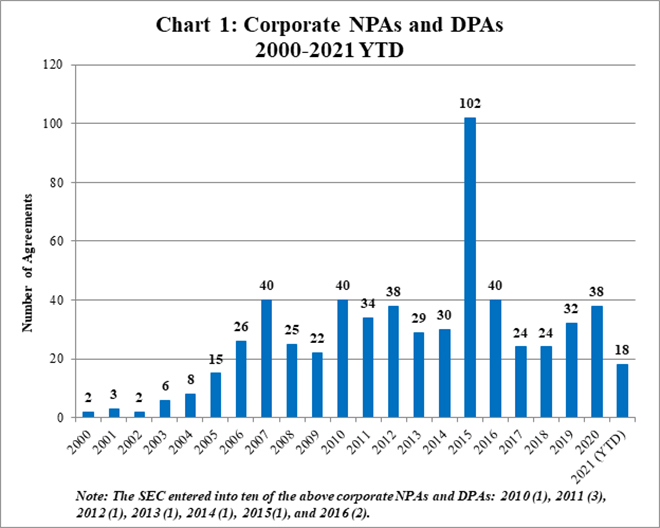
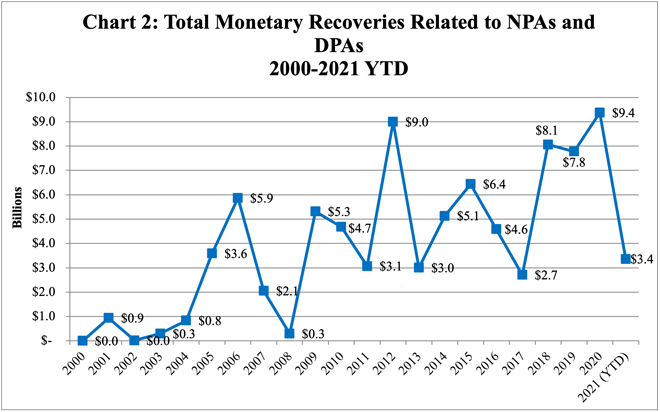
Chart 2 reflects total monetary recoveries related to NPAs and DPAs from 2000 through 2021 to date. The $9.4 billion in total monetary recoveries related to NPAs and DPAs in 2020 was the highest annual amount in history. At approximately $3.4 billion, recoveries associated with NPAs and DPAs thus far in 2021 slightly lag behind the amount recovered at this time in both 2020 (~$5.6 billion) and 2019 (~$4.7 billion) though the numbers are in line with the average recovery at the midpoint over the last 10 years. Total recoveries so far in 2021 are still more than 50 percent (57%) of the full annual average recoveries of approximately $5.9 billion in the last decade. Depending on developments in the second half of this year, total recoveries for 2021 could show a return to more typical levels, rather than a continuation of the increases in recent years.
Fifteen of the 18 agreements thus far in 2021 have been DPAs, reflecting a continuation of the trend toward DPAs as illustrated in Chart 3 below and discussed in both our 2020 Mid-Year Update and 2020 Year-End Update. Although the trend toward DPAs could signal a shift toward requiring self-disclosure to achieve an NPA, this year’s NPAs highlight the importance of fact-specific circumstances and mitigating factors: self-disclosure alone is not dispositive.
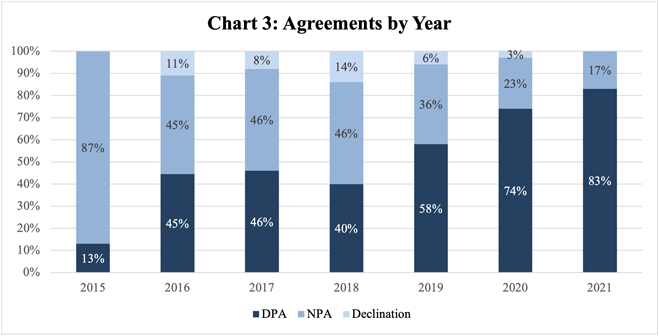
Only three companies have received NPAs to date in 2021: SAP SE (“SAP”), Avnet Asia Pte. Ltd. (“Avnet Asia”), and United Airlines, Inc. (“United”). Of the three, only SAP received voluntary self-disclosure credit. Notably, two of the three NPAs, involving SAP and Avnet Asia, involved DOJ’s National Security Division (“NSD”), which introduced a new voluntary disclosure policy in late 2019 that provides for a presumption toward NPAs for participating companies. Although Avnet Asia did not receive voluntary self-disclosure credit, the language of the NPA suggests that it may have made a self-disclosure to DOJ after prosecutors initiated their own investigation.
A second emerging trend in 2021 that appears to be consistent with 2020 is a steep decline in compliance monitors. Only one of the 18 agreements to date, the DPA with State Street Corporation (“State Street”), imposes an independent corporate monitor. Similarly, in 2020, only 2 out of 38 resolutions imposed an independent monitor or independent auditor. In contrast, in 2019, 7 out of 31 resolutions imposed some form of an independent compliance monitor.
Time will tell whether, under the Biden Justice Department, these trends will continue to hold true for the remainder of the year and beyond.
Key Developments in 2021 to Date
Enforcement in the Year of COVID-19 and Beyond
As the legal world progresses toward normalcy after an unprecedented 18 months, the mid-year mark of 2021 provides an opportunity to look back at how the COVID-19 pandemic has affected government enforcement efforts, and whether the unique legal risks facing companies managing COVID-19 will be reflected in enforcement activity going forward.
Although a dip in overall enforcement was expected by many at the start of the pandemic, that theory is not supported by the statistics. With the long gestation period of most corporate enforcement cases, the full impact of COVID-19, if any, might not be quantifiable until a later date. Nor does the broader enforcement landscape in 2020 reflect a significant downward trend. First, DOJ’s Civil Frauds Section reported 922 total new matters in 2020, the highest number since the Civil Division began reporting that statistic in 1987, and a 15% increase from 2019.[2] Meanwhile, DOJ Antitrust reported 20 new criminal antitrust matters filed in 2020, which, while a decrease from the 26 new matters filed in 2019, is up from the 18 filed in 2018, and is generally consistent with a 10-year downward trend in criminal antitrust enforcement.[3] If any enforcement arm can be said to have reported a significant dip in enforcement during the pandemic year, it is the SEC, which disclosed 715 new enforcement actions filed in 2020—a 17% decrease from 2019, a 13% decrease from 2018, a 5% decrease from 2017, and the lowest number on record since 2013.[4] However, although new enforcement actions were down, the SEC set a high-water mark for total financial remedies in 2020 of $4.68 billion.[5] Overall statistics from the first half of 2021 are not yet publicly available, but early signs indicate that at least DOJ is continuing its “[h]istoric level of enforcement.”[6]
Still, although the numbers may not reflect an annual dip in enforcement activity, the pandemic at least temporarily disrupted the work of government enforcement arms, as it did for much of the corporate world. For example, in the SEC’s 2020 Annual Report, the then-Enforcement Division Director cited the unique challenges of adapting to telework for the Commission, and stated that “in the early months . . . many of us spent the bulk of our time focused on learning and guiding our staff how to effectively do our job remotely. But we moved past that initial period of uncertainty and ultimately achieved a remarkable level of success, including bringing more than 700 enforcement cases during the fiscal year.”[7]
The more significant effects of the pandemic from an enforcement perspective will be forward looking—namely, how will the unique legal risks created in the last year shift enforcement priorities? As early as May 2020, the SEC had announced a “Coronavirus Steering Committee” to identify and respond to COVID-related legal risks.[8] And DOJ also made it clear that monitoring the use of significant public funds doled out by COVID-19 response programs such as the Paycheck Protection Program and Coronavirus Aid, Relief, and Economic Security Act would be a priority.[9] The then-Principal Deputy Assistant Attorney General said “we will energetically use every enforcement tool available to prevent wrongdoers from exploiting the COVID-19 crisis.”[10]
The results of those priorities are still taking shape. Thus far, DOJ’s publicly disclosed COVID-related enforcement efforts, while significant, have seemingly focused on individual defendants.[11] For example, in a May 2021 announcement by DOJ of charges brought in connection with an alleged nationwide COVID-related fraud scheme, which allegedly resulted in losses exceeding $143 million, all of the 14 defendants charged were individuals.[12] DOJ has yet to reach a public NPA or DPA with any company for criminal fraud related to COVID-19, although, as discussed in our 2020 Year-End Update, DOJ has entered into a pair of DPAs relating to price-gouging consumers of personal protective equipment. In light of DOJ’s interest in prosecuting COVID-19 related fraud cases and the corporate nature of the Paycheck Protection Program, it is likely that the lack of any publicly disclosed corporate resolutions to date reflects the greater complexity and longer timeline involved in investigating and prosecuting corporate cases.
That enforcement agencies are interested in pursuing COVID-related fraud by corporations, as well as individuals, is reflected in the SEC’s enforcement efforts throughout 2020 (described in our 2020 Year-End Securities Enforcement Update). At the very end of 2020, for example, the SEC brought its first settled charges (though not a DPA or NPA) with a company in response to a different COVID-related risk—misleading disclosures about the effects of the pandemic on a company’s financial condition—with The Cheesecake Factory Incorporated, which Gibson Dunn covered in a client alert.[13] More corporate COVID-related resolutions may follow, as investigations commenced in the last year reach their conclusions. We will continue to follow how enforcement involving COVID-related conduct develops.
June 2020 Corporate Compliance Program Guidance in Practice
In June 2020, DOJ updated the Criminal Division’s guidance on the “Evaluation of Corporate Compliance Programs,” a development Gibson Dunn discussed in a prior client alert and in our 2020 Year-End Update. Although DOJ has not commented officially on the guidance since the new administration took office, resolutions from the first half of 2021 may provide a window into how the updated guidance is playing out in practice.
The June 2020 guidance emphasized DOJ’s commitment to fact-specific resolutions by calling for “a reasonable, individualized determination in each case.”[14] That emphasis has made its way into several negotiated terms relating to specific corporate compliance programs so far in 2021, in some instances continuing a trend started in 2020 in the immediate wake of the updated guidance. Although DOJ often uses the same template as a starting point in many of its resolutions to detail the requirements for corporate compliance programs, context-specific requirements are appearing in resolutions.
For example, the Epsilon DPA follows the trend of fact-specific resolutions, adding a category for “Consumer Rights” not found in the compliance program requirements incorporated in other resolutions.[15] In light of DOJ’s allegation that employees at Epsilon sold customer data to clients that were engaging in consumer fraud, the Epsilon DPA requires Epsilon to provide individual customers with processes to both request the individual’s data that Epsilon may sell to clients and to request that Epsilon not sell the individual’s data at all.[16]
By contrast, the SAP NPA alleges that SAP acquired various companies but “made the decision to allow these companies to continue to operate as standalone entities, without being fully integrated into SAP’s more robust export controls and sanctions compliance program,” and despite “[p]re-acquisition due diligence . . . [that] identified that th[e] . . . companies lacked comprehensive export control and sanctions compliance programs, policies, and procedures.”[17] Because of this allegation, and given that M&A due diligence was a focus of the June 2020 guidance, SAP’s NPA requires it to audit newly acquired companies within 60 days of acquisition and inform DOJ about any potential violations.[18] This requirement is much more stringent than DOJ’s 2008 Opinion Release (discussed in our 2008 Mid-Year Update) regarding FCPA diligence in the context of M&A transactions.[19]
Additionally, both of the above agreements contain a provision for the continued monitoring and testing of the corporate compliance programs. The June 2020 guidance emphasizes that companies’ risk assessments should be based on “continuous access to operational data and information across functions,” as opposed to just providing a “snapshot in time.”[20] The Epsilon DPA provides for “periodic reviews and testing” of the company’s compliance policies, while the SAP NPA provides for continued maintenance and enhancement of its internal controls.[21] In line with the previous sections, each of these provisions is fact-specific: Epsilon must review its protection of consumer data; and SAP, its export controls and sanctions compliance programs.[22]
In sum, it appears that the June 2020 guidance from DOJ on corporate compliance programs has had its intended effect: DOJ and U.S. Attorneys’ Offices are, at least in some instances, tailoring the programs for individualized situations, and other foci of the June 2020 guidance are making their way into resolutions. Moving forward, we expect to see more agreements tailored to the individual circumstances of each company, drawing on the principles articulated in the June 2020 guidance.
Developments in Whistleblower Programs
On February 23, 2021, the SEC announced a $9.2 million award to a whistleblower who provided information that led to a successful DPA or NPA with the DOJ.[23] The order redacted information that would identify the type of agreement and fraud.[24] This marks the first SEC whistleblower award based on a DPA or NPA since amendments that expanded eligibility under the Whistleblower Rules[25] to include whistleblowers whose information leads to a DPA or NPA took effect in December 2020.[26] According to the award order, the whistleblower previously provided “significant information” about an ongoing fraud that resulted in DOJ charges.[27] The information facilitated “a large amount of money to be returned to investors harmed by the fraud.”[28]
The SEC whistleblower amendments reflect the recent expansion of whistleblower provisions in other contexts, in particular the anti-money laundering (“AML”) and antitrust areas. We covered two key developments in this regard—the passage of the Anti-Money Laundering Act of 2020, and the passage of the Criminal Antitrust Anti-Retaliation Act of 2020, here and here, respectively. With more avenues for government agencies to issue awards to people who report potential violations, we can expect to see an uptick in enforcement activity in the relevant areas.
DPA Conclusions
The first half of 2021 saw three notable DPA conclusions, with MoneyGram International, Inc. (“MoneyGram”), Standard Chartered Bank (“Standard Chartered”), and Zimmer Biomet (“Zimmer”) each released from very old and frequently extended DPAs entered into in 2012. Both the MoneyGram and Standard Chartered DPAs have been the subject of multiple extensions, as we noted in a prior client alert, and reflect the challenges companies often face even after a resolution is reached. On April 20, 2021, MoneyGram’s monitor certified that the company’s AML compliance program was “reasonably designed and implemented to detect and prevent fraud and money laundering and to comply with the Bank Secrecy Act.”[29] On May 4, 2021, DOJ and MoneyGram jointly filed a status report, stating that the parties were not seeking a further extension of the DPA.[30] The DPA terminated on May 10, 2021.
Standard Chartered reached the end of its monitorship, which was introduced in the 2014 amendment of its DPA, as scheduled in March 2019.[31] In April 2019, however, Standard Chartered agreed to a further amended DPA to resolve additional allegations, described in our 2019 Year-End Update. The 2019 amended DPA did not impose a monitor on Standard Chartered.[32] In May 2021, DOJ acknowledged that Standard Chartered had “complied with its obligations under the 2019 DPA,” and the DPA terminated.[33]
Zimmer’s DPA, which terminated in February 2021, related to pre-acquisition conduct by Biomet, Inc. (“Biomet”).[34] Biomet entered into the 2012 DPA in connection with allegations that it had violated the anti-bribery and accounting provisions of the FCPA.[35] Those allegations related to improper payments Biomet and its subsidiaries made between 2000 and 2008 in China, Argentina, and Brazil.[36] As part of its 2012 DPA, Biomet agreed to be subject to a monitor for 18 months.[37] The monitor was extended, however, after Biomet discovered additional potentially improper activities in Mexico and Brazil. In 2017, Zimmer entered into a new DPA with the DOJ relating to alleged violations of the FCPA’s internal controls provisions, under which it acknowledged that Biomet had failed to comply with the terms of the 2012 DPA.[38] As part of the 2017 DPA, Zimmer agreed to appoint a monitor for three years.[39] That monitorship concluded in August 2020, and its conclusion was followed by the termination of the DPA in February 2021.
Legislative Developments
In January, Congressman Gary Palmer of Alabama introduced the Settlement Agreement Information Database Act of 2021.[40] If passed, the Act would require Executive agencies to submit any information regarding settlement agreements to a public database.[41] The bill defines a “settlement agreement” broadly¾it includes any agreement, including a consent decree that (1) “is entered into by an Executive agency,” and (2) “relates to an alleged violation of Federal civil or criminal law.”[42] The submission must include the specific violations that provide the basis for the action, the settlement amount and classification as a civil penalty or criminal fine, a description of any data or methodology used to justify the agreement’s terms, the length of the agreement, and other identifying factors.[43] An agency is exempt from filing a submission if the agreement is subject to a confidentiality provision or if the information could be withheld under the Freedom of Information Act (“FOIA”).[44] The bill passed the House on January 5, 2021 and was referred to the Senate Committee on Homeland Security and Governmental Affairs.[45] The bill echoes a reporting requirement imposed on DOJ via a provision in the National Defense Authorization Act, whereby DOJ is now required to report to Congress annually on DPAs and NPAs concerning the Bank Secrecy Act.[46] We covered that development in more detail in our Year-End 2020 Update.
Congressman Palmer introduced the new bill after DOJ did not respond to an April 2020 FOIA request and subsequent administrative appeal in September 2020.[47] The FOIA request, which Professor Jon Ashley of the University of Virginia School of Law made to DOJ, sought all DPAs and NPAs entered into by the government since 2009 for the law school’s Corporate Prosecution Registry.[48] The registry houses more than 3,500 agreements, but Professor Ashley and some members of Congress believe that more agreements exist that have not been disclosed.[49] The bill follows Congressman Jamie Raskin’s August 2020 request to DOJ that it release a full list of all NPAs and DPAs since 2009—a call that has gone unanswered to date.[50] Although some observers believe that DOJ already has its own centralized “database” of agreements that could all be disclosed at once, in reality, the varying requirements for Main Justice involvement in and approval of different types of investigations and prosecutions[51] could mean that non-public agreements have been entered into by U.S. Attorneys’ Offices, for example, without being formally reported to DOJ. Gibson Dunn does not believe that a master database exists. To our knowledge, there is no regulatory or policy obligation for the various DOJ units, including the U.S. Attorneys’ Offices, to report these resolutions.
2021 Agreements to Date
Amec Foster Wheeler Energy Limited (DPA)
On June 24, 2021, Amec Foster Wheeler Energy Limited (“AFWEL”) entered into a three-year DPA with the Fraud Section and the U.S. Attorney’s Office for the Eastern District of New York.[52] The DPA stated that AFWEL engaged in a conspiracy to violate the anti-bribery provision of the FCPA in connection with the use of a third-party sales agent in Brazil.[53] The DPA imposed a penalty of approximately $18.4 million, which will be offset by amounts to be paid to UK and Brazilian authorities pursuant to parallel resolutions.[54]
The DPA granted AFWEL full cooperation credit and did not impose a monitor.[55] Under the terms of the agreement, AFWEL must report annually to DOJ on its compliance program.[56] The AFWEL DPA is one of two FCPA-related DPAs announced during the first half of this year. The other resolution involved Deutsche Bank AG (see below). Both companies were represented by Gibson Dunn.
Argos USA LLC (DPA)
On January 4, 2021, Argos USA LLC (“Argos”), a Georgia-based producer and supplier of ready-mix concrete, entered into a three-year DPA with the DOJ Antitrust Division for participation in a conspiracy to fix prices, rig bids, and allocate markets in and around the Southern District of Georgia.[57] The sole count against Argos alleged that employees of Argos and other ready-mix concrete companies coordinated and issued price-increase letters to customers, allocated jobs in coastal-Georgia, charged fuel surcharges and environmental fees, and submitted non-competitive bids to customers in a conspiracy lasting from 2010 until July 2016.[58]
According to the DPA, Argos, through its employees, conspired with others in violation of the Sherman Act, 15 U.S.C. § 1 from around October 2011 to July 2016, after they acquired the assets of a concrete supplier in Southern Georgia and in doing so employed two individuals also charged in the conspiracy.[59] Argos agreed to pay more than $20 million in a criminal penalty.[60] As part of the DPA, Argos also has agreed to cooperate in the Division’s ongoing criminal investigation and prosecution of others involved in the conspiracy.[61] The company has implemented and agreed to maintain a compliance and ethics program designed to prevent and detect antitrust violations, submit annual reports to the Division regarding remediation and implementation of its program, and to periodically review its compliance program and make adjustments as needed.[62]
Argos was the second company to be charged in this investigation, following Evans Concrete, LLC.[63] An indictment was also returned for the former Argos employees and two other individuals.[64]
Avanos Medical, Inc. (DPA)
On July 6, 2021, Avanos Medical, Inc. (“Avanos”) entered into a three-year DPA with the Fraud Section of DOJ’s Criminal Division, the Consumer Protection Branch (“CPB”) of DOJ’s Civil Division, and the U.S. Attorney’s Office for the Northern District of Texas.[65] The DPA resolved allegations that Avanos violated the Food, Drug, and Cosmetic Act (“FDCA”) by fraudulently misbranding surgical gowns.[66] In particular, the government alleged that Avanos’s labeling and branding of the gowns as compliant with a 2012 version of an AAMI standard for barrier protection was false and misleading.[67]
The DPA granted Avanos full cooperation credit and noted the company’s “extensive remedial measures,” including changes to its manufacturing process, devotion of additional resources to its compliance function, creation of “a stand-alone Compliance Committee of the Board of Directors,” and appointment of a full-time Chief Ethics and Compliance Officer “who reports directly to the CEO.”[68] The DPA also recognized Avanos’s spinoff of its surgical gown business in 2018, and cited that development as one of the reasons for which DOJ “determined that an independent compliance monitor was unnecessary.”[69] Avanos did not receive voluntary disclosure credit.[70]
Under the DPA, Avanos will pay a total of $22,228,000, comprised of $12.6 million in fines, $8,939,000 in compensation to purchasers of the gowns who “were directly and proximately harmed” by the company’s alleged conduct, and $689,000 in disgorgement.[71] The compensation to purchasers will be administered by a Victim Compensation Claims Administrator selected from a list of three candidates to be proposed by Avanos.[72]
Avnet Asia Pte. Ltd. (NPA)
On January 21, 2021, Avnet Asia Pte. Ltd. (“Avnet”), a Singapore distributor of electronic components and software, entered into a two-year NPA with the U.S. Attorney’s Office for the District of Columbia and DOJ NSD to resolve allegations related to alleged criminal conspiracies carried out by former employees.[73] Specifically, Avnet admitted in the NPA that two former employees (including a separately indicted sales account manager) engaged in two distinct conspiracies—one between 2007 and 2009, the other between 2012 and 2015—to violate U.S. export laws by shipping U.S. power amplifiers to Iran and China.[74] In the NPA, Avnet accepted responsibility for the acts of its employees and further admitted that neither the company nor any of its employees had applied for an export license from U.S. authorities.[75]
As part of the NPA, Avnet agreed to pay a $1.5 million financial penalty, to continue cooperating with any investigations concerning the underlying conduct, to provide all unprivileged documents pertaining to relevant investigations, and to make current and former employees available for interviews and testimony.[76] Avnet further agreed to implement a compliance program aimed at detecting and preventing violations of U.S. export laws and economic sanctions, and to provide updates on its compliance with such laws and sanctions on two occasions during the NPA’s term (at 10 and 20 months after the NPA’s execution).[77]
DOJ credited Avnet for its cooperation during the investigation (including disclosing the results of internal investigations and producing relevant documents) and for its significant remediation efforts (including substantial improvements to its export compliance program).[78] Avnet did not receive voluntary disclosure credit because it did not disclose the underlying misconduct prior to the commencement of the government’s investigation.[79] Relatedly, the U.S. Department of Commerce announced on January 29, 2021 that Avnet had agreed to pay an additional $1.7 million as part of a $3.2 million resolution of violations of the Export Administration Regulations.[80]
Bank Julius Baer & Co. Ltd. (DPA)
On May 27, 2021, Bank Julius Baer & Co. Ltd. (“BJB”), a Swiss bank with international operations, entered into a three-year DPA with DOJ’s Money Laundering and Asset Recovery Section (“MLARS”) and the United States Attorney’s Office for the Eastern District of New York.[81] DOJ alleged that from approximately February 2013 through May 2015, BJB conspired with sports marketing executives to launder through the United States at least $36 million in bribes to soccer officials in exchange for broadcasting rights to soccer matches, including the World Cup.[82]
Under the DPA, BJB agreed to pay a monetary penalty of approximately $43.32 million and forfeit $36.37 million.[83] DOJ stated that it reached this resolution with BJB based on a number of factors, including BJB’s 2016 DPA with DOJ which resolved allegations of “criminal violations relating to [BJB’s] efforts to [assist] U.S. taxpayers in evading U.S. taxes.”[84]
BJB received a 5% reduction off the bottom of the applicable U.S. Sentencing Guidelines fine range for its significant efforts to remediate its compliance program.[85] DOJ specifically acknowledged BJB’s three-year, $112 million AML initiative and “Know Your Client” upgrade launched in 2016; a large-scale AML transaction monitoring and risk management program launched in 2018; and the Bank’s 2019 initiative aimed at strengthening globally the Bank’s risk managements and risk tolerance framework.[86] BJB did not receive voluntary disclosure credit or cooperation credit.[87] The DPA noted the government’s determination that the appointment of an independent compliance monitor to oversee the remediation of BJB’s AML program by Swiss authorities made appointment of an additional monitor unnecessary.[88]
Berlitz Languages, Inc. (DPA) and Comprehensive Language Center, Inc. (DPA)
On January 19, 2021, Berlitz Languages, Inc. (“Berlitz”) and Comprehensive Language Center, Inc. (“CLCI”) entered into two separate, three-year DPAs with the DOJ Antitrust division for charges relating to a conspiracy to defraud the United States through non-competitive bidding processes in 2017[89] in connection with a multi-million dollar contract with the National Security Agency (“NSA”) to provide foreign language training services.[90] DOJ charged the companies with a conspiracy to defraud by “impending, impairing, obstructing, and defeating competitive bidding” in violation of 18 U.S.C. § 371.[91] Specifically, the companies facilitated providing false and misleading bid information to the NSA.[92]
In 2017, the NSA issued a bidding process to award up to three contracts spanning from 2017 until 2022 to provide foreign language training programs in six different locations across the United States.[93] NSA awarded the contracts to Berlitz and CLCI, along with another third-party company, in 2017, which entitled each to bid on individual delivery orders later awarded in December 2017.[94] To qualify for awards of delivery orders, the company had to be deemed “technically acceptable,” by having a facility in the location in which it could conduct the foreign language training.[95] The DPA alleged that the two companies conspired with each other to fraudulently obtain the contracts and delivery orders by falsely representing CLCI’s ability to perform and to suppress competition between Berlitz and CLCI.[96] Specifically, the companies admitted to falsely and misleadingly claiming that CLCI could perform services at a facility in Odenton, Maryland when that facility was owned and operated by Berlitz.[97] In exchange, CLCI then agreed to not bid against Berlitz when Berlitz bid on delivery orders calling for training in or near Odenton, Maryland.[98]
Under the DPA, the companies agreed to pay criminal penalties of around $140,000 each and agreed that they were jointly and severally liable to pay victim compensation to the NSA of approximately $57,000.[99] As part of the DPA, the companies admitted to participating in the alleged conspiracy, agreed to cooperate in any related investigation or prosecution, and implemented or agreed to implement and maintain compliance controls and a compliance and ethics program designed to prevent and detect fraud and antitrust violations.[100] The companies also agreed to periodically review the program and make adjustments as needed.[101]
The Boeing Company (DPA)
On January 7, 2021, The Boeing Company (“Boeing”) and the DOJ Fraud Section, as well as the U.S. Attorney’s Office for the Northern District of Texas, entered into a three-year DPA to resolve a criminal charge of conspiracy to defraud the Federal Aviation Administration’s (“FAA’s”) Aircraft Evaluation Group regarding an aircraft part called the Maneuvering Characteristics Augmentation System (“MCAS”) that affected the flight control system of the Boeing 737 MAX.[102] Pursuant to the DPA, Boeing agreed to pay approximately $2.5 billion, which includes a $243.6 million penalty and $1.77 billion in compensation to Boeing’s airline customers, and to establish a $500 million crash-victim beneficiaries fund.[103]
The DPA acknowledged Boeing’s remedial measures, including creating an aerospace safety committee of the Board of Directors to oversee Boeing’s policies and procedures governing safety and its interactions with the FAA and other government agencies and regulators,[104] and awarded partial credit for cooperation.[105]
Colas Djibouti SARL (DPA)
On February 17, 2021, Colas Djibouti SARL (“Colas Djibouti”)—a French concrete contractor and wholly owned subsidiary of French civil engineering company, Colas SA—entered into a DPA with the U.S. Attorney’s Office for the Southern District of California to resolve allegations concerning Colas Djibouti’s sale of contractually non-compliant concrete used to construct U.S. Navy airfields in the Republic of Djibouti.[106] Specifically, DOJ alleged that Colas Djibouti (1) knowingly provided substandard concrete for use on U.S. Navy airfield construction projects pursuant to contracts between Colas Djibouti and the U.S. Navy and (2) submitted documents and claims containing false representations about the composition and characteristics of the concrete to the United States.[107]
Under the terms of the DPA, Colas Djibouti agreed to plead to a one-count information of conspiracy to commit wire fraud under 18 U.S.C § 1349 and to pay approximately $10 million in restitution, a fine of $2.5 million, and forfeiture in the amount of $8 million (to be credited to the $10 million owed in restitution).[108]
In connection with the same underlying conduct, Colas Djibouti simultaneously agreed to a $3.9 million settlement of civil allegations that it violated the False Claims Act.[109] Under the terms of the settlement agreement, Colas Djibouti agreed to cooperate with any DOJ investigation of other individuals and entities not covered by the DPA and settlement agreement in connection with the underlying conduct.[110] Colas Djibouti agreed to encourage its former directors, officers, and employees to give interviews and testimony, and to furnish DOJ with non-privileged documents and records related to any investigation of the underlying conduct.[111] The civil settlement credited approximately $1.9 million of Colas Djibouti’s payment as restitution under the DPA and obligated Colas Djibouti to make a net payment of approximately $1.9 million.[112]
Deutsche Bank AG (DPA)
On January 8, 2021, Deutsche Bank AG (“Deutsche Bank”) entered into a three-year DPA and agreed to pay approximately $123 million in criminal penalties, disgorgement, and victim compensation to resolve FCPA and commodities fraud investigations.[113] The resolution was coordinated with the SEC.
The FCPA investigation concerned payments to consultants.[114] The commodities investigation related to allegations that Deutsche Bank precious metals traders placed orders with the intent to cancel the orders prior to execution.[115]
The Bank received full credit for cooperating with the investigation, including making detailed factual presentations and producing extensive documentation.[116] The DPA also acknowledged remedial measures taken by the Bank, including “conducting a robust root cause analysis and taking substantial steps to remediate and address the misconduct, including significantly enhancing its internal account controls, its anti-bribery and anti-corruption program, and its Business Development Consultants [] program on a global basis.”[117]
Epsilon Data Management LLC (DPA)
On January 19, 2021, marketing company Epsilon Data Management LLC (“Epsilon”) entered into a 30-month DPA with DOJ CPB and the U.S. Attorney’s Office for the District of Colorado to resolve a criminal charge for conspiracy to commit mail and wire fraud.[118] The government alleged that from July 2008 to July 2017, employees in Epsilon’s direct-to-consumer unit (“DTC”) sold over 30 million consumers’ information to individuals engaged in fraudulent mass-mailing schemes.[119]
Under the DPA, Epsilon agreed to pay $150 million, with $127.5 million dedicated to a victims’ compensation fund.[120] Epsilon also agreed to select, and cover the costs of, an independent claims administrator to distribute monies from the fund.[121] The agreement stated that DOJ was not requiring Epsilon to pay a criminal forfeiture amount because of the “facts and circumstances of th[e] case” and the company’s agreement to pay the victims’ compensation amount.[122]
The DPA noted the substantial enhancements Epsilon had already made to its compliance program and internal controls.[123] Epsilon further agreed to enhance its compliance program and internal controls to safeguard consumer data and prevent its sale to individuals engaged in fraudulent marketing campaigns.[124] Epsilon also agreed to cooperate fully in any related matters.[125]
The DPA stated that Epsilon received full credit for its “extensive cooperation,” which included (1) a “thorough and expedited internal investigation,” (2) regular government presentations, (3) facilitating employee interviews, and (4) analyzing and organizing “voluminous evidence.”[126] Epsilon also received credit for its extensive remedial measures, including (1) separating employees known to be involved in the alleged conduct, (2) terminating relationships with the individuals who carried out the fraudulent mailing schemes, (3) dissolving the DTC, (4) investing in additional legal and compliance resources, and (5) updating company policies and procedures.[127] The DPA further credited Epsilon for having no prior criminal history.[128] Epsilon did not receive voluntary disclosure credit.[129]
DOJ determined that an independent compliance monitor was unnecessary “based on Epsilon’s remediation and the state of its compliance program, the fact that the Covered Conduct concluded in 2017,” and the company’s agreement to report annually on the implementation of its compliance program.[130]
On June 14, 2021, the U.S. District Court for the District of Colorado unsealed an indictment charging two former Epsilon employees with conspiracy to commit and the substantive commission of mail and wire fraud in connection with conduct that was the subject of the Epsilon DPA.[131] The indictment alleges that the two individuals sold consumer lists to mass-mailing fraud schemes that invited consumers to engage in false “sweepstakes” and “astrology” solicitations.[132] The unsealing of the indictment coincided with DOJ announcing its DPA with KBM Group LLC (see below) to resolve nearly identical charges.[133]
KBM Group LLC (DPA)
On June 14, KBM Group LLC (“KBM”) entered into a 30-month DPA with the U.S. Attorney’s Office for the District of Colorado and DOJ CPB to resolve allegations that it sold millions of consumers’ information to individuals and entities engaged in elder fraud schemes.[134] DOJ alleged that KBM sold consumer lists to mass-mailing fraud schemes that invited consumers to engage in false “sweepstakes” and “astrology” solicitations.[135] A court in the same district earlier this year approved a similar agreement between the DOJ and Epsilon Data Management LLC to resolve parallel allegations.[136] The court approved the KBM DPA on June 29.[137]
Under the DPA, KBM will pay $42 million, $33.5 million of which will go to a victims’ compensation fund.[138] The DPA requires KBM to select, and cover the costs of, an independent claims administrator to distribute the victim compensation monies.[139] KBM also must implement compliance measures to safeguard consumer data and prevent its sale to perpetrators of fraudulent marketing schemes.[140] The compliance program requirements in KBM’s DPA are nearly identical to those in Epsilon’s, with the exception that KBM’s DPA explicitly requires the company to ensure that both senior and middle management reinforce and abide by the compliance code.[141] KBM’s agreement, like Epsilon’s, also requires annual compliance reporting and cooperation with the government in its ongoing investigations.[142]
The DOJ granted KBM nearly identical credit to that provided under Epsilon’s DPA, including full credit for its cooperation, its “significant remedial measures,” and lack of prior criminal history.[143] Additionally, the DPA credited KBM for its removal of terminated clients’ data from the KBM database and its revision of employee commission plans and co-op member agreements to align with the new compliance measures.[144]
The DOJ announced its filing of the DPA with KBM alongside the unsealing of an indictment charging two former Epsilon employees with mail and wire fraud in connection with a mass-mailing fraud scheme.[145]
PT Bukit Muria Jaya (DPA)
On January 17, 2021, PT Bukit Muria Jaya (“BMJ”)¾a global cigarette paper supplier based in Indonesia¾entered into an 18-month DPA with DOJ NSD and the U.S. Attorney’s Office for the District of Columbia to resolve allegations of conspiracy to commit bank fraud in connection with the shipment of BMJ products to North Korea.[146] DOJ alleged that BMJ customers in North Korea falsified paperwork and misled U.S. banks into processing payments in violation of U.S. sanctions.[147] According to DOJ, BMJ accepted payments from third parties, at the request of its North Korean customers, that were unrelated to the sales transactions, thereby taking the transactions outside the ambit of U.S. banks’ sanctions monitoring systems and leading the banks to process transactions it would have otherwise rejected.[148] BMJ also entered a settlement with the U.S. Treasury’s Office of Foreign Assets Control (“OFAC”) for the same underlying conduct, with OFAC determining that BMJ’s violations were “non-egregious.”[149]
Under the DPA, BMJ agreed to pay a $1.5 million penalty and implement a compliance program designed to prevent and identify violations of U.S. sanctions.[150] BMJ also agreed to report semi-annually on the status of its compliance improvements.[151] The 18-month DPA can be extended by up to one year if BMJ knowingly violates the terms of the agreement.[152]
In setting forth the rationale for the terms of the resolution, the Gibson Dunn-negotiated DPA credited BMJ for its (1) willingness to accept responsibility under U.S. law, (2) remediation efforts and comprehensive improvement of its compliance program, and (3) ongoing cooperation.[153] The agreement also noted that BMJ’s revenue from the sales in question constituted less than 0.3% of the company’s total sales revenue during that same period.[154]
Just six months prior to BMJ’s agreement, the DOJ imposed its first-ever corporate resolution for violations of the 2016 sanctions regulations concerning North Korea.[155] The BMJ DPA suggests that DOJ’s effort in this regard will proceed regardless of the transactions’ value to the entity. In announcing the BMJ DPA, Acting U.S. Attorney for the District of Columbia Michael R. Sherwin highlighted this point by stating that “[w]e want to communicate to all those persons and businesses who are contemplating engaging in similar schemes to violate U.S. sanctions on North Korea . . . . We will find you and prosecute you.”[156]
Rahn+Bodmer Co. (DPA)
On February 10, 2021, the oldest private bank in Zurich, Switzerland, Ranh+Bodmer Co. (“R+B”), entered into a three-year DPA with DOJ’s Tax Division and the United States Attorney’s Office for the Southern District of New York.[157] The DPA resolves allegations that from 2004 until 2012 R+B conspired to help U.S. account holders evade U.S. tax obligations, file false federal tax returns, and otherwise defraud the Internal Revenue Service (“IRS”) by hiding hundreds of millions of dollars in offshore bank accounts at R+B.[158] The DPA is the latest of over 90 resolutions since 2013 with Swiss banks involving tax evasion allegations.
Under the DPA, R+B agreed to make payments totaling $22 million.[159] Specifically, R+B agreed to pay (1) $4.9 million in restitution, representing the “approximate gross pecuniary loss to the [IRS]” resulting from R+B’s participation in the conspiracy; (2) $9.7 million in forfeiture, representing the approximate gross fees that R+B earned on its undeclared U.S.-related accounts between 2004 and 2012; and (3) $7.4 million in penalties, including a 55% discount for cooperation.[160] DOJ stated that it reached this resolution with R+B based on a number of factors, including that R+B conducted a “thorough internal investigation”; “provided a substantial volume of documents” to DOJ; and implemented remedial measures to “protect against the use of its services for tax evasion in the future.”[161] The agreement also requires R+B to disclose information consistent with the Department’s Swiss Bank Program relating to accounts closed between January 1, 2009, and December 31, 2019.[162]
SAP SE (NPA)
On April 29, 2021, SAP SE (“SAP”), a German software corporation, entered into an NPA with DOJ NSD and agreed to disgorge $5.14 million.[163] SAP also entered into concurrent administrative agreements with the Department of Commerce’s Bureau of Industry and Security and OFAC.[164] In voluntary disclosures to these three agencies, SAP acknowledged violations of the Export Administration Regulations and the Iranian Transactions and Sanctions Regulations.[165]
The conduct covered by the NPA involved SAP’s alleged export of software to Iranian end users. Between 2010 and 2017, SAP and overseas partners released U.S.-origin software, upgrades and patches, to users located in Iran in over 20,000 instances.[166] SAP’s Cloud Business Group companies separately permitted over 2,000 Iranian users access to U.S.-based cloud services in Iran.[167] Certain SAP senior managers were aware that the company did not have geolocation filters sufficient to identify and block the Iranian downloads, but SAP failed to institute remedial controls.[168]
According to the NPA, SAP received full credit for its timely voluntary disclosure, as well as credit for extensive cooperation with the government.[169] The company also received credit for spending more than $27 million on remediation efforts, including implementing GeoIP blocking, deactivating violative users of cloud services based in Iran, transitioning to automated sanction screening, auditing and suspending partners that sold to Iran-affiliated customers, and implementing other internal and export controls.[170]
The SAP resolution is one of the first of its kind focused on the provision of cloud services, and as such may now serve as a benchmark for future government enforcement actions—and compliance and remediation expectations—in this space.
State Street Corporation (DPA)
On May 13, 2021, State Street Corporation (“State Street”) entered into a new two-year DPA with the U.S. Attorney’s Office for the District of Massachusetts and agreed to pay a $115 million criminal penalty to resolve charges that it conspired to commit wire fraud by engaging in a scheme to defraud a number of the bank’s clients.[171] According to the DPA, State Street overcharged by over $290 million for expenses related to the bank’s custody of client assets.[172]
Between 1998 and 2015, according to the DPA, eight former bank executives omitted information about charges from client invoices and misled customers who raised concerns about the expenses.[173] Specifically, the former bank executives allegedly “conspired to add secret markups to ‘out-of-pocket’ (OOP) expenses charged to the bank’s clients while letting clients believe that State Street was billing OOP expenses as pass-through charges on which the bank was not earning a profit.”[174] An example of an OOP expense would be fees for interbank messages sent via the Society of Worldwide Interbank Financial Telecommunication (SWIFT) system.[175]
In addition to the $115 million criminal penalty, State Street also agreed to continue to “cooperate with the U.S. Attorney’s Office in any ongoing investigations and prosecutions relating to the conduct, to enhance its compliance program, and to retain an independent compliance monitor for a period of two years.”[176]
Unrelatedly, State Street saw the extension in March 2021 of a 2017 DPA. State Street’s 2017 DPA resolved allegations that it engaged in a scheme to defraud customers by applying extra commissions to billions of dollars’ worth of securities trades.[177] The most recent extension, which runs through September 3, 2021, was described in a joint filing as necessary because the COVID-19 pandemic and the resignation of the monitor (who took a position with the SEC) delayed completion of the monitor’s work.[178]
With the new DPA and the recent extension of the 2017 DPA, State Street is now subject to two concurrent DOJ-imposed monitorships. The new monitor will assess and make recommendations in a way that does not duplicate the efforts of the 2017 monitor, the DPA states.[179] Further, the terms of the agreement specify that State Street may choose to retain the same monitor under the new agreement instead of appointing a separate person.[180]
Swiss Life Holding AG (DPA)
On May 14, 2021, Swiss Life Holding AG (“Swiss Life Holding”), Swiss Life (Liechtenstein) AG, Swiss Life (Singapore) Pte. Ltd., and Swiss Life (Luxembourg) S.A. entered into a three-year DPA with DOJ’s Tax Division and the United States Attorney’s Office for the Southern District of New York.[181] The DPA resolves allegations that from 2005 to 2014, Swiss Life conspired with U.S. taxpayers and others to conceal from the IRS more than $1.452 billion in assets and income through the use of offshore Private Placement Life Insurance (“PPLI”) policies (colloquially known as “insurance wrappers”) and related policy investment accounts in banks around the world.[182] According to the allegations in the DPA, Swiss Life was identified as the owner of the policy investment accounts, rather than the U.S. policyholder and/or ultimate beneficial owner of the assets, thereby allowing U.S. taxpayers to hide undeclared assets and income through the insurance wrapper policies.[183]
Swiss Life Holding agreed to pay approximately $77.3 million to resolve the charges.[184] This sum included (1) $16,345,454 in restitution, representing the approximate unpaid taxes resulting from the Swiss Life Entities’ participation in the conspiracy; (2) $35,782,375 in forfeiture, representing the approximate gross fees (not profits) that the Swiss Life Entities earned on the relevant transactions; and (3) $25,246,508 in penalties, including a 50% discount for cooperation.[185]
DOJ stated that the penalty accounted for the extensive internal investigation conducted by Swiss Life, which included the review of over 1,500 hard-copy PPLI policy files, and production to DOJ of a substantial volume of documents and client-related data derived from that investigation.[186] The DPA noted that Swiss Life took additional measures to assist in the sharing of documents and information with DOJ consistent with the insurance-confidentiality and data privacy laws in the jurisdictions in which Swiss Life’s PPLI carriers operate, including preparing a Tax Information Exchange Agreement request to the Liechtenstein authorities.[187] In addition, Swiss Life conducted extensive outreach to current and former U.S. clients to confirm historical tax compliance, and to encourage disclosure to the IRS when policyholders’ historical tax compliance issues had not yet been resolved.[188]
United Airlines, Inc. (NPA)
On February 25, 2021, United Airlines, Inc. (“United”) entered into a three-year NPA with DOJ (Fraud Section, Criminal Division) to resolve a criminal investigation into an allegedly fraudulent scheme carried out by former United employees in connection with United’s fulfilment of contracts to deliver mail internationally for the U.S. Postal Service (“USPS”).[189] According to the Statement of Facts, United delivered mail internationally pursuant to International Commercial Air (“ICAIR”) contracts with USPS.[190] Under the terms of these ICAIR contracts, United was required to (1) take barcode scans of mail upon taking possession of the mail and upon delivering the mail overseas, and (2) provide these scans to USPS.[191] Rather than providing USPS with scans based on the actual movement of mail, United admitted that, between 2012 and 2015, it provided USPS with automated scans based on projected delivery times.[192] Submission of these automated scans violated the terms of United’s ICAIR contracts and prompted USPS to make millions of dollars in payments that United was not entitled to under the ICAIR contracts.[193] United further admitted that certain former employees knew the data being transmitted to USPS violated the terms of the ICAIR contracts and engaged in efforts to conceal the automated scan data, which, if discovered, would have subjected United to financial penalties under the ICAIR contracts.[194]
As part of the resolution, United agreed to pay $17.2 million in criminal penalties and disgorgement.[195] Under the NPA, United agreed to continue cooperating with the Fraud Section, strengthen its compliance program, and submit yearly reports to the Fraud Section regarding its remediation efforts and implementation of policies and controls aimed at deterring and detecting fraud surrounding United’s government contracts.[196]
The NPA credited United for cooperating with the Fraud Section’s investigation by producing documents, making employees available for interviews, and giving a factual presentation to DOJ.[197] The NPA also noted United’s extensive remedial action after learning about the underlying misconduct, including removing the principal manager of the alleged scheme, hiring outside advisors to evaluate United’s government contracting compliance policies, instituting an independent “Government Contracts Organization” that reported directly to the United Legal Department, implementing training for employees with duties related to government contracts, and prohibiting automation of and restricting access to flight configuration data to prevent future manipulation of data provided to USPS.[198] In light of the isolated nature of the alleged misconduct and United’s remedial improvements, the Fraud Section determined that an independent compliance monitor was unnecessary.[199]
In connection with the same underlying conduct, United entered into a separate False Claims Act settlement with DOJ (Civil Division, Fraud Section, Commercial Litigation Branch) on February 25, 2021.[200] United agreed to pay $32.1 million as part of the civil settlement.[201]
International DPA Developments
As prior Mid-Year and Year-End Updates have discussed (see, e.g., our 2020 Year-End Update), France and the United Kingdom also have robust DPA or DPA-like frameworks. The UK’s Serious Fraud Office (“SFO”) has entered into 12 DPAs since 2015,[202] and France’s prosecuting agencies have entered into 12 DPA-like agreements (called convention judiciaire d’intérêt public, or “CJIP”) since 2017.[203] France and the United Kingdom together produced four DPA-like agreements in the first half of 2021, and DPA developments in the United Kingdom sparked discussion regarding individual prosecution related to DPAs.
France – Bolloré SE
On February 26, 2021, France’s National Financial Prosecutor’s Office (“PNF”) announced that the Judicial Court of Paris approved a €12 million (about $14.5 million) CJIP with French transport company Bolloré SE and its parent company Financière de l’Odet to resolve allegations of corruption in Togo.[204] PNF alleged that Bolloré paid €370,000 (almost $450,000) to Togolese president Faure Gnassingbé between 2009 and 2011 to secure tax benefits and a contract to manage the Port of Lomé.[205] As part of the CJIP, Bolloré agreed to enhance its compliance program and pay up to €4 million in costs related to the French Anti-Corruption Agency’s (AFA) monitoring and audit of Bolloré over the next two years.
On the same day that the Judicial Court of Paris approved the corporate resolution, the court dismissed the plea bargains that three Bolloré executives had entered into with PNF to resolve allegations related to the same conduct.[206] The court ordered the three executives to stand trial because the allegations against them “seriously undermined economic public order” and the sovereignty of Togo.[207] This is the first time a French court has considered—let alone rejected—plea deals alongside a CJIP, so it remains to be seen whether this development will chill the negotiation of further CJIPs or create more reluctance among individuals implicated in PNF investigations to seek resolutions in parallel with the negotiation of CJIPs.[208]
United Kingdom
Amec Foster Wheeler Energy Limited
On the same day that DOJ and the SEC announced their resolutions with Amec Foster Wheeler Energy Limited, and Amec Foster Wheeler Limited, respectively, the SFO announced that it had “agreed [to] a Deferred Prosecution Agreement in principle with Amec Foster Wheeler Energy Limited.”[209] The DPA relates to the use of third-party agents in five countries in the period before AMEC plc acquired Foster Wheeler AG in November 2014, and prior to Wood’s acquisition of the resulting combined company in October 2017.[210] The SFO DPA, and the parallel DPA with DOJ, collectively call for total payments of $177 million and include fines and disgorgement.[211] On July 1, 2021, the Crown Court at Southwark, sitting at the Royal Courts of Justice, gave final approval of the DPA.[212] Under the UK DPA, AFWEL will pay approximately £103 million.[213]
Two Anonymous DPAs with Companies for UK Bribery Act Offenses
On July 20, 2021, the SFO announced final court approval of two separate DPAs with two UK-based companies for bribery offenses.[214] According to the SFO’s press release, the two companies will pay a total of £2,510,065 (over $3.4 million) in disgorgement of profits and financial penalties.[215] The SFO did not disclose the names of the companies, citing legal restrictions on reporting under the Contempt of Court Act 1981.[216] The publicly available information regarding these two DPAs will therefore be limited until the restrictions have been lifted and the DPAs are published. However, the SFO did state that the companies “either actively participated in or failed to prevent the rolling use of bribes to unfairly win contracts,” and the companies will be obligated to report on their compliance programs at regular intervals during the two-year term of the DPAs.[217]
Further UK Developments
DPAs continue to be in the spotlight more broadly in the United Kingdom. On May 4, 2021, the media reported that the SFO (which declined to comment) was ending a criminal investigation into individuals associated with Airbus SE (“Airbus”) 16 months after Airbus agreed to pay combined penalties of $3.9 billion to authorities in France, the United Kingdom, and the United States to resolve foreign bribery and export control charges (as summarized in our 2020 Mid-Year Update).[218] Similarly, in April 2021, the SFO’s prosecution of two former executives of Serco Georgrafix Ltd. (“Serco”) ended in a directed verdict of not guilty after the revelation that the SFO had failed to disclose evidence to the defense.[219] Serco, a leading provider of outsourced services to governments, entered into a DPA with the SFO in July 2019 and agreed to pay a penalty of £19.2 million (about $24 million) and to reimburse the SFO’s investigation costs of £3.7 million (over $4.6 million) to resolve allegations of fraud and false accounting (as discussed in our 2019 Year-End Update). The Serco case is not the first acquittal in recent years among SFO prosecutions against individuals; in fact, the SFO has yet to successfully prosecute individuals following a DPA.[220] This trend may undermine or at least shape the SFO’s efforts to enter into DPAs in the future, to the extent it leads corporations to question the SFO’s ability to secure a conviction if forced to prove its case in court.
APPENDIX: 2021 Non-Prosecution and Deferred Prosecution Agreements to Date
The chart below summarizes the agreements concluded by DOJ in 2021 to date. The SEC has not entered into any NPAs or DPAs in 2021. The complete text of each publicly available agreement is hyperlinked in the chart.
The figures for “Monetary Recoveries” may include amounts not strictly limited to an NPA or a DPA, such as fines, penalties, forfeitures, and restitution requirements imposed by other regulators and enforcement agencies, as well as amounts from related settlement agreements, all of which may be part of a global resolution in connection with the NPA or DPA, paid by the named entity and/or subsidiaries. The term “Monitoring & Reporting” includes traditional compliance monitors, self-reporting arrangements, and other monitorship arrangements found in settlement agreements.
U.S. Deferred and Non-Prosecution Agreements in 2021 to Date | ||||||
| Company | Agency | Alleged Violation | Type | Monetary Recoveries | Monitoring & Reporting | Term of NPA/DPA (months) |
| Amec Foster Wheeler Energy Limited | DOJ Fraud; E.D.N.Y. | Conspiracy to violate the FCPA | DPA | $41,139,287 | Yes | 36 |
| Argos USA LLC | DOJ Antitrust | Price-fixing conspiracy | DPA | $20,024,015 | Yes | 36 |
| Avanos Medical, Inc. | DOJ Fraud; DOJ CPB; N.D. Tex. | FDCA | DPA | $22,228,000 | Yes | 36 |
| Avnet Asia Pte. Ltd | D.D.C.; DOJ NSD | Export controls – conspiracy to violate the International Emergency Economic Powers Act | NPA | $1,508,000 | Yes | 24 |
| Bank Julius Baer & Co. Ltd. | DOJ MLARS; E.D.N.Y. | AML | DPA | $79,688,400 | Yes | 36 |
| Berlitz Languages, Inc. | DOJ Antitrust | Bid rigging | DPA | $203,984 | Yes | 36 |
| The Boeing Company | DOJ Fraud; N.D. Texas | Fraud | DPA | $2,513,600,000 | Yes | 36 |
| Colas Djibouti SARL | S.D. Cal.; DOJ Civil | FCA | DPA | $14,500,000 | No | 24 |
| Comprehensive Language Center, Inc. | DOJ Antitrust | Bid rigging | DPA | $196,984 | Yes | 36 |
| Deutsche Bank AG | DOJ Fraud; MLARS; E.D.N.Y. | FCPA | DPA | $124,796,046 | Yes | 36 |
| Epsilon Data Management, LLC | DOJ CPB; D. Colo. | Mail and wire fraud | DPA | $150,000,000 | Yes | 30 |
| KBM Group, LLC | DOJ CPB; D. Colo. | Mail and wire fraud | DPA | $42,000,000 | Yes | 30 |
| PT Bukit Muria Jaya | D.D.C.; DOJ NSD | Bank fraud | DPA | $1,561,570 | Yes | 18 |
| Rahn+Bodmer Co. | S.D.N.Y.; DOJ Tax | Fraud, false tax return filings, and tax evasion | DPA | $22,000,000 | No | 36 |
| SAP SE | DOJ NSD; D. Mass. | Export controls | NPA | $8,430,000 | Yes | 36 |
| State Street Corporation | D. Mass. | Wire fraud | DPA | $211,575,000 | Yes | 24 |
| Swiss Life Holding AG | S.D.N.Y.; DOJ Tax | Fraud, false tax return filings, and tax evasion | DPA | $77,374,337 | No | 36 |
| United Airlines, Inc. | DOJ Fraud | Fraud | NPA | $49,458,102 | No | 36 |
__________________________
[1] NPAs and DPAs are two kinds of voluntary, pre-trial agreements between a corporation and the government, most commonly DOJ. They are standard methods to resolve investigations into corporate criminal misconduct and are designed to avoid the severe consequences, both direct and collateral, that conviction would have on a company, its shareholders, and its employees. Though NPAs and DPAs differ procedurally—a DPA, unlike an NPA, is formally filed with a court along with charging documents—both usually require an admission of wrongdoing, payment of fines and penalties, cooperation with the government during the pendency of the agreement, and remedial efforts, such as enhancing a compliance program and—on occasion—cooperating with a monitor who reports to the government. Although NPAs and DPAs are used by multiple agencies, since Gibson Dunn began tracking corporate NPAs and DPAs in 2000, we have identified nearly 600 agreements initiated by DOJ, and 10 initiated by the U.S. Securities and Exchange Commission (“SEC”).
[2] Fraud Statistics – Overview, October 1, 1986 – September 30, 2020, U.S. Dep’t of Justice (Jan. 14, 2021), https://www.justice.gov/opa/press-release/file/1354316/download.
[3] Criminal Enforcement Trends Charts Through Fiscal Year 2020, U.S. Dep’t of Justice, Antitrust Div. (Nov. 23, 2020), https://www.justice.gov/atr/criminal-enforcement-fine-and-jail-charts.
[4] 2020 Annual Report, Div. of Enf’t, U.S. Sec. & Exch. Comm’n, https://www.sec.gov/files/enforcement-annual-report-2020.pdf, at 16; Year-by-Year SEC Enf’t Statistics (2005 – 2014), U.S. Sec. & Exch. Comm’n, https://www.sec.gov/news/newsroom/images/enfstats.pdf.
[5] 2020 Annual Report, Div. of Enf’t, U.S. Sec. & Exch. Comm’n, https://www.sec.gov/files/enforcement-annual-report-2020.pdf.
[6] Press Release, U.S. Dep’t of Justice, Justice Department Takes Action Against COVID-19 Fraud (Mar. 26, 2021), https://www.justice.gov/opa/pr/justice-department-takes-action-against-covid-19-fraud (hereinafter “DOJ COVID Press Release”).
[7] Id.
[8] Stephen Peiken, Co-Director, Div. of Enf’t, “Keynote Address: Securities Enforcement Forum West 2020” (May 12, 2020), https://www.sec.gov/news/speech/keynote-securities-enforcement-forum-west-2020.
[9] Ethan P. Davis, Principal Deputy Assistant Attorney General, “Principal Deputy Assistant Attorney General Ethan P. Davis delivers remarks on the False Claims Act at the U.S. Chamber of Commerce’s Institute for Legal Reform” (June 26, 2020), https://www.justice.gov/civil/speech/principal-deputy-assistant-attorney-general-ethan-p-davis-delivers-remarks-false-claims.
[10] Id.
[11] DOJ COVID Press Release, supra note 6.
[12] Press Release, DOJ Announces Coordinated Law Enforcement Action to Combat Health Care Fraud Related to COVID-19 (May 26, 2021), https://www.justice.gov/opa/pr/doj-announces-coordinated-law-enforcement-action-combat-health-care-fraud-related-covid-19.
[13] Gibson Dunn, SEC Brings First Enforcement Action Against a Public Company for Misleading Disclosures About the Financial Impacts of the Pandemic (Dec. 7, 2020), https://www.gibsondunn.com/sec-brings-first-enforcement-action-against-a-public-company-for-misleading-disclosures-about-the-financial-impacts-of-the-pandemic/.
[14] U.S. Dep’t of Justice, Crim. Div., Evaluation of Corporate Compliance Programs (Updated June 2020) at 1, https://www.justice.gov/criminal-fraud/page/file/937501/download (hereinafter “Compliance Program Update”).
[15] United States v. Epsilon Data Mgmt., LLC, No. 21-cr-06 (D. Colo. Jan. 19, 2021), at C-5 (hereinafter “Epsilon DPA”).
[16] Id.
[17] SAP NPA, Attach. A at 8.
[18] SAP NPA, Attach. B at 2.
[19] See U.S. Dep’t of Justice, Foreign Corrupt Practices Act Review, Op. Release No. 08-02 (June 13, 2008), https://www.justice.gov/sites/default/files/criminal-fraud/legacy/2010/04/11/0802.pdf.
[20] Compliance Program Update at 3.
[21] Epsilon DPA, at C-5; SAP NPA, at B-1.
[22] Id.
[23] Press Release, U.S. Sec. and Exch. Comm’n, SEC Awards More Than $9.2 Million to Whistleblower for Successful Related Actions, Including Agreement with DOJ (Feb. 23, 2021), https://www.sec.gov/news/press-release/2021-31 (hereinafter “Whistleblower Press Release”).
[24] Id.
[25] 17 C.F.R. § 240.21F.
[26] Whistleblower Press Release; Order Determining Whistleblower Award Claim, Release No. 91183 (Feb. 23, 2021), at 2, https://www.sec.gov/rules/other/2021/34-91183.pdf.
[27] Order Determining Whistleblower Award Claim, Release No. 91183 (Feb. 23, 2021), at 2, https://www.sec.gov/rules/other/2021/34-91183.pdf.
[28] Id.
[29] Gov’t Amended Unopposed Mot. to Dismiss the Crim. Info. with Prejudice, United States v. MoneyGram Int’l, Inc., No. 12-CR-291 (M.D. Pa. June 9, 2021), ¶ 11.
[30] Id. ¶ 12.
[31] See Amended Deferred Prosecution Agreement, United States v. Standard Chartered Bank, No. 12-cr-262 (D.D.C. Apr. 9, 2019), ¶ 19.
[32] Id.
[33] See Mot. to Dismiss with Prejudice, United States v. Standard Chartered Bank, No. 12-cr-262 (D.D.C. May 4, 2021), ¶ 4; Minute Order, United States v. Standard Chartered Bank, No. 12-cr-262 (D.D.C. May 4, 2021).
[34] Press Release, U.S. Dep’t of Justice, Zimmer Biomet Holdings Inc. Agrees to Pay $17.4 Million to Resolve Foreign Corrupt Practices Act Charges (Jan. 12, 2017), https://www.justice.gov/opa/pr/zimmer-biomet-holdings-inc-agrees-pay-174-million-resolve-foreign-corrupt-practices-act; Deferred Prosecution Agreement, United States v. Zimmer Biomet Holdings, Inc., No. 12-cr-80 (Jan. 12, 2017), https://www.justice.gov/opa/press-release/file/925171/download (hereinafter “Zimmer DPA”).
[35] Deferred Prosecution Agreement, Biomet, Inc., No. 12-cr-80 (Mar. 26, 2012), https://www.justice.gov/sites/default/files/criminal-fraud/legacy/2012/03/30/2012-03-26-biomet-dpa.pdf (hereinafter “Original Biomet DPA”).
[36] Press Release, U.S. Dep’t of Justice, Zimmer Biomet Holdings Inc. Agrees to Pay $17.4 Million to Resolve Foreign Corrupt Practices Act Charges (Jan. 12, 2017), https://www.justice.gov/opa/pr/zimmer-biomet-holdings-inc-agrees-pay-174-million-resolve-foreign-corrupt-practices-act.
[37] Original Biomet DPA at 27.
[38] Press Release, U.S. Dep’t of Justice, Zimmer Biomet Holdings Inc. Agrees to Pay $17.4 Million to Resolve Foreign Corrupt Practices Act Charges (Jan. 12, 2017), https://www.justice.gov/opa/pr/zimmer-biomet-holdings-inc-agrees-pay-174-million-resolve-foreign-corrupt-practices-act.
[39] Id.
[40] Settlement Agreement Information Database Act of 2021, H.R. 27, 117th Congress (as passed by House, Jan. 5, 2021).
[41] Id.
[42] Id. at § 307(a)(3).
[43] Id. at § 307(b)(1)(A).
[44] Id. at § 307(b)(1)(B).
[45] Id.
[46] See Nat’l Defense Auth. Act, Pub. L. No. 16-283, § 6311 (Jan. 1, 2021).
[47] See Biden Justice Department Refusing to Release Corporate Deferred and Non Prosecution Agreement Database, Corporate Crime Reporter (June 23, 2021), https://www.corporatecrimereporter.com/news/200/biden-justice-department-refusing-to-release-corporate-deferred-and-non-prosecution-agreement-database/.
[48] Id.
[49] Id.
[50] Id.
[51] See generally Justice Manual § 9-2.000 – Authority of the U.S. Attorney in Criminal Division Matters / Prior Approvals, https://www.justice.gov/jm/jm-9-2000-authority-us-attorney-criminal-division-mattersprior-approvals (last visited July 2, 2021).
[52] Press Release, U.S. Dep’t of Justice, Amec Foster Wheeler Energy Limited Agrees to Pay Over $18 Million to Resolve Charges Related to Bribery Scheme in Brazil (June 25, 2021), https://www.justice.gov/opa/pr/amec-foster-wheeler-energy-limited-agrees-pay-over-18-million-resolve-charges-related-bribery.
[53] Id.
[54] Id.
[55] Id.; Deferred Prosecution Agreement, United States v. Amec Foster Wheeler Energy Limited, No. 21-CR-298 (KAM) (E.D.N.Y. June 25, 2021), at 5 (hereinafter “AFWEL DPA”).
[56] Id. at 12.
[57] Press Release, U.S. Dep’t of Justice, Ready-Mix Concrete Company Admits to Fixing Prices and Rigging Bids in Violation of Antitrust Laws (Jan. 4, 2021), https://www.justice.gov/opa/pr/ready-mix-concrete-company-admits-fixing-prices-and-rigging-bids-violation-antitrust-laws (hereinafter “Argos Press Release”).
[58] Id.
[59] Deferred Prosecution Agreement, United States v. Argos USA LLC, No. 4:21-CR-0002-RSB-CLR (S.D. Ga. Jan. 4, 2021), at 24–25 (hereinafter “Argos DPA”).
[60] Id. at 7.
[61] Id. at 5.
[62] Id. at 9; Argos Press Release, supra note 57.
[63] Argos Press Release, supra note 57.
[64] Id.
[65] Deferred Prosecution Agreement, United States v. Avanos Medical, Inc., No. 3:21-cr-00307-E (N.D. Tex. July 7, 2021), at 1 (hereinafter, “Avanos DPA”).
[66] Id. ¶ 1; Dep’t of Justice, Office of Public Affairs, Avanos Medical Inc. to Pay $22 Million to Resolve Criminal Charge Related to the Fraudulent Misbranding of Its MicroCool Surgical Gowns (July 8, 2021), https://www.justice.gov/opa/pr/avanos-medical-inc-pay-22-million-resolve-criminal-charge-related-fraudulent-misbranding-its.
[67] Avanos DPA, supra note 65, Attach. A ¶¶ 6–31.
[68] Avanos DPA, supra note 65, ¶ 4(e).
[69] Id. ¶ 4(g).
[70] Id. ¶ 4(a).
[71] Id. ¶¶ 9–13.
[72] Id. ¶ 17.
[73] Press Release, U.S. Dep’t of Justice, Chinese National Charged with Criminal Conspiracy to Export US Power Amplifiers to China (Jan. 29, 2021), https://www.justice.gov/opa/pr/chinese-national-charged-criminal-conspiracy-export-us-power-amplifiers-china (hereinafter “Avnet Press Release”); Non-Prosecution Agreement, Avnet Asia Pte. Ltd. (Jan. 21, 2021), at 1 (hereinafter “Avnet NPA”).
[74] Avnet Press Release; Avnet NPA, at 13–14, 17–21.
[75] Avnet Press Release; Avnet NPA, at 1.
[76] Avnet NPA, at 3–4.
[77] Id. at 5.
[78] Id. at 2–3.
[79] Id. at 3.
[80] Avnet Press Release.
[81] Deferred Prosecution Agreement, United States v. Bank Julius Baer & Co. Ltd., No. 21cr273 (PKC) (E.D.N.Y. May 27, 2021) (hereinafter “BJB DPA”); Press Release, U.S. Dep’t Justice, Bank Julius Baer Agrees to Pay More than $79 Million for Laundering Money in FIFA Scandal (May 27, 2021), https://www.justice.gov/opa/pr/bank-julius-baer-agrees-pay-more-79-million-laundering-money-fifa-scandal (hereinafter “BJB Press Release”).
[82] BJB Press Release, supra note 81.
[83] Id.
[84] Id.
[85] BJB DPA, supra note 81, at 5.
[86] Id.
[87] Id. at 4.
[88] Id. at 6.
[89] Press Release, U.S. Dep’t of Justice, Foreign-Language Training Companies Admit to Participating in Conspiracy to Defraud the United States (Jan. 19, 2021), https://www.justice.gov/opa/pr/foreign-language-training-companies-admit-participating-conspiracy-defraud-united-states (hereinafter “Berlitz-CLCI Press Release”); Deferred Prosecution Agreement, United States v. Berlitz Languages, Inc., No. 21-51-FLW (D.N.J. Jan. 19, 2021) at 3 (hereinafter “Berlitz DPA”); Deferred Prosecution Agreement, United States v. Comprehensive Language Center, Inc., No. 21-50-FLW (D.N.J. Jan. 19, 2021) at 3 (hereinafter “CLCI DPA”).
[90] Id.
[91] Berlitz-CLCI Press Release, supra note 89.
[92] Id.
[93] Berlitz DPA, supra note 89 at 22.
[94] Id. at 23.
[95] Id.
[96] Id.
[97] Id. at 24.
[98] Id.
[99] Berlitz-CLCI Press Release, supra note 89.
[100] Berlitz-CLCI Press Release, supra note 89; Berlitz DPA, supra note 89 at 11; CLCI DPA, supra note 89 at 10.
[101] Id.
[102] Deferred Prosecution Agreement, United States v. The Boeing Company (N.D. Tex. Jan. 7, 2021) (hereinafter “Boeing DPA”); Press Release, U.S. Dep’t of Justice, Boeing Charged with 737 Max Fraud Conspiracy and Agrees to Pay over $2.5 Billion (Jan. 7, 2021), https://www.justice.gov/opa/pr/boeing-charged-737-max-fraud-conspiracy-and-agrees-pay-over-25-billion (hereinafter “Boeing Press Release”).
[103] Boeing DPA.
[104] Id.
[105] Id.
[106] Press Release, U.S. Dep’t of Justice, Concrete Contractor Agrees to Settle False Claim Act Allegations for $3.9 Million (Feb. 17, 2021), https://www.justice.gov/opa/pr/concrete-contractor-agrees-settle-false-claims-act-allegations-39-million (hereinafter “DOJ Colas Djibouti Press Release”); Press Release, U.S. Dep’t of Justice, U.S. Attorney’s Office for the Southern District of California, U.S. Navy Concrete Contractor in Djibouti Admits Fraudulent Conduct and Will Pay More than $12.5 Million (Feb. 17, 2021), https://www.justice.gov/usao-sdca/pr/us-navy-concrete-contractor-djibouti-admits-fraudulent-conduct-and-will-pay-more-125 (hereinafter “SDCA Colas Djibouti Press Release”).
[107] SDCA Colas Djibouti Press Release.
[108] Deferred Prosecution Agreement, United States v. Colas Djibouti SARL, No. 21-cr-00280 (S.D. Cal. Feb. 17, 2021), at ¶¶ 7–9; SDCA Colas Djibouti Press Release.
[109] DOJ Colas Djibouti Press Release.
[110] Settlement Agreement, Colas Djibouti, https://www.justice.gov/opa/press-release/file/1368556/download, at 6 (hereinafter “Colas Djibouti Settlement Agreement”).
[111] Id.
[112] DOJ Colas Djibouti Press Release.
[113] Press Release, U.S. Dep’t of Justice, Deutsche Bank Agrees to Pay over $130 Million to Resolve Foreign Corrupt Practices Act and Fraud Case (Jan. 8, 2021), https://www.justice.gov/opa/pr/deutsche-bank-agrees-pay-over-130-million-resolve-foreign-corrupt-practices-act-and-fraud.
[114] Id.
[115] Id.
[116] Deferred Prosecution Agreement, United States v. Deutsche Bank Aktiengesellschaft, No. 20-00584 (E.D.N.Y. Jan. 8. 2021).
[117] Id.
[118] Press Release, U.S. Dep’t of Justice, Marketing Company Agrees to Pay $150 Million for Facilitating Elder Fraud Schemes (Jan. 27, 2021), https://www.justice.gov/opa/pr/marketing-company-agrees-pay-150-million-facilitating-elder-fraud-schemes (hereinafter “Epsilon Press Release”).
[119] Id.
[120] Id.
[121] Id.
[122] Epsilon DPA, supra note 15, at 9.
[123] Id. at 5.
[124] Id. at 13–14.
[125] Id. at 6.
[126] Id. at 4.
[127] Id. at 4–5.
[128] Id. at 6.
[129] Id. at 4.
[130] Id. at 5.
[131] Press Release, U.S. Dep’t of Justice, Justice Department Recognizes World Elder Abuse Awareness Day; Files Case Against Marketing Company and Executives Who Knowingly Facilitated Elder Fraud (June 15, 2021), https://www.justice.gov/opa/pr/justice-department-recognizes-world-elder-abuse-awareness-day-files-cases-against-marketing (hereinafter “KBM Press Release”).
[132] Id.
[133] Id.
[134] Id.
[135] Id.
[136] Joint Notice of Agreement and Mot. for Deferral of Prosecution at 4–5, United States v. KBM Group, LLC, No. 21-cr-198 (D. Colo. June 14, 2021) (hereinafter “KBM Motion for DPA”).
[137] Order, United States v. KBM Group, LLC, No. 21-cr-198 (D. Colo. June 29, 2021).
[138] KBM Motion for DPA, supra note 136 at Ex. 1, ¶ 7.
[139] Id. ¶ 14.
[140] KBM Press Release, supra note 131.
[141] Compare KBM Motion for DPA, supra note 136, at Ex. 1 Attach. C-1–C-6, with Epsilon DPA, supra note 122, at Ex. 1 Attach. C-1–C-6.
[142] KBM Motion for DPA, supra note 136, at 2, Ex. 1 Attach. D.
[143] Compare KBM Motion for DPA, supra note 136, at Ex. 1, ¶ 4(d), with Epsilon DPA, supra note 122, at 4–6.
[144] KBM Motion for DPA, supra note 136, at Ex. 1, ¶ 4(d).
[145] KBM Press Release, supra note 131.
[146] Press Release, U.S. Dep’t of Justice, Indonesian Company Admits to Deceiving U.S. Banks in Order to Trade with North Korea, Agrees to Pay a Fine of More Than $1.5 Million (Jan. 17, 2021), https://www.justice.gov/opa/pr/indonesian-company-admits-deceiving-us-banks-order-trade-north-korea-agrees-pay-fine-more-15 (hereinafter “BMJ Press Release”).
[147] Id.
[148] United States v. PT Bukit Muria Jaya, No. 21-cr-14 (D.D.C. Jan. 14, 2021), at Attach. A, 7 (hereinafter “BMJ DPA”).
[149] Enf’t Release, U.S. Dep’t of Treasury, OFAC Settles with PT Bukit Muria Jaya for Its Potential Civil Liability for Apparent Violations of the North Korea Sanctions Regulations (Jan. 14, 2021), at 1, https://home.treasury.gov/system/files/126/20210114_BMJ.pdf.
[150] BMJ Press Release, supra note 146.
[151] BMJ DPA, supra note 148, at 10–12.
[152] Id. at 2.
[153] Id. at 3.
[154] Id. at 7.
[155] See Gibson Dunn, 2020 Year-End Update on Corporate Non-Prosecution Agreements and Deferred Prosecution Agreements (Jan. 19, 2021), https://www.gibsondunn.com/2020-year-end-update-on-corporate-non-prosecution-agreements-and-deferred-prosecution-agreements/#_ftn103.
[156] BMJ Press Release, supra note 146.
[157] Deferred Prosecution Agreement, United States v. Rahn+Bodmer Co. (S.D.N.Y. Feb. 10, 2021) (hereinafter “R+B DPA”); Press Release, U.S. Dep’t Justice, Zurich’s Oldest Private Bank Admits To Helping U.S. Taxpayers Hide Offshore Accounts From IRS (Mar. 11, 2021), https://www.justice.gov/usao-sdny/pr/zurich-s-oldest-private-bank-admits-helping-us-taxpayers-hide-offshore-accounts-irs (hereinafter “R+B Press Release”).
[158] R+B Press Release, supra note 157.
[159] R+B DPA, ¶ 3.
[160] Id. ¶¶ 3–10.
[161] R+B Press Release, supra note 157.
[162] Id.
[163] Press Release, U.S. Dep’t of Justice, SAP Admits to Thousands of Illegal Exports of its Software Products to Iran and Enters into Non-Prosecution Agreement with DOJ (Apr. 29, 2021), https://www.justice.gov/opa/pr/sap-admits-thousands-illegal-exports-its-software-products-iran-and-enters-non-prosecution.
[164] Id.
[165] Id.
[166] Id.
[167] Id.
[168] Id.
[169] Non-Prosecution Agreement, SAP SE (Apr. 29, 2021).
[170] Id.
[171] Deferred Prosecution Agreement, United States v. State Street Corp., No. 21-cr-10153 (D. Mass, May 13, 2021) (hereinafter “State Street DPA”); Press Release, U.S. Dep’t of Justice, State Street Corporation to Pay $115 Million Criminal Penalty and Enter Into Deferred Prosecution Agreement in Connection With Scheme to Overcharge Custody Customers (May 13, 2021), https://www.justice.gov/usao-ma/pr/state-street-corporation-pay-115-million-criminal-penalty-and-enter-deferred-prosecution.
[172] Press Release, U.S. Dep’t of Justice, State Street Corporation to Pay $115 Million Criminal Penalty and Enter Into Deferred Prosecution Agreement in Connection With Scheme to Overcharge Custody Customers (May 13, 2021), https://www.justice.gov/usao-ma/pr/state-street-corporation-pay-115-million-criminal-penalty-and-enter-deferred-prosecution.
[173] Id.
[174] Id.
[175] State Street DPA, supra note 171, ¶ 3.
[176] Press Release, U.S. Dep’t of Justice, State Street Corporation to Pay $115 Million Criminal Penalty and Enter Into Deferred Prosecution Agreement in Connection With Scheme to Overcharge Custody Customers (May 13, 2021), https://www.justice.gov/usao-ma/pr/state-street-corporation-pay-115-million-criminal-penalty-and-enter-deferred-prosecution.
[177] Press Release, U.S. Dep’t of Justice, State Street Corporation Agrees to Pay More than $64 Million to Resolve Fraud Charges (Jan. 18, 2017), https://www.justice.gov/opa/pr/state-street-corporation-agrees-pay-more-64-million-resolve-fraud-charges.
[178] Joint Status Report, United States v. State Street Corp., No. 17-10008-IT (D. Mass. Mar. 15, 2021).
[179] Id.
[180] Id.
[181] Deferred Prosecution Agreement, United States v. Swiss Life Holding AG, Swiss Life (Liechtenstein) AG, Swiss Life (Singapore) Pte. Ltd., and Swiss Life (Luxembourg) S.A. (May 14, 2021) (hereinafter “Swiss Life DPA”); Press Release, U.S. Dep’t Justice, Switzerland’s Largest Insurance Company And Three Subsidiaries Admit To Conspiring With U.S. Taxpayers To Hide Assets And Income In Offshore Accounts (May 14, 2021), https://www.justice.gov/usao-sdny/pr/switzerland-s-largest-insurance-company-and-three-subsidiaries-admit-conspiring-us (hereinafter “Swiss Life Press Release”).
[182] Swiss Life Press Release.
[183] Id.
[184] Id.
[185] Swiss Life DPA at 2–3.
[186] Swiss Life DPA, Ex. C at 21.
[187] Id. at 22.
[188] Id. at 21.
[189] Press Release, U.S. Dep’t of Justice, United Airlines to Pay $4.9 Million to Resolve Criminal Fraud Charges and Civil Claims (Feb. 26, 2021), https://www.justice.gov/opa/pr/united-airlines-pay-49-million-resolve-criminal-fraud-charges-and-civil-claims#:~:text=United%20Airlines%20Inc.,for%20transportation%20of%20international%20mail (hereinafter “United Airlines Press Release”); Non-Prosecution Agreement, United Airlines, Inc. (Feb. 25, 2021), at 3 (hereinafter “United Airlines NPA”).
[190] United Airlines NPA, supra note 189, Attach. A, at 2–3.
[191] Id.
[192] Id. at 2–6; United Airlines Press Release, supra note 189.
[193] United Airlines NPA, supra note 189, Attach. A at 4.
[194] Id. at 2–6; United Airlines Press Release, supra note 189.
[195] United Airlines Press Release, supra note 189.
[196] Id.; United Airlines NPA, supra note 189, at 4–5; Attachs. B–C.
[197] United Airlines NPA, supra note 189, at 1–2.
[198] Id. at 2; United Airlines Press Release, supra note 189.
[199] United Airlines NPA, supra note 189, at 2–3.
[200] United Airlines Press Release, supra note 189; Settlement Agreement, United Airlines, Inc. (Feb. 25, 2021), https://www.justice.gov/opa/press-release/file/1371071/download (hereinafter “United Airlines Settlement Agreement”).
[201] United Airlines Press Release; United Airlines Settlement Agreement.
[202] UK Serious Fraud Office, Deferred Prosecution Agreements, https://www.sfo.gov.uk/publications/guidance-policy-and-protocols/guidance-for-corporates/deferred-prosecution-agreements/.
[203] Agence Française Anticorruption, La Convention Judiciaire D’intérêt Public, https://www.agence-francaise-anticorruption.gouv.fr/fr/convention-judiciaire-dinteret-public.
[204] James Thomas, Paris Court Approves Corruption DPA with Transport Company but Rejects Plea Bargains with Execs, Global Investigations Rev. (Feb. 26, 2021), https://globalinvestigationsreview.com/anti-corruption/paris-court-approves-corruption-dpa-transport-company-rejects-plea-bargains-execs.
[205] Id.
[206] James Thomas, Bolloré Corruption Resolution May Damage Trust in French Settlement Tools, Global Investigations Rev. (Mar. 16, 2021), https://globalinvestigationsreview.com/anti-corruption/bollore-corruption-resolution-may-damage-trust-in-french-settlement-tools.
[207] Id.
[208] See id.
[209] Press Release, UK Serious Fraud Office, SFO Confirms DPA in Principle with Amec Foster Wheeler Energy Limited (June 25, 2021), https://www.sfo.gov.uk/2021/06/25/sfo-confirms-dpa-in-principle-with-amec-foster-wheeler-energy-limited/.
[210] Bonnie Eslinger, SFO Gets OK On Wood Group Unit DPA Over Bribery Claims, Law360 (July 1, 2021), https://www.law360.com/energy/articles/1399464/sfo-gets-ok-on-wood-group-unit-dpa-over-bribery-claims.
[211] Id.
[212] Id.
[213] Deferred Prosecution Agreement, Serious Fraud Office v. Amec Foster Wheeler Energy Ltd. (June 28, 2021), at 3–4.
[214] Press Release, UK Serious Fraud Office, SFO Secures Two DPAs with Companies for Bribery Act Offences (July 20, 2021), https://www.sfo.gov.uk/2021/07/20/sfo-secures-two-dpas-with-companies-for-bribery-act-offences/.
[215] Id.
[216] Id.
[217] Id.
[218] Kristin Ridley, UK Prosecutor Ends Investigation into Airbus Individuals – Sources, Reuters (May 4, 2021), https://www.reuters.com/business/aerospace-defense/uk-prosecutor-ends-investigation-into-airbus-individuals-sources-2021-05-04/.
[219] Jasper Jolly, Trial of Former Serco Executives Collapses as SFO Fails to Disclose Evidence, The Guardian (Apr. 26, 2021), https://www.theguardian.com/business/2021/apr/26/serco-trial-collapses-as-serious-office-fails-to-disclose-evidence.
[220] Joel M. Cohen, Sacha Harber-Kelly, and Steve Melrose, Why Corporations Should Rethink How They Evaluate Deferred Prosecution Agreements, N.Y. L.J. (May 6, 2021), https://www.gibsondunn.com/wp-content/uploads/2021/05/Cohen-Harber-Kelly-Melrose-Why-Corporations-Should-Rethink-How-They-Evaluate-Deferred-Prosecution-Agreements-New-York-Law-Journal-05-06-2021.pdf (compiling data).
The following Gibson Dunn lawyers assisted in preparing this client update: F. Joseph Warin, M. Kendall Day, Courtney Brown, Laura Cole, Michael Dziuban, Blair Watler, Benjamin Belair, Alexandra Buettner, William Cobb, Teddy Kristek, Madelyn La France, William Lawrence, Allison Lewis, Tory Roberts, Tanner Russo, Alyse Ullery-Glod, and Brian Williamson.
Gibson Dunn’s White Collar Defense and Investigations Practice Group successfully defends corporations and senior corporate executives in a wide range of federal and state investigations and prosecutions, and conducts sensitive internal investigations for leading companies and their boards of directors in almost every business sector. The Group has members across the globe and in every domestic office of the Firm and draws on more than 125 attorneys with deep government experience, including more than 50 former federal and state prosecutors and officials, many of whom served at high levels within the Department of Justice and the Securities and Exchange Commission, as well as former non-U.S. enforcers. Joe Warin, a former federal prosecutor, is co-chair of the Group and served as the U.S. counsel for the compliance monitor for Siemens and as the FCPA compliance monitor for Alliance One International. He previously served as the monitor for Statoil pursuant to a DOJ and SEC enforcement action. He co-authored the seminal law review article on NPAs and DPAs in 2007. M. Kendall Day is a partner in the Group and a former white collar federal prosecutor who spent 15 years at the Department of Justice, rising to the highest career position in the DOJ’s Criminal Division as an Acting Deputy Assistant Attorney General.
The Group has received numerous recognitions and awards, including its third consecutive ranking as No. 1 in the Global Investigations Review GIR 30 2020, an annual guide to the world’s top 30 cross-border investigations practices. GIR noted, “Gibson Dunn & Crutcher is the premier firm in the investigations space and has an unrivalled Foreign Corrupt Practices Act practice.” The list was published in October 2020.
Washington, D.C.
F. Joseph Warin (+1 202-887-3609, fwarin@gibsondunn.com)
M. Kendall Day (+1 202-955-8220, kday@gibsondunn.com)
Stephanie L. Brooker (+1 202-887-3502, sbrooker@gibsondunn.com)
David P. Burns (+1 202-887-3786, dburns@gibsondunn.com)
John W.F. Chesley (+1 202-887-3788, jchesley@gibsondunn.com)
Daniel P. Chung (+1 202-887-3729, dchung@gibsondunn.com)
David Debold (+1 202-955-8551, ddebold@gibsondunn.com)
Michael Diamant (+1 202-887-3604, mdiamant@gibsondunn.com)
Richard W. Grime (202-955-8219, rgrime@gibsondunn.com)
Scott D. Hammond (+1 202-887-3684, shammond@gibsondunn.com)
Judith A. Lee (+1 202-887-3591, jalee@gibsondunn.com)
Adam M. Smith (+1 202-887-3547, asmith@gibsondunn.com)
Patrick F. Stokes (+1 202-955-8504, pstokes@gibsondunn.com)
Oleh Vretsona (+1 202-887-3779, ovretsona@gibsondunn.com)
Christopher W.H. Sullivan (+1 202-887-3625, csullivan@gibsondunn.com)
Courtney M. Brown (+1 202-955-8685, cmbrown@gibsondunn.com)
Ella Alves Capone (+1 202-887-3511, ecapone@gibsondunn.com)
Melissa Farrar (+1 202-887-3579, mfarrar@gibsondunn.com)
Jason H. Smith (+1 202-887-3576, jsmith@gibsondunn.com)
Pedro G. Soto (+1 202-955-8661, psoto@gibsondunn.com)
New York
Zainab N. Ahmad (+1 212-351-2609, zahmad@gibsondunn.com)
Matthew L. Biben (+1 212-351-6300, mbiben@gibsondunn.com)
Reed Brodsky (+1 212-351-5334, rbrodsky@gibsondunn.com)
Joel M. Cohen (+1 212-351-2664, jcohen@gibsondunn.com)
Mylan L. Denerstein (+1 212-351-3850, mdenerstein@gibsondunn.com)
Lee G. Dunst (+1 212-351-3824, ldunst@gibsondunn.com)
Barry R. Goldsmith (+1 212-351-2440, bgoldsmith@gibsondunn.com)
Christopher M. Joralemon (+1 212-351-2668, cjoralemon@gibsondunn.com)
Mark A. Kirsch (+1 212-351-2662, mkirsch@gibsondunn.com)
Randy M. Mastro (+1 212-351-3825, rmastro@gibsondunn.com)
Karin Portlock (+1 212-351-2666, kportlock@gibsondunn.com)
Marc K. Schonfeld (+1 212-351-2433, mschonfeld@gibsondunn.com)
Orin Snyder (+1 212-351-2400, osnyder@gibsondunn.com)
Alexander H. Southwell (+1 212-351-3981, asouthwell@gibsondunn.com)
Lawrence J. Zweifach (+1 212-351-2625, lzweifach@gibsondunn.com)
Denver
Robert C. Blume (+1 303-298-5758, rblume@gibsondunn.com)
John D.W. Partridge (+1 303-298-5931, jpartridge@gibsondunn.com)
Ryan T. Bergsieker (+1 303-298-5774, rbergsieker@gibsondunn.com)
Laura M. Sturges (+1 303-298-5929, lsturges@gibsondunn.com)
Los Angeles
Nicola T. Hanna (+1 213-229-7269, nhanna@gibsondunn.com)
Debra Wong Yang (+1 213-229-7472, dwongyang@gibsondunn.com)
Marcellus McRae (+1 213-229-7675, mmcrae@gibsondunn.com)
Michael M. Farhang (+1 213-229-7005, mfarhang@gibsondunn.com)
Douglas Fuchs (+1 213-229-7605, dfuchs@gibsondunn.com)
Eric D. Vandevelde (+1 213-229-7186, evandevelde@gibsondunn.com)
Palo Alto
Benjamin B. Wagner (+1 650-849-5395, bwagner@gibsondunn.com)
San Francisco
Winston Y. Chan (+1 415-393-8362, wchan@gibsondunn.com)
Thad A. Davis (+1 415-393-8251, tadavis@gibsondunn.com)
Charles J. Stevens (+1 415-393-8391, cstevens@gibsondunn.com)
Michael Li-Ming Wong (+1 415-393-8234, mwong@gibsondunn.com)
London
Patrick Doris (+44 20 7071 4276, pdoris@gibsondunn.com)
Charlie Falconer (+44 20 7071 4270, cfalconer@gibsondunn.com)
Sacha Harber-Kelly (+44 20 7071 4205, sharber-kelly@gibsondunn.com)
Michelle Kirschner (+44 20 7071 4212, mkirschner@gibsondunn.com)
Matthew Nunan (+44 20 7071 4201, mnunan@gibsondunn.com)
Philip Rocher (+44 20 7071 4202, procher@gibsondunn.com)
Steve Melrose (+44 20 7071 4219, smelrose@gibsondunn.com)
Paris
Benoît Fleury (+33 1 56 43 13 00, bfleury@gibsondunn.com)
Bernard Grinspan (+33 1 56 43 13 00, bgrinspan@gibsondunn.com)
Munich
Benno Schwarz (+49 89 189 33-110, bschwarz@gibsondunn.com)
Michael Walther (+49 89 189 33-180, mwalther@gibsondunn.com)
Mark Zimmer (+49 89 189 33-130, mzimmer@gibsondunn.com)
Dubai
Graham Lovett (+971 (0) 4 318 4620, glovett@gibsondunn.com)
Hong Kong
Kelly Austin (+852 2214 3788, kaustin@gibsondunn.com)
Oliver D. Welch (+852 2214 3716, owelch@gibsondunn.com)
São Paulo
Lisa A. Alfaro (+5511 3521-7160, lalfaro@gibsondunn.com)
Fernando Almeida (+5511 3521-7093, falmeida@gibsondunn.com)
Singapore
Joerg Bartz (+65 6507 3635, jbartz@gibsondunn.com)
© 2021 Gibson, Dunn & Crutcher LLP
Attorney Advertising: The enclosed materials have been prepared for general informational purposes only and are not intended as legal advice.
On April 15, 2021, the United States announced a significant expansion of sanctions on Russia, including new restrictions on the ability of U.S. financial institutions to deal in Russian sovereign debt and the designation of more than 40 individuals and entities for supporting the Kremlin’s malign activities abroad. As part of a sprawling package of measures, the Biden administration imposed sectoral sanctions on some of Russia’s most economically consequential institutions—including the country’s central bank, finance ministry, and sovereign wealth fund. The administration also blacklisted an array of individuals and entities implicated in Russia’s annexation of Crimea, foreign election interference, and the SolarWinds cyberattack. Most of the sanctions authorities included in newly issued Executive Order (“E.O.”) 14024 were already in force across a range of earlier Executive Orders and actions promulgated to respond to Russia’s initial incursion into Crimea in 2014, Moscow’s malicious cyber activities, election interference, chemical weapons attacks, and human rights abuses. This new initiative, however, suggests that the Biden administration is prepared to move aggressively to deter Moscow from further engaging in destabilizing activities. Moreover, we assess that this new initiative by the Biden administration is designed, at least in part, to elicit multilateral support, principally from the United Kingdom and the European Union. Whether Washington’s transatlantic allies take up the call (London is apparently poised to follow soon) and whether these measures ultimately change Russia’s behavior remains to be seen. In the meantime, the already frosty relationship between the West and Moscow appears likely to further deteriorate, which could have significant repercussions for multinational companies active in both jurisdictions.
Executive Order 14024
E.O. 14024 authorizes blocking sanctions against, among others, (1) persons determined to operate in certain sectors of the Russian economy; (2) those determined to be responsible for or complicit in certain activities on behalf of the Russian Government such as malicious cyber activities, foreign election interference, and transnational corruption; (3) Russian Government officials; and (4) Russian Government political subdivisions, agencies, and instrumentalities. As noted above, many of these bases for designation already exist under earlier Executive Orders. The duplication of these authorities suggests that the Biden administration may be looking both to put its own stamp on U.S. sanctions policy and to have a single, consolidated sanctions tool that it can use to target the full range of Russian malign behavior. E.O. 14024 also expands upon some of those earlier authorities, for example, by authorizing the imposition of sanctions against the spouse and adult children of individuals sanctioned pursuant to the new E.O. This is a somewhat uncommon provision apparently designed to prevent sanctions evasion by those who may seek to shift assets to close relatives—a strategy that the United States has seen in its implementation and enforcement of Russian sanctions, especially with respect to oligarchs.
Restrictions on Russian Sovereign Debt
While the 46 individual and entity designations (discussed more fully below) are potentially impactful on the specific parties targeted, the most systemically important component of E.O. 14024 comes in the form of a new Directive issued by the U.S. Department of the Treasury’s Office of Foreign Assets Control (“OFAC”). Such directives have in the past only been issued in the context of sectoral sanctions imposed against Russia. This latest Directive prohibits U.S. financial institutions, as of June 14, 2021, from either (1) participating in the primary market for “new” ruble and non-ruble denominated bonds issued by the Central Bank of the Russian Federation, the National Wealth Fund of the Russian Federation (Russia’s principal sovereign wealth fund), or the Ministry of Finance of the Russian Federation, or (2) lending ruble or non-ruble denominated funds to those three entities. Modeled on earlier sectoral sanctions targeting major actors in Russia’s financial services, energy, defense, and oil sectors, the new Directive prohibits U.S. financial institutions from engaging only in certain narrow categories of transactions involving the targeted entities. Absent some other prohibition, U.S. banks may continue engaging in all other lawful dealings with the named entities. This reflects the delicate balance that President Biden and earlier administrations have attempted to strike by imposing meaningful consequences on large, globally significant actors without at the same time roiling global markets or imposing unpalatable collateral consequences on U.S. allies. Notably, the Biden administration stopped far short of more draconian measures such as blacklisting Russia’s sovereign wealth fund, or the Russian Government itself (as the Trump administration did in Venezuela).
The sectoral sanctions on Russia’s central bank, sovereign wealth fund, and finance ministry are further circumscribed in several key respects. First, they do not become effective until 60 days after the issuance of the Directive. Second, they are one of the rare instances in which OFAC’s Fifty Percent Rule does not apply, meaning that the Directive’s restrictions extend only to bonds issued by, and loans made to, the three named Russian Government entities and not to any other entities in which they may own a direct or indirect majority interest. Third, the Directive also does not prohibit U.S. financial institutions from participating in the secondary market for Russian sovereign bonds—a potentially wide loophole under which U.S. banks may continue to purchase such debt, just not directly from the three targeted entities. This is a loophole that could be significantly closed if the United Kingdom and European Union adopted similar measures—further supporting our assessment that the administration designed these restrictions in part to be imposed alongside similar restrictions promulgated by London and Brussels.
Particularly in light of existing restrictions on U.S. banks’ ability to participate in the primary market for non-ruble denominated Russian sovereign bonds, and from lending non-ruble denominated funds to the Russian sovereign, the Directive’s main significance is that it will make it more difficult for the Russian Government, starting on June 14, 2021, to borrow new funds in local currency. From a policy perspective, the Directive therefore appears calculated to further restrict potential sources of financing for the Russian state—in effect, penalizing the Kremlin by driving up its borrowing costs. Such a seemingly narrow expansion of restricted activities also leaves room to further strengthen measures if the Kremlin’s malign activities continue.
Sanctions Targeting Russia’s Other Troubling Activities
In addition to imposing restrictions on Russian sovereign debt, the Biden administration also designated dozens of individuals and entities to OFAC’s Specially Designated Nationals and Blocked Persons (“SDN”) List for their involvement in Russia’s destabilizing operations abroad. As a result of these designations, U.S. persons are generally prohibited from engaging in transactions involving the targeted individuals and entities and any property and interests in property of the targeted persons that come within U.S. jurisdiction are frozen. Underscoring the scope of the Biden administration’s concerns, these sanctions designations target an accumulation of Russian activities during the preceding months, including efforts to cement Russian control of the Crimea region of Ukraine, foreign election interference, and the SolarWinds cyberattack.
Among those targeted were eight individuals and entities involved in Russia’s annexation of Crimea. In particular, OFAC designated various persons involved in constructing the Kerch Strait Bridge, which connects the Crimean peninsula by rail to the Russian mainland. These designations also targeted Russian and local government officials for attempting to exercise control over Crimea, as well as a detention facility in the Crimean city of Simferopol that has been implicated in human rights abuses. Through these actions—which come amid reports of Russian troops massing on the eastern Ukrainian border—the United States appears to be signaling its continuing commitment to the territorial integrity of Ukraine.
In a second batch of designations, OFAC added a further 32 individuals and entities to the SDN List for attempting to influence democratic elections in the United States and Africa at the behest of the Russian state. Notably, these designations include a network of Russian intelligence-linked websites that allegedly engaged in a campaign of disinformation and election interference. OFAC also targeted associates and enablers of Yevgeniy Prigozhin, the principal financial backer of the Russia-based Internet Research Agency, as well as the Russian political consultant Konstantin Kilimnik. This set of sanctions targets not only Russian actors engaged in disinformation on behalf of the Russian government, but also those that facilitate this harmful behavior—adding a new layer of accountability to the extensive disinformation-related sanctions put in place over the last five years.
Finally, the Biden administration announced a long-awaited group of designations targeting six companies in the Russian technology sector in response to last year’s high-profile SolarWinds cyberattack on government and private networks—which the United States for the first time definitively attributed to Russia’s intelligence services. These technology companies, which were the first to be designated pursuant to E.O. 14024, were targeted because they are funded and operated by the Russian Ministry of Defense and allegedly helped research and develop malicious cyber operations for Russia’s three main intelligence agencies.
Taken together, these actions targeting a broad spectrum of disruptive activities beyond Russia’s borders mark a significant escalation of U.S. pressure on Moscow. U.S. Secretary of the Treasury Janet Yellen in a statement described the measures as “the start of a new U.S. campaign against Russian malign behavior,” implying that additional designations may be on the horizon. For example, a fresh round of sanctions could soon be announced if further harm were to come to the jailed Russian dissident Alexey Navalny.
Next Steps Between Washington and Moscow
This week’s wide-ranging sanctions on Moscow suggest that President Biden is likely to continue using sanctions and other instruments of economic coercion to deter and impose costs on the Kremlin. As for what this latest development means for foreign investors and multinational companies, the answer depends in part on how Russia ultimately responds. By reportedly holding out the possibility of a U.S.-Russia summit in a recent call with Russia’s President Vladimir Putin, as well as refraining from imposing more biting sanctions, President Biden appears to have left open the possibility of limited retaliation by Russia and an eventual de-escalation of tensions between Washington and Moscow. The Kremlin’s public response so far has been muted, including the expulsion of a handful of U.S. diplomats and the imposition of sanctions against eight senior U.S. officials. However, if Russia were to respond more forcefully—such as by launching an incursion further into Ukraine or through renewed cyberattacks against the United States and allied nations—the imposition of more severe sanctions barring U.S. persons from participating in the secondary market for Russian bonds or the designation of a major enterprise in the country’s energy sector could occur. At a minimum, the sanctions announced this past week are likely to further increase the risks, and the yield, associated with new issuance of Russian sovereign debt—marking the beginning of a new chapter in U.S. Government efforts to change the Russian Government’s behavior, or at least impose significant costs if the Kremlin refuses to alter course.
The following Gibson Dunn lawyers assisted in preparing this client update: Scott Toussaint, Judith Alison Lee, Adam Smith, Stephanie Connor, Christopher Timura and Laura Cole.
Gibson Dunn’s lawyers are available to assist in addressing any questions you may have regarding the above developments. Please contact the Gibson Dunn lawyer with whom you usually work, the authors, or any of the following leaders and members of the firm’s International Trade practice group:
United States:
Judith Alison Lee – Co-Chair, International Trade Practice, Washington, D.C. (+1 202-887-3591, jalee@gibsondunn.com)
Ronald Kirk – Co-Chair, International Trade Practice, Dallas (+1 214-698-3295, rkirk@gibsondunn.com)
Jose W. Fernandez – New York (+1 212-351-2376, jfernandez@gibsondunn.com)
Nicola T. Hanna – Los Angeles (+1 213-229-7269, nhanna@gibsondunn.com)
Marcellus A. McRae – Los Angeles (+1 213-229-7675, mmcrae@gibsondunn.com)
Adam M. Smith – Washington, D.C. (+1 202-887-3547, asmith@gibsondunn.com)
Stephanie L. Connor – Washington, D.C. (+1 202-955-8586, sconnor@gibsondunn.com)
Christopher T. Timura – Washington, D.C. (+1 202-887-3690, ctimura@gibsondunn.com)
Courtney M. Brown – Washington, D.C. (+1 202-955-8685, cmbrown@gibsondunn.com)
Laura R. Cole – Washington, D.C. (+1 202-887-3787, lcole@gibsondunn.com)
R.L. Pratt – Washington, D.C. (+1 202-887-3785, rpratt@gibsondunn.com)
Samantha Sewall – Washington, D.C. (+1 202-887-3509, ssewall@gibsondunn.com)
Audi K. Syarief – Washington, D.C. (+1 202-955-8266, asyarief@gibsondunn.com)
Scott R. Toussaint – Washington, D.C. (+1 202-887-3588, stoussaint@gibsondunn.com)
Shuo (Josh) Zhang – Washington, D.C. (+1 202-955-8270, szhang@gibsondunn.com)
Asia:
Kelly Austin – Hong Kong (+852 2214 3788, kaustin@gibsondunn.com)
Fang Xue – Beijing (+86 10 6502 8687, fxue@gibsondunn.com)
Qi Yue – Beijing – (+86 10 6502 8534, qyue@gibsondunn.com)
Europe:
Attila Borsos – Brussels (+32 2 554 72 10, aborsos@gibsondunn.com)
Nicolas Autet – Paris (+33 1 56 43 13 00, nautet@gibsondunn.com)
Susy Bullock – London (+44 (0)20 7071 4283, sbullock@gibsondunn.com)
Patrick Doris – London (+44 (0)207 071 4276, pdoris@gibsondunn.com)
Sacha Harber-Kelly – London (+44 20 7071 4205, sharber-kelly@gibsondunn.com)
Penny Madden – London (+44 (0)20 7071 4226, pmadden@gibsondunn.com)
Steve Melrose – London (+44 (0)20 7071 4219, smelrose@gibsondunn.com)
Matt Aleksic – London (+44 (0)20 7071 4042, maleksic@gibsondunn.com)
Benno Schwarz – Munich (+49 89 189 33 110, bschwarz@gibsondunn.com)
Michael Walther – Munich (+49 89 189 33-180, mwalther@gibsondunn.com)
Richard W. Roeder – Munich (+49 89 189 33-160, rroeder@gibsondunn.com)
© 2021 Gibson, Dunn & Crutcher LLP
Attorney Advertising: The enclosed materials have been prepared for general informational purposes only and are not intended as legal advice.
On March 25, 2021, the U.S. Treasury Department’s Office of Foreign Assets Control (“OFAC”) imposed additional sanctions in response to the ongoing crisis in Myanmar (also called Burma) by designating the country’s two largest military conglomerates: (1) Myanmar Economic Holdings Public Company Limited (“MEHL”) and (2) Myanmar Economic Corporation Limited (“MEC”).
Because Myanmar’s military controls significant segments of the country’s economy, including trading, natural resources, and consumer goods, through these two companies, these designations are the most consequential sanctions measures that the Biden Administration has taken to-date in response to the situation. By operation of OFAC’s “Fifty Percent Rule,” the sanctioned status of MEHL and MEC automatically flows to the dozens of their majority-owned subsidiaries that play critical roles throughout the country’s economy, implicating the Myanmar-based operations of numerous foreign companies that have touchpoints with the United States (over which the U.S. Government has enforcement jurisdiction). Recognizing the far-reaching impact, OFAC has concurrently issued four general licenses (regulatory exemptions) that provide blanket authorization to engage in certain categories of activities that would otherwise be prohibited—including the wind down of any existing transactions involving MEHL, MEC, or their majority-owned subsidiaries.
Below we summarize the U.S. response thus far to the Myanmar situation, before discussing the significance of these new OFAC designations and general licenses. We then survey briefly the latest developments in the sanctions regimes of the United Kingdom, Canada, and the European Union, which broadly align with the U.S. model. In coordination with the United States, also on March 25, 2021, the United Kingdom designated MEHL, but did not designate MEC until April 1, 2021. Canada, for its part, designated MEHL and MEC in 2007, and never lifted those designations. Meanwhile, the European Union has yet to take direct action against either military conglomerate, although there are signs it might choose to do so in the near term.
An Incremental, Whole-of-Government Approach As Violence Escalates in Myanmar
On February 1, 2021, Myanmar’s military (the “Tatmadaw”) nullified the election of November 2020 that resulted in Aung San Suu Kyi’s National League for Democracy strengthening its standing in the Burmese government in comparison with the military-affiliated Union Solidarity and Development Party. The Tatmadaw responded by seizing control of the government, detaining civilian leaders (including Aung San Suu Kyi), setting up the State Administration Council with military officers, and declaring a one-year state of emergency after which, supposedly, a new election will be held.
Ten days later, on February 11, 2021, President Biden issued Executive Order 14014—his first sanctions Executive Order—authorizing the designation of individuals and entities who, among others, directly or indirectly engaged in the situation in Myanmar or are leaders or officials of the Tatmadaw or the State Administration Council. The initial set of designations by OFAC included six officers who played a direct role in the coup, four officers who were appointed to the State Administration Council, and three business entities owned or controlled by the military that are in Myanmar’s gem industry. On the same day, the U.S. Commerce Department’s Bureau of Industry and Security (“BIS”) announced a license review policy of “presumption of denial” for exports or reexports to Myanmar’s Ministry of Defense, Ministry of Home Affairs, armed forces, and security services. BIS also suspended certain previously issued licenses and license exceptions related to Myanmar. Moreover, the Federal Reserve Bank of New York blocked the Tatmadaw from accessing more than $1 billion in Myanmar Government funds held in the United States. This initial, multi-agency response by the U.S. Government was analyzed in detail in our February 16, 2021 client alert.
For two months, the military-controlled Myanmar Government has maintained tight control over the country, violently cracking down on civilian protests. As of April 2, 2021, more than 500 protestors have been killed, and more than 2,900 have been arrested or charged—numbers that kept rising during the drafting of this update. The Myanmar military has declared a series of martial law orders and has created a military court system for prosecuting these protestors. To tamp down these protest movements, the military has also intermittently blocked certain social media platforms and imposed nightly Internet shutdowns. As the situation in Myanmar continues, so have the calls for targeted sanctions on the military—both from activists outside Myanmar and from Myanmar’s own ambassador to the United Nations (“UN”).
The Biden administration has issued sanctions on an incremental basis in response to events taking place on the ground. Over time, OFAC announced three additional sets of designations under Executive Order 14014 (on February 22, March 10, and March 22), which included:
- Two members of the State Administration Council;
- Two leaders of the police, military, or security forces;
- Two family members of Commander-in-Chief Min Aung Hlaing, as well as six business entities that they own or control; and
- Two Light Infantry Divisions of the military.
The Biden administration has also tightened the export-control restrictions regarding Myanmar. On March 4, 2021, BIS removed Myanmar from Country Group B and placed it in Country Group D:1, which effectively created a more restrictive review process for exports or reexports of items subject to the Export Administration Regulations (“EAR”) to end-users in Myanmar. That same day, BIS added MEHL, MEC, Myanmar’s Ministry of Defense, and Myanmar’s Ministry of Home Affairs to its “Entity List,” which is comprised of entities determined to pose a significant risk of involvement in activities contrary to U.S. security or foreign policy interests. Notably, with these listings, BIS chose to impose its broadest restriction―export or reexport of any item subject to the EAR to any of the four aforementioned entities requires a BIS license, and requests for such licenses are subject to a presumption of denial.
Imposing Sanctions on MEHL and MEC
On March 25, 2021, in response to the most brutal crackdown yet, OFAC designated MEHL and MEC pursuant to Executive Order 14014. Both MEHL and MEC were established during the old Myanmar military regime, respectively in 1990 and 1997. They were created with the express purpose of fulfilling the needs of the military and its desire to play a central role in Myanmar’s economy—MEHL focused on light industry, while MEC focused on heavy industry and supplied strategically important natural resources for the military. Although the two entities are not state-owned, they are supervised by senior leaders of the Tatmadaw, some of whom have been designated by OFAC.
As was previewed in President Biden’s speech that accompanied the initial February sanctions, the administration is interested in targeting the “business interests” of Myanmar military. The latest designations were made based on the connection between the two entities and the Tatmadaw’s source of revenue. OFAC Director Andrea Gacki stated that the designation of the two conglomerates is designed to “target[] the Burmese military’s control of significant segments of the Burmese economy, which is a vital financial lifeline for the military junta.” Myanmar’s military and its members rely heavily on the profits earned by these holding companies.
The latest designations should have a more potent effect on Myanmar’s economy than the earlier measures. The UN Human Rights Council reported in 2019 that there are 106 businesses owned by MEHL and MEC across diverse sectors of the Burmese economy “from construction and gem extraction to manufacturing, insurance, tourism and banking.” By operation of OFAC’s Fifty Percent Rule, those businesses that are owned, directly or indirectly, 50 percent or more by MEHL or MEC are also automatically blocked by U.S. sanctions. U.S. persons—and non-U.S. persons engaging in a transaction with a U.S. touchpoint—are generally prohibited from engaging in transactions involving the blocked entities, as well as their properties and interests in properties that come into U.S. jurisdiction.
A considerable number of foreign companies have commercial relationships with the newly designated entities. When the United States and other countries eased sanctions on Myanmar beginning in 2012, companies—including many from Japan, Korea, and Singapore—took advantage of business opportunities in the Myanmar market. According to the 2019 UN Human Rights Council report, there are 14 companies that have entered into formal joint ventures with MEHL, MEC, or their subsidiaries, and 44 additional companies with meaningful contractual or other commercial ties. Dozens of other companies from around the world also have more removed relationships with MEHL, MEC, and/or their subsidiaries. The degree to which the activities of any of these companies will be affected by the designations will depend on the extent to which they rely, directly or indirectly, on U.S. persons, companies, and/or financial institutions.
Parallel Issuance of New General Licenses and FAQs
Recognizing the potential collateral impact that the designations of MEHL and MEC could pose, OFAC concurrently issued four general licenses and related Frequently Asked Questions (“FAQs”):
- General License 1, “Official Business of the United States Government” authorizes all transactions and activities that are for the conduct of the official business of the U.S. Government by their employees, grantees, or contractors.
- General License 2, “Official Activities of Certain International Organizations and Other International Entities” authorizes all transactions and activities that are for the conduct of the official business of 10 enumerated entities, which include the UN and the International Committee of the Red Cross, by their employees, grantees, or contractors. OFAC simultaneously issued FAQ 882 to confirm that all UN-related bodies in the UN System Chart are eligible for General License 2.
- General License 3, “Certain Transactions in Support of Nongovernmental Organizations’ Activities” authorizes all transactions and activities that are “ordinarily incident and necessary to” certain enumerated activities by nongovernmental organizations, including humanitarian projects, democracy-building initiatives, education programs, non-commercial development projects, and environmental or natural resource protection programs. This sort of license is particularly welcome, given the violence, prosecutions, and imprisonments occurring in Myanmar.
- General License 4, “Authorizing the Wind Down of Transactions Involving Myanmar Economic Corporation Limited and Myanmar Economic Holdings Public Company Limited” authorizes all transactions and activities that are “ordinarily incident and necessary to the wind down of transactions involving” MEHL and MEC (or any of their majority-owned subsidiaries)— until 12:01 a.m. EDT on June 22, 2021. In the accompanying FAQ 883, OFAC confirmed that: (1) General License 4 allows for the involvement of the U.S. financial system and U.S. persons in processing related transactions; and (2) non-U.S. persons may engage in transactions and activities authorized by General License 4, without threat of designation pursuant to Executive Order 14014.
General License 4, in particular, will be a critical authority for companies that intend to exit commercial relationships with MEHL, MEC, or their subsidiaries. Where a designated company has significant economic importance, OFAC’s practice has been to promulgate a wind-down license to minimize the immediate disruption to non-targeted businesses and persons, and to allow parties the opportunity to disengage from the designated entity while hopefully limiting the negative impact on innocent parties. Companies affected by the new prohibitions can now take time to carefully consider options for terminating engagements with the newly-designated entities, and how each might affect the security and safety of their employees on the ground.
In comparing General License 4 to others of its kind, we have two observations. First, General License 4 covers the “wind down” of transactions, which is a flexible and broad concept. However, unlike some wind-down licenses that OFAC has issued in other sanctions programs, this general license does not also cover the “maintenance” of “operations, contracts, and other agreements.” Second, General License 4 does not impose any administrative conditions on parties taking advantage of the license. This is in contrast to other wind-down licenses under different sanctions programs that require, for example, that U.S. persons file a report with OFAC detailing the transactions undertaken pursuant to the license or that require any payments made in covered transaction to be deposited into a blocked account. The absence of such conditions—which can be onerous—could encourage more parties to take advantage of the license.
Notably, all four general licenses expressly limit their authorizations to transactions and activities that are prohibited by Executive Order 14014. In relying on these licenses, parties should be careful not to engage in transactions and activities that are prohibited under another authority. As such, the general licenses do not authorize transactions with persons or entities designated pursuant to other sanctions programs, such as Commander-in-Chief Min Aung Hlaing—who was sanctioned pursuant to Executive Order 13818 (Global Magnitsky Sanctions) for his role in the serious human rights abuses committed against the Rohingya in 2017. As made clear in OFAC’s FAQ 400, without a general or specific license, U.S. persons are prohibited from transacting with sanctioned individuals like Min Aung Hlaing, such as by entering into contracts with them, even if they are acting on behalf of a non-blocked entity.
UK, Canada, and EU Sanctions Regimes Targeting Myanmar
When we last discussed Myanmar in our February 16, 2021 client alert, the United States was the only major state to have imposed sanctions on the military regime despite President Biden’s call for multilateralism. That has changed. Since February 16, 2021, the United Kingdom, Canada, and the European Union have all designated Myanmar-related actors and otherwise strengthened their respective sanctions targeting Myanmar—in ways that are complementary to the actions of the United States.
In Coordination with the United States, the United Kingdom Designates MEHL and then MEC
The United Kingdom’s own sanctions regulations regarding Myanmar went into effect on December 31, 2020, following Brexit, and in response to the Rohingya crisis. Under the regulations, the Secretary of State may designate to the UK Sanctions List persons involved with the violation of various human rights in Myanmar, including right to life, right to liberty and security, right to a fair trial, and right to freedom of expression and peaceful assembly. Designation results in the freezing of assets, including funds and economic resources, that are owned, held, or controlled, either directly or indirectly, by the designated person.
In response to the coup in Myanmar, the UK Foreign Commonwealth & Development Office (the “FCO”) designated three leaders of the police, military, and security forces on February 18, 2021, and five members of the State Administration Council on February 25, 2021. On March 25, 2021, the United Kingdom joined the United States in adding MEHL to the UK Sanctions List, calling out the entity’s “involvement in serious human rights violations against the Rohingya” in 2017, as well as “its association with senior military figures.”
On April 1, 2021, the FCO added MEC to this list, noting that this designation was “in response to credible evidence that [MEC] has contributed funds to support . . . the Tatmadaw.” The FCO cited MEC’s association with senior military officers within the Tatmadaw, with MEC’s Board of Directors comprising mainly serving or retired personnel, as an additional reason for this designation.
In making the recent designations, the FCO noted that the United Kingdom “has been at the forefront of a strong, co-ordinated international response to situation in Myanmar.” U.S. Secretary of State Blinken has also described the United Kingdom as “a close partner in our response to the coup.”
Canada’s Historical Designation of MEHL and MEC
Canada, for its part, has had targeted sanctions in place against MEHL and MEC for more than a decade. Canada’s Myanmar-related sanctions regulations were first enacted on December 13, 2007. As Myanmar progressed towards democratic reforms, Canada lifted its comprehensive sanctions on April 24, 2012. While most Myanmar-related restrictions were effectively suspended, any trade in arms and related materials, as well as any technical and financial assistance related to military activities, remain prohibited. Canada also continued to maintain sanctions against certain listed individuals and entities, including MEHL, MEC, and a number of their subsidiaries.
In response to recent events in Myanmar, on February 18, 2021, Canada designated nine senior officers of the military, the National Defence and Security Council, and the State Administration Council. The designations brought the total number of Myanmar-related listed persons to fifty four. Moreover, as further evidence of multilateralism, these new Canadian sanctions were announced on the same day as those imposed by the United Kingdom, reportedly as part of the two countries’ strategy of joint actions on international security issues. In announcing the measures, Global Affairs Canada, the country’s foreign affairs department, noted that Canada’s sanctions “are part of a united response,” made “following recent measures by the United States and in coordination with the United Kingdom.”
European Union Contemplates Further Designation of Military Businesses
Prior to the coup in Myanmar, the European Union had in place a number of restrictions targeting Myanmar, including:
- A ban on the export of equipment that can be used for political repression in Myanmar;
- An export ban of dual-use goods for use by the Myanmar military and/or the border guard police;
- Export restrictions on equipment for monitoring communications that could be used for political repression in Myanmar;
- A prohibition on military cooperation with the Tatmadaw, including respective training; and
- An arms embargo relating to Myanmar.
In addition, the European Union deploys financial sanctions that have been and remain in place against individuals and entities in Myanmar that are deemed responsible for atrocities committed against the Rohingya population. Those designated parties are added to a consolidated list comparable to OFAC’s Specially-Designated Nationals List.
On March 22, 2021, the European Union imposed additional financial sanctions on 11 individuals considered responsible for the military coup in Myanmar and the crackdown on peaceful demonstrators that followed. Currently, there are 25 individuals or entities designated by the European Union.
While the European Union has not designated MEHL or MEC, there are signs that it may be prepared to do so in the near term. The European Union has stated that it is continuing to “review all of its policy options, including additional restrictive measures against economic entities owned or controlled by the military in Myanmar/Burma.” Notably, the European Parliament, as early as February 8, 2021, urged the EU Council “to amend the current scheme of restrictive measures to include the possibility of listing companies and extending targeted sanctions to the vast economic holdings of Myanmar’s military and its members, which provide the military with its revenue.” If the situation in Myanmar continues to deteriorate, we would not be surprised if the European Union follows its allied governments in the United States, the United Kingdom, and Canada in designating MEHL and/or MEC.
Possible Next Steps
The U.S. sanctions targeting MEHL and MEC represent a significant escalation in the economic pressure campaign against the Tatmadaw in Myanmar, members of whom exercise considerable influence over these conglomerates and profit from their many businesses. The Biden Administration could have continued to gradually sanction the subsidiaries and affiliates of these two military conglomerates, as well as individuals associated with those entities. Instead, it elected to sanction MEHL and MEC, knowing that restrictions would flow down to all of their majority-owned subsidiaries (by operation of OFAC’s Fifty Percent Rule). These consequential measures may have been deemed necessary in light of the worsening situation in Myanmar.
To soften the immediate blow to those foreign companies engaged with MEHL, MEC, and/or their subsidiaries, OFAC has issued a wind-down license as it has done in the past with respect to other sanctions designations of this magnitude. Such a license will be critical for those companies seeking to unwind their MEHL- or MEC-linked ventures, and will allow them to utilize the U.S. financial system and the U.S. dollar in doing so. But companies will likely still face challenges in the execution of the wind-down transaction and activities. The license, while inclusive in scope, cannot be invoked for operations that are not “ordinarily incident and necessary to” the wind-down of transactions. Moreover, the license does not cover dealings with Commander-in-Chief Min Aung Hlaing and other individuals that are designated pursuant to other sanctions programs (e.g., Global Magnitsky Sanctions). The license also expires on June 22, 2021, which may not be enough time for companies to effectively and safely extricate themselves from their respective arrangements. As companies engage in the wind-down process, we anticipate that OFAC will continue to issue, modify, and renew general licenses and related guidance.
For those companies that plan to continue to operate in Myanmar, it will be important to understand the scope of U.S. sanctions restrictions, and in particular the risk of enforcement and/or designation. The U.S. Department of Justice and OFAC continue to penalize non-U.S. companies under a theory of non-U.S. parties “causing” U.S. persons to engage in prohibited transactions. U.S. authorities have also continued to use non-U.S. companies’ reliance on the U.S. dollar and U.S. correspondent banking as a hook to secure jurisdiction over these sorts of actions. For that reason, it will be important for any non-U.S. company operating in Myanmar to understand the extent of its U.S. touchpoints.
In the little time that has passed since the MEHL and MEC designations, the Myanmar military has shown no signs of intending to relinquish their power. In fact, civilian deaths have risen dramatically. We would expect further action if this situation persists. The U.S. Government may choose to continue targeting individuals and entities with ties to the Myanmar military pursuant to Executive Order 14014, or it could create new sanctions authorities that impose more comprehensive sanctions—either on the whole Myanmar government (see, e.g., Venezuela sanctions) or the entire country (see, e.g., Iran and Cuba sanctions). Of course, the U.S. Government also has non-sanctions tools at its disposal. Indeed, on March 29, 2021, U.S. Trade Representative Katherine Tai announced the suspension of U.S. trade pact with Myanmar under the 2013 Trade and Investment Framework Agreement.
Finally, we expect there to be continued coordinated action among the United States, Canada, the United Kingdom, and European Union. The rhetoric used by officials in all four jurisdictions has highlighted the importance of multilateralism in responding to the situation in Myanmar. That said, the sanctions regimes in these jurisdictions are not exact copies—as is evidenced by the fact that not all have sanctioned MEHL and MEC. There will be differences that will be important to pinpoint and navigate, and that we are tracking closely. As the aforementioned sanctions regimes converge for the most part, we do not expect the UN Security Council to do the same given the competing interests on that body. While the UN Security Council has adopted multiple statements condemning the violence in Myanmar, countries such as China and Russia have reportedly steered the body away from even suggesting that it would impose sanctions. We expect this to continue to be the case.
The following Gibson Dunn lawyers assisted in preparing this client update: Audi K. Syarief, Claire Yi, Adam M. Smith, Judith Alison Lee, Patrick Doris, Christopher T. Timura, Stephanie L. Connor, Richard W. Roeder, Matt Aleksic, and Rose Naing.
Gibson Dunn’s lawyers are available to assist in addressing any questions you may have regarding the above developments. Please contact the Gibson Dunn lawyer with whom you usually work, the authors, or any of the following leaders and members of the firm’s International Trade practice group:
United States:
Judith Alison Lee – Co-Chair, International Trade Practice, Washington, D.C. (+1 202-887-3591, jalee@gibsondunn.com)
Ronald Kirk – Co-Chair, International Trade Practice, Dallas (+1 214-698-3295, rkirk@gibsondunn.com)
Jose W. Fernandez – New York (+1 212-351-2376, jfernandez@gibsondunn.com)
Nicola T. Hanna – Los Angeles (+1 213-229-7269, nhanna@gibsondunn.com)
Marcellus A. McRae – Los Angeles (+1 213-229-7675, mmcrae@gibsondunn.com)
Adam M. Smith – Washington, D.C. (+1 202-887-3547, asmith@gibsondunn.com)
Stephanie L. Connor – Washington, D.C. (+1 202-955-8586, sconnor@gibsondunn.com)
Christopher T. Timura – Washington, D.C. (+1 202-887-3690, ctimura@gibsondunn.com)
Courtney M. Brown – Washington, D.C. (+1 202-955-8685, cmbrown@gibsondunn.com)
Laura R. Cole – Washington, D.C. (+1 202-887-3787, lcole@gibsondunn.com)
Jesse Melman – New York (+1 212-351-2683, jmelman@gibsondunn.com)
R.L. Pratt – Washington, D.C. (+1 202-887-3785, rpratt@gibsondunn.com)
Samantha Sewall – Washington, D.C. (+1 202-887-3509, ssewall@gibsondunn.com)
Audi K. Syarief – Washington, D.C. (+1 202-955-8266, asyarief@gibsondunn.com)
Scott R. Toussaint – Washington, D.C. (+1 202-887-3588, stoussaint@gibsondunn.com)
Shuo (Josh) Zhang – Washington, D.C. (+1 202-955-8270, szhang@gibsondunn.com)
Asia:
Kelly Austin – Hong Kong (+852 2214 3788, kaustin@gibsondunn.com)
Fang Xue – Beijing (+86 10 6502 8687, fxue@gibsondunn.com)
Qi Yue – Beijing – (+86 10 6502 8534, qyue@gibsondunn.com)
Europe:
Attila Borsos – Brussels (+32 2 554 72 10, aborsos@gibsondunn.com)
Nicolas Autet – Paris (+33 1 56 43 13 00, nautet@gibsondunn.com)
Susy Bullock – London (+44 (0)20 7071 4283, sbullock@gibsondunn.com)
Patrick Doris – London (+44 (0)207 071 4276, pdoris@gibsondunn.com)
Sacha Harber-Kelly – London (+44 20 7071 4205, sharber-kelly@gibsondunn.com)
Penny Madden – London (+44 (0)20 7071 4226, pmadden@gibsondunn.com)
Steve Melrose – London (+44 (0)20 7071 4219, smelrose@gibsondunn.com)
Matt Aleksic – London (+44 (0)20 7071 4042, maleksic@gibsondunn.com)
Benno Schwarz – Munich (+49 89 189 33 110, bschwarz@gibsondunn.com)
Michael Walther – Munich (+49 89 189 33-180, mwalther@gibsondunn.com)
Richard W. Roeder – Munich (+49 89 189 33-160, rroeder@gibsondunn.com)
© 2021 Gibson, Dunn & Crutcher LLP
Attorney Advertising: The enclosed materials have been prepared for general informational purposes only and are not intended as legal advice.
On February 18, 2021, the U.S. Office of Foreign Assets Control (OFAC), an agency of the Treasury Department that administers and enforces U.S. economic and trade sanctions, issued an enforcement release of a settlement agreement with BitPay, Inc. (BitPay) for apparent violations relating to Bitpay’s payment processing solution that allows merchants to accept digital currency as payment for goods and services.[1] OFAC found that BitPay allowed users apparently located in sanctioned countries and areas to transact with merchants in the United States and elsewhere using the BitPay platform, even though BitPay had Internet Protocol (IP) address data for those users. The users in sanctioned countries were not BitPay’s direct customers, but rather its customer’s customers (in this case the merchants’ customers).
The BitPay action follows an OFAC December 30, 2020 enforcement release of a settlement agreement with BitGo, Inc. (BitGo), also for apparent violations related to digital currency transactions.[2] BitGo offers, among other services, non-custodial secure digital wallet management services, and OFAC found that BitGo failed to prevent users located in the Crimea region of Ukraine, Cuba, Iran, Sudan and Syria from using these services. OFAC determined that BitGo had reason to know the location of these users based on IP address data associated with the devices used to log into its platform.
This Alert discusses these developments.
I. OFAC’s Enforcement Against BitGo
BitGo, which was founded in 2013 and is headquartered in Palo Alto, California, is self-described as “the leader in digital asset financial services, providing institutional investors with liquidity, custody, and security solutions.”[3] As OFAC explained in its enforcement release, the company agreed to remit $98,830 to settle potential civil liability related to 183 apparent violations of multiple sanctions programs. OFAC specifically claimed that between 2015 and 2019, deficiencies in BitGo’s sanctions compliance procedures led to BitGo’s failing to prevent individuals located in the Crimea region of Ukraine, Cuba, Iran, Sudan, and Syria from using BitGo’s non-custodial secure digital wallet management service despite having reason to know that these individuals were located in sanctioned jurisdictions. Reason to know was based on BitGo’s having IP address data associated with the devices that these individuals used to log in to the BitGo platform. According to OFAC, BitGo processed 183 digital currency transactions on behalf of these individuals, totaling $9,127.79.
According to the OFAC release, prior to April 2018, BitGo had allowed individual users of its digital wallet management services to open an account by providing only a name and email address. In April 2018, BitGo supplemented this practice by requiring new users to verify the country in which they were located, with BitGo generally relying on the user’s attestation regarding his or her location rather than performing additional verification or diligence on the user’s location. In January 2020, however, BitGo discovered the apparent violations of multiple sanctions compliance programs. It thereupon implemented a new OFAC Sanctions Compliance Policy and undertook significant remedial measures. This new policy included appointing a Chief Compliance Officer, blocking IP addresses for sanctioned jurisdictions, and keeping all financial records and documentation related to sanctions compliance efforts.
II. OFAC’s Enforcement Against BitPay
BitPay, which was founded in 2011 and is headquartered in Atlanta, Georgia, provides digital asset management and payment services that enable consumers “to turn digital assets into dollars for spending at tens of thousands of businesses.”[4] As OFAC explained in its enforcement release, BitPay agreed to remit $507,375 to settle potential civil liability related to 2,102 apparent violations of multiple sanctions programs. OFAC specifically claimed that between 2013 and 2018, deficiencies in BitPay’s sanctions compliance procedures led to BitPay’s allowing individuals who appear to have been located in the Crimea region of Ukraine, Cuba, North Korea, Iran, Sudan, and Syria to transact with merchants in the United States and elsewhere using digital currency on BitPay’s platform despite BitPay having location data, including IP addresses, about those individuals prior to effecting the transactions.
BitPay allegedly “received digital currency payments on behalf of its merchant customers from those merchants’ buyers who were located in sanctioned jurisdictions, converted the digital currency to fiat currency, and then relayed that currency to its merchants.” According to OFAC, BitPay processed 2,102 such transactions totaling $128,582.61. Although BitPay had (i) screened its direct customers (i.e., its merchant customers) against OFAC’s List of Specially Designated Nationals and Blocked Persons and (ii) conducted due diligence on the merchants to ensure they were not located in sanctioned jurisdictions, BitPay failed to screen location data that it obtained about its merchants’ buyers—BitPay had begun receiving buyers’ IP address data in November 2017, and prior to that received information that included buyers’ addresses and phone numbers. BitPay had implemented sanctions compliance controls as early as 2013, including conducting due diligence and sanctions screening on its merchants, and formalized its sanctions compliance program in 2014. However, following its apparent violations, BitPay supplemented its program with the following:
- Blocking IP addresses that appear to originate in Cuba, Iran, North Korea, and Syria from connecting to the BitPay website or from viewing any instructions on how to make payment;
- Checking physical and email addresses of merchants’ buyers when provided by the merchants to prevent completion of an invoice from the merchant if BitPay identifies a sanctioned jurisdiction address or email top-level domain; and
- Launching “BitPay ID,” a new customer identification tool that is mandatory for merchants’ buyers who wish to pay a BitPay invoice equal to or above $3,000. As part of BitPay ID, the merchant’s customer must provide an email address, proof of identification/photo ID, and a selfie photo.
III. Conclusion
The major takeaway from these two enforcement cases is that OFAC expects digital asset companies to use IP address data or other location data—even for their customers’ customers—to screen that location information as part of their OFAC compliance function. OFAC will undoubtedly be considering whether a company has screened such information in assessing whether to impose a penalty. More guidance on OFAC’s perspective on the essential components of a sanctions compliance program is available in A Framework for OFAC Compliance Commitments, which OFAC published in May 2019. In addition, we anticipate ongoing scrutiny by OFAC of digital asset companies, given that key Treasury Department policymakers continue to express concerns about digital assets being used to avoid economic sanctions and anti-money laundering compliance.[5]
_____________________
[1] OFAC Enters Into $507,375 Settlement with BitPay, Inc. for Apparent Violations of Multiple Sanctions Programs Related to Digital Currency Transactions (Feb. 18, 2021), available at https://home.treasury.gov/system/files/126/20210218_bp.pdf.
[2] OFAC Enters Into $98,830 Settlement with BitGo, Inc. for Apparent Violations of Multiple Sanctions Programs Related to Digital Currency Transactions (Dec. 30, 2020), available at https://home.treasury.gov/system/files/126/20201230_bitgo.pdf.
[3] See BitGo Announces $16 Billion in Assets Under Custody (December 21, 2020), available at https://www.bitgo.com/newsroom/press-releases/bitgo-announces-16-billion-in-assets-under-custody.
[4] See For a Limited Time BitPay and Simplex Partner to Offer Zero Fees on Crypto Purchases for All of Europe (EEA) (February 15, 2021), available at https://www.businesswire.com/news/home/20210215005244/en/For-a-Limited-Time-BitPay-and-Simplex-Partner-to-Offer-Zero-Fees-on-Crypto-Purchases-for-All-of-Europe-EEA.
[5] U.S. Treasury Department Holds Financial Sector Innovation Policy Roundtable (February 10, 2021), available at https://home.treasury.gov/news/press-releases/jy0023.
The following Gibson Dunn lawyers assisted in preparing this client update: Arthur Long, Judith Alison Lee, Jeffrey Steiner and Rama Douglas.
Gibson Dunn’s lawyers are available to assist in addressing any questions you may have regarding these developments. Please contact the Gibson Dunn lawyer with whom you usually work, the authors, or any of the following members of the firm’s Financial Institutions, Derivatives, or International Trade practice groups:
Financial Institutions and Derivatives Groups:
Matthew L. Biben – New York (+1 212-351-6300, mbiben@gibsondunn.com)
Michael D. Bopp – Washington, D.C. (+1 202-955-8256, mbopp@gibsondunn.com)
Stephanie Brooker – Washington, D.C. (+1 202-887-3502, sbrooker@gibsondunn.com)
M. Kendall Day – Washington, D.C. (+1 202-955-8220, kday@gibsondunn.com)
Mylan L. Denerstein – New York (+1 212-351- 3850, mdenerstein@gibsondunn.com)
Michelle M. Kirschner – London (+44 (0) 20 7071 4212, mkirschner@gibsondunn.com)
Arthur S. Long – New York (+1 212-351-2426, along@gibsondunn.com)
Jeffrey L. Steiner – Washington, D.C. (+1 202-887-3632, jsteiner@gibsondunn.com)
International Trade Group:
Judith Alison Lee – Washington, D.C. (+1 202-887-3591, jalee@gibsondunn.com)
Adam M. Smith – Washington, D.C. (+1 202-887-3547, asmith@gibsondunn.com)
© 2021 Gibson, Dunn & Crutcher LLP
Attorney Advertising: The enclosed materials have been prepared for general informational purposes only and are not intended as legal advice.
On February 11, 2021, in one of its inaugural foreign policy actions since taking office, the Biden Administration authorized new sanctions and export-control restrictions on Myanmar (also called Burma) in response to the Myanmar military’s recent coup against the country’s elected civilian government. These actions imposed an initial round of limited, targeted measures ten days after the Myanmar military overthrew the country’s democratically-elected government, arrested civilian leaders including State Counselor Aung San Suu Kyi and President Win Myint, and imposed an intermittent nationwide shutdown on the internet and access to social media. Some of the Myanmar military leaders targeted by the new measures were already subject to U.S. sanctions due to the serious human rights abuses against the Rohingya, an ethnic minority population in Myanmar.
The Myanmar military’s extra-judicial actions are an unfortunate echo of Burma’s recent past—Suu Kyi had been detained by the military for much of the 1990s and into the early 2000s and the international community, led by the United States, had previously responded with sanctions. Indeed, U.S. sanctions against Myanmar were only formally removed in 2016, after the Myanmar military allowed certain democratic reforms, culminating in the election of State Counsellor Suu Kyi.
In a press conference on February 9, 2021, President Biden previewed his administration’s response to the coup, calling for a series of actions including imposing sanctions against a first round of targets, promulgating strong export controls, and restricting the ability of Myanmar’s military leaders to access the substantial funds the government of Myanmar has on deposit in the United States. European and other leaders were also quick to condemn the military coup, and are contemplating their own measures.
These new sanctions are among the first hints of how the new administration will wield the United States’ tools of economic coercion after four years of record-breaking usage under President Trump. These new sanctions were imposed in the midst of a broader review by the administration regarding all sanctions programs administered and enforced by the U.S. Department of the Treasury’s Office of Foreign Assets Control (“OFAC”). We assess that the measured approach undertaken here – with a conscious effort to focus on identifying targets to limit collateral consequences, to seek multilateral buy-in, and to ensure flexibility to calibrate pressure as the situation develops on the ground – will be the model for future actions in Myanmar and other areas in which sanctions and similar tools will play a role.
The Sanctions Imposed
Designations of Ten Individuals and Three Companies Under a New Executive Order
Calling the undermining of Myanmar’s democracy and rule of law a threat to U.S. national security and foreign policy, President Biden on February 11 issued an Executive Order on Blocking Property with Respect to the Situation in Burma (the “Executive Order”) which establishes a new sanctions program focused on Myanmar. Under this authority, OFAC may designate as Specially Designated Nationals (“SDNs”) those individuals and entities directly or indirectly causing, maintaining, or exacerbating the situation in Myanmar, and/or leading Myanmar’s military or current government, or operating in its defense sector. Under the Executive Order, OFAC may also designate the adult relatives of a designee, the entities owned or controlled by a designee, or those providing material support to a designee. The breadth of the Executive Order’s designation criteria affords the administration considerable flexibility in selecting targets for designation, and is in many respects broadly parallel with the earlier Burmese Sanctions Regulations imposed, strengthened, and then relieved by former Presidents Clinton, Bush, and Obama.
Pursuant to the Executive Order, OFAC designated six officers of Myanmar’s military who played a direct role in the coup: (1) Commander-in-Chief Min Aung Hlaing; (2) Deputy Commander-in-Chief Soe Win; (3) First Vice President and retired Lieutenant General Myint Swe; (4) Lieutenant General Sein Win; (5) Lieutenant General Soe Htut; and (6) Lieutenant General Ye Aung. Notably, both Min Aung Hlaing and Soe Win had already been designated on December 10, 2019 pursuant to Executive Order 13818 (the Global Magnitsky sanctions program) for their roles in the atrocities committed against the Rohingya.
OFAC also designated four military officials who were appointed to positions in Myanmar’s State Administration Council (“SAC”) government following the coup: (1) General Mya Tun Oo, appointed Minister of Defense; (2) Admiral Tin Aung San, appointed Minister for Transport and Communications; (3) Lieutenant General Ye Win Oo, appointed Joint Secretary of the SAC; and (4) Lieutenant General Aung Lin Dwe, appointed Secretary of the SAC.
Finally, OFAC designated three entities operating in Myanmar’s gem industry that are owned or controlled by Myanmar’s military: (1) Myanmar Ruby Enterprise; (2) Myanmar Imperial Jade Co. LTD; and (3) Cancri (Gems and Jewellery) Co., LTD.
U.S. persons (as well as non-U.S. persons when engaging in a transaction with a U.S. touchpoint) are, except as authorized by OFAC, generally prohibited from engaging in transactions involving the recently-sanctioned ten individuals and three entities, and their property and interests in property (which must also be blocked to the extent they come into U.S. jurisdiction).
Targeted Ramifications for Those Operating in Myanmar
According to a 2019 United Nations Human Rights Council report, many of the designated individuals and the three designated entities are linked to Myanmar Economic Holdings Limited (“MEHL”), one of the two military-controlled conglomerates that play foundational roles throughout Myanmar’s economy. Min Aung Hlaing, Soe Win, Mya Tun Oo, and Tin Aung San are purported members of the “Patron Group,” which plays a supervisory role for MEHL. Myint Swe and Aung Lin Dwe apparently serve on MEHL’s board of directors. All three designated companies―Myanmar Ruby Enterprise, Myanmar Imperial Jade Co. LTD, and Cancri (Gems and Jewellery) Co., LTD―are alleged subsidiaries of MEHL. There do not appear to be any direct ties between the new designees and the second military-controlled conglomerate, the Myanmar Economic Corporation (“MEC”).
While some of the recently-sanctioned individuals exercise considerable influence over the public and private spheres in Myanmar, that does not mean that the new sanctions apply wholesale to the country at large. Quite the opposite: the sanctions imposed thus far are limited in their reach and scope. We assess that this outcome is purposeful. Indeed, the absence of any General Licenses issued alongside the designations (to allow companies to wind down activities, for example) may suggest that the Biden Administration does not believe that there are any systemically critical, ongoing transactions that need to be addressed before shutting off all dealings. As such, the administration may be viewing this first tranche of targets more as a warning to the Myanmar military than as means for imposing substantial economic harm.
By operation of OFAC’s “Fifty Percent Rule,” U.S. sanctions automatically apply those restrictions to entities that are majority owned by one or more sanctioned persons – even if those entities are not explicitly identified by OFAC. A wholly-owned subsidiary of Myanmar Ruby Enterprise, for example, is now restricted by operation of law to the same extent as its parent company. However, as OFAC has made clear, U.S. sanctions do not automatically extend to entities over which a sanctioned person merely has decision-making authority or otherwise exercises control, nor does it extend to the parents or corporate siblings of designated entities. As a result, in the absence of majority ownership by designated parties, the fact that a sanctioned individual is the head of a Myanmar government agency or on a Myanmar company’s board of directors does not result in the automatic imposition of OFAC restrictions on that agency or company. Moreover, that a designated entity is part of a broader conglomerate does not mean that the designation extends to its parents or corporate siblings.
While OFAC has yet to release parallel guidance, we assess that the interpretations the agency developed in connection with its recent designation of 11 senior Hong Kong and mainland Chinese government officials will likely be applicable in this case. In the Hong Kong guidance, and as reported in our 2020 Year-End Sanctions and Export Controls Update, OFAC clarified that U.S. sanctions do not extend to the non-sanctioned government agencies led by those 11 sanctioned officials, and that routine dealings with those agencies were not necessarily prohibited. At the same time, OFAC cautioned that, in interacting with such agencies, persons under U.S. jurisdiction were still prohibited from transacting or dealing with the sanctioned officials and could not, for example, enter into contracts signed by, or negotiate with, these individuals. The initial Myanmar sanctions program was the first OFAC program to make clear that contracting with designated persons (even in their official capacities as leaders of non-designated entities) was prohibited – we expect the same to be true here and hence those operating in Myanmar should take similar precautions when dealing with any government agencies, or companies, affiliated with newly designated parties.
The Export Controls Imposed
Alongside the new U.S. sanctions, the U.S. Commerce Department’s Bureau of Industry and Security (“BIS”) announced that it would apply a “presumption of denial,” effective immediately, for items requiring a license for export and reexport to Myanmar’s Ministry of Defense, the Ministry of Home Affairs, armed forces, and security services. In addition, BIS announced a suspension of certain previously-issued licenses to these Myanmar government departments and agencies, and a revocation of certain license exemptions that had been available to Myanmar as a result of its Country Group status under the Export Administration Regulations (“EAR”)―such as Shipments to Country Group B countries (GBS) and Technology and Software under restriction (TSR). In the coming days, we expect more detail from BIS as to the scope of these suspensions.
Notably, BIS also indicated in its announcement that it is assessing further specific actions, including adding Myanmar entities to the Entity List (which would impose licensing obligations on almost any export from the United States to a listed party). In this regard, we see a continuation of the Trump Administration’s use of the Entity List – unlike any administration in the past, the Trump BIS was eager to leverage the surgical impact of an Entity Listing (as compared with the more draconian impact of a sanctions listing) when dealing with certain targets where a more limited economic impact was sought. As discussed in detail in our 2020 Year-End Sanctions and Export Controls Update and 2020 Mid-Year Sanctions and Export Controls Update, the Entity List was the tool of choice in dealing with many Chinese actors.
Given the risk of harming Myanmar citizens, as well as international investors, we assess that the Biden Administration could leverage BIS in a similar fashion to respond to the situation in the country, especially if it decides to increase pressure on military companies. Restricting certain exports to the Myanmar military risks less severe collateral consequences to innocent third parties and investors than potentially blacklisting the entire military or their conglomerates (as discussed below). Other actions BIS is apparently considering include adding Myanmar to the list of countries subject to the EAR’s new military end-use and end-user (MEU) and military-intelligence end-use and end-user (MIEU) restrictions, and downgrading Myanmar’s Country Group status in the EAR (requiring more scrutiny and licenses for exports to the country).
Anticipated Restrictions on Myanmar Government Funds in the United States
In addition to the aforementioned sanctions and export controls measures, the Biden Administration has also announced that it “is taking steps to prevent the generals from improperly accessing more than $1 billion in Burmese government funds held in the United States.” Though no further details have been released, the most likely restriction will be on the ability of the military leaders to access government funds kept on deposit with the Federal Reserve Bank of New York. This limitation is in addition to various U.S. grants and foreign aid to Myanmar that are now by law restricted due to the coup.
What Is Next and What Does the Myanmar Case Suggest for Sanctions Under a Biden Administration?
As noted above, under the sanctions regime launched last week, ten individuals and three business entities associated with Myanmar’s military have been added to the SDN List. This will certainly have immediate implications for those dealing with the sanctioned parties and entities majority owned by those parties. However, it is worth noting also what the Biden Administration chose not to do at this juncture. Not only did the Administration not sanction the entirety of the Myanmar military nor place the country under an embargo, it also avoided targeting the two military-controlled conglomerates MEHL and MEC. If either had been designated, U.S. sanctions prohibitions would have flowed (pursuant to OFAC’s Fifty Percent Rule) to the conglomerates’ numerous subsidiaries operating throughout Myanmar’s economy and to the operations of numerous foreign companies that have entered the country in partnership with a MEHL and/or MEC entity since the easing of sanctions under President Obama.
Harsher sanctions measures are still possible and Treasury Secretary Yellen has promised “additional action” if Myanmar’s military does not change course. But at least for now, the Biden Administration seems intent on deploying its tools surgically and deliberately, giving an opportunity for the military to alter course and time for Washington’s multilateral partners to join in the effort, and developing ways to calibrate sanctions pressure if the situation merits. The same variables appear true for the new export-controls measures, with a narrow set of restrictions being rolled out while other restrictions are being considered. Similarly, the anticipated restrictions on Myanmar government funds in the United States has been characterized as specifically preventing withdrawals by the military (as opposed to the government writ large).
The international implications of the situation in Myanmar have likely informed the U.S. government’s approach. Since February 1, 2021, governments around the world, including Canada, France, Germany, Italy, Japan, the United Kingdom, and the European Union, have strongly condemned the military coup and related actions in Myanmar. The United Nations Human Rights Counsel has unanimously called for the release of Suu Kyi and other imprisoned civilian leaders. In his remarks, President Biden has consistently emphasized the need for a multilateral response. State Department officials have echoed that message, and have reportedly consulted with U.S. allies on the appropriate U.S. response.
However, national economic interests can sometimes check the willingness of even close allies to match U.S. measures. Countries with significant ties to the Myanmar economy, such as Japan, may have swayed the Biden Administration to employ more targeted sanctions and export controls, rather than broad-based restrictions. It is noteworthy that at this time Tokyo has yet to impose its own restrictions on trade with Myanmar. This is another echo of the prior Myanmar sanctions program – Japan has long been one of Myanmar’s principal sources of foreign capital and, for years, the scale of Japanese foreign direct investment in the country made it challenging to bring Japan into the fold and compel it to impose its own sanctions on the country. In addition to concerns about the private sector impact of broad-based sanctions, another motivation for a more restrained approach may have been, as others have hypothesized, a concern that severe sanctions on the military would only serve to enhance China’s influence in the country while reducing the likelihood of a change in approach.
Assuming that the situation in Myanmar does not improve, we anticipate that the Biden Administration will impose further sanctions and export control measures. In addition, as part of the multilateral response, we expect U.S. allies including the European Union, the United Kingdom, Australia, and Canada to promulgate sanctions and export controls restrictions of their own.
The Biden Administration’s approach at play in this case is likely to be the model of its use of economic coercive tools going forward. We assess that the Administration will pursue a whole-of-government effort – with the State Department taking the foreign policy lead and encouraging multilateral uptake, while the Treasury and Commerce Departments implement complementary restrictions – in situations like Myanmar and in other foreign policy challenges including those relating to Iran, Venezuela, Russia, Cuba, and of course China. As with most international trade policy efforts, private sector actors will remain on the front lines in dealing with these tools. But, while we will need to wait and see whether they will be spared some of the uncertainty regarding the scope and trajectory of U.S. measures that have been pervasive over the last four years, the Biden Administration’s first sanctions foreign policy move has started out with a clearer policy direction, and better coordination both within the U.S. Government and between Washington and its allies.
The following Gibson Dunn lawyers assisted in preparing this client update: Adam M. Smith, Audi K. Syarief, Judith Alison Lee, Ronald Kirk, Patrick Doris, Christopher T. Timura, Stephanie L. Connor, and Richard W. Roeder.
Gibson Dunn’s lawyers are available to assist in addressing any questions you may have regarding the above developments. Please contact the Gibson Dunn lawyer with whom you usually work, the authors, or any of the following leaders and members of the firm’s International Trade practice group:
United States:
Judith Alison Lee – Co-Chair, International Trade Practice, Washington, D.C. (+1 202-887-3591, jalee@gibsondunn.com)
Ronald Kirk – Co-Chair, International Trade Practice, Dallas (+1 214-698-3295, rkirk@gibsondunn.com)
Jose W. Fernandez – New York (+1 212-351-2376, jfernandez@gibsondunn.com)
Nicola T. Hanna – Los Angeles (+1 213-229-7269, nhanna@gibsondunn.com)
Marcellus A. McRae – Los Angeles (+1 213-229-7675, mmcrae@gibsondunn.com)
Adam M. Smith – Washington, D.C. (+1 202-887-3547, asmith@gibsondunn.com)
Stephanie L. Connor – Washington, D.C. (+1 202-955-8586, sconnor@gibsondunn.com)
Christopher T. Timura – Washington, D.C. (+1 202-887-3690, ctimura@gibsondunn.com)
Courtney M. Brown – Washington, D.C. (+1 202-955-8685, cmbrown@gibsondunn.com)
Laura R. Cole – Washington, D.C. (+1 202-887-3787, lcole@gibsondunn.com)
Jesse Melman – New York (+1 212-351-2683, jmelman@gibsondunn.com)
R.L. Pratt – Washington, D.C. (+1 202-887-3785, rpratt@gibsondunn.com)
Samantha Sewall – Washington, D.C. (+1 202-887-3509, ssewall@gibsondunn.com)
Audi K. Syarief – Washington, D.C. (+1 202-955-8266, asyarief@gibsondunn.com)
Scott R. Toussaint – Washington, D.C. (+1 202-887-3588, stoussaint@gibsondunn.com)
Shuo (Josh) Zhang – Washington, D.C. (+1 202-955-8270, szhang@gibsondunn.com)
Asia:
Kelly Austin – Hong Kong (+852 2214 3788, kaustin@gibsondunn.com)
Fang Xue – Beijing (+86 10 6502 8687, fxue@gibsondunn.com)
Qi Yue – Beijing – (+86 10 6502 8534, qyue@gibsondunn.com)
Europe:
Peter Alexiadis – Brussels (+32 2 554 72 00, palexiadis@gibsondunn.com)
Attila Borsos – Brussels (+32 2 554 72 10, aborsos@gibsondunn.com)
Nicolas Autet – Paris (+33 1 56 43 13 00, nautet@gibsondunn.com)
Susy Bullock – London (+44 (0)20 7071 4283, sbullock@gibsondunn.com)
Patrick Doris – London (+44 (0)207 071 4276, pdoris@gibsondunn.com)
Sacha Harber-Kelly – London (+44 20 7071 4205, sharber-kelly@gibsondunn.com)
Penny Madden – London (+44 (0)20 7071 4226, pmadden@gibsondunn.com)
Steve Melrose – London (+44 (0)20 7071 4219, smelrose@gibsondunn.com)
Matt Aleksic – London (+44 (0)20 7071 4042, maleksic@gibsondunn.com)
Benno Schwarz – Munich (+49 89 189 33 110, bschwarz@gibsondunn.com)
Michael Walther – Munich (+49 89 189 33-180, mwalther@gibsondunn.com)
Richard W. Roeder – Munich (+49 89 189 33-160, rroeder@gibsondunn.com)
© 2021 Gibson, Dunn & Crutcher LLP
Attorney Advertising: The enclosed materials have been prepared for general informational purposes only and are not intended as legal advice.
2020 was a uniquely uncertain and perilous year. Within the world of international trade, the steady increase in the use of sanctions and export controls—principally by the United States but also by jurisdictions around the world—proved to be a rare constant. In each of the last four years, our annual year-end Updates have chronicled a sharp rise in the use of sanctions promulgated by the U.S. Department of the Treasury’s Office of Foreign Assets Control (“OFAC”), as well as growing economic tensions between the United States and other major world powers. In the final tally, OFAC during President Donald Trump’s single term sanctioned more entities than it had under two-term President George W. Bush and almost as many as two-term President Barack Obama.
The raw numbers understate the story, as the Trump administration focused sanctions authorities on larger and more systemically important players in the global economy than ever before, and also brought to bear other coercive economic measures—including export controls, import restrictions, foreign investment reviews, tariffs, and novel measures like proposed bans on Chinese mobile apps and restrictions on U.S. persons’ ability to invest in securities of certain companies with alleged ties to the Chinese military. The pace and frequency of these actions intensified in the Trump administration’s final days—an ostensible attempt to force the hand of the incoming Biden-Harris administration on a number of key national security policy decisions.
![]() |
![]() |
China takes top billing in this year’s Update, as long-simmering tensions between Beijing and Washington seemingly reached a boil. Despite a promising start to the year with the January 2020 announcement of a “phase one” trade agreement between the world’s two largest economies, relations between the two powers rapidly deteriorated amidst recriminations concerning the pandemic, a crackdown in Hong Kong, a heated U.S. presidential election, and a deepening struggle for economic, technological, and military primacy. The Chinese government on January 9, 2021 responded to the Trump administration’s barrage of trade restrictions by issuing the first sanctions blocking regime in China to counteract the impact of foreign sanctions on Chinese firms. Although the law—which borrows from a similar measure adopted by the European Union—is effective immediately, it currently only establishes a legal framework. The Chinese blocking statute will become enforceable once the Chinese government identifies the specific extra-territorial measures—likely sanctions and export controls the United States has levied against Chinese companies—to which it will then apply. While experts have long predicted the rise of a technological Cold War with Chinese 5G and Western 5G competing for dominance—the advent of China’s blocking statute (amid threats of additional counter-measures) suggests the emergence of a regulatory Cold War as well. Major multinational companies may be forced to choose between the two powers.
The pandemic and Sino-American tensions almost over-shadowed what would have been the principal trade story of the year: nearly four-and-a-half years after the United Kingdom voted to leave the European Union, London and Brussels finally completed Brexit. On December 30, 2020—one day prior to the end of the Brexit Transition period—the EU and China concluded negotiations, over the objections of the incoming U.S. administration, for a comprehensive agreement on investment focused on enabling an increase in outbound investment in China from the EU.
At year’s end, China, France, Germany, Russia, the United Kingdom, and the High Representative of the European Union for Foreign Affairs and Security Policy stressed the importance of the 2015 Joint Comprehensive Plan of Action (“JCPOA”), while the Trump administration sought to impose additional sanctions on Tehran that will make it more difficult for the Biden-Harris administration to reenter the agreement.
In the coming months, the Biden-Harris administration has promised a fulsome review of U.S. trade measures with a view to finding ways of providing possible relief to help with the global response to the coronavirus pandemic. And although we expect a more measured approach to diplomatic relations under the new administration, U.S. sanctions and export controls will continue to play a dominant role in U.S. foreign policy—and an increasingly dominant role in foreign policy strategies of America’s friends and competitors. The increasing complexity of these measures in the United States—with “sanctions” authorities increasingly split between the U.S. Treasury Department, the Department of Commerce, the Department of State, the Department of Homeland Security, and even the Department of Defense—makes for increasing challenges for parties seeking to successfully comply while managing their businesses.
Contents
A. Protecting Communications Networks and Sensitive Personal Data
B. TikTok and WeChat Prohibitions and Emerging Jurisprudence Limiting Certain Executive Authorities
C. Slowing the Advance of China’s Military Capabilities
D. Promoting Human Rights in Hong Kong
E. Promoting Human Rights in Xinjiang
F. Trade Imbalances and Tariffs
G. China’s Counter-Sanctions – The Chinese Blocking Statute
H. New Chinese Export Control Regime
II. U.S. Sanctions Program Developments
A. Iran
B. Venezuela
C. Cuba
D. Russia
E. North Korea
F. Syria
G. Other Sanctions Developments
A. Commerce Department
B. State Department
A. EU-China Relationship
B. EU Sanctions Developments
C. EU Member State Export Controls
D. EU Counter-Sanctions
V. United Kingdom Sanctions and Export Controls
A. Sanctions Developments
B. Export Controls Developments
_______________________________
I. U.S.-China Relationship
The dozens of new China-related trade restrictions announced in 2020 were generally calculated to advance a handful of longstanding U.S. policy interests for which there is broad, bipartisan support within the United States, namely protecting U.S. communications networks, intellectual property, and sensitive personal data; slowing the advance of China’s military capabilities; promoting human rights in Hong Kong and Xinjiang; and narrowing the trade deficit between Washington and Beijing. As such, while the new Biden-Harris administration promises a shift in tone—including greater coordination with traditional U.S. allies and a more orderly and strategic policymaking process—the core objectives of U.S. trade policy toward China are unlikely to change, at least in the near term. Given the emerging consensus in Washington in favor of a tough stance against China, we anticipate that President Biden will continue to pressure China over its human rights record and will be disinclined to relax Trump-era measures targeting Chinese-made goods and technology without first extracting concessions from Beijing.
Meanwhile, China shows few signs of backing down in the face of U.S. pressure. As we wrote here, in January 2021 China’s Ministry of Commerce unveiled long-anticipated counter-sanctions prohibiting Chinese citizens and companies from complying with “unjustified” foreign trade restrictions, which could soon force multinational firms into an unpalatable choice between complying with U.S. or Chinese regulations. How vigorously and selectively the Chinese authorities enforce these new counter-sanctions remains to be seen and will help set the tone for the future of U.S.-China trade relations and the challenges multinational corporations will have in navigating between the two powers.
A. Protecting Communications Networks and Sensitive Personal Data
Spurred by concerns about Chinese espionage and trade secret theft, the United States during 2020 imposed a variety of trade restrictions designed to protect U.S. communications networks and sensitive personal data by targeting globally significant Chinese technology firms like Huawei and popular mobile apps like TikTok and WeChat.
During 2020, the Trump administration continued its diplomatic, intelligence-sharing, and economic pressure campaign to dissuade countries from partnering with Huawei and other Chinese telecommunications providers in the development and deployment of fifth-generation (“5G”) wireless networks. The rollout of 5G networks—long viewed as a key battleground in the U.S.-China tech war—is about more than faster smartphones, as 5G networks are expected to support advanced technology like autonomous vehicles and to catalyze innovation across the economy from manufacturing to the military. As Huawei has emerged as a leader in 5G infrastructure, the U.S. government has increasingly raised alarms that the company’s technology may be vulnerable to Chinese government espionage. Some U.S. allies have taken steps to block Huawei’s involvement in their own domestic 5G networks. Australia blacklisted Huawei from its 5G network in August 2018, and the British government announced in July 2020 that it would ban the purchase of new Huawei equipment and would remove Huawei gear already installed from its networks by 2027, marking a reversal from a prior decision in January 2020. Other European allies, however, have resisted an outright ban, with Germany signaling in December 2020 that it could allow Huawei’s continued involvement subject to certain assurances.
The Trump administration also continued to tighten the screws on Huawei along several other fronts, with the U.S. Department of Commerce’s Bureau of Industry and Security (“BIS”) adding another 38 non-U.S. affiliates of Huawei to the Entity List in August 2020. Since first adding Huawei in May 2019 citing national security concerns, the Trump administration has added over 150 Huawei affiliates to the Entity List, significantly limiting Huawei’s ability to source products from the United States and U.S. companies. These actions highlight the administration’s sustained focus on Huawei, but also reflect a broader trend in the increasingly expansive use of the Entity List against Chinese firms. In its expanding size, scope, and profile, the Entity List has begun to rival the more traditional OFAC Specially Designated Nationals (“SDN”) and Blocked Persons List as a tool of first resort when U.S. policymakers seek to wield coercive authority especially against major economies and significant economic actors.
On May 15, 2020, BIS announced a new rule to further restrict Huawei’s access to U.S. technology. The complicated rule amends the “Direct Product Rule” (discussed below) and the Entity List to restrict Huawei’s ability to share its semiconductor designs or rely on foreign foundries to manufacture semiconductors using U.S. software and technology. Although multiple rounds of Entity List designations targeting Huawei entities had already effectively cut off the company’s access to exports of most U.S.-origin products and technology, BIS claimed that Huawei had responded to the designations by moving more of its supply chain outside the United States. However, for the time being, Huawei and many of the foreign chip manufacturers that Huawei uses, still depend on U.S. equipment, software, and technology to design and produce Huawei chipsets.
BIS’s May 2020 Direct Product Rule amendment expanded one of the bases on which the U.S. can claim jurisdiction over items produced outside of the United States. Generally, under the EAR, the United States claims jurisdiction over items that are (1) U.S. origin, (2) foreign-made items that are being exported from the United States, (3) foreign-made items that incorporate more than a minimal amount of controlled U.S.-origin content, and (4) foreign-made “direct products” of certain controlled U.S.-origin software and technology. Under the fourth basis of jurisdiction, also known as the Direct Product Rule, foreign-made items are subject to U.S. Export Administration Regulation (“EAR”) controls if they are the direct product of certain U.S.-origin technology or software or are the direct product of a plant or major component of a plant located outside the United States, where the plant or major component of a plant itself is a direct product of certain U.S.-origin software and technology.
BIS’s new rule allows for the application of a tailored version of the Direct Product Rule to parties identified on its Entity List, with a bespoke list of controlled software and technology commonly used by foreign manufacturers to design and manufacture telecommunications and other kinds of integrated circuits for Huawei. Specifically, the rule makes the following non-U.S.-origin items subject to the restrictions of U.S. export controls:
- Items, such as chip designs, that Huawei and its affiliates on the Entity List produce by using certain U.S.-origin software or technology that is subject to the EAR; and
- Items, such as chipsets, made by manufacturers from Huawei-provided design specifications, if those manufacturers are using semiconductor manufacturing equipment that itself is a direct product of certain U.S.-origin software or technology subject to the EAR.
By subjecting these items to a new licensing requirement, BIS can block the sale of many semiconductors manufactured by a number of non-U.S.-based manufacturers that Huawei uses across its telecom equipment and smartphone business lines.
While Huawei has been a focal point of U.S. trade policy over the past several years, U.S. government concerns about maintaining the integrity of its communications networks and U.S. residents’ sensitive personal data extend more broadly across China’s tech sector. On May 15, 2019, acting under the authorities provided by the International Emergency Economic Powers Act (“IEEPA”)—the statutory basis for most U.S. sanctions programs—President Trump issued Executive Order 13873, which declared a national emergency with respect to the exploitation of vulnerabilities in information and communications technology and services (“ICTS”) by foreign adversaries, and authorized the Secretary of Commerce to prohibit transactions involving ICTS designed, developed, manufactured, or supplied by persons owned, controlled, or subject to the jurisdiction of a foreign adversary that pose an undue or unacceptable risk to U.S. critical infrastructure, the U.S. digital economy, national security, or the safety of U.S. persons.
On January 19, 2021, the Commerce Department published an Interim Final Rule clarifying the processes and procedures that the Secretary of Commerce will use to evaluate ICTS transactions covered by Executive Order 13873. The Interim Final Rule identified six foreign adversaries: China (including Hong Kong), Cuba, Iran, North Korea, Russia, and Venezuela’s President Nicolás Maduro; though this list can be revised as necessary. The Interim Final Rule also identified broad categories of ICTS transactions that fall within its scope, and announced that the Commerce Department will establish a licensing process for entities to seek pre-approval of ICTS transactions. Unless the Biden-Harris administration acts to delay the measure, the Interim Final Rule is scheduled to take effect on March 22, 2021.
B. TikTok and WeChat Prohibitions and Emerging Jurisprudence Limiting Certain Executive Authorities
To address the national emergency declared in the ICTS order, President Trump on August 6, 2020 issued two further Executive Orders restricting U.S. persons from dealing with the Chinese social media platforms TikTok and WeChat. The orders sought to prohibit or restrict certain categories of transactions—subsequently to be defined by the U.S. Secretary of Commerce—involving TikTok’s corporate parent ByteDance and WeChat’s corporate parent Tencent Holdings Ltd. by September 20, 2020.
Pursuant to these Executive Orders, the Commerce Department on September 18, 2020 issued a broad set of prohibitions that would have essentially banned the use or download of the TikTok and WeChat apps in the United States. The following day, a California federal district court granted a nationwide preliminary injunction halting the WeChat ban on First Amendment grounds. The plaintiffs, a group of WeChat users, successfully argued that WeChat functions as a “public square” for the Chinese-American community in the United States and that the restrictions imposed by the Commerce Department infringed upon their First Amendment rights.
One week later, a Washington D.C. federal district court granted a similar injunction with respect to the TikTok ban, finding that content exchanged by users on TikTok constitutes “information and informational materials” protected by the Berman Amendment, a statutory provision within IEEPA that aims to safeguard the free flow of information. The court further found that, by virtue of being primarily a conduit of such informational materials, the platform itself was protected by the Berman Amendment. On October 30, 2020, a Pennsylvania federal district court granted a second, nationwide preliminary injunction halting the TikTok ban on Berman Amendment grounds. On December 7, 2020, the D.C. district court found that the Trump administration had overstepped its authority under IEEPA by failing to adequately consider “an obvious and reasonable alternative” to an outright ban. Together these opinions have clarified and expanded case law regarding the limits of the President’s authority under IEEPA.
The litigation over the Commerce Department’s TikTok and WeChat bans upended a parallel effort by the U.S. Committee on Foreign Investment in the United States (“CFIUS”)—the interagency committee tasked with reviewing the national security risks associated with foreign investments in U.S. companies—to force a divestiture of TikTok’s U.S. operations. In 2019, CFIUS initiated a review of ByteDance’s 2017 acquisition of the U.S. video-sharing platform Musical.ly in response to growing concerns regarding the use of data and censorship directed by the Chinese government. The CFIUS review culminated in an August 14, 2020 order directing ByteDance to divest its interest in TikTok’s U.S. platform by November 12, 2020.
The Commerce restrictions and ensuing litigation threatened to derail CFIUS negotiations over the TikTok divestment—a matter made more challenging on August 28, 2020, when China retaliated with its own set of export controls requiring Chinese government approval for such a transaction. Although the U.S. Department of the Treasury announced an agreement in principle for the sale of TikTok on September 19, 2020, a final agreement proved elusive. Negotiations ground to a halt around the time of the U.S. presidential election, and CFIUS extended the deadline for a resolution three times by the end of the year before defaulting to a de facto continuation as the parties continue to negotiate.
None of these developments, however, appeared to dampen the Trump administration’s drive to target leading Chinese technology companies. On January 5, 2021, President Trump issued another Executive Order requiring the Commerce Department to issue a more narrowly tailored set of prohibitions with respect to the Chinese mobile payment apps WeChat Pay, Alipay, QQ Wallet, as well as CamScanner, SHAREit, Tencent QQ, VMate, and WPS Office within 45 days (by February 19, 2021). Given the timing of the order, the Biden-Harris administration will ultimately be responsible for either implementing or revoking the ban, setting up an early test case for the Biden-Harris administration with respect to Trump-era restrictions on Chinese tech companies.
C. Slowing the Advance of China’s Military Capabilities
Another key goal of the Trump administration’s trade policy in 2020 was its attempt to blunt the development of China’s military capabilities, including by restricting exports to Chinese military end uses and end users, adding military-linked firms to the Entity List, prohibiting U.S. persons from investing in the securities of dozens of “communist Chinese military companies,” and proposing new rules that seek to eject Chinese firms from U.S. stock exchanges for failure to comply with U.S. auditing standards.
Over the past year, the Trump administration has heavily relied on export controls to deny Beijing access to even seemingly low-end U.S. technologies that might be used to modernize China’s military. Pursuant to the Military End Use / User Rule, exporters of certain listed items subject to the EAR require a license from BIS to provide such items to China, Russia, or Venezuela, if the exporter knows or has reason to know that the exported items are intended for a “military end use” or “military end user.” In April 2020, BIS announced significant changes to these military end use and end user controls that became effective on June 29, 2020. Notably, the new rules (1) expanded the scope of military end uses subject to control, (2) added a new license requirement for exports to Chinese military end users, (3) expanded the list of covered items, and (4) broadened the reporting requirement for exports to China, Russia, and Venezuela. These changes appear to have been animated by concerns among U.S. policymakers that the targeted countries are each pursuing a policy of “military-civil fusion” that blurs the line between civilian and military technological development and applications of sensitive technologies.
In particular, where the prior formulation of the Military End Use / User Rule only captured items exported for the purpose of using, developing, or producing military items, the rule now covers items that merely “support or contribute to” those functions. The scope of “military end uses” subject to control was also expanded to include the operation, installation, maintenance, repair, overhaul, or refurbishing of military items. For a more comprehensive discussion of the new Military End Use / User Rule, please see our client alert on the subject, as well as our 2020 Mid-Year Sanctions and Export Controls Update.
The expanded Military End Use / User Rule has presented a host of compliance challenges for industry, prompting BIS in June 2020 to release a detailed set of frequently asked questions (“FAQs”) addressing potential ambiguities in the rule and in December 2020 to publish a new, non-exhaustive Military End User List to help exporters determine which organizations are considered military end users. The more than 100 Chinese and Russian companies identified to date appear to be principally involved in the aerospace, aviation, and materials processing industries, which is consistent with the newly added categories of items covered under the rule. BIS has also continued to add new companies to the Military End User List.
Meanwhile, reflecting the recent significant expansion of the bases for additions to the Entity List, the U.S. Department of Commerce during 2020 announced three batches of Entity List designations tied to activities in support of China’s military. Among those designated in June, August and December 2020 were more than 50 governmental and commercial organizations accused of procuring items for Chinese military end users, building artificial islands in the South China Sea, and supporting China’s policy of “military-civil fusion”—including substantial enterprises like the Chinese chipmaker Semiconductor Manufacturing International Corporation (“SMIC”). Such military-related designations have continued into January 2021 with the addition to the Entity List of China National Offshore Oil Corporation (“CNOOC”) for its activities in the South China Sea, suggesting that the Entity List remains an attractive option for U.S. officials looking to impose meaningful costs on large non-U.S. firms that act contrary to U.S. interests while avoiding the economic disruption of designating such enterprises to OFAC’s SDN List.
In addition to using export controls to deny the Chinese military access to sensitive technology, during 2020 the Trump administration and Congress deployed several other types of measures to deny the Chinese military, and the firms that support it, access to U.S. capital. On November 12, 2020, the Trump administration issued Executive Order 13959, which sought to prohibit U.S. persons from purchasing securities of certain Communist Chinese military companies (“CCMCs”)—ostensibly civil companies that the U.S. Department of Defense alleges have ties to the Chinese military, intelligence, and security services, including enterprises with substantial economic footprints in the United States such as Hikvision and Huawei. A fuller description of the Order and its implications can be found in our November 2020 client alert.
As amended and interpreted to date by OFAC (which has been tasked with implementing and enforcing the Order), Executive Order 13959 seeks to prohibit U.S. persons from engaging in any transaction in publicly traded securities or any securities that are derivative of, or are designed to provide investment exposure to such securities, of any CCMC. The Order covers a wide range financial instruments linked to such companies, including derivatives (e.g., futures, options, swaps), warrants, American depositary receipts, global depositary receipts, exchange-traded funds, index funds, and mutual funds.
OFAC has published a list of the targeted CCMCs, providing additional identifying information about the CCMCs. U.S. persons holding covered securities of CCMCs identified in the initial Annex of Executive Order 13959 must sell or otherwise dispose of those securities by the expiration of a wind-down period on November 11, 2021. As such, the new Biden-Harris administration has a period of time to review the prohibitions and propose further modifications.
In the months since it was issued, Executive Order 13959 has generated widespread confusion within the regulated community concerning what activities are (and are not) prohibited, prompting index providers to sever ties with named Chinese companies and a major U.S. stock exchange to reverse course multiple times on whether such companies should be de-listed. Indeed, despite a flurry of guidance from OFAC, there remains considerable uncertainty concerning which companies are covered by the Order, including how the restriction applies to companies whose names “closely match” firms identified by the U.S. government, as well as such companies’ subsidiaries. In seeming recognition of the compliance concerns expressed by industry, OFAC has issued a general license delaying the Order’s effective date with respect to entities with “closely matching” names of parties explicitly listed until May 2021.
Whatever comes of the Trump administration’s restrictions on investments in CCMCs, there remains broad bipartisan support in Congress for denying Chinese firms access to U.S. capital markets. In December 2020, Congress unanimously passed and President Trump signed into law the Holding Foreign Companies Accountable Act, which requires foreign companies listed on any U.S. stock exchange to comply with U.S. auditing standards or risk being de-listed within three years. Although formally applicable to companies from any foreign country, the Act appears to be principally aimed at Chinese firms, many of which have historically declined to comply with U.S. auditing standards, citing national security and state-secrets concerns. Whether the threat of de-listing Chinese firms materializes will depend in part on how the Act is implemented by the U.S. Securities and Exchange Commission. However, the measure’s approval by Congress without a single dissenting vote suggests that there is likely to be continuing support among U.S. policymakers for limiting Beijing’s access to U.S. investors and capital.
D. Promoting Human Rights in Hong Kong
In connection with China’s crackdown on protests in Hong Kong and the June 2020 enactment of China’s new Hong Kong national security law—which criminalizes dissent through vague offenses such as secession, subversion, terrorism, and collusion with a foreign power—the United States moved to impose consequences on Beijing for undermining freedoms enshrined in the 1984 Sino-British Joint Declaration and Hong Kong’s Basic Law. However, such U.S. measures have so far been limited in scope and have principally involved revoking Hong Kong’s special trading status and imposing sanctions on several senior Hong Kong and mainland Chinese government officials. No governmental entity within the Special Administrative Region (“SAR”) of Hong Kong has yet been sanctioned.
Under U.S. law, the Secretary of State must periodically certify that Hong Kong retains a “high degree of autonomy” from mainland China in order for the territory to continue receiving preferential treatment—including lower tariffs, looser export controls, and relaxed visa requirements—compared to the rest of China. On May 28, 2020, Secretary of State Mike Pompeo reported to the U.S. Congress that Hong Kong is no longer sufficiently autonomous to warrant such preferential treatment. Shortly thereafter, President Trump on July 14, 2020 issued Executive Order 13936 formally revoking Hong Kong’s special trading status and signed into law the Hong Kong Autonomy Act (“HKAA”), which authorizes the President to impose sanctions such as asset freezes and visa bans on individuals and entities that enforce the new Hong Kong national security law. The HKAA also authorizes “secondary” sanctions on non-U.S. financial institutions that knowingly conduct significant transactions with persons that enforce the Hong Kong national security law—potentially subjecting non-U.S. banks that engage in such dealings to a range of consequences, including loss of access to the U.S. financial system.
With that policy framework in place, various arms of the U.S. government soon implemented more targeted measures designed to hold Hong Kong’s leadership accountable and to conform Hong Kong’s legal status with the rest of China.
Notably, on August 7, 2020, OFAC designated to the SDN List 11 senior Hong Kong and mainland Chinese government officials—including Hong Kong’s chief executive, Carrie Lam—for their involvement in implementing the national security law. As a result of this action, U.S. persons (as well as non-U.S. persons when engaging in a transaction with a U.S. touchpoint) are, except as authorized by OFAC, generally prohibited from engaging in transactions involving these 11 individuals and their property and interests in property. Although OFAC has clarified in published guidance that the prohibition does not extend to routine dealings with the non-sanctioned government agencies that these individuals lead, U.S. persons should take care not to enter into contracts signed by, or negotiate with, government officials who are SDNs, activities which could trigger U.S. sanctions.
Meanwhile, the U.S. Department of Commerce in June 2020 suspended the availability of certain export license exceptions that treated Hong Kong more favorably than mainland China. As a result of this suspension—which appears to have been driven by concerns among U.S. policymakers that sensitive goods, software, and technology exported to Hong Kong could be diverted to the mainland—exports, reexports, or transfers to or within Hong Kong of items subject to the EAR may now require a specific license from the U.S. government. Further cementing this shift in U.S. policy, the U.S. Department of Commerce in December 2020 removed Hong Kong as a separate destination on the Commerce Country Chart, effectively ending Hong Kong’s preferential treatment for purposes of U.S. export controls.
While the implementation of tougher sanctions and export controls represents an escalation of U.S. pressure on the Chinese government, the Trump administration during its final year in office shied away from imposing more draconian measures with respect to Hong Kong. For example, the United States has to date refrained from targeting non-U.S. banks, the Hong Kong SAR government, or acted to undermine the longstanding peg that has linked the Hong Kong Dollar and the U.S. Dollar—likely out of concern for the heavy collateral consequences that such measures could inflict on Hong Kong’s pro-Western population, as well as on the many U.S. and multinational firms with operations in the city.
In our assessment, such severe measures—which could undermine Hong Kong’s historic role as a global financial hub—are unlikely to be imposed by the Biden-Harris administration absent significant further deterioration in relations between Washington and Beijing. Instead, particularly in light of reports of a wave of arrests in January 2021 pursuant to the Hong Kong national security law, the Biden-Harris administration could designate additional Chinese and Hong Kong government officials for their role in eroding Hong Kong’s autonomy. A further option available to President Biden could involve easing the path for Hong Kong residents to immigrate to the United States (in line with similar proposals mooted by the U.K. government)—which would both shield such individuals from repression and impose costs on Beijing by draining away some of Hong Kong’s considerable human capital.
E. Promoting Human Rights in Xinjiang
During 2020, the United States ramped up legislative and regulatory efforts to address and punish reported human rights abuses in China’s Xinjiang Uyghur Autonomous Region (“Xinjiang”). Although concerns about high-tech surveillance and harsh security measures against Muslim minority groups date back over a decade, the latest reports estimate that up to 1.5 million Uyghurs, Kazakhs, and other Turkic minorities have been detained in “reeducation camps” and that many others, including former detainees, have been forced into involuntary labor in textile, apparel, and other labor-intensive industries.
In response to these developments, President Trump on June 17, 2020 signed into law the Uyghur Human Rights Policy Act of 2020. The Act required the President to submit within 180 days a report to Congress—which as of this writing has yet to be issued—that identifies foreign persons, including Chinese government officials, who are responsible for flagrant human rights violations in Xinjiang. The Act authorizes the President to impose sanctions (including asset freezes and visa bans) on persons identified therein, and directs the Department of State, the Director of National Intelligence, and the Federal Bureau of Investigation to submit reports to Congress on human rights abuses, and the national security and economic implications of the PRC’s actions, in Xinjiang.
The Trump administration also took a number of executive actions against Chinese individuals and entities implicated in the alleged Xinjiang repression campaign. On July 9, 2020, OFAC designated to the SDN List the Xinjiang Public Security Bureau and four current or former Chinese government officials for their ties to mass detention programs and other abuses. On July 31, 2020, OFAC followed up on this action by sanctioning the Xinjiang Production and Construction Corps (“XPCC”)—a state-owned paramilitary organization and one of the region’s most economically consequential actors—plus two further government officials.
In tandem with sanctions designations, the United States during 2020 leveraged export controls to advance the U.S. policy interest in curtailing human rights abuses in Xinjiang—most notably through expanded use of the Entity List. As discussed in our 2020 Mid-Year Sanctions and Export Controls Update, BIS has over the past year continued to use its powerful Entity List designation tool to effectively ban U.S. exports to entities implicated by the interagency End-User Review Committee (“ERC”) in certain human rights violations.
While the ERC has long had the power to designate companies and other organizations for acting contrary to U.S. national security and foreign policy interests, these interests historically have been focused on regional stability, counterproliferation, and anti-terrorism concerns, plus violations of U.S. sanctions and export controls. Beginning in October 2019, however, the ERC added human rights to this list of concerns, focusing especially on human rights violations occurring in Xinjiang and directed against Uyghurs, Kazakhs, and other members of Muslim minority groups in China. Accelerating this trend, the ERC on three separate occasions this past year—including in June, July, and December 2020—added a total of 24 Chinese organizations to the Entity List for their conduct in Xinjiang. Among the entities targeted were Chinese firms that enable high-tech repression by producing video surveillance equipment and facial recognition software, as well as Chinese companies that benefit from forced labor in Xinjiang such as manufacturers of textiles and electronic components. In addition to denying these entities access to controlled U.S.-origin items, these designations also spotlight sectors of the Chinese economy that are likely to remain subject to regulatory scrutiny under the Biden-Harris administration and which may call for enhanced due diligence by U.S. companies that continue to engage with Xinjiang.
Consistent with the Trump administration’s whole-of-government approach to trade with China, the United States also used import restrictions—including a record number of withhold release orders issued by U.S. Customs and Border Protection (“CBP”)—to deny certain goods produced in Xinjiang access to the U.S. market.
CBP is authorized to enforce Section 307 of the Tariff Act of 1930, which prohibits the importation of foreign goods produced with forced or child labor. Upon determining that there is information that reasonably, but not conclusively, indicates that goods that are being, or are likely to be, imported into the United States may be produced with forced or child labor, CBP may issue a withhold release order, which requires the detention of such goods at any U.S. port. Historically, this policy tool was seldom used until the latter half of the Obama administration.
During 2020, CBP ramped up its use of this policy instrument, issuing 15 withhold release orders—the most in any single year for at least half a century. Of those orders, nine were focused on Xinjiang, including import restrictions on hair products and garments produced by certain manufacturers, as well as cotton and cotton products produced by XPCC, the Chinese paramilitary organization sanctioned by OFAC. On January 13, 2021, the Trump administration went further and imposed a withhold release order targeting all cotton products and tomato products originating from Xinjiang. Taken together, these developments suggest that the U.S. government is likely to continue its aggressive use of import restrictions against goods sourced from Xinjiang, further heightening the need for importers to scrutinize suppliers with ties to the region in order to minimize the risk of supply chain disruptions and reputational harm.
As a complement to the regulatory changes described above, the Trump administration during 2020 published multiple rounds of guidance to assist the business community in conducting human rights diligence related to Xinjiang. On July 1, 2020, the U.S. Departments of State, Treasury, Commerce, and Homeland Security issued the Xinjiang Supply Chain Business Advisory, a detailed guidance document for industry spotlighting risks related to doing business with or connected to forced labor practices in Xinjiang and elsewhere in China. The Advisory underscores that businesses and individuals engaged in certain industries may face reputational or legal risks if their activities involve support for or acquisition of goods from commercial or governmental actors involved in illicit labor practices and identifies potential indicators of forced labor, including factories located within or near known internment camps.
Separately, and as discussed further below, the U.S. Department of State on September 30, 2020 issued guidance specifically focused on exports to foreign government end-users of products or services with surveillance capabilities with an eye toward preventing such items from being used to commit human rights abuses of the sort reported in Xinjiang.
Underscoring the extent of U.S. concern about the situation in Xinjiang, then-Secretary of State Pompeo on the Trump administration’s last full day in office issued a determination that the Chinese government’s activities in the region constitute genocide and crimes against humanity—a declaration that was quickly echoed by current Secretary of State Antony Blinken in his Senate confirmation hearing. While the declaration triggers few immediate consequences under U.S. law, it could portend further U.S. sanctions designations related to China’s treatment of ethnic and religious minorities.
F. Trade Imbalances and Tariffs
Also in 2020, the Trump administration continued to make broad use of its authority to impose tariffs on Chinese-made goods. This policy approach met with significant opposition from private plaintiffs, setting the stage for substantial and largely unresolved litigation at the U.S. Court of International Trade. The year began with significant tariffs already in place through two mechanisms: Section 232 of the Trade Expansion Act of 1962 (“Section 232”), which allows the President to adjust the imports of an article upon the determination of the U.S. Secretary of Commerce that the article is being imported into the United States in such quantities or under such circumstances as to impair the national security, and Section 301 of the Trade Act of 1974 (“Section 301”), which allows the President to direct the U.S. Trade Representative to take all “appropriate and feasible action within the power of the President” to eliminate unfair trade practices or policies by a foreign country.
1. Section 232
On January 24, 2020, President Trump issued a proclamation under Section 232 expanding the scope of existing steel and aluminum tariffs (25 percent and 10 percent, respectively) to cover certain derivatives of aluminum and steel such as nails, wire, and staples, which went into effect on February 8, 2020. President Biden has stated that he plans to review the Section 232 tariffs, although no immediate timetable for that review has been set forth to date.
Two cases of note regarding the scope of the President’s power to impose Section 232 tariffs were decided this year. In Transpacific Steel LLC v. United States, 466 F.Supp. 3d 1246 (CIT 2020), the court held that Proclamation 9772, which imposed a 50 percent tariff on steel products from Turkey, was unlawful because it violated Section 232’s statutory procedures and the Fifth Amendment’s Equal Protection guarantees. The court noted that Section 232 “grants the President great, but not unfettered, discretion,” and agreed with the importers that the President acted outside the 90-day statutorily mandated window and without a proper report on the national security threat posed by steel imports from Turkey. The court also agreed that Proclamation 9772 denied the importers the equal protection of law because it arbitrarily and irrationally doubled the tariff rate on Turkish steel products and there was “no apparent reason to treat importers of Turkish steel products differently from importers of steel products from any other country listed in the” relevant report. While Transpacific limited the President’s power to impose Section 232 tariffs, on February 28, 2020, the Federal Circuit rejected a constitutional challenge to Section 232 itself and held that Section 232 did not unlawfully cede authority to control trade to the President in violation of the Constitution’s nondelegation doctrine, and the 232 tariffs remain in place.
On December 14, 2020, the Commerce Department published a notice announcing changes to the Section 232 steel and aluminum tariffs exclusions process. Changes include (1) the adoption of General Approved Exclusions for specific products; (2) a new volume certification requirement meant to limit requests for more volume than needed compared to past usage; and (3) a streamlined review process for “No Objection” exclusion requests.
2. Section 301
Although the Trump administration initiated Section 301 tariff investigations involving multiple jurisdictions, the Section 301 tariffs that have dominated the headlines are the tariffs imposed on China in retaliation for practices with respect to technology transfer, intellectual property, and innovation that the Office of the U.S. Trade Representative (“USTR”) has determined to be unfair (“China 301 Tariffs”). The China 301 Tariffs were imposed in a series of waves in 2018 and 2019, and as originally implemented they together cover over $500 billion in products from China.
On January 15, 2020, the United States and China signed a Phase One Trade Agreement, leading to a slight reprieve in the U.S.-China trade dispute. As part of that agreement, the United States agreed to suspend indefinitely its List 4B tariffs and to reduce its List 4A tariffs to 7.5 percent. Pursuant to the agreement, China committed (1) to purchase an additional $200 billion in U.S. manufactured, agriculture, and energy goods and services as compared to a 2017 baseline; (2) to address U.S. complaints about intellectual property practices by providing stronger Chinese legal protections and eliminating pressure for foreign companies to transfer technology to Chinese firms as a condition of market access; (3) to implement certain regulatory measures to clear the way for more U.S. food and agricultural exports to China; and (4) to improve access to China’s financial services market for U.S. companies. A “Phase Two” trade deal never materialized following strained relations between the two countries catalyzed in part over the coronavirus pandemic.
As the statute of limitations to challenge two of the larger China 301 Tariff tranches (List 3 and List 4A) approached with no further progress beyond the Phase One Trade Agreement, in an unprecedented act thousands of parties affected by the tariffs filed suit at the Court of International Trade, alleging that the tariffs were not properly authorized by the Trade Act of 1974, and that USTR violated the Administrative Procedure Act when it imposed them. More than 3,500 actions, some filed jointly by multiple plaintiffs, were filed, and case management issues are still under development: the U.S. Court of International Trade has not yet designated a “test” case or cases—the case(s) which will be resolved first, while the rest of the cases are stayed pending resolution—or determined if the case(s) will be heard by a three-judge panel. These arguments are playing out on the docket of HMTX Industries LLC v. United States, Ct. No. 20-00177, which we presume will be a lead case.
Although the China 301 Tariffs were a hallmark of the Trump administration’s trade policy, we expect them to remain in place under the Biden-Harris administration, at least during an initial period of review. President Biden has nominated Katherine Tai, the former lead trade attorney for the U.S. House of Representatives Ways and Means Committee, to serve as USTR. Her background includes significant China-related expertise—including successful litigation at the World Trade Organization, involvement in drafting proposed legislation on China-related issues, such as Uyghur forced labor, and experience as USTR’s chief counsel for China enforcement—suggesting that China will remain a focus of U.S. trade policy going forward.
G. China’s Counter-Sanctions – The Chinese Blocking Statute
The Chinese Blocking Statute, which we discuss at greater depth in our recent client alert, creates a reporting obligation for Chinese persons and entities impacted by extra-territorial foreign regulations. Critically, this reporting obligation is applicable to Chinese subsidiaries of multinational companies. The Chinese Blocking Statute also creates a private right of action for Chinese persons or entities to seek civil remedies in Chinese courts from anyone who complies with prohibited extra-territorial measures.
While the Chinese regulations remain nascent and the initial list of extra-territorial measures that the Chinese Blocking Statute will cover has yet to be published, the law marks a material escalation in the longstanding Chinese threats to impose counter-measures against the United States (principally) by establishing a meaningful Chinese legal regime that could challenge foreign companies with operations in China. If the European model for the Chinese Blocking Statute continues to serve as Beijing’s inspiration, we will likely see both administrative actions to enforce the measure as well as private sector suits to compel companies to comply with contractual obligations, even if doing so is in violation of their own domestic laws.
The question for the United States with respect to this new Chinese law will be how to balance the aggressive suite of U.S. sanctions and export control measures levied against China—which the U.S. government is unlikely to pare back—against the growing regulatory risk for global firms in China that could be caught between inconsistent compliance obligations. As has long been the case, international companies will continue to be on the front lines of Washington-Beijing tensions and they will need to remain flexible in order to respond to a fluid regulatory environment and maintain access to the world’s two largest economies.
H. New Chinese Export Control Regime
On December 1, 2020, the Export Control Law of the People’s Republic of China (“China’s Export Control Law”) officially took effect. This marks a milestone on China’s long-running efforts towards a comprehensive and unified export control regime and to large parts has been discussed in detail in our recent client alert.
By passing China’s Export Control Law, China has formally introduced concepts common to other jurisdictions, yet new to China’s export control regime such as, inter alia, embargos, into its export control regime, and particularly expands the scope of China’s Export Control Law to have an extraterritorial effect. Compared to China’s prior export control rules scattered in various other laws and regulations, China’s Export Control Law has also imposed significantly enhanced penalties in case of violations. Pursuant to China’s Export Control Law, the maximum monetary penalties in certain violations could reach 20 times the illegal income. Any foreign perpetrators may also be held liable, although unclear how.
Before this new law came into effect, China already took actions to curb the export control of sensitive technologies. On August 28, 2020, in the midst of the forced TikTok sale demanded by the U.S. government, China amended its Catalogue of Technologies Whose Exports Are Prohibited or Restricted to capture additional technologies, including “personalized information push service technology based on data analysis” that is relied upon by TikTok. Such inclusion would make it extremely challenging, if not impossible, to export the captured technologies because “substantial negotiation” of any technology export agreement with respect to such technology may not be conducted without the approval of the relevant Chinese authorities.
In addition to China’s Export Control Law, detailed provisions with respect to China’s unreliable entity list were unveiled on September 19, 2020, namely, the Provisions on the Unreliable Entities List. This unreliable entity list, which may include foreign companies and individuals (although none has been identified so far), has been deemed by some as China’s attempt to directly counter BIS’s frequent use of its entity list. For those listed in China’s unreliable entity list, China-related import and export, investment and other business activities may be restricted or prohibited.
Although there has been no official update so far with respect to exactly whom or which entity would be placed on China’s control list or unreliable entity list, China has imposed sanctions on a number of U.S. individuals and entities in the second half of 2020, which has been perceived as a counter measure against U.S.’s sanctions of Chinese (including Hong Kong) entities and officials.
For instance, on December 10, 2020, shortly after the Hong Kong-related designations by the U.S. Department of the Treasury on December 7, 2020, a spokesperson from China’s Ministry of Foreign Affairs announced sanctions against certain U.S. officials for “bad behavior” over Hong Kong issues and revoked visa-free entry policy previously granted to U.S. diplomatic passport holders when visiting Hong Kong and Macau.
II. U.S. Sanctions Program Developments
A. Iran
During the second half of 2020, the outgoing Trump administration and then-candidate Biden articulated sharply contrasting positions on Iran sanctions—both bearing the hallmarks of their broader approaches to foreign policy. In its final push for “maximum economic pressure,” the Trump administration sought to impose additional sanctions that would make it more difficult for the Biden-Harris administration to reenter the JCPOA, the nuclear deal negotiated by the Obama administration. At the same time, then-candidate Biden laid out his plan to reengage with Iran, reinstate compliance with the JCPOA, and roll back the U.S. sanctions that had been re-imposed.
With the international community rebuffing efforts to abandon the JCPOA and Iran’s current government signaling interest in a quick return to the deal, the stage could be set for the Biden-Harris administration to achieve its goals for Iran, although the timing is uncertain. Domestic political concerns in both countries, a global pandemic, and pressure from U.S. allies in the Middle East could frustrate these efforts and ensure the sanctions status quo remains in the near term.
The Trump administration’s effort in August and September to snap United Nations sanctions back into effect marked the culmination of a years-long campaign intended to drive Iran to negotiate a more comprehensive deal for relief. Where the JCPOA only addressed Iran’s nuclear program, the Trump administration sought an agreement regulating more facets of Iran’s “malign activities” in return for sanctions relief. The “maximum economic pressure” campaign began in earnest in November 2018 with the full re-imposition of sanctions that had been lifted under the terms of the JCPOA. As we discussed in our 2019 Year-End Sanctions Update, the campaign continued throughout 2019, as the United States targeted new industries and entities and ramped up pressure on previously sanctioned persons.
The Trump administration continued increasing this pressure over the course of 2020, while clarifying the scope of humanitarian exemptions in response to the global coronavirus pandemic. Our 2020 Mid-Year Sanctions and Export Controls Update details re-imposition of restrictions on certain nuclear activities, a steady stream of new designations, and the expansion of U.S. secondary sanctions to target new sectors of the Iranian economy. This increasing pressure was accompanied by several measures designed to facilitate Iran’s response to the coronavirus pandemic, including additional interpretive guidance, approved payment mechanisms, and a new general license.
Trump administration efforts in the latter half of 2020 were more focused on maximizing economic pressure on Iran. OFAC made use of new secondary sanctions authorities to impose additional sanctions on Iran’s financial sector, and announced further authorities targeting conventional arms sales to Iran, responding directly to the impending rollback of UN sanctions. The steady stream of designations also continued, with OFAC focusing particularly on entities operating in or supporting Iran’s petroleum and petrochemicals trade (see e.g., designation announcements in September, October, and December), including additional restrictions on the Iranian Ministry of Petroleum, the National Iranian Oil Company (“NIOC”), and the National Iranian Tanker Company (“NITC”). OFAC also designated several rounds of new targets, including senior officials in the Iranian government, for alleged involvement in human rights violations.
Despite this mounting economic pressure, Iran has still found ways to slip through the grasp of the tightening embargo. In the fall of 2020, market watchers observed a sharp uptick in Iranian oil exports. Increasing demand among U.S. adversaries—including China and Venezuela—along with steep discounts from Iran have likely contributed to the spike in exports. Increasingly-sophisticated evasion tactics have helped too—despite State Department guidance published in May 2020 to address these deceptive shipping practices.
The U.S. also continued to pursue criminal penalties for entities that tried to evade U.S. sanctions. In August, the United States charged an Emirati entity and its managing director for implementing a scheme to circumvent U.S. sanctions and supply aircraft parts to Mahan Air, an Iranian airline and longtime target of U.S. export controls and sanctions designated for supporting Iran’s Islamic Revolutionary Guard Corps’ Quds Force. OFAC simultaneously imposed sanctions on those Emirati targets, as well as several other associated entities. These enforcement efforts hit one notable setback in July, when a judge in the Southern District of New York dismissed a case against Ali Sadr Hashemi Nejad, who had been convicted of using the U.S. financial system to process payments to Iran. The judge vacated Mr. Nejad’s conviction after the U.S. Attorney’s office revealed alleged misconduct by the prosecutors that originally tried the case—including efforts to “bury” evidence turned over to the defense.
Efforts to increase pressure on Iran reached their zenith with the Trump administration’s unilateral push to trigger the snapback of broad international sanctions on Iran. In an effort to ensure that the JCPOA remained responsive to concerns about Iran’s compliance, the original parties included a mechanism that would allow the UN-based international sanctions regime to snap back into place if a party to the agreement brought a compliant that Iran was not in compliance. The United States attempted to trigger this snapback mechanism by submitting allegations of Iranian noncompliance to the UN Security Council on August 20, 2020. The other members of the Security Council flatly rejected the U.S. efforts. They argued that the United States, which had withdrawn from the agreement in 2018, no longer had standing to trigger the snapback, and, although they acknowledged Iran’s noncompliance, they expressed a preference for resolving the issue within the confines of the JCPOA. Nevertheless, in keeping with the timelines provided in the JCPOA, Secretary Pompeo announced “the return of virtually all previously terminated UN sanctions” on September 19. The remaining members of the JCPOA ignored the announcement and did not re-impose restrictions.
This fatigue with the current U.S. position and the calls for further leniency in response to the pandemic have created an international environment that may facilitate the Biden-Harris administration’s plans to return to the JCPOA. President Biden and his National Security Adviser, Jake Sullivan, have clearly stated that, if Iran returns to “strict compliance,” the administration would rejoin the JCPOA. For its part, Iranian President Hassan Rouhani has announced that Iran would hasten to comply with the JCPOA if the U.S. were to rejoin. Iran’s supreme leader, Ayatollah Ali Khamenei, may also favor a return to the JCPOA, as more reliable oil revenues are important to help ensure future domestic stability.
However, the window for a return to the JCPOA may be narrow and may not accommodate the Biden-Harris administration’s desire for follow-on agreements addressing other aspects of Iran’s malign activities. Iranian elections are coming up in June, and hard-liners have signaled their opposition to a revived JCPOA. Iran has also increased its uranium enrichment and begun construction projects at its most significant nuclear facilities. This activity could embolden domestic opposition in the United States, where there is already limited appetite for a return to the basic JCPOA structure. Even close Biden ally Senator Chris Coons (D-DE) has suggested that a revised deal should address not only the nuclear issues covered by the JCPOA but also Iran’s missile program. If domestic political concerns prevent a return to the agreement, sanctions could continue to tighten and could even return to pre-JCPOA levels if Iran intensifies its noncompliance.
B. Venezuela
Despite the far reaching effects of OFAC’s current Venezuela sanctions program, which has crippled Venezuela’s state-owned oil company, Petróleos de Venezuela, S.A. (“PdVSA”), the regime of President Nicolás Maduro remains firmly entrenched, and emerged victorious from a December 2020 legislative election that U.S. Secretary of State Mike Pompeo described as a “political farce.” The results have made it increasingly difficult for Venezuela’s opposition movement seeking to oust Maduro, further undermining opposition leader and Interim President Juan Guaidó. The economic devastation, political instability, and compounding impacts of the pandemic have continued the refugee crisis pressuring some of Venezuela’s neighbors and creating an even more delicate security environment for the Biden-Harris administration.
At the end of 2020, Biden-Harris transition representatives suggested that the new administration would push for free and fair elections in Venezuela in exchange for sanctions relief, but not necessarily to require Maduro’s surrender as a condition of negotiations. The approach is expected to be coordinated with international allies, and Maduro’s foreign backers in Russia, China, Iran and Cuba will likely be involved. The Biden-Harris team has promised to review existing OFAC sanctions with respect to Venezuela, assessing which potential measures may be lifted as part of any future discussions.
As we described in our 2020 Mid-Year Sanctions and Export Controls Update, last year the Trump administration deployed an array of tools to deny the Maduro regime the resources and support necessary to sustain its hold on power—from indicting several of Venezuela’s top leaders to aggressively targeting virtually all dealings with Venezuela’s crucial oil sector with sanctions, including designating prominent Chinese and Russian companies involved with the sector. In February and March 2020, OFAC designated two subsidiaries of the Russian state-controlled oil giant Rosneft for brokering the sale and transport of Venezuelan crude—prompting Rosneft to sell off the relevant assets and operations to a unnamed company. On November 30, 2020, OFAC announced another major designation under the Venezuela sanctions program, China National Electronic Import-Export Company (“CEIEC”). OFAC explained that CEIEC supported the Maduro regime’s “malicious cyber efforts,” including online censorship, strategically timed intentional electricity and cellphone blackouts, and a fake website purportedly for volunteers to participate in the delivery of international humanitarian aid that was actually designed to phish for personal information. CEIEC has over 200 subsidiaries and offices worldwide, and through the application of OFAC’s 50 Percent rule any subsidiaries that are at least half-owned by CEIEC will be subject to the same restrictions as CEIEC.
On December 18, 2020, OFAC designated a Venezuelan entity and two individuals for providing material support to the Maduro regime, including by providing goods and services used to carry out the “fraudulent” parliamentary elections. On December 30, 2020, OFAC designated a Venezuelan judge and prosecutor for involvement in the unfair trial of the “Citgo 6,” six executives of PdVSA’s U.S. subsidiary Citgo who were lured to Venezuela under false pretenses and arrested in 2017.
OFAC also narrowed the scope of activities authorized by several general licenses. In April 2020, OFAC further restricted dealings with Venezuela’s oil sector by narrowing one of the few remaining authorizations for U.S. companies to engage in dealings with PdVSA. On November 17, 2020, OFAC extended this narrowed version of General License 8 through June 3, 2021. On January 4, 2021, OFAC revised General License 31A, which authorized certain transactions involving the Venezuelan National Assembly and Guaidó, to specify that it applies only to the members of the National Assembly seated on January 5, 2016, i.e. prior to the December 2020 election.
C. Cuba
The Trump administration continued its pressure on Cuba in 2020, in an ostensible attempt to appeal to Cuban-American and other voters in Florida prior to the election and then to bind the incoming Biden-Harris administration from shifting course in U.S.-Cuba relations. The new U.S. administration had previously nodded to changes in U.S.-Cuba relations, with then-candidate Biden criticizing the Trump administration for inflicting harm on the Cuban people and promising to roll back certain Trump’s policies. That said, Biden-Harris representatives acknowledged that significant change was unlikely to happen anytime soon.
1. Designations and Remittance Restrictions
As we analyzed in our 2020 Mid-Year Sanctions and Export Controls Update, the Trump administration added numerous entities to the State Department’s Cuba Restricted List this year, thus prohibiting U.S. persons and entities from engaging in direct financial transactions with them and imposing certain U.S. export control licensing requirements. Between June and September 2020, the State Department added numerous Cuban military-owned sub-entities—most operating in Cuba’s tourism industry—to the Cuba Restricted List, including the financial services company Financiera Cimex (“FINCIMEX”) and its subsidiary American International Services (“AIS”). In October 2020, OFAC amended the Cuban Assets Control Regulations (“CACR”) to prohibit indirect remittance transactions with entities on the Cuba Restricted List, including transactions relating to the collection, forwarding, or receipt of remittances. The U.S. administration turned the screws again on FINCIMEX in December 2020, designating it, Kave Coffee, and their Cuban military-controlled umbrella enterprise Grupo de Administración Empresarial (“GAESA”) to the SDN List. On January 15, 2021, five days before President Biden’s inauguration, OFAC designated the Cuban Ministry of Interior (“MININT”) and its leader, Lazaro Alberto Álvarez Casas, for human rights abuses relating to the monitoring of political activity. According to OFAC, Cuban dissident Jose Daniel Ferrer was beaten, tortured, and held in isolation in a MININT-controlled prison in September 2019.
2. State Sponsor of Terrorism Determination
Furthermore, on January 11, 2021, the State Department re-designated Cuba as a State Sponsor of Terrorism (“SST”), on the grounds that Cuba “repeatedly provid[es] support for acts of international terrorism in granting safe harbor to terrorists,” and in a direct reversal of a May 2015 decision by the Obama administration to remove that designation. An SST designation imposes several restrictions, including a ban on Cuba-related defense exports, credits, guarantees, other financial assistance, and export licensing overseen by the State Department (Section 40 of the Arms Export Control Act); a license requirement (with a presumption of denial) for exports of dual-use items to Cuba (Section 1754(c) of the National Defense Authorization Act for Fiscal Year 2019); and a ban on U.S. foreign assistance to Cuba (Section 620A of the Foreign Assistance Act). The SST designation opens the door for other U.S. federal agencies to impose further restrictions, and it remains to be seen how the new Biden-Harris administration will navigate the course. When President Obama lifted the designation, that procedure required months of review by the State Department, a 45-day pre-notification period for Congress, and a cooperative Congress that did not exercise the blocking authority made available to it under the Arms Export Control Act.
3. Travel Restrictions
In September 2020, OFAC amended the CACR for the first time since September 2019. In this amendment, OFAC targeted Cuba’s travel, alcohol, and tobacco industries by prohibiting any U.S. person from engaging in lodging transactions, either directly or indirectly, with any property that the Secretary of State has identified as owned or controlled by the Cuban government or its prohibited officials and their relatives. Concurrent with this change, the State Department published the new Cuba Prohibited Accommodations List to identify the lodging properties that would trigger this prohibition. Additionally, the CACR amendment eliminated certain general licenses to restrict attendance at professional meetings or conferences in Cuba and attendance at or transactions incident to public performances, clinics, workshops, other athletic or non-athletic competitions, and exhibitions in Cuba.
4. Helms-Burton Act
As we wrote in May 2019, on April 17, 2019, the Trump administration lifted long-standing limitations on American citizens seeking to sue over property confiscated by the Cuban regime after the revolution led by Fidel Castro six decades ago. Title III of the Cuban Liberty and Democratic Solidarity (“LIBERTAD”) Act of 1996, commonly known as the Helms-Burton Act, authorizes current U.S. citizens and companies whose property was confiscated by the Cuban government on or after January 1, 1959 to bring suit for monetary damages against individuals or entities that “traffic” in that property. The policy rationale for this private right of action was to provide recourse for individuals whose property was seized by the Castro regime. As part of the statutory scheme, Congress provided that the President may suspend this private right of action for up to six months at a time, renewable indefinitely. Until May 2019, U.S. Presidents of both parties had consistently suspended that statutory provision in full every six months. While President Biden could suspend the private right of action, already-existing Title III lawsuits are authorized under the Helms-Burton Act to run to completion, inclusive of any appeals.
D. Russia
Although the COVID-19 pandemic and resulting economic crisis dominated President Biden’s first few days in office, his administration was forced to act fast to achieve an extension of the New Strategic Arms Reduction Treaty (“New START”) arms control treaty ahead of a February 5, 2021 deadline. The extension to February 4, 2026, does not necessarily portend any greater degree of cooperation between the two countries, however, as the new U.S. administration has suggested that it may impose new measures on Russia pending an intelligence assessment of its recent activities.
1. CAATSA Section 224 Russian Cyber Sanctions
As noted above, U.S. federal agencies are still assessing the scope and impact of the recent Russian cyberattack that breached network security measures of at least half a dozen cabinet-level agencies and many more private sector entities, which could lead to sanctions under a 2015 Executive Order targeting persons engaged in malicious cyber activities or Section 224 of the Countering America’s Adversaries Through Sanctions Act (“CAATSA”). There is recent precedent for such actions—on October 23, 2020, OFAC designated Russia’s State Research Center of the Russian Federation FGUP Central Scientific Research Institute of Chemistry and Mechanics (“TsNIIKhM”) pursuant to Section 224 of CAATSA for TsNIIKhM’s involvement in the development and spread of Triton malware, also known as TRISIS or HatMan, which targets and manipulates industrial safety systems and has been described as “the most dangerous” publicly known cybersecurity threat. Triton first made news in 2017 after it crippled a petrochemical plant in Saudi Arabia, and OFAC warned that Russian hackers had turned their attention to U.S. infrastructure, where at least 20 electric utilities have been probed by hackers for vulnerabilities since 2019.
2. CAATSA Section 231 Russian Military Sanctions
On December 14, 2020, the United States imposed sanctions on the Republic of Turkey’s Presidency of Defense Industries (“SSB”), the country’s defense procurement agency, and four senior officials at the agency, for its dealings with Rosoboronexport (“ROE”), Russia’s main arms export entity, in procuring the S-400 surface-to-air missile system. As we described in December 2020, Section 231 of CAATSA required the imposition of sanctions on any person determined to have knowingly engaged in a significant transaction with the defense or intelligence sectors of the Russian government. Notwithstanding Section 231’s mandatory sanctions requirement, the Trump administration repeatedly tried to pressure Turkey to abandon the ROE deal before sanctions were imposed. In line with a growing list of non-SDN measures managed by OFAC (including the Sectoral Sanctions and the Communist Chinese Military Companies investment restrictions), these sanctions are not full blocking measures and the SSB listing led OFAC to construct a new Non-SDN Menu-Based Sanctions List.
3. CAATSA Section 232 Nord Stream 2 and TurkStream Sanctions
U.S. efforts to block Russia’s ongoing construction of major gas export pipelines to bypass Ukraine have been a longstanding source of tension not just between Washington and Moscow but also with the United States’ core European allies. In Section 232 of CAATSA, Congress authorized—but did not require—the President to impose certain sanctions targeting Russian energy export pipelines “in coordination with allies of the United States,” a statement of apparent deference to NATO allies like Germany and Turkey that would benefit most from the construction of the Nord Stream 2 and the TurkStream pipelines. That deference waned in the intervening years, and as we wrote in our 2019 Year-End Sanctions Update, the National Defense Authorization Act for Fiscal Year 2020 (“2020 NDAA”) included provisions requiring the imposition of sanctions against vessels and persons involved in the construction of the Nord Stream 2 and the TurkStream pipelines. Although the inclusion of these sanctions signaled U.S. support for Ukraine, their impact was thought to be minimal as the pipelines’ construction was nearly complete (only one 50-mile gap remained of the Nord Stream 2 pipeline).
But the impact was more severe than anticipated. On July 15, 2020, the Department of State updated its guidance concerning the applicability of sanctions under Section 232 of CAATSA, expanding its scope to almost all entities involved in the construction of the Nord Stream 2 or TurkStream gas pipelines, not just to those who initiated their work after CAATSA’s enactment. And on January 1, 2021, as part of the NDAA for Fiscal Year 2021, Congress amended CAATSA to authorize sanctions for foreign persons whom the Secretary of State, in consultation with the Secretary of the Treasury, deems to have knowingly helped provide pipe-laying vessels for Russian energy export pipelines.
Despite these sanctions—as well as growing domestic opposition to Russia in the aftermath of the poisoning of Russian opposition leader Aleksei Navalny—Germany remains committed to completing Nord Stream 2, which is now over 90 percent finished. Indeed, in early January, Germany’s Mecklenburg-Vorpommern State Parliament voted to create a state-owned foundation to facilitate the pipeline’s construction, taking advantage of an exemption added on January 1 for EU governmental entities not operating as a business enterprise.
4. Other Recent Russian Designations
In July 2020, OFAC targeted Russian financier Yevgeniy Prigozhin’s wide-ranging network of companies in Sudan, Hong Kong and Thailand. Prigozhin has been the target of U.S. sanctions since 2016, and purportedly financed the Internet Research Agency, a Russian troll farm designated by OFAC in 2018, as well as Private Military Company (“PMC”) Wagner, a Russian military proxy force active in Ukraine, Syria, Sudan and Libya that was designated by OFAC in 2017. OFAC highlighted Prigozhin’s role in Sudan and the “interplay between Russia’s paramilitary operations, support for preserving authoritarian regimes, and exploitation of natural resources.” OFAC also targeted Prigozhin’s network of financial facilitators in Hong Kong and Thailand. In September 2020, OFAC imposed sanctions on entities and individuals working on behalf of Prigozhin to advance Russia’s interest in the Central African Republic (“CAR”).
Also in September, OFAC imposed blocking sanctions on Andrii Derkach, a member of the Ukrainian parliament and an alleged agent of Russia’s intelligence services. According to the U.S. Department of the Treasury, Derkach waged a “covert influence campaign” against then-candidate Biden by distributing false and unsubstantiated narratives through media outlets and social media platforms with the aim of undermining the 2020 U.S. presidential election. An additional round of sanctions was announced on January 11, targeting individuals and news outlets in Ukraine that cooperated with Derkach in his efforts to interfere in the 2020 U.S. election. OFAC also extended two Ukraine-related General Licenses, 13P and 15J, that permit U.S. persons to undertake certain transactions related to GAZ Group, which was among the Russian entities designated on April 6, 2018 for being owned by one or more Russian oligarchs or senior Russian government officials. Among other actions, the regulatory authorizations, extended for over one year to January 26, 2022, allow U.S. persons to transfer or divest their holdings in GAZ Group to non-U.S. persons, allow U.S. persons to facilitate the transfer of holdings in GAZ Group by a non-U.S. person to another non-U.S. person, and allow U.S. persons to engage in certain transactions related to the manufacture and sale of automobiles, trucks, and other vehicles produced by GAZ Group or its subsidiaries.
E. North Korea
As we described in our 2020 Mid-Year Sanctions and Export Controls Update, the United States continued to expand its campaign to isolate North Korea economically and to cut off illicit avenues of international support for its nuclear, chemical, and biological weapons programs. In addition to amending the North Korea Sanctions Regulations (“NKSR”), U.S. authorities issued sanctions advisories and pursued multiple enforcement actions against persons who violated these sanctions.
1. NKSR Amendments
On April 10, 2020, OFAC issued amendments to the NKSR, 31 C.F.R. part 510, to implement certain provisions of the North Korea Sanctions and Policy Enhancement Act of 2016 (“NKSPEA”), as amended by CAATSA, and the 2020 NDAA. Changes included implementing secondary sanctions for certain transactions; adding potential restrictions to the use of correspondent accounts for non-U.S. financial institutions that provide significant services to identified SDNs; prohibiting non-U.S. subsidiaries of U.S. financial institutions from transacting with the government of North Korea or any SDN designated under the NKSR; and revising the definitions of “significant transactions” and “luxury goods.”
These amendments mark a significant jurisdictional expansion; in addition to potential secondary sanctions for foreign financial institutions that conduct significant business with North Korea, foreign banks that are subsidiaries of U.S. financial institutions are now directly subject to the NKSR. Thus, although the ailing condition of North Korea’s economy may limit the impact of these measures on the international community, they put global financial institutions on notice to be vigilant with sanctions compliance and mindful of any dealings with North Korea.
2. Ballistic Missile Procurement Advisory
On September 1, 2020, the U.S. Departments of State, Treasury, and Commerce issued an advisory on North Korea’s ballistic missile procurement activities. The advisory identified key North Korean procurement entities, including the Korea Mining Development Trading Corporation (“KOMID”), the Korea Tangun Trading Corporation (“Tangun”), and the Korea Ryonbong General Corporation (“Ryonbong”), and provided an annex identifying the main materials and equipment that North Korea is looking to source internationally for its ballistic missile program. The guidance also highlighted various procurement tactics that North Korea employs, including using North Korean officials accredited as diplomats to orchestrate the acquisition of sensitive technology; collaborating with foreign-incorporated companies (often Chinese and Russian entities) to acquire foreign-sourced basic commercial components; and mislabeling sensitive goods to escape export control requirements or to conceal the true end user.
The advisory emphasized that suppliers must not only watch for items listed in the Annex—or on U.S. or UN control lists—but also for widely available items that may end up contributing to the production or development of weapons of mass destruction (“WMD”). The electronics, chemical, metals, and materials industries, as well as the financial, transportation, and logistics sectors, are at particular risk of such end-use exposure and must pay heed to “catch-all” controls, such as United Nations Security Council Resolution (“UNSCR”) 2270, that require authorization, like a license or permit, if there is any risk that their products may contribute to WMD-related programs. Consistent with OFAC’s compliance framework, the advisory encouraged companies to take a risk-based approach to sanctions compliance.
3. SDN Designations in the Shipping Industry
In May 2020, OFAC, the Department of State, and the U.S. Coast Guard issued a global advisory warning the maritime industry, as well as the energy and metals sectors, about deceptive shipping practices used to evade sanctions. Numerous designations throughout the course of 2020 demonstrate OFAC’s continued focus on the shipping industry and North Korean trade. On December 8, 2020, OFAC designated six entities and four vessels for violating UNSCR 2371’s restrictions on transporting or exporting North Korean coal. Designees include several Chinese entities (two of which were also registered in the United Kingdom), as well as companies in Hong Kong and Vietnam.
4. Criminal Enforcement
The violation of North Korean sanctions also continues to be an enforcement priority for both OFAC and U.S. Department of Justice. As we described in our 2020 Mid-Year Sanctions and Export Controls Update, on May 28, 2020, DOJ unsealed an indictment charging 33 individuals, acting on behalf of North Korea’s Foreign Trade Bank, for facilitating over $2.5 billion in illegal payments to support North Korea’s nuclear program.
DOJ and OFAC have also focused on non-North Korean companies who have supported the efforts of their North Korean customers to access the U.S. financial system. In July 2020, OFAC and DOJ announced parallel resolutions with UAE-based Essentra FZE Company Limited (“Essentra”) for violating the NKSR by exporting cigarette filters to North Korea using deceptive practices, including the use of front companies. On August 31, 2020, DOJ announced that Yang Ban Corporation (“Yang Ban”), a company established in the British Virgin Islands that operated in South East Asia, pled guilty to conspiring to launder money in connection with evading sanctions on North Korea and deceiving correspondent banks into processing U.S. dollar transactions.
Lastly, on January 14, 2021, OFAC announced a settlement with Indonesian paper products manufacturer PT Bukit Muria Jaya (“BMJ”) to resolve alleged violations of the NKSR connected to the exportation of cigarette paper to North Korea. DOJ announced a parallel resolution with BMJ through a Deferred Prosecution Agreement (“DPA”) to resolve allegations of conspiracy to commit bank fraud shortly thereafter. The Yang Ban and BMJ matters highlight DOJ’s increasing use of the money laundering and bank fraud statutes to pursue criminal cases related to sanctions violations, as neither case included an alleged violation of IEEPA.
F. Syria
OFAC continues to maintain a comprehensive and wide-ranging sanctions regime against the Bashal al-Assad regime in Syria. On August 20, 2020, OFAC designated Assad’s press officer and the leader of the Syrian Ba’ath Party under Executive Order 13573 as senior Government of Syria officials, while the State Department simultaneously imposed sanctions on several individuals under Executive Order 13894 for their role in “the obstruction, disruption, or prevention of a political solution to the Syrian conflict and/or a ceasefire in Syria.”
On September 30, 2020, OFAC and the State Department designated additional “key enablers of the Assad regime,” including the head of the Syrian General Intelligence Directorate, the Governor of the Central Bank of Syria, and a prominent businessman (and his businesses) who served as a local intermediary for the Syrian Arab Army, while on November 9 OFAC and State designated additional individuals and entities, focusing on stymying Syria’s attempt to revive its petroleum industry. Rounding out the year, on December 22, 2020, OFAC and the State Department sanctioned additional senior government officials and entities, including Assad’s wife, Asma al-Assad—who had already been designated in June 2020—as well as several members of her family.
Additionally, on December 22, OFAC officially designated the Central Bank of Syria (“CBS”) as an SDN. However, as the accompanying press release noted, the CBS has been blocked under Executive Order 13582 since 2011. As a simultaneously issued FAQ states, the designation “underscore[es] its blocked status” but “does not trigger new prohibitions.” The FAQ includes the reminder that “non-U.S. persons who knowingly provide significant financial, material, or technological support to, or knowingly engage in a significant transaction with the Government of Syria, including the [CBS], or certain other persons sanctioned with respect to Syria, risk exposure to sanctions.” Another FAQ, issued on the same date, reiterated that U.S. and non-U.S. persons can continue engage with CBS in authorized transactions that provide humanitarian assistance to Syria, and clarified that OFAC will not consider transactions to be “significant” if they are otherwise authorized to U.S. persons, and therefore non-U.S. persons are not prohibited from participating in transactions that provide humanitarian assistance to the people of Syria.
G. Other Sanctions Developments
1. Belarus
During the second half of 2020, OFAC designated several individuals and entities for their role in participating in the fraudulent August 9, 2020 Belarus presidential election or the violent suppression of the peaceful protests that followed. Beginning in August 2020, the Belarusian government instituted a violent crackdown on wide scale protests that had erupted following the reelection of longtime leader Aleksandr Lukashenko, which had been widely denounced as fraudulent. The crackdown was broadly condemned internationally, with both the U.S. and EU imposing sanctions on those determined to have been involved in orchestrating the election fraud or the subsequent violence.
On October 2, 2020, OFAC, in coordination with the United Kingdom, Canada, and EU, designated eight individuals under Executive Order 13405, which was initially promulgated in response to Lukashenko’s questionable reelection in 2006. The eight individuals include Belarus’s Interior Minister and his deputy, the leaders of organizations involved in violently suppressing protesters, the Commander and Deputy Commander of the Ministry of the Interior’s Internal Troops, and the Central Election Commission’s Deputy Chairperson and Secretary. Several months later, on December 23, OFAC designated the Chief of the Criminal Police as well as four entities involved in the administration of the election and subsequent crackdown. The EU similarly imposed three rounds of sanctions on a total of 88 individuals and 7 entities following the August 9, 2020 election, while Canada and the United Kingdom also imposed sanctions on Belarus.
2. Ransomware Advisory
On October 1, 2020, OFAC issued an “Advisory on Potential Sanctions Risks for Facilitating Ransomware Payments,” which details the sanctions risk posed by paying ransom to malicious cyber actors on behalf of victims of cyberattacks. The Advisory provides several examples of SDNs who have been designated due to their malicious cyber activities, and underscores the prevalence of such actors on OFAC’s sanctions lists. While the Advisory did not break new ground, it emphasizes that facilitating a ransomware payment, even on behalf of a victim of an attack, could constitute a sanctions violation, including in cases where a non-U.S. person causes a U.S. person to violate sanctions (in this case, to make the ransom payment to an SDN on behalf of the U.S. victim).
3. Art Advisory
One month later, on October 30, 2020, OFAC issued an “Advisory and Guidance on Potential Sanctions Risks Arising from Dealings in High-Value Artwork.” The Advisory underscores the sanctions risk posed by dealing in high value artwork—in particular artwork valued in excess of $100,000—due to the prevalence of SDNs’ participation in the market. The Advisory details how SDNs take advantage of the anonymity and confidentiality characteristic of the market to evade sanctions and even provides several examples of SDNs—including a top Hizballah donor, two Russian oligarchs, and a sanctioned North Korean art studio—who have taken advantage of the high-end art market to evade sanctions.
The Advisory further encourages U.S. persons and companies, including galleries, museums, private collectors, and art brokers, to implement risk-based compliance programs to mitigate against these risks. Further, and significantly, the Advisory clarifies that although the import and export of artwork is exempted from regulation under the Berman Amendment to IEEPA (which exempts from sanctions the export of information), OFAC does not interpret this exemption to encompass the intentional evasion of sanctions via the laundering of financial assets through the purchase and sale of high value artwork.
4. Hizballah Designations
OFAC has continued to put pressure on Hizballah through the imposition of sanctions in the second half 2020, particularly in the wake of the explosion at the Port of Beirut in August 2020, which highlighted the corruption and mismanagement that had become endemic to the Lebanese government. By the end of 2020, over 95 Hizballah-affiliated individuals and entities had been designated by OFAC since 2017. On September 8, 2020, OFAC designated two Lebanese government ministers for having “provided material support to Hizballah and engaged in corruption.” Both ministers reportedly took bribes from Hizballah in return for granting the organization political and business favors. Fewer than two weeks later, on September 17, 2020, OFAC designated two Lebanese companies for being owned or controlled by Hizballah, as well as a senior Hizballah official, who is “closely associated” with the companies. The companies, which are controlled by Hizballah’s Executive Council, reportedly had been used by Hizballah to evade sanctions and conceal the organization’s funds. One month later, on October 22, 2020, OFAC designated two members of Hizballah’s Central Council, which is the body that elects the organization’s ruling Shura Council.
5. International Criminal Court-Related Designations
On September 2, 2020, the United States designated the chief prosecutor of the International Criminal Court (“ICC”), as well as an ICC senior official, to the SDN List, the first promulgation of sanctions pursuant to a June 11, 2020 Executive Order—which we discussed in more detail in our 2020 Mid-Year Sanctions and Export Controls Update—declaring the ICC to be a threat to the national security of the United States due to its ongoing investigation of U.S. military actions in Afghanistan.
On January 21, 2020, a court in the Southern District of New York issued a preliminary injunction against the government, enjoining it from enforcing aspects of the Executive Order and its implementing regulations (that had been published on September 30, 2020). In so doing, the court determined that, by preventing U.S. persons and organizations from providing advice or other speech-based support to the designated individuals, the restrictions infringe on the plaintiffs’ constitutional right to free speech. Although the court has yet to issue a final ruling, the case may become mooted if the Biden-Harris administration revokes or allows the Executive Order to lapse, as commentators speculate.
III. U.S. Export Controls
Although China was often an explicit or implicit focus of many developments in U.S. export controls, 2020 was also year of significant innovation more broadly in export controls, especially those administered by the Department of Commerce. Each innovation has brought with it added complexities for compliance.
A. Commerce Department
1. Emerging Technology Controls
The Department of Commerce’s Advanced Notice of Proposed Rule Making on Emerging Technologies in late 2018 sparked strong concern within many economic sectors that the Department was planning to swiftly act on its mandate under the Export Control Reform Act (“ECRA”) of 2019 to identify and impose new and broadly framed controls concerning emerging technologies. However, as 2020 began—and even before the coronavirus took hold—it became clear that Commerce, for a few reasons, planned to take it slow. Commerce took well into late 2019 to analyze the public comments and to host many non-public meetings with a range of private sector actors, interagency, and non-government stakeholders on emerging technology controls. Among the key takeaways Commerce has shared publicly is its determination that emerging technology controls need to be tailored narrowly, and that Commerce needed to persuade other countries to adopt similar export controls to minimize the impact on the U.S. private sector companies and other organizations that are developing them.
The United States has several different ways to promote multilateral controls, including through its participation in the 42 member Wassenaar Arrangement (“WA”). Through its inter-plenary work in 2019, the participating states of the WA achieved consensus to impose new controls on six specific technologies at the December 2019 Wassenaar Arrangement Plenary, and in October 2020, Commerce added new controls on: hybrid additive manufacturing (AM)/computer numerically controlled (“CNC”) tools; computational lithography software designed for the fabrication of extreme ultraviolet (“EUV”) masks; technology for finishing wafers for 5 nm production; digital forensics tools that circumvent authentication or authorization controls on a computer (or communications device) and extract raw data; software for monitoring and analysis of communications and metadata acquired from a telecommunications service provider via a handover interface; and sub-orbital craft. Due to COVID, the Wassenaar Arrangement did not convene its annual plenary in December 2020 and consequently no new controls were adopted. However, the United States will Chair the General Working Group of Wassenaar in 2021, and given the significant work completed by Commerce and other U.S. Government agencies over the past several years to identify emerging technologies for control, the United States will be well-positioned to push for new controls over the course of 2021 for adoption at the Plenary meeting in December 2021.
Commerce made one exception in 2020 to its policy of waiting to build international consensus before imposing U.S. controls on emerging technologies. On January 3, 2020 it imposed new export controls on artificial intelligence software that is specially designed to automate the analysis of geospatial imagery in response to emergent national security concerns related to the newly covered software. As a result, a license from Commerce is now required to export the geospatial imagery software to all countries, except Canada, or to release the software to foreign nationals employees working with the software in the United States. To impose the new control, Commerce deployed a rarely used tool for temporarily controlling the export of emerging technologies—the 0Y521 Export Controls Classification Number (“ECCN”). This special ECCN category allows BIS to impose export restrictions on previously uncontrolled items that have “significant military or intelligence advantage” or when there are “foreign policy reasons” supporting restrictions on its export. In early 2021, Commerce opted to extend this unilateral control for another year while it continues to work towards consensus with other countries to impose parallel controls.
2. Foundational Technology Controls
ECRA also mandates Commerce to identify and impose new export controls on foundational technologies, and Commerce released an Advance Notice of Proposed Rule-making (“ANPRM”) on this topic in August 2020. However, in contrast to its more open-ended ANPRM on emerging technologies, in this request for comments, Commerce suggested that new, item-based controls on foundational technologies may not be warranted provided that their export is being controlled to certain destinations through other means. Specifically, Commerce noted that the expanded list of ECCNs it added to the EAR’s Military End User controls, which includes technologies that might be used by the governments of China, Russia, and Venezuela to build their respective defense industrial capabilities, could be deemed foundational technologies. Commerce also noted that it might draw on recent DOJ enforcement actions to help identify technologies that other countries have deemed critical enough to target for economic espionage. Overall, the approach taken in this ANPRM suggests that Commerce will be looking for other ways to impose controls on foundational technologies that would be less sweeping than the near globally-applicable, item-based licensing requirements it has imposed on the emerging technologies it has identified to date.
3. Removal of CIV License Exception
On June 29, 2020, as part of its efforts to curtail the export of sensitive technologies to countries that have policies of military-civil fusion, Commerce removed the license exception Civil End Users (“CIV”) from Part 740 of the EAR, which previously allowed eligible items controlled only for National Security (NS) reasons to be exported or reexported without a license for civil end users and civil end uses in certain countries.
NS controls are BIS’s second most-frequently applied type of control, applying to a wide range of items listed in all categories of the Commerce Control List (“CCL”). The countries included in this new restriction are from Country Group D:1, which identifies countries of national security concern for which the Commerce Department will review proposed exports for potential contribution to the destination country’s military capability. D:1 countries include China, Russia, Ukraine, and Venezuela, among others. By removing License Exception CIV, the Commerce Department now requires a license for the export of items subject to the EAR and controlled for NS reasons to D:1 countries. As with the expansion of the Military End Use and End User license requirements described above, the Commerce Department has stated that the reason for the removal of License Exception CIV is the increasing integration of civilian and military technological development pursued by countries identified in Country Group D:1, making it difficult for exporters or the U.S. Government to be sufficiently assured that U.S.-origin items exported for apparent civil end uses will not actually also be used to enhance a country’s military capacity contrary to U.S. national security interests.
4. Direct Product Rule Change
Although Commerce’s initial expansion of its Entity List-based controls targeted Huawei, it may point the way toward other Entity List-based and new end-user and end use-based licensing controls in 2021. As noted above, to further constrain Huawei and its affiliates, Commerce created a new Entity List-specific rule that significantly expands the Direct Product Rule to include a wide range of software, technology, and their direct products, many of which used to develop and produce semiconductor and other items that Huawei uses in its products. We expect further experimentation with Entity List-based controls in 2021, including potentially, lowered the “De Minimis Rule” thresholds, which could greatly expand the range of foreign products incorporating controlled U.S. content that would require Commerce licensing when specific parties are involved.
5. Expanded Crime Control and Human Rights Licensing Policy
Commerce also focused efforts in 2020 on a review and update of controls imposed on U.S. origin items under its Crime Control policy. Most of the items controlled by the EAR for Crime Control reasons today are items that have been used by repressive regimes for decades, such as riot gear, truncheons, and implements of torture. In July 2020, Commerce issued a Notice of Inquiry signaling its intention to update the list of items to include advanced technology such as facial recognition software and other biometric surveillance systems, non-lethal visual disruption lasers, and long range acoustic devices. While, as of this writing, Commerce continues to work through the comments submitted in response to the Notice, on October 6, 2020 it imposed new controls on exports of water cannon systems for riot and crowd control to implement a specific mandate from Congress to restrict the export of commercial munitions to the Hong Kong Police Force.
On the same day, Commerce amended the EAR to reflect a new licensing policy to deny the export of items listed on the Commerce Control List for crime control reasons to countries where there is either civil disorder or it assesses that there is a risk that items will be used in the violation or abuse of human rights. This amendment changed the Commerce Department’s licensing policy in two ways. First Commerce licensing officers no longer require evidence that the government of an importing country has violated internationally recognized human rights. Instead, BIS will consider whether an export could enable non-state actors engage in or enable the violation or abuse of human rights.
Second, Commerce noted that it would extend its Crime Control review policy to proposed exports of other items that are not specifically listed on the CCL for Crime Control reasons. This second expansion is particularly noteworthy because it expressly allows Commerce licensing officers to consider human rights concerns when reviewing proposed exports of many other items used by repressive governments today to surveil and stifle dissent or engage in other kinds of human rights violations, such as more generally benign telecommunications, information security, and sensor equipment.
B. State Department
1. Directorate of Defense Trade Controls (DDTC)
There were far fewer legal or regulatory developments at DDTC than occurred at Commerce in 2020, and DDTC appeared to focus much more effort on several practice-related changes. Indeed, DDTC spent significant time to launch a single digital platform for the processing of registrations, license applications, and correspondence requests, among other submissions.
The most significant rule change came in January when DDTC issued its final rule to revise Categories I, II, and III of the United States Munitions List to remove from Department of State jurisdiction the controls on certain firearms, close assault weapons, and combat shotguns, other guns and armament, and ammunition. The Department of Commerce now regulates the export and reexport of the items transferred to the Commerce Control List going forward.
DDTC also implemented a long awaited change to the ITAR’s export licensing treatment of encrypted communications on March 25, 2020. The rule change affords similar (but not thesame) treatment to encrypted communications as does the EAR and should make it easier for companies and other organizations to use Internet and international cloud networks to transmit and store encrypted ITAR technical data without triggering licensing requirements.
DDTC made greater use in 2020 of Frequently Asked Questions to provide guidance on a range of topics. Most significantly, the DDTC shared, in real time, its evolving policy on whether U.S. person nationals working outside of the United States and providing defense services need to maintain separate registrations and obtain ITAR authorizations in a series of FAQs published on January 8, February 21, and April 4. DDTC also issued FAQs providing guidance on its recently revamped “By or For” license exemption, 22 CFR § 126.4, which will make it significantly easier for U.S. Government contractors to export defense articles and defense services without ITAR authorization when these exports are being done at the direction of U.S. Government agencies and meet certain criteria. On October 20, DDTC used an FAQ to provide an explanation of a frequently invoked but not always clearly understood licensing rule referred to as the ITAR “see-through rule.” Curiously, DDTC found it necessary to inform the exporting public in a May FAQ that Puerto Rico is in fact a U.S. territory, along with American Samoa, Guam, and the U.S. Virgin Islands, and did not require ITAR licensing.
2. Bureau of Democracy, Human Rights, and Labor
On September 30, the State Department Bureau of Democracy, Human Rights, and Labor issued due diligence guidance on transactions that might result in the sale of products and services with surveillance capabilities foreign government end-users (hereinafter “Guidance”). The non-binding Guidance tracks and applies human rights diligence international standards set out in the United Nations Guiding Principles and Organization for Economic Co-operation and Development (OECD) Guidelines for Multinational Enterprises to surveillance product and service transactions. State’s surveillance guidance identifies “red flags” members of the regulated community should watch for prior to entering into a transaction with a government end-user, along with suggested safeguards—such as contractual provisions and confidential reporting mechanisms—to detect and halt rights abuses should they occur. Although the Guidance does not break new ground for many large manufacturers of these products that already incorporate human rights-related diligence in their evaluation of proposed sales of these products and services, sensitive jurisdictions, mid- and smaller-size firms might find it helpful. Especially for resource-constrained entities that may not know what resources might be available to inform their due diligence, the Guidance identifies specific U.S. and non-U.S. Government publications and tools. For those companies not yet conducting human rights diligence on transactions involving these products, the Guidance helps set the bar on the expectations that investors, non-government organizations, and other stakeholders have for their business conduct going forward.
IV. European Union
A. EU-China Relationship
In 2020, the EU charted a somewhat different course than Washington in its economic relations with China. It finalized a comprehensive agreement on investment focused on enabling an increase in outbound investment in China from the EU, and at the same time, EU and its member states enhanced their framework for reviewing foreign direct investment (“FDI”) to address concerns regarding, inter alia, Chinese investments in certain sectors in the EU.
On December 30, 2020, the EU and China concluded negotiations for a Comprehensive Agreement on Investment (“CAI”). China has committed to a greater level of market access for EU investors, including opening certain markets for foreign investments from the EU for the first time. China has also made commitments to ensure fair treatment of investors from the EU, with the EU hoping for a level playing field in China (specifically vis-à-vis state owned enterprises), transparency of subsidies granted and rules against the forced transfer of technologies. China has also agreed to ambitious provisions on sustainable development, including certain commitments on forced labor and the ratification of certain conventions of the International Labor Organization. The EU has committed to a high level of market entry for Chinese investors and that all rules apply in a reciprocal manner. As next steps, China and the EU will be working towards finalizing the text of CAI, before then being submitted for approval by the EU Council and the European Parliament.
On October 11, 2020, Regulation (EU) 2019/452 of 19 March 2019 establishing a framework for screening of foreign direct investments into the EU (the “EU Screening Regulation”) entered into force, marking the beginning of EU-wide coordination regarding FDIs among EU member states and the European Commission. While FDI screening and control remains a member state competency, the EU Screening Regulation increases transparency and awareness of FDI flows into the EU. (For details on the EU Screening Regulation and the newly applicable EU-wide cooperation process, see our respective client alert of March 2019.)
A notable case of enforcing FDI control in particular with respect to China is the prohibition by the German government in December 2020 of the indirect acquisition of a German company with expertise in satellite/radar communications and 5G millimeter wave technology by a Chinese state-owned defense group. Germany has seen an increased number and complexity of foreign investments and takeover (attempts) over the past couple of years, especially by Chinese investors, which has resulted in a continuous tightening of FDI rules in Germany. For additional details on the developments in 2020 with regard to the German FDI rules, including an overview of the investment screening process in Germany, please refer to our client alerts in May 2020 and November 2020.
B. EU Sanctions Developments
Currently, the EU has over forty different sanctions regimes or “restrictive measures” in place, adopted under the EU’s common foreign and security policy (“CFSP”). Some are mandated by the United Nations Security Council, whereas others are adopted autonomously by the EU. They can broadly be categorized in EU Economic and EU Financial Sanctions. Further, EU member states may implement additional sanctions. EU economic sanctions, broadly comparable to U.S. sectoral sanctions, are restrictive measures designed to restrict trade, usually within a particular economic sector, industry or market—e.g., the oil and gas sector or the defense industry (“EU Economic Sanctions”).
EU financial sanctions are restrictive measures taken against specific individuals or entities that may originate from a sanctioned country, or may have committed a condemned activity (“EU Financial Sanctions”). These natural persons and organizations are identified and listed by the EU in the EU Consolidated List of Persons, Groups and Entities Subject to EU Financial Sanctions (“EU Consolidated List”), broadly comparable to U.S. Specially Designated Nationals (“SDN”) listings.
It is noteworthy that, on a regular basis, third-party countries align with EU Sanctions, such as recently North Macedonia, Montenegro, Albania, Iceland and Norway with regards to the Belarus Sanctions.
For a full introduction into EU Sanctions, including the EU Blocking Statute, as well as, exemplary, the German export control regime, please take a look at a recent GDC co-authored publication, the International Comparative Legal Guide to Sanctions 2020.
While EU sanctions are enforced by EU member states, the EU Commission has announced that it plans to take steps to strengthen sanctions enforcement. On January 19, 2021, the EU Commission published a Communication to the European Parliament, the Council, the European Central Bank, the European Economic and Social Committee and the Committee of the Regions titled “The European economic and financial system: fostering openness, strength and resilience” (the “Communication”). The Communication describes EU sanctions as “key instrument” playing a “critical role in upholding the EU’s values and in projecting its influence internationally”. To improve the design and effectiveness of EU sanctions, the EU Commission will from 2021 will conduct a review of practices that circumvent and undermine sanctions. It will further develop a database, the Sanctions Information Exchange Repository, to enable “prompt reporting and exchange of information between the Member States and the Commission on the implementation and enforcement of sanctions.” In addition, the Commission is setting up an expert group of Member States’ representative on sanctions and extra-territoriality and intends to improve coordination on certain cross-border sanctions-related matters between Member States. The Commission will also work with Member States to establish a single contact point for enforcement and implementation issues when there are cross-border implications.
To supervise the harmonized enforcement of EU sanctions, the EU Commission—among other measures—plans to create a dedicated system to report sanctions’ evasion anonymously, including a confidential whistleblowing system.
1. EU Human Rights Sanctions
On December 7, 2020, the Foreign Affairs Council of the Council of the European Union, adopted Decision (CFSP) 2020/1999 and Regulation (EU) 2020/1998, together establishing the EU’s first global and comprehensive human rights sanctions regime (“EU Human Rights Sanctions”) (as discussed in detail in our recent client alert). The EU Human Rights Sanctions will allow the EU to target individuals and entities responsible for, involved in or associated with serious human rights violations and abuses and provides for the possibility to impose travel bans, asset freeze measures and the prohibition of making funds or economic resources available to those designated.
EU Human Rights Sanctions mirror in parts the U.S. Magnitsky Act of 2012, and its 2016 expansion, the U.S. Global Magnitsky Human Rights Accountability Act as well as similar Canadian and United Kingdom sanction regimes. Notably, in contrast to the U.S. and Canadian human rights sanctions regimes, and similar to the United Kingdom human rights sanctions regime, the list of human rights violations does not include corruption.
While human rights violations have been subject to EU sanctions in the past, imposed on the basis of a sanctions framework linked to specific countries, conflicts or crises, the newly adopted EU Human Rights Sanctions are a significantly more flexible tool for the EU to respond to significant human rights violations. Although no specific individual or entity have yet been designated under the EU human rights sanctions, companies active in the EU should be mindful of this new sanctions regime and take it into consideration in their compliance efforts.
On December 17, 2020, the European Commission published the Commission Guidance Note of the Implementation of Certain Provisions of Council Regulation (EU) 2020/1998 (“Human Rights Guidance Note”) regarding the implementation of certain provisions of the EU Human Rights Sanctions, advising on the scope and implementation in the form of 13 “most likely” questions that may arise and the respective answers.
2. EU Cyber Sanctions
On May 17, 2019, the EU established a sanctions framework for targeted restrictive measures to deter and respond to cyber-attacks that constitute an external threat to the EU or its Member States. The framework was expounded in two documents, Council Decision (CFSP) 2019/797 and Council Regulation 2019/796 (as discussed in detail in our previous client alert). In July 2020, the EU imposed its first ever sanctions listing related to cyber-attacks against Russian intelligence, North Korean and Chinese firms over alleged cyber-attacks. The EU targeted the department for special technologies of the Russian military intelligence service for two cyber-attacks in June 2017. Four individuals working for the Russian military intelligence service were sanctioned for their alleged participation in an attempted cyber-attack against the Organization for the Prohibition of Chemical Weapons in the Netherlands in April 2018. Further, North Korean company Chosun Expo was sanctioned due to suspicions of it having supported the Lazarus Group, which is deemed responsible for a series of major cyber-attacks and cybercrime activities worldwide. In addition, Chinese firm Haitai Technology Development and two Chinese individuals were sanctioned. The EU alleged cyber-attacks aimed at stealing sensitive business data from multinational companies. On October 22, 2020, the EU used the framework to impose further sanctions on two Russian officials and part of Russia’s military intelligence agency (GRU) over a cyberattack against the German parliament in 2015.
The Council of the EU recently extended the EU Cyber Sanctions until May 18, 2021.
3. EU Chemical Weapons Sanctions
On October 12, 2020, the European Council decided to extend the sanctions concerning restrictive measures against the proliferation and use of chemical weapons by one year, until October 16, 2021. Such EU Chemical Weapons Sanctions were initially introduced in 2018 with the aim to counter the proliferation and use of chemical weapons which pose an international security threat. The restrictive measures consist of travel bans and asset freezes. Further, persons and entities in the EU are forbidden from making funds available to those listed. Currently, restrictive measures are imposed on nine persons and one entity. Five of the persons are linked to the Syrian regime and the sanctioned entity is understood to be the Syrian regime’s main company for the development of chemical weapons. The remaining four of the nine persons are linked to the 2018 attack in Salisbury using the toxic nerve agent Novichok.
4. EU Iran Sanctions & Judicial Review
In January 2020, France, Germany and the UK (the “E3”) issued a joint statement reaffirming their support to the JCPOA, repeating their commitment throughout the year, and roundly rejecting the United States’ attempts to trigger a UN sanctions snapback. In September 2020, the E3 also warned the United States that its claim to have the authority to unilaterally trigger the so-called JCPOA snap-back mechanism that would have led to reimposing UN mandated nuclear-related sanctions on Iran would have no effect in law. On December 21, 2020, a Meeting of the E3/EU+2 (China, France, Germany, the Russian Federation, the United Kingdom, and the High Representative of the European Union for Foreign Affairs and Security Policy) and the Islamic Republic of Iran stressed that JCPOA remains a key element of the global nuclear non-proliferation architecture and a substantial achievement of multilateral diplomacy that contributes to regional and international security. The Ministers reiterated their deep regret towards the U.S. withdrawal and agreed to continue to dialogue to ensure the full implementation of the JCPOA. Finally, the Meeting also acknowledged the prospect of a return of the U.S. to the JCPOA, and expressed they were ready to positively address this move in a joint effort.
Regarding litigation, on October 6, 2020, the Court of Justice of the European Union (“CJEU”) gave its long-awaited judgment in Bank Refah Kargaran v. Council (C-134/19 P), an appeal against the judgment of the General Court in T-552/15, raising the question of the EU Courts’ jurisdiction in sanctions damages cases. By this judgment, the General Court dismissed the action by Bank Refah Kargaran seeking compensation for the damage it allegedly suffered as a result of the inclusion in various lists of restrictive measures in respect of the Islamic Republic of Iran.
In its judgment, the CJEU ruled that the General Court erred in law by declaring that it lacked jurisdiction to hear and determine the action for damages for the harm allegedly suffered by the appellant as a result of the Common Foreign and Security Policy (“CFSP”) decisions adopted under Article 29 TEU. According to the CJEU, and in sync with Advocate General Hogan’s Opinion delivered in that case in May 2020, the General Court’s jurisdiction extends to actions for damages in matters relating to the CFSP. In fact, it is to be understood that jurisdiction is given for the award of damages arising out of both targeted sanctions decisions and regulations. However, the CJEU dismissed the appeal on account of the lack of an unlawful conduct capable of giving rise to non-contractual liability on the part of the EU and upheld the General Court’s interpretation that the inadequacy of the statement of reasons for the legal acts imposing restrictive measures is not in itself sufficiently serious as to activate the EU’s liability
5. EU Venezuela Sanctions
The EU’s Venezuela Sanctions include an arms embargo as well as travel bans and asset freezes on listed individuals, targeting those involved in human rights violations, and those undermining democracy or the rule of law.
On January 9, 2020, the EU’s High Representative, Josep Borrell, declared that the EU is “ready to start work towards applying additional targeted measures against individuals” involved in the recent use of force against Juan Guaidó, the president of Venezuela’s National Assembly, and other lawmakers to impede their access to the National Assembly on January 5, 2020.
On November 12, 2020, the European Council extended sanctions on Venezuela until November 14, 2021, and replaced the list of designated individuals, which now includes 36 listed individuals in official positions who are deemed responsible for human rights violations and for undermining democracy and the rule of law in Venezuela.
Recently, the EU has issued a Declaration stating that it is prepared to impose additional targeted sanctions in response to the decision of the Venezuelan National Assembly to assume its mandate on January 5, 2021, on the basis of non-democratic elections.
6. EU Russia Sanctions & Judicial Review
Since March 2014, the EU has progressively imposed increasingly harsher economic and financial sanctions against Russia in response to the destabilization of Ukraine and annexation of Crimea. EU Russia Economic Sanctions continue to include an arms embargo, an export ban on dual-use goods for military use or military end-users in Russia, limited access to EU primary and secondary capital markets for major Russian state-owned financial institutions and major Russian energy companies, and limited Russian access to certain sensitive technologies and services that can be used for oil production and exploration. On December 17, 2020, the EU renewed such sanctions for six months. The EU Russia Economic Sanctions imposed in response to the annexation of Crimea and Sevastopol have been extended until June 23, 2021.
Russia has imposed counter-measures in response to EU Russia Economic and Financial Sanctions. In particular, Russia decided to ban agricultural imports from jurisdictions that participated in sanctions against Moscow. The measures included a ban on fruit, vegetables, meat, fish, milk and dairy products. On December 22, 2020, in response to new EU Russia Financial Sanctions imposed on Russians officials in connection with the poisoning of opposition leader Alexei Navalny, Russia imposed additional travel bans on representatives of EU countries and institutions.
As to related judicial review, on June 25, 2020, the CJEU dismissed appeals brought by VTB Bank (C-729/18 P) and Vnesheconombank (C-731/18 P) against the General Court’s judgments confirming their inclusion in 2014 in the EU’s sanctions list, which restricted the access of certain Russian financial institutions to the EU capital markets. The Court inter alia remarked that the measures were justified and proportionate because they were capable of imposing a financial burden on the Russian government, because the government might need to have to rescue the banks in the future.
On September 17, 2020, the CJEU rejected an appeal (C-732/18 P) brought by Rosneft (a Russian oil company) against the General Court’s decision to uphold its 2014 EU listing (T‑715/14). The CJEU confirmed the General Court’s assessment that the measures were appropriate to the aims they sought to attain. More specifically, given the importance of the oil sector to the Russian economy, there was a rational connection between the restrictions on exports and access to capital markets and the objective of the sanctions, which was to put pressure on the government, and to increase the costs of Russia’s actions in Ukraine.
Following the same line of reasoning as in a series of previous judgments by the EU Courts in 2018[1] and 2019,[2] the General Court decided in a number of new cases that certain individual listings on the EU’s Ukraine sanctions list (which, inter alia, targets those said to be responsible for the “misappropriation of State funds”) are unlawful because the EU has not properly verified whether the decisions of the Ukrainian authorities contained sufficient information or that the procedures respected rights of defence. More specifically:
On December 16, 2020, the General Court annulled the 2019 designation of Mykola Azarov, the former Prime Minister of Ukraine (T-286/19). Mr. Azarov is no longer subject to EU sanctions after his delisting in March 2020. The Court ruled that the Council of the European Union had made an error of assessment by failing to establish that the Ukrainian judicial authorities had respected Mr Azarov’s rights of the defence and right to judicial protection.
Earlier in 2020, on June 25, 2020, the General Court issued its judgment in Case T-295/19 Klymenko v Council, in which the Court held that it was not properly determined whether Mr Klymenko’s rights of defence were respected in the ongoing criminal proceedings against him in Ukraine. In particular, the Council had not responded to or considered Mr Klymenko’s arguments such as that the pre-conditions for trying him in his absence had not been fulfilled, he had been given a publicly appointed lawyer who did not provide him with a proper defence, the Ukrainian procedure did not permit him to appeal against the decision of the investigating judge, and he was not being tried within a reasonable time. Mr Klymenko was relisted in March 2020 and so remains on the EU sanctions list.
Furthermore, on September 23, 2020, with its Judgments in cases T-289/19, T-291/19 and T-292/19, the General Court annulled the 2019 designation of Sergej Arbuzov, the former Prime Minister of Ukraine, Victor Pshonka, former Prosecutor General and his son Artem Pshonka, respectively. All remain on the EU’s sanctions list, because their designations were renewed in March 2020.
7. EU Belarus Sanctions
On August 9, 2020, Belarus conducted presidential elections and, based on what were considered credible reports from domestic observers, the election process was deemed inconsistent with international standards by the EU. In light of these events and acting with partners in the United States and Canada, the EU foreign ministers agreed on the need to sanction those responsible for violence, repression and the falsification of election results. In addition, EU foreign ministers called on Belarusian authorities to stop the disproportionate violence against peaceful protesters and to release those detained.
Shortly afterwards, on August 19, 2020 the EU heads of state and government met to discuss the situation and, in declarations to the press, President Charles Michel affirmed that the EU does not recognize the election results presented by the Belarus authorities and that EU leaders condemned the violence against peaceful protesters. On this occasion, EU leaders agreed on imposing sanctions on the individuals responsible for violence, repression, and election fraud. However, Cyprus opposed the adoption of measures by insisting that the EU should first agree on the adoption of restrictive measures against Turkey. This episode highlighted that a single EU member state or small group of EU member states can complicate EU foreign policy goals and push for trade-offs on unrelated matters.
Yet, restrictive measures were effectively imposed on October 2, 2020 against 40 individuals identified as responsible for repression and intimidation against peaceful demonstrators, opposition members and journalists in the wake of the 2020 presidential election, as well as for misconduct of the electoral process. The restrictive measures included a travel ban and asset freezing.
On November 6, 2020, the set of restrictive measures was expanded, and the Council of the EU added 15 members of the Belarusian authorities, including Alexandr Lukashenko, as well as his son and National Security Adviser Viktor Lukashenko, to the list of individuals sanctioned.
Lastly, on December 17, 2020, the set of restrictive measures was further expanded in order to adopt 36 additional designations, which targeted high-level officials responsible for the ongoing violent repression and intimidation of peaceful demonstrators, opposition members and journalists, among others. The listings also target economic actors, prominent businessmen and companies benefiting from and/or supporting the regime of Aleksandr Lukashenko. Therefore, after three rounds of sanctions on Belarus, there are currently a total of 88 individuals and 7 entities designated under the sanctions’ regime in place for Belarus.
8. EU North Korea Sanctions
On July 30, 2020, the EU North Korea Economic Sanctions targeting North Korea’s nuclear-related, ballistic-missile-related or other weapons of mass destruction-related programs or for sanctions evasion were confirmed, and will continue to apply for one year, until the next annual review.
9. EU Turkey Sanctions
On December 10, 2020, EU leaders agreed to prepare limited sanctions on Turkish individuals over an energy exploration dispute with Greece and Cyprus, postponing any harsher steps until March 2021 as countries sparred over how to handle Ankara.
Josep Borrell, the High Representative of the European Union for Foreign Affairs and Security Policy, is now expected to come forward with a broad overview report on the state of play concerning the EU-Turkey political, economic and trade relations and on instruments and options on how to proceed, including on the extension of the scope of the above-mentioned decision for consideration at the latest at the March 2021 European Council.
10. EU Syria Sanctions – Judicial Review
On December 16, 2020, the General Court dismissed the applications of two Syrian businessmen, George Haswani (T-521/19) and Maen Haikal (T-189/19), to annul their inclusion on the EU’s Syria sanctions list. In both cases, the General Court held that the Council of the European Union had provided a sufficiently concrete, precise and consistent body of evidence capable of demonstrating that both Applicants are influential businessmen operating in Syria.
Similarly, on July 8, 2020, the General Court rejected an application by Khaled Zubedi to annul his inclusion on the EU’s Syria sanctions (T-186/19) and on July 9, 2020 the CJEU rejected an appeal by George Haswani (C-241/19 P). In both cases the Courts concluded that the Council of the European Union could appropriately demonstrate that both men were leading businessmen operating in Syria and that neither had rebutted the presumption of association with the regime of President Assad. Also, on December 2, 2020, the General Court dismissed Nader Kalai’s similar application of annulment (T-178/19).
In addition, maintaining its established position on the subject, the CJEU dismissed a series of appeals brought before it by 6 Syrian entities, Razan Othman (Rami Makhlouf’s wife), and Eham Makhlouf (vice-president of one of the listed entities) challenging the General Court’s decision to uphold their 2016-2018 listings (see cases C-350/19 P; C‑349/19 P, C-348/19 P, C‑261/19 P, C‑260/19 P, C‑159/19 P, C‑158/19 P and C‑157/19 P, published on October 1, 2020). The CJEU held that the General Court was right to uphold the appellants’ listings because the EU’s Syria sanctions include membership of the Makhlouf family as a criterion on which a designation can be based. Considering that the Appellants were all found to be wholly or by majority owned by Rami Makhlouf, their assets were liable to be frozen without the need to demonstrate that they actively supported or had derived some benefit from the regime.
11. EU Egypt Sanctions – Judicial Review
On December 3, 2020, the CJEU delivered its ruling on Joined Cases C‑72/19 P and C‑145/19 P, concluding that the sanctions on deceased former Egyptian leader Hosni Mubarak and several members of his family should be lifted because of due process errors. The CJEU found that the Council of the EU took as its basis for listing Mr. Mubarak and his family members the mere existence of judicial proceedings against them in Egypt for misappropriation of State funds, i.e., the decision of an authority of a third State. As the Council of the EU took assurances from Egyptian authorities that these rights were being observed when it should have independently confirmed that the legal protections were in place before designating the individuals, the CJEU found that the Council of the EU failed to verify whether that decision had been adopted in accordance with the rights of the defense and the right to effective judicial protection of the individuals listed.
Nevertheless, the asset freeze on the Mubarak family members will remain in place as the judgment only overturns the Council of the EU’s decisions to impose sanctions on the family in 2016, 2017 and 2018. The 2019 and 2020 renewals of the original legal framework are still undergoing litigation.
C. EU Member State Export Controls
1. Belgium
On June 26, 2020 the Belgian Federal Parliament adopted of a resolution urging the government to prepare a list of countermeasures against Israel in case it annexes the occupied Palestinian territories.
2. France
On June 3, 2020, the Court of Appeal of Paris (international commercial chamber) issued its Judgment in SA T v Société N. The Court of Appeal dismissed an appeal by a French contractor seeking the annulment of an arbitral tribunal’s award on the grounds that it had breached French international public policy by failing to take into account UN, EU and US sanctions. The tribunal had ordered the contractor to pay €1 million to an Iranian company following a dispute over the conversion of a gas field into an underground storage facility. The Court of Appeal concluded that UN and EU sanctions regulations constitute “mandatory overriding provisions.”
On July 24, 2020, the French Cour de Cassation lodged a request for a preliminary ruling to the CJEU, regarding the interpretation of UN and EU Iran sanctions, and more specifically on questions concerning creditors’ ability to take enforcement action against assets frozen by EU sanctions regulations (registered under Case C-340/20).
The French Court referred the questions to the CJEU in order to decide appeals brought in case Bank Sepah v Overseas Financial Ltd and Oaktree Finance Ltd.
On December 9, 2020, the French government published an Ordinance n° 2020-1544 in the Official Journal, which expands controls on digital assets as part of efforts to combat money laundering and terrorist financing.
3. Germany
The German Federal Court of Justice (Bundesgerichtshof) (“BGH”) decided on August 31, 2020, that the procurement of materials for a foreign intelligence service, while circumventing EU Sanctions, fulfills the elements of a crime under section 18 para. 7 No. 1 of the Foreign Trade and Payments Act (Aussenwirtschaftsgesetz) (“AWG”). Espionage or affiliation with an intelligence service are not necessary to act “for the intelligence service of a foreign power.”
In the case, a man sold machine tools to Russian companies for around €8 million in seven cases between 2016 and 2018. The man’s actual contractual partner—a member of a Russian intelligence service—subsequently supplied the machines to a Russian state-owned arms company for military use. The arms company operates in the field of carrier technology and develops cruise missiles. The machine tools are considered dual-use technology, and the sale and export of such items to Russia is prohibited since 2014 under the EU Russia Sanctions, specifically Regulation (EU) 883/2014 as amended.
The BGH decided that it is sufficient if the delivery of the machines is a result of the perpetrator’s involvement in the procurement structure of foreign intelligence services. An organizational integration of the perpetrator into the foreign intelligence service is not required to justify the higher penalty of section 18 para. 7 No. 1 AWG (imprisonment of not less than one year) compared to the regular sentencing range of section 18 para. 1 AWG (imprisonment from three months up to five years) imposed for embargo violations under the AWG.
4. Latvia / Lithuania / Estonia
On August 31, 2020, Latvia, as well as Lithuania and Estonia, imposed travel bans on 30 officials including the President of Belarus Alexander Lukashenko, on the basis of their contribution to violations of international electoral standards and human rights, as well as repression against civil society and opposition to democratic processes. Following this designation, on September 25, 2020, the aforementioned EU Member States added 98 Belarusian officials to this list.
In November 2020, the aforementioned EU Member States proceeded to further designations. More specifically, Estonia and Lithuania imposed travel bans on an additional 28 Belarusian officials, and Latvia imposed a travel ban on 26 officials, all of whom are said to have played a central role in falsifying election results and using violence against peaceful protesters in Belarus. Overall, Latvia has now listed a total of 159 officials, who are banned from entering its territory indefinitely. Estonia and Lithuania have both listed 156 officials in total.
In February 2020, the Administrative Regional Court in Riga, Latvia rejected a request to suspend a ban issued by Latvia’s National Electronic Mass Media Council on the broadcasting of 9 Russian television channels due to the designation of their co-owner, Yuriy Kovalchuck, who is listed pursuant to Council Regulation (EU) 269/2014 (undermining or threatening the territorial integrity, sovereignty and independence of Ukraine).
5. Luxembourg
On December 27, 2020, a law allowing Luxembourg to implement certain sanctions in financial matters adopted by the UN and the EU entered into force. The restrictive measures in financial matters envisaged by the law include asset freeze measures, prohibitions/restrictions of financial activities and financial services to designated people, entities or groups.
The measures can be imposed on Luxembourg nationals (residing or operating in or outside Luxembourg), legal persons having their registered office, a permanent establishment or their center of main interests in Luxembourg and which operate in, from or outside the territory, as well as all other natural and legal persons operating in Luxembourg.
Under this legislation, domestic supervisory and regulatory bodies are responsible for supervising the implementation of the law. This includes (i) the power to access any documentation; (ii) request information from any person; (iii) request disclosure of communications from regulated persons; (iv) carry out on-site inspections; and (v) refer information to the State prosecutor for criminal investigation.
Failure to comply with the newly adopted restrictive measures shall be punishable by criminal penalties, such as imprisonment and/or a fine up to €5 million. Where the offence has resulted in substantial financial gain, the fine may be increased to four times the amount of the offence.
6. The Netherlands
On April 21, 2020, the Dutch Senate adopted an Act implemented amendments to the Fourth Anti-Money Laundering Directive (Directive EU 2015/849). This Act—which entered into force on May 18, 2020—provides that professional and commercial cryptocurrency exchange and wallet providers seeking to provide services in the Netherlands must register themselves at the Dutch Central Bank. For successful registration, adequate internal measures and controls to ensure compliance with EU and national (Dutch) sanctions must be demonstrated. Failure to show adequate sanctions compliance systems could lead to registration being denied, in which case such crypto companies would need to refrain from providing services. Further, the adoption in December 2019 by the Dutch Ministry of Foreign Affairs of guidelines for companies compiling an internal compliance programme (ICP) for “strategic goods, torture goods, technology and sanctions” is noteworthy. These guidelines resemble that of the EU’s guidance aside from the inclusion of shipment control (rather than physical and information security) in its seven core elements.
7. Slovenia
On November 30, 2020, the Slovenian government issued a statement proscribing Hezbollah as a terrorist organisation, becoming the sixth EU member, after the Netherlands, Germany, Lithuania, Estonia, and Latvia to recognize the Iranian-sponsored Hezbollah as a terrorist organization.
8. Spain
On June 12, 2020, the Spanish Ministry of Economic Affairs and Digital Transformation published a Draft Law, amending Law 10/2010 of April 28 on the prevention of money laundering and terrorist financing, to transpose into Spanish domestic law the EU’s Fifth Money Laundering Directive. The legislation also sets out the legal framework for enforcing compliance with EU and UN sanctions. More specifically, when it comes to the enforcement of sanctions, the Draft Law increases the limitation periods for sanctions: in the case of very serious offenses from three to four years, and in the case of serious offenses, from two to three years. In addition, fines will always be accompanied by other sanctions such as public or private reprimands/warnings, temporary suspensions or removals from office, while with the current Law 10/2010 this only occurs in case of sanctions for grave infractions.
C. EU Counter-Sanctions
The EU and its member states are also deeply concerned about the extraterritorial effects of both U.S. and Chinese sanctions and the recent approval of U.S. sanctions in relation to the Nord Stream 2 pipeline have further focused attention on this issue. With respect to Nord Stream 2, Josep Borrell affirmed that the EU does not recognize the extraterritorial application of U.S. sanctions and that it considers such conduct to be contrary to international law.
As discussed above, Germany has taken concrete steps to fend off the threat of U.S. sanctions targeting the Nord Stream 2 pipeline. The German state of Mecklenburg-Vorpommern approved the establishment of the Mecklenburg-Vorpommern Climate and Environmental Protection Foundation (the “Foundation”) to, inter alia, ensure the completion of the Pipeline, which is already more than 94% completed. While the declared aim of the Foundation is to counter climate change and to protect the environment (e.g., to avoid a pipeline run on the bottom of the ocean), the Foundation is also outspokenly designed to provide protection against U.S. sanctions by acquiring, holding and releasing necessary hardware to complete the Pipeline.
If successful, the move to shield companies or projects with state-owned/state-supported foundations might be copied by other governments in the EU, replacing or at least complimenting reliance on the EU Blocking Statute, which, at least in its current form, has been perceived as being insufficient to achieve its stated goal.
The EU has also been taking steps to provide itself with a toolkit that would allow to adopted block or counter non-EU sanctions with which it disagrees. A recent study requested by the European Parliament foreshadows possible upcoming counter sanctions and blocking measures aimed at defending the sovereignty of the European Union. The study suggests, for example, that EU businesses should be encouraged and assisted in bringing claims in international investor-state arbitration and in U.S. courts against sanctions imposed by the U.S. or other States and the blocking of financial transactions by the SWIFT system, which is constituted under Belgian law, subjected to European legislation and has been used in connection with the EU implementation of UN sanctions in the past. It remains to be seen if the EU will take onboard any of the suggestions put forward by the study.
Finally, on January 19, 2021, the EU Commission published a Communication to the European Parliament, the Council, the European Central Bank, the European Economic and Social Committee and the Committee of the Regions titled “The European economic and financial system: fostering openness, strength and resilience” (the “Communication”). The Communication notes that the EU plans to enforce the policy goals of the EU Blocking Statute through the general investment screening processes, which is enforced by the EU member states. Accordingly, U.S. investments in EU companies could be subject to more intense investment scrutiny if such investments could result in the EU target having to comply with U.S. extra-territorial sanctions.
According to the Communication, the EU Commission also plans to strengthen cooperation on sanctions, in particular with the G-7 partners. Also, the EU Commission will put in place measures to strengthen the Blocking Statute as the EU’s most powerful tool to respond to sanction regimes of third countries, including (i) clearer procedures and rules; (ii) strengthened measures to block the recognition and enforcement of foreign decisions and judgments; (iii) streamlines processing for authorization requests; and (iv) possible involvement in foreign proceedings to support EU companies and individuals.
V. United Kingdom Sanctions and Export Controls
A. Sanctions Developments
1. New U.K. Sanctions Regime
Following the end of the Brexit Transition period on December 31, 2020, EU sanctions regulations are no longer being enforced by the U.K. However, the EU sanctions regime has been substantially retained in law in the U.K. through the introduction of multiple new U.K. sanctions regulations under the Sanctions and Anti-Money Laundering Act 2018 (“SAMLA”). The full list of these sanctions regulations can be found here. Certain of the new regulations relate to specific geographic regions (essentially those also subject to EU sanctions regimes). There are also a number of sanctions and related regulations imposing thematic sanctions (again, largely reflecting existing EU regimes), such as those relating to chemical weapons, terrorism, cybersecurity, human rights and kleptocracy.
The U.K. is also now maintaining the U.K. sanctions list, which provides details of all persons designated or ships specified under regulations made under SAMLA, the relevant sanctions measures which apply, and for U.K. designations, reasons for the designation. The U.K. sanctions list is updated in light of decisions making, varying or revoking a designation or specification. The U.K.’s Office of Financial Sanctions Implementation (“OFSI”) maintains a consolidated list of persons and organizations under financial sanctions, including those under SAMLA and other U.K. laws. It should be noted that not all persons designated under EU sanctions regimes have been designated under the new U.K. regulations.
The new U.K. regime differs in certain modest, albeit significant ways, from the EU regime as implemented in the U.K. that went before. Perhaps the most significant of these is the fact that the U.K. sanctions regulations provide a greater degree of clarity than has been present to date in EU instruments as to the circumstances in which a designated person may “own or control” a corporate entity. The relevant provisions typically provide that a person will own or control a company where (s)he holds, directly or indirectly, more than 50 percent of its shares or voting rights or a right to remove or appoint the majority of the board, or where it is reasonable in all the circumstances to expect that (s)he would be able to “achieve the result that affairs of” the company are conducted in accordance with his/her wishes, by whatever means.
The geographic scope of liability under U.K. sanctions regimes is clarified by section 21(1) of SAMLA, and generally extends only to conduct in the U.K. or by U.K. persons elsewhere. Certain U.K. sanctions regulations contain provisions allowing the effect of the sanctions regulation in question to be overridden in the interests of national security or prevention or detection of crime; a provision which has no analogue in the EU sanctions instruments. “No claims” clauses of the kind typically present in EU sanctions regulations (i.e., provisions prohibiting satisfaction of a claim occasioned by the imposition of a sanctions regime) are not a feature of U.K. sanctions regulations.
The provisions in the U.K. sanctions regulations relating to asset-freezes also differ in certain limited, but material respects. For example, the provisions creating offences for breaches of asset-freezes require a prosecuting authority must prove that the accused had knowledge or reasonable cause for suspicion that (s)he was dealing in frozen funds or economic resources.
The framework for U.K. sanctions designations, administrative ministerial and periodic review of designations, and judicial challenges to designation decisions under Chapters 2 and 4 of SAMLA is now in effect.
2. New U.K. Human Rights Sanctions Regime
On July 9, 2020, the U.K. Government introduced into law in the U.K. the Global Human Rights Sanctions Regulations 2020 and began designating individuals under those regulations in connection with their alleged involvement in gross human rights violations. A link to our client alert on these Magnitsky-style sanctions can be found here.
3. The “U.K. Blocking Statute”
Following the end of the Brexit transition period, the EU Blocking Statute (Council Regulation No 2271/96) and related Commission Implementing Regulation 2018/1101) will no longer be directly applicable in the U.K., but will form part of the retained EU law applying in the U.K. through the Protecting against the Effects of the Extraterritorial Application of Third Country Legislation (Amendment) (EU Exit) Regulations 2020, which amends the Extraterritorial US Legislation (Sanctions against Cuba, Iran and Libya) (Protection of Trading Interests) Order 1996, the law which implemented the EU Blocking Statute. The explanatory memorandum to the 2020 Regulations can be found here, and related (albeit likely non-binding) summary guidance here.
It therefore remains an offence in the U.K. to comply with a prohibition or requirement imposed by the proscribed U.S. laws relating to Iran and Cuba, or by a decision or judgment based on or resulting from the legislation imposing the proscribed sanctions, and such decisions and judgments may not be executed in the U.K. The offence can be committed by anyone resident in the U.K., a legal person incorporated in the U.K., any legal person providing maritime transport services which is a U.K. national or (where for U.K.-registered vessels) controlled by a U.K. national, or by any other natural person physically present within the U.K. acting in a professional capacity.
4. U.K. Sanctions Enforcement in 2020
On February 18, 2020, OFSI published the fact that two fines totaling £20.47 million had been issued to Standard Chartered for violations of the Ukraine (European Union Financial Sanctions) (No. 3) Regulations 2014, which implemented EU Council Regulation 833/2014 imposing sanctions in view of Russia’s actions in Ukraine. Article 5(3) of the EU Regulation prohibits any EU person from making loans or credit or being part of an arrangement to make loans or credit, available to sanctioned entities, where those loans or credit have a maturity of over 30 days. This enforcement action, which was in connection with loans made by Standard Chartered to Turkey’s Denizbank, which was at the time owned almost to 100% Russia’s Sberbank (then subject to restrictive measures), was OFSI’s highest fine to date. The Report of Penalty can be found here.
The decision followed a review by the Economic Secretary to the Treasury under section 147 of the Policing and Crime Act 2017, which permits a party on whom a monetary penalty is imposed by the Treasury (of which OFSI forms part) under section 146 of that Act to request a review by the relevant minister. The Economic Secretary upheld OFSI’s decision to impose two monetary penalties, but substituted smaller fine amounts. The fines originally imposed by OFSI were of £11.9 million and £19.6 million. The Economic Secretary reduced these to £7.6 million and £12.7 million. These numbers included a 30 percent reduction in accordance with OFSI’s Guidance on Monetary Penalties to reflect the fact that Standard Chartered made a voluntary disclosure in this case. OFSI determined that this case should be considered in the ‘most serious’ category for fining purposes, allowing a maximum reduction of 30 percent.
The fine reductions granted by the Economic Secretary were on the basis of further findings that the bank did not willfully breach the sanctions regime, had acted in good faith, had intended to comply with the relevant restrictions, had fully co-operated with OFSI and had taken remedial steps following the breach. While these factors had been considered in OFSI’s assessment, the Economic Secretary felt they should have been given more weight in the penalty recommendation.
B. Export Controls Developments
Following the end of the Brexit transition period, the domestic regime for exporting controlled goods (primarily military and dual-use items, and goods subject to trade sanctions) remains substantially unchanged in the U.K., save that the U.K.’s relationship with the EU and the equivalent EU regime will change. The Export Control Joint Unit (“ECJU”) remains the body responsible for control and licensing exports of such items. Under the Northern Ireland Protocol to the EU-U.K. Trade and Cooperation Agreement of December 30, 2020, EU regulations governing on export of controlled goods continue to apply in Northern Ireland.
Controls on the export of military items from the U.K. are largely unchanged; such exports remain subject to licensing, although open individual export licenses (“OIELs”) exist for the export of military items from Great Britain (i.e., the U.K. excluding Northern Ireland) to the EU.
The former EU regime for export control of dual use items established under EU Regulation No 428/2009 is largely retained in English law through The Trade etc. in Dual-Use Items and Firearms etc. (Amendment) (EU Exit) Regulations 2019, the Export Control (Amendment) (EU Exit) Regulations 2020 and the Export Control Act 2002, which remains in force.
U.K. persons will now need an export license issued by the U.K. for exports of dual-use items from Great Britain to the EU, however, such exports are covered by a new open general export licence (“OGEL”) published by the ECJU, which reduces the burdens for Great Britain exporters in having to apply for individual licenses. For exports of such items from the EU to the U.K., a license issued by an EU member state will now be needed, although it has been proposed by the European Council that the U.K. be added as a permitted destination under GEA EU001 to avoid licensing burdens for such exports.
An OGEL or individual export license to export dual-use items to a non-EU country issued by the U.K. remains valid for export from Great Britain. Registrations made with the U.K. for the EU General Export Authorisations (“GEAs”) will continue to be valid for exports from Great Britain, as they will automatically become registrations for the retained GEAs. However, an export license issued by an EU member state will no longer be valid for export from Great Britain. Moreover, licenses issued by the U.K. will no longer be valid for export from an EU member state.
* * *
Finally, our entire team wishes you and yours health and safety during what continue to be very challenging circumstances. We recognize that the coronavirus pandemic has affected our clients and friends in different ways over the course of the last year—some have thrived, some are starting to rebuild, and others can never regain what has been lost. Our hearts go out to those who have struggled the most. We aim to be of service in the best and worst of times, and we certainly all hope for better days ahead in 2021.
_________________________
[1] Judgment of the Court of Justice of the European Union of December 19, 2018 in case C‑530/17 P, Mykola Yanovych Azarov v The Council of the European Union, para. 26, EU:C:2018:1031.
[2] Judgment of the General Court of the European Union of July 11, 2019 in cases T‑244/16 and T‑285/17, Viktor Fedorovych Yanukovych v The Council of the European Union, EU:T:2019:502; Judgment of the General Court of the European Union of July 11, 2019 in case T‑274/18, Oleksandr Viktorovych Klymenko v The Council of the European Union, EU:T:2019:509; Judgment of the General Court of the European Union of July 11, 2019 in case T‑285/18, Viktor Pavlovych Pshonka v The Council of the European Union, EU:T:2019:512.
The following Gibson Dunn lawyers assisted in preparing this client update: Judith Alison Lee, Attila Borsos, Patrick Doris, Markus Nauheim, Adam M. Smith, Michael Walther, Wilhelm Reinhardt, Qi Yue, Stephanie Connor, Chris Timura, Matt Butler, Laura Cole, Francisca Couto, Vasiliki Dolka, Amanda George, Anna Helmer, Sebastian Lenze, Allison Lewis, Shannon C. McDermott, Jesse Melman, R.L. Pratt, Patrick Reischl, Tory Roberts, Richard Roeder, Sonja Ruttmann, Anna Searcey, Samantha Sewall, Audi Syarief, Scott Toussaint, Xuechun Wen, Brian Williamson, Claire Yi, Stefanie Zirkel, and Shuo Josh Zhang.
Gibson Dunn’s lawyers are available to assist in addressing any questions you may have regarding the above developments. Please contact the Gibson Dunn lawyer with whom you usually work, the authors, or any of the following leaders and members of the firm’s International Trade practice group:
United States:
Judith Alison Lee – Co-Chair, International Trade Practice, Washington, D.C. (+1 202-887-3591, jalee@gibsondunn.com)
Ronald Kirk – Co-Chair, International Trade Practice, Dallas (+1 214-698-3295, rkirk@gibsondunn.com)
Jose W. Fernandez – New York (+1 212-351-2376, jfernandez@gibsondunn.com)
Nicola T. Hanna – Los Angeles (+1 213-229-7269, nhanna@gibsondunn.com)
Marcellus A. McRae – Los Angeles (+1 213-229-7675, mmcrae@gibsondunn.com)
Adam M. Smith – Washington, D.C. (+1 202-887-3547, asmith@gibsondunn.com)
Stephanie L. Connor – Washington, D.C. (+1 202-955-8586, sconnor@gibsondunn.com)
Christopher T. Timura – Washington, D.C. (+1 202-887-3690, ctimura@gibsondunn.com)
Courtney M. Brown – Washington, D.C. (+1 202-955-8685, cmbrown@gibsondunn.com)
Laura R. Cole – Washington, D.C. (+1 202-887-3787, lcole@gibsondunn.com)
Jesse Melman – New York (+1 212-351-2683, jmelman@gibsondunn.com)
R.L. Pratt – Washington, D.C. (+1 202-887-3785, rpratt@gibsondunn.com)
Samantha Sewall – Washington, D.C. (+1 202-887-3509, ssewall@gibsondunn.com)
Audi K. Syarief – Washington, D.C. (+1 202-955-8266, asyarief@gibsondunn.com)
Scott R. Toussaint – Washington, D.C. (+1 202-887-3588, stoussaint@gibsondunn.com)
Shuo (Josh) Zhang – Washington, D.C. (+1 202-955-8270, szhang@gibsondunn.com)
Asia:
Kelly Austin – Hong Kong (+852 2214 3788, kaustin@gibsondunn.com)
Fang Xue – Beijing (+86 10 6502 8687, fxue@gibsondunn.com)
Qi Yue – Beijing – (+86 10 6502 8534, qyue@gibsondunn.com)
Europe:
Peter Alexiadis – Brussels (+32 2 554 72 00, palexiadis@gibsondunn.com)
Attila Borsos – Brussels (+32 2 554 72 10, aborsos@gibsondunn.com)
Nicolas Autet – Paris (+33 1 56 43 13 00, nautet@gibsondunn.com)
Susy Bullock – London (+44 (0)20 7071 4283, sbullock@gibsondunn.com)
Patrick Doris – London (+44 (0)207 071 4276, pdoris@gibsondunn.com)
Sacha Harber-Kelly – London (+44 20 7071 4205, sharber-kelly@gibsondunn.com)
Penny Madden – London (+44 (0)20 7071 4226, pmadden@gibsondunn.com)
Steve Melrose – London (+44 (0)20 7071 4219, smelrose@gibsondunn.com)
Matt Aleksic – London (+44 (0)20 7071 4042, maleksic@gibsondunn.com)
Benno Schwarz – Munich (+49 89 189 33 110, bschwarz@gibsondunn.com)
Michael Walther – Munich (+49 89 189 33-180, mwalther@gibsondunn.com)
Richard W. Roeder – Munich (+49 89 189 33-160, rroeder@gibsondunn.com)
© 2021 Gibson, Dunn & Crutcher LLP
Attorney Advertising: The enclosed materials have been prepared for general informational purposes only and are not intended as legal advice.
The world changed significantly in 2020. Amid the uncertainty wrought by COVID-19, however, the use of corporate non-prosecution agreements (“NPAs”) and deferred prosecution agreements (“DPAs”) by the U.S. Department of Justice (“DOJ”) proved to be a constant.[1] The year 2020 proved to be a record-breaking year in terms of the sums recovered through corporate resolutions, and the busiest full year under this Administration’s Justice Department when measured by the number of agreements concluded.
In this client alert, the 23rd in our series on NPAs and DPAs, we: (1) report key statistics regarding NPAs and DPAs from 2000 through 2020; (2) analyze the possible effect of the upcoming change in presidential administrations on corporate enforcement; (3) discuss recent commentary from DOJ suggesting a possible increase in focus on compliance programs; (4) take an in-depth look at the increased use of DPAs by DOJ’s Antitrust Division; (5) summarize 2020’s publicly available federal corporate NPAs and DPAs; and (6) survey recent developments in DPA regimes abroad.
Chart 1 below shows all known corporate NPAs and DPAs from 2000 through 2020. Of 2020’s 38 total NPAs and DPAs, 9 are NPAs and 29 are DPAs. DOJ also entered into one public NPA addendum. The SEC, consistent with its trend since 2016, did not enter into any NPAs or DPAs in 2020.

Chart 2 reflects total monetary recoveries related to NPAs and DPAs from 2000 through 2020. At nearly $9.4 billion, recoveries associated with NPAs and DPAs in 2020 are the highest for any year since 2000, surpassing even the prior record-high recoveries in the year 2012. As in 2012, the large recovery amount in 2020 was driven by a small number of settlements of over $1 billion apiece. In fact, in 2020, approximately 53% of the total monetary recoveries were attributable to the two largest resolutions. And enforcement in the financial sector was particularly active in 2020, with financial institutions accounting for the four largest resolutions. At the same time, 2020 witnessed a record-breaking 13 resolutions each with total recoveries of $100 million or more—more agreements over the $100 million threshold than in any other year in the last two decades. Together, these top 13 resolutions (which included the two largest ones discussed above) accounted for approximately 94% of total recoveries in 2020. With recoveries in 2020 totaling nearly twice the average yearly recoveries from 2005 through 2020, it remains to be seen whether 2020 proves an outlier, or whether the overall trend towards more resolutions above the $100 million and $1 billion thresholds continues.

2020 in Context
Twenty-nine of the 39 resolutions concluded in 2020 (including one declination and excluding an NPA addendum) have been DPAs. As illustrated in Chart 3 below and discussed in our Mid-Year Update, a larger number of DPAs compared to NPAs signals a notable decline in the percentage of NPAs on an annual basis. As we discussed in the mid-year update, this could signal a shift toward requiring self-disclosure to achieve an NPA, and reserving NPAs only for those cases that otherwise present unusual mitigating circumstances.[2]
Only nine companies received NPAs in 2020. One, Patterson Companies Inc., appears to have received credit for voluntarily disclosing conduct “beyond [its subsidiary’s] conduct set forth in the [related] Information and Plea Agreement.”[3] None of the remaining eight companies appear to have received voluntary self-disclosure credit, but many of the resolutions referenced unusual mitigating circumstances. For example, the potential for significant collateral consequences likely factored into at least two of the NPAs. Specifically, the NPA entered with Alutiiq International Solutions, LLC (“AIS”) cited the fact that AIS’s profits went directly to support Alaskan Native shareholders, who are residents of, or descendants of residents of, two Alaska Native villages that are severely economically disadvantaged.[4] The NPA with Progenity, Inc. (“Progenity”) explicitly noted the “significant collateral consequences to health care beneficiaries and the public from further criminal prosecution of Progenity.”[5] One NPA, for Bank Hapoalim B.M. (“BHBM”) and Bank Hapoalim (Switzerland) Ltd. (“BHS”), expressly involved extraordinary remedial measures or redress of the misconduct through other means. In that agreement, BHBM substantially exited the private banking business outside of Israel and represented that it would close BHS.[6] Conditions leading to concern that a company would go out of business may have weighed in favor of unusual leniency in the context of 2020’s agreements. Power Solutions (“PSI”) entered an NPA after already settling a civil class action lawsuit related to the misconduct and paying the SEC a civil monetary fine.[7] The resolution noted that PSI would not be able to pay a criminal penalty “without seriously jeopardizing the Company’s continued viability.”[8] The successful prosecution of six individuals and their subsequent guilty pleas for conspiring to impede the lawful functions of the EPA and Department of Transportation and to violate the Clean Air Act was likely a factor in the government’s decision to enter an NPA with Select Energy Services, Inc. (“SES”)—DOJ has noted that the adequacy of prosecution of individuals is one consideration when making charging decisions. Finally, substantial cooperation likely contributed to the government’s decision to not prosecute Jia Yuan USA Co., Inc. Jia Yuan proactively provided the government with records located in China and also made the chairman available for an interview “while he was located outside the reach of U.S. law enforcement.”[9]

2015 calculated including the 80 Swiss Bank Program NPAs. With the Swiss Bank NPAs removed, the 2015 percentages are 59% DPAs and 41% NPAs.
Corporate Enforcement in the Biden Administration
Any changes to the DOJ enforcement landscape following the inauguration of Joseph R. Biden Jr. on January 20, 2021 are difficult to predict. Historically, the overall level of corporate enforcement has remained largely steady with each change in administration and typically is not politicized in one direction or another—as evidenced most recently by the large recoveries under both the Obama and Trump Administrations. Specific policies and priorities, however, including around corporate enforcement, do tend to shift when administrations change. Corporate enforcement priorities under the Biden Administration will largely be driven by Attorney General nominee Merrick Garland, as well as by other officials such as Lisa Monaco, President-elect Biden’s nominee for Deputy Attorney General (“DAG”), the second highest ranking position in the Justice Department. We have discussed in our prior updates instances in which then-current DAGs have articulated their corporate enforcement priorities in written guidance to DOJ prosecutors. In the two most recent examples, then-DAG Rod Rosenstein in 2018 issued a memorandum (the “Rosenstein Memorandum”) promoting coordination of corporate resolution penalties among DOJ components and between DOJ and other agencies,[10] and then-DAG Sally Yates penned a memorandum (the “Yates Memorandum”) encouraging individual accountability in corporate enforcement.[11] Typically, DAG memoranda have served to develop or emphasize particular aspects of corporate enforcement that DOJ leadership sees as priorities, rather than to effect top-to-bottom overhauls of DOJ’s approach to enforcement. While Ms. Monaco, who was Homeland Security and Counterterrorism Advisor to President Obama and has served in a number of senior roles at DOJ,[12] may continue this trend, it remains to be seen what her precise priorities will be in the area of corporate enforcement.
What we can glean from public statements by President-elect Biden regarding corporate misconduct suggests that enforcement efforts by DOJ will remain robust. After 1985, when Mr. Biden asked, “[H]ow long can a democratic society dependent upon the confidence of its people afford to tolerate legal and corporate standards that deviate significantly from traditional expectations for honesty and accountability among power-holders?,”[13] Mr. Biden authored a number of “tough on crime” provisions throughout his time in the Senate, including the 1994 Crime Bill, and a provision of the Sarbanes-Oxley Act that increased penalties on individual corporate officers for misleading their companies’ pension funds about the value of the companies’ stocks and for failing to sign off on financial reports to the SEC.[14] History suggests that DOJ’s approach to corporate resolutions is unlikely to change significantly with a new administration, but President-elect Biden’s consistently strong stance on corporate accountability is a reminder of the perspective he will bring to what are already deeply ingrained approaches to investigating and prosecuting white-collar crime.
Judge Garland, a sitting judge on the U.S. Court of Appeals for the D.C. Circuit, became a household name as the president’s choice to replace the late Associate Justice Antonin Scalia on the U.S. Supreme Court prior to the 2016 election. Earlier in his career, Judge Garland served as Deputy Assistant Attorney General for the Criminal Division and as Principal Associate Deputy Attorney General in the Clinton Administration.[15] Given his background, Judge Garland is likely to continue DOJ’s sharp focus on white-collar enforcement. And, given the central role NPAs and DPAs have come to play both in securing large recoveries for the government and in influencing companies’ approach to compliance, we can expect that these resolution vehicles will continue to feature prominently in the new administration.
In the coming year, we may also expect to see increased involvement by Congress in overseeing DOJ’s use of NPAs and DPAs, at least in certain areas of corporate enforcement. The bipartisan National Defense Authorization Act,[16] which became law despite President Trump’s veto,[17] contains (among other provisions regarding the Bank Secrecy Act (“BSA”)) a provision specific to corporate resolutions concerning violations of the BSA. The provision requires DOJ to submit to Congress an annual report of all “deferred prosecution agreements and non-prosecution agreements that [DOJ] has entered into, amended, or terminated during the year covered by the report with any person [or corporate entity] with respect to a violation or suspected violation of the [BSA],” including the justifications for the decision and a list of factors considered in making that determination.[18] Although this provision is specific to one area of corporate enforcement and as such may represent at most an incremental step towards increased congressional oversight, it may show a willingness by both sides of the aisle to wade into aspects of the enforcement process over which DOJ has historically had significant discretion.
Focus on Corporate Compliance Programs
Since DOJ’s June 2020 updates to the Criminal Division’s guidance on the “Evaluation of Corporate Compliance Programs”—which Gibson Dunn addressed in a prior client alert—the defense bar and DOJ alike have increasingly focused on corporate compliance program health in resolving investigations. In September 2020, the then-Acting Assistant Attorney General emphasized the importance of this focus, stressing the importance of “corporate rehabilitation” through compliance program improvements.[19] He further explained that the Criminal Division had “moved away from simply seeking ever-larger fine payments from corporations, and [was] in every case taking great care to achieve the maximum public benefit available using all of the tools at [DOJ’s] disposal, be they fines, other monetary payments, improvements to internal processes such as compliance or reporting functions, or any number of oversight and assurance mechanisms.”[20] Though the Acting Assistant Attorney General did not specifically discuss DPAs or NPAs, his remarks indicated that DOJ will continue to scrutinize compliance programs—and improvements to them or lack thereof—when negotiating DPAs and NPAs. DOJ’s DPA with JPMorgan Chase reflected DOJ’s focus on compliance program improvements by highlighting, over more than two pages, the company’s compliance program enhancements implemented since the time of the alleged conduct.[21] The DPA noted a “systematic effort to reassess and enhance [JPMorgan Chase’s] market conduct compliance program and internal controls,” listing seven specific improvements such as: adding hundreds of compliance officers and internal audit personnel, with significant increases in compliance and internal audit spending; improving the company’s anti-fraud and manipulation training and policies; and increasing its electronic communications surveillance program, with ongoing updates to the list of monitored employees and regular updates to the terminology used.[22]
Developments in Antitrust Division Attitudes
In the last 18 months we have seen significant developments in DOJ Antitrust Division’s attitudes toward DPAs, including a new stated policy and a subsequent string of novel agreements entered into by the Antitrust Division. Entering 2021, the availability of DPAs to resolve Antitrust investigations represents a potentially exciting opportunity for practitioners, but many questions remain as to how the Antitrust Division will navigate its various programs going forward.
Under long-standing DOJ Antitrust Division policy, the first company or individual to self-report an antitrust violation can qualify for leniency. The Antitrust Division has historically required others involved in an alleged conspiracy to plead guilty or face indictment. To further incentivize self-reporting, the Division has historically expressed that it disfavors the use of NPAs and DPAs to resolve antitrust investigations for companies that do not qualify for leniency. Consistent with that stance, the Division has entered into NPAs associated with only two investigations since 2006, and, prior to 2019, had entered into only three DPAs.
Then, in July 2019, the Antitrust Division announced a policy shift to allow prosecutors to more actively consider resolving antitrust investigations with Deferred Prosecution Agreements, as we covered in our client alert here. According to the policy announcement by Assistant Attorney General Makan Delrahim, the Antitrust Division would begin to consider the “four hallmarks” of “good corporate citizenship” in evaluating a potential DPA, specifically whether the company has: (i) implemented an effective compliance program, (ii) self-reported wrongdoing, (iii) cooperated with investigations, and (iv) remedied past misconduct.[23] Delrahim noted that the Antitrust Division would continue to disfavor NPAs.[24]
With the announcement of this significant departure from traditional policy still fresh, we entered 2020 with open questions as to how the program would operate in practice. Specifically, the announcement caused some to ask what incentives remain for companies to be first-movers for leniency purposes. Because self-reporting was indicated as a potential factor to be considered in negotiating a DPA, seemingly for any company facing Antitrust charges, there was uncertainty whether the leniency program, which strongly incentivized self-reporting first, remained as attractive. So, in February 2020, Deputy Assistant Attorney General Richard Powers addressed the question, remarking that the Antitrust Division had heard that “companies uncovering cartel conduct may no longer feel the need to seek leniency as quickly as possible, but may instead sit tight and later advocate for a DPA if leniency is no longer available.”[25] Powers explained that such a wait-and-see approach could be a “costly mistake,” noting that “[l]eniency’s exclusive benefits include complete immunity from criminal prosecution for the company and its covered cooperating employees,” in addition to other benefits.[26]
Open questions remain, however, including how and to what extent the “four hallmarks” of good corporate citizenship will be considered in negotiating potential DPAs without intruding on the incentives of leniency. Although the Antitrust Division has entered into seven DPAs since June 2019, including four in 2020, none of those agreements explicitly references the new policy, and it is not clear to what extent consideration of the “four hallmarks” influenced the Antitrust Division to enter into the agreements.
Five of these DPAs have been with companies connected to a common conspiracy investigation into anticompetitive conduct in the generic drug industry, with two more companies currently facing unresolved charges in the same investigation.[27] Multiple of these agreements referenced potential collateral consequences, such as mandatory exclusion from federal healthcare programs resulting from a conviction, as primary factors motivating pre-trial resolution, rather than any of the “four hallmarks” of corporate citizenship. The Antitrust Division has also entered into a DPA with private oncology practice Florida Cancer Specialists to resolve allegations of anticompetitive conduct in the oncology industry, an agreement which also noted potential exclusion from Federal healthcare programs as the Antitrust Division’s foremost consideration.[28] Then, most recently, in early 2021 the Antitrust Division announced an agreement with concrete company Argos USA LLC to resolve Antitrust conspiracy charges.[29] This agreement did not implicate either (1) potential disbarment or exclusion from Federal programs, or (2) robust consideration of the “four hallmarks” such as self-reporting or existing compliance efforts. Thus, the Argos agreement could signal the Antitrust Division’s widespread openness to DPAs going forward, or be an outlier as we approach a change in administration.
Collectively, these seven DPAs represent the first examples of the Antitrust Division using these agreements to resolve purely antitrust-based charges, as opposed to charges brought in conjunction with other enforcement divisions or agencies. So, while the contours of the Antitrust Division’s approach to DPA negotiations is still being developed, especially as they relate to self-reporting and leniency, what is clear is that DPAs are now on the menu for practitioners navigating Antitrust investigations.
We will continue to monitor if and how the Antitrust Division develops its use of DPAs.
Year-End 2020 Agreements
The following summarizes agreements concluded in 2020 that were not otherwise summarized in our Mid-Year Update.
5D Holdings Ltd. (“5Dimes”)
On September 25, 2020, 5D Holdings Ltd. (operating under the brand name “5Dimes”), an offshore internet sports betting company, and Laura Varela, the wife of former 5Dimes owner, operator, and founder, William Sean Creighton, entered into an NPA with the United States Attorney’s Office for the Eastern District of Pennsylvania (“E.D. Pa.”).[30] E.D. Pa. alleged that 5Dimes, which operated in Costa Rica, allowed American gamblers to place bets through its website, www.5Dimes.eu.[31] 5Dimes allegedly used third-party payment processors to process credit card transactions from American gamblers, hiding the nature of the transactions from credit card companies.[32] From 2011 to September 2018, 5Dimes allegedly hid more than $46.8 million in illegal gambling proceeds.[33] In September 2018, Mr. Creighton was kidnapped and murdered; subsequently, Ms. Varela assumed responsibility for 5Dimes’ assets but did not take operational control of the company.[34] E.D. Pa. began its investigation in 2016, and after Mr. Creighton’s death Ms. Varela sought to resolve the investigation and bring the operations of the company into compliance with U.S. law.[35]
Ms. Varela and 5Dimes “each have cooperated fully and actively” with the investigation, including by identifying criminal assets from 5Dimes, overseeing a new compliance program, reorganizing the corporate structure of the company, and bringing 5Dimes into compliance with U.S. law.[36] Ms. Varela’s and 5Dimes’ cooperation “did not include information about the identities of individual U.S.-based customers.”[37] Ms. Varela also temporarily suspended all of 5Dimes’ U.S. operations so that it could “emerge[]” from the NPA ready to lawfully operate in the United States.[38] E.D. Pa. considered the following conduct in choosing to pursue an NPA: 5Dimes’ “willingness to acknowledge and accept responsibility for its conduct”; Varela’s and 5Dimes’ “extraordinary cooperation”; 5Dimes’ “commitment to agree to the forfeiture of the proceeds”; Varela’s “lack of involvement in the criminal conduct or operations” of 5Dimes; “the changing legal climate of sports betting and its legality in many states in the U.S.”; and “5Dimes’ commitment—as directed by Varela—to becoming compliant with U.S. law.”[39]
5Dimes and Varela must pay $46,817,880.60, which includes forfeiting $3,376,189 in cash, gold, sports memorabilia, and other assets belonging to Creighton; forfeiting $26,441,691.60 in additional assets; forfeiting $2,000,000 that was seized in Costa Rica by Costa Rican law enforcement; and paying $15,000,000 in additional proceeds of the criminal conduct.[40] E.D. Pa. agreed—at Varela’s request—to “answer inquiries made by gaming regulators, potential investors, and/or financial institutions regarding her cooperation in [E.D. Pa.’s] investigation and lack of involvement in the operations” of 5Dimes.[41] The 5Dimes agreement does not include an express term of length, but most of 5Dimes’ obligations were required to be satisfied by the effective date of the agreement, which was September 30, 2020.
The Bank of Nova Scotia (DPA)
On August 19, 2020, The Bank of Nova Scotia (“Scotiabank”) and the DOJ Fraud Section, as well as the U.S. Attorney’s Office for the District of New Jersey, entered into a three-year DPA to resolve criminal charges of wire fraud and attempted price manipulation.[42] The DPA imposes an independent compliance monitor and requires payment of over $60.4 million, composed of a criminal penalty ($42 million), criminal disgorgement ($11.8 million), and victim compensation ($6.6 million).[43] A portion of the criminal penalty will be credited against payments made to the Commodity Futures Trading Commission (“CFTC”) under a separate agreement.[44]
The Scotiabank DPA resolved allegations that between approximately January 2008 and July 2016, four traders located in New York, London, and Hong Kong placed thousands of unlawful orders in the precious metals futures contracts markets.[45] One of the traders pleaded guilty to attempted price manipulation in July 2019, with sentencing scheduled for January 2021.[46]
Scotiabank received credit for its cooperation, including (1) voluntarily making an internationally based employee available for interview in the United States, (2) producing documents from foreign countries without implicating foreign data privacy laws, and (3) proactively identifying important documents and information, even when unfavorable.[47] The DPA also acknowledges Scotiabank’s remedial measures, including increasing the budget, headcount, expertise, and infrastructure of the compliance function.[48] As part of the DPA, the bank committed to continuing the enhancement of its compliance program and internal controls.[49] Scotiabank did not receive credit for self-reporting.[50]
This DPA illustrates the importance of compliance programs and the obligation of compliance personnel to address allegedly unlawful behavior. Although DOJ credited Scotiabank for remediation, the DPA emphasizes the alleged failure of the bank’s “compliance function, especially as it related to trade surveillance function . . . to detect and deter the four traders’ unlawful practices.”[51] Furthermore, the DPA alleges that for almost a three-year period, three compliance officers had “substantial information” regarding unlawful practices by one trader, yet “failed to stop that activity and thus contributed to the offense conduct.”[52] Based principally on these considerations, DOJ imposed a fine at the top of the applicable Sentencing Guidelines fine range in calculating the criminal penalty of $42 million,[53] and determined that an independent monitor was necessary.[54]
Contemporaneous with the DOJ resolution, Scotiabank entered into two settlements with the CFTC. First, Scotiabank consented to a CFTC order, which amended a prior 2018 resolution, resolving allegations of spoofing by the individual traders.[55] Under the terms of the resolution, Scotiabank agreed to pay approximately $60.4 million, including a civil monetary penalty of $42 million, as well as restitution and disgorgement.[56] Second, Scotiabank consented to a CFTC order related to false statements made by Scotiabank to the CFTC, Commodity Exchange Inc., and the National Futures Association.[57] Under the terms of the second resolution, Scotiabank agreed to pay a civil monetary penalty of approximately $17 million.[58]
Beam Suntory Inc. (DPA)
On October 23, 2020, Beam Suntory Inc. (“Beam”), a Chicago-based company that produces and sells distilled beverages, agreed to enter into a three-year DPA with the U.S. Attorney’s Office for the Northern District of Illinois and the DOJ Fraud Section for violating the Foreign Corrupt Practices Act (“FCPA”).[59] According to the DPA, Beam engaged in a scheme to pay a bribe to an Indian government official in exchange for approval of a license to bottle a line of products that Beam sought to market and sell in India.[60] Beam also allegedly violated the internal controls and books and records provisions of the FCPA.[61] For example, a former member of Beam’s legal department allegedly was willfully blind to information related to improper activities and practices by third parties engaged by Beam in India.[62]
Pursuant to the DPA, Beam agreed to pay a $19.5 million criminal fine.[63] Additionally, Beam agreed to enhance its compliance and ethics program and to review its internal accounting controls, policies, and procedures in connection with the FCPA and other applicable anti-corruption laws.[64] Beam has also agreed to submit annual reports to DOJ for the three-year term of the DPA regarding the remediation and implementation of these compliance measures.[65]
In a related matter with the SEC, Beam agreed in July 2018 to pay the SEC disgorgement and prejudgment interest totaling approximately $6 million and a civil monetary penalty of $2 million.[66] However, DOJ did not credit this SEC settlement towards the criminal penalty because, according to DOJ, Beam did not seek to coordinate a parallel resolution with DOJ.[67] This is noteworthy, as the FPCA Resource Guide advises DOJ and SEC to “strive to avoid imposing duplicative penalties, forfeiture, and disgorgement for the same conduct.”[68] This policy was articulated by former Deputy Attorney General Rod Rosenstein in May 2018, when he announced the policy against “piling on,” which instructs DOJ attorneys “when possible, to coordinate with other federal, state, local, and foreign enforcement authorities seeking to resolve a case with a company for the same misconduct.”[69] Nevertheless, the policy provides that DOJ should weigh all relevant factors when determining whether coordination between DOJ and other enforcement agencies is appropriate, including “the adequacy and timeliness of a company’s disclosures and its cooperation with the Department, separate from any such disclosures and cooperation with other relevant enforcement authorities.”[70] In this case, Beam received only “partial credit” from DOJ for its cooperation and remediation.[71] Accordingly, this may be a situation where DOJ’s view of Beam’s cooperativeness may have frustrated clean application of the “piling on” policy.
For a discussion of this and other FCPA resolutions in 2020, please refer to our 2020 Year-End FCPA Update.
Catholic Diocese of Jackson (DPA)
On July 15, 2020, the U.S. Attorney for the Northern District of Mississippi (“N.D. Miss.”) entered into a twelve-month DPA with the Catholic Diocese of Jackson, a Mississippi non-profit corporation.[72] The agreement resolved allegations that the Diocese committed misprision of a felony, stemming from the fraudulent fundraising activities of one of the Diocese’s former priests, Lenin Vargas, who subsequently fled the country to Mexico.[73] The DPA stated that the Diocese had cooperated with the N.D. Miss. investigation; identified all payments made to Vargas; begun refunding parishioners’ donations made in relation to Vargas’s fraudulent charitable solicitations; and had no prior criminal history.[74]
As part of the terms of the DPA, the Diocese was required to complete “prior remedial measures” including: (1) returning donations made by parishioners related to Vargas’s fraudulent solicitation of charitable donations; (2) undertaking staff changes in the Diocese’s Accounting and Chancery Offices; (3) undertaking improvements in accounting for donations in priest spending; (4) forming a new review board focusing on ethical conduct; (5) establishing a fraud prevention hotline; (6) revising collection practices; and (7) initiating a formal disciplinary process for Vargas, including revocation of his priest privileges by the Catholic Diocese of Jackson, notification regarding Vargas’s activities to his home diocese in Mexico, and initiation of Vargas’s laicization.[75] The Diocese agreed to cooperate fully with N.D. Miss. as “a material condition of the DPA” and agreed to implement an effective financial compliance program, including a compliance review board and designation of a compliance officer responsible for monitoring the effectiveness of the program.[76] Additional measures included, among others, an “open[ness] to monitoring/reporting on additional measures taken and the results of its changes to the parish and priest financial reporting,” reconciliation with those impacted by the priest’s conduct without retaliation for participation in N.D. Miss.’s investigation, and a commitment to undertake steps to remove the offending priest’s rights under Canonical law.[77]
Commonwealth Edison Company (DPA)
On July 17, 2020, Commonwealth Edison Company (“ComEd”), an electric utility provider, entered into a DPA with the United States Attorney’s Office for the Northern District of Illinois (“N.D. Ill.”).[78] N.D. Ill. alleged that ComEd arranged “jobs, vendor subcontracts, and monetary payments associated with those jobs and subcontracts” for associates of “Public Official A,” in exchange for passing favorable legislation.[79] Media outlets have reported that “Public Official A” is Michael Madigan, the Speaker of the Illinois House of Representatives and the Chairperson of the Democratic Party of Illinois.[80] ComEd allegedly paid associates of Mr. Madigan—who performed “little or no work” for ComEd—over $1.3 million between 2011 and 2019.[81] N.D. Ill. also alleged that Mr. Madigan arranged for ComEd to appoint his associate to its Board of Directors, retain a certain law firm, despite not having “enough appropriate legal work” to give to the firm, and award internships to students from Mr. Madigan’s ward in Chicago.[82] In return, N.D. Ill. alleged that Mr. Madigan supported two bills—the Energy and Infrastructure and Modernization Act of 2011 and the Future Energy Jobs Act of 2016—the “reasonably foreseeable anticipated benefits” of which to ComEd exceeded $150,000,000.[83]
N.D. Ill. acknowledged that ComEd “provided substantial cooperation,” including “conducting a thorough and expedited internal investigation” and “making regular factual presentations to” N.D. Ill. at which ComEd “shar[ed] information that would not have been otherwise available to the government.”[84] ComEd also created a new position—Executive Vice President for Compliance and Audit—which maintains “a direct reporting line to the Audit Committee of the Exelon [ComEd’s parent company] Board of Directors and Chief Executive Officer.”[85] Additionally, ComEd drafted and implemented new compliance policies, which require careful review of ComEd’s ongoing relationships with third-party lobbyists and political consultants.[86] ComEd did not receive voluntary self-disclosure credit.
The DPA has a three-year term, which may be extended up to one year if N.D. Ill. finds that ComEd breached the agreement.[87] ComEd must pay a criminal penalty of $200,000,000, which ComEd can make in two installments: $100,000,000 within 30 days of the filing of the DPA and the remaining $100,000,000 within 90 days of the filing of the DPA.[88] Over the course of the three years, ComEd must conduct and submit reports on compliance reviews at least annually.[89]
CSG Imports and KG Imports
On August 14, 2020, the U.S. Attorney’s Office for the District of New Jersey (“D.N.J.”) entered into DPAs with CSG Imports LLC and KG Imports LLC, both of Lakewood, New Jersey, to resolve violations of the Defense Production Act of 1950 for allegedly price-gouging consumers of personal protective equipment (“PPE”) during the COVID-19 pandemic.[90] The resolutions arise out of law enforcement’s April 22, 2020, seizure of over 11 million items of PPE—predominantly N-95 respirator face masks and three-ply disposable face masks—owned by CSG Imports and KG Imports from three warehouses in Lakewood.[91] Law enforcement seized the PPE after learning that the companies were offering for sale and selling scarce PPE at prices in excess of prevailing market prices for those items.[92]
CSG Imports entered into a one-year DPA with D.N.J., and KG Imports entered into a two-year DPA.[93] Under the terms of its DPA, CSG Imports has committed to selling the seized PPE at cost and compensating two entities that purchased PPE from CSG Imports in excess of prevailing market prices in the amount of $400,000.[94] The agreement provides that CSG Imports must pay a minimum of $200,000 to each entity directly (in amounts proportionate to CSG Imports’ profits), and that it may compensate the remaining portion of the $400,000 by transferring PPE to these entities at no cost.[95] Pursuant to its DPA, KG Imports also agreed to sell the seized PPE at cost.[96]
Additionally, CSG Imports agreed that it would cease, for the term of the DPA, obtaining PPE of any kind for the purpose of resale.[97] If CSG Imports does not comply with this requirement, the term of the agreement will be extended to two years.[98]
D.N.J. cited the following factors as relevant to both DPAs:
- Both CSG Imports and KG Imports accepted responsibility for the conduct described in their respective Statements of Facts;
- Each entity cooperated with D.N.J.’s investigation;
- Each entity agreed to the sale and disposition of PPE previously seized by the government at prices not to exceed reasonable costs; and
- Neither entity voluntarily self-disclosed the conduct at issue to D.N.J.[99]
In the case of CSG Imports, D.N.J. also cited its agreement to compensate particular entities $400,000 for their purchase of PPE during the relevant time period.[100]
Both entities are required to report to D.N.J. at six-month intervals regarding all transactions involving the sale of the seized PPE until the last of the seized PPE has been sold or otherwise transferred.[101]
Essentra FZE (DPA)
On July 16, 2020, Essentra FZE Company Limited (“Essentra FZE”), a global supplier of cigarette products incorporated in the United Arab Emirates (UAE), entered into a three-year DPA with the United States Attorney’s Office for the District of Columbia and the DOJ National Security Division for conspiring to violate the International Emergency Economic Powers Act (“IEEPA”) and defrauding the United States in connection with evading sanctions on North Korea.[102] According to the DPA, Essentra FZE conspired to violate the North Korea Sanctions Regulations by causing a U.S. financial institution, including its foreign branch, to export financial services to North Korea, in violation of 31 C.F.R. § 510.101 et seq.[103] In particular, Essentra FZE allegedly conspired with a front company to export cigarette products to North Korea by establishing false end-user information for shipments to North Korea and addressing commercial invoices to financial cutouts. The DPA alleges that this was done in an effort to conceal the North Korean nexus of these transactions and deceive U.S. financial institutions into processing Essentra FZE’s U.S. dollar transactions.[104] Notably, this is the first-ever DOJ corporate resolution for violations of the sanctions regulations placed on North Korea in March 2016.[105]
As part of the DPA, Essentra FZE agreed to pay a $665,112 fine, which represents twice the value of the transactions at issue in the DPA.[106] In addition, Essentra FZE has implemented and will continue to implement a sanctions compliance program, including global sanctions training covering the United States, the United Nations, United Kingdom, and European Union sanctions and trade control laws.[107] Finally, Essentra FZE is required to provide quarterly reports describing the status of the company’s continued improvements to its sanctions compliance program, as required by the DPA, in addition to other reporting requirements.[108]
Essentra FZE also entered into a settlement agreement with the Treasury Department’s Office of Foreign Assets Control (“OFAC”) in connection with these violations, and was assessed a $665,112 fine.[109] OFAC credited Essentra FZE’s DOJ penalty, and therefore its obligation to pay OFAC was deemed satisfied.[110]
Goldman Sachs Group, Inc. (DPA)
On October 22, 2020, the Goldman Sachs Group, Inc. (“Goldman Sachs”), the U.S. Attorney’s Office for the Eastern District of New York (“E.D.N.Y.”), and DOJ’s Criminal Division, Fraud Section and Money Laundering and Asset Recovery Sections (together, “the Offices”) entered into a DPA as part of a $2.9 billion global settlement for alleged conspiracy to violate the anti-bribery provisions of the FCPA related to three bond offerings the firm had structured and arranged for Malaysia’s state development fund 1MDB.[111] The DPA term is three years, with the option for an extension of one year if the Offices, in their sole discretion, determine Goldman Sachs has knowingly violated any provision of the DPA.[112] Additionally, a Malaysian subsidiary of Goldman Sachs pleaded guilty to one count of conspiracy to violate the anti-bribery provisions of the FCPA.[113]
The DPA states that the Offices reached this resolution with Goldman Sachs based on a number of factors, including Goldman Sachs’s remedial measures and commitment to enhancing its compliance controls. Relevant measures identified in the DPA included: (i) implementing heightened controls and additional procedures and policies relating to electronic surveillance and investigation, due diligence on proposed transactions or clients, and the use of third-party intermediaries across business units; and (ii) enhancing anti-corruption training for all management and relevant employees.[114] Goldman Sachs received partial credit for cooperation with the investigation and did not receive voluntary disclosure credit.
The company agreed to report to the Offices annually during the term of the DPA regarding its remediation and implementation of the compliance measures.
Herbalife Nutrition Ltd. (DPA)
On August 28, 2020, Herbalife Nutrition, Ltd. (“Herbalife”), a global nutrition company, agreed to enter into a three-year DPA with the DOJ Fraud Section and the U.S. Attorney’s Office for the Southern District of New York (“S.D.N.Y.”) for conspiring to violate the books and records provisions of the FCPA.[115] According to the DPA, from 2007 to 2016, Yangliang Li, an executive at one of Herbalife’s wholly owned subsidiaries based in China (Herbalife China), and other employees at Herbalife China, engaged in a scheme to falsify books and records and provide improper payments and benefits to Chinese government officials, for the purpose of obtaining, retaining, and increasing Herbalife’s business in China.[116] Li and others at Herbalife China, according to the DPA, maintained false account records that did not accurately reflect the transactions and dispositions of Herbalife’s assets by, for example, falsely recording certain payments and benefits as “travel and entertainment expenses.”[117]
As part of the DPA, Herbalife agreed to pay a criminal fine of over $55 million. In addition, Herbalife has implemented and will continue to implement a compliance and ethics program related to the FCPA and other applicable anti-corruption laws, as well as undertake a review of its internal accounting controls, policies, and procedures regarding compliance with the FCPA and other applicable anti-corruption laws.[118] Further, Herbalife will submit annual reports for the term of the DPA regarding the remediation and implementation of these compliance measures.[119]
In November 2019, DOJ unsealed related criminal charges against Li and another former Herbalife China executive involved in the criminal conduct.[120] Finally, in a related matter with the SEC, Herbalife agreed to pay disgorgement and prejudgment interest totaling over $67 million.[121]
Jia Yuan USA Co. (NPA)
On October 5, 2020, Jia Yuan USA Co., Inc., the subsidiary of China-based hotel group Shenzhen Hazens, entered into a three-year NPA with the U.S. Attorney’s Office for the Central District of California (“C.D. Cal.”) to resolve an investigation into the company’s conduct with Los Angeles municipal officials, including alleged bribery, honest services fraud, and foreign and conduit campaign contributions.[122] The company agreed to pay a criminal monetary penalty of $1,050,000 as part of the resolution.[123]
To advance the company’s efforts to operate and redevelop a Los Angeles hotel which it purchased in 2014 for more than $100 million, Jia Yuan admitted a series of acts including: providing concert tickets to a city councilman soon after that individual and the city’s deputy mayor for economic development intervened in a compliance issue on behalf of the hotel group; making campaign contributions to several U.S. political candidates despite being prohibited from doing so; providing several in-kind contributions to political candidates by hosting reduced-cost fundraising events at the hotel in question; and providing indirect bribe payments and a family trip to China for the city councilman.[124]
The company’s substantial cooperation appears to have contributed to DOJ’s decision to enter the NPA in lieu of prosecution. According to the NPA, relevant considerations included the company’s “extensive internal investigative actions in connection with the collection, analysis and organization of vast amounts of relevant data and evidence, including providing C.D. Cal. records located in China and in the personal possession of its Chairman.”[125] The company also timely accepted responsibility for its conduct and took several remedial measures, including the termination of an outside consultant involved in the alleged bribery (who separately pleaded guilty and will be sentenced in early 2021) and various enhancements to its ethics, compliance, and internal controls programs.[126] The NPA also specifically noted the company’s agreement to “continue to cooperate with the USAO and the FBI during the pendency of any prosecution the USAO has instituted and may institute” based on related conduct.[127]
JP Morgan Chase & Co. (DPA)
On September 29, 2020, JPMorgan Chase & Co. (“JPMorgan”) and the DOJ Fraud Section, as well as the U.S. Attorney’s Office for the District of Connecticut (“D. Conn.”), entered into a three-year DPA to resolve criminal charges of wire fraud.[128] Under the terms of the DPA, JPMorgan paid over $920 million in a criminal monetary penalty ($436.4 million), criminal disgorgement ($172 million), and victim compensation ($311.7 million).[129] The monetary penalty and disgorgement will be credited for separate agreements with the CFTC and SEC, respectively.[130]
The JPMorgan DPA resolved allegations related to two fraudulent schemes spanning eight years. First, from about March 2008 to August 2016, traders and sales personnel working in New York, London, and Singapore allegedly unlawfully traded in the markets for precious metals futures contracts.[131] Two individual traders located in New York pleaded guilty to related charges in 2018 and 2019; to date, neither has been sentenced.[132] DOJ also obtained a superseding indictment against three former traders and one former salesperson in the Northern District of Illinois in 2019; to date, the charges have not been resolved.[133] The second alleged scheme occurred from about April 2008 to January 2016.[134] Traders in New York and London allegedly unlawfully traded in the markets for U.S. Treasury futures contracts and in the secondary cash market for U.S. Treasury notes and bonds.[135]
As part of the DPA, JPMorgan and its subsidiaries, JPMorgan Chase Bank, N.A. (“JPMC”) and J.P. Morgan Securities LLC (“JPMS”), agreed to “cooperate fully” with the Fraud Section and D. Conn. in any matters relating to the conduct at issue in the DPA or other conduct under investigation.[136] JPMorgan and its subsidiaries also must report evidence or allegations of conduct that may constitute a violation of the wire fraud statute or other enumerated laws governing securities, commodities, and trading.[137] Furthermore, the entities agreed to enhance their compliance programs and report to the government regarding those enhancements.[138]
DOJ credited JPMorgan for its cooperation and remedial efforts.[139] The DPA highlights that JPMorgan suspended and ultimately terminated employees involved in the conduct and provided all relevant facts known to it, including information regarding individual participants.[140] The DPA also describes JPMorgan’s efforts to improve its compliance program and internal controls, including: (1) hiring hundreds of compliance officers and internal audit personnel, with significant increases in compliance and internal audit spending; (2) improving anti-fraud and manipulation training and policies; (3) revising its trade surveillance program, with continuing modifications to the parameters used to detect potential spoofing in response to lessons learned; (4) increasing its electronic communications surveillance program, with ongoing updates to the universe of monitored employees and regular updates to the lexicon used; (5) implementing tools to facilitate closer supervision of traders; (6) considering employees’ commitment to compliance in promotion and compensation decisions; and (7) implementing independent quality assurance testing of surveillance alerts.[141] Based on the remedial efforts, state of the compliance program, and reporting obligations, DOJ did not require an independent compliance monitor.[142]
DOJ also considered a number of other factors when determining the type and scope of the resolution, including the number of instances of unlawful trading (tens of thousands) and duration of the alleged misconduct (over nearly eight years),[143] as well as a guilty plea on May 20, 2015, for similar conduct.[144] The company did not receive credit for timely and voluntary self-disclosure.[145]
In a separate but parallel resolution with the CFTC, JPMorgan and its subsidiaries agreed to pay approximately $920 million, including a civil monetary penalty of approximately $436 million, as well as restitution and disgorgement, credited to any such payments made to DOJ.[146] Similarly, JPMS resolved an investigation by the SEC into trading activity in the secondary cash market.[147] JPMS agreed to pay $10 million in disgorgement and a civil monetary penalty of $25 million.[148]
Natural Advantage LLC (DPA)
On June 10, 2020, Natural Advantage LLC, a Louisiana-based chemical manufacturer, entered into a three-year DPA and agreed to forfeit $1,938,650 to resolve charges that it distributed and exported regulated List 1 chemicals (those which, in addition to legitimate uses, can be precursor chemicals for the production of methamphetamine and ecstasy) without proper registration.[149] Two executives were simultaneously charged in a criminal information with failure to appropriately report the manufacture of such chemicals under 21 U.S.C. § 843(a)(9).[150]
Natural Advantage allegedly distributed and exported 1,550 kilograms of List 1 chemicals domestically and internationally without obtaining the proper registration from the U.S. Drug Enforcement Administration.[151] The DEA had previously warned the company not to distribute these chemicals without authorization, and the charged executives allegedly concealed their conduct by failing to file annual manufacturing reports.[152] However, the DPA and information do not allege that the chemicals were diverted to narcotics traffickers.[153]
The company received credit for its acceptance of responsibility, cooperation with law enforcement, and commitment to enhance its regulatory compliance measures.[154] As part of the latter factor, the company agreed to retain an independent auditor to oversee compliance with List 1 chemical distribution and associated accounting requirements.[155] Relevant considerations also included the potential collateral consequences to employees and the absence of any prior criminal history.[156] However, the DPA also noted the seriousness of the misconduct that spanned multiple jurisdictions and was known by company management.[157]
Patterson Companies, Inc. (NPA)
On February 14, 2020, Patterson Companies, Inc. (“Patterson”) entered into an NPA in coordination with the simultaneous guilty plea of its corporate subsidiary, Animal Health International, Inc. (“AHI”), a Colorado veterinary and agricultural prescription distributor, for introducing misbranded drugs into interstate commerce.[158] The allegations centered on AHI’s distribution of veterinary drugs from unlicensed veterinarians and to individuals not authorized or licensed to receive such drugs.[159] AHI was required to pay $52 million in penalties as a result of its plea, and Patterson committed to enhance its compliance program.[160]
The NPA highlighted Patterson’s cooperation in the investigation in the decision not to prosecute the company.[161] This cooperation included proactively bringing information to the prosecutor’s attention, remediation of non-compliant activity and implementation of control enhancements (including as it related to licensing, dispensing, distribution, and related sales practices), and entering into tolling agreements.[162] Patterson also voluntarily disclosed additional non-compliant conduct at the company beyond that described in the information against AHI.[163] The NPA noted that the company “has since taken extensive proactive steps to enhance its regulatory function, capabilities and support to guide the business and other control functions on regulatory compliance matters.”[164]
Power Solutions International, Inc. (NPA)
On September 24, 2020, Power Solutions International, Inc. (“PSI”), an engine manufacturing company, entered into an NPA with N.D. Ill.[165] N.D. Ill. alleged that from 2014 through 2016, PSI over-reported its revenue figures by millions of dollars in representations to the SEC.[166] The same day, PSI also resolved a parallel SEC investigation through a settlement agreement in which PSI agreed to pay a $1.7 million civil fine and remedy deficiencies in its internal controls.[167] PSI senior executives, including the CEO, allegedly agreed to special terms—which included rights to “return products,” “exchange products,” “discounts,” and “extended and indefinite periods in which to pay”—for certain transactions but did not report the special terms to PSI’s Accounting Department, effectively inflating the recognized revenue for those transactions.[168] N.D. Ill. also alleged that PSI shipped products without customers’ knowledge and consent to further inflate its revenue and made misrepresentations to its auditor to conceal the inflated revenue.[169]
N.D. Ill. recognized that PSI promptly hired outside counsel and a forensic accounting firm to conduct an independent investigation after allegations of inflating revenue were raised to the company’s Board of Directors.[170] Upon learning of N.D. Ill.’s and the SEC’s investigations into the same allegations, PSI took several steps, including apprising N.D. Ill. of its internal investigation, removing employees involved in the conduct, and “implementing extensive remedial measures and operational improvements.”[171] N.D. Ill. gave PSI full credit for cooperating with its investigation, including “voluntarily waiving the attorney-client privilege and work product protection to provide additional information to [N.D. Ill.], including the results of its independent investigation.”[172] PSI’s remedial measures included “removing certain executives and employees” involved in the conduct; “retaining a new leadership team,” including a new CEO, CFO, Chairman of the Board, and others; compensating shareholder victims through an $8.5 million class action settlement; “full remediation of the deficiencies in its internal control over financial reporting”; the $1.7 million fine paid to the SEC; and “extensive operational improvements,” including creating the new position of Vice President of Internal Audit.[173] Given PSI’s cooperation, N.D. Ill. agreed to an NPA, although PSI did not receive voluntary self-disclosure credit.[174]
The NPA has a three-year term, which may be extended up to one year if N.D. Ill. finds that PSI breached the agreement.[175] N.D. Ill. did not impose a criminal monetary penalty, recognizing that given PSI’s “current financial condition,” “even with the use of a reasonable installment schedule,” it would be unable to pay a criminal monetary penalty on top of the $8.5 million civil class action settlement and $1.7 million civil fine to the SEC without “seriously jeopardizing the Company’s continued viability.”[176] N.D. Ill. also required PSI to conduct and submit reports on compliance reviews at least annually over the course of the three-year agreement.[177]
Progenity, Inc. (NPA)
On July 21, 2020, Progenity, Inc., a San Diego-based clinical laboratory, entered into a one-year NPA with the U.S. Attorney’s Office for the Southern District of California (“S.D. Cal.”) as part of a $49 million multi-jurisdictional settlement.[178] Concurrently with the NPA to resolve criminal allegations, Progenity entered into civil settlements with S.D. Cal. and S.D.N.Y., as well as multiple states.[179] Although the NPA carried no separate monetary penalty, Progenity agreed to pay a total of $49 million to resolve federal and state civil allegations that Progenity had fraudulently billed and submitted false claims to federal healthcare programs by using incorrect Current Procedural Terminology (“CPT”) codes for its noninvasive prenatal testing (“NIPT”) for pregnant women and provided kickbacks to physicians to induce to them to order Progenity tests for their patients.[180]
The criminal investigation, which was brought only by S.D. Cal., related to the company’s practices for billing its NIPT tests to government healthcare programs and were resolved via an NPA based on a number of factors, including: the company’s extensive remedial efforts, including termination of employees responsible for the payments, its compliance program, creating a Compliance Committee independent from the Board composed of senior personnel, instituting third-party review of Progenity’s CPT code selection, and conducting regular audits of claims to government payors; cooperation with S.D. Cal.’s investigation; and the payment of restitution to the relevant federal healthcare programs.[181] S.D. Cal. also noted the significant collateral consequences to healthcare beneficiaries and the public from further prosecution of Progenity.[182]
Under the terms of the NPA, S.D. Cal. may, upon notice to Progenity, extend the term of the NPA in six-month increments, for a maximum total term of two years (that is, the one-year NPA term plus two six-month extensions).[183]
Schneider Electric Buildings Americas, Inc. (NPA)
On December 16, 2020, Schneider Electric Buildings Americas, Inc. (“Schneider Electric”), an electricity services company, entered into an NPA with the United States Attorney’s Office for the District of Vermont (“D. Vt.”).[184] D. Vt. alleged that Schneider Electric made and submitted false claims and false statements material to false claims regarding eight “Energy Savings Performance Contracts” made with the Department of the Navy, the Department of Homeland Security, the General Services Administration, the Department of Agriculture, and the Department of Veterans Affairs.[185] According to D. Vt., these false claims included “hiding or burying” costs from one project in separate construction estimates, inflating line item construction cost estimates, and improperly allocating risk, which inflated the cost of the contracts.[186] D. Vt. also alleged that a former Schneider Electric Senior Project Manager solicited and received kickbacks for six of those contracts.[187]
Schneider Electric received partial cooperation credit for, among other things, voluntarily disclosing the findings of its internal investigation, voluntarily disclosing additional wrongdoing not previously known to the government, and producing 1.9 million pages of documents before they were fully reviewed by counsel.[188] Schneider Electric also “engaged in extensive remedial measures, including enhancing its compliance program and internal controls”; terminated two employees responsible for the alleged wrongdoing and “admonished” two more employees who were involved; voluntarily made employees available for interviews; and agreed to cooperate in the government’s ongoing investigation.[189] That said, D. Vt. did not give credit to Schneider Electric for timely accepting responsibility for its conduct (though it did ultimately admit responsibility for the actions of its direct and indirect agents), voluntary self-disclosure, identifying any individuals (with one exception) not previously known to the government, or calculating certain loss amounts.[190]
The NPA has a three-year term, which may be extended up to one year if D. Vt. finds that Schneider Electric breached the agreement.[191] The NPA provides for $1,630,700 in criminal forfeiture.[192] In addition, under a separate civil settlement agreement with the DOJ Civil Division and D. Vt. (on behalf of the Department of the Navy, the Department of Homeland Security, the General Services Administration, the Department of Agriculture, and the Department of Veterans Affairs), Schneider Electric agreed to pay a civil fine of $9,369,000, of which $4,625,546.44 (nearly half) is restitution and interest.[193] Schneider Electric must submit reports to the government of annual compliance reviews undertaken over the course of the three-year agreement.[194]
Select Energy Services, Inc. (NPA)
On September 28, 2020, Select Energy Services, Inc. (“SES”), a water management company, entered into an NPA with the United States Attorney’s Office for the Middle District of Pennsylvania (“M.D. Pa.”).[195] SES is the successor in interest to Rockwater Energy Solutions, Inc. (“Rockwater Energy”), which is the parent company of Rockwater Northeast LLC (“Rockwater Northeast”). Rockwater Northeast entered into a plea agreement with M.D. Pa.[196] As a condition of that plea agreement, SES agreed to entered into an NPA.[197] Six individuals also pleaded guilty, four of whom were Rockwater Northeast employees and two of whom were third-party contractors—DOJ has noted that the adequacy of prosecution of individuals is a factor when making charging decisions.
M.D. Pa. alleged that Rockwater Northeast and Rockwater Energy violated the Clean Air Act by installing “defeat devices” on 60 heavy-duty diesel trucks, which are designed to foil annual safety inspections by the Department of Transportation.[198]
The NPA has a three-year term, and SES must pay a monetary penalty of $2.3 million.[199] SES agreed to continue cooperating with M.D. Pa. and implement an environmental compliance program.[200] Over the course of the agreement, SES must conduct annual audits over the course of the three-year NPA to ensure compliance with the Clean Air Act.[201]
Taro Pharmaceuticals (DPA)
On July 23, 2020, Taro Pharmaceuticals U.S.A., Inc. (“Taro”) entered into a DPA to resolve allegations that the company participated in two criminal antitrust conspiracies to fix prices, allocate customers, and rig bids for generic drugs.[202] The company agreed to pay a $205,653,218 criminal penalty and admitted that its sales affected by the charged conspiracies exceeded $500 million.[203] Taro additionally agreed to cooperate fully with the Antitrust Division’s ongoing criminal investigation into the generic drug industry.[204]
Among the factors motivating the Antitrust Division to agree to a pre-trial resolution was that a conviction for Taro could result in severe collateral consequences in the form of mandatory exclusion from federal healthcare programs.[205] This consideration has been noted in other DPAs entered into by the Antitrust Division, discussed above.
Taro’s resolution with the Antitrust Division is the latest in a series of five DPAs entered into in connection with a common investigation into price fixing in the generic drug industry, which we began to cover in our 2019 Year-End Update and again in our 2020 Mid-Year Update. In addition to the five DPAs associated with this investigation, four executives have been charged for their roles in the alleged price fixing schemes, and three of those individuals have pleaded guilty. Former Taro U.S.A. executive Ara Aprahamian was indicted in February 2020 and is awaiting trial.[206]
The generic drug industry agreements reflect the Antitrust Division’s recent shift toward using DPAs to resolve charges, which is covered in further detail above.
Ticketmaster LLC (DPA)
On December 30, 2020, Ticketmaster LLC (“Ticketmaster”), an online event ticket retailer and distributor, entered into a three-year DPA with E.D.N.Y. and agreed to pay $10,000,000 to resolve Computer Fraud and Abuse Act, computer intrusion, and fraud charges stemming from its alleged repeated accessing of the computer systems of a competitor without authorization.[207] The former head of Ticketmaster’s Artist Services division pleaded guilty in a related case to conspiracy to commit computer intrusions and wire fraud in October 2019.[208]
The alleged scheme centered on Ticketmaster’s use of information derived from a former employee of the company’s competitor, which offered artists the ability to sell presale tickets in advance of the general tickets that Ticketmaster provided.[209] The employee shared with Ticketmaster employees unique URLs used by the competitor for drafting ticketing web pages. Ticketmaster used this information to retrieve information from these nonpublic websites to “benchmark” Ticketmaster’s prices against those of its competitor, thereby granting it a competitive advantage.[210]
Ticketmaster received only partial credit for cooperation, in part because it disclosed the conduct to the government only after it was identified in civil litigation.[211] Ticketmaster agreed to implement remedial measures, including those specific to the use and misuse of computer systems and passwords, along with enhancements to its compliance and internal controls programs.[212] Other relevant considerations to the form of agreement included the duration of the scheme, alleged repeated instances of misconduct by employees and executives, and the resulting benefits for the company from the misconduct.[213] The DPA further requires Ticketmaster to submit an annual report regarding remediation and implementation of the agreed-upon compliance measures, but does not require an independent compliance monitor in light of the company’s remediation and the effectiveness of its compliance program.[214]
Vitol Inc. (DPA)
On December 3, 2020, DOJ Fraud and E.D.N.Y. entered into a three-year DPA with Vitol Inc. (“Vitol”), the U.S. affiliate of one of the largest oil distributors and energy commodities traders in the world, for conspiring to violate the anti-bribery provisions of the FCPA between 2005 and 2020.[215] The DPA alleged that Vitol made improper payments to foreign officials at state-owned oil companies in Brazil, Ecuador, and Mexico.[216]
As part of the resolution, Vitol agreed to pay a total criminal penalty of $135 million, $45 million of which DOJ credited against the amount the company will pay to resolve a parallel investigation by the Brazilian Ministério Público Federal for the same conduct relating to Brazil.[217] Vitol also settled related charges via cease-and-desist proceedings brought by the CFTC, which included “attempted manipulation of S&P Global Platts physical oil benchmarks.”[218] This case was the first CFTC action involving foreign corruption, and, as part of the CFTC settlement, Vitol agreed to pay $12.7 million in disgorgement and a civil penalty of $16 million related to Vitol’s trading activity not covered by the DOJ settlement.[219]
Vitol and its parent company, Vitol S.A.,[220] received full credit for cooperation, which included: (1) making factual presentations to DOJ Fraud and E.D.N.Y.; (2) voluntarily facilitating an interview in the U.S. of a former foreign-based employee; (3) promptly producing relevant documents, including documents outside of the United States and translations of documents; and (4) timely accepting responsibility for the conduct and reaching a prompt resolution.[221] Vitol and Vitol S.A. also provided DOJ with “all relevant facts known to them, including information about the individuals involved” in the alleged misconduct.[222] The DPA further acknowledged that Vitol, Vitol S.A., and their affiliates engaged in remedial measures, including enhancing their compliance programs and internal controls, making personnel changes, conducting internal investigations and risk assessments, and enhancing their training and internal reporting programs.[223] Vitol did not receive voluntary self-disclosure credit.[224]
The DPA did not impose a corporate monitor due to Vitol and Vitol S.A.’s remediation efforts and annual reporting requirements during the term of the DPA.[225]
International DPA Developments
We continue to track the global trend of countries adopting and developing DPA regimes. As prior Mid-Year and Year-End Updates have discussed (see, e.g., our 2020 Mid-Year Update), Canada, France, Singapore, and the United Kingdom currently allow for DPA or DPA-like agreements, although prosecutors in Canada and Singapore have yet to enter into such an agreement since both countries passed legislation authorizing the practice in 2018.[226] Additional countries, including Australia,[227] Ireland,[228] Poland,[229] and Switzerland,[230] have also considered adopting DPAs or similar agreements, but little progress has been made on the proposals in all four countries since 2018. France and the United Kingdom therefore continue to be the frontrunners in developing DPA-like regimes in the international landscape, as the United Kingdom has allowed DPAs since 2013, France has allowed DPA-like agreements since 2016, and both announced agreements and issued related guidance in 2020.
The United Kingdom led the international DPA scene in terms of number of agreements in 2020, with the Serious Fraud Office (“SFO”) entering into three new DPAs. As discussed in our 2020 Mid-Year Update, the SFO entered into DPAs with Airbus SE[231] and G4S Care and Justice Services (UK) Ltd[232] in the first half of the year. In October, the SFO also entered into a third DPA with Airline Services Limited and released comprehensive guidance on the office’s approach to DPAs, both discussed below. France’s Ministry of Justice entered into two Conventions Judiciaire d’Intérêt Public or Judicial Public Interest Agreements (“CJIPs”)—and released a circular concerning CJIPs in 2020, discussed in our 2020 Mid-Year Update.
Airline Services Limited (United Kingdom)
On October 22, 2020, the SFO announced that it reached a DPA with Airline Services Limited (“ASL”),[233] and the DPA was approved by the Southwark Crown Court a week later.[234] The DPA resolved allegations that ASL, an airlines services company based in the United Kingdom, failed to prevent bribery by an associated person in violation of the U.K. Bribery Act.[235] ASL, as described in the agreement, engaged an agent to assist in procuring contracts from airlines that was at the same time engaged by Deutsche Lufthansa AG as a project manager responsible for assessing bids received. Between 2011 and 2013, the agent assisted ASL in submitting three winning bids to Lufthansa by sharing confidential information with ASL about the bidding process. ASL self-reported the conduct to the SFO in July 2015, but the SFO did not announce its investigation until the DPA was reached in October 2020.[236]
Pursuant to the DPA, ASL agreed to pay disgorgement in the amount of £990,971.45.[237] ASL also agreed to pay a financial penalty of £1,238,714.31, which included a 50% discount to reflect ASL’s early self-report and cooperation with the SFO, and a contribution to the SFO’s costs of £750,000.[238]
SFO Guidance on DPAs
In October 2020, the SFO also updated the SFO Operational Handbook to include a chapter on DPAs.[239] The Director of the SFO described the chapter as “comprehensive guidance” on how the SFO approaches DPAs, as well as how the office engages with companies where a DPA is a prospective outcome.[240] The guidance echoes much of the same content as the DPA Code of Practice that has been in place since 2014,[241] and the Code of Practice is cited frequently throughout the guidance. The guidance provides an overview of the two tests that must be applied by a prosecutor in considering a DPA: the evidential test, which assesses whether there is sufficient evidence to provide a realistic prospect of conviction, and the public interest test, which asks whether the public interest would be properly met by entering into a DPA rather than proceeding with prosecution.[242] The guidance also outlines many of the key factors that the SFO will consider when deciding whether to enter into a DPA, including cooperation and voluntary self-reporting. Similar to DOJ policy in the United States, the guidance also encourages prosecutors to consider parallel investigations by other agencies, either overseas or in the U.K.[243] Although the guidance is consistent with SFO’s Code of Practice, it provides greater clarity on the mechanics of negotiating a DPA with the SFO. For additional information on the SFO guidance, please refer to our October 2020 client alert.
____________________
APPENDIX: 2020 Non-Prosecution and Deferred Prosecution Agreements
The chart below summarizes the agreements concluded by DOJ in 2020. The SEC has not entered into any NPAs or DPAs in 2020. The complete text of each publicly available agreement is hyperlinked in the chart.
The figures for “Monetary Recoveries” may include amounts not strictly limited to an NPA or a DPA, such as fines, penalties, forfeitures, and restitution requirements imposed by other regulators and enforcement agencies, as well as amounts from related settlement agreements, all of which may be part of a global resolution in connection with the NPA or DPA, paid by the named entity and/or subsidiaries. The term “Monitoring & Reporting” includes traditional compliance monitors, self-reporting arrangements, and other monitorship arrangements found in settlement agreements.
|
5D Holdings Ltd. |
E.D. Pa. |
Illegal gambling / wire fraud |
NPA |
$46,817,881 |
No |
Not specified(a) |
|
DOJ Fraud; DOJ NSD; D.D.C. |
FCPA; AECA; ITAR |
DPA |
$582,628,702 |
Yes |
36 | |
|
DOJ Fraud; D.N.J. |
FCPA |
DPA |
$8,925,000 |
Yes |
36 | |
|
DOJ Fraud |
Major fraud against the United States |
NPA |
$1,259,444 |
Yes |
36 | |
|
DOJ Antitrust |
Antitrust |
DPA |
$24,100,000 |
No |
36 | |
|
DOJ Tax; S.D.N.Y. |
Tax |
DPA |
$874,270,533 |
Yes |
36 | |
|
DOJ MLARS; E.D.N.Y. |
AML |
NPA |
$30,063,317 |
Yes |
36 | |
|
DOJ Fraud; D.N.J.; CFTC |
Wire fraud; price manipulation |
DPA |
$77,451,102 |
Yes |
36 | |
|
N.D. Ill.; DOJ Fraud |
FCPA |
DPA |
$19,572,885 |
Yes |
36 | |
|
W.D. Wash.; DOJ Civil |
Major fraud against the United States |
DPA |
$10,896,924 |
No |
36 | |
|
D.N.J. |
Defense Production Act |
DPA |
$400,000 |
Yes |
12 | |
|
N.D. Miss. |
Fraud |
DPA |
$0 |
Yes |
12 | |
|
C.D. Cal.; DOJ CPB |
FDCA |
DPA |
$25,000,000 |
Yes |
36 | |
|
N.D. Ill. |
Bribery of a Public Official |
DPA |
$200,000,000 |
Yes |
36 | |
|
DOJ NSD; D.D.C. |
Sanctions |
DPA |
$666,544 |
Yes |
36 | |
|
DOJ Antitrust |
Antitrust |
DPA |
$100,000,000 |
No |
44 | |
|
E.D.N.Y.; DOJ Fraud; DOJ MLARS |
FCPA |
DPA |
$1,967,088,000 |
Yes |
36 | |
|
DOJ Fraud; S.D.N.Y. |
FCPA |
DPA |
$123,056,591 |
Yes |
36 | |
|
S.D.N.Y. |
BSA |
DPA |
$86,000,000 |
Yes |
24 | |
|
C.D. Cal. |
Federal program bribery |
NPA |
$1,050,000 |
No |
36 | |
|
DOJ Fraud; D. Conn. |
Wire Fraud |
DPA |
$920,203,609 |
Yes |
36 | |
|
D.N.J. |
Defense Production Act |
DPA |
$0 |
Yes |
24 | |
|
M.D. Pa. |
Unlicensed chemical distribution and exportation |
DPA |
$1,938,650 |
Yes |
36 | |
|
D. Mass. |
Natural Gas Pipeline Safety Act |
DPA |
$53,030,116 |
No |
36 | |
|
DOJ Fraud; D.N.J. |
FCPA |
DPA |
$337,800,000 |
Yes |
36 | |
|
W.D. Va. |
FDCA |
NPA |
$52,802,203 |
Yes |
42 | |
|
D.N.J.; DOJ CPB |
FDCA |
DPA |
$43,000,000 |
Yes |
36 | |
|
N.D. Ill. |
Securities fraud |
NPA |
$1,700,000 |
Yes |
36 | |
|
D. Vt.; DOJ Civil |
AKS |
DPA |
$145,000,000 |
Yes |
36 | |
|
S.D. Cal.; S.D.N.Y. |
Healthcare fraud |
NPA |
$49,000,000(b) |
Yes |
12 | |
|
DOJ Fraud |
Commodities violations (7 U.S.C. §§ 6c and 13) |
DPA |
$1,000,000 |
Yes |
36 | |
|
DOJ Antitrust; E.D. Pa. |
Antitrust |
DPA |
$195,000,000 |
No |
36 | |
|
D. Vt.; DOJ Civil |
Anti-Kickback Act; wire fraud |
NPA |
$10,999,700 |
Yes |
36 | |
|
M.D. Pa. |
Clean Air Act |
NPA |
$2,300,000 |
No |
36 | |
|
DOJ Antitrust; E.D. Pa. |
Antitrust |
DPA |
$205,653,218 |
No |
36 | |
|
E.D.N.Y. |
Computer Fraud and Abuse Act; wire fraud |
DPA |
$10,000,000 |
Yes |
36 | |
|
DOJ Tax |
Tax |
NPA addendum |
$14,000,000 |
No |
48 (in original NPA) | |
|
DOJ Fraud; E.D.N.Y.; CFTC |
FCPA |
DPA |
$163,791,000 |
Yes |
36 | |
|
C.D. Cal; W.D.N.C. |
Falsification of bank records; identity theft |
DPA |
$3,000,000,000 |
No |
36 | |
|
(a) The effective date of the 5D Holdings Ltd. agreement, by which most of 5Dimes’ obligations were required to have been satisfied, was September 30, 2020. (b) The amount paid by Progenity was attributable entirely to the parallel civil resolutions; the NPA itself imposed no penalties. | ||||||
____________________
[1] NPAs and DPAs are two kinds of voluntary, pre-trial agreements between a corporation and the government, most commonly DOJ. They are standard methods to resolve investigations into corporate criminal misconduct and are designed to avoid the severe consequences, both direct and collateral, that conviction would have on a company, its shareholders, and its employees. Though NPAs and DPAs differ procedurally—a DPA, unlike an NPA, is formally filed with a court along with charging documents—both usually require an admission of wrongdoing, payment of fines and penalties, cooperation with the government during the pendency of the agreement, and remedial efforts, such as enhancing a compliance program and—on occasion—cooperating with a monitor who reports to the government. Although NPAs and DPAs are used by multiple agencies, since Gibson Dunn began tracking corporate NPAs and DPAs in 2000, we have identified approximately 570 agreements initiated by DOJ, and 10 initiated by the U.S. Securities and Exchange Commission (“SEC”).
[3] Non-Prosecution Agreement, Patterson Companies, Inc. (Feb. 14, 2020), at 1 (hereinafter “Patterson NPA”).
[4] Non-Prosecution Agreement, Alutiiq International Solutions, LLC (June 8, 2020), at 3.
[5] Non Prosecution Agreement, Progenity, Inc. (July 2, 2020), at 1 (hereinafter “Progenity Inc. NPA”).
[6] Non-Prosecution Agreement, Bank Hapoalim B.M. and Hapoalim (Switzerland) Ltd. (Apr. 30, 2020), at 2.
[7] Non-Prosecution Agreement, Power Solutions Int’l, Inc. (Sept. 24, 2020), at 3 (hereinafter “PSI NPA”).
[9] Non-Prosecution Agreement, Jia Yuan USA Co. (Oct. 5, 2020), at 2 (hereinafter “Jia Yuan NPA”).
[10] Memorandum from Rod J. Rosenstein, Deputy Attorney General, U.S. Dep’t of Justice, to Heads of Department Components, et al., Policy on Coordination of Corporate Resolution Penalties (May 9, 2018), https://www.justice.gov/opa/speech/file/1061186/download (hereinafter Rosenstein Memorandum).
[11] Memorandum from Sally Quillian Yates, Deputy Attorney General, U.S. Dep’t of Justice, to Assistant Attorney General, Antitrust Division, et al., Individual Accountability for Corporate Wrongdoing (Sept. 9, 2015), http://www.justice.gov/dag/file/769036/download (hereinafter Yates Memorandum).
[12] See Jackson Cole, Massachusetts Native Lisa Monaco Picked as Deputy Attorney General Under Joe Biden. (Jan. 7, 2021) MassLive, https://www.masslive.com/boston/2021/01/massachusetts-native-lisa-monaco-picked-as-deputy-attorney-general-under-joe-biden-served-in-key-homeland-security-role-under-obama-during-boston-marathon-bombing.html.
[13] Joseph R. Biden Jr., History and the Hutton Affair, Chi. Trib. (Sept. 30, 1985), https://www.chicagotribune.com/news/ct-xpm-1985-09-30-8503060345-story.html.
[14] See James Kuhnhenn, Senate OKs Stiff Corporate Fraud Penalties, Miami Herald (July 11, 2002), 2002 WLNR 4621664; Elaine S. Povich, Senate Fights Accounting Abuse, Newsday (July 11, 2002), 2002 WLNR 533094.
[15] Background on Judge Merrick Garland, The White House (March 16, 2016), https://obamawhitehouse.archives.gov/the-press-office/2016/03/16/background-judge-merrick-garland.
[16] The William M. (Mac) Thornberry National Defense Authorization Act for Fiscal Year 2021, Pub. L. No. 116-283, https://www.congress.gov/116/bills/hr6395/BILLS-116hr6395enr.pdf.
[17] See Andrew Duehren, Senate Overrides Trump’s Veto of NDAA Defense Bill, Wall St. J. (Jan. 1, 2021), https://www.wsj.com/articles/senate-overrides-trumps-veto-of-defense-bill-11609529894.
[18] See supra, note 9 § 6311.
[19] Brian C. Rabbitt, Acting Assistant Attorney General, “Rabbitt Delivers Remarks at the Practicing Law Institute’s White Collar Conference” (Sept. 23, 2020), https://www.justice.gov/opa/speech/acting-assistant-attorney-general-brian-c-rabbitt-delivers-remarks-practicing-law.
[21] Deferred Prosecution Agreement, United States v. JPMorgan Chase & Co., Case No. 3:20-cr-00175-RNC (Sept. 29, 2020) (hereinafter “JPMorgan DPA”).
[23] Press Release, U.S. Dep’t of Justice, Assistant Attorney General Makan Delrahim, Wind of Change: A New Model for Incentivizing Antitrust Compliance Programs (July 11, 2019), https://www.justice.gov/opa/speech/assistant-attorney-general-makan-delrahim-delivers-remarks-new-york-university-school-l-0.
[25] Press Release, U.S. Dep’t of Justice, Deputy Assistant Attorney General Richard Powers, A Matter of Trust: Enduring Leniency Lessons for the Future of Cartel Enforcement (Feb. 19, 2020), https://www.justice.gov/opa/speech/deputy-assistant-attorney-general-richard-powers-delivers-remarks-13th-international.
[27] See Press Release, U.S. Dep’t of Justice, Seventh Generic Drug Manufacturer Is Charged In Ongoing Criminal Antitrust Investigation (Aug. 25, 2020), https://www.justice.gov/usao-mdpa/pr/louisiana-chemical-company-agrees-pay-over-19-million-and-company-executives-charged. Gibson Dunn navigated negotiation of the first of these agreements, which carried a criminal penalty of $225,000. Criminal penalties associated with this investigation have since ranged as high as $205 million.
[28] Deferred Prosecution Agreement, United States v. Florida Cancer Specialists & Research Institute, LLC, No. 2:20-cr-00078-TPB-MRM (M.D. Fla. Apr. 30, 2020) (hereinafter “Florida Cancer Specialists DPA”).
[29] Deferred Prosecution Agreement, United States v. Argos USA, LLC, 4:21-CR-0002-RSB-CLR (S.D. Ga. Jan. 4, 2021).
[30] Non-Prosecution Agreement, 5D Holdings Ltd. (Sept. 30, 2020) (hereinafter “5Dimes NPA”).
[31] Press Release, U.S. Dep’t of Justice, Offshore Internet Sports Betting Company Agrees to Forfeit Over $46.8 Million in Proceeds to Resolve Criminal Investigation (Sept. 30, 2020), https://www.justice.gov/usao-edpa/pr/offshore-internet-sports-betting-company-agrees-forfeit-over-468-million-proceeds (hereinafter “5Dimes DOJ Press Release”).
[36] 5Dimes NPA, supra note 23 at 4, 8.
[42] Deferred Prosecution Agreement, United States v. The Bank of Nova Scotia, No. 20-707 (D.N.J. Aug. 19, 2020), at 1-2 (hereinafter Scotiabank DPA).
[45] Press Release, U.S. Dep’t of Justice, The Bank of Nova Scotia Agrees to Pay $60.4 Million in Connection with Commodities Price Manipulation Scheme (Aug. 19, 2020), https://www.justice.gov/opa/pr/bank-nova-scotia-agrees-pay-604-million-connection-commodities-price-manipulation-scheme (hereinafter “Scotiabank Press Release”).
[47] Scotiabank DPA supra note 35, at 5.
[55] Scotiabank Press Release, supra note 38.
[59] Deferred Prosecution Agreement, Beam Suntory Inc. (October 23, 2020) , https://www.justice.gov/criminal-fraud/file/1341831/download (hereinafter “Beam DPA”).
[61] Press Release, U.S. Dep’t of Justice, Beam Suntory Inc. Agrees to Pay Over $19 Million to Resolve Criminal Foreign Bribery Case (Oct. 27, 2020), https://www.justice.gov/opa/pr/beam-suntory-inc-agrees-pay-over-19-million-resolve-criminal-foreign-bribery-case (hereinafter “Beam Press Release”).
[62] Beam DPA, supra note 52, at 5.
[66] Beam Press Release, supra note 54.
[68] U.S. Dep’t of Justice & U.S. Securities and Exchange Comm’n, A Resource Guide to the Foreign Corrupt Practices Act (2020) at 71, available at https://www.justice.gov/criminal-fraud/file/1292051/download (hereinafter “FCPA Resource Guide”).
[69] U.S. Dep’t of Justice, Deputy Attorney General Rod Rosenstein Delivers Remarks to the New York City Bar White Collar Crime Institute, May 9, 2018, available at https://www.justice.gov/opa/speech/deputy-attorney-general-rod-rosenstein-delivers-remarks-new-york-city-bar-white-collar.
[70] FCPA Resource Guide, supra note 61, at 71.
[71] Beam Press Release, supra note 54.
[72] See Press Release, Catholic Diocese of Jackson, Catholic Diocese of Jackson Agrees to Resolve Investigation (July 15, 2020), https://jacksondiocese.org/2020/07/catholic-diocese-of-jackson-agrees-to-resolve-investigation/.
[74] Deferred Prosecution Agreement, United States v. The Catholic Diocese of Jackson, No. 1:20-mj-00009 (N.D. Miss. July 15, 2020) (hereinafter “Catholic Diocese of Jackson DPA”).
[78] Deferred Prosecution Agreement, United States v. Commonwealth Edison Co. (N.D. Ill. July 16, 2020) (hereinafter “ComEd DPA”).
[80] Jason Meisner & Ray Long, Madigan confidant, three others indicted in ComEd bribery scheme allegedly aimed at influencing speaker, Chi. Trib. (Nov. 19, 2020), https://www.chicagotribune.com/news/criminal-justice/ct-jay-doherty-comed-bribery-charges-madigan-20201119-xs4xyhulvrhs7elkiuslkutr64-story.html.
[81] ComEd DPA, supra note 71, at A-4, A-8.
[90] Press Release, U.S. Dep’t of Justice, Two Ocean County Companies Agree to Resolve Price-Gouging Charges Involving 11 Million Items of Scarce Personal Protective Equipment by Selling Them at Cost and Disgorging Illicit Profits, (August 14, 2020) https://www.justice.gov/usao-nj/pr/two-ocean-county-companies-agree-resolve-price-gouging-charges-involving-11-million-items (hereinafter “CSG Imports and KG Imports Press Release”).
[93] Deferred Prosecution Agreement, CSG Imports LLC (August 12, 2020) (hereinafter “CSG Imports DPA”); Deferred Prosecution Agreement, KG Imports, LLC (August 12, 2020) (hereinafter “KG Imports DPA”).
[94] CSG Imports DPA, supra note 86.
[96] KG Imports DPA, supra note 86.
[97] Prior to the COVID-19 pandemic, CSG Imports had never imported PPE or health-care equipment or products of any kind. KG Imports was formed after the pandemic began specifically to import PPE into the United States. See CSG Imports and KG Imports Press Release, supra note 83.
[98] CSG Imports DPA, supra note 86.
[99] CSG Imports DPA, KG Imports DPA, supra note 86.
[100] CSG Imports DPA, supra note 86.
[101] CSG Imports DPA, KG Imports DPA, supra note 86.
[102] Press Release, U.S. Dep’t of Justice, Essentra Fze Admits to North Korean Sanctions and Fraud Violations, Agrees to Pay Fine (July 16, 2020), https://www.justice.gov/opa/pr/essentra-fze-admits-north-korean-sanctions-and-fraud-violations-agrees-pay-fine
#:~:text=Essentra%20FZE%20Company%20Limited%20(Essentra
,the%20International%20Emergency%20Economic%20Powers (hereinafter “Essentra Press Release”).
[103] Deferred Prosecution Agreement, Essentra FZE Company Limited (July 16, 2020) (hereinafter “Essentra DPA”).
[105] Essentra Press Release, supra note 95.
[106] Essentra DPA, supra note 96.
[109] Essentra Press Release, supra note 95.
[110] Settlement Agreement, Essentra FZE Company Limited (July 16, 2020), https://home.treasury.gov/system/files/126/20200716_essentra_fze_settlement.pdf.
[111] Press Release, U.S. Dep’t of Justice, Goldman Sachs Resolves Foreign Bribery Case and Agrees To Pay Over $2.9 Million (Oct. 22, 2020), https://www.justice.gov/opa/pr/goldman-sachs-charged-foreign-bribery-case-and-agrees-pay-over-29-billion (hereinafter “Goldman Sachs Press Release”).
[112] Deferred Prosecution Agreement, United States v. Goldman Sachs, No. 20-437 (E.D.N.Y.Oct. 22, 2020), https://www.justice.gov/criminal-fraud/file/1329926/download (hereinafter “Goldman Sachs DPA”).
[113] Goldman Sachs Press Release, supra note 104.
[114] Goldman Sachs DPA, supra note 105, at 4-6.
[115] Press Release, U.S. Dep’t of Justice, Herbalife Agrees To Pay $123 Million To Resolve Foreign Corrupt Practices Act Case (August 28, 2020), https://www.justice.gov/usao-sdny/pr/herbalife-agrees-pay-123-million-resolve-foreign-corrupt-practices-act-case (hereinafter “Herbalife Press Release”).
[116] Deferred Prosecution Agreement, United States v. Herbalife Nutrition Ltd., No. 1:20-cr-00443-GHW (S.D.N.Y. Aug. 24, 2020) (hereinafter “Herbalife DPA”).
[120] Herbalife Press Release, supra note 108.
[122] Press Release, U.S. Dep’t of Justice, Chinese Company’s SoCal Subsidiary Agrees to Pay More than $1 Million to Resolve Criminal Investigation into Bribe Payments to Jose Huizar and Illegal Contributions to Other Political Figures (Oct. 7, 2020), https://www.justice.gov/usao-cdca/pr/chinese-company-s-socal-subsidiary-agrees-pay-more-1-million-resolve-criminal (hereinafter “Jia Yuan Press Release”).
[124] Jia Yuan NPA, supra note 9, Attach. A at 3.
[128] JPMorgan DPA, supra note 14.
[131] Press Release, U.S. Dep’t of Justice, JPMorgan Chase & Co. Agrees to Pay $920 Million in Connection with Schemes to Defraud Precious Metals and U.S. Treasuries Markets (Sept. 29, 2020), https://www.justice.gov/opa/pr/jpmorgan-chase-co-agrees-pay-920-million-connection-schemes-defraud-precious-metals-and-us (hereinafter “JPMorgan Press Release”).
[136] JPMorgan DPA, supra note 14, at 9.
[146] JPMorgan Press Release, supra note 124; see Press Release, Commodity Futures Trading Comm’n, CFTC Orders JPMorgan to Pay Record $920 Million for Spoofing and Manipulation (Sept. 29, 2020), https://www.cftc.gov/PressRoom/PressReleases/8260-20.
[147] JPMorgan Press Release, supra note 124.
[149] Press Release, U.S. Dep’t of Justice, Louisiana Chemical Company Agrees to Pay Over $1.9 Million and Company Executives Charged in Investigation of the Unlicensed Distribution and Exportation of Regulated List 1 Chemicals (June 10, 2020), https://www.justice.gov/usao-mdpa/pr/louisiana-chemical-company-agrees-pay-over-19-million-and-company-executives-charged.
[154] Deferred Prosecution Agreement, United States v. Natural Advantage LLC, No. 3:20-cr-00112-RDM (M.D. Pa. June 10, 2020), at 4-5 (hereinafter “Natural Advantage DPA”).
[158] Press Release, U.S. Dep’t of Justice, Animal Health International Sentenced on Federal Misbranding Charge (May 4, 2020), https://www.justice.gov/usao-wdva/pr/animal-health-international-sentenced-federal-misbranding-charge.
[161] Patterson NPA, supra note 3, at 1.
[165] PSI NPA, supra note 7, at 1.
[167] Press Release, U.S. Sec. and Exch. Comm’n., Engine Manufacturing Company to Pay Penalty, Take Remedial Measures to Settle Charges of Accounting Fraud (Sep. 24, 2020), https://www.sec.gov/news/press-release/2020-222.
[168] PSI NPA, supra note 7, at A-4, A-6–A-7.
[178] Press Release, U.S. Dep’t of Justice, https://www.justice.gov/usao-sdca/pr/san-diego-laboratory-admits-fraudulent-tricare-billing-agrees-pay-49-million (July 23, 2020) (hereinafter Progenity Inc. Press Release).
[180] Progenity Inc. NPA, supra note 5.
[184] Non-Prosecution Agreement, Schneider Electric Buildings Americas Inc. (Dec. 16, 2020) (hereinafter “Schneider Electric NPA”).
[185] Settlement Agreement, Schneider Electric Buildings Americas Inc. (Dec. 17, 2020) (hereinafter “Schneider Electric Settlement Agreement”), at 1–2.
[188] Schneider Electric NPA, supra note 177, at 2.
[193] Schneider Electric Settlement Agreement, supra note 178, at 3.
[194] Schneider Electric NPA, supra note 177, at 5.
[195] SES Press Release, U.S. Dep’t of Justice, Water Management Companies Enter Resolutions to Pay $4.3 Million in Monetary Penalties for Clean Air Act Violations (Sept. 28, 2020), https://www.justice.gov/usao-mdpa/pr/water-management-companies-enter-resolutions-pay-43-million-monetary-penalties-clean (hereinafter “SES Press Release”)
[196] Plea Agreement, United States v. Rockwater Northeast LLC, No. 4:20-cr-00230-MWB (M.D. Pa. Sept. 24, 2020).
[198] SES Press Release, supra note 188.
[202] Deferred Prosecution Agreement, United States v. Taro Pharmaceuticals U.S.A., Inc., No. 20-CR-213 (E.D.P.A. July 23, 2020) (hereinafter “Taro DPA”).
[206] Press Release, U.S. Dep’t of Just., Sixth Pharmaceutical Company Charged In Ongoing Criminal Antitrust Investigation (July 23, 2020), https://www.justice.gov/opa/pr/sixth-pharmaceutical-company-charged-ongoing-criminal-antitrust-investigation.
[207] Press Release, U.S. Dep’t of Justice, Ticketmaster Pays $10 Million Criminal Fine for Intrusions into Competitor’s Computer Systems (Dec. 30, 2020), https://www.justice.gov/usao-edny/pr/ticketmaster-pays-10-million-criminal-fine-intrusions-competitor-s-computer-systems-0.
[211] Deferred Prosecution Agreement, United States v. Ticketmaster L.L.C., Cr. No. 20-563 (MKB) (E.D.N.Y. Dec. 29, 2020), at 4 (hereinafter “Ticketmaster DPA”).
[215] Press Release, U.S. Dep’t of Justice, Vitol Inc. Agrees to Pay over $135 Million to Resolve Foreign Bribery Case (Dec. 3, 2020), https://www.justice.gov/opa/pr/vitol-inc-agrees-pay-over-135-million-resolve-foreign-bribery-case (hereinafter “Vitol Press Release”); Deferred Prosecution Agreement, United States v. Vitol Inc., No. 20-539 (ENV) (E.D.N.Y. Dec. 3, 2020) (hereinafter “Vitol DPA”).
[216] Vitol Press Release, supra note 208; Vitol DPA, supra note 208, at A-3, A-5, A-6.
[217] Vitol Press Release, supra note 208.
[218] Press Release, CFTC, CFTC Orders Vitol Inc. to Pay $95.7 Million for Corruption-Based Fraud and Attempted Manipulation (Dec. 3, 2020), https://www.cftc.gov/PressRoom/PressReleases/8326-20.
[219] Id.; Vitol Press Release, supra note 208.
[220] Although not a defendant, Vitol S.A., a Swiss company that directly owned and controlled Vitol from approximately 2004 through 2009, also agreed to certain terms and obligations as part of the DPA.
[221] Vitol DPA, supra note 208, at 4.
[226] Lawrence F. Ritchie & Sonja Pavic, Canada’s Deferred Prosecution Agreements: Still Waiting for Takeoff, Osler (Dec. 11, 2020), https://www.osler.com/en/resources/regulations/2020/canada-s-deferred-prosecution-agreements-still-waiting-for-takeoff; Criminal Justice Reform Act 2018 (Act. No. 19/2018) (Sg.), https://sso.agc.gov.sg/Acts-Supp/19-2018.
[227] Australian Gov’t: Attorney-General’s Dep’t, Deferred Prosecution Agreement Scheme Code of Practice Consultation (June 8, 2018), https://www.ag.gov.au/integrity/consultations/deferred-prosecution-agreement-scheme-code-practice.
[228] Colm Keena, The DPA Regime Recommended for Ireland Does Not Allow Deals Which Give Immunity to Particular Individuals, Irish Times (Oct. 26, 2018), https://www.irishtimes.com/news/crime-and-law/the-dpa-regime-recommended-for-ireland-does-not-allow-deals-which-give-immunity-to-particular-individuals-1.3675677.
[229] Poland Gov’t Legislative Process, Draft Act on the Liability of Collective Entities for Offenses, https://legislacja.rcl.gov.pl/projekt/12312062.
[230] See Emily Casswell, Switzerland Favours US-Style DPAs, Global Investigations Rev. (May 25, 2018), https://globalinvestigationsreview.com/article/1169927/switzerland-favours-us-style-dpas.
[231] Press Release, UK Serious Fraud Office, SFO Enters Into €991m Deferred Prosecution Agreement with Airbus as Part of a €3.6bn Global Resolution (Jan. 31, 2020), https://www.sfo.gov.uk/2020/01/31/sfo-enters-into-e991m-deferred-prosecution-agreement-with-airbus-as-part-of-a-e3-6bn-global-resolution/.
[232] Press Release, UK Serious Fraud Office, SFO Receives Approval in Principle for DPA with G4S Care and Justice Services (UK) Ltd (July 10, 2020), https://www.sfo.gov.uk/2020/07/10/sfo-receives-approval-in-principle-for-dpa-with-g4s-care-and-justice-services-uk-ltd/.
[233] Press Release, UK Serious Fraud Office, SFO Confirms DPA in Principle with Airline Services Limited (Oct. 22, 2020), https://www.sfo.gov.uk/2020/10/22/sfo-confirms-dpa-in-principle-with-airline-services-limited/.
[234] Press Release, UK Serious Fraud Office, SFO Enters into Deferred Prosecution Agreement with Airline Services Limited (Oct. 30, 2020), https://www.sfo.gov.uk/2020/10/30/sfo-enters-into-deferred-prosecution-agreement-with-airline-services-limited/.
[235] Deferred Prosecution Agreement, Director of Serious Fraud Office and Airline Services Limited, Case No. U20201913 (October 30, 2020).
[239] Serious Fraud Office, SFO Operational Handbook: Deferred Prosecution Agreements (Oct. 23, 2020), https://www.sfo.gov.uk/publications/guidance-policy-and-protocols/sfo-operational-handbook/deferred-prosecution-agreements/ (hereinafter “SFO Operational Handbook”).
[240] Press Release, UK Serious Fraud Office, Serious Fraud Office Releases Guidance on Deferred Prosecution Agreements (Oct. 23, 2020), https://www.sfo.gov.uk/2020/10/23/serious-fraud-office-releases-guidance-on-deferred-prosecution-agreements/.
[241] Serious Fraud Office, Deferred Prosecution Agreements Code of Practice (Feb. 14, 2014), https://www.sfo.gov.uk/?wpdmdl=1447.
[242] SFO Operational Handbook, supra note 232.
[243] Id. Similarly, the Justice Manual instructs prosecutors to coordinate with other enforcement agencies in imposing penalties on a company in relation to investigations of the same conduct. See U.S. Dep’t of Justice, Justice Manual § 1-12.100.
The following Gibson Dunn lawyers assisted in preparing this client update: F. Joseph Warin, Kendall Day, Courtney Brown, Melissa Farrar, Michael Dziuban, Benjamin Belair, William Cobb, Laura Cole, Chelsea D’Olivo, Brittany Garmyn, Cate Harding, Amanda Kenner, Teddy Kristek, Madelyn La France, William Lawrence, Elizabeth Niles, Tory Roberts, Blair Watler, Brian Williamson, and former associate Kelley Pettus.
Gibson Dunn’s White Collar Defense and Investigations Practice Group successfully defends corporations and senior corporate executives in a wide range of federal and state investigations and prosecutions, and conducts sensitive internal investigations for leading companies and their boards of directors in almost every business sector. The Group has members across the globe and in every domestic office of the Firm and draws on more than 125 attorneys with deep government experience, including more than 50 former federal and state prosecutors and officials, many of whom served at high levels within the Department of Justice and the Securities and Exchange Commission, as well as former non-U.S. enforcers. Joe Warin, a former federal prosecutor, is co-chair of the Group and served as the U.S. counsel for the compliance monitor for Siemens and as the FCPA compliance monitor for Alliance One International. He previously served as the monitor for Statoil pursuant to a DOJ and SEC enforcement action. He co-authored the seminal law review article on NPAs and DPAs in 2007. M. Kendall Day is a partner in the Group and a former white collar federal prosecutor who spent 15 years at the Department of Justice, rising to the highest career position in the DOJ’s Criminal Division as an Acting Deputy Assistant Attorney General.
The Group has received numerous recognitions and awards, including its recent ranking as No. 1 in the Global Investigations Review GIR 30, an annual guide to the world’s top 30 cross-border investigations practices. GIR noted, “Gibson Dunn & Crutcher is the premier firm in the investigations space. On Foreign Corrupt Practices Act (FCPA) matters alone, Gibson Dunn regularly advises around 50 companies, four of which are in the Fortune 20.” The list was published on October 25, 2019.
Washington, D.C.
F. Joseph Warin (+1 202-887-3609, fwarin@gibsondunn.com)
M. Kendall Day (+1 202-955-8220, kday@gibsondunn.com)
Stephanie L. Brooker (+1 202-887-3502, sbrooker@gibsondunn.com)
John W.F. Chesley (+1 202-887-3788, jchesley@gibsondunn.com)
Daniel P. Chung (+1 202-887-3729, dchung@gibsondunn.com)
David Debold (+1 202-955-8551, ddebold@gibsondunn.com)
Michael Diamant (+1 202-887-3604, mdiamant@gibsondunn.com)
Richard W. Grime (202-955-8219, rgrime@gibsondunn.com)
Scott D. Hammond (+1 202-887-3684, shammond@gibsondunn.com)
Judith A. Lee (+1 202-887-3591, jalee@gibsondunn.com)
Adam M. Smith (+1 202-887-3547, asmith@gibsondunn.com)
Patrick F. Stokes (+1 202-955-8504, pstokes@gibsondunn.com)
Oleh Vretsona (+1 202-887-3779, ovretsona@gibsondunn.com)
Christopher W.H. Sullivan (+1 202-887-3625, csullivan@gibsondunn.com)
Courtney M. Brown (+1 202-955-8685, cmbrown@gibsondunn.com)
Ella Alves Capone (+1 202-887-3511, ecapone@gibsondunn.com)
Melissa Farrar (+1 202-887-3579, mfarrar@gibsondunn.com)
Jason H. Smith (+1 202-887-3576, jsmith@gibsondunn.com)
Pedro G. Soto (+1 202-955-8661, psoto@gibsondunn.com)
New York
Zainab N. Ahmad (+1 212-351-2609, zahmad@gibsondunn.com)
Matthew L. Biben (+1 212-351-6300, mbiben@gibsondunn.com)
Reed Brodsky (+1 212-351-5334, rbrodsky@gibsondunn.com)
Joel M. Cohen (+1 212-351-2664, jcohen@gibsondunn.com)
Mylan L. Denerstein (+1 212-351-3850, mdenerstein@gibsondunn.com)
Lee G. Dunst (+1 212-351-3824, ldunst@gibsondunn.com)
Barry R. Goldsmith (+1 212-351-2440, bgoldsmith@gibsondunn.com)
Christopher M. Joralemon (+1 212-351-2668, cjoralemon@gibsondunn.com)
Mark A. Kirsch (+1 212-351-2662, mkirsch@gibsondunn.com)
Randy M. Mastro (+1 212-351-3825, rmastro@gibsondunn.com)
Marc K. Schonfeld (+1 212-351-2433, mschonfeld@gibsondunn.com)
Orin Snyder (+1 212-351-2400, osnyder@gibsondunn.com)
Alexander H. Southwell (+1 212-351-3981, asouthwell@gibsondunn.com)
Lawrence J. Zweifach (+1 212-351-2625, lzweifach@gibsondunn.com)
Daniel P. Harris (+1 212-351-2632, dpharris@gibsondunn.com)
Denver
Robert C. Blume (+1 303-298-5758, rblume@gibsondunn.com)
John D.W. Partridge (+1 303-298-5931, jpartridge@gibsondunn.com)
Ryan T. Bergsieker (+1 303-298-5774, rbergsieker@gibsondunn.com)
Laura M. Sturges (+1 303-298-5929, lsturges@gibsondunn.com)
Los Angeles
Nicola T. Hanna (+1 213-229-7269, nhanna@gibsondunn.com)
Debra Wong Yang (+1 213-229-7472, dwongyang@gibsondunn.com)
Marcellus McRae (+1 213-229-7675, mmcrae@gibsondunn.com)
Michael M. Farhang (+1 213-229-7005, mfarhang@gibsondunn.com)
Douglas Fuchs (+1 213-229-7605, dfuchs@gibsondunn.com)
Eric D. Vandevelde (+1 213-229-7186, evandevelde@gibsondunn.com)
Palo Alto
Benjamin B. Wagner (+1 650-849-5395, bwagner@gibsondunn.com)
San Francisco
Winston Y. Chan (+1 415-393-8362, wchan@gibsondunn.com)
Thad A. Davis (+1 415-393-8251, tadavis@gibsondunn.com)
Charles J. Stevens (+1 415-393-8391, cstevens@gibsondunn.com)
Michael Li-Ming Wong (+1 415-393-8234, mwong@gibsondunn.com)
London
Patrick Doris (+44 20 7071 4276, pdoris@gibsondunn.com)
Charlie Falconer (+44 20 7071 4270, cfalconer@gibsondunn.com)
Sacha Harber-Kelly (+44 20 7071 4205, sharber-kelly@gibsondunn.com)
Michelle Kirschner (+44 20 7071 4212, mkirschner@gibsondunn.com)
Matthew Nunan (+44 20 7071 4201, mnunan@gibsondunn.com)
Philip Rocher (+44 20 7071 4202, procher@gibsondunn.com)
Steve Melrose (+44 20 7071 4219, smelrose@gibsondunn.com)
Paris
Benoît Fleury (+33 1 56 43 13 00, bfleury@gibsondunn.com)
Bernard Grinspan (+33 1 56 43 13 00, bgrinspan@gibsondunn.com)
Jean-Philippe Robé (+33 1 56 43 13 00, jrobe@gibsondunn.com)
Munich
Benno Schwarz (+49 89 189 33-110, bschwarz@gibsondunn.com)
Michael Walther (+49 89 189 33-180, mwalther@gibsondunn.com)
Mark Zimmer (+49 89 189 33-130, mzimmer@gibsondunn.com)
Dubai
Graham Lovett (+971 (0) 4 318 4620, glovett@gibsondunn.com)
Hong Kong
Kelly Austin (+852 2214 3788, kaustin@gibsondunn.com)
Oliver D. Welch (+852 2214 3716, owelch@gibsondunn.com)
São Paulo
Lisa A. Alfaro (+5511 3521-7160, lalfaro@gibsondunn.com)
Fernando Almeida (+5511 3521-7093, falmeida@gibsondunn.com)
Singapore
Joerg Bartz (+65 6507 3635, jbartz@gibsondunn.com)
© 2021 Gibson, Dunn & Crutcher LLP
Attorney Advertising: The enclosed materials have been prepared for general informational purposes only and are not intended as legal advice.
On December 14, 2020, the United States imposed sanctions on the Republic of Turkey’s Presidency of Defense Industries (“SSB”), the country’s defense procurement agency, and four senior officials at the agency, for knowingly engaging in a “significant transaction” with Rosoboronexport (“ROE”), Russia’s main arms export entity, in procuring the S-400 surface-to-air missile system. These measures were a long-time coming—under Section 231 of the Countering America’s Adversaries Through Sanctions Act (“CAATSA”) of 2017, the President has been required to impose sanctions on any person determined to have knowingly “engage[d] in a significant transaction with a person that is part of, or operates for or on behalf of, the defense or intelligence sectors of the Government of the Russian Federation.” This includes ROE, and Turkey’s multi-billion dollar S-400 transaction with ROE has been public knowledge for at least three years. Indeed, in 2017, we forecasted that the deal would “test both the power of [Section 231]’s deterrence and potentially Congress’s patience.”
That the President only imposed the sanctions now demonstrates that despite Congress’ increasing appetite for being involved in sanctions implementation—which has historically been the province of the Executive—the legislative branch has limited ability to push the Executive to impose sanctions even when requiring such measures by law. Moreover, it also demonstrates that, as we have discussed in prior updates, the President retains meaningful discretion when deciding whether to impose congressionally-mandated sanctions because all similar “mandatory” sanctions measures are triggered only after the Executive makes a “determination” of “significance.” At least in the context of sanctions, “[t]he President shall impose . . .” turns out not to have the meaning in practice that Congress arguably thinks it means. Under CAATSA, the President needs to “determine” that a transaction was “significant”—two discretionary gating requirements that can be used to delay the imposition of measures if the Executive chooses. This flexibility was also used by the Obama Administration with respect to certain mandated Iran sanctions; and we fully expect the incoming Biden Administration to rely on a similar flexibility as it deems fit when calibrating its foreign policy.
Since the deal with ROE was announced, the United States has repeatedly pressured Turkey, a U.S. ally and member of the North Atlantic Treaty Organization (“NATO”), to abandon the plan—going so far as to remove Ankara from its F-35 stealth fighter development and training project—but had thus far refused to impose the Section 231 sanctions. The United States has not been so restrained with respect to China. In September 2018, the Trump Administration imposed Section 231 sanctions on a Chinese entity—the Equipment Development Department (“EDD”)—for facilitating China’s acquisition of the identical S-400 equipment. Despite U.S. efforts at deterrence with respect to Turkey, President Erdogan proceeded with formally acquiring the S-400 system in July 2019 and reportedly began its testing in October 2020.
The Sanctions Imposed
The four SSB executives who have been sanctioned (“SSB Executives”)—Dr. Ismail Demir (President), Faruk Yigit (Vice President), Serhat Gencoglu (Head of Department of Air Defense and Space), and Mustafa Alper Deniz (Program Manager for Regional Air Defense Systems Directorate)—have been added to the Specially Designated Nationals and Blocked Persons List (“SDN List”) managed by the Treasury Department’s Office of Foreign Assets Control (“OFAC”). Any of their assets under U.S. jurisdiction are blocked and U.S. persons are prohibited from engaging in nearly any transaction with them—including as counterparties on contracts (see OFAC FAQ 400).
The sanctions imposed on SSB are more complex and are novel enough that OFAC was compelled to construct a new Non-SDN Menu-Based Sanctions (“NS-MBS”) List solely for SSB (and any subsequent entity subject to similar sanctions). The Administration chose to fully sanction China’s EDD and added the entity to the SDN List in September 2018—so the new list structure was not needed at that time.
Section 231 of CAATSA requires the imposition of at least five of the 12 “menu-based” sanctions described in Section 235. The five menu-based sanctions imposed on SSB are:
- Prohibition on granting U.S. export licenses and authorizations for any goods or technology transferred to SSB (CAATSA Section 235(a)(2));
- Prohibition on loans or credits by U.S. financial institutions to SSB totaling more than $10 million in any 12-month period (CAATSA Section 235(a)(3));
- Prohibition on U.S. Export-Import Bank assistance for exports to SSB (CAATSA Section 235(a)(1));
- Requirement for the United States to oppose loans benefitting SSB by international financial institutions (CAATSA Section 235(a)(4)); and
- Full blocking sanctions and visa restrictions (CAATSA Section 235(a)(7), (8), (9), (11), and (12)) on the SSB Executives.
While the designation of the four SSB Executives is impactful for them personally—and potentially for SSB to the extent any or all are directly involved in dealings—the most meaningful restriction for SSB itself is likely to be the prohibition on the granting of U.S. export licenses under Section 235(a)(2). Pursuant to this prohibition, the State Department’s Directorate of Defense Trade Controls (“DDTC”) and the Commerce Department’s Bureau of Industry and Security (“BIS”) announced that they will not approve any export license or authorization applications where SSB is a party to the transaction. However, even this restriction may be less than it seems. In our experience, SSB is rarely identified as a party to export licenses, which more typically identify a more specific Turkish Armed Forces component, companies owned by SSB, or joint ventures these companies might form with non-Turkish defense contractors. Moreover, DDTC clarified that it will construe the prohibition to not include temporary import authorizations, existing export and re-export authorizations, and licenses involving subsidiaries of SSB—although any licenses submitted in relation with SSB subsidiaries will be “subject to a standard case-by-case review, including a foreign policy and national security review.” Furthermore, because many of the existing export authorizations have four- and ten-year terms, it may be many years before any change in DDTC or BIS treatment of SSB-associated licensing requests have a practical impact on SSB or the Turkish Armed Forces. Notwithstanding these facts, it is possible that the mere listing of SSB will prove impactful—and it is also possible that, if Turkey continues its activities, the regulations could become stricter and additional designations (including to the SDN List) could be imposed.
Conclusion and Implications
The sanctions imposed on SSB mark the first time that CAATSA measures have been imposed against a member of the NATO alliance. According to the State Department, the Administration’s “actions are not intended to undermine the military capabilities or combat readiness of Turkey or any other U.S. ally or partner, but rather to impose costs on Russia in response to its wide range of malign activities.” That might explain why the menu-based sanctions chosen, while consequential, do not go so far as to add SSB to the SDN List. This was not the first time the Trump Administration sanctioned major Turkish actors. It is, however, a far more nuanced approach than that the Trump Administration took in October 2019 when it sanctioned the Turkish defense and natural resources ministries (and their ministers) in connection with Ankara’s military operations in Syria (see our October 18, 2019 Client Update). In that case, the entities and individuals were added to the SDN List—and then promptly de-listed a short time later following a ceasefire in Syria.
The SSB sanctions may have a longer life under the Biden Administration. Not only is the new administration likely to be more keen on imposing meaningful measures against Russia, but also Congress is seeking to tie the Executive’s hands further with respect to the CAATSA sanctions. On December 11, 2020, Congress passed the National Defense Authorization Act for the Fiscal Year 2021 (“NDAA FY 2021”). Though President Trump has threatened to veto the bill, it has passed both Houses of Congress with a veto-proof majority. Section 1241 of NDAA FY 2021 requires the President to impose sanctions on persons involved in Turkey’s S-400 deal, under Section 231 of CAATSA, within 30 days. The bill further provides that the sanctions cannot be terminated without reliable assurances that Turkey no longer possesses and will not possess the S-400 “or a successor system” (a reference to an S-500 missile system Turkey and Russia have talked about since May 2019). This would require a public reversal of Turkey’s defense policies and acquisitions, which seems unlikely in the near term. As such, there may not be a colorable statutory basis to lift the sanctions. Indeed, rather than indicating a retreat from its S-400 purchase, immediately following the sanctions decision, the Turkish Ministry of Foreign Affairs issued a statement that Turkey “will retaliate in a manner and timing it deems appropriate” and urged the United States “to reconsider this unfair decision.” Considering Turkey’s status as a NATO ally and the presence of U.S. forces in Turkey, the Biden Administration will almost certainly face pressures in the early days to articulate its view of the bilateral relationship going forward.
The following Gibson Dunn lawyers assisted in preparing this client update: Judith Alison Lee, Ron Kirk, Adam M. Smith, Chris T. Timura, Stephanie L. Connor, Audi Syarief, and Claire Yi.
Gibson Dunn’s lawyers are available to assist in addressing any questions you may have regarding the above developments. Please contact the Gibson Dunn lawyer with whom you usually work, the authors, or any of the following leaders and members of the firm’s International Trade practice group:
United States:
Judith Alison Lee – Co-Chair, International Trade Practice, Washington, D.C. (+1 202-887-3591, jalee@gibsondunn.com)
Ronald Kirk – Co-Chair, International Trade Practice, Dallas (+1 214-698-3295, rkirk@gibsondunn.com)
Jose W. Fernandez – New York (+1 212-351-2376, jfernandez@gibsondunn.com)
Marcellus A. McRae – Los Angeles (+1 213-229-7675, mmcrae@gibsondunn.com)
Adam M. Smith – Washington, D.C. (+1 202-887-3547, asmith@gibsondunn.com)
Stephanie L. Connor – Washington, D.C. (+1 202-955-8586, sconnor@gibsondunn.com)
Christopher T. Timura – Washington, D.C. (+1 202-887-3690, ctimura@gibsondunn.com)
Ben K. Belair – Washington, D.C. (+1 202-887-3743, bbelair@gibsondunn.com)
Courtney M. Brown – Washington, D.C. (+1 202-955-8685, cmbrown@gibsondunn.com)
Laura R. Cole – Washington, D.C. (+1 202-887-3787, lcole@gibsondunn.com)
Jesse Melman – New York (+1 212-351-2683, jmelman@gibsondunn.com)
R.L. Pratt – Washington, D.C. (+1 202-887-3785, rpratt@gibsondunn.com)
Samantha Sewall – Washington, D.C. (+1 202-887-3509, ssewall@gibsondunn.com)
Audi K. Syarief – Washington, D.C. (+1 202-955-8266, asyarief@gibsondunn.com)
Scott R. Toussaint – Washington, D.C. (+1 202-887-3588, stoussaint@gibsondunn.com)
Claire Yi – Washington, D.C. (+1 202.887.3644, CYi@gibsondunn.com)
Shuo (Josh) Zhang – Washington, D.C. (+1 202-955-8270, szhang@gibsondunn.com)
Asia and Europe:
Fang Xue – Beijing (+86 10 6502 8687, fxue@gibsondunn.com)
Qi Yue – Beijing – (+86 10 6502 8534, qyue@gibsondunn.com)
Joerg Bartz – Singapore – (+65 6507 3635, jbartz@gibsondunn.com)
Peter Alexiadis – Brussels (+32 2 554 72 00, palexiadis@gibsondunn.com)
Attila Borsos – Brussels (+32 2 554 72 10, aborsos@gibsondunn.com)
Nicolas Autet – Paris (+33 1 56 43 13 00, nautet@gibsondunn.com)
Susy Bullock – London (+44 (0)20 7071 4283, sbullock@gibsondunn.com)
Patrick Doris – London (+44 (0)207 071 4276, pdoris@gibsondunn.com)
Sacha Harber-Kelly – London (+44 20 7071 4205, sharber-kelly@gibsondunn.com)
Penny Madden – London (+44 (0)20 7071 4226, pmadden@gibsondunn.com)
Steve Melrose – London (+44 (0)20 7071 4219, smelrose@gibsondunn.com)
Matt Aleksic – London (+44 (0)20 7071 4042, maleksic@gibsondunn.com)
Benno Schwarz – Munich (+49 89 189 33 110, bschwarz@gibsondunn.com)
Michael Walther – Munich (+49 89 189 33-180, mwalther@gibsondunn.com)
Richard W. Roeder – Munich (+49 89 189 33-160, rroeder@gibsondunn.com)
© 2020 Gibson, Dunn & Crutcher LLP
Attorney Advertising: The enclosed materials have been prepared for general informational purposes only and are not intended as legal advice.

