
Reform in the ADGM Courts: Introduction of the Real Property Division and a Fast Track in the Commercial and Civil Division
Client Alert | November 4, 2025
The establishment of the Real Property Division under the new ADGM Court Rules is a significant step toward supporting Abu Dhabi’s growing real estate market and addressing end-user requirements, with the Fast Track offering a route for the quick resolution of claims, providing parties with certainty and a way to resolve disputes efficiently.
Introduction
Gibson Dunn is proud to have partnered with the Abu Dhabi Global Market (ADGM) Courts for the Courts’ most significant reform project yet: the introduction of a new Real Property Division (including a simplified Short-Term Residential Lease procedure) and a Fast Track in the Commercial and Civil Division.
On 17 October 2025, the ADGM Courts published a series of amendments to their legislative and civil procedure framework, following the ten-fold geographical increase of the Court’s jurisdiction with the ADGM’s territorial expansion to Al Reem Island. The amendments introduce new Court rules and procedures designed to expedite and streamline court processes. These changes will allow the Court to more efficiently resolve real property and commercial disputes, and to implement an armoury of real property-specific remedies, for the benefit of practitioners and Court users.
Gibson Dunn is proud to have led this reform project, with an international team spanning our UAE, London, New York and Paris offices. The team, led by Nooree Moola, Lord Falconer, Robert Spano, Helen Elmer, and Praharsh Johorey, brought diverse experience which allowed the ADGM to benchmark against international best practices from a variety of jurisdictions.
The changes include:
- a new Real Property Division, which will hear all real property claims. These changes create bespoke procedural rules that operate on a fast-track basis. They also provide for a range of important real property-specific remedies.
- a new “Fast Track” for the Commercial and Civil Claims Division, which ensures that certain straightforward commercial and civil claims can be resolved efficiently and expeditiously, while also making the Court procedures more accessible and manageable.
- a new practice direction for short-term residential lease claims, which sets out clear, user-friendly guidelines for resolving disputes relating to residential leases with a term of less than four years.
A summary of the amendments made in these instruments is set out below.
The Real Property Division
The ADGM’s geographical expansion into Al Reem Island in 2023 gave rise to a tenfold increase in its jurisdiction, and, unsurprisingly, larger volumes and new categories of claims and disputes bespoke to the residential and commercial property sector. Following this, the ADGM issued its “New Real Property Framework” in 2024, which expanded upon the types of property-specific claims and applications that could be made to the Court.[1]
To efficiently resolve these disputes, the updated ADGM Court Rules now establish a “Real Property Division” within the Court, which seeks to provide a streamlined and efficient service to the approximately 30,000 residents and 1,500 businesses that will need access to residential and commercial property dispute resolution. It provides bespoke and user-friendly procedures, practice directions and court forms.
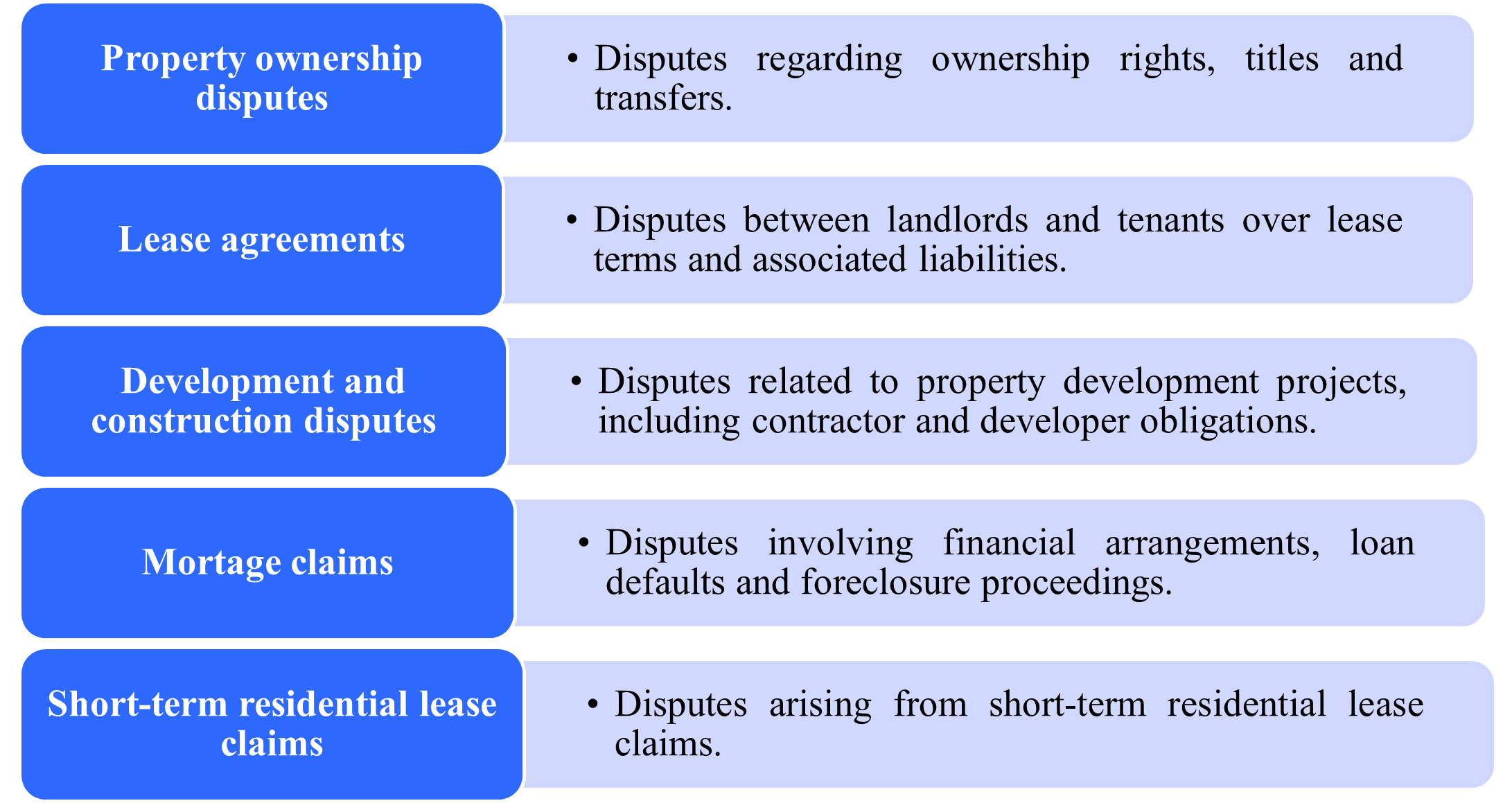
Disputes that will be heard in the Real Property Division include:
 |
The ADGM Courts did not previously have a specific procedural framework for real property claims and applications. With the current changes, a new Real Property Division has been introduced within the ADGM Court of First Instance, which has exclusive jurisdiction over all ADGM real property claims. This will serve as a “one-stop-shop” for resolving real property claims, allowing users to easily identify the procedures applicable to their real property claim. The Division has an inherently fast-tracked and easy-to-understand process, with procedures tailored specifically for real property claims and remedies.
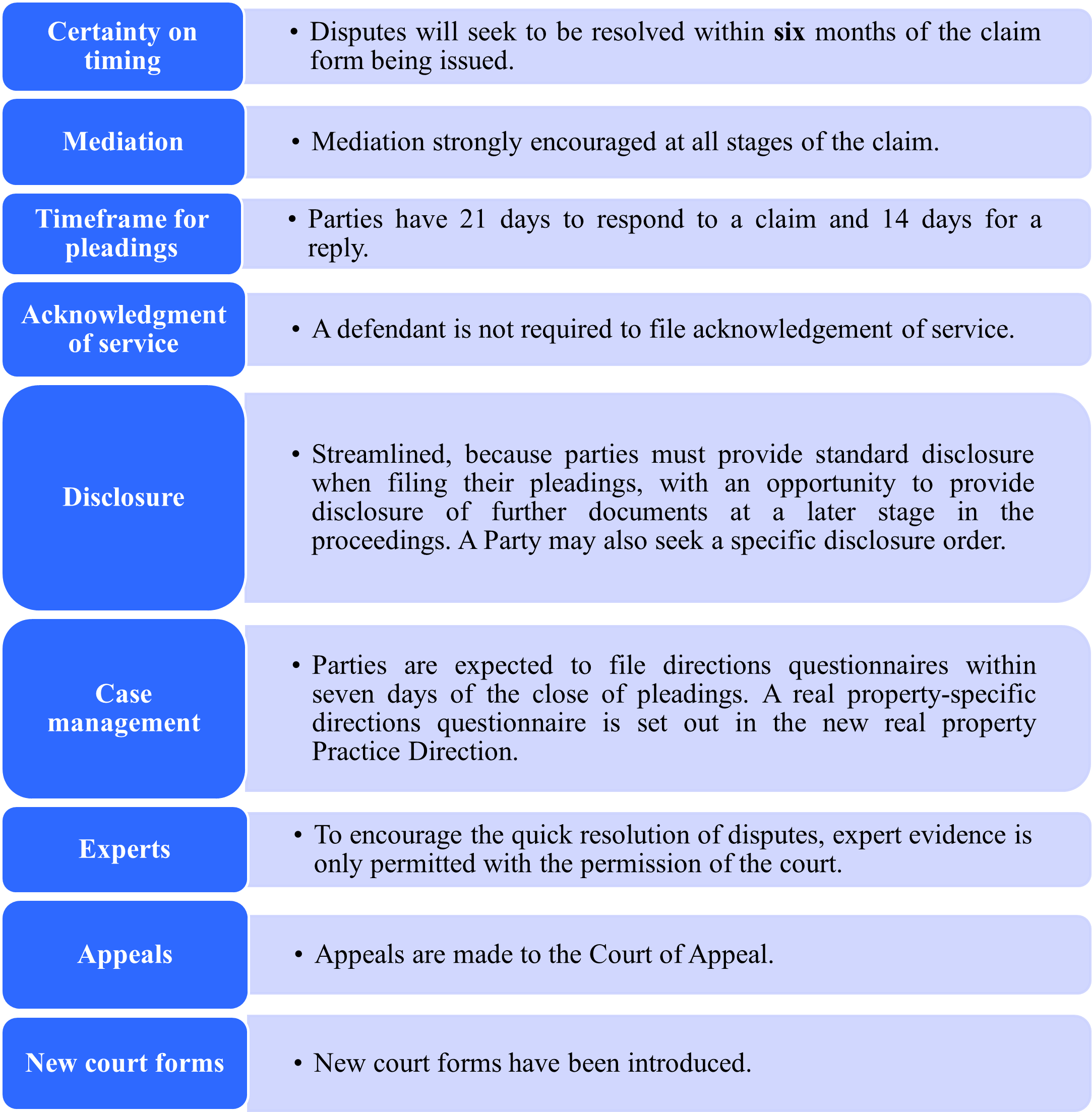
Some of the key features of the Real Property Division are:
 |
Short-Term Residential Lease Claims
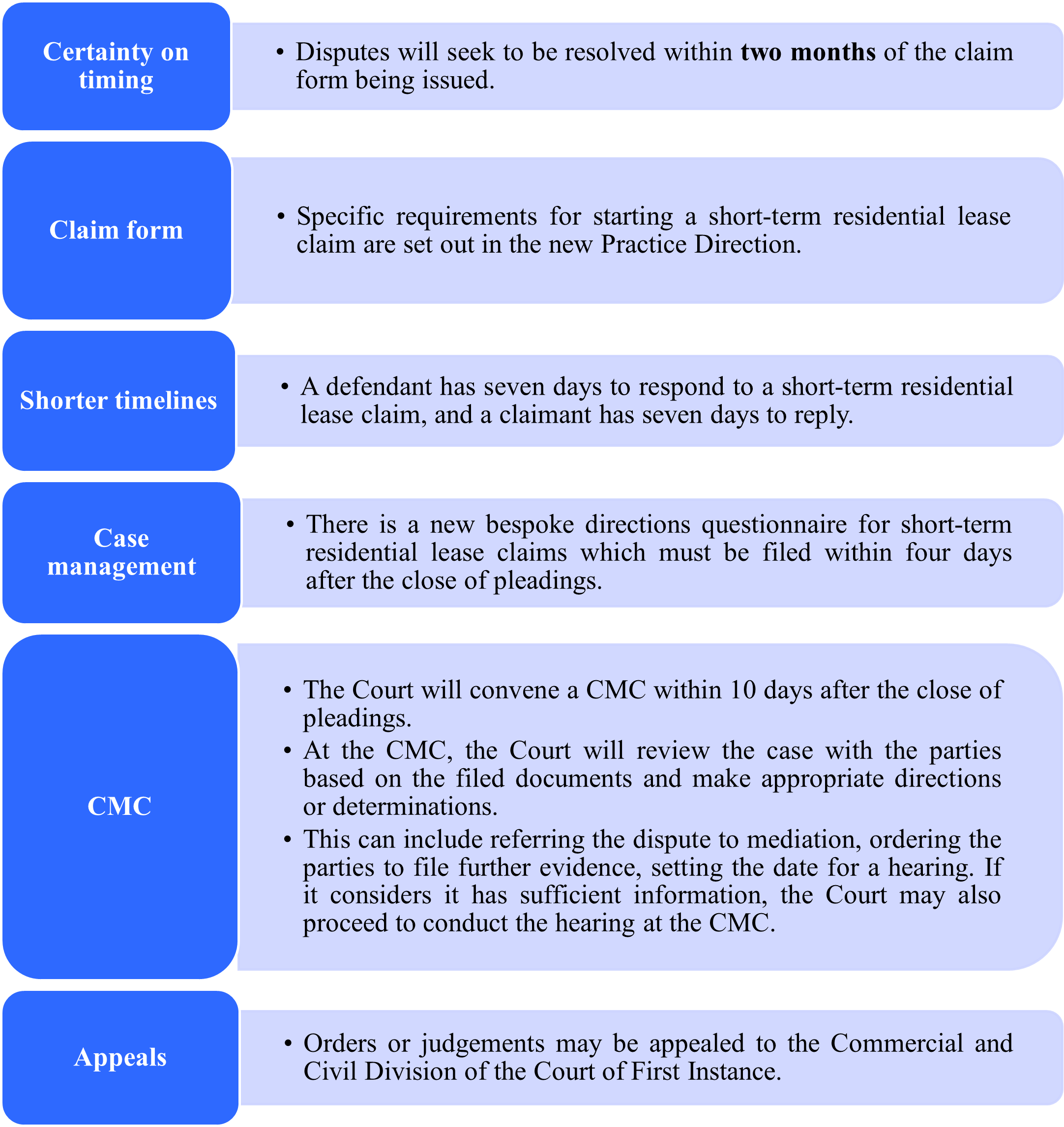
The ADGM Courts have also introduced a bespoke, user-friendly process for “short-term residential lease claims”, i.e., claims arising from leases of residential property with a term of less than four years. These changes recognise the need to cater for higher volumes of relatively low-value disputes, as well as litigants-in-person. The framework is significantly streamlined, in that claims are intended to be disposed of within two months from start to finish. The framework also allows litigants to represent themselves with ease.
The key features are as follows:
 |
“Fast Track” Procedure for Commercial and Civil Claims
New procedures have also been introduced in the Commercial and Civil Division. Key among these changes is the introduction of a “Fast Track” procedure, which will expedite the resolution of more straightforward commercial and civil claims.
The key features of the Fast Track procedure are set out in the Court Procedure Rules and the updated Practice Direction 2 and include:
- Party choice: Parties can opt in to the Fast Track when filing their claim form or the acknowledgment of service, with the other Party having the opportunity to contest the allocation.
- Flexible eligibility criteria: the amended PD 2 sets out detailed guidance on what cases might be suitable for the Fast Track, summarized below:
- A case may be suitable for the Fast Track where, in the opinion of the party proposing the Fast Track, the case will require: a hearing of two days or fewer; no expert evidence; two fact witnesses or fewer per party; limited disclosure; and limited, if any, interlocutory applications.
- A case that is suitable for the Fast Track may also have one or more of the following features (i) the case has a financial value of between US$ 100,000 and US$ 500,000, excluding interest; (ii) the case is straightforward, does not involve a substantial dispute of fact, and does not fall under the Small Claims, Employment or Real Property Divisions; (iii) and/or the case is urgent.
- A case is also likely to be suitable for the Fast Track where it is a liquidated debt claim; an arbitration claim; a claim for declaratory or other relief which is unlikely to involve a substantial dispute of fact; an application for contempt of court; an application for extension of period for delivery of a charge; or an application for a freezing injunction, search order or interim remedy.
- Certainty on timing: the Fast Track aims to resolve cases within six months of allocation, with specific timelines for filing pleadings, disclosure and witness statements.
- Case management: the Fast Track includes provisions for CMCs, progress monitoring and pre-trial reviews to ensure efficient case progression. It also introduces a directions questionnaire and proposed directions tailored to Fast Track claims.
- Document production: Parties must provide standard disclosure when filing their pleadings and parties may also seek specific disclosure. The procedure for the disclosure on the Fast Track dispenses with Redfern Schedules.
- Mediation continues to be strongly encouraged at all stages of the claim.
Comparison of the Rule 27 and Fast Track Procedures
The Fast Track will result in case management on a significantly faster timescale than the traditional Rule 27 procedure. The Fast Track also effectively replaces the streamlined Rule 30 procedure, which has been repealed as part of the reforms. Below, we compare the Fast Track Procedure against the Rule 27 procedure:
| Process | Rule 27 procedure | Fast Track procedure |
| ADR | ADR continues to be encouraged but not mandatory. | |
| Claim form issued | Claimant requests that the Court issues claim form. | Claimant opts into Fast Track in claim form. The Court confirms the allocation when issuing the claim form.
Parties must make standard disclosure when filing their pleadings. |
| AoS and ‘opt in’ to Fast Track | AoS must be filed within 14 days of service of claim form. | AoS must be filed within 7 days if the claim has been placed on the Fast Track.
Defendant may agree or object to proposed Fast Track allocation in its AoS (or propose the Fast Track if not already proposed by Claimant). If there is party disagreement on Fast Track, the Court will determine the correct allocation on the papers. |
| Defence and Counterclaim | Filed within 28 days of claim form. Extendable by agreement by up to 28 days, or further with the Court’s permission. | To be filed within 21 days of claim form (extendable only by up to 14 days).
Where the Court has reserved its decision on the allocation of the case to the Fast Track until after the defendant has answered the claim, the defendant must file and serve an answer to the claim within 28 days of being served with the claim form. |
| Reply and defence to Counterclaim | To be filed within 21 days of service of the defence. | To be filed within 14 days of service of the defence. |
| CMC | CMC convened within 14 days of close of pleadings. | CMC to be scheduled within 10 days of close of pleadings. |
| Trial timetable | Court sets trial timetable as soon as practicable after receiving the parties’ pre-trial checklist. | Fast Track claims will seek to be disposed of within 6 months from allocation of the case to the Fast Track. |
| Disclosure | Standard disclosure but with the ability to request Specific Disclosure. | Parties provide standard disclosure with their pleadings. Parties may make applications for specific disclosure. |
| Evidence | Evidence is served in accordance with timetable agreed in the CMC. Expert evidence with the permission of the Court. | Maximum 2 fact witnesses each, unless the Court directs otherwise.
No expert evidence, unless the Court directs otherwise. |
| Option to decide the claim on the papers | At the Court’s general discretion. | At the Court’s general discretion. |
| The Hearing | At the Court’s general discretion. | Fast Tracked trials should generally be no more than 2 hearing days. |
| Costs and Appeals | The usual rules on costs and appeals for cases in the Commercial and Civil Division apply. | |
.
Other Changes in the Commercial and Civil Division
The updated CPR and Practice Direction 2 also provide several other key changes for Court users. Key among these are the following:
- Removal of the Rule 30 procedure: the Rule 30 process has been removed. It is likely that any claim previously brought under the Rule 30 procedure can now be dealt with using the Fast Track process.
- Removal of page limits: while claim forms in the Commercial and Civil Division were previously limited to 50 pages, this requirement has been removed. This does not reflect an intention that claim forms be longer than 50 pages; however the Court will not prescribe strict limits.
- Extensions of time: the amendments provide greater certainty for parties when applying for an extension of time.
Commentary
The changes to the CPR and Practice Directions reflect the ADGM’s commitment to not only meet but surpass international best practices. They provide a robust and efficient legal framework for the resolution of disputes, particularly in the realm of real property and commercial claims, for the benefit of all Court users. The establishment of the Real Property Division under the new ADGM Court Rules is a significant step toward supporting Abu Dhabi’s growing real estate market and addressing end-user requirements, with the Fast Track offering a route for the quick resolution of claims, providing parties with certainty and a way to resolve disputes efficiently.
The Court has published Guidance Notes for the: (i) Fast Track; (ii) Real Property Division (other than Short-Term Residential Lease Claims); and (iii) Short-Term Residential Lease Claims. These Guidance Notes are on the Court’s website and can be accessed here.
[1] See primarily (i) Real Property Regulations 2024; (ii) Off-Plan Development Regulations 2024; (iii) Off-Plan and Real Property Professionals Regulations 2024; (iv) Off-Plan Development Regulations (Project Account) Rules 2024. Other disputes, claims and applications concerning real property (including commercial leases) are set out in the ADGM Courts, Civil Evidence, Judgments, Enforcement and Judicial Appointments Regulations 2015 as well as the Taking Control of Goods and Commercial Rent Arrears Recovery Rules 2015.
Gibson Dunn’s lawyers are available to assist in addressing any questions you may have. Please contact the Gibson Dunn lawyer with whom you usually work, the authors, or any of the following practice leaders and members of Gibson Dunn’s global Litigation, Transnational Litigation, or International Arbitration practice groups:
Nooree Moola – Dubai (+971 4 318 4643, nmoola@gibsondunn.com)
Lord Falconer – London (+44 20 7071 4270, cfalconer@gibsondunn.com)
Robert Spano – London/Paris (+33 1 56 43 13 00, rspano@gibsondunn.com)
© 2025 Gibson, Dunn & Crutcher LLP. All rights reserved. For contact and other information, please visit us at www.gibsondunn.com.
Attorney Advertising: These materials were prepared for general informational purposes only based on information available at the time of publication and are not intended as, do not constitute, and should not be relied upon as, legal advice or a legal opinion on any specific facts or circumstances. Gibson Dunn (and its affiliates, attorneys, and employees) shall not have any liability in connection with any use of these materials. The sharing of these materials does not establish an attorney-client relationship with the recipient and should not be relied upon as an alternative for advice from qualified counsel. Please note that facts and circumstances may vary, and prior results do not guarantee a similar outcome.