
On June 8, 2021, in Oakwood Laboratories LLC v. Thanoo, the Third Circuit “endeavored to clarify the requirements for pleading a trade secret misappropriation claim under the Defend Trade Secrets Act” (the “DTSA”).[1] Enacted in 2016, the DTSA for the first time created a federal private cause of action for civil litigants seeking to protect trade secrets, allowing plaintiffs to seek injunctive relief and/or damages in the event of misappropriation. While other federal Courts of Appeal have previously commented on the DTSA’s similarity to various state trade secret laws,[2] as well as differences between the federal statute and certain state regimes,[3] it remains to be seen whether any will adopt Oakwood’s analyses. In the meantime, Oakwood is an important decision in this fast-evolving field of federal law of which those prosecuting and defending DTSA claims should be aware.
I. Background Concerning the Defend Trade Secrets Act
Prior to the relatively recent enactment of the DTSA, parties seeking to protect their trade secrets via civil litigation were limited to rights provided by various state laws. Through the DTSA, which provides that the “owner of a trade secret that is misappropriated may bring a civil action . . . if the trade secret is related to a product or service used in, or intended for use in, interstate or foreign commerce,”[4] Congress sought to create uniform national standards for trade secret misappropriation.
Courts have generally required plaintiffs to allege three elements to bring a claim under the DTSA: (1) the existence of a trade secret, (2) that is related to interstate or foreign commerce, and (3) misappropriation of that trade secret.[5] The DTSA defines “trade secrets” as a wide variety of “information” for which “reasonable measures” have been taken “to keep [the information] secret,” and which “derives independent economic value . . . from not being generally known” nor “readily ascertainable through proper means” to others “who can obtain economic value from [its] disclosure or use.”[6] The statute defines “misappropriation” as the “improper” “acquisition,” “disclosure” or “use” of such a trade secret.[7]
Plaintiffs who prevail on a trade secret misappropriation claim under the DTSA may obtain an injunction against further “actual or threatened misappropriation,” and recover damages calculated based upon (i) the plaintiff’s “actual loss,” (ii) “any unjust enrichment” derived by the defendant, or (iii) “a reasonable royalty” for the misappropriation.[8] If the misappropriation was willful and malicious, plaintiffs may also be entitled to reasonable attorney’s fees and “exemplary damages” of up to twice the damages they could otherwise receive.[9]
II. The Facts of Oakwood
The dispute in Oakwood pits Oakwood Laboratories, a pharmaceutical company, against its former senior scientist, Dr. Bagavathikanun Thanoo, and his new employer, Aurobindo Pharma U.S.A., Inc. After working for Oakwood for nearly twenty years, Dr. Thanoo left to take a new job with Aurobindo. Oakwood alleged that Dr. Thanoo misappropriated trade secrets in his new role regarding its “Microsphere Project,” which focused on a particular pharmaceutical technology.[10] In addition, Oakwood and Aurobindo had previously engaged in ultimately unsuccessful negotiations regarding a possible collaboration on the Microsphere Project, in connection with which Oakwood had shared certain proprietary information with Aurobindo pursuant to a confidentiality agreement.[11]
Oakwood alleged that, over the course of nearly 20 years, a team of 20-40 full-time Oakwood employees spent countless hours and approximately $130 million on the Microsphere Project.[12] Accordingly, Oakwood alleged that “the Microsphere Project is not something that could have been replicated” by Aurobindo in under four years “absent misappropriation of Oakwood’s trade secrets.”[13] Aurobindo nevertheless claimed to have done just that, while Oakwood alleges that Aurobindo’s apparent success necessarily reflects the misappropriation of Oakwood’s trade secrets.
The parties’ dispute reached the Third Circuit following four dismissals of various iterations of Oakwood’s complaint by the district court, with each complaint adding additional details not pleaded in earlier versions. The district court initially found that Oakwood failed to identify a specific trade secret,[14] while it subsequently held that later versions of the complaint sufficiently alleged a trade secret but did not adequately plead misappropriation nor how Oakwood had suffered any harm as a result thereof.[15] Rather than amend its complaint for a fourth time, Oakwood appealed from the dismissal of its third amended complaint.
III. The Third Circuit’s Interpretation of the Defend Trade Secrets Act
The parties in Oakwood primarily disagreed on the meaning and application of the first and third elements of a DTSA claim: identification of a trade secret and misappropriation thereof.[16] Accordingly, the Third Circuit first clarified the level of specificity required to plead a trade secret before discussing the definition of misappropriation under the statute. The Court also addressed the defendants’ argument that Oakwood had alleged only speculative harms because Aurobindo had not yet launched any products based on allegedly misappropriated trade secrets. As to each issue, the Third Circuit disagreed with the district court’s reasoning and held that Oakwood’s third amended complaint was sufficient to state a trade secret claim under federal law.
In addressing the level of specificity required to plead a trade secret, the Third Circuit relied on California state law in explaining that while a “trade secret must be described ‘with sufficient particularity to separate it from matters of general knowledge in the trade or of special knowledge of those persons who are skilled in the trade, and to permit the defendant to ascertain at least the boundaries within which the secret lies,’” plaintiffs nevertheless “need not ‘spell out the details of the trade secret’ to avoid dismissal.”[17] In doing so, the Third Circuit joined its sister circuits in noting that the DTSA is “substantially similar as a whole” to many states’ trade secret statutes,[18] the interpretation of which can inform federal courts’ interpretation of the DTSA.
Next, the Court explained that “[t]here are three ways to establish misappropriation under the DTSA: improper acquisition, disclosure, or use of a trade secret without consent.”[19] Although Oakwood had alleged misappropriation via improper acquisition and disclosure, the Third Circuit limited its analysis to “the ‘use’ of a trade secret” because each of the underlying facts relating to acquisition and disclosure concerned events that took place prior to the DTSA’s effective date of May 11, 2016.[20] In interpreting the term “use,” Oakwood turned to Texas state authority, under which “use” was “broadly defined” to mean “any exploitation of the trade secret that is likely to result in injury to the trade secret owner or enrichment to the defendant,” including “marketing goods that embody the trade secret, employing the trade secret in manufacturing or production, relying on the trade secret to assist or accelerate research or development, or soliciting customers through [its] use.”[21] In other words, the Court deemed a trade secret “used” through any way in which one “take[s] advantage” of it “to obtain an economic benefit, competitive advantage, or other commercial value.”[22] In particular, the Third Circuit rejected the district court’s equating of the term “use” with the term “replicate,” noting that the latter term is used elsewhere in the DTSA and thus the two words could not have been intended as synonyms.[23] The Third Circuit thus held that Oakwood could state a DTSA claim without expressly alleging that Aurobindo had copied its trade secret.
Lastly, the Third Circuit held that a plaintiff need not allege harm separate and apart from misappropriation because “misappropriation is harm.”[24] Trade secrets derive “‘economic value . . . from not being generally known’” or “‘readily ascertainable through proper means,’” such that their “economic value depreciates or is eliminated altogether upon its loss of secrecy when a competitor obtains and uses that information without the owner’s consent.”[25] Accordingly, the Third Circuit in Oakwood reasoned that even where defendants “have not yet launched a competing product, that does not mean that [a plaintiff] is uninjured” so long as it “has lost the exclusive use of trade secret information,” which is a “real and redressable harm,”[26]
Conclusion
The Third Circuit’s interpretation of elements of the DTSA will be instructive for litigants based within that Court’s jurisdiction, and may also have an impact in its sister circuits. Given the differing state trade secret regimes that have developed over many decades, as well as the developing case law regarding the DTSA, parties will be well-served by promptly consulting with experienced trade secret counsel when evaluating actual or potential trade secret claims.
_______________________
[1] 2021 WL 2325127, at *1, — F.3d — (3d Cir. 2021).
[2] See, e.g., InteliClear, LLC v. ETC Glob. Holdings, Inc., 978 F.3d 653, 657 (9th Cir. 2020); Akira Techs., Inc. v. Conceptant, Inc., 773 F. App’x 122, 125 (4th Cir. 2019).
[3] See, e.g., Compulife Software Inc. v. Newman, 959 F.3d 1288, 1311 (11th Cir. 2020) (noting “one important difference” between DTSA’s definitions of “misappropriation” and “improper means” and the definitions under Florida law).
[5] Oakwood, 2021 WL 2325127, at *8.
[10] Oakwood, 2021 WL 2325127, at *2.
[14] Oakwood Labs., LLC v. Thanoo, No. 17 Civ. 5090, 2017 WL 5762393, at *4 (D.N.J. Nov. 28, 2017).
[15] Oakwood Labs., LLC v. Thanoo, No. 17 Civ. 5090, 2019 WL 5420453, at *3–4 (D.N.J. Oct. 23, 2019).
[16] Oakwood, 2021 WL 2325127, at *8.
[17] Id. (quoting Diodes, Inc. v. Franzen, 260 Cal. App. 2d 244, 252-53 (Cal. Ct. App. 1968)).
[18] Oakwood, 2021 WL 2325127, at *8.
[21] Id. at *11 (quoting Gen. Universal Sys., Inc. v. HAL, Inc., 500 F.3d 444, 450-51 (5th Cir. 2007)).
[25] Id. at *15 (quoting 18 U.S.C. § 1839(3)(B)).
The following Gibson Dunn attorneys assisted in preparing this client update: Michael L. Nadler, Brian C. Ascher, Ilissa Samplin, Alexander H. Southwell, and Joshua H. Lerner.
Gibson Dunn lawyers are available to assist in addressing any questions you may have about these developments. Please contact the Gibson Dunn lawyer with whom you usually work, any member of the firm’s Trade Secrets practice group, or any of the following:
Joshua H. Lerner – Chair, Trade Secrets Practice, San Francisco (+1 415-393-8254, jlerner@gibsondunn.com)
Brian C. Ascher – New York (+1 212-351-3989, bascher@gibsondunn.com)
Ilissa Samplin – Los Angeles (+1 213-229-7354, isamplin@gibsondunn.com)
Alexander H. Southwell – New York (+1 212-351-3981, asouthwell@gibsondunn.com)
© 2021 Gibson, Dunn & Crutcher LLP
Attorney Advertising: The enclosed materials have been prepared for general informational purposes only and are not intended as legal advice.
Decided June 23, 2021
Collins v. Yellen, No. 19-422
Yellen v. Collins, No. 19-563
Today, the Supreme Court held 6-3 that the structure of the Federal Housing Finance Agency—led by a single Director, removable only “for cause”—violates the Constitution’s separation of powers, but ruled 8-1 that a remand is necessary to determine the proper scope of relief.
Background:
Congress created the Federal National Mortgage Association (“Fannie Mae”) and the Federal Home Loan Mortgage Corporation (“Freddie Mac”) to provide liquidity and stability to the national mortgage market. In the Housing and Economic Recovery Act of 2008, Congress created the Federal Housing Finance Agency (“FHFA”) to regulate these enterprises. FHFA is headed by a single Director who serves a five-year term and is removable by the President only “for cause.”
In 2008, FHFA placed Fannie Mae and Freddie Mac into conservatorship and secured financing from the Treasury Department—which agreed to infuse hundreds of billions of dollars into the enterprises in exchange for preferred stock, dividends, fees, and the like—to keep them afloat.
In 2012, FHFA (led at the time by an Acting Director) and Treasury amended their financing agreements to require Fannie Mae and Freddie Mac to pay Treasury a quarterly dividend equal to nearly all of their net worth, rather than a dividend tied to Treasury’s capital investment.
Three shareholders challenged the amendment on statutory and constitutional grounds, arguing that FHFA’s single-Director structure independent-agency structure violates the Constitution’s separation of powers. The en banc Fifth Circuit held that FHFA’s structure violated the constitution but that the unconstitutionality could be cured by severing the Director’s “for cause” removal restriction. The Fifth Circuit also held that the Recovery Act forecloses the statutory claims against Treasury but not FHFA.
In January 2021, FHFA and Treasury amended the agreements for a fourth time to eliminate the net-worth-based dividend formula that caused the shareholders’ injuries.
Issues:
(1) Whether FHFA’s structure violates the separation of powers;
(2) If so, whether the fourth amendment (2021) moots the shareholders’ claims;
(3) If FHFA’s structure violates the separation of powers, whether the proper retrospective remedy is to set aside all actions taken by the unconstitutionally structured FHFA (including the 2012 amendment at issue); and
(4) Whether the Recovery Act forecloses the shareholders’ statutory claim.
Court’s Holding:
(1) Yes. FHFA’s structure as an “independent” federal agency headed by a single Director removable by the President only “for cause” violates the Constitution’s separation of powers.
(2) Yes, in part. Shareholders’ claims for prospective relief were rendered moot by the adoption of the fourth amendment in 2021. The retrospective claims were not mooted by the fourth amendment.
(3) No. There is no reason to set aside the third amendment because it was (i) adopted by an Acting Director who was removable at will and (ii) subsequently implemented by confirmed Directors who were appointed in a manner consistent with the constitution and thus possessed lawful executive power (only the statute’s removal provision was unconstitutional). The Court remanded for further proceedings to determine the retrospective relief, if any, to which the shareholders are entitled.
(4) The Recovery Act’s anti-injunction provision bars shareholders’ statutory claim.
What It Means:
- In step with the Court’s decision last term in Seila Law LLC v. CFPB, 140 S. Ct. 2183 (2020), today’s decision again recognizes the significant limitation on Congress’s ability to insulate agencies from presidential control. Agencies that execute federal law and are headed by a single Director, including financial regulators, cannot be “independent” of the President, but instead must be subject to the President’s constitutional duty to control the federal officers who assist the President in executing federal law.
- The Court’s holding that a federal agency headed by a single Director removable by the President only “for cause” is unconstitutional could have ripple effects. For example, the validity of the Social Security Administration’s leadership structure, which has been led by a single commissioner since 1994, may be called into question.
- The Court’s decision that all of FHFA’s actions while unconstitutionally structured need not be set aside could impact other litigation challenging actions that the Consumer Financial Protection Bureau took when it was unconstitutionally structured. But as the Court made clear, plaintiffs are entitled to retrospective relief so long as they can show that the unconstitutional removal provision inflicted compensable harm.
- The Court’s 8-1 decision on standing reiterated that, for traceability purposes, the relevant inquiry turns on whether the injury can be traced to the defendant’s allegedly unlawful conduct—not the provision of law being challenged.
The Court’s opinion is available here.
Gibson Dunn’s lawyers are available to assist in addressing any questions you may have regarding developments at the Supreme Court. Please feel free to contact the following practice leaders:
Appellate and Constitutional Law Practice
| Allyson N. Ho +1 214.698.3233 aho@gibsondunn.com | Mark A. Perry +1 202.887.3667 mperry@gibsondunn.com | Lucas C. Townsend +1 202.887.3731 ltownsend@gibsondunn.com |
| Bradley J. Hamburger +1 213.229.7658 bhamburger@gibsondunn.com |
Related Practice: Administrative Law and Regulatory Practice
| Eugene Scalia +1 202.955.8543 escalia@gibsondunn.com | Helgi C. Walker +1 202.887.3599 hwalker@gibsondunn.com |
Overshadowed in the media by the historic judgment of 3 February 2021 by the Administrative Court of Paris in the “Affaire du siècle” (the Case of the century), a ruling by the Versailles Administrative Court of Appeal (the Court) on 29 January 2021 could also result in a historic ruling by the Court of Justice of the European Union (the CJEU). Indeed, upon referral by the Court, the CJEU will be called upon to rule on the existence of a right to breathe clean air and on the liability incurred by the Member States of the European Union in the case of disregard of their obligations in terms of air quality (Case C-61/21).
I. Context of the ruling rendered by the Court
Under Directive 2008/50/EC of 21 May 2008 on “ambient air quality and cleaner air for Europe” (the Directive), Member States must establish zones and agglomerations throughout their territory in which air quality is assessed (Article 4).
Article 13-1 of the Directive requires Member States to ensure that levels of fine particulate matter (PM10), carbon monoxide or nitrogen dioxide (NO2) do not exceed limit values set out in an annex.
Article 23-1 of the Directive provides that where these limit values are exceeded by levels of pollutants in ambient air, Member States must, in the given zone or agglomeration, adopt “air quality plans”. If the limit values are exceeded after the deadline for their application, the air quality plans provide for appropriate measures to ensure that the period of exceedance is as short as possible.
At the end of 2019, following an action for failure to fulfil obligations brought by the European Commission, the Court of Justice of the European Union ruled that France had failed to fulfil its obligations under Articles 13(1) and 23(1) of the Directive with regards to NO2 for several French regions, including the Paris region (CJEU, 24 October 2019, case C-636/18). On 30 October 2020, the European Commission announced that it would bring a new action against France before the CJEU for failure to fulfil obligations , it being specified that the failures this time deal with the excessive level of PM10 in the air.
For its part, the Conseil d’Etat (Council of State, France), the highest administrative court in France, had already ruled in 2017 that, given the persistence of observed exceedance of PM10 and NO2 concentrations in the air, the air quality plans for certain areas, including the Paris region, had to be considered insufficient with respect to the obligations and thresholds set by the Directive. The Conseil d’Etat had then enjoined the State to take the necessary measures to bring PM10 and NO2 concentrations below the limit values (CE, 12 July 2017, No. 394254). In a decision dated 10 July 2020, the Conseil d’Etat considered that the French State had not complied with the injunctions requested in the decision of 12 July 2017, and imposed a €10 million penalty on them if they did not justify having taken the required measures within six months of the decision (CE, ass., 10 July 2020, No. 428409). In light of the publicly available information, the Conseil d’Etat should soon rule on whether the French State has finally fulfilled its obligations.
It is in this context that the Court, sitting in plenary session, was called upon to rule on the action for damages brought by an applicant, resident of the Paris region, who attributed his various allergies to air pollution. The applicant considered that the deterioration of the air quality resulted in particular from the disregard by the French authorities of the obligations set by Articles 13(1) and 23(1) of the Directive.
II. Reasoning steps followed by the Court
It has been consistently held that “the principle of State liability for loss and damage caused to individuals as a result of breaches of [Community] law for which it can be held responsible is inherent in the system of the [Treaty on the Functioning of the European Union]” (CJEU, 5 March 1996, cases C-46/93 and C-48/93).
The CJEU also recalls that a right to reparation is recognized by European law if the following three conditions are met:
- the rule of law infringed must be intended to confer rights on individuals;
- the breach must be sufficiently serious, it being specified that this is the case if the breach has persisted despite a judgment by the CJEU finding the infringement in question to be established;
- there must be a direct causal link between the breach of the obligation resting on the State and the damage sustained by the injured parties.
In the present case, since it was seized of a claim for damages based on the breach of the Directive, i.e. of a norm of European law, the Court had to verify whether the three conditions mentioned above were met.
In order to determine whether the first condition had been met, the Court had first to decide whether Articles 13(1) and 23(1) of the Directive, which the applicant claimed had been disregarded, gave him a “right”. In other words, the Court had to determine whether these Articles conferred a “right to breathe clean air” eligible of giving rise to a compensation claim.
As early as 2014, the CJEU had indicated that Articles 13(1) and 23(1) allowed “persons directly concerned by the limit value being exceeded” to obtain, before the national authorities and courts, the establishment of an air quality plan in accordance with the requirements of Article 23 (CJEU, 19 November 2014, case C-404/13). It is, moreover, this right that was implemented by the Conseil d’Etat in the 2017 and 2020 decisions outlined above.
The Court probably considered that the right thus available to individuals to compel Member States to implement the obligations laid down by the Directive did not necessarily imply the recognition for their benefit of a “right to breathe clean air”, the disregard of which is likely to give rise to an action for damages.
Since the answer was uncertain and the issue was related to the scope of a European norm, the Court chose to refer two questions to the CJEU for a preliminary ruling on Articles 13(1) and 23(1) of the Directive in order to obtain the appropriate interpretation of these Articles.
The first question is relative to whether Articles 13(1) and 23(1) of the Directive give individuals, in the event of a sufficiently serious breach by a Member State of the European Union of the obligations arising therefrom, a right to obtain from the Member State in question, compensation for damage to their health which has a direct and certain causal link with the deterioration of air quality.
If the answer to the first question is affirmative, the Court then asked the CJEU to specify the conditions for the opening of this right, in particular with regards to the date on which the existence of the breach attributable to the Member State in question must be assessed.
III. Possible consequences of the Court’s ruling
If the CJEU were to answer the first of the questions asked by the Court in the affirmative, it would then be for the Court to determine whether the other two conditions for the French State’s liability to be characterized are met.
Insofar as France has already been subject of a breach judgment for failure to comply with its obligations with respect to NO2 (CJEU, 24 October 2019, cited above), the condition relating to the sufficiently serious breach of a right conferred on individuals does not seem to pose any particular difficulty.
It will then be up to the Court to assess whether there is a direct causal link between the violation and the damage claimed by the applicant, it being specified that this demonstration will depend on the answer given by the CJEU to the second question, namely from what date the existence of the violation attributable to the Member State in question must be assessed, and will probably require recourse to a medical expert opinion.
The recognition of a right to breathe clean air likely to be subject of an action for compensation would very probably constitute a strong constraint weighing on the Member States of the European Union. In this respect, it should be emphasized that France is far from being the only country in the European Union to have been condemned for failure to comply with the obligations set out in Articles 13(1) and 23 of the Directive: Italy has been condemned for systematic and persistent exceeding of the PM 10 limit values (CJEU, 10 November 2020, case C-644/18), the United Kingdom and Germany have been condemned in the same way, but for N02 (CJEU, 4 March 2021, case C-664/18 and CJEU, 3 June 2021, case C-635/18). The question of a possible compensation claim based on the disregard of the right to breathe clean air could thus have a repercussion in all of the European Union States.
The following Gibson Dunn attorneys assisted in preparing this client update: Nicolas Autet and Grégory Marson.
Gibson Dunn’s lawyers are available to assist in addressing any questions you may have regarding these developments. Please contact the Gibson Dunn lawyer with whom you usually work, the authors, or any of the following lawyers in Paris by phone (+33 1 56 43 13 00) or by email:
Nicolas Autet (nautet@gibsondunn.com)
Grégory Marson (gmarson@gibsondunn.com)
Nicolas Baverez (nbaverez@gibsondunn.com)
Maïwenn Béas (mbeas@gibsondunn.com)
© 2021 Gibson, Dunn & Crutcher LLP
Attorney Advertising: The enclosed materials have been prepared for general informational purposes only and are not intended as legal advice.
On June 11, 2021, New York Governor Andrew M. Cuomo signed into law a Uniform Foreign Country Money Judgments Act (the “2021 Recognition Act”), amending New York’s Uniform Foreign Country Money-Judgments Recognition Act of 1970 (the “1970 Recognition Act”).[1] The bill was designed to update and bring New York’s existing legislation in line with the revisions proposed by the Uniform Law Commission in 2005.[2] With this enactment, New York follows a growing number of U.S. states that have modernized their recognition acts over the last decade.
As detailed herein, the 2021 Recognition Act both clarifies the procedural mechanisms and substantive arguments that litigants can invoke in a proceeding to recognize foreign country money judgments (“foreign judgments”), while also significantly expanding the defenses to recognition and enforcement of foreign judgments available to defendants in New York. In particular, the substantive changes seek to ensure that the New York courts only recognize foreign judgments that have been procured through a fair and impartial process.
I. Overview of Recognition of Foreign Judgments in the United States
There is no federal law governing recognition of foreign judgments in the United States. However, the rules are broadly similar across all 50 U.S. states and the District of Columbia, providing for recognition of foreign judgments that are final, conclusive, and enforceable where rendered. Over the last 60 years, a majority of U.S. states have codified their rules on recognition, following initially the Uniform Foreign Money Judgments Recognition Act of 1962 (the “1962 Uniform Act”) or now increasingly the Uniform Foreign-Country Money Judgments Recognition Act of 2005 (the “2005 Uniform Act”).
The 1962 Uniform Act was designed to increase the predictability and stability in this area of the law, facilitate international commercial transactions, and encourage foreign courts to recognize U.S. judgments.[3] Notably, the 1962 Uniform Act did not prescribe any enforcement procedure, providing instead that a foreign judgment, once domesticated, is enforceable in the same manner as the judgment of a court of a sister U.S. state, which is entitled to full faith and credit. That is still the prevailing rule today.
The 1962 Uniform Act defined certain threshold requirements for recognition and outlined certain mandatory and discretionary grounds for non-recognition. For example, the recognizing U.S. court was directed to consider, inter alia, whether the judgment was rendered under a judicial system that provides for impartial tribunals and procedures compatible with due process; whether the foreign court had personal and subject matter jurisdiction; whether the defendant received sufficient notice of the proceedings to mount a defense; whether the judgment was obtained by fraud; and whether the cause of action or claim for relief on which the judgment is based is repugnant to the public policy of the recognizing state.
In 2005, the Uniform Law Commission issued the 2005 Uniform Act.[4] Its purpose was to update and clarify the 1962 Uniform Act and “to correct problems created by the interpretation of the provisions of that Act by the courts over the years since its promulgation” while maintaining “the basic rules or approach.”[5] In particular, the 2005 Uniform Act created new discretionary bases for non-recognition, updated and clarified the definitions section, clarified the procedure for seeking (and resisting) recognition of a foreign judgment, expressly allocated the burden of proof, and established a statute of limitations for recognition actions.[6]
Since 2007, a growing number of U.S. states have enacted the modernized 2005 Uniform Act (see map below). As of June 2021, 27 states and the District of Columbia have adopted the 2005 Uniform Act, while one state has introduced this legislation.[7] Another 11 states and the U.S. Virgin Islands currently still apply the 1962 Uniform Act.[8] In the remaining 12 states, the recognition of judgments remains primarily a matter of common law or unique statutory provisions.
Law on Recognition of Foreign Judgments in the United States
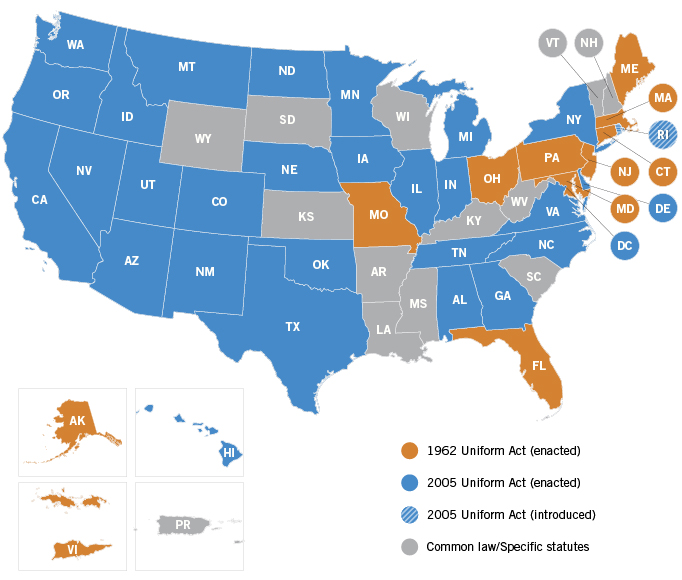
Data Source: Uniform Law Commission
II. Overview of Recognition of Foreign Judgments in New York
New York adopted the 1962 Uniform Act as CPLR Article 53 in 1970. Traditionally in New York, once the judgment creditor had made the initial showing that the foreign judgment falls within the scope of New York’s recognition statute, the judgment debtor had to establish a basis for non-recognition if it wished to avoid recognition. As in most U.S. states, New York’s 1970 Recognition Act set out both mandatory grounds for non-recognition—under which the court is prohibited from granting recognition—and discretionary bases on which a court may decline recognition.
With the enactment of the 2021 Recognition Act, New York largely leaves intact the legal framework established by the 1970 Recognition Act while adopting the key updates from the 2005 Uniform Law:
- New Proceeding-Specific Discretionary Criteria. There are two new discretionary criteria for non-recognition, providing that a court may decline recognition where (i) “the judgment was rendered in circumstances that raise substantial doubt about the integrity of the rendering courts with respect to the judgment,”[9] or (ii) “the specific proceeding in the foreign court leading to the judgment was not compatible with the requirement of due process of law.”[10] These two new grounds are significant because they are proceeding-specific—i.e., the judgment debtor can challenge recognition based on a lack of due process or impartial tribunals in the specific proceedings that gave rise to the foreign judgment, regardless of the fairness or procedural safeguards available in the foreign country’s judicial system overall. Under the 1970 Recognition Act, by contrast, complaints about the particular proceeding against the judgment debtor were generally insufficient. To avoid recognition, by statute, a judgment debtor had to establish that the foreign country’s judicial system as a whole lacked impartial tribunals or due process—a high bar in state courts that may be loath to condemn the entire judicial system of a foreign country. Nonetheless, as the Uniform Law Commission noted in its letter of support of the bill, a number of U.S. courts applying the 1962 Uniform Act were either ignoring the “system” language in the governing statute or else “stretching” that language to import proceeding-specific considerations.[11] Such interpretative issues were sufficiently significant to warrant the Uniform Law Commission’s revision of the 1962 Uniform Act.[12]
- Updated Grounds for Non-Recognition. The 2021 Recognition Act also expands the mandatory and discretionary grounds for non-recognition available to a judgment debtor seeking to resist recognition. For example, whereas a lack of subject matter jurisdiction was a discretionary basis for non-recognition under the 1970 Recognition Act, it is mandatory under the 2021 Recognition Act, meaning that a New York court must refuse recognition where the foreign court lacked subject matter jurisdiction over the underlying dispute.[13] Further, the 2021 Recognition Act expands the scope of the (discretionary) public policy non-recognition ground, providing that a court may consider either whether the foreign judgment or the cause of action on which the judgment is based is “repugnant to the public policy of New York or of the United States.”[14] Under the 1970 Recognition Act, this ground was limited to cases where the underlying cause of action—and not the foreign judgment itself—was repugnant to New York’s public policy.
- Burden of Proof. The 2021 Recognition Act clarifies and makes explicit that the party seeking recognition of a foreign judgment bears the burden of establishing that the judgment is subject to the act,[15] while the party resisting recognition has the burden of establishing that a specific ground for non-recognition applies.[16]
- Procedure. The Act clarifies that when recognition is sought as an original matter, the party seeking recognition must file an action on the judgment (or a motion for summary judgment in lieu of complaint) to obtain recognition,[17] but when recognition is sought in a pending action, it may be filed as a counter-claim, cross-claim, or affirmative defense.[18]
- Statute of Limitations. The 2021 Recognition Act establishes a limitations period, providing that a New York court may only enforce a foreign judgment that is still “effective in the foreign country.”[19] If there is no limitation on enforcement in the country of origin, recognition must be sought within 20 years of the date that the judgment became effective in the foreign country.[20]
As with the 1970 Recognition Act, the 2021 Recognition Act applies to any foreign judgment that is “final, conclusive and enforceable” where rendered.[21] It does not apply to a foreign judgment for taxes, a fine or penalty, and it further clarifies that it does not apply to a “judgment for divorce, support or maintenance, or other judgment rendered in connection with domestic relations.”[22] Within those defined limits, the 2021 Recognition Act will apply to all recognition actions commenced on or after the effective date of the act (i.e., June 11, 2021)[23] even if the relevant transactions or proceedings in the foreign country took place before then.
III. Implications of New York’s 2021 Recognition Act
As noted above, the 2021 Recognition Act provides certain definitional, procedural, and substantive changes that will impact judgment creditors and debtors litigating recognition in New York courts.
Many of these revisions will benefit both parties by providing greater clarity and precision about the procedural mechanisms and substantive arguments they can plausibly invoke in a recognition proceeding. Some of the revisions, like the statute of limitations, reduce the incentive to forum-shop where foreign law provides for a shorter effectiveness period than New York law.
The most immediate effect of the 2021 Recognition Act will be felt on the scope and complexity of litigation. As the Sponsor Memo noted, the 2021 Recognition Act “revises the grounds for denying recognition of foreign country money judgements to better reflect the even more varied forms of judicial process on the modern global stage.”[24] Notably, the 2021 Recognition Act will permit judgment debtors to challenge foreign judgments based on proceeding-specific concerns so as to ensure the foreign judgment being recognized has adhered to fundamental principles of due process that the New York courts have a vested interest in protecting. This was previously more difficult to do where only systemic (as opposed to proceeding-specific) due process considerations could be considered in denying recognition.[25] The inclusion of proceeding-specific grounds, which will inevitably expand the range of arguments a judgment debtor can now raise, will likely increase the number of foreign judgments denied recognition in New York courts.
These additional defenses will require greater sophistication by both judgment creditors and debtors in recognition actions in terms of what kinds of foreign legal and expert evidence to marshal. At the same time, these defenses give the New York courts additional bases to ensure that they only recognize judgments that result from a fair and impartial proceeding.
______________________________
[1] The bill was signed into law (Chapter 127) on June 11, 2021. See Senate Bill S523A, N.Y. State Senate (last visited June 21, 2021), https://www.nysenate.gov/legislation/bills/2021/s523.
[2] S.B. S523A (N.Y. 2021) (“An act to amend [New York’s] civil practice law and rules, in relation to revising and clarifying the uniform foreign country money-judgments recognition act.”).
[3] See Uniform Law Comm’n, Uniform Foreign Money-Judgments Recognition Act (with Prefatory Note and Comments) (1962).
[4] See Uniform Law Comm’n, Uniform Foreign-Country Money Judgments Recognition Act (with Prefatory Note and Comments) (2005).
[5] Id., Prefatory Note, at 1.
[7] Foreign-Country Money Judgments Recognition Act 2005, Uniform Law Comm’n (last visited June 22, 2021), https://www.uniformlaws.org/committees/community-home?CommunityKey=ae280c30-094a-4d8f-b722-8dcd614a8f3e.
[8] Foreign-Country Money Judgments Recognition Act 1962, Uniform Law Comm’n (last visited June 22, 2021), https://www.uniformlaws.org/committees/community-home?CommunityKey=9c11b007-83b2-4bf2-a08e-74f642c840bc.
[9] N.Y. CPLR § 5304(a)(7) (McKinney 2021).
[11] See Letter from the Uniform Law Commission to the Chairmen of the New York Assembly Judiciary Committee, dated March 11, 2021, at 2.
[13] N.Y. CPLR § 5304(a)(3) (McKinney 2021).
[24] Sponsor’s Mem., S.B. S523A (N.Y. 2021), https://www.nysenate.gov/legislation/bills/2021/s523.
[25] See, e.g., Shanghai Yongrun Inv. Management Co., Ltd. v. Kashi Galaxy Venture Capital Co., Ltd., No. 156328/2020, 2021 WL 1716424 (N.Y. Sup. Ct. Apr. 30, 2021); Chevron Corp. v. Donziger, 974 F. Supp. 2d 362 (S.D.N.Y. 2014), aff’d, 833 F.3d 74 (2d Cir. 2016); Bridgeway Corp. v. Citibank, 45 F. Supp. 2d 276 (S.D.N.Y. 1999), aff’d, 201 F.3d 134 (2d Cir. 2000). See also Osorio v. Dole Food Co., 665 F. Supp. 2d 1307 (S.D. Fla. 2009), aff’d sub nom. Osorio v. Dow Chem. Co., 635 F.3d 1277 (11th Cir. 2011); Bank Melli Iran v. Pahlavi, 58 F.3d 1406 (9th Cir. 1995).
The following Gibson Dunn lawyers prepared this client alert: Rahim Moloo, Lindsey D. Schmidt, Maria L. Banda, and Peter M. Wade.
Gibson Dunn’s lawyers are available to assist in addressing any questions you may have regarding these issues. Please contact the Gibson Dunn lawyer with whom you usually work, any member of the firm’s International Arbitration, Judgment and Arbitral Award Enforcement or Transnational Litigation practice groups, or the following:
Rahim Moloo – New York (+1 212-351-2413, rmoloo@gibsondunn.com)
Lindsey D. Schmidt – New York (+1 212-351-5395, lschmidt@gibsondunn.com)
Anne M. Champion – New York (+1 212-351-5361, achampion@gibsondunn.com)
Maria L. Banda – Washington, D.C. (+1 202-887-3678, mbanda@gibsondunn.com)
Please also feel free to contact the following practice group leaders:
International Arbitration Group:
Cyrus Benson – London (+44 (0) 20 7071 4239, cbenson@gibsondunn.com)
Penny Madden QC – London (+44 (0) 20 7071 4226, pmadden@gibsondunn.com)
Judgment and Arbitral Award Enforcement Group:
Matthew D. McGill – Washington, D.C. (+1 202-887-3680, mmcgill@gibsondunn.com)
Robert L. Weigel – New York (+1 212-351-3845, rweigel@gibsondunn.com)
Transnational Litigation Group:
Susy Bullock – London (+44 (0) 20 7071 4283, sbullock@gibsondunn.com)
Perlette Michèle Jura – Los Angeles (+1 213-229-7121, pjura@gibsondunn.com)
Andrea E. Neuman – New York (+1 212-351-3883, aneuman@gibsondunn.com)
William E. Thomson – Los Angeles (+1 213-229-7891, wthomson@gibsondunn.com)
© 2021 Gibson, Dunn & Crutcher LLP
Attorney Advertising: The enclosed materials have been prepared for general informational purposes only and are not intended as legal advice.
Decided June 21, 2021
United States v. Arthrex, Inc., No. 19-1434; Smith & Nephew, Inc. v. Arthrex, Inc., No. 19-1452; Arthrex, Inc. v. Smith & Nephew, Inc., No. 19-1458
Today, the Supreme Court held 5-4 that the absence of Executive Branch review of decisions rendered by Administrative Patent Judges (APJs) of the Patent Trial and Appeal Board (PTAB) violates the Appointments Clause, and that the proper remedy is to sever a statutory provision so that the Director of the Patent and Trademark Office may review PTAB decisions.
Background:
The Constitution’s Appointments Clause, art. II, § 2, cl. 2, requires principal Officers of the United States to be appointed by the President with the advice and consent of the Senate, but permits inferior Officers to be appointed by a department head such as the Secretary of Commerce. Under the Patent Act, the Secretary appoints APJs to preside over adjudicatory proceedings such as inter partes review (IPR) and may fire them for cause. The Director of the Patent and Trademark Office supervises APJs in various ways, but cannot unilaterally review their patentability decisions. Smith & Nephew petitioned for IPR of Arthrex’s patent claims and a panel of APJs decided the claims were unpatentable. On appeal, Arthrex argued that APJs are unconstitutionally appointed principal Officers because they are insufficiently supervised by others. The Federal Circuit agreed that APJs’ appointment violated the Appointments Clause. As a remedy, it severed APJs’ for-cause removal protections to render them inferior Officers, and remanded Arthrex’s IPR to a new panel of APJs.
Issue:
Does the Appointments Clause require administrative review of PTAB decisions?
Court’s Holding:
Yes. The Appointments Clause does not permit APJs to exercise executive power unreviewed by any Executive Branch official. Accordingly, the Director has the authority to unilaterally review any PTAB decision, and a contrary statutory provision (35 U.S.C. § 6(c)) is unenforceable as applied to the Director.
“The structure of the PTO and the governing constitutional principles chart a clear course: decisions by APJs must be subject to review by the director.”
Chief Justice Roberts, writing for the majority
Gibson Dunn represented the petitioners: Smith & Nephew, Inc. and ArthroCare Corp.
What It Means:
- The Court’s 5-4 decision holding that the Patent Act provided for constitutionally inadequate supervision of APJs may make it easier for future challengers to raise Appointments Clause objections to other administrative adjudicators.
- By a 7-2 vote, the Court rejected calls by critics of the PTAB to invalidate the entire system. Although the Court’s decision allows the PTAB to continue operating, the Director now will be able to review final PTAB decisions and, upon review, may issue decisions on behalf of the Board.
- The Court clarified that its opinion concerns only the Director’s ability to supervise APJs in adjudicating petitions for IPR. The opinion does not address the Director’s supervision over other PTAB adjudications, such as the examination process.
- The Court held that because “the source of the constitutional violation is the restraint on the review authority of the Director, rather than the appointment of APJs by the Secretary,” the appropriate remedy is a limited remand to the Acting Director to decide whether to rehear Smith & Nephew’s IPR petition, rather than a hearing before a new panel of APJs.
The Court’s opinion is available here.
Gibson Dunn’s lawyers are available to assist in addressing any questions you may have regarding developments at the Supreme Court. Please feel free to contact the following practice leaders:
Appellate and Constitutional Law Practice
| Allyson N. Ho +1 214.698.3233 aho@gibsondunn.com | Mark A. Perry +1 202.887.3667 mperry@gibsondunn.com | Lucas C. Townsend +1 202.887.3731 ltownsend@gibsondunn.com |
| Bradley J. Hamburger +1 213.229.7658 bhamburger@gibsondunn.com |
Related Practice: Intellectual Property
| Kate Dominguez +1 212.351.2338 kdominguez@gibsondunn.com | Y. Ernest Hsin +1 415.393.8224 ehsin@gibsondunn.com | Josh Krevitt – New York +1 212.351.4000 jkrevitt@gibsondunn.com |
| Jane M. Love, Ph.D. +1 212.351.3922 jlove@gibsondunn.com |
Decided June 21, 2021
Nat’l Collegiate Athletic Ass’n v. Alston, No. 20-512; and Am. Athletic Conf. v. Alston, No. 20-520
Today, the Supreme Court unanimously held that the NCAA’s current limits on education-related benefits for student-athletes violate the Sherman Act.
Background:
The NCAA imposes eligibility rules fixing the compensation and benefits that member schools can offer student-athletes. The NCAA maintains that its rules, including its restrictions on certain education-related benefits, are necessary to preserve amateurism in college athletics, which is what distinguishes its product from professional sports.
Several student-athletes brought class-action suits against the NCAA and its member conferences, arguing that the restrictions on compensation and benefits run afoul of the Sherman Act. After a bench trial, the district court enjoined the NCAA’s restrictions on education-related benefits after ruling that they violated the Sherman Act. The court ordered the NCAA to allow its member schools to offer athletes education-related benefits such as academic incentive awards and paid, post-eligibility internships. The court did not, however, enjoin NCAA rules that restrict benefits unrelated to education.
The Ninth Circuit affirmed, holding that the NCAA’s limits on education-related benefits violate the Sherman Act, and that allowing student-athletes to receive certain education-related benefits beyond the cost of college attendance, such as paid post-eligibility internships, would not eliminate the distinction between college athletics and professional sports.
Issue:
Whether the NCAA’s restrictions on education-related benefits for student-athletes violate the Sherman Act.
Court’s Holding:
Yes. The NCAA’s restrictions on education-related benefits violate Section 1 of the Sherman Act. Substantially less restrictive rules that permit student-athletes to receive certain limited education-related benefits would adequately preserve the distinction between college athletics and professional sports.
The district court’s injunction “does not float on a sea of doubt but stands on firm ground—an exhaustive factual record, a thoughtful legal analysis consistent with established antitrust principles, and a healthy dose of judicial humility.”
Justice Gorsuch, writing for the Court
Gibson Dunn submitted an amicus brief on behalf of the Players Associations of the NFL, NBA, WNBA, and National Women’s Soccer League, and the National Collegiate Players Association, in support of respondents: Shawne Alston, et al.
What It Means:
- Today’s decision rejects the NCAA’s argument that it is effectively immune from antitrust scrutiny because its rules should receive abbreviated, deferential review, and instead holds that the NCAA’s restrictions are subject to review under the “rule of reason.”
- The Court confirmed that antitrust law does not require businesses “to use anything like the least restrictive means of achieving legitimate business purposes,” but upheld the district court’s conclusion that restrictions on education-related benefits were not necessary to preserve consumer demand for college athletics, in light of the record evidence establishing that the immense popularity of college sports is largely unrelated to education-related benefits paid to student-athletes and given the existence of substantially less restrictive alternatives.
- The Court’s decision permits student-athletes to receive a variety of education-related benefits that go beyond the cost of college attendance, such as academic and graduation incentive awards, graduate-school scholarships, and paid, post-eligibility internships. That said, there is nothing that requires member schools to offer such benefits, nor are individual conferences prohibited from imposing their own restrictions.
- The continued viability of the NCAA’s restrictions on benefits unrelated to education remains an open question. The student-athletes did not press their challenge to these rules—which the Ninth Circuit upheld—before the Court. Justice Kavanaugh wrote a separate concurrence “to underscore” his view that those rules “raise serious questions under the antitrust laws.” He indicated that the NCAA may lack a valid procompetitive justification for its remaining compensation rules because its argument—“that colleges may decline to pay student athletes because the defining feature of college sports . . . is that the student athletes are not paid”—“is circular and unpersuasive.”
- Nothing in the Court’s decision prevents states or Congress from devising different rules to govern the compensation and benefits available to college athletes. Many states have adopted or are considering proposals to loosen restrictions on such benefits. Congress is considering similar proposals, as well as a bill, the “Fairness in Collegiate Athletics Act” (S. 4004), which would arguably give the NCAA the antitrust immunity it sought in this case.
The Court’s opinion is available here.
Gibson Dunn’s lawyers are available to assist in addressing any questions you may have regarding developments at the Supreme Court. Please feel free to contact the following practice leaders:
Appellate and Constitutional Law Practice
| Allyson N. Ho +1 214.698.3233 aho@gibsondunn.com | Mark A. Perry +1 202.887.3667 mperry@gibsondunn.com | Lucas C. Townsend +1 202.887.3731 ltownsend@gibsondunn.com |
| Bradley J. Hamburger +1 213.229.7658 bhamburger@gibsondunn.com | Kristen C. Limarzi +1 202.887.3518 klimarzi@gibsondunn.com |
Related Practice: Antitrust and Competition
| Rachel S. Brass +1 415.393.8293 rbrass@gibsondunn.com | Stephen Weissman +1 202.955.8678 sweissman@gibsondunn.com |
Related Practice: Sports Law
| Richard J. Birns +1 212.351.4032 rbirns@gibsondunn.com | Maurice M. Suh +1 213.229.7260 msuh@gibsondunn.com |
Decided June 21, 2021
Goldman Sachs Group Inc. v. Arkansas Teacher Retirement System, No. 20-222
Today, the Supreme Court held 8-1 that the Second Circuit must clarify its reasoning in its certification of a securities class action against Goldman Sachs, and held 6-3 that the defendant bears the burden of persuasion when attempting to rebut the “fraud on the market” presumption.
Background:
Goldman Sachs was sued under the securities laws for making statements suggesting that it did not have any conflicts of interest in the management of its mortgage business. The plaintiffs sought to certify a class of investors in Goldman stock and invoked the “fraud on the market” presumption, recognized in Basic Inc. v. Levinson, 485 U.S. 224 (1988), to show that every class member relied on Goldman’s alleged misrepresentations in buying or selling at the market price. Goldman tried to rebut this presumption of reliance by pointing to the generic nature of its challenged statements (e.g., “Integrity and honesty are at the heart of our business”). As Goldman saw it, no investors could have truly relied on such statements in buying their shares because the statements were too generic to impact the stock’s price. The district court rejected that argument and certified the class.
The Second Circuit initially reversed the class-certification order and remanded, after which the district court recertified the class; the Second Circuit then affirmed that second certification order. The Second Circuit held that the generic nature of the statements was irrelevant at the class-certification stage, and instead should be litigated at trial.
Issues:
Can a defendant in a securities class action rebut the presumption of classwide reliance recognized in Basic by arguing that the statements were too generic to have had any impact on the price of the security?
Does a defendant seeking to rebut the Basic presumption with evidence of a lack of price impact bear only the burden of production or also the ultimate burden of persuasion?
Court’s Holdings:
A court should consider the generic nature of the statements at the class certification stage, and the Second Circuit must clarify on remand whether it in fact did so here.
The defendant bears the ultimate burden of persuasion when attempting to rebut the Basic presumption.
“The generic nature of a misrepresentation often will be important evidence of a lack of price impact, particularly in cases proceeding under the inflation maintenance theory.”
Justice Barrett, writing for the Court
What It Means:
- Today’s decision is the first time the Supreme Court has discussed the “inflation-maintenance” theory of securities fraud, although the Court expressly noted that it was taking no view on the “validity” or “ contours” of that theory. Under the inflation-maintenance theory, a misrepresentation causes a stock price to remain inflated by preventing inflation from dissipating from the price. The theory, which has become increasingly common in securities class actions, often depends on an inference that a negative disclosure about the company corrected an earlier misrepresentation, and that a drop in the stock price associated with the disclosure is equal to the amount of inflation maintained by the earlier misrepresentation.
- The Court’s decision suggests important limitations on the theory. The Court explained that the inference that the back-end price drop equals front-end inflation “starts to break down when there is a mismatch between the contents of the misrepresentation and the corrective disclosure,” and this occurs “when the earlier misrepresentation is generic . . . and the later corrective disclosure is specific.”
- The decision thus holds that defendants in securities class action suits may rebut the Basic presumption by arguing that the allegedly fraudulent statements are too generic to have impacted the price of the security, even if those arguments overlap with the ultimate merits of the case.
- The Court also clarified that its prior decisions in Basic and Erica P. John Fund, Inc. v. Halliburton Co., 563 U. S. 804, 813 (2011), established that securities-fraud defendants bear the ultimate burden of persuading the court that the Basic presumption does not apply. The Court’s decision thus underscores the importance of defendants offering factual and expert evidence at the class certification stage to rebut the Basic presumption.
The Court’s opinion is available here.
Gibson Dunn’s lawyers are available to assist in addressing any questions you may have regarding developments at the Supreme Court. Please feel free to contact the following practice leaders:
Appellate and Constitutional Law Practice
| Allyson N. Ho +1 214.698.3233 aho@gibsondunn.com | Mark A. Perry +1 202.887.3667 mperry@gibsondunn.com | Lucas C. Townsend +1 202.887.3731 ltownsend@gibsondunn.com |
| Bradley J. Hamburger +1 213.229.7658 bhamburger@gibsondunn.com |
Securities Litigation Practice
| Monica K. Loseman +1 303.298.5784 mloseman@gibsondunn.com | Brian M. Lutz +1 415.393.8379 blutz@gibsondunn.com | Craig Varnen +1 213.229.7922 cvarnen@gibsondunn.com |
On June 11, 2021, the Securities and Exchange Commission released Chair Gary Gensler’s Spring 2021 Unified Agenda of Regulatory and Deregulatory Actions (the “Reg Flex Agenda”). This agenda reflects Chair Gensler’s willingness to reopen and perhaps even undo certain rulemakings that were completed in the last two years of former Chair Jay Clayton’s leadership and adopted by the Commission over the dissent of the Democrat Commissioners. Shortly after the Reg Flex Agenda was issued, Republican Commissioners Hester Peirce and Elad Roisman issued a public statement criticizing Chair Gensler for “reopening large swathes of work that was just completed without new evidence to warrant reopening” and thereby, in their view, “undermin[ing] the Commission’s reputation as a steady regulatory hand.”[1]
In this Client Alert, we summarize the key and noteworthy aspects of the Reg Flex Agenda that potentially impact public companies. It should be noted that the items listed in the agenda reflect only the priorities of Chair Gensler and do not necessarily reflect the views and priorities of any other Commissioner. In addition, the agenda does not contain much substantive information, only a brief “abstract” describing each rulemaking item. Nevertheless, just the appearance of an item on the agenda can be informative.[2]
As the Gensler Commission begins to appoint senior staff and to implement this agenda, it will be important for public companies and market participants to pay attention to the development and execution of Gensler’s agenda. While no one expected the Gensler Commission to continue Clayton’s policy initiatives, at the same time, the extent to which Chair Gensler appears willing to undo or unwind the Clayton Commission’s previously adopted rulemakings is surprising, in part because, as a general matter, the SEC Staff tasked with doing the actual work of drafting the releases do not change. What Gensler’s Reg Flex Agenda makes clear is that rulemakings that were adopted exclusively along party-line votes are particularly vulnerable to being “revisited,” and the roadmap for any future actions can be discerned from past dissenting statements the Democrat Commissioners issued when the rules were adopted.[3]
Proxy Reform
On June 1, 2021, Chair Gensler issued a public statement in which he directed the Division of Corporation Finance to revisit the Commission’s recent amendments regarding the application of the proxy rules to proxy advisory firms.[4] These amendments, adopted in July 2020, codified the Commission’s view (which has also been the Staff’s longstanding view) that proxy voting advice generally constitutes a “solicitation” as defined in Exchange Act Rule 14a-1; added new conditions to the exemptions in Rule 14a-2(b)(9) from the proxy rules’ information and filing requirements that are used by proxy advisory firms; and amended the Note to Rule 14a-9 to include specific examples of material misstatements or omissions related to proxy voting advice. These rule amendments took effect on November 2, 2020, and the proxy advisory firms are required to comply with the new conditions as of December 1, 2021.
Consistent with Chair Gensler’s June 1 statement, the Reg Flex Agenda lists “Proxy Voting Advice” as a new item and indicates that it is at the “proposed rule stage” as opposed to the “prerule stage.”[5] In addition, also on June 1, 2021, the Division announced that it would not enforce the Commission’s 2019 interpretation and guidance or the 2020 rule amendments during the period in which the Commission is considering further regulatory action in this area.[6] This development does not affect the ability of private parties to file suit under the proxy rules, as amended; and the parties subject to the rule amendments technically must continue to comply with the provisions that have become effective.
The agenda also includes “Rule 14a-8 Amendments” as a new item in the “proposed rule stage,” thereby putting into question whether the September 2020 amendments to the procedural requirements and resubmission thresholds in Rule 14a-8 will remain in effect by the time of the peak 2021/2022 shareholder proposal season.[7] Although they became effective on January 4, 2021, the September 2020 amendments only apply to proposals submitted for an annual or special meeting to be held on or after January 1, 2022, and there is an even longer transition period for the new share ownership thresholds, which need not be satisfied for meetings held before January 1, 2023.
The Reg Flex Agenda continues to list “Universal Proxy” as a “final rule stage” item, which is the last step in the rulemaking process in which the Commission responds to public comment on the proposed rule and makes appropriate revisions before publishing the final rule in the Federal Register. Although the proposing release for this rulemaking was issued in October 2016 under Chair Mary Jo White’s leadership, it was first included in Chair Clayton’s Reg Flex Agenda in Spring 2020.
Exempt Offerings
One of the last rulemaking projects completed by the Clayton Commission was amending the accredited investor definition in August 2020[8] and simplifying the Securities Act integration framework in November 2020, as part of a larger effort to harmonize the exempt offering framework.[9]
Given the scope of these amendments, it was not generally expected that exempt offerings would be a priority for the Gensler Commission. Nevertheless, the Reg Flex Agenda lists “Exempt Offerings” as a new “prerule stage” item and describes the rulemaking project with greater specificity as compared to other items, as follows:
“The Division is considering recommending that the Commission seek public comment on ways to further update the Commission’s rules related to exempt offerings to more effectively promote investor protection, including updating the financial thresholds in the accredited investor definition, ensuring appropriate access to and enhancing the information available regarding Regulation D offerings, and amendments related to the integration framework for registered and exempt offerings.”
ESG Disclosure
As expected, the Reg Flex Agenda lists a number of items relating to Environmental/Social/Governance disclosures, all of which are “proposed rule stage” items:[10]
- “Climate Change Disclosure” – whether to “propose rule amendments to enhance registrant disclosures regarding issuers’ climate-related risks and opportunities”;[11]
- “Human Capital Management Disclosure” – whether to “propose rule amendments to enhance registrant disclosures regarding human capital management”;
- “Cybersecurity Risk Governance” – whether to “propose rule amendments to enhance issuer disclosures regarding cybersecurity risk governance”; and
- “Corporate Board Diversity” – whether to “propose rule amendments to enhance registrant disclosures about the diversity of board members and nominees.”
On March 15, 2021, then-Acting Chair Allison Herren Lee solicited public input on climate change disclosures by publishing 15 questions for comment.[12] The informal comment period for this solicitation of input ended on June 13, 2021.
Rule 10b5-1 Plans and Share Buybacks
As early as 2007, then-Director of Enforcement Linda Chatman Thomsen gave a speech in which she expressed concern about possible abuse of Rule 10b5-1 plans, which were first authorized in 2000.[13] She noted that “[r]ecent academic studies suggest that Rule 10b5-1 may be being abused. The academic data shows that executives who trade within a 10b5-1 plan outperform their peers who trade outside of a plan by nearly 6%.” As a result, “[t]his raises the possibility that plans are being abused essentially to facilitate trading on inside information. So we’re looking…. If executives are in fact trading on inside information and using a plan for cover, the plan will provide no defense.”
Although the Commission has brought only a handful of enforcement actions involving the alleged abuse of a Rule 10b5-1 plan,[14] Chair Gensler recently stated that, “[i]n my view, these plans have led to real cracks. Thus, I’ve asked staff to make recommendations for the Commission’s consideration on how we might freshen up Rule 10b5-1.”[15] Gensler cited four areas of concern. First, there is no cooling off period required before an insider can make his or her first trade under the plan. He noted that cooling-off periods of four to six months have received bipartisan support. Second, he noted that there is currently no limitation on when Rule 10b5-1 plans can be cancelled. In his view, “canceling a plan may be as economically significant as carrying out an actual transaction.” Third, there are no mandatory disclosure requirements regarding Rule 10b5-1 plans. Fourth, there are no limits on the number of 10b5-1 plans that insiders can adopt. Finally, Gensler noted that he is interested in Rule 10b5-1’s “intersection with share buybacks.”
Consistent with these statements, the Reg Flex Agenda lists “Rule 10b5-1” as a new “proposed rule stage” item regarding whether to “propose amendments to address concerns about the use of the affirmative defense provisions of Exchange Act Rule 10b5-1.” The agenda also lists “Share Repurchases Disclosure Modernization” as a new “proposed rule stage” item regarding whether to “propose amendments to modernize disclosure of share repurchases, including Item 703 of Regulation S-K.” Currently, share repurchase information (total number of shares purchased each month and the average price paid per share for that month) is required to be included in periodic reports, with footnote disclosure indicating whether purchases have been made pursuant to publicly announced plans or programs or outside of any such plans or programs.
Beneficial Ownership Reporting and Swaps
The Reg Flex Agenda notes that the Division is “considering recommending that the Commission propose amendments to enhance market transparency, including disclosure related beneficial ownership or interests in security-based swaps.” This new “proposed rule stage” item is likely related to the recent blow-up at Archegos Capital, a family office with extensive security-based swap and derivative positions that resulted in significant losses at several major investment banks.[16] The magnitude of the losses emanating from this unregulated entity attracted much attention among legislators and the Commission, so it comes as no surprise that the Commission is considering whether to propose new rules seeking to enhance the transparency of significant holdings of swaps by market participants. What is surprising is the absence of any mention of rulemaking that would potentially accelerate the current 10-calendar day deadline for filing initial Schedule 13D beneficial ownership reports – a generous filing deadline that has been of keen interest to public companies, legal practitioners, market participants and academics alike for decades.[17]
SPACs
Given the recent and significant volume of SPAC filings, it is not surprising that the Reg Flex Agenda lists, as a new “proposed rule stage” item, “Special Purpose Acquisition Companies.” As the abstract indicates only that the Division is considering whether to recommend that the Commission propose rule amendments “related to special purpose acquisition companies,” it is not possible to discern the nature or objective of this rulemaking project based on the Reg Flex Agenda.
Dodd-Frank Items Added Back to the Reg Flex Agenda
The Fall 2020 Reg Flex Agenda, the last one issued under the Clayton Commission, did not include certain Dodd-Frank-mandated rulemakings; these have now been added back to the Spring 2021 Reg Flex Agenda. Specifically, these are “Listing Standards for Recovery of Erroneously Awarded Compensation,” which is to implement Section 954 of Dodd-Frank and is now in the “proposed rule stage” (i.e., it is being reproposed); “Incentive-Based Compensation Arrangements,” which is to implement Section 956 of Dodd-Frank and is also being reproposed; and “Pay Versus Performance,” which is to implement Section 953(a) of Dodd-Frank and is listed (alarmingly, given the critical comments that were submitted on the initial rule proposal) as a “final rule stage” item.
Dropped from the Reg Flex Agenda
In July 2018, the Commission published a concept release on “Compensatory Securities Offerings and Sales,” which solicited comment on Securities Act Rule 701, which exempts from registration offers and sales of securities issued by non-reporting companies pursuant to compensatory arrangements, as well as on Form S-8, which is the registration statement for compensatory offerings by reporting companies. Noting that “[s]ignificant evolution has taken place both in the types of compensatory offerings issuers make and the composition of the workforce since the Commission last substantively amended these regulation,” the Commission sought comment on “possible ways to modernize the exemption and the relationship between and Form S-8, consistent with investor attention.”
This concept release then served as the basis for an item in the Fall 2020 Reg Flex Agenda, “Amendments to Rule 701/Form S-8.” Also listed in the Fall 2020 Reg Flex Agenda was a new “proposed rule stage” item, “Temporary Rules to Include Certain ‘Platform Workers’ in Compensatory Offerings Under Rule 701 and Form S-8,” which Commissioners Peirce and Roisman described in their June 14, 2021 statement as “allow[ing] companies to compensate gig workers with equity.” Both of these items have been dropped from the Spring 2021 Reg Flex Agenda.
Conclusion
Not unlike what is happening elsewhere in the Executive Branch, it now appears that part of the agenda of the Gensler Commission will be undoing the work of the Trump Administration. In particular, in the last year of the Clayton Commission, many significant rulemakings were adopted over the dissent of the Democrat Commissioners. Rereading now the “Statement on Departure of Chairman Jay Clayton” by Commissioners Allison Herren Lee and Caroline A. Crenshaw, their use of the possessive pronoun takes on more meaning: “In addition to advancing his policy priorities, Chairman Clayton has led the agency through difficult times for the markets and our staff” (emphasis added).[18]
________________________
[1] Commissioner Hester M. Peirce and Commissioner Elad L. Roisman, “Moving Forward or Falling Back? Statement on Chair Gensler’s Regulatory Agenda,” June 14, 2021, available at: https://www.sec.gov/news/public-statement/moving-forward-or-falling-back-statement-chair-genslers-regulatory-agenda.
[2] It should also be noted that the requirement to provide a bi-annual reg flex agenda stems from the Regulatory Flexibility Act, which was enacted in 1980 to require agencies to consider the impact of their rules on small entities and to consider less burdensome alternatives. A reg flex agenda provides notice to the public about what future rulemaking is under consideration and is not binding upon an agency in any way.
[3] In a June 17, 2021 newsletter, the Council of Institutional Investors (CII) stated, “The SEC on June 11 released a Spring 2021 rulemaking agenda that closely aligns with most of the priorities that CII set out for this year.”
[4] Chair Gary Gensler, “Statement on the application of the proxy rules to proxy voting advice,” June 1, 2021, available at: https://www.sec.gov/news/public-statement/gensler-proxy-2021-06-01. Chair Gensler’s statement also referred to the Commission’s guidance and interpretation issued in 2019 relating to proxy advisory firms, which have effectively been superseded by the 2020 rule amendments. This guidance and interpretation addressed two questions: first, whether proxy voting advice constitutes a “solicitation”; and second, whether proxy voting advice is subject to the antifraud rule, Exchange Act Rule 14a-9. In October 2019, Institutional Shareholder Services, Inc. filed suit in the U.S. District Court for the District of Columbia to challenge the 2019 interpretation and guidance. On June 1, 2021, the Commission filed an unopposed motion to hold the case in abeyance, noting that “[f]urther regulatory action on the items Chair Gensler has directed staff to consider revisiting could substantially narrow or moot some or all of ISS’s claims.”
[5] A “prerule” means that the Commission will solicit public comment on whether or not, or how best, to initiate a rulemaking. In contrast, a “proposed rule” means that the Commission is at the stage in which it will propose to add to or change its existing regulations and will solicit public comment on a rule proposal.
[6] Division of Corporation Finance, “Statement on Compliance with the Commission’s 2019 Interpretation and Guidance Regarding the Applicability of the Proxy Rules to Proxy Voting Advice and Amended Rules 14a-1(1), 14a-2(b), 14a-9,” June 1, 2021, available at: https://www.sec.gov/news/public-statement/corp-fin-proxy-rules-2021-06-01.
[7] Release No. 34-89964, Procedural Requirements and Resubmission Thresholds under Exchange Act Rule 14a-8, Sept. 23, 2020, available at: https://www.sec.gov/rules/final/2020/34-89964.pdf. On June 15, 2021, a group of investors led by the Interfaith Center on Corporate Responsibility filed suit against the Commission in U.S. District Court in the District of Columbia to vacate these rule amendments. Interfaith Center on Corporate Responsibility et al. v. SEC, U.S. District Court, District of Columbia, No. 21-01620 (June 15, 2021).
[8] Accredited Investor Definition, Release No. 33-10824 (Aug. 26, 2020) [85 FR 63726]
[9] Facilitating Capital Formation and Expanding Investment Opportunities by Improving Access to Capital in Private Markets, Release No. 33-10884 (Nov. 2, 2020) [86 FR 3496].
[10] The first three items are new; the last is a continuation from the Fall 2020 Reg Flex Agenda.
[11] On June 16, 2021, the U.S. House of Representatives passed a bill, the Corporate Governance Improvement and Investor Protection Act, H.R. 1187, that would direct the Commission to issue rules within two years requiring every public company to disclose climate-specific metrics in financial statements.
[12] Acting Chair Allison Herren Lee, “Public Input Welcomed on Climate Change Disclosures,” March 15, 2021, available at: https://www.sec.gov/news/public-statement/lee-climate-change-disclosures.
[13] Linda Chatman Thomsen, “Opening Remarks Before the 15th Annual NASPP Conference,” Oct. 10, 2007, available at: https://www.sec.gov/news/speech/2007/spch101007lct.htm.the
[14] See, for example, the SEC’s Enforcement action in 2010 against Angelo Mozilo, the former head of Countrywide Financial. The SEC’s complaint alleged that, “During the course of this fraud, Mozilo engaged in insider trading in Countrywide’s securities. Mozilo established four sales plans pursuant to Rule 10b5-1 of the Securities Exchange Act in October, November, and December 2006 while in possession of material, non-public information concerning Countrywide’s increasing credit risk and the risk that the poor expected performance of Countrywide-originated loans would prevent Countrywide from continuing its business model of selling the majority of the loans it originated into the secondary mortgage market.”
[15] Gary Gensler, “Prepared Remarks at the Meeting of SEC Investor Advisory Committee,” June 10, 2021, available at: https://www.sec.gov/news/public-statement/gensler-iac-2021-06-10?utm_medium=email&utm_source=govdelivery.
[16] See Alexis Goldstein, These Invisible Whales Could Sink the Economy, N.Y. Times, May 18, 2021, available here: https://www.nytimes.com/2021/05/18/opinion/archegos-bill-hwang-gary-gensler.html
[17] See, e.g., Wachtell, Lipton, Rosen & Katz rulemaking petition on Schedule 13D filing deadlines (Mar. 7, 2011) available here: https://www.sec.gov/rules/petitions/2011/petn4-624.pdf.
[18] Commissioners Allison Herren Lee and Caroline A. Crenshaw, “Statement on Departure of Chairman Jay Clayton,” Nov. 16, 2020, available at: https://www.sec.gov/news/public-statement/lee-crenshaw-statement-departure-chairman-jay-clayton.
The following Gibson Dunn attorneys assisted in preparing this client update: Thomas J. Kim, Hillary H. Holmes, Elizabeth A. Ising, Brian J. Lane, James J. Moloney, Ronald O. Mueller and Lori Zyskowski.
Gibson Dunn’s lawyers are available to assist in addressing any questions you may have regarding these developments. Please contact the Gibson Dunn lawyer with whom you usually work, any of member of the firm’s Securities Regulation and Corporate Governance, Capital Markets or ESG practice groups, or the following:
Securities Regulation and Corporate Governance Group:
Elizabeth Ising – Washington, D.C. (+1 202-955-8287, eising@gibsondunn.com)
James J. Moloney – Orange County, CA (+ 949-451-4343, jmoloney@gibsondunn.com)
Lori Zyskowski – New York (+1 212-351-2309, lzyskowski@gibsondunn.com)
Brian J. Lane – Washington, D.C. (+1 202-887-3646, blane@gibsondunn.com)
Ronald O. Mueller – Washington, D.C. (+1 202-955-8671, rmueller@gibsondunn.com)
Thomas J. Kim – Washington, D.C. (+1 202-887-3550, tkim@gibsondunn.com)
Michael A. Titera – Orange County, CA (+1 949-451-4365, mtitera@gibsondunn.com)
Capital Markets Group:
Andrew L. Fabens – New York (+1 212-351-4034, afabens@gibsondunn.com)
Hillary H. Holmes – Houston (+1 346-718-6602, hholmes@gibsondunn.com)
Stewart L. McDowell – San Francisco (+1 415-393-8322, smcdowell@gibsondunn.com)
Peter W. Wardle – Los Angeles (+1 213-229-7242, pwardle@gibsondunn.com)
Environmental, Social and Governance (ESG) Group:
Susy Bullock – London (+44 (0) 20 7071 4283, sbullock@gibsondunn.com)
Elizabeth Ising – Washington, D.C. (+1 202-955-8287, eising@gibsondunn.com)
Perlette M. Jura – Los Angeles (+1 213-229-7121, pjura@gibsondunn.com)
Ronald Kirk – Dallas (+1 214-698-3295, rkirk@gibsondunn.com)
Michael K. Murphy – Washington, D.C. (+1 202-955-8238, mmurphy@gibsondunn.com)
Selina S. Sagayam – London (+44 (0) 20 7071 4263, ssagayam@gibsondunn.com)
© 2021 Gibson, Dunn & Crutcher LLP
Attorney Advertising: The enclosed materials have been prepared for general informational purposes only and are not intended as legal advice.
On June 8, 2021, the New York Senate confirmed the appointment of Anthony Cannataro and Madeline Singas to the seven-member New York Court of Appeals. Judge Cannataro, who was formerly the Administrative Judge of the Civil Court of the City of New York, will fill the vacancy left by Judge Paul Feinman, who recently passed away. Judge Singas, who was formerly the Nassau County District Attorney, will fill the vacancy left by the retiring Judge Leslie Stein.[1] These new judges will leave a lasting mark on the Court of Appeals, which is New York’s court of last resort.
Governor Andrew Cuomo has now appointed all seven members of the Court,[2] and because Judges Cannataro and Singas could serve on the Court for a decade or more, they could serve well past the Governor’s time in office.[3] Judge Singas’s confirmation, however, was not unanimous, with opposition coming from Democrats as well as Republicans.[4]
Although the replacement of Judges Feinman and Stein marks an important development for the Court and its litigants, it remains to be seen whether, and if so in what ways, the confirmation of these new judges portends a shift in the Court’s jurisprudence.
Judge Cannataro Replaces Judge Feinman
Judge Cannataro has had a distinguished career in public service, particularly on the bench. After graduating from New York Law School in 1996, he served in the New York City Law Department and then as principal law clerk to Carmen Beauchamp Ciparick on the New York Court of Appeals, and to Lottie Wilkins on the New York Supreme Court. He then served on the New York County Civil Court and held positions on the Kings County Family Court, Bronx County Civil Court, and New York Supreme Court. In 2017, he was elected to Supreme Court, New York County, and was appointed as Administrative Judge for the Civil Court of the City of New York.[5]
Judge Cannataro is the second openly LGBTQ judge on the Court of Appeals, following his predecessor (Judge Feinman), who was the first.[6] Judge Cannataro has been the Co-Chair of the Richard C. Failla LGBT Commission of the New York State Courts, and he has been a member of the Plain Language Committee of the Permanent Commission on Access to Justice.[7] He has publicly emphasized that judges are attuned to the needs of litigants, and that they are “regular people” who “come in all different types, sizes, and backgrounds.”[8]
Despite his lengthy judicial career, Judge Cannataro has not yet sat an appellate bench, and he has published only a handful of opinions in the New York Official Reports.[9] Predicting his judicial philosophy is therefore particularly difficult. Nevertheless, at least one commentator has predicted that he will resolve cases somewhere on the Court’s ideological center-left.[10]
Judge Cannataro replaces recently deceased Judge Feinman, who was appointed in 2017 to fill a vacancy created by the tragic death of Judge Sheila Abdus-Salaam.[11] Judge Feinman graduated from the University of Minnesota Law School in 1985, then worked as a staff attorney for the Legal Aid Society and as a principal law clerk for Justice Angela Mazzarelli on the New York Supreme Court and in the Appellate Division, First Department. From there, he began a lengthy judicial career, starting with his election to the Civil Court of the City of New York in 1996. He then was assigned to the Criminal Court until 2001, designated an acting Supreme Court Justice in 2004, and elected a Justice of Supreme Court in 2007. Governor Cuomo appointed him to the Appellate Division, First Department, in 2012.[12]
Judge Feinman made history as the first openly gay judge to serve on the New York Court of Appeals.[13] His confirmation was unanimous, and he received strong support from LGBTQ rights groups, with experience and leadership positions in LGBTQ and other organizations.[14] He was highly regarded for his thoughtfulness, collegiality, and “sparkling” intellect, with an ability to parse a wide range of issues in a balanced, non-biased manner.[15] Some described him as a “moderate with progressive instincts” who was not “dogmatic in his thinking.”[16] In the year preceding his passing, he voted with Chief Judge DiFiore and Judge Michael Garcia in nearly 90% of cases—a far higher rate than did other members of the current Court.[17]
Judge Singas Replaces Judge Stein
Judge Singas comes to the bench with a distinguished public career as a former prosecutor. The daughter of Greek immigrants, she graduated from Fordham Law School and began her legal career as an Assistant District Attorney in Queens in 1991 “at the height of the crack wars.” She eventually joined the Nassau County District Attorney’s Office in 2006 as chief of the Special Victims Bureau, focusing on crimes against the elderly, children, and victims of domestic and sexual abuse. She became the District Attorney of Nassau County in 2015.[18]
As a district attorney, Judge Singas touted her focus on combatting drug and gun trafficking, violent gangs, sexual assaults, and government corruption.[19] The Governor appointed her to investigate Eric Schneiderman, the state’s former Attorney General accused of assaulting four women, and although the investigation found credible allegations, it did not lead to criminal charges because of purported legal impediments.[20] In nominating Judge Singas, Governor Cuomo praised her work in championing “justice for all” through the creation of an Immigrant Affairs Office, dedicating resources to post-incarceration resources, and working on behalf of Nassau County’s “most vulnerable victims” such as children and victims of domestic and sexual abuse.[21]
Judge Singas’s confirmation followed a debate in the Senate, with opposition coming from both sides of the political aisle.[22] Democratic senators and advocates for criminal justice cautioned that her confirmation could lead to an expansion of police powers and a less equitable justice system, given the Court’s current slate of former prosecutors and her public statements about measures such as bail reform.[23] Republican senators expressed concern that she could rule favorably for the Governor in a potential impeachment trial.[24] Judge Singas was strongly supported by moderate Long Island Democrats who helped propel her to confirmation; at her confirmation hearing, Judge Singas highlighted her immigrant background and experience working with vulnerable individuals, assuring the Senate that she would rule fairly and impartially if confirmed.[25]
Given her lack of judicial experience, it is difficult to predict how her confirmation will impact the Court. Notably, however, her appointment follows the confirmation of two other former prosecutors who often vote together—Chief Judge DiFiore, a former Republican whom she has called a friend and mentor,[26] and Judge Garcia, who served as a U.S. Attorney during the George W. Bush administration.[27] Some commentators have predicted that she will rule consistently with these judges on certain issues, particularly in criminal cases,[28] but that remains to be seen.
Judge Singas replaces Judge Stein, who followed a different path on her way to the Court. Judge Stein graduated from Albany Law School in 1981 and began her career as a law clerk to the Schenectady Family Court Judges. After focusing on matrimonial and family law in private practice, she was appointed and elected to the Albany City Court, in addition to serving as an Acting Albany County Court Judge and New York State Supreme Court Judge. In 2008, she was appointed to the New York State Appellate Division, Third Department. She has served as the Administrative Judge of the Rensselaer County Integrated Domestic Violence Part, and she was a former co-chair of the State Unified Court System Family Violence Task Force.[29]
Judge Stein’s nomination was easily confirmed in 2015. She promised to keep an open mind and refrain from being an “activist judge.”[30] Her simultaneous confirmation with Judge Eugene Fahey swung the court from a Republican-appointed to a Democrat-appointed majority for the last several years.[31] Her announcement last year, however, that she would retire from the bench after serving less than half of her term was surprising. She has explained that she wished to spend more time on private pursuits, particularly after the pandemic, and that she sought to step down in advance of Judge Fahey’s impending exit from the Court at the end of this year.[32]
During Judge Stein’s career, court analysts perceived her to be aligned with the Court’s more liberal judges, typically siding with women, children, and other vulnerable individuals, but without a particularly strong pattern in criminal cases and with a concededly deferential approach to administrative agencies.[33] She has recently characterized herself as a “consensus builder” and stated that she believes her judicial record cannot be “easily pigeonholed” or criticized as prejudging cases for preferred results.[34] Indeed, analysts who regularly follow the Court suggest she likely left the Court as its “swing vote,” having voted with the majority in 95% of cases last year and sided often with the “DiFiore-Garcia-Feinman block” in sharply divided decisions.[35]
Conclusion
The departures of Judges Feinman and Stein mark a significant and unexpected development for the Court. The Court’s changing composition could impact both its opinions and its caseload, especially at a time when the Court has been reviewing fewer civil cases per year and has been issuing a growing number of fractured concurring and dissenting opinions.[36]
Although some believe that newly confirmed Judges Cannataro and Singas will spark a “dramatic rightward turn for the Court,”[37] particularly given the latter’s prosecutorial background, it remains to be seen how the two collectively will affect future rulings. Indeed, the Court has been perceived by some as fairly moderate in recent years,[38] with Judges Feinman and Stein (and Judge Fahey) considered to form the Court’s ideological center,[39] and similarities between the new and departing judges, such as judicial experience and a focus on protecting especially vulnerable individuals, suggest a possible continuation of that trend.
Since Judge Feinman’s passing, the Court has ordered several cases to be reargued in a “future court session,”[40] which may suggest that his was a potential swing vote in those cases. Regardless, analysts have expressed some concern that the new Court lacks “professional diversity,” which now includes three former prosecutors and only one judge (Fahey) who has judicial experience on the Appellate Division.[41]
The Court’s future will grow even more uncertain in the coming months, as Judge Fahey will reach his mandatory retirement age at the end of this year.[42] Not only is he considered a potential swing judge on the current Court,[43] but his replacement will undoubtedly have an opportunity to join the newly confirmed judges in shaping the Court’s jurisprudence moving forward.
_______________________
[1] https://www.governor.ny.gov/news/governor-cuomo-announces-nominations-court-appeals-and-court-claims-and-first-round.
[2] https://www.democratandchronicle.com/story/news/politics/albany/2021/05/25/cuomo-new-york-court-of-appeals-nominations/7435678002/.
[3] See N.Y. Const. art. VI, § 2; see also, e.g., https://www.democratandchronicle.com/story/news/politics/albany/2021/05/25/cuomo-new-york-court-of-appeals-nominations/7435678002/; https://www.law.com/newyorklawjournal/2021/06/04/singas-nomination-to-ny-court-of-appeals-draws-concern-from-law-professors/; https://www.law.com/newyorklawjournal/2021/06/08/weathering-fiery-confirmation-fight-singas-confirmed-to-nys-high-court-along-with-cannataro/.
[4] https://www.law.com/newyorklawjournal/2021/06/08/weathering-fiery-confirmation-fight-singas-confirmed-to-nys-high-court-along-with-cannataro/; https://www.nydailynews.com/news/politics/new-york-elections-government/ny-cuomo-court-of-appeals-candidates-approved-20210608-nalzuynhxrb2lchgk5nutem2h4-story.html; https://www.wsj.com/articles/gov-andrew-cuomo-scores-victory-with-judicial-confirmations-11623625200; https://www.newsday.com/news/region-state/singas-court-of-appeals-senate-1.50271826; https://spectrumlocalnews.com/nys/central-ny/ny-state-of-politics/2021/06/08/lawmakers-look-to-a-potential-impeachment-future; https://nynow.wmht.org/blogs/criminal-justice/cuomos-court-nominees-approved-but-faced-scrutiny-from-the-left-and-the-right/.
[5] http://ww2.nycourts.gov/courts/1jd/supctmanh/bio_Cannataro.shtml (last visited June 9, 2021); https://www.governor.ny.gov/news/governor-cuomo-announces-nominations-court-appeals-and-court-claims-and-first-round.
[6] See, e.g., https://www.cityandstateny.com/articles/politics/news-politics/3-things-know-about-cuomos-new-judicial-picks.html.
[7] Id.; http://ww2.nycourts.gov/courts/1jd/supctmanh/bio_Cannataro.shtml (last visited June 9, 2021).
[8] https://www.amny.com/news/a-conversation-with-judge-anthony-cannataro-civil-court-of-the-city-of-new-york-and-justice-of-the-new-york-state-supreme-court/.
[9] See https://iapps.courts.state.ny.us/lawReporting/Search?searchType=opinion.
[10] https://nysappeals.com/2021/05/26/governor-andrew-cuomo-nominates-madeline-singas-and-hon-anthony-cannataro-to-the-court-of-appeals/.
[11] https://www.nycourts.gov/ctapps/jfeinman.htm; https://www.timesunion.com/allwcm/article/Senate-confirms-Court-of-Appeals-nominee-Paul-11237072.php?_sm_au_=iHVs4RVLTRvMnVF7FcVTvKQkcK8MG.
[12] https://www.nycourts.gov/ctapps/jfeinman.htm (last visited June 10, 2021); http://www.courts.state.ny.us/whatsnew/pdf/Feinman-Statement-33121.pdf; https://nysba.org/court-of-appeals-judge-paul-feinman-has-died/; https://www.nytimes.com/2021/04/01/nyregion/paul-feinman-dead.html?login=email&auth=login-email.
[13] See, e.g., https://www.lambdalegal.org/blog/20210401_mourning-the-passing-of-judge-paul-feinman.
[14] https://www.nytimes.com/2021/04/01/nyregion/paul-feinman-dead.html?login=email&auth=login-email; https://www.timesunion.com/allwcm/article/Senate-confirms-Court-of-Appeals-nominee-Paul-11237072.php; https://nysba.org/court-of-appeals-judge-paul-feinman-has-died/; https://www.governor.ny.gov/news/governor-cuomo-nominate-justice-paul-g-feinman-associate-judge-new-york-state-court-appeals.
[15] https://www.nydailynews.com/news/politics/new-york-elections-government/ny-obit-ny-supreme-court-judge-paul-feinman-20210331-gyjcxfokcjh5hnue74g5jgfhgq-story.html; http://www.courts.state.ny.us/whatsnew/pdf/Feinman-Statement-33121.pdf; https://www.democratandchronicle.com/story/news/politics/albany/2017/06/21/new-yorks-top-court-gets-first-openly-gay-judge/103079984/.
[16] https://www.nytimes.com/2017/06/21/nyregion/paul-feinman-court-of-appeals-gay-judge.html.
[17] https://twentyeagle.com/twentyeagles-2020-2021-new-york-court-of-appeals-statistics/.
[18] https://nassauda.org/299/Meet-The-District-Attorney (last visited June 7, 2021); https://www.cityandstateny.com/articles/politics/news-politics/3-things-know-about-cuomos-new-judicial-picks.html?.
[19] https://nassauda.org/299/Meet-The-District-Attorney (last visited June 7, 2021).
[20] https://nysappeals.com/2021/05/26/governor-andrew-cuomo-nominates-madeline-singas-and-hon-anthony-cannataro-to-the-court-of-appeals/; https://www.politico.com/states/new-york/albany/story/2018/11/08/no-criminal-charges-for-schneiderman-after-abuse-complaints-687755; https://www.npr.org/2018/11/08/665673141/eric-schneiderman-wont-face-criminal-charges-over-allegations-of-abuse; https://www.npr.org/2018/11/08/665673141/eric-schneiderman-wont-face-criminal-charges-over-allegations-of-abuse; https://www.cnn.com/2018/11/08/politics/no-charges-for-former-ny-ag-schneiderman/index.html.
[21] https://www.governor.ny.gov/news/governor-cuomo-announces-nominations-court-appeals-and-court-claims-and-first-round.
[22] https://www.law.com/newyorklawjournal/2021/06/08/weathering-fiery-confirmation-fight-singas-confirmed-to-nys-high-court-along-with-cannataro/; https://patch.com/new-york/gardencity/madeline-singas-confirmed-new-york-court-appeals-justice; https://news.wbfo.org/post/cuomos-court-nominees-approved-faced-scrutiny-left-and-right.
[23] https://www.nysenate.gov/newsroom/press-releases/alessandra-biaggi/new-york-state-senators-issue-joint-statement-opposition; https://slate.com/news-and-politics/2021/06/cuomo-criminal-justice-court-nominees.html; https://www.law.com/newyorklawjournal/2021/06/07/a-great-day-for-mediocrity-many-lawyers-left-disappointed-by-nominees-for-nys-top-court/; https://www.newsday.com/news/region-state/singas-court-of-appeals-senate-1.50271826; https://www.law.com/newyorklawjournal/2021/06/04/singas-nomination-to-ny-court-of-appeals-draws-concern-from-law-professors/.
[24] https://news.wbfo.org/post/cuomos-court-nominees-approved-faced-scrutiny-left-and-right; https://spectrumlocalnews.com/nys/central-ny/ny-state-of-politics/2021/06/08/lawmakers-look-to-a-potential-impeachment-future; https://www.wsj.com/articles/gov-andrew-cuomo-scores-victory-with-judicial-confirmations-11623625200; https://www.newsday.com/news/region-state/singas-court-of-appeals-senate-1.50271826.
[25] https://www.law.com/newyorklawjournal/2021/06/08/weathering-fiery-confirmation-fight-singas-confirmed-to-nys-high-court-along-with-cannataro/; https://news.wbfo.org/post/cuomos-court-nominees-approved-faced-scrutiny-left-and-right; https://www.newsday.com/news/region-state/singas-court-of-appeals-senate-1.50271826.
[26] https://www.law.com/newyorklawjournal/2021/06/04/singas-nomination-to-ny-court-of-appeals-draws-concern-from-law-professors/; https://www.politico.com/states/new-york/city-hall/story/2015/12/cuomo-picks-janet-difiore-to-lead-new-yorks-court-of-appeals-000000.
[27] http://www.nycourts.gov/ctapps/jgarcia.htm; see https://twentyeagle.com/twentyeagles-2020-2021-new-york-court-of-appeals-statistics/.
[28] See, e.g., https://nysappeals.com/2021/05/26/governor-andrew-cuomo-nominates-madeline-singas-and-hon-anthony-cannataro-to-the-court-of-appeals/; https://www.newsday.com/news/region-state/singas-court-of-appeals-senate-1.50271826.
[29] http://www.nycourts.gov/ctapps/jstein.htm (last visited June 10, 2021); https://nysba.org/a-candid-interview-with-court-of-appeals-associate-judge-leslie-e-stein/.
[30] https://www.nbcnewyork.com/news/local/new-york-court-of-appeals-judges-confirmed-leslie-stein-eugene-fahey/2022980/?_sm_au_=iHVs4RVLTRvMnVF7FcVTvKQkcK8MG.
[31] https://www.timesunion.com/news/article/Two-new-judges-taking-seats-on-state-s-top-court-6071942.php.
[32] https://nysba.org/a-candid-interview-with-court-of-appeals-associate-judge-leslie-e-stein/.
[33] See, e.g., Charlotte Rehfuss, Note, Judge Stein: Neither Left nor Right, 81 Albany L. Rev. 1185 (2018); http://www.newyorkcourtwatcher.com/2015/02/part-4-more-of-judge-steins-tendencies.html?_sm_au_=iHVs4RVLTRvMnVF7FcVTvKQkcK8MG; https://nysba.org/a-candid-interview-with-court-of-appeals-associate-judge-leslie-e-stein/.
[34] https://nysba.org/a-candid-interview-with-court-of-appeals-associate-judge-leslie-e-stein/; https://twentyeagle.com/interview-with-judge-leslie-stein/.
[35] https://twentyeagle.com/twentyeagles-2020-2021-new-york-court-of-appeals-statistics/.
[36] See, e.g., Mylan L. Denerstein, Akiva Shapiro, Seth M. Rokosky & Genevieve Quinn, New York Court of Appeals Roundup & Preview (2020), https://www.gibsondunn.com/new-york-court-of-appeals-round-up-december-2020/; https://twentyeagle.com/twentyeagles-2020-2021-new-york-court-of-appeals-statistics/; see also https://www.nycourts.gov/ctapps/news/annrpt/AnnRpt2020.pdf.
[37] https://www.washingtonexaminer.com/politics/cuomo-picks-two-for-seats-on-new-yorks-highest-court.; see, e.g., https://www.nysenate.gov/newsroom/press-releases/alessandra-biaggi/new-york-state-senators-issue-joint-statement-opposition; https://slate.com/news-and-politics/2021/06/cuomo-criminal-justice-court-nominees.html.
[38] See, e.g., https://www.newsday.com/news/region-state/janet-difiore-andrew-cuomo-court-of-appeals-1.30301355 (explaining that the Court has recently “moved in a more conservative direction” to a “more centrist viewpoint”). .
[39] https://nysappeals.com/2021/05/26/governor-andrew-cuomo-nominates-madeline-singas-and-hon-anthony-cannataro-to-the-court-of-appeals/.
[40] Keshia Clukey, Prosecutor, City Judge Nominated for New York’s Highest Court, Bloomberg Law News (June 3, 2021).
[41] See, e.g., https://nysappeals.com/2021/05/26/governor-andrew-cuomo-nominates-madeline-singas-and-hon-anthony-cannataro-to-the-court-of-appeals/; https://www.law.com/newyorklawjournal/2021/06/07/a-great-day-for-mediocrity-many-lawyers-left-disappointed-by-nominees-for-nys-top-court/.
[42] https://nysba.org/nominees-to-fill-judge-paul-feinmans-court-of-appeals-seat-announced/; see N.Y. Const. art. VI, § 25(b).
[43] https://nysappeals.com/2021/05/26/governor-andrew-cuomo-nominates-madeline-singas-and-hon-anthony-cannataro-to-the-court-of-appeals/.
The following Gibson Dunn lawyers prepared this client alert: Mylan Denerstein, Akiva Shapiro, Seth Rokosky, Seton Hartnett O’Brien, Grace Assaye, and Lavi Ben Dor.
Gibson, Dunn & Crutcher’s lawyers are available to assist with any questions you may have regarding these issues. For further information, please contact the Gibson Dunn lawyer with whom you usually work, or the following authors:
Mylan L. Denerstein – New York (+1 212-351-3850, mdenerstein@gibsondunn.com)
Akiva Shapiro – New York (+1 212-351-3830, ashapiro@gibsondunn.com)
Seth M. Rokosky – New York (+1 212-351-6389, srokosky@gibsondunn.com)
Seton Hartnett O’Brien – New York (+1 212-351-6259, sobrien@gibsondunn.com)
© 2021 Gibson, Dunn & Crutcher LLP
Attorney Advertising: The enclosed materials have been prepared for general informational purposes only and are not intended as legal advice.
On Saturday, June 14, 2021, a federal judge in Texas dismissed the lawsuit filed by employees and former employees against Houston Methodist Hospital challenging its policy requiring all employees to be vaccinated against COVID-19. The holding may provide some degree of reassurance to employers that have decided to require employees to be vaccinated against COVID-19.
The plaintiffs claimed that (1) they were wrongfully discharged, (2) the vaccine mandate violates public policy, (3) the vaccine mandate violates the Food, Drug, and Cosmetic Act (“FDCA”) provisions on emergency use authorization (“EUA”), (4) the vaccine mandate violates federal laws on human test subjects, and (5) the vaccine mandate violates the Nuremberg Code. The plaintiffs sought damages as well as declaratory and injunctive relief.
Judge Lynn N. Hughes of the U.S. District Court for the Southern District of Texas issued a four-page order holding that the plaintiffs failed to state any claim on which relief could be granted.
First, the plaintiffs’ wrongful discharge claim failed because Texas state law “only protects employees from being terminated for refusing to commit an act carrying criminal penalties to the worker,” and “[r]eceiving a COVID-19 vaccination is not an illegal act.”
Second, the plaintiffs’ claims based on a public-policy exception to at-will employment failed because “Texas does not recognize [an] exception to at-will employment” based on “public policy,” and even if it did, the Hospital’s vaccine mandate would not qualify for an exception. This determination was based on Supreme Court precedent holding that due process is not violated by involuntary quarantine to prevent transmission of contagious diseases or by mandatory vaccination requirements, as well as non-binding guidance from the Equal Employment Opportunity Commission that employers can mandate vaccination for employees, as long as they do so subject to reasonable accommodation requirements under the Americans with Disabilities Act and Title VII.
Third, Judge Hughes rejected the plaintiffs’ arguments that the Hospital’s vaccine mandate violated the provisions of the FDCA that require the Secretary of Health and Human Services to ensure that recipients of products authorized for emergency use under § 21 U.S.C. § 360bbb-3 are informed of the “option to accept or refuse administration of the product.” (Emphasis added.) The opinion explained that there is no private right of action under Section 360bbb-3, and the provision “neither expands nor restricts the responsibilities of private employers”—and in fact “does not apply at all to private employers.”
Fourth, the opinion rejected the plaintiffs’ argument that they were being unlawfully forced to participate in a human trial and that the vaccination policy violated the Nuremberg Code. “Equating the injection requirement to medical experimentation in concentration camps is reprehensible,” Judge Hughes commented.
Finally, Judge Hughes explained that the Hospital’s vaccine mandate does not amount to coercion. Just as the FDCA provides, an employee “can freely choose to accept or refuse a COVID-19 vaccine; however, if she refuses, she will simply need to work somewhere else…. Every employment includes limits on the worker’s behavior in exchange for his remuneration. That is all part of the bargain.”
Judge Hughes’ reasoning is consistent with that of many employers who have implemented or considered a vaccination mandate. Although the order does not eliminate all risk to employers that a vaccine mandate could be found unlawful—it will not be binding precedent on other courts faced with similar challenges to employer-mandated vaccines in the future—it should provide some degree of reassurance to employers, particularly with regard to its holding that the FDCA EUA provisions do not create employment rights and are not susceptible to a private right of action.
Gibson Dunn lawyers are available to assist in addressing any questions you may have about these developments. Please contact the Gibson Dunn lawyer with whom you usually work, any member of the firm’s Labor and Employment practice group, or the following authors:
Jessica Brown – Denver (+1 303-298-5944, jbrown@gibsondunn.com)
Hannah Regan-Smith – Denver (+1 303-298-5761, hregan-smith@gibsondunn.com)
Please also feel free to contact the following practice leaders:
Jason C. Schwartz – Washington, D.C. (+1 202-955-8242, jschwartz@gibsondunn.com)
Katherine V.A. Smith – Los Angeles (+1 213-229-7107, ksmith@gibsondunn.com)
© 2021 Gibson, Dunn & Crutcher LLP
Attorney Advertising: The enclosed materials have been prepared for general informational purposes only and are not intended as legal advice.
In order to meet the technical requirements for the upcoming interconnection of the EU Member States’ national registers holding beneficial ownership information via a European central platform, the German lawmaker made some elemental changes to the provisions on the German transparency register[i], which will result in new filing requirements for numerous German legal entities and registered partnerships (see section 1. below). The new filing requirements with the German transparency register will apply in addition to any filing requirements with other public registers such as, e.g., the commercial register, and will also apply to listed companies and their subsidiaries. Moreover, the obligations of foreign entities to file beneficial ownership information for registration in the German transparency register are significantly expanded, in particular, to capture share deals involving real estate located in Germany (see section 2. below).
The new regulations will take effect as early as 01 August 2021. However, German legal entities and registered partnerships, which will have to file beneficial ownership information with the transparency register for the first time solely due to the new rules, benefit from transitional periods, with filing deadlines that – depending on the type of entity – will expire only on 31 March 2022, 30 June 2022 or even 31 December 2022. The new filing obligations for foreign entities directly or indirectly acquiring real estate located in Germany, however, will take effect immediately on 01 August 2021. German notaries are obliged to ascertain that any such filing obligations with the transparency register have been complied with, and they must refuse notarization in case of non-compliance with the filing obligations. Foreign entities planning to acquire (directly or indirectly) real estate located in Germany thus are strongly advised to ensure that the required beneficial ownership information is filed with the German transparency register in due time prior to the scheduled signing date in order not to risk a delay of their transaction because the German notary refuses notarization. Furthermore, significant administrative fines may be imposed if the filing requirement is not complied with.
1. German legal entities and registered partnerships
Current Status
Since 2017, legal entities (juristische Personen) under German private law and registered partnerships have been required to file beneficial ownership information for registration in the German transparency register. To prevent double filings to multiple registers, this filing obligation is deemed fulfilled if the relevant beneficial ownership information is available in electronic form in certain other German registers, e.g., in shareholders lists retrievable via the German commercial register (“notification fiction”) (§ 20 (2) sentence 1 of the German Anti-Money Laundering Act (Geldwäschegesetz – GwG)). In addition, with respect to corporations listed on regulated markets with adequate transparency requirements with regard to voting rights, no filing of beneficial ownership information with the transparency register is required for the listed corporation and even its subsidiaries if the chain of control up to the listed parent company is traceable via documents and information stored in electronic form in German registers (so-called “unconditional notification fiction”, § 20 (2) sentence 2 GwG). As a result of these notification fictions, an excerpt from the German transparency register often does not reveal the names of beneficial owners, and further complex and cumbersome analysis is required in order to chase down, via various public registers, the persons ultimately owning or controlling the relevant legal entity or registered partnership.
New Regulations
Effective 01 August 2021, the notification fictions of § 20 (2) GwG will be abolished in total. As a result, every legal entity under private German law and registered partnership under German law will not only be required to collect information on their beneficial owners, to store such information and to keep such information up to date, but will also be required to file such beneficial ownership information for registration with the German transparency register. If there is no natural person who directly or indirectly ultimately owns or controls the legal entity or partnership, the legal representative, managing shareholder or partner of the legal entity or partnership must be filed as “fictional beneficial owners” for registration with the transparency register; the fact that the relevant legal representatives are already registered in the commercial register (or another recognized public register, respectively), will no longer be sufficient. There will be an exemption only for not-for-profit registered associations (such as, e.g., sport and music clubs) for which the register-keeper, the Federal Gazette, will file the beneficial ownership information based on the data available in the German association register.
The definition of a beneficial owner remains essentially unchanged – in particular, as now, in case of a legal entity (other than associations capable of holding rights) every natural person holding or controlling, directly or indirectly (via a controlled legal entity) more than 25 per cent of the capital, more than 25 per cent of the voting rights or exercising control in a comparable way qualifies as a beneficial owner. However, with regard to the beneficial ownership information, in the future not only one nationality but all nationalities of the beneficial owners must be filed for registration; according to the explanatory memorandum, however, it shall be sufficient that missing relevant information on further nationalities is filed in due course as part of updates.
The new filing obligations will affect numerous German legal entities and registered partnerships, especially including German subsidiaries of groups with listed or widely held parent holdings, which so far have often profited from the notification fictions of § 20 (2) GwG. At least, the Act provides for relatively generous staggered transitional periods for the German entities and registered partnerships that are required to file beneficial ownership information for the first time solely due to the cancellation of the notification fictions of § 20 (2) GwG:
- for stock corporations (Aktiengesellschaft – AG), European stock corporations (Societas Europaea – SE) and limited partnerships limited by shares (Kommanditgesellschaft auf Aktien – KGaA) until 31 March 2022;
- for limited liability companies (Gesellschaft mit beschränkter Haftung – GmbH), cooperatives (Genossenschaften), European cooperatives (Europäische Genossenschaften) or partnerships (Partnerschaften) until 30 June 2022; and
- for all other obliged legal entities and registered partnerships until 31 December 2022.
In addition, administrative fines for failure to file beneficial ownership information triggered by the new rules shall not be imposed for a transitional period of one year following the expiry of the corresponding filing deadlines.
2. Foreign entities directly or indirectly acquiring German real estate
The real estate sector in general is considered particularly vulnerable to money laundering, and, especially, German real estate is attractive for not only national but also international criminals.
As a consequence, since 2020 foreign entities (i.e., entities having their headquarters abroad) that undertake to acquire real estate in Germany by way of an asset deal have been required to file beneficial ownership information with the German transparency register. The German notary recording the real estate transaction must ascertain that the filing obligation has been complied with or otherwise refuse notarization, which effectively prevents the acquisition as real estate purchase agreements under German law must be notarized to be effective.
From 01 August 2021, the obligations of foreign entities to collect, keep up-to-date, and file information on their beneficial owners with the German transparency register are further expanded to also cover share deals and other transaction structures resulting in an indirect acquisition of German real estate. In the future, the obligation for foreign entities to file beneficial ownership information with the German transparency register will thus be triggered if a foreign entity
- undertakes to acquire real estate located in Germany (asset deal);
- directly or indirectly acquires at least 90 per cent of the capital of a German or foreign corporation holding real estate located in Germany (share deals triggering German real estate transfer tax in accordance with § 1 (3) German Real Estate Transfer Tax Act (Grunderwerbsteuergesetz)), or
- directly or indirectly acquires a beneficial interest of at least 90 per cent of the capital of a (German or foreign) corporation holding real estate located in Germany (transactions triggering German real estate transfer tax in accordance with § 1 (3a) German Real Estate Transfer Tax Act).
The details of the new filing obligations in case of share deals and other transaction structures are still unclear. Hopefully, explanatory guidelines concerning the interpretation of these new filing obligations will be published by the German Office of Administration (Bundesverwaltungsamt) in due time.
Exemptions from the filing obligations to the German transparency register apply if the foreign entity has already filed the relevant beneficial ownership information to another EU Member State’s register on beneficial ownership.
The new regulations provide for a similar expansion of the filing obligations for trustees with residence or legal headquarters outside of the European Union if they wish to acquire (directly or indirectly) real estate located in Germany (§ 21 (1) sentence 2 GwG new version).
__________________________
[i] Act for the European interconnection of the transparency registers and for transforming Directive (EU) 2019/1153 of the European Parliament and the Council of 20 June 2019 for the use of financial information to combat money laundering, terrorist financing and other serious crimes (Transparency Register and Financial Information Act) of 10 June 2021 (Gesetz zur europäischen Vernetzung der Transparenzregister und zur Umsetzung der Richtlinie 2019/1153 des Europäischen Parlaments und des Rates vom 20. Juni 2019 zur Nutzung von Finanzinformationen für die Bekämpfung von Geldwäsche, Terrorismusfinanzierung und sonstiger schwerer Straftaten (Transparenzregister- und Finanzinformationsgesetz) vom 10. Juni 2021).
Gibson Dunn’s lawyers are available to assist in addressing any questions you may have regarding the issues discussed in this update. For further information, please feel free to contact the Gibson Dunn lawyer with whom you usually work, any member of the team in Frankfurt or Munich, or the following authors:
Silke Beiter – Munich (+49 89 189 33271, sbeiter@gibsondunn.com)
Daniel Gebauer – Munich (+49 89 189 33216, dgebauer@gibsondunn.com)
Martin Schmid – Munich (+49 89 189 33290, mschmid@gibsondunn.com)
© 2021 Gibson, Dunn & Crutcher LLP
Attorney Advertising: The enclosed materials have been prepared for general informational purposes only and are not intended as legal advice.
1. Introduction
When calculating interest rates for floating rate loans or other instruments, the interest rate has historically been made up of (i) a margin element, and (ii) an inter-bank offered rate (IBOR) such as the London Inter-Bank Offered Rate (LIBOR) as a proxy for the cost of funds for the lender. As a result of certain issues with IBORs, the loan market is shifting away from legacy IBORs and moving towards alternative benchmark rates that are risk free rates (RFRs) that are based on active, underlying transactions. Regulators and policymakers around the world remain focused on encouraging market participants to no longer rely on the IBORs after certain applicable dates (the Cessation Date) – 31 December 2021 is the Cessation Date for CHF LIBOR, GBP LIBOR, EUR LIBOR, JPY LIBOR and the 1 week and 2 month tenors of USD LIBOR, while 30 June 2023 is the Cessation Date for the remaining tenors of USD LIBOR (overnight, 1, 3, 6 and 12 month tenors). Other IBORs in other jurisdictions may have different cessation dates (e.g. SIBOR) while others may continue (e.g. EIBOR). Market participants should be aware of these forthcoming changes and make appropriate preparations now to avoid uncertainty in their financing agreements or other contracts.
2. What will replace IBORs?
Regulators have been urging market participants to replace IBORs with recommended RFRs which tend to be backward-looking overnight reference rates – in contrast to IBORs which are forward-looking with a fixed term element (for example, LIBOR is quoted as an annualised interest rate for fixed periods e.g. 1 month, 3 months, 6 months etc), however, in the US, the Alternative Reference Rates Committee (ARRC) will be recommending a Term SOFR rate as well which would be forward looking. Additionally, some market participants are seeking to use a credit sensitive rate (USD-BSBY). As a result, when RFRs are used, it may not be possible to calculate in advance the floating rate that would be applicable for a particular interest period depending on which RFR is used – creating some uncertainty as to the interest amount due at the end of that interest period. To combat this uncertainty (and help CFOs and accounting teams):
- forward-looking term rates for RFRs are being developed (but it is unclear if they will be available prior to the Cessation Date);
- the market has developed an approach which averages the RFRs on a compounded or simple average basis over an interest period to produce a term interest rate and introduce a mechanism to shift the observation period backwards by a short (typically 5 day) period so that the interest amount for the interest period is known five days prior to the payment date; and
- for certain products, market participants may seek to utilise the averaged RFR from the prior period for the current period so that the RFR rate is known at the beginning of the period (known as compounding in advance).
Regulators recommend market participants to amend IBOR provisions in contracts with a suitable alternative rate and/or to use robust fall-back options which enable the contract to move to a suitable alternative rate. For new facilities, industry bodies (such as the LMA) have published suggested language to facilitate a change in the relevant IBOR and to make consequential amendments upon the occurrence of the relevant Cessation Date.
3. Tough Legacy Contracts
“Tough legacy contracts” are contracts with a term extending beyond the discontinuance of IBORs that contain problematic fall-back options (i.e. rates that are uneconomic or cannot be calculated) or do not contain any fall-back language at all; and are for one reason or another, difficult to amend (or there is no realistic ability for the contracts to be renegotiated or amended).
Tough legacy contracts are at risk of becoming unworkable if they cannot be transitioned to a suitable alternative reference rate prior to IBORs being discontinued. This issue is not limited to the world of finance as IBOR rates are also commonly used in other contracts such as sale and purchase agreements, shareholders agreements, inter-company agreements, joint-venture agreements and other commercial contracts to determine payment amounts due – each of these contracts should also be considered well in advance of the relevant Cessation Date to ascertain and, where necessary, implement appropriate amendments.
There has been some recognition by market participants that it may be advisable in certain circumstances to amend legacy documents so that consequential amendments may be made at a later date once an alternative has been broadly settled in the market – i.e. a two stage amendment process. However, certain regulators have favoured a more definitive approach (i.e. a hardwired approach) that sets forth the specific fall-back provisions for what the rate will be following the Cessation Date.
Certain governments are also introducing legislation to combat the issue of tough legacy contracts for the purpose of providing the regulators with the authority to change the calculation methodology and extend the publication for critical benchmarks for a limited time period (among other powers) to avoid economic risk and wider market disruption. It waits to be seen if similar legislation will be implemented in the UAE.
In the UK financing space, the market has settled on SONIA (compounded daily on a look back basis) as the replacement reference rate to GBP LIBOR (which is a look forward rate). However, as SONIA is a fluctuating overnight rate – there is no such thing as a SONIA term rate – it will not be a practical alternative to LIBOR for most commercial contracts. For most commercial contracts, it may be possible to use an alternative rate such as the Bank of England’s base rate as an alternative to GBP LIBOR, this might constitute a much more practical solution because this rate is widely understood and moves relatively infrequently (and when it does move, any change will be well publicised). In addition, this rate is unlikely to fall foul of any “unfair terms” legislation. Alternatively, a reasonable and agreed numeric rate could be included if counterparties are worried about unforeseen spikes e.g. a Black Wednesday event.
Although most LIBOR rates will cease to be published from 31 December 2021, certain GBP LIBOR rates may continue on a non-representative basis after that date. Any such continuing rates are likely to be “synthetic” in nature. Whilst, it is possible that “replacement LIBOR” wording in an existing commercial contract could, as a purely contractual matter, pick up a non-representative GBP LIBOR rate – in most cases – contract counterparties will not be able to rely on any such drafting. In the United Kingdom, we are still awaiting full details of the primary and secondary legislation to deal with this but – to the extent introduced – the intention is that all such non-representative rates will only be available for the purposes of “tough legacy contracts” where it is impossible and/or impractical to amend such contracts to deal with LIBOR cessation. As such, in most cases, it will be necessary to amend existing commercial contracts that extend beyond the end of 2021 and which reference GBP LIBOR. For documents that are not governed by English law but reference GBP LIBOR (e.g. a New York law governed bond), it will be a question of the governing law of the applicable non-English law contract as to whether the courts in that jurisdiction will enforce any limitations in such UK legislation on the use of “synthetic GBP LIBOR” as a fall back in contracts governed by that law.
We previously discussed the developments in the United Kingdom in our Client Alert dated 9 March 2021 and the newly adopted New York State LIBOR legislation in our earlier Client Alert dated 8 April 2021[1].
4. Islamic Transactions and IBOR complexities
From a Shari’a perspective, the replacement of IBORs with an RFR may cause further issues as (in accordance with the Shari’a principle of gharar) Shari’a transactions require that the calculation of the profit element must be certain. Historically the floating rate is set at the start of a profit period creating the necessary certainty – this was possible when using legacy IBORs but may become more challenging with backward-looking RFRs. Additional work will be required to align the IBOR transition approach to the needs of both the Islamic and the conventional finance markets but some possible solutions are:
- On or prior to the Cessation Date, conventional and Shari’a compliant corporate facilities should contain appropriate fall-back provisions. To the extent there are conventional and Shari’a compliant facilities as part of one transaction, the fall-back provisions should be considered alongside one another and structured and priced accordingly.
- Utlising the averaged RFR from the prior period for the current period so that the RFR is known at the beginning of the period – though in situations where there are conventional and Shari’a compliant facilities the compounding in advance method would have to be used for both facilities to avoid any pricing mis-match. Market participants will also need to consider whether using the compounding in advance method would put Shari’a financing at a competitive disadvantage (or advantage).
- Forward-looking term RFRs could be adopted in respect of Islamic transactions (e.g. Term Sterling Overnight Index Average or term sterling overnight index average reference rates (TSSR)) – this would require the fewest changes to the documentation and structure, however TSSRs are only intended to be used in certain circumstances (Islamic finance qualifies for this according to a paper published by the SONIA Working Group in January 2020) but this may lead to pricing gaps / other issues between conventional and Islamic facilities if forward-looking term RFRs (once developed) are to be widely used in Islamic finance while the conventional finance market use RFRs compounded in arrears.
- Effectively converting what was a floating rate transaction into a fixed rate transaction – though market participants will have to consider how to price these transactions to ensure that they remain competitive whilst still providing protection to the lenders. Participants should also consider that if fixed rate loans become the norm this would have a knock on impact to the derivatives market.
- The IBOR transition could be a motivating factor for market participants to develop alternative Islamic benchmarks which could avoid reliance on interest-based conventional benchmarks such as RFRs.
5. UAE Guidance
The following regulatory authorities in the UAE have provided guidance on the transition away from IBOR benchmarks to other alternative solutions.
UAE Central Bank
Emirates Interbank Offered Rate (EIBOR) is the benchmark interest rate, stated in UAE Dirhams, for lending between banks within the UAE market. While the relevant IBOR for the UAE is EIBOR, a number of contracts in the UAE use GBP and USD LIBOR as the reference rate (among others), therefore, GBP and USD LIBOR changes will also be relevant in the UAE. At present, we are not aware of any plans for the discontinuation of EIBOR. As the UAE Dirham is not a LIBOR currency, we do not anticipate EIBOR to be directly impacted by the discontinuation of certain IBORs. However, the UAE Central Bank may in the future adopt reforms to EIBOR. We understand that UAE banks have been asked to provide consultation on the migration to a new open currency rate. It waits to be seen if the UAE Central Bank will mandate a similar transition away from EIBOR, we will be following developments closely in this regard.
Dubai Financial Services Authority (DFSA)
Given the DFSA authorised firms frequently use other IBORs as the reference rate in their contracts, the transition away from certain IBORs is likely to impact the Dubai International Financial Centre (DIFC) market. As a result, the DFSA is engaging with those authorised firms on an individual basis on the progress of the transition arrangements. There is an expectation on DFSA authorised firms to consider how the challenges affect their DIFC operations by identifying and deciding, if necessary, subject to timelines, how they plan to:
- deal with existing IBOR-referencing securities or products with maturities or rolling over arrangements beyond the end of the relevant LIBOR phase-out deadline;
- negotiate with counterparties and include conversion clauses in legacy contracts referencing IBORs;
- measure exposures, and adapt to new valuation methods;
- adapt internal and third-party managed systems, processes and documentation to factor in the transition; and
- conduct appropriate awareness and outreach with the firm’s clients on the impact of the transition.
Further consultations between the DFSA and the authorised firms in the coming months will draw out the concerns and highlight the key areas where there is a need for more transition preparation.
6. Conclusion
Given the Cessation Date is fast approaching and industry bodies are taking an increasingly hard-line approach to the discontinuance of IBORs, market participants should focus on the agreements which will be impacted by these changes as a matter of urgency.
Existing contracts that reference IBORs should be reviewed (and amended) to ensure that appropriate provisions that accommodate the discontinuance of IBORs are included where appropriate and new transactions entered into prior to the discontinuance of IBORs should contain appropriate provisions to adopt an alternative benchmark rate, including RFRs, if appropriate.
___________________________
[1] See, The End Is Near: LIBOR Cessation Dates Formally Announced (March 9, 2021) and New York Adopts LIBOR Legislation (April 8, 2021).
Gibson Dunn’s lawyers are available to help with any of these issues and with the review of any contracts that may be impacted by these changes. Please contact any member of the Gibson Dunn team, the Gibson Dunn lawyer with whom you usually work in the firm’s Capital Markets, Derivatives, Financial Institutions, Global Finance or Tax practice groups, or the following authors of this client alert:
Aly Kassam – Dubai (+971 (0) 4 318 4641, akassam@gibsondunn.com)
Galadia Constantinou – Dubai (+971 (0) 4 318 4663, gconstantinou@gibsondunn.com)
Jeffrey L. Steiner – Washington, D.C. (+1 202-887-3632, jsteiner@gibsondunn.com)
Linda L. Curtis – Los Angeles (+1 213-229-7582, lcurtis@gibsondunn.com)
Ben Myers – London (+44 (0) 20 7071 4277, bmyers@gibsondunn.com)
Bridget English – London (+44 (0) 20 7071 4228, benglish@gibsondunn.com)
Please also feel free to contact the following practice leaders and members:
Capital Markets Group:
Andrew L. Fabens – New York (+1 212-351-4034, afabens@gibsondunn.com)
Hillary H. Holmes – Houston (+1 346-718-6602, hholmes@gibsondunn.com)
Stewart L. McDowell – San Francisco (+1 415-393-8322, smcdowell@gibsondunn.com)
Peter W. Wardle – Los Angeles (+1 213-229-7242, pwardle@gibsondunn.com)
Derivatives Group:
Michael D. Bopp – Washington, D.C. (+1 202-955-8256, mbopp@gibsondunn.com)
Jeffrey L. Steiner – Washington, D.C. (+1 202-887-3632, jsteiner@gibsondunn.com)
Darius Mehraban – New York (+1 212-351-2428, dmehraban@gibsondunn.com)
Erica N. Cushing – Denver (+1 303-298-5711, ecushing@gibsondunn.com)
Financial Institutions Group:
Matthew L. Biben – New York (+1 212-351-6300, mbiben@gibsondunn.com)
Stephanie Brooker – Washington, D.C. (+1 202-887-3502, sbrooker@gibsondunn.com)
M. Kendall Day – Washington, D.C. (+1 202-955-8220, kday@gibsondunn.com)
Arthur S. Long – New York (+1 212-351-2426, along@gibsondunn.com)
Michelle M. Kirschner – London (+44 (0) 20 7071 4212, mkirschner@gibsondunn.com)
Global Finance Group:
Aaron F. Adams – New York (+1 212 351 2494, afadams@gibsondunn.com)
Linda L. Curtis – Los Angeles (+1 213 229 7582, lcurtis@gibsondunn.com)
Aly Kassam – Dubai (+971 (0) 4 318 4641, akassam@gibsondunn.com)
Ben Myers – London (+44 (0) 20 7071 4277, bmyers@gibsondunn.com)
Michael Nicklin – Hong Kong (+852 2214 3809, mnicklin@gibsondunn.com)
Jamie Thomas – Singapore (+65 6507 3609, jthomas@gibsondunn.com)
Tax Group:
Sandy Bhogal – London (+44 (0) 20 7071 4266, sbhogal@gibsondunn.com)
Benjamin Fryer – London (+44 (0) 20 7071 4232, bfryer@gibsondunn.com)
Jeffrey M. Trinklein – London/New York (+44 (0) 20 7071 4224/+1 212-351-2344), jtrinklein@gibsondunn.com)
© 2021 Gibson, Dunn & Crutcher LLP
Attorney Advertising: The enclosed materials have been prepared for general informational purposes only and are not intended as legal advice.
In several recent announcements, the Biden Administration has signaled that the United States is going on the offensive to root out global corruption. Though new administrations regularly communicate an intention to fight corruption—with varying success in outcomes—closely timed statements from both the White House and the Department of Justice (“DOJ”) in recent weeks suggest this Administration is prioritizing anti-corruption enforcement and may usher in substantial changes to the regulatory landscape—changes that raise important questions about the reach of regulators’ enforcement mechanisms and the potential risks facing companies.
Earlier this month, the White House released a memorandum identifying corruption as a core national security threat and announcing the Administration’s intent to use the full arsenal of its enforcement, financial, foreign policy, and intelligence tools to detect and combat corruption.[1] Likewise, DOJ Criminal Division leadership emphasized their prosecutors are continuing to build out capabilities to detect and proactively investigate Foreign Corrupt Practices Act (“FCPA”) violations, for example through innovative data mining techniques, in addition to rewarding self-reporting. These announcements, along with the recent enactment of the Anti-Money Laundering Act of 2020 (“AMLA”) and the anticipated implementing regulations, highlight the Administration’s interest in establishing an even more aggressive enforcement environment through the use of broadened detection efforts and strengthened enforcement tools [2]
- White House Statements Establishing the Fight Against Corruption as a Core United States National Security Interest
On June 3, 2021, the U.S. government demonstrated its renewed commitment to combating corruption when the White House published a National Security Study Memorandum that explicitly “establish[es] countering corruption as a core United States national security interest.”[3] In the memorandum, President Biden emphasized the serious costs of corruption, explaining that it “threatens United States national security, economic equity, global anti-poverty and development efforts, and democracy itself” and drains “between 2 and 5 percent of global gross domestic product.”[4]
To combat the risks associated with global corruption, President Biden directed Assistants to the President on National Security, Economic Policy, and Domestic Policy to conduct an interagency review process within 200 days and submit strategic recommendations.[5] Significantly, the interagency review involves a wide array of agencies with different tools, perspectives, and focuses on corruption, including the regular players like DOJ, the Department of State, and the Department of the Treasury, to key players in the defense and intelligence apparatus like the Department of Defense and the Central Intelligence Agency. It remains to be seen how the Biden Administration will coordinate future anti-corruption efforts, particularly where information sharing between enforcement and intelligence agencies is limited by law, but the Administration appears ready to employ an aggressive multi-front strategy to combat corruption as a national security issue.
The recommendations from the interagency review process will aim to significantly bolster the U.S. government’s efforts to, for example, require United States companies “to report their beneficial owner[ship] to the Department of Treasury”;[6] “hold accountable corrupt individuals, criminal organizations, and their facilitators” by identifying, freezing, or returning stolen assets;[7] improve frameworks in domestic and international institutions to prevent corruption and to combat “money laundering, illicit finance, and bribery”;[8] and develop international partnerships to “counteract strategic corruption by foreign leaders” by closing loopholes.[9] Though the specific recommendations resulting from the study remain to be seen, its aims are directionally consistent with past efforts to increase interagency coordination, explore use of additional enforcement and intelligence tools, and increase focus on corruption as a national security threat.
Vice President Harris’s remarks this week during her trip to Guatemala further demonstrate the White House’s focus on anti-corruption measures and its concerted effort to show the seriousness of its commitment to fighting global corruption.[10] While her remarks centered on immigration, Vice President Harris took the opportunity to emphasize that the United States is working vigorously to combat corruption by creating “an anti-corruption task force — the first of its kind,” which will combine the forces of DOJ, the Department of Treasury, and the State Department “to conduct investigations and train local law enforcement to conduct their own.”[11]
- Statements from Senior DOJ Officials
Consistent with President Biden’s call for increased focus on combating corruption, DOJ officials announced at the June 2, 2021 American Conference Institute’s FCPA Conference that DOJ is developing “groundbreaking policies” and taking an “entirely new” approach to FCPA enforcement.[12] While many FCPA investigations historically originated from company self-reporting, Acting Assistant Attorney General Nicholas McQuaid, who oversees the Criminal Division, announced at the conference that DOJ is now developing FCPA cases “as much, if not more” through proactive investigation methods. Fraud Section Acting Chief Daniel Kahn added, “we have upped our detection, and we are learning of cases through a number of different ways.”[13] This messaging suggests DOJ may move to a more aggressive posture in corporate investigations and away from the last administration’s perceived approach, which had encouraged corporate America to engage in “self-policing” and to regard law enforcement “as an ally.”[14]
Acting Assistant Attorney General McQuaid emphasized that DOJ is using its independent authority to gather evidence in corruption cases through law enforcement sources and cooperators, “proactive and innovative” data mining, and partnerships with foreign governments. He suggested that DOJ increasingly is “covertly” developing evidence before ever engaging with target companies and that the public can expect an increase in DOJ-driven FCPA investigations before the end of the year.[15] McQuaid assured the audience that DOJ will produce FCPA enforcement results on par with the “size, scope, and significance” of previous years.[16]
McQuaid further warned that companies should not attempt to game DOJ’s anti-piling on policy “to get lower penalties for foreign corruption violations.”[17] The policy is designed to encourage coordination in parallel investigations to avoid unfair and duplicative penalties by multiple agencies for the same misconduct.[18] Despite DOJ’s anti-piling on policy, the inefficiencies and lack of coordination at the investigation and resolution stages continue in large part because DOJ’s policy only binds DOJ. McQuaid cautioned that DOJ will “not restrict the scope of our enforcement actions in response to tactically front-loaded resolutions.”[19] In other words, companies may be wise to coordinate with DOJ if they wish to seek credit for resolving related claims by other agencies and prosecuting authorities.
DOJ has long claimed to rely less on self-disclosures as the genesis of its investigations and to be exploring new investigatory mechanisms. It remains to be seen whether McQuaid’s recent statements signal a real shift in DOJ’s investigatory approach and will lead to a proportional increase in cases originating from DOJ-driven investigations. Gibson Dunn will continue to closely track the FCPA docket to monitor these enforcement trends.
- Anti-Money Laundering Act of 2020
The recent enactment of the AMLA gives the Biden Administration another mechanism to fight corruption, and the U.S. government can be expected to use its new found powers under the AMLA to target certain conduct that is typically regulated through FCPA enforcement.[20] Prosecutors have increasingly used money laundering criminal statutes and investigatory powers to investigate and bring enforcement actions for corrupt conduct. While the AMLA is not primarily focused on anti-corruption measures, it does provide the U.S. government with enhanced investigatory tools that likely will similarly be used by the Biden Administration to identify and punish corruption.
As one of its many goals, the AMLA seeks to prevent criminals from using shell companies in the U.S. to launder illegally obtained money, such as proceeds from corrupt activities.[21] To curtail this practice and to “assist national security, intelligence, and law enforcement agencies with the pursuit of crimes,” the AMLA calls for regulations that will require certain legal entities that are formed within the U.S. or registered to do business within the U.S. to disclose to the Department of Treasury’s Financial Crimes Enforcement Network (“FinCEN”) their beneficial ownership and that will require FinCEN to maintain a non-public, federal registry of that information.[22] Many types of entities are excluded from this reporting requirement, including public companies, entities subject to significant U.S. regulatory oversight, and other types of entities that are not typically shell companies that pose heightened AML risk. Although FinCEN’s registry will be non-public, law enforcement agencies will be able to request access to information for national security, law enforcement, and intelligence purposes.[23]
Other portions of the AMLA similarly grant the U.S. government enhanced investigatory powers to assist in identifying corruption. For example, the AMLA expands prosecutors’ foreign subpoena powers by authorizing them to subpoena any foreign bank that maintains a correspondent account in the United States for records, including those maintained outside of the United States, relating to any account at the foreign bank that are the subject of “any investigation of a violation of a criminal law of the United States.”[24] Once the implementing regulations are promulgated, the Biden Administration is likely to utilize FinCEN’s corporate registry and the U.S. government’s heightened subpoena powers to help identify and investigate companies and individuals engaged in corrupt activities, whether through the FCPA, money laundering, or other criminal statutes.
In addition to expanding investigatory powers, the AMLA also expanded penalties for certain financial activities, which can assist the U.S. government in its enforcement efforts against international corruption and bribery.[25] The AMLA creates a new prohibition on knowingly concealing or misrepresenting a material fact from or to a financial institution concerning the ownership or control of assets involved in transactions entailing at least $1 million of assets and assets belonging to or controlled by a senior foreign political figure or an immediate family member or close associate of a senior foreign political figure.[26]
The AMLA also drastically increases penalties for certain violations of the Bank Secrecy Act, which imposes money laundering regulatory requirements on financial institutions, with particularly enhanced penalties for repeat offenders.[27] The Secretary of Treasury will be able to impose civil penalties on recurring offenders in an amount either triple the profit lost due to the violation or “two times the maximum penalty” under the new provision.[28]
Accordingly, the AMLA’s implementing regulations may solidify the Administration’s objective of increasing the U.S. government’s ability to combat all forms of corruption by providing additional investigatory and enforcement powers to pursue such activity when related financial transactions fall under the broad scope of the AMLA.
Conclusion
These developments suggest we may see important shifts to the anti-corruption enforcement landscape under the Biden Administration, with a heightened focus on combatting corruption, including through expanded detection and enforcement mechanisms. Though the recent announcements from the White House and DOJ are directionally consistent with the messaging we have seen from previous administrations—insofar as they emphasize corruption as a national security focus, the need for inter-agency cooperation, and the development of new investigatory tools—the timing of these announcements, along with the recent enactment of AMLA, puts us on notice that real change may be afoot. For companies and senior executives, some of these changes may make it more difficult to anticipate regulatory risks. While it remains to be seen how the Biden Administration’s interagency review effort will change the enforcement landscape, DOJ’s claims of success with data mining and other enforcement tools to identify and proactively investigate cases, along with the enhanced anti-money laundering powers coming online, may signal an era of heightened anti-corruption enforcement risks. Companies and practitioners will want to keep a keen eye on how the enforcement landscape changes over time, particularly when considering the benefits and risks of self-disclosure. In this new enforcement regime, companies may find the outcomes of regulatory investigations harder to predict. We also note that these shifts come at a time of increasing anti-corruption enforcement action by regulators around the globe. Navigating in this new environment will require close attention to these changes.
______________________________
[1] The White House, Memorandum on Establishing the Fight Against Corruption as a Core United States National Security Interest (June 3, 2021), https://www.whitehouse.gov/briefing-room/presidential-actions/2021/06/03/memorandum-on-establishing-the-fight-against-corruption-as-a-core-united-states-national-security-interest/ (“National Security Study Memorandum”).
[2] One columnist identified the new anti-corruption plans as a step toward challenging “kleptocrats” and “klepto-dictators around the world.” See David Ignatius, Biden’s Anti-corruption Plan Appears to Have Some Teeth. Here’s Hoping They Bite., Wash. Post (June 3, 2021), https://www.washingtonpost.com/opinions/2021/06/03/bidens-trying-crack-down-international-corruption-lets-hope-it-works-this-time/.
[3] See National Security Study Memorandum, supra fn. 1.
[10] U.S. Embassy in Guatemala, Remarks by Vice President Harris and President Giammattei of Guatemala in joint Press Conference (June 7, 2021), https://gt.usembassy.gov/remarks-by-vice-president-harris-and-president-giammattei-of-guatemala-in-joint-press-conference/.
[12] Nicholas McQuaid, Acting Assistant Attorney General, Dep’t of Justice, Keynote Address at the Foreign Corrupt Practices Act New York (June 2, 2021); See also Clara Hudson, FCPA Enforcement is “In An Entirely New” Place, Says Acting Criminal Division Chief, Global Investigations Rev. (June 2, 2021), https://globalinvestigationsreview.com/just-anti-corruption/fcpa/fcpa-enforcement-in-entirely-new-place-says-acting-criminal-division-chief.
[14] Dep’t of Justice, Deputy Attorney General Rod J. Rosenstein Delivers Keynote Address on FCPA Enforcement Developments (Mar. 7, 2019), https://www.justice.gov/opa/speech/deputy-attorney-general-rod-j-rosenstein-delivers-keynote-address-fcpa-enforcement.
[15] See Hudson, FCPA Enforcement is “In An Entirely New” Place, Says Acting Criminal Division Chief, supra fn. 12.
[17] U.S. Official to Firms: Don’t Game DOJ Policy Against Multiple Penalties, Reuters (June 2, 2021), https://www.reuters.com/business/us-official-firms-dont-game-doj-policy-against-multiple-penalties-2021-06-02/.
[18] See Dep’t of Justice, Deputy Attorney General Rod Rosenstein Delivers Remarks to the New York City Bar White Collar Crime Institute (May 9, 2018), https://www.justice.gov/opa/speech/deputy-attorney-general-rod-rosenstein-delivers-remarks-new-york-city-bar-white-collar (“Today, we are announcing a new Department policy that encourages coordination among Department components and other enforcement agencies when imposing multiple penalties for the same conduct. The aim is to enhance relationships with our law enforcement partners in the United States and abroad, while avoiding unfair duplicative penalties.”).
[19] See U.S. Official to Firms: Don’t Game DOJ Policy Against Multiple Penalties, supra fn. 17.
[20] William M. (Mac) Thornberry National Defense Authorization Act for Fiscal Year 2021, H.R. 6395. Division F of the National Defense Authorization Act is the Anti-Money Laundering Act of 2020 (“AMLA “).
[25] For more information on the AMLA, please see Gibson Dunn’s previous client alert titled The Top 10 Takeaways for Financial Institutions from the Anti-Money Laundering Act of 2020, https://www.gibsondunn.com/the-top-10-takeaways-for-financial-institutions-from-the-anti-money-laundering-act-of-2020/.
The following Gibson Dunn lawyers assisted in preparing this client update: Joel M. Cohen, F. Joseph Warin, Nicola T. Hanna, Stephanie Brooker, Chuck Stevens, Partick F. Stokes, David Burns, Kelly S. Austin, Benno Schwarz, Alina R. Wattenberg, Nina Meyer, and Kevin Reilly, a recent law graduate working in the Firm’s New York office who is not yet admitted to practice law.
Gibson Dunn’s lawyers are available to assist in addressing any questions you may have regarding these issues. We have more than 110 attorneys with anti-corruption and FCPA experience, including a number of former federal prosecutors and SEC officials, spread throughout the firm’s domestic and international offices. Please contact the Gibson Dunn attorney with whom you work, or any of the following:
Washington, D.C.
F. Joseph Warin (+1 202-887-3609, fwarin@gibsondunn.com)
Richard W. Grime (+1 202-955-8219, rgrime@gibsondunn.com)
Patrick F. Stokes (+1 202-955-8504, pstokes@gibsondunn.com)
Judith A. Lee (+1 202-887-3591, jalee@gibsondunn.com)
David Debold (+1 202-955-8551, ddebold@gibsondunn.com)
Michael S. Diamant (+1 202-887-3604, mdiamant@gibsondunn.com)
John W.F. Chesley (+1 202-887-3788, jchesley@gibsondunn.com)
Daniel P. Chung (+1 202-887-3729, dchung@gibsondunn.com)
Stephanie Brooker (+1 202-887-3502, sbrooker@gibsondunn.com)
David P. Burns (+1 202-887-3786, dburns@gibsondunn.com)
M. Kendall Day (+1 202-955-8220, kday@gibsondunn.com)
Adam M. Smith (+1 202-887-3547, asmith@gibsondunn.com)
Oleh Vretsona (+1 202-887-3779, ovretsona@gibsondunn.com)
Christopher W.H. Sullivan (+1 202-887-3625, csullivan@gibsondunn.com)
Courtney M. Brown (+1 202-955-8685, cmbrown@gibsondunn.com)
Jason H. Smith (+1 202-887-3576, jsmith@gibsondunn.com)
Ella Alves Capone (+1 202-887-3511, ecapone@gibsondunn.com)
Pedro G. Soto (+1 202-955-8661, psoto@gibsondunn.com)
New York
Zainab N. Ahmad (+1 212-351-2609, zahmad@gibsondunn.com)
Matthew L. Biben (+1 212-351-6300, mbiben@gibsondunn.com)
Reed Brodsky (+1 212-351-5334, rbrodsky@gibsondunn.com)
Joel M. Cohen (+1 212-351-2664, jcohen@gibsondunn.com)
Lee G. Dunst (+1 212-351-3824, ldunst@gibsondunn.com)
Mark A. Kirsch (+1 212-351-2662, mkirsch@gibsondunn.com)
Alexander H. Southwell (+1 212-351-3981, asouthwell@gibsondunn.com)
Lawrence J. Zweifach (+1 212-351-2625, lzweifach@gibsondunn.com)
Karin Portlock (+1 212-351-2666, kportlock@gibsondunn.com)
Denver
Robert C. Blume (+1 303-298-5758, rblume@gibsondunn.com)
John D.W. Partridge (+1 303-298-5931, jpartridge@gibsondunn.com)
Ryan T. Bergsieker (+1 303-298-5774, rbergsieker@gibsondunn.com)
Laura M. Sturges (+1 303-298-5929, lsturges@gibsondunn.com)
Los Angeles
Nicola T. Hanna (+1 213-229-7269, nhanna@gibsondunn.com)
Debra Wong Yang (+1 213-229-7472, dwongyang@gibsondunn.com)
Marcellus McRae (+1 213-229-7675, mmcrae@gibsondunn.com)
Michael M. Farhang (+1 213-229-7005, mfarhang@gibsondunn.com)
Douglas Fuchs (+1 213-229-7605, dfuchs@gibsondunn.com)
San Francisco
Winston Y. Chan (+1 415-393-8362, wchan@gibsondunn.com)
Thad A. Davis (+1 415-393-8251, tadavis@gibsondunn.com)
Charles J. Stevens (+1 415-393-8391, cstevens@gibsondunn.com)
Michael Li-Ming Wong (+1 415-393-8333, mwong@gibsondunn.com)
Palo Alto
Benjamin Wagner (+1 650-849-5395, bwagner@gibsondunn.com)
London
Patrick Doris (+44 20 7071 4276, pdoris@gibsondunn.com)
Charlie Falconer (+44 20 7071 4270, cfalconer@gibsondunn.com)
Sacha Harber-Kelly (+44 20 7071 4205, sharber-kelly@gibsondunn.com)
Michelle Kirschner (+44 20 7071 4212, mkirschner@gibsondunn.com)
Matthew Nunan (+44 20 7071 4201, mnunan@gibsondunn.com)
Philip Rocher (+44 20 7071 4202, procher@gibsondunn.com)
Steve Melrose (+44 20 7071 4219, smelrose@gibsondunn.com)
Paris
Benoît Fleury (+33 1 56 43 13 00, bfleury@gibsondunn.com)
Bernard Grinspan (+33 1 56 43 13 00, bgrinspan@gibsondunn.com)
Munich
Benno Schwarz (+49 89 189 33-110, bschwarz@gibsondunn.com)
Michael Walther (+49 89 189 33-180, mwalther@gibsondunn.com)
Mark Zimmer (+49 89 189 33-130, mzimmer@gibsondunn.com)
Hong Kong
Kelly Austin (+852 2214 3788, kaustin@gibsondunn.com)
Oliver D. Welch (+852 2214 3716, owelch@gibsondunn.com)
São Paulo
Lisa A. Alfaro (+5511 3521-7160, lalfaro@gibsondunn.com)
Fernando Almeida (+5511 3521-7093, falmeida@gibsondunn.com)
Singapore
Joerg Bartz (+65 6507 3635, jbartz@gibsondunn.com)
© 2021 Gibson, Dunn & Crutcher LLP
Attorney Advertising: The enclosed materials have been prepared for general informational purposes only and are not intended as legal advice.
On 4 June 2021, the European Commission adopted two implementing decisions containing standard contractual clauses for the processing and transfer of personal data in compliance with the General Data Protection Regulation (“GDPR”).[1] In particular, these decisions adopt:
- standard contractual clauses (“New SCCs”) for controllers and processors to provide appropriate safeguards regarding personal data transfers out of the European Economic Area (“EEA”) to third countries not recognised by the European Commission as ensuring an adequate level of protection for personal data (and which replace the standard contractual clauses adopted in 2001 and 2010 under the Data Protection Directive 95/46/EC, the “Old SCCs”);[2] and
- standard contractual clauses for the protection of personal data in the context of data processing agreements under Article 28 of the GDPR (“DPAs”) between controllers and processors (including within the European Economic Area, or “EEA”).[3]
These decisions aim to provide more complete contractual instruments for companies to execute prior to processing or transferring personal data from within the EEA, in line with the new requirements contained in the GDPR. Unlike the Old SCCs, which only applied to controller-to-controller (“C2C”) and controller-to-processor (“C2P”) transfers outside of the EEA, the New SCCs include different modules that parties may select and complete depending on the circumstances of the transfer (C2C, C2P, P2P, and P2C). Furthermore, the New SCCs applicable to transfers of personal data outside the EEA take into account the ruling of the Court of Justice of the EU (“CJEU”) of 16 July 2020 in the Schrems II judgment.
The New SCCs are of particular interest for European or U.S. companies and organisations, in particular those who could not rely on the Old SCCs to transfer data outside the EEA (because transfers did not occur in the C2C or C2P context addressed by the Old SCCs), or those companies and organisations whose transfers of personal data were compromised since the annulment of the EU-U.S. Privacy Shield.
Although the new standard contractual clauses can be used as of 27 June 2021, the European Commission has put in place two grace periods for the New SCCs applicable to transfers of personal data outside of the EEA. The first grace period allows controllers and processors to execute the Old SCCs until 27 September 2021. The second grace period allows controllers and processors to rely on Old SCCs executed before 27 September 2021, until 27 December 2022. As of the latter date, companies that relied on Old SCCs to transfer personal data outside of the EEA are expected to have fully transitioned to the New SCCs.
This Client Alert aims to help explain the potential uses of these new standard contractual clauses.
I. Context
Under the GDPR, the European Commission has the power to adopt implementing acts, in particular: (i) creating standard contractual clauses for DPAs between controllers and processors and between processors and sub-processors (Article 28(7) of the GDPR), and (ii) creating standard contractual clauses as an appropriate safeguard for transfers of personal data to third countries (Article 46(2)(a) of the GDPR).
The implications of the adoption of these standard contractual clauses by the European Commission are different for both scenarios.
On one side, the standard contractual clauses for DPAs aim to provide an optional set of clauses that controllers and processors may use to execute contracts in compliance with Article 28 of the GDPR. However, any DPA is directly subject to Article 28 of the GDPR, and does not require the use of clauses approved by the European Commission or by EU supervisory authorities to be valid. Furthermore, numerous supervisory authorities have published and issued similar sample or template DPAs to give guidance to controllers and processors.[4] However, the standard contractual clauses for DPAs adopted by the European Commission may give additional comfort to companies and organisations that engage in cross-border processing of personal data and could not rely on any guidance offered by their (lead) supervisory authority.
On the other hand, like the Old SCCs adopted under Directive 95/46/EC, the New SCCs adopted for transfers of personal data outside of the EEA have a greater importance for companies and organisations. They may be considered to be de facto binding in most circumstances, as they are the most accessible and affordable framework from those available under the GDPR to transfer personal data to third countries. The execution and application of New SCCs allows entities to transfer personal data to third countries without the direct and immediate intervention of or notification to any EU supervisory authority.[5]
Since last year, the adoption of the New SCCs had become a pressing political and legal issue at the EU level. On 16 July 2020, the CJEU adopted the Schrems II judgment, which invalidated the EU-U.S. Privacy Shield. Numerous companies had relied on this framework to transfer personal data from the EEA to the U.S. and to provide assurances that this data would be protected after the transfer. The CJEU’s ruling confirmed the validity of the Old SCCs adopted under Directive 95/46/EC (before the GDPR), but required companies to verify, prior to any transfer of personal data pursuant to the SCCs, whether data subjects would be granted a level of protection in the receiving country essentially equivalent to that guaranteed within the EU. These requirements have been addressed and explained by the European Data Protection Board (“EDPB”) in two recommendations issued on 10 November 2020, and were discussed in a previous client alert.
Against this backdrop, the European Commission initiated the process for the adoption of these standard contractual clauses on 12 November 2020, when it adopted draft implementing decisions for the New SCCs and for standard contractual clauses for DPAs. The decisions adopted on 4 June 2021 take into account the joint opinion of the EDPB and the European Data Protection Supervisor (“EDPS”), the feedback of stakeholders, and the opinion of Member States’ representatives.
II. The implementation of the New SCCs under Articles 46(1) and (2)(c) of the GDPR
The New SCCs adopted by the European Commission for transfers of personal data outside of the EEA put in place a different and more comprehensive approach to data transfers than the Old SCCs adopted under Directive 95/46/EC in 2001 and 2010.
The Old SCCs were specific contractual instruments adopted by the European Commission to address specific situations: C2C transfers (the 2001 SCCs) and C2P transfers (the 2010 SCCs).
Under the New SCCs, the European Commission has adopted a single set of clauses within a contract, composed of three kinds of provisions: (i) fixed clauses, which are intended to remain unmodified regardless of the parties that execute the New SCCs; (ii) modules, which are intended to be added/removed from the final contract depending on the parties that execute the New SCCs (C2C, C2P, P2C, and P2P) and their choice among the options available; and (iii) blank clauses and annexes, which are to be filled in and completed by the parties with relevant information (e.g., the categories of data transferred, the data subjects concerned, etc.).
As can be seen, the New SCCs are intended to be live and adaptive instruments that can be tailored as needed. First, this modular approach allows the parties to address various transfer scenarios and the complexity of modern processing chains. Second, the New SCCs enable the possibility of adding more than two parties to the contractual arrangement, both at its execution and during its lifetime.
It should be noted that, where the data importer is a processor or a sub-processor, the New SCCs include the DPA requirements of Article 28(2) to (4) of the GDPR. This should make the execution of two instruments (DPAs and the New SCCs) unnecessary in data transfer scenarios, as the use of the New SCCs alone would cover both requirements under Article 28 and Article 46 of the GDPR. Where two or more parties execute a DPA and the New SCCs to govern a controller-processor relationship, the terms of the latter will prevail over those of the former or over any other instrument governing the data processing terms applicable to the parties.
From a substantive perspective, the New SCCs bring along a series of novelties compared to the Old SCCs adopted under Directive 95/46/EC. The New SCCs reinforce data subjects’ rights, by entitling them to be informed about data processing operations, to have a means to contact foreign controllers, to receive a copy of the New SCCs, and to be compensated for damages occurred in relation to their personal data.
In order to ensure the effective application and enforcement of the New SCCs against data importers established in third countries, the New SCCs provide that data importers shall submit to the jurisdiction of relevant EU supervisory authorities and courts, and shall commit to abide by any decision under the applicable Member State law. Also, by entering into the New SCCs, data importers agree to respond to enquiries, submit to audits (including inspections at its premises or physical facilities), and comply with the measures adopted by the relevant supervisory authority.
In light of the abovementioned Schrems II ruling of the CJEU, the European Commission has supplemented the New SCCs with a number of specific measures that aim to address any effects of the laws of the third country on the data importer’s ability to comply with the New SCCs. In particular, data exporters and importers that execute the New SCCs will warrant that “they have no reason to believe” that the laws and practices in the third country of destination prevent the data importer from fulfilling its obligations under the New SCCs. This representation is intended to be based on an assessment that needs to be documented, and whose disclosure may be requested by EU supervisory authorities.[6]
Furthermore, data importers entering into the New SCCs commit to the following main obligations:[7]
- To notify the data exporter if it has reason to believe that it is not able to meet the New SCCs’ requirements and, in such case, add complementary measures to address the situation, or, if not possible, suspend the transfer.
- To notify the data exporter and the data subject when receiving legally binding requests from public authorities, or if not possible, provide the data exporter with as much relevant information as possible and aggregated information at regular intervals.
- To challenge the legally binding request if it has reasonable grounds to consider that request unlawful.
III. The implementation of the new standard contractual clauses for DPAs under Article 28(7) of the GDPR
The GDPR mandates that, when a controller engages a processor to process personal data on its behalf, this relationship shall be governed by a contract or other written legal act, that is binding on the processor vis-a-vis the controller, and that contains the elements listed in Articles 28(2) to (4) of the GDPR. These requirements are further explained in the EDPB Guidelines 07/2020, that are still under public consultation.[8]
The standard contractual clauses for DPAs adopted by the European Commission on 4 June 2021 therefore aim to provide a single and prima facie lawful DPA that companies and organisations can rely upon and execute to govern their controller-processor relationship.
As indicated above, since the GDPR was adopted, a number of EU supervisory authorities had issued their own DPA drafts and templates in order to provide an easy-to-implement tool for entities to comply with the GDPR. Although the European Commission’s standard contractual clauses arrive some years after these national DPA templates have been adopted, they are expected to enhance the consistent application of the GDPR within the EU.
The standard contractual clauses for DPAs contain all elements referred to by Article 28 of the GDPR for controller-processor agreements to be valid. In some sections, they allow parties some margin of maneuver, for example, by providing two options for the use of sub-processors (i.e., prior specific authorisation or general written authorisation). Also, the implementing decision of the European Commission specifies that the standard contractual clauses laid can be used in whole or in part by the parties as part of their own DPAs, or within a broader contract.
The use of these standard contractual clauses for DPAs will give to controllers and processors a level of additional certainty regarding their compliance with Article 28 of the GDPR, in particular vis-à-vis supervisory authorities or before national courts in case of litigation. Although DPAs that do not follow the standard contractual clauses of the European Commission or of supervisory authorities are not per se illegal, they are expected to be subject to detailed scrutiny if they are subject to dispute or if they come under the authorities’ cross-hairs.
IV. The timeline
The decisions on the standard clauses for DPAs and the New SCCs were adopted by the European Commission on 4 June and published in the EU’s Official Journal on 7 June 2021. They will enter into force 20 days after their publication, i.e., on 27 June 2021.
The decision relating to the New SCCs for transfers of personal data to third countries provide for two transitional (or grace) periods in order to allow stakeholders to change their contractual frameworks.
- First, the Old SCCs adopted under Directive 95/47/EC will be valid for an additional period of three months, until 27 September 2021, when they will be repealed. This means that, until 27 September 2021, companies and organisations can continue executing the Old SCCs to cover their data transfers outside the EEA. After this date, entities are meant to only execute the New SCCs.
- Second, the Old SCCs executed before 27 September 2021 will be considered to be valid for an additional period of 15 months, until 27 December 2022. After this date, companies are expected to have transitioned the Old SCCs governing their data transfers outside the EEA to the New SCCs.
V. Consequences
The publication of the final version the standard contractual clauses and, especially, the New SCCs on personal data transfers to third countries, were widely anticipated.
The update and upgrade brought about by the New SCCs was considered by many to be necessary, given the importance attached by numerous EU supervisory authorities to ensuring the protection of personal data transferred outside the EEA. The New SCCs are subject to the strictures of being fixed (i.e., any changes would need to be authorised by the competent EU supervisory authority) and requiring significant substantial obligations on the data importer. Notwithstanding this, they remain a preferred cost-effective option to govern data transfers outside of the EEA, as other options for entities to continue transferring personal data are generally more burdensome or costly.
EU companies, in particular those dealing with U.S. companies and that have been in a stand-by situation since the Schrems II ruling in July 2020, are advised to consider initiating agreement renewals using the New SCCs. Companies in the U.S. and in other countries not recognised by the EU as granting an adequate level of protection are also recommended to review and become acquainted with the New SCCs, as they may need to implement in their offerings the new terms and the many new obligations that data importers will have to comply with by 27 September 2021. By 27 December 2022, all agreements executed under the Old SCCs will need to have been transitioned to the New SCCs.
________________________
[1] See Commission Implementing Decision (EU) 2021/915 of 4 June 2021 on standard contractual clauses between controllers and processors under Article 28(7) of Regulation (EU) 2016/679 of the European Parliament and of the Council and Article 29(7) of Regulation (EU) 2018/1725 of the European Parliament and of the Council; and Commission Implementing Decision (EU) 2021/914 of 4 June 2021 on standard contractual clauses for the transfer of personal data to third countries pursuant to Regulation (EU) 2016/679 of the European Parliament and of the Council.
[2] See Article 46(1) and (2)(c) of the GDPR.
[3] See Artic le 28(7) of the GDPR.
[4] See Article 28(8) of the GDPR, which also enabled EU supervisory authorities to adopt standard contractual clauses for DPAs. See, for example, the French CNIL (https://www.cnil.fr/fr/sous-traitance-exemple-de-clauses); the Spanish AEPD (https://www.aepd.es/sites/default/files/2019-10/guia-directrices-contratos.pdf). Denmark, Slovenia and Lithuania have also submitted to the European Data Protection Board (“EDPB”) draft standard contractual clauses for DPAs under Article 28 of the GDPR.
[5] Unlike other frameworks for the transfer of personal data outside the EEA, foreseen by Articles 46 and 47 of the GDPR, such as Binding Corporate Rules (“BCRs”), approved codes of conduct and certification mechanisms, or even ad hoc contractual clauses negotiated privately among controllers and/or processors. All these mechanisms require or assume the intervention of a supervisory authority or a certified/approved third party to supervise and authorise the transfer of personal data outside of the EEA.
[8] See Guidelines 07/2020 on the concepts of controller and processor in the GDPR, available at: https://edpb.europa.eu/our-work-tools/documents/public-consultations/2020/guidelines-072020-concepts-controller-and_en.
The following Gibson Dunn lawyers prepared this client alert: Ahmed Baladi, Ryan T. Bergsieker, Kai Gesing, Alejandro Guerrero, Vera Lukic, Adelaide Cassanet, and Clemence Pugnet.
Gibson Dunn lawyers are available to assist in addressing any questions you may have about these developments. Please also feel free to contact the Gibson Dunn lawyer with whom you usually work, the authors, or any member of the firm’s Privacy, Cybersecurity and Data Innovation practice group:
Europe
Ahmed Baladi – Co-Chair, PCDI Practice, Paris (+33 (0)1 56 43 13 00, abaladi@gibsondunn.com)
James A. Cox – London (+44 (0) 20 7071 4250, jacox@gibsondunn.com)
Patrick Doris – London (+44 (0) 20 7071 4276, pdoris@gibsondunn.com)
Kai Gesing – Munich (+49 89 189 33-180, kgesing@gibsondunn.com)
Bernard Grinspan – Paris (+33 (0)1 56 43 13 00, bgrinspan@gibsondunn.com)
Penny Madden – London (+44 (0) 20 7071 4226, pmadden@gibsondunn.com)
Michael Walther – Munich (+49 89 189 33-180, mwalther@gibsondunn.com)
Alejandro Guerrero – Brussels (+32 2 554 7218, aguerrero@gibsondunn.com)
Vera Lukic – Paris (+33 (0)1 56 43 13 00, vlukic@gibsondunn.com)
Sarah Wazen – London (+44 (0) 20 7071 4203, swazen@gibsondunn.com)
Asia
Kelly Austin – Hong Kong (+852 2214 3788, kaustin@gibsondunn.com)
Connell O’Neill – Hong Kong (+852 2214 3812, coneill@gibsondunn.com)
Jai S. Pathak – Singapore (+65 6507 3683, jpathak@gibsondunn.com)
United States
Alexander H. Southwell – Co-Chair, PCDI Practice, New York (+1 212-351-3981, asouthwell@gibsondunn.com)
S. Ashlie Beringer – Co-Chair, PCDI Practice, Palo Alto (+1 650-849-5327, aberinger@gibsondunn.com)
Debra Wong Yang – Los Angeles (+1 213-229-7472, dwongyang@gibsondunn.com)
Matthew Benjamin – New York (+1 212-351-4079, mbenjamin@gibsondunn.com)
Ryan T. Bergsieker – Denver (+1 303-298-5774, rbergsieker@gibsondunn.com)
David P. Burns – Washington, D.C. (+1 202-887-3786, dburns@gibsondunn.com)
Nicola T. Hanna – Los Angeles (+1 213-229-7269, nhanna@gibsondunn.com)
Howard S. Hogan – Washington, D.C. (+1 202-887-3640, hhogan@gibsondunn.com)
Robert K. Hur – Washington, D.C. (+1 202-887-3674, rhur@gibsondunn.com)
Joshua A. Jessen – Orange County/Palo Alto (+1 949-451-4114/+1 650-849-5375, jjessen@gibsondunn.com)
Kristin A. Linsley – San Francisco (+1 415-393-8395, klinsley@gibsondunn.com)
H. Mark Lyon – Palo Alto (+1 650-849-5307, mlyon@gibsondunn.com)
Karl G. Nelson – Dallas (+1 214-698-3203, knelson@gibsondunn.com)
Ashley Rogers – Dallas (+1 214-698-3316, arogers@gibsondunn.com)
Deborah L. Stein – Los Angeles (+1 213-229-7164, dstein@gibsondunn.com)
Eric D. Vandevelde – Los Angeles (+1 213-229-7186, evandevelde@gibsondunn.com)
Benjamin B. Wagner – Palo Alto (+1 650-849-5395, bwagner@gibsondunn.com)
Michael Li-Ming Wong – San Francisco/Palo Alto (+1 415-393-8333/+1 650-849-5393, mwong@gibsondunn.com)
Cassandra L. Gaedt-Sheckter – Palo Alto (+1 650-849-5203, cgaedt-sheckter@gibsondunn.com)
© 2021 Gibson, Dunn & Crutcher LLP
Attorney Advertising: The enclosed materials have been prepared for general informational purposes only and are not intended as legal advice.
In its list of the most renowned law firms and lawyers in M&A and Antitrust, German publication WirtschaftsWoche has recognized Gibson Dunn as a Top Law Firm in both practices. Frankfurt partner Dirk Oberbracht was named a Top Lawyer in M&A, and Munich partner Kai Gesing and Frankfurt partner Georg Weidenbach were recognized as Top Lawyers in Antitrust. The list was published on June 11, 2021.
Kai Gesing particularly focuses on antitrust and competition law and advises clients in all aspects of European and German antitrust issues, including defense in cartel and other regulatory investigations and court proceedings, antitrust compliance, and merger control proceedings before the German Federal Cartel Office, the European Commission and other international competition authorities.
Dirk Oberbracht is a leading private equity and M&A lawyer. He advises private equity investors, corporate clients, families and management teams. He has extensive expertise in cross-border and domestic deals, including carve-outs, joint ventures, minority investments, corporate restructurings and management equity programs.
Georg Weidenbach focuses his practice on European and German antitrust law. He regularly advises clients on cartel investigations and related cartel damage claims, merger control, compliance programs and audits, antitrust related distribution and abuse of dominance matters.
Last week, the New York Court of Appeals issued an important decision clarifying the reach of New York’s consumer protection statute, which broadly prohibits any deceptive, “consumer-oriented” business conduct.[1] The Court’s holding confirms the expansive reach of what constitutes “consumer-oriented” conduct, making clear that it extends beyond products and services directed to individuals for personal or home use, and includes sales and marketing directed to businesses and professionals. The Court went on to hold that the alleged deception in the case was not actionable because it would not have deceived a reasonable consumer under the circumstances, particularly in light of the parties’ contract and the language in a disclaimer, and the Court avoided a question relating to what constitutes a cognizable injury under the statute.
New York’s Consumer Protection Statute
Several provisions of New York’s consumer protection statute protect consumers from deceptive and fraudulent practices,[2] including General Business Law (“GBL”) § 349(a), which prohibits “[d]eceptive acts or practices in the conduct of any business, trade or commerce in the furnishing of any service in the state.” This statute was intended to provide “authority to cope with the numerous, ever-changing types of false and deceptive business practices” that impact New York consumers,[3] and it “seeks to secure an honest market place where trust, and not deception, prevails.”[4] Accordingly, much like its federal counterpart, the Federal Trade Commission Act, GBL § 349 “is intentionally broad, applying to virtually all economic activity.”[5]
Nevertheless, the broad provision “does not apply to every improper action”[6] and is “directed at wrongs against the consuming public” at large rather than private individuals.[7] “Private contract disputes, unique to the parties, for example, would not fall within the ambit of the statute.”[8] Moreover, “whether a representation or an omission, the deceptive practice must be ‘likely to mislead a reasonable consumer acting reasonably under the circumstances.’”[9]
Although initially only the New York Attorney General’s Office could sue to enforce the consumer protection statute, the Legislature subsequently added a private right of action in 1980 for any person who has been injured by reason of a violation, allowing injunctive relief, damages, and attorney’s fees.[10] To state a claim under GBL § 349, a plaintiff bringing such a cause of action must allege that: (1) the defendant has engaged in “consumer-oriented” conduct (2) that conduct was materially misleading; and (3) the plaintiff suffered an injury as a result.[11] Each of these elements was at issue in the Court of Appeals case.
The Court of Appeals Ruling
In Himmelstein, McConnell, Gribben, Donoghue & Joseph, LLP v. Matthew Bender & Company, Inc., a law firm and various tenant advocates brought an action on behalf of themselves and other purchasers of “the Tanbook,” a compilation of New York materials discussing landlord-tenant law, against Matthew Bender & Company, the Tanbook’s publisher.[12] Plaintiffs alleged that Matthew Bender engaged in deceptive business practices under GBL § 349 because the company had materially misrepresented that part of the Tanbook contained a complete and accurate compilation of the statutes and regulations governing rent-controlled and rent-stabilized apartments in New York City, when in fact, key portions were omitted or inaccurate.[13] The Court affirmed the grant of Matthew Bender’s motion to dismiss, but on different grounds from those accepted by the trial and intermediate appellate courts.[14]
A. Consumer Oriented Conduct
The Court held that Matthew Bender’s actions were “consumer-oriented” because the alleged misrepresentations were “contained in a manual that was then marketed to and available for purchase by consumers.”[15] The Court reasoned that Matthew Bender allegedly “advertised the Tanbook and made it available for sale to the general public, including through its website and a public, online shopping service.”[16] Moreover, Matthew Bender’s conduct was “not unique to the parties,” as its “marketing and sale of the Tanbook [was] not limited to a single transaction,” and it was sold “to a robust consumer base, including through a subscription plan whereby purchasers (including plaintiffs) automatically received new annual editions and updates.”[17] “Nor [was] the sales agreement designed to the specifications of a particular buyer”; rather, the company had relied “on a form contract with its customers.”[18]
Notably, the Court rejected the argument—endorsed by the trial court, pursuant to precedent from the Appellate Division, First Department—that GBL § 349 did not apply to the sale and marketing of the Tanbook because the treatise “could only be used by businesses” and was “not directed at consumers at large for personal, family, or household use.”[19] The Court explained that the “text and purpose” of the statute broadly prohibit deceptive acts or practices in the conduct of business or services, and that practices can be “consumer-oriented” when they have “a broader impact on consumers at large.”[20] Thus, although the consumer-oriented element precludes a GBL § 349 claim based on “[p]rivate contract disputes, unique to the parties,” it does not “depend on the use to be made of the product, and “what matters is whether the defendant’s allegedly deceptive act or practice is directed to the consuming public and the marketplace.”[21]
The Court similarly rejected the argument that GBL § 349 did not apply because the Tanbook was marketed and sold to businesses and “legal professionals” such as lawyers, judges, and tenant advocates, rather than to the general consuming public.[22] The Court explained that “persons and businesses working in the legal field purchase the Tanbook to assist in their professional endeavors,” but legal professionals “are merely a subclass of consumers,” and “‘consumer-oriented conduct’ need not ‘be directed to all members of the public.’”[23]
B. Deception and Injury
Despite this ruling, the Court held that the complaint was properly dismissed on the second element of GBL § 349—the requirement that conduct be “materially misleading.”[24] The Court explained that the Tanbook’s susceptibility to revision at any time based on legislative developments, coupled with the fact that a disclaimer in the parties’ contract had “addresse[d] the precise deception alleged in the complaint,” left no possibility that a reasonable consumer would have been misled by the treatise’s content.[25] Ultimately, “that a purchaser might not buy the Tanbook without an accurate and complete reproduction of the statutes and regulations—because, as plaintiffs allege, that would render the Tanbook unreliable—[went] to whether the defendant [was] offering an item worth buying,” not whether consumers were deceived.[26]
Finally, the Court did not reach the ground on which the Appellate Division had affirmed dismissal in the court below—namely, that prior Court of Appeals precedent in Small v. Lorillard Tobacco Co., which had rejected an injury theory claiming that consumers bought a product they would not have purchased because such a theory amounted to “deception as both act and injury,”[27] could be read to foreclose the plaintiffs in this case from claiming that they were injured in the “amount that plaintiffs paid for the book” because they would not have paid for it but for the acts and omissions that rendered the Tanbook inaccurate.[28] The parties had disputed, among other things, the extent to which broad language in Small should be revisited or limited to certain facts.
Judge Fahey dissented in part. Although he agreed that Matthew Bender’s marketing and sale of the Tanbook was consumer-oriented conduct,[29] he believed that plaintiffs adequately pleaded that the Tanbook was materially misleading.[30] Turning to the injury requirement, he would have re-examined the Court’s precedent in Small, explaining that “[t]he underlying legislative purpose behind GBL § 349, as well as common sense, require the conclusion that when a consumer would not have purchased a product but for the defendant’s deceptive conduct, that consumer has suffered a cognizable injury, i.e., the price that the consumer paid for the product.”[31]
Conclusion
The Court’s ruling in Himmelstein signals a willingness to read the consumer protection statute expansively, especially as to what constitutes “consumer-oriented” behavior—a key requirement that appears to be of recent interest to the Court and serves to distinguish a violation from common law fraud. Savvy practitioners may find this development unsurprising, as just last year, the Court decided two additional cases interpreting the scope of “consumer-oriented” behavior and appeared to take an expansive view of the statute’s reach in those cases as well.[32]
Nevertheless, the Court’s ruling contains language that could be read to restrict these claims in the future, suggesting that the Court will vigorously examine allegations of deception, even at the motion to dismiss stage. Indeed, the Court ultimately dismissed plaintiffs’ cause of action, finding that documentary evidence such as a disclaimer “refuted” plaintiffs’ allegations that a reasonable consumer would be deceived under the circumstances, despite the fact that the Tanbook was allegedly inaccurate at various times. And the Court has previously expressed caution at reading GBL § 349 too broadly, lest the statute be permitted to result in “a tidal wave of litigation against businesses that was not intended by the Legislature.”[33]
The future of such claims also remains unclear in several respects. The Court left open what constitutes a cognizable injury under the statute, even though plaintiffs in Himmelstein had expressly sought leave to appeal in part on that issue.[34] Moreover, Judge Fahey made clear in his dissent that he believed the Court’s precedent “should be corrected . . . at the appropriate opportunity, or, alternatively, by the legislature,” because broad language in Small was incorrect,[35] and he would have held that “[t]he use of deception to induce a consumer to buy a product is precisely the kind of conduct the legislature sought to prohibit with GBL § 349.”[36]
How the Court will apply GBL § 349 in future cases is all the more unclear in light of the rapidly changing composition of the Court. Judge Fahey is set to leave the Court at the end of this year, and Judges Singas and Cannataro have already replaced Judges Feinman and Stein. It remains to be seen how the new judges will impact these types of challenges moving forward, but the Himmelstein decision is likely to have an impact on this area for years to come.
_______________________
[1] Himmelstein, McConnell, Gribben, Donoghue & Joseph, LLP v. Matthew Bender & Co., Inc., — N.Y.3d —, 2021 WL 2228800 (N.Y. Ct. App. June 3, 2021).
[2] See, e.g., Plavin v. Group Health Inc., 35 N.Y.3d 1, 9 (2020); City of New York v. Smokes-Spirits.Com, Inc., 12 N.Y.3d 616, 621 (2009).
[3] Karlin v. IVF Am., Inc., 93 N.Y.2d 282, 291 (1999).
[4] Goshen v. Mutual Life Ins. Co. of N.Y., 98 N.Y.2d 314, 324 (2002).
[5] Id. (quotation marks omitted); see City of New York, 12 N.Y.3d at 205.
[6] Collazo v. Netherland Prop. Assets, 35 N.Y.3d 987, 992 (2020) (quotation marks omitted).
[7] Oswego Laborers’ Local 214 Pension Fund v. Marine Midland Bank, 85 N.Y.2d 20, 24-25 (1995).
[9] Stutman v. Chemical Bank, 95 N.Y.2d 24, 29 (2000) (quoting Oswego, 85 N.Y.2d at 26).
[10] See, e.g., Plavin, 35 N.Y.3d at 9; Blue Cross & Blue Shield of N.J., Inc. v. Philip Morris USA Inc., 3 N.Y.3d 200, 205 (2004); Stutman, 95 N.Y.2d at 29.
[14] See id. at *2; see also Himmelstein, McConnell, Gribben, Donoghue & Joseph, LLP v. Matthew Bender & Co., Inc., 172 A.D.3d 405, 406 (1st Dep’t 2019);.Himmelstein v. Matthew Bender & Co. Inc., 2018 WL 984850, at *5-6 (Sup. Ct. N.Y. County Feb. 6, 2018).
[15] Himmelstein, 2021 WL 2228800, at *1.
[23] Id. at *4 (quoting Plavin, 35 N.Y.3d at 13).
[27] See Small v. Lorillard Tobacco Co., 94 N.Y.2d 43, 56 (1999).
[28] Himmelstein, 172 A.D.3d at 406; see Himmelstein, 2021 WL 2228800, at *6 n.4.
[29] Himmelstein, 2021 WL 2228800, at *6 (Fahey, dissenting).
[32] See Plavin, 35 N.Y.3d 1 (2020) (finding consumer-oriented conduct even where there was an underlying insurance contract negotiated by sophisticated entities, and explaining that the statute does not impose a requirement that consumer-oriented conduct be directed to all members of the public); Collazo, 35 N.Y.3d 987 (2020) (assuming without deciding that a claim may lie for a landlord’s representation about an apartment’s exemption from rent regulation); id. at 991-92 (Rivera, J., dissenting in part) (rejecting a per se rule adopted by lower courts); see also Mylan L. Denerstein, Akiva Shapiro, Seth M. Rokosky & Genevieve Quinn, New York Court of Appeals Roundup & Preview (2020), https://www.gibsondunn.com/new-york-court-of-appeals-round-up-december-2020/.
[33] City of New York, 12 N.Y.3d at 622 (quotation marks omitted).
[34] See Mot. for Lv. to Appeal to the N.Y. State Ct. of App. at 18-20, Himmelstein, 2021 WL 2228800 (dated Sept. 4, 2019).
[35] Himmelstein, 2021 WL 2228800, at *8-9 (Fahey, J., dissenting).
Gibson, Dunn & Crutcher’s lawyers are available to assist with any questions you may have regarding these issues. For further information, please contact the Gibson Dunn lawyer with whom you usually work, or the authors:
Mylan L. Denerstein – New York (+1 212-351-3850, mdenerstein@gibsondunn.com)
Akiva Shapiro – New York (+1 212-351-3830, ashapiro@gibsondunn.com)
Seth M. Rokosky – New York (+1 212-351-6389, srokosky@gibsondunn.com)
© 2021 Gibson, Dunn & Crutcher LLP
Attorney Advertising: The enclosed materials have been prepared for general informational purposes only and are not intended as legal advice.
This edition of Gibson Dunn’s Federal Circuit Update summarizes a new petition for certiorari in a case originating in the Federal Circuit concerning anticipation of method-of-treatment claims. It also discusses recent Federal Circuit decisions concerning assignment agreements, personal jurisdiction, and more Western District of Texas venue issues.
Federal Circuit News
Supreme Court:
This month, the Supreme Court did not add any new cases originating at the Federal Circuit. United States v. Arthrex, Inc. (U.S. Nos. 19-1434, 19-1452, 19-1458) and Minerva Surgical Inc. v. Hologic Inc. (U.S. No. 20-440) are still pending. Decisions in both cases are expected this month.
Noteworthy Petitions for a Writ of Certiorari:
A newly filed certiorari petition challenges the Federal Circuit’s longstanding approach to anticipation in the context of recombinant biological products (see Amgen Inc. v. Hoffman-La Roche Ltd., 580 F.3d 1340 (Fed. Cir. 2009)):
Biogen MA Inc. v. EMD Serono, Inc. (U.S. No. 20-1604): “Whether courts may disregard the express claim term ‘recombinant’ so as to render a method-of-treatment patent anticipated—and thus invalid—in light of prior-art treatments that used the naturally occurring human protein, where it is undisputed that the recombinant protein was not used in the prior art?” Gibson Dunn partners Mark A. Perry, Wayne M. Barsky, and Timothy P. Best represented Serono in the Federal Circuit.
Other updates include:
On May 3, in American Axle & Manufacturing, Inc. v. Neapco Holdings LLC (U.S. No. 20‑891), concerning patent eligibility under 35 U.S.C. § 101, the Court invited the Acting Solicitor General to file a brief expressing the views of the United States.
On May 25, the Court requested a response in PersonalWeb Technologies, LLC v. Patreon, Inc. (U.S. No. 20-1394), which concerns the Kessler doctrine.
The petition in Warsaw Orthopedic v. Sasso (U.S. No. 20-1284) concerning state versus federal court jurisdiction is still pending. The petition in Sandoz v. Immunex (U.S. No. 20-1110), which concerns obviousness-type double patenting, was denied. The petition in Ariosa Diagnostics, Inc. v. Illumina, Inc. (U.S. No. 20-892), concerning patent eligibility under 35 U.S.C. § 101, was dismissed by the parties.
Other Federal Circuit News:
On May 22, 2021, the Honorable Kimberly A. Moore assumed the duties of Chief Circuit Judge of the Federal Circuit.
Upcoming Oral Argument Calendar
The list of upcoming arguments at the Federal Circuit is available on the court’s website.
Live streaming audio is available on the Federal Circuit’s new YouTube channel. Connection information is posted on the court’s website.
Key Case Summaries (May 2021)
Trimble Inc. v. PerDiemCo LLC (Fed. Cir. No. 19-2164): Trimble appealed a district court’s order finding that it lacked personal jurisdiction over PerDiemCo in Trimble’s declaratory judgment noninfringement action. Over the course of several months, PerDiemCo (a Texas company whose only employee worked in Washington, D.C.) communicated with Trimble (a Delaware company headquartered in California) twenty-two times about Trimble’s alleged infringement of PerDiemCo’s assigned patents. Trimble then filed a declaratory judgment action in the Northern District of California seeking a declaration of noninfringement. The district court dismissed the case for lack of jurisdiction under Red Wing Shoe Co. v. Hockerson-Halberstadt, Inc., 148 F.3d 1355, 1361 (Fed. Cir. 1998), which stated that “[a] patentee should not subject itself to personal jurisdiction in a forum solely by informing a party who happens to be located there of suspected infringement” because “[g]rounding personal jurisdiction on such contacts alone would not comport with principles of fairness.”
The Federal Circuit (Dyk, J., joined by Newman, J. and Hughes, J.) reversed and remanded. The court found that “[t]hree subsequent developments have clarified the scope of Red Wing”: (1) “the Supreme Court cases following Red Wing have made clear that the analysis of personal jurisdiction cannot rest on special patent policies”; (2) “the Supreme Court has held that communications sent into a state may create specific personal jurisdiction, depending on the nature and scope of such communications”; and (3) “the Supreme Court’s recent decision in [Ford Mo-tor Co. v. Mont. Eighth Jud. Dist. Ct., 141 S. Ct. 1017, 1024 (2021)] has established that a broad set of a defendant’s contacts with a forum [is] relevant to the minimum contacts analysis.” The court concluded that, under these three principles, Red Wing remains correctly decided on its facts due to the limited number of communications in that case. But the court held that exercising personal jurisdiction over PerDiemCo here would comport with due process because PerDiemCo’s communications with Trimble were “far more extensive than those in Red Wing” and went beyond solely informing Trimble of suspected infringement. As such, the five-factor balancing test from Burger King Corp. v. Rudzewicz, 471 U.S. 462 (1985), and World-Wide Volkswagen Corp. v. Woodson, 444 U.S. 286 (1980), was satisfied.
Bio-Rad Laboratories, Inc. v. ITC (Fed. Cir. No. 20-1785): Bio-Rad appealed a final determination of the International Trade Commissions finding that Bio-Rad was not a co-owner of three patents directed to methods for tagging small DNA segments in microfluidics using droplets asserted against it in a complaint by 10X Genomics Inc. Two of the inventors of the asserted patents previously worked for Bio-Rad before leaving and starting 10X. Although the applications that led to the asserted patents were filed after those inventors departed Bio-Rad, Bio-Rad asserted that those inventors developed “ideas” that contributed to the inventions described in the asserted patents while still employed by Bio-Rad. Because the inventors were contractually obligated to assign their ideas to it, Bio-Rad argued that it could not be liable for infringement because it co-owned the asserted patents. The ALJ rejected that argument, and found that Bio-Rad infringed all three of the asserted patents. The Commission agreed and Bio-Rad appealed.
The Federal Circuit (Taranto, J., joined by Chen, J. and Stoll, J.) affirmed. The court held that substantial evidence supported the Commission’s finding that Bio-Rad infringed all three of the asserted patents, rejecting each of Bio-Rad’s arguments challenging that finding. The court also rejected Bio-Rad’s indefiniteness and lack of domestic industry arguments. Lastly, the court held that the Commission correctly determined that Bio-Rad did not have any ownership interest in the asserted patents. The court held that substantial evidence supported the Commission’s finding that the co-inventors’ work while employed at Bio-Rad amounted to no more than general ideas and concepts known in the art. The court explained that work that “might one day turn out to contribute significantly to a later patentable invention” is not itself intellectual property, which “does not exist until at least conception of” a patentable invention. Accordingly, the court rejected Bio-Rad’s co-ownership argument, explaining that Bio-Rad’s assignment agreement was limited to “intellectual property” that was invented during an employee’s employment period with Bio-Rad, and no such invention occurred with respect to the asserted patents until after the co-inventors left Bio-Rad’s employ.
In Re Bose Corp. (Fed. Cir. No. 21-145) (nonprecedential): Bose Corporation petitioned for a writ of mandamus directing the United States District Court for the Western District of Texas to stay all non-venue-related proceedings until the district court resolves Bose’s pending motion to dismiss or transfer.
The panel (Dyk, J., joined by Lourie, J. and Reyna, J.) denied the petition, explaining that, under the district court’s March 23, 2021 standing order, the district court would not conduct a Markman hearing until after resolution of Bose’s pending motion to dismiss or transfer the case. The Court expected the district court to “promptly” decide Bose’s motion.
In Re Western Digital Technologies, Inc. (Fed. Cir. No. 21-137) (nonprecedential): Western Digital (“WDT”) petitioned for a writ of mandamus instructing Judge Albright in the Western District of Texas to transfer the patent infringement case to the Northern District of California. The district court had found the Western District of Texas more convenient because it could compel the testimony of non-party witnesses, the Western District had a local interest, and that the Northern District had a more congested docket.
The panel (Prost, C.J., joined by O’Malley, J. and Wallach, J.) denied the petition and determined that WDT had not met the demanding standard for mandamus relief. The panel noted that the district court incorrectly overstated the burden on WDT to show transfer is more convenient as “heavy” and “significant,” and that they “may have evaluated some of the factors differently.” The panel did not find that the district court’s ultimate conclusion amounted to a clear abuse of discretion.
Gibson Dunn’s lawyers are available to assist in addressing any questions you may have regarding developments at the Federal Circuit. Please contact the Gibson Dunn lawyer with whom you usually work or the authors of this alert:
Blaine H. Evanson – Orange County (+1 949-451-3805, bevanson@gibsondunn.com)
Jessica A. Hudak – Orange County (+1 949-451-3837, jhudak@gibsondunn.com)
Please also feel free to contact any of the following practice group co-chairs or any member of the firm’s Appellate and Constitutional Law or Intellectual Property practice groups:
Appellate and Constitutional Law Group:
Allyson N. Ho – Dallas (+1 214-698-3233, aho@gibsondunn.com)
Mark A. Perry – Washington, D.C. (+1 202-887-3667, mperry@gibsondunn.com)
Intellectual Property Group:
Kate Dominguez – New York (+1 212-351-2338, kdominguez@gibsondunn.com)
Y. Ernest Hsin – San Francisco (+1 415-393-8224, ehsin@gibsondunn.com)
Josh Krevitt – New York (+1 212-351-4000, jkrevitt@gibsondunn.com)
Jane M. Love, Ph.D. – New York (+1 212-351-3922, jlove@gibsondunn.com)
© 2021 Gibson, Dunn & Crutcher LLP
Attorney Advertising: The enclosed materials have been prepared for general informational purposes only and are not intended as legal advice.
On 21 May 2021, the Hong Kong government published the Consultation Conclusions[1] on legislative proposals to enhance anti-money laundering and counter-terrorist financing (“AML/CTF”) regulations in Hong Kong, including a proposal to introduce a licensing regime for virtual asset services providers (“VASPs”). This client alert discusses the proposed scope of the licensing regime, the proposed regulatory requirements for licence holders, implications for cryptocurrency trading platforms, and opportunities for the future development of such trading platforms in Hong Kong.
Note that the discussions in this alert are based on the Consultation Conclusions. While unlikely, there could still be further changes in the drafting of the legislation before the laws are passed. Importantly there will be further public consultation before the detailed regulatory regime for licence holders, including applicable guidelines, are published, as discussed below.
I. Why introduce a licensing regime for VASPs?
In recent years, the world has seen tremendous growth in the trading of virtual assets (“VAs”) including cryptocurrencies like bitcoin. This drew the attention of the Financial Action Task Force (“FATF”), which expressed concern about the perceived money laundering and terrorist financing (“ML/TF”) risks arising from the growing use of VAs. To address these ML/TF risks, the FATF updated the FATF Standards in February 2019[2] to require jurisdictions to subject VASPs to the same range of AML/CTF obligations as financial institutions. To fulfil its obligations as a member of FATF, the Hong Kong government launched a public consultation on 3 November 2020.[3] Amongst other things, the consultation proposed amendments to the Anti-Money Laundering and Counter-Terrorist Financing Ordinance (“AMLO”) to introduce a licensing regime for VASPs. The public consultation period ended on 31 January 2021, and the Consultation Conclusions were published on 21 May 2021.
II. Scope of proposed licensing regime for VASPs
The proposed licensing regime for VASPs would designate the business of operating a VA exchange as a “regulated VA activity”. As such, any person seeking to operate a VA exchange in Hong Kong would be required to apply for a licence[4] from the Hong Kong Securities and Futures Commission (“SFC”) to become a licensed VASP under the AMLO. The granting of the licence would be subject to meeting the SFC’s fit-and-proper test and other regulatory requirements, which we discuss further below.
The proposed definition of a “VA exchange” is any trading platform which:
- Is operated for the purpose of allowing an invitation to be made to buy or sell any VA in exchange for any money or any VA; and
- Comes into custody, control, power or possession of, or over, any money or any VA at any time during the course of its business.
Accordingly, a peer-to-peer trading platform would not fall within the definition of a VA exchange provided that the actual transactions in VAs are conducted outside the platform and the platform is not involved in the underlying transaction by coming into possession of any money or any VA at any point in time (i.e. platforms that only provide a forum for buyers and sellers to post their bids and offers, where the parties themselves transact outside the platform). As such, on the basis of the current drafting, it is possible that decentralised exchanges (“DEXs”) that operate on the basis of non-custodial storage (as opposed to centralised exchanges where users give up custody of their assets to the exchange) and without a centralised entity in charge of the order book, may not ultimately be caught by the definition of a VA exchange.
The proposed definition of “VA” means a digital representation of value that:
- Is expressed as a unit of account or a store of economic value;
- Functions (or is intended to function) as a medium of exchange accepted by the public as payment for goods or services or for the discharge of debt, or for investment purposes; and
- Can be transferred, stored or traded electronically.
The definition of “VA” is therefore likely to include cryptocurrencies such as bitcoin and VAs backed by another asset for the purpose of stabilising its value (i.e. stablecoins). On the other hand, the definition of VA would not cover:
- Digital representations of fiat currencies (such as digital currencies issued by central banks);
- Financial products already regulated under the Securities and Futures Ordinance (“SFO”);
- Closed-loop, limited purpose items that are non-transferable, non-exchangeable and non-fungible (e.g. air miles, credit card rewards, gift cards, customer loyalty points, gaming coins, etc.); and
- Stored value facilities which are regulated under the Payment Systems and Stored Value Facilities Ordinance.
Depending on the final drafting of the legislative amendment to introduce the licensing regime for VASPs, it appears that non-fungible tokens (“NFTs”) may fall outside the definition of “VA”. In that scenario NFT trading platforms would also fall outside the scope of the licensing regime
III. Implications for non-Hong Kong cryptocurrency exchanges
The proposed licensing regime for VASPs would also extend to VA exchanges which operate outside of Hong Kong, but which actively market to the public of Hong Kong. This means that a cryptocurrency exchange that is based outside of Hong Kong will be prohibited from ‘actively marketing’ regulated VA activity (i.e. operating a VA exchange) to the public of Hong Kong unless they are a licensed VASP. This would be similar to existing prohibitions under the SFO[5] on actively marketing regulated activities to the public of Hong Kong (see below). In the context of the SFO, the meaning of actively markets is potentially broad, with some guidance available from the SFC[6] and in case law on its interpretation.
IV. Crypto assets which are securities or futures contracts are already regulated under the SFO
It is important to note that financial products which are already regulated under the SFO would not fall within the definition of “VA”, and therefore trading platforms which enable trading in such products would not fall within the licensing regime for VASPs. An example of such financial products is bitcoin futures which, depending on its terms and features, would likely either fall within the definition of “securities” or “futures contracts” under the SFO (and therefore would not be considered VAs).[7]
However, such trading platforms may already fall within the SFO regulatory regime for providing automated trading services, if it operates in or from Hong Kong, or actively markets to the public in Hong Kong (even if the platforms are based outside of Hong Kong). In this respect, in November 2019, the SFC published a position paper[8] which outlined the regulatory standards for the licensing of trading platforms that enable trading of crypto assets which have “securities” features.
V. Proposed licensing requirements for licensed VASPs
- Eligibility: applicants must either be incorporated in Hong Kong, or non-Hong Kong incorporated companies which are registered in Hong Kong under the Companies Ordinance.
- Fit-and-proper test: in considering whether or not an applicant is fit-and-proper to be granted a VASP licence, the SFC will take into account, among other matters, whether or not the applicant has been convicted of an ML/TF offence or other offence involving fraud, corruption or dishonesty, their experience and qualifications, their good standing and financial integrity, etc. This fit-and-proper test is likely to be very similar to, if not derived from, the well-established fit-and-proper test which applicants are required to satisfy to be granted a regulated activity licence under the SFO.
- Two responsible officers: as with any firm currently licensed by the SFC, applicants will need to appoint at least two responsible officers to assume the responsibility of ensuring compliance with AML/CTF and other regulatory requirements, who may be held personally accountable in case of non-compliance.
VI. Regulatory requirements for licensed VASPs
Licensed VASPs will be subject to the AML/CTF requirements stipulated in Schedule 2 of the AMLO (i.e. the same as financial institutions), including customer due diligence and record-keeping requirements.
In addition to AML/CTF requirements, licensed VASPs will also be subject to regulatory requirements designed to protect market integrity and investor interests. These requirements will be set out in codes and guidelines to be published by the SFC. Licensed VASPs would be required to comply with these requirements under licensing conditions imposed by the SFC. These requirements are likely to be wide-ranging in scope, with prescribed requirements covering, among other things, financial resources, risk management, segregation and management of client assets, financial reporting, prevention of market manipulative and abusive activities, prevention of conflicts of interest, etc.
Notably, licensed VASPs will only be able to provide services to professional investors, i.e. high net worth and institutional investors. This means that after the commencement of the licensing regime for VASPs, licensed VASPs cannot provide services to retail investors.
VII. Supervisory powers of the SFC over licensed VASPs
The SFC will be given broad powers to supervise the AML/CTF and regulatory compliance of licensed VASPs. This will include powers to enter business premises, to request the production of documents and records, to investigate non-compliance and to impose sanctions (including orders for remedial actions, civil penalties and suspension or revocation licence) for non-compliances. The SFC will also have intervention powers to impose restrictions and prohibitions against the operations of licensed VASPs and their associated entities where the circumstances warrant, such as to prohibit further transactions or restrict the disposal of property. These powers enable the SFC to protect client assets in the event of emergency and to prevent the dissipation of client assets in the case of misconduct by a licensed VASP.
VIII. Timing
The Hong Kong government aims to introduce the AMLO amendment bill into the Legislative Council in the 2021-22 legislative session, which is due to commence in October 2021. The SFC will also prepare and publish for consultation the regulatory requirements for licensed VASPs, before commencement of the licensing regime for VASPs. Considering the above, the licensing regime is unlikely to commence before 2022. In any event there will be a 180-day transitional period from the commencement of the licensing regime to facilitate licence applications by interested parties.
IX. Conclusion
While the primary motivation for introducing the licensing regime for VASPs is to ensure that Hong Kong meets the latest FATF Standards, the Hong Kong authorities are also focused on promoting the protection of market integrity and investor interests, and the regulatory requirements for licensed VASPs extend beyond AML/CTF requirements by seeking to regulate matters including customer type (i.e. professional investors only), prevention of market manipulative and abusive activities, and prevention of conflicts of interest.
As Mr. Christopher Hui, Secretary for Financial Services and the Treasury, recently said in his remarks at a fintech forum,[9] the introduction of the licensing regime for VASPs is intended to facilitate the development of such an industry by providing a clear regulatory framework for the industry to operate within. Notably, the original proposal for the licensing regime has now been amended to allow non-Hong Kong companies to apply for a VASP licence[10] which may help to attract overseas crypto asset trading platforms that wish to develop their business within the Hong Kong regulatory framework.
For current VASPs contemplating applying for a VA licence when the licensing regime commences, we would recommend starting by reviewing their existing AML/CTF policies and systems and controls to identify gaps with the requirements under Schedule 2 of the AMLO. This is because these requirements are unlikely to be significantly modified during the legislative process, and it may take time and resources to design and implement. VASPs should also be alert to future consultations by the SFC on the codes and guidelines for licensed VASPs in order to identify the detailed regulatory requirements which licensed VASPs would need to comply with. Implementing these requirements will likely require preparing written policies and procedures, upgrading systems and controls, and potentially restructuring aspects of their business and operations to address potential conflicts of interest.
__________________________
[1] Consultation Conclusions on Public Consultation on Legislative Proposal to Enhance Anti-Money Laundering and Counter-Terrorist Financing Regulation in Hong Kong (May 2021), published by the Financial Services and the Treasury Bureau, available at: https://www.fstb.gov.hk/fsb/en/publication/consult/doc/consult_conclu_amlo_e.pdf
[2] Public Statement – Mitigating Risks from Virtual Assets (22 February 2019), published by FATF, available at: https://www.fatf-gafi.org/publications/fatfrecommendations/documents/regulation-virtual-assets-interpretive-note.html
[3] Government launches consultation on legislative proposal to enhance anti-money laundering and counter-terrorist financing regulation (3 November 2020), Hong Kong government press release, available at: https://www.info.gov.hk/gia/general/202011/03/P2020110300338.htm
[4] There will be an exception for a VA exchange that is already regulated as a licensed corporation in the voluntary opt-in regime supervised by the SFC pursuant to the SFO.
[6] “Actively markets” under section 115 of the SFO (last updated 17 March 2003), published by the SFC, available at: https://www.sfc.hk/en/faqs/intermediaries/licensing/Actively-markets-under-section-115-of-the-SFO#9CAC2C2643CF41458CEDA9882E56E25B
[7] Circular to Licensed Corporations and Registered Institutions on Bitcoin futures contracts and cryptocurrency-related investment products (11 December 2017), published by the SFC, available at: https://apps.sfc.hk/edistributionWeb/gateway/EN/circular/doc?refNo=17EC79
[8] Position paper: Regulation of virtual asset trading platforms (6 November 2019), published by the SFC, available at: https://www.sfc.hk/-/media/EN/files/ER/PDF/20191106-Position-Paper-and-Appendix-1-to-Position-Paper-Eng.pdf
[9] Secretary for Financial Services and the Treasury, Mr. Christopher Hui, remarks at StartmeupHK Festival – Virtual FinTech Forum on 27 May 2021, available at: https://www.news.gov.hk/eng/2021/05/20210527/20210527_131949_094.html
[10] The non-Hong Kong incorporated company would need to be registered in Hong Kong under the Companies Ordinance.
Gibson Dunn’s lawyers are available to assist in addressing any questions you may have regarding these developments. If you would like to discuss further, please contact the Gibson Dunn lawyer with whom you usually work, any member of the firm’s Financial Institutions practice group, or the following authors:
Connell O’Neill – Hong Kong (+852 2214 3812, coneill@gibsondunn.com)
Sébastien Evrard – Hong Kong (+852 2214 3798, sevrard@gibsondunn.com)
Arnold Pun – Hong Kong (+852 2214 3838, apun@gibsondunn.com)
Please also feel free to contact any of the following practice leaders and members:
Matthew L. Biben – New York (+1 212-351-6300, mbiben@gibsondunn.com)
Michael D. Bopp – Washington, D.C. (+1 202-955-8256, mbopp@gibsondunn.com)
Stephanie Brooker – Washington, D.C. (+1 202-887-3502, sbrooker@gibsondunn.com)
M. Kendall Day – Washington, D.C. (+1 202-955-8220, kday@gibsondunn.com)
Mylan L. Denerstein – New York (+1 212-351- 3850, mdenerstein@gibsondunn.com)
Michelle M. Kirschner – London (+44 (0) 20 7071 4212, mkirschner@gibsondunn.com)
Arthur S. Long – New York (+1 212-351-2426, along@gibsondunn.com)
Matthew Nunan – London (+44 (0) 20 7071 4201, mnunan@gibsondunn.com)
Jeffrey L. Steiner – Washington, D.C. (+1 202-887-3632, jsteiner@gibsondunn.com)
© 2021 Gibson, Dunn & Crutcher LLP
Attorney Advertising: The enclosed materials have been prepared for general informational purposes only and are not intended as legal advice.
As a reaction to the spectacular collapse of Wirecard, a then-DAX-listed financial service provider, in June 2020, an Act on Strengthening the Financial Market Integrity (Finanzmarktintegritätsstärkungsgesetz – FISG) has now been adopted following several months of intense discussions. It enters into effect on 1 July 2021 with a transitional period for certain provisions. The Act establishes new requirements for the corporate governance and the audit of listed companies as well as other public-interest entities.
Corporate Governance
- Mandatory audit committee comprising at least two financial experts
Although German law already now addresses the composition, role and functions of audit committees in several regulations and the recommendations by the German Corporate Governance Code (see D.3 German Corporate Governance Code), it had been, until now, up to the discretion of the supervisory board whether to form an audit committee. The FISG now requires all listed companies and other public-interest entities (PIE), including in particular certain financial institutions and insurance companies as defined in the new § 316a German Commercial Code (Handelsgesetzbuch – HGB), to establish a mandatory audit committee no later than 1 January 2022 (§ 107 (4) Stock Corporation Act (Aktiengesetz -AktG) (new version), § 324 HGB (new version)). In order to ensure compliance with the obligation to form an audit committee, a (periodic) penalty payment of up to € 5,000 can be imposed on each individual member of the supervisory board (§ 407 AktG (new version)). Since the formation of audit committees is already best practice for listed companies, however, the implications of this for the vast majority of the listed companies will be limited.
The FISG further requires that the audit committee (or, if the supervisory board comprises only three members, the supervisory board itself) shall comprise at least two financial experts, with one member having expertise in the fields of accounting and another member in the fields of auditing (§ 100 (5) AktG (new version), 107 (4) AktG (new version)). Previously, the law required only that at least one supervisory board member (who, if an audit committee was formed, must have been also a member of the audit committee) must qualify as a financial expert with expertise in the fields of auditing or (alternatively) accounting. The new qualification requirements shall ensure that both kinds of expertise are represented, and with different board members. The consequences in case the new qualification requirements are not met are not further stipulated by the law and thus remain unclear. According to the prevailing view in legal literature, the election of a supervisory board member which results in a violation of this special requirement for the composition can be challenged in court within the usual one-month period after the election takes place; if no legal action is brought within this term, the election is finally valid.
The new qualification requirements must be met for elections taking place on or after 1 July 2021, but do not apply retroactively.
- Extended information rights and functions for audit committee members
Each audit committee member shall have the right to request information from the heads of the company’s central services that fall within the audit committee’s responsibilities, e.g. the head of risk management, the head of internal audit or the head of the compliance department. Any such requests must be channeled via the chair of the audit committee, who must then provide the requested information to all other audit committee members and must also inform the management board of the information request without undue delay) (§ 107 (4) AktG (new version)). Furthermore, the Act now also explicitly stresses that the responsibilities of the audit committee in relation to the audit also include the quality of the audit (§ 107 (3) AktG (new version)). The new information rights and functions apply starting 1 January 2022.
- Separate meetings with the auditor without the management board
In order to foster the confidentiality of communications between the auditor and the supervisory board or the audit committee, respectively, the law explicitly stipulates that if the auditor is consulted as an expert by the supervisory board or a supervisory board committee, from 1 July 2021 on, the management board shall only participate in such a meeting if the supervisory board or its committees deems its participation necessary (§ 109 (1) AktG (new version)).
- Legal obligation to establish an internal control system and a risk management system
The new law explicitly requires the management board of a listed company to establish an effective internal control system and a risk management system which are appropriate for the size and the risk position of its business (§ 91 (3) AktG (new version)). The implications of this new statutory obligation, which will be applicable immediately starting 1 July 2021, will be limited since most listed companies already have such systems in place (see also principle 4 of the German Corporate Governance Code).
Audit
- Mandatory external auditor rotation after ten (10) years and internal auditor rotation after five (5) years
The maximum duration for an audit engagement of public-interest entities shall be ten (10) years. The currently existing option to extend this period under the exemption of the Member State option of Regulation (EU) /No 537/2014 (hereinafter EU Regulation) will be abolished (elimination of § 318 (1a) HGB). Abolishing this exemption also re-synchronizes the maximum term for listed companies with the maximum ten-year term applicable to CRR institutes and insurance companies.
For a transition period audit engagements may still be renewed after expiry of the ten (10)-year term for the business year beginning after 30 June 2021 and the following business year, provided the requirements for a renewal of the engagement have been fulfilled prior to 30 June 2021. If the business year equals the calendar year this means that the auditor needs to be changed for the business year 2024 at the latest.
Furthermore, the maximum term for the internal rotation of the key audit partner will be reduced from currently seven (7) to five (5) years (§ 43 (6) Public Accountant Act (Wirtschaftsprüferordnung – WPO) (new version)). In the absence of any transitional period the shortened term will be immediately applicable starting 1 July 2021.
- Tightening of the prohibition of non-audit services
In order to further strengthen the independence of auditors, the Member State option of the EU regulation to allow certain tax and valuation services when such services are immaterial or have no direct effect on the audited financial statements (see § 319a HGB) will be rescinded. As a consequence, all black-listed non-audit services of Article 5 (1) sub-paragraph 2 of the EU Regulation will now be prohibited. In addition, the exemption relating to the fee cap (§ 319a (1a) HGB) will also be abolished. In case of noncompliance with the prohibition of non-audit services, shareholders holding five percent (5%) per cent of the voting rights or share capital or shares with a stock market value of at least € 500,000 can request the court to replace the auditor (§ 318 (3) HGB (new version)). The new rules will apply to the audit of business years starting on or after 1 January 2022.
- Increase of the liability caps for auditors and tightened criminal liability
Previously, the civil liability of auditors was capped at one (1) million Euro for listed companies to four (4) million Euro, respectively, for negligence (including gross negligence), and higher damages could only be recovered by the company or its group of companies in case of intent on the auditors’ part. In the future, the civil liability of auditors for negligence will be capped at sixteen (16) million Euro for the audit of listed and other capital market companies, at four (4) million Euro for other PIEs and at one point five (1.5) million Euro for all other companies. In addition, in case of intent or gross negligence no liability cap will apply for listed companies and other capital market-orientated companies. With regard to other PIEs and other companies, the cap for gross negligence will be thirty-two (32) million Euro or twelve (12) million Euro, respectively (§ 323 (2) HGB new version)). The new rules will be applicable for the audit of business years starting on or after 1 January 2022.
One should note, however, that under German law, shareholders, absent any tort, normally do not have liability claims against the statutory auditors of companies. Thus, absent exceptional circumstances, only the company can raise such claims. It remains to be seen whether this will change in the aftermath to the Wirecard accounting fraud.
Furthermore, the FISG also provides for a significant tightening of criminal liability for accounting and auditing offences.
- Election of auditors of insurance companies by the shareholders
The auditors of insurance companies will now be elected by the shareholders and not by the supervisory board (cancellation of § 341k (2) HGB). This shall apply for business years starting on or after 1 January 2022.
Financial Reporting Enforcement
The current two-tier enforcement system will be fundamentally changed. With effects as of 1 January 2022, the private-law Financial Reporting Enforcement Panel (FREP) (Deutsche Prüfstelle für Rechnungslegung – DPR) will be abolished, and financial reporting enforcement will be bundled at the Federal Financial Supervisory Authority (Bundesanstalt für Finanzdienstleistungsaufsicht – BaFin) (§§ 106 et seq. Securities Trading Act (Wertpapierhandelsgesetz – WpHG) (new version)). In addition, the competences of BaFin will be extended, and will include, amongst others, a right of BaFin to search business and residential premises as well as to confiscate documents and other evidence. The competent court for issuing the required search warrant and confiscation order will be the local court of Frankfurt/Main.
Gibson Dunn’s lawyers are available to assist in addressing any questions you may have regarding the issues discussed in this update. For further information, please feel free to contact the Gibson Dunn lawyer with whom you usually work, any member of the team in Frankfurt or Munich, or the following authors:
Silke Beiter – Munich (+49 89 33371, sbeiter@gibsondunn.com)
Ferdinand Fromholzer – Munich (+ 49 89 33270, ffromholzer@gibsondunn.com)
Johanna Hauser – Munich (+49 89 33272, jhauser@gibsondunn.com)
Finn Zeidler – Frankfurt (+49 69 247411530, fzeidler@gibsondunn.com)
© 2021 Gibson, Dunn & Crutcher LLP
Attorney Advertising: The enclosed materials have been prepared for general informational purposes only and are not intended as legal advice.
Decided June 3, 2021
Van Buren v. United States, No. 19-783
Today, the Supreme Court held 6-3 that the Computer Fraud and Abuse Act does not cover obtaining information for an improper purpose if the user is otherwise authorized to access that information.
Background:
The Computer Fraud and Abuse Act of 1986 (CFAA) creates criminal and civil liability for “[w]hoever . . . intentionally accesses a computer without authorization or exceeds authorized access, and thereby obtains . . . information.” 18 U.S.C. § 1030(a)(2). The phrase “exceeds authorized access” means “to access a computer with authorization and to use such access to obtain or alter information in the computer that the accesser is not entitled so to obtain or alter.” Id. § 1030(e)(6).
Van Buren, a police officer, used his access to a law-enforcement database to run an unauthorized license-plate search in exchange for money, and was charged under the CFAA. The Eleventh Circuit, applying a broad view of the CFAA, held that Van Buren had exceeded his authorized access because he accessed the database for an improper purpose, in violation of his department’s policies.
The Supreme Court granted certiorari to resolve the split between the narrow approach of the Second, Fourth, and Ninth Circuits, which hold that a person “exceeds authorized access” only if he accesses information on a computer that he is prohibited from accessing, and the broader approach of the First, Fifth, Seventh, and Eleventh Circuits, which hold that a person “exceeds authorized access” if he accesses otherwise available information for an unauthorized purpose.
Issue:
Whether a person who is authorized to access information on a computer for certain purposes violates the CFAA if he accesses the same information for an unauthorized purpose.
Court’s Holding:
No. The CFAA proscribes only obtaining information from computers, files, folders, or databases that a person is not authorized to access. It does not create liability for those who, like Van Buren, obtain information otherwise available to them for an unauthorized purpose.
The CFAA “covers those who obtain information from particular areas in the computer—such as files, folders, or databases—to which their computer access does not extend. It does not cover those who . . . have improper motives for obtaining information that is otherwise available to them.”
Justice Barrett, writing for the Court
What It Means:
- By holding that the CFAA does not prohibit accessing otherwise-available information for an improper purpose, today’s decision clarifies that day-to-day violations of computer-use policies, such as using an employer-provided electronic device for a non-business purpose in violation of workplace rules, or using a pseudonym on a social media website in violation of the site’s terms and conditions, do not in and of themselves give rise to liability under the CFAA.
- The Court explained that section 1030(a)(2)’s “exceeds authorized access” clause targets “inside hackers”—“those who access a computer with permission, but then exceed the parameters of authorized access by entering an area of the computer to which that authorization does not extend,” whereas the “without authorization” clause targets “outside hackers”—those who “access a computer without any permission at all.” The Court held that liability under both clauses turns on “a gates-up-or-down inquiry”—“one either can or cannot access a computer system, and one either can or cannot access certain areas within the system”—rejecting the Government’s view that the “exceeds authorized access” inquiry depends on the facts and circumstances.
- The Court specifically left open the question of whether the scope of authorization turns only on technological or code-based restrictions on access or violations of contractual terms alone may give rise to liability under the CFAA. Nonetheless, the Court’s reasoning suggests that a user violating terms-of-service or other policy restrictions alone likely does not exceed authorized access under the CFAA.
The Court’s opinion is available here.
Gibson Dunn’s lawyers are available to assist in addressing any questions you may have regarding developments at the Supreme Court. Please feel free to contact the following practice leaders:
Appellate and Constitutional Law Practice
| Allyson N. Ho +1 214.698.3233 aho@gibsondunn.com | Mark A. Perry +1 202.887.3667 mperry@gibsondunn.com | Lucas C. Townsend +1 202.887.3731 ltownsend@gibsondunn.com |
| Bradley J. Hamburger +1 213.229.7658 bhamburger@gibsondunn.com |
Related Practice: Privacy, Cybersecurity and Data Innovation
| Alexander H. Southwell +1 212.351.3981 asouthwell@gibsondunn.com | S. Ashlie Beringer +1 650.849.5327 aberinger@gibsondunn.com | Ahmed Baladi +33 (0)1 56 43 13 50 abaladi@gibsondunn.com |
| Matthew Benjamin +1 212.351.4079 mbenjamin@gibsondunn.com |
Related Practice: White Collar Defense and Investigations
| Stephanie Brooker +1 201.887.3502 sbrooker@gibsondunn.com | Joel M. Cohen +1 212.351.2664 jcohen@gibsondunn.com | Nicola T. Hanna +1 213.229.7269 nhanna@gibsondunn.com |
| Chuck Stevens +1 415.393.8391 cstevens@gibsondunn.com | F. Joseph Warin +1 202.887.3609 fwarin@gibsondunn.com | Reed Brodsky +1 212.351.5334 rbrodsky@gibsondunn.com |