
False Claims Act 2026 Mid-Year Update
Client Alert | July 30, 2026
This update summarizes noteworthy enforcement activity from the first six months of 2026. We discuss significant federal policy and state legislative developments, including the current status of state false claims statutes. We also analyze the most consequential court decisions of the first half of the year.
The first half of 2026 confirmed not only the False Claims Act (FCA)’s entrenched status as the federal government’s principal civil fraud enforcement tool, but also the depth and breadth of the current Administration’s efforts to use the statute to pursue its policy and political goals. Thus far, 2026 has—like many years before it—borne witness to significant recoveries across industries. All told, the FCA settlements and judgments announced during the first half of 2026 and discussed below total more than $1.8 billion. These included two nine-figure resolutions in the Medicare Advantage space, and a more than half-billion-dollar settlement related to customs duties (the largest ever). DOJ’s track record thus far this year means it could be on pace to exceed the $2.9 billion DOJ reported in FCA settlements and judgments for FY 2024, although it remains to be seen whether DOJ will break the $6.8 billion it reported for FY 2025. At the same time, DOJ reached its first-ever settlement on an anti-discrimination theory since the establishment of the Civil Rights Fraud Initiative last year, and publicly and in significant detail explained the theories it is pursuing, and the approaches it is taking to resolution, in that space. And in April, DOJ stated that more than 780 qui tam cases had already been filed in FY 2026—a trend that, if it continues, is set to make FY 2026 another record-breaking year in terms of the number of new qui tam filings.
These enforcement developments unfolded against a backdrop of significant moves by DOJ to publicly announce updates to its approach to reviewing and prioritizing new qui tam complaints. In moves that raise nearly as many questions as they answer, DOJ announced an initiative that formalized its by-now-longstanding focus on encouraging data-mining by relators, and it directed the fast-tracking of investigations of qui tam matters alleging fraud on federally funded, state-administered benefits programs. All the while, the defense and relators’ bars alike have been awaiting news as to whether FCA enforcement responsibility will remain in the Civil Division or will be subsumed within the National Fraud Enforcement Division that DOJ created in April. And if life in the FCA world were not interesting enough already, several states also took significant steps toward expanding their false claims laws, often teeing up marked differences compared to the federal law. Some of those proposals take direct aim at private equity ownership in particular––most notably Minnesota’s, which would extend false claims liability expressly to investors in entities that commit FCA violations.
Below, we first summarize noteworthy enforcement activity from the first six months of 2026. We then turn to significant federal policy and state legislative developments, including the current status of state false claims statutes. Finally, we analyze the most consequential court decisions of the first half of the year.
I. NOTEWORTHY FCA RECOVERIES AND INTERVENTIONS IN THE FIRST HALF OF 2026
A. Judgments and Settlements
This section summarizes noteworthy judgments and settlements announced during the first half of 2026.[1]
1. Judgments
On March 13, the U.S. District Court for the District of South Carolina entered judgment against a government contractor following a March 11 jury verdict of $15 million based on a “reverse” FCA theory. The relators alleged that the contractor violated the FCA by knowingly avoiding an obligation to pay the government for lost property under a property management contract. The $15 million does not include trebling or penalties, which the court has not yet determined.[2]
On March 19, DOJ announced that it had obtained an approximately $31 million civil judgment—representing approximately $16.3 million in trebled damages and approximately $14.7 million in civil penalties—against a salesman for his role in allegedly referring patients to a pharmacy in exchange for kickbacks. DOJ previously settled with the case’s other five co-defendants and others involved in a parallel civil forfeiture resolution. The court’s order was entered on DOJ’s motion for partial summary judgment, to which the defendant did not respond.[3]
On June 8, the government announced that a federal court had entered an approximately $3.4 million default judgment against a Nebraska pharmacist and the pharmacy she owned. DOJ alleged that the pharmacist sought reimbursement for prescription drugs that were never validly prescribed, prescription drugs that were never dispensed, and name-brand medications for which she dispensed cheaper generic versions.[4]
2. Settlements
a. Health Care and Life Sciences Industries
On January 9, a home-health company agreed to pay $34 million to resolve FCA allegations that it billed Medicare for medically unnecessary home-health services and paid physicians for referrals. DOJ alleged that, from 2021 to 2024, one of the company’s locations submitted claims for home-health services that were not medically necessary, and that from 2019 to 2024 the company paid physician-medical directors who referred Medicare patients to it. DOJ stated that the company earned cooperation credit by self-disclosing the conduct, cooperating with the investigation, and taking remedial steps including termination of responsible individuals.[5]
On January 14, affiliates of a health care consortium agreed to pay $556 million to resolve allegations that they submitted invalid diagnosis codes to inflate the Medicare Advantage payments they received from the government. DOJ alleged that the affiliates pressured physicians to alter patients’ medical records after visits, adding diagnoses the physicians had not considered or addressed and thereby leading to higher risk-adjustment payments than they were entitled to receive.[6]
On January 15, the government announced that five Florida ophthalmology practices agreed to pay nearly $6 million combined to resolve allegations that they billed Medicare and Medicaid for medically unnecessary cranial ultrasounds tied to a kickback arrangement with a third-party testing company. DOJ alleged that, from 2018 to 2022, the ophthalmology practices and a third-party testing company gave patients diagnoses that could support reimbursement of transcranial Doppler ultrasounds, before receiving test results and when only a few of those patients ever had those diagnoses.[7]
On January 29, the government announced that a rheumatology practice and its physician owner agreed to pay $2.18 million to resolve allegations that they billed Medicare for infusion services performed in violation of state law. DOJ alleged that the practice used unlicensed medical assistants to administer infusions, including powerful chemotherapy medications.[8]
On February 13, a surgical hospital and its affiliates agreed to pay $5.6 million to resolve allegations of improper financial contributions to a physician group that referred patients to the hospital. DOJ alleged that, from 2011 through 2018, the hospital made interest payments on convertible bonds issued to the group. The settlement agreement states that DOJ credited the settling parties for self-disclosing the arrangements, taking remedial actions, and cooperating throughout the investigation.[9]
On February 27, a gastroenterology practice agreed to pay $4.75 million to resolve allegations that it accepted kickbacks for patient referrals and billed for medically unnecessary testing. DOJ alleged that, beginning around May 2017, the practice let an outside pathology laboratory set up and operate a limited-capacity laboratory at the practice and agreed to exclusively refer its patients to that in-house laboratory. DOJ alleged that the practice benefitted from the arrangement because it was able to bill Medicare for the technical component of preparing slides at the in-house lab while the laboratory billed separately for interpreting them. According to DOJ, the practice also performed and billed for unnecessary “special stain” tests through an automatic ordering process, without a pathologist first determining that the additional tests were warranted.[10]
On March 5, a durable medical equipment company agreed to pay $6.9 million to resolve allegations that it billed federal health care programs for medically unnecessary equipment. DOJ alleged that, from 2019 through 2024, the company provided patients with orthopedic braces they did not need and then billed Medicare, TRICARE, and other federal programs for them as if they were necessary. DOJ also alleged that the company induced patients to accept the braces by waiving co-pays and handing out free equipment. In connection with the settlement, the company entered into a five-year Corporate Integrity Agreement (CIA) with the Department of Health and Human Services Office of Inspector General (HHS-OIG).[11]
On March 11, a national health insurer agreed to pay $117.7 million to resolve allegations that it submitted or failed to withdraw inaccurate diagnosis codes in order to inflate its Medicare Advantage risk-adjustment payments. DOJ alleged that the insurer ran a “chart review” program that mined medical records for additional diagnoses to include on submissions to CMS, but declined to withdraw previously reported diagnosis codes that the same reviews showed were unsupported. DOJ further alleged that, in a later period, the insurer submitted or failed to delete diagnosis codes for morbid obesity for patients whose recorded body-mass index was inconsistent with that diagnosis.[12]
On March 12, an Arizona cardiology group and three of its physicians agreed to pay $4.75 million to resolve allegations that they performed and billed for medically unnecessary vein ablations in violation of the FCA. DOJ alleged that the physicians performed ablations on perforator veins that did not qualify for treatment under accepted standards, and made the procedures appear justified by incorrectly measuring or documenting medical indicators, patient symptoms, and attempts at conservative therapy.[13]
On March 25, a physical-therapy company agreed to pay nearly $5 million to resolve allegations that it submitted false claims to federal health care programs. DOJ alleged that from 2018 to 2024, the company improperly billed time-based physical-therapy codes, claiming more billable units of therapy than the time actually spent with patients supported. DOJ noted that the company cooperated with the government by self-identifying improper claims and implementing new compliance controls.[14]
On April 2, a urology corporation and its affiliated companies agreed to pay $14 million to settle allegations that they billed federal health care programs for urological and diagnostic procedures that were medically unnecessary or never performed. Regarding medical necessity in particular, DOJ alleged that the company implanted permanent nerve-stimulator devices without first determining whether patients would benefit from the device, performed unnecessary scope procedures under anesthesia, administered a rarely-used electrical-signal test on nearly every new patient, and ordered thousands of unnecessary ultrasounds.[15]
On May 1, a mobile PET scan company agreed to pay $8.3 million, plus additional amounts tied to future revenue, to resolve allegations that it paid kickbacks to referring physicians. DOJ alleged that, from September 2016 to January 2025, the company paid referring cardiologists above-market “supervision” fees as inducements for referrals. These payments allegedly compensated cardiologists for time spent treating other patients in their own offices, for time when they were not on site at all, and for services beyond supervision that were rarely or never provided. According to DOJ, the company relied on an attorney-opinion letter regarding fair-market value that rested on fundamental inaccuracies and that was later withdrawn. In connection with the settlement, the company entered into a five-year CIA with HHS-OIG.[16]
On May 6, a California-based vascular practice and its physician agreed to pay more than $6.73 million to resolve allegations that they billed Medicare and California’s Medicaid program for medically unnecessary vascular procedures. DOJ alleged that the physician falsely documented patient symptoms in medical records to justify interventional procedures in excess of accepted standards of medical practice.[17]
On May 12, an operator of several national supermarkets with in-store retail pharmacies agreed to pay $40 million to resolve allegations that it reported inflated “usual and customary” prices on claims to federal health care programs over an approximately eight-year period. DOJ alleged that the company’s pharmacies ran prescription-savings programs that offered enrolled members discounted drug prices, but failed to report those discounted prices as the “usual and customary” prices for these drugs, resulting in federal programs overpaying for the drugs.[18]
On May 14, a pharmaceutical company agreed to pay over $13.6 million to resolve allegations that it paid kickbacks to physicians to induce prescriptions of one of its antidepressant medications. DOJ alleged that, from January 2014 to October 2020, the company gave prescribers speaker-program honoraria and meals at high-end restaurants to induce them to prescribe the drug. According to DOJ, the company selected providers for a paid speaker bureau intending that the honoraria and meals would drive prescriptions, and some prescribers attended duplicate programs that offered no genuine educational benefit. The company received credit for cooperation, including by voluntarily producing third-party materials, voluntarily terminating the speaking program linked to its alleged conduct, and enhancing its compliance policies.[19]
On May 15, a children’s hospital agreed to pay more than $10 million to resolve allegations that it engaged in false billing to obtain coverage for gender-transition procedures provided to minors. DOJ alleged that the billing conduct violated the FCA, the Federal Food, Drug, and Cosmetic Act, and federal fraud and conspiracy laws. As part of the resolution, the hospital agreed to stop performing gender-transition procedures on minors, including the administration of puberty blockers and cross-sex hormones, and to establish a clinic to provide care to individuals seeking detransition-related care. The release stated that the government credited the hospital’s cooperation with the investigation.[20]
On May 15, the operators of a day-treatment program for children with behavioral and mental health needs agreed to a $15.2 million civil judgment to resolve allegations that they defrauded the Kentucky and Ohio Medicaid programs. DOJ alleged that, from August 2022 through June 2025, the operators billed Medicaid for children’s time spent on education, recreation, and lunch breaks, which are not covered activities, and misrepresented clinicians’ qualifications by billing for services delivered by lower-level or unqualified staff as though they had been provided by higher-licensed professionals. In connection with the resolution, the operators entered into a five-year (CIA) with HHS-OIG.[21]
On May 27, an operator of psychiatric hospitals, together with its founder and two top executives, agreed to pay $32 million to resolve allegations that the operator knowingly failed to return Medicare overpayments. DOJ alleged that, beginning in 2021, the company retained Medicare payments, which its own consultants had identified as overpayments, for patients admitted to facilities who did not qualify for inpatient psychiatric care. According to DOJ, the conduct violated a CIA that the company had entered into as part of a prior FCA settlement. In connection with the May settlement, the company and executives agreed to a voluntary 10-year exclusion from all federal health care programs.[22]
On June 1, the DOJ announced that a diagnostic company’s former chief executive and former sales executive, a physician, and several marketers and their companies agreed to pay approximately $2 million to resolve allegations that they took part in a kickback scheme to generate laboratory-testing referrals. DOJ alleged that, from 2015 to 2017, the two former laboratory executives caused the submission of false claims to Medicare, Medicaid, and TRICARE through an arrangement in which marketers paid physicians kickbacks disguised as investment distributions from management services organizations (MSOs) to induce testing referrals, including for medically unnecessary testing, and that the executives expanded the arrangement despite indications that it involved the inducement of referrals. According to DOJ, the physician separately accepted thousands of dollars from purported MSOs in exchange for his referrals. The civil payments were in addition to criminal monetary penalties that several of the parties were previously ordered to pay in a related criminal case.[23]
On June 3, the DOJ announced that a health services company, a mobile health assessment business it had acquired, and that business’s founder agreed to pay a total of $56.5 million to resolve allegations that they submitted false or invalid diagnosis codes to the Medicare Advantage program. DOJ alleged that, between 2014 and 2019, the health services company used in-home assessments to report to Medicare Advantage organizations (MAOs) chronic condition diagnoses that were unsupported by the records, did not conform to coding guidelines, and were often not diagnosed by any other provider treating the patient. According to DOJ, the mobile assessment business separately reported diagnoses from 2015 to 2017, including serious conditions, that were undocumented or based only on patient attestation or medication history and were at times contradicted by the patients’ own test results. DOJ alleged the companies knowingly caused MAOs to submit false and invalid diagnoses that led to inflated risk-adjustment payments the MAOs were not entitled to receive.[24]
On June 12, a pathology laboratory, its MSO, and its owners agreed to pay $30 million to resolve allegations that, between 2015 and 2022, they caused the submission of claims to federal health care programs through unlawful kickbacks and medically unnecessary testing. In parallel with the resolution, the laboratory entered into a five-year CIA with HHS-OIG.[25]
On June 16, an opioid treatment provider and its former chief executive agreed to pay $10.2 million to resolve allegations that they submitted false claims to Rhode Island’s Medicaid program and Medicare for substance use disorder treatment services that were not provided. DOJ and the State of Rhode Island alleged that, between 2015 and 2021, the provider billed Medicaid for treatment planning and counseling that patients did not receive, maintained counselor caseloads so high that providing the required counseling was impossible, and altered and backdated records to make it appear the provider was satisfying applicable program requirements.[26]
On June 29, an Iowa-based health system agreed to pay $4.6 million to settle allegations that one of its hospitals overbilled for a heart pump device between April 2016 and March 2022. The resolution occurred following a voluntary self-disclosure, and was announced as part of DOJ’s 2026 National Health Care Fraud Takedown.[27]
b. Government Contracting and Procurement
On January 26, a federal contractor agreed to pay approximately $3.5 million to resolve allegations that it charged the Department of Energy for inflated labor hours. DOJ alleged that, between August 2020 and September 2025, the contractor falsely billed the department under its site-services prime contract for excessive idle time, after failing to give employees enough work to fill their shifts and then directing them to record their time as if they had worked the full shift.[28]
On January 26, a shipping container manufacturer agreed to pay $2.6 million to resolve allegations that it used less-expensive foreign-flagged vessels to transport shipping containers that it manufactured for the U.S. Army and U.S. Air Force. DOJ alleged that, between late 2017 and late 2021, the company delivered containers under roughly 35 defense contracts aboard these cheaper foreign-flagged ships, despite being statutorily and contractually required to use U.S.-flagged ships. DOJ also claimed that the company gave military authorities inaccurate, misleading information when questioned about the alleged scheme.[29]
On February 5, a construction and facilities maintenance contractor agreed to pay $2.4 million to resolve allegations that it overbilled the U.S. Postal Service. DOJ alleged that, from August 2020 through August 2025, the company submitted false and altered documentation that inflated its labor hours and materials purchases in requests for payment under its contract to build and maintain postal facilities in New Jersey, Pennsylvania, and Delaware.[30]
On February 11, two asphalt companies agreed to pay a total of $30 million to resolve allegations that they submitted fraudulent test results to the Ohio Department of Transportation for federally funded road projects. DOJ alleged that, over more than a decade, the companies repeatedly skipped asphalt mix-design testing that is required before companies begin work on federally funded road projects. The companies instead allegedly submitted test results containing data copied from earlier submissions and also reported false quality-control test results.[31]
On March 17, two industrial welding and metal fabrication companies, an affiliated manufacturer, and their chief executive agreed to pay $10.5 million to resolve allegations that they overcharged the U.S. Air Force and Navy for weld tables. DOJ alleged that, in connection with federal funds provided to refurbish and equip a large-scale welding facility, the companies and chief executive submitted or caused to be submitted claims that knowingly overcharged for the weld tables supplied for the project.[32]
On April 10, a technology company agreed to pay approximately $17.1 million to resolve allegations that it violated the FCA by failing to comply with anti-discrimination requirements in its federal contracts. DOJ described the settlement as the first resolution under its Civil Rights Fraud Initiative and alleged that, from January 2019 through April 2026, the company maintained employment practices that took race, color, national origin, or sex into account—including compensation adjustments tied to demographic targets, interview-eligibility criteria based on protected characteristics, business-unit demographic goals; and limiting access to certain training, mentoring, leadership development, educational, and similar opportunities on the basis of protected characteristics. In a move consistent with a statement by DOJ earlier in the year—but otherwise rarely seen in the FCA settlement context—DOJ’s press release and the settlement agreement state that the resolution amount was inclusive of both damages and civil penalties. DOJ credited the company for early factual disclosures, assistance with damages and penalties calculations, and voluntary remediation, including terminating or modifying the related programs and practices.[33]
On May 6, a wireless telecommunications company agreed to pay more than $17 million to resolve allegations that it improperly obtained federal subsidies from two Federal Communications Commission (FCC) programs that subsidized broadband service for low-income consumers. DOJ alleged that, between May 2021 and February 2022, the company enrolled subscribers who did not qualify and collected up to $50 per subscriber per month. DOJ further alleged that the company failed to screen, train, or supervise its third-party sales agents, and that its own sales employees directed agents to submit inaccurate information. The FCC Inspector General further stated that the company’s executives failed to take corrective action even after learning of the alleged fraud and receiving a warning from the FCC Office of Inspector General.[34]
On June 2, two government contractors agreed to pay a total of more than $3.6 million to resolve allegations arising from federal contracts set aside for service-disabled veteran-owned small businesses (SDVOSBs). DOJ alleged that one contractor won seven set-aside contracts between May 2017 and June 2018 by falsely certifying that it qualified as an SDVOSB, when its management and daily operations were not in fact controlled by a service-disabled veteran. According to DOJ, the second contractor caused the resulting breaches of those contracts through its role in the first contractor’s alleged misrepresentations.[35]
On June 5, two government contractors and their chief executive and president agreed to pay $21.3 million to resolve allegations that they fraudulently obtained federal contracts set aside for SDVOSBs and other small businesses. DOJ alleged that the contractors used “pass-through” qualifying businesses to access set-aside contracts but then had their own personnel control the execution of the contracts in violation of the relevant eligibility requirements.[36]
c. Customs
On May 13, two California-based aluminum companies and four affiliated warehousing companies agreed to pay a total of approximately $550 million to resolve allegations that they violated the FCA by evading customs duties on aluminum imported from China. This is the largest dollar value to date of an FCA settlement premised on customs allegations. DOJ alleged that, from July 2011 through June 2014, the companies avoided antidumping and countervailing duties on more than 2.2 million aluminum extrusions by misrepresenting them to U.S. Customs and Border Protection (CBP) as finished “pallets” not subject to the duties, and by spot-welding them together to appear as such. In August 2021, the companies were convicted at trial of conspiracy and other offenses in a related criminal case. Approximately $350 million of the settlement amount is attributable to anticipated net proceeds from the sale of the warehouses, per an earlier agreement between DOJ and the warehousing companies, and the remaining $200 million is attributable to the sale of the aluminum seized by the government pursuant to a 2022 forfeiture order.[37]
On May 20, two steel companies and two individuals agreed to pay $19 million to resolve allegations that they evaded customs duties owed on imported steel. DOJ alleged that from May 2019 through January 2025, the companies knowingly misrepresented to CBP that flat-rolled steel had been made in Canada or the United States, when they knew it was manufactured in China, Indonesia, Italy, Turkey, or Vietnam and was subject to duties.[38]
d. COVID-19 Relief Programs
In the first half of 2026, DOJ obtained 23 resolutions totaling approximately $76 million that involved allegations of PPP fraud, frequently related to eligibility based on employee headcount. All of these settlements were for below $10 million apiece, and all but three were for below $4 million apiece. Below we summarize notable and representative examples of these resolutions:
- On January 7, a bank agreed to pay approximately $7.7 million to resolve allegations that it had submitted PPP loans for forgiveness that the bank had compelling evidence to know were fraudulently obtained. DOJ alleged that one of the bank’s branch managers conspired to recruit owners of shell companies to apply for PPP loans using false employee and payroll figures and fabricated tax documents. According to DOJ, after the bank detected suspicious patterns in the bank manager’s accounts and flagged certain loans to the Small Business Administration after an internal investigation, the bank nonetheless submitted forgiveness applications for those loans, and for others it had not investigated. The bank manager pleaded guilty to conspiracy to commit bank fraud, and other individuals pleaded to, or were indicted for, similar charges including, among other things, money laundering by transacting in criminal proceeds, wire-fraud conspiracy, wire fraud, and conspiracy to commit bank fraud.[39]
- On January 15, a private membership club agreed to pay approximately $2.4 million to resolve allegations that it obtained a PPP loan for which it was not eligible, despite SBA guidance that private clubs which restrict membership or patronage for reasons other than capacity are ineligible for loan programs. The settlement credited the club for its cooperation with the DOJ’s guidelines.[40]
- On February 5, a plastics manufacturer and its affiliates agreed to pay about $3.3 million to resolve allegations that they obtained PPP loans for which they were ineligible under applicable size guidelines. The settlement credited the manufacturer and its affiliates for their cooperation with DOJ’s investigation.[41]
- On May 28, five manufacturing companies agreed to approximately $7.9 million in multiple settlements to resolve allegations that they fraudulently obtained PPP loans for which they were not eligible under applicable headcount rules.[42]
- On June 22, DOJ announced the unsealing of a $7 million settlement resolving allegations that a group of IT companies fraudulently obtained a PPP loan by falsely representing themselves as separate entities to meet the applicable headcount rules.[43]
B. DOJ Complaints-in-Intervention
DOJ’s FCA interventions, like its resolutions, afford an important glimpse into the government’s enforcement priorities. During the first half of 2026, DOJ filed complaints-in-intervention involving health care, COVID-19 relief, and other government programs. Below we summarize seven notable interventions.
1. Health Care
On January 16, 2026, DOJ filed a complaint-in-intervention in the Western District of Louisiana against a hospital management company, three long-term care hospital operators, and a physician practicing at one of those hospitals. DOJ alleges that the hospital defendants manipulated Medicare reimbursement by holding long-term care hospital patients until financially optimal discharge dates and long enough to satisfy the 25-day average length of stay requirement for long-term care hospitals, even when patients were ready to leave sooner, thereby billing Medicare for care that was not reasonable or necessary and falsely certifying compliance with Medicare’s medical-necessity requirements. DOJ separately alleges that one hospital, along with the hospital management company, entered into sham compensation arrangements with the physician defendant to induce patient referrals and admissions in violation of the Anti-Kickback Statute and Stark Law.[44]
On April 9, 2026, DOJ filed a complaint-in-intervention in the Eastern District of Arkansas against an anatomic pathology laboratory company, its management services organization, and several part-owners of the company. DOJ alleges a nationwide scheme, running from 2015 through at least July 2022, in which the defendants paid illegal remuneration to gastroenterology practices by setting up and managing in-office, limited-purpose laboratories, or “lean labs,” for little or no charge in exchange for exclusive referrals, and separately ordered and performed medically unnecessary testing, including automatic and serial testing without documented rationale.[45]
2. COVID-19 Relief Funding
On January 29, 2026, DOJ filed a complaint-in-intervention in an Eastern District of Texas case against a group of affiliated utility excavation, construction, materials-supply, and hauling companies, along with three of their principals and an outside accountant. DOJ alleges that the defendants fraudulently obtained two PPP loans to pay off pre-existing debt rather than eligible payroll costs, including by inflating employee counts.[46]
On February 4, 2026, DOJ filed a complaint-in-intervention in a Northern District of Illinois case against a privately held metal-fabrication company and its majority owner and president. DOJ alleges that the owner signed the company’s first-draw and second-draw PPP loan applications while subject to pending federal criminal charges, and thus falsely answered “No” to the question asking whether any 20% owner faced formal criminal charges.[47]
On March 18, 2026, DOJ filed a complaint-in-intervention in a Southern District of New York case against a fashion and clothing retail company. DOJ alleges that the company falsely represented its employee count on a $2 million Second-Draw PPP loan application and forgiveness application, understating the number of employees to stay within the 300-employee cap.[48]
On May 22, 2026, DOJ filed a complaint-in-intervention in a Western District of Michigan case against a group of affiliated, family-owned modular-home manufacturing, transportation, and building-products companies. DOJ alleges that the defendants were ineligible for both first- and second-round PPP loans because their combined affiliated employee counts exceeded SBA size limits.[49]
3. Other Government Programs
On May 1, 2026, DOJ filed a complaint-in-intervention in a Western District of Arkansas case against a direct-mail marketing company and its owner-president. DOJ alleges that the defendants purchased counterfeit first-class U.S. Postal Service (USPS) stamps from an online vendor for as little as 11 cents apiece and used them on millions of marketing mailers sent through USPS from at least June 2023 through August 2024, thereby knowingly causing USPS to provide first-class postal services for which the defendants never paid.[50]
II. POLICY AND LEGISLATIVE DEVELOPMENTS
A. Federal Policy Developments
The first half of 2026 witnessed significant federal policy developments, including the launch of formal DOJ initiatives regarding data mining and the fast-tracking of certain qui tam cases, and detailed public statements by a senior FCA enforcement official regarding cases premised on anti-discrimination violations. Taken together, this half-year’s developments signal a continuation of DOJ’s efforts under the second Trump Administration to further entrench the FCA as an enforcement tool and use it to police the Administration’s policy and political priorities.
1. Sustained DOJ Focus on Administration Priorities
DOJ’s enforcement efforts this year reflect a continued emphasis on using the FCA to advance policy and political goals that have remained headline issues for DOJ and the Trump Administration. As of the halfway mark this year, DOJ has reached at least one resolution in each of four such areas—DEI, Medicare Advantage, trade, and gender-related care—as the following table shows.[51] With these “firsts” having occurred on such a relatively short timeline, we can anticipate sustained focus in all of these areas by DOJ going forward.
|
DOJ Initiative and Date of Announcement |
Notable Resolutions Under Each DOJ Initiative |
|
Attorney General memorandum regarding gender-related care: 4/22/2025 |
First FCA settlement regarding gender-related care since memorandum: 5/15/2026 |
|
Civil Rights Fraud Initiative: 5/19/2025 |
First settlement under initiative: 4/10/2026 |
|
DOJ-HHS FCA Working Group (with Medicare Advantage as a top priority): 7/2/2025 |
First Medicare Advantage settlement since the working group was announced: 1/14/2026 |
|
Trade Fraud Task Force: 8/29/2025 |
First settlement after task force was announced: 11/26/2025 Largest-ever customs-related FCA recovery: 5/13/2026 |
2. The FOCUS Initiative
On April 30, DOJ’s Civil Division announced the Fraud Oversight through Careful Use of Statistics (FOCUS) initiative.[52] In announcing the initiative, DOJ framed it as a response to a sustained surge in qui tam filings—roughly 980 in FY 2024, nearly 1,300 in FY 2025, and more than 780 in the first half of FY 2026.[53] DOJ’s announcement attributed much of this trend to data miners—individuals and firms that analyze publicly available government data for indicia of potential fraud.[54] By DOJ’s account, data miners have filed more than 45% of all qui tam complaints since FY 2024.[55] Under FOCUS, DOJ invites data miners to meet with the Civil Frauds Section to explain their methodology, how they validate findings, and why their signals reliably correlate with fraud.[56] DOJ has indicated that it will prioritize engagement with data miners who have “demonstrated an investment in pre-filing diligence” along with analytical rigor, familiarity with program rules, and legally sufficient allegations.[57]
The fact of FOCUS’s creation is unsurprising, given that data mining has been proliferating in qui tam cases for several years. More remarkable is the initiative’s silence on two major issues that will invariably shape the volume and quality of the data-driven cases DOJ receives. The first is the growing influence of litigation funding in the data-mining space, and the corresponding potential for altered incentives for relators and their lawyers seeking to bring cases to DOJ. It is no longer a given that relator awards upon judgment or settlement are the only source of funds to offset the costs of investigating, bringing, and litigating a case. We can expect DOJ’s formal invitation to relators to continue their data-mining efforts to amplify calls for increases in pre-suit and litigation funding.
A second and related issue is whether and how FOCUS will reshape DOJ’s intervention decisions. Given that the FCA’s public disclosure bar prevents relators from pursuing cases based on public information, data mining relators have a particularly significant incentive to convince the Department to intervene. The FOCUS announcement implicitly recognizes this by stating that data mining qui tam cases rely on public data. What the announcement does not make clear, however, is whether DOJ will prioritize intervention in cases where the data mining already performed by the relator leaves DOJ with a significantly lower investigative burden of its own—and whether DOJ interventions will in turn be skewed toward cases brought by relators with greater access to data mining technology and the resources to employ it.
3. Accelerated Review of Benefits-Fraud Qui Tam Cases
On May 27, Civil Division Assistant Attorney General Brett Shumate announced that the Division will fast-track assessment of sealed qui tam cases alleging fraud against federally funded, state-administered benefits programs.[58] The memorandum focuses on cases alleging fraud on “federally-funded benefits programs administered by states,” language that on its face excludes programs the federal government administers itself, such as Medicare.[59] DOJ’s public framing is broader, however: the press release accompanying the memorandum frames the priority as complaints alleging fraud against “public benefits programs” broadly, and both the memorandum and the Executive Order underlying it invoke a range of taxpayer-funded housing, food, medical care, and cash assistance benefits.[60]
The memorandum outlining the initiative states that DOJ will prioritize and, “to the maximum extent practicable,” complete its review of new benefits-fraud qui tams within the 60-day statutory period, and in any event no later than 120 days.[61] At the end of that review, DOJ will make one of three determinations: (1) permit the relator to proceed with the action and assume primary responsibility for litigating it, “subject to the government’s ongoing supervision and ultimate control of the matter”; (2) conclude that the allegations warrant further government investigation; or (3) determine that the qui tam should be dismissed under 31 U.S.C. § 3730(c)(2)(A) “because the allegations lack adequate specificity or are legally deficient.”[62] The memorandum sets out specific mechanics in the event that DOJ determines further investigation is warranted: developing an investigative plan that includes prompt issuance of legal process; using early witness interviews and depositions as alternatives to document production; providing defendants with definitive response deadlines and filing enforcement actions if those deadlines are missed, absent good cause; requesting assistance from relator’s counsel; and refining damages estimates during discovery rather than before intervention.[63] In assessing whether to allow the relator to promptly proceed to litigate the qui tam after the initial investigative period, the relevant considerations specified by the memorandum include that the case “involves a scheme or course of misconduct that is not novel or complex,” that the allegations are supported by available information, and that the amount of potential damages is below the $10 million settlement authority delegated to the Director of the Civil Frauds Section, and that aggravating factors are present, such as beneficiary harm, ongoing misuse of federal funds, or concealment by the defendant.[64]
The memorandum leaves key questions unanswered, especially regarding timing. Many qui tam cases already do not wend their way to the Civil Frauds Section until well after the complaint is initially served on the government. Indeed, the Justice Manual explicitly recognizes that “relators frequently fail to serve the Attorney General [in addition to the applicable U.S. Attorney] or delay in doing so,” and exhorts U.S. Attorneys to “promptly forward” qui tam filings to Main Justice.[65] Given this reality, it remains to be seen whether DOJ can realistically complete its initial assessment of any given qui tam within the prescribed 60-day (or even 120-day) period.
Another critical question left unanswered by the memorandum is whether the initiative will create more pressure on DOJ attorneys to share information with relators and their attorneys. The FCA permits DOJ to share information obtained by a civil investigative demand with a relator where the Attorney General or a designee determines that doing so “is necessary as part of any false claims act investigation,” 31 U.S.C. § 3733(a)(1), but DOJ and the relators’ bar have long disagreed about how far that authority reaches. In theory, the fast-tracking memorandum’s reference to enlisting relator investigative assistance should not itself change DOJ’s practice under that provision. What remains to be seen is whether, as a condition of providing such assistance, relators will press DOJ to read it more expansively.
Finally, the initiative’s boundary is still uncertain in two respects. By its terms the memorandum reaches only state-administered programs, but DOJ’s broader framing leaves the Department room to read it more expansively, and it remains to be seen how DOJ will police that line. Nor is it clear whether DOJ will seek to replicate the fast-track approach in FCA investigations that fall outside the initiative altogether—or, by the same token, whether resource constraints will cause those investigations to draw out for even longer periods while civil enforcement attorneys are forced to fast-track their benefits fraud cases.
4. Developments in DOJ’s Pursuit of Cases Related to Corporate Diversity, Equity, and Inclusion (DEI) Programs
a. Executive Order 14398
On March 26, President Trump signed Executive Order 14398, “Addressing DEI Discrimination by Federal Contractors.”[66] The order defines “racially discriminatory DEI activities” to include disparate treatment based on race or ethnicity across recruitment, employment, contracting, program participation, and resource allocation, and it defines “program participation” broadly to encompass training, mentoring, leadership development, and similar opportunities.[67] The order directed agencies to include, within 30 days of the order, a new clause in federal contracts that requires contractors to certify they will not engage in the defined activities and to provide records enabling verification of compliance.[68] The order is notable primarily for how long it took to issue it relative to the start of the Trump Administration’s longstanding campaign against corporate DEI programs and DOJ’s use of the FCA to further that campaign, a more than one-year delay. At the same time, the order suggests that the government’s focus on FCA enforcement in the corporate anti-discrimination space is unlikely to abate anytime soon.
b. DOJ’s Statements Regarding Its DEI-Related FCA Theories
More than a month before the executive order issued, on February 19, Deputy Assistant Attorney General for the Commercial Litigation Branch Brenna Jenny addressed DOJ’s DEI-related FCA investigations during remarks at the Federal Bar Association’s annual Qui Tam Conference.[69] Her remarks are the fullest public account to date of how DOJ seeks to fit DEI-related conduct within the FCA’s elements. On the falsity element, Jenny stated that DOJ is not investigating companies simply for maintaining DEI programs; rather, DOJ’s theory requires a predicate violation of federal anti-discrimination law. Jenny outlined specific categories of concern to the Department: preferential hiring or promotion; the use of protected traits to select for program participation; and “diverse slate” policies. She further articulated three recurring fact patterns she claimed DOJ has seen in its investigations: demographic goals and tracking; compensation or incentives tied to workforce demographic targets; and requirements that employees set DEI objectives that affect their own compensation or advancement. She indicated DOJ regards its position on the falsity element as strongest where the practices at issue demonstrably influenced specific employment decisions.
On materiality, Jenny framed anti-discrimination compliance as a core condition of the government’s provision of funds, such that preferring candidates by race or sex takes a contractor “outside the conditions” of federal support. On the scienter element, she suggested that knowledge would not be difficult to establish where, for example: management explicitly directs the hiring of a set number of individuals of a given race, and such direction is followed by conforming hires; there are internal communications prioritizing candidates by protected trait; or a mismatch exists between a contractor’s Office of Federal Contract Compliance Programs (OFCCP) disclosures and its actual practices. On remedies, Jenny notably stated that DOJ expects to seek civil penalties in settlements in this area. This is a significant departure from longstanding DOJ policy under which the Department refrains from seeking penalties in a settlement posture in order to incentivize cooperation and resolution. Yet, consistent with Jenny’s statement, in April DOJ included civil penalties in its first DEI-related FCA settlement.
The detailed nature of Jenny’s remarks, together with the positive emphasis on DEI under prior administrations and the fact that the government is only now starting to require anti-discrimination certifications in federal contracts, suggests that the core debates in the DEI-related FCA space will continue to turn on materiality and scienter.
5. DOJ’s National Fraud Enforcement Division
Amid all of the developments discussed above, the first half of 2026 also marked a potential turning point in the delegation of authority to investigate and litigate FCA cases. On April 7, 2026, Acting Attorney General Todd Blanche issued a memorandum formally establishing the National Fraud Enforcement Division (NFED), a new standalone division of DOJ dedicated to investigating and prosecuting fraud against taxpayer-funded programs.[70] Effective upon its creation, NFED assumed operational control of three Criminal Division components—the Tax Section, the Health Care Fraud Unit, and the Market, Government, and Consumer Fraud Unit.[71] The Civil Division’s Fraud Section—or Civil Frauds, long the DOJ component tasked with FCA enforcement—was not moved into the NFED upon its creation, but the Blanche memorandum creating NFED directed DOJ’s Office of Legal Policy (OLP) to recommend to the Deputy Attorney General, within 120 days (i.e., by early August 2026), whether non-criminal DOJ components should be folded into NFED.[72] It remains to be seen whether OLP recommends integrating Civil Frauds into NFED and—if such integration does occur—what the effect will be on the staffing of FCA matters, as well as on the relative risks for companies of parallel civil and criminal investigations.
B. State Developments
1. Overview of State False Claims Laws Landscape
State false claims laws remain an important yet convoluted complement to federal FCA enforcement. A majority of states have enacted some form of false claims statute, but these laws vary widely—some reach false claims for any state funds, while others are limited to Medicaid. A significant driver of state legislative activity in this area is Section 1909 of the Social Security Act (42 U.S.C. § 1396h), which entitles a state to an additional ten percentage points of its share of recoveries in Medicaid fraud cases if HHS-OIG determines that the state’s law meets specified criteria—including qui tam and damages provisions at least as effective in rewarding and facilitating whistleblower actions as those of the federal FCA. HHS-OIG periodically reviews and publishes the approval status of state false claims statutes.
The map below reflects the current landscape of HHS-OIG approvals, in addition to specifying which states have no FCAs at all and which ones have Medicaid-only FCAs.[73] In a notable development, HHS-OIG recently announced the rescission of federal funding for New York’s Medicaid Fraud Control Unit (MFCU), a shift that thus far has not affected the approval status of the state’s false claims law.[74]
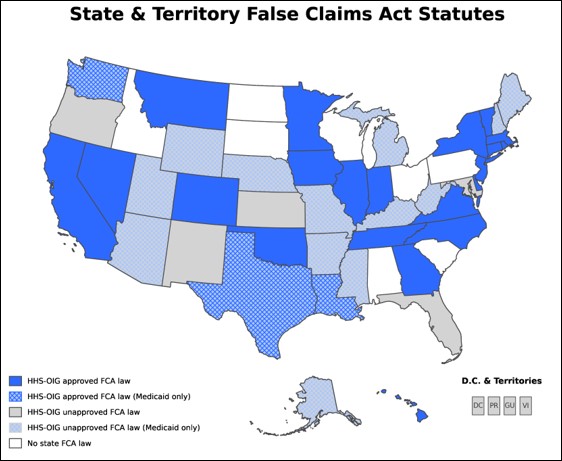 |
Sources: Gibson Dunn’s analysis of HHS-OIG State FCA Reviews and of state statutes cited in endnote 73.
2. State Legislative Developments in the First Half of 2026
In the first half of the year, several state legislatures introduced notable bills that would expand the states’ existing false claims laws.
The most significant of these occurred in Minnesota, where on April 16 the legislature introduced an amendment that would expressly expand false claims liability to private equity firms and to tax-related claims.[75] On private equity, the bill adds a new “ownership or investment interest” definition reaching holders of more than 10% equity, investor groups that raise or return capital, and pooled funds managed by private limited partnerships employing investment strategies; and the bill makes a person with such an interest in a violator of the statute liable if the interest-holder knows of the violation and fails to disclose it within 60 days.[76] Regarding tax, the bill brings tax-related violations within the state FCA where the defendant’s net income or sales is at least $1 million and pleaded damages exceed $350,000.[77] In another notable move, the bill explicitly codifies a rule that the government’s payment despite knowledge of fraud is not dispositive of materiality.[78]
In Washington state, the legislature introduced a bill on January 20 that would give the state a general FCA (Washington’s current false claims law is limited to Medicaid).[79] The bill provides for treble damages plus civil penalties pegged to the federal FCA’s inflation-adjusted amounts.[80] It also contains a qui tam mechanism that broadly aligns with the federal one, including by matching the federal FCA’s relator share ranges for intervened and declined cases.[81] Unlike other recent state FCA legislation, the Washington bill does not contain language explicitly targeting private equity ownership of health care entities. It also lacks any language specifying whether tax-related claims are barred. As of this writing, the bill failed to pass before the end of the legislative session but could be reintroduced in the future.[82]
In West Virginia, the legislature introduced a bill on January 26 that would expand the state’s FCA beyond Medicaid, with notable caveats. H.B. 4811 would limit the definition of “claim” in non-Medicaid cases to a claim for more than $25,000; the bill also would require actual knowledge in non-Medicaid cases, and would establish “innocent mistake” as a defense.[83] The qui tam provisions are significantly distinct from those in the federal FCA: the West Virginia Attorney General must make a finding that a case has a “reasonable basis in fact” before either intervening or declining; in non-Medicaid cases, a finding that the case has no such basis bars the suit entirely—a determination that can be appealed en banc to the state’s intermediate appellate court.[84] Relator shares for non-Medicaid claims are capped at the lesser of 20% or $250,000 when the state intervenes, and in all declined cases shares are capped at $1,000,000 absent specific judicial findings that a larger award is necessary and proper.[85] Elsewhere, the bill bears similarities to the federal FCA, including by imposing treble damages and penalties pegged to the federal regime, and by carving out tax-related claims.[86] As of this writing, the bill remains in the House Judiciary Committee.[87]
III. NOTABLE CASE-LAW DEVELOPMENTS
A. Fourth Circuit Reverses Dismissal of Qui Tam Case Against Manufacturer on Scienter Grounds
On remand from the Supreme Court, the Fourth Circuit reversed the dismissal of a qui tam action alleging that a pharmaceutical manufacturer underreported the lowest prices it charged private customers under the Medicaid Drug Rebate Statute, holding that the relator adequately pleaded scienter. United States ex rel. Sheldon v. Allergan Sales, LLC, 170 F.4th 227, 232 (4th Cir. 2026). The Medicaid Rebate Statute requires manufacturers to report the “best price” they give private purchasers so that Medicaid can factor that information into its calculations of the rebates manufacturers will pay to Medicaid.
The relator alleged that the manufacturer, Forest Laboratories, declined to aggregate the various discounts it offered on a single drug when calculating and reporting its best price, thereby inflating the reported figure and reducing its rebate obligations to Medicaid. Id. at 235–37. The district court dismissed the complaint, concluding that even if the allegations were true, they could not satisfy the FCA’s scienter requirement. Id. at 240. The case reached the Fourth Circuit following the Supreme Court’s intervening decision in United States ex rel. Schutte v. SuperValu Inc., 598 U.S. 739 (2023), which held that the FCA’s knowledge standard is subjective and turns on what the defendant actually believed, not on whether its conduct was consistent with an objectively reasonable (even if incorrect) interpretation of the law.
Applying that subjective standard, the Fourth Circuit held that the relator’s allegations satisfied the pleading requirements. The court pointed to a letter the manufacturer wrote to CMS arguing for a change of language in the rule so as to not require aggregation and the fact that, after CMS declined to make the change, it issued guidance allegedly emphasizing the aggregation requirement, which supported an inference that the company subjectively knew of—or recklessly disregarded—a substantial risk that its reported prices were false. Sheldon, 170 F.4th at 243–44. The court therefore reversed and remanded. Id. at 245.
Sheldon is a significant illustration of how courts are implementing SuperValu at the pleading stage, by determining that contemporaneous warnings that a defendant’s legal interpretation is wrong can vitiate a motion to dismiss. By the same token, the Sheldon decision suggests that the complexity of the regulatory question underlying a case is insufficient grounds to overcome the Supreme Court’s exhortation that courts engage in evaluation of scienter-related facts at the pleading stage.
B. Fifth Circuit Confirms that Visa-Fee and Wage Theories Cannot Support Reverse FCA Liability Absent an Established Duty to Pay
The Fifth Circuit affirmed the dismissal of a qui tam action alleging that an IT-consulting firm avoided obligations to the government by procuring cheaper visa types and underpaying visa-dependent workers, joining every circuit to address the question in holding that the relator failed to plead a “reverse” false claim. United States ex rel. Palmer v. Tata Consulting Services, Ltd., 174 F.4th 462 (5th Cir. 2026). A reverse false claim under 31 U.S.C. § 3729(a)(1)(G) occurs when a defendant knowingly conceals or improperly avoids an “obligation”—defined as an “established duty” to pay the government.
The relator argued that the defendant should have applied for more expensive H-1B visas rather than cheaper L-1A and B-1 visas, and thus avoided higher visa fees. Id. at 466–67. The court rejected this theory, holding that the relevant regulations require payment only for the visas actually sought; any duty to pay higher fees was “merely potential or contingent” on the company first applying for those more expensive visas, and so was not an established duty. Id. at 467, 470. The relator also argued that the defendant assigned its employees to perform work appropriate for H-1B recipients and thus was required to file new or amended visa petitions, along with the appropriate fees, to correct that discrepancy. Id. at 469. The court found, however, that the regulations only require amendment of applications for visas of the same type, not new visa applications based on a change in circumstance—and therefore do not trigger an “established duty” to file new petitions and pay additional fees. Id. at 470. In its reasoning, the court aligned with the D.C., Second, and Ninth Circuits, see United States ex rel. Kini v. Tata Consultancy Servs., Ltd., 146 F.4th 1184, 1194 (D.C. Cir. 2025); United States ex rel. Billington v. HCL Techs. Ltd., 126 F.4th 799, 805 (2d Cir. 2025); United States ex rel. Lesnik v. ISM Vuzem d.o.o., 112 F.4th 816, 820 (9th Cir. 2024).
The relator also argued that the defendant’s systematic underpayment of visa workers meant it withheld too little in payroll taxes, but the court held this theory was barred by the FCA’s tax bar, 31 U.S.C. § 3729(d), and noted that every other court to address similar tax-related claims had rejected a reverse false claim theory. Id. at 471–73. The court therefore affirmed the district court’s dismissal of the relator’s complaint. Id. at 473–74.
Palmer reinforces a now near-uniform body of circuit law treating the reverse-FCA “obligation” element as a bulwark against cases premised on a theory of underpayment of visa fees. The decision’s significance, moreover, could extend beyond the visa context. Without the limiting principles the court applied in reaching its holding, virtually any regulatory licensing or fee regime could be recast as an FCA “obligation” whenever the government contended that the filer should have submitted a different—and costlier—application. By insisting on an established rather than a merely contingent duty, Palmer reinforces a critical firewall against the FCA becoming “a vehicle for punishing garden-variety breaches of contract or regulatory violations.” Universal Health Servs., Inc. v. United States ex rel. Escobar, 579 U.S. 176, 194 (2016).
C. Sixth Circuit Affirms That Forward-Looking Compliance Certifications Cannot Support a False-Certification Claim
The Sixth Circuit affirmed summary judgment for the City of Detroit in a qui tam action alleging that the City fraudulently certified compliance with federal requirements in connection with paratransit performance reports prepared by its contractor. United States ex rel. Lynn v. City of Detroit, No. 25-1537, 2026 WL 973955 (6th Cir. Apr. 10, 2026).
The relators alleged that performance reports used a 40-minute pickup window rather than the FTA’s required 30-minute window, rendering the City’s annual compliance certifications fraudulent. Id. at *2. The City’s “Certifications and Assurances” in its contract provided that the City “agrees to comply with all federal laws, regulations, and requirements,” to follow applicable federal guidance, and to abide by the certifications applicable to each application its authorized representative submitted to the FTA in that fiscal year. Id. at *5. The Sixth Circuit held that these statements were forward-looking promises of future compliance, which cannot support an FCA fraud claim. Id. The panel also rejected the relators’ promissory-fraud theory as unpleaded—noting that the Sixth Circuit has never endorsed that theory in the FCA context—and found present-tense certification language added in 2019 irrelevant because the alleged noncompliance predated that year. Id. at *6.
Lynn reinforces the longstanding principle that promises of future compliance—as opposed to representations of present or past compliance—generally cannot anchor FCA liability based on a false certification theory. This distinction likely will remain a hotly debated one, given DOJ’s reliance on false certification theories in its DEI investigations and in its efforts to use such theories to moot the separate debate, in the AKS context, over what it means for an AKS violation to cause a false claim.
D. Fifth Circuit Holds That a Relator Who Recovers No Share of the Proceeds Cannot Recover Attorneys’ Fees
The Fifth Circuit affirmed the denial of attorneys’ fees to a relator whose original claims were dropped after the government intervened and settled other claims for more than $13 million. The court held that the FCA conditions a fee award on the relator’s receipt of a share of the proceeds. United States ex rel. Conyers v. Kellogg Brown & Root, Inc., 175 F.4th 569, 571–72 (5th Cir. 2026).
In the case below, the relator was a veteran who drove supply convoys in Iraq and alleged, among other things, that the contractor’s employees used mortuary trailers to deliver consumable supplies, received kickbacks from vehicle suppliers, and billed the government for prostitutes. Id. at 570–71. The relator received no share of the government’s proceeds because the government pursued and settled different claims than the ones he brought. Id. at 571.
In interpreting the applicable FCA statutory language, the district court applied the rule of the last antecedent to conclude that the “such person” entitled to “reasonable expenses” and “attorneys’ fees and costs” is the same person who brought the action and received a payment from the proceeds. Id. at 571–72. Because the relator received no share of the proceeds, he was not entitled to fees. In so holding, the court joined the First and Sixth Circuits, which had reached the same conclusion. The Fifth Circuit affirmed. Id. at 572–73. This case is a notable example of how statutory interpretation can limit the power and benefits granted to qui tam relators.
IV. CONCLUSION
We will monitor these developments, along with other FCA legislative activity, settlements, and jurisprudence throughout the year and report back in our 2026 False Claims Act Year-End Update.
[1] The summaries in this section cover the period from January 1, 2026, through June 30, 2026, and focus on judgments and settlements valued at $2 million or more.
[2] Judgment, United States ex rel. Shepherd v. Fluor Corp., No. 6:13-cv-02428 (D.S.C. Mar. 13, 2026); Verdict Form, United States ex rel. Shepherd v. Fluor Corp., No. 6:13-cv-02428 (D.S.C. Mar. 11, 2026).
[3] See Press Release, U.S. Atty’s Office for the Middle Dist. of Ala., Mississippi Man Ordered to Pay $31 Million for Role in Healthcare Kickback Scheme (Mar. 19, 2026), https://www.justice.gov/usao-mdal/pr/mississippi-man-ordered-pay-31-million-role-healthcare-kickback-scheme; Mem. Op. and Order, United States v. Crites, No. 2:21-CV-244 (M.D. Ala. Mar. 16, 2026).
[4] See Press Release, U.S. Atty’s Office for the Dist. of Neb., United States Obtains $3.4M in a False Claims Act Judgment Against Nebraska Pharmacist (June 8, 2026), https://www.justice.gov/usao-ne/pr/united-states-obtains-34m-false-claims-act-judgment-against-nebraska-pharmacist.
[5] See Press Release, U.S. Dep’t of Justice, Traditions Health Agrees to Pay $34M to Resolve False Claims Act Liability Relating to Home Health Services Following Self Disclosure (Jan. 22, 2026), https://www.justice.gov/opa/pr/traditions-health-agrees-pay-34m-resolve-false-claims-act-liability-relating-home-health; Settlement Agreement, U.S. Dep’t of Justice and Traditions Health (Jan. 9, 2026), https://www.justice.gov/opa/media/1425436/dl.
[6] See Press Release, U.S. Dep’t of Justice, Kaiser Permanente Affiliates Pay $556M to Resolve False Claims Act Allegations (Jan. 14, 2026), https://www.justice.gov/opa/pr/kaiser-permanente-affiliates-pay-556m-resolve-false-claims-act-allegations; Settlement Agreement, U.S. Dep’t of Justice and Kaiser Foundation Health Plan, Inc. et al. (Jan. 13, 2026), https://www.justice.gov/opa/media/1423426/dl.
[7] See Press Release, U.S. Atty’s Office for the Middle Dist. of Fla., Five Ophthalmology Practices Agree to Pay Nearly $6M to Resolve Allegations of Fraudulent Claims to Medicare and Medicaid for Cranial Ultrasounds (Jan. 15, 2026), https://www.justice.gov/usao-mdfl/pr/five-ophthalmology-practices-agree-pay-nearly-6m-resolve-allegations-fraudulent-claims.
[8] See Press Release, U.S. Atty’s Office for the Northern Dist. of Ga., Arthritis & Rheumatology Center, P.C. and Jatin Patel Settle False Claims Act Case for $2.18 Million (Jan. 29, 2026), https://www.justice.gov/usao-ndga/pr/arthritis-rheumatology-center-pc-and-jatin-patel-settle-false-claims-act-case-218.
[9] See Press Release, U.S. Dep’t of Justice, Arizona Surgical Hospital Agrees to Pay $5.6M to Resolve Alleged False Claims Act Violations (Feb. 24, 2026), https://www.justice.gov/opa/pr/arizona-surgical-hospital-agrees-pay-56m-resolve-alleged-false-claims-act-violations; Settlement Agreement, U.S. Dep’t of Justice and Southwest Orthopedic and Spine Hospital, LLC et al. (Feb. 13, 2026), https://www.justice.gov/opa/media/1428841/dl.
[10] See Press Release, U.S. Dep’t of Justice, Gastroenterology Practice Agrees to Pay $4.75M to Settle Allegations of Kickbacks and Unnecessary Medical Testing Services (Feb. 27, 2026), https://www.justice.gov/opa/pr/gastroenterology-practice-agrees-pay-475m-settle-allegations-kickbacks-and-unnecessary; Settlement Agreement, U.S. Dep’t of Justice and Atlanta Gastroenterology Assocs., et al. (Feb. 27, 2026), https://www.justice.gov/opa/media/1429451/dl.
[11] See Press Release, U.S. Atty’s Office for the Eastern Dist. of Wisc., Waukesha Medical Equipment Company Agrees to Pay Nearly $7 Million to Resolve Allegations of False Billing to Federal Health Programs (Mar. 5, 2026), https://www.justice.gov/usao-edwi/pr/waukesha-medical-equipment-company-agrees-pay-nearly-7-million-resolve-allegations; Corporate Integrity Agreement, Dep’t of Health & Hum. Servs., Office of Inspector Gen. and Kinex Med. Co., Inc. (Mar. 2, 2026), https://oig.hhs.gov/documents/cias/11521/Kinex_Medical_Company_LLC_03022026.pdf.
[12] See Press Release, U.S. Dep’t of Justice, Aetna Agrees to Pay $117.7 Million to Resolve False Claims Act Allegations (Mar. 11, 2026), https://www.justice.gov/opa/pr/aetna-agrees-pay-1177-million-resolve-false-claims-act-allegations.
[13] See Press Release, U.S. Dep’t of Justice, Arizona Cardiology Group to Pay $4.75M to Resolve Allegations of Unnecessary Vein Ablations (Mar. 12, 2026), https://www.justice.gov/opa/pr/arizona-cardiology-group-pay-475m-resolve-allegations-unnecessary-vein-ablations.
[14] See Press Release, U.S. Atty’s Office for the Eastern Dist. of Mich., Team Rehab Physical Therapy agrees to pay nearly $5 Million to resolve False Claims Act allegations related to fraudulent billing scheme (Mar. 25, 2026), https://www.justice.gov/usao-edmi/pr/team-rehab-physical-therapy-agrees-pay-nearly-5-million-resolve-false-claims-act.
[15] See Press Release, U.S. Atty’s Office for the Northern Dist. of Ga., Advanced Urology and Jitesh Patel will pay $14 million to settle False Claims Act case involving allegations of fraudulent billing and unnecessary medical procedures (Apr. 2, 2026), https://www.justice.gov/usao-ndga/pr/advanced-urology-and-jitesh-patel-will-pay-14-million-settle-false-claims-act-case.
[16] See Press Release, U.S. Atty’s Office for the Central Dist. of Cal., O.C. Medical Scan Provider Agrees to Pay $8.3 Million to Resolve False Claims Allegations It Unlawfully Paid Doctors Kickbacks (May 1, 2026), https://www.justice.gov/usao-cdca/pr/oc-medical-scan-provider-agrees-pay-83-million-resolve-false-claims-allegations-it.
[17] See Press Release, U.S. Dep’t of Justice, Vascular Practice and Physician Agree to Pay More Than $6.73M to Settle False Claims Act Allegations of Unnecessary Vascular Interventional Procedures (May 6, 2026), https://www.justice.gov/opa/pr/vascular-practice-and-physician-agree-pay-more-673m-settle-false-claims-act-allegations; Settlement Agreement, U.S. Dep’t of Justice and Dr. Feliciano Serrano et al. (May 6, 2026), https://www.justice.gov/opa/media/1439676/dl.
[18] See Press Release, U.S. Atty’s Office for the Western Dist. of Pa., Ahold Delhaize USA Inc. to Pay $40M for Allegedly Reporting Inflated Drug Prices on Claims to Federal Healthcare Programs (June 10, 2026), https://www.justice.gov/usao-wdpa/pr/ahold-delhaize-usa-inc-pay-40m-allegedly-reporting-inflated-drug-prices-claims-federal; Settlement Agreement, U.S. Dep’t of Justice and Ahold Delhaize USA, Inc. et al. (May 12, 2026), https://www.justice.gov/opa/media/1445306/dl.
[19] See Press Release, U.S. Atty’s Office for the Eastern Dist. of Cal., Takeda Pharmaceuticals Agrees to Pay $13.6 Million to Resolve False Claims Allegations Relating to Improper Payments to Physicians (May 14, 2026), https://www.justice.gov/usao-edca/pr/takeda-pharmaceuticals-agrees-pay-136-million-resolve-false-claims-allegations; Settlement Agreement, U.S. Dep’t of Justice and Takeda Pharmaceuticals, U.S.A., Inc. (May 14, 2026), https://www.justice.gov/usao-edca/media/1440786/dl.
[20] See Press Release, U.S. Dep’t of Justice, Justice Department Secures Landmark Resolution to End Pediatric “Gender-Affirming Care” and Create Detransition Clinic (May 15, 2026), https://www.justice.gov/opa/pr/justice-department-secures-landmark-resolution-end-pediatric-gender-affirming-care-and.
[21] See Press Release, U.S. Atty’s Office for the Eastern Dist. of Ky., Operators of Day Treatment Program for Children Agree to $15.2 Million Civil Judgment to Resolve Medicaid Fraud Allegations (May 15, 2026), https://www.justice.gov/usao-edky/pr/operators-day-treatment-program-children-agree-152-million-civil-judgment-resolve.
[22] See Press Release, U.S. Atty’s Office for the Middle Dist. of Fla., Oglethorpe Inc. and Top Executives Agree to Pay $32M to Resolve False Claims Act Allegations (May 27, 2026), https://www.justice.gov/usao-mdfl/pr/oglethorpe-inc-and-top-executives-agree-pay-32m-resolve-false-claims-act-allegations.
[23] See Press Release, U.S. Dep’t of Justice, Laboratory Executives, Marketers, and Physician to Pay Over $2M to Settle Allegations of Illegal Kickbacks to Doctors (June 1, 2026), https://www.justice.gov/opa/pr/laboratory-executives-marketers-and-physician-pay-over-2m-settle-allegations-illegal; Settlement Agreement, U.S. Dep’t of Justice and Susan Hertzberg (May 29, 2026), https://www.justice.gov/opa/media/1443306/dl; Settlement Agreement, U.S. Dep’t of Justice and Matthew Theiler (May 29, 2026), https://www.justice.gov/opa/media/1443311/dl; Settlement Agreement, U.S. Dep’t of Justice and Frederick Brown (Sept. 22, 2025), https://www.justice.gov/opa/media/1443371/dl; Settlement Agreement, U.S. Dep’t of Justice and Thomas Gray Hardaway (June 1, 2026), https://www.justice.gov/opa/media/1443376/dl; Settlement Agreement, U.S. Dep’t of Justice and William Todd Hickman (Nov. 4, 2025), https://www.justice.gov/opa/media/1443381/dl; Settlement Agreement, U.S. Dep’t of Justice and Ginny Jacobs et al. (Oct. 9, 2025), https://www.justice.gov/opa/media/1443386/dl.
[24] See Press Release, U.S. Atty’s Office for the Eastern Dist. of Tex., Matrix, HealthFair, and HealthFair founder agree to pay $56.5 million to resolve False Claims Act allegations (June 3, 2026), https://www.justice.gov/usao-edtx/pr/matrix-healthfair-and-healthfair-founder-agree-pay-565-million-resolve-false-claims; Settlement Agreement, U.S. Dep’t of Justice and Matrix Medical Network et al. (June 2, 2026), https://www.justice.gov/opa/media/1444066/dl; Settlement Agreement, U.S. Dep’t of Justice and DPN USA, LLC (June 2, 2026), https://www.justice.gov/opa/media/1444056/dl; Settlement Agreement, U.S. Dep’t of Justice and Shahriah Ekbatani et al. (June 2, 2026), https://www.justice.gov/opa/media/1444051/dl.
[25] See Press Release, U.S. Atty’s Office for the Western Dist. of Pa., Arkansas Pathology Laboratory and Its Owners Pay $30M to Settle Allegations of Kickbacks and Unnecessary Medical Testing (June 17, 2026), https://www.justice.gov/usao-wdpa/pr/arkansas-pathology-laboratory-and-its-owners-pay-30m-settle-allegations-kickbacks-and; Settlement Agreement, U.S. Dep’t of Justice and Advanced Pathology Solutions, PLLC et al. (June 12, 2026), https://www.justice.gov/opa/media/1446416/dl.
[26] See Press Release, U.S. Atty’s Office for the Dist. of R.I., Journey to Hope Health and Healing and Former CEO Agree to Pay $10.2 Million to Resolve False Claims Allegations (June 16, 2026), https://www.justice.gov/usao-ri/pr/journey-hope-health-and-healing-and-former-ceo-agree-pay-102-million-resolve-false.
[27] See Press Release, U.S. Atty’s Office for the Southern Dist. of Iowa, Southern District of Iowa Announces Cases Related to the 2026 National Health Care Fraud Takedown (June 29, 2026), https://www.justice.gov/usao-sdia/pr/southern-district-iowa-announces-cases-related-2026-national-health-care-fraud.
[28] See Press Release, U.S. Atty’s Office for the Eastern Dist. of Wash., Hanford Contractor, Hanford Mission Integration Solutions (HMIS), Agrees to Pay $3.45 Million to Resolve Allegations of Fraud (Mar. 2, 2026), https://www.justice.gov/usao-edwa/pr/hanford-contractor-hanford-mission-integration-solutions-hmis-agrees-pay-345-million; Settlement Agreement, U.S. Dep’t of Justice and Hanford Mission Integration Solutions et al. (Jan. 26, 2026), https://www.justice.gov/usao-edwa/media/1428536/dl.
[29] See Press Release, U.S. Atty’s Office for the Dist. of N.J., Sea Box, Inc. Agrees to Pay $2.6 Million to Settle Claims it Used Foreign-Flagged Vessels to Transport Shipping Containers for Army, Air Force (Feb. 23, 2026), https://www.justice.gov/usao-nj/pr/sea-box-inc-agrees-pay-26-million-settle-claims-it-used-foreign-flagged-vessels; Settlement Agreement, U.S. Dep’t of Justice and SEA BOX, Inc. (Jan. 26, 2026), https://www.justice.gov/usao-nj/media/1428596/dl.
[30] See Press Release, U.S. Atty’s Office for the Dist. of N.J., Contractor Agrees to Pay $2.4 Million to Settle False Claims Act Allegations (Feb. 6, 2026), https://www.justice.gov/usao-nj/pr/contractor-agrees-pay-24-million-settle-false-claims-act-allegations; Settlement Agreement, U.S. Dep’t of Justice and Phillips-Glenwood Construction, Inc. (Feb. 5, 2026), https://www.justice.gov/usao-nj/media/1427051/dl.
[31] See Press Release, U.S. Atty’s Office for the Southern Dist. of Ohio, Asphalt Companies Agree to Pay $30 Million to Settle False Claims Act Allegations (Feb. 11, 2026), https://www.justice.gov/usao-sdoh/pr/asphalt-companies-agree-pay-30-million-settle-false-claims-act-allegations.
[32] See Press Release, U.S. Dep’t of Justice, W International Companies Agree to Pay $10.5M to Settle False Claims Act Allegations for Overcharging the Air Force and the Navy for Weld Tables (Mar. 17, 2026), https://www.justice.gov/opa/pr/w-international-companies-agree-pay-105m-settle-false-claims-act-allegations-overcharging.
[33] See https://tinyurl.com/5bw5skvcPress; https://tinyurl.com/3ncm3ytw. ‘
[34] See Press Release, U.S. Atty’s Office for the Dist. of Columbia, DISH Wireless LLC to Pay More than $17M to Resolve False Claims Act and Administrative Allegations Related to FCC’s Broadband Benefits Programs (May 6, 2026), https://www.justice.gov/usao-dc/pr/dish-wireless-llc-pay-more-17m-resolve-false-claims-act-and-administrative-allegations.
[35] See Press Release, U.S. Atty’s Office for the Middle Dist. of Fla., Government Contractors Agree to Pay Over $3.6 Million to Settle False Claims Act and Contract Disputes Act Liability (June 2, 2026), https://www.justice.gov/usao-mdfl/pr/government-contractors-agree-pay-over-36-million-settle-false-claims-act-and-contract.
[36] See Press Release, U.S. Dep’t of Justice, Government Contractor and Executives to Pay $21.3M to Resolve Fraud Scheme Involving Service-Disabled Veteran-Owned Small Business Contracts (June 9, 2026), https://www.justice.gov/opa/pr/government-contractor-and-executives-pay-213m-resolve-fraud-scheme-involving-service; Settlement Agreement, U.S. Dep’t of Justice and Broadway Electric, Inc. et al. (June 5, 2026), https://www.justice.gov/opa/media/1444866/dl.
[37] See Press Release, U.S. Atty’s Office for the Central Dist. of Cal., Perfectus Aluminum Inc. and Related Companies Agree to Pay $549.5 Million to Settle False Claims Act Allegations Relating to Evaded Customs Duties (May 13, 2026), https://www.justice.gov/usao-cdca/pr/perfectus-aluminum-inc-and-related-companies-agree-pay-5495-million-settle-false; see also Settlement Agreement, U.S. Dep’t of Justice and Scuderia Development and Perfectus Aluminum et al. (May 1, 2026), https://www.justice.gov/opa/media/1440366/dl.
[38] See Press Release, U.S. Dep’t of Justice, Canadian Steel Companies and Owner to Pay $19M to Settle False Claims Act Allegations Relating to Evaded Customs Duties (May 20, 2026), https://www.justice.gov/opa/pr/canadian-steel-companies-and-owner-pay-19m-settle-false-claims-act-allegations-relating.
[39] See Press Release, U.S. Atty’s Office for the Dist. of N.J., Key Bank Agrees to Pay $7.7 Million to Resolve Branch Manager’s Fraud (Jan. 7, 2026), https://www.justice.gov/usao-nj/pr/key-bank-agrees-pay-77-million-resolve-branch-managers-fraud.
[40] See Press Release, U.S. Atty’s Office for the Dist. of Mass., The Harvard Club of Boston Agrees to Pay $2.4 Million to Resolve Allegations of PPP Loan Fraud (Jan. 15, 2026), https://www.justice.gov/usao-ma/pr/harvard-club-boston-agrees-pay-24-million-resolve-allegations-ppp-loan-fraud; Settlement Agreement, U.S. Dep’t of Justice and Harvard Club of Boston (Jan. 14, 2026), https://www.justice.gov/usao-ma/media/1423561/dl?inline.
[41] See Press Release, U.S. Atty’s Office for the Dist. of Mass., Arkansas Company and Affiliates Pay $3.2 Million to Resolve Allegations Relating to Paycheck Protection Program Loans (Feb. 5, 2026), https://www.justice.gov/usao-ma/pr/arkansas-company-and-affiliates-pay-32-million-resolve-allegations-relating-paycheck; Settlement Agreement, U.S. Dep’t of Justice and QP Holdings, LLC et al. (Feb. 3, 2026), https://www.justice.gov/usao-ma/media/1426926/dl.
[42] See Press Release, U.S. Atty’s Office for the Dist. of S.C., U.S. Attorney’s Office Reaches $7.9M in Settlements Connected to PPP Fraud Enforcement Initiative (May 28, 2026), https://www.justice.gov/usao-sc/pr/us-attorneys-office-reaches-79m-settlements-connected-ppp-fraud-enforcement-initiative.
[43] See Press Release, U.S. Atty’s Office for the Northern Dist. of Okla., IT Group Agrees to Repay $7 Million in CARES Act Funding (June 22, 2026), https://www.justice.gov/usao-ndok/pr/it-group-agrees-repay-7-million-cares-act-funding.
[44] Compl.-in-Intervention ¶¶ 1–10, 149–58, United States ex rel. DeVos v. Priority Hosp. Grp., LLC, No. 20-cv-01041 (W.D. La. Jan. 16, 2026) (alleging manipulation of long-term care hospital stays to maximize Medicare reimbursement and kickbacks in violation of the AKS and Stark Law), https://www.justice.gov/opa/media/1424361/dl; see id. ¶¶ 8, 465, 472, 477, 484, 488–91 (alleging Medicare paid over $2 million on referred patients and over $17 million on admitted patients).
[45] Compl.-in-Intervention ¶¶ 2–6, United States ex rel. Watkins v. Advanced Pathology Solutions, LLC, No. 4:20-cv-1110 (E.D. Ark. Apr. 9, 2026) (alleging “lean lab” kickbacks to capture gastroenterology-pathology referrals and medically unnecessary automatic serial and rare-condition testing), https://www.justice.gov/opa/media/1446501/dl; see id. ¶ 6 (alleging Medicare paid “tens of millions of dollars” for tainted and unnecessary services).
[46] Compl.-in-Intervention ¶¶ 2–5, 40 137–151, United States ex rel. Piper v. RKM Utility Servs., Inc., No. 4:21-cv-357 (E.D. Tex. Jan. 29, 2026) (alleging falsified employee counts, payroll expenses, and PPP eligibility and forgiveness certifications); id. ¶¶ 74–104, 114–128 (alleging proceeds were used to pay pre-existing debt); id. ¶ 5.
[47] Compl.-in-Intervention ¶¶ 1–3, 31–49, United States ex rel. Forsyth v. KSO MetalFab, Inc., No. 23-cv-4875 (N.D. Ill. Feb. 4, 2026) (alleging false certifications that no 20%-or-greater owner faced criminal charges and that the company was PPP-eligible).
[48] Compl.-in-Intervention ¶¶ 1–5, 32–39, United States ex rel. Verity Investigations, LLC v. Alice + Olivia, LLC, No. 24-cv-5038 (S.D.N.Y. Mar. 18, 2026) (alleging false second-draw PPP eligibility and forgiveness certifications based on an under-300 employee count when the company allegedly had 366 employees including affiliates); see id. ¶¶ 33–34, 39 (alleging a $2,000,000 loan forgiven in full plus $24,111.11 in interest).
[49] Compl.-in-Intervention ¶¶ 1–3, 33–37, 38–69, United States ex rel. Clearwater Metrics LLC v. Ritz-Craft Corp. of Mich., Inc., No. 1:25-cv-01402 (W.D. Mich. May 22, 2026) (alleging affiliated companies falsely understated employee counts on first- and second-round PPP applications and forgiveness submissions); id. ¶ 3 & ¶¶ 74, 79, 83 (alleging $7,786,355 in forgiven loans, plus interest and bank processing fees).
[50] Compl.-in-Intervention ¶¶ 2–3, 16–32, 46–54, United States ex rel. Kelsey v. INS Marketing Online LLC, No. 3:24-cv-03006-TLB (W.D. Ark. May 1, 2026) (alleging counterfeit first-class USPS stamps used on millions of mailers, causing the Postal Service to provide unpaid first-class services, and alleging conspiracy).
[51] Compare Office of the Attorney General, Memorandum for Select Component Heads, Preventing the Mutilation of American Children (Apr. 22, 2025), https://www.justice.gov/ag/media/1402396/dl, with supra note 20.
Compare Press Release, U.S. Dep’t of Justice, Justice Department Establishes Civil Rights Fraud Initiative (May 19, 2025), https://www.justice.gov/opa/pr/justice-department-establishes-civil-rights-fraud-initiative, with supra note 33.
Compare Press Release, U.S. Dep’t of Health & Hum. Servs., DOJ-HHS False Claims Act Working Group (July 2, 2025), https://www.hhs.gov/press-room/hhs-doj-false-claims-act-working-group.html, with supra note 6.
Compare Press Release, U.S. Dep’t of Justice, Departments of Justice and Homeland Security Partnering on Cross-Agency Trade Fraud Task Force (Aug. 29, 2025), https://www.justice.gov/opa/pr/departments-justice-and-homeland-security-partnering-cross-agency-trade-fraud-task-force, with Press Release, U.S. Atty’s Office for the Eastern Dist. of Mich., International Audio Electronics Company Harman Pays $11.8 Million to Settle Fraud Allegations for Evading Customs Duties on Chinese Extruded Aluminum (Nov. 26, 2025), https://www.justice.gov/usao-edmi/pr/international-audio-electronics-company-harman-pays-118-million-settle-fraud and supra note 37.
[52] See Press Release, U.S. Dep’t of Justice, Civil Division Announces FOCUS Initiative for Data Miners Filing Qui Tam Complaints (Apr. 30, 2026), https://www.justice.gov/opa/pr/civil-division-announces-focus-initiative-data-miners-filing-qui-tam-complaints [hereinafter FOCUS Press Release].
[53] U.S. Dep’t of Justice, FOCUS Initiative for DOJ Data Miners Filing Qui Tam Complaints, https://www.justice.gov/opa/media/1438871/dl.
[54] FOCUS Press Release, supra note 52.
[55] U.S. Dep’t of Justice, FOCUS Initiative for DOJ Data Miners Filing Qui Tam Complaints, https://www.justice.gov/opa/media/1438871/dl.
[56] FOCUS Press Release, supra note 52.
[57] Id.
[58] U.S. Dep’t of Justice, Accelerating Review and Enhancing Enforcement in Benefits Fraud Matter (May 27, 2026), https://www.justice.gov/opa/media/1442566/dl [hereinafter Accelerating Review Memo].
[59] Id. at 1.
[60] Press Release, U.S. Dep’t of Justice, Civil Division Moves to Fast-Track Benefits Fraud Enforcement (May 27, 2026), https://www.justice.gov/opa/pr/civil-division-moves-fast-track-benefits-fraud-enforcement.
[61] Accelerating Review Memo, supra note 58, at 2.
[62] Id.
[63] Id. at 2–3.
[64] Id. at 2.
[65] U.S. Dep’t of Justice, Justice Manual § 9-42.440 (2020), https://www.justice.gov/jm/jm-9-42000-fraud-against-the-government#9-42.440.
[66] Executive Order 14,398, 91 Fed. Reg. 61 (Mar. 26, 2026).
[67] Id. § 2. The order defines “racially discriminatory DEI activities” as “disparate treatment based on race or ethnicity in the recruitment, employment (e.g., hiring, promotions), contracting (e.g., vendor agreements), program participation, or allocation or deployment of an entity’s resources.” Id. § 2(a). “Program participation” is defined as “membership or participation in, or access or admission to: training, mentoring, or leadership development programs; educational opportunities; clubs; associations; or similar opportunities that are sponsored or established by the contractor or subcontractor.” Id. § 2(b).
[68] Id. § 3 (directing agencies, within 30 days, to include a contract clause requiring contractor certification and records access).
[69] Brenna E. Jenny, Deputy Assistant Att’y Gen., U.S. Dep’t of Justice, Civ. Div., Remarks at the Federal Bar Association 2026 Qui Tam Conference, panel “Illegal DEI’ as an FCA Trigger?” (Feb. 19, 2026).
[70] Memorandum from Todd Blanche, Acting Att’y Gen., U.S. Dep’t of Justice, Establishment of the National Fraud Enforcement Division (Apr. 7, 2026), https://www.justice.gov/ag/media/1435311/dl [hereinafter Blanche Memorandum].
[71] Id. (directing immediate NFED operational control over the Criminal Division’s Tax Section, Health Care Fraud Unit, and Market, Government, and Consumer Fraud Unit).
[72] Id.
[73] The designation of each jurisdiction as “approved” or “unapproved” reflects the determination of HHS-OIG under Section 1909 of the Social Security Act, 42 U.S.C. § 1396h, whether that jurisdiction’s false claims act qualifies for the financial incentive described therein. See U.S. Dep’t of Health & Hum. Servs., Off. of Inspector Gen., State False Claims Act Reviews, https://oig.hhs.gov/fraud/state-false-claims-act-reviews/ (last visited July 25, 2026). The state and territorial false claims statutes depicted are: Alaska Stat. §§ 09.58.010 to 09.58.110; Ariz. Rev. Stat. Ann. §§ 36-2918 to 36-2918.01; Ark. Code Ann. §§ 20-77-901 to 20-77-912; Cal. Gov’t Code §§ 12650–12656; Colo. Rev. Stat. §§ 24-31-1201 to 24-31-1211 (general) and §§ 25.5-4-303.5 to 25.5-4-310 (Medicaid); Conn. Gen. Stat. §§ 4-274 to 4-289; Del. Code Ann. tit. 6, §§ 1201–1211; D.C. Code §§ 2-381.01 to 2-381.10; Fla. Stat. §§ 68.081 to 68.092; Ga. Code Ann. §§ 23-3-120 to 23-3-127 (general) and §§ 49-4-168 to 49-4-168.6 (Medicaid); 5 Guam Code Ann. §§ 37101–37412; Haw. Rev. Stat. §§ 661-21 to 661-31; 740 Ill. Comp. Stat. 175/1 to 175/8; Ind. Code §§ 5-11-5.5-1 to 5-11-5.5-18 (general) and §§ 5-11-5.7-1 to 5-11-5.7-18 (Medicaid); Iowa Code §§ 685.1 to 685.7; Kan. Stat. Ann. §§ 75-7501 to 75-7511; Ky. Rev. Stat. Ann. §§ 205.8451 to 205.8483; La. Rev. Stat. Ann. §§ 46:437.1 to 46:440.3; Me. Rev. Stat. Ann. tit. 22, § 15; Md. Code Ann., Gen. Provisions §§ 8-101 to 8-111 (general) and Md. Code Ann., Health-Gen. §§ 2-601 to 2-611 (Medicaid); Mass. Gen. Laws ch. 12, §§ 5A–5O; Mich. Comp. Laws §§ 400.601 to 400.615; Minn. Stat. §§ 15C.01 to 15C.16; Miss. Code Ann. §§ 43-13-201 to 43-13-233; Mo. Rev. Stat. §§ 191.900 to 191.914; Mont. Code Ann. §§ 17-8-401 to 17-8-416; Neb. Rev. Stat. §§ 68-934 to 68-947; Nev. Rev. Stat. §§ 357.010 to 357.250; N.H. Rev. Stat. Ann. §§ 167:61-a to 167:61-e; N.J. Stat. Ann. §§ 2A:32C-1 to 2A:32C-18; N.M. Stat. Ann. §§ 44-9-1 to 44-9-14 (general) and §§ 27-14-1 to 27-14-15 (Medicaid); N.Y. State Fin. Law §§ 187–194; N.C. Gen. Stat. §§ 1-605 to 1-618 (general) and §§ 108A-70.10 to 108A-70.16 (Medicaid); Okla. Stat. tit. 63, §§ 5053 to 5053.7; Or. Rev. Stat. §§ 180.750 to 180.785; P.R. Laws Ann. tit. 32, § 2931 et seq.; R.I. Gen. Laws §§ 9-1.1-1 to 9-1.1-9; Tenn. Code Ann. §§ 4-18-101 to 4-18-108 (general) and §§ 71-5-181 to 71-5-185 (Medicaid); Tex. Hum. Res. Code Ann. §§ 36.001 to 36.132; Utah Code Ann. §§ 26B-3-1101 to 26B-3-1115; Vt. Stat. Ann. tit. 32, §§ 630–642; V.I. Code Ann. tit. 33, §§ 3501–3509; Va. Code Ann. §§ 8.01-216.1 to 8.01-216.19; Wash. Rev. Code §§ 74.66.005 to 74.66.130; W. Va. Code §§ 9-7-1 to 9-7-9; and Wyo. Stat. Ann. §§ 42-4-301 to 42-4-306.
[74] See Press Release, U.S. Atty’s Office for the Northern Dist. of N.Y., Statement on Federal Decertification of the New York Medicaid Fraud Control Unit (July 2, 2026), https://www.justice.gov/usao-ndny/pr/statement-federal-decertification-new-york-medicaid-fraud-control-unit.
[75] H.F. 4976, 94th Leg., Reg. Sess. (Minn. 2026) (as introduced Apr. 16, 2026), https://www.revisor.mn.gov/bills/94/2026/0/HF/4976/versions/0/pdf/; S.F. 4786, 94th Leg., Reg. Sess. (Minn. 2026) (as introduced Mar. 25, 2026).
[76] Id. at §§ 1, 5.
[77] Id. at §5.
[78] Id. at §4.
[79] H.B. 2585, 69th Leg., Reg. Sess. (Wash. 2026) (as introduced Jan. 20, 2026), https://lawfilesext.leg.wa.gov/biennium/2025-26/Pdf/Bills/House%20Bills/2585.pdf.
[80] Id. at § 3.
[81] Id. at §§ 6–9.
[82] WA HB2585, BillTrack50, https://www.billtrack50.com/billdetail/1941475 (last visited July 30, 2026).
[83] H.B. 4811, 87th Leg., Reg. Sess. §§ 14-4-1(2), (4) (W. Va. 2026) (introduced by Del. Funkhouser, Jan. 26, 2026), https://www.wvlegislature.gov/Bill_Text_HTML/2026_SESSIONS/RS/bills/hb4811%20intr.pdf
[84] Id. at §§ 14-4-4(1–3).
[85] Id. at §§ 14-4-6(a)(2), (b)(2).
[86] Id. at § 14-4-2.
[87] Bill Status – Complete Bill History: H.B. 4811, W. Va. Legislature, https://www.wvlegislature.gov/Bill_Status/bills_history.cfm?year=2026&sessiontype=RS&input=4811 (last visited July 30, 2026).
Gibson Dunn lawyers regularly counsel clients on the False Claims Act and are available to assist in addressing any questions you may have regarding these issues. Please contact the Gibson Dunn lawyer with whom you usually work, the authors, or any leader or member of the firm’s False Claims Act/Qui Tam Defense practice group:
False Claims Act/Qui Tam Defense:
Washington, D.C.
Jonathan M. Phillips – Co-Chair (+1 202.887.3546, jphillips@gibsondunn.com)
Jake M. Shields (+1 202.955.8201, jmshields@gibsondunn.com)
F. Joseph Warin (+1 202.887.3609, fwarin@gibsondunn.com)
Stuart F. Delery (+1 202.955.8515,sdelery@gibsondunn.com)
Gustav W. Eyler (+1 202.955.8610, geyler@gibsondunn.com)
Lindsay M. Paulin (+1 202.887.3701, lpaulin@gibsondunn.com)
Geoffrey M. Sigler (+1 202.887.3752, gsigler@gibsondunn.com)
Michael R. Dziuban (+1 202.955.8252; mdziuban@gibsondunn.com)
San Francisco
Winston Y. Chan – Co-Chair (+1 415.393.8362, wchan@gibsondunn.com)
New York
Reed Brodsky (+1 212.351.5334, rbrodsky@gibsondunn.com)
Mylan Denerstein (+1 212.351.3850, mdenerstein@gibsondunn.com)
Denver
John D.W. Partridge (+1 303.298.5931, jpartridge@gibsondunn.com)
Ryan T. Bergsieker (+1 303.298.5774, rbergsieker@gibsondunn.com)
Monica K. Loseman (+1 303.298.5784, mloseman@gibsondunn.com)
Los Angeles
James L. Zelenay Jr. (+1 213.229.7449, jzelenay@gibsondunn.com)
Nicola T. Hanna (+1 213.229.7269, nhanna@gibsondunn.com)
Jeremy S. Smith (+1 213.229.7973, jssmith@gibsondunn.com)
Deborah L. Stein (+1 213.229.7164, dstein@gibsondunn.com)
Dhananjay S. Manthripragada (+1 213.229.7366, dmanthripragada@gibsondunn.com)
© 2026 Gibson, Dunn & Crutcher LLP. All rights reserved. For contact and other information, please visit us at www.gibsondunn.com.
Attorney Advertising: These materials were prepared for general informational purposes only based on information available at the time of publication and are not intended as, do not constitute, and should not be relied upon as, legal advice or a legal opinion on any specific facts or circumstances. Gibson Dunn (and its affiliates, attorneys, and employees) shall not have any liability in connection with any use of these materials. The sharing of these materials does not establish an attorney-client relationship with the recipient and should not be relied upon as an alternative for advice from qualified counsel. Please note that facts and circumstances may vary, and prior results do not guarantee a similar outcome.