
The torrid pace of new securities class action filings over the last several years slowed a bit in the first half of 2021, a period in which there have been many notable developments in securities law. This mid-year update briefs you on major developments in federal and state securities law through June 2021:
- In Goldman Sachs, the Supreme Court found that lower courts should hear evidence regarding the impact of alleged misstatements on the price of securities to rebut any presumption of classwide reliance at the class-certification stage, and that defendants bear the burden of persuasion on this issue.
- Just before its summer recess, the Supreme Court granted certiorari in Pivotal Software, teeing up a decision on whether the PSLRA’s discovery-stay provision applies to state court actions, which may impact forum selection in private securities actions.
- We explore various developments in Delaware courts, including the relative decline of appraisal litigation, and the Court of Chancery’s (1) decision to enjoin a poison pill, (2) rejection of a claim that the COVID-19 pandemic constituted a material adverse effect, (3) approach in a potential bellwether SPAC case, and (4) analysis of post-close employment opportunities with respect to Revlon fiduciary duties.
- We continue to survey securities-related lawsuits arising in connection with the coronavirus pandemic, including securities class actions, stockholder derivative actions, and SEC enforcement actions.
- We examine developments under Lorenzo regarding disseminator liability and under Omnicare regarding liability for opinion statements.
- Finally, we explain important developments in the federal courts, including (1) the widening circuit split regarding the jurisdictional reach of the Exchange Act based on recent decisions in the First and Second Circuits, (2) the Eighth Circuit’s holding that class action allegations, including those under Section 10(b), can be struck from pleadings, (3) Congress’s codification of the SEC’s disgorgement authority in the National Defense Authorization Act, (4) a federal district court’s holding that a forum selection clause superseded anti-waiver provisions in the Exchange Act, and (5) the Ninth Circuit’s broad interpretation of the PSLRA’s safe harbor for forward-looking statements.
I. Filing and Settlement Trends
According to Cornerstone Research, both the number of new filings and the average approved settlement amount in securities class actions decreased relative to the same period last year and historically. However, the number of approved settlements is the highest it has been since the second half of 2017, indicating that 2021 may be on track to set a record in terms of the number of approved securities class action settlements even if the total dollar amount falls short of last year.
The decline in total filings is driven by a sharp decline in new mergers and acquisitions filings, which are at the lowest level since the second half of 2014. Despite the decline in filings, 2021 has nonetheless already set a record for new SPAC-related filings by doubling both the 2020 and 2019 full-year totals in this category.
A. Filing Trends
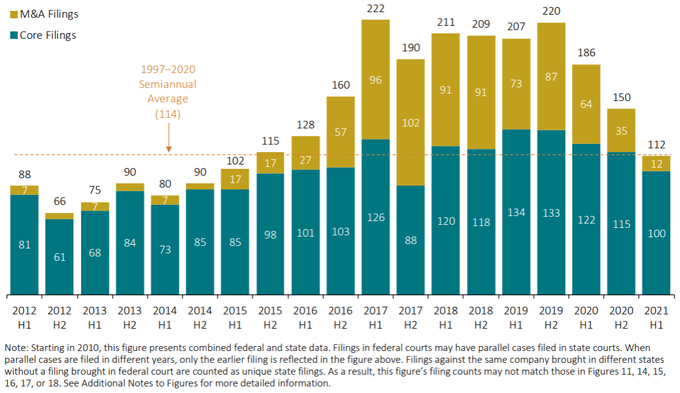
Figure 1 below reflects filing rates for the first half of 2021 (all charts courtesy of Cornerstone Research). The first half of the year saw 112 new class action securities filings, a nearly 40% decrease from the same period last year and a 25% decrease from the second half of 2020. The decrease is largely driven by a drop in new M&A filings, from 64 and 35 in the two halves of 2020, respectively, to 12 in the first half of 2021. This represents a 66% decline in M&A filings from the second half of 2020, and 83% decline against the biannual average for M&A filings dating back through 2016.
Figure 1:
Semiannual Number of Class Action Filings (CAF Index®)
January 2012 – June 2021
B. Industry and Other Trends in Cases Filed
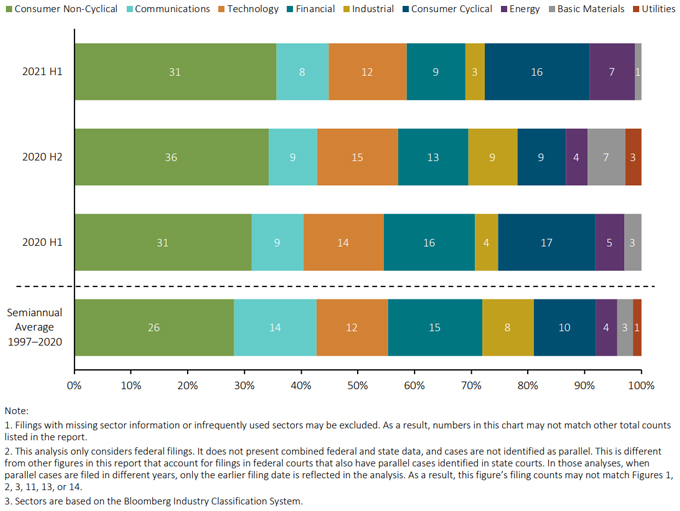
Keeping with recent trends, new filings against consumer non-cyclical firms continued to make up the majority of new federal, non-M&A filings in the first half of 2021, as shown in Figure 2 below. New filings against communications and technology sector firms remained fairly steady, and an increase in filings against firms in the consumer cyclical and energy sectors partially offset the decline in filings against firms in the basic materials, industrial and financial sectors.
Figure 2:
Core Federal Filings by Industry
January 1997 – June 2021
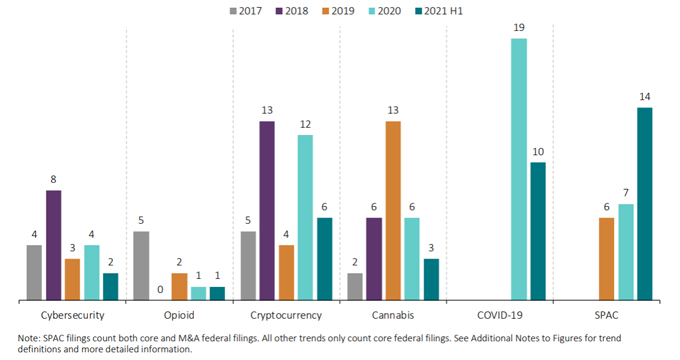
As noted at the start and illustrated in Figure 3 below, the number of SPAC-related filings in the first half of 2021 exceeds those filed in both 2019 and 2020 combined. The increase is driven by filings in the consumer cyclical industry, and specifically, firms in the Auto manufacturers and Auto Parts & Equipment industries. In addition to notable activity in the SPAC space, cybersecurity-, cryptocurrency- and cannabis-related filings are all on pace to meet or exceed the 2020 totals, and 2021’s increased activity in ransomware attacks has already resulted in an uptick in cybersecurity filings in the second half of 2021. On the other hand, the majority of the new filings related to COVID-19 occurred earlier in the year, indicating that, as mentioned below, it is still too early to tell what the full year brings in terms of filings related to COVID-19.
Figure 3:
Summary of Trend Case Filings
January 2017 – June 2021
C. Settlement Trends
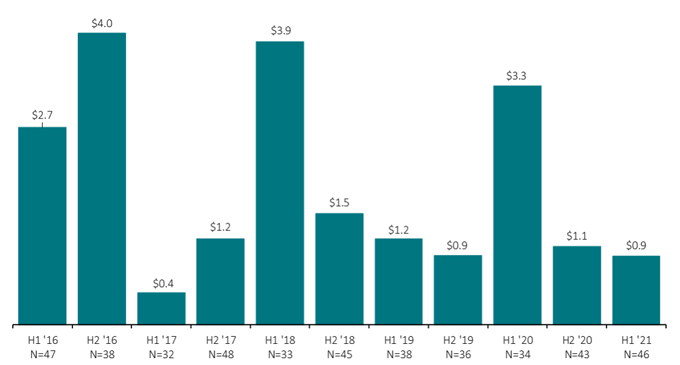
As shown in Figure 4, the total settlement dollars, adjusted for inflation, is down 72.7% against the same period last year despite a 35% increase in the number of settlements approved. Two settlements in the first half of 2021 exceeded $100 million, as compared to six such settlements last year and four in 2019, and the median value of approved settlements through the first half of the year is $7.9 million, reflecting an 18% decline against the same period last year. The difference between the magnitude of the decline in settlement amounts is likely driven by an outlier settlement in first half of last year.
Figure 4:
Total Settlement Dollars (in billions)
January 2016 – June 2021
II. What to Watch for in the Supreme Court
A. Supreme Court Issues Narrow Decision in Price-Impact Case
As we previewed in our 2020 Year-End Securities Litigation Update, in Goldman Sachs Group Inc. v. Arkansas Teacher Retirement System, 141 S. Ct. 1951 (2021), the Supreme Court this Term considered questions regarding price-impact analysis at the class-certification stage in securities class actions. Recall that in Halliburton Co. v. Erica P. John Fund, Inc., 573 U.S. 258 (2014) (“Halliburton II”), the Supreme Court preserved the “fraud-on-the-market” theory that enables courts to presume classwide reliance in Rule 10b-5 cases, but also permitted defendants to rebut that presumption with evidence that the alleged misrepresentation did not affect the issuer’s stock price.
Goldman Sachs presented the Court with the opportunity to decide how courts can address cases in which plaintiffs plead fraud through the “inflation maintenance” price impact theory, which claims that misstatements caused a preexisting inflated price to be maintained instead of causing the artificial inflation in the first instance. In granting certiorari, the Supreme Court accepted two questions for review: (1) “[w]hether a defendant in a securities class action may rebut the presumption of classwide reliance recognized in Basic Inc. v. Levinson, 485 U.S. 224 (1988), by pointing to the generic nature of the alleged misstatements in showing that the statements had no impact on the price of the security, even though that evidence is also relevant to the substantive element of materiality,” and (2) “[w]hether a defendant seeking to rebut the Basic presumption has only a burden of production or also the ultimate burden of persuasion.” Petition for a Writ of Certiorari at I, Goldman Sachs, 141 S. Ct. 1951 (No. 20-222).
In its June 21, 2021 decision, the Court declined to take a position on the “validity or . . . contours” of the inflation-maintenance theory in general, which it has never directly approved. Goldman Sachs, 141 S. Ct. at 1959 n.1. On the first question, the Court unanimously agreed with the parties that lower courts should hear evidence—including expert evidence—and rely on common sense to make determinations at the class-certification stage as to whether the alleged misrepresentations were so generic that they did not distort the price of securities. Id. at 1960. This analysis is permitted at the class-certification stage even though such evidence may also be relevant to the question of materiality, which is reserved for the merits stage. Id. at 1955 (citing Amgen Inc. v. Connecticut Ret. Plans and Tr. Funds, 568 U.S. 455, 462 (2013)). Importantly, the Court noted that in the context of an inflation-maintenance theory, the mismatch between generic misrepresentations and later, specific corrective disclosures will be a key consideration in the price-impact analysis. Goldman Sachs, 141 S. Ct. at 1961. “Under those circumstances, it is less likely that the specific disclosure actually corrected the generic misrepresentation, which means that there is less reason to infer front-end price inflation—that is, price impact—from the back-end price drop.” Id. The Court, with only Justice Sotomayor dissenting, then remanded the case for further consideration of the generic nature of the statements at issue here, explicitly directing the Second Circuit to “take into account all record evidence relevant to price impact, regardless whether that evidence overlaps with materiality or any other merits issue.” Id. (emphasis in original).
As to the second question, the Court held by a 6–3 majority that defendants at the class-certification stage bear the burden of persuasion on the issue of price impact in order to rebut the presumption of reliance—that is, to convince the court, by a preponderance of the evidence, that the challenged statements did not affect the price of securities. The Court determined that this rule had already been established by its previous decisions in Basic and Halliburton II: Basic recognized that defendants could rebut the presumption of classwide reliance by making “[a]ny showing that severs the link between the alleged misrepresentation and . . . the price,” and in Halliburton II, the Court again referenced defendants’ ability to rebut the Basic presumption with a “showing.” Id. at 1962 (internal citations omitted). The majority rejected an argument by the defendants, taken up by Justice Gorsuch (joined by Justices Thomas and Alito), that these references to a “showing” by the defense imposed only a burden of production. Id. at 1962; see also id. at 1965–70 (Gorsuch, J., concurring in part and dissenting in part). That reading would have allowed defendants to rebut the presumption of reliance “by introducing any competent evidence of a lack of price impact”—and would have imposed on plaintiffs the requirement to “directly prov[e] price impact in almost every case,” a requirement that had been rejected in Halliburton II. Id. at 1962–63 (emphasis in original). However, the Court noted that imposing the burden of persuasion on defendants would be unlikely to alter the outcome in most cases, as the “burden of persuasion will have bite only when the court finds the evidence is in equipoise—a situation that should rarely arise.” Id. at 1963.
B. Supreme Court to Decide whether the PSLRA’s Discovery Stay Applies in State Court
On July 2, 2021, just before its summer recess, the Court granted certiorari in Pivotal Software, Inc. v. Tran, No. 20-1541, which raises the question of whether the Private Securities Litigation Reform Act’s (“PSLRA”) discovery-stay provision applies to state court actions in which a private party raises a Securities Act claim. The PSLRA provides that the stay applies “[i]n any private action arising under” the Securities Act before a court has addressed a motion to dismiss, 15 U.S.C. § 77z-1-(b)(1), but state courts are sharply divided over whether the stay applies to suits in state court, rather than only to those in federal court. In opposition, respondent plaintiffs argued that not only is the issue moot (because they have agreed to adhere to the stay provision and the state court will have issued a decision on the motion to dismiss before the Supreme Court can issue an opinion), but also that no court of appeals has ever decided the issue. Brief in Opposition at 7–16, Pivotal Software, Inc. v. Tran, No. 20-1541. Petitioners countered that the issue will only ever arise in state courts and that state trial courts are divided, with at least a dozen decisions refusing to apply the stay and seven applying it, with many more decisions unreported. Moreover, the issue evades appellate review because it is time-sensitive and unlikely to affect a final judgment, rendering any error harmless. Reply Brief for Petitioners at 1–12, Pivotal Software, Inc. v. Tran, No. 20-1541.
Given the costs of discovery in securities actions, Pivotal could have a lasting impact on both the choice of forum in which securities actions are brought and on how discovery progresses in the early stages of a case.
C. The Court Addresses Constitutional Challenges to Administrative Adjudicators
Recall that in Lucia v. SEC, 138 S. Ct. 2044 (2018), the Court held that the SEC’s administrative law judges (“ALJs”) were “Officers of the United States” who must be appointed by the President, a court of law, or the SEC itself. Building on Lucia, the Supreme Court issued two decisions this Term that raised further questions on the constitutionality of administrative officers’ appointments.
Following Lucia, the petitioners in Carr v. Saul and Davis v. Saul sought judicial review of administrative decisions of the Social Security Administration (“SSA”), challenging in the district courts for the first time the constitutionality of SSA ALJ appointments. Carr v. Saul, 141 S. Ct. 1352, 1356–57 (2021). The district courts split on the question of whether petitioners had been required to raise their constitutional challenges during their administrative hearings in the first instance, but both the Eighth and Tenth Circuits agreed that the challenges had been forfeited. Id. at 1357. In its April 22, 2021 decision in these consolidated cases, the Supreme Court unanimously reversed, holding that the petitioners were not required to raise the appointments issue in SSA administrative proceedings, though the Justices were split in their reasoning. Id. at 1356.
The majority opinion held that the benefits claimants were not required to administratively exhaust the appointment issue, in the absence of any statutory or regulatory requirement, for three primary reasons. First, the Court had previously held that the SSA’s Appeals Council conducts proceedings that are more “inquisitorial” than “adversarial,” and that in the absence of “adversarial development of issues by the parties” before the agency tribunal, there was no basis for requiring a petitioner to raise all claims before the agency in order to preserve the issues for judicial review. Id. at 1358–59 (citing Sims v. Apfel, 530 U.S. 103, 112 (2000)). The Court applied the Sims rationale to SSA ALJs who, like the Appeals Council, conduct “informal, nonadversarial proceedings,” even though SSA ALJ proceedings may be considered “relatively more adversarial.” Id. at 1359–60. Second, as the Court has “often observed,” agency decision-makers “are generally ill suited to address structural constitutional challenges, which usually fall outside the adjudicators’ areas of technical expertise.” Id. at 1360. And third, the Court recognized that requiring issue exhaustion here would be futile as the agency adjudicators “are powerless to grant the relief requested.” Id. at 1361. The Court’s consolidated decision in Carr and Davis was dependent on features specific to the SSA’s review, so the question of whether issue exhaustion is required may be answered differently if it arises in future cases, either in the context of an agency with more adversarial administrative review procedures or if the constitutional challenge at issue is “[outside] the context of [the] Appointments Clause.” Id. at 1360 n.5.
In United States v. Arthrex, Inc., 141 S. Ct. 1970 (2021), the Court took up the question of whether administrative patent judges (“APJs”) in the Patent and Trademark Office (“PTO”) are “principal” or “inferior” officers under the Appointments Clause. (Readers should note that Gibson Dunn represented the private parties arguing alongside the government that APJs are inferior officers permissibly appointed by the Secretary of Commerce.) By a 5–4 vote, the majority held that the “unreviewable authority” of APJs to resolve inter partes review proceedings was incompatible with their appointment to an inferior office because “[o]nly an officer properly appointed to a principal office may issue a final decision binding the Executive Branch.” Id. at 1985.
In fashioning a remedy supported by seven Justices, the Court opted for a “tailored approach,” rather than striking down the entire inter partes review regime as unconstitutional. Id. at 1987. Specifically, the Court severed a provision of the statutory scheme that prevented the PTO Director from reviewing APJ decisions. Id. According to the Chief Justice, this remedy would align the Patent Trial and Appeal Board adjudication scheme with others in the Executive Branch and within the PTO itself. Id. In finding that the Constitutional violation is the restraint on the Director’s review authority rather than the APJs’ appointment by the Secretary, the Court found that the proper remedy was remand to the Director rather than to a new panel of APJs for rehearing. Id. at 1987–88.
The majority opinion drew opinions concurring and dissenting in part by Justice Gorsuch (objecting to the Court’s severability analysis) and Justice Breyer (joined by Justices Sotomayor and Kagan, agreeing with Justice Thomas’s analysis on the merits, but supporting the Court’s remedy), as well as a full dissent by Justice Thomas, who criticized the Court’s failure to take a clear position on whether APJs are inferior officers and whether their appointment complies with the Constitution. Id. at 1988–2011. He also disagreed with the Court’s modification of the statutory scheme because, in his view, APJs “are both formally and functionally inferior to the Director and to the Secretary,” and those officers already had sufficient control over APJs. Id. at 2011 (Thomas, J., dissenting).
III. Delaware Developments
A. Court of Chancery Invalidates Poison Pill under Second Unocal Prong
In February, the Court of Chancery in Williams Companies Stockholder Litigation, 2021 WL 754593 (Del. Ch. Feb. 26, 2021), enjoined a stockholder rights plan, also known as a “poison pill.” In March 2020, The Williams Companies, Inc. (“Williams”), a natural gas infrastructure company, adopted a stockholder rights plan after the company’s stock price declined substantially due to fallout from the COVID‑19 pandemic, which decreased demand and lowered prices in the global natural gas markets. Id. at *1. Williams adopted the plan in response to multiple perceived threats, including stockholder activism generally, concerns that activist investors may pursue disruptive, short-term agendas, and the potential for rapid and undetected accumulation of Williams stock (a “lightning strike”) by an opportunistic outside investor. Id. at *2.
The court employed the two-part Unocal standard of review to analyze whether (1) the Williams Board had a reasonable basis to implement a poison pill to respond to a legitimate threat, and (2) the reasonableness of the actual terms of the poison pill in relation to the threat posed. Id. at *22 (citing Unocal Corp. v. Mesa Petroleum Co., 493 A.2d 946 (Del. 1985)). Assuming for the sake of analysis that the “lightning strike” concern constituted a legitimate corporate objective, the court held that the plan’s terms were unreasonable. Id. at *33–34. The plan included a triggering ownership threshold of just 5%, compared to a typical market range of 10% to 15%. Id. at *35–36. It also contained an expansive definition of “beneficial ownership” that covered even synthetic interests, an expansive definition of “acting in concert” that covered any parallel conduct by multiple parties, and a relatively narrow definition of the term “passive investor,” which limited the number of investors exempt from the plan’s provisions. Id. at *35. The court concluded that the combined impact of these terms went well beyond that of comparable rights plans and could impermissibly stifle legitimate stockholder activity. Id. at *35–40. Notably, the court looked beyond the stated rationales listed in board resolutions, board minutes, and company disclosures, and instead sought to determine the actual intent of the directors based on testimony and other evidence. Id. The ruling offers an important reminder that rights plans have limits and that the Court of Chancery will not hesitate to assess a board’s subjective basis for implementing a rights plan and its specific terms.
B. Court of Chancery Rejects Claim that Pandemic Constituted a Materially Adverse Effect
In April, the Court of Chancery in Snow Phipps Group, LLC v. KCake Acquisition, Inc., 2021 WL 1714202 (Del Ch. Apr. 30, 2021), rejected a claim that the COVID‑19 pandemic constituted a material adverse effect (“MAE”) under the agreement at issue. There, a private equity firm buyer signed a $550 million agreement with Snow Phillips to purchase DecoPac, a company that supplies cake decorations and equipment to grocery stores. Id. at *1, *9–10. The deal coincided with the early months of the COVID-19 pandemic, which caused a significant decline in DecoPac’s sales. Id. at *1–2. The buyer subsequently attempted to terminate the agreement when it was unable to secure financing based on the target’s revised sales projections. Id. at *24–25.
In the ensuing litigation, the buyer alleged that DecoPac breached a representation that no change or development had, or “would reasonably be expected to have,” an MAE on DecoPac’s finances. Id. at *10. The court rejected this argument, observing—consistent with Delaware precedent—that the existence of an MAE must be judged in terms of DecoPac’s long-term financial prospects (measured in “years rather than months”). Id. at *30. Further, the court noted that the reduction in sales fell within a carve-out from the MAE representation, namely, effects arising from changes in laws or governmental orders. Id. at *35. The decision is notable not just for reaffirming the difficulty of invoking MAE clauses, but also for its broad discussion of how MAE clause carve-outs might negate the occurrence of an existing MAE.
C. Bellwether SPAC Litigation Remains in Initial Stages
In June, the defendants in In re MultiPlan Corp. Stockholders Litigation, Cons. C.A. No. 2021-0300-LWW, filed their motion to dismiss a closely watched consolidated class action filed by the stockholders of MultiPlan, a provider of cost management technology services to insurance agencies. MultiPlan was partially acquired in October 2020 via a reverse merger with a Special Purpose Acquisition Company (“SPAC”), Churchill Capital Corp. III. Most notably, the complaint contends that SPAC structures create inherent conflicts, alleging that MultiPlan’s business prospects have weakened and its stock price has decreased approximately 30% since the acquisition, but the personal investments of individuals managing the SPAC entity have increased materially. The plaintiff stockholders accuse the SPAC, its sponsor, and other directors of issuing misleading and deficient disclosures and of grossly mispricing the transaction.
Although some commentators have characterized the case as a bellwether and the claims asserted as novel, the defendants’ motion to dismiss tracks familiar arguments for attacking complaints concerning merger transactions at the pleading stage. For example, the defendants characterize the claims as derivative and urge dismissal for failure to make a demand. The defendants alternatively assert that, if the claims are direct, they are subject to the business judgment rule and warrant dismissal. More notably, the defendants contend that claims regarding plaintiffs’ redemption rights cannot proceed as fiduciary duty claims because they arise solely from contract. A decision on the pending MultiPlan motion to dismiss may have significant implications for the very active SPAC market, as the Court of Chancery weighs in on the efficacy of these entities and any implications their structure may have for deal disclosures.
D. Court of Chancery Determines CEO Breached Fiduciary Duty and Financial Advisor Aided and Abetted That Breach in Course of Executing a Merger
In Firefighters’ Pension System of the City of Kansas City, Missouri Trust v. Presidio, Inc., 2021 WL 298141 (Del. Ch. Jan. 29, 2021), the Court of Chancery denied motions to dismiss by Presidio’s CEO for allegedly breaching his fiduciary duty and Presidio’s financial advisor for allegedly aiding and abetting that breach, but dismissed claims against the controlling stockholder and other board members. The class action suit challenged a merger of Presidio, a controlled company, with an unaffiliated third party. The court held that a number of actions the CEO allegedly took, if credited, would yield an unreasonable sales process under Revlon. Id. at 267–68. For example, the court credited allegations that the CEO inappropriately steered the bidding process in favor of a private equity buyer that was more eager to retain existing management and simultaneously downplayed to the board of directors the interests of a strategic bidder. Although the strategic bidder allegedly had the capability to pay a higher price as a result of the synergies, it was more likely to replace the CEO. Id. at 267. The court also credited allegations that Presidio’s financial advisor had tipped the potential private equity buyer to confidential information that enabled it to structure its proposed terms into the ultimately bid-winning offer. Id. Presidio has the potential to serve as informative precedent for transactions entailing potential post-close employment opportunities for executives who guide the company’s sale process.
E. Appraisal Litigation Continues Its Steady Decline
The frequency of appraisal litigation continues to decline, with just four appraisal actions filed in the Delaware Court of Chancery in the first half of 2021, compared to the 13 actions filed in the first half of 2020. Going forward, we expect to see appraisal actions concentrated to a subset of deals involving alleged conflicts, process issues, or a limited market check.
Recent appraisal actions that have proceeded continue to reinforce the rulings in DFC Global Corp. v. Muirfield Value Partners, L.P., 172 A.3d 346 (Del. 2017) and Dell, Inc. v. Magnetar Global Event Driven Master Fund Ltd., 177 A.3d 1 (Del. 2017): objective market evidence—including deal price (potentially less synergies) and unaffected market price—generally provides the best indication of a company’s fair value. In In re Appraisal of Regal Entertainment Group, 2021 WL 1916364 (Del. Ch. May 13, 2021), for example, the Court of Chancery awarded a relatively modest 2.6% increase over the original merger price. The court held that the best evidence of the target’s fair value was the deal price, adjusted for post-signing value increases. Id. at *58. The court rejected arguments that Regal’s stock price was the best indicator of fair value, finding that “the sale process that led to the Merger Agreement was sufficiently reliable to make it probable that the deal price establishes a ceiling for the determination of fair value.” Id. at *34.
In the absence of reliable market-based indicators, the Court of Chancery has demonstrated a willingness to fall back on potentially more subjective valuation techniques, including discounted cash flow and comparable company analyses. In January 2021, the Delaware Supreme Court affirmed a Court of Chancery decision awarding a 12% premium on the merger price based solely on a discounted cash flow (“DCF”) valuation. SourceHOV Holdings, Inc. v. Manichaean Capital, LLC, 246 A.3d 139 (Del. 2021). The Court of Chancery’s exclusive use of the petitioner’s DCF valuation was premised on the Respondent’s failure to prove a fair value for the transaction, with the court noting it was “struck by the fact that [Respondent] disagreed with its own valuation expert, relied on witnesses whose credibility was impeached and employed a novel approach to calculate SourceHOV’s equity beta that is not supported by the record evidence. In a word, Respondent’s proffer of fair value is incredible.” Manichaean Capital, LLC v. SourceHOV Holdings, Inc., 2020 WL 496606, at *2 (Del. Ch. Jan. 30, 2020).
IV. Further Development of Disseminator Liability Theory Upheld in Lorenzo
As we initially discussed in our 2019 Mid-Year Securities Litigation Update, in March 2019, the Supreme Court held in Lorenzo v. SEC, 139 S. Ct. 1094 (2019), that those who disseminate false or misleading information to the investing public with the intent to defraud can be liable under Section 17(a)(1) of the Securities Act and Exchange Act, Rules 10b-5(a) and 10b-5(c), even if the disseminator did not “make” the statement within the meaning of Rule 10b-5(b). In practice, Lorenzo creates the possibility that secondary actors—such as financial advisors and lawyers—could face liability under Rules 10b-5(a) and 10b-5(c) (known as the “scheme liability provisions”) simply for disseminating the alleged misstatement of another, if a plaintiff can show that the secondary actor knew the alleged misstatement contained false or misleading information.
In 2021, courts have continued to grapple with Lorenzo’s application, particularly “whether Lorenzo’s language can be read to stretch scheme liability to cases in which plaintiffs are specifically alleging that the defendant did ‘make’ misleading statements (or omissions) as prohibited in Rule 10b5-(b),” or if “Lorenzo merely extends scheme liability to those who ‘disseminate false or misleading statements’ but that it does not hold that ‘misstatements [or omissions] alone are sufficient to trigger scheme liability’” absent additional conduct. Puddu v. 6D Global Techs., Inc., 2021 WL 1198566, at *10 (S.D.N.Y. Mar. 30, 2021) (quoting SEC v. Rio Tinto PLC, 2021 WL 818745, at *2 (S.D.N.Y. Mar. 3, 2021)) (summarizing the divergent views of various district courts).
In June, the Ninth Circuit, in In re Alphabet, Inc. Securities Litigation, 1 F.4th 687 (9th Cir. 2021) (“Alphabet”), signaled its support for the view that disseminator liability does not require “conduct other than misstatements.” Alphabet involved allegations that executives at Google and its holding company, Alphabet, were aware of security vulnerabilities on the Google+ social network. Id. at 693–97. Plaintiffs brought a claim against Alphabet under Rule 10b-5(b), in addition to scheme liability claims under Rule 10b-5(a) and (c), alleging a scheme to defraud shareholders by withholding material and damaging information about the security vulnerabilities from Alphabet’s quarterly filings. See id. at 698. The district court granted Alphabet’s motion to dismiss in full, finding that plaintiffs had failed to adequately allege a misrepresentation or omission of a material fact and failed to adequately allege scienter for the purposes of their Rule 10b-5 claims. Id.
On appeal, the Ninth Circuit reversed in part, holding that that the trial court erred by dismissing the claims under Rule 10b-5(a) and (c) because defendants had not specifically moved to dismiss those claims but instead moved to dismiss only on the basis of Rule 10b-5(b) and Rule 10b-5 generally. Id. at 709. Notably, the panel also disagreed with Alphabet’s “argument that Rule 10b-5(a) and (c) claims cannot overlap with Rule 10b-5(b) statement liability claims” because such an argument “is foreclosed by Lorenzo, which rejected the petitioner’s argument that Rule 10b-5(a) and (c) ‘concern “scheme liability claims” and are violated only when conduct other than misstatements is involved.’” Id. (quoting Lorenzo, 139 S. Ct. at 1101–02).
At the same time, district courts within the Second Circuit are considering the breadth of Lorenzo. See In re Teva Sec. Litig., 2021 WL 1197805, at *5 (D. Conn. Mar. 30, 2021) (summarizing the divergent views). As the Teva court explained, “[s]ome district courts in this circuit apparently agree with the” view that Lorenzo “abrogated the rule that ‘scheme liability depends on conduct that is distinct from an alleged misstatement,’” “[b]ut other district courts cabin Lorenzo and read it more restrictively” to only hold that “‘those who disseminate false or misleading statements to potential investors with the intent to defraud can be liable under [Rule 10b-5(a) and (c)], not that misstatements alone are sufficient to trigger scheme liability.’” Id. (quoting Rio Tinto PLC, 2021 WL 818745, at *2–3).
The Second Circuit itself has not yet squarely addressed the scope of Lorenzo. However, earlier this year, the district court in SEC v. Rio Tinto PLC, 2021 WL 1893165 (S.D.N.Y. May 11, 2021), certified an interlocutory appeal to the Second Circuit, following its dismissal of scheme liability claims where the SEC failed to “allege that Defendants disseminated [the] false information, only that they failed to prevent misleading statements from being disseminated by others.” At the time of this update, the Second Circuit had not ruled on whether it will hear the appeal. Gibson Dunn represents Rio Tinto in this and other litigation.
As these developments suggest, the application of the Lorenzo disseminator liability theory continues to evolve among and within the circuits. We will continue to monitor closely the changing applications of Lorenzo and provide a further update in our 2021 Year-End Securities Litigation Update.
V. Survey of Coronavirus-Related Securities Litigation
Although the stock market has largely stabilized since COVID-19 first impacted the United States in 2020, courts are still feeling the effects of the economic disruption and attendant securities litigation arising out of the pandemic. While the first series of COVID-19 securities lawsuits focused on select industries, such as travel and healthcare, plaintiffs eventually set their sights on other industries. We surveyed a select number of these cases in our 2020 Year-End Securities Litigation Update.
Since then, there have been several dismissals of COVID-19-related securities cases, including dismissals of some of the earliest cases brought in March 2020 concerning the travel industry. Nevertheless, lawsuits for misstatements regarding safety and risk disclosures are still being brought, and now that the “Delta” variant has spread throughout the United States, such lawsuits may continue for the foreseeable future.
Although it is too soon to tell whether the midpoint of COVID-19 securities litigation has passed, we will continue to monitor developments in this area. Additional resources regarding the legal impact of COVID-19 can be found in the Gibson Dunn Coronavirus (COVID-19) Resource Center.
A. Securities Class Actions
1. False Claims Concerning Commitment to Safety
Douglas v. Norwegian Cruise Lines, No. 20-cv-21107, 2021 WL 1378296 (S.D. Fla. Apr. 12, 2021): As we discussed in our 2020 Mid-Year Securities Litigation Update, the COVID-19 pandemic birthed an entire category of class action lawsuits concerning service companies’ commitments to safety, including a proposed class action lawsuit against Norwegian Cruise Lines. In April 2021, Judge Robert Scola, Jr. dismissed the lawsuit, which had originally alleged that Norwegian violated securities laws by minimizing the impact of the COVID-19 outbreak on its operations and failing to disclose allegedly deceptive sales practices that downplayed COVID-19. Id. at *2–3. Judge Scola, Jr. concluded that “[a]ll the challenged statements constitute corporate puffery” such that no reasonable investor would have relied on them. Id. at *4.
In re Carnival Corp. Securities Litigation, No. 20-cv-22202, 2021 WL 2583113 (S.D. Fla. May 28, 2021): Similarly, in May 2021, a year after plaintiffs filed the complaint, Judge K. Michael Moore dismissed a putative class action against Carnival that alleged that Carnival misrepresented the effectiveness of its health and safety protocols during the COVID-19 outbreak. Id. at *1–3. The court held that the plaintiffs-investors had failed to show that Carnival’s “statements affirming compliance with then-existing regulatory requirements [were] materially false or misleading” because the plaintiffs’ argument relied on the inference that “passengers would ultimately fall ill aboard Carnival’s ships—just as people did in other venues across the globe.” Id. at *15. Accordingly, the court found the inference was “too tenuous to meet the heightened pleading standard applicable in the securities fraud context.” Id.
2. Failure to Disclose Specific Risks
Plymouth Cnty. Retirement Assoc. v. Array Techs., Inc., No. 21-cv-04390 (S.D.N.Y. May 14, 2021): Plaintiffs allege that Array, a solar panel manufacturer, along with several of its directors and underwriters, failed to disclose that “unprecedented” increases in steel and shipping costs negatively impacted the company’s quarterly results until the company’s CFO revealed the results in a conference call. Dkt. No. 1 at ¶¶ 10–42, 113–15. Upon the release of this news, Array’s stock price fell by $11.49 to close at $13.46. Id. at ¶ 118. Array had previously issued warnings on the “global shipping constraints due to COVID-19” but allegedly failed to disclose the impact of dramatically increasing supply prices and increasing freight costs. Id. at ¶¶ 103, 112. This case was later consolidated with Keippel v. Array Technologies, Inc., 21-cv-5658 (S.D.N.Y. June 30, 2021). Dkt. No. 61 at 1. The case remains pending.
Denny v. Canaan Inc., No. 21-cv-03299 (S.D.N.Y. Apr. 15, 2021): A shareholder of Canaan, a company that manufactures and sells Bitcoin mining machines, alleged that the company misleadingly issued positive statements about strong demand for bitcoin mining machines without disclosing how “ongoing supply chain disruptions” and the introduction of its latest machines had “cannibalized sales of [its] older product offerings,” which caused sales to decline. Dkt No. 1 at ¶ 4. Purportedly, Canaan did not reveal these issues until a conference call to discuss fourth quarter earnings, after which Canaan’s American Depository Receipts, which are a type of securities, declined by nearly 30%. Id. at ¶¶ 27–28.
3. Alleged Insider Trading and “Pump and Dump” Schemes
Tang v. Eastman Kodak Co., No. 20-cv-10462 (D.N.J. Aug. 13, 2020): In our 2020 Year-End Securities Litigation Update, we previously discussed this putative class action, in which stockholders contended Eastman Kodak violated securities law by failing to disclose that its officers were granted stock options prior to the company’s public announcement that it had received a loan to produce drugs for the treatment of COVID-19. Dkt. No. 1 at 2. On May 28, the New Jersey federal judge transferred the case to the Western District of New York, where the alleged misconduct occurred. Dkt. No. 62 at 1. In parallel, New York Attorney General Leticia James commenced an action under Section 34 of General Business Law to seek evidence of insider trading from Kodak. NYSCEF No. 451652/2021, Dkt. No. 1 at 1. On June 15, the court ordered Kodak’s executives to publicly testify. Dkt. No. 9 at 2.
B. Stockholder Derivative Actions
1. Disclosure Liability
Berndt v. Kelly, No. 21-cv-50422 (W.D. Wash. June 4, 2021): In this derivative suit, plaintiff alleges that CytoDyn Inc., which is developing a drug with potential benefits for HIV patients, misleadingly touted the drug as a potential COVID-19 treatment, resulting in a significant increase in the company’s stock price. Dkt. No. 1 at ¶¶ 2–4. “[W]hile the [c]ompany’s stock price was sufficiently inflated with the COVID-19 cure hype,” the complaint alleges, a close circle of long-term shareholders “dumped millions of shares.” Id. at ¶ 6. Following the alleged cash-out of company shares, the price of CytoDyn “dropped precipitously” after it was revealed that the COVID-19 treatment was not commercially viable. Id. at ¶ 8. The suit includes claims for breach of fiduciary duty, waste of corporate assets, unjust enrichment, and violations of the Exchange Act. Id. at ¶¶ 78–98.
Golubinski v. Douglas, No. 2021-0172 (Del. Ch. Apr. 20, 2021): An investor of Novavax Inc. derivatively sued the company’s directors and certain officers, claiming that they granted themselves a series of lucrative equity awards in 2020 with the knowledge that Novavax’s stock was going to increase nearly 700% based on promising COVID-19 vaccine news. Dkt. 1 at ¶¶ 5–13. The investor alleges that “management exploited its relationships with regulators and influential players in the vaccine community to both secure funding and position itself to receive even more funding for COVID-19 research prior to granting spring-loaded awards to [c]ompany insiders.” Id. at ¶ 15. The stock granted to executives in April and June 2020 allegedly rose in value within a few months, after the news became public that the company would be getting billions in funding through Operation Warp Speed, the U.S. government’s COVID-19 vaccine initiative. Id. at ¶¶ 9–13. The derivative suit seeks, among other things, to have the stock awards rescinded. Id. at ¶ 16.
2. Oversight Liability
Bhandari v. Carty, No. 2021-0090 (Del. Ch. Feb. 5, 2021): Two stockholders of YRC Worldwide, Inc. sued the company’s directors, claiming that they oversaw a fraudulent scheme to overcharge customers for freight cargo, and then sought a $700 million government bailout purportedly justified by fraudulent concerns relating to COVID-19. Dkt. 1 at ¶¶ 3–15. The bailout, which plaintiffs allege “made the company one of the largest recipients of taxpayer money meant to support businesses and workers struggling amid the coronavirus,” has now “come under scrutiny from” Congress, which is investigating whether it “was really worthy of a rescue,” according to the complaint. Id. at ¶ 15. Plaintiffs allege that the board “could and should have quickly and responsibly taken action to correct management’s wrongdoing,” but failed to do so. Id. at ¶ 5.
3. Insider Trading
Lincolnshire Police Pension Fund v. Kramer, No. 21-cv-01595 (D. Md. June 29, 2021): Plaintiff sued directors of Emergent BioSolutions Inc. derivatively for claims that the board members allegedly sold a combined $20 million of personally held Emergent shares “on the basis of the nonpublic information about the problems at the Bayview Facility,” where the company was working on a COVID-19 vaccine for Johnson and Johnson. Dkt. 1 at ¶¶ 9, 15–26, 89, 101. The fund claims that the directors allegedly “used their knowledge of Emergent’s material, nonpublic information to sell their personal holdings while the Company’s stock was artificially inflated.” Id. at ¶ 89. Specifically, the allegations are that the directors were supposedly aware of Bayview’s history of internal control failures and inability to handle the “massive and critical work required to manufacture [the COVID-19] vaccines.” Id. at ¶ 3.
In Delaware, another Emergent stockholder brought a Section 220 action against Emergent to enforce his statutory right to inspect the company’s books and records. See Elton v. Emergent BioSolutions, Inc., No. 2021-0426 (Del. Ch. May 21, 2021). There, too, the stockholder alleged that there was a “credible basis to infer the Company’s fiduciaries sold Company stock while in possession of material, non-public information” relating to Emergent’s alleged “regulatory, compliance, and manufacturing failures.” Dkt. 1 at ¶ 3.
C. SEC Cases
SEC v. Arrayit Corp., No. 21-cv-01053 (N.D. Cal. Feb. 11, 2021): As we discussed in our 2020 Year-End Securities Litigation Update, the SEC charged Mark Schena, the President of Arrayit Corporation, a healthcare technology company, for “making false and misleading statements about the status of Arrayit’s delinquent financial reports.” SEC v. Schena, No. 20-cv-06717 (N.D. Cal. Sept. 25, 2020), Dkt. No. 1 at ¶ 1. That case was stayed, pending the resolution of a criminal case against Mr. Schena. Dkt. 23. Since then, the SEC has brought a separate case against Arrayit itself, as well as Mark Schena’s wife, who served as Arrayit’s CEO, CFO, and chairman for over a decade. No. 5:21-cv-01053, Dkt. No. 1 at ¶¶ 1, 11. The new claims brought under Sections 10(b) and 13(a) mirror those in the prior action against Mr. Schena, namely that the defendants allegedly misrepresented the company’s capability to develop COVID-19 tests. Id. at ¶ 1. The parties settled on a neither-admit-nor-deny basis, with Ms. Schena also agreeing to a $50,000 penalty. Dkt. No. 11 at 1–3; Dkt No. 12 at 2.
SEC v. Parallax Health Sciences, Inc., No. 21-cv-05812 (S.D.N.Y. July 7, 2021): This enforcement action, brought under Section 17(a)(1)(3) of the Securities Act and Section 10(b) of the Exchange Act, resulted from a series of seven press releases issued by Parallax, a healthcare company, about its ability to capitalize on the COVID-19 pandemic. Dkt. No. 1 at ¶¶ 1, 4. The SEC’s complaint alleges that Parallax falsely claimed that its COVID-19 screening test would be “available soon” despite the company’s insolvency and the company’s own internal projections showing that, even if it had the funds, other factors prevented the company from acquiring the needed equipment. Id. at ¶¶ 1–2. Parallax, its CEO, and CTO settled with the SEC on a neither-admit-nor-deny basis, and agreed to penalties of $100,000, $45,000, and $40,000, respectively. Dkt. No. 4 at 1, 4.
SEC v. Wellness Matrix Grp., Inc., No. 21-cv-1031 (C.D. Cal. June 11, 2021): The SEC charged Wellness Matrix, a wellness company, and its controlling shareholder for allegedly misleading investors about the availability and approval status of its at-home COVID-19 testing kits and disinfectants in violation of Section 10(b) and Rule 10b-5. Dkt. No. 1 at ¶¶ 6–7, 9. The SEC alleges that the company’s claims were false and, to the contrary, defendants knew its distributor was unable to fulfill the order and the products were neither FDA- nor EPA-approved. Id. at ¶¶ 44–48. The SEC had suspended trading in Wellness Matrix’s securities approximately two months before bringing the action. Id. at ¶ 68.
VI. Falsity of Opinions – Omnicare Update
As we discussed in our prior securities litigation updates, lower courts continue to examine the standard for imposing liability based on a false opinion as set forth by the Supreme Court in Omnicare, Inc. v. Laborers District Council Construction Industry Pension Fund, 575 U.S. 175 (2015). In Omnicare, the Supreme Court held that “a sincere statement of pure opinion is not an ‘untrue statement of material fact,’ regardless whether an investor can ultimately prove the belief wrong,” but that an opinion statement can form the basis for liability in three different situations: (1) the speaker did not actually hold the belief professed; (2) the opinion contained embedded statements of untrue facts; or (3) the speaker omitted information whose omission made the statement misleading to a reasonable investor. Id. at 184–89.
In 2021, federal courts have continued to grapple with whether Omnicare—which was decided in the context of a Section 11 claim—applies to claims brought under the Exchange Act. In April, the Ninth Circuit extended the Omnicare standard to claims brought under Exchange Act Section 14(a) and Rule 14a-9. Golub v. Gigamon Inc., 994 F.3d 1102, 1107 (9th Cir. 2021). The court reasoned that such claims contain a “virtually identical limitation on liability” to claims under Section 11 and Rule 10b-5, to which the Ninth Circuit held Omnicare applies. Id.; see also City of Dearborn Heights Act 345 Police & Fire Ret. Sys. v. Align Tech., Inc., 856 F.3d 605 (9th Cir. 2017).
Two additional cases addressing Omnicare’s application to the Exchange Act came down in the District of New Jersey, with one of them ultimately deciding to apply the Omnicare standard for falsity to claims brought under Section 10(b) and Rule 10b-5. Ortiz v. Canopy Growth Corp., No. 2:19-cv-20543, 2021 WL 1967714 (D.N.J. May 17, 2021). Recognizing the majority view outside the Third Circuit that Omnicare applies to such claims, the court in Ortiz “s[aw] no reason to apply a different rule.” Id. at *33. However, after finding that the alleged statements were actionable under Omnicare, the court still dismissed the complaint for failure to plead scienter. Id. at *44. While plaintiffs adequately pled that defendants did not believe certain statements when they were made and misleadingly omitted certain material facts, plaintiffs could not overcome the PLSRA’s high bar for scienter. Id. at *38–39. The court found that plaintiffs failed to plead facts to support a “strong inference” of scienter because, based on several factors, another more “innocent explanation” was plausible. Id. at *42–43. In another case, a District of New Jersey court found evaluation of Omnicare unnecessary for the same reason: Plaintiffs did not plead facts to “support a ‘strong inference’ of scienter.” In re Amarin Corp. PLC Sec. Litig., No. 3:19-cv-06601, 2021 WL 1171669 at *19 (D.N.J. Mar. 29, 2021). These cases suggest Omnicare may rarely be outcome-determinative for Section 10(b) and Rule 10b-5 claims because opinions that may be actionable under Omnicare may often lack an “intent to deceive, manipulate, or defraud,” as required to demonstrate scienter. See Ortiz, 2021 WL 1967714, at *10.
Omnicare has remained a significant pleading barrier in the first half of 2021. In Salim v. Mobile Telesystems PJSC, No. 19-cv-1589, 2021 WL 796088 (E.D.N.Y. Mar. 1, 2021), the Eastern District of New York held that a statement about potential liability resulting from investigations into alleged FCPA violations “would have necessarily been a statement of opinion until the company could give a reasonable estimate of its potential losses.” Because plaintiff failed to allege sufficient facts to show that defendant did not actually believe what it stated, the court granted defendants’ motion to dismiss. Id. at *8–9. Similarly, in City of Miami Fire Fighters’ and Police Officers’ Retirement Trust v. CVS Health Corp., the District of Rhode Island held that reported results of goodwill assessments conducted under Generally Accepted Accounting Principles are opinion statements that must be assessed under Omnicare because “[e]stimates of goodwill depend on management’s determination of the fair value of the assets acquired and liabilities assumed, which are not matters of objective fact.” No. 19-437-MSM-PAS, 2021 WL 515121, at *9 (D.R.I. Feb. 11, 2021). In granting defendants’ motion to dismiss, the court found allegations “amount[ing] to a retrospective disagreement with [defendant’s] judgment” inadequate “without sufficient facts to undermine the assumptions [defendant] used when it made its goodwill assessments.” Id. at *10.
Other recent district court decisions illustrate the narrow situations in which plaintiffs have overcome Omnicare’s high bar. For instance, in Howard v. Arconic Inc., defendants argued that aluminum manufacturer Arconic’s statement that it “believes it has adopted appropriate risk management and compliance programs to address and reduce” certain risks was a non-actionable opinion under Omnicare. No. 2:17-cv-1057, 2021 WL 2561895, at *7 (W.D. Pa. June 23, 2021). The court disagreed, holding that the statement “conveyed to investors that there was a reasonable basis for [defendants’] belief about the adequacy of the compliance/risk management programs,” but facts regarding Arconic’s practice of selling hazardous products “call[ed] into question the reasonableness of that belief.” Id.
Finally, in SEC v. Bluepoint Investment Counsel, LLC, the SEC claimed that the investment-advisor defendants had defrauded investors by reporting misleading and unreasonable valuations of fund assets in order to charge excessive management and other fees. No. 19-cv-809, 2021 WL 719647, at *1 (W.D. Wis. Feb. 24, 2021). The court held that the statements were actionable, consistent with Omnicare, because “the SEC has alleged specific facts which, taken as true, involve valuations containing embedded statements of fact that were untrue.” Id. at *17. Specifically, defendants had stated that the valuations would be “based on underlying market driven events,” but the SEC alleged that the appraisal process was far less thorough. Id. This method, the court reasoned, “reflects the kind of ‘baseless, off-the-cuff judgment[]’ that an investor reasonably would not expect in the context of a third-party appraisal that is then relied upon in an investor fund’s financial statements.” Id.
As shareholder litigation arising from the economic impact of COVID-19 continues, including a handful of cases targeting vaccine development and efficacy, Omnicare will likely play a significant role. See Complaint for Violations of the Federal Securities Law, In re AstraZeneca PLC Sec. Litig., No. 1:21-cv-00722 (S.D.N.Y. Jan. 26, 2021) (containing various allegations based on statements or omissions relating to clinical trials for the COVID-19 vaccine). Disclosures and accounting estimates impacted by the rapidly evolving circumstances presented by the pandemic, and other statements and estimates involving interpretation of complex scientific data, are at the heart of Omnicare analysis. We will continue to monitor developments in these and similar cases.
VII. Halliburton II Market Efficiency and “Price Impact” Cases
As previewed in our last two updates, and discussed above in our Supreme Court roundup, the Supreme Court issued its decision in Goldman Sachs Group, Inc. v. Arkansas Teacher Retirement System on June 21. 141 S. Ct. 1951 (2021) (“Goldman Sachs”). Practitioners now have confirmation from the Supreme Court that courts must consider the generic nature of allegedly fraudulent statements at the class certification stage when necessary to determine whether the statements impacted the issuer’s stock price, even though that analysis will often overlap with the merits issue of materiality. See id. at 1960–61. The Court also resolved the question of which party bears what burden when defendants offer evidence of a lack of price impact to rebut the presumption of reliance, placing the burdens of both production and persuasion on defendants. See id. at 1962–63.
Recall that in Halliburton Co. v. Erica P. John Fund, Inc., 573 U.S. 258 (2014) (“Halliburton II”), the Supreme Court preserved the “fraud-on-the-market” presumption of class-wide reliance in Rule 10b-5 cases, but also permitted defendants to rebut this presumption at the class certification stage with evidence that the alleged misrepresentation did not impact the issuer’s stock price. Since that decision, as we have detailed in these updates, lower courts have struggled with several recurring questions, including: (1) how to reconcile Halliburton II with Erica P. John Fund, Inc. v. Halliburton Co., 563 U.S. 804 (2011) (“Halliburton I”) and Amgen Inc. v. Connecticut Retirement Plans and Trust Funds, 568 U.S. 455 (2013), in which the Court held that loss causation and materiality, respectively, were not class certification issues, but instead should be addressed at the merits stage; (2) who bears what burden when defendants present evidence of a lack of price impact; and (3) what evidence is sufficient to rebut the presumption. The Court has now resolved the first two questions in Goldman Sachs.
In its most recent decision, the Second Circuit held that the generic nature of Goldman Sachs’s allegedly fraudulent statements was irrelevant at the class-certification stage and instead should be litigated at trial, and that defendants bore both the burden of production and persuasion in rebutting the presumption of reliance. Ark. Tchr. Ret. Sys. v. Goldman Sachs Grp., Inc., 955 F.3d 254, 265–74 (2d Cir. 2020). As detailed above, the Supreme Court disagreed with the first holding but agreed with the second. Because it was unclear whether the Second Circuit properly considered Goldman Sachs’s price impact evidence, the Court remanded for further consideration. Goldman Sachs, 141 S. Ct. at 1961. The Court also confirmed that the Second Circuit allocated the parties’ burdens correctly, because the defendant “bear[s] the burden of persuasion to prove a lack of price impact by a preponderance of the evidence,” including at the class-certification stage. Id. at 1958. The Court clarified that its opinions had already placed that burden on defendants—although “the allocation of burden is unlikely to make much difference on the ground,” and will “have bite only when the court finds the evidence in equipoise.” Id. at 1963.
Most importantly, an eight-justice majority made clear that even when the question of price impact overlaps with merits questions, all relevant evidence on price impact must be considered at the class certification stage. Goldman Sachs, 141 S. Ct. at 1960–61 (citing Halliburton II, Comcast Corp. v. Behrend, 569 U.S. 27 (2013), and Wal-Mart Stores, Inc. v. Dukes, 564 U.S. 338 (2011)). This is the case even though “materiality and price impact are overlapping concepts” and “evidence relevant to one will almost always be relevant to the other.” Id. at 1961 n.2. In other words, the Supreme Court has now confirmed that Halliburton I, Amgen, and Halliburton II are consistent because plaintiffs do not need to prove materiality and loss causation to invoke the presumption of reliance, but defendants can use price impact evidence—including evidence of immateriality or a lack of loss causation—to defeat the presumption of reliance at the class certification stage.
Despite its relevance to the case, the Court declined to offer a view on the validity of the inflation-maintenance theory, under which plaintiffs frequently argue that price movements associated with negative news can be attributed to earlier, challenged statements. See id. at 1959 n.1. However, the Court underscored that the connection between a statement and a corrective disclosure is particularly important in inflation-maintenance cases. Id. at 1961. As the Court noted, the inference that a subsequent price drop proves there was previous inflation “starts to break down when there is a mismatch between the contents of the misrepresentation and the corrective disclosure,” which can occur “when the earlier misrepresentation is generic . . . and the later corrective disclosure is specific.” Id.
The Second Circuit has now remanded to the district court to examine all relevant evidence of price impact in the first instance. Arkansas Tchr. Ret. Sys. v. Goldman Sachs Grp., Inc., No. 18-3667, 2021 WL 3776297, at *1 (2d Cir. Aug. 26, 2021). We will continue to monitor this and related cases.
VIII. Other Notable Developments
A. Morrison Domestic Transaction Test
The circuit split concerning the application of the domestic transaction test from Morrison v. National Australia Bank Ltd., 561 U.S. 247 (2010), has widened in the first half of this year. In Morrison, the Supreme Court held that the Exchange Act only applied to “transactions in securities listed on domestic exchanges, and domestic transactions in other securities.” Id. at 267. This holding was premised on “the focus of the Exchange Act,” which is “not upon the place where the deception originated, but upon purchases and sales of securities in the United States.” Id. at 266. Thereafter, courts have held that a security that is not traded on a domestic exchange satisfies the second prong of Morrison, “if irrevocable liability is incurred or title passes within the United States.” Absolute Activist Value Master Fund Ltd. v. Ficeto, 677 F.3d 60, 67 (2d Cir. 2012).
This January, in Cavello Bay Reinsurance Ltd. v. Shubin Stein, 986 F.3d 161 (2d Cir. 2021), the Second Circuit reaffirmed its prior holding in Parkcentral Global Hub Ltd. v. Porsche Automobile Holdings SE, 763 F.3d 198 (2d Cir. 2014), that the traditional “irrevocable liability” test is necessary, but not sufficient to bring a claim under the Exchange Act. Instead, a plaintiff must additionally show that the transaction was not “‘so predominantly foreign’ as to be impermissibly extraterritorial.” Cavello Bay, 986 F.3d at 165 (citing Parkcentral, 763 F.3d at 216). The Second Circuit considered that this test “uses Morrison’s focus on the transaction rather than surrounding circumstances, and flexibly considers whether a claim—in view of the security and the transaction as structured—is still predominantly foreign.” Id. at 166–67. Under this framework, the court affirmed the dismissal of an action based on “a private offering between a Bermudan investor . . . and a Bermudan issuer” because it was predominantly foreign, even though the fact that the contract was countersigned in the United States may have been sufficient to incur irrevocable liability in the United States. Id. at 167–68.
On the other hand, in its first application of Morrison, the First Circuit, “[l]ike the Ninth Circuit . . . reject[ed] Parkcentral as inconsistent with Morrison.” Sec. & Exch. Comm’n v. Morrone, 997 F.3d 52, 60 (1st Cir. 2021). Because “Morrison says that § 10(b)’s focus is on transactions,” the court found that “[t]he existence of a domestic transaction suffices to apply the federal securities laws under Morrison” and “[n]o further inquiry is required.” Id.
B. Eighth Circuit Strikes Class Allegations under Rule 12(f)
In Donelson v. Ameriprise Financial Services, Inc., 999 F.3d 1080 (8th Cir. 2021), the Eighth Circuit struck class allegations pursuant to Rule 12(f) of the Federal Rules of Civil Procedure, which permits a court to strike from a pleading “any insufficient defense or any redundant, immaterial, impertinent, or scandalous matter.” Id. at 1091 (quoting Fed. R. Civ. P. 12(f)). The court “agree[d] with the Sixth Circuit that a district court may grant a motion to strike class-action allegations prior to the filing of a motion for class-action certification” when certification is a “clear impossibility,” noting that other federal courts have reached the conclusion that this was not permissible. Id. at 1092.
Donelson concerned an investor’s claims, including under Section 10(b) of the Securities Exchange Act, against a broker and investment advisor for mishandling and making misrepresentations about his investment account. Id. at 1086. The plaintiff sought to bring claims on behalf of a class of individuals who had allegedly suffered similar harms. While the agreement governing the plaintiff’s account contained a mandatory arbitration clause, there was an exception for “putative or certified class actions.” Id. The court found that the class allegations should be stricken because they were not “cohesive” and would require “a significant number of individualized factual and legal determinations to be made,” including specifically whether the defendants made misrepresentations to each investor, whether those misrepresentations were material, whether the investor relied upon them, and whether the investor suffered economic harm. Id. at 1092–93. Furthermore, the court found that the circumstances warranted striking the class allegations because delaying the inevitable decision would “needlessly force the parties to remain in court when they previously agreed to arbitrate.” Id. at 1092.
C. Congress Codifies SEC Disgorgement Remedy
On January 1, 2021, Congress codified the SEC’s right to disgorgement remedies as part of the National Defense Authorization Act (“NDAA”). While the SEC has often sought—and courts have often granted—disgorgement remedies, the new law codifies this right and also adds guidance as to the parameters. Section 6501 of the NDAA amends the Exchange Act to allow any United States District Court to “require disgorgement…of any unjust enrichment by the person who received such unjust enrichment as a result of [violations under the securities laws].” Previously, disgorgement was awarded pursuant to the court’s equitable power, rather than statutorily mandated in cases of unjust enrichment.
Significantly, the amendment also provides for a 10-year statute of limitations that applies to “[any actions for disgorgement arising out] of the securities laws for which scienter must be established.” 15 U.S.C. § 78u(d)(8)(A)(ii). The law further provides for a 10-year statute of limitations for “any equitable remedy, including for an injunction or for a bar, suspension, or cease and desist order” irrespective of whether the underlying securities law violation carries a scienter requirement. 15 U.S.C. § 78u(d)(8)(B). The law expands disgorgement to “any equitable remedy” and ensures that a court awards disgorgement in these cases. Moreover, for the purposes of calculating any limitations period under this paragraph, “any time in which the person . . . is outside of the United States shall not count towards the accrual of that period.” 15 U.S.C. § 78u(d)(8)(C).
D. Delaware Exclusive Forum Bylaws Applicable to Section 14
A recent federal decision in the Northern District of California precluded plaintiffs from bringing Section 14(a) claims in the face of an exclusive forum selection clause in a company’s bylaws. Lee v. Fisher, 2021 WL 1659842 (N.D. Cal. Apr. 27, 2021). In Lee, plaintiffs brought derivative claims on behalf of The Gap, Inc. for violation of Section 14(a) of the Securities Exchange Act as a result of allegedly misleading statements about the Gap’s commitment to diversity. Id. at *1. The defendants moved to dismiss the claims on forum non conveniens grounds based on the forum selection clause in Gap’s bylaws, which provided that any action had to be brought in Delaware Chancery Court. Id. at *2. In granting the motion and dismissing the claims, the court noted a strong policy in favor of enforcing forum selection clauses where practicable. Id. at *3. In response to the plaintiff’s objection that Section 14(a) claims must be asserted in federal court because of its exclusive jurisdiction and that the anti-waiver provisions in the Securities Act preclude waiving the jurisdictional requirement, the court noted Ninth Circuit precedent has held that the policy of enforcing forum selection clauses supersedes anti-waiver provisions like those in the Exchange Act. Id. In addition, enforcement of the exclusive forum selection clause would not leave the plaintiff without a remedy because the plaintiff could file separate state law derivative claims in Delaware, even if such action could not include a federal securities law claim. The plaintiffs have filed a notice of appeal in the Ninth Circuit.
E. Ninth Circuit Upholds Broad Protection for Forward-Looking Statements
In Wochos v. Tesla, Inc., 985 F.3d 1180 (9th Cir. 2021), the Ninth Circuit upheld a broad interpretation of the safe harbor protections afforded by the PSLRA. The PSLRA’s safe harbor for forward-looking statements protects against liability that is premised upon statements made about a company’s plans, objectives, and projections of future performance, along with the assumptions underlying such statements. In Wochos, the Ninth Circuit held that this protection applies even when the statements touch on the current state of affairs.
The plaintiffs in Wochos alleged that statements by Tesla officers that the company was “on track” to meet certain production goals was misleading because the company was facing manufacturing problems that made these production goals difficult to attain. Id. at 1185–86. Plaintiffs claimed that the statements were not protected under the PSLRA’s safe harbor provisions because these “predictive statements contain[ed] embedded assertions concerning present facts that are actionable.” Id. at 1191 (emphasis in original). The court disagreed, finding that the definition of forward-looking statements “expressly includes ‘statement[s] of the plans and objectives of management for future operations,’” and “‘statement[s] of the assumptions underlying or relating to’ those plans and objectives.” Id. (emphases in original). Even though Tesla’s statements touched on the current state of the business, the court found that they were forward-looking because “any announced ‘objective’ for ‘future operations’ necessarily reflects an implicit assertion that the goal is achievable based on current circumstances.” Id. at 1192 (emphasis in original). The court reasoned that the safe harbor would be rendered moot if it “could be defeated simply by showing that a statement has the sort of features that are inherent in any forward-looking statement.” Id. (emphasis in original).
The following Gibson Dunn attorneys assisted in preparing this client update: Jeff Bell, Shireen Barday, Monica Loseman, Brian Lutz, Mark Perry, Avi Weitzman, Lissa Percopo, Michael Celio, Alisha Siqueira, Rachel Jackson, Andrew Bernstein, Megan Murphy, Jonathan D. Fortney, Sam Berman, Fernando Berdion-Del Valle, Andrew V. Kuntz, Colleen Devine, Aaron Chou, Luke Dougherty, Lindsey Young, Katy Baker, Jonathan Haderlein, Marc Aaron Takagaki, and Jeffrey Myers.
Gibson Dunn lawyers are available to assist in addressing any questions you may have regarding these developments. Please contact the Gibson Dunn lawyer with whom you usually work, the authors, or any of the following members of the Securities Litigation practice group:
Monica K. Loseman – Co-Chair, Denver (+1 303-298-5784, mloseman@gibsondunn.com)
Brian M. Lutz – Co-Chair, San Francisco/New York (+1 415-393-8379/+1 212-351-3881, blutz@gibsondunn.com)
Craig Varnen – Co-Chair, Los Angeles (+1 213-229-7922, cvarnen@gibsondunn.com)
Shireen A. Barday – New York (+1 212-351-2621, sbarday@gibsondunn.com)
Jefferson Bell – New York (+1 212-351-2395, jbell@gibsondunn.com)
Matthew L. Biben – New York (+1 212-351-6300, mbiben@gibsondunn.com)
Michael D. Celio – Palo Alto (+1 650-849-5326, mcelio@gibsondunn.com)
Paul J. Collins – Palo Alto (+1 650-849-5309, pcollins@gibsondunn.com)
Jennifer L. Conn – New York (+1 212-351-4086, jconn@gibsondunn.com)
Thad A. Davis – San Francisco (+1 415-393-8251, tadavis@gibsondunn.com)
Ethan Dettmer – San Francisco (+1 415-393-8292, edettmer@gibsondunn.com)
Mark A. Kirsch – New York (+1 212-351-2662, mkirsch@gibsondunn.com)
Jason J. Mendro – Washington, D.C. (+1 202-887-3726, jmendro@gibsondunn.com)
Alex Mircheff – Los Angeles (+1 213-229-7307, amircheff@gibsondunn.com)
Robert F. Serio – New York (+1 212-351-3917, rserio@gibsondunn.com)
Robert C. Walters – Dallas (+1 214-698-3114, rwalters@gibsondunn.com)
Avi Weitzman – New York (+1 212-351-2465, aweitzman@gibsondunn.com)
© 2021 Gibson, Dunn & Crutcher LLP
Attorney Advertising: The enclosed materials have been prepared for general informational purposes only and are not intended as legal advice.
On August 19, 2021, the New York Stock Exchange (“NYSE”) proposed an amendment to Section 314.00 of the NYSE Listed Company Manual (the “NYSE Manual”), the NYSE’s related party transaction approval rule. The proposal follows the NYSE’s recent amendments to Section 314.00, approved by the Securities and Exchange Commission (the “SEC”) on April 2, 2021, which had amended the rules to, among other things, require “reasonable prior review and oversight” of related party transactions and had defined related party transactions (for companies other than foreign private issuers) to be those subject to Item 404 of the SEC’s Regulation S-K, but “without applying the transaction threshold of that provision.” For foreign private issuers, the previous amendments had defined related party transactions to be those subject to disclosure under Form 20-F, but “without regard to the materiality threshold of that provision.” As a result of those amendments, NYSE-listed companies were faced with the prospect of potentially presenting immaterial transactions, or transactions in which related parties’ interests were immaterial, before their independent directors for approval.
In its latest proposal, the NYSE noted that the prior amendment had been intended to “provide greater clarity as to the types of transactions that were specifically subject to review and approval under the rule” but that “[i]n the period since the adoption of that amendment, it has become clear to the Exchange that the amended rule’s exclusion of the applicable transaction value and materiality thresholds is inconsistent with the historical practice of many listed companies, and has had unintended consequences.” As such, the NYSE’s latest amendments to Section 314.00 “provide that the review and approval requirement of that rule will be applicable only to transactions that are required to be disclosed after taking into account the transaction value and materiality thresholds set forth in Item 404 of Regulation S-K or Item 7.B of Form 20-F, respectively, as applicable.” Notably, Item 404 of Regulation S-K only requires disclosure of transactions where the amount involved is greater than $120,000 and in which the related person “had or will have a direct or indirect material interest” in the transaction. The notes to Item 404 also contain various other exclusions.
The following Gibson Dunn attorneys assisted in preparing this update: Elizabeth Ising, Ronald Mueller, Cassandra Tillinghast, and Lori Zyskowski.
© 2021 Gibson, Dunn & Crutcher LLP
Attorney Advertising: The enclosed materials have been prepared for general informational purposes only and are not intended as legal advice.
This update provides an overview of key class action developments during the second quarter of 2021. Part I covers TransUnion v. Ramirez, 141 S. Ct. 2190 (2021), an important decision from the Supreme Court about Article III standing and its application to damages class actions. Significantly, the Supreme Court for the first time held that all class members seeking to recover damages must have Article III standing. Part II reports on developments in a closely watched Ninth Circuit appeal that also concerns the application of Article III standing in putative class actions.
I. The Supreme Court Issues Important Ruling on the Application of Article III Standing to Damages Class Actions in TransUnion v. Ramirez
In the years since Spokeo, Inc. v. Robins, 578 U. S. 330 (2016), the courts of appeals have wrestled with applying Article III standing principles to putative class actions. On June 25, 2021, the Supreme Court revisited the issue of Article III standing for the first time since Spokeo. In TransUnion LLC v. Ramirez, 141 S. Ct. 2190 (2021), the Court reversed a judgment on the claims of more than 6,000 class members whose internal credit reports contained inaccuracies that were never published to any third parties. In so holding, the Court clarified an issue left ambiguous in Spokeo: whether the violation of a federal statute, standing alone, confers Article III standing. The Court held that it does not. If a plaintiff does not suffer a real harm and the risk of future harm never materializes, there is no concrete injury and thus no standing to assert a damages claim. And importantly, the Court held that “every class member”—not just the named plaintiff—is required to meet this standard in order to recover individual damages.
As covered in a previous update, Ramirez concerned a jury verdict awarding $60 million in damages to a class of over 8,000 consumers. The plaintiff alleged that TransUnion violated the Fair Credit Reporting Act (“FCRA”) by inaccurately labelling him and his fellow class members as potential terrorists, drug traffickers, and other threats to national security on their consumer credit reports. The Ninth Circuit noted that “each member of a class certified under Rule 23 must satisfy the bare minimum of Article III standing at the final judgment stage of a class action in order to recover monetary damages in federal court,” but it found that each of the 8,185 class members had done so. 951 F.3d 1008, 1023 (9th Cir. 2020). Even though 75% of the class never had an inaccurate credit report disseminated to any third party, the Ninth Circuit ruled that each class member had standing because they were subjected to a real risk of harm to their privacy, reputational, and informational interests protected by the FCRA. Id. at 1027.
The Supreme Court, in a 5-4 decision, reversed. The core of the Court’s ruling was premised on the straightforward Article III principle: “No concrete harm, no standing.” 141 S. Ct. at 2200. The Court explained that under Spokeo, each class member must have suffered a “concrete” harm bearing a “close relationship” to traditional harms—like physical injury, monetary injury, or intangible injuries like damage to reputation—to have standing. Id. And even though “Congress may create causes of action for plaintiffs to sue defendants who violate . . . legal prohibitions or obligations,” “an injury in law is not an injury in fact.” Id. at 2205. Thus, only those class members whose inaccurate credit reports were actually provided to third parties had Article III standing to pursue the FCRA claim. Id. at 2209–10. By contrast, the remaining 75% of class members, “whose credit reports were not provided to third-party businesses,” did not have Article III standing because the “mere existence of inaccurate information” does not constitute a “concrete injury.” Id. at 2209. The Court left it to the Ninth Circuit to “consider in the first instance whether class certification is appropriate in light of [the] conclusion about standing.” Id. at 2214.
Although the Court’s decision clarifies the Article III standard, and confirms that all class members seeking damages must satisfy it, the decision still left unresolved the question “whether every class member must demonstrate standing before a court certifies a class,” id. at 2208 n.4 (emphasis added), and whether the lead plaintiff’s claims were typical of those of the class, id. at 2216 n.1. As a practical matter, it makes little sense for either party to defer this question until after class certification, because time and resources spent litigating a faulty class action benefits no one. At minimum, the issue of how Article III standing can be proven in a class trial should be part of the Rule 23 calculus. But we expect that in the coming months, the lower courts will grapple with these important issues as they seek to apply TransUnion.
II. The Ninth Circuit Grants Rehearing En Banc in Olean v. Bumble Bee Foods
As we discussed in our First-Quarter 2021 Update, the Ninth Circuit issued an important decision in April 2021 in Olean Wholesale Grocery Cooperative, Inc. v. Bumble Bee Foods LLC, 993 F.3d 774 (9th Cir. 2021), concerning the standards for establishing predominance in putative class actions under Rule 23(b)(3). In a 2-1 decision, the court held that even though plaintiffs may establish predominance using statistical evidence, district courts must still scrutinize the reliability of that evidence before certifying a class. Id. at 791. Additionally, the court stated that the inclusion of uninjured individuals in a class “must be de minimis,” and suggested “that 5% to 6% constitutes the outer limits of a de minimis number.” Id. at 792-93. Consistent with the Supreme Court’s subsequent holding in TransUnion, the court also acknowledged that the presence of uninjured class members presented “serious standing implications under Article III,” but did not reach the issue because class certification failed under Rule 23(b)(3). Id. at 792 n.7.
On August 3, 2021, the Ninth Circuit vacated this split-panel decision and agreed to rehear the matter en banc. 5 F.4th 950 (9th Cir. 2021). Although the court’s order did not specify the issues the court will consider, it will likely provide guidance on the interplay between Article III and Rule 23 in the wake of the Supreme Court’s decision in TransUnion, and potentially address whether Rule 23(b)(3) requires a district court to find that no more than a “de minimis” number of class members are uninjured before certifying a class.
The following Gibson Dunn lawyers contributed to this client update: Christopher Chorba, Kahn Scolnick, Bradley Hamburger, Lauren Blas, Jennafer Tryck, Wesley Sze, and Lauren Fischer.
Gibson Dunn attorneys are available to assist in addressing any questions you may have regarding these developments. Please contact the Gibson Dunn lawyer with whom you usually work in the firm’s Class Actions or Appellate and Constitutional Law practice groups, or any of the following lawyers:
Theodore J. Boutrous, Jr. – Los Angeles (+1 213-229-7000, tboutrous@gibsondunn.com)
Christopher Chorba – Co-Chair, Class Actions Practice Group – Los Angeles (+1 213-229-7396, cchorba@gibsondunn.com)
Theane Evangelis – Co-Chair, Litigation Practice Group, Los Angeles (+1 213-229-7726, tevangelis@gibsondunn.com)
Kahn A. Scolnick – Co-Chair, Class Actions Practice Group – Los Angeles (+1 213-229-7656, kscolnick@gibsondunn.com)
Bradley J. Hamburger – Los Angeles (+1 213-229-7658, bhamburger@gibsondunn.com)
Lauren M. Blas – Los Angeles (+1 213-229-7503, lblas@gibsondunn.com)
© 2021 Gibson, Dunn & Crutcher LLP
Attorney Advertising: The enclosed materials have been prepared for general informational purposes only and are not intended as legal advice.
Climate change matters and related calls for regulation are in headlines daily. On August 9, 2021, the UN’s Intergovernmental Panel on Climate Change (IPCC) published the first major international assessment of climate-change research since 2013. The IPCC report will inform negotiations at the 2021 UN Climate Change Conference, also known as COP26, beginning on October 31, 2021 in Glasgow.
Chair Gary Gensler of the Securities and Exchange Commission (SEC) has made climate change headlines of his own in recent weeks. On July 16, 2021, Chair Gensler appointed Mika Morse to the newly created role of Climate Counsel on his policy staff, further demonstrating the importance of climate policy to the SEC’s agenda. In addition, the Reg Flex Agenda includes “Climate Change Disclosure” – whether to “propose rule amendments to enhance registrant disclosures regarding issuers’ climate-related risks and opportunities.” (See our client alert on the Reg Flex Agenda here.) Chair Gensler has also been very active on Twitter. On July 28, 2021, he posted a video on his Twitter feed addressing the question: “What does the SEC have to do with climate?”
In prepared remarks at the Principles for Responsible Investment “Climate and Global Financial Markets” webinar later that same day, Chair Gensler shared that he has “asked SEC staff to develop a mandatory climate risk disclosure rule proposal for the Commission’s consideration by the end of the year,” and offered detailed insights into potential elements of that rulemaking. Chair Gensler’s remarks began, like many conversations this summer, with a reference to the Olympics. Drawing a connection between the games and public company disclosure, he contended having clear rules to judge performance is critical in both forums. Taking the analogy further, Chair Gensler observed the events competed in at the Olympics, as well as who can compete in them, have evolved substantially since the first modern games in 1896. Likewise, he suggested, the categories of information investors require to make an informed investment decision also evolve over time and that the framework for public company disclosure must take appropriate steps to modernize.
The following Gibson Dunn attorneys assisted in preparing this update: Hillary Holmes, Elizabeth Ising, Lori Zyskowski, and Patrick Cowherd.
© 2021 Gibson, Dunn & Crutcher LLP
Attorney Advertising: The enclosed materials have been prepared for general informational purposes only and are not intended as legal advice.
Decided August 12, 2021
Chrysafis v. Marks, No. 21A8
On Thursday, August 12, 2021, the Supreme Court granted Gibson Dunn’s request for an extraordinary writ of injunction pending appeal and held that New York State’s eviction moratorium law (“CEEFPA”)—which bars landlords from commencing or continuing eviction proceedings against any tenants who self-certify that they are suffering a COVID-related “hardship,” with no opportunity for property owners to challenge those hardship claims—is inconsistent with fundamental due process principles.
Background:
CEEFPA was enacted in December 2020 and extended in May 2021. The law prohibits New York property owners from filing eviction petitions, continuing pending eviction cases, or enforcing existing eviction warrants, even in cases initiated prior to the COVID 19 pandemic, if their tenants submit a “hardship declaration.” It also requires landlords to distribute these hardship declarations, along with government-drafted notices and government-curated lists of legal service providers, to their tenants.
On May 6, 2021, Pantelis Chrysafis, Betty S. Cohen, Brandie LaCasse, Mudan Shi, Feng Zhou, and the Rent Stabilization Association of NYC, Inc. (“Plaintiffs”), represented by Gibson Dunn partners Randy M. Mastro and Akiva Shapiro, filed suit in the U.S. District Court for the Eastern District of New York. Plaintiffs alleged that CEEFPA—which shuts them out of the housing courts without a hearing and compels them to convey government messages against their own wishes and interests—violates the Due Process Clause and the First Amendment.
Despite finding, after an evidentiary hearing, that Plaintiffs had adequately alleged irreparable harm, the district court declined to enter a preliminary injunction and dismissed the case on the merits. Among other things, the district court determined that CEEFPA did not implicate property owners’ procedural due process rights; that it only compelled commercial speech and was thus subject only to rational basis review; and that the government’s interest in combatting the pandemic outweighed the irreparable harm that Plaintiffs had demonstrated. A Second Circuit panel denied Plaintiffs’ motion for an emergency injunction pending appeal.
Issues:
1. Whether Plaintiffs’ constitutional challenge to CEEFPA was likely to succeed.
2. If so, whether the eviction moratorium should be enjoined on an emergency basis pending appeal.
Court’s Holding:
Yes and yes.
“[The moratorium] violates the Court’s longstanding teaching that ordinarily ‘no man can be a judge in his own case’ consistent with the Due Process Clause.”
Per Curiam Opinion of the Court
What It Means:
- CEEFPA’s prohibitions on initiating eviction proceedings, prosecuting existing eviction cases, and enforcing existing eviction warrants—along with its requirement that landlords distribute hardship declarations to tenants—cannot be enforced during the pendency of appellate proceedings in the Second Circuit and, potentially, before the Supreme Court. Six Justices agreed that the challenged “scheme”—under which, “[i]f a tenant self-certifies financial hardship,” the moratorium “generally precludes a landlord from contesting that certification and denies the landlord a hearing”—“violates the Court’s longstanding teaching that ordinarily ‘no man can be a judge in his own case’ consistent with the Due Process Clause.” Slip. op. 1 (citation omitted). While the analogy to other state and federal COVID-19 eviction moratoria is not exact, the decision suggests that government actors cannot close the courthouse doors for any extended period of time to landlords seeking to protect their property rights by prosecuting eviction actions.
- The majority effectively rejected the dissenting Justices’ arguments that emergency relief was unwarranted because, inter alia, CEEFPA is set to expire in a number of weeks and courts should defer to a state government’s pandemic-based defenses or justifications. See Slip. op. 3-4 (Breyer, J., dissenting). Moreover, even those dissenting Justices acknowledged “the hardship to New York landlords” that the eviction moratorium has caused, and they signaled that they might be inclined to grant a renewed application for emergency relief if the State were to extend the moratorium beyond its current expiration date of August 31. Slip. op. 4-5 (Breyer, J., dissenting).
The Court’s opinion is available here.
Gibson Dunn’s lawyers are available to assist in addressing any questions you may have regarding developments at the Supreme Court. Please feel free to contact Randy M. Mastro (+1 212.351.3825, rmastro@gibsondunn.com), Akiva Shapiro (+1 212.351.3830, ashapiro@gibsondunn.com), or the following practice leaders:
Appellate and Constitutional Law Practice
| Allyson N. Ho +1 214.698.3233 aho@gibsondunn.com | Mark A. Perry +1 202.887.3667 mperry@gibsondunn.com |
On August 6, 2021, a divided Securities and Exchange Commission (the “SEC”) voted to approve new listing rules submitted by The Nasdaq Stock Market LLC (“Nasdaq”) to advance board diversity through a “comply or disclose” framework and enhance transparency of board diversity statistics (the “Final Rules”). The Final Rules continue the use of listing standards by Nasdaq and other securities exchanges to improve corporate governance at listed companies (e.g., requiring independent board committees) and reflect similar movement in the market (e.g., Goldman Sachs’s requirement to have at least two diverse directors, including one woman, on boards of companies it helps take public after July 1, 2021).
Overview
There are three key components of the Final Rules. Under the Final Rules, certain Nasdaq-listed companies are required to:
- annually disclose aggregated statistical information about the board’s voluntary self-identified gender and racial characteristics and LGBTQ+ status in substantially the format set forth in new Nasdaq Rule 5606 (the “Board Diversity Matrix”)[1] for the current year and (after the first year of disclosure) the prior year (the “Board Diversity Disclosure Rule”); and
- either include on their board of directors, or publicly disclose why their board does not include, a certain number (as discussed below) of “Diverse”[2] directors (the “Board Diversity Objective Rule”).
As discussed below, the compliance period for the Board Diversity Disclosure Rule begins in 2022, while the Final Rules take a tiered approach for the compliance period for the Board Diversity Objective Rule, which begins in 2023. These compliance periods are subject to certain phase-in-periods for companies newly listing on Nasdaq.
Third, the Final Rules provide for Nasdaq to offer certain listed companies access to a complimentary board recruiting service to help advance diversity on company boards (the “Board Recruiting Service Rule”). Companies that do not have a specified number of Diverse directors will have the opportunity to access “a network of board-ready diverse candidates” in order to help them meet the Board Diversity Objective Rule.[3]
Background and SEC Approval
Nasdaq first proposed these rules on December 1, 2020 (the “Proposed Rules”) as discussed in detail in our December client alert. On February 26, 2021, following the receipt of over 200 comment letters from Nasdaq-listed issuers, institutional investors, state and federal legislators, advocacy organizations and other parties, Nasdaq filed an amendment to the Proposed Rules, as well as a response letter to the SEC addressing the comments it received. While Nasdaq indicated that almost 85% of substantive comment letters supported the Proposed Rules, Nasdaq responded to concerns raised by commenters by: amending the Proposed Rules to provide more flexibility for boards with five or fewer directors; extending the compliance periods for newly listing Nasdaq companies; aligning the disclosure requirements with companies’ annual shareholder meetings; and adding a grace period for covered companies that fall out of compliance with applicable board diversity objectives. In its response letter, Nasdaq emphasized that the rules are not intended to impose a quota or numeric mandate on listed companies, as companies will have the choice to either meet the board diversity objectives or explain both their different approach and why it is appropriate for the company. Nasdaq also responded to commenter concerns that the Board Recruiting Service Rule could create a conflict of interest by emphasizing that companies are not required to use the complimentary recruiting service and, accordingly, Nasdaq will not penalize companies that do not utilize the service.
The SEC approved the Board Diversity Disclosure Rule and Board Objective Rule by a 3-2 party-line vote and approved the Board Recruiting Service Rule by a 4-1 vote, with only Commissioner Peirce voting against its approval.[4] The majority characterized the Final Rules as “improv[ing] the quality of information available to investors for making investment and voting decisions by providing consistent and comparable diversity metrics.”[5] As Chairman Gary Gensler explained, the Final Rules “reflect calls from investors for greater transparency about the people who lead public companies,” and will “allow investors to gain a better understanding of Nasdaq-listed companies’ approach to board diversity, while ensuring that those companies have the flexibility to make decisions that best serve their shareholders.”[6]
By contrast, Commissioners Peirce and Roisman expressed concern about the SEC’s approval of the Board Diversity Disclosure Rule and Board Diversity Objective Rule. Commissioner Roisman expressed concern that the SEC failed to “meet[] the legal standards that [it is] required to apply in evaluating rules proposed by self-regulatory organizations” and that approval of the Final Rules could result in the SEC “tak[ing] future action in which the agency must consider disclosure of the racial, ethnic, gender, or LGBTQ+ status of individual directors.”[7] Commissioner Peirce separately criticized the empirical evidence cited by Nasdaq in support of the proposed rule changes. She also argued that the Final Rules are outside of the scope of the SEC’s authority under the Securities Exchange Act of 1934, as amended, and “encourage discrimination and effectively compel speech by both individuals and issuers in a way that offends protected Constitutional interests.”[8]
Nasdaq’s Board Diversity Disclosure Rule
Under the Board Diversity Disclosure Rule, Nasdaq-listed companies, other than “Exempt Entities,”[9] are required to annually report aggregated statistical information about the Board’s self-identified gender and racial characteristics and self-identification as LGBTQ+ using the Board Diversity Matrix or in a substantially similar format. For the first year companies are required to provide only current year data, and in subsequent years companies must disclose data on both the current and prior year.
This statistical information must be provided in a searchable format (1) in the company’s proxy statement or information statement for its annual meeting of shareholders (“Proxy Materials”), (2) in an Annual Report on Form 10-K or Form 20-F (“Annual Report”), or (3) on the company’s website. If provided on its website, the company must also submit the disclosure to the Nasdaq Listing Center no later than 15 calendar days after the company’s annual shareholders meeting.
In addition to formatting and other non-substantive changes, the Final Rules reflect several changes to the matrix and related instructions initially included with the Proposed Rules.[10] The amended instructions also clarify that companies may include supplemental data in addition to the statistical information required in the Board Diversity Matrix. However, companies may not substantially alter the matrix. Nasdaq provides on its website examples of the Board Diversity Matrix and the alternative disclosure matrix for Foreign Issuers as well as examples of acceptable and unacceptable matrices.
Nasdaq’s Board Diversity Objective Rule
The Final Rules require most Nasdaq-listed companies, other than Exempt Entities and companies with boards consisting of five or fewer members (“Smaller Boards”), to:
- have at least two self-identified “Diverse”[11] members of its board of directors; or
- explain why the company does not have the minimum number of directors on its board who self-identify as “Diverse.”
Of the two self-identified Diverse directors, at least one director must self-identify as Female and at least one director must self-identify as an Underrepresented Minority and/or LGBTQ+.
In response to commenter concerns, the Board Diversity Objective Rule provides additional flexibility for listed companies with Smaller Boards. Specifically, Smaller Boards are required only to have at least one self-identified Diverse director. In addition, companies with Smaller Boards in place prior to becoming subject to the Board Diversity Objective Rule are permitted to add a sixth director who is Diverse in order to meet the one Diverse director requirement for Smaller Boards. However, if the company later increases its board to more than six members, it will become subject to the two Diverse director requirement.
Where a listed company determines instead to explain why it does not meet the applicable diversity objectives, Nasdaq emphasized that it will not evaluate the substance or merits of that explanation. However, companies must detail the reasons why they do not have the applicable number of Diverse directors instead of merely stating that they do not comply with the Board Diversity Objective Rule.
Compliance Periods
Under the Final Rules, the compliance periods for both the Board Diversity Disclosure Rule and the Board Diversity Objective Rule were extended.
- Listed companies (other than newly listing companies) now must comply with the Board Diversity Disclosure Rule by the later of (1) August 6, 2022, or (2) the date the company files its Proxy Materials (or, if the company does not file Proxy Materials, the date it files its Annual Report) for the company’s annual shareholders meeting held during the 2022 calendar year.
- Listed companies (other than newly listing companies) now must comply with the Board Diversity Objective Rule as follows:
- At Least One Diverse Director by 2023: A company listed on the Nasdaq Global Select Market, Nasdaq Global Market or Nasdaq Capital Market must have, or explain why it does not have, one Diverse director by the later of (1) August 6, 2023, or (2) the date the company files its Proxy Materials (or, if the company does not file Proxy Materials, the date it files its Annual Report) for the company’s annual shareholders meeting held during the 2023 calendar year.
- At Least Two Diverse Directors:
- A company listed on the Nasdaq Global Select Market or Nasdaq Global Market with more than five directors must have, or explain why it does not have, at least two Diverse directors by the later of (1) August 6, 2025, or (2) the date the Company files its Proxy Materials (or, if the company does not file Proxy Materials, the date it files its Annual Report) for the company’s annual shareholders meeting held during the 2025 calendar year.
- A company listed on the Nasdaq Capital Market with more than five directors must have, or explain why it does not have, at least two Diverse directors by the later of (1) August 6, 2026, or (2) the date the Company files its Proxy Materials (or, if the company does not file Proxy Materials, the date it files its Annual Report) for the company’s annual shareholders meeting held during the 2026 calendar year.
Phase-in Periods for Newly Listing Companies
Under the Final Rules, a company newly listing on Nasdaq will be subject to certain phase-in-periods for compliance with the Board Diversity Disclosure Rule and Board Diversity Objective Rule, as long as the company was not previously subject to a substantially similar requirement of another national securities exchange.
A company newly listing on Nasdaq must comply with the requirements of the Board Diversity Disclosure Rule within one year of its listing date.
For the Board Diversity Objective Rule, Nasdaq extended the phase-in period in response to comments. The Final Rules take a tiered approach based on the Nasdaq market on which the company is newly listing and the size of the company’s board:
- A company newly listing on the Nasdaq Global Select Market or the Nasdaq Global Market must have or explain why it does not have:
- at least one Diverse director by the later of (a) one year from the listing date, or (b) the date the company files its Proxy Materials (or, if the company does not file Proxy Materials, its Annual Report) for the company’s first annual shareholders meeting after its listing; and
- at least two Diverse directors by the later of (a) two years from the listing date, or (b) the date the company files its Proxy Materials (or, if the company does not file Proxy Materials, its Annual Report) for the company’s second annual shareholders meeting after its listing.
- A company newly listing on the Nasdaq Capital Market must have, or explain why it does not have, at least two Diverse directors by the later of (1) two years from the listing date, or (2) the date the company files its Proxy Materials (or, if the company does not file Proxy Materials, its Annual Report) for the company’s second annual shareholders meeting after its listing.
- A company newly listing on the Nasdaq Global Select Market, Nasdaq Global Market or Nasdaq Capital Market with a Smaller Board must have, or explain why it does not have, at least one Diverse director by the later of (1) two years from the listing date, or (2) the date the company files its Proxy Materials (or, if the company does not file Proxy Materials, its Annual Report) for the company’s second annual shareholders meeting after its listing.
In addition, companies that cease to be a Foreign Issuer, a Smaller Reporting Company or an Exempt Entity will be permitted to satisfy the applicable requirements of the Board Diversity Objective Rule by the later of (1) one year from the date the company’s status changes, or (2) the date the company files its Proxy Materials (or, if the company does not file Proxy Materials, its Annual Report) during the calendar year following the date the company’s status changes.
Grace Period for Board Diversity Objective Rule
The Final Rules also provide a grace period for listed companies that fall out of compliance with the Board Diversity Objective Rule because of a board vacancy. In such a circumstance, a non-compliant company will have until the later of (1) one year from the date of the vacancy, or (2) the date the company files its Proxy Materials (or, if the company does not file Proxy Materials, its Annual Report) for its annual shareholder meeting in the calendar year after the year in which the vacancy occurs, to comply with the Board Diversity Objective Rule. During this period, the company is not required to explain why it is not compliant with the Board Diversity Objective Rule, and it may publicly disclose that it is relying on the board vacancy grace period.
Cure Period
If a listed company fails to comply with the Board Diversity Objective Rule, Nasdaq’s Listing Qualifications Department will notify the company that it has until the later of the company’s next annual shareholders meeting, or 180 days from the event that caused the deficiency, to cure the deficiency.
If a listed company fails to comply with the Board Diversity Disclosure Rule, it will have 45 days after notification of non-compliance by Nasdaq’s Listing Qualifications Department to submit a plan to regain compliance. Based on that plan, Nasdaq could provide the company with up to 180 days to regain compliance.
Practical Considerations
While Nasdaq-listed companies have some time to bring their boards into compliance with the Board Diversity Objective Rule, director recruitment is a time-consuming task that requires careful decision making. Accordingly, Nasdaq-listed companies and pre-IPO companies considering listing on Nasdaq should review the current composition of their boards in order to assess whether to make any changes in light of the Final Rules. Although both Nasdaq and the SEC have emphasized that the Final Rules do not impose a mandate on listed companies to have a certain number of Diverse directors, companies will need to carefully consider the disclosure requirements and potential investor reaction should they elect not to have the minimum number of Diverse directors required under the Board Diversity Objective Rule.
In addition, Nasdaq-listed companies should consider adding questions to their D&O questionnaires to elicit responses regarding the self-identified diversity characteristics required to be disclosed in the Board Diversity Matrix (as well as by other diversity requirements such as California’s two board diversity laws, which impose diversity quotas for women and underrepresented minorities for publicly held companies with principal executive offices in California). As noted above, the Final Rules indicate that companies may also include supplemental data on their directors’ diversity characteristics. Accordingly, companies should consider whether their D&O questionnaires should include questions about other diversity characteristics, such as a director’s military service, disability status, language and/or culture.
We note that the Final Rules may face legal challenges from activists and other interest groups that have characterized the rules’ requirements as inconsistent with the Constitution’s equal protection principles and the Civil Rights Act of 1964. State laws that mandate board representation for women and other communities are already being challenged in court. For example, in June the U.S. Court of Appeals for the Ninth Circuit revived a legal challenge to California’s board gender diversity law. In its reversal of the District Court’s dismissal for lack of standing, the Ninth Circuit held that the plaintiff “plausibly alleged that [California’s board diversity law] requires or encourages him to discriminate based on sex” and therefore has standing to challenge the law.[12] And in July the Alliance for Fair Board Recruitment, a Texas-based nonprofit that submitted comments opposing approval of the Final Rules, filed suit against the state of California over both of its board diversity laws. The organization argues that the quotas require California corporations to impermissibly discriminate based on sex and race in selecting their board members.
It also remains to be seen whether the New York Stock Exchange will follow Nasdaq’s lead and adopt its own board diversity rules. Nonetheless, the SEC’s approval of Nasdaq’s Final Rules is in keeping with increased market focus on board diversification. And, in light of statements made by the majority in its approval of the Final Rules, the SEC appears poised to take future action to support board diversity initiatives.[13]
Exhibit A
Board Disclosure Format
| Board Diversity Matrix (As of [DATE]) | ||||
| Total Number of Directors | # | |||
| Female | Male | Non-Binary | Did Not Disclose Gender | |
| Part I: Gender Identity | ||||
| Directors | # | # | # | # |
| Part II: Demographic Background | ||||
| African American or Black | # | # | # | # |
| Alaskan Native or Native American | # | # | # | # |
| Asian | # | # | # | # |
| Hispanic or Latinx | # | # | # | # |
| Native Hawaiian or Pacific Islander | # | # | # | # |
| White | # | # | # | # |
| Two or More Races or Ethnicities | # | # | # | # |
| LGBTQ+ | # | |||
| Did Not Disclose Demographic Background | # | |||
|
Board Diversity Matrix (As of [DATE]) To be completed by Foreign Issuers (with principal executive offices outside of the U.S.) | ||||
| Country of Principal Executive Offices: | [Insert Country Name] | |||
| Foreign Private Issuer | Yes/No | |||
| Disclosure Prohibited Under Home Country Law | Yes/No | |||
| Total Number of Directors | # | |||
| Female | Male | Non-Binary | Did Not Disclose Gender | |
| Part I: Gender Identity | ||||
| Directors | # | # | # | # |
| Part II: Demographic Background | ||||
| Underrepresented Individual in Home Country Jurisdiction | # | |||
| LGBTQ+ | # | |||
| Did Not Disclose Demographic Background | # | |||
———
[1] The Board Diversity Matrix included in the Final Rules is reproduced as Exhibit A below and is also available at the Nasdaq Listing Center.
[2] Under the Final Rules, “Diverse” director means (1) a director who self-identifies her gender as female, without regard to the individual’s designated sex at birth (“Female”), (2) a director who self-identifies as one more or of: Black or African American, Hispanic or Latinx, Asian, Native American or Alaska Native, Native Hawaiian or Pacific Islander, or two or more races or ethnicities (“Underrepresented Minority”), and (3) lesbian, gay, bisexual, transgender or a member of the queer community (“LGBTQ+”).
[3] Nasdaq has provided a short primer on the Final Rules, which includes additional compliance information and related resources for listed companies.
[4] Although she voted against it, Commissioner Peirce indicated she did not object to the approval of the Board Recruiting Service Rule. See Commissioner Hester M. Peirce, “Statement on the Commission’s Order Approving Proposed Rule Changes, as Modified by Amendments No. 1, to Adopt Listing Rules Related to Board Diversity submitted by the Nasdaq Stock Market LLC” (Aug. 6, 2021) at note 3, available here.
[5] Commissioner Allison Herren Lee and Commissioner Caroline A. Crenshaw, “Statement on Nasdaq’s Diversity Proposal – A Positive First Step for Investors” (Aug. 6, 2021), available here.
[6] Chairman Gary Gensler, “Statement on the Commission’s Approval of Nasdaq’s Proposal for Disclosure about Board Diversity and Proposal for Board Recruiting Service” (Aug. 6, 2021), available here.
[7] Commissioner Elad L. Roisman, “Statement on the Commission’s Order Approving Exchange Rules Relating to Board Diversity” (Aug. 6, 2021), available here.
[8] Commissioner Hester M. Peirce, “Statement on the Commission’s Order Approving Proposed Rule Changes, as Modified by Amendments No. 1, to Adopt Listing Rules Related to Board Diversity submitted by the Nasdaq Stock Market LLC” (Aug. 6, 2021), available here.
[9] Under the Final Rules, “Exempt Entities” means: (1) acquisition companies; (2) asset-backed issuers and other passive issuers (as set forth in Rule 5615(a)(1)); (3) cooperatives (as set forth in Rule 5615(a)(2)); (4) limited partnerships (as set forth in Rule 5615(a)(4)); (5) management investment companies (as set forth in Rule 5615(a)(5)); (6) issuers of non-voting preferred securities, debt securities, and derivative securities (as set forth in Rule 5615(a)(6)) that do not have equity securities listed on the Exchange; and (7) issuers of securities listed under the Rule 5700 series.
[10] The Board Diversity Matrix and related instructions were revised to refer to “Native American” instead of “American Indian” and include a definition of the term “Non-Binary.” For Foreign Issuers, the alternative disclosure matrix was amended to permit Foreign Issuers to note whether disclosure of the data required by the Board Diversity Disclosure Rule is prohibited under the company’s home country law.
[11] For Foreign Issuers the definition of “underrepresented individual” within the definition of “Diverse” was amended in the Final Rules to be based on identity in the country of the Foreign Issuer’s principal executive offices, as opposed to the Foreign Issuer’s home country jurisdiction.
[12] See Meland v. Weber, No. 20-15762 (9th Cir. 2021), available here.
[13] Notably, Commissioners Lee and Crenshaw emphasized their support for additional action to enhance both diversity and transparency and expressed the hope that the Final Rules are “a starting point for initiatives related to diversity, not the finish line.” Commissioner Allison Herren Lee and Commissioner Caroline A. Crenshaw, “Statement on Nasdaq’s Diversity Proposal – A Positive First Step for Investors” (Aug. 6, 2021), available here.
Gibson Dunn’s lawyers are available to assist with any questions you may have regarding these developments. To learn more about these issues, please contact the Gibson Dunn lawyer with whom you usually work in the Securities Regulation and Corporate Governance or Capital Markets practice groups, or any of the following practice leaders and members:
Elizabeth Ising – Washington, D.C. (+1 202-955-8287, eising@gibsondunn.com)
Thomas J. Kim – Washington, D.C. (+1 202-887-3550, tkim@gibsondunn.com)
Brian J. Lane – Washington, D.C. (+1 202-887-3646, blane@gibsondunn.com)
James J. Moloney – Orange County, CA (+ 949-451-4343, jmoloney@gibsondunn.com)
Ronald O. Mueller – Washington, D.C. (+1 202-955-8671, rmueller@gibsondunn.com)
Michael Titera – Orange County, CA (+1 949-451-4365, mtitera@gibsondunn.com)
Lori Zyskowski – New York, NY (+1 212-351-2309, lzyskowski@gibsondunn.com)
Hillary H. Holmes – Houston (+1 346-718-6602, hholmes@gibsondunn.com)
Aaron Briggs – San Francisco, CA (+1 415-393-8297, abriggs@gibsondunn.com)
Julia Lapitskaya – New York, NY (+1 212-351-2354, jlapitskaya@gibsondunn.com)
Cassandra Tillinghast – Washington, D.C. (+1 202-887-3524, ctillinghast@gibsondunn.com)
Geoffrey E. Walter – Washington, D.C. (+1 202-887-3749, gwalter@gibsondunn.com)
© 2021 Gibson, Dunn & Crutcher LLP
Attorney Advertising: The enclosed materials have been prepared for general informational purposes only and are not intended as legal advice.
After a busy start to the year, regulatory and policy developments related to Artificial Intelligence and Automated Systems (“AI”) have continued apace in the second quarter of 2021. Unlike the comprehensive regulatory framework proposed by the European Union (“EU”) in April 2021,[1] more specific regulatory guidelines in the U.S. are still being proposed on an agency-by-agency basis. President Biden has so far sought to amplify the emerging U.S. AI strategy by continuing to grow the national research and monitoring infrastructure kick-started by the 2019 Trump Executive Order[2] and remain focused on innovation and competition with China in transformative innovations like AI, superconductors, and robotics. Most recently, the U.S. Innovation and Competition Act of 2021—sweeping, bipartisan R&D and science-policy legislation—moved rapidly through the Senate.
While there has been no major shift away from the previous “hands off” regulatory approach at the federal level, we are closely monitoring efforts by the federal government and enforcers such as the FTC to make fairness and transparency central tenets of U.S. AI policy. Overarching restrictions or bans on specific AI use cases have not yet been passed at the federal level, but we anticipate (at the very least) further guidance that insists upon greater transparency and explainability to address concerns about algorithmic discrimination and bias, and, in the near term, increased regulation and enforcement of narrow AI applications such as facial recognition technology.
Our 2Q21 Artificial Intelligence and Automated Systems Legal Update focuses on these key regulatory efforts, and also examines other policy developments within the U.S. and EU that may be of interest to domestic and international companies alike.[3]
________________________
Table of Contents
I. U.S. NATIONAL POLICY & REGULATORY DEVELOPMENTS
- Senate Passes Bipartisan U.S. Innovation and Competition Act (S. 1260) to Bolster Tech Competitiveness with China
- U.S. Launches National AI Research Resource Task Force and National Artificial Intelligence Advisory Committee
- Understanding “Trustworthy” AI: NIST Proposes Model to Measure and Enhance User Trust in AI Systems
- GAO Publishes Report “Artificial Intelligence: An Accountability Framework for Federal Agencies and Other Entities”
II. EU POLICY & REGULATORY DEVELOPMENTS
A. EDPB & EDPS Call for Ban on Use of AI for Facial Recognition in Publicly Accessible Spaces
________________________
I. U.S. NATIONAL POLICY & REGULATORY DEVELOPMENTS
A. U.S. National AI Strategy
1. Senate Passes Bipartisan U.S. Innovation and Competition Act (S. 1260) to Bolster Tech Competitiveness with China
On June 8, 2021, the U.S. Senate voted 68-32 to approve the U.S. Innovation and Competition Act (S. 1260), intended to grow the boost the country’s ability to compete with Chinese technology by investing more than $200 billion into U.S. scientific and technological innovation over the next five years, listing artificial intelligence, machine learning, and autonomy as “key technology focus areas.”[4] $80 billion is earmarked for research into AI, robotics, and biotechnology. Among various other programs and activities, the bill establishes a Directorate for Technology and Innovation in the National Science Foundation (“NSF”) and bolsters scientific research, development pipelines, creates grants, and aims to foster agreements between private companies and research universities to encourage technological breakthroughs.
The Act also includes provisions labelled as the “Advancing American AI Act,”[5] intended to “encourage agency artificial intelligence-related programs and initiatives that enhance the competitiveness of the United States” while ensuring AI deployment “align[s] with the values of the United States, including the protection of privacy, civil rights, and civil liberties.”[6] The AI-specific provisions mandate that the Director of the Office for Management and Budget (“OMB”) shall develop principles and policies for the use of AI in government, taking into consideration the NSCAI report, the December 3, 2020 Executive Order “Promoting the Use of Trustworthy Artificial Intelligence in the Federal Government,” and the input of various interagency councils and experts.[7]
2. U.S. Launches National AI Research Resource Task Force and National Artificial Intelligence Advisory Committee
On January 1, 2021, President Trump signed the National Defense Authorization Act (“NDAA”) for Fiscal Year 2021 into law, which included the National AI Initiative Act of 2020 (the “Act”). The Act established the National AI Initiative, creating a coordinated program across the federal government to accelerate AI research and application to support economic prosperity, national security, and advance AI leadership in the U.S.[8] In addition to creating the Initiative, the Act also established the National AI Research Resource Task Force (the “Task Force”), convening a group of technical experts across academia, government and industry to assess and provide recommendations on the feasibility and advisability of establishing a National AI Research Resource (“NAIRR”).
On June 10, 2021, the White House Office of Science and Technology Policy (“OSTP”) and the NSF formed the Task Force pursuant to the requirements in the NDAA.[9] The Task Force will develop a coordinated roadmap and implementation plan for establishing and sustaining a NAIRR, a national research cloud to provide researchers with access to computational resources, high-quality data sets, educational tools and user support to facilitate opportunities for AI research and development. The roadmap and plan will also include a model for governance and oversight, technical capabilities and an assessment of privacy and civil liberties, among other contents. Finally, the Task Force will submit two reports to Congress to present its findings, conclusions and recommendations—an interim report in May 2022 and a final report in November 2022. The Task Force includes 10 AI experts from the public sector, private sector, and academia, including DefinedCrowd CEO Daniela Braga, Google Cloud AI chief Andrew Moore, and Stanford University’s Fei-Fei Li. Lynne Parker, assistant director of AI for the OSTP, will co-chair the effort, along with Erwin Gianchandani, senior adviser at the NSF. A request for information (“RFI”) will be posted in the Federal Register to gather public input on the development and implementation of the NAIRR.
The Biden administration also announced the establishment of the National AI Advisory Committee, which is tasked with providing recommendations on various topics related to AI, including the current state of U.S. economic competitiveness and leadership, research and development, and commercial application. [10] Additionally, the Advisory Committee will assess the management, coordination and activities of the National AI Initiative, and societal, ethical, legal, safety and security matters, among other considerations. An RFI will be posted in the Federal Register to call for nominations of qualified experts to help develop recommendations on these issues, including perspectives from labor, education, research, startup businesses and more.
3. Understanding “Trustworthy” AI: NIST Proposes Model to Measure and Enhance User Trust in AI Systems
In June 2021 the National Institute of Standards and Technology (“NIST”), tasked by the Trump administration to develop standards and measures for AI, released its report of how to identify and manage biases in AI technology.[11] NIST is accepting comments on the document until September 10, 2021 (extended from the original deadline of August 5, 2021), and the authors will use the public’s responses to help shape the agenda of several collaborative virtual events NIST will hold in coming months.
4. GAO Publishes Report “Artificial Intelligence: An Accountability Framework for Federal Agencies and Other Entities”
In June 2021, the U.S. Government Accountability Office (“GAO”) published a report identifying key practices to help ensure accountability and responsible AI use by federal agencies and other entities involved in the design, development, deployment, and continuous monitoring of AI systems. In its executive summary, the agency notes that these practices are necessary as a result of the particular challenges faced by government agencies seeking to regulate AI, such as the need for expertise, limited access to key information due to commercial procurement of AI systems, as well as a limited understanding of how an AI system makes decisions.[12]
The report identifies four key focus areas: (1) organization and algorithmic governance; (2) system performance; (3) documenting and analyzing the data used to develop and operate an AI system; and (4) continuous monitoring and assessment of the system to ensure reliability and relevance over time.[13]
The key monitoring practices identified by the GAO are particularly relevant to organizations and companies seeking to implement governance and compliance programs for AI-based systems and develop metrics for assessing the performance of the system. The GAO report notes that monitoring is a critical tool for several reasons: first, it is necessary to continually analyze the performance of an AI model and document findings to determine whether the results are as expected, and second, monitoring is key where a system is either being scaled or expanded, or where applicable laws, programmatic objectives, and the operational environment change over time.[14]
B. National Security
1. Artificial Intelligence Capabilities and Transparency (“AICT”) Act
On May 19, 2021, Senators Rob Portman (R-OH) and Martin Heinrich (D-NM), introduced the bipartisan Artificial Intelligence Capabilities and Transparency (“AICT”) Act.[15] AICT would provide increased transparency for the government’s AI systems, and is based primarily on recommendations promulgated by the National Security Commission on AI (“NSCAI”) in April 2021.[16] It would establish a Chief Digital Recruiting Officer within the Department of Defense, the Department of Energy, and the Intelligence Community to identify digital talent needs and recruit personnel, and recommends that the NSF should establish focus areas in AI safety and AI ethics as a part of establishing new, federally funded National Artificial Intelligence Institutes.
The AICT bill was accompanied by the Artificial Intelligence for the Military (AIM) Act.[17] The AICT Act would establish a pilot AI development and prototyping fund within the Department of Defense aimed at developing AI-enabled technologies for the military’s operational needs, and would develop a resourcing plan for the DOD to enable development, testing, fielding, and updating of AI-powered applications.[18]
C. Algorithmic Accountability and Consumer Protection
As we have noted previously, companies using algorithms, automated processes, and/or AI-enabled applications are now squarely on the radar of both federal and state regulators and lawmakers focused on addressing algorithmic accountability and transparency from a consumer protection perspective.[19] The past quarter again saw a wave of proposed privacy-related federal and state regulation and lawsuits indicative of the trend for stricter regulation and enforcement with respect to the use of AI applications that impact consumer rights and the privacy implications of AI. As a result, companies developing and using AI are certain to be focused on these issues in the coming months, and will be tackling how to balance these requirements with further development of their technologies. We recommend that companies developing or deploying automated decision-making adopt an “ethics by design” approach and review and strengthen internal governance, diligence and compliance policies.
1. Federal Lawmakers Reintroduce the Facial Recognition and Biometric Technology Moratorium Act
On June 15, 2021, Senators Edward Markey (D-Mass.), Jeff Merkley (D-Ore), Bernie Sanders (II-Vt.), Elizabeth Warren (D-Mass.), and Ron Wyden (D-Ore.), and Representatives Pramila Jayapal (D-Wash.), Ayanna Pressley, (D-Mass.), and Rashida Tlaib, (D-Mich.), reintroduced the Facial Recognition and Biometric Technology Moratorium Act, which would prohibit agencies from using facial recognition technology and other biometric tech—including voice recognition, gate recognition, and recognition of other immutable physical characteristics—by federal entities, and block federal funds for biometric surveillance systems.[20] As we previously reported, a similar bill was introduced in both houses in the previous Congress but did not progress ut of committee.[21]
The legislation, which is endorsed by the ACLU and numerous other civil rights organizations, also provides a private right of action for individuals whose biometric data is used in violation of the Act (enforced by state Attorneys General), and seeks to limit local entities’ use of biometric technologies by tying receipt of federal grant funding to localized bans on biometric technology. Any biometric data collected in violation of the bill’s provisions would also be banned from use in judicial proceedings.
2. Algorithmic Justice and Online Platform Transparency Act of 2021 (S. 1896)
On May 27, 2021, Senator Edward J. Markey (D-Mass.) and Congresswoman Doris Matsui (CA-06) introduced the Algorithmic Justice and Online Platform Transparency Act of 2021 to prohibit harmful algorithms, increase transparency into websites’ content amplification and moderation practices, and commission a cross-government investigation into discriminatory algorithmic processes across the national economy.[22] The Act would prohibit algorithmic processes on online platforms that discriminate on the basis of race, age, gender, ability and other protected characteristics. In addition, it would establish a safety and effectiveness standard for algorithms and require online platforms to describe algorithmic processes in plain language to users and maintain detailed records of these processes for review by the FTC.
3. House Approves Bill to Study Cryptocurrency and Consumer Protection (H.R. 3723)
On June 22, 2021, the House voted 325-103 to approve the Consumer Safety Technology Act, or AI for Consumer Product Safety Act (H.R. 3723), which requires the Consumer Product Safety Commission to create a pilot program that uses AI to explore consumer safety questions such as injury trends, product hazards, recalled products or products that should not be imported into the U.S.[23] This is the second time the Consumer Safety Technology Act has passed the House. Last year, after clearing the House, the bill did not progress in the Senate after being referred to the Committee on Commerce, Science and Transportation.[24]
4. Data Protection Act of 2021 (S. 2134)
In June 2021, Senator Kirsten Gillibrand (D-NY) introduced the Data Protection Act of 2021, which would create an independent federal agency to protect consumer data and privacy.[25] The main focus of the agency would be to protect individuals’ privacy related to the collection, use, and processing of personal data.[26] The bill defines “automated decisions system” as “a computational process, including one derived from machine learning, statistics, or other data processing or artificial intelligence techniques, that makes a decision, or facilitates human decision making.”[27] Moreover, using “automated decision system processing” is a “high-risk data practice” requiring an impact evaluation after deployment and a risk assessment on the system’s development and design, including a detailed description of the practice including design, methodology, training data, and purpose, as well as any disparate impacts and privacy harms.[28]
D. Autonomous Vehicles (“AVs”)
The second quarter of 2021 saw new legislative proposals relating to the safe deployment of autonomous vehicles (“AVs”). As we previously reported, federal regulation of CAVs has so far faltered in Congress, leaving the U.S. without a federal regulatory framework while the development of autonomous vehicle technology advances. In June 2021, Representative Bob Latta (R-OH-5) again re-introduced the Safely Ensuring Lives Future Deployment and Research Act (“SELF DRIVE Act”) (H.R. 3711), which would create a federal framework to assist agencies and industries to deploy AVs around the country and establish a Highly Automated Vehicle Advisory Council within the National Highway Traffic Safety Administration (“NHTSA”). Representative Latta had previously introduced the bill in September 23, 2020 and in previous sessions.[29]
Also in June 2021, the Department of Transportation (“DOT”) released its “Spring Regulatory Agenda,” and proposed that the NHTSA establish rigorous testing standards for AVs as well as a national incident database to document crashes involving AVs.[30] The DOT indicated that there will be opportunities for public comments on the proposals, and we stand ready to assist companies who wish to participate with submitting such comments.
Further, NHTSA issued a Standing General Order on June 29, 2021 requiring manufacturers and operators of vehicles equipped with certain automated driving systems (“ADS”)[31] to report certain crashes to NHTSA to enable the agency to exercise oversight of potential safety defects in AVs operating on publicly accessible roads.[32]
Finally, NHTSA extended the period for public comments in response to its Advance Notice of Proposed Rulemaking (“ANPRM”), “Framework for Automated Driving System Safety,” until April 9, 2021.[33] The ANPRM acknowledged that the NHTSA’s previous AV-related regulatory notices “have focused more on the design of the vehicles that may be equipped with an ADS—not necessarily on the performance of the ADS itself.”[34] To that end, the NHTSA sought input on how to approach a performance evaluation of ADS through a safety framework, and specifically whether any test procedure for any Federal Motor Vehicle Safety Standard (“FMVSS”) should be replaced, repealed, or modified, for reasons other than for considerations relevant only to ADS. NHTSA noted that “[a]lthough the establishment of an FMVSS for ADS may be premature, it is appropriate to begin to consider how NHTSA may properly use its regulatory authority to encourage a focus on safety as ADS technology continues to develop,” emphasizing that its approach will focus on flexible “performance-oriented approaches and metrics” over rule-specific design characteristics or other technical requirements.[35]
II. EU POLICY & REGULATORY DEVELOPMENTS
On April 21, 2021, the European Commission (“EC”) presented its much-anticipated comprehensive draft of an AI Regulation (also referred to as the “Artificial Intelligence Act”).[36] It remains uncertain when and in which form the Artificial Intelligence Act will come into force, but recent developments underscore that the EC has set the tone for upcoming policy debates with this ambitious new proposal. We stand ready to assist clients with navigating the potential issues raised by the proposed EU regulations as we continue to closely monitor developments in that regard.
A. EDPB & EDPS Call for Ban on Use of AI for Facial Recognition in Publicly Accessible Spaces
On June 21, 2021, the European Data Protection Board (“EDPB”) and European Data Protection Supervisor (“EDPS”) published a joint Opinion calling for a general ban on “any use of AI for automated recognition of human features in publicly accessible spaces, such as recognition of faces, gait, fingerprints, DNA, voice, keystrokes and other biometric or behavioral signals, in any context.”[37]
In their Opinion, the EDPB and the EDPS welcomed the risk-based approach underpinning the EC’s proposed AI Regulation and emphasized that it has important data protection implications. The Opinion also notes the role of the EDPS—designated by the EC’s AI Regulation as the competent authority and the market surveillance authority for the supervision of the EU institutions—should be further clarified.[38] Notably, the Opinion also recommended “a ban on AI systems using biometrics to categorize individuals into clusters based on ethnicity, gender, political or sexual orientation, or other grounds on which discrimination is prohibited under Article 21 of the Charter of Fundamental Rights.”
Further, the EDPB and the EDPS noted that they “consider that the use of AI to infer emotions of a natural person is highly undesirable and should be prohibited, except for very specified cases, such as some health purposes, where the patient emotion recognition is important, and that the use of AI for any type of social scoring should be prohibited.”
________________________
[1] For more information on the EU’s proposed regulations, please see our Artificial Intelligence and Automated Systems Legal Update (1Q21).
[2] For more details, please see our previous alerts: Fourth Quarter and 2020 Annual Review of Artificial Intelligence and Automated Systems; and President Trump Issues Executive Order on “Maintaining American Leadership in Artificial Intelligence.”
[3] Note also, for example, the Government of Canada’s “Consultation on a Modern Copyright Framework for Artificial Intelligence and the Internet of Things.” The consultation seeks public comment on the interplay between copyright, AI, and the “Internet of Things.” With respect to AI, the consultation paper covers three potential areas of reform: (1) text and data mining (TDM), also known as “Big Data”; (2) authorship and ownership of works generated by AI; and (3) copyright infringement and liability regarding AI. With respect to IoT, the paper outlines twin concerns of repair and interoperability of IoT devices. The comment period is open until September 17, 2021. There have also been several recent policy developments in the UK, including the Government’s “Ethics, Transparency and Accountability Framework for Automated Decision-Making” (available here), and the UK Information Commissioner’s Opinion and accompanying blog post on “The Use of Live Facial Recognition Technology in Public Places.”
[4] S. 1260, 117th Cong. (2021).
[7] Id., §4204. For more details on the NSCAI report and 2020 Executive Order, please see our Fourth Quarter and 2020 Annual Review of Artificial Intelligence and Automated Systems.
[9] The White House, Press Release, The Biden Administration Launches the National Artificial Intelligence Research Resource Task Force (June 10, 2021), available at https://www.whitehouse.gov/ostp/news-updates/2021/06/10/the-biden-administration-launches-the-national-artificial-intelligence-research-resource-task-force/.
[11] Draft NIST Special Publication 1270, A Proposal for Identifying and Managing Bias in Artificial Intelligence (June 2021), available at https://nvlpubs.nist.gov/nistpubs/SpecialPublications/NIST.SP.1270-draft.pdf?_sm_au_=iHVbf0FFbP1SMrKRFcVTvKQkcK8MG.
[12] U.S. Government Accountability Office, Artificial Intelligence: An Accountability Framework for Federal Agencies and Other Entities, Highlights of GAO-21-519SP, available at https://www.gao.gov/assets/gao-21-519sp-highlights.pdf.
[14] U.S. Government Accountability Office, Artificial Intelligence: An Accountability Framework for Federal Agencies and Other Entities, Full Report GAO-21-519SP, available at https://www.gao.gov/assets/gao-21-519sp.pdf.
[15] S. 1705, 117th Cong. (2021); see also Press Release, Senator Martin Heinrich, ‘Heinrich, Portman Announce Bipartisan Artificial Intelligence Bills To Boost AI-Ready National Security Personnel, Increase Governmental Transparency’ (May 12, 2021), available at https://www.heinrich.senate.gov/press-releases/heinrich-portman-announce-bipartisan-artificial-intelligence-bills-to-boost-ai-ready-national-security-personnel-increase-governmental-transparency.
[16] For more information, please see our Artificial Intelligence and Automated Systems Legal Update (1Q21).
[17] S. 1776, 117th Cong. (2021).
[18] S. 1705, 117th Cong. (2021).
[19] See our Artificial Intelligence and Automated Systems Legal Update (1Q21).
[20] S. _, 117th Cong. (2021); see also Press Release, Senators Markey, Merkley Lead Colleagues on Legislation to Ban Government Use of Facial Recognition, Other Biometric Technology (June 15, 2021), available at https://www.markey.senate.gov/news/press-releases/senators-markey-merkley-lead-colleagues-on-legislation-to-ban-government-use-of-facial-recognition-other-biometric-technology.
[21] For more details, please see our previous alerts: Fourth Quarter and 2020 Annual Review of Artificial Intelligence and Automated Systems.
[22] S. 1896, 117th Cong. (2021); see also Press Release, Senator Markey, Rep. Matsui Introduce Legislation to Combat Harmful Algorithms and Create New Online Transparency Regime (May 27, 2021), available at https://www.markey.senate.gov/news/press-releases/senator-markey-rep-matsui-introduce-legislation-to-combat-harmful-algorithms-and-create-new-online-transparency-regime.
[23] H.R. 3723, 117th Cong. (2021).
[24] Elise Hansen, House Clears Bill To Study Crypto And Consumer Protection, Law360 (June 23, 2021), available at https://www.law360.com/articles/1396110/house-clears-bill-to-study-crypto-and-consumer-protection.
[25] S. 2134, 117th Cong. (2021); see also Press Release, Office of U.S. Senator Kirsten Gillibrand, Press Release, Gillibrand Introduces New And Improved Consumer Watchdog Agency To Give Americans Control Over Their Data (June 17, 2021), available at https://www.gillibrand.senate.gov/news/press/release/gillibrand-introduces-new-and-improved-consumer-watchdog-agency-to-give-americans-control-over-their-data.
[26] Under the proposed legislation, “personal data” is defined as “electronic data that, alone or in combination with other data—(A) identifies, relates to, describes, is capable of being associated with, or could reasonably be linked, directly or indirectly, with a particular individual, household, or device; or (B) could be used to determine that an individual or household is part of a protected class.” Data Protection Act of 2021, S. 2134, 117th Cong. § 2(16) (2021).
[28] Id., § 2(11)-(13) (2021).
[29] As we addressed in previous legal updates, the House previously passed the SELF DRIVE Act (H.R. 3388) by voice vote in September 2017, but its companion bill (the American Vision for Safer Transportation through Advancement of Revolutionary Technologies (“AV START”) Act (S. 1885)) stalled in the Senate. For more details, see our Fourth Quarter and 2020 Annual Review of Artificial Intelligence and Automated Systems.
[30] U.S. Department of Transportation, Press Release, U.S. Department of Transportation Releases Spring Regulatory Agenda (June 11, 2021), available at https://www.transportation.gov/briefing-room/us-department-transportation-releases-spring-regulatory-agenda.
[31] For a full description of the Society of Automotive Engineers (“SAE”) levels of driving automation, see SAE J3016 Taxonomy and Definitions for Terms Related to Driving Automation Systems for On-Road Motor Vehicles (April 2021), available at https://www.nhtsa.gov/technology-innovation/automated-vehicles-safety#topic-road-self-driving.
[32] See NHTSA, Standing General Order on Crash Reporting for Levels of Driving Automation 2-5, available at https://www.nhtsa.gov/laws-regulations/standing-general-order-crash-reporting-levels-driving-automation-2-5.
[33] 49 CFR 571, available at https://www.nhtsa.gov/sites/nhtsa.gov/files/documents/ads_safety_principles_anprm_website_version.pdf
[36] For a fulsome analysis of the draft AI Regulation, please see our Artificial Intelligence and Automated Systems Legal Update (1Q21).
[37] Joint Opinion 5/2021 on the proposal for a Regulation of the European Parliament and of the Council laying down harmonised rules on artificial intelligence, available at https://edpb.europa.eu/system/files/2021-06/edpb-edps_joint_opinion_ai_regulation_en.pdf.
[38] EDPS, Press Release, EDPB & EDPS Call For Ban on Use of AI For Automated Recognition of Human Features in Publicly Accessible Spaces, and Some Other Uses of AI That Can Lead to Unfair Discrimination (June 21, 2021), available at https://edps.europa.eu/press-publications/press-news/press-releases/2021/edpb-edps-call-ban-use-ai-automated-recognition_en?_sm_au_=iHVWn7njFDrbjJK3FcVTvKQkcK8MG.
The following Gibson Dunn lawyers prepared this client update: H. Mark Lyon, Frances Waldmann, Samantha Abrams-Widdicombe, Tony Bedel, Emily Lamm, Prachi Mistry, and Derik Rao.
Gibson Dunn’s lawyers are available to assist in addressing any questions you may have regarding these developments. Please contact the Gibson Dunn lawyer with whom you usually work, any member of the firm’s Artificial Intelligence and Automated Systems Group, or the following authors:
H. Mark Lyon – Palo Alto (+1 650-849-5307, mlyon@gibsondunn.com)
Frances A. Waldmann – Los Angeles (+1 213-229-7914,fwaldmann@gibsondunn.com)
Please also feel free to contact any of the following practice group members:
Artificial Intelligence and Automated Systems Group:
H. Mark Lyon – Chair, Palo Alto (+1 650-849-5307, mlyon@gibsondunn.com)
J. Alan Bannister – New York (+1 212-351-2310, abannister@gibsondunn.com)
Patrick Doris – London (+44 (0)20 7071 4276, pdoris@gibsondunn.com)
Kai Gesing – Munich (+49 89 189 33 180, kgesing@gibsondunn.com)
Ari Lanin – Los Angeles (+1 310-552-8581, alanin@gibsondunn.com)
Robson Lee – Singapore (+65 6507 3684, rlee@gibsondunn.com)
Carrie M. LeRoy – Palo Alto (+1 650-849-5337, cleroy@gibsondunn.com)
Alexander H. Southwell – New York (+1 212-351-3981, asouthwell@gibsondunn.com)
Christopher T. Timura – Washington, D.C. (+1 202-887-3690, ctimura@gibsondunn.com)
Eric D. Vandevelde – Los Angeles (+1 213-229-7186, evandevelde@gibsondunn.com)
Michael Walther – Munich (+49 89 189 33 180, mwalther@gibsondunn.com)
© 2021 Gibson, Dunn & Crutcher LLP
Attorney Advertising: The enclosed materials have been prepared for general informational purposes only and are not intended as legal advice.
Gibson, Dunn & Crutcher LLP is pleased to announce that the firm has launched a Global Financial Regulatory Practice, which provides comprehensive advice to financial institutions on all aspects of regulatory compliance, enforcement and transactions.
The launch of this practice draws together our market-leading regulatory lawyers across the world’s leading financial centers, and will be led by three of the firm’s most experienced leaders in this field:
 |  |  |
| William R. Hallatt Partner, Hong Kong | Michelle M. Kirschner Partner, London | Jeffrey L. Steiner Partner, Washington, D.C. |
William Hallatt joined Gibson Dunn’s Hong Kong office in May 2021 from Herbert Smith Freehills along with an experienced financial services regulatory team comprised of associates Emily Rumble, Becky Chung and Arnold Pun. Michelle Kirschner joined Gibson Dunn’s London office in October 2019 while Jeffrey Steiner was promoted to partner in the firm’s Washington, DC office in January of the same year. Our broader practice group includes attorneys across the globe who have significant in-house experience within financial institutions or have worked in senior positions within the world’s most prominent regulatory and policy agencies.
The practice’s core services include:
- advising on complex conduct and governance issues, including the implementation of senior management accountability regimes and advising senior management and boards of directors on culture and conduct risk;
- handling regulatory issues which arise in merger and acquisition transactions, including on a cross-border basis;
- representing end users that are impacted by financial regulation;
- preparing applications for licenses and registrations, and engagement with regulators to seek relief, exemptions and interpretations in connection with regulatory compliance matters;
- advising on financial policy matters, including helping to shape the policies that impact our clients;
- advising fintech and cryptocurrency businesses on the operation of their businesses inside and outside of the regulatory perimeter;
- defending clients in relation to their most significant regulatory investigations and enforcement matters on high profile issues such as market misconduct, governance failings, anti-money laundering and counter-terrorist financing compliance, cybersecurity breaches, and systems and controls failures; and
- conducting internal reviews and investigations, including at the request of regulators or in parallel with their inquiries.
We are trusted advisers to our clients, providing strategic advice in relation to regulatory change and the implementation of new requirements across the jurisdictions in which we operate. We regularly represent our clients before regulators on a formal and informal basis on a range of matters. We also work closely with regulators and leading industry associations and have led industry responses to high profile proposed reforms in a range of jurisdictions.
Stay Tuned!
The practice’s co-chairs will be accompanied by other senior members of the practice to provide a comprehensive overview of recent financial regulatory trends globally in a webinar coming this Fall.
In March of 2020, as the COVID-19 pandemic and the consequent government shutdown orders forced business closures and event cancellations across the United States, we provided a four-step checklist and flowchart on evaluating contracts’ force majeure provisions in order to aid contracting parties in understanding their options. Force majeure (or “act of god”) provisions are the most common terms in commercial contracts that address parties’ obligations when they become unable to comply with contract terms. These provisions generally set forth limited circumstances under which a party may suspend performance, fail to perform or, in some cases, terminate the contract, without liability due to the occurrence of an unforeseen event.[1]
In the months since March 2020, as commercial disputes over these clauses have wended their way through the courts, some patterns have emerged regarding litigants’ and courts’ treatment of force majeure clauses in light of the pandemic. The courts’ discussions of these clauses in decisions over the past sixteen months provide supplemental guidance regarding the four steps of analysis of the application of force majeure clauses.
STEP 1: Does COVID-19 trigger the force majeure clause? The first step is to review the triggering events enumerated in the force majeure clause.
First, as we explained back in March 2020, force majeure clauses pre-COVID tended to be interpreted narrowly and therefore COVID-19 might not be a covered event under the general rubric of “acts of God” absent reference in the relevant clause to a specific triggering event.[2] Among those triggering events can be events relating to diseases, including “epidemic,” “pandemic,” or “public health crisis.” At the onset of the 2020 crisis, there was general consensus that COVID-19 would be covered under any of these categories, and that has not changed. Likewise, other clauses referring to government actions also seemed likely to be triggered by the restrictive executive orders regulating the size of gatherings or shuttering certain businesses, and our guidance has not altered on this point. “Catch all” language invoking other events or causes “outside the reasonable control of a party” seemed likely to broaden the interpretation of such clauses to reach COVID-19 and its derivative impacts, except in the case where such language is qualified by an exclusion of events of general applicability.
The great majority of the early published decisions on force majeure continue to adhere to the principles in our early guidance; however, litigants in cases to date appear to have primarily engaged the courts to resolve disputes over the effect of triggering their force majeure provisions and therefore have not engaged in litigation over whether COVID-19 triggered the relevant force majeure clause in the first place.
For example, in Future St. Ltd. v. Big Belly Solar, LLC, 2020 WL 4431764 (D. Mass. July 31, 2020), the issue confronting the court was whether the difficulties in making certain minimum purchases and payments under the parties’ contract was caused by COVID-19 or not; there did not appear to be a dispute that the relevant force majeure provision would have been triggered if COVID-19 had indeed been the precipitating cause. The court in that case held, consistent with the prior case law, that the plaintiff failed to establish causation but assumed without discussion that “the pandemic and effects of same” were a valid triggering event under the relevant force majeure clause, which excused failure to perform “occasioned solely by fire, labor disturbance, acts of civil or military authorities, acts of God, or any similar cause beyond such party’s control.” Id. at *6.
Similarly, in Palm Springs Mile Assocs., Ltd. v. Kirkland’s Stores, Inc., 2020 WL 5411353 (S.D. Fla. Sept. 9, 2020), the parties raised the issue of whether the defendant (who was seeking to excuse its failure to pay rent) had adequately demonstrated that county regulations restricting non-essential business operations “directly affect[ed] [its] ability to pay rent.” Id. (emphasis added).[3] The court concluded he had not. And in something of a “split the baby” decision, In re Hitz Rest. Grp., 616 B.R. 374 (Bankr. N.D. Ill. 2020), held that the triggering of a force majeure clause only “partially excuse[d]” a restaurant tenant’s obligation to pay rent after Illinois’ executive order suspending in-person dining services went into effect. Examining the factual record, the Hitz court held that the restaurant could have used approximately 25% of its space to conduct activities that were still permitted following the executive order, including food pick-up and delivery services. Accordingly, the court held that the tenant was still on the hook for 25% of the rent. See, id. at 377 (finding force majeure clause to have been “unambiguously triggered” by an executive order).
Thus, because litigants generally have not disputed that COVID-19 falls within one or more of the enumerated events in the clauses to have been considered by courts thus far, most courts have not had occasion to opine on whether COVID-19 would trigger a clause that listed only “acts of god” without specific triggering events such as pandemic. The one outlier appears to be a single case from a New York federal court, which concluded that COVID-19 qualifies as a “national disaster” based on a number of factors, including Black’s Law Dictionary’s definition of “natural” and “disaster”; the Oxford English Dictionary’s definition of “natural disaster”; and the fact that “the Second Circuit has identified ‘disease’ as an example of a natural disaster.” See JN Contemporary Art LLC v. Phillips Auctioneers LLC, 2020 WL 7405262, at *7 and n.7 (S.D.N.Y. Dec. 16, 2020) (“It cannot be seriously disputed that the COVID-19 pandemic is a natural disaster.”). Interestingly, the generic “acts of God” category in a force majeure clause has been interpreted to include “national disasters” even as it has been interpreted to exclude public health events like pandemics. What the Southern District of New York decision does not clarify is whether the Court now views COVID-19 as covered by a generic “acts of God” provision even if that provision does not specifically enumerate “national disasters.” It also remains to be seen whether other courts will follow in the footsteps of the federal court’s expansion of jurisprudence or whether other courts will continue to adhere to the notion that force majeure provisions should be interpreted narrowly.
STEP 2: What is the standard of performance? The second step is to review what specifically the force majeure clause excuses.
As described above, a number of early cases have tackled the causation component of force majeure, concluding that, consistent with prior cases, a litigant must establish a direct relationship between the alleged triggering event and the performance he or she alleges should be excused. A review of COVID-19 force majeure cases also reveals that courts have taken a narrow approach when analyzing the related question of whether the remedy sought by the litigant invoking force majeure is available under the express language of the contract. For example, in MS Bank S.A. Banco de Cambio v. CBW Bank, 2020 WL 5653264 (D. Kan. Sept. 23, 2020), the plaintiff sought to delay the defendant’s termination of a service agreement based on force majeure, but the court analyzed the agreement and held that “nothing in the Services Agreement” allowed the plaintiff “to forestall termination based on force majeure.”
Similarly, in NetOne, Inc. v. Panache Destination Mgmt., Inc., 2020 WL 6325704, (D. Haw. Oct. 28, 2020), the plaintiff argued that the defendant had breached its agreement by refusing to refund a deposit after the plaintiff terminated its event contract based on the agreement’s force majeure provision. The court held for the defendant, finding no language in the contract that obligated the defendant to refund deposits based on a triggering of the force majeure clause. In contrast, the force majeure clause in the contract at issue in Sanders v. Edison Ballroom LLC, No. 654992/2020, 2021 WL 1089938, at *1 (N.Y. Sup. Ct. Mar. 22, 2021), expressly stated that defendant would “refund all payments made by” the plaintiff in the event that the clause was triggered. The court in Sanders therefore awarded summary judgment to the plaintiff, requiring defendant to refund the full deposit previously paid by plaintiff on an event space due to the fact that the act of a “governmental authority” had made it “illegal or impossible” for the defendant to hold the event, thus triggering the force majeure clause. Id. at *3.
Ultimately, as we cautioned in March 2020, it is vital to understand not just whether or when your force majeure clause has been triggered, but what happens next. Often, such a clause provides an excuse for delaying performance, but only if that failure is directly caused by the force majeure event, as in many of the cases discussed herein. Other contracts provide that that performance may be delayed in light of a force majeure event, but only so long as the force majeure event continues.
It is worth noting that all of the foregoing cases were analyzing contracts entered into before COVID-19 came to dominate all of our lives. It will be interesting to see how courts analyze force majeure clauses in contracts executed after March 2020 and whether that context will make a difference in terms of how narrowly courts read such provisions.
| Does the force majeure clause broadly cover events caused by conditions beyond the reasonable control of the performing party without enumerating specific events? | No ☐ | Yes ☐ |  | If yes, proceed to Step 2. Inquiry should also be made into what additional elements a party may need to demonstrate based on the applicable law. Some courts may require a party invoking a force majeure provision to demonstrate that the triggering event was beyond its control and without its fault or negligence and that it made efforts to perform its contractual duties despite the occurrence of the event. |
| Does the force majeure clause specifically reference an “epidemic,” “pandemic,” “disease outbreak,” or “public health crisis”? | No ☐ | Yes ☐ | | If yes, proceed to Step 2. Inquiry should also be made into what additional elements a party may need to demonstrate based on the applicable law. Some courts may require a party invoking a force majeure provision to demonstrate that the triggering event was beyond its control and without its fault or negligence and that it made efforts to perform its contractual duties despite the occurrence of the event. |
| Does the force majeure clause refer specifically to “acts of civil or military authority,” “acts, regulations, or laws of any government,” or “government order or regulation”? | No ☐ | Yes ☐ | | If yes, proceed to Step 2.
Inquiry should also be made into what additional elements a party may need to demonstrate based on the applicable law. Some courts may require a party invoking a force majeure provision to demonstrate that the triggering event was beyond its control and without its fault or negligence and that it made efforts to perform its contractual duties despite the occurrence of the event. |
| Does the force majeure clause cover only “acts of God”? | No ☐ | Yes ☐ | | If yes, proceed to Step 2.
While some courts have interpreted the phrase “act of God” in a force majeure clause in a limited manner, encompassing only natural disasters like floods, earthquakes, volcanic eruptions, tornadoes, hurricanes, and blizzards, one court to consider the question head-on has found that COVID-19 clearly constitutes a “natural disaster,” suggesting that COVID-19 may trigger provisions covering only “acts of God.” |
| Does the force majeure clause have a catchall provision that covers “any other cause whatsoever beyond the control of the respective party” and contains an enumeration of specific events that otherwise do not cover the current situation? | No ☐ | Yes ☐ |  | If yes, the force majeure clause may not have been triggered because courts generally interpret force majeure clauses narrowly and may not construe a general catch-all provision to cover externalities that are unlike those specifically enumerated in the balance of the clause.
But depending on the jurisdiction, courts may look at whether the event was actually beyond the parties’ reasonable control and unforeseeable and the common law doctrine of impossibility or commercial impracticability may still apply, depending on the jurisdiction. |
Step 2a. What is the standard of performance?
| Does the force majeure clause require performance of obligations to be “impossible” (often, as a result of something outside the reasonable control of a party) before contractual obligations are excused? | No ☐ | Yes ☐ | | If yes, the force majeure clause may have been triggered if the current government regulations specifically prohibit the fulfillment of contractual obligations. Proceed to Step 2b. |
| Does the force majeure clause require only that performance would be “inadvisable” or “commercially impractical”? | No ☐ | Yes ☐ | | If yes, the force majeure clause may have been triggered due to the extreme disruptions caused by COVID-19. Proceed to Step 2b. |
Step 2b. What remedy is available when the force majeure clause is triggered?
| Does the contract clearly provide that the remedy sought is available upon the triggering of the force majeure clause? | No ☐ | Yes ☐ | | If yes, then proceed to Step 3.
For example, a party seeking to terminate an agreement, to obtain a refund of a deposit, or to obtain some other remedy will need to demonstrate that such remedy is expressly contemplated by the contract upon the occurrence of a force majeure event. |
Step 3. When must notice be given?
| Does the contract require notice? | No ☐ | Yes ☐ | | If yes, proceed to Step 4. Timely notice must be provided in accordance with the notice provision, or termination may not be available even though a triggering event has occurred. Some notice provisions required notice in advance of performance due. Others required notice within a certain number of days of the triggering event. Still others require notice within a specified number of days from the date that a party first asserts the impact of force majeure, without regard to when the triggering event occurred. |
Step 4. Are there requirements for the form of notice?
| Does the contract contain specific provisions for the method of notice? | No ☐ | Yes ☐ | | If yes, notice provisions may specify the form of the notice, to whom it must be sent, and the manner in which it must be sent. Specific notice language may also be required. |
| Does the contract require specific language to give notice of a force majeure event? | Yes ☐ | No ☐ | | If yes, determine whether required wording is present in any notice. Some contracts may even have form of notices attached as exhibits to the contract. |
| Does the contract specify a specific method for delivery of such notice? | No ☐ | Yes ☐ | | If yes, notice may be required by email, priority mail, or through use of a particular form addressed to specific people. |
________________________
[1] The COVID-19 pandemic ultimately thrust these clauses to the mainstream, with prominent media outlets covering the effect of force majeure clauses on sports league cancellations and broadcast contracts. See, e.g., https://www.espn.com/nba/story/_/id/29050090/under-plan-nba-players-receive-25-less-paychecks-starting-15; https://nypost.com/2020/04/28/dish-demands-disney-pay-for-espn-refund-over-no-live-sports/
[2] See, e.g., Kel Kim Corp. v. Cent. Mkts., Inc., 70 N.Y.2d 900, 902-03 (1987) (“[O]nly if the force majeure clause specifically includes the event that actually prevents a party’s performance will that party be excused.”).
[3] The force majeure clause at issue in Palm Springs excused delays that were “due to” the force majeure event.
Gibson Dunn’s lawyers are available to assist in addressing any questions you may have regarding these developments. For additional information, please contact the Gibson Dunn lawyer with whom you usually work, any member of the firm’s Coronavirus (COVID-19) Team or Litigation, Real Estate, or Transactional groups, or the authors:
Shireen A. Barday – New York (+1 212-351-2621, sbarday@gibsondunn.com)
Nathan C. Strauss – New York (+1 212-351-5315, nstrauss@gibsondunn.com)
© 2021 Gibson, Dunn & Crutcher LLP
Attorney Advertising: The enclosed materials have been prepared for general informational purposes only and are not intended as legal advice.
Last week the Department of Labor published a notice of proposed rulemaking to increase the minimum wage for federal contractors to $15.00 per hour, starting on January 30, 2022. This represents an approximately 37 percent increase over the current minimum wage for federal contractors of $10.95 per hour. The proposal follows President Biden’s April 27th Executive Order, titled “Increasing the Minimum Wage for Federal Contractors,” which directed the Department to undertake the rulemaking. The notice provides for a 32-day comment period that will close on August 23rd. Under President Biden’s Order, the Department has until November 24th of this year to issue a final regulation.
Under the proposed rule, the increased minimum wage would apply only to new contracts, including renewals and extensions of existing contracts, and to workers who are employed on or in connection with a federal contract. Beginning on January 1, 2023, and annually thereafter, the minimum wage would be increased in line with the annual percentage increase of the Consumer Price Index. Like President Biden’s Executive Order, the proposed rule offers as justification for the wage increase the purported efficiency benefits that come with a higher wage, including “enhance[d] worker productivity” and “higher quality work” due to increased worker health, morale, and effort. The proposal also reasons that a higher wage will reduce absenteeism and turnover, and lower supervisory and training costs.
Federal contractors concerned about the $15 minimum wage can participate in the rulemaking by submitting comments explaining how the wage requirement may increase, rather than decrease, their costs and their contract prices with the government.
The Executive Order, and by extension the proposed rule, rely on the President’s authority under the Federal Property and Administrative Services Act (the “Procurement Act”) to establish contracting practices that promote economy and efficiency in federal procurement. It is the latest in a long line of executive orders issued by presidents of both parties to use the procurement authority to influence contractors’ employment practices. Past orders addressed paid sick leave, use of the E-Verify system, mandatory postings about union members’ rights, and non-discrimination in hiring and employment. In the 1970s, President Carter cited efficiency in contracting as the reason to impose maximum wage requirements, in the form of wage controls.
The new $15 per hour wage requirement could be legally vulnerable if a court challenge is brought to the final rule. Courts have recognized that policies adopted under the Procurement Act must be connected to cost savings or other efficiency gains that benefit the federal government. A policy that has more to do with effecting a president’s domestic policy priorities than with saving the government money could be held to exceed the president’s authority. The wage requirement, insofar as its rationale is that increased labor costs will ultimately save federal funds, may be particularly vulnerable to such a challenge.
Gibson Dunn lawyers are available to assist in addressing any questions you may have about these developments. Please contact the Gibson Dunn lawyer with whom you usually work in the firm’s Labor and Employment practice group, or the following authors:
Eugene Scalia – Washington, D.C. (+202-955-8210, escalia@gibsondunn.com)
Blake Lanning* – Washington, D.C. (+1 202-887-3794, blanning@gibsondunn.com)
Please also feel free to contact any of the following practice leaders:
Labor and Employment Group:
Katherine V.A. Smith – Los Angeles (+1 213-229-7107, ksmith@gibsondunn.com)
Jason C. Schwartz – Washington, D.C. (+1 202-955-8242, jschwartz@gibsondunn.com)
* Mr. Lanning is admitted only in Indiana and practicing under the supervision of members of the District of Columbia Bar.
© 2021 Gibson, Dunn & Crutcher LLP
Attorney Advertising: The enclosed materials have been prepared for general informational purposes only and are not intended as legal advice.
As the United States emerges from the darkest days of the COVID-19 pandemic and the Biden Administration settles in, the U.S. government and qui tam relators continue to churn out litigation and investigations under the False Claims Act (“FCA”), the government’s primary tool for combatting fraud against the federal fisc.
Six months ago, in our 2020 Year-End FCA Update, we explored what the new Biden Administration’s priorities might be and whether they would alter FCA enforcement. To date, there have been no major shifts in overarching policy, but the contours of the Biden Administration’s priorities are emerging. And, with nearly $400 million in FCA settlements in the first half of the year, more aggressive and forward-leaning FCA enforcement may well be on the horizon. Indeed, the Biden Administration forecasts that its efforts to root out COVID-19-related fraud will result in “significant cases and recoveries” under the FCA.
Meanwhile, federal courts issued several significant decisions in the first half of 2021, including important decisions exploring the use of statistical evidence in FCA cases, causation in fraudulent inducement cases, alleged “fraud on the FDA,” liability based on Anti-Kickback Statute (“AKS”) violations, the FCA’s materiality requirement, and DOJ’s discretion to dismiss qui tam cases where the government has not intervened.
Below, we begin by summarizing recent enforcement activity, then provide an overview of notable legislative and policy developments at the federal and state levels, and finally analyze significant court decisions from the past six months. Gibson Dunn’s recent publications regarding the FCA may be found on our website, including in-depth discussions of the FCA’s framework and operation, industry-specific presentations, and practical guidance to help companies avoid or limit liability under the FCA. And, of course, we would be happy to discuss these developments—and their implications for your business—with you.
I. NOTEWORTHY DOJ ENFORCEMENT ACTIVITY DURING THE FIRST HALF OF 2021
Momentum continued to build on the FCA enforcement front during 2021’s first half, as DOJ announced a number of FCA resolutions totaling more than $393 million. Although the number of resolutions demonstrated a continued high level of enforcement activity, these resolutions did not include any blockbuster settlements by historical standards; DOJ did not announce any nine-figure settlements in the first half of the year.
Below, we summarize the most notable settlements thus far in 2021, with a focus on the industries and theories of liability involved. Consistent with historical trends, a majority of FCA recoveries from enforcement actions for the first half of this year have involved health care and life sciences entities, including alleged violations of the AKS, but DOJ also announced several resolutions in the government contracting and procurement space.
A. HEALTH CARE AND LIFE SCIENCE INDUSTRIES
FCA resolutions in the health care and life sciences industries totaled more than $228 million. Consistent with historical trends, this made up the largest share of overall recoveries of any industry. Of the 27 resolutions summarized below, at least five included a Corporate Integrity Agreement.
- On January 11, a California laboratory agreed to pay $2.5 million to resolve allegations that it violated the FCA and the AKS by billing Medicare for genetic tests that were induced by kickbacks paid for referrals of the tests. A marketing company purportedly referred its clients to the laboratory for testing, and the laboratory allegedly paid a specified percentage or fixed amount of Medicare’s reimbursement for covered tests.[1]
- On February 4, a Florida company and the company’s president agreed to pay $20.3 million to settle allegations that they violated the FCA by fraudulently establishing corporations to bill for medically unnecessary durable medical equipment (“DME”) and by engaging in improper marketing practices in violation of the According to the government’s allegations, the company established dozens of front companies purporting to be DME suppliers, submitted more than $400 million in improper DME claims to Medicare and the Veterans Administration (“VA”), and bribed doctors to approve the claims even when they had not interacted with the purported beneficiaries. In addition to the settlement, the company’s president pleaded guilty to conspiracy to commit health care fraud and filing a false tax return for which she faces a maximum penalty of 13 years in federal prison. The share of the whistleblower who originally filed the action was not disclosed at the time of the settlement announcement.[2]
- On February 25, a Pennsylvania pharmacy agreed to pay $2.9 million to resolve allegations that it violated the FCA by filling prescriptions with inexpensive generic medications but billing Medicare for pricier brand-name drugs, and that it violated the Controlled Substances Act by illegally dispensing opioids and other controlled substances to individuals who did not have prescriptions.[3]
- On February 25, a global medical technology company agreed to pay $3.6 million to settle allegations that it violated the FCA by submitting improperly completed certificates of medical necessity (“CMN”) for devices that were medically unnecessary. The allegations stemmed from the company’s self-disclosure to HHS-OIG that its sales representatives at times filled out a CMN section that, under Medicare rules, must be completed by the treating physician’s office.[4]
- On March 2, a North Carolina medical equipment provider agreed to pay $20.1 million, and its individual owner agreed to pay an additional $4 million, to resolve allegations that the company violated the federal and North Carolina FCA The government alleged that the company fraudulently billed Medicaid for DME purportedly provided to individual Medicaid recipients, but the individuals never ordered or received the equipment; in some cases, the supposed recipients allegedly had been deceased for years before the submission of the claims. The U.S. government and the state of North Carolina also obtained a default judgment of $34.7 million against a sales representative of the company. In a related criminal investigation, the company was sentenced to five years of probation and ordered to pay a $2 million fine and over $10 million in restitution to the North Carolina Medicaid Program related to charges of health care fraud. The company self-reported the activity to the North Carolina Medicaid Investigations Division.[5]
- On March 2, a Virginia medical practice agreed to pay $2.1 million to resolve allegations that it violated the FCA by double-billing Medicare for treatments administered to patients. The at-issue treatment is sold in single-use vials, but some patients do not need an entire vial. In such cases, Medicare rules allow the doctor to bill as if the entire vial had been administered while discarding the leftover amount. Allegedly, the medical practice engaged in a scheme whereby it would administer a partial vial to one patient, give the remainder of the vial to a different patient, and then bill Medicare for one full vial per patient. In June 2020, the medical practice pleaded guilty to one count of criminal health care fraud related to the conduct.[6]
- On March 5, the Florida-based parent of two Ohio psychiatric hospitals and one Ohio substance abuse treatment facility agreed to pay $10.3 million to resolve allegations that they violated the FCA by billing federal health care programs for medical services that were induced by kickbacks improperly provided to patients. According to the government, the company unlawfully provided free long-distance transportation to patients to induce them to seek treatment at the company’s facilities and then submitted claims for the services it provided to those patients. The government also alleged that some of the inpatient admissions, for which the company submitted claims, were medically unnecessary. In addition to the financial settlement, the company entered into a Corporate Integrity Agreement with HHS-OIG that requires it to retain an independent reviewer for a five-year period to examine its claims to Medicare and Medicaid. The share of the whistleblower who originally filed the action was not disclosed at the time of the settlement announcement.[7]
- On March 16, two former owners of a telemarketing company agreed to collectively pay at least $4 million to settle allegations that they violated the FCA by scheming to generate referrals to pharmacies in exchange for kickbacks. The government alleged that the former owners solicited prospective patients to accept compounded drugs notwithstanding the medical necessity of such drugs, procured prescriptions for the patients, and then arranged to have those prescriptions filled at compounding pharmacies. In exchange, the former owners received a kickback from the pharmacies equal to half of the amount that TRICARE ultimately reimbursed for each prescription. Under the settlement agreement, the exact resolution amount will be determined based the sale price of certain real property that one of the former owners agreed to sell. A former employee of one pharmacy to which the telemarketing company referred prescriptions initially filed the qui tam The share of the whistleblower who originally filed the action was not publicized at the time the settlement was announced.[8]
- On March 18, a Michigan physician and his practice agreed to pay $2 million to resolve allegations that the practice violated the FCA by billing federal programs for diagnostic tests that were unnecessary or never performed. In addition to the financial settlement, the physician and his practice agreed to a Integrity Agreement with HHS-OIG that requires billing practices oversight for a three-year period. The shares of the two whistleblowers who originally filed the actions were not disclosed at the time of the settlement announcement.[9]
- On March 26, a former owner of a North Carolina diagnostic testing laboratory agreed to pay $2 million to settle allegations that he participated in kickback schemes to induce physicians to refer patients to the laboratory for medically unnecessary drug tests, leading to the submission of claims to Medicare in violation of the AKS and the FCA. According to the government, the laboratory provided benefits, including urine drug testing equipment and loans to physicians, as well as volume-based commissions and a salary to an individual for influence over two physician practices, in exchange for referrals to the laboratory for testing. On March 30, another of the laboratory’s former owners consented to an entry of final judgement requiring that he pay $4.5 million to resolve allegations that he paid kickbacks to the owner or a medical practice.[10]
- On April 1, a New York-based pharmaceutical company agreed to pay $75 million to resolve allegations that it knowingly underpaid rebates owed pursuant to the Medicaid Drug Rebate Program. The government alleged that the company had underreported the Average Manufacturer Prices (“AMPs”) for multiple drugs because it improperly subtracted service fees paid to wholesalers from the reported AMPs and excluded additional value the company received under contractual price-appreciation provisions with the wholesalers. According to the government, the underreported AMPs resulted in underpaid quarterly rebates to states and, relatedly, caused overcharges to the United States for the government’s Medicaid program payments to the states.[11] The company will pay approximately $41 million, plus interest, to the United States and the remainder to states participating in the settlement. The settlement stemmed from a qui tam lawsuit, which the whistleblower pursued after the government declined to intervene. The whistleblower’s share was not announced with the settlement.
- On April 8, an urgent-care provider network in South Carolina and its management company agreed to pay $22.5 million to resolve allegations that the management company falsely certified that network health care providers credentialed to bill Medicaid, Medicare, and TRICARE had performed various procedures, when non-credentialed providers actually performed those services. The companies also entered into a five-year Corporate Integrity Agreement with HHS-OIG and DCIS that requires the management company to retain an independent review organization to review its claims.[12] The share of the whistleblowers who originally filed the action was not announced with the settlement.
- On April 20, a network of three specialty health care providers in Massachusetts agreed to pay $2.6 million to resolve allegations that they improperly billed Medicare and Massachusetts’ Medicaid program for certain office visits while also billing for procedures performed at the office visits, allowing the providers to obtain reimbursements to which they were not entitled under the circumstances. The whistleblower who originally filed the action will receive 15% of the recovery.[13]
- On April 21, a Tennessee-based network of pain-management clinics, its four majority owners, and a former executive agreed to pay $4.1 million to settle allegations involving the submission of false claims for medically unnecessary or non-reimbursable treatments, testing, and drugs to federal health care programs, as well as for services and testing that were not actually performed. The settlement also resolved common-law claims of fraud, payment by mistake, and unjust enrichment. With the settlement, the government agreed to dismiss its underlying civil action against all the parties except the network’s former CEO, who was convicted of health care fraud in 2019. The allegations originally stemmed from qui tam lawsuits, pursuant to which the whistleblowers will receive $610,685.[14]
- On April 30, a health care software developer in Florida agreed to pay $3.8 million to resolve allegations that it used its marketing referral program for electronic health records products to pay unlawful kickbacks to generate sales. The government alleged that the referral program financially incentivized existing clients to recommend the developer’s products and barred program participants from providing negative product information to prospective clients, without the prospective clients’ knowledge of the arrangement. The government also asserted that the kickback payments rendered false the claims the company submitted under Medicare and Medicaid Meaningful Use Programs and the Merit-Based Incentive Payment System. The whistleblower who originally filed the action will receive approximately $800,000 in connection with the settlement.[15]
- On May 3, a neurosurgeon in South Dakota, as well as two affiliated medical device distributors owned by the doctor, agreed to pay $4.4 million to resolve allegations that the doctor accepted illegal payments to use certain medical devices and knowingly submitted claims for medically unnecessary surgeries. The doctor allegedly requested and received kickbacks, in the form of meals and alcohol, from a medical device manufacturer through a restaurant that the doctor owned with his wife. The doctor also allegedly knowingly submitted false claims for medically unnecessary procedures using medical devices in which he had a financial interest. The two medical device distributors agreed to pay an additional $100,000 to resolve claims that they violated the Centers for Medicare & Medicaid Services’ (“CMS”) Open Payments Program when the distributors failed to report to the CMS the doctor’s ownership interests and payments made to him. The settlement precludes each of the defendants from participating in federal health care programs for a period of six years. The whistleblowers who originally filed the action will receive $880,000 in connection with the settlement.[16]
- On May 4, a Delaware-based pharmaceutical manufacturer agreed to pay $12.6 million to resolve allegations that it used a third-party foundation to cover the copays of Medicare and TRICARE patients taking its myelofibrosis drug. The government alleged that the manufacturer improperly induced patients to purchase its drugs after pressuring the foundation to use funds donated by the manufacturer for patient copays and help ineligible patients complete financial assistance applications to the fund. The whistleblower who originally filed the action will receive approximately $3.59 million of the recovery.[17]
- On May 5, an Arizona hospital, operated by one of the largest health care systems in the United States, and a neurosurgery provider on the hospital’s campus agreed to pay $10 million to resolve allegations that they billed Medicare for concurrent, overlapping surgeries in violation of regulations and reimbursement policies. The neurosurgery provider contemporaneously entered into a five-year Corporate Integrity Agreement with HHS-OIG that requires the provider to maintain compliance and risk-assessment programs and hire an independent review organization to annually review its claims. The share of the recovery the whistleblower who originally filed the action was not announced with the settlement.[18]
- On May 10, a private university in Florida agreed to pay $22 million to resolve claims related to its laboratory and off-campus, hospital-based facilities. The government alleged that the university billed federal health care programs for medically unnecessary laboratory tests for kidney transplant patients, submitted inflated reimbursement claims for pre-transplant laboratory testing in violation of regulations limiting above-cost reimbursements for tests performed by a provider’s related entity, and knowingly failed to provide required notice to beneficiaries regarding the cost of receiving services at hospital facilities rather than physician offices. Contemporaneous with the settlement, the university entered into a five-year Corporate Integrity Agreement with HHS-OIG, which requires the university to establish compliance, risk-assessment, and internal-review programs. The share of the whistleblower who originally filed the three underlying qui tam lawsuits was not disclosed at the time of settlement.[19]
- On May 11, a national pharmacy-services provider based in Texas agreed to pay $2.8 million to resolve a number of alleged violations under the Controlled Substances Act and FCA. The settlement also resolved allegations that the provider dispensed opioids and other controlled substances without valid prescriptions, submitted false claims for invalid emergency prescriptions to Medicare, and billed Medicare for claims that had already been reimbursed. The share of the whistleblower who originally filed the action was not announced with the settlement.[20]
- On May 14, two Texas-based dentists, as well as their affiliated practices and dental management companies, agreed to pay $3.1 million to resolve allegations that they knowingly billed Medicaid for services not rendered or falsely identified who provided those services. The share of the whistleblowers who originally filed the action was not announced with the settlement.[21]
- On May 19, a French medical device manufacturer and its American affiliate agreed to pay $2 million to resolve allegations that they violated the AKS, FCA, and the Open Payments Program’s requirements. The government alleged the manufacturer provided items of value—such as meals, entertainment, and travel expenses—to U.S.-based doctors attending a conference in France to induce purchases of their spinal devices and failed to fully report the physician-entertainment expenses as part of the Open Payments Program. The share of the whistleblower who originally filed the action was not announced with the settlement.[22]
- On May 21, an Atlanta-based chain of nursing facilities agreed to pay $11.2 million to resolve allegations that it billed Medicare for medically unreasonable, unnecessary, and unskilled rehabilitation therapy services, and that it billed both Medicare and Medicaid for substandard or “worthless” skilled-nursing services after allegedly failing to have a sufficient number of skilled nursing staff to care for the residents. The settlement also resolved allegations that the chain submitted false claims to Medicaid for coinsurance amounts for beneficiaries eligible for both Medicare and Medicaid. Contemporaneously, the chain entered into a five-year Corporate Integrity Agreement with HHS-OIG that requires an independent organization to annually review patient stays and associated claims as well as an independent monitor to review resident-care quality. The settlement resolves several qui tam suits; the whistleblowers’ share of the recovery was not announced with the settlement.[23]
- On May 25, a dental-clinic system in New York agreed to pay $2.7 million to resolve allegations that it submitted false claims to Medicaid for dental services performed with improperly sterilized equipment. The share of the whistleblower who originally filed the action was not announced with the settlement.[24]
- On June 8, a Texas-based chiropractor and her medical group agreed to pay $2.6 million to resolve allegations that the chiropractor improperly billed Medicare and TRICARE programs for the implantation of neurostimulator electrodes despite not performing such surgeries. In addition to the settlement, the chiropractor and affiliated medical entities agreed to a 10-year period of exclusion from participation in any federal health care program.[25]
- On June 28, a surgery center and its affiliated outpatient surgery provider agreed to pay $3.4 million to resolve allegations that the companies submitted claims for kidney stone procedures that were not medically justified and also engaged in a kickback scheme. One of the surgery centers allegedly submitted claims for certain kidney stone procedures for Medicare and TRICARE patients that were not medically necessary. Further, a physician and the two companies allegedly engaged in a kickback arrangement in which the physician performed the kidney stone procedures in exchange for per-procedure payments at the surgery center, which the surgery center then billed to Medicare and TRICARE. The settlement resulted from a qui tam lawsuit, and the whistleblower will receive $748,000 of the settlement proceeds. In November 2020, the estate of the physician also paid the U.S. government $1.75 million to resolve claims related to his participation in the conduct.[26]
B. GOVERNMENT CONTRACTING AND PROCUREMENT
Settlement amounts to resolve liability under the FCA in the government contracting and procurement space totaled more than $165 million in the first half of 2021.
- On January 8, a Connecticut electrical contractor agreed to pay $3.2 million to settle allegations that it violated the FCA in connection with public construction contracts principally funded by the U.S. Department of Transportation. Under the terms of the contracts, the contractor was required to subcontract a portion of the work to Disadvantaged Business Enterprises (“DBE”). The government alleged that the contractor fraudulently misrepresented that a DBE had performed work as a subcontractor, when in fact the work in question was performed by the electrical contractor’s own employees. As part of the settlement, the contractor agreed to enter a monitoring agreement with the Federal Transit Administration.[27]
- On January 12, a Washington aerospace contractor agreed to pay $25 million to resolve allegations that it submitted materially false cost and pricing data in relation to military contracts, in violation of the FCA. The contractor entered into contracts to supply Unmanned Aerial Vehicles (“UAVs”) to the military. The proposals submitted by the contractor incorporated cost and pricing data that assumed new parts would be used in building the UAVs, but the government alleged that the contractor instead used recycled, refurbished, reconditioned, or reconfigured parts. The whistleblower who originally filed the qui tam lawsuit will receive $4.625 million of the settlement amount.[28]
- On February 17, a subsidiary of a French civil engineering company agreed to pay $3.9 million to resolve allegations that it violated the FCA by knowingly using contractually noncompliant concrete in the construction of an overseas U.S. military airfield. In addition to the civil settlement, the company agreed to enter into a separate DPA under which the company admitted to the underlying facts and accepted responsibility for a one-count information for conspiracy to commit wire fraud, and agreed to pay a monetary penalty of more than $12.5 million. The civil settlement credited approximately $1.95 million of the DPA payment.[29]
- On February 19, a Virginia company agreed to pay more than $6 million to settle allegations that its predecessor company, an information technology contractor, violated the FCA by overbilling the Department of Homeland Security (“DHS”) for work performed by its employees. The contractor allegedly used underqualified personnel to perform services and knowingly billed DHS at higher rates meant for more qualified personnel.[30]
- On February 26, a U.S.-based airline agreed to pay $49 million to resolve criminal charges and civil claims that it provided fraudulent data to the U.S. Postal Service (“USPS”) in connection with a contract to deliver mail internationally on behalf of U.S.P.S. Under the airline’s contracts with USPS, it was required to provide bar code scans of mail containers when it took possession of them and again when it delivered them to intended recipients; the airline was entitled to payment only if accurate scans were provided and the mail was timely delivered. According to the government, the airline submitted automated scans that did not correspond to the actual movement of the mail, and thus it was not entitled to payment. The airline admitted that it concealed problems related to mail movement and scanning that would have subjected it to penalties under the contracts. The airline agreed to pay nearly $32.2 million to resolve civil allegations that it violated the FCA, and the airline also entered into a criminal non-prosecution agreement and agreed to pay an additional $17.3 million in criminal penalties and disgorgement. The airline also agreed to continued cooperation with the DOJ Criminal Division’s Fraud Section. The airline further agreed to strengthen its compliance program and agreed to reporting requirements, including annual reports to DOJ.[31]
- On March 1, the subsidiary of a multinational software engineering and support company agreed to pay $2.2 million to settle allegations that it violated the FCA by failing to pay required administrative fees pursuant to contracts it signed with the U.S. General Services Administration, and that it violated the FCA by failing to provide contracted discounts and not meeting contractual requirements regarding the educational and experiential qualifications of its staff.[32]
- On March 19, a New York-based nongovernmental organization (“NGO”) agreed to pay $6.9 million to settle allegations that it violated the FCA in relation to programming funded by the U.S. Agency for International Development (“USAID”). The NGO received USAID funding to provide humanitarian assistance to refugees in Syria. According to the government, the NGO’s staff participated in a collusion and kickback scheme with a foreign supplier to rig bids for goods and services contracts used in its humanitarian relief efforts. The government alleged that this conduct led to the procurement of goods at unreasonably high prices, which were then invoiced to USAID.[33]
- On April 29, a California-based manufacturer agreed to pay $5.6 million to resolve allegations that it falsely certified the origin of materials and the manufacturing location of items produced under a contract with the Government of Israel, which was funded by the U.S. Defense Security Cooperation Agreement Agency. To be eligible for foreign procurement grant funds, the materials must be sourced and manufactured in the United States by domestic companies. As related to items manufactured under the DSCA-funded contract with the Government of Israel, the government alleged that the manufacturer knowingly submitted false certifications that Chinese-sourced materials were produced in the United States and that manufacturing had occurred in the United States, when the company had in fact contracted with a Mexican maquiladora. The whistleblowers who filed the action will receive 17% of the settlement.[34]
- On May 27, an Illinois-based military manufacturer agreed to pay $50 million to resolve allegations that it fraudulently induced the U.S. Marine Corps to enter into a contract modification at inflated prices for components of armored vehicles. The government alleged that the manufacturer knowingly created and submitted fraudulent sales invoices for sales that never occurred to justify the contract’s inflated prices. The whistleblower who filed the action will receive approximately $11.1 million of the settlement.[35]
- On June 3, a Washington subsidiary of a Colorado-based environmental cleanup and remediation company paid approximately $3 million to resolve allegations that it submitted fraudulent small-business subcontractor reports. The company had entered into a government contract that required it to make efforts to award small businesses a percentage of its subcontracts and regularly report its progress; the contract provided fee-based incentives for its subcontracting successes and imposed monetary penalties if these goals were missed in bad faith. The government alleged that the company falsely represented the status of two businesses awarded subcontracts to claim credit for small-business subcontractors under the contract. The whistleblowers who originally filed the action will receive approximately $865,900 of the settlement.[36]
- On June 10, a national car-rental group headquartered in New Jersey agreed to pay $10.1 million to resolve allegations that it submitted false claims under an agreement managed by the Department of Defense Travel Management Office for unallowable supplemental charges to car rentals, such as collision-damage waiver insurance, supplemental liability coverage, personal-effects coverage, and late turn-in fees. Additionally, the government alleged that some of the fees charged were already included in the government rental rate.[37]
- On June 25, a multinational telecommunications and Internet service provider company agreed to pay more than $12.7 million to resolve allegations that the company violated the FCA in numerous ways. Former officials of the company allegedly accepted kickbacks in return for favorable treatment for subcontractors related to government contracts. The company also allegedly improperly obtained protected competitor bid information related to a government contract to gain a bidding advantage. Further, the company allegedly misstated its compliance with woman-owned small business subcontracting requirements under a contract with the Department of Homeland Security. The settlement resolves claims under the FCA, the Anti-Kickback Act, and the Procurement Integrity Act. The share of the whistleblower who originally filed the action was not disclosed at the time of the settlement announcement.[38]
- On June 30, a government contractor agreed to pay $4.3 million to settle allegations that three of its former executives accepted kickbacks from a subcontractor in exchange for awarding subcontracts for government contracts. A former executive allegedly instructed a subcontractor to mark up the cost of the subcontractor’s services provided to the contractor, and instructed the subcontractor to divide the proceeds between the subcontractor, the former executive, and two other former executives in exchange for awarding the subcontracts to the subcontractor.[39]
II. POLICY AND LEGISLATIVE DEVELOPMENTS
A. COVID-19-RELATED DEVELOPMENTS
During the first half of 2021, DOJ has maintained its focus on COVID-19-related fraud. In a February 17, 2021 speech at the Federal Bar Association Qui Tam Conference, Acting Assistant Attorney General Brian M. Boynton outlined the Civil Division’s key enforcement priorities and placed pandemic-related fraud at the top of the list.[40] Acting AAG Boynton described ongoing efforts by DOJ and its agency partners to “identify, monitor, and investigate the misuse of critical pandemic relief monies,” and also expressed confidence that DOJ’s devotion of resources to this effort will be worthwhile: “The vast majority of the funds distributed under [pandemic relief] programs have gone to eligible recipients. Unfortunately, however, some individuals an1 businesses applied for—and received—payments to which they were not entitled.”[42]
In his remarks, Acting AAG Boynton highlighted DOJ’s first civil settlement under the PPP.[42] The settlement was small (only $100,000), but marked the first such settlement related to COVID PPP funds and resolved claims a company had violated the FCA and the Financial Institutions Reform, Recovery and Enforcement Act (FIRREA) based on allegations the company “made false statements to federally insured banks that [it] was not in bankruptcy in order to influence those banks to approve, and the Small Business Administration (SBA) to guarantee” a PPP loan.[43] And while the PPP-related settlement did not involve a qui tam relator, in March, DOJ confirmed what many in the defense bar have long known or suspected—namely that “whistleblower complaints have been on the rise” during the COVID-19 pandemic.[44]
The other priorities Acting AAG Boynton outlined in his February speech also reveal that DOJ views pandemic-related fraud as extending beyond relief programs implemented during the pandemic. For example, in discussing DOJ’s continued focus on the opioid crisis, Acting AAG Boynton characterized the crisis as “not new, but . . . exacerbated by the pandemic.”[45] Similarly, he attributed DOJ’s “continued focus on telehealth schemes” in part to “the expansion of telehealth during the pandemic.”[46] These remarks make clear that DOJ has not lost sight of pre-pandemic enforcement priorities, in addition to focusing on fraud tied to government programs that are themselves creatures of the pandemic.
B. CONTENDING WITH THE LEGACY OF THE GRANSTON MEMO
Under the Trump administration, DOJ took prominent steps to assert DOJ’s control of FCA lawsuits. Specifically, on January 10, 2018, Michael Granston, the then-Director of the Fraud Section of DOJ’s Civil Division, issued a memorandum directing government lawyers evaluating a recommendation to decline intervention in a qui tam FCA action to “consider whether the government’s interests are served . . . by seeking dismissal pursuant to 31 U.S.C. § 3730(c)(2)(A).”[47] That policy was then formally incorporated into the Justice Manual. After that, DOJ became noticeably more willing to seek dismissal of certain FCA cases.
Thus far in 2021, the Biden Administration has not signaled whether it plans to scale back DOJ’s efforts to dismiss certain qui tam suits. Nor has the Administration disavowed the principles outlined in the Granston Memo or Justice Manual. However, statements by DOJ officials in the last six months suggest that DOJ may be adapting its approach to qui tam enforcement by enhancing the government’s own ability to identify and pursue FCA violations without prompting from relators. In his February speech, Acting AAG Boynton stated explicitly that observers can “expect the Civil Division to continue to expand its own efforts to identify potential fraudsters, including its reliance on various types of data analysis.”[48] He went on to discuss “sophisticated analyses of Medicare data” by DOJ “to uncover potential fraud schemes that have not been identified by whistleblower suits, as well as to help analyze and support the allegations that we do receive from such suits.”[49]
While the Biden Administration DOJ explores its options, there has been continued criticism by Senator Chuck Grassley (R-IA) of DOJ’s use of its dismissal authority under the FCA. A week after Acting AAG Boynton’s remarks, Senator Grassley wrote to then-Attorney General Nominee Merrick Garland that “it is up to the courts, through a hearing, to determine whether or not a [qui tam] case lacks merit.”[50] According to Senator Grassley, “[t]he Justice Department is not, and cannot be, the judge, jury, and executioner of a relator’s claim.”[51] Senator Grassley asserted that he is “working with a cadre of bipartisan Senate colleagues to draft legislation that will further strengthen and improve the False Claims Act.”[52]
While the degree of DOJ involvement in this legislative effort—and the extent to which it addresses DOJ’s dismissal authority—remains to be seen, the balance between DOJ-pursued FCA cases and relator-driven matters may shift. On one level, increased leveraging of data analytics could result in less reliance on relators overall, and therefore fewer situations in which DOJ attempts to exercise its dismissal authority and risks making bad law. On another, an increase in the volume and sophistication of DOJ’s data analyses of cases that do involve relators could better position DOJ to make merits-based arguments in favor of dismissal in the event that judicial scrutiny of those decisions ratchets up.
C. A PIVOT AWAY FROM THE BRAND MEMO?
In January 2018, then-Associate Attorney General (the third-ranking position at DOJ) Rachel Brand issued a memorandum titled “Limiting Use of Agency Guidance Documents In Affirmative Civil Enforcement Cases.”[53] The so-called “Brand Memo” expressly asserted that “[g]uidance documents” issued without notice-and-comment rulemaking “cannot create binding requirements that do not already exist by statute or regulation.”[54] Therefore, the Brand Memo stated that DOJ “may not use compliance with guidance documents as a basis for proving violations of applicable law in [affirmative civil enforcement] cases.”[55] The Brand Memo also explained that DOJ “should not treat a party’s noncompliance with an agency guidance document as presumptively or conclusively establishing that the party violated the applicable statute or regulation.”[56] Despite its brevity—under two pages—the Brand Memo represented a substantial policy change for civil enforcement, especially for the FCA. In December 2018, DOJ issued new section 1-20.000 of the Justice Manual, “Limitation on Use of Guidance Documents in Litigation,” which incorporated the Brand Memo and explained that, with some important caveats—such as the use of “awareness of [a] guidance document” as evidence of scienter—DOJ “should not treat a party’s noncompliance with a guidance document as itself a violation of applicable statutes or regulations.”[57]
Under the Biden Administration, DOJ may marginalize the Brand Memo. On the day he was inaugurated, President Biden issued an executive order that signaled an expected shift from the Trump Administration’s skepticism of agencies toward greater deference to agency expertise and guidance. Executive Order 13992 revoked six Trump executive orders relating to agency regulation.[58] This included revoking Trump’s Executive Order 13891 (“Promoting the Rule of Law Through Improved Agency Guidance Documents”), which required that “agencies treat guidance documents as non-binding both in law and in practice, except as incorporated into a contract” and stated as a matter of executive policy that “[a]gencies may impose legally binding requirements on the public only through regulations and on parties on a case-by-case basis through adjudications.”[59]
President Biden’s order noted that “executive departments and agencies . . . must be equipped with the flexibility to use robust regulatory action to address national priorities,” which include addressing the “coronavirus disease 2019 (COVID-19) pandemic, economic recovery, racial justice, and climate change” (emphasis added).[60] Although Executive Order 13992 does not expressly refer to DOJ’s civil enforcement or the FCA, the Order may foster a climate in which DOJ is more willing to use sub-regulatory guidance as the basis for FCA allegations. Such a change would both allow for broader FCA enforcement and signal support for the expertise of agencies in promulgating external-facing guidance. Likewise, as companies continue to adapt to DOJ’s efforts to root out fraud in government programs, a renewed focus on agency guidance could change the risk calculus built into corporate compliance programs and internal investigation efforts.
D. STATE LEGISLATIVE DEVELOPMENTS
The federal government provides incentives for states to conform their false claims statutes to the federal FCA. In particular, HHS-OIG grants “a 10-percentage-point increase” in a state’s share of any recoveries under the relevant laws to any state that obtains HHS-OIG approval for its false claims statute.[61] Such approval requires that the statute in question, among other requirements, “contain provisions that are at least as effective in rewarding and facilitating qui tam actions for false or fraudulent claims as those described in the [federal] FCA.”[62] The statute is also required to contain a 60-day sealing provision and “a civil penalty that is not less than the amount of the civil penalty authorized under the [federal] FCA.”[63] The total number of states with approved statutes is now twenty-two, with Minnesota having obtained approval on May 27, 2021.[64] That leaves seven states—Florida, Louisiana, Michigan, New Hampshire, New Jersey, New Mexico, and Wisconsin—with false claims statutes listed by HHS-OIG as “not approved.”[65]
There have been several other notable developments in state-level false claims legislation in the first half of this year.
- In Montana, the legislature passed a law in April that changes the order of priority according to which damages and penalties not paid to qui tam relators are to be disbursed to affected government entities.[66] The statute previously provided that the affected government entity’s general fund would receive the balance of such monies; under the new law, the monies “must be distributed first to fully reimburse any losses suffered by the governmental entity as a result of the defendant’s actions,” with the remainder then going to the entity’s general fund.[67]
- In Arkansas, which has a false claims statute specific to its Medicaid program, the General Assembly recently approved a bill granting the state’s Attorney General the ability to intervene in cases brought in federal court under the federal FCA that implicate Arkansas Medicaid funds.[68]
- In California, the legislature introduced a bill that would (among other things) levy a 1% annual “wealth tax” on any resident with a net worth of over $50 million (or $25 million in the case of a married taxpayer who files a separate return).[69] The bill contains a provision subjecting false claims and records concerning the wealth tax to liability under California’s false claims statute.[70]
III. CASE LAW DEVELOPMENTS
The first half of 2021 saw a number of notable federal appellate court decisions, which we have summarized below.
A. D.C. CIRCUIT EXPLORES CAUSATION IN FCA CASES PREMISED ON “FRAUDULENT INDUCEMENT” THEORY
In United States ex rel. Cimino v. International Business Machines Corp., the D.C. Circuit issued an important opinion exploring the contours of the “fraudulent inducement” theory of FCA liability, under which an initial fraud during procurement of a contract allegedly results in liability for all claims submitted to the federal government under that contract. No. 19-7139, 2021 WL 2799946 (D.C. Cir. July 6, 2021). In its decision, the D.C. Circuit imposed important limits on the fraudulent inducement theory by requiring a relator to plead (and ultimately prove) but-for causation.
The Cimino case involved allegations that IBM had “violated the FCA by (1) using a false audit to fraudulently induce the IRS to enter into a $265 million license agreement for software the IRS did not want or need, and (2) presenting false claims for payment for software that the IRS never received.” Id. at *1. In evaluating what it deemed an issue of first impression, the D.C. Circuit undertook an in-depth review of fraudulent inducement cases under the FCA, and the Supreme Court’s most recent opinions in FCA cases, to conclude that “a successful claim for fraudulent inducement requires demonstrating that a defendant’s fraud caused the government to enter a contract that later results in a request for payment.” Id. at *4. The court explained that the critical question for “liability under the FCA for fraudulent inducement must turn on whether the fraud caused the government to contract.” Id. Turning to what standard of causation applied, the court rejected a lesser standard urged by the Relator and instead held that the FCA requires the relator or government “to allege actual cause under the but-for test,” which required the relator in Cimino to “provide sufficient facts for the court to draw a reasonable inference that IBM’s false audit caused the IRS to enter the license agreement.” Id. at *6 (emphasis added). Notably, the court also rejected relator’s argument that causation was encompassed within the FCA’s materiality requirement, and did not need to be pled separately. The court instead recognized that “a plaintiff must plead both causation and materiality,” id. at *7, and that those are “separate elements that we cannot conflate,” id. at *5.
Applying these standards, the D.C. Circuit concluded that the Relator had met his pleading burden in this particular case. But by setting forth this rigorous analysis of the causation and materiality requirements under the FCA in fraudulent inducement cases, the court also charted a course for defendants facing liability under similar circumstances. Where a relator does not plead that a defendants conduct actually caused the government to enter into the underlying contract, a fraudulent inducement theory should not be able to move forward.
Turning to relator’s second theory, the court did dismiss certain claims under Federal Rule of Civil Procedure 9(b) (which requires pleading fraud claims with particularity). Applying a strict form of Rule 9(b), the court concluded that the relator failed to plead certain claims with sufficient particularity because he did not plead “when the false claims were presented and who presented those claims.” Id. at *9.
Finally, in a concurrence, Circuit Judge Rao went a step further and questioned whether fraudulent inducement is even a valid theory under the FCA. Applying a textualist framework, he argued that “[t]he text of the FCA does not readily suggest liability for fraudulent inducement as a separate cause of action.” Id. at *9 (Rao, J., concurring). The concurrence explained that courts across the country have long accepted fraudulent inducement theories based largely on an eighty-year-old Supreme Court FCA decision in United States ex rel. Marcus v. Hess, 317 U.S. 537 (1943), superseded by statute on other grounds, Act of Dec. 23, 1943, ch. 377, 57 Stat. 608, 609. See Cimino, 2021 WL 2799946, at *10. But Judge Rao said that decision is “hardly a model of clarity regarding the existence of a fraudulent inducement cause of action,” and suggested that a “reconsideration of a fraudulent inducement cause of action may be warranted because it exists in some tension with recent Supreme Court decisions” that emphasize the text of the statute over its purpose. Id. at *11. We will be watching carefully to see if other courts take up this project of reconsideration.
B. ELEVENTH CIRCUIT DECIDES THAT QUI TAM CHALLENGE MIGHT SURVIVE SUMMARY JUDGMENT DESPITE GOVERNMENT’S CONTINUED PAYMENT
In Universal Health Services v. United States ex rel. Escobar, 136 S. Ct. 1989 (2016), the Supreme Court directed the district courts to scrutinize whether plaintiffs have alleged facts sufficient to satisfy the “rigorous” and “demanding” materiality standard the FCA imposes. The Supreme Court also emphasized that the government’s decision to continue paying claims, despite knowledge of an alleged deficiency with those claims, is “very strong evidence” that those issues are not material for purposes of the FCA. Since then, the federal courts have grappled with the impact of these instructions.
Earlier this year, the Eleventh Circuit addressed this issue in United States ex. rel. Bibby v. Mortgage Investors Corp., 987 F.3d 1340 (11th Cir. 2021), cert. denied sub nom. Mortg. Invs. Corp. v. United States ex rel. Bibby, No. 20-1463, 2021 WL 1951877, at *1 (U.S. May 17, 2021). In Bibby, the relators alleged that lenders were charging fees prohibited by the U.S. Department of Veterans Affairs (“VA”) regulations (attorneys’ fees) while certifying that they charged only permissible fees (title examination and insurance fees) by bundling them together. Id. at 1343-45. The district court granted summary judgment for the lender defendants on materiality grounds in light of the fact that the government continued to pay the claims after being on notice of the alleged issue. See id. at 1346
The Eleventh Circuit reversed, holding that genuine issues of material fact precluded summary judgment. Id. There was no dispute that the VA was aware of the lenders’ noncompliance with fee requirements, so the issue of material fact was how the VA reacted to the knowledge that the lenders were charging prohibited fees. Id. at 1349-50. The court acknowledged that the government’s payment decision is typically relevant to the materiality inquiry, but asserted that the relevance of that fact “var[ies] depending on the circumstances.” Id. at 1350. In this case, the Eleventh Circuit found it significant that “[o]nce the VA issues guaranties, it is required by law to honor those guaranties” and pay holders in due course, “regardless of any fraud by the original lender.” Id.
Having decided to “divorce [its] analysis from a strict focus on the government’s payment decision,” the court “s[aw] no reason to limit [its] view only to the VA’s issuance of guaranties.” Id. at 1351. Instead, the court reviewed “the VA’s behavior holistically” and found evidence of materiality in a VA circular sent to lenders reminding them of the applicable fee regulations, as well as the VA’s implementation of “more frequent and more rigorous audits.” Id. Although the VA neither revoked payment on guaranties of loans with purportedly fraudulent fees nor prohibited those lenders from participating in the program, the court determined that those facts did not answer the materiality question on their own. See id. at 1352. In ultimately concluding that the question of materiality in this case was one for the fact finder, the panel again emphasized that “the materiality test is holistic, with no single element—including the government’s knowledge and its enforcement action—being dispositive.” Id.
The Supreme Court denied the petition for writ of certiorari on May 17, 2021. Bibby, 2021 WL 1951877, at *1. The Eleventh Circuit court’s decision in Bibby stands as an indicator that the meaning of Escobar continues to evolve.
C. NINTH AND ELEVENTH CIRCUITS LIMIT USE OF STATISTICAL EVIDENCE AS SUFFICIENT TO MEET BOTH PLAUSIBILITY AND PARTICULARITY REQUIREMENTS OF FCA PLEADINGS
Courts have continued to clarify pleading requirements for FCA claims under Federal Rules of Civil Procedure 8(a) and 9(b).
In Integra Med Analytics LLC v. Providence Health & Services, No. 19-56367, 2021 WL 1233378, at *1 (9th Cir. Mar. 31, 2021), a Ninth Circuit panel held that Integra’s statistical analysis of publicly available data—allegedly demonstrating that Providence Health submitted Medicare claims “with higher-paying diagnosis codes” than other comparable institutions—was not enough to plead falsity when Integra had failed to rule out an “obvious alternative explanation” and therefore failed to meet the Rule 8(a) requirement for pleading a plausible claim for relief. Id. at *1, *3 (citing Bell Atl. Corp. v. Twombly, 550 U.S. 544, 557 (2007)).
The court noted that Integra, in its pleading, had not ruled out an alternative explanation for why Providence Health’s claim submissions included more Medicare reimbursement codes—in this case, major complication or comorbidity (“MCC”) codes—than other institutions: namely that Providence, with the assistance of third-party billing consultant JATA aimed at improving its Medicare billing practices, was “at the forefront of a national trend toward coding these relevant MCCs at a higher rate.” Id. at *4. Absent any insider information alleging otherwise, the court found that Integra offered only a “possible explanation” for the results of its statistical analysis (i.e., that Providence was directing its doctors to falsify claims) and ignored that the statistical analysis could also support a “plausible alternative (and legal) explanation.” Id. (emphasis in original). Thus, the court stated “[w]e need not accept the conclusion that the defendant engaged in unlawful conduct when its actions are in line with lawful ‘rational and competitive business strategy.’” Id. (citation omitted).
Although the Ninth Circuit’s decision should reduce the weight courts are willing to attribute to the findings of statistical analyses at the pleading stage FCA cases, the court expressly noted in a footnote that its decision was not “categorically preclud[ing]” the use of statistical data to meet the FRCP 8(a) and 9(b) pleading requirements. Id. at *4 n.5.
Similarly, in Estate of Helmly v. Bethany Hospice and Palliative Care of Coastal Georgia, LLC, the Eleventh Circuit upheld the dismissal with prejudice of a qui tam suit brought by two former employees against Bethany Hospice, reasoning that allegations based on numerical probability are mere inferences that do not suffice to plead fraud with particularity under Rule 9(b). No. 20-11624, 2021 WL 1609823, at *6 (11th Cir. Apr. 26, 2021).
In Helmly, the relators alleged that the defendant hospice violated the FCA by submitting false claims when it billed the government for services provided to patients obtained through a kickback scheme. Id. at *1. They argued that because a significant number of Medicare recipients were referred to the hospice, and because “all or nearly all” of the patients at the hospice received coverage from Medicare, it was mathematically plausible that the hospice had submitted to the government claims for patients obtained under kickback agreements. Id. at *4-6.
The Eleventh Circuit rejected this argument as the basis for an FCA claim, holding that relators failed to plead the submission of an actual false claim. Id. at *6. In order to meet Rule 9(b)’s particularity requirement, a complaint “must allege actual submission of a false claim” and must do so with “some indicia of reliability.” Id., at *5 (citing Carrel v. AIDS Healthcare Found., Inc., 898 F.3d 1267, 1275 (11th Cir. 2018)) (internal quotation marks omitted). The Helmly court held that “numerical probability is not an indicium of reliability” sufficient to “meet Rule 9(b)’s particularity requirement.” Id. at *6. “[R]elators cannot ‘rely on mathematical probability to conclude that [a defendant] surely must have submitted a false claim at some point.’” Id. (quoting Carrel, 898 F.3d at 1277) (second alteration in original).
These decisions demonstrate that the pleading stage of an FCA claim requires greater specificity than many relators have typically supplied. Regardless of what the alleged core FCA claim may entail, courts are likely to require plaintiffs to clearly connect the dots and provide more concrete evidence of falsity to survive a motion to dismiss.
D. NINTH CIRCUIT AFFIRMS THE “FRAUD-ON-THE-FDA” THEORY
This past spring, the Ninth Circuit reaffirmed that “fraud-on-the-FDA” theories may state a valid FCA claim sufficient to survive a motion to dismiss in certain circumstances. United States ex rel. Dan Abrams Co. LLC v. Medtronic Inc., 850 Fed. App’x 508 (9th Cir. 2021). In Medtronic, the relator alleged, among other claims, that the defendant fraudulently obtained FDA 510(k) clearance for several devices used in spinal fusion surgeries. Id. at 510. According to the relator, some of these devices could only be used for a contraindicated use, and could not be used as indicated in defendant’s 510(k) submissions at all (the “Contraindicated-only Devices”). Id. As such, the relator alleged that these devices were not properly approved or cleared by the FDA and thus would have been ineligible for reimbursement under Medicare but for the defendant’s alleged fraud. Id. The district court dismissed these fraud-on-the-FDA allegations for failure to state a claim because the allegations were offered “solely as a predicate for the claim that the [devices] were intended for off-label use” and “the federal government allows reimbursement for off-label and even contraindicated uses.” Id. at 511.
The Ninth Circuit affirmed most of the district court’s dismissal of relators’ claims, but reversed the district court’s holding as to the Contraindicated-only Devices, holding that the FCA may serve as a vehicle to bring a fraud-on-the-FDA claim here. Citing United States ex rel. Campie v. Gilead Sciences, Inc., 862 F.3d 890, 899 (9th Cir. 2017), the court concluded that for the Contraindicated-only Devices, the relator did not merely allege off-label use; rather, the relator alleged that the devices were not properly cleared for any use by the FDA. Because the Contraindicated-only Devices could “only be used for their contraindicated use,” and disclosures about that intended use are “precisely those that the FDA considers in granting Class II certification,” the court held that Medtronic’s alleged fraud went “to the very essence of the bargain” and therefore could proceed as a fraud-on-the-FDA claim. Medtronic, 850 Fed. App’x at 511. Although the Ninth Circuit recognized that other jurisdictions had previously “cautioned against allowing claims under the [FCA] to wade into the FDA’s regulatory regime[,]” citing Campie, 862 F.3d. at 905, Ninth Circuit precedent allowed a relator’s fraud-on-the-FDA theory to move forward. Id.
Relator’s other claims—such as the allegation that the defendant promoted off-label and contraindicated uses of certain devices—were dismissed because the devices included those that could be used for their stated intended use but were contraindicated for use elsewhere. Id. *3. The panel affirmed dismissal of the relator’s claim that defendant violated the AKS by entering into improper rebate agreements with hospitals and offering kickbacks to physicians for certain business development events. Id. at *511–12. The Ninth Circuit stated that the AKS does not include discounts offered to providers if they are properly disclosed and reflected in charges to the federal program. Moreover, the relator failed to explain how defendant’s rebate agreement violated the statute or to state sufficiently specific allegations related to physician kickbacks. Id.
E. FOURTH CIRCUIT AFFIRMS THE BROAD REACH OF THE AKS AS A BASIS FOR FCA LIABILITY
The Fourth Circuit’s ruling earlier this year in United States v. Mallory, 988 F.3d 730 (4th Cir. 2021), serves as a reminder of the risk of compensating independent contractors for marketing activities in light of HHS-OIG guidance on whether such compensation falls within an AKS safe harbor. In Mallory, a laboratory that provided blood testing for cardiovascular disease and diabetes contracted with a consulting company to market and sell the blood tests. The consulting company received a base payment and a percentage of revenue based on the number of blood tests ordered. Based on the evidence presented at trial, the jury found that the laboratory’s revenue-based commission payments to its sales agents constituted improper remuneration that was intended to induce the sales agents to sell as many laboratory tests as possible. See United States ex rel. Lutz v. BlueWave Healthcare Consultants, Inc., No. 9:11-CV-1593-RMG, 2018 WL 11282049, at *1 (D.S.C. May 23, 2018), aff’d sub nom. United States v. Mallory, 988 F.3d 730 (4th Cir. 2021).
Defendants argued on appeal that the government failed to prove that the defendants “knowingly and willfully” violated the AKS and that, accordingly, the defendants could not have “knowingly” violated the FCA. Mallory, 988 F.3d at 736. The Fourth Circuit found those arguments unconvincing given that, in the course of attempting to assert an advice-of-counsel defense, the defendants were unable to “identify any specific legal opinion” that could support a “good-faith belief that their conduct . . . did not violate the Anti-Kickback Statute.” Id. at 739. To the contrary, the Government offered evidence that several attorneys had expressed concerns to the defendants regarding possible AKS violations in the arrangements. Id. at 736–37.
The defendants also argued on appeal that commissions to independent contractor salespeople do not constitute kickbacks under the AKS. Although the court noted that the AKS does contain a safe harbor for bona fide employment relationships, it explained that HHS-OIG “has expressly recognized that this safe harbor does not cover independent contractors.” Id. at 738. The court discussed the history of the statutory safe harbor for commissions paid to salespeople who are “employee[s]” that have a “bona fide employment relationship” with their employer, 42 U.S.C. § 1320a-7b(b)(3)(B), and HHS’s reasoning that if employers “desire to pay [ ] salesperson[s] on the basis of the amount of business they generate,” they “should make these salespersons employees” to avoid “civil or criminal prosecution.” 54 Fed. Reg. 3088, 3093 (Jan. 23, 1989). Because the amount of compensation in Mallory varied with the volume of the referrals, the court found that it fit squarely outside the bounds of the salesperson commission safe harbor. Mallory, 988 F.3d at 738.
The Fourth Circuit affirmed the jury’s findings and assessment of actual damages totaling more than $16 million for violations of FCA. Id. at 742; Lutz, 2018 WL 11282049, at *2–3. The court also affirmed the district court’s judgment, which totaled more than $100 million after the district court trebled the actual damages and added civil monetary penalties as required by the FCA. Lutz, 2018 WL 11282049, at *8.
F. SUPREME COURT DECLINES TO REVIEW SEVERAL IMPORTANT ISSUES UNDER THE FCA
1. SUPREME COURT REJECTS OPPORTUNITY TO REVIEW A SEVENTH CIRCUIT DECISION UPHOLDING DOJ AUTHORITY TO DISMISS CASES OVER OBJECTION OF RELATORS
In the final week of June, the Supreme Court denied a petition to review a Seventh Circuit decision regarding the proper standard to evaluate a government motion to dismiss a relator’s claim. See Cimznhca, LLC v. United States, No. 20-1138, 2021 WL 2637991 (U.S. June 28, 2021). Cimznhca’s appeal argued that the Seventh Circuit improperly expanded its jurisdiction by treating the government’s motion to dismiss also as a motion to intervene for purposes of dismissal, even though the government never sought to intervene.
As explained in Gibson Dunn’s 2020 Year-End Update and discussed above, DOJ has more regularly invoked its dismissal authority under 31 U.S.C. § 3730(c)(2)(A) since the Granston Memo was issued. In evaluating DOJ’s requests to dismiss, courts historically have split based on whether they followed the Ninth Circuit’s Sequoia Orange test or the D.C. Circuit’s Swift test in deciding whether the government may dismiss a qui tam case. Under the Sequoia Orange approach, the government may dismiss a qui tam case if: (1) it identifies a valid government purpose; (2) a rational relation exists between the dismissal and the accomplishment of that purpose; and (3) dismissal is not fraudulent, arbitrary and capricious, or illegal. United States ex rel. Sequoia Orange Co. v. Baird-Neece Packing Corp., 151 F.3d 1139, 1145 (9th Cir. 1998). The Swift test, by contrast, affords the government an “unfettered” right to dismiss a case such that the decision is “unreviewable” except in instances of “fraud on the court.” Swift v. United States, 318 F.3d 250, 252-53 (D.C. Cir. 2003). Both standards generally favor the government’s discretion, albeit to different degrees, and DOJ regularly argues in its motions to dismiss that it has sufficient discretion to dismiss a case under either standard.
In Cimznhca, the Seventh Circuit called the choice between the Sequoia Orange and Swift standards “a false one, based on a misunderstanding of the government’s rights and obligations under the False Claims Act.” United States v. UCB, Inc., 970 F.3d 835, 839 (7th Cir. 2020). Although it recognized the value of a Sequoia Orange-type standard focused on the outer constitutional limits on the exercise of the government’s prosecutorial discretion, the court stated that it believes the limit lies closer to the more-deferential Swift standard.
When moving for dismissal in the district court, the government argued that the allegations “lack[ed] sufficient merit to justify the cost of investigation and prosecution and [were] otherwise . . . contrary to the public interest.” Id. at 840. In reversing the district court’s denial of the government’s motion, the Seventh Circuit viewed the government’s motion as a motion to intervene and dismiss and held that Federal Rule of Civil Procedure 41 (which governs voluntary dismissal by plaintiffs generally) supplied “the beginning and end of [the court’s] analysis.” Id. at 849. Turning to the Sequoia Orange and Swift standards, the court held that Sequoia Orange simply means that dismissal “may not violate the substantive component of the Due Process Clause,” id. at 851, which the court characterized as a “bare rationality standard” targeting “only the most egregious official conduct” that “shocks the conscience” or “offend[s] even hardened sensibilities,” id. at 852 (internal quotation marks omitted) (alteration in original). The court rejected the idea that the relatively formal nature of Section 3730(c)(2)(A) hearings “justif[ies] imposing on the government in each case the burden of satisfying Sequoia Orange’s ‘two-step test’ before the burden is put back on the relator to show unlawful executive conduct.” Id. at 853.
By declining to review the Cimznhca appeal, the Supreme Court left unresolved a growing circuit split over DOJ dismissals of whistleblower lawsuits. Accordingly, we may see other circuits apply either Sequoia Orange or Swift—or take the Seventh Circuit’s position in Cimznhca that the standard lies somewhere between the two and should primarily be informed by Federal Rule of Civil Procedure 41.
2. SUPREME COURT DECLINES TO RESOLVE DEBATE OVER “OBJECTIVELY FALSE”
In February, the United States Supreme Court also declined to resolve a prominent split between federal courts of appeal regarding the FCA’s falsity standard. In denying petitions for writs of certiorari in Care Alternatives v. United States, — S. Ct. —, 2021 WL 666386 (Feb. 22, 2021), and RollinsNelson LTC Corp. v. U.S. ex rel. Winters, — S. Ct. —, 2021 WL 666435 (Feb. 22, 2021), the Court left unresolved whether FCA liability must be predicated on a claim that is objectively false based on verifiable facts, or whether a post hoc expert opinion can suffice to establish falsity (at least at the pleading stage). As we have written about here, this objective falsity issue joins a host of other FCA-related questions as to which the federal courts have been unable to provide uniform answers.
IV. CONCLUSION
We will monitor these developments, along with other FCA legislative activity, settlements, and jurisprudence throughout the year and report back in our 2021 False Claims Act Year-End Update, which we will publish in January 2022.
____________________________
[1] See Press Release, U.S. Atty’s Office for the Western Dist. of WI, AutoGenomics, Inc. Agrees to Pay Over $2.5 Million for Allegedly Paying Kickbacks (Jan. 11, 2021), https://www.justice.gov/usao-wdwi/pr/autogenomics-inc-agrees-pay-over-25-million-allegedly-paying-kickbacks.
[2] See Press Release, Office of Pub. Affairs, U.S. Dep’t of Justice, Florida Businesswoman Pleads Guilty to Criminal Health Care and Tax Fraud Charges and Agrees to $20.3 Million Civil False Claims Act Settlement (Feb. 4, 2021), https://www.justice.gov/opa/pr/florida-businesswoman-pleads-guilty-criminal-health-care-and-tax-fraud-charges-and-agrees-203.
[3] See Press Release, U.S. Atty’s Office for the Eastern Dist. of PA, Lancaster County Pharmacy and Pharmacist Agree to Resolve Civil Allegations of Dispensing Controlled Substances Without a Prescription and Falsely Billing Medicare for $2.9 Million (Feb. 25, 2021), https://www.justice.gov/usao-edpa/pr/lancaster-county-pharmacy-and-pharmacist-agree-resolve-civil-allegations-dispensing.
[4] See Press Release, U.S. Atty’s Office for the Middle Dist. of NC, Bioventus Agrees to Pay More Than $3.6 Million to Resolve False Claims Act Violations (Feb. 25, 2021), https://www.justice.gov/usao-mdnc/pr/bioventus-agrees-pay-more-36-million-resolve-false-claims-act-violations.
[5] See Press Release, U.S. Atty’s Office for the Eastern Dist. of N.C., North Carolina Durable Medical Equipment Corporation Sentenced for $10 Million Healthcare Fraud Scheme, and the Company and Its Owner Agree to Pay Millions to Resolve Related Civil Claims (Mar. 2, 2021), https://www.justice.gov/usao-ednc/pr/north-carolina-durable-medical-equipment-corporation-sentenced-10-million-healthcare.
[6] See Press Release, U.S. Atty’s Office for the Western Dist. of VA, Allergy and Asthma Associates in Roanoke Pleads Guilty to Criminal Charge; Enters into Civil Resolution Over Health Care Fraud Allegations (Mar. 2, 2021), https://www.justice.gov/usao-wdva/pr/allergy-and-asthma-associates-roanoke-pleads-guilty-criminal-charge-enters-civil.
[7] See Press Release, Office of Pub. Affairs, U.S. Dep’t of Justice, Ohio Treatment Facilities and Corporate Parent Agree to Pay $10.25 Million to Resolve False Claims Act Allegations of Kickbacks to Patients and Unnecessary Admissions (Mar. 5, 2021), https://www.justice.gov/opa/pr/ohio-treatment-facilities-and-corporate-parent-agree-pay-1025-million-resolve-false-claims.
[8] See Press Release, Office of Pub. Affairs, U.S. Dep’t of Justice, Former Owners of Telemarketing Company Agree to Pay At Least $4 Million to Resolve False Claims Act Allegations (Mar. 16, 2021), https://www.justice.gov/opa/pr/former-owners-telemarketing-company-agree-pay-least-4-million-resolve-false-claims-act.
[9] See Press Release, U.S. Atty’s Office for the Eastern Dist. of MI, Cardiologist Dinesh Shah Pays $2 Million to Resolve False Claims Act Allegations Relating to Excessive Testing (Mar. 18, 2021), https://www.justice.gov/usao-edmi/pr/cardiologist-dinesh-shah-pays-2-million-resolve-false-claims-act-allegations-relating.
[10] See Press Release, U.S. Atty’s Office for the Western Dist. of NC, Owner of Defunct Urine Drug Testing Laboratory Agrees to Pay Over $2 Million to Resolve Allegations of Participation in Kickback Schemes (Mar. 26, 2021), https://www.justice.gov/usao-wdnc/pr/owner-defunct-urine-drug-testing-laboratory-agrees-pay-over-2-million-resolve; Press Release, U.S. Atty’s Office for the Western Dist. of NC, Court Enters $4.5 Million Judgment Against Owner of Defunct Urine Drug Testing Laboratory Resolving Allegations of Participation in Kickback Schemes (Mar. 30, 2021), https://www.justice.gov/usao-wdnc/pr/court-enters-45-million-judgment-against-owner-defunct-urine-drug-testing-laboratory.
[11] See Press Release, U.S. Atty’s Office for the Eastern Dist. of PA, Bristol-Myers Squibb to Pay $75 Million to Resolve False Claims Act Allegations of Underpayment of Drug Rebates Owed Through Medicaid (Apr. 1, 2021), https://www.justice.gov/usao-edpa/pr/bristol-myers-squibb-pay-75-million-resolve-false-claims-act-allegations-underpayment.
[12] See Press Release, U.S. Atty’s Office for the Dist. of SC, South Carolina’s Largest Urgent Care Provider and its Management Company to Pay $22.5 Million to Settle False Claims Act Allegations (Apr. 8, 2021), https://www.justice.gov/usao-sc/pr/south-carolina-s-largest-urgent-care-provider-and-its-management-company-pay-225-million.
[13] See Press Release, U.S. Atty’s Office for the Dist. of MA, Massachusetts Eye and Ear Agrees to Pay $2.6 Million to Resolve False Claims Act Allegations (Apr. 20, 2021), https://www.justice.gov/usao-ma/pr/massachusetts-eye-and-ear-agrees-pay-26-million-resolve-false-claims-act-allegations.
[14] See Press Release, U.S. Atty’s Office for Middle Dist. of TN, Comprehensive Pain Specialists And Former Owners Agree To Pay $4.1 Million To Settle Fraud Allegations (Apr. 21, 2021), https://www.justice.gov/usao-mdtn/pr/comprehensive-pain-specialists-and-former-owners-agree-pay-41-million-settle-fraud.
[15] See Press Release, U.S. Atty’s Office for the Southern Dist. of FL, Miami-Based CareCloud Health, Inc. Agrees to Pay $3.8 Million to Resolve Allegations that it Paid Illegal Kickbacks (Apr. 30, 2021), https://www.justice.gov/usao-sdfl/pr/miami-based-carecloud-health-inc-agrees-pay-38-million-resolve-allegations-it-paid.
[16] See Press Release, U.S. Atty’s Office for the Dist. of SD, Neurosurgeon and Two Affiliated Companies Agree to Pay $4.4 Million to Settle Healthcare Fraud Allegations (May 3, 2021), https://www.justice.gov/usao-sd/pr/neurosurgeon-and-two-affiliated-companies-agree-pay-44-million-settle-healthcare-fraud; Press Release, Office of Pub. Affairs, U.S. Dep’t of Justice, Neurosurgeon and Two Affiliated Companies Agree to Pay $4.4 Million to Settle Healthcare Fraud Allegations (May 3, 2021), https://www.justice.gov/opa/pr/neurosurgeon-and-two-affiliated-companies-agree-pay-44-million-settle-health-care-fraud.
[17] See Press Release, U.S. Atty’s Office for the Eastern Dist. of PA, Pharmaceutical Manufacturer Agrees to Pay $12.6 Million to Resolve Allegations it Provided Kickbacks Through Donations to a Third-Party Charity (May 4, 2021), https://www.justice.gov/usao-edpa/pr/pharmaceutical-manufacturer-agrees-pay-126-million-resolve-allegations-it-provided; Press Release, Office of Pub. Affairs, U.S. Dep’t of Justice, Incyte Corporation to Pay $12.6 Million to Resolve False Claims Act Allegations for Paying Kickbacks (May 4, 2021), https://www.justice.gov/opa/pr/incyte-corporation-pay-126-million-resolve-false-claims-act-allegations-paying-kickbacks.
[18] See Press Release, U.S. Atty’s Office for the Dist. of AZ, Neurosurgical Associates, LTD and Dignity Health, D/B/A St. Joseph’s Hospital, Paid $10 Million to Resolve False Claims Allegations (May 5, 2021), https://www.justice.gov/usao-az/pr/neurosurgical-associates-ltd-and-dignity-health-dba-st-josephs-hospital-paid-10-million.
[19] See Press Release, U.S. Atty’s Office for the Southern Dist. of FL, University of Miami to Pay $22 Million to Settle Claims Involving Medically Unnecessary Laboratory Tests and Fraudulent Billing Practices (May 10, 2021), https://www.justice.gov/usao-sdfl/pr/university-miami-pay-22-million-settle-claims-involving-medically-unnecessary; Press Release, Office of Pub. Affairs, U.S. Dep’t of Justice, University of Miami to Pay $22 Million to Settle Claims Involving Medically Unnecessary Laboratory Tests and Fraudulent Billing Practices (May 10, 2021), https://www.justice.gov/opa/pr/university-miami-pay-22-million-settle-claims-involving-medically-unnecessary-laboratory; Office of Inspector Gen. of Dep’t of Health and Hum. Servs., Corporate Integrity Agreement Between the Office of Inspector General of the Department of Health and Human Services and University of Miami (2021), https://oig.hhs.gov/fraud/cia/agreements/University_of_Miami_05072021.pdf.
[20] See Press Release, U.S. Atty’s Office for the Northern Dist. of GA, AlixaRx LLC Agrees to Pay $2.75 Million to Resolve Allegations that it Improperly Dispensed Controlled Substances at Long-Term Care Facilities (May 11, 2021), https://www.justice.gov/usao-ndga/pr/alixarx-llc-agrees-pay-275-million-resolve-allegations-it-improperly-dispensed.
[21] See Press Release, U.S. Atty’s Office for the Northern Dist. of TX, Dentists to Pay $3.1 Million to Resolve Allegations They Submitted False Claims for Services Not Provided to Underprivileged Children (May 14, 2021), https://www.justice.gov/usao-ndtx/pr/dentists-pay-31-million-resolve-allegations-they-submitted-false-claims-services-not.
[22] See Press Release, U.S. Atty’s Office for the Eastern Dist. of PA, French Medical Device Manufacturer to Pay $2 Million to Resolve Alleged Kickbacks to Physicians and Related Medicare Open Payments Program Violations (May 19, 2021), https://www.justice.gov/usao-edpa/pr/french-medical-device-manufacturer-pay-2-million-resolve-alleged-kickbacks-physicians.
[23] See Press Release, U.S. Atty’s Office for the Eastern Dist. of PA, Atlanta-Based National Chain of Skilled Nursing Facilities to Pay $11.2 Million to Resolve Allegations of Providing Substandard Care, Medically Unnecessary Therapy Services (May 21, 2021), https://www.justice.gov/usao-edpa/pr/atlanta-based-national-chain-skilled-nursing-facilities-pay-112-million-resolve.
[24] See Press Release, U.S. Atty’s Office for the Western Dist. of NY, Upper Allegheny Health System To Pay $2.7 Million To Settle False Claims Act Allegations (May 25, 2021), https://www.justice.gov/usao-wdny/pr/upper-allegheny-health-system-pay-27-million-settle-false-claims-act-allegations.
[25] See Press Release, U.S. Atty’s Office for the Southern Dist. of TX, Wrongful Billing Results in $2.6M Settlement and 10-Year Exclusion from Federal Health Care Programs (June 8, 2021), https://www.justice.gov/usao-sdtx/pr/wrongful-billing-results-26m-settlement-and-10-year-exclusion-federal-health-care.
[26] See Press Release, U.S. Atty’s Office for the Middle Dist. of FL, Surgical Care Affiliates And Orlando Surgery Center Agree To Pay $3.4 Million To Settle False Claims Act Liability (June 28, 2021), https://www.justice.gov/usao-mdfl/pr/surgical-care-affiliates-and-orlando-surgery-center-agree-pay-34-million-settle-false.
[27] See Press Release, U.S. Atty’s Office for the Dist. of CT, Connecticut Electrical Contractor Agrees to Pay $3.2 Million to Resolve Criminal and Civil Investigation (Jan. 8, 2021), https://www.justice.gov/usao-ct/pr/connecticut-electrical-contractor-agrees-pay-32-million-resolve-criminal-and-civil.
[28] See Press Release, Office of Pub. Affairs, U.S. Dep’t of Justice, Insitu Inc. to Pay $25 Million to Settle False Claims Act Case Alleging Knowing Overcharges on Unmanned Aerial Vehicle Contracts (Jan. 12, 2021), https://www.justice.gov/opa/pr/insitu-inc-pay-25-million-settle-false-claims-act-case-alleging-knowing-overcharges-unmanned.
[29] See Press Release, Office of Pub. Affairs, U.S. Dep’t of Justice, Concrete Contractor Agrees to Settle False Claims Act Allegations for $3.9 Million (Feb. 17, 2021), https://www.justice.gov/opa/pr/concrete-contractor-agrees-settle-false-claims-act-allegations-39-million.
[30] See Press Release, Office of Pub. Affairs, U.S. Dep’t of Justice, Federal Contractor Agrees to Pay More Than $6 Million to Settle Overbilling Allegations (Feb. 19, 2021), https://www.justice.gov/opa/pr/federal-contractor-agrees-pay-more-6-million-settle-overbilling-allegations.
[31] See Press Release, Office of Pub. Affairs, U.S. Dep’t of Justice, United Airlines to Pay $49 Million to Resolve Criminal Fraud Charges and Civil Claims (Feb. 26, 2021), https://www.justice.gov/opa/pr/united-airlines-pay-49-million-resolve-criminal-fraud-charges-and-civil-claims.
[32] See Press Release, U.S. Atty’s Office for the Eastern Dist. of PA, SAP Public Services, Inc. to Pay $2.2 Million to Settle False Claims Act Allegations (Mar. 1, 2021), https://www.justice.gov/usao-edpa/pr/sap-public-services-inc-pay-22-million-settle-false-claims-act-allegations.
[33] See Press Release, U.S. Atty’s Office for D.C., The International Rescue Committee (“IRC”) Agrees to Pay $6.9 Million to Settle Allegations That It Performed Procurement Fraud by Engaging in Collusive Behavior and Misconduct on Programs Funded by the U.S. Agency for International Development (Mar. 19, 2021), https://www.justice.gov/usao-dc/pr/international-rescue-committee-irc-agrees-pay-69-million-settle-allegations-it-performed.
[34] See Press Release, U.S. Atty’s Office for Southern Dist. of CA, Tungsten Heavy Powder of San Diego Agrees to Pay $5.6 Million to Settle False Claims Act Allegations (Apr. 29, 2021), https://www.justice.gov/usao-sdca/pr/tungsten-heavy-powder-san-diego-agrees-pay-56-million-settle-false-claims-act.
[35] See Press Release, Office of Pub. Affairs, U.S. Dep’t of Justice, Navistar Defense Agrees to Pay $50 Million to Resolve False Claims Act Allegations Involving Submission of Fraudulent Sales Histories (May 27, 2021), https://www.justice.gov/opa/pr/navistar-defense-agrees-pay-50-million-resolve-false-claims-act-allegations-involving.
[36] See Press Release, U.S. Atty’s Office for Eastern WA, CH2M Hill Plateau Remediation Company Agrees to Pay More than $3 Million to Settle Hanford Subcontract Small Business Fraud Allegations (June 3, 2021), https://www.justice.gov/usao-edwa/pr/ch2m-hill-plateau-remediation-company-agrees-pay-more-3-million-settle-hanford.
[37] See Press Release, U.S. Atty’s Office for NJ, Avis Budget Group to Pay $10.1 Million to Settle False Claims Act Allegations for Overcharging United States on Rental Vehicles (June 10, 2021), https://www.justice.gov/usao-nj/pr/avis-budget-group-pay-101-million-settle-false-claims-act-allegations-overcharging-united.
[38] See Press Release, U.S. Atty’s Office for the Eastern Dist. of VA, Level 3 Communications, LLC Agrees to Pay Over $12.7 Million to Settle Civil False Claims Act Allegations (June 25, 2021), https://www.justice.gov/usao-edva/pr/level-3-communications-llc-agrees-pay-over-127-million-settle-civil-false-claims-act.
[39] See Press Release, U.S. Atty’s Office for the Eastern Dist. of VA, Armed Forces Services Corporation Pays $4.3 Million to Resolve Anti-Kickback Act and False Claims Act Allegations (June 30, 2021), https://www.justice.gov/usao-edva/pr/armed-forces-services-corporation-pays-43-million-resolve-anti-kickback-act-and-false.
[40] Press Release, Office of Pub. Affairs, U.S. Dep’t of Justice, Acting Assistant Attorney General Brian M. Boynton Delivers Remarks at the Federal Bar Association Qui Tam Conference (Feb. 17, 2021), https://www.justice.gov/opa/speech/acting-assistant-attorney-general-brian-m-boynton-delivers-remarks-federal-bar [hereinafter, “Boynton Speech”].
[43] See Press Release, U.S. Atty’s Office for the Eastern Dist. of CA., Eastern District of California Obtains Nation’s First Civil Settlement for Fraud on Cares Act Paycheck Protection Program (Jan. 12, 2021), https://www.justice.gov/usao-edca/pr/eastern-district-california-obtains-nation-s-first-civil-settlement-fraud-cares-act.
[44] Press Release, Office of Pub. Affairs, U.S. Dep’t of Justice, Justice Department Takes Action Against COVID-19 Fraud: Historic level of enforcement action during national health emergency continues (Mar. 26, 2021), https://www.justice.gov/opa/pr/justice-department-takes-action-against-covid-19-fraud.
[45] Boynton Speech, supra note 41.
[47] U.S. Dep’t of Justice, Memorandum from Michael D. Granston, Director, Commercial Litigation Branch, Fraud Section (Jan. 10, 2018), https://drive.google.com/file/d/1PjNaQyopCs_KDWy8RL0QPAEIPTnv31ph/view.
[50] Ltr. from Sen. Chuck Grassley to Hon. Merrick B. Garland (Feb. 24, 2021), https://g7x5y3i9.rocketcdn.me/wp-content/uploads/2021/03/2021-02-24-CEG-to-DOJAG-Nominee-Garland-regarding-FCA.pdf [hereinafter, “Grassley Letter”].
[53] Department of Justice, Office of the Associate Attorney General Rachel Brand, Memorandum for Heads of Civil Litigating Components and United States Attorneys: Limiting Use of Agency Guidance Documents In Affirmative Civil Enforcement Cases (Jan. 25, 2018), available at https://www.justice.gov/file/1028756/download.
[57] Department of Justice, Justice Manual § 1-20.000, available at https://www.justice.gov/jm/1-20000-limitation-use-guidance-documents-litigation.
[58] Executive Order 13992, 86 Fed. Reg. 7049 (Jan. 20, 2021) (“Revocation of Certain Executive Orders Concerning Federal Regulation”).
[59] Executive Order 13981, 84 Fed. Reg. 55235 (Oct. 9, 2019) (“Promoting the Rule of Law Through Improved Agency Guidance Documents”).
[61] HHS-OIG, State False Claims Act Reviews, https://oig.hhs.gov/fraud/state-false-claims-act-reviews/.
[64] Id.; see also Ltr. from Christi A. Grimm, Principal Deputy Inspector General, to Hon. Keith Ellison, Attorney General of Minnesota (May 27, 2021), https://oig.hhs.gov/documents/false-claims-act/369/Minnesota_False_Claims_Act_Letter_05272021.pdf.
[65] State False Claims Act Reviews, supra note 62.
[66] See Montana S.B. No. 345, https://legiscan.com/MT/bill/SB345/2021.
[68] Arkansas H.B. 1623, https://legiscan.com/AR/text/HB1623/2021.
[69] California Assembly Bill No. 310, https://leginfo.legislature.ca.gov/faces/billTextClient.xhtml?bill_id=202120220AB310.
The following Gibson Dunn lawyers assisted in the preparation of this alert: Jonathan Phillips, Winston Chan, Nicola Hanna, John Partridge, James Zelenay, Sean Twomey, Reid Rector, Allison Chapin, Maya Nuland, Michael Dziuban, and Eva Michaels.
Gibson Dunn lawyers regularly counsel clients on the False Claims Act issues. Please feel free to contact the Gibson Dunn lawyer with whom you usually work, the authors, or any of the following members of the firm’s False Claims Act/Qui Tam Defense Group:
False Claims Act/Qui Tam Defense Group Leaders:
Winston Y. Chan – San Francisco (+1 415-393-8362, wchan@gibsondunn.com)
Jonathan M. Phillips – Washington, D.C. (+1 202-887-3546, jphillips@gibsondunn.com)
Please also feel free to contact any of the following practice members:
Washington, D.C.
Jonathan M. Phillips (+1 202-887-3546, jphillips@gibsondunn.com),
F. Joseph Warin (+1 202-887-3609, fwarin@gibsondunn.com)
Joseph D. West (+1 202-955-8658, jwest@gibsondunn.com)
Robert K. Hur (+1 202-887-3674, rhur@gibsondunn.com)
Geoffrey M. Sigler (+1 202-887-3752, gsigler@gibsondunn.com)
New York
Reed Brodsky (+1 212-351-5334, rbrodsky@gibsondunn.com)
Mylan Denerstein (+1 212-351-3850, mdenerstein@gibsondunn.com)
Alexander H. Southwell (+1 212-351-3981, asouthwell@gibsondunn.com)
Casey Kyung-Se Lee (+1 212-351-2419, clee@gibsondunn.com)
Denver
Robert C. Blume (+1 303-298-5758, rblume@gibsondunn.com)
Monica K. Loseman (+1 303-298-5784, mloseman@gibsondunn.com)
John D.W. Partridge (+1 303-298-5931, jpartridge@gibsondunn.com)
Ryan T. Bergsieker (+1 303-298-5774, rbergsieker@gibsondunn.com)
Dallas
Robert C. Walters (+1 214-698-3114, rwalters@gibsondunn.com)
Andrew LeGrand (+1 214-698-3405, alegrand@gibsondunn.com)
Los Angeles
Nicola T. Hanna (+1 213-229-7269, nhanna@gibsondunn.com)
Timothy J. Hatch (+1 213-229-7368, thatch@gibsondunn.com)
Deborah L. Stein (+1 213-229-7164, dstein@gibsondunn.com)
James L. Zelenay Jr. (+1 213-229-7449, jzelenay@gibsondunn.com)
Palo Alto
Benjamin Wagner (+1 650-849-5395, bwagner@gibsondunn.com)
San Francisco
Winston Y. Chan (+1 415-393-8362, wchan@gibsondunn.com)
Charles J. Stevens (+1 415-393-8391, cstevens@gibsondunn.com)
© 2021 Gibson, Dunn & Crutcher LLP
Attorney Advertising: The enclosed materials have been prepared for general informational purposes only and are not intended as legal advice.
The change in presidential administration has not detoured the institutional momentum of the use of non-prosecution agreements (“NPAs”) and deferred prosecution agreements (“DPAs”) in the first half of 2021.[1] Eighteen agreements have been executed to date, which is in line with recent mid-year marks.
In this client alert, the 24th in our series on NPAs and DPAs, we:
- report key statistics regarding NPAs and DPAs from 2000 through the present;
- consider the effect of the COVID-19 pandemic on NPAs and DPAs;
- analyze the effect of the Department of Justice’s (“DOJ’s”) 2020 corporate compliance program guidelines;
- survey the latest developments in corporate whistleblower programs;
- discuss notable DPA conclusions;
- outline key legislative developments;
- summarize 2021’s publicly available corporate NPAs and DPAs; and finally
- outline some key international developments affecting NPAs and DPAs.
One fundamental trend is clear: The NPA/DPA vehicles are being utilized by a broad swath of DOJ and U.S. Attorneys’ Offices. This underscores the broad acceptance of these agreements as a path to resolve complicated fact patterns.
Chart 1 below shows all known corporate NPAs and DPAs from 2000 through 2021 to date. Despite the COVID-19 pandemic, 2020 saw a total of 38 corporate DPAs and NPAs—reflecting an uptick from each of 2018 and 2019, and the highest number on record in a single year since 2016. Often on the eve of a DOJ administration change, agreements are entered because organizations fear the deal terms might change. Although 2021 to date lags slightly behind 2020 in terms of the number of agreements as of the mid-year mark, 2021 is on pace to be another active year in this space.
Chart 2 reflects total monetary recoveries related to NPAs and DPAs from 2000 through 2021 to date. The $9.4 billion in total monetary recoveries related to NPAs and DPAs in 2020 was the highest annual amount in history. At approximately $3.4 billion, recoveries associated with NPAs and DPAs thus far in 2021 slightly lag behind the amount recovered at this time in both 2020 (~$5.6 billion) and 2019 (~$4.7 billion) though the numbers are in line with the average recovery at the midpoint over the last 10 years. Total recoveries so far in 2021 are still more than 50 percent (57%) of the full annual average recoveries of approximately $5.9 billion in the last decade. Depending on developments in the second half of this year, total recoveries for 2021 could show a return to more typical levels, rather than a continuation of the increases in recent years.
Fifteen of the 18 agreements thus far in 2021 have been DPAs, reflecting a continuation of the trend toward DPAs as illustrated in Chart 3 below and discussed in both our 2020 Mid-Year Update and 2020 Year-End Update. Although the trend toward DPAs could signal a shift toward requiring self-disclosure to achieve an NPA, this year’s NPAs highlight the importance of fact-specific circumstances and mitigating factors: self-disclosure alone is not dispositive.
Only three companies have received NPAs to date in 2021: SAP SE (“SAP”), Avnet Asia Pte. Ltd. (“Avnet Asia”), and United Airlines, Inc. (“United”). Of the three, only SAP received voluntary self-disclosure credit. Notably, two of the three NPAs, involving SAP and Avnet Asia, involved DOJ’s National Security Division (“NSD”), which introduced a new voluntary disclosure policy in late 2019 that provides for a presumption toward NPAs for participating companies. Although Avnet Asia did not receive voluntary self-disclosure credit, the language of the NPA suggests that it may have made a self-disclosure to DOJ after prosecutors initiated their own investigation.
A second emerging trend in 2021 that appears to be consistent with 2020 is a steep decline in compliance monitors. Only one of the 18 agreements to date, the DPA with State Street Corporation (“State Street”), imposes an independent corporate monitor. Similarly, in 2020, only 2 out of 38 resolutions imposed an independent monitor or independent auditor. In contrast, in 2019, 7 out of 31 resolutions imposed some form of an independent compliance monitor.
Time will tell whether, under the Biden Justice Department, these trends will continue to hold true for the remainder of the year and beyond.
Key Developments in 2021 to Date
Enforcement in the Year of COVID-19 and Beyond
As the legal world progresses toward normalcy after an unprecedented 18 months, the mid-year mark of 2021 provides an opportunity to look back at how the COVID-19 pandemic has affected government enforcement efforts, and whether the unique legal risks facing companies managing COVID-19 will be reflected in enforcement activity going forward.
Although a dip in overall enforcement was expected by many at the start of the pandemic, that theory is not supported by the statistics. With the long gestation period of most corporate enforcement cases, the full impact of COVID-19, if any, might not be quantifiable until a later date. Nor does the broader enforcement landscape in 2020 reflect a significant downward trend. First, DOJ’s Civil Frauds Section reported 922 total new matters in 2020, the highest number since the Civil Division began reporting that statistic in 1987, and a 15% increase from 2019.[2] Meanwhile, DOJ Antitrust reported 20 new criminal antitrust matters filed in 2020, which, while a decrease from the 26 new matters filed in 2019, is up from the 18 filed in 2018, and is generally consistent with a 10-year downward trend in criminal antitrust enforcement.[3] If any enforcement arm can be said to have reported a significant dip in enforcement during the pandemic year, it is the SEC, which disclosed 715 new enforcement actions filed in 2020—a 17% decrease from 2019, a 13% decrease from 2018, a 5% decrease from 2017, and the lowest number on record since 2013.[4] However, although new enforcement actions were down, the SEC set a high-water mark for total financial remedies in 2020 of $4.68 billion.[5] Overall statistics from the first half of 2021 are not yet publicly available, but early signs indicate that at least DOJ is continuing its “[h]istoric level of enforcement.”[6]
Still, although the numbers may not reflect an annual dip in enforcement activity, the pandemic at least temporarily disrupted the work of government enforcement arms, as it did for much of the corporate world. For example, in the SEC’s 2020 Annual Report, the then-Enforcement Division Director cited the unique challenges of adapting to telework for the Commission, and stated that “in the early months . . . many of us spent the bulk of our time focused on learning and guiding our staff how to effectively do our job remotely. But we moved past that initial period of uncertainty and ultimately achieved a remarkable level of success, including bringing more than 700 enforcement cases during the fiscal year.”[7]
The more significant effects of the pandemic from an enforcement perspective will be forward looking—namely, how will the unique legal risks created in the last year shift enforcement priorities? As early as May 2020, the SEC had announced a “Coronavirus Steering Committee” to identify and respond to COVID-related legal risks.[8] And DOJ also made it clear that monitoring the use of significant public funds doled out by COVID-19 response programs such as the Paycheck Protection Program and Coronavirus Aid, Relief, and Economic Security Act would be a priority.[9] The then-Principal Deputy Assistant Attorney General said “we will energetically use every enforcement tool available to prevent wrongdoers from exploiting the COVID-19 crisis.”[10]
The results of those priorities are still taking shape. Thus far, DOJ’s publicly disclosed COVID-related enforcement efforts, while significant, have seemingly focused on individual defendants.[11] For example, in a May 2021 announcement by DOJ of charges brought in connection with an alleged nationwide COVID-related fraud scheme, which allegedly resulted in losses exceeding $143 million, all of the 14 defendants charged were individuals.[12] DOJ has yet to reach a public NPA or DPA with any company for criminal fraud related to COVID-19, although, as discussed in our 2020 Year-End Update, DOJ has entered into a pair of DPAs relating to price-gouging consumers of personal protective equipment. In light of DOJ’s interest in prosecuting COVID-19 related fraud cases and the corporate nature of the Paycheck Protection Program, it is likely that the lack of any publicly disclosed corporate resolutions to date reflects the greater complexity and longer timeline involved in investigating and prosecuting corporate cases.
That enforcement agencies are interested in pursuing COVID-related fraud by corporations, as well as individuals, is reflected in the SEC’s enforcement efforts throughout 2020 (described in our 2020 Year-End Securities Enforcement Update). At the very end of 2020, for example, the SEC brought its first settled charges (though not a DPA or NPA) with a company in response to a different COVID-related risk—misleading disclosures about the effects of the pandemic on a company’s financial condition—with The Cheesecake Factory Incorporated, which Gibson Dunn covered in a client alert.[13] More corporate COVID-related resolutions may follow, as investigations commenced in the last year reach their conclusions. We will continue to follow how enforcement involving COVID-related conduct develops.
June 2020 Corporate Compliance Program Guidance in Practice
In June 2020, DOJ updated the Criminal Division’s guidance on the “Evaluation of Corporate Compliance Programs,” a development Gibson Dunn discussed in a prior client alert and in our 2020 Year-End Update. Although DOJ has not commented officially on the guidance since the new administration took office, resolutions from the first half of 2021 may provide a window into how the updated guidance is playing out in practice.
The June 2020 guidance emphasized DOJ’s commitment to fact-specific resolutions by calling for “a reasonable, individualized determination in each case.”[14] That emphasis has made its way into several negotiated terms relating to specific corporate compliance programs so far in 2021, in some instances continuing a trend started in 2020 in the immediate wake of the updated guidance. Although DOJ often uses the same template as a starting point in many of its resolutions to detail the requirements for corporate compliance programs, context-specific requirements are appearing in resolutions.
For example, the Epsilon DPA follows the trend of fact-specific resolutions, adding a category for “Consumer Rights” not found in the compliance program requirements incorporated in other resolutions.[15] In light of DOJ’s allegation that employees at Epsilon sold customer data to clients that were engaging in consumer fraud, the Epsilon DPA requires Epsilon to provide individual customers with processes to both request the individual’s data that Epsilon may sell to clients and to request that Epsilon not sell the individual’s data at all.[16]
By contrast, the SAP NPA alleges that SAP acquired various companies but “made the decision to allow these companies to continue to operate as standalone entities, without being fully integrated into SAP’s more robust export controls and sanctions compliance program,” and despite “[p]re-acquisition due diligence . . . [that] identified that th[e] . . . companies lacked comprehensive export control and sanctions compliance programs, policies, and procedures.”[17] Because of this allegation, and given that M&A due diligence was a focus of the June 2020 guidance, SAP’s NPA requires it to audit newly acquired companies within 60 days of acquisition and inform DOJ about any potential violations.[18] This requirement is much more stringent than DOJ’s 2008 Opinion Release (discussed in our 2008 Mid-Year Update) regarding FCPA diligence in the context of M&A transactions.[19]
Additionally, both of the above agreements contain a provision for the continued monitoring and testing of the corporate compliance programs. The June 2020 guidance emphasizes that companies’ risk assessments should be based on “continuous access to operational data and information across functions,” as opposed to just providing a “snapshot in time.”[20] The Epsilon DPA provides for “periodic reviews and testing” of the company’s compliance policies, while the SAP NPA provides for continued maintenance and enhancement of its internal controls.[21] In line with the previous sections, each of these provisions is fact-specific: Epsilon must review its protection of consumer data; and SAP, its export controls and sanctions compliance programs.[22]
In sum, it appears that the June 2020 guidance from DOJ on corporate compliance programs has had its intended effect: DOJ and U.S. Attorneys’ Offices are, at least in some instances, tailoring the programs for individualized situations, and other foci of the June 2020 guidance are making their way into resolutions. Moving forward, we expect to see more agreements tailored to the individual circumstances of each company, drawing on the principles articulated in the June 2020 guidance.
Developments in Whistleblower Programs
On February 23, 2021, the SEC announced a $9.2 million award to a whistleblower who provided information that led to a successful DPA or NPA with the DOJ.[23] The order redacted information that would identify the type of agreement and fraud.[24] This marks the first SEC whistleblower award based on a DPA or NPA since amendments that expanded eligibility under the Whistleblower Rules[25] to include whistleblowers whose information leads to a DPA or NPA took effect in December 2020.[26] According to the award order, the whistleblower previously provided “significant information” about an ongoing fraud that resulted in DOJ charges.[27] The information facilitated “a large amount of money to be returned to investors harmed by the fraud.”[28]
The SEC whistleblower amendments reflect the recent expansion of whistleblower provisions in other contexts, in particular the anti-money laundering (“AML”) and antitrust areas. We covered two key developments in this regard—the passage of the Anti-Money Laundering Act of 2020, and the passage of the Criminal Antitrust Anti-Retaliation Act of 2020, here and here, respectively. With more avenues for government agencies to issue awards to people who report potential violations, we can expect to see an uptick in enforcement activity in the relevant areas.
DPA Conclusions
The first half of 2021 saw three notable DPA conclusions, with MoneyGram International, Inc. (“MoneyGram”), Standard Chartered Bank (“Standard Chartered”), and Zimmer Biomet (“Zimmer”) each released from very old and frequently extended DPAs entered into in 2012. Both the MoneyGram and Standard Chartered DPAs have been the subject of multiple extensions, as we noted in a prior client alert, and reflect the challenges companies often face even after a resolution is reached. On April 20, 2021, MoneyGram’s monitor certified that the company’s AML compliance program was “reasonably designed and implemented to detect and prevent fraud and money laundering and to comply with the Bank Secrecy Act.”[29] On May 4, 2021, DOJ and MoneyGram jointly filed a status report, stating that the parties were not seeking a further extension of the DPA.[30] The DPA terminated on May 10, 2021.
Standard Chartered reached the end of its monitorship, which was introduced in the 2014 amendment of its DPA, as scheduled in March 2019.[31] In April 2019, however, Standard Chartered agreed to a further amended DPA to resolve additional allegations, described in our 2019 Year-End Update. The 2019 amended DPA did not impose a monitor on Standard Chartered.[32] In May 2021, DOJ acknowledged that Standard Chartered had “complied with its obligations under the 2019 DPA,” and the DPA terminated.[33]
Zimmer’s DPA, which terminated in February 2021, related to pre-acquisition conduct by Biomet, Inc. (“Biomet”).[34] Biomet entered into the 2012 DPA in connection with allegations that it had violated the anti-bribery and accounting provisions of the FCPA.[35] Those allegations related to improper payments Biomet and its subsidiaries made between 2000 and 2008 in China, Argentina, and Brazil.[36] As part of its 2012 DPA, Biomet agreed to be subject to a monitor for 18 months.[37] The monitor was extended, however, after Biomet discovered additional potentially improper activities in Mexico and Brazil. In 2017, Zimmer entered into a new DPA with the DOJ relating to alleged violations of the FCPA’s internal controls provisions, under which it acknowledged that Biomet had failed to comply with the terms of the 2012 DPA.[38] As part of the 2017 DPA, Zimmer agreed to appoint a monitor for three years.[39] That monitorship concluded in August 2020, and its conclusion was followed by the termination of the DPA in February 2021.
Legislative Developments
In January, Congressman Gary Palmer of Alabama introduced the Settlement Agreement Information Database Act of 2021.[40] If passed, the Act would require Executive agencies to submit any information regarding settlement agreements to a public database.[41] The bill defines a “settlement agreement” broadly¾it includes any agreement, including a consent decree that (1) “is entered into by an Executive agency,” and (2) “relates to an alleged violation of Federal civil or criminal law.”[42] The submission must include the specific violations that provide the basis for the action, the settlement amount and classification as a civil penalty or criminal fine, a description of any data or methodology used to justify the agreement’s terms, the length of the agreement, and other identifying factors.[43] An agency is exempt from filing a submission if the agreement is subject to a confidentiality provision or if the information could be withheld under the Freedom of Information Act (“FOIA”).[44] The bill passed the House on January 5, 2021 and was referred to the Senate Committee on Homeland Security and Governmental Affairs.[45] The bill echoes a reporting requirement imposed on DOJ via a provision in the National Defense Authorization Act, whereby DOJ is now required to report to Congress annually on DPAs and NPAs concerning the Bank Secrecy Act.[46] We covered that development in more detail in our Year-End 2020 Update.
Congressman Palmer introduced the new bill after DOJ did not respond to an April 2020 FOIA request and subsequent administrative appeal in September 2020.[47] The FOIA request, which Professor Jon Ashley of the University of Virginia School of Law made to DOJ, sought all DPAs and NPAs entered into by the government since 2009 for the law school’s Corporate Prosecution Registry.[48] The registry houses more than 3,500 agreements, but Professor Ashley and some members of Congress believe that more agreements exist that have not been disclosed.[49] The bill follows Congressman Jamie Raskin’s August 2020 request to DOJ that it release a full list of all NPAs and DPAs since 2009—a call that has gone unanswered to date.[50] Although some observers believe that DOJ already has its own centralized “database” of agreements that could all be disclosed at once, in reality, the varying requirements for Main Justice involvement in and approval of different types of investigations and prosecutions[51] could mean that non-public agreements have been entered into by U.S. Attorneys’ Offices, for example, without being formally reported to DOJ. Gibson Dunn does not believe that a master database exists. To our knowledge, there is no regulatory or policy obligation for the various DOJ units, including the U.S. Attorneys’ Offices, to report these resolutions.
2021 Agreements to Date
Amec Foster Wheeler Energy Limited (DPA)
On June 24, 2021, Amec Foster Wheeler Energy Limited (“AFWEL”) entered into a three-year DPA with the Fraud Section and the U.S. Attorney’s Office for the Eastern District of New York.[52] The DPA stated that AFWEL engaged in a conspiracy to violate the anti-bribery provision of the FCPA in connection with the use of a third-party sales agent in Brazil.[53] The DPA imposed a penalty of approximately $18.4 million, which will be offset by amounts to be paid to UK and Brazilian authorities pursuant to parallel resolutions.[54]
The DPA granted AFWEL full cooperation credit and did not impose a monitor.[55] Under the terms of the agreement, AFWEL must report annually to DOJ on its compliance program.[56] The AFWEL DPA is one of two FCPA-related DPAs announced during the first half of this year. The other resolution involved Deutsche Bank AG (see below). Both companies were represented by Gibson Dunn.
Argos USA LLC (DPA)
On January 4, 2021, Argos USA LLC (“Argos”), a Georgia-based producer and supplier of ready-mix concrete, entered into a three-year DPA with the DOJ Antitrust Division for participation in a conspiracy to fix prices, rig bids, and allocate markets in and around the Southern District of Georgia.[57] The sole count against Argos alleged that employees of Argos and other ready-mix concrete companies coordinated and issued price-increase letters to customers, allocated jobs in coastal-Georgia, charged fuel surcharges and environmental fees, and submitted non-competitive bids to customers in a conspiracy lasting from 2010 until July 2016.[58]
According to the DPA, Argos, through its employees, conspired with others in violation of the Sherman Act, 15 U.S.C. § 1 from around October 2011 to July 2016, after they acquired the assets of a concrete supplier in Southern Georgia and in doing so employed two individuals also charged in the conspiracy.[59] Argos agreed to pay more than $20 million in a criminal penalty.[60] As part of the DPA, Argos also has agreed to cooperate in the Division’s ongoing criminal investigation and prosecution of others involved in the conspiracy.[61] The company has implemented and agreed to maintain a compliance and ethics program designed to prevent and detect antitrust violations, submit annual reports to the Division regarding remediation and implementation of its program, and to periodically review its compliance program and make adjustments as needed.[62]
Argos was the second company to be charged in this investigation, following Evans Concrete, LLC.[63] An indictment was also returned for the former Argos employees and two other individuals.[64]
Avanos Medical, Inc. (DPA)
On July 6, 2021, Avanos Medical, Inc. (“Avanos”) entered into a three-year DPA with the Fraud Section of DOJ’s Criminal Division, the Consumer Protection Branch (“CPB”) of DOJ’s Civil Division, and the U.S. Attorney’s Office for the Northern District of Texas.[65] The DPA resolved allegations that Avanos violated the Food, Drug, and Cosmetic Act (“FDCA”) by fraudulently misbranding surgical gowns.[66] In particular, the government alleged that Avanos’s labeling and branding of the gowns as compliant with a 2012 version of an AAMI standard for barrier protection was false and misleading.[67]
The DPA granted Avanos full cooperation credit and noted the company’s “extensive remedial measures,” including changes to its manufacturing process, devotion of additional resources to its compliance function, creation of “a stand-alone Compliance Committee of the Board of Directors,” and appointment of a full-time Chief Ethics and Compliance Officer “who reports directly to the CEO.”[68] The DPA also recognized Avanos’s spinoff of its surgical gown business in 2018, and cited that development as one of the reasons for which DOJ “determined that an independent compliance monitor was unnecessary.”[69] Avanos did not receive voluntary disclosure credit.[70]
Under the DPA, Avanos will pay a total of $22,228,000, comprised of $12.6 million in fines, $8,939,000 in compensation to purchasers of the gowns who “were directly and proximately harmed” by the company’s alleged conduct, and $689,000 in disgorgement.[71] The compensation to purchasers will be administered by a Victim Compensation Claims Administrator selected from a list of three candidates to be proposed by Avanos.[72]
Avnet Asia Pte. Ltd. (NPA)
On January 21, 2021, Avnet Asia Pte. Ltd. (“Avnet”), a Singapore distributor of electronic components and software, entered into a two-year NPA with the U.S. Attorney’s Office for the District of Columbia and DOJ NSD to resolve allegations related to alleged criminal conspiracies carried out by former employees.[73] Specifically, Avnet admitted in the NPA that two former employees (including a separately indicted sales account manager) engaged in two distinct conspiracies—one between 2007 and 2009, the other between 2012 and 2015—to violate U.S. export laws by shipping U.S. power amplifiers to Iran and China.[74] In the NPA, Avnet accepted responsibility for the acts of its employees and further admitted that neither the company nor any of its employees had applied for an export license from U.S. authorities.[75]
As part of the NPA, Avnet agreed to pay a $1.5 million financial penalty, to continue cooperating with any investigations concerning the underlying conduct, to provide all unprivileged documents pertaining to relevant investigations, and to make current and former employees available for interviews and testimony.[76] Avnet further agreed to implement a compliance program aimed at detecting and preventing violations of U.S. export laws and economic sanctions, and to provide updates on its compliance with such laws and sanctions on two occasions during the NPA’s term (at 10 and 20 months after the NPA’s execution).[77]
DOJ credited Avnet for its cooperation during the investigation (including disclosing the results of internal investigations and producing relevant documents) and for its significant remediation efforts (including substantial improvements to its export compliance program).[78] Avnet did not receive voluntary disclosure credit because it did not disclose the underlying misconduct prior to the commencement of the government’s investigation.[79] Relatedly, the U.S. Department of Commerce announced on January 29, 2021 that Avnet had agreed to pay an additional $1.7 million as part of a $3.2 million resolution of violations of the Export Administration Regulations.[80]
Bank Julius Baer & Co. Ltd. (DPA)
On May 27, 2021, Bank Julius Baer & Co. Ltd. (“BJB”), a Swiss bank with international operations, entered into a three-year DPA with DOJ’s Money Laundering and Asset Recovery Section (“MLARS”) and the United States Attorney’s Office for the Eastern District of New York.[81] DOJ alleged that from approximately February 2013 through May 2015, BJB conspired with sports marketing executives to launder through the United States at least $36 million in bribes to soccer officials in exchange for broadcasting rights to soccer matches, including the World Cup.[82]
Under the DPA, BJB agreed to pay a monetary penalty of approximately $43.32 million and forfeit $36.37 million.[83] DOJ stated that it reached this resolution with BJB based on a number of factors, including BJB’s 2016 DPA with DOJ which resolved allegations of “criminal violations relating to [BJB’s] efforts to [assist] U.S. taxpayers in evading U.S. taxes.”[84]
BJB received a 5% reduction off the bottom of the applicable U.S. Sentencing Guidelines fine range for its significant efforts to remediate its compliance program.[85] DOJ specifically acknowledged BJB’s three-year, $112 million AML initiative and “Know Your Client” upgrade launched in 2016; a large-scale AML transaction monitoring and risk management program launched in 2018; and the Bank’s 2019 initiative aimed at strengthening globally the Bank’s risk managements and risk tolerance framework.[86] BJB did not receive voluntary disclosure credit or cooperation credit.[87] The DPA noted the government’s determination that the appointment of an independent compliance monitor to oversee the remediation of BJB’s AML program by Swiss authorities made appointment of an additional monitor unnecessary.[88]
Berlitz Languages, Inc. (DPA) and Comprehensive Language Center, Inc. (DPA)
On January 19, 2021, Berlitz Languages, Inc. (“Berlitz”) and Comprehensive Language Center, Inc. (“CLCI”) entered into two separate, three-year DPAs with the DOJ Antitrust division for charges relating to a conspiracy to defraud the United States through non-competitive bidding processes in 2017[89] in connection with a multi-million dollar contract with the National Security Agency (“NSA”) to provide foreign language training services.[90] DOJ charged the companies with a conspiracy to defraud by “impending, impairing, obstructing, and defeating competitive bidding” in violation of 18 U.S.C. § 371.[91] Specifically, the companies facilitated providing false and misleading bid information to the NSA.[92]
In 2017, the NSA issued a bidding process to award up to three contracts spanning from 2017 until 2022 to provide foreign language training programs in six different locations across the United States.[93] NSA awarded the contracts to Berlitz and CLCI, along with another third-party company, in 2017, which entitled each to bid on individual delivery orders later awarded in December 2017.[94] To qualify for awards of delivery orders, the company had to be deemed “technically acceptable,” by having a facility in the location in which it could conduct the foreign language training.[95] The DPA alleged that the two companies conspired with each other to fraudulently obtain the contracts and delivery orders by falsely representing CLCI’s ability to perform and to suppress competition between Berlitz and CLCI.[96] Specifically, the companies admitted to falsely and misleadingly claiming that CLCI could perform services at a facility in Odenton, Maryland when that facility was owned and operated by Berlitz.[97] In exchange, CLCI then agreed to not bid against Berlitz when Berlitz bid on delivery orders calling for training in or near Odenton, Maryland.[98]
Under the DPA, the companies agreed to pay criminal penalties of around $140,000 each and agreed that they were jointly and severally liable to pay victim compensation to the NSA of approximately $57,000.[99] As part of the DPA, the companies admitted to participating in the alleged conspiracy, agreed to cooperate in any related investigation or prosecution, and implemented or agreed to implement and maintain compliance controls and a compliance and ethics program designed to prevent and detect fraud and antitrust violations.[100] The companies also agreed to periodically review the program and make adjustments as needed.[101]
The Boeing Company (DPA)
On January 7, 2021, The Boeing Company (“Boeing”) and the DOJ Fraud Section, as well as the U.S. Attorney’s Office for the Northern District of Texas, entered into a three-year DPA to resolve a criminal charge of conspiracy to defraud the Federal Aviation Administration’s (“FAA’s”) Aircraft Evaluation Group regarding an aircraft part called the Maneuvering Characteristics Augmentation System (“MCAS”) that affected the flight control system of the Boeing 737 MAX.[102] Pursuant to the DPA, Boeing agreed to pay approximately $2.5 billion, which includes a $243.6 million penalty and $1.77 billion in compensation to Boeing’s airline customers, and to establish a $500 million crash-victim beneficiaries fund.[103]
The DPA acknowledged Boeing’s remedial measures, including creating an aerospace safety committee of the Board of Directors to oversee Boeing’s policies and procedures governing safety and its interactions with the FAA and other government agencies and regulators,[104] and awarded partial credit for cooperation.[105]
Colas Djibouti SARL (DPA)
On February 17, 2021, Colas Djibouti SARL (“Colas Djibouti”)—a French concrete contractor and wholly owned subsidiary of French civil engineering company, Colas SA—entered into a DPA with the U.S. Attorney’s Office for the Southern District of California to resolve allegations concerning Colas Djibouti’s sale of contractually non-compliant concrete used to construct U.S. Navy airfields in the Republic of Djibouti.[106] Specifically, DOJ alleged that Colas Djibouti (1) knowingly provided substandard concrete for use on U.S. Navy airfield construction projects pursuant to contracts between Colas Djibouti and the U.S. Navy and (2) submitted documents and claims containing false representations about the composition and characteristics of the concrete to the United States.[107]
Under the terms of the DPA, Colas Djibouti agreed to plead to a one-count information of conspiracy to commit wire fraud under 18 U.S.C § 1349 and to pay approximately $10 million in restitution, a fine of $2.5 million, and forfeiture in the amount of $8 million (to be credited to the $10 million owed in restitution).[108]
In connection with the same underlying conduct, Colas Djibouti simultaneously agreed to a $3.9 million settlement of civil allegations that it violated the False Claims Act.[109] Under the terms of the settlement agreement, Colas Djibouti agreed to cooperate with any DOJ investigation of other individuals and entities not covered by the DPA and settlement agreement in connection with the underlying conduct.[110] Colas Djibouti agreed to encourage its former directors, officers, and employees to give interviews and testimony, and to furnish DOJ with non-privileged documents and records related to any investigation of the underlying conduct.[111] The civil settlement credited approximately $1.9 million of Colas Djibouti’s payment as restitution under the DPA and obligated Colas Djibouti to make a net payment of approximately $1.9 million.[112]
Deutsche Bank AG (DPA)
On January 8, 2021, Deutsche Bank AG (“Deutsche Bank”) entered into a three-year DPA and agreed to pay approximately $123 million in criminal penalties, disgorgement, and victim compensation to resolve FCPA and commodities fraud investigations.[113] The resolution was coordinated with the SEC.
The FCPA investigation concerned payments to consultants.[114] The commodities investigation related to allegations that Deutsche Bank precious metals traders placed orders with the intent to cancel the orders prior to execution.[115]
The Bank received full credit for cooperating with the investigation, including making detailed factual presentations and producing extensive documentation.[116] The DPA also acknowledged remedial measures taken by the Bank, including “conducting a robust root cause analysis and taking substantial steps to remediate and address the misconduct, including significantly enhancing its internal account controls, its anti-bribery and anti-corruption program, and its Business Development Consultants [] program on a global basis.”[117]
Epsilon Data Management LLC (DPA)
On January 19, 2021, marketing company Epsilon Data Management LLC (“Epsilon”) entered into a 30-month DPA with DOJ CPB and the U.S. Attorney’s Office for the District of Colorado to resolve a criminal charge for conspiracy to commit mail and wire fraud.[118] The government alleged that from July 2008 to July 2017, employees in Epsilon’s direct-to-consumer unit (“DTC”) sold over 30 million consumers’ information to individuals engaged in fraudulent mass-mailing schemes.[119]
Under the DPA, Epsilon agreed to pay $150 million, with $127.5 million dedicated to a victims’ compensation fund.[120] Epsilon also agreed to select, and cover the costs of, an independent claims administrator to distribute monies from the fund.[121] The agreement stated that DOJ was not requiring Epsilon to pay a criminal forfeiture amount because of the “facts and circumstances of th[e] case” and the company’s agreement to pay the victims’ compensation amount.[122]
The DPA noted the substantial enhancements Epsilon had already made to its compliance program and internal controls.[123] Epsilon further agreed to enhance its compliance program and internal controls to safeguard consumer data and prevent its sale to individuals engaged in fraudulent marketing campaigns.[124] Epsilon also agreed to cooperate fully in any related matters.[125]
The DPA stated that Epsilon received full credit for its “extensive cooperation,” which included (1) a “thorough and expedited internal investigation,” (2) regular government presentations, (3) facilitating employee interviews, and (4) analyzing and organizing “voluminous evidence.”[126] Epsilon also received credit for its extensive remedial measures, including (1) separating employees known to be involved in the alleged conduct, (2) terminating relationships with the individuals who carried out the fraudulent mailing schemes, (3) dissolving the DTC, (4) investing in additional legal and compliance resources, and (5) updating company policies and procedures.[127] The DPA further credited Epsilon for having no prior criminal history.[128] Epsilon did not receive voluntary disclosure credit.[129]
DOJ determined that an independent compliance monitor was unnecessary “based on Epsilon’s remediation and the state of its compliance program, the fact that the Covered Conduct concluded in 2017,” and the company’s agreement to report annually on the implementation of its compliance program.[130]
On June 14, 2021, the U.S. District Court for the District of Colorado unsealed an indictment charging two former Epsilon employees with conspiracy to commit and the substantive commission of mail and wire fraud in connection with conduct that was the subject of the Epsilon DPA.[131] The indictment alleges that the two individuals sold consumer lists to mass-mailing fraud schemes that invited consumers to engage in false “sweepstakes” and “astrology” solicitations.[132] The unsealing of the indictment coincided with DOJ announcing its DPA with KBM Group LLC (see below) to resolve nearly identical charges.[133]
KBM Group LLC (DPA)
On June 14, KBM Group LLC (“KBM”) entered into a 30-month DPA with the U.S. Attorney’s Office for the District of Colorado and DOJ CPB to resolve allegations that it sold millions of consumers’ information to individuals and entities engaged in elder fraud schemes.[134] DOJ alleged that KBM sold consumer lists to mass-mailing fraud schemes that invited consumers to engage in false “sweepstakes” and “astrology” solicitations.[135] A court in the same district earlier this year approved a similar agreement between the DOJ and Epsilon Data Management LLC to resolve parallel allegations.[136] The court approved the KBM DPA on June 29.[137]
Under the DPA, KBM will pay $42 million, $33.5 million of which will go to a victims’ compensation fund.[138] The DPA requires KBM to select, and cover the costs of, an independent claims administrator to distribute the victim compensation monies.[139] KBM also must implement compliance measures to safeguard consumer data and prevent its sale to perpetrators of fraudulent marketing schemes.[140] The compliance program requirements in KBM’s DPA are nearly identical to those in Epsilon’s, with the exception that KBM’s DPA explicitly requires the company to ensure that both senior and middle management reinforce and abide by the compliance code.[141] KBM’s agreement, like Epsilon’s, also requires annual compliance reporting and cooperation with the government in its ongoing investigations.[142]
The DOJ granted KBM nearly identical credit to that provided under Epsilon’s DPA, including full credit for its cooperation, its “significant remedial measures,” and lack of prior criminal history.[143] Additionally, the DPA credited KBM for its removal of terminated clients’ data from the KBM database and its revision of employee commission plans and co-op member agreements to align with the new compliance measures.[144]
The DOJ announced its filing of the DPA with KBM alongside the unsealing of an indictment charging two former Epsilon employees with mail and wire fraud in connection with a mass-mailing fraud scheme.[145]
PT Bukit Muria Jaya (DPA)
On January 17, 2021, PT Bukit Muria Jaya (“BMJ”)¾a global cigarette paper supplier based in Indonesia¾entered into an 18-month DPA with DOJ NSD and the U.S. Attorney’s Office for the District of Columbia to resolve allegations of conspiracy to commit bank fraud in connection with the shipment of BMJ products to North Korea.[146] DOJ alleged that BMJ customers in North Korea falsified paperwork and misled U.S. banks into processing payments in violation of U.S. sanctions.[147] According to DOJ, BMJ accepted payments from third parties, at the request of its North Korean customers, that were unrelated to the sales transactions, thereby taking the transactions outside the ambit of U.S. banks’ sanctions monitoring systems and leading the banks to process transactions it would have otherwise rejected.[148] BMJ also entered a settlement with the U.S. Treasury’s Office of Foreign Assets Control (“OFAC”) for the same underlying conduct, with OFAC determining that BMJ’s violations were “non-egregious.”[149]
Under the DPA, BMJ agreed to pay a $1.5 million penalty and implement a compliance program designed to prevent and identify violations of U.S. sanctions.[150] BMJ also agreed to report semi-annually on the status of its compliance improvements.[151] The 18-month DPA can be extended by up to one year if BMJ knowingly violates the terms of the agreement.[152]
In setting forth the rationale for the terms of the resolution, the Gibson Dunn-negotiated DPA credited BMJ for its (1) willingness to accept responsibility under U.S. law, (2) remediation efforts and comprehensive improvement of its compliance program, and (3) ongoing cooperation.[153] The agreement also noted that BMJ’s revenue from the sales in question constituted less than 0.3% of the company’s total sales revenue during that same period.[154]
Just six months prior to BMJ’s agreement, the DOJ imposed its first-ever corporate resolution for violations of the 2016 sanctions regulations concerning North Korea.[155] The BMJ DPA suggests that DOJ’s effort in this regard will proceed regardless of the transactions’ value to the entity. In announcing the BMJ DPA, Acting U.S. Attorney for the District of Columbia Michael R. Sherwin highlighted this point by stating that “[w]e want to communicate to all those persons and businesses who are contemplating engaging in similar schemes to violate U.S. sanctions on North Korea . . . . We will find you and prosecute you.”[156]
Rahn+Bodmer Co. (DPA)
On February 10, 2021, the oldest private bank in Zurich, Switzerland, Ranh+Bodmer Co. (“R+B”), entered into a three-year DPA with DOJ’s Tax Division and the United States Attorney’s Office for the Southern District of New York.[157] The DPA resolves allegations that from 2004 until 2012 R+B conspired to help U.S. account holders evade U.S. tax obligations, file false federal tax returns, and otherwise defraud the Internal Revenue Service (“IRS”) by hiding hundreds of millions of dollars in offshore bank accounts at R+B.[158] The DPA is the latest of over 90 resolutions since 2013 with Swiss banks involving tax evasion allegations.
Under the DPA, R+B agreed to make payments totaling $22 million.[159] Specifically, R+B agreed to pay (1) $4.9 million in restitution, representing the “approximate gross pecuniary loss to the [IRS]” resulting from R+B’s participation in the conspiracy; (2) $9.7 million in forfeiture, representing the approximate gross fees that R+B earned on its undeclared U.S.-related accounts between 2004 and 2012; and (3) $7.4 million in penalties, including a 55% discount for cooperation.[160] DOJ stated that it reached this resolution with R+B based on a number of factors, including that R+B conducted a “thorough internal investigation”; “provided a substantial volume of documents” to DOJ; and implemented remedial measures to “protect against the use of its services for tax evasion in the future.”[161] The agreement also requires R+B to disclose information consistent with the Department’s Swiss Bank Program relating to accounts closed between January 1, 2009, and December 31, 2019.[162]
SAP SE (NPA)
On April 29, 2021, SAP SE (“SAP”), a German software corporation, entered into an NPA with DOJ NSD and agreed to disgorge $5.14 million.[163] SAP also entered into concurrent administrative agreements with the Department of Commerce’s Bureau of Industry and Security and OFAC.[164] In voluntary disclosures to these three agencies, SAP acknowledged violations of the Export Administration Regulations and the Iranian Transactions and Sanctions Regulations.[165]
The conduct covered by the NPA involved SAP’s alleged export of software to Iranian end users. Between 2010 and 2017, SAP and overseas partners released U.S.-origin software, upgrades and patches, to users located in Iran in over 20,000 instances.[166] SAP’s Cloud Business Group companies separately permitted over 2,000 Iranian users access to U.S.-based cloud services in Iran.[167] Certain SAP senior managers were aware that the company did not have geolocation filters sufficient to identify and block the Iranian downloads, but SAP failed to institute remedial controls.[168]
According to the NPA, SAP received full credit for its timely voluntary disclosure, as well as credit for extensive cooperation with the government.[169] The company also received credit for spending more than $27 million on remediation efforts, including implementing GeoIP blocking, deactivating violative users of cloud services based in Iran, transitioning to automated sanction screening, auditing and suspending partners that sold to Iran-affiliated customers, and implementing other internal and export controls.[170]
The SAP resolution is one of the first of its kind focused on the provision of cloud services, and as such may now serve as a benchmark for future government enforcement actions—and compliance and remediation expectations—in this space.
State Street Corporation (DPA)
On May 13, 2021, State Street Corporation (“State Street”) entered into a new two-year DPA with the U.S. Attorney’s Office for the District of Massachusetts and agreed to pay a $115 million criminal penalty to resolve charges that it conspired to commit wire fraud by engaging in a scheme to defraud a number of the bank’s clients.[171] According to the DPA, State Street overcharged by over $290 million for expenses related to the bank’s custody of client assets.[172]
Between 1998 and 2015, according to the DPA, eight former bank executives omitted information about charges from client invoices and misled customers who raised concerns about the expenses.[173] Specifically, the former bank executives allegedly “conspired to add secret markups to ‘out-of-pocket’ (OOP) expenses charged to the bank’s clients while letting clients believe that State Street was billing OOP expenses as pass-through charges on which the bank was not earning a profit.”[174] An example of an OOP expense would be fees for interbank messages sent via the Society of Worldwide Interbank Financial Telecommunication (SWIFT) system.[175]
In addition to the $115 million criminal penalty, State Street also agreed to continue to “cooperate with the U.S. Attorney’s Office in any ongoing investigations and prosecutions relating to the conduct, to enhance its compliance program, and to retain an independent compliance monitor for a period of two years.”[176]
Unrelatedly, State Street saw the extension in March 2021 of a 2017 DPA. State Street’s 2017 DPA resolved allegations that it engaged in a scheme to defraud customers by applying extra commissions to billions of dollars’ worth of securities trades.[177] The most recent extension, which runs through September 3, 2021, was described in a joint filing as necessary because the COVID-19 pandemic and the resignation of the monitor (who took a position with the SEC) delayed completion of the monitor’s work.[178]
With the new DPA and the recent extension of the 2017 DPA, State Street is now subject to two concurrent DOJ-imposed monitorships. The new monitor will assess and make recommendations in a way that does not duplicate the efforts of the 2017 monitor, the DPA states.[179] Further, the terms of the agreement specify that State Street may choose to retain the same monitor under the new agreement instead of appointing a separate person.[180]
Swiss Life Holding AG (DPA)
On May 14, 2021, Swiss Life Holding AG (“Swiss Life Holding”), Swiss Life (Liechtenstein) AG, Swiss Life (Singapore) Pte. Ltd., and Swiss Life (Luxembourg) S.A. entered into a three-year DPA with DOJ’s Tax Division and the United States Attorney’s Office for the Southern District of New York.[181] The DPA resolves allegations that from 2005 to 2014, Swiss Life conspired with U.S. taxpayers and others to conceal from the IRS more than $1.452 billion in assets and income through the use of offshore Private Placement Life Insurance (“PPLI”) policies (colloquially known as “insurance wrappers”) and related policy investment accounts in banks around the world.[182] According to the allegations in the DPA, Swiss Life was identified as the owner of the policy investment accounts, rather than the U.S. policyholder and/or ultimate beneficial owner of the assets, thereby allowing U.S. taxpayers to hide undeclared assets and income through the insurance wrapper policies.[183]
Swiss Life Holding agreed to pay approximately $77.3 million to resolve the charges.[184] This sum included (1) $16,345,454 in restitution, representing the approximate unpaid taxes resulting from the Swiss Life Entities’ participation in the conspiracy; (2) $35,782,375 in forfeiture, representing the approximate gross fees (not profits) that the Swiss Life Entities earned on the relevant transactions; and (3) $25,246,508 in penalties, including a 50% discount for cooperation.[185]
DOJ stated that the penalty accounted for the extensive internal investigation conducted by Swiss Life, which included the review of over 1,500 hard-copy PPLI policy files, and production to DOJ of a substantial volume of documents and client-related data derived from that investigation.[186] The DPA noted that Swiss Life took additional measures to assist in the sharing of documents and information with DOJ consistent with the insurance-confidentiality and data privacy laws in the jurisdictions in which Swiss Life’s PPLI carriers operate, including preparing a Tax Information Exchange Agreement request to the Liechtenstein authorities.[187] In addition, Swiss Life conducted extensive outreach to current and former U.S. clients to confirm historical tax compliance, and to encourage disclosure to the IRS when policyholders’ historical tax compliance issues had not yet been resolved.[188]
United Airlines, Inc. (NPA)
On February 25, 2021, United Airlines, Inc. (“United”) entered into a three-year NPA with DOJ (Fraud Section, Criminal Division) to resolve a criminal investigation into an allegedly fraudulent scheme carried out by former United employees in connection with United’s fulfilment of contracts to deliver mail internationally for the U.S. Postal Service (“USPS”).[189] According to the Statement of Facts, United delivered mail internationally pursuant to International Commercial Air (“ICAIR”) contracts with USPS.[190] Under the terms of these ICAIR contracts, United was required to (1) take barcode scans of mail upon taking possession of the mail and upon delivering the mail overseas, and (2) provide these scans to USPS.[191] Rather than providing USPS with scans based on the actual movement of mail, United admitted that, between 2012 and 2015, it provided USPS with automated scans based on projected delivery times.[192] Submission of these automated scans violated the terms of United’s ICAIR contracts and prompted USPS to make millions of dollars in payments that United was not entitled to under the ICAIR contracts.[193] United further admitted that certain former employees knew the data being transmitted to USPS violated the terms of the ICAIR contracts and engaged in efforts to conceal the automated scan data, which, if discovered, would have subjected United to financial penalties under the ICAIR contracts.[194]
As part of the resolution, United agreed to pay $17.2 million in criminal penalties and disgorgement.[195] Under the NPA, United agreed to continue cooperating with the Fraud Section, strengthen its compliance program, and submit yearly reports to the Fraud Section regarding its remediation efforts and implementation of policies and controls aimed at deterring and detecting fraud surrounding United’s government contracts.[196]
The NPA credited United for cooperating with the Fraud Section’s investigation by producing documents, making employees available for interviews, and giving a factual presentation to DOJ.[197] The NPA also noted United’s extensive remedial action after learning about the underlying misconduct, including removing the principal manager of the alleged scheme, hiring outside advisors to evaluate United’s government contracting compliance policies, instituting an independent “Government Contracts Organization” that reported directly to the United Legal Department, implementing training for employees with duties related to government contracts, and prohibiting automation of and restricting access to flight configuration data to prevent future manipulation of data provided to USPS.[198] In light of the isolated nature of the alleged misconduct and United’s remedial improvements, the Fraud Section determined that an independent compliance monitor was unnecessary.[199]
In connection with the same underlying conduct, United entered into a separate False Claims Act settlement with DOJ (Civil Division, Fraud Section, Commercial Litigation Branch) on February 25, 2021.[200] United agreed to pay $32.1 million as part of the civil settlement.[201]
International DPA Developments
As prior Mid-Year and Year-End Updates have discussed (see, e.g., our 2020 Year-End Update), France and the United Kingdom also have robust DPA or DPA-like frameworks. The UK’s Serious Fraud Office (“SFO”) has entered into 12 DPAs since 2015,[202] and France’s prosecuting agencies have entered into 12 DPA-like agreements (called convention judiciaire d’intérêt public, or “CJIP”) since 2017.[203] France and the United Kingdom together produced four DPA-like agreements in the first half of 2021, and DPA developments in the United Kingdom sparked discussion regarding individual prosecution related to DPAs.
France – Bolloré SE
On February 26, 2021, France’s National Financial Prosecutor’s Office (“PNF”) announced that the Judicial Court of Paris approved a €12 million (about $14.5 million) CJIP with French transport company Bolloré SE and its parent company Financière de l’Odet to resolve allegations of corruption in Togo.[204] PNF alleged that Bolloré paid €370,000 (almost $450,000) to Togolese president Faure Gnassingbé between 2009 and 2011 to secure tax benefits and a contract to manage the Port of Lomé.[205] As part of the CJIP, Bolloré agreed to enhance its compliance program and pay up to €4 million in costs related to the French Anti-Corruption Agency’s (AFA) monitoring and audit of Bolloré over the next two years.
On the same day that the Judicial Court of Paris approved the corporate resolution, the court dismissed the plea bargains that three Bolloré executives had entered into with PNF to resolve allegations related to the same conduct.[206] The court ordered the three executives to stand trial because the allegations against them “seriously undermined economic public order” and the sovereignty of Togo.[207] This is the first time a French court has considered—let alone rejected—plea deals alongside a CJIP, so it remains to be seen whether this development will chill the negotiation of further CJIPs or create more reluctance among individuals implicated in PNF investigations to seek resolutions in parallel with the negotiation of CJIPs.[208]
United Kingdom
Amec Foster Wheeler Energy Limited
On the same day that DOJ and the SEC announced their resolutions with Amec Foster Wheeler Energy Limited, and Amec Foster Wheeler Limited, respectively, the SFO announced that it had “agreed [to] a Deferred Prosecution Agreement in principle with Amec Foster Wheeler Energy Limited.”[209] The DPA relates to the use of third-party agents in five countries in the period before AMEC plc acquired Foster Wheeler AG in November 2014, and prior to Wood’s acquisition of the resulting combined company in October 2017.[210] The SFO DPA, and the parallel DPA with DOJ, collectively call for total payments of $177 million and include fines and disgorgement.[211] On July 1, 2021, the Crown Court at Southwark, sitting at the Royal Courts of Justice, gave final approval of the DPA.[212] Under the UK DPA, AFWEL will pay approximately £103 million.[213]
Two Anonymous DPAs with Companies for UK Bribery Act Offenses
On July 20, 2021, the SFO announced final court approval of two separate DPAs with two UK-based companies for bribery offenses.[214] According to the SFO’s press release, the two companies will pay a total of £2,510,065 (over $3.4 million) in disgorgement of profits and financial penalties.[215] The SFO did not disclose the names of the companies, citing legal restrictions on reporting under the Contempt of Court Act 1981.[216] The publicly available information regarding these two DPAs will therefore be limited until the restrictions have been lifted and the DPAs are published. However, the SFO did state that the companies “either actively participated in or failed to prevent the rolling use of bribes to unfairly win contracts,” and the companies will be obligated to report on their compliance programs at regular intervals during the two-year term of the DPAs.[217]
Further UK Developments
DPAs continue to be in the spotlight more broadly in the United Kingdom. On May 4, 2021, the media reported that the SFO (which declined to comment) was ending a criminal investigation into individuals associated with Airbus SE (“Airbus”) 16 months after Airbus agreed to pay combined penalties of $3.9 billion to authorities in France, the United Kingdom, and the United States to resolve foreign bribery and export control charges (as summarized in our 2020 Mid-Year Update).[218] Similarly, in April 2021, the SFO’s prosecution of two former executives of Serco Georgrafix Ltd. (“Serco”) ended in a directed verdict of not guilty after the revelation that the SFO had failed to disclose evidence to the defense.[219] Serco, a leading provider of outsourced services to governments, entered into a DPA with the SFO in July 2019 and agreed to pay a penalty of £19.2 million (about $24 million) and to reimburse the SFO’s investigation costs of £3.7 million (over $4.6 million) to resolve allegations of fraud and false accounting (as discussed in our 2019 Year-End Update). The Serco case is not the first acquittal in recent years among SFO prosecutions against individuals; in fact, the SFO has yet to successfully prosecute individuals following a DPA.[220] This trend may undermine or at least shape the SFO’s efforts to enter into DPAs in the future, to the extent it leads corporations to question the SFO’s ability to secure a conviction if forced to prove its case in court.
APPENDIX: 2021 Non-Prosecution and Deferred Prosecution Agreements to Date
The chart below summarizes the agreements concluded by DOJ in 2021 to date. The SEC has not entered into any NPAs or DPAs in 2021. The complete text of each publicly available agreement is hyperlinked in the chart.
The figures for “Monetary Recoveries” may include amounts not strictly limited to an NPA or a DPA, such as fines, penalties, forfeitures, and restitution requirements imposed by other regulators and enforcement agencies, as well as amounts from related settlement agreements, all of which may be part of a global resolution in connection with the NPA or DPA, paid by the named entity and/or subsidiaries. The term “Monitoring & Reporting” includes traditional compliance monitors, self-reporting arrangements, and other monitorship arrangements found in settlement agreements.
U.S. Deferred and Non-Prosecution Agreements in 2021 to Date | ||||||
| Company | Agency | Alleged Violation | Type | Monetary Recoveries | Monitoring & Reporting | Term of NPA/DPA (months) |
| Amec Foster Wheeler Energy Limited | DOJ Fraud; E.D.N.Y. | Conspiracy to violate the FCPA | DPA | $41,139,287 | Yes | 36 |
| Argos USA LLC | DOJ Antitrust | Price-fixing conspiracy | DPA | $20,024,015 | Yes | 36 |
| Avanos Medical, Inc. | DOJ Fraud; DOJ CPB; N.D. Tex. | FDCA | DPA | $22,228,000 | Yes | 36 |
| Avnet Asia Pte. Ltd | D.D.C.; DOJ NSD | Export controls – conspiracy to violate the International Emergency Economic Powers Act | NPA | $1,508,000 | Yes | 24 |
| Bank Julius Baer & Co. Ltd. | DOJ MLARS; E.D.N.Y. | AML | DPA | $79,688,400 | Yes | 36 |
| Berlitz Languages, Inc. | DOJ Antitrust | Bid rigging | DPA | $203,984 | Yes | 36 |
| The Boeing Company | DOJ Fraud; N.D. Texas | Fraud | DPA | $2,513,600,000 | Yes | 36 |
| Colas Djibouti SARL | S.D. Cal.; DOJ Civil | FCA | DPA | $14,500,000 | No | 24 |
| Comprehensive Language Center, Inc. | DOJ Antitrust | Bid rigging | DPA | $196,984 | Yes | 36 |
| Deutsche Bank AG | DOJ Fraud; MLARS; E.D.N.Y. | FCPA | DPA | $124,796,046 | Yes | 36 |
| Epsilon Data Management, LLC | DOJ CPB; D. Colo. | Mail and wire fraud | DPA | $150,000,000 | Yes | 30 |
| KBM Group, LLC | DOJ CPB; D. Colo. | Mail and wire fraud | DPA | $42,000,000 | Yes | 30 |
| PT Bukit Muria Jaya | D.D.C.; DOJ NSD | Bank fraud | DPA | $1,561,570 | Yes | 18 |
| Rahn+Bodmer Co. | S.D.N.Y.; DOJ Tax | Fraud, false tax return filings, and tax evasion | DPA | $22,000,000 | No | 36 |
| SAP SE | DOJ NSD; D. Mass. | Export controls | NPA | $8,430,000 | Yes | 36 |
| State Street Corporation | D. Mass. | Wire fraud | DPA | $211,575,000 | Yes | 24 |
| Swiss Life Holding AG | S.D.N.Y.; DOJ Tax | Fraud, false tax return filings, and tax evasion | DPA | $77,374,337 | No | 36 |
| United Airlines, Inc. | DOJ Fraud | Fraud | NPA | $49,458,102 | No | 36 |
__________________________
[1] NPAs and DPAs are two kinds of voluntary, pre-trial agreements between a corporation and the government, most commonly DOJ. They are standard methods to resolve investigations into corporate criminal misconduct and are designed to avoid the severe consequences, both direct and collateral, that conviction would have on a company, its shareholders, and its employees. Though NPAs and DPAs differ procedurally—a DPA, unlike an NPA, is formally filed with a court along with charging documents—both usually require an admission of wrongdoing, payment of fines and penalties, cooperation with the government during the pendency of the agreement, and remedial efforts, such as enhancing a compliance program and—on occasion—cooperating with a monitor who reports to the government. Although NPAs and DPAs are used by multiple agencies, since Gibson Dunn began tracking corporate NPAs and DPAs in 2000, we have identified nearly 600 agreements initiated by DOJ, and 10 initiated by the U.S. Securities and Exchange Commission (“SEC”).
[2] Fraud Statistics – Overview, October 1, 1986 – September 30, 2020, U.S. Dep’t of Justice (Jan. 14, 2021), https://www.justice.gov/opa/press-release/file/1354316/download.
[3] Criminal Enforcement Trends Charts Through Fiscal Year 2020, U.S. Dep’t of Justice, Antitrust Div. (Nov. 23, 2020), https://www.justice.gov/atr/criminal-enforcement-fine-and-jail-charts.
[4] 2020 Annual Report, Div. of Enf’t, U.S. Sec. & Exch. Comm’n, https://www.sec.gov/files/enforcement-annual-report-2020.pdf, at 16; Year-by-Year SEC Enf’t Statistics (2005 – 2014), U.S. Sec. & Exch. Comm’n, https://www.sec.gov/news/newsroom/images/enfstats.pdf.
[5] 2020 Annual Report, Div. of Enf’t, U.S. Sec. & Exch. Comm’n, https://www.sec.gov/files/enforcement-annual-report-2020.pdf.
[6] Press Release, U.S. Dep’t of Justice, Justice Department Takes Action Against COVID-19 Fraud (Mar. 26, 2021), https://www.justice.gov/opa/pr/justice-department-takes-action-against-covid-19-fraud (hereinafter “DOJ COVID Press Release”).
[7] Id.
[8] Stephen Peiken, Co-Director, Div. of Enf’t, “Keynote Address: Securities Enforcement Forum West 2020” (May 12, 2020), https://www.sec.gov/news/speech/keynote-securities-enforcement-forum-west-2020.
[9] Ethan P. Davis, Principal Deputy Assistant Attorney General, “Principal Deputy Assistant Attorney General Ethan P. Davis delivers remarks on the False Claims Act at the U.S. Chamber of Commerce’s Institute for Legal Reform” (June 26, 2020), https://www.justice.gov/civil/speech/principal-deputy-assistant-attorney-general-ethan-p-davis-delivers-remarks-false-claims.
[10] Id.
[11] DOJ COVID Press Release, supra note 6.
[12] Press Release, DOJ Announces Coordinated Law Enforcement Action to Combat Health Care Fraud Related to COVID-19 (May 26, 2021), https://www.justice.gov/opa/pr/doj-announces-coordinated-law-enforcement-action-combat-health-care-fraud-related-covid-19.
[13] Gibson Dunn, SEC Brings First Enforcement Action Against a Public Company for Misleading Disclosures About the Financial Impacts of the Pandemic (Dec. 7, 2020), https://www.gibsondunn.com/sec-brings-first-enforcement-action-against-a-public-company-for-misleading-disclosures-about-the-financial-impacts-of-the-pandemic/.
[14] U.S. Dep’t of Justice, Crim. Div., Evaluation of Corporate Compliance Programs (Updated June 2020) at 1, https://www.justice.gov/criminal-fraud/page/file/937501/download (hereinafter “Compliance Program Update”).
[15] United States v. Epsilon Data Mgmt., LLC, No. 21-cr-06 (D. Colo. Jan. 19, 2021), at C-5 (hereinafter “Epsilon DPA”).
[16] Id.
[17] SAP NPA, Attach. A at 8.
[18] SAP NPA, Attach. B at 2.
[19] See U.S. Dep’t of Justice, Foreign Corrupt Practices Act Review, Op. Release No. 08-02 (June 13, 2008), https://www.justice.gov/sites/default/files/criminal-fraud/legacy/2010/04/11/0802.pdf.
[20] Compliance Program Update at 3.
[21] Epsilon DPA, at C-5; SAP NPA, at B-1.
[22] Id.
[23] Press Release, U.S. Sec. and Exch. Comm’n, SEC Awards More Than $9.2 Million to Whistleblower for Successful Related Actions, Including Agreement with DOJ (Feb. 23, 2021), https://www.sec.gov/news/press-release/2021-31 (hereinafter “Whistleblower Press Release”).
[24] Id.
[25] 17 C.F.R. § 240.21F.
[26] Whistleblower Press Release; Order Determining Whistleblower Award Claim, Release No. 91183 (Feb. 23, 2021), at 2, https://www.sec.gov/rules/other/2021/34-91183.pdf.
[27] Order Determining Whistleblower Award Claim, Release No. 91183 (Feb. 23, 2021), at 2, https://www.sec.gov/rules/other/2021/34-91183.pdf.
[28] Id.
[29] Gov’t Amended Unopposed Mot. to Dismiss the Crim. Info. with Prejudice, United States v. MoneyGram Int’l, Inc., No. 12-CR-291 (M.D. Pa. June 9, 2021), ¶ 11.
[30] Id. ¶ 12.
[31] See Amended Deferred Prosecution Agreement, United States v. Standard Chartered Bank, No. 12-cr-262 (D.D.C. Apr. 9, 2019), ¶ 19.
[32] Id.
[33] See Mot. to Dismiss with Prejudice, United States v. Standard Chartered Bank, No. 12-cr-262 (D.D.C. May 4, 2021), ¶ 4; Minute Order, United States v. Standard Chartered Bank, No. 12-cr-262 (D.D.C. May 4, 2021).
[34] Press Release, U.S. Dep’t of Justice, Zimmer Biomet Holdings Inc. Agrees to Pay $17.4 Million to Resolve Foreign Corrupt Practices Act Charges (Jan. 12, 2017), https://www.justice.gov/opa/pr/zimmer-biomet-holdings-inc-agrees-pay-174-million-resolve-foreign-corrupt-practices-act; Deferred Prosecution Agreement, United States v. Zimmer Biomet Holdings, Inc., No. 12-cr-80 (Jan. 12, 2017), https://www.justice.gov/opa/press-release/file/925171/download (hereinafter “Zimmer DPA”).
[35] Deferred Prosecution Agreement, Biomet, Inc., No. 12-cr-80 (Mar. 26, 2012), https://www.justice.gov/sites/default/files/criminal-fraud/legacy/2012/03/30/2012-03-26-biomet-dpa.pdf (hereinafter “Original Biomet DPA”).
[36] Press Release, U.S. Dep’t of Justice, Zimmer Biomet Holdings Inc. Agrees to Pay $17.4 Million to Resolve Foreign Corrupt Practices Act Charges (Jan. 12, 2017), https://www.justice.gov/opa/pr/zimmer-biomet-holdings-inc-agrees-pay-174-million-resolve-foreign-corrupt-practices-act.
[37] Original Biomet DPA at 27.
[38] Press Release, U.S. Dep’t of Justice, Zimmer Biomet Holdings Inc. Agrees to Pay $17.4 Million to Resolve Foreign Corrupt Practices Act Charges (Jan. 12, 2017), https://www.justice.gov/opa/pr/zimmer-biomet-holdings-inc-agrees-pay-174-million-resolve-foreign-corrupt-practices-act.
[39] Id.
[40] Settlement Agreement Information Database Act of 2021, H.R. 27, 117th Congress (as passed by House, Jan. 5, 2021).
[41] Id.
[42] Id. at § 307(a)(3).
[43] Id. at § 307(b)(1)(A).
[44] Id. at § 307(b)(1)(B).
[45] Id.
[46] See Nat’l Defense Auth. Act, Pub. L. No. 16-283, § 6311 (Jan. 1, 2021).
[47] See Biden Justice Department Refusing to Release Corporate Deferred and Non Prosecution Agreement Database, Corporate Crime Reporter (June 23, 2021), https://www.corporatecrimereporter.com/news/200/biden-justice-department-refusing-to-release-corporate-deferred-and-non-prosecution-agreement-database/.
[48] Id.
[49] Id.
[50] Id.
[51] See generally Justice Manual § 9-2.000 – Authority of the U.S. Attorney in Criminal Division Matters / Prior Approvals, https://www.justice.gov/jm/jm-9-2000-authority-us-attorney-criminal-division-mattersprior-approvals (last visited July 2, 2021).
[52] Press Release, U.S. Dep’t of Justice, Amec Foster Wheeler Energy Limited Agrees to Pay Over $18 Million to Resolve Charges Related to Bribery Scheme in Brazil (June 25, 2021), https://www.justice.gov/opa/pr/amec-foster-wheeler-energy-limited-agrees-pay-over-18-million-resolve-charges-related-bribery.
[53] Id.
[54] Id.
[55] Id.; Deferred Prosecution Agreement, United States v. Amec Foster Wheeler Energy Limited, No. 21-CR-298 (KAM) (E.D.N.Y. June 25, 2021), at 5 (hereinafter “AFWEL DPA”).
[56] Id. at 12.
[57] Press Release, U.S. Dep’t of Justice, Ready-Mix Concrete Company Admits to Fixing Prices and Rigging Bids in Violation of Antitrust Laws (Jan. 4, 2021), https://www.justice.gov/opa/pr/ready-mix-concrete-company-admits-fixing-prices-and-rigging-bids-violation-antitrust-laws (hereinafter “Argos Press Release”).
[58] Id.
[59] Deferred Prosecution Agreement, United States v. Argos USA LLC, No. 4:21-CR-0002-RSB-CLR (S.D. Ga. Jan. 4, 2021), at 24–25 (hereinafter “Argos DPA”).
[60] Id. at 7.
[61] Id. at 5.
[62] Id. at 9; Argos Press Release, supra note 57.
[63] Argos Press Release, supra note 57.
[64] Id.
[65] Deferred Prosecution Agreement, United States v. Avanos Medical, Inc., No. 3:21-cr-00307-E (N.D. Tex. July 7, 2021), at 1 (hereinafter, “Avanos DPA”).
[66] Id. ¶ 1; Dep’t of Justice, Office of Public Affairs, Avanos Medical Inc. to Pay $22 Million to Resolve Criminal Charge Related to the Fraudulent Misbranding of Its MicroCool Surgical Gowns (July 8, 2021), https://www.justice.gov/opa/pr/avanos-medical-inc-pay-22-million-resolve-criminal-charge-related-fraudulent-misbranding-its.
[67] Avanos DPA, supra note 65, Attach. A ¶¶ 6–31.
[68] Avanos DPA, supra note 65, ¶ 4(e).
[69] Id. ¶ 4(g).
[70] Id. ¶ 4(a).
[71] Id. ¶¶ 9–13.
[72] Id. ¶ 17.
[73] Press Release, U.S. Dep’t of Justice, Chinese National Charged with Criminal Conspiracy to Export US Power Amplifiers to China (Jan. 29, 2021), https://www.justice.gov/opa/pr/chinese-national-charged-criminal-conspiracy-export-us-power-amplifiers-china (hereinafter “Avnet Press Release”); Non-Prosecution Agreement, Avnet Asia Pte. Ltd. (Jan. 21, 2021), at 1 (hereinafter “Avnet NPA”).
[74] Avnet Press Release; Avnet NPA, at 13–14, 17–21.
[75] Avnet Press Release; Avnet NPA, at 1.
[76] Avnet NPA, at 3–4.
[77] Id. at 5.
[78] Id. at 2–3.
[79] Id. at 3.
[80] Avnet Press Release.
[81] Deferred Prosecution Agreement, United States v. Bank Julius Baer & Co. Ltd., No. 21cr273 (PKC) (E.D.N.Y. May 27, 2021) (hereinafter “BJB DPA”); Press Release, U.S. Dep’t Justice, Bank Julius Baer Agrees to Pay More than $79 Million for Laundering Money in FIFA Scandal (May 27, 2021), https://www.justice.gov/opa/pr/bank-julius-baer-agrees-pay-more-79-million-laundering-money-fifa-scandal (hereinafter “BJB Press Release”).
[82] BJB Press Release, supra note 81.
[83] Id.
[84] Id.
[85] BJB DPA, supra note 81, at 5.
[86] Id.
[87] Id. at 4.
[88] Id. at 6.
[89] Press Release, U.S. Dep’t of Justice, Foreign-Language Training Companies Admit to Participating in Conspiracy to Defraud the United States (Jan. 19, 2021), https://www.justice.gov/opa/pr/foreign-language-training-companies-admit-participating-conspiracy-defraud-united-states (hereinafter “Berlitz-CLCI Press Release”); Deferred Prosecution Agreement, United States v. Berlitz Languages, Inc., No. 21-51-FLW (D.N.J. Jan. 19, 2021) at 3 (hereinafter “Berlitz DPA”); Deferred Prosecution Agreement, United States v. Comprehensive Language Center, Inc., No. 21-50-FLW (D.N.J. Jan. 19, 2021) at 3 (hereinafter “CLCI DPA”).
[90] Id.
[91] Berlitz-CLCI Press Release, supra note 89.
[92] Id.
[93] Berlitz DPA, supra note 89 at 22.
[94] Id. at 23.
[95] Id.
[96] Id.
[97] Id. at 24.
[98] Id.
[99] Berlitz-CLCI Press Release, supra note 89.
[100] Berlitz-CLCI Press Release, supra note 89; Berlitz DPA, supra note 89 at 11; CLCI DPA, supra note 89 at 10.
[101] Id.
[102] Deferred Prosecution Agreement, United States v. The Boeing Company (N.D. Tex. Jan. 7, 2021) (hereinafter “Boeing DPA”); Press Release, U.S. Dep’t of Justice, Boeing Charged with 737 Max Fraud Conspiracy and Agrees to Pay over $2.5 Billion (Jan. 7, 2021), https://www.justice.gov/opa/pr/boeing-charged-737-max-fraud-conspiracy-and-agrees-pay-over-25-billion (hereinafter “Boeing Press Release”).
[103] Boeing DPA.
[104] Id.
[105] Id.
[106] Press Release, U.S. Dep’t of Justice, Concrete Contractor Agrees to Settle False Claim Act Allegations for $3.9 Million (Feb. 17, 2021), https://www.justice.gov/opa/pr/concrete-contractor-agrees-settle-false-claims-act-allegations-39-million (hereinafter “DOJ Colas Djibouti Press Release”); Press Release, U.S. Dep’t of Justice, U.S. Attorney’s Office for the Southern District of California, U.S. Navy Concrete Contractor in Djibouti Admits Fraudulent Conduct and Will Pay More than $12.5 Million (Feb. 17, 2021), https://www.justice.gov/usao-sdca/pr/us-navy-concrete-contractor-djibouti-admits-fraudulent-conduct-and-will-pay-more-125 (hereinafter “SDCA Colas Djibouti Press Release”).
[107] SDCA Colas Djibouti Press Release.
[108] Deferred Prosecution Agreement, United States v. Colas Djibouti SARL, No. 21-cr-00280 (S.D. Cal. Feb. 17, 2021), at ¶¶ 7–9; SDCA Colas Djibouti Press Release.
[109] DOJ Colas Djibouti Press Release.
[110] Settlement Agreement, Colas Djibouti, https://www.justice.gov/opa/press-release/file/1368556/download, at 6 (hereinafter “Colas Djibouti Settlement Agreement”).
[111] Id.
[112] DOJ Colas Djibouti Press Release.
[113] Press Release, U.S. Dep’t of Justice, Deutsche Bank Agrees to Pay over $130 Million to Resolve Foreign Corrupt Practices Act and Fraud Case (Jan. 8, 2021), https://www.justice.gov/opa/pr/deutsche-bank-agrees-pay-over-130-million-resolve-foreign-corrupt-practices-act-and-fraud.
[114] Id.
[115] Id.
[116] Deferred Prosecution Agreement, United States v. Deutsche Bank Aktiengesellschaft, No. 20-00584 (E.D.N.Y. Jan. 8. 2021).
[117] Id.
[118] Press Release, U.S. Dep’t of Justice, Marketing Company Agrees to Pay $150 Million for Facilitating Elder Fraud Schemes (Jan. 27, 2021), https://www.justice.gov/opa/pr/marketing-company-agrees-pay-150-million-facilitating-elder-fraud-schemes (hereinafter “Epsilon Press Release”).
[119] Id.
[120] Id.
[121] Id.
[122] Epsilon DPA, supra note 15, at 9.
[123] Id. at 5.
[124] Id. at 13–14.
[125] Id. at 6.
[126] Id. at 4.
[127] Id. at 4–5.
[128] Id. at 6.
[129] Id. at 4.
[130] Id. at 5.
[131] Press Release, U.S. Dep’t of Justice, Justice Department Recognizes World Elder Abuse Awareness Day; Files Case Against Marketing Company and Executives Who Knowingly Facilitated Elder Fraud (June 15, 2021), https://www.justice.gov/opa/pr/justice-department-recognizes-world-elder-abuse-awareness-day-files-cases-against-marketing (hereinafter “KBM Press Release”).
[132] Id.
[133] Id.
[134] Id.
[135] Id.
[136] Joint Notice of Agreement and Mot. for Deferral of Prosecution at 4–5, United States v. KBM Group, LLC, No. 21-cr-198 (D. Colo. June 14, 2021) (hereinafter “KBM Motion for DPA”).
[137] Order, United States v. KBM Group, LLC, No. 21-cr-198 (D. Colo. June 29, 2021).
[138] KBM Motion for DPA, supra note 136 at Ex. 1, ¶ 7.
[139] Id. ¶ 14.
[140] KBM Press Release, supra note 131.
[141] Compare KBM Motion for DPA, supra note 136, at Ex. 1 Attach. C-1–C-6, with Epsilon DPA, supra note 122, at Ex. 1 Attach. C-1–C-6.
[142] KBM Motion for DPA, supra note 136, at 2, Ex. 1 Attach. D.
[143] Compare KBM Motion for DPA, supra note 136, at Ex. 1, ¶ 4(d), with Epsilon DPA, supra note 122, at 4–6.
[144] KBM Motion for DPA, supra note 136, at Ex. 1, ¶ 4(d).
[145] KBM Press Release, supra note 131.
[146] Press Release, U.S. Dep’t of Justice, Indonesian Company Admits to Deceiving U.S. Banks in Order to Trade with North Korea, Agrees to Pay a Fine of More Than $1.5 Million (Jan. 17, 2021), https://www.justice.gov/opa/pr/indonesian-company-admits-deceiving-us-banks-order-trade-north-korea-agrees-pay-fine-more-15 (hereinafter “BMJ Press Release”).
[147] Id.
[148] United States v. PT Bukit Muria Jaya, No. 21-cr-14 (D.D.C. Jan. 14, 2021), at Attach. A, 7 (hereinafter “BMJ DPA”).
[149] Enf’t Release, U.S. Dep’t of Treasury, OFAC Settles with PT Bukit Muria Jaya for Its Potential Civil Liability for Apparent Violations of the North Korea Sanctions Regulations (Jan. 14, 2021), at 1, https://home.treasury.gov/system/files/126/20210114_BMJ.pdf.
[150] BMJ Press Release, supra note 146.
[151] BMJ DPA, supra note 148, at 10–12.
[152] Id. at 2.
[153] Id. at 3.
[154] Id. at 7.
[155] See Gibson Dunn, 2020 Year-End Update on Corporate Non-Prosecution Agreements and Deferred Prosecution Agreements (Jan. 19, 2021), https://www.gibsondunn.com/2020-year-end-update-on-corporate-non-prosecution-agreements-and-deferred-prosecution-agreements/#_ftn103.
[156] BMJ Press Release, supra note 146.
[157] Deferred Prosecution Agreement, United States v. Rahn+Bodmer Co. (S.D.N.Y. Feb. 10, 2021) (hereinafter “R+B DPA”); Press Release, U.S. Dep’t Justice, Zurich’s Oldest Private Bank Admits To Helping U.S. Taxpayers Hide Offshore Accounts From IRS (Mar. 11, 2021), https://www.justice.gov/usao-sdny/pr/zurich-s-oldest-private-bank-admits-helping-us-taxpayers-hide-offshore-accounts-irs (hereinafter “R+B Press Release”).
[158] R+B Press Release, supra note 157.
[159] R+B DPA, ¶ 3.
[160] Id. ¶¶ 3–10.
[161] R+B Press Release, supra note 157.
[162] Id.
[163] Press Release, U.S. Dep’t of Justice, SAP Admits to Thousands of Illegal Exports of its Software Products to Iran and Enters into Non-Prosecution Agreement with DOJ (Apr. 29, 2021), https://www.justice.gov/opa/pr/sap-admits-thousands-illegal-exports-its-software-products-iran-and-enters-non-prosecution.
[164] Id.
[165] Id.
[166] Id.
[167] Id.
[168] Id.
[169] Non-Prosecution Agreement, SAP SE (Apr. 29, 2021).
[170] Id.
[171] Deferred Prosecution Agreement, United States v. State Street Corp., No. 21-cr-10153 (D. Mass, May 13, 2021) (hereinafter “State Street DPA”); Press Release, U.S. Dep’t of Justice, State Street Corporation to Pay $115 Million Criminal Penalty and Enter Into Deferred Prosecution Agreement in Connection With Scheme to Overcharge Custody Customers (May 13, 2021), https://www.justice.gov/usao-ma/pr/state-street-corporation-pay-115-million-criminal-penalty-and-enter-deferred-prosecution.
[172] Press Release, U.S. Dep’t of Justice, State Street Corporation to Pay $115 Million Criminal Penalty and Enter Into Deferred Prosecution Agreement in Connection With Scheme to Overcharge Custody Customers (May 13, 2021), https://www.justice.gov/usao-ma/pr/state-street-corporation-pay-115-million-criminal-penalty-and-enter-deferred-prosecution.
[173] Id.
[174] Id.
[175] State Street DPA, supra note 171, ¶ 3.
[176] Press Release, U.S. Dep’t of Justice, State Street Corporation to Pay $115 Million Criminal Penalty and Enter Into Deferred Prosecution Agreement in Connection With Scheme to Overcharge Custody Customers (May 13, 2021), https://www.justice.gov/usao-ma/pr/state-street-corporation-pay-115-million-criminal-penalty-and-enter-deferred-prosecution.
[177] Press Release, U.S. Dep’t of Justice, State Street Corporation Agrees to Pay More than $64 Million to Resolve Fraud Charges (Jan. 18, 2017), https://www.justice.gov/opa/pr/state-street-corporation-agrees-pay-more-64-million-resolve-fraud-charges.
[178] Joint Status Report, United States v. State Street Corp., No. 17-10008-IT (D. Mass. Mar. 15, 2021).
[179] Id.
[180] Id.
[181] Deferred Prosecution Agreement, United States v. Swiss Life Holding AG, Swiss Life (Liechtenstein) AG, Swiss Life (Singapore) Pte. Ltd., and Swiss Life (Luxembourg) S.A. (May 14, 2021) (hereinafter “Swiss Life DPA”); Press Release, U.S. Dep’t Justice, Switzerland’s Largest Insurance Company And Three Subsidiaries Admit To Conspiring With U.S. Taxpayers To Hide Assets And Income In Offshore Accounts (May 14, 2021), https://www.justice.gov/usao-sdny/pr/switzerland-s-largest-insurance-company-and-three-subsidiaries-admit-conspiring-us (hereinafter “Swiss Life Press Release”).
[182] Swiss Life Press Release.
[183] Id.
[184] Id.
[185] Swiss Life DPA at 2–3.
[186] Swiss Life DPA, Ex. C at 21.
[187] Id. at 22.
[188] Id. at 21.
[189] Press Release, U.S. Dep’t of Justice, United Airlines to Pay $4.9 Million to Resolve Criminal Fraud Charges and Civil Claims (Feb. 26, 2021), https://www.justice.gov/opa/pr/united-airlines-pay-49-million-resolve-criminal-fraud-charges-and-civil-claims#:~:text=United%20Airlines%20Inc.,for%20transportation%20of%20international%20mail (hereinafter “United Airlines Press Release”); Non-Prosecution Agreement, United Airlines, Inc. (Feb. 25, 2021), at 3 (hereinafter “United Airlines NPA”).
[190] United Airlines NPA, supra note 189, Attach. A, at 2–3.
[191] Id.
[192] Id. at 2–6; United Airlines Press Release, supra note 189.
[193] United Airlines NPA, supra note 189, Attach. A at 4.
[194] Id. at 2–6; United Airlines Press Release, supra note 189.
[195] United Airlines Press Release, supra note 189.
[196] Id.; United Airlines NPA, supra note 189, at 4–5; Attachs. B–C.
[197] United Airlines NPA, supra note 189, at 1–2.
[198] Id. at 2; United Airlines Press Release, supra note 189.
[199] United Airlines NPA, supra note 189, at 2–3.
[200] United Airlines Press Release, supra note 189; Settlement Agreement, United Airlines, Inc. (Feb. 25, 2021), https://www.justice.gov/opa/press-release/file/1371071/download (hereinafter “United Airlines Settlement Agreement”).
[201] United Airlines Press Release; United Airlines Settlement Agreement.
[202] UK Serious Fraud Office, Deferred Prosecution Agreements, https://www.sfo.gov.uk/publications/guidance-policy-and-protocols/guidance-for-corporates/deferred-prosecution-agreements/.
[203] Agence Française Anticorruption, La Convention Judiciaire D’intérêt Public, https://www.agence-francaise-anticorruption.gouv.fr/fr/convention-judiciaire-dinteret-public.
[204] James Thomas, Paris Court Approves Corruption DPA with Transport Company but Rejects Plea Bargains with Execs, Global Investigations Rev. (Feb. 26, 2021), https://globalinvestigationsreview.com/anti-corruption/paris-court-approves-corruption-dpa-transport-company-rejects-plea-bargains-execs.
[205] Id.
[206] James Thomas, Bolloré Corruption Resolution May Damage Trust in French Settlement Tools, Global Investigations Rev. (Mar. 16, 2021), https://globalinvestigationsreview.com/anti-corruption/bollore-corruption-resolution-may-damage-trust-in-french-settlement-tools.
[207] Id.
[208] See id.
[209] Press Release, UK Serious Fraud Office, SFO Confirms DPA in Principle with Amec Foster Wheeler Energy Limited (June 25, 2021), https://www.sfo.gov.uk/2021/06/25/sfo-confirms-dpa-in-principle-with-amec-foster-wheeler-energy-limited/.
[210] Bonnie Eslinger, SFO Gets OK On Wood Group Unit DPA Over Bribery Claims, Law360 (July 1, 2021), https://www.law360.com/energy/articles/1399464/sfo-gets-ok-on-wood-group-unit-dpa-over-bribery-claims.
[211] Id.
[212] Id.
[213] Deferred Prosecution Agreement, Serious Fraud Office v. Amec Foster Wheeler Energy Ltd. (June 28, 2021), at 3–4.
[214] Press Release, UK Serious Fraud Office, SFO Secures Two DPAs with Companies for Bribery Act Offences (July 20, 2021), https://www.sfo.gov.uk/2021/07/20/sfo-secures-two-dpas-with-companies-for-bribery-act-offences/.
[215] Id.
[216] Id.
[217] Id.
[218] Kristin Ridley, UK Prosecutor Ends Investigation into Airbus Individuals – Sources, Reuters (May 4, 2021), https://www.reuters.com/business/aerospace-defense/uk-prosecutor-ends-investigation-into-airbus-individuals-sources-2021-05-04/.
[219] Jasper Jolly, Trial of Former Serco Executives Collapses as SFO Fails to Disclose Evidence, The Guardian (Apr. 26, 2021), https://www.theguardian.com/business/2021/apr/26/serco-trial-collapses-as-serious-office-fails-to-disclose-evidence.
[220] Joel M. Cohen, Sacha Harber-Kelly, and Steve Melrose, Why Corporations Should Rethink How They Evaluate Deferred Prosecution Agreements, N.Y. L.J. (May 6, 2021), https://www.gibsondunn.com/wp-content/uploads/2021/05/Cohen-Harber-Kelly-Melrose-Why-Corporations-Should-Rethink-How-They-Evaluate-Deferred-Prosecution-Agreements-New-York-Law-Journal-05-06-2021.pdf (compiling data).
The following Gibson Dunn lawyers assisted in preparing this client update: F. Joseph Warin, M. Kendall Day, Courtney Brown, Laura Cole, Michael Dziuban, Blair Watler, Benjamin Belair, Alexandra Buettner, William Cobb, Teddy Kristek, Madelyn La France, William Lawrence, Allison Lewis, Tory Roberts, Tanner Russo, Alyse Ullery-Glod, and Brian Williamson.
Gibson Dunn’s White Collar Defense and Investigations Practice Group successfully defends corporations and senior corporate executives in a wide range of federal and state investigations and prosecutions, and conducts sensitive internal investigations for leading companies and their boards of directors in almost every business sector. The Group has members across the globe and in every domestic office of the Firm and draws on more than 125 attorneys with deep government experience, including more than 50 former federal and state prosecutors and officials, many of whom served at high levels within the Department of Justice and the Securities and Exchange Commission, as well as former non-U.S. enforcers. Joe Warin, a former federal prosecutor, is co-chair of the Group and served as the U.S. counsel for the compliance monitor for Siemens and as the FCPA compliance monitor for Alliance One International. He previously served as the monitor for Statoil pursuant to a DOJ and SEC enforcement action. He co-authored the seminal law review article on NPAs and DPAs in 2007. M. Kendall Day is a partner in the Group and a former white collar federal prosecutor who spent 15 years at the Department of Justice, rising to the highest career position in the DOJ’s Criminal Division as an Acting Deputy Assistant Attorney General.
The Group has received numerous recognitions and awards, including its third consecutive ranking as No. 1 in the Global Investigations Review GIR 30 2020, an annual guide to the world’s top 30 cross-border investigations practices. GIR noted, “Gibson Dunn & Crutcher is the premier firm in the investigations space and has an unrivalled Foreign Corrupt Practices Act practice.” The list was published in October 2020.
Washington, D.C.
F. Joseph Warin (+1 202-887-3609, fwarin@gibsondunn.com)
M. Kendall Day (+1 202-955-8220, kday@gibsondunn.com)
Stephanie L. Brooker (+1 202-887-3502, sbrooker@gibsondunn.com)
David P. Burns (+1 202-887-3786, dburns@gibsondunn.com)
John W.F. Chesley (+1 202-887-3788, jchesley@gibsondunn.com)
Daniel P. Chung (+1 202-887-3729, dchung@gibsondunn.com)
David Debold (+1 202-955-8551, ddebold@gibsondunn.com)
Michael Diamant (+1 202-887-3604, mdiamant@gibsondunn.com)
Richard W. Grime (202-955-8219, rgrime@gibsondunn.com)
Scott D. Hammond (+1 202-887-3684, shammond@gibsondunn.com)
Judith A. Lee (+1 202-887-3591, jalee@gibsondunn.com)
Adam M. Smith (+1 202-887-3547, asmith@gibsondunn.com)
Patrick F. Stokes (+1 202-955-8504, pstokes@gibsondunn.com)
Oleh Vretsona (+1 202-887-3779, ovretsona@gibsondunn.com)
Christopher W.H. Sullivan (+1 202-887-3625, csullivan@gibsondunn.com)
Courtney M. Brown (+1 202-955-8685, cmbrown@gibsondunn.com)
Ella Alves Capone (+1 202-887-3511, ecapone@gibsondunn.com)
Melissa Farrar (+1 202-887-3579, mfarrar@gibsondunn.com)
Jason H. Smith (+1 202-887-3576, jsmith@gibsondunn.com)
Pedro G. Soto (+1 202-955-8661, psoto@gibsondunn.com)
New York
Zainab N. Ahmad (+1 212-351-2609, zahmad@gibsondunn.com)
Matthew L. Biben (+1 212-351-6300, mbiben@gibsondunn.com)
Reed Brodsky (+1 212-351-5334, rbrodsky@gibsondunn.com)
Joel M. Cohen (+1 212-351-2664, jcohen@gibsondunn.com)
Mylan L. Denerstein (+1 212-351-3850, mdenerstein@gibsondunn.com)
Lee G. Dunst (+1 212-351-3824, ldunst@gibsondunn.com)
Barry R. Goldsmith (+1 212-351-2440, bgoldsmith@gibsondunn.com)
Christopher M. Joralemon (+1 212-351-2668, cjoralemon@gibsondunn.com)
Mark A. Kirsch (+1 212-351-2662, mkirsch@gibsondunn.com)
Randy M. Mastro (+1 212-351-3825, rmastro@gibsondunn.com)
Karin Portlock (+1 212-351-2666, kportlock@gibsondunn.com)
Marc K. Schonfeld (+1 212-351-2433, mschonfeld@gibsondunn.com)
Orin Snyder (+1 212-351-2400, osnyder@gibsondunn.com)
Alexander H. Southwell (+1 212-351-3981, asouthwell@gibsondunn.com)
Lawrence J. Zweifach (+1 212-351-2625, lzweifach@gibsondunn.com)
Denver
Robert C. Blume (+1 303-298-5758, rblume@gibsondunn.com)
John D.W. Partridge (+1 303-298-5931, jpartridge@gibsondunn.com)
Ryan T. Bergsieker (+1 303-298-5774, rbergsieker@gibsondunn.com)
Laura M. Sturges (+1 303-298-5929, lsturges@gibsondunn.com)
Los Angeles
Nicola T. Hanna (+1 213-229-7269, nhanna@gibsondunn.com)
Debra Wong Yang (+1 213-229-7472, dwongyang@gibsondunn.com)
Marcellus McRae (+1 213-229-7675, mmcrae@gibsondunn.com)
Michael M. Farhang (+1 213-229-7005, mfarhang@gibsondunn.com)
Douglas Fuchs (+1 213-229-7605, dfuchs@gibsondunn.com)
Eric D. Vandevelde (+1 213-229-7186, evandevelde@gibsondunn.com)
Palo Alto
Benjamin B. Wagner (+1 650-849-5395, bwagner@gibsondunn.com)
San Francisco
Winston Y. Chan (+1 415-393-8362, wchan@gibsondunn.com)
Thad A. Davis (+1 415-393-8251, tadavis@gibsondunn.com)
Charles J. Stevens (+1 415-393-8391, cstevens@gibsondunn.com)
Michael Li-Ming Wong (+1 415-393-8234, mwong@gibsondunn.com)
London
Patrick Doris (+44 20 7071 4276, pdoris@gibsondunn.com)
Charlie Falconer (+44 20 7071 4270, cfalconer@gibsondunn.com)
Sacha Harber-Kelly (+44 20 7071 4205, sharber-kelly@gibsondunn.com)
Michelle Kirschner (+44 20 7071 4212, mkirschner@gibsondunn.com)
Matthew Nunan (+44 20 7071 4201, mnunan@gibsondunn.com)
Philip Rocher (+44 20 7071 4202, procher@gibsondunn.com)
Steve Melrose (+44 20 7071 4219, smelrose@gibsondunn.com)
Paris
Benoît Fleury (+33 1 56 43 13 00, bfleury@gibsondunn.com)
Bernard Grinspan (+33 1 56 43 13 00, bgrinspan@gibsondunn.com)
Munich
Benno Schwarz (+49 89 189 33-110, bschwarz@gibsondunn.com)
Michael Walther (+49 89 189 33-180, mwalther@gibsondunn.com)
Mark Zimmer (+49 89 189 33-130, mzimmer@gibsondunn.com)
Dubai
Graham Lovett (+971 (0) 4 318 4620, glovett@gibsondunn.com)
Hong Kong
Kelly Austin (+852 2214 3788, kaustin@gibsondunn.com)
Oliver D. Welch (+852 2214 3716, owelch@gibsondunn.com)
São Paulo
Lisa A. Alfaro (+5511 3521-7160, lalfaro@gibsondunn.com)
Fernando Almeida (+5511 3521-7093, falmeida@gibsondunn.com)
Singapore
Joerg Bartz (+65 6507 3635, jbartz@gibsondunn.com)
© 2021 Gibson, Dunn & Crutcher LLP
Attorney Advertising: The enclosed materials have been prepared for general informational purposes only and are not intended as legal advice.
I. Introduction: Themes and Notable Developments
This mid-year update marks the first six months of the Commission under the Biden administration. Change came swiftly, yet is only just beginning. In this update, we look at the significant developments from the first six months of 2021, and consider what to expect from new leadership at the Commission and the Enforcement Division. In sum, it is safe to say that the next four years will see a return to increasing regulatory oversight and escalated enforcement of market participants.
As predicted in our 2020 Year-End Securities Enforcement Update, promptly after President Biden was inaugurated, the White House substituted then Acting Chairman Elad Roisman with the senior Democratic Commissioner, Allison Herren Lee.[1] Under Acting Chair Lee’s leadership, the Commission began a number of initiatives that immediately signaled more aggressive and proactive regulatory oversight, including in areas of climate and environmental, social and governance (ESG) disclosure and investment management, and special purpose acquisition companies (SPACs), both of which are discussed further below. At the same time, Republican Commissioners often issued statements raising concerns about the approach being taken by the Commission in areas such as ESG disclosure and cryptocurrency.[2]
Shortly after her appointment to the Acting Chair position, Acting Chair Lee announced changes to the enforcement process that facilitated the opening of formal investigations and also added uncertainty to the settlement process for companies and SEC registered firms. In February, Acting Chair Lee restored the delegated authority of senior Enforcement Division staff to issue formal orders of investigation, which authorize the staff to issue subpoenas for documents and testimony.[3] The re-delegation of authority reversed the 2017 decision under the Trump administration which restricted authority to issue formal orders to the Director of the Enforcement or the Commissioners. Acting Chair Lee cited the need to allow investigative staff “to act more swiftly to detect and stop ongoing frauds, preserve assets, and protect vulnerable investors.”[4] Immediately following that pronouncement, the Commission announced an end to the practice of permitting settling parties to make contingent settlement offers—offers to resolve an investigation contingent on receiving from the Commission a waiver of collateral consequences, such as disqualifications from regulatory safe harbors, which would otherwise arise from the violations. In her statement, Acting Chair Lee noted that “waivers should not be used as ‘a bargaining chip’ in settlement negotiations, nor should they be considered a ‘default position’ under the SEC.”[5] Following the announcement, Commissioners Hester Peirce and Elad Roisman, both Republicans, issued a joint statement criticizing the impact of the policy reversal on parties seeking to resolve an investigation through a settlement “because it undercuts the certainty and finality that settlement might otherwise provide.”[6]
In April, Gary Gensler was sworn in as Chairman of the SEC.[7] Before joining the SEC, Chairman Gensler was Chairman of the Commodity Futures Trading Commission in the Obama administration and presided over a period of heightened financial regulation and aggressive enforcement against major financial institutions.
In June, Chairman Gensler appointed Gurbir Grewal, the Attorney General for the State of New Jersey, as the new Director of the Division of Enforcement.[8] Mr. Grewal will begin his role as Division Director on July 26. With the appointment of Mr. Grewal, Chairman Gensler continues a trend, begun in the wake of the 2008 financial crisis, of appointing former prosecutors to the that position. Before becoming New Jersey Attorney General, Mr. Grewal had been the Bergen County Prosecutor, and Assistant U.S. Attorney in the District of New Jersey (where he was Chief of the Economic Crimes Unit) and in the Eastern District of New York (where he was assigned to the Business and Securities Fraud Unit). Mr. Grewal also worked in private practice from 1999 to 2004 and 2008 to 2010.
Now that the new Commission leadership is taking shape, we expect the coming months to reflect increasingly the influence of the new administration. Undoubtedly, this will translate into heightened scrutiny on legal and compliance departments and financial reporting functions of financial institutions, investment advisers, broker-dealers, and public companies.
A. Climate and ESG Task Force
In March, Acting Chair Lee announced the creation of a Climate and ESG Task Force.[9] The task force is composed of 22 members drawn from various Commission offices and specialized units. The Climate and ESG task force is charged with developing initiatives to identify ESG-related misconduct and analyzing data to identify potential violations. Additionally, the task force aims to identify misstatements in issuers’ disclosure of climate risks and to analyze disclosure and compliance issues related to ESG stakeholders and investors. The SEC has also established a website and intake submission form for tips, referrals, and whistleblower complaints for ESG-related issues. The task force will work closely with other SEC Divisions and Offices, including the Division of Corporation Finance, Investment Management, and Examinations.
In April, the Division of Examinations issued a Risk Alert detailing its observations of deficiencies and internal control weaknesses from examinations of investment advisers and funds regarding investing that incorporates ESG factors.[10] The Division’s Risk Alert provides a useful roadmap to assist investment advisers in developing, testing and enhancing their compliance policies, procedures and practices. Please see our prior client alert on this subject for an analysis of the lessons learned from the Division’s Risk Alert.
B. Focus on SPACs
Over the course of the first half of this year, the SEC has been intensifying its focus on SPACs. Also referred to as blank check companies, SPACs are shell companies which offer private companies an alternative path to the public securities markets instead of an IPO. A SPAC transaction proceeds in two phases: (i) an initial phase in which the shell company raises investor funds to finance all or a portion of a future acquisition of a private company and (ii) a de-SPAC phase in which the SPAC merges with a private target company. During the de-SPAC phase, investors in the initial SPAC either sell their shares on the secondary market or have their shares redeemed. After the de-SPAC, the entity continues to operate as a public company. Typically, SPACs have two years to complete a merger with a private company.
Earlier this year, senior SEC officials in the Division of Corporation Finance and Office of the Chief Accountant issued a string of pronouncements concerning the risks posed by the explosion of SPAC initial public offerings in 2020 and early 2021, including a potential misalignment of interests and incentives between SPAC sponsors and shareholders.[11] Last week the Commission announced an enforcement action against a SPAC, the SPAC sponsor, and the CEO of the SPAC, as well as the proposed merger target and the former CEO of the target for misstatements in a registration statement and amendments concerning the target’s technology and business risks.[12]
In a separate alert, we analyzed the important implications this enforcement action has for SPACs, their sponsors and executives for their diligence on proposed acquisition targets. To emphasize the point, SEC Chairman Gary Gensler took the unusual step of providing comments that echoed the concerns of senior officials and sent a clear message that even when the SPAC is “lied to” by the target, the SPAC and its executives are at risk for liability under the securities laws if their diligence fails to uncover misrepresentations or omissions by the target. Chairman Gensler stated, “This case illustrates risks inherent to SPAC transactions, as those who stand to earn significant profits from a SPAC merger may conduct inadequate due diligence and mislead investors. . . . The fact that [the target] lied to [the SPAC] does not absolve [the SPAC] of its failure to undertake adequate due diligence to protect shareholders.”
C. Focus on Cybersecurity Risks
For a number of years, the Commission has been increasing its focus on controls and disclosures related to the risks of cyberattacks. In June, the Division of Enforcement publicly disclosed that it was conducting an investigation regarding a cyberattack involving the compromise of software made by the SolarWinds Corp.[13] As part of that investigation, the Division staff issued letters to a number of entities requesting information concerning the SolarWinds compromise. The inquiry is notable both for its public nature as well as the scope of the requests and signals a heightened scrutiny of how companies manage cyber-related risks.
D. Shifting Approach to Penalties against Public Companies
In addition to the overarching expectations for increasingly aggressive enforcement under this administration, the first half of this year also revealed indications that the Commission’s approach to corporate penalties may be undergoing a transition.
For many years the Commission has debated whether, and to what extent, public companies should be subject to monetary penalties in settlement of enforcement actions based on allegations of improper accounting or financial reporting or misleading disclosures. On one hand, advocates for the imposition of substantial penalties argue that they are a statutorily authorized remedy that serves regulatory goals of specific and general deterrence and, since the creation of fair funds, the potential goal of financial remediation. On the other hand, imposing penalties on a public company is simply taking value away from current shareholders of the company, some of whom may also have been the victims of the alleged financial reporting misconduct, and, in the absence of a fair fund, simply transferring that value to the U.S. Treasury. In the wake of the corporate accounting scandals of the 2000s, the SEC’s penalties against public companies rose to the hundreds of millions of dollars, leading to calls for a framework for the determination of appropriate penalties.
In an effort to bring some consistency to the Commission’s and the Enforcement Division’s approach to negotiating corporate penalties, in 2006 the Commission unanimously issued guidance on whether, and to what extent, the Commission should seek to impose penalties against public companies.[14] Rooting the guidance in the legislative history of the 1990 Congressional authorization of SEC penalty authority, the Commission’s 2006 guidance identified two principal factors to determine whether a penalty against a public company would be appropriate: (1) whether the company received a direct financial benefit as a result of the alleged violation, and (2) the extent to which a penalty would recompense or harm injured shareholders. Although the 2006 guidance identified other relevant factors—such as the need for deterrence, egregiousness of the harm from the violation, level of intent, corporate cooperation—the first two factors were of paramount importance. As a general matter, in the years following the 2006 Guidance, the size of corporate penalties in financial reporting cases moderated.
In March of this year, Commissioner Caroline Crenshaw, a Democrat, delivered a speech[15] in which she criticized the 2006 guidance. Calling the guidance “myopic” and “fundamentally flawed,” Commissioner Crenshaw argued that the Commission should not treat the presence or absence of a corporate benefit as a threshold issue to imposing a penalty. Instead, the Commission should focus on factors such as: (1) the egregiousness of the misconduct, (2) the extent of the company’s self-reporting, cooperation and remediation, (3) the extent of harm to victims, (4) the level of complicity of senior management within the company in the alleged misconduct, and (5) the difficulty of detecting the alleged misconduct. Anecdotal experience suggests that a majority of the Commissioners, and consequently, the staff of the Enforcement Division, are following the principles outlined in Commissioner Crenshaw’s speech.
The significance of this for public companies is that the Commission’s approach to corporate penalties diverges from its statutory underpinnings. The securities laws provide for prescribed penalty amounts per violation.[16] In general, in litigated cases, district courts and administrative law judges have generally imposed reasonable limits on the penalties sought by the Commission.[17] If the Commission is no longer following the 2006 guidance, then untethered from a consideration of corporate benefit or shareholder cost-benefit, the Commission’s posture on corporate penalties is vulnerable to subjective assessments of egregiousness and corporate cooperation. Moreover, unlike calculations under the US Sentencing Guidelines, there is no public disclosure of exactly how the SEC reaches a particular penalty, leaving companies and counsel unable to understand the basis for any negotiated penalty amount.
E. Litigation Developments
In the SEC’s ongoing litigation against Ripple Labs, there were notable developments in the defendants’ ability to obtain discovery of the SEC Staff’s prior policy positions concerning whether digital currencies constitute securities. In the pending litigation against Ripple, filed at the end of 2020, the SEC alleges that Ripple’s sales of digital token XRP constituted unregistered securities offerings. In April, a Magistrate Judge hearing discovery disputes granted the defendants’ motion seeking discovery of internal SEC Staff documents bearing on whether XRP tokens are similar to other cryptocurrencies that the SEC Staff has deemed not to be securities. More recently, in July, the Magistrate Judge ordered that the defendants could take the deposition of William Hinman, the former Director of the SEC’s Division of Corporation Finance, regarding a speech he delivered as Division Director concerning whether, in the Staff’s view, certain digital tokens constitute securities. These discovery decisions provide notable precedent for obtaining discovery of evidence relevant to the positions of Commission Staff on policy issues that may be relevant to the issues pending in particular enforcement litigation.
F. Other Senior Staffing Updates
In addition to the confirmation of Chairman Gensler and appointment of Enforcement Director Grewal, there were a number of other changes in the senior staffing of the Commission:
- In April, Jane Norberg, Chief of the SEC’s Office of the Whistleblower, left the agency. Ms. Norberg had been with the Office of the Whistleblower since near its inception in 2012. The Office’s Deputy Chief, Emily Pasquinelli, has been serving as Acting Chief pending appointment of a new Chief.
- In May, Joel R. Levin, the Director of the Chicago Regional Office, left the SEC.[18] He had served as Director of the Chicago office since 2018. Associate Directors Kathryn A. Pyszka and Daniel Gregus have been serving as Regional Co-Directors pending appointment of a new Regional Director.
- In June, Chairman Gensler announced additions to his executive staff, including Amanda Fischer as Senior Counselor; Lisa Helvin as Legal Counsel; Tejal D. Shah as Enforcement Counsel; Angelica Annino as Director of Scheduling and Administration; Liz Bloom as Speechwriter to the Chair; Basmah Nada as Digital Director; and Jahvonta Mason as Special Assistant to the Chief of Staff.
- Also in June, Renee Jones joined the SEC as Director of the Division of Corporation Finance, while the Acting Director of the Division, John Coates, was named SEC General Counsel.[19] Jones previously served as Professor of Law and Associate Dean for Academic Affairs at Boston College Law School, is a member of the American Law Institute and has served as the Co-Chair of the Securities Law Committee of the Boston Bar Association. Mr. Coates had previously served as the SEC’s Acting Director of the Division of Corporate Finance since February 2021. Before joining the SEC, he was Professor of Law and Economics at Harvard University.
G. Whistleblower Awards
Coming off another record year of whistleblower awards in 2020, the Commission has continued to issue awards at a record pace in the first half of 2021. There is no reason to believe that these awards will slow down given the importance of the program to the Commission. Through June of this year, the SEC’s whistleblower program has awarded nearly $200 million to 45 separate whistleblowers. That is almost $100 million more than the first half of 2020, which was $115 million to 15 individuals. Overall, the SEC’s whistleblower program has paid out approximately $937 million to 178 individuals since the start of the program.
In April, the SEC announced an award of over $50 million to joint whistleblowers for information that alerted the SEC to violations involving highly complex transactions that would have “been difficult to detect without their information.”[20] This award is the second largest in the history of the program and reflects the Commission’s dedication to recovering funds for harmed investors.
Other significant whistleblower awards granted during the first half of this year include:
- Four awards in January, including an award of almost $500,000 to three whistleblowers in connection with two related enforcement actions; nearly $600,000 to a whistleblower whose information caused the opening of an investigation, and for the whistleblower’s ongoing assistance in the SEC’s investigation; an award of more than $100,000 to a whistleblower whose independent analysis led to a successful enforcement action;[21] and an award of $600,000 to a whistleblower whose tip led to the success of an enforcement action.[22]
- Five awards in February, including a $9.2 million award to a whistleblower who provided information that led to successful related actions by the Department of Justice.[23] Additional awards in February included two awards totaling almost $3 million to two separate whistleblowers whose high quality information led to an enforcement action that resulted in millions of dollars to harmed clients;[24] and two awards totaling more than $1.7 million to two whistleblowers in separate proceedings relating to the new Form TCR filing requirement set forth in Securities Exchange Act Rule 21F-9(e).[25]
- Four awards in March, including over $500,000 to two whistleblowers for tips that revealed ongoing fraud;[26] an award of over $5 million to joint whistleblowers whose tip resulted in the opening of an investigation;[27] approximately $1.5 million to a whistleblower whose information and assistance led to a successful SEC enforcement action;[28] and an award of more than $500,000 to a whistleblower for information and assistance that led to the shutting down of an ongoing fraudulent scheme.[29]
- Three awards in April, including an award of approximately $2.5 million to a whistleblower whose information and assistance to the SEC contributed to the success of an SEC enforcement action;[30] a $3.2 million award to a whistleblower who alerted the SEC to violations and provided subject matter expertise to the staff that conserved SEC resources; and a $100,000 award to a whistleblower for significant information and ongoing assistance.[31]
- Six awards in May, including two awards totaling $31 million to four whistleblowers, two of which received $27 million for providing the SEC with new information and assistance during an existing investigation; and two others who received $3.76 million and $750,000 respectively for independently providing the SEC with information that assisted an ongoing investigation.[32] Additional awards in May include an award of approximately $22 million to two whistleblowers for information and assistance that was “crucial” to a successful enforcement action brought against a financial services firm;[33] a $3.6 million award to a whistleblower whose information and assistance led to a successful enforcement action;[34] an award of more than $28 million to a whistleblower for information that caused both the SEC and another agency to open investigations that resulted in significant enforcement actions;[35] and an award of more than $4 million to a whistleblower who alerted the SEC to certain violations that led to the opening of an investigation.[36]
- Five awards in June, including an award of more than $23 million to two whistleblowers whose information and assistance led to successful SEC and related actions;[37] an award of $3 million to two whistleblowers who separately and independently provided the SEC with valuable information and ongoing assistance;[38] two awards totaling nearly $5.3 million to four whistleblowers who provided information that prompted the opening of two separate investigations;[39] and an award of more than $1 million to a whistleblower whose information and assistance led to multiple successful SEC enforcement actions.[40]
II. Public Company Accounting, Financial Reporting and Disclosure Cases
A. Financial Reporting Cases
Cases Against Public Companies and Executives
In February, the SEC announced settled charges against the former CEO and CFO of a company that provides Flexible Spending Account services for allegedly making false and misleading statements and omissions that resulted in the company’s improper recognition of revenue related to a contract with a large public-sector client.[41] The SEC’s order alleged that one of the company’s large public sector clients stated on multiple occasions that it did not intend to pay for certain development and transition work associated with an existing contract. The CEO and CFO allegedly directed the company to recognize $3.6 million in revenue related to this work without disclosing to internal accounting staff or to the company’s external auditor that the client’s employees denied that it owed these amounts to the company. Without admitting or denying the SEC’s findings, the CEO and CFO agreed respectively to cease and desist from further violations of the charged provisions, pay penalties of $75,000 and $100,000, and reimburse the company for incentive-based compensation received on the basis of the alleged violations.
In May, the SEC instituted a settled action against a sports apparel manufacturer for allegedly misleading investors as to the bases of its revenue growth and failing to disclose known uncertainties concerning its future revenue prospects.[42] The SEC’s order alleged that the company accelerated, or “pulled forward,” a total of $408 million in existing orders that customers had requested be shipped in future quarters and that the company attributed its revenue growth during the relevant period to a variety of other factors without disclosing to investors material information about the impact of its pull forward practices. The company agreed to cease and desist from further violations and to pay a $9 million penalty without admitting or denying the findings in the SEC order.
Cases Against Auditors and Accountants
In February, the SEC suspended two former auditors from practicing before the SEC in connection with settled charges alleging improper professional conduct during an audit of a now defunct, not-for-profit educational institution.[43] The auditors allegedly issued an audit report without following Generally Accepted Auditing Standards by, among other things, failing to obtain sufficient appropriate audit evidence or to properly prepare audit documentation. The resultant financial statements allegedly fraudulently overstated the college’s net assets by $33.8 million. Without admitting or denying the findings, the auditors agreed to the suspension with the right to apply for reinstatement after three years and one year, respectively.
In April, the SEC instituted administrative proceedings against a Texas-based CPA for allegedly failing to register his firm with the Public Company Accounting Oversight Board (PCAOB) and alleged failures in auditing and reviewing the financial statements of a public company client.[44] The CPA allegedly failed to complete his application to register with the PCAOB and performed an audit while the application was incomplete. The audit allegedly failed to comply with multiple PCAOB Auditing Standards as well. The proceedings will be scheduled for a public hearing before the Commission.
B. Disclosure Cases
In February, the SEC announced settled charges against a gas exploration and production company and its former CEO for failing to properly disclose as compensation certain perks provided to the CEO and certain related personal transactions.[45] The alleged failures to disclose included approximately $650,000 in the form of perquisites, including costs associated with the CEO’s use of the company’s chartered aircraft and corporate credit card. The SEC took into account the company’s significant cooperation efforts when accepting the settlement offer. The Company and CEO agreed, without admitting or denying to the SEC’s findings, to cease-and-desist from further violations. Additionally, the CEO agreed to pay a civil penalty in the amount of $88,248.
In April, the SEC instituted a settled action against eight companies for allegedly failing to disclose in SEC Form 12b-25 “Notification of Late Filing” forms (known as Form NT) that their requests for seeking a delayed quarterly or annual reporting filing was caused by an anticipated restatement or correction of prior financial reporting.[46] The orders found that each company announced restatements or corrections to financial reporting within four to fourteen days of their Form NT filings despite failing to disclose that anticipated restatements or corrections were among the principal reasons for their late filings. The companies, without admitting or denying the findings, agreed to cease-and-desist-orders and paid penalties of either $25,000 or $50,000.
In May, the SEC announced settled charges against a firm that produces, maintains, licenses, and markets stock market indices.[47] The SEC’s order alleged failures relating to a previously undisclosed quality control feature of one of the firm’s volatility-related indices, which allegedly led it to publish and disseminate stale index values during a period of unprecedented volatility. The allegedly undisclosed feature was an “Auto Hold”, which is triggered if an index value breaches certain thresholds, at which point the immediately prior index value continues to be reported. Without admitting or denying the SEC’s findings, the firm agreed to a cease-and-desist order and to pay a $9 million penalty.
C. Disclosure and Internal Controls Case against Ratings Agency
In February, the SEC filed a civil action against a former credit ratings agency. The SEC’s complaint alleged that the agency violated disclosure and internal control provisions in rating commercial mortgage-backed securities (CMBS).[48] According to the complaint, the credit ratings agency allowed analysts to make undisclosed adjustments to ratings models and did not establish and enforce effective internal controls over these adjustments for 31 transactions.
III. Investment Advisers and Broker-Dealers
A. Investment Advisers
In late May, the SEC filed a civil action against two investment advisers and their portfolio managers for allegedly misleading investors about risk management practices related to their short volatility trading strategy.[49] According to the SEC’s complaint, the investment advisers made misleading statements about their risk management practices. During a period of historically low volatility in late 2017, the investment adviser firms increased the level of risk in the portfolios while assuring investors that the portfolios’ risk profiles remained stable. The SEC’s complaint alleged that a sudden spike in volatility in early 2018 led to trading losses exceeding $1 billion over two trading days. The SEC separately settled related charges with the Firm’s Chief Risk Oficer.
In mid-June, the SEC announced that it had obtained an asset freeze and filed charges against a Miami-based investment professional and two investment firms for engaging in a “cherry-picking” scheme in which they allegedly channeled trading profits to preferred accounts.[50] The SEC alleged that beginning in September 2015, the firms diverted profitable trades to accounts held by relatives and allocated losing trades to other clients by using a single account to place trades without specifying the intended recipients of the securities at the time of the trade. According to the SEC’s complaint, the preferred clients received approximately $4.6 million in profitable trades while the other clients experienced over $5 million in first-day losses.
B. Broker-Dealer Reporting and Recordkeeping
In May, the SEC announced settled charges against a Colorado-based broker-dealer for failing to file Suspicious Activity Reports (SARs).[51] The purpose of SARs is to identify and investigate potentially suspicious activity. The SEC’s order alleged that for a three-year period, the broker-dealer failed to file SARs—or filed incomplete SARs—while it was aware that there were attempts to use improperly obtained personal identifying information to gain access to the retirement accounts of individual plan participants at the broker-dealer. The SEC’s order noted significant cooperation by the broker-dealer and remedial efforts including anti-money laundering systems, replacing key personnel, clarifying delegation of responsibility, and implement new SAR-related policies and training.
IV. Cryptocurrency and Digital Assets
A. Registration Case
In May, the SEC filed a civil action against five individuals for allegedly promoting unregistered digital asset securities.[52] The defendants worked as promoters for an open-source cryptocurrency, raising over $2 billion dollars from retail investors. The SEC’s complaint alleged that from January 2017 to January 2018, the promoters advertised the cryptocurrency’s “lending program” by creating “testimonial” style videos that appeared on YouTube. According to the complaint, the defendants did not register as broker-dealers and also did not register the securities offering. The complaint seeks injunctive relief, disgorgement, and civil penalties from all five defendants.
B. Fraud Case
In February, the SEC filed a civil action against three defendants, a founder of two digital currency companies and promoters for the companies, for allegedly defrauding hundreds of retail investors out of over $11 million through digital asset securities offerings.[53] The SEC’s complaint alleged that from December 2017 to January 2018, the individuals induced investors to purchase securities in the companies by claiming their trading platform was the “largest” and “most secure” Bitcoin exchange. The defendants then promoted the unregistered initial coin offering of their cryptocurrency, referred to as B2G tokens by telling investors that their cryptocurrency would be built on the Ethereum blockchain and would launch in April 2018. Instead, the SEC claims, the defendants misappropriated the investor funds for their personal benefit. The complaint seeks injunctive relief, disgorgement, and penalties, along with an officer and director bar for the founder and one promoter. The U.S. Attorney’s Office for the Eastern District of New York and the Department of Justice Fraud Section announced parallel criminal charges against the promoter.
V. Meme Stocks
In the first half of this year, the SEC responded to the growing presence of ‘meme stocks,’ which undergo spikes of rapid growth in short periods of time largely in response to social media activity. In January, following a period of increased market activity in GameStop stock fueled by posts on the social media aggregator site Reddit, the SEC released an alert that warned investors against “jump[ing] on the bandwagon” and emphasized avoiding making investment decisions based on social media posts.[54]
A. Trading Suspensions
In February, the SEC suspended trading in an inactive company due to potentially manipulative social media activity attempting to artificially inflate the company’s stock price.[55] The SEC’s trading suspension order stated that in January 2021, several social media accounts coordinated to increase the share price of stocks for a Minnesota-based medical device company, although the company had not filed reports with the SEC since 2017 and its website and contact information were non-functional. During this time, the share price and trading volume of the company’s securities increased. A few weeks later, the SEC suspended trading in the securities for 15 companies again in response to social media activity relating to the issuers, none of which had filed information with the SEC for over a year.[56] In total, the SEC suspended trading for 24 companies in February because of suspicious social media posts.
B. Fraud Case
In March, the SEC announced a filed civil action and an asset freeze against a California-based trader for allegedly using social media to post false information about a company, while selling his own holdings in the company’s stock.[57] The SEC’s complaint alleged that the defendant purchased 41 million shares of stock from a defunct company with publicly traded securities. In the same day, the trader allegedly made over 120 tweets containing false information about the company, including that the company recently revived its operations and expanded its business. As an example, one of the posts alleged that the company had “huge” investors and the CEO had “big plans” for the company’s future. In the following days, the company’s share price increased by over 4,000 percent, at which point the defendant sold his shares for a profit of over $929,000 dollars and continued to post on Twitter about the company’s success. The complaint seeks a permanent injunction, disgorgement, and a civil penalty. The SEC also temporarily suspended trading in the company’s securities.[58]
VI. Insider Trading
In March, the SEC filed settled charges against a California individual for perpetuating a scheme to sell “insider tips” on the dark web.[59] This is the SEC’s first enforcement action involving alleged securities violations on the dark web, a platform allowing users to access the internet anonymously. The complaint alleged that the individual falsely claimed to possess material, nonpublic information, which he sold on the dark web. Several investors purchased the individual’s purported tips and traded on the information he provided. The individual agreed to a bifurcated settlement (which reserves the determination of disgorgement and penalties for a later date); the U.S. Attorney’s Office for the Middle District of Florida announced parallel criminal charges.
In June 2021, the SEC announced settled charges against a New York-based couple for insider trading relating to the stock of a pharmaceutical company where one of them worked as a clinical trial project manager.[60] According to the SEC’s complaint, the project manager learned of negative results from the drug trial she oversaw, and tipped another individual who sold all of his stock in the pharmaceutical company ahead of the public news announcement. The individual also tipped his uncle, who also sold all of his stock. After the negative news was announced, the company stock fell approximately 50%, which would have led to losses of over $100,000 for the individuals had the individuals not sold their stock. The individuals have agreed to pay around $325,000 to settle the charges.
VII. Regulation FD
In the twenty years since the adoption of Regulation FD, which prohibits selective disclosure by public companies of material, non-public material information, the Commission has filed only two litigated enforcement actions alleging violation of the Rule. The first case, filed against Seibel Systems in 2005, ended swiftly when the district court granted the defendants’ motion to dismiss the Commission’s complaint for failure to state a claim.[61] More than fifteen years later, in March of this year, the SEC filed a litigated action against AT&T and three investor relations employees.[62] The complaint alleges that the three IR employees selectively released material financial data in March and April of 2016. Specifically, the SEC alleges that the IR employees disclosed material nonpublic information to a group of analysts at twenty research firms in an effort to avoid the Company’s quarterly revenue falling short of the analyst community’s estimates. AT&T issued a statement in response explaining that any information discussed in communications with analysts was public and immaterial.[63] Among other things, AT&T noted that the information discussed with analysts “concerned the widely reported, industry-wide phase-out of subsidy programs for new smartphone purchases and the impact of this trend on smartphone upgrade rates and equipment revenue…. Not only did AT&T publicly disclose this trend on multiple occasions before the analyst calls in question, but AT&T also made clear that the declining phone sales had no material impact on its earnings.” Notably, AT&T highlighted the fact that the Commission’s complaint “does not cite a single witness involved in any of these analyst calls who believes that material nonpublic information was conveyed to them.”
VIII. Offering Frauds
The SEC continued to bring a large number of offering fraud cases in the first half of 2021.
A. Investment Frauds
In January, the SEC filed two civil actions; the first was against a real estate broker and his company for raising $58 million from investors in two real estate funds by using a fabricated investment record.[64] The SEC’s complaint also alleged that the broker, who had no investment management experience, misappropriated over $7 million in investor assets to conceal losses that ultimately forced the funds to wind down. In the second action, the SEC filed a complaint against an entertainment company and its founder for using a “boiler room” sales scheme to raise money from investors.[65] According to the complaint, the company employed salespeople who utilized high-pressure tactics and made misrepresentations about the company’s growth in order to raise $14 million from individual investors. Both complaints seek disgorgement, injunctive relief, and civil penalties.
In early March, the SEC filed charges against seven individuals and a technology company for an alleged scheme to raise the price of the company’s stock, after which they sold their shares for proceeds of over $22 million.[66] The complaint also alleged that during this campaign, approximately $22.8 million was raised from investors who were allegedly misled about the true nature of the company and that a large portion of the money raised from investors was used for personal expenses. The complaint seeks disgorgement, civil penalties, and injunctive relief.
In mid-March, the SEC announced three cases relating to investor frauds. The SEC filed a civil complaint against a New Jersey resident for defrauding potential investors, most of whom were members of the Orthodox Jewish community, including friends and family of the defendant.[67] According to the complaint, the defendant raised millions of dollars using misleading and false representations regarding his real estate investment company, which purchased and owned apartment complexes. The individual defendant agreed to settle the charges against him subject to court approval; the U.S. Attorney’s Office for the District of New Jersey filed parallel criminal charges. The SEC also filed a civil complaint against an individual who raised money from investors in his company by making representations that was an environmentally friendly drink bottling and manufacturing company.[68] The complaint alleged that in reality, the company had no operations, and the money was used by the defendant for personal expenses. The SEC obtained emergency relief in this matter and the seeks complaint injunctive relief and civil penalties. Finally, the SEC filed charges against the two co-founders of a San Francisco-based biotech company for raising funds from investors by misrepresenting their company as a fast-growing medical company that could improve people’s lives via new inventions in the “microbiome industry.”[69] The complaint alleged that the co-founders’ claims regarding their clinical testing were based on false medical tests and other improper practices. The U.S. Attorney’s Office for the Northern District of California filed parallel criminal charges against the co-founders.
In April, the SEC filed a pair of civil actions against firms and their executives for conduct which resulted in significant investor losses. In the first action, the SEC alleged that an Israeli-based company and two of its former executives created a binary option securities trading platform in which investor losses were probable, and failed to inform investors that their partners were counterparties on the options.[70] In the second action, the SEC alleged that an individual and investment adviser misled investors regarding the strategy for his fund, and induced them to invest in highly illiquid companies and real estate rather than liquid assets as promised.[71] The complaint further alleged that the individual misappropriated fund assets for personal uses and failed to disclose all conflicts of interest. The U.S. Attorney’s Office for the Southern District of New York filed parallel criminal charges against the individual.
In May, the SEC filed charges against a New Jersey-based healthcare company and its founder for fraudulently raising money from investors by selling them membership interests in a company that purportedly offered employers a supplemental medical reimbursement plan.[72] The complaint alleged that the individual defendant raised money from investors through various misrepresentations, including failing to disclose his prior felony convictions and history of regulatory violations. The complaint seeks disgorgement, injunctive relief, and civil penalties.
B. Ponzi-Like Schemes
In February, the SEC filed a civil action against three individuals and their affiliated entities alleging that they conducted a Ponzi-like scheme that raised more than $1.7 billion.[73] The complaint alleged that the defendants promised investors an 8% annualized distribution payment, and represented that it was generated by portfolio companies when it was in fact sourced from other investor money. The complaint seeks disgorgement and civil penalties.
In March, the SEC filed a settled complaint against an individual for operating a decade-long fraud in which he transferred poorly performing assets from a fund controlled by him to two private hedge funds.[74] The defendant told investors that these funds were generating positive returns when a substantial number of the investments were actually used to make Ponzi-like payments to prior investors. The defendant agreed to settle to these charges, and also pled guilty to related criminal charges in the District of New Jersey.
In April, the SEC filed two civil actions alleging Ponzi-like schemes. In the first action, the SEC alleged that an actor raised $690 million by promising investors high returns by telling them that they were buying film rights which he would resell to HBO and Netflix.[75] The defendant allegedly paid investors the returns using new investments, and also misappropriated investor funds for his personal use. In the second action, the SEC’s complaint alleged that the defendant raised more than $17.1 million from over 100 investors by promising investors annual returns between 10% and 60% on resale of “customer lead generation campaigns.”[76] According to the complaint, the defendant instead use the investments to make payments to other investors and entities, as well as for personal expenses.
____________________________
[1] SEC Press Release, Allison Herren Lee Named Acting Chair of the SEC (January 21, 2021), available at https://www.sec.gov/news/press-release/2021-13.
[2] https://www.sec.gov/news/public-statement/peirce-roisman-coinschedule; https://www.sec.gov/news/public-statement/rethinking-global-esg-metrics.
[3] SEC Press Release, U.S. Sec. & Exch. Comm’n, Statement of Acting Chair Allison Herren Lee on Empowering Enforcement to Better Protect Investors (Feb, 9, 2021), https://www.sec.gov/news/public-statement/lee-statement-empowering-enforcement-better-protect-investors.
[5] See Allison Herren Lee, Acting Chair, Statement of Acting Chair Allison Herren Lee on Contingent Settlement Offers (Feb. 11, 2021), https://www.sec.gov/news/public-statement/lee-statement-contingent-settlement-offers-021121.
[6] See Hester M. Peirce & Elad L. Roisman, Commissioners, Statement of Commissioners Hester M. Peirce and Elad L. Roisman on Contingent Settlement Offers (Feb. 12, 2021), https://www.sec.gov/news/public-statement/peirce-roisman-statement-contingent-settlement-offers-021221.
[7] SEC Press Release, Gary Gensler Sworn in as Member of the SEC (April 17, 2021), available at https://www.sec.gov/news/press-release/2021-65.
[8] SEC Appoints New Jersey Attorney General Gurbir S. Grewal as Director of Enforcement, Rel. No. 2021-114, June 29, 2021, available at https://www.sec.gov/news/press-release/2021-114.
[9] SEC Press Release, SEC Announces Enforcement Task Force Focused on Climate and ESG Issues (March 4, 2021), https://www.sec.gov/news/press-release/2021-42.
[10] The Division of Examinations’ Review of ESG Investing, April 9, 2021, available at https://www.sec.gov/files/esg-risk-alert.pdf.
[11] March 31, 2021 Staff Statement on Select Issues Pertaining to Special Purpose Acquisition Companies, available at https://www.sec.gov/news/public-statement/division-cf-spac-2021-03-31; March 31, 2021 Public Statement: Financial Reporting and Auditing Considerations of Companies Merging with SPACs, available at https://www.sec.gov/news/public-statement/munter-spac-20200331; Apr. 8, 2021 Public Statement: SPACs, IPOs and Liability Risk under the Securities Laws, available at https://www.sec.gov/news/public-statement/spacs-ipos-liability-risk-under-securities-laws; Apr. 12, 2021 Public Statement: Staff Statement on Accounting and Reporting Considerations for Warrants Issued by Special Purpose Acquisition Companies (“SPACs”), available at https://www.sec.gov/news/public-statement/accounting-reporting-warrants-issued-spacs; SEC Official Warns on Growth of Blank-Check Firms, Wall St. Journal (Apr. 7, 2021), available at https://www.wsj.com/articles/sec-official-warns-on-growth-of-blank-check-firms-11617804892.
[12] Press Release, Securities and Exchange Commission, SEC Charges SPAC, Sponsor Merger Target, and CEOs for Misleading Disclosures Ahead of Proposed Business Combination (July 13, 2021), available at https://www.sec.gov/news/press-release/2021-124.
[13] In the Matter of Certain Cybersecurity-Related Events (HO-14225) FAQs, available at https://www.sec.gov/enforce/certain-cybersecurity-related-events-faqs.
[14] Statement of the Securities and Exchange Commission Concerning Financial Penalties, Rel. 2006-4, Jan. 4, 2006, available at https://www.sec.gov/news/press/2006-4.htm.
[15] Moving Forward Together – Enforcement for Everyone, Commissioner Caroline A. Crenshaw, March 9, 2021, available at https://www.sec.gov/news/speech/crenshaw-moving-forward-together.
[16] See, e.g., Securities Exchange Act of 1934, Section 21(d)(3) (15 U.S.C. § 78u).
[17] See, e.g., In re Total Wealth Management, Inc., Initial Dec. No. 860 (Aug. 17, 2005) (finding Enforcement Division staff’s argument that each investor constitutes a separate violation “arbitrary” and “overly simplistic” and may “lead to wildly disproportionate penalty amounts.”).
[18] SEC Press Release, Joel R. Levin, Director of Chicago Regional Office, to Leave SEC, (April 16, 2021), available at https://www.sec.gov/news/press-release/2021-63.
[19] SEC Press Release, Renee Jones to Join SEC as Director of Corporation Finance; John Coates Named SEC General Counsel, (June 14, 2021), available at https://www.sec.gov/news/press-release/2021-101.
[20] SEC Press Release, SEC Awards Over $50 Million to Joint Whistleblowers (April 15, 2021), available at https://www.sec.gov/news/press-release/2021-62.
[21] SEC Press Release, SEC Issues Over $1.1 Million to Multiple Whistleblowers (January 7, 2021), available at https://www.sec.gov/news/press-release/2021-2.
[22] SEC Press Release, SEC Awards Nearly $600,000 to Whistleblower (January 14, 2021), available at https://www.sec.gov/news/press-release/2021-7.
[23] SEC Press Release, SEC Awards Almost $3 Million Total in Separate Whistleblower Awards (February 19, 2021), available at https://www.sec.gov/news/press-release/2021-31.
[24] SEC Press Release, SEC Awards More Than $9.2 Million to Whistleblower for Successful Related Actions, Including Agreement with DOJ (February 23, 2021), available at https://www.sec.gov/news/press-release/2021-30.
[25] SEC Press Release, SEC Issues Whistleblower Awards Totaling Over $1.7 Million (February 25, 2021), available at https://www.sec.gov/news/press-release/2021-34.
[26] SEC Press Release, SEC Awards Over $500,000 to Two Whistleblowers (March 1, 2021), available at https://www.sec.gov/news/press-release/2021-37.
[27] SEC Press Release, SEC Issues Over $5 Million to Joint Whistleblowers Located Abroad (March 4, 2021), available at https://www.sec.gov/news/press-release/2021-41.
[28] SEC Press Release, SEC Awards Approximately $1.5 Million to Whistleblower (March 9, 2021), available at https://www.sec.gov/news/press-release/2021-44.
[29] SEC Press Release, SEC Awards Over $500,000 to Whistleblower Under “Safe Harbor” for Internal Reporting and Surpasses Record for Individual Awards (March 29, 2021), available at https://www.sec.gov/news/press-release/2021-54.
[30] SEC Press Release, SEC Awards Approximately $2.5 Million to Whistleblower (April 9, 2021), available at https://www.sec.gov/news/press-release/2021-60.
[31] SEC Press Release, SEC Awards More Than $3 Million to Whistleblowers in Two Enforcement Actions (April 23, 2021), available at https://www.sec.gov/news/press-release/2021-70.
[32] SEC Press Release, SEC Awards More Than $31 Million to Whistleblowers in Two Enforcement Actions (May 17, 2021), available at https://www.sec.gov/news/press-release/2021-85.
[33] SEC Press Release, SEC Awards $22 Million to Two Whistleblowers (May 10, 2021), available at https://www.sec.gov/news/press-release/2021-81.
[34] SEC Press Release, SEC Awards Approximately $3.6 Million to Whistleblower (May 12, 2021), available at https://www.sec.gov/news/press-release/2021-83.
[35] SEC Press Release, SEC Awards More Than $28 Million to Whistleblower Who Aided SEC and Other Agency Actions (May 19, 2021), available at https://www.sec.gov/news/press-release/2021-86.
[36] SEC Press Release, SEC Awards More Than $4 Million to Whistleblower (May 27, 2021), available at https://www.sec.gov/news/press-release/2021-88.
[37] SEC Press Release, SEC Awards More Than $23 Million to Whistleblowers (June 2, 2021), available at https://www.sec.gov/news/press-release/2021-91.
[38] SEC Press Release, SEC Awards Approximately $3 Million to Two Whistleblowers (June 14, 2021), available at https://www.sec.gov/news/press-release/2021-100.
[39] SEC Press Release, SEC Issues Whistleblower Awards Totaling Nearly $5.3 Million (June 21, 2021), available at https://www.sec.gov/news/press-release/2021-106.
[40] SEC Press Release, SEC Awards More Than $1 Million to Whistleblower (June 24, 2021), available at https://www.sec.gov/news/press-release/2021-110.
[41] SEC Press Release, SEC Charges Former Executives of San Francisco Bay Area Company With Accounting Violations (Feb. 2, 2021), available at https://www.sec.gov/news/press-release/2021-23.
[42] SEC Press Release, SEC Charges Under Armour Inc. With Disclosure Failures (May 3, 2021), available at https://www.sec.gov/news/press-release/2021-78.
[43] SEC Press Release, SEC Charges Two Former KPMG Auditors for Improper Professional Conduct During Audit of Not-for-Profit College (Feb. 23, 2021), available at https://www.sec.gov/news/press-release/2021-32.
[44] SEC Press Release, Auditor Charged for Failure to Register with PCAOB and Multiple Audit Failures (Apr. 5, 2021), available at https://www.sec.gov/news/press-release/2021-56.
[45] SEC Press Release, SEC Charges Gas Exploration and Production Company and Former CEO with Failing to Disclose Executive Perks (Feb. 24, 2021), available at https://www.sec.gov/news/press-release/2021-33.
[46] SEC Press Release, SEC Charges Eight Companies for Failure to Disclose Complete Information on Form NT (Apr. 29 2021), available at https://www.sec.gov/news/press-release/2021-76.
[47] SEC Press Release, SEC Charges S&P Dow Jones Indices for Failures Relating to Volatility-Related Index (May 17, 2021), available at https://www.sec.gov/news/press-release/2021-84.
[48] SEC Press Release, SEC Charges Ratings Agency With Disclosure And Internal Controls Failures Relating To Undisclosed Model Adjustments (February 16, 2021), available at https://www.sec.gov/news/press-release/2021-29.
[49] SEC Press Release, SEC Charges Mutual Fund Executives with Misleading Investors Regarding Investment Risks in Funds that Suffered $1 Billion Trading Loss (May 27, 2021), available at https://www.sec.gov/news/press-release/2021-89.
[50] SEC Press Release, SEC Charges Investment Advisers With Cherry-Picking, Obtains Asset Freeze (June 17, 2021), available at https://www.sec.gov/news/press-release/2021-105.
[51] SEC Press Release, SEC Charges Broker-Dealer for Failures Related to Filing Suspicious Activity Reports (May 12, 2021), available at https://www.sec.gov/news/press-release/2021-82.
[52] SEC Press Release, SEC Charges U.S. Promoters of $2 Billion Global Crypto Lending Securities Offering (May 28, 2021), available at https://www.sec.gov/news/press-release/2021-90.
[53] SEC Press Release, SEC Charges Three Individuals in Digital Asset Frauds (Feb. 1, 2021), available at https://www.sec.gov/news/press-release/2021-22.
[54] SEC Investor Alert, Thinking About Investing in the Latest Hot Stock? (Jan. 30, 2021), available at https://www.sec.gov/oiea/investor-alerts-and-bulletins/risks-short-term-trading-based-social-media-investor-alert.
[55] SEC Press Release, SEC Suspends Trading in Inactive Issuer Touted on Social Media (Feb. 11, 2021), available at https://www.sec.gov/news/press-release/2021-28.
[56] SEC Order of Suspension of Trading, In the Matter of Bebiba Beverage Co., et. al. (Feb. 25, 2021), available at https://www.sec.gov/litigation/suspensions/2021/34-91213-o.pdf.
[57] SEC Press Release, SEC Obtains Emergency Asset Freeze, Charges California Trader with Posting False Stock Tweets (Mar. 15, 2021), available at https://www.sec.gov/news/press-release/2021-46.
[58] SEC Order of Suspension of Trading, In the Matter of Arcis Resources Corporation (Mar. 2, 2021), available at https://www.sec.gov/litigation/suspensions/2021/34-91245-o.pdf.
[59] SEC Press Release, SEC Charges California-Based Fraudster With Selling “Insider Tips” on the Dark Web (March 18, 2021), available at https://www.sec.gov/news/press-release/2021-51.
[60] SEC Press Release, SEC Charges Couple With Insider Trading on Confidential Clinical Trial Data (June 7, 2021), available at https://www.sec.gov/news/press-release/2021-94.
[61] SEC v. Siebel Systems, Inc., 384 F. Supp. 2d 694 (S.D.N.Y. 2005).
[62] SEC Press Release, SEC Charges AT&T and Three Executives with Selectively Providing Information to Wall Street Analysts (Mar. 5, 2021), available at https://www.sec.gov/news/press-release/2021-43.
[63] AT&T Disputes SEC Allegations, Mar. 5, 2021, available at https://www.prnewswire.com/news-releases/att-disputes-sec-allegations-301241737.html.
[64] SEC Press Release, SEC Charges Real Estate Fund Manager With Misappropriating Over $7 Million From Retail Investors (Jan. 12, 2021), available at https://www.sec.gov/news/press-release/2021-4.
[65] SEC Press Release, SEC Charges Vuuzle Media Corp. and Affiliated Individuals in Connection With $14 Million Offering Fraud (Jan. 27, 2021), available at https://www.sec.gov/news/press-release/2021-18.
[66] SEC Press Release, SEC Charges Seven Individuals for $45 Million Fraudulent Scheme (Mar. 2, 2021), available at https://www.sec.gov/news/press-release/2021-38.
[67] SEC Press Release, SEC Charges Owner of Real Estate Investment Company with Defrauding Investors (Mar. 18, 2021), available at https://www.sec.gov/news/press-release/2021-48.
[68] SEC Press Release, SEC Obtains Emergency Asset Freeze, Charges Colorado Resident with Fraud Involving Sham Bottling Company (Mar. 18, 2021), available at https://www.sec.gov/news/press-release/2021-50.
[69] SEC Press Release, SEC Charges Co-Founders of San Francisco Biotech Company With $60 Million Fraud (Mar. 18, 2021), available at https://www.sec.gov/news/press-release/2021-49.
[70] SEC Press Release, SEC Charges Binary Options Trading Platform and Two Top Executives with Fraud (Apr. 19, 2021), available at https://www.sec.gov/news/press-release/2021-66.
[71] SEC Press Release, SEC Charges Fund Manager and Former Race Car Team Owner with Multimillion Dollar Fraud (Apr. 23, 2021), available at https://www.sec.gov/news/press-release/2021-71-0.
[72] SEC Press Release, SEC Charges Healthcare Company and Its Founder with Multimillion Dollar Fraud (May 19, 2021), available at https://www.sec.gov/news/press-release/2021-87.
[73] SEC Press Release, SEC Charges Investment Adviser and Others With Defrauding Over 17,000 Retail Investors (Feb. 4, 2021), available at https://www.sec.gov/news/press-release/2021-24.
[74] SEC Press Release, SEC Charges Unregistered Investment Adviser with Defrauding Investors in Decade-Long Scheme (Mar. 9, 2021), available at https://www.sec.gov/news/press-release/2021-45.
[75] SEC Press Release, SEC Obtains Emergency Asset Freeze, Charges Actor with Operating a $690 Million Ponzi Scheme (Apr. 6, 2021), available at https://www.sec.gov/news/press-release/2021-58.
[76] SEC Press Release, SEC Obtains Emergency Relief, Charges Florida Company and CEO with Misappropriating Investor Money and Operating a Ponzi Scheme (Apr. 26, 2021), available at https://www.sec.gov/news/press-release/2021-74.
The following Gibson Dunn lawyers assisted in the preparation of this client update: Mark Schonfeld and Tina Samanta.
Gibson Dunn is one of the nation’s leading law firms in representing companies and individuals who face enforcement investigations by the Securities and Exchange Commission, the Department of Justice, the Commodities Futures Trading Commission, the New York and other state attorneys general and regulators, the Public Company Accounting Oversight Board (PCAOB), the Financial Industry Regulatory Authority (FINRA), the New York Stock Exchange, and federal and state banking regulators.
Our Securities Enforcement Group offers broad and deep experience. Our partners include the former Director of the SEC’s New York Regional Office, the former head of FINRA’s Department of Enforcement, the former United States Attorneys for the Central and Eastern Districts of California, and former Assistant United States Attorneys from federal prosecutors’ offices in New York, Los Angeles, San Francisco and Washington, D.C., including the Securities and Commodities Fraud Task Force.
Securities enforcement investigations are often one aspect of a problem facing our clients. Our securities enforcement lawyers work closely with lawyers from our Securities Regulation and Corporate Governance Group to provide expertise regarding parallel corporate governance, securities regulation, and securities trading issues, our Securities Litigation Group, and our White Collar Defense Group.
Gibson Dunn’s lawyers are available to assist in addressing any questions you may have regarding these developments. Please contact the Gibson Dunn lawyer with whom you usually work or any of the following:
Securities Enforcement Practice Group Leaders:
Richard W. Grime – Washington, D.C. (+1 202-955-8219, rgrime@gibsondunn.com)
Mark K. Schonfeld – New York (+1 212-351-2433, mschonfeld@gibsondunn.com)
Please also feel free to contact any of the following practice group members:
New York
Zainab N. Ahmad (+1 212-351-2609, zahmad@gibsondunn.com)
Matthew L. Biben (+1 212-351-6300, mbiben@gibsondunn.com)
Reed Brodsky (+1 212-351-5334, rbrodsky@gibsondunn.com)
Joel M. Cohen (+1 212-351-2664, jcohen@gibsondunn.com)
Lee G. Dunst (+1 212-351-3824, ldunst@gibsondunn.com)
Barry R. Goldsmith (+1 212-351-2440, bgoldsmith@gibsondunn.com)
Mary Beth Maloney (+1 212-351-2315, mmaloney@gibsondunn.com)
Alexander H. Southwell (+1 212-351-3981, asouthwell@gibsondunn.com)
Avi Weitzman (+1 212-351-2465, aweitzman@gibsondunn.com)
Lawrence J. Zweifach (+1 212-351-2625, lzweifach@gibsondunn.com)
Tina Samanta (+1 212-351-2469, tsamanta@gibsondunn.com)
Washington, D.C.
Stephanie L. Brooker (+1 202-887-3502, sbrooker@gibsondunn.com)
Daniel P. Chung (+1 202-887-3729, dchung@gibsondunn.com)
M. Kendall Day (+1 202-955-8220, kday@gibsondunn.com)
Jeffrey L. Steiner (+1 202-887-3632, jsteiner@gibsondunn.com)
Patrick F. Stokes (+1 202-955-8504, pstokes@gibsondunn.com)
F. Joseph Warin (+1 202-887-3609, fwarin@gibsondunn.com)
San Francisco
Winston Y. Chan (+1 415-393-8362, wchan@gibsondunn.com)
Thad A. Davis (+1 415-393-8251, tadavis@gibsondunn.com)
Charles J. Stevens (+1 415-393-8391, cstevens@gibsondunn.com)
Michael Li-Ming Wong (+1 415-393-8234, mwong@gibsondunn.com)
Palo Alto
Michael D. Celio (+1 650-849-5326, mcelio@gibsondunn.com)
Paul J. Collins (+1 650-849-5309, pcollins@gibsondunn.com)
Benjamin B. Wagner (+1 650-849-5395, bwagner@gibsondunn.com)
Denver
Robert C. Blume (+1 303-298-5758, rblume@gibsondunn.com)
Monica K. Loseman (+1 303-298-5784, mloseman@gibsondunn.com)
Los Angeles
Michael M. Farhang (+1 213-229-7005, mfarhang@gibsondunn.com)
Douglas M. Fuchs (+1 213-229-7605, dfuchs@gibsondunn.com)
Nicola T. Hanna (+1 213-229-7269, nhanna@gibsondunn.com)
Debra Wong Yang (+1 213-229-7472, dwongyang@gibsondunn.com)
© 2021 Gibson, Dunn & Crutcher LLP
Attorney Advertising: The enclosed materials have been prepared for general informational purposes only and are not intended as legal advice.
This alert surveys recent case law and legislative developments involving California’s anti-SLAPP statute, California Code of Civil Procedure § 425.16(e). The anti-SLAPP statute offers defendants in actions brought pursuant to California law a powerful procedural tool to seek early dismissal of lawsuits that target defendants’ actions taken in furtherance of their “right of petition or free speech under the United States Constitution or the California Constitution in connection with a public issue.”[1]
Courts apply a two-pronged analytical framework to evaluate an anti-SLAPP special motion to strike. The first is the “protected activity” prong, under which the defendant has the burden of proving that the activity that gave rise to the plaintiff’s cause of action arises from one of the four enumerated categories under § 425.16(e):
- any written or oral statement or writing made before a legislative, executive, or judicial proceeding, or any other official proceeding authorized by law,
- any written or oral statement or writing made in connection with an issue under consideration or review by a legislative, executive, or judicial body, or any other official proceeding authorized by law,
- any written or oral statement or writing made in a place open to the public or a public forum in connection with an issue of public interest, or
- any other conduct in furtherance of the exercise of the constitutional right of petition or the constitutional right of free speech in connection with a public issue or an issue of public interest.
If the first prong is met, the burden shifts to the plaintiff to establish on the second prong that “there is a probability that the plaintiff will prevail on the claim.”[2] Giving additional teeth to the law, a defendant who prevails on an anti-SLAPP special motion to strike is entitled to recover its attorneys’ fees and costs incurred in bringing the motion.[3]
Below, we discuss recent substantive decisions by state and federal courts that apply the anti-SLAPP statute’s framework to lawsuits in the media, finance, employment, and real estate contexts and which involve claims regarding revenge porn, trade libel, unfair competition, business torts, and employment discrimination, and also implicate the law’s commercial-speech exemption.
1. Hill v. Heslep et al., Case No. 20STCV48797 (Apr. 7, 2021, L.A. Cnty. Super. Ct.)
Facts: Plaintiff Katherine Hill, a former U.S. Representative from California’s 25th congressional district, sued Mail Media, Inc. (publisher of the Daily Mail) in a California state court for publishing to its MailOnline website nonconsensually distributed nude photographs of Hill.[4] The photographs had been disseminated by Kenneth Heslep, Hill’s ex-husband (also named as a defendant). Hill also sued talk-radio host Joe Messina for statements referencing the images that he made on-air and in an article posted to his blog, as well as Salem Media Group, Inc. (owner of the conservative political blog RedState) and RedState editor Jennifer Van Laar for their alleged roles in the distribution of the nude photos. Hill alleged that the actions of each defendant violated California Civil Code § 1708.85, the state’s revenge porn law, which prohibits the “distribution” of certain types of intimate photographs (among other types of media) without the consent of the depicted individual. Distribution is not defined by the statute, but Judge Yolanda Orozco of the Los Angeles County Superior Court construed it broadly enough to include activities such as dissemination of prohibited photographs by an individual to others as well as publication by media outlets. On April 7, 2021, Judge Orozco heard and granted Mail Media’s anti-SLAPP motion to strike; Hill has filed a notice of appeal.
Prong 1: In analyzing prong one, Judge Orozco noted that “reporting the news is speech subject to the protections of the First Amendment and subject to an anti-SLAPP motion if the report concerns a public issue or an issue of public interest,”[5] and “‘[t]he character and qualifications of a candidate for public office constitutes a “public issue or public interest”’ for purposes of section 425.16.”[6] While the court agreed with Hill that “the gravamen of her Complaint against [Mail Media] is [its] distribution of Plaintiff’s intimate images,”[7] it noted that this distribution occurred via an online news publication, and the “intimate images published by Defendant spoke to Plaintiff’s character and qualifications for her position, as they allegedly depicted Plaintiff with a campaign staffer whom she was alleged to have had a sexual affair with and appeared to show Plaintiff using a then-illegal drug…”[8] Thus, “the gravamen of Plaintiff’s Complaint against Defendant constitutes protected activity under Section 425.16(e)(3) and (4).”[9]
Prong 2: On the second (merits) prong, Judge Orozco noted that Hill’s claims presented a novel intersection of California’s anti-SLAPP and revenge porn laws. Section 1708.85(a) states, in relevant part,
A private cause of action lies against a person who intentionally distributes… a photograph… of another, without the other’s consent, if (1) the person knew that the other person had a reasonable expectation that the material would remain private, (2) the distributed material exposes an intimate body part of the other person… and (3) the other person suffers general or special damages…
However, Judge Orozco held that the newspaper’s activities fell squarely within the “matter of public concern” exemption contained in § 1708.85(c)(4), as the published images “speak to Plaintiff’s character and qualifications for her position as a Congresswoman.”[10] Thus, “Plaintiff failed to carry her burden establishing that there is a probability of success on the merits of her claim.”[11]
Other Case Notes & Attorneys’ Fees Awards: In a subsequent hearing on June 2, 2021, Judge Orozco granted Mail Media’s motion for costs and prevailing-party attorneys’ fees, totaling $104,747.75.[12] The dismissal of Mail Media’s claims followed the earlier dismissals and awards of attorneys’ fees for all of the other defendants except for Heslep, the lone defendant remaining in the case.[13] In total, Hill has been ordered to pay over $200,000 in attorneys’ fees to the prevailing defendants.[14]
Of note, Hill was ordered to pay $30,000 in fees and costs to Messina, the radio personality who merely commented about the pictures on his program and blog.[15] Shortly after Messina filed his anti-SLAPP motion to strike, but before the scheduled hearing, Hill voluntarily withdrew her claims against Messina. Despite this, Judge Orozco entertained Messina’s motion for attorneys’ fees as the prevailing defendant under Section 425.16. Judge Orozco noted that “‘because a defendant who has been sued in violation of his… free speech rights is entitled to an award of attorney fees, the trial court must, upon defendant’s motion for a fee award, rule on the merits of the SLAPP motion even if the matter has been dismissed prior to the hearing on that motion.’”[16] Judge Orozco concluded that Messina was the prevailing party on the merits of the motion to strike and granted the motion for attorneys’ fees.
While the trial court’s orders are non-precedential, the Court of Appeal will have a chance to review them, as on June 18, 2021, Hill filed notices of appeal for the orders granting the anti-SLAPP motions of Mail Media, Van Laar, and Salem Media.
2. Muddy Waters, LLC v. Superior Court, 62 Cal. App. 5th 905 (2021)
Facts: In 2017, Perfectus Aluminum, Inc., a distributor of aluminum products, sued Muddy Waters, LLC, a financial analysis firm that engages in activist short selling, following the latter’s publication of a pair of reports that allegedly implicated Perfectus in a scheme to inflate aluminum sales for Zhongwang Holdings, Ltd., a publicly traded Chinese company.[17] The two reports (“Dupré Reports”) were published by Muddy Waters on a publicly accessible website under the business pseudonym “Dupré Analytics.” In its complaint, Perfectus alleged that U.S. Customs detained a shipment of the company’s aluminum awaiting export in the port of Long Beach and lost potential business as a result of the allegations in the Dupré Reports, bringing claims for 1) violation of California’s Unfair Competition Law; 2) trade libel; and 3) intentional interference with prospective economic advantage.
The Superior Court of San Bernardino County denied Muddy Waters’s anti-SLAPP motion on the grounds that Muddy Waters failed to prove that the causes of action arose from protected activity and, alternatively, that the commercial speech exemption of Section 425.17(c) applied to the publication of the Dupré Reports, thereby barring an anti-SLAPP challenge. Because the trial court found Section 425.17 applied, Muddy Waters lacked the immediate right of appeal that is otherwise available upon denial of an anti-SLAPP motion and thus sought a writ of mandate from the Court of Appeal.
Prong 1: The Court of Appeal began its analysis of the first prong by highlighting the third category of protected activities in § 425.16(e): “any written or oral statement or writing made in a place open to the public or a public forum in connection with an issue of public interest.” The Court divided the first prong’s analysis into two stages. In the first stage, the Court determined whether a publicly accessible website constitutes a public forum, and found that it does, as “Internet postings on websites that ‘are open and free to anyone who wants to read the messages’ and ‘accessible free of charge to any member of the public’ satisfies the public forum requirement of section 425.16.”[18]
In the second stage, the Court asked whether the content of the Dupré Reports represented an issue of public interest, and found that it did because the reports alleged that Zhongwang was artificially inflating reported sales and allegations of “mismanagement or investor scams” made against a publicly traded company constitute an “issue of public interest” for purposes of the anti-SLAPP law.[19]
Commercial Speech Exemption: Before moving to the merits prong of the anti-SLAPP analysis, the Court of Appeal addressed the trial court’s determination that the § 425.17(c) commercial speech exemption applied, thereby barring Muddy Waters’s ability to bring an anti-SLAPP motion. The Court noted that the plaintiff has the burden of proof to establish the applicability of the commercial speech exemption, and that the exemption is “narrow,” excluding only a “‘subset of commercial speech—specifically, comparative advertising.’”[20] Thus, it noted, the commercial speech exemption is triggered only with respect to “speech or conduct by a person engaged in the business of selling or leasing goods or services when… that challenged [speech or] conduct pertains to the business of the speaker or his or her competitors.”[21] In other words, the Court noted, the commercial speech exemption does not apply in circumstances like the current case, where a defendant has made representations of fact about a noncompetitor’s goods in order to promote sales of the defendant’s goods or services. Accordingly, the Court of Appeal reversed the Superior Court’s determination that the commercial speech exemption applied and barred Muddy Waters from bringing an anti-SLAPP motion.
Prong 2: The Court of Appeal next determined whether Perfectus had satisfied the merits prong for each of its three causes of action.
For the California UCL claim, the Court wrote that “nothing in the record suggests that plaintiff has lost money or property such that it would have standing to pursue a UCL action against Muddy Waters.”[22] The Court found that Perfectus had not produced any evidence that would establish a nexus between the alleged unfair practice (publication of the Dupré Reports) and the loss of property (the aluminum that was detained by U.S. Customs), and therefore lacked standing to bring a UCL claim.
For the trade libel claim, the Court noted that Perfectus failed to produce evidence identifying a specific third party that was deterred from conducting business with Perfectus as a result of the Dupré Reports, a required element for the claim. It wrote, “‘it is not enough to show a general decline in [Perfectus’s] business resulting from the falsehood, even where no other cause for it is apparent… it is only the loss of specific sales [as a result of the defendant’s actions] that can be recovered.’”[23] Thus, Perfectus’s failure to specify a particular business partner that was convinced by the Dupré Reports to refrain from dealing with Perfectus doomed the trade libel cause of action.
Finally, on the intentional-interference-with-prospective-economic-advantage claim, the Court noted that Perfectus would need to prove an “actual economic relationship with a third party”[24] and that the relationship “‘contains the probability of future economic benefit to [Perfectus],’”[25] but that Perfectus failed to submit evidence that identified such an actual economic relationship with a specific third party.[26]
Result: The Court of Appeal issued a writ of mandate directing the Superior Court to vacate its order denying Muddy Waters’s anti-SLAPP motion and to enter in its place a new order granting the motion. Perfectus has sought review in the California Supreme Court.
3. Verceles v. Los Angeles Unified School District, 63 Cal. App. 5th 776 (2021)
Facts: Plaintiff Junnie Verceles, a Filipino man who was 46 years old at the time he filed his complaint in March 2019, was a teacher in the Los Angeles Unified School District from 1998 until his termination on March 13, 2018.[27] On December 1, 2015, following unspecified allegations of misconduct, Verceles was reassigned and placed on paid suspension, which Verceles described as “teacher jail.” In November 2016, Verceles filed a discrimination complaint with the California Department of Fair Employment and Housing (DFEH) while an investigation by the District into the alleged misconduct was still underway. The DFEH case was closed on March 7, 2017, and roughly one year later, the District terminated Verceles’s employment. Verceles alleged three violations of California’s Fair Employment and Housing Act (FEHA): 1) age discrimination, 2) race and national origin discrimination, and 3) retaliation; in response, the District filed an anti-SLAPP motion to strike each of the three causes of action. After the Los Angeles County Superior Court granted the District’s motion, Verceles appealed; the Court of Appeal reversed.
Prong 1: The District argued that each cause of action arose out of its investigation into teacher misconduct, and was thus protected activity under § 425.16(e). Verceles argued that the gravamen of his complaint was not the investigation into teacher misconduct, but the discrimination and retaliation that resulted in his firing by the District. The trial court granted the motion, characterizing the investigation and resulting termination (and alleged discrimination and retaliation) as a single “proceeding” that gave rise to the causes of action.
The Court of Appeal, however, rejected the District’s attempt to “define the alleged adverse action broadly to encompass the entirety of its investigation into Verceles’s purported misconduct.”[28] Instead, the Court found persuasive Verceles’s argument that the investigation as a whole into his alleged misconduct was not tainted by discriminatory or retaliatory intent. After all, Verceles argued, the investigation began before Verceles filed his DFEH complaint, and so up to that point, there was nothing for the District to retaliate against. Furthermore, Verceles argued, the District’s other investigations into alleged misconduct did not demonstrate a pattern of discrimination against protected groups that resulted in the requisite disparate impact; however, according to Verceles, the District’s termination practices and use of “teacher’s jail” to discipline a relative few number of teachers like him did demonstrate such a pattern of disparate, adverse impacts on protected groups. Thus, the Court concluded that the activities that underpinned Verceles’s complaint were his reassignment to “teacher’s jail” and termination.
The District argued that the “investigation was an ‘official proceeding authorized by law’ for purposes of [425.16(e)(2)],” and that all actions taken in the course of the investigation—including the decision to reassign and terminate Verceles—fell within the ambit of this protected activity.[29] The Court acknowledged that the District was generally correct to state that an investigation into alleged misconduct by a public employee is categorized as “an official proceeding”; however, the Court rejected the idea that every action taken during the course of such an investigation constituted a protected activity for anti-SLAPP purposes.[30] “Such an interpretation,” wrote the Court, “ignores the plain language of the statute, which requires a claim be based on a written or oral statement made in connection with the proceeding.”[31] Instead, Section 425.16(e) protects the District’s speech and petitioning activity “that led up to or contributed” to the decision to reassign and terminate Verceles, but it did not protect the actual acts of reassignment and termination.[32] Thus, “In the absence of any oral or written statements from which Verceles’ claims arise, the District’s decisions to place Verceles on leave and terminate his employment are not protected activity within the meaning of [Section 425.16(e)(2)].”[33]
Result: Thus, the Court held that the District failed to meet its burden under the first prong of the anti-SLAPP analysis and reversed the trial court’s judgment granting the District’s motion to strike and motion for attorney’s fees as the prevailing party. The Court also granted Verceles’s the costs related to his appeal of the order granting the motion to strike. The District filed a petition for review, which is currently pending before the California Supreme Court.
4. Appel v. Wolf, 839 F. App’x 78 (9th Cir. 2020)
Facts: Defendant Robert Wolf is an attorney who represents Concierge Auctions, LLC, a company that specializes in auctioning off luxury real estate. A dispute arose between Concierge and the plaintiff Howard Appel over the sale of property in Fiji. During the course of this dispute, Wolf sent an email containing an allegedly defamatory statement that Wolf knew Appel and that Appel “had legal issues (securities fraud).”[34] After Appel sued Wolf for defamation, Wolf filed an anti-SLAPP motion to strike, arguing that the statements in the email were made pursuant to settlement discussions in the course of litigation and so were protected under Section 425.16. The district court denied the motion to strike and Wolf appealed. Though it found the district court erred in its prong-one analysis, the Ninth Circuit found such error harmless and therefore affirmed.
Prong 1: In its first prong analysis, the Ninth Circuit held that the district court erred in holding that Wolf’s email communication was not protected activity, as acts that occur in the course of litigation “are generally considered protected conduct falling within section 425.16(e)(2)’s broad ambit.”[35] The panel noted that “[t]his protection extends to ‘an attorney’s communication with opposing counsel on behalf of a client regarding pending litigation’ and includes ‘an offer of settlement to counsel.’”[36] The panel then found that “[t]he district court misapplied California law when it reasoned that Wolf’s email—which was sent to Appel’s counsel, allegedly ‘begging for a phone[-]call discussion about possible settlement of Appel’s case against Concierge’—was insufficiently concrete to qualify as protected conduct,” because “Section 425.16(e)(2) has no such ‘concreteness’ requirement.”[37] Thus, the allegedly libelous email qualified for Section 425.16(e)(2)’s protection, and Wolf satisfied his burden of establishing the first prong.
Prong 2: However, the Ninth Circuit held that the district court’s error on prong one was ultimately harmless, because Appel was “reasonably likely to succeed on the merits of his claim, given that Wolf’s email was facially defamatory and not immunized by California’s litigation privilege.”[38] First, the complaint’s allegations and the email itself supported the district court’s finding that Wolf’s statement “would have negative, injurious ramifications on [Appel’s] integrity.”[39] Next, though Wolf’s statement was made in the context of settlement negotiations, the panel held it was not privileged, as “the privilege ‘does not prop the barn door wide open’ for every defamatory ‘charge or innuendo,’ merely because the libelous statement is included in a presumptively privileged communication,”[40] and “Appel established that Wolf’s false insinuation that he had been involved in securities fraud is not reasonably relevant to Appel’s underlying dispute with Concierge.”[41]
Result: The Ninth Circuit thus affirmed the district court’s denial of Wolf’s anti-SLAPP motion.
5. SB 329 Proposes Limitation on Use of Anti-SLAPP Motions in “No Contest” Wills and Trust Actions
Finally, a new bill, California Senate Bill 329, introduced by Senator Brian Jones (R, 38th Dist.), proposes to prohibit the use of anti-SLAPP motions in actions relating to wills and trusts. The bill would amend Section 425.17 to add the following provision: “(e) Section 425.16 does not apply to an action to enforce a no contest clause contained in a will, trust, or other instrument. As used in this subdivision, ‘no contest clause’ has the meaning provided in Section 21310 of the Probate Code.” A “no-contest” clause is a provision that disinherits a beneficiary who challenges a will or trust.
The Senate Floor Analysis of the bill notes that “[a]lthough commonly associated with the protection of constitutional rights, the anti-SLAPP statute applies to a broad range of contexts, including proceedings to enforce a no-contest clause in a trust or will that penalizes beneficiaries who challenge the terms of the will without probable cause.” The Senate Judiciary notes that two recent Court of Appeal cases “establish that the anti-SLAPP statute applies to no-contest enforcement petitions.”[42] SB 329 is sponsored by the California Conference of Bar Associations and the Executive Committee of the Trusts and Estates Section of the California Lawyers Association, which “argue that the statute was not intended to apply in this context and that it offers minimal upside while opening the door to needless litigation and cost.”
_________________________
[1] Cal. Civ. Code § 425.16(b)(1).
[4] Hill v. Heslep et al., Case No. 20STCV48797, at *1 (Apr. 7, 2021, L.A. Cnty. Super. Ct.).
[5] Id. at *8 (citing Liberman v. KCOP Television, Inc., 110 Cal. App. 4th 156, 164 (2003)).
[6] Id. at *6-7 (quoting Collier v. Harris, 240 Cal. App. 4th 41, 52 (2015)).
[12] Hill v. Heslep et al., Case No. 20STCV48797 at *5 (Super. Ct. of L.A. Cnty., June 2, 2021).
[13] Nathan Solis, Katie Hill Owes Daily Mail $105K for Attorney Fees in Nude Photo Fight, Courthouse News Service (June 2, 2021), https://www.courthousenews.com/katie-hill-owes-daily-mail-105k-for-attorney-fees-in-nude-photo-fight/.
[15] Hill v. Heslep, et. al., Case No. 20STCV48797, at *12 (Super. Ct. of L.A. Cnty., May 4, 2021).
[16] Id. at *3 (citing Pfeiffer Venice Properties v. Bernard, 101 Cal. App. 4th 211, 218 (2002)).
[17] Muddy Waters, LLC v. Superior Ct., 62 Cal. App. 5th 905, 912-93 (2021), reh’g denied (Apr. 23, 2021), petition for review filed (May 18, 2021).
[18] Muddy Waters, 62 Cal. App. 5th at 917 (citing ComputerXpress, Inc. v. Jackson, 93 Cal. App. 4th 993, 1007 (2001)).
[20] Id. at 919-20 (citing Dean v. Friends of Pine Meadow, 21 Cal. App. 5th 91, 105 (2018)).
[23] Id. at 925 (citing Erlich v. Etner, 224 Cal. App. 2d 69, 73 (1964)).
[25] Id. (citing Korea Supply Co. v. Lockheed Martin Corp., 29 Cal 4th 1134, 1164 (2003)).
[26] Muddy Waters, 62 Cal. App. 5th at 926-27.
[27] Verceles v. Los Angeles Unified Sch. Dist., 63 Cal. App. 5th 776, 779 (2021), petition for review filed (June 3, 2021).
[34] Appel v. Wolf, 839 F. App’x 78, 80 (9th Cir. 2020).
[36] Id. (citing GeneThera, Inc. v. Troy & Gould Pro. Corp., 171 Cal. App. 4th 901, 905 (2009)).
[40] Id. at 81 (quoting Nguyen v. Proton Technology Corp., 69 Cal. App. 4th 140, 150 (1999)).
[42] Citing Key v. Tyler, 34 Cal. App. 5th 505 (2019); Urick v. Urick, 15 Cal. App. 5th 1182 (2017).
The following Gibson Dunn lawyers assisted in the preparation of this client update: Scott Edelman and Nathaniel L. Bach.
Gibson Dunn lawyers are available to assist in addressing any questions you may have regarding these developments. Please contact the Gibson Dunn lawyer with whom you usually work, the author, or the following leaders and members of the firm’s Media, Entertainment & Technology Practice Group:
Scott A. Edelman – Co-Chair, Los Angeles (+1 310-557-8061, sedelman@gibsondunn.com)
Kevin Masuda – Co-Chair, Los Angeles (+1 213-229-7872, kmasuda@gibsondunn.com)
Benyamin S. Ross – Co-Chair, Los Angeles (+1 213-229-7048, bross@gibsondunn.com)
Orin Snyder – New York (+1 212-351-2400, osnyder@gibsondunn.com)
Brian C. Ascher – New York (+1 212-351-3989, bascher@gibsondunn.com)
Anne M. Champion – New York (+1 212-351-5361, achampion@gibsondunn.com)
Michael H. Dore – Los Angeles (+1 213-229-7652, mdore@gibsondunn.com)
Howard S. Hogan – Washington, D.C. (+1 202-887-3640, hhogan@gibsondunn.com)
Ilissa Samplin – Los Angeles (+1 213-229-7354, isamplin@gibsondunn.com)
Nathaniel L. Bach – Los Angeles (+1 213-229-7241,nbach@gibsondunn.com)
Please also feel free to contact the leaders of the firm’s Labor and Employment practice group:
Jason C. Schwartz – Washington, D.C. (+1 202-955-8242, jschwartz@gibsondunn.com)
Katherine V.A. Smith – Los Angeles (+1 213-229-7107, ksmith@gibsondunn.com)
© 2021 Gibson, Dunn & Crutcher LLP
Attorney Advertising: The enclosed materials have been prepared for general informational purposes only and are not intended as legal advice.
Decided June 29, 2021
PennEast Pipeline Co. v. New Jersey, No. 19-1039
Today, the Supreme Court held in a 5-4 decision that the Natural Gas Act authorizes a private party who has obtained federal government approval to exercise eminent domain power along a federally approved pipeline route to sue a State to condemn state land.
Background:
The Natural Gas Act, 15 U.S.C. § 717 et seq., delegates the federal government’s power to take property by eminent domain to private parties that have been issued a certificate of public convenience and necessity by the Federal Energy Regulatory Commission (FERC). PennEast Pipeline obtained a certificate from FERC to build an interstate natural gas pipeline and sued New Jersey under the Natural Gas Act to condemn properties that the State owned or had an easement over along the pipeline route. New Jersey sought to dismiss the condemnation suits for lack of jurisdiction, citing the State’s sovereign immunity under the Eleventh Amendment and PennEast’s failure to satisfy the jurisdictional requirements of the Natural Gas Act. The district court ruled in favor of PennEast. The Third Circuit reversed, holding that the Natural Gas Act does not clearly delegate to private parties the federal government’s exemption from a State’s sovereign immunity.
Issue:
Does the Natural Gas Act authorize private parties to exercise the federal government’s eminent domain power to condemn state land in which a State claims an interest?
Court’s Holding:
Yes. The Natural Gas Act delegates to private parties the federal government’s power to take property by eminent domain, and States do not have sovereign immunity from the exercise of that power.
“Since the founding, the Federal Government has exercised its eminent domain authority through both its own officers and private delegatees. And it has used that power to take property interests held by both individuals and the States. Section 717f(h) is an unexceptional instance of this established practice.”
Chief Justice Roberts, writing for the Court
What It Means:
- The Supreme Court’s decision prevents States from having a de facto veto over interstate pipelines found to be in the public interest and authorized by the Federal Energy Regulatory Commission. The Court explained that States consented to the exercise of federal eminent domain power in the plan of the Constitutional Convention and consequently “have no immunity left to waive or abrogate when it comes to condemnation suits by the Federal Government and its delegatees.”
- The Court explained that Congress added the eminent domain authority to “remedy” a “defect” in the Natural Gas Act that left pipeline certificate holders with “only an illusory right to build” pipelines authorized by the federal government.
- In dissent, Justice Barrett—joined by Justices Thomas, Kagan, and Gorsuch—emphasized that “States did not surrender their sovereign immunity to suits authorized pursuant to Congress’ power to regulate interstate commerce” and “no historical evidence” supports a different result for private condemnation suits against States.
- Justice Gorsuch, joined by Justice Thomas, wrote a separate dissenting opinion to clarify that a State’s structural immunity, waivable by consent, is distinct from its Eleventh Amendment immunity.
The Court’s opinion is available here.
Gibson Dunn’s lawyers are available to assist in addressing any questions you may have regarding developments at the Supreme Court. Please feel free to contact the following practice leaders:
Appellate and Constitutional Law Practice
| Allyson N. Ho +1 214.698.3233 aho@gibsondunn.com | Mark A. Perry +1 202.887.3667 mperry@gibsondunn.com | David Debold +1 202.955.8551 ddebold@gibsondunn.com |
| Lucas C. Townsend +1 202.887.3731 ltownsend@gibsondunn.com | Bradley J. Hamburger +1 213.229.7658 bhamburger@gibsondunn.com |
Related Practice: Energy
| Michael P. Darden +1 346.718.6789 mpdarden@gibsondunn.com | Anna P. Howell +44 (0) 20 7071 4241 ahowell@gibsondunn.com | Brad Roach +65 6507 3685 broach@gibsondunn.com |
| William S. Scherman +1 202.887.3510 wscherman@gibsondunn.com |
Introduction and Overview
On 25 June 2021, the UK Supreme Court rendered its judgment in General Dynamics United Kingdom Limited v The State of Libya.[1] This much anticipated decision provides important guidance concerning the interaction of State immunity principles with the rules applicable to the service of enforcement proceedings on States. The decision has significant practical consequences for the enforcement of arbitral awards against States, with the dissenting opinion of the minority making plain the difficulty faced by the courts in seeking to balance, on the one hand, the potentially competing considerations of respecting the arbitral process with, on the other hand, the traditional privileges accorded to States when responding to English proceedings.
By a majority of 3:2 (Lord Lloyd-Jones, Lady Arden and Lord Burrows comprising the majority), the Supreme Court allowed Libya’s appeal and concluded that Section 12 of the State Immunity Act 1978 (the “SIA”) requires service of either the arbitration claim form or the enforcement order made by the English court (depending on the circumstances) in order to properly institute arbitration enforcement proceedings against a State. Such service must be effected via the UK’s Foreign, Commonwealth and Development Office (the “FCDO”)[2] and the State must then respond within two months. The majority found that this formal service procedure is mandatory and cannot be dispensed with. In doing so, the majority reversed the Court of Appeal’s 2019 judgment which had signalled greater flexibility in the interpretation of the strict rules on service.
Background
Arbitration Award
The arbitral award in question was rendered in relation to a dispute between General Dynamics and Libya arising from a contract for the supply of communication systems to Libya. The dispute was referred to arbitration before an ICC tribunal seated in Geneva in which Libya fully participated. On 5 January 2016, the tribunal rendered an award in excess of £16 million in favour of General Dynamics, together with interest and costs (the “Award”). Libya has not paid any sums under the Award.
The Enforcement Order and Set Aside Proceedings
General Dynamics applied to the English courts to enforce the Award in the United Kingdom. Civil Procedure Rules (“CPR”) Rule 62.18, which governs applications for permission to enforce most arbitration awards,[3] permits such applications to be made without notice in an arbitration claim form.
Following an ex parte hearing in July 2018, an order was made by Mr Justice Teare (i) granting permission to enforce the Award; and (ii) dispensing with service of both the arbitration claim form and the enforcement order itself, pursuant to CPR Rules 6.16 and 6.28 (which allow the court to dispense with a service requirement in “exceptional circumstances”). Teare J found that exceptional circumstances existed due to the practical difficulties of serving Libya at the time, including because there were two competing governments as well as a state of civil unrest (which had led to the closure of the British Embassy, among other things). The Court found that there was uncertainty as to the time which would be required to effect service through the FCDO, and doubts as to whether this was possible at all.
Subsequently, Libya applied to set aside those parts of Teare J’s order dispensing with service. Libya relied upon Section 12(1) of the SIA, which requires service through the FCDO of “any writ or other document required to be served for instituting proceedings against a State”. Section 12(2) of the SIA further provides that a State cannot be required to “enter[] an appearance [in]” the proceedings until the expiry of two months after service via the FCDO.
Libya’s set aside application was granted via a decision of Lord Justice Males on 18 January 2019.[4] General Dynamics appealed to the Court of Appeal.
The Court of Appeal Proceedings
In a decision dated 3 July 2019, the Court of Appeal restored Teare J’s finding that Section 12(1) of the SIA did not require service of either the arbitration claim form or the order permitting enforcement.[5] The Court of Appeal’s reasoning was that: (i) although the arbitration claim form is a document instituting proceedings under Section 12(1), CPR Rule 62.18 does not contain a requirement to serve the arbitration claim form; and (ii) while CPR Rule 62.18(8)(b) requires an order permitting the enforcement of an arbitral award to be served, such an order is not the document “instituting” the proceedings and therefore does fall within the remit of Section 12(1).
The Court of Appeal also found that, because there is no statutory requirement to serve either the arbitration claim form or the enforcement order, the court could dispense with service under CPR Rules 6.16 and/or 6.28. The Court of Appeal agreed with Teare J’s exercise of discretion in dispensing with the requirement for service of the order permitting enforcement of the award on the basis that there were “exceptional circumstances” (a discretion that Males LJ had also said he would have exercised, had he found that he had the power to do so[6]). The Court of Appeal essentially approved the findings of Teare J and Males LJ regarding the dangerous and complex circumstances in Libya.
Libya appealed the Court of Appeal’s judgment to the Supreme Court.
The Supreme Court Judgment
The majority allowed Libya’s appeal, essentially on three bases.
Firstly, the majority focused on “the importance of the defendant state receiving notice of the proceedings against it so that it had adequate time and opportunity to respond to proceedings of whatever nature which affected its interests”.[7] As such, it held that, in cases where Section 12(1) of the SIA applies, the procedure for service on a defendant State through the FCDO is mandatory and exclusive.[8]
The minority, on the other hand, adopted a purposive construction of Section 12 of the SIA, noting that Parliament intended the applicability of Section 12(1) to depend on what was required by the relevant court rules.[9] In their view, this interpretation would give effect to the intention of the legislature to prevent States avoiding service (and thus obstructing the enforcement of awards),[10] and to hold States to their legal obligations.[11] The minority also drew attention to the potential chilling effect of the majority’s conclusion, as parties might be deterred from dealing with States (thereby restricting those States’ ability to operate in the global marketplace).[12] The minority also favoured an approach promoting “speedy and effective enforcement of arbitral awards”, and a “restrictive doctrine of state immunity”, particularly where a State has agreed to and participated in the arbitral process.[13]
Secondly, the majority concluded that there is no power to dispense with service of an enforcement order under CPR Rules 6.16 and/or 6.28,[14] holding that the CPR cannot override the SIA and give the court a discretion to dispense with a statutory requirement found in the SIA.
Finally, the majority was not persuaded by General Dynamics’ arguments on the basis of Article 6 (right to a fair trial) of the European Convention on Human Rights (the “ECHR”). General Dynamics argued that Section 12(1) of the SIA should be construed, pursuant to Section 3 of the Human Rights Act 1998 (the “HRA”)[15] and/or common law principles, to allow the court to make alternative directions as to service in “exceptional circumstances”.[16]
The majority rejected this argument, holding that the procedure prescribed by Section 12(1) of the SIA (i) is a proportionate mechanism for pursuing the legitimate objective of a workable means of service and (ii) conforms with the requirements of international law and comity, in circumstances of considerable international sensitivity. It therefore did not consider the procedure to infringe Article 6 of the ECHR, or to engage the common law principle of legality.[17]
Comment
The majority’s decision has now settled that there must always be a document that is “required to be served for instituting proceedings against a State”. In the context of enforcing arbitral awards, that document will either be the claim form (if the court requires it to be served) or the enforcement order itself. Further, such service must be via the FCDO (the FCDO, however, has no general discretion to decline to effect service).[18]
Whilst the Supreme Court’s decision provides welcome clarification of the service requirements in relation to States and the interpretation of Section 12 of the SIA, the reservations expressed in the dissenting judgment make plain that the decision will not be universally celebrated. Diplomatic service via the FCDO is often far from straightforward, particularly where it involves a recalcitrant State facing a substantial arbitral award. Lord Stephens highlighted the potential for the majority’s decision to embolden such States, with the potential for them to obtain “de facto” immunity, where they would otherwise not have it, by “being obstructive about service”.[19] At a minimum, the decision opens the door for further delays and prejudice to award creditors, thereby potentially undermining the arbitral process even where the State against which enforcement is sought had already expressly consented to and actively participated in that process.
________________________
[1] General Dynamics United Kingdom Ltd v State of Libya [2021] UKSC 22 (Lloyd-Jones, Briggs, Arden, Kitchin and Burrows JJSC).
[2] Formerly known, and referred to in some of the lower court decisions described below, as the “Foreign and Commonwealth Office”, or the “FCO”.
[3] There is a separate procedure for the enforcement of International Centre for Settlement of Investment Disputes (ICSID) awards, set out at CPR Rule 62.21.
[4] General Dynamics United Kingdom Ltd v Libya [2019] EWHC 64 (Comm) (Males LJ).
[5] General Dynamics United Kingdom Ltd v The State of Libya [2019] EWCA Civ 1110 (Sir Terence Etherton MR, Longmore and Flaux LLJ).
[6] General Dynamics United Kingdom Ltd v Libya [2019] EWHC 64 (Comm) at [89] (Males LJ).
[7] General Dynamics United Kingdom Ltd v State of Libya [2021] UKSC 22, at [73]-[75] (Lloyd-Jones JSC, citing the decision of Kannan Ramesh J (in the High Court of Singapore) in Van Zyl v Kingdom of Lesotho [2017] SGHC 104; [2017] 4 SLR 849). See also, e.g., [65]-[66] (Lloyd-Jones JSC, citing, inter alia, Hamblen J in L v Y Regional Government of X [2015] EWHC 68 (Comm); [2015] 1 WLR 3948).
[8] Subject only to the possibility of service in accordance with Section 12(6) of the SIA in a manner agreed by the defendant State. Id., at [37], [76(2)] (Lloyd-Jones JSC). See also, id., at [96] (Lady Arden JSC, who engaged in more of a discussion of the concepts of “open textured expressions” and “functional equivalence” in statutory construction).
[9] Id., at [165]-[166], [177], [189]-[191], [200], [231] (Stephens JSC).
[10] See, e.g., id., at [109]-[110] (Stephens JSC).
[11] See, e.g., id., at [134], [145] (Stephens JSC).
[12] See, e.g., id., at [145], [166], [197] (Stephens JSC).
[13] Id., at [171] (Stephens JSC, approving Unión Fenosa Gas SA v Egypt [2020] EWHC 1723 (Comm)).
[14] Id., at [81] (Lloyd-Jones JSC).
[15] The HRA gives effect in UK domestic law to the rights guaranteed by the ECHR. The HRA was enacted after the SIA was passed by the UK Parliament.
[16] General Dynamics United Kingdom Ltd v State of Libya [2021] UKSC 22, at [82] (Lloyd-Jones JSC).
[17] Id., at [84]-[85] (Lloyd-Jones JSC).
[18] Id., at [33] (Lloyd-Jones JSC) and [214]-[215] (Stephens JSC).
[19] Id., at [109] (Stephens JSC).
The following Gibson Dunn lawyers assisted in the preparation of this client update: Doug Watson, Ceyda Knoebel, Piers Plumptre, Alexa Romanelli and Theo Tyrrell.
Gibson Dunn’s lawyers are available to assist in addressing any questions you may have regarding these issues. Please contact the Gibson Dunn lawyer with whom you usually work, any member of the firm’s International Arbitration, Judgment and Arbitral Award Enforcement or Transnational Litigation practice groups, or any of the following in London:
Cyrus Benson (+44 (0) 20 7071 4239, cbenson@gibsondunn.com)
Penny Madden QC (+44 (0) 20 7071 4226, pmadden@gibsondunn.com)
Jeffrey Sullivan QC (+44 (0) 20 7071 4231, jeffrey.sullivan@gibsondunn.com)
Doug Watson (+44 (0) 20 7071 4217, dwatson@gibsondunn.com)
© 2021 Gibson, Dunn & Crutcher LLP
Attorney Advertising: The enclosed materials have been prepared for general informational purposes only and are not intended as legal advice.
28. Juni 2021
Zum BMF-Schreiben vom 24.03.2021: Das Bundesministerium der Finanzen (BMF) hat vor kurzem zur körperschaftsteuerlichen Anerkennung von Gewinnabführungsverträgen Stellung genommen. Dies gibt Anlass, insbesondere sog. Altverträge, die vor dem 27.02.2013 abgeschlossen oder letztmals geändert worden sind, zu prüfen und ggf. anzupassen.
I. Hintergrund
Mit dem Gesetz zur Fortentwicklung des Sanierungs- und Insolvenzrechts vom 22.12.2020 wurde § 302 Abs. 3 Satz 2 AktG mit Wirkung zum 01.01.2021 um einen Verweis auf den ebenfalls neu eingeführten Restrukturierungsplan ergänzt. Obwohl mit dem Verweis auf den Restrukturierungsplan keine Änderung körperschaftsteuerrechtlicher Regelungen verfolgt wurde, kann die Gesetzesänderung dennoch Auswirkungen auf bestimmte Gewinnabführungsverträge haben und ihre Anpassung erforderlich machen, da u.U. die Voraussetzungen der körperschaftlichen Organschaft andernfalls nicht mehr erfüllt sind.
In § 302 AktG ist die Verlustübernahmepflicht des anderen Vertragsteils bei Bestehen bestimmter Unternehmensverträge geregelt. § 302 Abs. 3 Satz 1 AktG enthält ein diesbezügliches Verzichts- und Vergleichsverbot in Bezug auf den entsprechenden Ausgleichsanspruch. Ausnahmen von diesem Verbot sind in § 302 Abs. 3 S. 2 AktG geregelt. Der Katalog der Ausnahmen wurde mit dem Gesetz zur Fortentwicklung des Sanierungs- und Insolvenzrechts um den Fall ergänzt, dass die Ersatzpflicht in einem Restrukturierungsplan geregelt wird.
Der Wortlaut des § 302 AktG ist jedoch auch für das Körperschaftsteuergesetz von Bedeutung. Die Voraussetzungen einer steuerrechtlichen Organschaft mit einer anderen als den in § 14 KStG aufgeführten Kapitalgesellschaften sind in § 17 KStG geregelt. Unter diese „anderen“ Gesellschaften fällt insbesondere die GmbH. Die bis 26.02.2013 gültige Fassung des § 17 S. 2 Nr. 2 KStG setzte eine Verlustübernahme „entsprechend den Vorschriften“ des § 302 AktG voraus. Seit der Anpassung durch das Gesetz zur Änderung und Vereinfachung der Unternehmensbesteuerung und des steuerrechtlichen Reisekostenrechts vom 20.02.2013 ist seither gemäß § 17 S. 2 Nr. 2 KStG (a.F.) (nunmehr § 17 Abs. 1 S. 2 Nr. 2 KStG) Voraussetzung, dass eine Verlustübernahme durch Verweis auf die Vorschriften des § 302 AktG in seiner jeweils gültigen Fassung vereinbart wird. Erforderlich ist demnach ein sog. dynamischer Verweis; von der Neuregelung in 2013 waren jedoch nur Gewinnabführungsverträge erfasst, die nach dem 26.02.2013 abgeschlossen oder geändert wurden. Sog. Altverträge, die vor dem 27.02.2013 abgeschlossen oder letztmalig geändert wurden, waren für Zwecke der Organschaft weiterhin anzuerkennen, selbst wenn diese lediglich einen statischen Verweis auf § 302 AktG oder eine Wiederholung des damaligen Wortlauts enthalten.
Die nun vorgenommene Änderung des Wortlautes des § 302 AktG führt allerdings dazu, dass bei Altverträgen keine Verlustübernahme mehr entsprechend den Vorschriften des § 302 AktG vereinbart ist und im Ergebnis auch die Vorgaben des § 17 S. 2 Nr. 2 KStG in seiner alten Fassung nicht mehr erfüllt sind.
II. Betroffene Verträge
Für Gewinnabführungsverträge, die nach dem 26.02.2013 abgeschlossen oder geändert wurden, ist nach § 17 Abs. 1 S. 2 Nr. 2 KStG in seiner gegenwärtigen Fassung ohnehin schon ein expliziter dynamischer Verweis auf § 302 AktG erforderlich. Für diese sog. Neuverträge – soweit sie den Anforderungen des § 17 Abs. 1 S. 2 Nr. 2 KStG entsprechen – besteht durch die jetzige Änderung in § 302 AktG kein Anpassungsbedarf.
Für sog. Altverträge, die vor dem 27.02.2013 abgeschlossen oder letztmalig geändert wurden und die noch einen statischen Verweis auf – die nun nicht mehr aktuelle Fassung des – § 302 AktG enthalten, besteht Anpassungsbedarf.
III. Stellungnahme der Finanzverwaltung
In Bezug auf die steuerrechtlichen Auswirkungen der Änderung des § 302 AktG nahm das BMF in seinem Schreiben vom 24.03.2021 (DStR 2021, 803) Stellung. Für vor dem 27.02.2013 abgeschlossene oder letztmalig geänderte Gewinnabführungsverträge gelte Folgendes:
„Aufgrund der am 1.1.2021 in Kraft getretenen Änderung des § 302 AktG […] ist für die weitere Anerkennung der Organschaft nach § 17 KStG Voraussetzung, dass die bisherigen Vereinbarungen zur Verlustübernahme im Gewinnabführungsvertrag angepasst werden […]. Dabei muss nach aktueller Rechtslage die Verlustübernahme durch Verweis auf die Vorschriften des § 302 AktG in seiner jeweils gültigen Fassung (dynamischer Verweis) gemäß § 17 Abs. 1 S. 2 Nr. 2 KStG vereinbart werden.
Der Anerkennung der Organschaft steht es für Veranlagungszeiträume ab 2021 nicht entgegen, wenn die Anpassung der Altverträge zur Aufnahme des dynamischen Verweises nach § 17 Abs. 1 S. 2 Nr. 2 KStG spätestens bis zum Ablauf des 31.12.2021 vorgenommen wird.“
IV. Anpassung von Gewinnabführungsverträgen
Wie in der Stellungnahme des BMF angegeben ist für die Wirksamkeit einer Organschaft das Einfügen eines dynamischen Verweises in Altverträge erforderlich: Die nunmehr aufgrund der Änderung des § 302 AktG vorzunehmende Anpassung der Vereinbarung zur Verlustübernahme führt dazu, dass aufgrund § 17 Abs. 1 S. 2 Nr. 2 KStG in Altverträgen nun ein dynamischer Verweis auf § 302 AktG aufzunehmen ist.
Die Änderung ist nach der Stellungnahme des BMF bis zum Ablauf des 31.12.2021 vorzunehmen. Dabei soll nach Auffassung des BMF die notarielle Beurkundung des Zustimmungsbeschlusses der Organgesellschaft (zur privatschriftlichen Änderungsvereinbarung des Gewinnabführungsvertrags) und die Anmeldung der Änderung zur Eintragung ins Handelsregister bis zum 31.12.2021 ausreichen. Diese Aussage kann jedoch in ihrer Belastbarkeit hinterfragt werden, da es ja noch offen sei, ob die Rechtsprechung diesen Grundsätzen folgen und nicht ggf. doch auf die (zivilrechtlich erforderliche) Eintragung im Handelsregister abstellen werde. Es empfiehlt sich daher, auch die Handelsregistereintragung bis spätestens zum 31.12.2021 zu bewirken.
Die Anpassung des Gewinnabführungsvertrages zur Aufnahme eines dynamischen Verweises auf § 302 AktG soll nach Auffassung des BMF keinem Neuabschluss des Gewinnabführungsvertrages gleichgestellt sein. Eine neue Mindestlaufzeit iSd § 14 Abs. 1 S. 1 Nr. 3 S. 1 KStG werde durch diese Anpassung nicht in Gang gesetzt. Nicht erforderlich sei eine Anpassung von Altverträgen hingegen, wenn die Organschaft mit oder vor Ablauf der Umsetzungsfrist für die Änderungsvereinbarung zum 01.01.2022 beendet würde.
Wird die nach dem BMF-Schreiben geforderte Anpassung der betroffenen Altverträge nicht vorgenommen, kann die Organschaft für den Veranlagungszeitraum 2021 und zukünftige Veranlagungszeiträume steuerlich nicht anerkannt werden.
Ihre Ansprechpartner:
Steuerrecht
Dr. Hans Martin Schmid (+49 89 189 33 110, mschmid@gibsondunn.com)
Gesellschafts- und Kapitalmarktrecht, Unternehmenstransaktionen
Dr. Lutz Englisch (+49 89 189 33 150, lenglisch@gibsondunn.com)
Dr. Birgit Friedl (+49 89 189 33 180, bfriedl@gibsondunn.com)
© 2021 Gibson, Dunn & Crutcher LLP
Wenn Sie Fragen zu diesem Thema haben, sprechen Sie uns bitte an, wir stehen Ihnen gerne zur Verfügung. Dieses Client Update ist nur zu allgemeinen Informationszwecken erstellt, es dient nicht als Rechtsberatung und ersetzt nicht Ihre anwaltliche Beratung.
Decided June 25, 2021
TransUnion LLC v. Ramirez, No. 20-297
Today, the Supreme Court ruled 5-4 that every member of a class certified under Rule 23 must establish Article III standing in order to be awarded individual damages.
Background:
In February 2011, Sergio Ramirez was unable to purchase a car after a TransUnion credit report incorrectly flagged him as a “Specially Designated National” (“SDN”) who is prohibited from transacting business in the United States for national security reasons. When Ramirez requested a copy of his credit report, TransUnion mailed him a report that redacted the SDN alert and a separate letter notifying him of the alert but not how to correct inaccurate information.
Ramirez filed a putative class action against TransUnion alleging violations of the Fair Credit Report Act (“FCRA”) for failing to ensure the accuracy of the SDN alerts, to disclose the entire credit report to class members, and to include a summary of rights in the mailed letters. A jury found in favor of the class on all three claims and awarded $8 million in statutory damages and $52 million in punitive damages.
The Ninth Circuit affirmed the district court’s certification of the class. Although most of the absent class members did not suffer injury from having their credit reports disclosed to third parties, the court concluded that all class members had the requisite Article III standing to recover damages because of the risk of harm to their privacy, reputational, and informational interests protected by the FCRA. The court affirmed the jury’s award of statutory damages but vacated the punitive damages award.
Issue:
Whether all class members must have Article III standing to recover individual damages in federal court.
Court’s Holding:
Yes. Every member of a class action must satisfy Article III standing requirements in order to recover individual damages, and proof of a statutory violation without a showing of concrete harm is insufficient to satisfy Article III.
“Every class member must have Article III standing in order to recover individual damages. ‘Article III does not give federal courts the power to order relief to any uninjured plaintiff, class action or not.’”
Justice Kavanaugh, writing for the Court
What It Means:
- The Supreme Court held that all class members must demonstrate standing at each stage of litigation “for each claim that they press and for each form of relief that they seek.” The Court explained that “an injury in law is not an injury in fact,” and “[o]nly those plaintiffs who have been concretely harmed by a defendant’s statutory violation” have standing. Although all the class members suffered a statutory violation, most did not experience a “physical, monetary, or cognizable intangible harm” necessary to establish a concrete injury under Article III.
- The Court’s decision clarifies an issue left ambiguous in Spokeo, Inc. v. Robins, 578 U.S. 330 (2016): whether the violation of a federal statute alone is sufficient to confer Article III standing. The Court held that a violation of a federal statute is not, without more, sufficient for Article III standing. The ruling could have ramifications for other types of class actions asserting violations of federal statutes.
- The Court’s decision also resolves a circuit split as to whether the mere risk of inaccurate consumer data being disseminated is sufficient to confer standing. As the Court explained, class members whose internal credit files were not disseminated to third parties did not have Article III standing because “there is ‘no historical or common-law analog where the mere existence of inaccurate information, absent dissemination, amounts to concrete injury.’”
- In dissent, Justice Thomas—joined by Justices Breyer, Sotomayor, and Kagan—decried the Court’s decision as “remarkable in both its novelty and effects” because the Court has “[n]ever before . . . declared that legal injury is inherently insufficient to support standing.”
- The decision left undecided whether Ramirez’s claims were “typical” of the other class members’ claims. Instead, the Court remanded the case so the Ninth Circuit could determine whether class certification continues to be appropriate in light of the decision.
The Court’s opinion is available here.
Gibson Dunn’s lawyers are available to assist in addressing any questions you may have regarding developments at the Supreme Court. Please feel free to contact the following practice leaders:
Appellate and Constitutional Law Practice
| Allyson N. Ho +1 214.698.3233 aho@gibsondunn.com | Mark A. Perry +1 202.887.3667 mperry@gibsondunn.com | Lucas C. Townsend +1 202.887.3731 ltownsend@gibsondunn.com |
| Bradley J. Hamburger +1 213.229.7658 bhamburger@gibsondunn.com |
Related Practice: Class Actions
| Christopher Chorba +1 213.229.7396 cchorba@gibsondunn.com | Kahn A. Scolnick +1 213.229.7656 kscolnick@gibsondunn.com |
On June 21, 2021, the U.S. Department of Justice’s Antitrust Division (“DOJ”) announced that two officers of Endeavor Group Holdings Inc. have resigned their positions on the board of directors of Live Nation Entertainment Inc. in the wake of concerns expressed by DOJ that the two companies formed an illegal interlocking directorate under the antitrust laws. The announcement is a reminder that companies must continue to be mindful of potential antitrust concerns when their current or prospective directors or officers serve in similar roles at other entities.
Background
Common ownership issues frequently arise in the context of interlocking directorates: competing firms that share common officers or directors. An interlocking directorate raises antitrust concerns because of the perceived risk that the officer or director may serve as the conduit for an anticompetitive agreement or information exchange. An antitrust investigation into a potential interlock may force the resignation of key officers or directors, delay the closing of a proposed transaction, or trigger consumer class actions alleging collusion. As such, it is important to be aware of applicable statutes in this area and implement appropriate measures to detect problematic interlocks before they create potential antitrust concerns.
Clayton Act, Section 8
Section 8 of the Clayton Act (15 U.S.C. § 19) is the primary vehicle by which the U.S. antitrust agencies police interlocking directorates.[1] In general, the statute prohibits one person from being an officer (defined as an “officer elected or chosen by the Board of Directors”) or director at two companies that are “by virtue of their business and location of operation, competitors.” Section 8 broadly defines “competitors” to include any two corporations where “the elimination of competition by agreement between them would constitute a violation of any of the antitrust laws.” Section 8 is broad and potentially applies where two competing companies have an officer or director in common, subject to certain exceptions.
There are three potential safe harbors from Section 8 liability:
1) The competitive sales of either company are less than 2% of that company’s total sales;
2) The competitive sales of each company are less than 4% of that company’s total sales; or
3) The competitive sales of either company are less than $3,782,300 as of January 21, 2021.
While there are no penalties or fines imposed due to a Section 8 violation, the statute requires that the parties eliminate the interlock if a violation is found to have occurred.
Enforcement and Compliance
While enforcement actions such as the one against Endeavor and Live Nation are relatively rare, companies need to continually evaluate Section 8 concerns both for existing officers and directors as well as when vetting potential officers or director candidates.
In practice, determining whether a potential interlock exists and whether any safe harbors may apply requires a careful analysis of the products or markets in which the two firms compete. Rightly or wrongly, the antitrust agencies in the past have taken a broad view when determining whether two companies compete for purposes of Section 8, sometimes not limited by well-established market definition analysis.
Section 8 issues can also arise if a growing corporate subsidiary or acquisition may bring it into new arenas of competition and create potential overlaps that fall outside of Section 8 safe harbors. Where an interlock exists but is within Section 8 safe harbors, counsel should monitor the situation periodically to confirm the safe harbor continues to apply.
Finally, other antitrust statutes, particularly Section 1 of the Sherman Act (which prohibits agreements that unreasonably restrain trade), continue to apply even if the interlock is within the Section 8 safe harbors. A sound compliance plan will therefore also establish procedures to prevent sharing of competitively sensitive information and avoid situations that could create the appearance of potential competition concerns.
_______________________
[1] A separate statute, the Depository Institution Management Interlocks Act, governs director interlocks between unaffiliated depository institutions (FDIC-insured banks, thrifts, credit unions, and trust companies), between unaffiliated depository institution holding companies (bank and thrift holding companies), and between their nonbank affiliates.
The following Gibson Dunn attorneys assisted in preparing this client update: Elizabeth Ising, Stephen Weissman, Cassandra Tillinghast and Chris Wilson.
Gibson Dunn’s lawyers are available to assist in addressing any questions you may have regarding these developments. Please contact the Gibson Dunn lawyer with whom you usually work, any member of the firm’s Antitrust and Competition or Securities Regulation and Corporate Governance practice groups, or the following:
Antitrust and Competition Group:
Rachel S. Brass – San Francisco (+1 415-393-8293, rbrass@gibsondunn.com)
Adam Di Vincenzo – Washington, D.C. (+1 202-887-3704, adivincenzo@gibsondunn.com)
Kristen C. Limarzi – Washington, D.C. (+1 202-887-3518, klimarzi@gibsondunn.com)
Chris Wilson – Washington, D.C. (+1 202-955-8520, cwilson@gibsondunn.com)
Securities Regulation and Corporate Governance Group:
Elizabeth Ising – Washington, D.C. (+1 202-955-8287, eising@gibsondunn.com)
Lori Zyskowski – New York (+1 212-351-2309, lzyskowski@gibsondunn.com)
Julia Lapitskaya – New York (+1 212-351-2354, jlapitskaya@gibsondunn.com)
Cassandra Tillinghast – Washington, D.C. (+1 202-887-3524, ctillinghast@gibsondunn.com)
© 2021 Gibson, Dunn & Crutcher LLP
Attorney Advertising: The enclosed materials have been prepared for general informational purposes only and are not intended as legal advice.
Decided June 25, 2021
HollyFrontier Cheyenne Refining, LLC v. Renewable Fuels Association, No. 20-472
Today, the Supreme Court held 6-3 that the Clean Air Act authorizes the EPA to exempt a small refinery from compliance with the renewable fuel standards program, even if the small refinery had not received an exemption each year since the program commenced in 2011.
Background:
The renewable fuel standard program in the Clean Air Act (“CAA”) requires refiners and importers of transportation fuel to blend certain amounts of renewable fuels into their products. The CAA exempted small refineries from the program until 2011, and provided that small refineries could “at any time petition [the EPA] for an extension of the exemption … for the reason of disproportionate economic hardship.” The EPA granted exemptions to three small refineries that had not continuously received exemptions since 2011. The Tenth Circuit vacated the EPA’s exemption orders, holding that a small refinery may not receive “an extension of the exemption” unless it has a continuous, unbroken history of exemptions since the program commenced.
Issue:
Whether the EPA may grant an extension of the hardship exemption to a small refinery that has not received continuous extensions of the initial exemption for every year since 2011.
Court’s Holding:
The EPA may grant extensions of the hardship exemption to small refineries that have not received prior extensions because the CAA permits small refineries to petition EPA “at any time.”
“[T]he key phrase at issue before us … means exactly what it says: A small refinery can apply for … a hardship extension ‘at any time.’”
Justice Gorsuch, writing for the Court
What It Means:
- The Court’s decision confirms that the CAA itself does not preclude small refineries from obtaining the hardship exemption simply because they did not obtain an exemption for one or more prior years.
- The Court observed that both sides presented “plausible accounts of legislative purpose and sound public policy,” but concluded that “[n]either the statute’s text, structure, nor history afford [it] sufficient guidance to be able to choose … between the parties’ competing narratives.” As a result, the Court rested its decision on “the statute’s text”—which, the Court held, “nowhere commands a continuity requirement.”
- The Court noted that the Tenth Circuit’s contrary interpretation would force small refineries that once attained, but could not maintain, compliance with the program’s requirements “to exit the market” but permit “the least compliant [small] refineries” that never comply with the program’s requirements to continue operating.
- The Court did not address the Tenth Circuit’s alternative ruling that EPA may not grant an exemption based on hardship flowing from “something other than” compliance with the program’s obligations, such as economic hardship caused by other factors.
- In January 2021, EPA announced that it would cease granting hardship exemptions to small refineries that had not received continuous exemptions since 2011. It is uncertain whether EPA will begin granting hardship exemptions again in light of the Court’s decision or withhold hardship exemptions on other grounds.
The Court’s opinion is available here.
Gibson Dunn’s lawyers are available to assist in addressing any questions you may have regarding developments at the Supreme Court. Please feel free to contact the following practice leaders:
Appellate and Constitutional Law Practice
| Allyson N. Ho +1 214.698.3233 aho@gibsondunn.com | Mark A. Perry +1 202.887.3667 mperry@gibsondunn.com | Lucas C. Townsend +1 202.887.3731 ltownsend@gibsondunn.com |
| Bradley J. Hamburger +1 213.229.7658 bhamburger@gibsondunn.com |
Related Practice: Environmental Litigaton and Mass Tort
| Daniel W. Nelson +1 202.887.3687 dnelson@gibsondunn.com | Stacie B. Fletcher +1 202.887.3627 sfletcher@gibsondunn.com | David Fotouhi +1 202.955.8502 dfotouhi@gibsondunn.com |