
Securities Litigation 2026 Mid-Year Update
Client Alert | October 13, 2026
This update provides an overview of the major developments in federal and state securities litigation since our 2025 Year-End Securities Litigation Update.
This update covers the following 2026 developments:
- In this update, we discuss two decisions issued by the Supreme Court last term—one holding that the SEC need not prove pecuniary loss to investors to obtain a disgorgement award, and another holding that there is no implied private right of action for rescission under Section 47(b) of the Investment Company Act of 1940. We also address a pending certiorari petition concerning Section 11 claims premised on hypothetical risk disclosures.
- We discuss recent decisions from the Delaware Supreme Court and Delaware Court of Chancery, including the first decision construing amended Section 144(d)(2)’s “heightened” presumption of director disinterestedness and its interaction with the demand-futility standard, a decision of first impression holding that Revlon’s stockholder-value-maximization mandate does not apply to directors of public benefit corporations, and a decision rejecting bright-line rules regarding post-demand evidence and confidential-source hearsay in Section 220 books and records proceedings.
- In the Industry Developments section, we again cover (A) recent developments in the cryptocurrency and artificial intelligence (AI) space, including the SEC-CFTC joint interpretation classifying crypto assets and recent decisions addressing whether digital assets qualify as securities, whether a crypto exchange is a “statutory seller” under Section 12(a)(1), claims of “AI washing,” and the Securities Litigation Uniform Standards Act’s preclusive effect on state law claims arising from AI-generated advertisements, and (B) developments involving issues that cut across several industries—e.g., environmental, social, and governance (ESG) and diversity, equity, and inclusion (DEI) policies and disclosures.
- Class certification continues to be an active battleground in securities litigation. Below, we discuss the Fourth Circuit’s decision reversing certification where plaintiffs failed to offer a class-wide damages methodology consistent with their theory of liability under Comcast Corp. v. Behrend, 569 U.S. 27 (2013), continued “mismatch” challenges after Goldman—including Zillow’s pending certiorari petition—market efficiency challenges in the context of meme stocks, and a renewed Rule 23(f) petition in FirstEnergy.
TABLE OF CONTENTS
I. FILING AND SETTLEMENT TRENDS
I. FILING AND SETTLEMENT TRENDS
A recent NERA Economic Consulting (NERA) study provides an overview of federal securities litigation filings in the first half of 2026. This section highlights several notable trends.
A. Filing Trends
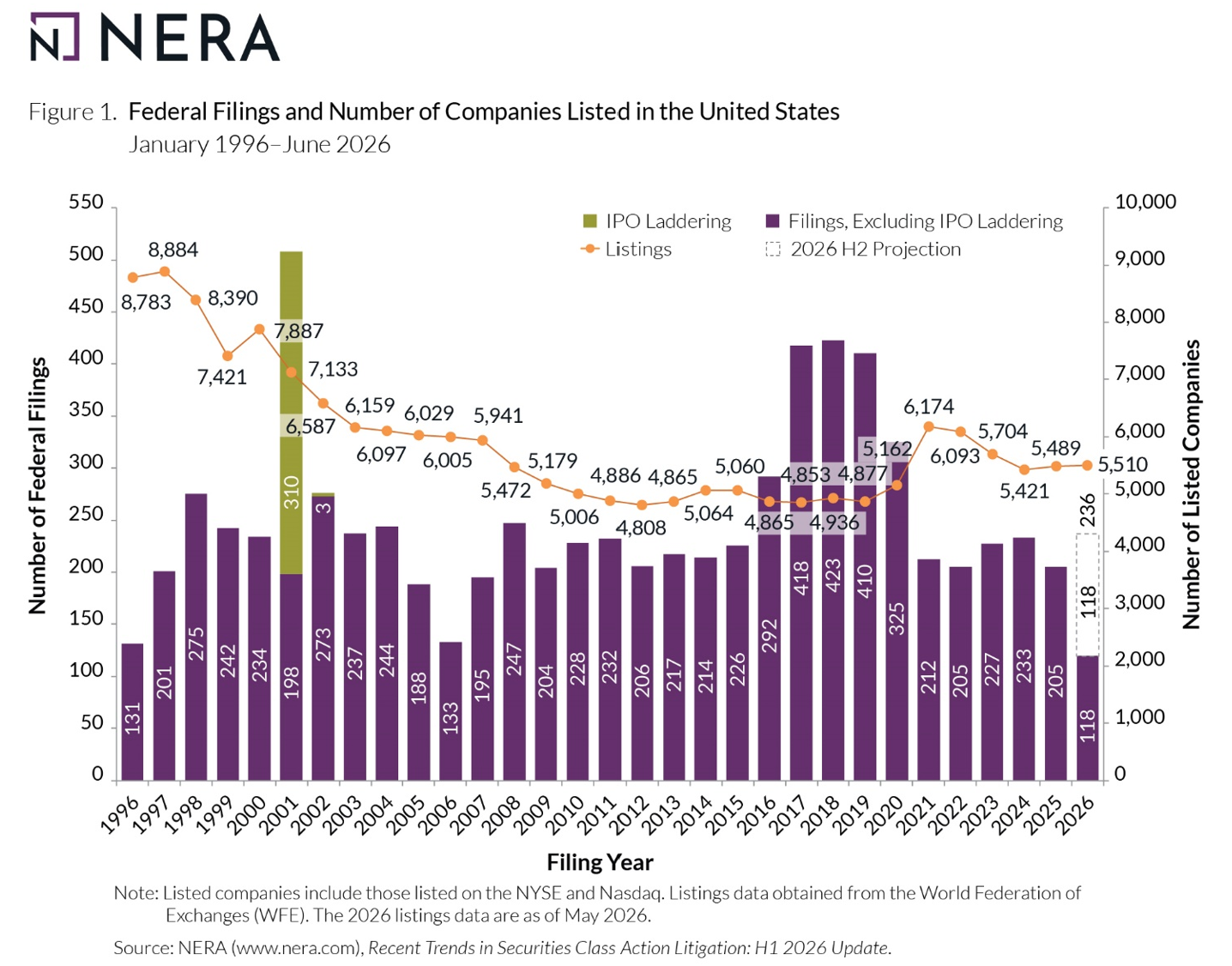
Figure 1 below reflects the federal filing rates from 1996 through the first half of 2026. In the first half of 2026, 118 federal cases have been filed. On an annualized basis, that number would exceed the recent peak in 2024 by three cases and would represent a 15% increase over the number of cases filed in 2025. Filing rates, however, are still well below the peak years of 2017–2019. As before, this figure does not include class action suits filed in state court or state court derivative suits, including those in the Delaware Court of Chancery.
Figure 1:
 |
B. Mix Of Cases Filed In The First Half Of 2026
1. Filings By Industry Sector
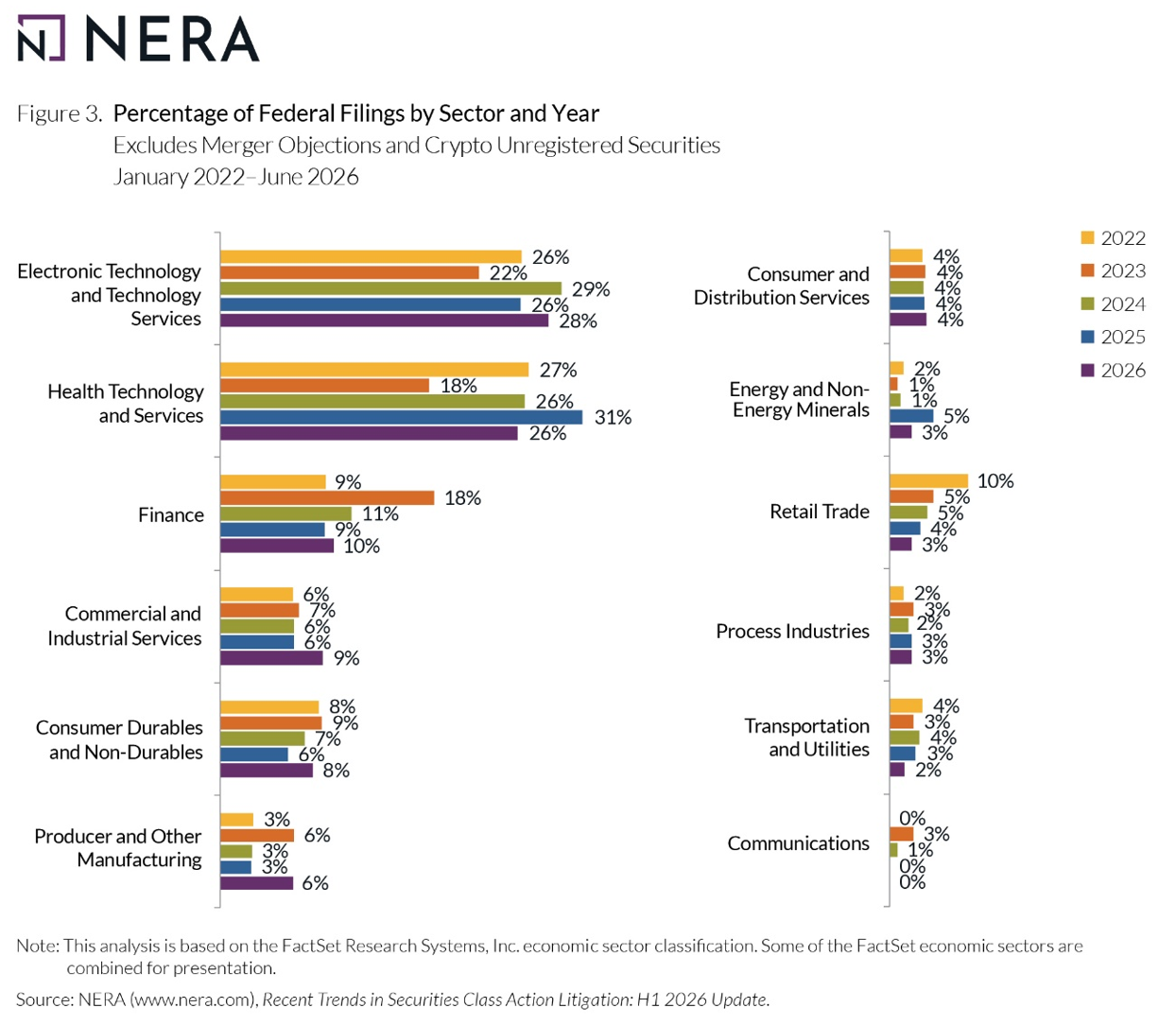
As shown in Figure 2 below, the distribution of non-merger objection and non-crypto unregistered securities filings in the first half of 2026 varied somewhat from 2025. The “Health Technology and Services” sector percentage declined from 31% in 2025 to 26%, while the percentage of “Electronic Technology and Technology Services” remained near its five-year high at 28%. Together, “Health Technology and Services” and “Electronic Technology and Technology Services” filings continue to comprise more than 50% of filings. Meanwhile, the contribution of “Finance” sector filings increased slightly from 9% to 10%.
Figure 2:
 |
2. Filings By Type
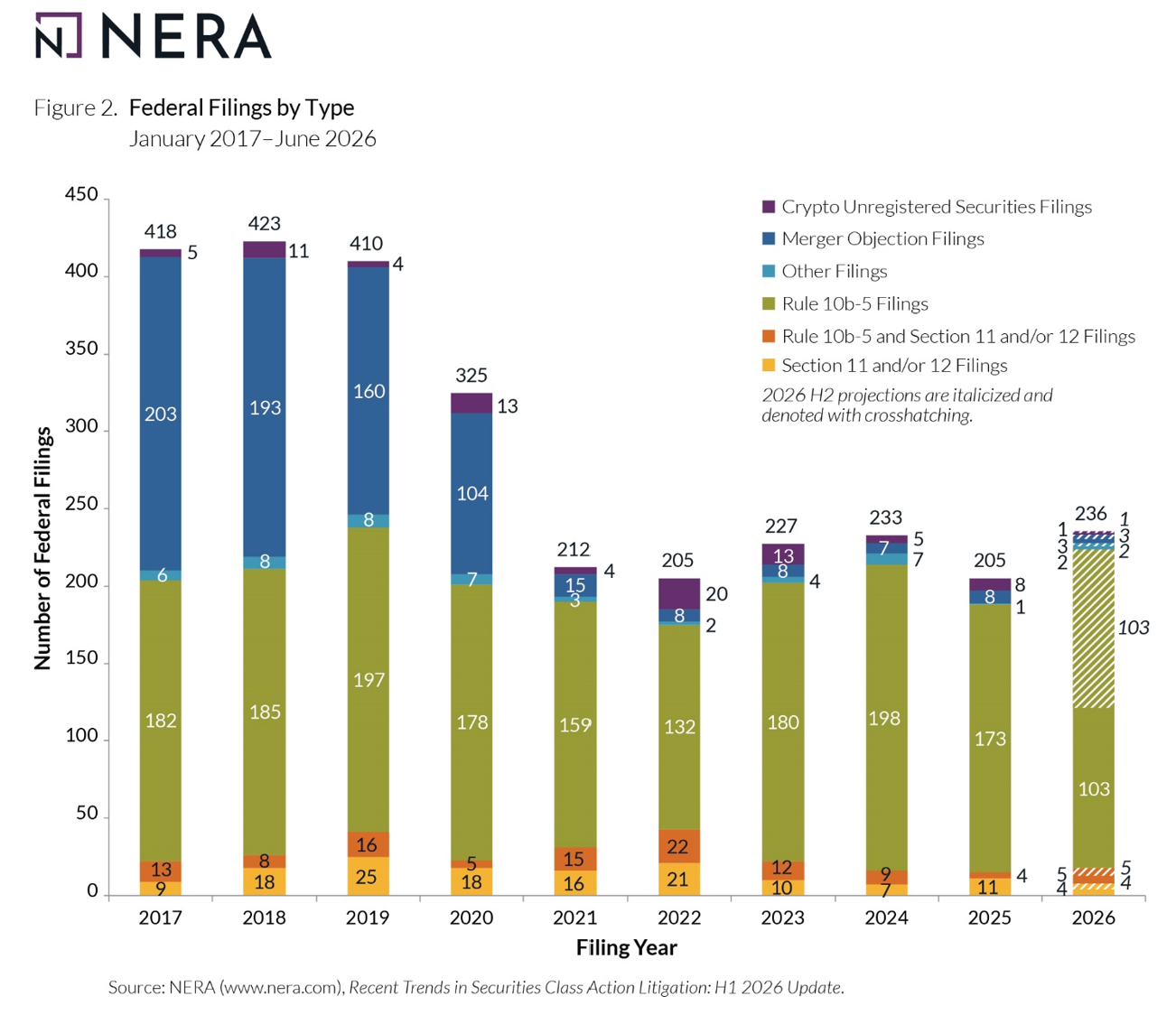
As shown in Figure 3 below, Rule 10b-5 filings made up the vast majority of federal filings in the first half of this year. Meanwhile, filings of other types reached a historic low.
Figure 3:
 |
3. Filings By Circuit
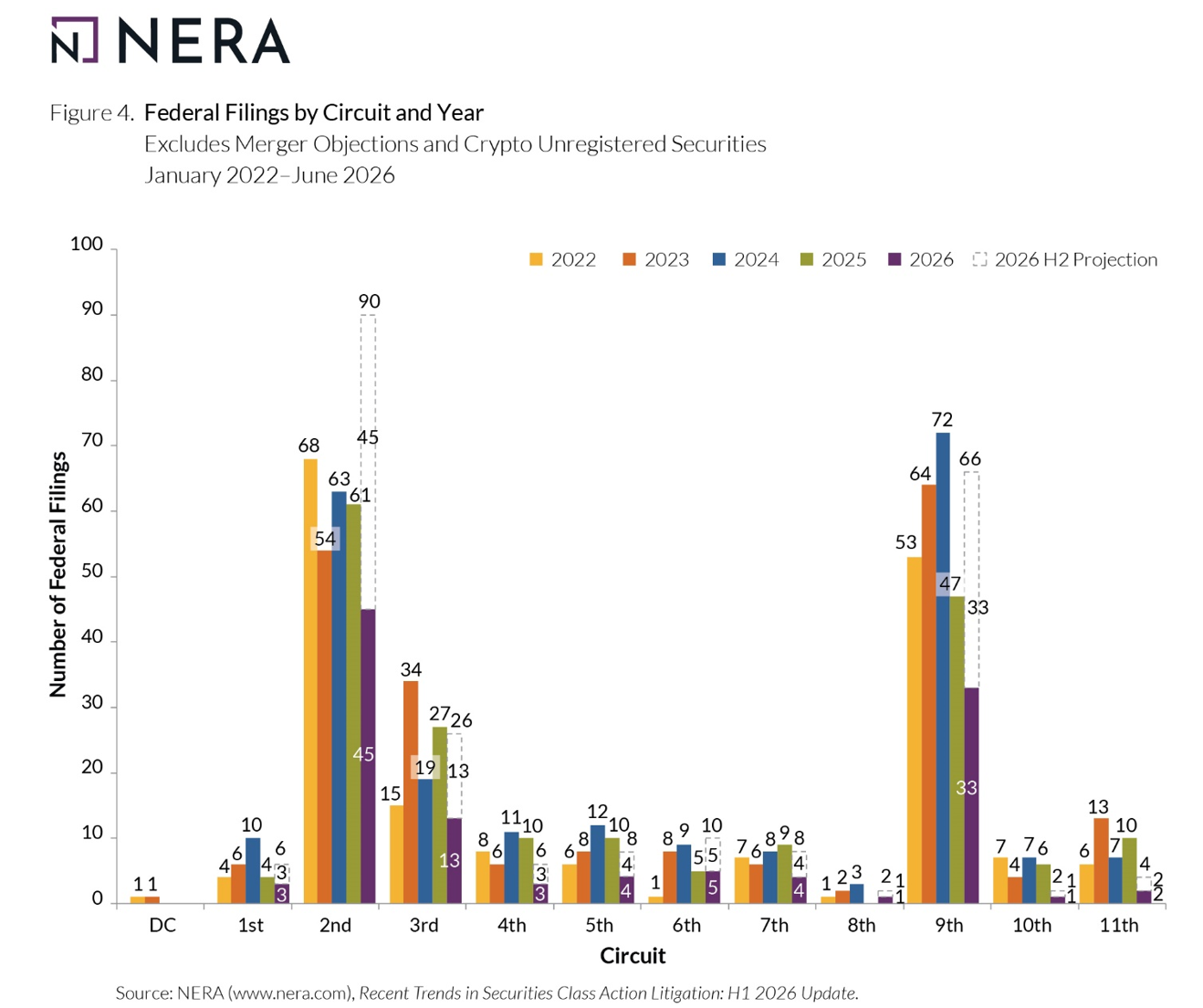
Figure 4 provides insight into the distribution of federal filings by Circuit. Most filings occur in the Second and Ninth Circuits. If the same pace continues into the second half of the year, the number of filings in the Second Circuit would surpass its five-year high, and filings in the Ninth Circuit would also increase significantly from the 2025 level.
Figure 4:
 |
4. Event-Driven And Other Special Cases
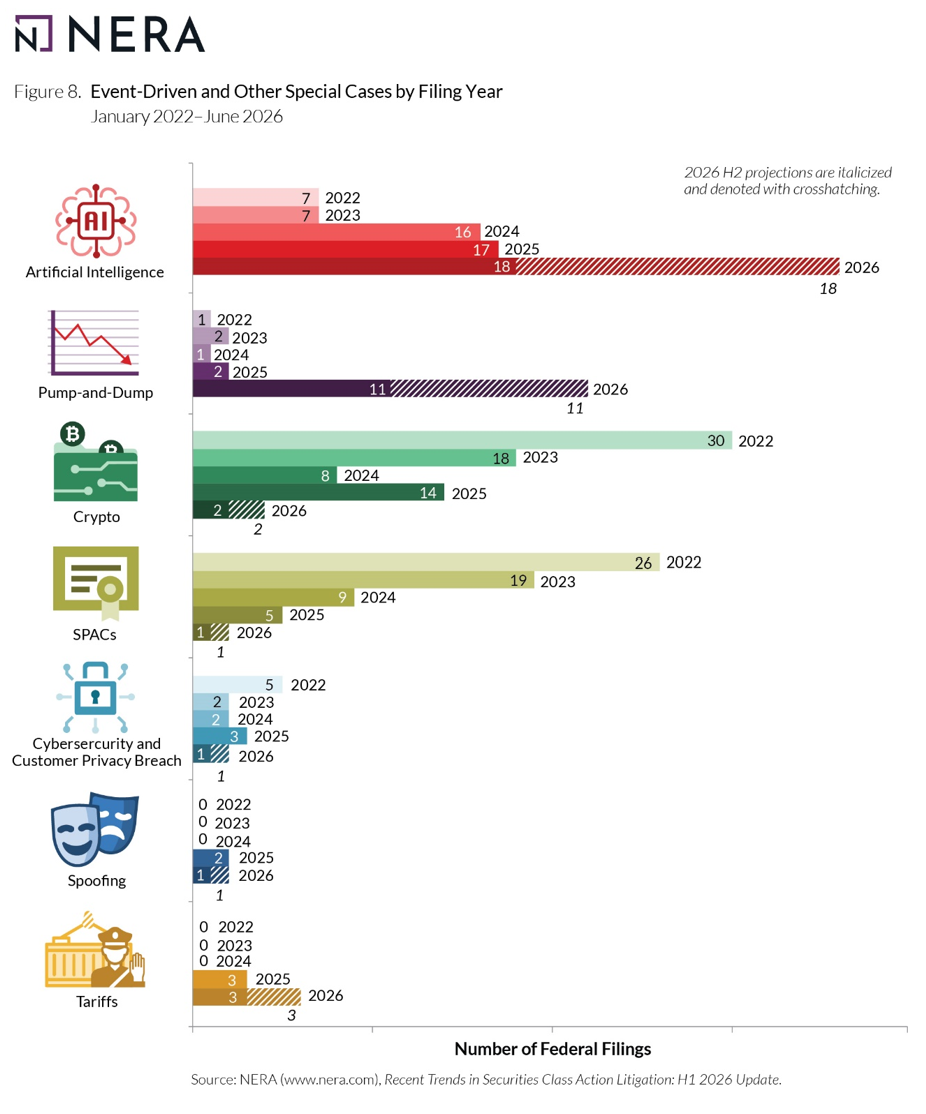
Figure 5 illustrates trends in the number of event-driven and other special case filings since 2022. The number of AI-related filings continued to increase, with the number for the first half of 2026 already exceeding the total in 2025. Alleged market manipulation cases, most notably pump-and-dump schemes, also increased sharply. By contrast, SPAC and crypto-related filings decreased significantly from 2025 levels.
Figure 5:
 |
C. Settlement Trends
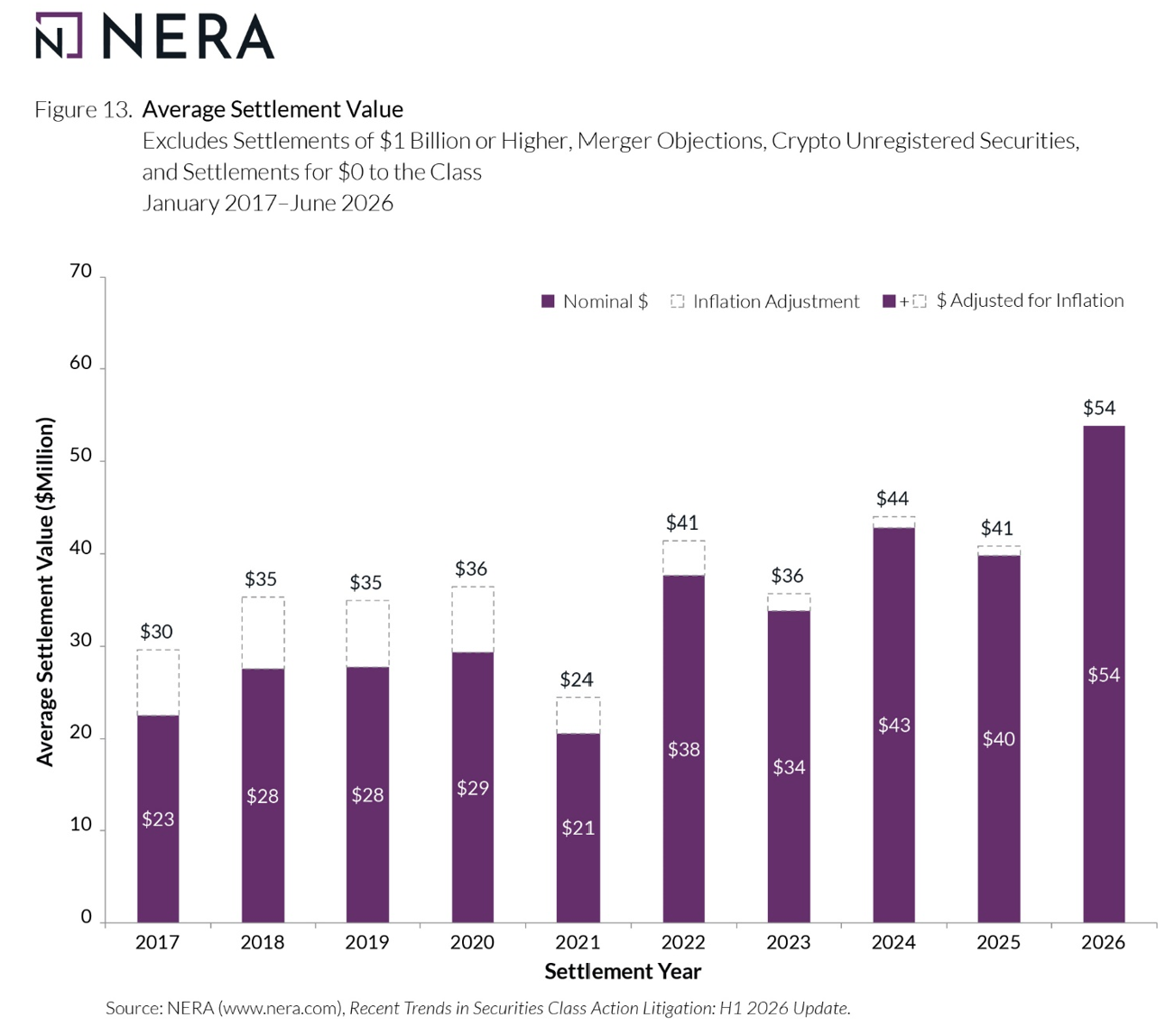
As reflected in Figure 6 below, the average settlement value in the first half of 2026 was $54 million. This is a significant increase from last year, and a ten-year high on an inflation-adjusted basis. Note that the average settlement value excludes merger-objection cases, crypto unregistered securities cases, and cases settling for more than $1 billion or $0 to the class.
Figure 6:
 |
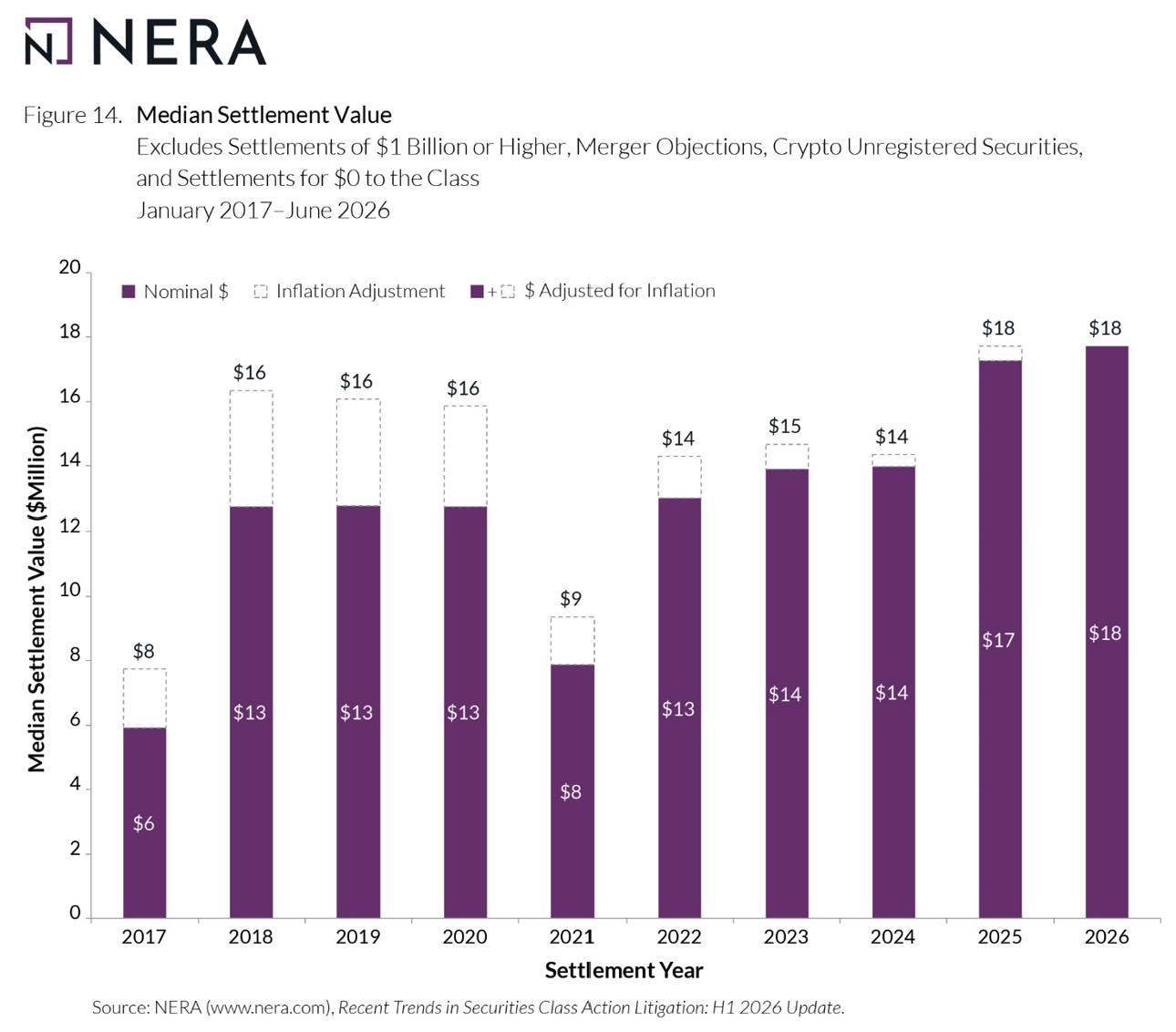
As for median settlement value, it was $18 million, up slightly from $17 million in 2025 in nominal terms and unchanged on an inflation-adjusted basis. In absolute and inflation-adjusted terms, this continued to be the highest figure in at least a decade. Note that median settlement value excludes settlements over $1 billion, merger-objection cases, crypto unregistered securities cases, and zero-dollar settlements.
Figure 7:
 |
II. WHAT TO WATCH FOR IN THE SUPREME COURT
A. Sripetch v. SEC: Supreme Court Holds SEC Does Not Need to Show Investor Loss for Disgorgement Award.
In Sripetch v. SEC, the Supreme Court held that the SEC may secure a disgorgement award from a wrongdoer without proving that wronged investors suffered pecuniary losses. 146 S. Ct. 1403, 1413 (2026). In this case, the SEC brought an enforcement action against Ongkaruck Sripetch after he allegedly orchestrated numerous fraudulent schemes involving dozens of companies. Id. at 1408. Mr. Sripetch consented to the entry of judgment “and agreed that the court could order disgorgement,” but disputed the amount of disgorgement. Id. The SEC sought over $4.1 million and the defendant objected, arguing that the SEC “lacked evidence that his schemes caused investors to suffer any ‘financial losses,’ so there were no ‘victims’ for whom disgorgement could be awarded.” Id. The SEC responded that investors could be “‘victims’ . . . even if they lost no money.” Id.
The Supreme Court agreed with the SEC. Assuming without deciding that the disgorgement remedy under 15 U.S.C. §§ 78u(d)(5) and (d)(7) must comply with “traditional equitable rules,” the Court noted that the proper amount of an equitable award “is not measured by [the investor’s] loss but by the defendant’s gain attributable to his wrongdoing against the [investor].” Id. at 1410. Therefore, a “victim” is defined as an investor who has “suffered an interference with protected interests,” not necessarily an investor who has lost money. Id. (citation omitted).
This decision resolves a divergence among the Courts of Appeals. The Second Circuit had previously held that disgorgement can only be awarded after a showing of pecuniary harm to investor-victims, see SEC v. Govil, 86 F.4th 89, 106 (2d Cir. 2023), while the Ninth Circuit, siding with the First Circuit, had held that no such showing was required, see SEC v. Sripetch, 154 F.4th 980, 989 (9th Cir. 2025). The Second Circuit precedent is no longer good law. The practical takeaway is that, when the SEC seeks disgorgement, that award will be measured by the amount of net profit the wrongdoer received, irrespective of any monetary harm that befell his victims.
While the Supreme Court’s decision was unanimous, Justice Thomas wrote a lengthy concurrence. Notably, Justice Thomas posited that disgorgement is actually a legal remedy, rather than an equitable one. Sripetch, 146 S. Ct. at 1413 (Thomas, J., concurring). If the Court were to adopt that view in the future, defendants would be entitled to a jury trial on the disgorgement question under the Seventh Amendment.
B. FS Credit Opportunities Corp. v. Saba Capital Master Fund, Ltd.: Supreme Court Holds No Private Right of Action Under Section 47(b).
In FS Credit Opportunities Corp. v. Saba Capital Master Fund, Ltd., the Supreme Court held that there is no implied private right of action for rescission of contract under Section 47(b) of the Investment Company Act of 1940 (ICA). 146 S. Ct. 1546, 1551, 1555 (2026). In this case, Saba Capital challenged certain resolutions adopted by closed-end funds under § 47(b), relying on an implied private right of action. Id. at 1551–52. But after reviewing the statute, the Supreme Court rejected that position. Section 47, in relevant part, provides that “any contractual waiver of compliance with the ICA ‘shall be void’” and that “if such contract ‘has been performed, a court may not deny rescission at the instance of any party . . . .’” Id. at 1553 (quoting § 47(a)–(b)). The Court concluded that the phrase “at the instance of any party” does not confer a right of action because it “presupposes that parties are already before the court.” Id. at 1554. A party seeking rescission could end up before the court in “various ways,” such as by filing a state law breach of contract claim or through a shareholder action alleging breach of fiduciary duties. Id. Because “other sources of law typically supply the right of action in suits requesting rescission,” rescission is just a remedy, and the ICA does not alter that fact. Id.
Justices Kagan, Sotomayor, and Jackson dissented. All three Justices argued that the statutory text conferred a private right of action. Id. at 1559 (Kagan, J., dissenting); id. at 1563 (Jackson, J., dissenting). Justices Jackson and Sotomayor also argued that the “legislative Committee Reports . . . unequivocally expressed Congress’s ‘wish’ that [§ 47(b)] continue to be interpreted to allow private suits.” Id. at 1559 (Jackson, J., dissenting). Much of the disagreement between the majority and dissenting Justices centered around basic issues of judicial philosophy—whether courts should fashion causes of action without express direction from the legislature and whether courts should rely on legislative history—and not around anything particular to the securities laws. Nevertheless, this decision will limit the number of ICA challenges faced by closed-end funds.
C. ON24, Inc. v. Leadersel Innotech ESG: Defendants Seek Supreme Court Review of Ninth Circuit Decision Reviving Section 11 Claims Premised on Hypothetical Risk Disclosures.
A certiorari petition is also pending in ON24, Inc. v. Leadersel Innotech ESG. The class plaintiff alleges that ON24’s initial public offering documents misled investors by omitting material facts concerning “atypical” customers who engaged ON24 for short-term subscriptions during the pandemic. In re ON24, Inc. Sec. Litig., 2026 WL 45259, at *1–2 (9th Cir. Jan. 7, 2026). According to the plaintiff, the IPO documents failed to disclose that: (i) these atypical customers had informed ON24 of their intent either to downsell or not renew their subscriptions and (ii) churn and downselling among atypical customers had begun before the IPO. Id.
The Ninth Circuit held that the plaintiff plausibly alleged that these omissions rendered five of ON24’s challenged statements misleading. Invoking the principle that “[r]isk disclosures that speak entirely of as-yet-unrealized risks and contingencies and do not alert the reader that some of these risks may already have come to fruition can mislead reasonable investors,” the Circuit concluded that the plaintiff plausibly alleged that ON24 “knew that the risk of material churn and downselling had started to come to fruition before the IPO yet disclosed only that those risks may occur.” Id. at *2 (emphasis in original). The panel likewise revived the plaintiff’s claim that ON24 failed to disclose “known trends or uncertainties” under Item 303 of Regulation S-K, along with the derivative Section 15 claim. Id. at *3 (citation omitted).
In their petition, ON24 and the other defendants present three questions: (1) “whether an issuer violates Section 11(a)’s misleading-omissions prong by describing unmaterialized risks as hypothetical”; (2) whether an issuer violates that prong “whenever it omits information related to a disclosed fact, regardless of whether the omission renders an affirmative statement misleading”; and (3) whether an issuer violates Item 303 “by failing to disclose immaterial facts as known trends or uncertainties.” Petition for Writ of Certiorari at i, ON24, Inc. v. Leadersel Innotech ESG, No. 25-1376. Petitioners argue that the decision below squarely conflicts with the First, Third, and Tenth Circuits, “which hold that risk disclosures are not misleading when they describe potential harms as hypothetical unless the warned-of harm has already occurred or is virtually certain to occur.” Id. at 2, 14–21. Petitioners note that this is the same conflict the Court agreed to resolve in Facebook, Inc. v. Amalgamated Bank, 144 S. Ct. 2629 (2024), before dismissing the writ as improvidently granted. Id. at 19–21. We will continue to monitor the petition as it proceeds.
A. In a Decision of First Impression, the Court of Chancery Applies Amended Section 144’s “Heightened” Director Exchange-Based Independence Presumption.
In Ayers v. Foley, 362 A.3d 355 (Del. Ch. 2026), Vice Chancellor Lori W. Will issued the first decision interpreting Section 144(d)(2), which was added by the Delaware legislature last year. Section 144(d)(2) establishes a presumption of disinterestedness for directors of public companies not party to an act or transaction if the board determines that such director satisfies applicable stock exchange criteria for “director independence from the corporation” and, if applicable, the controlling stockholder. Ayers provides meaningful guidance on the interaction between Section 144’s new “heightened” presumption—that directors deemed independent under applicable national securities exchange rules are also presumed to be disinterested under Section 144—and Court of Chancery Rule 23.1’s well-established demand-futility standard.
The nominal defendant in the case, Fidelity National Financial, Inc. (FNF), is a provider of title insurance, mortgage loan servicing, and other real estate services. The plaintiff, an FNF stockholder, asserted derivative claims for, among other things, breach of fiduciary duty against FNF’s founder and Non-Executive Chairman, William P. Foley, and the company’s nine non-employee directors (NEDs). In particular, the plaintiff challenged (i) an equity grant to Foley (the Equity Grant) by the Compensation Committee and the separate Related Person Transaction Committee (the RPT Committee), and (ii) the directors’ 2022–2024 annual compensation set by the Compensation Committee (the NED Compensation). Id. at 364–68. The Court declined to treat the awards as a single board act: the record reflected two discrete decisions made through separate processes, and because the directors’ own compensation was already approved when the RPT Committee took up Foley’s grant, that review could not “call into question” the members’ own pay. Id. at 370–71.
Applying the three-pronged demand-futility test, the Court held that plaintiff failed to plead that a majority of FNF’s eleven-member board could not impartially consider a demand to pursue claims regarding the Equity Grant. Ayers, 362 A.3d at 369–70, 373, 381.
Under the first prong, the Court found that Foley was disabled, but demand was not excused because the plaintiff did not allege that any of the nine NEDs “received a material personal benefit from the alleged misconduct that is the subject of the litigation demand.” Id. at 372 (citation omitted).
The Court also concluded that demand was not futile under the third prong. At the center of the Court’s analysis was amended Section 144(d)(2), which provides that a director of an exchange-listed corporation is “presumed to be a disinterested director” as to a transaction to which the director is not a party if the board has determined that the director satisfies the applicable exchange’s independence criteria—a presumption that is “heightened” and “may only be rebutted by substantial and particularized facts” of a material interest or material relationship. Id. at 373–74 (quoting 8 Del. C. § 144(d)(2)). Having already held that the Equity Grant was a transaction distinct from the NED Compensation, the Court found that the NEDs were not parties to it and could therefore invoke the presumption as to that grant—disposing of plaintiff’s contention that the presumption was unavailable because the NEDs were parties to their own compensation packages. Because no Delaware court had construed Section 144(d)(2), the Court applied settled principles of statutory interpretation and reached several conclusions of first impression.
First, the Court concluded Section 144’s heightened presumption applies whenever director interest is assessed, including for demand futility under Rule 23.1. Id. at 374–75. The Court reasoned that, unlike other parts of Section 144 that expressly limit their reach—like Section 144(d)(7) and the definitions in Section 144(e)—Section 144(d)(2) contains no such limiting language. Id. Reading the presumption to apply only within Section 144 also would illogically result in a lighter burden on plaintiffs to plead director interest under Rule 23.1 than under Rule 12(b)(6). Id. at 375 n.124.
Second, the Court construed the standard for rebutting the statute’s independence presumption. Id. at 375–76. The Court determined that “particularized” carries the meaning Delaware courts have long given that term under Rule 23.1—namely “specific, non-conclusory facts.” Id. The Court then interpreted the added requirement that the facts be “substantial” as a qualitative directive: the pleaded facts must be “significant enough to evidence a disabling conflict.” Id. at 375. As the Court put it, “a collection of trivial facts will not satisfy” the heightened standard by sheer accumulation. Id. at 376 n.132. Measured against that standard, the Court concluded plaintiff’s allegations fell short. Id. at 376–78.
Finally, as to the second prong, the Court found that plaintiff waived and, in any event, failed to plead a “substantial likelihood of liability” theory due to two interlocking protections: (i) the Section 144(a)(1) safe harbor foreclosed relief because the material facts of any conflict were disclosed or known and a majority of disinterested directors approved the grant in good faith and without gross negligence; and (ii) FNF’s Section 102(b)(7) charter provision exculpated the directors for any breach of the duty of care. Id. at 378–80. Together, these provisions meant plaintiff could establish a substantial likelihood of liability for the approving disinterested directors only by pleading “particularized facts supporting a reasonable inference that they acted [in] bad faith”—a “high hurdle” the complaint did not clear. Id. at 379–80.
Because the plaintiff failed to allege a lack of independence as to three of the five challenged directors, there was no conflicted board majority, and demand was not excused for the Equity Grant claims.
The Court came to a different conclusion with regard to the NED Compensation decision. The Court ruled that, although the plaintiff did not adequately plead a claim against the non-Compensation Committee member directors for the NED Compensation decision, the circumstances of this case and plaintiff’s allegations prevented dismissal of the claims against the Compensation Committee members under Section 144(a)(3). Section 144(a)(3), which insulates an interested-director transaction shown to be “fair as to the corporation and the corporation’s stockholders,” requires a plaintiff to plead facts supporting a reasonable inference of both unfair dealing and unfair price. Id. at 382–83. The Court concluded that allegations regarding performance metrics that were different from those used by the Compensation Committee when setting compensation “present[ed] a factual dispute inappropriate for resolution on a motion to dismiss.” Id. at 384.
For further discussion, see our post on the Securities Regulation and Corporate Governance Monitor.
B. Court of Chancery Holds That Statutory Safe Harbor Protects PBC Directors and Revlon’s Stockholder-Value-Maximization Mandate Does Not Apply to PBCs.
Once a niche corporate form, the Delaware public benefit corporation (PBC) has become an increasingly significant feature of the corporate landscape, having been adopted by a number of prominent companies, including highly valued private issuers and established public companies. Until July of this year, however, the PBC statute had generated almost no case law on what PBC directors owe their stockholders in a sale of control.
In July 2026, the Delaware Court of Chancery addressed that issue in a decision from Vice Chancellor Cook in Drakes Landing Associates, L.P. v. Tilden Park Capital Management, L.P., 2026 WL 2185439 (Del. Ch. July 29, 2026). The Court held, as a matter of first impression, that Revlon’s stockholder-value-maximization mandate does not apply to directors of a public benefit corporation in a change-of-control transaction and dismissed breach of fiduciary duty and aiding-and-abetting claims with prejudice under the statutory safe harbor in 8 Del. C. § 365(b). Id. at *1. However, the Court left open the question of whether enhanced scrutiny might nevertheless apply as a standard of review in a modified form—which the opinion referred to as “‘PBC’ enhanced scrutiny.” See id. For further information, see our July 31, 2026 Client Alert.
C. Delaware Supreme Court Rejects Bright-Line Rules in Section 220 Books and Records Proceedings.
In March 2026, in Paramount Global v. Rhode Island Office of the General Treasurer ex rel. Employees’ Retirement System of Rhode Island, __ A.3d __, 2026 WL 820647 (Del. Mar. 25, 2026), the Delaware Supreme Court held 3–2 that, in ruling on a Section 220 books and records demand, the Court of Chancery may, in exceptional circumstances and in its sound discretion, consider post-demand evidence that is material to the credible-basis inquiry and not prejudicial to the corporation. The Court acknowledged the general rule that a stockholder seeking books and records under Section 220 is limited to evidence identified in its demand or known when the demand was made but held that the Court of Chancery could look at post-demand evidence under certain circumstances. The Court further held that hearsay from confidential sources in news articles, if sufficiently reliable under a fact-specific inquiry, can also support a credible basis to suspect wrongdoing—affirming an order compelling inspection in connection with the Paramount/National Amusements sale process. In dissent, Chief Justice Seitz and Justice Valihura said they would have categorically barred post-demand evidence. For further information, see our April 1, 2026 Client Alert.
A. Technology Updates
In an interpretation joined by the CFTC, the SEC addressed the application of the federal securities laws to crypto assets, classifying crypto assets into five categories and clarifying when crypto assets, as well as certain crypto asset transactions, are subject to the federal securities laws. Recent court decisions likewise address whether certain digital assets qualify as securities, whether a crypto exchange is a “statutory seller” under Section 12(a)(1) of the Securities Act, claims of “AI washing,” and the Securities Litigation Uniform Standards Act’s preclusive effect on state law claims arising from AI-generated advertisements.
1. Regulatory Developments.
SEC-CFTC Joint Interpretation on the Application of the Federal Securities Laws to Crypto Assets. On March 17, 2026, the SEC issued an interpretation, joined by the CFTC, regarding the application of the federal securities laws to certain types of crypto assets and certain transactions involving crypto assets. SEC Clarifies the Application of Federal Securities Laws to Crypto Assets, Release No. 2026-30 (Mar. 17, 2026); Application of the Federal Securities Laws to Certain Types of Crypto Assets and Certain Transactions Involving Crypto Assets, Release No. 33-11412, 91 Fed. Reg. 13,714 (Mar. 23, 2026) (the Release). The Release, effective March 23, 2026, classifies crypto assets into five categories—digital commodities, digital collectibles, digital tools, stablecoins, and digital securities—and concludes that the first three “are not themselves securities” but “can be offered and sold subject to an investment contract.” Release at 13. The Release identifies sixteen assets by name as digital commodities, including Bitcoin, Ether, Solana, and XRP. Id. at 13–16 & n.51. The Release also clarifies that payment stablecoins issued by permitted issuers will be excluded from the definition of “security” by operation of the GENIUS Act, while digital or “tokenized” securities remain classified as securities, stating “[a] security is a security regardless of whether it is issued, or otherwise represented, offchain or onchain.” Id. at 21–24.
The Release addresses not only how a non-security crypto asset becomes subject to an investment contract under SEC v. W.J. Howey Co., 328 U.S. 293 (1946), but also how the asset may separate from that investment contract. Release at 24–28. Separation occurs when the issuer fulfills its promised essential managerial efforts, or when purchasers can no longer reasonably expect the issuer to perform them, such as upon a widely disseminated and unambiguous announcement of abandonment. Id. at 28–31. Upon separation, the investment contract “ceases to exist” and the asset “is not subject to the Federal securities laws” in subsequent transactions—although the issuer remains potentially liable under the antifraud provisions, and for any failure to register the original offering, notwithstanding the later separation. Id. at 29–34. The Release further concludes that protocol mining, protocol staking, and the “wrapping” of non-security crypto assets, in the manner and under the circumstances described in the Release, do not involve the offer and sale of a security, and that airdrops of such assets for “no or nominal consideration” do not give rise to an investment contract. Id. at 38, 47, 55, 58, 60–61. Although styled as an interpretive rule exempt from notice and comment, the interpretation has been designated a “major rule” under the Congressional Review Act, and the Commission has solicited public comment and described the Release as its “first step toward developing a clearer regulatory framework” for crypto assets. Id. at 9, 63. We will monitor how courts engage with the Commission’s views, including the “separation” framework, in pending and future private securities litigation.
2. Digital Assets Developments.
Central District of California Holds Celebrity-Promoted Memecoin Is Not a Security Absent Pooling or Product Development: Azad v. Jenner, 2026 WL 1084840 (C.D. Cal. Apr. 16, 2026). The Central District of California dismissed with prejudice a Securities Act claim against defendants Caitlyn Jenner and her manager arising from their promotion and sale of the $JENNER token on the Ethereum blockchain. Id. at *6. The court held that Jenner’s promotion of the memecoin—unaccompanied by any pooling of investor proceeds or development of a related product—does not create the common enterprise required under Howey. Id. at *4–6; see also Howey, 328 U.S. at 298–99. Plaintiffs’ allegations that “investors separately bought and sold $JENNER on Ethereum, hoping it would increase in value over time as Jenner encouraged more people to buy it” reflected “parallel speculation rather than a common enterprise tying investor fortunes together.” Azad, 2026 WL 1084840, at *5.
A common enterprise requires either horizontal or vertical commonality. The court distinguished several cases plaintiffs relied on in which courts “have found horizontal commonality when a seller of cryptocurrencies pools the proceeds and uses them to finance the development of technology that increases the value of the currency.” Id. at *3–4. The court found there was no horizontal commonality because defendants “did not pool the proceeds of the investors’ purchases or use them to develop any related product or technology,” noting that defendants stated the token is “a memecoin . . . intended solely for entertainment purposes” and “that its value would increase because Jenner would use her fame and influence to promote it.” Id. at *4.
The court next determined that a vertical commonality finding was also precluded by plaintiffs’ allegation that “Jenner obtained a 3 percent tax on every transaction” because “even if an investor lost money on the transaction, Jenner would still receive transaction-based fees.” Id. at *5. In doing so, the court relied on Ninth Circuit precedent finding no vertical commonality “where a promoter ‘could reap large commissions for itself and be characterized as successful, while the individual accounts could be wiped out.’” Id. (quoting Brodt v. Bache & Co., 595 F.2d 459, 461 (9th Cir. 1978)). The court denied leave to amend the federal claim as futile and declined to exercise supplemental jurisdiction over the remaining state law claims. Id. at *6. Plaintiffs filed a notice of appeal on May 13, 2026.
The SEC issued its interpretation of the federal securities laws as applied to crypto assets after briefing and argument on the motion. The court observed that the interpretation is nonbinding, declined to rely on it, and said it reached its conclusion independently, although it regarded the interpretation as consistent with its own treatment of a memecoin. Id. at *5 n.1.
Southern District of New York Holds Crypto Exchange Is Not a Statutory Seller Where It Matched Buyers and Sellers: Underwood v. Coinbase Global, Inc., 2026 WL 2198774 (S.D.N.Y. July 30, 2026). Following the discovery ruling discussed in our 2025 Year-End Update, the court granted Coinbase summary judgment on all federal and state claims arising from “matched transactions,” which accounted for 99.97% of transactions on its trading platforms in the 60 tokens at issue in the case. Id. at *1–2, *11. The court held that Coinbase’s matching of users’ buy and sell orders does not render it a “statutory seller” under Section 12(a)(1) of the Securities Act. Id. at *1–2, *39.
Referencing the test laid out in Pinter v. Dahl, 486 U.S. 622 (1988), the court noted a defendant is a statutory seller if it either (1) “passed title, or other interest in the security, to the buyer for value,” or (2) “successfully solicit[ed] the purchase [of a security], motivated at least in part by a desire to serve [its] own financial interests or those of the [security’s] owner.” Id. at *11 (alterations in original) (quoting Pinter, 486 U.S. at 642, 647).
As to the first prong, the parties’ primary disagreement was “whether Coinbase exercised sufficient control over the tokens traded by its users to gain an ownership interest in them.” Id. at *12. The court noted that Coinbase’s user agreements uniformly provided that ownership remained with users; its custody and operational control of tokens—like that of traditional securities intermediaries—conferred no ownership interest; it did not record users’ assets as its own on its books; and its spreads and fees reflected compensation for executing trades, not for acting as principal. Accordingly, the court held that Coinbase did not pass any ownership interest to buyers. Id. at *12, *24.
As to the second prong, the court first found that “the information that Coinbase provided regarding tokens did not induce plaintiffs to purchase them” because plaintiffs “relied on numerous sources of information that were far more in-depth than the basic overview that Coinbase provided of each token and its price history” and it was clear from the record that “Coinbase’s provision of such basic information did not cause either plaintiff’s token purchases.” Id. at *26. The court then concluded that even if Coinbase’s provision of such information had caused plaintiffs’ token purchases, “such conduct did not extend beyond the ‘collateral’ participation in sales that Pinter excluded from Section 12 liability.” Id. The court explained that the “prices that Coinbase displayed to users were based on real-time supply and demand” and that this alone cannot fall within Pinter’s solicitation prong. Id. The court also noted that Coinbase’s token pages were “high-level and descriptive” summaries, and that each token page included disclaimers such as “for informational purposes only” and “does not constitute a recommendation by Coinbase to buy, sell, or hold.” Id. at *26. The court therefore concluded Coinbase was not a statutory seller as to the matched transactions and granted defendants’ motion for summary judgment as to those claims. Id. at *27, *39.
The court reached the opposite conclusion as to the remaining 0.03% of transactions—the “inventory transactions” in which Coinbase filled orders “from a corporate inventory of tokens it owned” and, according to the court, acted as a principal rather than an agent. Id. at *1–2, *30. These claims will proceed to discovery on the remaining elements. Id. at *39. This decision confines Section 12(a)(1) exposure to a narrow subset of trades in which the platform acts as principal. As the court observed, federal courts had not previously resolved whether a centralized digital asset exchange is a statutory seller of the tokens traded on it. Id. at *17.
3. Artificial Intelligence Developments.
District of New Jersey Dismisses “AI Washing” Claims Where Plaintiff’s Confidential Witnesses Conceded Company Used Artificial Intelligence: D’Agostino v. Innodata Inc., 2026 WL 1133664 (D.N.J. Apr. 27, 2026). The District of New Jersey dismissed without prejudice Section 10(b), Rule 10b-5, and Section 20(a) claims alleging that a data engineering company overstated its AI capabilities on earnings calls and in SEC filings. Id. at *1, *19. The court first rejected two of defendants’ threshold arguments, holding that the complaint was “not an improper puzzle pleading” and that defendants’ reliance on their disclosures about offshore labor and limited research and development spending “functions more as an answer denying the allegations of the SAC than an independent basis to dismiss.” Id. at *14. The court found that plaintiff nevertheless failed to plead falsity, as he relied on the statements of three confidential former employees, all of whom worked in sales and none of whom was employed for the full class period. The court struck the claims premised on company statements that fell outside the employees’ tenure, holding it could not “plausibly infer that [the employees] had credible or firsthand knowledge about company statements made before or after their tenure,” and found that as to the remaining statements, the allegations about how the witnesses obtained the information were “insufficiently detailed.” Id. at *14–15. The witnesses’ statements that the products were “machine learning-enabled” and that the platform “worked” if enough people loaded information onto it amounted to “an admission that, at some level, Defendants did have at least one functional AI product.” Id. at *15. That concession also defeated scienter because if defendants “had some kind of AI,” the statements would have been true. Id. at *18. In this regard, the court found the plaintiff’s argument “self-defeating.” Id. The court also held that a short seller report whose publication preceded a 31% single-day price decline could “properly serve as a corrective disclosure,” rejecting defendants’ argument that it revealed no “new information,” but nonetheless concluded that plaintiff failed to plead loss causation. Id. The parties subsequently filed a stipulation dismissing the case with prejudice. Stipulation and Order of Dismissal with Prejudice, D’Agostino v. Innodata Inc., No. 2:24-cv-00971-JKS-JSA (D.N.J. June 11, 2026), ECF No. 61.
Northern District of California Holds SLUSA Bars State Law Class Action Against Meta Over Allegedly AI-Generated Advertisements Tied to Securities Fraud Scheme: Bouck v. Meta Platforms, Inc., 2026 WL 1697631 (N.D. Cal. June 11, 2026), appeal filed (9th Cir. July 13, 2026). The Northern District of California dismissed plaintiffs’ putative state law class action against Meta under the Securities Litigation Uniform Standards Act (SLUSA), holding that the theory that had defeated Meta’s immunity under Section 230 of the Communications Decency Act—the allegation that Meta “literally generat[ed], using artificial intelligence, the images and text in the advertisements”—brought the alleged misrepresentations under SLUSA’s jurisdictional bar. Id. at *1–2, *6–7 (emphasis in original). Plaintiffs’ win on the first motion to dismiss thus compelled their loss on the second. Plaintiffs alleged that investment advertisements on Meta’s platforms were fraudulent and funneled them into private messaging groups in which fraudsters urged them to buy shares of a thinly traded penny stock that the fraudsters’ co-conspirators were secretly unloading. Id. at *1–2. Plaintiffs alleged the investment caused losses of more than $300 million when the share price collapsed. Id. at *2. Meta’s first motion to dismiss, invoking Section 230, was denied. Id. at *1. The court found the complaint’s AI-generation allegations sufficed to allege Meta’s material contribution to the alleged illegality of the ads. Id. Meta then moved to dismiss again under SLUSA, arguing that if Meta contributed to the creation of the fraudulent advertisements, the suit was a covered state law class action alleging misrepresentations made “in connection with the purchase or sale” of a covered security. Id. at *2 (quoting 15 U.S.C. § 78bb(f)(1)).
The court agreed. Under Chadbourne & Parke LLP v. Troice, 571 U.S. 377, 387–88 (2014), “a connection matters where the misrepresentation makes a significant difference to someone’s decision to purchase or sell a covered security.” Bouck, 2026 WL 1697631, at *3. The court found the plaintiffs’ own theory satisfied that standard because absent the alleged misrepresentations from Meta lending the messaging groups “the veneer of legitimacy,” the plaintiffs would not have joined those groups and ultimately purchased the stock. Id. The court explained that a third party’s misrepresentations that “imbue a fraudster with credibility” are made “in connection with” a covered securities transaction where, as a result of the misstatement, the plaintiff “enters into a relationship with that fraudster to trade covered securities”—and that it was “inconsequential” that the alleged misrepresentations were made by a party “acting as an advertiser.” Id. at *4. The court rejected plaintiffs’ argument that SLUSA did not apply because the advertisements never mentioned the stock by name, explaining that a misstatement can be material to a trading decision “even if it does not mention the security by name.” Id. The court likewise rejected the argument that the advertisements merely induced a relationship with the fraudsters rather than any securities transaction, holding that the “ultimate—and legally relevant—effect was to get them to buy near-worthless securities.” Id. at *5. “At bottom,” the court concluded plaintiffs were “trying to have it both ways”—asserting that the alleged misrepresentations abetted the core fraud while maintaining that those alleged misrepresentations were not material to their trading decision. Id. at *6. Because the dismissal was jurisdictional, it was without prejudice to refile under the federal securities laws or in another forum not precluded by SLUSA. Id. at *1, *7. Any refiled federal securities claims, however, would be subject to the PSLRA’s heightened pleading standards. Plaintiffs’ appeal to the Ninth Circuit is pending, and we will monitor further developments.
B. Cross-Cutting Issues
We continue to track cases where environmental, social, and governance (ESG) and diversity, equity, and inclusion (DEI) policies and statements are at issue. In prior updates, we noted that litigation trends in this area may be affected by political, social, and commercial factors. Over the past several months, securities cases have touched on ESG and DEI concepts, with varying results.
Indiana Pub. Ret. Sys. v. Rivian Auto. Inc., No. 2:24-cv-04566, 2026 WL 199989 (C.D. Cal.): In this putative class action filed in May 2024, shareholders in Rivian Automotive Inc. (Rivian)—a manufacturer of electric vehicles—allege that Rivian and certain officers violated Section 10(b) of the Securities Exchange Act and SEC Rule 10b-5 by making misrepresentations about the company’s demand outlook between August 2022 and February 2024. See, e.g., ECF No. 1 ¶¶ 1, 33, 51–54. The plaintiffs allege that during that period, contrary to its representations, Rivian was experiencing softening demand. Id. ¶ 33. On January 22, 2026, the court denied the defendants’ motion for judgment on the pleadings. 2026 WL 199989, at *4. In denying the motion, the district court explained it had already “considered the context surrounding the alleged statements” by Rivian in denying the defendants’ motion to dismiss; even in context, the plaintiffs sufficiently alleged that the challenged statements were false and materially misleading. Id. at *3.
Pembroke Pines Firefighters & Police Officers Pension Fund v. Abbott Lab’ys, No. 22-cv-4661, 2026 WL 2137943 (N.D. Ill.): On July 24, 2026, the U.S. District Court for the Northern District of Illinois dismissed this putative securities class action, which alleged that Abbott Laboratories and individual defendants made false statements and engaged in fraudulent conduct that downplayed the impact of a recall of Abbott-produced baby formula. 2026 WL 2137943, at *1. The plaintiffs alleged that the company misrepresented its commitment to product quality, compliance with good manufacturing practices, and factory conditions. Id. at *16. Some statements the plaintiffs challenged appeared in the company’s Global Sustainability Reports: “annual report[s] about the company’s [ESG] impacts.” Id. at *14 n.2. The court determined statements from the Global Sustainability Reports regarding company safety and product quality were inactionable because they were “immaterial puffery.” See id. at *23–25, *27. The court described these statements—such as a general claim that “Abbott’s ‘purpose’ was ‘helping people live healthier, fuller lives’”—as “cotton candy,” “fluffy puffy,” and “squishier-than-Charmin,” not statements on which a reasonable investor would rely in making investment decisions. Id. at *23–24.
Crognale v. Fink, No. 26-cv-05913 (S.D.N.Y.): In the 2024 Year-End Update, we covered Texas v. BlackRock, Inc., No. 24-cv-00437 (E.D. Tex.), in which a group of states filed a lawsuit against a group of major asset managers, alleging that their climate-focused investment strategies violated antitrust laws. Texas v. BlackRock, Inc., ECF No. 1. On February 9, 2026, a BlackRock, Inc. shareholder filed a derivative action against the company’s officers and directors, relying on the allegations in—and the existence of—the Texas action. See Crognale, ECF No. 1 ¶ 10. The shareholder alleges the defendants breached their fiduciary duties by “deceiv[ing] investors about the Company’s ESG practices” and “prioritizing ‘ideological environmental objectives’ over stockholder value.” See id. ¶¶ 11, 95, 120. The case was initially filed in the Eastern District of Texas; it was transferred to the Southern District of New York on July 13, 2026. ECF Nos. 38, 39. Gibson Dunn represents the defendants in this action.
The Arbitrage Fund v. Activision Blizzard, Inc., No. 1:26-cv-00489 (D. Del.): The Arbitrage Fund filed this putative shareholder class action on April 27, 2026, against Activision Blizzard, Inc. (Activision) and two members of its former leadership, alleging violations of Section 10(b) and Rule 10b-5. ECF No. 7 at 1. The complaint alleges that in pursuing a merger between Activision and Microsoft Corporation, the defendants made material misstatements and omissions to rush the merger to close, before fallout from investigations into sexual harassment and discrimination at Activision materialized. Id. ¶¶ 1–3, 35–52, 135–144, 148–153, 166. On June 17, 2026, the defendants moved to stay the action during the pendency of a related Delaware Court of Chancery action. See ECF No. 16 at 1. That motion for a stay remains pending. Absent a stay, a motion to dismiss or other response to the complaint is due on November 13, 2026.
2026 is shaping up to be a significant year for defendants seeking to defeat class certification in securities class actions. The Fourth Circuit confirmed that plaintiffs’ burden to offer a class-wide damages methodology consistent with their theory of liability is a substantive requirement. The Fifth Circuit is considering whether the Basic presumption of reliance is available for so-called “meme stock” companies. And courts continue to grapple with the standard defendants must meet to rebut the presumption of reliance with evidence that the challenged statements did not impact the issuer’s stock price.
A. Fourth Circuit Reverses Class Certification for Failure to Offer a Damages Methodology Consistent With the Theory of Liability Under Comcast.
The Fourth Circuit recently issued its much-awaited decision in Office of General Treasurer ex rel. Employees Retirement System v. Boeing Company, 182 F.4th 422 (4th Cir. 2026), reversing certification where the plaintiffs failed to offer a class-wide damages methodology consistent with their theory of liability and the district court failed to conduct the “rigorous analysis” required by Comcast Corp. v. Behrend, 569 U.S. 27 (2013). Gibson Dunn represents Boeing in the appeal. Our prior coverage of this appeal is available in our 2025 Mid-Year and 2025 Year-End Updates.
In Boeing, the plaintiffs alleged that the defendants made forty false and misleading statements about the company’s commitment to safety. Id. at 431–32. The plaintiffs moved for class certification, offering a report from an expert who said he would use the “out-of-pocket” damages methodology, under which “each class member’s ‘damages are equal to the artificial inflation per share at the time of purchase minus the artificial inflation per share at the time of sale.’” Id. at 435. The plaintiffs contended that this approach “matche[d]” their theory of liability. Id. Rather than calculate the artificial inflation per day or specify how he would do so, plaintiffs’ expert simply stated it would be possible to do so in a method common to the class. Id. Boeing challenged the plaintiffs’ expert as only “identif[ying] possible techniques that he might use to calculate damages without committing to an approach,” arguing that this amounted to “propos[ing] no methodology at all.” Id. at 436. The plaintiffs argued that their expert’s approach satisfied Comcast.
The district court certified the class, reasoning that the plaintiffs’ submission satisfied Comcast because the out-of-pocket method was “widely accepted,” that it fit the plaintiffs’ theory, and that Fourth Circuit case law “does not require plaintiffs to conduct detailed damages modeling” at the class certification stage. Id. at 437. Defendants filed a Rule 23(f) petition for interlocutory review, which the Fourth Circuit granted.
On the merits, the Fourth Circuit explained that Comcast requires plaintiffs seeking class certification “to put forth evidentiary proof of a damages methodology showing how damages are calculable on a class-wide basis in a manner that is consistent with their theory of liability and that is not speculative.” Id. at 428. A district court must then “conduct a rigorous analysis to determine whether plaintiffs have satisfied this burden.” Id. This means plaintiffs must (1) identify a damages methodology and “explain how damages will be measured in [the] specific case”; (2) show “how damages can be measured on a class-wide basis”; (3) show that the methodology is consistent with the plaintiffs’ theory of liability; (4) show that the methodology permits “a just and reasonable inference” of damages rather than speculation; and (5) offer “evidentiary proof” that these requirements were satisfied. Id. at 440–41.
Measured against this framework, the Fourth Circuit identified three bases to reject the plaintiffs’ bid for certification.
First, the court held that invocation of the out-of-pocket damages measure is not itself a methodology, because that “doesn’t tell us how to determine the artificial inflation embedded in Boeing’s stock price on any day of the class period,” and “Comcast demands that missing step.” Id. at 442.
Second, the Fourth Circuit confirmed that plaintiffs must commit to a liability theory at class certification. The plaintiffs had argued that the challenged statements both inflated Boeing’s stock price and maintained the existing inflation, without committing to either theory. The court rejected that approach, reasoning that a confirmed theory is necessary for the district court to conduct the required Comcast analysis. Id. at 443.
Finally, the court confirmed that a constant inflation model is vulnerable where the complaint alleges numerous statements over an extended period that suppressed a variety of different types of information. Id. at 448. The court doubted that a methodology first committed to in a post-certification merits report could cure the deficiency at all, id. at 447, and in any event concluded that a constant calculation of inflation was inconsistent with the plaintiffs’ theory challenging forty varied statements over a three-year period that spanned different industry and macroeconomic conditions and evolving investor risk perceptions, id. at 447–48. “Conclusorily claiming that each statement had the exact same effect on the market is speculation, not a showing of consistency.” Id. at 448.
The Seventh Circuit is considering related class certification issues on Rule 23(f) review in In re Boeing Securities Litigation, No. 26-2018. Gibson Dunn also represents the defendants-appellants in that appeal. We will continue to monitor this and other developments in this space.
B. Market Efficiency and “Meme Stock” Dynamics.
As reported in our 2025 Year-End Update, the Fifth Circuit granted interlocutory review under Rule 23(f) in Bozorgi v. Cassava Sciences, Inc., No. 25-50855 (5th Cir.), to consider whether the Basic presumption of reliance for stocks that trade in an efficient market applies where defendants offer evidence of meme-driven market movements rather than movements based on new, material information. Gibson Dunn represents the defendants-appellants. The appeal was argued on August 3, 2026, and Cassava remains the case to watch for the first appellate guidance on the Basic presumption in the meme-stock context.
C. Renewed Rule 23(f) Petition Pending In FirstEnergy After District Court Recertifies on Remand.
Our 2025 Mid-Year Update covered the Sixth Circuit’s decision in In re FirstEnergy Corporation Securities Litigation, 149 F.4th 587 (6th Cir. 2025), which vacated a class-certification order to the extent it applied the Affiliated Ute presumption of reliance, held that this “mixed” case was primarily based on misrepresentations and therefore governed by Basic rather than Affiliated Ute, and remanded to the district court to conduct its analysis under the proper standard set forth in Comcast. Id. at 602–03, 610, 622–23. On remand, the district court recertified the class, and the defendants filed a renewed Rule 23(f) petition, which remains pending. In re FirstEnergy Corporation, et al., No. 26-0303 (6th Cir. 2026).
D. Zillow Seeks Supreme Court Review of Ninth Circuit’s Application of Goldman.
Zillow recently filed a petition for writ of certiorari asking the Supreme Court to review the Ninth Circuit’s decision in Jaeger v. Zillow Group, Inc. As discussed in our 2025 Mid-Year and 2025 Year-End Updates, Zillow provided the Ninth Circuit with its first opportunity to apply Goldman Sachs Group, Inc. v. Arkansas Teacher Retirement System, 594 U.S. 113 (2021). In Zillow, the Ninth Circuit held that the district court did not abuse its discretion in concluding that defendants failed to rebut the Basic presumption of reliance with evidence that the back-end disclosures associated with stock price drops did not mirror the challenged statements. The court reasoned that because the back-end disclosures revealed new information that may have “obscured” earlier statements, the front-end and back-end statements “matched enough.” 2025 WL 2741642, at *1–2 (9th Cir. Sept. 26, 2025). In its petition for certiorari, Zillow asks the Supreme Court to clarify what constitutes a mismatch under Goldman, and specifically whether statements addressing the “same general subject matter” suffice.
District courts within the Ninth Circuit have continued to grapple with what type of mismatch is sufficient to defeat certification under Goldman. In In re Enovix Corporation Securities Litigation, 2026 WL 1078569 (N.D. Cal. Apr. 21, 2026), the district court denied class certification, finding the Basic presumption rebutted because the sole remaining misstatement—which implied that vendor-supplied manufacturing equipment had passed a key quality test—had no price impact. Id. at *9, *13. Because plaintiffs proceeded on an inflation-maintenance theory, the court required “a closer fit” between the challenged statement and its alleged correction. The court concluded there was a “mismatch,” because the statement concerned the vendor equipment, while the alleged corrective disclosures concerned the failure of the company’s factory broadly speaking and not the equipment specifically. Id. at *11, *13.
Gibson Dunn lawyers are available to assist in addressing any questions you may have regarding these developments. Please contact the Gibson Dunn lawyer with whom you usually work, the authors, or any of the following leaders and members of the firm’s Securities Litigation practice group:
Christopher D. Belelieu – New York (+1 212.351.3801, cbelelieu@gibsondunn.com)
Jefferson Bell – New York (+1 212.351.2395, jbell@gibsondunn.com)
Michael D. Celio – Palo Alto (+1 650.849.5326, mcelio@gibsondunn.com)
Colin B. Davis – Orange County (+1 949.451.3993, cdavis@gibsondunn.com)
Sarah Eddy – New York (+1 212.351.2373, seddy@gibsondunn.com)
Jonathan D. Fortney – New York (+1 212.351.2386, jfortney@gibsondunn.com)
Randall W. Jackson – New York (+1 212.351.2600, rwjackson@gibsondunn.com)
Michael J. Kahn – San Francisco (+1 415.393.8316, mjkahn@gibsondunn.com)
Allison K. Kostecka – Denver (+1 303.298.5718, akostecka@gibsondunn.com)
David M. Kusnetz – New York (+1 212.351.2657, dkusnetz@gibsondunn.com)
Jeff Lombard – Palo Alto (+1 650.849.5340, jlombard@gibsondunn.com)
Monica K. Loseman – Co-Chair, Denver (+1 303.298.5784, mloseman@gibsondunn.com)
Brian M. Lutz – Co-Chair, San Francisco (+1 415.393.8379, blutz@gibsondunn.com)
Mary Beth Maloney – New York (+1 212.351.2315, mmaloney@gibsondunn.com)
Ryan A. McLeod – New York (+1 212.351.2611, rmcleod@gibsondunn.com)
Mark H. Mixon, Jr. – New York (+1 212.351.2394, mmixon@gibsondunn.com)
Jason J. Mendro – Co-Chair, Washington, D.C. (+1 202.887.3726, jmendro@gibsondunn.com)
Laura K. O’Boyle – New York (+1 212.351.2304, loboyle@gibsondunn.com)
Lissa M. Percopo – Washington, D.C. (+1 202.887.3770, lpercopo@gibsondunn.com)
Anitha Reddy – New York (+1 212.351.2636, areddy@gibsondunn.com)
William Savitt – New York (+1 212.351.2355, wsavitt@gibsondunn.com)
Jessica Valenzuela – Palo Alto (+1 650.849.5282, jvalenzuela@gibsondunn.com)
Craig Varnen – Co-Chair, Los Angeles (+1 213.229.7922, cvarnen@gibsondunn.com)
Bradley R. Wilson – New York (+1 212.351.2371, brwilson@gibsondunn.com)
*A recent law graduate in the New York office, not yet admitted to practice law.
© 2026 Gibson, Dunn & Crutcher LLP. All rights reserved. For contact and other information, please visit us at www.gibsondunn.com.
Attorney Advertising: These materials were prepared for general informational purposes only based on information available at the time of publication and are not intended as, do not constitute, and should not be relied upon as, legal advice or a legal opinion on any specific facts or circumstances. Gibson Dunn (and its affiliates, attorneys, and employees) shall not have any liability in connection with any use of these materials. The sharing of these materials does not establish an attorney-client relationship with the recipient and should not be relied upon as an alternative for advice from qualified counsel. Please note that facts and circumstances may vary, and prior results do not guarantee a similar outcome.