
In 2021, the U.S. Department of Justice (“DOJ”) articulated a renewed prosecutorial vision and strong statements and took decisive moves to expand the scope of enforcement efforts and devote more resources to them. Enforcement activity resulting in corporate non-prosecution agreements (“NPAs”) and deferred prosecution agreements (“DPAs”) was lower in 2021 than in 2020, but generally consistent with the trend in the past two decades. We expect continued aggressive corporate enforcement in 2022 as part of President Biden’s stated initiative to revisit standards of corporate prosecution.
In this client alert, the 25th in our series on NPAs and DPAs, we: (1) report key statistics regarding NPAs and DPAs from 2000 through 2021; (2) analyze statements by DOJ about recalibrating corporate enforcement policies and a coming effort to “surge resources” in corporate enforcement; (3) take an in-depth look at the use of corporate resolutions by DOJ’s National Security Division (“NSD”); (4) provide an update on the SEC whistleblower program and its implications for NPAs and DPAs; (5) summarize 2021’s publicly available DOJ corporate NPAs and DPAs since our 2021 Mid-Year Update; and (6) survey recent developments in DPA regimes abroad.
Chart 1 below shows all known DOJ NPAs and DPAs from 2000 through 2021. Of 2021’s 28 total NPAs and DPAs, 7 are NPAs and 21 are DPAs.[1] The SEC, consistent with its trend since 2016, did not enter into any NPAs or DPAs in 2021.
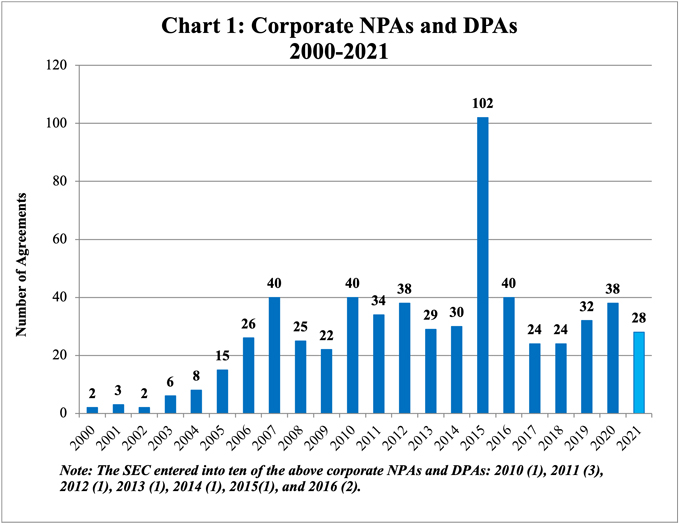
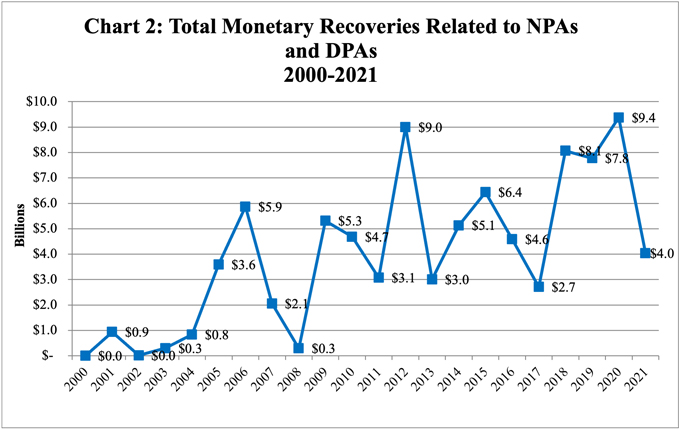
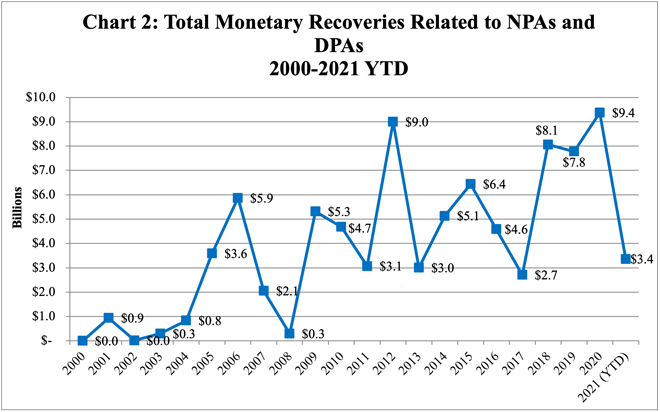
Chart 2 reflects total monetary recoveries related to NPAs and DPAs from 2000 through 2021. At approximately $4.0 billion, recoveries associated with NPAs and DPAs in 2021 are the lowest since 2018, and are below the average yearly recoveries for the period between 2005 (when use of these agreements became fairly routine) and 2021. As we have stated repeatedly, annual statistics should not be isolated to try to extrapolate a trend. The completion of investigations ebb and flow and are not calibrated to the calendar. Although 2021 represents a significant reduction in recoveries compared to 2020’s record-breaking $9.4 billion, certain patterns identified in prior years have remained. For example, in 2020, the two largest resolutions accounted for approximately 53% of the total monetary recoveries. Similarly, in 2021, the two largest resolutions accounted for 69% of all recoveries, and the largest resolution accounted for approximately 62%. In 2020, 34% of the agreements had total recoveries of $100 million or more; in 2021, approximately 21% included recoveries of at least $100 million. Supported by statements suggesting a possible shift in DOJ corporate enforcement policies (discussed in further detail below), these 2021 trends suggest a continued focus by DOJ on large monetary resolutions.
2021 in Context
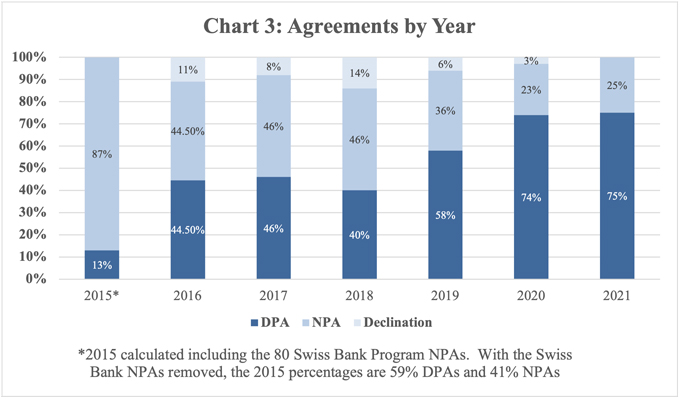
21 of the 28 resolutions—or 75%— in 2021 were DPAs. The 28 resolutions entered in 2021 resolved investigations brought by fourteen distinct lead enforcement offices, including nine different U.S. Attorney’s offices. Among the fourteen, DOJ’s Fraud Section (5), Antitrust Division (4), and Consumer Protection Branch (3) were most active. Increased activity by DOJ’s Consumer Protection Branch, in particular, may be a trend to watch in the coming year. This branch has a broad enforcement mandate and is staffed by approximately 100 lawyers.
Of particular note, the number of DPAs in 2021, as illustrated in Chart 3 below and discussed in our Mid-Year Update, is consistent with a seven-year trend toward the increased use of DPAs compared to NPAs.
Three of the seven NPAs entered in 2021 referenced division-specific self-disclosure programs as primary motivating factors. SAP SE and Avnet Asia Pte. Ltd., respectively, qualified for NPAs under NSD’s Export Control and Sanctions Enforcement Policy for Business Organizations, announced in late 2019.[2]
Although there are limited outliers, the numbers reflect a continuing trend toward increased use of DPAs.
2021 was also the first year without a public declination pursuant to DOJ’s FCPA Corporate Enforcement Policy since DOJ first announced the precursor FCPA Pilot Program in 2016. The program was designed originally to encourage voluntary self-disclosure and cooperation from companies involved in potential misconduct. The number of public declinations offered by DOJ under the program and the FCPA Corporate Enforcement Policy has steadily declined in recent years, with four declinations in 2018, two in 2019, and only one in 2020.[3] However, DOJ has disagreed with commentary suggesting this decline reflects a long-term trend, with an official spokesperson stating “We do not believe the aforementioned results in 2019 and 2020 reflect a ‘lull’ or a downward trend, rather we believe they reflect the natural ebb and flow of our cases.”[4] Further, it remains possible that DOJ has issued private declinations where it has determined “a public declination is neither necessary nor warranted,” on the basis that that the decision to disclose a declination belongs solely to the DOJ.[5] Gibson Dunn’s investigative inventory corresponds to DOJ’s perspective.
DOJ Announces Shifting Enforcement Policies and Resource “Surge”
In the final months of 2021, DOJ has made several important announcements regarding corporate enforcement as part of President Biden’s broader initiative to revisit the standards and practices that DOJ has applied to corporate criminal enforcement. These announcements, which touch on every stage of corporate enforcement—from investigation through charging, settlement, and beyond—reflect that DOJ is taking a fresh, holistic look at its approach to corporate enforcement. Through these changes, DOJ is signaling to companies that DOJ intends to maintain a sharp focus on identifying and addressing corporate crime.
Reflecting this focus, DOJ announced the formation of a Corporate Crime Advisory Group, which will be made up of representatives from all divisions of DOJ involved in corporate criminal enforcement. This new advisory body has a broad mandate to make recommendations and propose revisions to DOJ’s policies on corporate criminal enforcement topics, including monitorship selection, recidivism and NPA/DPA non-compliance, and prioritization of individual accountability, all of which were targeted for updates in 2021.
Zero Tolerance for Recidivism and Noncompliance
In an October 5, 2021 speech, Principal Associate Deputy Attorney General (“PADAG”) John Carlin emphasized that DOJ will continue to use NPAs, DPAs, and guilty pleas, and that DOJ views the inking of an agreement as the start of a longer-term obligation.[6] He stated that companies should expect DOJ to enforce agreement terms, noting that DOJ will be firm with companies that do not comply. He also said that the consequences for violating an agreement “may be worse than the original punishment.” Typically, DPAs and NPAs include specific obligations with respect to compliance, cooperation, and reporting of misconduct over the term of the agreement (often three years).
Shortly after PADAG Carlin’s speech, Deputy Attorney General (“DAG”) Lisa Monaco amplified this position, stating that DOJ has “no tolerance for companies that take advantage of [DPAs or NPAs] by going on to continue to commit crimes.”[7] These statements hearken back to 2015, when DOJ similarly postured about not hesitating to “tear up” agreements for companies that fail to meet their NPA or DPA obligations.[8] DOJ has already proved willing to follow through on this renewed zero-tolerance policy, requiring Monsanto Company (“Monsanto”) to plead guilty to both of the previously deferred two felony charges that otherwise would have been dismissed pursuant to its 2019 DPA, as well as thirty new misdemeanor charges, as a result of new conduct that violated laws involving the proper use of pesticides and the terms of the 2019 DPA.[9]
Further emphasizing its tough stance on recidivist behavior, DOJ also announced that it will take into account a corporation’s full criminal, civil, and regulatory record in making charging decisions, even if alleged prior misconduct is dissimilar from the alleged conduct at issue.[10] No longer will DOJ focus primarily on prior misconduct similar to the conduct under investigation. This revised policy is sweeping, implicating not only prior enforcement actions across all DOJ units, but all prosecutions and non-criminal enforcement actions across all federal regulators, the states and other countries, as well.[11]
Taken at face value, this means that a prior resolution for conduct that would not be illegal in the United States could theoretically be taken into account in a domestic charging decision. Practitioners have raised significant concerns about this new policy, particularly given this potential for consideration of acts that are not punishable in the United States, and for consideration of criminal, civil, and regulatory actions involving completely inapposite facts, standards, and legal frameworks.
Speaking at the American Conference Institute’s 38th International Conference on the FCPA, Assistant Attorney General for the Criminal Division, Kenneth Polite, responded to these concerns, stating that, “it’s a discretionary evaluation, where we have to trust and rely on our trial attorneys to properly evaluate each instance…where every potential act of misconduct is not going to be weighted the same way.”[12] At the same event, Chief of the DOJ’s FCPA Unit, David Last stated that, “if there are so many instances to count, that may be another conversation that we need to have…If you’re in the 50s, or the hundreds of prior touches, that’s something we probably need to know.”[13]
Surging Resources to Investigate Corporate Wrongdoing
Also in October, PADAG John Carlin noted that DOJ is “building up to surge resources for corporate enforcement.”[14] These resources include additional FBI agents tasked to work full-time alongside the prosecutors in the Criminal Fraud section, which PADAG Carlin stated has worked in the past and would provide flexibility to pursue white-collar matters nationwide.
According to Mr. Carlin, the surge in resources also will facilitate the use of data analytics tools, including working together with other regulatory agencies to share “the same fruits of analytic [labor],” to identify criminal conduct. He noted corporations should take advantage of these types of tools as DOJ will expect corporations to use data analytics in their compliance programs to look for and predict misconduct.[15]
These comments build on updates to DOJ’s corporate enforcement posture dating back to 2020. On June 1, 2020, DOJ updated its guidance to prosecutors for assessing corporate compliance programs when conducting investigations, making charging decisions, and negotiating resolutions. That guidance included an expectation that companies’ internal risk assessments should be based on “continuous access to operational data and information across functions.” Reflecting the application of this guidance, 2021 agreements include a provision requiring data-based monitoring, review, and testing of a company’s compliance procedures. As discussed in our Mid-Year Update, the Epsilon DPA, for example, requires the company to “conduct periodic reviews and testing” of its compliance program as it relates to “preventing and detecting the transfer or sale of consumer data.”[16] More recently, the Recology DPA requires that “compliance and control personnel have sufficient direct or indirect access to relevant sources of data to allow for timely and effective monitoring and/or testing.”[17] The Credit Suisse DPA contains nearly identical language that specifically aims at monitoring and testing transactional data.[18] Given the express focus on analytics, Mr. Carlin’s recent messaging, and the cross-pollination that tends to occur among the 93 U.S. Attorney’s Offices and Main Justice, we expect to see this enhanced language make its way into future agreements.
Continued Focus on Pursuit of Individual Actions
Historically, DOJ has had a particular focus on pursuing individuals responsible for corporate crime. In 2015, the Yates Memorandum announced a requirement that companies seeking cooperation credit provide DOJ with all non-privileged information about all individuals involved in misconduct to receive credit.[19] Reflecting what some viewed as a more pro-company stance, DOJ modified the Yates Memo requirement in November 2018, in response to concerns that the requirement was slowing down investigations by forcing companies to pursue and disclose every individual fact pattern—even relatively immaterial ones.[20] This revised standard premised cooperation credit on providing information about individuals who were “substantially” involved in, or responsible for, the misconduct.[21]
In October 2021, Deputy Attorney General Monaco announced a return to the Yates standard, explaining that the revised standard had proved unworkable because the standard was not clear and left too much to the judgment of cooperating companies.[22] In response to renewed concerns about the burden on companies imposed by the Yates standard, Assistant Attorney General Polite disagreed about the impacts to companies, explaining that the Yates standard is appropriate because it swings the decision regarding who is culpable back to DOJ, which views itself as being in the best position to evaluate who is substantially involved, based on all of the information known to it.[23]
Monitorship Policy Reconsidered
In 2021, DOJ also has “rescinded” any prior guidance suggesting that monitorships are disfavored, and prosecutors are, therefore, free to impose a corporate monitor when they determine it is appropriate. This signals a possible intent to reverse a trend away from compliance monitorships, which have declined in recent years in favor of self-reporting requirements. According to our records, only two of the 28 publicly available agreements in 2021 and two of 38 resolutions in 2020 imposed a corporate monitor, as compared to 9 out of 40 agreements in 2016, for example, and 5 out of 23 in 2017. Practitioners have raised concerns that DOJ’s new position on corporate monitors may make companies less willing to self-report, because self-reporting will carry a greater risk of monitorship—an extremely expensive and burdensome outcome. It remains to be seen whether individual prosecutors will take this as a signal to increase use of monitorship arrangements, and whether this will have a chilling effect on self-reporting.
DOJ Adds a Formal Disclosure Certification
NPAs and DPAs have long included obligations to disclose additional related conduct or evidence of illegal activity identified during the agreement’s term.[24] Many also require certification on behalf of the company, at the conclusion of the term, that all relevant evidence has been disclosed.[25] Until recently, DOJ had not given form to this certification requirement, instead relying on companies to provide the certification in an ad hoc manner.
Beginning in late-2020, DOJ’s Fraud Section introduced a new certification attached to some NPAs and DPAs, formalizing the certification requirement. This certification requires a company’s executives to certify, on the date that that the period of the NPA or DPA expires, that (1) they are aware of the company’s disclosure obligations under the NPA or DPA; and (2) the company has disclosed “any and all evidence,” including all allegations relating to broadly-specified conduct (which varies by agreement).[26] In 2021, this new certification became standard across resolutions involving the Fraud Section.[27] It also was adopted by the Antitrust Division in several resolutions[28] and the USAO for the Eastern District of New York in at least one case[29]. The corporate officers required to sign the certification varies; the Fraud Section has thus far required the CEO and CFO to sign, the Antitrust Division lists the CEO/President and internal or external legal counsel as mandatory signatories, and the Eastern District of New York required that the President and Chief Compliance Officer sign the certification.
Consistent with past practice surrounding disclosures, the certification expressly deems any disclosure “ a material statement and representation by the Company to the executive branch of the United States” under 18 U.S.C. § 1001, which imposes harsh penalties for materially false or fraudulent statements. The resolutions provide that the certification “constitute[s] a significant and important component” of the resolution for the purposes of determining whether the company has satisfied its obligations under the agreement—an express acknowledgment that did not exist before the new certification requirement.
At the same time, as has been the case in recent years, continuing disclosure requirements often are more expansive than the conduct at issue in the underlying agreement. For example, an agreement may require disclosure of evidence relating to any potential violation of a specific law anywhere in the world, even where the underlying agreement relates to conduct specific to a location or line of business, even if the conduct would not constitute a violation of law because it did not occur within the jurisdiction of the United States, and even where the evidence is not credible on its face. As a continuation of this trend, the certification form defines “disclosable information” exceptionally broadly, to include “any and all evidence or allegations” of specified illegal conduct – going well beyond concrete evidence of illegal activity.
As a result, accurate and complete self-reporting is becoming increasingly more difficult to navigate as companies seek to balance their self-reporting obligations with retaining some autonomy to make informed judgments about the credibility of allegations raised and the sufficiency of evidence identified in internal investigations. This, coupled with the new statement that adherence to expansive self-reporting mandates is a “significant and important component” of agreement compliance, plus DOJ’s renewed emphasis on the consequences of breach and recidivist acts, create a mine field for companies seeking to meet their agreement obligations without outsourcing investigative judgment completely to the U.S. government.
We will continue to monitor whether this certification requirement becomes the norm across Divisions and USAOs moving forward. For now, it continues a trend of extracting increasingly intrusive disclosure agreements from companies, and increasing the risk of potential breach when the letter of those requirements is not met.
Spotlight on DOJ National Security Division (NSD) Developments
Background on Updated Guidance
As detailed in a prior Gibson Dunn client alert, in December 2019, NSD released updated guidance governing the treatment of voluntary self-disclosures in criminal sanctions and export control investigations.[30] To incentivize self-reporting, the NSD guidance established a presumption that a company that voluntarily discloses potentially willful criminal sanctions or export control violations will receive an NPA and will not pay a fine.[31] Although a company will not pay a fine under the NSD guidance, the company must still pay all disgorgement, forfeiture, and restitution resulting from the misconduct.[32] The NSD guidance also takes into account potential aggravating factors that could merit a DPA or guilty plea instead of an NPA. Listed aggravating factors present elevated threats to national security, such as the export of items known to be used in the construction of weapons of mass destruction, the knowing involvement of upper management in the criminal conduct, or repeated violations.[33] If aggravating factors are present such that a DPA or guilty plea is warranted, DOJ will recommend a reduced fine and will not require a monitor if the other requirements in the guidance are met, including voluntary self-disclosure, full cooperation with the government’s investigation, remediation, and the implementation of an effective compliance program.[34] In this way, the guidance assigns value to voluntary self-disclosure even where the facts and circumstances of a particular case otherwise make an NPA inappropriate in the eyes of DOJ.
Recent NSD Corporate Resolutions
Since the NSD guidance was published in December 2019, NSD has entered into five corporate resolutions. These resolutions provide an initial view into how DOJ is applying the updated NSD guidance in practice and how companies should weigh the guidance when considering a potential voluntary self-disclosure. We covered two of these resolutions in our 2020 Mid‑Year and Year-End Updates.
In 2021, NSD entered into NPAs with Avnet Asia Pte. Ltd (“Avnet”) and SAP SE (“SAP”). In January 2021, Avnet entered into a two-year NPA to resolve allegations related to an alleged criminal conspiracy carried out by former employees to violate U.S. export laws by shipping U.S. power amplifiers to Iran and China.[35] Avnet paid a $1.5 million penalty. Avnet did not receive voluntary self-disclosure credit. The NPA suggests that Avnet may have made a self-disclosure to DOJ after prosecutors initiated their own investigation as it states that Avnet did not receive voluntary self-disclosure credit because it did not disclose the conduct “prior to commencement of the investigation.”[36] In contrast, in April 2021 SAP entered into a three-year NPA after making voluntary self-disclosures to NSD, the Bureau of Industry and Security (“BIS”), and the Office of Foreign Assets Controls (“OFAC”) acknowledging violations of the Export Administration Regulations (“EAR”) and Iranian sanctions through the export of software to Iranian end users.[37] SAP received full credit for its timely voluntary self-disclosure to NSD and, consistent with the 2019 NSD guidance, SAP was required to disgorge $5.14 million but was not required to pay additional financial penalties pursuant to the NPA.[38] In the press release announcing the SAP NPA, NSD noted the December 2019 guidance and encouraged companies to make voluntary self-disclosures of all potentially willful violations of export control and sanctions laws.[39] The SAP NPA is the first clear example of NSD applying the updated NSD guidance and entering an NPA, and it appears that the updated NSD guidance may have informed the approach for the Avnet NPA as well.
By contrast, in early 2021, NSD entered into a DPA with PT Bukit Muria Jaya (“BMJ”) to resolve allegations of conspiracy to commit bank fraud in connection with providing goods to North Korea.[40] BMJ did not self-disclose and therefore did not receive voluntary self-disclosure credit, and the Company paid a $1.5 million penalty.[41] The BMJ DPA did not identify aggravating factors related to repeat offenses or the involvement of upper management, so it appears that the lack of voluntary self-disclosure may have meaningfully influenced DOJ’s decision to offer a DPA instead of an NPA.
Guidance for Practitioners
These NSD developments illustrate several important considerations for companies when evaluating if and when to disclose potential misconduct. The developments highlight the significant role played by NSD in the criminal enforcement of U.S. sanctions and export controls. Relatedly, the updated NSD guidance includes a stringent timing requirement for voluntary self-disclosures. To receive full credit, the updated NSD guidance requires that a company submit a voluntary self-disclosure to NSD rather than submitting it only to a regulatory agency (e.g. the Department of State’s Directorate of Defense Trade Controls (“DDTC”), BIS, or OFAC).[42] In the SAP case, for example, SAP made a voluntary self-disclosure to DOJ on the same day that a voluntary self-disclosure was made to OFAC.[43] In an investigation with NSD implications, careful consideration should be given to the NSD program.
Under the guidance, when considering the potential benefits or downside to self-disclosing misconduct, a company that discovers a potential willful export control or sanctions violation must carefully consider at what stage in an investigation the misconduct should be disclosed to the government; and to what agencies the disclosure should be made and in what sequence. The NSD guidance does not answer these questions so much as it emphasizes that, for any situation in which the conduct at issue could be of interest to DOJ, timely voluntary self-disclosure can carry significant weight in resolution negotiations.
Developments in SEC Whistleblower Program
Effective December 7, 2020, the SEC amended its whistleblower program rules to include NPAs and DPAs in its definition of “administrative action.”[44] Given that the SEC can award whistleblowers for information leading to a successful “administrative action,” this amendment expands the scope of actions in which the SEC can make such awards.[45] Gibson Dunn analyzed the changes to the whistleblower rules in an alert in September 2020, when the Commission first approved the amendments. In February 2021, the SEC made its first award under the new rules, which included a $9.2 million award to a whistleblower who reportedly provided “significant information” that led to “successful related actions” by DOJ, “one of which was” an NPA or DPA.[46] The SEC has continued to issue awards under this new rule. On October 29, 2021, the SEC announced an award of over $2 million to a whistleblower who provided information that led to a successful NPA or DPA.[47] The award order notes that the whistleblower “provided information that prompted the opening of the DOJ and SEC investigations.”[48] The whistleblower also “provided extensive, ongoing assistance in the investigations.”[49] This award came shortly after the SEC announced that it issued whistleblower awards in connection with four NPAs and DPAs in fiscal year 2021, accounting for more than $117 million in whistleblower awards, equivalent to approximately 21% of total whistleblower awards reported in 2021.[50]
This uptick in NPA- and DPA-related whistleblower awards is in line with the SEC’s overall whistleblower award increase. According to the 2021 Whistleblower Program Annual Report to Congress, the SEC broke nearly every whistleblower program record in fiscal year 2021, including the highest amount awarded, the highest number of individuals awarded, and the highest number of whistleblower tips received—all previous highs from only one year prior.[51] The report also states that the SEC has “made more whistleblower awards in FY 2021 than in all prior years combined.”[52] We can expect the trend in NPA- and DPA-related whistleblower awards to continue, particularly in light of the link the SEC rule amendments now make between whistleblower tips and related DOJ “administrative actions,” DOJ’s own plans for a “surge” in corporate enforcement[53], and the other features of the amended SEC rules that reinforce incentives for whistleblowers to report directly to the government without first reporting internally.
2021 Agreements Since Mid-Year
Bank of N.T. Butterfield & Son Ltd. (NPA)
On July 26, 2021, The Bank of N.T. Butterfield & Son Limited (“Butterfield” or “Bank”) entered into a three-year NPA with the Office of the United States Attorney (“USAO”) for the Southern District of New York and the DOJ Tax Division.[54] The government alleged that from at least 2001 through 2013, Butterfield, whose principal operations were based out of its Bermuda and Cayman Island operations, assisted U.S. taxpayer-clients in evading their U.S. tax obligations.[55] The government alleged that Butterfield knew or should have known that these clients were using their Butterfield accounts to evade U.S. tax obligations.[56]
In entering into the NPA, the USAO considered Butterfield’s voluntary and “extraordinary cooperation” with the government, specifically noting that the Bank turned over approximately 386 client files; its voluntary implementation of remedial measures beginning in or about 2013; and its representation that the conduct did not extend beyond what is described in the NPA’s statement of facts.[57] The government did not impose a criminal penalty on Butterfield. Butterfield agreed to pay $5.6 million in forfeiture and restitution and agreed not to contest a civil forfeiture action filed by the United States.[58] Further, Butterfield agreed to continuing cooperating and disclosure requirements for the NPA’s three-year term.[59] During this term, Butterfield is also required to report any criminal conduct by, and criminal investigations of, Butterfield or its employees related to any federal law violations that come to senior management’s attention, in addition to any administrative proceeding or civil action brought by the U.S. government in which Butterfield is a party.[60] Notwithstanding the three-year term, Butterfield is also required to cooperate with the government on any matters related to the conduct in the NPA until all investigations, proceedings, or appeals are concluded.[61]
Bicycle Casino (NPA)
On October 22, 2021, The Bicycle Casino, L.P. (“Bicycle”), a California-based hotel and casino, entered into a two-year NPA with the United States Attorney’s Office for the Central District of California to resolve an investigation into alleged violations of the anti-money laundering provisions of the Bank Secrecy Act (“BSA”).[62] According to the NPA, after a foreign national conducted certain transactions at the casino, Bicycle failed to properly file Currency Transaction Reports (“CTRs”) and Suspicious Activity Reports for Casinos (“SARCS”) that are required under the BSA.[63]
In deciding to enter into the NPA, DOJ considered Bicycle’s remedial efforts to strengthen its anti-money laundering program, as well as its cooperation with authorities during the investigation.[64] Additionally, Bicycle agreed to pay $500,000, which represents the revenue that Bicycle made from the foreign national in question, and to undergo enhanced review and reporting requirements. These requirements included both self-reporting and a one-time audit and report, within one year of signing the agreement and an at least two-year look-back review by an independent “third-party reviewer” retained by Bicycle and “subject to the determination of non-objection” of DOJ.[65]
Constructure Technologies (DPA)
On September 14, 2021, Constructure Technologies LLC (“Constructure”), a New York-based information technology services company, entered into a three-year DPA with the U.S. Attorney’s Office for the Eastern District of New York to resolve a criminal charge for violating the Digital Millennium Copyright Act (“DMCA”) in relation to certain copyright protection systems for software, including encryption systems.[66] Specifically, the government alleged that from 2011 to 2018, the company installed unlicensed versions of software for its customers using illegally-obtained license keys that company employees had acquired through cracking programs and key generators found on the internet. These keys allowed Constructure to grant its customers access to copyrighted software programs and then bill its customers for those same keys, which the customers believed to be legitimate license keys.[67] This case appears to be the first time that the DOJ has entered into either a DPA or NPA in relation to the DMCA.
Under the terms of the DPA, Constructure agreed to pay a criminal penalty of $60,000 and implement a compliance and ethics program that will enhance the company’s ability to prevent and detect future violations of the DMCA.[68] The company also agreed to fully cooperate with the government until the conclusion of the investigation or the end of the three-year DPA term, whichever is later.[69] Three Constructure employees, including two principals, pleaded guilty to misdemeanor charges of criminal copyright infringement and face up to one year in prison and a fine.[70]
Credit Suisse (DPA)
On October 19, 2021, Credit Suisse Group AG (“Credit Suisse”) entered into a three-year DPA with DOJ’s Money Laundering and Asset Recovery Section (“MLARS”) and Fraud Section, and the United States Attorney’s Office for the Eastern District of New York.[71] The government alleged that between 2013 and March 2017, Credit Suisse, through its subsidiary Credit Suisse Securities (Europe) Limited (“CSSEL”), defrauded investors in connection with a Mozambique lending project.[72] DOJ alleged that Credit Suisse hid information regarding the risk that proceeds from loans to three Mozambican government-owned entities were used to pay approximately $150 million in bribes to senior government officials and $50 million in kickbacks to two CSSEL employees.[73] DOJ also alleged that Credit Suisse hid from its investors information about debt owed by the Mozambique government.[74] The DPA followed guilty pleas by three CSSEL employees and was concurrent with CSSEL’s guilty plea to one count of conspiracy to commit wire fraud.[75]
Under the DPA, Credit Suisse agreed to pay a U.S. criminal monetary penalty of $247.5 million.[76] The DPA considered Credit Suisse’s resolutions with SEC and United Kingdom’s Financial Conduct Authority (“FCA”), which included (1) a $65 million civil penalty and $34.1 million in disgorgement and prejudgment interest to SEC, and (2) a $200.6 million penalty to FCA and a promise to irrevocably undertake $200 million of debt relief to Mozambique.[77] DOJ credited the Company for these payments, reducing its penalty to approximately $175.5 million.[78] The DPA did not credit the Company with voluntary disclosure or full cooperation with the government’s investigation.[79]
Gree Electric Appliances (DPA)
On October 28, 2021, Gree Electric Appliances Inc. of Zhuhai (“Gree Zhuhai”)—a China-based appliance manufacturer—and one of its subsidiaries entered into a three-year DPA with the U.S. Attorney’s Office for the Central District of California and DOJ’s Consumer Protection Branch (“CPB”) to resolve charges related to the companies’ failure to notify the U.S. Consumer Product Safety Commission (“CPSC”) of defects in its humidifiers.[80] DOJ alleged that the companies knew that their humidifiers failed to meet applicable safety standards and failed to notify the CPSC of these dangerous defects for six months.[81] The resolutions are the first corporate criminal enforcement actions that have been brought under the Consumer Product Safety Act of 1972, the law which established the CPSC.[82]
Under the DPA terms, Gree Zhuhai agreed to pay $91 million in penalties and agreed to provide restitution for any uncompensated victims that received injuries as a result of the companies’ humidifiers.[83] The companies also agreed to continue to cooperate with any ongoing or future investigations related to the defective humidifiers until these investigations are fully concluded.[84] Additionally, Gree Zhuhai and its affiliate agreed to strengthen their compliance programs and to provide DOJ with yearly reports about the companies’ remediation efforts and the status of their compliance programs.[85] Prior to the DPA, the Gree Companies had already agreed to pay a $15.45 million civil penalty as part of a 2016 settlement with the CPSC.[86] Consistent with DOJ’s policy of coordinating resolution penalties in multi-agency investigations arising out of the same misconduct, the DPA credits the Gree Companies’ earlier payment of $15.45 million to the CPSC against the $91 million total penalty.[87]
National Spine and Pain Centers (NSPC) (NPA)
On August 4, 2021, the National Spine and Pain Centers, LLC (“NSPC” or “Company”) entered into a two-year NPA with the United States Attorney’s Offices for the Central District of California and Southern District of California (collectively “USAO”).[88] NSPC agreed to pay $5.1 million to the government to resolve charges for receiving payments in violation of the Anti-Kickback Statute.
The USAO’s charges stem from NSPC’s and its affiliate’s agreement with Proove Biosciences, Inc. (“Proove”), a now defunct genetics testing company. The USAO alleged, and NSPC admitted, that NSPC’s and its affiliate’s physicians received illegal kickback payments from Proove “under the guise of a clinical research program,” that they were receiving payments “per test” or “per patient,” and that as part of the scheme, these physicians submitted timesheets used by Proove to pay the physicians which overstated the time they spent conducting clinical research.[89] The USAO also alleged that as a result of these violations, Medicare overpaid Proove for claims submitted in connection with its agreement with NSPC.[90] NSPC terminated its contract with Proove for compliance reasons in March 2017 before NSPC was acquired by a new ownership group.[91]
In entering into the NPA, the USAO considered NSPC’s commitment to compliance, specifically noting its implementation of a compliance program designed to ensure compliance with the Anti-Kickback Statute; the Company’s early engagement and cooperation with the USAO’s investigation; the Company’s acceptance of responsibility; the Company’s voluntary undertaking of remedial measures prior to its knowledge of the criminal investigation; and the Company’s agreement to continue to cooperate with the USAO, FBI, and HHS-OIG.[92] Further, the USAO determined that there was no need for an independent compliance monitor.[93]
Nine individuals were charged in connection with the alleged scheme in the Central District of California in a related case.[94]
Penn Credit Corp. (DPA)
On October 12, 2021, Penn Credit Corporation (“Penn Credit”), a debt collection company, entered into a two-year DPA with the United States Attorney’s Office for the Northern District of Illinois to resolve a corruption investigation.[95] According to the DPA, Penn Credit engaged in a corruption scheme at the direction of its former owner, Donald Donagher, Jr.[96] Donagher separately pleaded guilty to one count of bribery.[97] Specifically, the scheme involved Donagher underwriting certain expenses for a special event hosted by the former Cook County Circuit Court Clerk in an effort to reward the Clerk for awarding debt collection work to Penn Credit.[98]
DOJ entered into the agreement based on the nature and seriousness of the offense conduct, Penn Credit’s and its current management’s ongoing cooperation, and its remedial measures and operational improvements.[99] In terms of remedial measures, Penn Credit ensured that its former CEO is no longer employed by or has a business relationship with the company.[100] Further, Penn Credit and its current management created a compliance policy and code of ethics for the company and implemented a system involving company counsel to ensure compliance with laws and regulations relating to monetary contributions to campaigns and/or charitable entities run or managed by elected officials.[101] Additionally, Penn Credit agreed to report to DOJ annually during the term of the agreement regarding remediation and implementation of the compliance measures.[102] As a part of the DPA, Penn Credit will pay a monetary penalty of $225,000.[103]
SF Recology Group (DPA)
On September 9, 2021, three San Francisco-based trash disposal subsidiaries of Recology, Inc., entered into a three-year DPA with the United States Attorney’s Office for the Northern District of California and agreed to pay $36 million in criminal penalties.[104] The DPA resolved allegations that the companies conspired to commit honest services fraud in violation of 18 U.S.C. §§ 1343, 1346, and 1349.[105] Specifically, the companies admitted to utilizing recurring nonprofit donations to pay bribes and kickbacks or rewards to a former public official with the City and County of San Francisco, with the intent to obtain favorable official action and influence.[106]
As part of the resolution, Recology and its subsidiaries agreed to cooperate with the government’s ongoing investigation into public corruption, and to adopt a new compliance program or modify its existing compliance program.[107] The DPA outlines a number of remedial measures taken by Recology, including terminating employees identified as responsible for the underlying conduct.[108] In addition, Recology “revamped” its companywide compliance program by, among other things, developing new policy guidance, procedures, training and reporting mechanisms around travel expenses, charitable contributions, gifts, and interactions with public officials.[109]
International Developments
As noted in prior Mid-Year and Year-End Updates (see, e.g., our 2020 Year-End Update), a number of countries have adopted DPA-like regimes.[110] DPA-like agreements are available in Brazil, Canada, France, Singapore, and the United Kingdom, although prosecutors in Canada and Singapore have yet to enter into such an agreement since both countries passed legislation authorizing the practice in 2018.[111]
In 2021, France and Brazil had the most active DPA-like regimes. Prosecuting authorities in each country entered into four DPA-like agreements this year. The UK was close behind with the SFO entering into three DPAs in the first half of the year, but there have been no new agreements in the latter half of the year. For a summary of the DPAs entered by the SFO in 2021, see our 2021 Mid-Year Alert. As discussed there, the SFO has received wide-spread media attention recently for its failure to successfully prosecute individuals involved in the subject matter of past DPAs.
France
After a relatively quiet first half of the year, France’s prosecuting agencies entered into three DPA-like agreements (known as convention judiciaire d’intérêt public, or “CJIPs”) in the latter half of 2021. On July 12, 2021, Systra SA, a subsidiary of French state transport company RATP and public railway company SNCF, entered into a CJIP with the French National Prosecutor’s Office (PNF) to resolve allegations that it profited in the amount of €5 million by engaging in multiple bribery schemes in connection with public contracts in Azerbaijan and Uzbekistan between 2009 and 2014.[112] Consistent with the trend we are seeing in increasingly complex international enforcement interactions, the PNF initiated the investigation into Systra’s misconduct in 2017, based on a complaint filed by Japanese authorities in 2015, following a complaint by a Japanese expatriate living in Uzbekistan.[113] The PNF’s investigation also identified misconduct by Systra in connection with the award of an engineering contract in Azerbaijan in May 2009.[114]
Under the CJIP, Systra agreed to pay a €7.5 million fine (approximately $8.9 million at the time of the agreement), which reflected a significant reduction from the maximum permitted under the law (€187.2 million).[115] In imposing the reduced fine, the PNF considered mitigating factors such as the relatively distant dates of the misconduct, Systra’s implementation of a reinforced compliance program since the discovery of the facts, and the company’s ongoing cooperation and remediation.[116]
On September 2, 2021, JP Morgan Chase Bank (“JPMC”) entered into a CJIP with the PNF to resolve allegations that JPMC aided and abetted tax fraud committed by former executives and board directors at French investment company, the Wendel Group.[117] The investigation was opened in 2012 after the French tax authority filed a complaint related to a series of transactions made from 2004 to 2007.[118] JPMC allegedly helped finance 11 former executives and three former board directors at the Wendel Group to help them evade capital gains taxes on €315 million of investment income.[119] Under the terms of the agreement, JPMC agreed to pay €25 million (approximately $29.6 million at the time of the agreement).[120] JPMC’s role was limited to financing, and it did not act as a legal or tax advisor; PNF treated these facts, JPMC’s cooperation, and the isolated nature of the facts, as mitigating factors.[121] Conversely, the complexity of the individuals’ alleged tax scheme was considered an aggravating factor.[122] The individuals involved in the alleged misconduct are scheduled to go to trial in early 2022.[123]
Finally, on December 15, 2021, a luxury goods company agreed to pay €10 million (approximately $11.3 million) to resolve allegations that the company hired the former head of France’s domestic intelligence agency to spy on a French journalist and filmmaker and other private citizens.
Brazil
On October 25, 2021, Brazil’s Office of the Comptroller General (CGU) and the Attorney General of the Union (AGU) entered into a leniency agreement with Rolls-Royce PLC related to allegations that the company bribed public bribery Petrobras 2003, 2004, and 2005.[124] The agreement is related to the coordinated resolution Rolls-Royce entered into in 2017 with the UK’s SFO, the Brazilian Ministério Público Federal (MPF), and DOJ to resolve allegations that Rolls-Royce caused millions in bribes to be paid to officials of state-owned oil companies in Angola, Azerbaijan, Brazil, Iraq, Kazakhstan, and Thailand.[125] As discussed in our 2017 Mid-Year FCPA Update, under the terms of the 2017 settlement, Rolls-Royce agreed to pay over $800 million in penalties, including a penalty of approximately $25.5 million to the MPF in connection with conspiring to bribe Brazilian officials between 2005 and 2008.[126] Under the new agreement with the CGU and AGU, Rolls-Royce agreed to pay a penalty of $27.8 million.[127]
On June 7, 2021, manufacturing companies SICPA do Brasil Ltda (SICPA) and CEPTIS SA (CEPTIS), agreed to pay fines and restitution totaling 762 million reais (approximately $135.4 million), to be paid to the Brazilian government and the Brazilian Mint in 21 installments over a 20-year period.[128] Through its own internal investigation, SICPA identified irregularities in certain payments made to a public agent between 2009 and 2015 and self-disclosed the issue to Brazilian authorities.[129] The agreement recognizes the companies’ cooperation and remedial efforts.[130]
On February 22, 2021, South Korean shipbuilder Samsung Heavy Industries (SHI) entered into a leniency agreement with the CGU, AGU, MPF to resolve allegations that the company engaged in bribery and money laundering in connection with its contracts with Petrobras.[131] The agreement is second part of a global resolution SHI negotiated with Brazilian and U.S. authorities.[132] As discussed in our 2019 Year-End Update, in November 2019, SHI entered into a DPA with the DOJ and agreed to pay a $75.5 million penalty.[133] Under the new agreement with Brazilian authorities, SHI agreed to a pay a total of 812 million reais (approximately $148.56 million), reflecting 706 million reais in damages to be paid to Petrobras and a 106 million reais fine.[134]
Brazilian authorities entered into a fourth leniency agreement in 2021, in connection with the resolution with Amec Foster Wheeler Energy Limited (“AFWEL”) that we discussed in our 2021 Mid-Year Update.[135] DOJ and the SEC credited most of the amounts paid under the leniency agreement against those agencies’ resolutions in the AFWEL matter.[136]
APPENDIX: 2021 Non-Prosecution and Deferred Prosecution Agreements
The chart below summarizes the agreements entered into by DOJ in 2021. The SEC has not entered into any NPAs or DPAs in 2021. The complete text of each publicly available agreement is hyperlinked in the chart.
The figures for “Monetary Recoveries” may include amounts not strictly limited to an NPA or a DPA, such as fines, penalties, forfeitures, and restitution requirements imposed by other regulators and enforcement agencies, as well as amounts from related settlement agreements, all of which may be part of a global resolution in connection with the NPA or DPA, paid by the named entity and/or subsidiaries. The term “Monitoring & Reporting” includes traditional compliance monitors, self-reporting arrangements, and other monitorship arrangements found in settlement agreements.
|
U.S. Deferred and Non-Prosecution Agreements in 2020 |
||||||
|
Company |
Agency |
Alleged Violation |
Type |
Monetary Recoveries |
Monitoring & Reporting |
Term of DPA/NPA (months) |
|
DOJ |
Conspiracy |
DPA |
$41,139,287 |
Yes |
36 |
|
|
American Century Companies, Inc. |
DOJ Antitrust |
Restraint |
NPA |
$1,500,000 |
Yes |
36 |
|
Argos |
DOJ |
Price-fixing |
DPA |
$20,024,015 |
Yes |
36 |
|
DOJ |
FDCA |
DPA |
$22,228,000 |
Yes |
36 |
|
|
D.D.C.; |
Export |
NPA |
$1,508,000 |
Yes |
24 |
|
|
DOJ |
AML |
DPA |
$79,688,400 |
Yes |
36 |
|
|
DOJ |
Defrauding |
NPA |
$5,600,000 |
No |
36 |
|
|
Berlitz |
DOJ |
Bid |
DPA |
$203,984 |
Yes |
36 |
|
C.D. |
Bank |
NPA |
$500,000 |
Yes |
24 |
|
|
DOJ |
Fraud |
DPA |
$2,513,600,000 |
Yes |
36 |
|
|
S.D. |
FCA |
DPA |
$14,500,000 |
No |
24 |
|
|
DOJ |
Bid |
DPA |
$196,984 |
Yes |
36 |
|
|
E.D.N.Y. |
Copyright |
DPA |
$60,000 |
No |
36 |
|
|
E.D.N.Y. |
Wire |
DPA |
$ |
Yes |
36 |
|
|
DOJ |
FCPA |
DPA |
$124,796,046 |
Yes |
36 |
|
|
DOJ |
Mail |
DPA |
$150,000,000 |
Yes |
30 |
|
|
DOJ |
Failure |
DPA |
$91,200,000 |
Yes |
36 |
|
|
DOJ |
Mail |
DPA |
$42,000,000 |
Yes |
30 |
|
|
S.D. |
Conspiracy |
NPA |
$5,100,000 |
No |
24 |
|
|
N.D. |
Offense |
DPA |
$225,000 |
Yes |
24 |
|
|
D.D.C.; |
Bank |
DPA |
$1,561,570 |
Yes |
18 |
|
|
S.D.N.Y.; |
>Fraud, |
DPA |
$22,000,000 |
No |
36 |
|
|
DOJ |
Export |
NPA |
$8,430,000 |
Yes |
36 |
|
|
N.D. |
Honest |
DPA |
$36,000,000 |
Yes |
36 |
|
|
D. |
Wire |
DPA |
$211,575,000 |
Yes |
24 |
|
|
S.D.N.Y.; |
Fraud, |
DPA |
$77,374,337 |
No |
36 |
|
|
DOJ |
Fraud |
NPA |
$49,458,102 |
No |
36 |
|
__________________________
[1] For client reasons, an additional DPA is not discussed here but is included in relevant statistics.
[2] See infra “New NSD Corporate Resolutions”; see also U.S. Dep’t of Justice, NSD Div., Export Control and Sanctions Enforcement Policy for Business Organizations (Dec. 13, 2019), https://www.justice.gov/nsd/ces_vsd_policy_2019/download (hereinafter “Updated NSD Guidance”).
[3] See U.S. Dep’t of Justice, Fraud Section: Declinations, available at https://www.justice.gov/criminal-fraud/corporate-enforcement-policy/declinations.
[4] Clara Hudson, “DOJ sees decrease in corporate enforcement policy declinations,” Global Investigations Review (Apr. 15, 2021), https://globalinvestigationsreview.com/just-anti-corruption/fcpa/doj-corporate-enforcement-policy-declinations-decrease.
[5] Deputy Assistant Attorney General Matt Miner Delivers Remarks at The American Bar Association, Criminal Justice Section Third Global White Collar Crime Institute Conference, (June 27, 2019), available at https://www.justice.gov/opa/speech/deputy-assistant-attorney-general-matt-miner-delivers-remarks-american-bar-association.
[6] Transcript, John Carlin on Stepping up DOJ Corporate Enforcement (Oct. 11, 2021), https://globalinvestigationsreview.com/news-and-features/in-house/2020/article/john-carlin-stepping-doj-corporate-enforcement.
[7] Deputy Attorney General Lisa O. Monaco Gives Keynote Address at ABA’s 36th National Institute on White Collar Crime (Oct. 28, 2021), https://www.justice.gov/opa/speech/deputy-attorney-general-lisa-o-monaco-gives-keynote-address-abas-36th-national-institute.
[8] See Assistant Attorney General Leslie R. Caldwell Delivers Remarks at a Press Conference on Foreign Exchange Spot Market Manipulation (May 20, 2015), available at https://www.justice.gov/opa/speech/assistant-attorney-general-leslie-r-caldwell-delivers-remarks-press-conference-foreign (“If appropriate and proportional to the misconduct and the company’s track record, we will tear up an NPA or a DPA and prosecute the offending company based on the admitted statement of facts”).
[9] Press Release, Monsanto Agrees to Plead Guilty to Illegally Using Pesticide at Corn Growing Fields in Hawaii and to Pay Additional $12 Million (Dec. 9, 2021), https://www.justice.gov/usao-cdca/pr/monsanto-agrees-plead-guilty-illegally-using-pesticide-corn-growing-fields-hawaii-and.
[10] Deputy Attorney General Lisa O. Monaco Gives Keynote Address at ABA’s 36th National Institute on White Collar Crime (Oct. 28, 2021), https://www.justice.gov/opa/speech/deputy-attorney-general-lisa-o-monaco-gives-keynote-address-abas-36th-national-institute.
[12] Dylan Tokar, Justice Department Officials Dig In on Corporate Repeat Offenders, Wall. St. J. (Dec. 1, 2021), https://www.wsj.com/articles/justice-department-officials-dig-in-on-corporate-repeat-offenders-11638405092.
[14] Transcript, John Carlin on Stepping up DOJ Corporate Enforcement (Oct. 11, 2021), https://globalinvestigationsreview.com/news-and-features/in-house/2020/article/john-carlin-stepping-doj-corporate-enforcement.
[16] Deferred Prosecution Agreement, United States v. Epsilon Data Mgmt., LLC, No. 21-cr-06 (D. Colo. Jan. 19, 2021) (hereinafter “Epsilon DPA”), at C-5.
[17] Deferred Prosecution Agreement, United States v. Recology San Francisco, et al., No. CR21-356 (N.D. Cal. Sep. 9, 2021) (hereinafter “Recology DPA”), at B-4.
[18] Deferred Prosecution Agreement, United States v. Credit Suisse Group AG, Cr. No. 21-521 (E.D.N.Y. Oct. 19, 2021) (hereinafter “Credit Suisse DPA”), at C-9.
[19] Memorandum from Sally Quillian Yates, Deputy Attorney General, U.S. Dep’t of Justice, to Assistant Attorney General, Antitrust Division, et al., Individual Accountability for Corporate Wrongdoing (Sept. 9, 2015), at 3, http://www.justice.gov/dag/file/769036/download; as covered in our prior client alert here.
[20] See Deputy Attorney General Rod J. Rosenstein Delivers Remarks at the American Conference Institute’s 35th International Conference on the Foreign Corrupt Practices Act (Nov. 29, 2018), available at https://www.justice.gov/opa/speech/deputy-attorney-general-rod-j-rosenstein-delivers-remarks-american-conference-institute-0.
[22] Deputy Attorney General Lisa O. Monaco Gives Keynote Address at ABA’s 36th National Institute on White Collar Crime (Oct. 28, 2021), https://www.justice.gov/opa/speech/deputy-attorney-general-lisa-o-monaco-gives-keynote-address-abas-36th-national-institute.
[23] Jack Queen, New DOJ Crime Chief Talks ‘Carrot And Stick’ Enforcement, Law360 (Dec. 8, 2021), https://www.law360.com/articles/1447069/new-doj-crime-chief-talks-carrot-and-stick-enforcement.
[24] See, e.g., Non-Prosecution Agreement, Petróleo Brasileiro S.A. – Petrobras (Sept. 26, 2018), at 5 (imposing obligation to “promptly report” “evidence or allegations of actual or potentially corrupt payments or actual or potential violations of the FCPA” to DOJ) (hereinafter “Petrobras NPA”); Deferred Prosecution Agreement, United States v. Telefonaktiebolaget LM Ericsson (Nov. 26, 2019), at 7 (hereinafter “Ericsson DPA”).
[25] Petrobras NPA at 5; Ericsson DPA at 18.
[26] See, e.g., Deferred Prosecution Agreement, United States v. Vitol Inc., No. 20-539 (ENV) (E.D.N.Y. Dec. 3, 2020).
[27] See, e.g., Deferred Prosecution Agreement, United States v. Deutsche Bank Aktiengesellschaft, No. 20-00584 (E.D.N.Y. Jan. 8, 2021); Deferred Prosecution Agreement, United States v. The Boeing Company (N.D. Tex. Jan. 7, 2021).
[28] See, e.g., Non-Prosecution Agreement, American Century Companies, Inc. (March 5, 2021); Deferred Prosecution Agreement, United States v. Argos USA LLC, No. 4:21-CR-0002-RSB-CLR (S.D. Ga. Jan. 4, 2021); Deferred Prosecution Agreement, United States v. Berlitz Languages, Inc., No. 21-51-FLW (D.N.J. Jan. 19, 2021); Deferred Prosecution Agreement, United States v. Comprehensive Language Center, Inc., No. 21-50-FLW (D.N.J. Jan. 19, 2021).
[29] See, e.g., Deferred Prosecution Agreement, United States v. Ticketmaster L.L.C., Cr. No. 20-563 (MKB) (E.D.N.Y. Dec. 29, 2020).
[30] U.S. Dep’t of Justice, NSD Div., Export Control and Sanctions Enforcement Policy for Business Organizations (Dec. 13, 2019), https://www.justice.gov/nsd/ces_vsd_policy_2019/download (hereinafter “Updated NSD Guidance”).
[31] Id. at 2. NSD defines an act as willful if done with knowledge that it is illegal. Id. at 1 n.2.
[35] Press Release, U.S. Dep’t of Justice, Chinese National Charged with Criminal Conspiracy to Export US Power Amplifiers to China (Jan. 29, 2021), https://www.justice.gov/opa/pr/chinese-national-charged-criminal-conspiracy-export-us-power-amplifiers-china.
[36] Non-Prosecution Agreement, Avnet Asia Pte. Ltd. (Jan. 21, 2021), at 3, 4 (“The Company did not receive voluntary disclosure credit because it did not disclose to the Offices the conduct described in the Statement of Facts prior to commencement of the investigation.”)
[37] Press Release, U.S. Dep’t of Justice, SAP Admits to Thousands of Illegal Exports of its Software Products to Iran and Enters into Non-Prosecution Agreement with DOJ (Apr. 29, 2021), https://www.justice.gov/opa/pr/sap-admits-thousands-illegal-exports-its-software-products-iran-and-enters-non-prosecution.
[40] Press Release, U.S. Dep’t of Justice, Indonesian Company Admits to Deceiving U.S. Banks in Order to Trade with North Korea, Agrees to Pay a Fine of More Than $1.5 Million (Jan. 17, 2021), https://www.justice.gov/opa/pr/indonesian-company-admits-deceiving-us-banks-order-trade-north-korea-agrees-pay-fine-more-15.
[41] United States v. PT Bukit Muria Jaya, No. 21-cr-14 (D.D.C. Jan. 14, 2021), at Attach. A, 3-4, 7‑8.
[42] Updated NSD Guidance, supra note 1, at 3 (“It is important to note that when a company identifies potentially willful conduct, but chooses to self-report only to a regulatory agency and not to DOJ, the company will not qualify for the benefits of a VSD under this Policy in any subsequent DOJ investigation.”).
[43] Non-Prosecution Agreement, SAP SE (Apr. 29, 2021), at Attach. A, 5 (“On September 8, 2017, SAP made a voluntary self-disclosure to DOJ’s National Security Division and the U.S. Department of the Treasury’s Office of Foreign Assets Control (‘OFAC&rsqrsquo;) regarding potential violations of the ITSR.”)
[44] 17 C.F.R. § 240.21F-4(d)(3)(i)-(ii).
[46] Press Release, U.S. Sec. and Exch. Comm’n, SEC Awards More Than $9.2 Million to Whistleblower for Successful Related Actions, Including Agreement with DOJ (Feb. 23, 2021), https://www.sec.gov/news/press-release/2021-31; SEC Order Determining Whistleblower Award Claim, Release No. 91183 (Feb. 23, 2021), at 2, https://www.sec.gov/rules/other/2021/34-91183.pdf.
[47] Press Release, U.S. Sec. and Exch. Comm’n, SEC Awards More Than $2 Million to Whistleblower for Successful Related Action (Oct. 29, 2021), https://www.sec.gov/news/press-release/2021-220 (hereinafter “$2M Whistleblower Press Release”); SEC Order Determining Whistleblower Award Claim, Release No. 93465 (Oct. 29. 2021), https://www.sec.gov/rules/other/2021/34-93465.pdf (hereinafter “$2M Whistleblower Award Order”).
[48] $2M Whistleblower Award Order, at 2.
[50] U.S. Sec. and Exch. Comm’n, Office of the Whistleblower, 2021 Annual Report to Congress: Whistleblower Program (2021), https://www.sec.gov/files/owb-2021-annual-report.pdf (hereinafter “2021 SEC Whistleblower Report”), at 1, 20.
[51] 2021 SEC Whistleblower Report, at 1.
[53] Transcript, John Carlin on Stepping up DOJ Corporate Enforcement (Oct. 11, 2021), https://globalinvestigationsreview.com/news-and-features/in-house/2020/article/john-carlin-stepping-doj-corporate-enforcement.
[54] Non-Prosecution Agreement, Bank of N.T. Butterfield & Son Ltd. (Jul. 26, 2021) (hereinafter “Butterfield NPA”).
[58] Press Release, U.S. Dep’t of Justice, Manhattan U.S. Attorney Announces Agreement With Bermudian Bank To Resolve Criminal Tax Investigation (Aug. 3, 2021), https://www.justice.gov/usao-sdny/pr/manhattan-us-attorney-announces-agreement-bermudian-bank-resolve-criminal-tax.
[62] Non-Prosecution Agreement, The Bicycle Casino, L.P. (Oct. 22, 2021), (hereinafter “Bicycle NPA”); Press Release, U.S. Dep’t Justice, Bicycle Casino Agrees to Pay $500,000 Settlement and Submit to Increased Review of Anti-Money Laundering Compliance Program (Nov. 5, 2021), https://www.justice.gov/usao-cdca/pr/bicycle-casino-agrees-pay-500000-settlement-and-submit-increased-review-anti-money (hereinafter “Bicycle NPA Press Release”).
[63] Bicycle NPA Press Release.
[66] Press Release, U.S. Dep’t of Justice, Three Employees of a Long Island Information Technology Company Plead Guilty to Criminal Copyright Infringement (Sep. 16, 2021), https://www.justice.gov/usao-edny/pr/three-employees-long-island-information-technology-company-plead-guilty-criminal (hereinafter “Constructure Technologies DPA Press Release”).
[69] Deferred Prosecution Agreement, United States v. Constructure Technologies, LLC, No. 2:21-cr-00368, at 3 (E.D. N.Y., Sep. 15, 2021).
[70] Constructure Technologies DPA Press Release.
[71] Press Release, U.S. Dep’t of Justice, Credit Suisse Resolves Fraudulent Mozambique Loan Case in $547 Million Coordinated Global Resolution (Oct. 19, 2021), https://www.justice.gov/opa/pr/credit-suisse-resolves-fraudulent-mozambique-loan-case-547-million-coordinated-global.
[77] Deferred Prosecution Agreement, United States v. Credit Suisse Group AG, No. 21-cr-00521, at 5 (E.D. N.Y., Oct. 19, 2021) (hereinafter “Credit Suisse DPA”).
[78] Credit Suisse Press Release, supra note 58.
[80] Deferred Prosecution Agreement, United States v. Gree Electric Appliances, Inc. of Zhuhai, and Hong Kong Gree Electric Appliances Sales Co., Ltd., (C.D. Cal. Oct. 28, 2021) (hereinafter “Gree DPA”); Press Release, U.S. Dep’t of Justice, Gree Appliance Companies Charged with Failure to Report Dangerous Dehumidifiers and Agree to $91 Million Resolution (Oct. 28, 2021), https://www.justice.gov/opa/pr/gree-appliance-companies-charged-failure-report-dangerous-dehumidifiers-and-agree-91-million (hereinafter “Gree Press Release”).
[88] Non-Prosecution Agreement, National Spine and Pain Centers, LLC (Aug. 3, 2021) (hereinafter “NSPC NPA”).
[89] Press Release, U.S. Dep’t of Justice, Pain Management Organization Pays $5.1 Million to Settle Criminal Medicare Kickback Violations (Aug. 6, 2021), https://www.justice.gov/usao-sdca/pr/pain-management-organization-pays-51-million-settle-criminal-medicare-kickback.
[94] Case No. 21CR0112-JLS; Press Release, U.S. Dep’t of Justice, Pain Management Organization Pays $5.1 Million to Settle Criminal Medicare Kickback Violations (Aug. 6, 2021), https://www.justice.gov/usao-sdca/pr/pain-management-organization-pays-51-million-settle-criminal-medicare-kickback.
[95] Deferred Prosecution Agreement, United States v. Penn Credit Corporation, No. 19 CR 240 (Oct. 12, 2021), (hereinafter “Penn Credit DPA”); Press Release, Owner of Debt Collection Company Pleads Guilty to Corruptly Providing Benefits to Public Official (Oct. 12, 2021), https://www.justice.gov/usao-ndil/pr/owner-debt-collection-company-pleads-guilty-corruptly-providing-benefits-public (hereinafter “Penn Credit DPA Press Release”).
[96] Penn Credit DPA Press Release.
[104] Press Release, U.S. Dep’t of Justice, Three San Francisco Garbage Companies Admit Bribery And Pay $36 Million To Resolve Federal Investigation (September 9, 2021), https://www.justice.gov/usao-ndca/pr/three-san-francisco-garbage-companies-admit-bribery-and-pay-36-million-resolve-federal.
[105] Deferred Prosecution Agreement, United States v. Recology San Francisco, Sunset Scavenger Company. Golden Gate Disposal & Recycling Company, No. 21-cr-356 (N.D. Cal., Sept. 9, 2021) (hereinafter “SF Recology DPA”).
[110] Gibson, Dunn & Crutcher, 2020 Year-End Update On Corporate Non-Prosecution Agreements And Deferred Prosecution Agreements, at 22 (Jan. 19, 2021), https://www.gibsondunn.com/2020-year-end-update-on-corporate-non-prosecution-agreements-and-deferred-prosecution-agreements/.
[111] Lawrence F. Ritchie & Sonja Pavic, Canada’s Deferred Prosecution Agreements: Still Waiting for Takeoff, Osler (Dec. 11, 2020), https://www.osler.com/en/resources/regulations/2020/canada-s-deferred-prosecution-agreements-still-waiting-for-takeoff; Criminal Justice Reform Act 2018 (Act. No. 19/2018) (Sg.), https://sso.agc.gov.sg/Acts-Supp/19-2018.
[112] James Thomas, Regular compliance renewal helps French transport company minimize corruption fine, Global Investigations Review (Aug. 2, 2021) https://globalinvestigationsreview.com/anti-corruption/regular-compliance-renewal-helps-french-transport-company-minimise-corruption-fine
[117] Leila Abboud, JPMorgan to pay €25m to settle tax fraud case in France, Financial Times (Sept. 2, 2021) https://www.ft.com/content/0b845a1c-0b73-400f-93c5-b3d3d08ffe08/.
[118] Id.
[119] Fraude fiscale d’ex-dirigeants de Wendel: JPMorgan paie 25 millions d’euros d’amende pour clore les poursuites, Le Figaro (Sept. 2, 2021), https://www.lefigaro.fr/societes/fraude-fiscale-d-ex-dirigeants-de-wendel-jpmorgan-paie-25-millions-d-euros-d-amende-pour-clore-les-poursuites-20210902. \
[123] US bank agrees 25 million euro deal to settle French tax fraud investigation (Sept. 2, 2021), https://www.rfi.fr/en/france/20210902-us-bank-agrees-25-million-euro-deal-to-settle-french-tax-fraud-investigation.
[124] CGU e AGU assinam acordo de leniência com a Rolls-Royce PLC (Oct. 26, 2021), https://www.gov.br/cgu/pt-br/assuntos/noticias/2021/10/cgu-e-agu-assinam-acordo-de-leniencia-com-a-rolls-royce-plc.
[125] Gibson, Dunn & Crutcher, 2017 Mid-Year FCPA Update, at 4-5 (July 10, 2017), https://www.gibsondunn.com/2017-mid-year-fcpa-update/.
[127] CGU e AGU assinam acordo de leniência com a Rolls-Royce PLC (Oct. 26, 2021), https://www.gov.br/cgu/pt-br/assuntos/noticias/2021/10/cgu-e-agu-assinam-acordo-de-leniencia-com-a-rolls-royce-plc.
[128] Brazil Leniency Agreement (June 7, 2021), https://www.sicpa.com/news/brazil-leniency-agreement.
[129] CGU and AGU Enter Into a Leniency Agreement with the Companies SICPA and CEPTIS in the Amount of BRL 762 million, gov.br (June 7, 2021), https://www.gov.br/cgu/pt-br/assuntos/noticias/2021/06/cgu-e-agu-celebram-acordo-de-leniencia-com-as-empresas-sicpa-e-ceptis-no-valor-de-r-762-milhoes.
[131] UPDATE 1-South Korea’s Samsung Heavy settles Brazil graft probe for $149 mln, Reuters (Feb. 23, 2021), https://www.reuters.com/article/samsung-heavy-brazil-corruption/update-1-south-koreas-samsung-heavy-settles-brazil-graft-probe-for-149-mln-idUSL1N2KT0E1.
[133] Gibson, Dunn & Crutcher, 2019 Year-End FCPA Update, at 8 (Jan. 6, 2020), https://www.gibsondunn.com/2019-year-end-fcpa-update/.
[134] UPDATE 1-South Korea’s Samsung Heavy settles Brazil graft probe for $149 mln, Reuters (Feb. 23, 2021), https://www.reuters.com/article/samsung-heavy-brazil-corruption/update-1-south-koreas-samsung-heavy-settles-brazil-graft-probe-for-149-mln-idUSL1N2KT0E1.
[135] CGU and AGU Enter Into a R$86 Million Leniency Agreement with Companies for Illicit Activities in a Project with Petrobras (June 25, 2021), https://www.gov.br/cgu/pt-br/assuntos/noticias/2021/06/cgu-e-agu-celebram-acordo-de-leniencia-de-r-86-milhoes-com-empresas-por-ilicitos-em-projeto-com-a-petrobras.
[136] Deferred Prosecution Agreement, United States v. Amec Foster Wheeler Energy Limited, No. 21-cr-298 (E.D. N.Y., June 23, 2021) (hereinafter “Amec DPA”); Order Instituting Cease-and-Desist Proceedings Pursuant to Section 21C of The Securities Exchange Act of 1934, Making Findings, and Imposing a Cease-and-Desist Order, Release No. 92259 (June 25, 2021), https://www.sec.gov/litigation/admin/2021/34-92259.pdf.
The following Gibson Dunn lawyers assisted in preparing this client update: F. Joseph Warin, M. Kendall Day, Courtney Brown, Melissa Farrar, Laura Cole, Michael Dziuban, Alexandra Buettner, Will Cobb, Abiel Garcia, Yamini Grema, Sarah Hafeez, Cate Harding, Jasdeep Kaur, Teddy Kristek, Madelyn La France, Allison Lewis, Jacob McGee, Katie Mills, Tory Roberts, Alyse Ullery-Glod, and Brian Williamson.
Gibson Dunn’s White Collar Defense and Investigations Practice Group successfully defends corporations and senior corporate executives in a wide range of federal and state investigations and prosecutions, and conducts sensitive internal investigations for leading companies and their boards of directors in almost every business sector. The Group has members across the globe and in every domestic office of the Firm and draws on more than 125 attorneys with deep government experience, including more than 50 former federal and state prosecutors and officials, many of whom served at high levels within the Department of Justice and the Securities and Exchange Commission, as well as former non-U.S. enforcers. Joe Warin, a former federal prosecutor, is co-chair of the Group and served as the U.S. counsel for the compliance monitor for Siemens and as the FCPA compliance monitor for Alliance One International. He previously served as the monitor for Statoil pursuant to a DOJ and SEC enforcement action. He co-authored the seminal law review article on NPAs and DPAs in 2007. M. Kendall Day is a partner in the Group and a former white collar federal prosecutor who spent 15 years at the Department of Justice, rising to the highest career position in the DOJ’s Criminal Division as an Acting Deputy Assistant Attorney General.
The Group has received numerous recognitions and awards, including its third consecutive ranking as No. 1 in the Global Investigations Review GIR 30 2020, an annual guide to the world’s top 30 cross-border investigations practices. GIR noted, “Gibson Dunn & Crutcher is the premier firm in the investigations space and has an unrivalled Foreign Corrupt Practices Act practice.” The list was published in October 2020.
Please feel free to contact any of the following practice leaders and members:
Washington, D.C.
F. Joseph Warin (+1 202-887-3609, fwarin@gibsondunn.com)
M. Kendall Day (+1 202-955-8220, kday@gibsondunn.com)
Stephanie L. Brooker (+1 202-887-3502, sbrooker@gibsondunn.com)
David P. Burns (+1 202-887-3786, dburns@gibsondunn.com)
John W.F. Chesley (+1 202-887-3788, jchesley@gibsondunn.com)
Daniel P. Chung (+1 202-887-3729, dchung@gibsondunn.com)
David Debold (+1 202-955-8551, ddebold@gibsondunn.com)
Michael Diamant (+1 202-887-3604, mdiamant@gibsondunn.com)
Richard W. Grime (202-955-8219, rgrime@gibsondunn.com)
Scott D. Hammond (+1 202-887-3684, shammond@gibsondunn.com)
Judith A. Lee (+1 202-887-3591, jalee@gibsondunn.com)
Adam M. Smith (+1 202-887-3547, asmith@gibsondunn.com)
Patrick F. Stokes (+1 202-955-8504, pstokes@gibsondunn.com)
Oleh Vretsona (+1 202-887-3779, ovretsona@gibsondunn.com)
Courtney M. Brown (+1 202-955-8685, cmbrown@gibsondunn.com)
Ella Alves Capone (+1 202-887-3511, ecapone@gibsondunn.com)
Melissa Farrar (+1 202-887-3579, mfarrar@gibsondunn.com)
Jason H. Smith (+1 202-887-3576, jsmith@gibsondunn.com)
Pedro G. Soto (+1 202-955-8661, psoto@gibsondunn.com)
New York
Zainab N. Ahmad (+1 212-351-2609, zahmad@gibsondunn.com)
Matthew L. Biben (+1 212-351-6300, mbiben@gibsondunn.com)
Reed Brodsky (+1 212-351-5334, rbrodsky@gibsondunn.com)
Joel M. Cohen (+1 212-351-2664, jcohen@gibsondunn.com)
Mylan L. Denerstein (+1 212-351-3850, mdenerstein@gibsondunn.com)
Lee G. Dunst (+1 212-351-3824, ldunst@gibsondunn.com)
Barry R. Goldsmith (+1 212-351-2440, bgoldsmith@gibsondunn.com)
Christopher M. Joralemon (+1 212-351-2668, cjoralemon@gibsondunn.com)
Mark A. Kirsch (+1 212-351-2662, mkirsch@gibsondunn.com)
Randy M. Mastro (+1 212-351-3825, rmastro@gibsondunn.com)
Karin Portlock (+1 212-351-2666, kportlock@gibsondunn.com)
Marc K. Schonfeld (+1 212-351-2433, mschonfeld@gibsondunn.com)
Orin Snyder (+1 212-351-2400, osnyder@gibsondunn.com)
Alexander H. Southwell (+1 212-351-3981, asouthwell@gibsondunn.com)
Lawrence J. Zweifach (+1 212-351-2625, lzweifach@gibsondunn.com)
Denver
Robert C. Blume (+1 303-298-5758, rblume@gibsondunn.com)
John D.W. Partridge (+1 303-298-5931, jpartridge@gibsondunn.com)
Ryan T. Bergsieker (+1 303-298-5774, rbergsieker@gibsondunn.com)
Laura M. Sturges (+1 303-298-5929, lsturges@gibsondunn.com)
Los Angeles
Nicola T. Hanna (+1 213-229-7269, nhanna@gibsondunn.com)
Debra Wong Yang (+1 213-229-7472, dwongyang@gibsondunn.com)
Marcellus McRae (+1 213-229-7675, mmcrae@gibsondunn.com)
Michael M. Farhang (+1 213-229-7005, mfarhang@gibsondunn.com)
Douglas Fuchs (+1 213-229-7605, dfuchs@gibsondunn.com)
Eric D. Vandevelde (+1 213-229-7186, evandevelde@gibsondunn.com)
Palo Alto
Benjamin B. Wagner (+1 650-849-5395, bwagner@gibsondunn.com)
San Francisco
Winston Y. Chan (+1 415-393-8362, wchan@gibsondunn.com)
Thad A. Davis (+1 415-393-8251, tadavis@gibsondunn.com)
Charles J. Stevens (+1 415-393-8391, cstevens@gibsondunn.com)
Michael Li-Ming Wong (+1 415-393-8234, mwong@gibsondunn.com)
London
Patrick Doris (+44 20 7071 4276, pdoris@gibsondunn.com)
Charlie Falconer (+44 20 7071 4270, cfalconer@gibsondunn.com)
Sacha Harber-Kelly (+44 20 7071 4205, sharber-kelly@gibsondunn.com)
Michelle Kirschner (+44 20 7071 4212, mkirschner@gibsondunn.com)
Matthew Nunan (+44 20 7071 4201, mnunan@gibsondunn.com)
Philip Rocher (+44 20 7071 4202, procher@gibsondunn.com)
Steve Melrose (+44 20 7071 4219, smelrose@gibsondunn.com)
Paris
Benoît Fleury (+33 1 56 43 13 00, bfleury@gibsondunn.com)
Bernard Grinspan (+33 1 56 43 13 00, bgrinspan@gibsondunn.com)
Munich
Benno Schwarz (+49 89 189 33-110, bschwarz@gibsondunn.com)
Michael Walther (+49 89 189 33-180, mwalther@gibsondunn.com)
Mark Zimmer (+49 89 189 33-130, mzimmer@gibsondunn.com)
Dubai
Graham Lovett (+971 (0) 4 318 4620, glovett@gibsondunn.com)
Hong Kong
Kelly Austin (+852 2214 3788, kaustin@gibsondunn.com)
Oliver D. Welch (+852 2214 3716, owelch@gibsondunn.com)
São Paulo
Lisa A. Alfaro (+5511 3521-7160, lalfaro@gibsondunn.com)
Fernando Almeida (+5511 3521-7093, falmeida@gibsondunn.com)
Singapore
Joerg Bartz (+65 6507 3635, jbartz@gibsondunn.com)
© 2022 Gibson, Dunn & Crutcher LLP
Attorney Advertising: The enclosed materials have been prepared for general informational purposes only and are not intended as legal advice.
The change in presidential administration has not detoured the institutional momentum of the use of non-prosecution agreements (“NPAs”) and deferred prosecution agreements (“DPAs”) in the first half of 2021.[1] Eighteen agreements have been executed to date, which is in line with recent mid-year marks.
In this client alert, the 24th in our series on NPAs and DPAs, we:
- report key statistics regarding NPAs and DPAs from 2000 through the present;
- consider the effect of the COVID-19 pandemic on NPAs and DPAs;
- analyze the effect of the Department of Justice’s (“DOJ’s”) 2020 corporate compliance program guidelines;
- survey the latest developments in corporate whistleblower programs;
- discuss notable DPA conclusions;
- outline key legislative developments;
- summarize 2021’s publicly available corporate NPAs and DPAs; and finally
- outline some key international developments affecting NPAs and DPAs.
One fundamental trend is clear: The NPA/DPA vehicles are being utilized by a broad swath of DOJ and U.S. Attorneys’ Offices. This underscores the broad acceptance of these agreements as a path to resolve complicated fact patterns.
Chart 1 below shows all known corporate NPAs and DPAs from 2000 through 2021 to date. Despite the COVID-19 pandemic, 2020 saw a total of 38 corporate DPAs and NPAs—reflecting an uptick from each of 2018 and 2019, and the highest number on record in a single year since 2016. Often on the eve of a DOJ administration change, agreements are entered because organizations fear the deal terms might change. Although 2021 to date lags slightly behind 2020 in terms of the number of agreements as of the mid-year mark, 2021 is on pace to be another active year in this space.
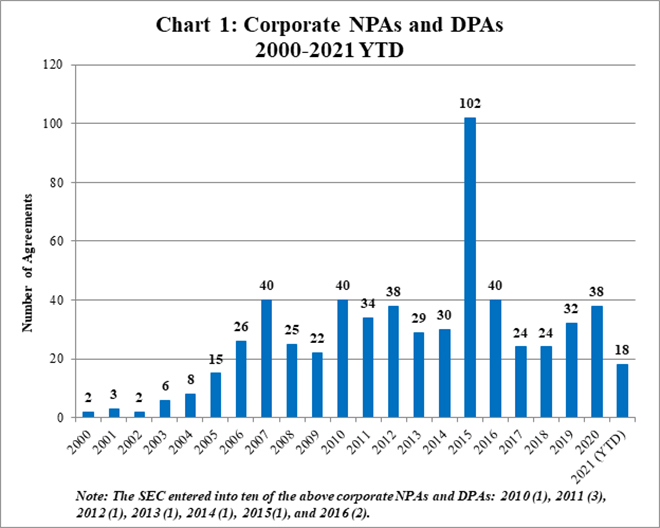
Chart 2 reflects total monetary recoveries related to NPAs and DPAs from 2000 through 2021 to date. The $9.4 billion in total monetary recoveries related to NPAs and DPAs in 2020 was the highest annual amount in history. At approximately $3.4 billion, recoveries associated with NPAs and DPAs thus far in 2021 slightly lag behind the amount recovered at this time in both 2020 (~$5.6 billion) and 2019 (~$4.7 billion) though the numbers are in line with the average recovery at the midpoint over the last 10 years. Total recoveries so far in 2021 are still more than 50 percent (57%) of the full annual average recoveries of approximately $5.9 billion in the last decade. Depending on developments in the second half of this year, total recoveries for 2021 could show a return to more typical levels, rather than a continuation of the increases in recent years.
Fifteen of the 18 agreements thus far in 2021 have been DPAs, reflecting a continuation of the trend toward DPAs as illustrated in Chart 3 below and discussed in both our 2020 Mid-Year Update and 2020 Year-End Update. Although the trend toward DPAs could signal a shift toward requiring self-disclosure to achieve an NPA, this year’s NPAs highlight the importance of fact-specific circumstances and mitigating factors: self-disclosure alone is not dispositive.
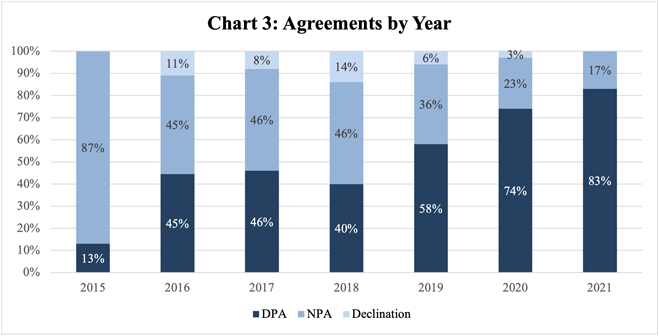
Only three companies have received NPAs to date in 2021: SAP SE (“SAP”), Avnet Asia Pte. Ltd. (“Avnet Asia”), and United Airlines, Inc. (“United”). Of the three, only SAP received voluntary self-disclosure credit. Notably, two of the three NPAs, involving SAP and Avnet Asia, involved DOJ’s National Security Division (“NSD”), which introduced a new voluntary disclosure policy in late 2019 that provides for a presumption toward NPAs for participating companies. Although Avnet Asia did not receive voluntary self-disclosure credit, the language of the NPA suggests that it may have made a self-disclosure to DOJ after prosecutors initiated their own investigation.
A second emerging trend in 2021 that appears to be consistent with 2020 is a steep decline in compliance monitors. Only one of the 18 agreements to date, the DPA with State Street Corporation (“State Street”), imposes an independent corporate monitor. Similarly, in 2020, only 2 out of 38 resolutions imposed an independent monitor or independent auditor. In contrast, in 2019, 7 out of 31 resolutions imposed some form of an independent compliance monitor.
Time will tell whether, under the Biden Justice Department, these trends will continue to hold true for the remainder of the year and beyond.
Key Developments in 2021 to Date
Enforcement in the Year of COVID-19 and Beyond
As the legal world progresses toward normalcy after an unprecedented 18 months, the mid-year mark of 2021 provides an opportunity to look back at how the COVID-19 pandemic has affected government enforcement efforts, and whether the unique legal risks facing companies managing COVID-19 will be reflected in enforcement activity going forward.
Although a dip in overall enforcement was expected by many at the start of the pandemic, that theory is not supported by the statistics. With the long gestation period of most corporate enforcement cases, the full impact of COVID-19, if any, might not be quantifiable until a later date. Nor does the broader enforcement landscape in 2020 reflect a significant downward trend. First, DOJ’s Civil Frauds Section reported 922 total new matters in 2020, the highest number since the Civil Division began reporting that statistic in 1987, and a 15% increase from 2019.[2] Meanwhile, DOJ Antitrust reported 20 new criminal antitrust matters filed in 2020, which, while a decrease from the 26 new matters filed in 2019, is up from the 18 filed in 2018, and is generally consistent with a 10-year downward trend in criminal antitrust enforcement.[3] If any enforcement arm can be said to have reported a significant dip in enforcement during the pandemic year, it is the SEC, which disclosed 715 new enforcement actions filed in 2020—a 17% decrease from 2019, a 13% decrease from 2018, a 5% decrease from 2017, and the lowest number on record since 2013.[4] However, although new enforcement actions were down, the SEC set a high-water mark for total financial remedies in 2020 of $4.68 billion.[5] Overall statistics from the first half of 2021 are not yet publicly available, but early signs indicate that at least DOJ is continuing its “[h]istoric level of enforcement.”[6]
Still, although the numbers may not reflect an annual dip in enforcement activity, the pandemic at least temporarily disrupted the work of government enforcement arms, as it did for much of the corporate world. For example, in the SEC’s 2020 Annual Report, the then-Enforcement Division Director cited the unique challenges of adapting to telework for the Commission, and stated that “in the early months . . . many of us spent the bulk of our time focused on learning and guiding our staff how to effectively do our job remotely. But we moved past that initial period of uncertainty and ultimately achieved a remarkable level of success, including bringing more than 700 enforcement cases during the fiscal year.”[7]
The more significant effects of the pandemic from an enforcement perspective will be forward looking—namely, how will the unique legal risks created in the last year shift enforcement priorities? As early as May 2020, the SEC had announced a “Coronavirus Steering Committee” to identify and respond to COVID-related legal risks.[8] And DOJ also made it clear that monitoring the use of significant public funds doled out by COVID-19 response programs such as the Paycheck Protection Program and Coronavirus Aid, Relief, and Economic Security Act would be a priority.[9] The then-Principal Deputy Assistant Attorney General said “we will energetically use every enforcement tool available to prevent wrongdoers from exploiting the COVID-19 crisis.”[10]
The results of those priorities are still taking shape. Thus far, DOJ’s publicly disclosed COVID-related enforcement efforts, while significant, have seemingly focused on individual defendants.[11] For example, in a May 2021 announcement by DOJ of charges brought in connection with an alleged nationwide COVID-related fraud scheme, which allegedly resulted in losses exceeding $143 million, all of the 14 defendants charged were individuals.[12] DOJ has yet to reach a public NPA or DPA with any company for criminal fraud related to COVID-19, although, as discussed in our 2020 Year-End Update, DOJ has entered into a pair of DPAs relating to price-gouging consumers of personal protective equipment. In light of DOJ’s interest in prosecuting COVID-19 related fraud cases and the corporate nature of the Paycheck Protection Program, it is likely that the lack of any publicly disclosed corporate resolutions to date reflects the greater complexity and longer timeline involved in investigating and prosecuting corporate cases.
That enforcement agencies are interested in pursuing COVID-related fraud by corporations, as well as individuals, is reflected in the SEC’s enforcement efforts throughout 2020 (described in our 2020 Year-End Securities Enforcement Update). At the very end of 2020, for example, the SEC brought its first settled charges (though not a DPA or NPA) with a company in response to a different COVID-related risk—misleading disclosures about the effects of the pandemic on a company’s financial condition—with The Cheesecake Factory Incorporated, which Gibson Dunn covered in a client alert.[13] More corporate COVID-related resolutions may follow, as investigations commenced in the last year reach their conclusions. We will continue to follow how enforcement involving COVID-related conduct develops.
June 2020 Corporate Compliance Program Guidance in Practice
In June 2020, DOJ updated the Criminal Division’s guidance on the “Evaluation of Corporate Compliance Programs,” a development Gibson Dunn discussed in a prior client alert and in our 2020 Year-End Update. Although DOJ has not commented officially on the guidance since the new administration took office, resolutions from the first half of 2021 may provide a window into how the updated guidance is playing out in practice.
The June 2020 guidance emphasized DOJ’s commitment to fact-specific resolutions by calling for “a reasonable, individualized determination in each case.”[14] That emphasis has made its way into several negotiated terms relating to specific corporate compliance programs so far in 2021, in some instances continuing a trend started in 2020 in the immediate wake of the updated guidance. Although DOJ often uses the same template as a starting point in many of its resolutions to detail the requirements for corporate compliance programs, context-specific requirements are appearing in resolutions.
For example, the Epsilon DPA follows the trend of fact-specific resolutions, adding a category for “Consumer Rights” not found in the compliance program requirements incorporated in other resolutions.[15] In light of DOJ’s allegation that employees at Epsilon sold customer data to clients that were engaging in consumer fraud, the Epsilon DPA requires Epsilon to provide individual customers with processes to both request the individual’s data that Epsilon may sell to clients and to request that Epsilon not sell the individual’s data at all.[16]
By contrast, the SAP NPA alleges that SAP acquired various companies but “made the decision to allow these companies to continue to operate as standalone entities, without being fully integrated into SAP’s more robust export controls and sanctions compliance program,” and despite “[p]re-acquisition due diligence . . . [that] identified that th[e] . . . companies lacked comprehensive export control and sanctions compliance programs, policies, and procedures.”[17] Because of this allegation, and given that M&A due diligence was a focus of the June 2020 guidance, SAP’s NPA requires it to audit newly acquired companies within 60 days of acquisition and inform DOJ about any potential violations.[18] This requirement is much more stringent than DOJ’s 2008 Opinion Release (discussed in our 2008 Mid-Year Update) regarding FCPA diligence in the context of M&A transactions.[19]
Additionally, both of the above agreements contain a provision for the continued monitoring and testing of the corporate compliance programs. The June 2020 guidance emphasizes that companies’ risk assessments should be based on “continuous access to operational data and information across functions,” as opposed to just providing a “snapshot in time.”[20] The Epsilon DPA provides for “periodic reviews and testing” of the company’s compliance policies, while the SAP NPA provides for continued maintenance and enhancement of its internal controls.[21] In line with the previous sections, each of these provisions is fact-specific: Epsilon must review its protection of consumer data; and SAP, its export controls and sanctions compliance programs.[22]
In sum, it appears that the June 2020 guidance from DOJ on corporate compliance programs has had its intended effect: DOJ and U.S. Attorneys’ Offices are, at least in some instances, tailoring the programs for individualized situations, and other foci of the June 2020 guidance are making their way into resolutions. Moving forward, we expect to see more agreements tailored to the individual circumstances of each company, drawing on the principles articulated in the June 2020 guidance.
Developments in Whistleblower Programs
On February 23, 2021, the SEC announced a $9.2 million award to a whistleblower who provided information that led to a successful DPA or NPA with the DOJ.[23] The order redacted information that would identify the type of agreement and fraud.[24] This marks the first SEC whistleblower award based on a DPA or NPA since amendments that expanded eligibility under the Whistleblower Rules[25] to include whistleblowers whose information leads to a DPA or NPA took effect in December 2020.[26] According to the award order, the whistleblower previously provided “significant information” about an ongoing fraud that resulted in DOJ charges.[27] The information facilitated “a large amount of money to be returned to investors harmed by the fraud.”[28]
The SEC whistleblower amendments reflect the recent expansion of whistleblower provisions in other contexts, in particular the anti-money laundering (“AML”) and antitrust areas. We covered two key developments in this regard—the passage of the Anti-Money Laundering Act of 2020, and the passage of the Criminal Antitrust Anti-Retaliation Act of 2020, here and here, respectively. With more avenues for government agencies to issue awards to people who report potential violations, we can expect to see an uptick in enforcement activity in the relevant areas.
DPA Conclusions
The first half of 2021 saw three notable DPA conclusions, with MoneyGram International, Inc. (“MoneyGram”), Standard Chartered Bank (“Standard Chartered”), and Zimmer Biomet (“Zimmer”) each released from very old and frequently extended DPAs entered into in 2012. Both the MoneyGram and Standard Chartered DPAs have been the subject of multiple extensions, as we noted in a prior client alert, and reflect the challenges companies often face even after a resolution is reached. On April 20, 2021, MoneyGram’s monitor certified that the company’s AML compliance program was “reasonably designed and implemented to detect and prevent fraud and money laundering and to comply with the Bank Secrecy Act.”[29] On May 4, 2021, DOJ and MoneyGram jointly filed a status report, stating that the parties were not seeking a further extension of the DPA.[30] The DPA terminated on May 10, 2021.
Standard Chartered reached the end of its monitorship, which was introduced in the 2014 amendment of its DPA, as scheduled in March 2019.[31] In April 2019, however, Standard Chartered agreed to a further amended DPA to resolve additional allegations, described in our 2019 Year-End Update. The 2019 amended DPA did not impose a monitor on Standard Chartered.[32] In May 2021, DOJ acknowledged that Standard Chartered had “complied with its obligations under the 2019 DPA,” and the DPA terminated.[33]
Zimmer’s DPA, which terminated in February 2021, related to pre-acquisition conduct by Biomet, Inc. (“Biomet”).[34] Biomet entered into the 2012 DPA in connection with allegations that it had violated the anti-bribery and accounting provisions of the FCPA.[35] Those allegations related to improper payments Biomet and its subsidiaries made between 2000 and 2008 in China, Argentina, and Brazil.[36] As part of its 2012 DPA, Biomet agreed to be subject to a monitor for 18 months.[37] The monitor was extended, however, after Biomet discovered additional potentially improper activities in Mexico and Brazil. In 2017, Zimmer entered into a new DPA with the DOJ relating to alleged violations of the FCPA’s internal controls provisions, under which it acknowledged that Biomet had failed to comply with the terms of the 2012 DPA.[38] As part of the 2017 DPA, Zimmer agreed to appoint a monitor for three years.[39] That monitorship concluded in August 2020, and its conclusion was followed by the termination of the DPA in February 2021.
Legislative Developments
In January, Congressman Gary Palmer of Alabama introduced the Settlement Agreement Information Database Act of 2021.[40] If passed, the Act would require Executive agencies to submit any information regarding settlement agreements to a public database.[41] The bill defines a “settlement agreement” broadly¾it includes any agreement, including a consent decree that (1) “is entered into by an Executive agency,” and (2) “relates to an alleged violation of Federal civil or criminal law.”[42] The submission must include the specific violations that provide the basis for the action, the settlement amount and classification as a civil penalty or criminal fine, a description of any data or methodology used to justify the agreement’s terms, the length of the agreement, and other identifying factors.[43] An agency is exempt from filing a submission if the agreement is subject to a confidentiality provision or if the information could be withheld under the Freedom of Information Act (“FOIA”).[44] The bill passed the House on January 5, 2021 and was referred to the Senate Committee on Homeland Security and Governmental Affairs.[45] The bill echoes a reporting requirement imposed on DOJ via a provision in the National Defense Authorization Act, whereby DOJ is now required to report to Congress annually on DPAs and NPAs concerning the Bank Secrecy Act.[46] We covered that development in more detail in our Year-End 2020 Update.
Congressman Palmer introduced the new bill after DOJ did not respond to an April 2020 FOIA request and subsequent administrative appeal in September 2020.[47] The FOIA request, which Professor Jon Ashley of the University of Virginia School of Law made to DOJ, sought all DPAs and NPAs entered into by the government since 2009 for the law school’s Corporate Prosecution Registry.[48] The registry houses more than 3,500 agreements, but Professor Ashley and some members of Congress believe that more agreements exist that have not been disclosed.[49] The bill follows Congressman Jamie Raskin’s August 2020 request to DOJ that it release a full list of all NPAs and DPAs since 2009—a call that has gone unanswered to date.[50] Although some observers believe that DOJ already has its own centralized “database” of agreements that could all be disclosed at once, in reality, the varying requirements for Main Justice involvement in and approval of different types of investigations and prosecutions[51] could mean that non-public agreements have been entered into by U.S. Attorneys’ Offices, for example, without being formally reported to DOJ. Gibson Dunn does not believe that a master database exists. To our knowledge, there is no regulatory or policy obligation for the various DOJ units, including the U.S. Attorneys’ Offices, to report these resolutions.
2021 Agreements to Date
Amec Foster Wheeler Energy Limited (DPA)
On June 24, 2021, Amec Foster Wheeler Energy Limited (“AFWEL”) entered into a three-year DPA with the Fraud Section and the U.S. Attorney’s Office for the Eastern District of New York.[52] The DPA stated that AFWEL engaged in a conspiracy to violate the anti-bribery provision of the FCPA in connection with the use of a third-party sales agent in Brazil.[53] The DPA imposed a penalty of approximately $18.4 million, which will be offset by amounts to be paid to UK and Brazilian authorities pursuant to parallel resolutions.[54]
The DPA granted AFWEL full cooperation credit and did not impose a monitor.[55] Under the terms of the agreement, AFWEL must report annually to DOJ on its compliance program.[56] The AFWEL DPA is one of two FCPA-related DPAs announced during the first half of this year. The other resolution involved Deutsche Bank AG (see below). Both companies were represented by Gibson Dunn.
Argos USA LLC (DPA)
On January 4, 2021, Argos USA LLC (“Argos”), a Georgia-based producer and supplier of ready-mix concrete, entered into a three-year DPA with the DOJ Antitrust Division for participation in a conspiracy to fix prices, rig bids, and allocate markets in and around the Southern District of Georgia.[57] The sole count against Argos alleged that employees of Argos and other ready-mix concrete companies coordinated and issued price-increase letters to customers, allocated jobs in coastal-Georgia, charged fuel surcharges and environmental fees, and submitted non-competitive bids to customers in a conspiracy lasting from 2010 until July 2016.[58]
According to the DPA, Argos, through its employees, conspired with others in violation of the Sherman Act, 15 U.S.C. § 1 from around October 2011 to July 2016, after they acquired the assets of a concrete supplier in Southern Georgia and in doing so employed two individuals also charged in the conspiracy.[59] Argos agreed to pay more than $20 million in a criminal penalty.[60] As part of the DPA, Argos also has agreed to cooperate in the Division’s ongoing criminal investigation and prosecution of others involved in the conspiracy.[61] The company has implemented and agreed to maintain a compliance and ethics program designed to prevent and detect antitrust violations, submit annual reports to the Division regarding remediation and implementation of its program, and to periodically review its compliance program and make adjustments as needed.[62]
Argos was the second company to be charged in this investigation, following Evans Concrete, LLC.[63] An indictment was also returned for the former Argos employees and two other individuals.[64]
Avanos Medical, Inc. (DPA)
On July 6, 2021, Avanos Medical, Inc. (“Avanos”) entered into a three-year DPA with the Fraud Section of DOJ’s Criminal Division, the Consumer Protection Branch (“CPB”) of DOJ’s Civil Division, and the U.S. Attorney’s Office for the Northern District of Texas.[65] The DPA resolved allegations that Avanos violated the Food, Drug, and Cosmetic Act (“FDCA”) by fraudulently misbranding surgical gowns.[66] In particular, the government alleged that Avanos’s labeling and branding of the gowns as compliant with a 2012 version of an AAMI standard for barrier protection was false and misleading.[67]
The DPA granted Avanos full cooperation credit and noted the company’s “extensive remedial measures,” including changes to its manufacturing process, devotion of additional resources to its compliance function, creation of “a stand-alone Compliance Committee of the Board of Directors,” and appointment of a full-time Chief Ethics and Compliance Officer “who reports directly to the CEO.”[68] The DPA also recognized Avanos’s spinoff of its surgical gown business in 2018, and cited that development as one of the reasons for which DOJ “determined that an independent compliance monitor was unnecessary.”[69] Avanos did not receive voluntary disclosure credit.[70]
Under the DPA, Avanos will pay a total of $22,228,000, comprised of $12.6 million in fines, $8,939,000 in compensation to purchasers of the gowns who “were directly and proximately harmed” by the company’s alleged conduct, and $689,000 in disgorgement.[71] The compensation to purchasers will be administered by a Victim Compensation Claims Administrator selected from a list of three candidates to be proposed by Avanos.[72]
Avnet Asia Pte. Ltd. (NPA)
On January 21, 2021, Avnet Asia Pte. Ltd. (“Avnet”), a Singapore distributor of electronic components and software, entered into a two-year NPA with the U.S. Attorney’s Office for the District of Columbia and DOJ NSD to resolve allegations related to alleged criminal conspiracies carried out by former employees.[73] Specifically, Avnet admitted in the NPA that two former employees (including a separately indicted sales account manager) engaged in two distinct conspiracies—one between 2007 and 2009, the other between 2012 and 2015—to violate U.S. export laws by shipping U.S. power amplifiers to Iran and China.[74] In the NPA, Avnet accepted responsibility for the acts of its employees and further admitted that neither the company nor any of its employees had applied for an export license from U.S. authorities.[75]
As part of the NPA, Avnet agreed to pay a $1.5 million financial penalty, to continue cooperating with any investigations concerning the underlying conduct, to provide all unprivileged documents pertaining to relevant investigations, and to make current and former employees available for interviews and testimony.[76] Avnet further agreed to implement a compliance program aimed at detecting and preventing violations of U.S. export laws and economic sanctions, and to provide updates on its compliance with such laws and sanctions on two occasions during the NPA’s term (at 10 and 20 months after the NPA’s execution).[77]
DOJ credited Avnet for its cooperation during the investigation (including disclosing the results of internal investigations and producing relevant documents) and for its significant remediation efforts (including substantial improvements to its export compliance program).[78] Avnet did not receive voluntary disclosure credit because it did not disclose the underlying misconduct prior to the commencement of the government’s investigation.[79] Relatedly, the U.S. Department of Commerce announced on January 29, 2021 that Avnet had agreed to pay an additional $1.7 million as part of a $3.2 million resolution of violations of the Export Administration Regulations.[80]
Bank Julius Baer & Co. Ltd. (DPA)
On May 27, 2021, Bank Julius Baer & Co. Ltd. (“BJB”), a Swiss bank with international operations, entered into a three-year DPA with DOJ’s Money Laundering and Asset Recovery Section (“MLARS”) and the United States Attorney’s Office for the Eastern District of New York.[81] DOJ alleged that from approximately February 2013 through May 2015, BJB conspired with sports marketing executives to launder through the United States at least $36 million in bribes to soccer officials in exchange for broadcasting rights to soccer matches, including the World Cup.[82]
Under the DPA, BJB agreed to pay a monetary penalty of approximately $43.32 million and forfeit $36.37 million.[83] DOJ stated that it reached this resolution with BJB based on a number of factors, including BJB’s 2016 DPA with DOJ which resolved allegations of “criminal violations relating to [BJB’s] efforts to [assist] U.S. taxpayers in evading U.S. taxes.”[84]
BJB received a 5% reduction off the bottom of the applicable U.S. Sentencing Guidelines fine range for its significant efforts to remediate its compliance program.[85] DOJ specifically acknowledged BJB’s three-year, $112 million AML initiative and “Know Your Client” upgrade launched in 2016; a large-scale AML transaction monitoring and risk management program launched in 2018; and the Bank’s 2019 initiative aimed at strengthening globally the Bank’s risk managements and risk tolerance framework.[86] BJB did not receive voluntary disclosure credit or cooperation credit.[87] The DPA noted the government’s determination that the appointment of an independent compliance monitor to oversee the remediation of BJB’s AML program by Swiss authorities made appointment of an additional monitor unnecessary.[88]
Berlitz Languages, Inc. (DPA) and Comprehensive Language Center, Inc. (DPA)
On January 19, 2021, Berlitz Languages, Inc. (“Berlitz”) and Comprehensive Language Center, Inc. (“CLCI”) entered into two separate, three-year DPAs with the DOJ Antitrust division for charges relating to a conspiracy to defraud the United States through non-competitive bidding processes in 2017[89] in connection with a multi-million dollar contract with the National Security Agency (“NSA”) to provide foreign language training services.[90] DOJ charged the companies with a conspiracy to defraud by “impending, impairing, obstructing, and defeating competitive bidding” in violation of 18 U.S.C. § 371.[91] Specifically, the companies facilitated providing false and misleading bid information to the NSA.[92]
In 2017, the NSA issued a bidding process to award up to three contracts spanning from 2017 until 2022 to provide foreign language training programs in six different locations across the United States.[93] NSA awarded the contracts to Berlitz and CLCI, along with another third-party company, in 2017, which entitled each to bid on individual delivery orders later awarded in December 2017.[94] To qualify for awards of delivery orders, the company had to be deemed “technically acceptable,” by having a facility in the location in which it could conduct the foreign language training.[95] The DPA alleged that the two companies conspired with each other to fraudulently obtain the contracts and delivery orders by falsely representing CLCI’s ability to perform and to suppress competition between Berlitz and CLCI.[96] Specifically, the companies admitted to falsely and misleadingly claiming that CLCI could perform services at a facility in Odenton, Maryland when that facility was owned and operated by Berlitz.[97] In exchange, CLCI then agreed to not bid against Berlitz when Berlitz bid on delivery orders calling for training in or near Odenton, Maryland.[98]
Under the DPA, the companies agreed to pay criminal penalties of around $140,000 each and agreed that they were jointly and severally liable to pay victim compensation to the NSA of approximately $57,000.[99] As part of the DPA, the companies admitted to participating in the alleged conspiracy, agreed to cooperate in any related investigation or prosecution, and implemented or agreed to implement and maintain compliance controls and a compliance and ethics program designed to prevent and detect fraud and antitrust violations.[100] The companies also agreed to periodically review the program and make adjustments as needed.[101]
The Boeing Company (DPA)
On January 7, 2021, The Boeing Company (“Boeing”) and the DOJ Fraud Section, as well as the U.S. Attorney’s Office for the Northern District of Texas, entered into a three-year DPA to resolve a criminal charge of conspiracy to defraud the Federal Aviation Administration’s (“FAA’s”) Aircraft Evaluation Group regarding an aircraft part called the Maneuvering Characteristics Augmentation System (“MCAS”) that affected the flight control system of the Boeing 737 MAX.[102] Pursuant to the DPA, Boeing agreed to pay approximately $2.5 billion, which includes a $243.6 million penalty and $1.77 billion in compensation to Boeing’s airline customers, and to establish a $500 million crash-victim beneficiaries fund.[103]
The DPA acknowledged Boeing’s remedial measures, including creating an aerospace safety committee of the Board of Directors to oversee Boeing’s policies and procedures governing safety and its interactions with the FAA and other government agencies and regulators,[104] and awarded partial credit for cooperation.[105]
Colas Djibouti SARL (DPA)
On February 17, 2021, Colas Djibouti SARL (“Colas Djibouti”)—a French concrete contractor and wholly owned subsidiary of French civil engineering company, Colas SA—entered into a DPA with the U.S. Attorney’s Office for the Southern District of California to resolve allegations concerning Colas Djibouti’s sale of contractually non-compliant concrete used to construct U.S. Navy airfields in the Republic of Djibouti.[106] Specifically, DOJ alleged that Colas Djibouti (1) knowingly provided substandard concrete for use on U.S. Navy airfield construction projects pursuant to contracts between Colas Djibouti and the U.S. Navy and (2) submitted documents and claims containing false representations about the composition and characteristics of the concrete to the United States.[107]
Under the terms of the DPA, Colas Djibouti agreed to plead to a one-count information of conspiracy to commit wire fraud under 18 U.S.C § 1349 and to pay approximately $10 million in restitution, a fine of $2.5 million, and forfeiture in the amount of $8 million (to be credited to the $10 million owed in restitution).[108]
In connection with the same underlying conduct, Colas Djibouti simultaneously agreed to a $3.9 million settlement of civil allegations that it violated the False Claims Act.[109] Under the terms of the settlement agreement, Colas Djibouti agreed to cooperate with any DOJ investigation of other individuals and entities not covered by the DPA and settlement agreement in connection with the underlying conduct.[110] Colas Djibouti agreed to encourage its former directors, officers, and employees to give interviews and testimony, and to furnish DOJ with non-privileged documents and records related to any investigation of the underlying conduct.[111] The civil settlement credited approximately $1.9 million of Colas Djibouti’s payment as restitution under the DPA and obligated Colas Djibouti to make a net payment of approximately $1.9 million.[112]
Deutsche Bank AG (DPA)
On January 8, 2021, Deutsche Bank AG (“Deutsche Bank”) entered into a three-year DPA and agreed to pay approximately $123 million in criminal penalties, disgorgement, and victim compensation to resolve FCPA and commodities fraud investigations.[113] The resolution was coordinated with the SEC.
The FCPA investigation concerned payments to consultants.[114] The commodities investigation related to allegations that Deutsche Bank precious metals traders placed orders with the intent to cancel the orders prior to execution.[115]
The Bank received full credit for cooperating with the investigation, including making detailed factual presentations and producing extensive documentation.[116] The DPA also acknowledged remedial measures taken by the Bank, including “conducting a robust root cause analysis and taking substantial steps to remediate and address the misconduct, including significantly enhancing its internal account controls, its anti-bribery and anti-corruption program, and its Business Development Consultants [] program on a global basis.”[117]
Epsilon Data Management LLC (DPA)
On January 19, 2021, marketing company Epsilon Data Management LLC (“Epsilon”) entered into a 30-month DPA with DOJ CPB and the U.S. Attorney’s Office for the District of Colorado to resolve a criminal charge for conspiracy to commit mail and wire fraud.[118] The government alleged that from July 2008 to July 2017, employees in Epsilon’s direct-to-consumer unit (“DTC”) sold over 30 million consumers’ information to individuals engaged in fraudulent mass-mailing schemes.[119]
Under the DPA, Epsilon agreed to pay $150 million, with $127.5 million dedicated to a victims’ compensation fund.[120] Epsilon also agreed to select, and cover the costs of, an independent claims administrator to distribute monies from the fund.[121] The agreement stated that DOJ was not requiring Epsilon to pay a criminal forfeiture amount because of the “facts and circumstances of th[e] case” and the company’s agreement to pay the victims’ compensation amount.[122]
The DPA noted the substantial enhancements Epsilon had already made to its compliance program and internal controls.[123] Epsilon further agreed to enhance its compliance program and internal controls to safeguard consumer data and prevent its sale to individuals engaged in fraudulent marketing campaigns.[124] Epsilon also agreed to cooperate fully in any related matters.[125]
The DPA stated that Epsilon received full credit for its “extensive cooperation,” which included (1) a “thorough and expedited internal investigation,” (2) regular government presentations, (3) facilitating employee interviews, and (4) analyzing and organizing “voluminous evidence.”[126] Epsilon also received credit for its extensive remedial measures, including (1) separating employees known to be involved in the alleged conduct, (2) terminating relationships with the individuals who carried out the fraudulent mailing schemes, (3) dissolving the DTC, (4) investing in additional legal and compliance resources, and (5) updating company policies and procedures.[127] The DPA further credited Epsilon for having no prior criminal history.[128] Epsilon did not receive voluntary disclosure credit.[129]
DOJ determined that an independent compliance monitor was unnecessary “based on Epsilon’s remediation and the state of its compliance program, the fact that the Covered Conduct concluded in 2017,” and the company’s agreement to report annually on the implementation of its compliance program.[130]
On June 14, 2021, the U.S. District Court for the District of Colorado unsealed an indictment charging two former Epsilon employees with conspiracy to commit and the substantive commission of mail and wire fraud in connection with conduct that was the subject of the Epsilon DPA.[131] The indictment alleges that the two individuals sold consumer lists to mass-mailing fraud schemes that invited consumers to engage in false “sweepstakes” and “astrology” solicitations.[132] The unsealing of the indictment coincided with DOJ announcing its DPA with KBM Group LLC (see below) to resolve nearly identical charges.[133]
KBM Group LLC (DPA)
On June 14, KBM Group LLC (“KBM”) entered into a 30-month DPA with the U.S. Attorney’s Office for the District of Colorado and DOJ CPB to resolve allegations that it sold millions of consumers’ information to individuals and entities engaged in elder fraud schemes.[134] DOJ alleged that KBM sold consumer lists to mass-mailing fraud schemes that invited consumers to engage in false “sweepstakes” and “astrology” solicitations.[135] A court in the same district earlier this year approved a similar agreement between the DOJ and Epsilon Data Management LLC to resolve parallel allegations.[136] The court approved the KBM DPA on June 29.[137]
Under the DPA, KBM will pay $42 million, $33.5 million of which will go to a victims’ compensation fund.[138] The DPA requires KBM to select, and cover the costs of, an independent claims administrator to distribute the victim compensation monies.[139] KBM also must implement compliance measures to safeguard consumer data and prevent its sale to perpetrators of fraudulent marketing schemes.[140] The compliance program requirements in KBM’s DPA are nearly identical to those in Epsilon’s, with the exception that KBM’s DPA explicitly requires the company to ensure that both senior and middle management reinforce and abide by the compliance code.[141] KBM’s agreement, like Epsilon’s, also requires annual compliance reporting and cooperation with the government in its ongoing investigations.[142]
The DOJ granted KBM nearly identical credit to that provided under Epsilon’s DPA, including full credit for its cooperation, its “significant remedial measures,” and lack of prior criminal history.[143] Additionally, the DPA credited KBM for its removal of terminated clients’ data from the KBM database and its revision of employee commission plans and co-op member agreements to align with the new compliance measures.[144]
The DOJ announced its filing of the DPA with KBM alongside the unsealing of an indictment charging two former Epsilon employees with mail and wire fraud in connection with a mass-mailing fraud scheme.[145]
PT Bukit Muria Jaya (DPA)
On January 17, 2021, PT Bukit Muria Jaya (“BMJ”)¾a global cigarette paper supplier based in Indonesia¾entered into an 18-month DPA with DOJ NSD and the U.S. Attorney’s Office for the District of Columbia to resolve allegations of conspiracy to commit bank fraud in connection with the shipment of BMJ products to North Korea.[146] DOJ alleged that BMJ customers in North Korea falsified paperwork and misled U.S. banks into processing payments in violation of U.S. sanctions.[147] According to DOJ, BMJ accepted payments from third parties, at the request of its North Korean customers, that were unrelated to the sales transactions, thereby taking the transactions outside the ambit of U.S. banks’ sanctions monitoring systems and leading the banks to process transactions it would have otherwise rejected.[148] BMJ also entered a settlement with the U.S. Treasury’s Office of Foreign Assets Control (“OFAC”) for the same underlying conduct, with OFAC determining that BMJ’s violations were “non-egregious.”[149]
Under the DPA, BMJ agreed to pay a $1.5 million penalty and implement a compliance program designed to prevent and identify violations of U.S. sanctions.[150] BMJ also agreed to report semi-annually on the status of its compliance improvements.[151] The 18-month DPA can be extended by up to one year if BMJ knowingly violates the terms of the agreement.[152]
In setting forth the rationale for the terms of the resolution, the Gibson Dunn-negotiated DPA credited BMJ for its (1) willingness to accept responsibility under U.S. law, (2) remediation efforts and comprehensive improvement of its compliance program, and (3) ongoing cooperation.[153] The agreement also noted that BMJ’s revenue from the sales in question constituted less than 0.3% of the company’s total sales revenue during that same period.[154]
Just six months prior to BMJ’s agreement, the DOJ imposed its first-ever corporate resolution for violations of the 2016 sanctions regulations concerning North Korea.[155] The BMJ DPA suggests that DOJ’s effort in this regard will proceed regardless of the transactions’ value to the entity. In announcing the BMJ DPA, Acting U.S. Attorney for the District of Columbia Michael R. Sherwin highlighted this point by stating that “[w]e want to communicate to all those persons and businesses who are contemplating engaging in similar schemes to violate U.S. sanctions on North Korea . . . . We will find you and prosecute you.”[156]
Rahn+Bodmer Co. (DPA)
On February 10, 2021, the oldest private bank in Zurich, Switzerland, Ranh+Bodmer Co. (“R+B”), entered into a three-year DPA with DOJ’s Tax Division and the United States Attorney’s Office for the Southern District of New York.[157] The DPA resolves allegations that from 2004 until 2012 R+B conspired to help U.S. account holders evade U.S. tax obligations, file false federal tax returns, and otherwise defraud the Internal Revenue Service (“IRS”) by hiding hundreds of millions of dollars in offshore bank accounts at R+B.[158] The DPA is the latest of over 90 resolutions since 2013 with Swiss banks involving tax evasion allegations.
Under the DPA, R+B agreed to make payments totaling $22 million.[159] Specifically, R+B agreed to pay (1) $4.9 million in restitution, representing the “approximate gross pecuniary loss to the [IRS]” resulting from R+B’s participation in the conspiracy; (2) $9.7 million in forfeiture, representing the approximate gross fees that R+B earned on its undeclared U.S.-related accounts between 2004 and 2012; and (3) $7.4 million in penalties, including a 55% discount for cooperation.[160] DOJ stated that it reached this resolution with R+B based on a number of factors, including that R+B conducted a “thorough internal investigation”; “provided a substantial volume of documents” to DOJ; and implemented remedial measures to “protect against the use of its services for tax evasion in the future.”[161] The agreement also requires R+B to disclose information consistent with the Department’s Swiss Bank Program relating to accounts closed between January 1, 2009, and December 31, 2019.[162]
SAP SE (NPA)
On April 29, 2021, SAP SE (“SAP”), a German software corporation, entered into an NPA with DOJ NSD and agreed to disgorge $5.14 million.[163] SAP also entered into concurrent administrative agreements with the Department of Commerce’s Bureau of Industry and Security and OFAC.[164] In voluntary disclosures to these three agencies, SAP acknowledged violations of the Export Administration Regulations and the Iranian Transactions and Sanctions Regulations.[165]
The conduct covered by the NPA involved SAP’s alleged export of software to Iranian end users. Between 2010 and 2017, SAP and overseas partners released U.S.-origin software, upgrades and patches, to users located in Iran in over 20,000 instances.[166] SAP’s Cloud Business Group companies separately permitted over 2,000 Iranian users access to U.S.-based cloud services in Iran.[167] Certain SAP senior managers were aware that the company did not have geolocation filters sufficient to identify and block the Iranian downloads, but SAP failed to institute remedial controls.[168]
According to the NPA, SAP received full credit for its timely voluntary disclosure, as well as credit for extensive cooperation with the government.[169] The company also received credit for spending more than $27 million on remediation efforts, including implementing GeoIP blocking, deactivating violative users of cloud services based in Iran, transitioning to automated sanction screening, auditing and suspending partners that sold to Iran-affiliated customers, and implementing other internal and export controls.[170]
The SAP resolution is one of the first of its kind focused on the provision of cloud services, and as such may now serve as a benchmark for future government enforcement actions—and compliance and remediation expectations—in this space.
State Street Corporation (DPA)
On May 13, 2021, State Street Corporation (“State Street”) entered into a new two-year DPA with the U.S. Attorney’s Office for the District of Massachusetts and agreed to pay a $115 million criminal penalty to resolve charges that it conspired to commit wire fraud by engaging in a scheme to defraud a number of the bank’s clients.[171] According to the DPA, State Street overcharged by over $290 million for expenses related to the bank’s custody of client assets.[172]
Between 1998 and 2015, according to the DPA, eight former bank executives omitted information about charges from client invoices and misled customers who raised concerns about the expenses.[173] Specifically, the former bank executives allegedly “conspired to add secret markups to ‘out-of-pocket’ (OOP) expenses charged to the bank’s clients while letting clients believe that State Street was billing OOP expenses as pass-through charges on which the bank was not earning a profit.”[174] An example of an OOP expense would be fees for interbank messages sent via the Society of Worldwide Interbank Financial Telecommunication (SWIFT) system.[175]
In addition to the $115 million criminal penalty, State Street also agreed to continue to “cooperate with the U.S. Attorney’s Office in any ongoing investigations and prosecutions relating to the conduct, to enhance its compliance program, and to retain an independent compliance monitor for a period of two years.”[176]
Unrelatedly, State Street saw the extension in March 2021 of a 2017 DPA. State Street’s 2017 DPA resolved allegations that it engaged in a scheme to defraud customers by applying extra commissions to billions of dollars’ worth of securities trades.[177] The most recent extension, which runs through September 3, 2021, was described in a joint filing as necessary because the COVID-19 pandemic and the resignation of the monitor (who took a position with the SEC) delayed completion of the monitor’s work.[178]
With the new DPA and the recent extension of the 2017 DPA, State Street is now subject to two concurrent DOJ-imposed monitorships. The new monitor will assess and make recommendations in a way that does not duplicate the efforts of the 2017 monitor, the DPA states.[179] Further, the terms of the agreement specify that State Street may choose to retain the same monitor under the new agreement instead of appointing a separate person.[180]
Swiss Life Holding AG (DPA)
On May 14, 2021, Swiss Life Holding AG (“Swiss Life Holding”), Swiss Life (Liechtenstein) AG, Swiss Life (Singapore) Pte. Ltd., and Swiss Life (Luxembourg) S.A. entered into a three-year DPA with DOJ’s Tax Division and the United States Attorney’s Office for the Southern District of New York.[181] The DPA resolves allegations that from 2005 to 2014, Swiss Life conspired with U.S. taxpayers and others to conceal from the IRS more than $1.452 billion in assets and income through the use of offshore Private Placement Life Insurance (“PPLI”) policies (colloquially known as “insurance wrappers”) and related policy investment accounts in banks around the world.[182] According to the allegations in the DPA, Swiss Life was identified as the owner of the policy investment accounts, rather than the U.S. policyholder and/or ultimate beneficial owner of the assets, thereby allowing U.S. taxpayers to hide undeclared assets and income through the insurance wrapper policies.[183]
Swiss Life Holding agreed to pay approximately $77.3 million to resolve the charges.[184] This sum included (1) $16,345,454 in restitution, representing the approximate unpaid taxes resulting from the Swiss Life Entities’ participation in the conspiracy; (2) $35,782,375 in forfeiture, representing the approximate gross fees (not profits) that the Swiss Life Entities earned on the relevant transactions; and (3) $25,246,508 in penalties, including a 50% discount for cooperation.[185]
DOJ stated that the penalty accounted for the extensive internal investigation conducted by Swiss Life, which included the review of over 1,500 hard-copy PPLI policy files, and production to DOJ of a substantial volume of documents and client-related data derived from that investigation.[186] The DPA noted that Swiss Life took additional measures to assist in the sharing of documents and information with DOJ consistent with the insurance-confidentiality and data privacy laws in the jurisdictions in which Swiss Life’s PPLI carriers operate, including preparing a Tax Information Exchange Agreement request to the Liechtenstein authorities.[187] In addition, Swiss Life conducted extensive outreach to current and former U.S. clients to confirm historical tax compliance, and to encourage disclosure to the IRS when policyholders’ historical tax compliance issues had not yet been resolved.[188]
United Airlines, Inc. (NPA)
On February 25, 2021, United Airlines, Inc. (“United”) entered into a three-year NPA with DOJ (Fraud Section, Criminal Division) to resolve a criminal investigation into an allegedly fraudulent scheme carried out by former United employees in connection with United’s fulfilment of contracts to deliver mail internationally for the U.S. Postal Service (“USPS”).[189] According to the Statement of Facts, United delivered mail internationally pursuant to International Commercial Air (“ICAIR”) contracts with USPS.[190] Under the terms of these ICAIR contracts, United was required to (1) take barcode scans of mail upon taking possession of the mail and upon delivering the mail overseas, and (2) provide these scans to USPS.[191] Rather than providing USPS with scans based on the actual movement of mail, United admitted that, between 2012 and 2015, it provided USPS with automated scans based on projected delivery times.[192] Submission of these automated scans violated the terms of United’s ICAIR contracts and prompted USPS to make millions of dollars in payments that United was not entitled to under the ICAIR contracts.[193] United further admitted that certain former employees knew the data being transmitted to USPS violated the terms of the ICAIR contracts and engaged in efforts to conceal the automated scan data, which, if discovered, would have subjected United to financial penalties under the ICAIR contracts.[194]
As part of the resolution, United agreed to pay $17.2 million in criminal penalties and disgorgement.[195] Under the NPA, United agreed to continue cooperating with the Fraud Section, strengthen its compliance program, and submit yearly reports to the Fraud Section regarding its remediation efforts and implementation of policies and controls aimed at deterring and detecting fraud surrounding United’s government contracts.[196]
The NPA credited United for cooperating with the Fraud Section’s investigation by producing documents, making employees available for interviews, and giving a factual presentation to DOJ.[197] The NPA also noted United’s extensive remedial action after learning about the underlying misconduct, including removing the principal manager of the alleged scheme, hiring outside advisors to evaluate United’s government contracting compliance policies, instituting an independent “Government Contracts Organization” that reported directly to the United Legal Department, implementing training for employees with duties related to government contracts, and prohibiting automation of and restricting access to flight configuration data to prevent future manipulation of data provided to USPS.[198] In light of the isolated nature of the alleged misconduct and United’s remedial improvements, the Fraud Section determined that an independent compliance monitor was unnecessary.[199]
In connection with the same underlying conduct, United entered into a separate False Claims Act settlement with DOJ (Civil Division, Fraud Section, Commercial Litigation Branch) on February 25, 2021.[200] United agreed to pay $32.1 million as part of the civil settlement.[201]
International DPA Developments
As prior Mid-Year and Year-End Updates have discussed (see, e.g., our 2020 Year-End Update), France and the United Kingdom also have robust DPA or DPA-like frameworks. The UK’s Serious Fraud Office (“SFO”) has entered into 12 DPAs since 2015,[202] and France’s prosecuting agencies have entered into 12 DPA-like agreements (called convention judiciaire d’intérêt public, or “CJIP”) since 2017.[203] France and the United Kingdom together produced four DPA-like agreements in the first half of 2021, and DPA developments in the United Kingdom sparked discussion regarding individual prosecution related to DPAs.
France – Bolloré SE
On February 26, 2021, France’s National Financial Prosecutor’s Office (“PNF”) announced that the Judicial Court of Paris approved a €12 million (about $14.5 million) CJIP with French transport company Bolloré SE and its parent company Financière de l’Odet to resolve allegations of corruption in Togo.[204] PNF alleged that Bolloré paid €370,000 (almost $450,000) to Togolese president Faure Gnassingbé between 2009 and 2011 to secure tax benefits and a contract to manage the Port of Lomé.[205] As part of the CJIP, Bolloré agreed to enhance its compliance program and pay up to €4 million in costs related to the French Anti-Corruption Agency’s (AFA) monitoring and audit of Bolloré over the next two years.
On the same day that the Judicial Court of Paris approved the corporate resolution, the court dismissed the plea bargains that three Bolloré executives had entered into with PNF to resolve allegations related to the same conduct.[206] The court ordered the three executives to stand trial because the allegations against them “seriously undermined economic public order” and the sovereignty of Togo.[207] This is the first time a French court has considered—let alone rejected—plea deals alongside a CJIP, so it remains to be seen whether this development will chill the negotiation of further CJIPs or create more reluctance among individuals implicated in PNF investigations to seek resolutions in parallel with the negotiation of CJIPs.[208]
United Kingdom
Amec Foster Wheeler Energy Limited
On the same day that DOJ and the SEC announced their resolutions with Amec Foster Wheeler Energy Limited, and Amec Foster Wheeler Limited, respectively, the SFO announced that it had “agreed [to] a Deferred Prosecution Agreement in principle with Amec Foster Wheeler Energy Limited.”[209] The DPA relates to the use of third-party agents in five countries in the period before AMEC plc acquired Foster Wheeler AG in November 2014, and prior to Wood’s acquisition of the resulting combined company in October 2017.[210] The SFO DPA, and the parallel DPA with DOJ, collectively call for total payments of $177 million and include fines and disgorgement.[211] On July 1, 2021, the Crown Court at Southwark, sitting at the Royal Courts of Justice, gave final approval of the DPA.[212] Under the UK DPA, AFWEL will pay approximately £103 million.[213]
Two Anonymous DPAs with Companies for UK Bribery Act Offenses
On July 20, 2021, the SFO announced final court approval of two separate DPAs with two UK-based companies for bribery offenses.[214] According to the SFO’s press release, the two companies will pay a total of £2,510,065 (over $3.4 million) in disgorgement of profits and financial penalties.[215] The SFO did not disclose the names of the companies, citing legal restrictions on reporting under the Contempt of Court Act 1981.[216] The publicly available information regarding these two DPAs will therefore be limited until the restrictions have been lifted and the DPAs are published. However, the SFO did state that the companies “either actively participated in or failed to prevent the rolling use of bribes to unfairly win contracts,” and the companies will be obligated to report on their compliance programs at regular intervals during the two-year term of the DPAs.[217]
Further UK Developments
DPAs continue to be in the spotlight more broadly in the United Kingdom. On May 4, 2021, the media reported that the SFO (which declined to comment) was ending a criminal investigation into individuals associated with Airbus SE (“Airbus”) 16 months after Airbus agreed to pay combined penalties of $3.9 billion to authorities in France, the United Kingdom, and the United States to resolve foreign bribery and export control charges (as summarized in our 2020 Mid-Year Update).[218] Similarly, in April 2021, the SFO’s prosecution of two former executives of Serco Georgrafix Ltd. (“Serco”) ended in a directed verdict of not guilty after the revelation that the SFO had failed to disclose evidence to the defense.[219] Serco, a leading provider of outsourced services to governments, entered into a DPA with the SFO in July 2019 and agreed to pay a penalty of £19.2 million (about $24 million) and to reimburse the SFO’s investigation costs of £3.7 million (over $4.6 million) to resolve allegations of fraud and false accounting (as discussed in our 2019 Year-End Update). The Serco case is not the first acquittal in recent years among SFO prosecutions against individuals; in fact, the SFO has yet to successfully prosecute individuals following a DPA.[220] This trend may undermine or at least shape the SFO’s efforts to enter into DPAs in the future, to the extent it leads corporations to question the SFO’s ability to secure a conviction if forced to prove its case in court.
APPENDIX: 2021 Non-Prosecution and Deferred Prosecution Agreements to Date
The chart below summarizes the agreements concluded by DOJ in 2021 to date. The SEC has not entered into any NPAs or DPAs in 2021. The complete text of each publicly available agreement is hyperlinked in the chart.
The figures for “Monetary Recoveries” may include amounts not strictly limited to an NPA or a DPA, such as fines, penalties, forfeitures, and restitution requirements imposed by other regulators and enforcement agencies, as well as amounts from related settlement agreements, all of which may be part of a global resolution in connection with the NPA or DPA, paid by the named entity and/or subsidiaries. The term “Monitoring & Reporting” includes traditional compliance monitors, self-reporting arrangements, and other monitorship arrangements found in settlement agreements.
U.S. Deferred and Non-Prosecution Agreements in 2021 to Date | ||||||
| Company | Agency | Alleged Violation | Type | Monetary Recoveries | Monitoring & Reporting | Term of NPA/DPA (months) |
| Amec Foster Wheeler Energy Limited | DOJ Fraud; E.D.N.Y. | Conspiracy to violate the FCPA | DPA | $41,139,287 | Yes | 36 |
| Argos USA LLC | DOJ Antitrust | Price-fixing conspiracy | DPA | $20,024,015 | Yes | 36 |
| Avanos Medical, Inc. | DOJ Fraud; DOJ CPB; N.D. Tex. | FDCA | DPA | $22,228,000 | Yes | 36 |
| Avnet Asia Pte. Ltd | D.D.C.; DOJ NSD | Export controls – conspiracy to violate the International Emergency Economic Powers Act | NPA | $1,508,000 | Yes | 24 |
| Bank Julius Baer & Co. Ltd. | DOJ MLARS; E.D.N.Y. | AML | DPA | $79,688,400 | Yes | 36 |
| Berlitz Languages, Inc. | DOJ Antitrust | Bid rigging | DPA | $203,984 | Yes | 36 |
| The Boeing Company | DOJ Fraud; N.D. Texas | Fraud | DPA | $2,513,600,000 | Yes | 36 |
| Colas Djibouti SARL | S.D. Cal.; DOJ Civil | FCA | DPA | $14,500,000 | No | 24 |
| Comprehensive Language Center, Inc. | DOJ Antitrust | Bid rigging | DPA | $196,984 | Yes | 36 |
| Deutsche Bank AG | DOJ Fraud; MLARS; E.D.N.Y. | FCPA | DPA | $124,796,046 | Yes | 36 |
| Epsilon Data Management, LLC | DOJ CPB; D. Colo. | Mail and wire fraud | DPA | $150,000,000 | Yes | 30 |
| KBM Group, LLC | DOJ CPB; D. Colo. | Mail and wire fraud | DPA | $42,000,000 | Yes | 30 |
| PT Bukit Muria Jaya | D.D.C.; DOJ NSD | Bank fraud | DPA | $1,561,570 | Yes | 18 |
| Rahn+Bodmer Co. | S.D.N.Y.; DOJ Tax | Fraud, false tax return filings, and tax evasion | DPA | $22,000,000 | No | 36 |
| SAP SE | DOJ NSD; D. Mass. | Export controls | NPA | $8,430,000 | Yes | 36 |
| State Street Corporation | D. Mass. | Wire fraud | DPA | $211,575,000 | Yes | 24 |
| Swiss Life Holding AG | S.D.N.Y.; DOJ Tax | Fraud, false tax return filings, and tax evasion | DPA | $77,374,337 | No | 36 |
| United Airlines, Inc. | DOJ Fraud | Fraud | NPA | $49,458,102 | No | 36 |
__________________________
[1] NPAs and DPAs are two kinds of voluntary, pre-trial agreements between a corporation and the government, most commonly DOJ. They are standard methods to resolve investigations into corporate criminal misconduct and are designed to avoid the severe consequences, both direct and collateral, that conviction would have on a company, its shareholders, and its employees. Though NPAs and DPAs differ procedurally—a DPA, unlike an NPA, is formally filed with a court along with charging documents—both usually require an admission of wrongdoing, payment of fines and penalties, cooperation with the government during the pendency of the agreement, and remedial efforts, such as enhancing a compliance program and—on occasion—cooperating with a monitor who reports to the government. Although NPAs and DPAs are used by multiple agencies, since Gibson Dunn began tracking corporate NPAs and DPAs in 2000, we have identified nearly 600 agreements initiated by DOJ, and 10 initiated by the U.S. Securities and Exchange Commission (“SEC”).
[2] Fraud Statistics – Overview, October 1, 1986 – September 30, 2020, U.S. Dep’t of Justice (Jan. 14, 2021), https://www.justice.gov/opa/press-release/file/1354316/download.
[3] Criminal Enforcement Trends Charts Through Fiscal Year 2020, U.S. Dep’t of Justice, Antitrust Div. (Nov. 23, 2020), https://www.justice.gov/atr/criminal-enforcement-fine-and-jail-charts.
[4] 2020 Annual Report, Div. of Enf’t, U.S. Sec. & Exch. Comm’n, https://www.sec.gov/files/enforcement-annual-report-2020.pdf, at 16; Year-by-Year SEC Enf’t Statistics (2005 – 2014), U.S. Sec. & Exch. Comm’n, https://www.sec.gov/news/newsroom/images/enfstats.pdf.
[5] 2020 Annual Report, Div. of Enf’t, U.S. Sec. & Exch. Comm’n, https://www.sec.gov/files/enforcement-annual-report-2020.pdf.
[6] Press Release, U.S. Dep’t of Justice, Justice Department Takes Action Against COVID-19 Fraud (Mar. 26, 2021), https://www.justice.gov/opa/pr/justice-department-takes-action-against-covid-19-fraud (hereinafter “DOJ COVID Press Release”).
[7] Id.
[8] Stephen Peiken, Co-Director, Div. of Enf’t, “Keynote Address: Securities Enforcement Forum West 2020” (May 12, 2020), https://www.sec.gov/news/speech/keynote-securities-enforcement-forum-west-2020.
[9] Ethan P. Davis, Principal Deputy Assistant Attorney General, “Principal Deputy Assistant Attorney General Ethan P. Davis delivers remarks on the False Claims Act at the U.S. Chamber of Commerce’s Institute for Legal Reform” (June 26, 2020), https://www.justice.gov/civil/speech/principal-deputy-assistant-attorney-general-ethan-p-davis-delivers-remarks-false-claims.
[10] Id.
[11] DOJ COVID Press Release, supra note 6.
[12] Press Release, DOJ Announces Coordinated Law Enforcement Action to Combat Health Care Fraud Related to COVID-19 (May 26, 2021), https://www.justice.gov/opa/pr/doj-announces-coordinated-law-enforcement-action-combat-health-care-fraud-related-covid-19.
[13] Gibson Dunn, SEC Brings First Enforcement Action Against a Public Company for Misleading Disclosures About the Financial Impacts of the Pandemic (Dec. 7, 2020), https://www.gibsondunn.com/sec-brings-first-enforcement-action-against-a-public-company-for-misleading-disclosures-about-the-financial-impacts-of-the-pandemic/.
[14] U.S. Dep’t of Justice, Crim. Div., Evaluation of Corporate Compliance Programs (Updated June 2020) at 1, https://www.justice.gov/criminal-fraud/page/file/937501/download (hereinafter “Compliance Program Update”).
[15] United States v. Epsilon Data Mgmt., LLC, No. 21-cr-06 (D. Colo. Jan. 19, 2021), at C-5 (hereinafter “Epsilon DPA”).
[16] Id.
[17] SAP NPA, Attach. A at 8.
[18] SAP NPA, Attach. B at 2.
[19] See U.S. Dep’t of Justice, Foreign Corrupt Practices Act Review, Op. Release No. 08-02 (June 13, 2008), https://www.justice.gov/sites/default/files/criminal-fraud/legacy/2010/04/11/0802.pdf.
[20] Compliance Program Update at 3.
[21] Epsilon DPA, at C-5; SAP NPA, at B-1.
[22] Id.
[23] Press Release, U.S. Sec. and Exch. Comm’n, SEC Awards More Than $9.2 Million to Whistleblower for Successful Related Actions, Including Agreement with DOJ (Feb. 23, 2021), https://www.sec.gov/news/press-release/2021-31 (hereinafter “Whistleblower Press Release”).
[24] Id.
[25] 17 C.F.R. § 240.21F.
[26] Whistleblower Press Release; Order Determining Whistleblower Award Claim, Release No. 91183 (Feb. 23, 2021), at 2, https://www.sec.gov/rules/other/2021/34-91183.pdf.
[27] Order Determining Whistleblower Award Claim, Release No. 91183 (Feb. 23, 2021), at 2, https://www.sec.gov/rules/other/2021/34-91183.pdf.
[28] Id.
[29] Gov’t Amended Unopposed Mot. to Dismiss the Crim. Info. with Prejudice, United States v. MoneyGram Int’l, Inc., No. 12-CR-291 (M.D. Pa. June 9, 2021), ¶ 11.
[30] Id. ¶ 12.
[31] See Amended Deferred Prosecution Agreement, United States v. Standard Chartered Bank, No. 12-cr-262 (D.D.C. Apr. 9, 2019), ¶ 19.
[32] Id.
[33] See Mot. to Dismiss with Prejudice, United States v. Standard Chartered Bank, No. 12-cr-262 (D.D.C. May 4, 2021), ¶ 4; Minute Order, United States v. Standard Chartered Bank, No. 12-cr-262 (D.D.C. May 4, 2021).
[34] Press Release, U.S. Dep’t of Justice, Zimmer Biomet Holdings Inc. Agrees to Pay $17.4 Million to Resolve Foreign Corrupt Practices Act Charges (Jan. 12, 2017), https://www.justice.gov/opa/pr/zimmer-biomet-holdings-inc-agrees-pay-174-million-resolve-foreign-corrupt-practices-act; Deferred Prosecution Agreement, United States v. Zimmer Biomet Holdings, Inc., No. 12-cr-80 (Jan. 12, 2017), https://www.justice.gov/opa/press-release/file/925171/download (hereinafter “Zimmer DPA”).
[35] Deferred Prosecution Agreement, Biomet, Inc., No. 12-cr-80 (Mar. 26, 2012), https://www.justice.gov/sites/default/files/criminal-fraud/legacy/2012/03/30/2012-03-26-biomet-dpa.pdf (hereinafter “Original Biomet DPA”).
[36] Press Release, U.S. Dep’t of Justice, Zimmer Biomet Holdings Inc. Agrees to Pay $17.4 Million to Resolve Foreign Corrupt Practices Act Charges (Jan. 12, 2017), https://www.justice.gov/opa/pr/zimmer-biomet-holdings-inc-agrees-pay-174-million-resolve-foreign-corrupt-practices-act.
[37] Original Biomet DPA at 27.
[38] Press Release, U.S. Dep’t of Justice, Zimmer Biomet Holdings Inc. Agrees to Pay $17.4 Million to Resolve Foreign Corrupt Practices Act Charges (Jan. 12, 2017), https://www.justice.gov/opa/pr/zimmer-biomet-holdings-inc-agrees-pay-174-million-resolve-foreign-corrupt-practices-act.
[39] Id.
[40] Settlement Agreement Information Database Act of 2021, H.R. 27, 117th Congress (as passed by House, Jan. 5, 2021).
[41] Id.
[42] Id. at § 307(a)(3).
[43] Id. at § 307(b)(1)(A).
[44] Id. at § 307(b)(1)(B).
[45] Id.
[46] See Nat’l Defense Auth. Act, Pub. L. No. 16-283, § 6311 (Jan. 1, 2021).
[47] See Biden Justice Department Refusing to Release Corporate Deferred and Non Prosecution Agreement Database, Corporate Crime Reporter (June 23, 2021), https://www.corporatecrimereporter.com/news/200/biden-justice-department-refusing-to-release-corporate-deferred-and-non-prosecution-agreement-database/.
[48] Id.
[49] Id.
[50] Id.
[51] See generally Justice Manual § 9-2.000 – Authority of the U.S. Attorney in Criminal Division Matters / Prior Approvals, https://www.justice.gov/jm/jm-9-2000-authority-us-attorney-criminal-division-mattersprior-approvals (last visited July 2, 2021).
[52] Press Release, U.S. Dep’t of Justice, Amec Foster Wheeler Energy Limited Agrees to Pay Over $18 Million to Resolve Charges Related to Bribery Scheme in Brazil (June 25, 2021), https://www.justice.gov/opa/pr/amec-foster-wheeler-energy-limited-agrees-pay-over-18-million-resolve-charges-related-bribery.
[53] Id.
[54] Id.
[55] Id.; Deferred Prosecution Agreement, United States v. Amec Foster Wheeler Energy Limited, No. 21-CR-298 (KAM) (E.D.N.Y. June 25, 2021), at 5 (hereinafter “AFWEL DPA”).
[56] Id. at 12.
[57] Press Release, U.S. Dep’t of Justice, Ready-Mix Concrete Company Admits to Fixing Prices and Rigging Bids in Violation of Antitrust Laws (Jan. 4, 2021), https://www.justice.gov/opa/pr/ready-mix-concrete-company-admits-fixing-prices-and-rigging-bids-violation-antitrust-laws (hereinafter “Argos Press Release”).
[58] Id.
[59] Deferred Prosecution Agreement, United States v. Argos USA LLC, No. 4:21-CR-0002-RSB-CLR (S.D. Ga. Jan. 4, 2021), at 24–25 (hereinafter “Argos DPA”).
[60] Id. at 7.
[61] Id. at 5.
[62] Id. at 9; Argos Press Release, supra note 57.
[63] Argos Press Release, supra note 57.
[64] Id.
[65] Deferred Prosecution Agreement, United States v. Avanos Medical, Inc., No. 3:21-cr-00307-E (N.D. Tex. July 7, 2021), at 1 (hereinafter, “Avanos DPA”).
[66] Id. ¶ 1; Dep’t of Justice, Office of Public Affairs, Avanos Medical Inc. to Pay $22 Million to Resolve Criminal Charge Related to the Fraudulent Misbranding of Its MicroCool Surgical Gowns (July 8, 2021), https://www.justice.gov/opa/pr/avanos-medical-inc-pay-22-million-resolve-criminal-charge-related-fraudulent-misbranding-its.
[67] Avanos DPA, supra note 65, Attach. A ¶¶ 6–31.
[68] Avanos DPA, supra note 65, ¶ 4(e).
[69] Id. ¶ 4(g).
[70] Id. ¶ 4(a).
[71] Id. ¶¶ 9–13.
[72] Id. ¶ 17.
[73] Press Release, U.S. Dep’t of Justice, Chinese National Charged with Criminal Conspiracy to Export US Power Amplifiers to China (Jan. 29, 2021), https://www.justice.gov/opa/pr/chinese-national-charged-criminal-conspiracy-export-us-power-amplifiers-china (hereinafter “Avnet Press Release”); Non-Prosecution Agreement, Avnet Asia Pte. Ltd. (Jan. 21, 2021), at 1 (hereinafter “Avnet NPA”).
[74] Avnet Press Release; Avnet NPA, at 13–14, 17–21.
[75] Avnet Press Release; Avnet NPA, at 1.
[76] Avnet NPA, at 3–4.
[77] Id. at 5.
[78] Id. at 2–3.
[79] Id. at 3.
[80] Avnet Press Release.
[81] Deferred Prosecution Agreement, United States v. Bank Julius Baer & Co. Ltd., No. 21cr273 (PKC) (E.D.N.Y. May 27, 2021) (hereinafter “BJB DPA”); Press Release, U.S. Dep’t Justice, Bank Julius Baer Agrees to Pay More than $79 Million for Laundering Money in FIFA Scandal (May 27, 2021), https://www.justice.gov/opa/pr/bank-julius-baer-agrees-pay-more-79-million-laundering-money-fifa-scandal (hereinafter “BJB Press Release”).
[82] BJB Press Release, supra note 81.
[83] Id.
[84] Id.
[85] BJB DPA, supra note 81, at 5.
[86] Id.
[87] Id. at 4.
[88] Id. at 6.
[89] Press Release, U.S. Dep’t of Justice, Foreign-Language Training Companies Admit to Participating in Conspiracy to Defraud the United States (Jan. 19, 2021), https://www.justice.gov/opa/pr/foreign-language-training-companies-admit-participating-conspiracy-defraud-united-states (hereinafter “Berlitz-CLCI Press Release”); Deferred Prosecution Agreement, United States v. Berlitz Languages, Inc., No. 21-51-FLW (D.N.J. Jan. 19, 2021) at 3 (hereinafter “Berlitz DPA”); Deferred Prosecution Agreement, United States v. Comprehensive Language Center, Inc., No. 21-50-FLW (D.N.J. Jan. 19, 2021) at 3 (hereinafter “CLCI DPA”).
[90] Id.
[91] Berlitz-CLCI Press Release, supra note 89.
[92] Id.
[93] Berlitz DPA, supra note 89 at 22.
[94] Id. at 23.
[95] Id.
[96] Id.
[97] Id. at 24.
[98] Id.
[99] Berlitz-CLCI Press Release, supra note 89.
[100] Berlitz-CLCI Press Release, supra note 89; Berlitz DPA, supra note 89 at 11; CLCI DPA, supra note 89 at 10.
[101] Id.
[102] Deferred Prosecution Agreement, United States v. The Boeing Company (N.D. Tex. Jan. 7, 2021) (hereinafter “Boeing DPA”); Press Release, U.S. Dep’t of Justice, Boeing Charged with 737 Max Fraud Conspiracy and Agrees to Pay over $2.5 Billion (Jan. 7, 2021), https://www.justice.gov/opa/pr/boeing-charged-737-max-fraud-conspiracy-and-agrees-pay-over-25-billion (hereinafter “Boeing Press Release”).
[103] Boeing DPA.
[104] Id.
[105] Id.
[106] Press Release, U.S. Dep’t of Justice, Concrete Contractor Agrees to Settle False Claim Act Allegations for $3.9 Million (Feb. 17, 2021), https://www.justice.gov/opa/pr/concrete-contractor-agrees-settle-false-claims-act-allegations-39-million (hereinafter “DOJ Colas Djibouti Press Release”); Press Release, U.S. Dep’t of Justice, U.S. Attorney’s Office for the Southern District of California, U.S. Navy Concrete Contractor in Djibouti Admits Fraudulent Conduct and Will Pay More than $12.5 Million (Feb. 17, 2021), https://www.justice.gov/usao-sdca/pr/us-navy-concrete-contractor-djibouti-admits-fraudulent-conduct-and-will-pay-more-125 (hereinafter “SDCA Colas Djibouti Press Release”).
[107] SDCA Colas Djibouti Press Release.
[108] Deferred Prosecution Agreement, United States v. Colas Djibouti SARL, No. 21-cr-00280 (S.D. Cal. Feb. 17, 2021), at ¶¶ 7–9; SDCA Colas Djibouti Press Release.
[109] DOJ Colas Djibouti Press Release.
[110] Settlement Agreement, Colas Djibouti, https://www.justice.gov/opa/press-release/file/1368556/download, at 6 (hereinafter “Colas Djibouti Settlement Agreement”).
[111] Id.
[112] DOJ Colas Djibouti Press Release.
[113] Press Release, U.S. Dep’t of Justice, Deutsche Bank Agrees to Pay over $130 Million to Resolve Foreign Corrupt Practices Act and Fraud Case (Jan. 8, 2021), https://www.justice.gov/opa/pr/deutsche-bank-agrees-pay-over-130-million-resolve-foreign-corrupt-practices-act-and-fraud.
[114] Id.
[115] Id.
[116] Deferred Prosecution Agreement, United States v. Deutsche Bank Aktiengesellschaft, No. 20-00584 (E.D.N.Y. Jan. 8. 2021).
[117] Id.
[118] Press Release, U.S. Dep’t of Justice, Marketing Company Agrees to Pay $150 Million for Facilitating Elder Fraud Schemes (Jan. 27, 2021), https://www.justice.gov/opa/pr/marketing-company-agrees-pay-150-million-facilitating-elder-fraud-schemes (hereinafter “Epsilon Press Release”).
[119] Id.
[120] Id.
[121] Id.
[122] Epsilon DPA, supra note 15, at 9.
[123] Id. at 5.
[124] Id. at 13–14.
[125] Id. at 6.
[126] Id. at 4.
[127] Id. at 4–5.
[128] Id. at 6.
[129] Id. at 4.
[130] Id. at 5.
[131] Press Release, U.S. Dep’t of Justice, Justice Department Recognizes World Elder Abuse Awareness Day; Files Case Against Marketing Company and Executives Who Knowingly Facilitated Elder Fraud (June 15, 2021), https://www.justice.gov/opa/pr/justice-department-recognizes-world-elder-abuse-awareness-day-files-cases-against-marketing (hereinafter “KBM Press Release”).
[132] Id.
[133] Id.
[134] Id.
[135] Id.
[136] Joint Notice of Agreement and Mot. for Deferral of Prosecution at 4–5, United States v. KBM Group, LLC, No. 21-cr-198 (D. Colo. June 14, 2021) (hereinafter “KBM Motion for DPA”).
[137] Order, United States v. KBM Group, LLC, No. 21-cr-198 (D. Colo. June 29, 2021).
[138] KBM Motion for DPA, supra note 136 at Ex. 1, ¶ 7.
[139] Id. ¶ 14.
[140] KBM Press Release, supra note 131.
[141] Compare KBM Motion for DPA, supra note 136, at Ex. 1 Attach. C-1–C-6, with Epsilon DPA, supra note 122, at Ex. 1 Attach. C-1–C-6.
[142] KBM Motion for DPA, supra note 136, at 2, Ex. 1 Attach. D.
[143] Compare KBM Motion for DPA, supra note 136, at Ex. 1, ¶ 4(d), with Epsilon DPA, supra note 122, at 4–6.
[144] KBM Motion for DPA, supra note 136, at Ex. 1, ¶ 4(d).
[145] KBM Press Release, supra note 131.
[146] Press Release, U.S. Dep’t of Justice, Indonesian Company Admits to Deceiving U.S. Banks in Order to Trade with North Korea, Agrees to Pay a Fine of More Than $1.5 Million (Jan. 17, 2021), https://www.justice.gov/opa/pr/indonesian-company-admits-deceiving-us-banks-order-trade-north-korea-agrees-pay-fine-more-15 (hereinafter “BMJ Press Release”).
[147] Id.
[148] United States v. PT Bukit Muria Jaya, No. 21-cr-14 (D.D.C. Jan. 14, 2021), at Attach. A, 7 (hereinafter “BMJ DPA”).
[149] Enf’t Release, U.S. Dep’t of Treasury, OFAC Settles with PT Bukit Muria Jaya for Its Potential Civil Liability for Apparent Violations of the North Korea Sanctions Regulations (Jan. 14, 2021), at 1, https://home.treasury.gov/system/files/126/20210114_BMJ.pdf.
[150] BMJ Press Release, supra note 146.
[151] BMJ DPA, supra note 148, at 10–12.
[152] Id. at 2.
[153] Id. at 3.
[154] Id. at 7.
[155] See Gibson Dunn, 2020 Year-End Update on Corporate Non-Prosecution Agreements and Deferred Prosecution Agreements (Jan. 19, 2021), https://www.gibsondunn.com/2020-year-end-update-on-corporate-non-prosecution-agreements-and-deferred-prosecution-agreements/#_ftn103.
[156] BMJ Press Release, supra note 146.
[157] Deferred Prosecution Agreement, United States v. Rahn+Bodmer Co. (S.D.N.Y. Feb. 10, 2021) (hereinafter “R+B DPA”); Press Release, U.S. Dep’t Justice, Zurich’s Oldest Private Bank Admits To Helping U.S. Taxpayers Hide Offshore Accounts From IRS (Mar. 11, 2021), https://www.justice.gov/usao-sdny/pr/zurich-s-oldest-private-bank-admits-helping-us-taxpayers-hide-offshore-accounts-irs (hereinafter “R+B Press Release”).
[158] R+B Press Release, supra note 157.
[159] R+B DPA, ¶ 3.
[160] Id. ¶¶ 3–10.
[161] R+B Press Release, supra note 157.
[162] Id.
[163] Press Release, U.S. Dep’t of Justice, SAP Admits to Thousands of Illegal Exports of its Software Products to Iran and Enters into Non-Prosecution Agreement with DOJ (Apr. 29, 2021), https://www.justice.gov/opa/pr/sap-admits-thousands-illegal-exports-its-software-products-iran-and-enters-non-prosecution.
[164] Id.
[165] Id.
[166] Id.
[167] Id.
[168] Id.
[169] Non-Prosecution Agreement, SAP SE (Apr. 29, 2021).
[170] Id.
[171] Deferred Prosecution Agreement, United States v. State Street Corp., No. 21-cr-10153 (D. Mass, May 13, 2021) (hereinafter “State Street DPA”); Press Release, U.S. Dep’t of Justice, State Street Corporation to Pay $115 Million Criminal Penalty and Enter Into Deferred Prosecution Agreement in Connection With Scheme to Overcharge Custody Customers (May 13, 2021), https://www.justice.gov/usao-ma/pr/state-street-corporation-pay-115-million-criminal-penalty-and-enter-deferred-prosecution.
[172] Press Release, U.S. Dep’t of Justice, State Street Corporation to Pay $115 Million Criminal Penalty and Enter Into Deferred Prosecution Agreement in Connection With Scheme to Overcharge Custody Customers (May 13, 2021), https://www.justice.gov/usao-ma/pr/state-street-corporation-pay-115-million-criminal-penalty-and-enter-deferred-prosecution.
[173] Id.
[174] Id.
[175] State Street DPA, supra note 171, ¶ 3.
[176] Press Release, U.S. Dep’t of Justice, State Street Corporation to Pay $115 Million Criminal Penalty and Enter Into Deferred Prosecution Agreement in Connection With Scheme to Overcharge Custody Customers (May 13, 2021), https://www.justice.gov/usao-ma/pr/state-street-corporation-pay-115-million-criminal-penalty-and-enter-deferred-prosecution.
[177] Press Release, U.S. Dep’t of Justice, State Street Corporation Agrees to Pay More than $64 Million to Resolve Fraud Charges (Jan. 18, 2017), https://www.justice.gov/opa/pr/state-street-corporation-agrees-pay-more-64-million-resolve-fraud-charges.
[178] Joint Status Report, United States v. State Street Corp., No. 17-10008-IT (D. Mass. Mar. 15, 2021).
[179] Id.
[180] Id.
[181] Deferred Prosecution Agreement, United States v. Swiss Life Holding AG, Swiss Life (Liechtenstein) AG, Swiss Life (Singapore) Pte. Ltd., and Swiss Life (Luxembourg) S.A. (May 14, 2021) (hereinafter “Swiss Life DPA”); Press Release, U.S. Dep’t Justice, Switzerland’s Largest Insurance Company And Three Subsidiaries Admit To Conspiring With U.S. Taxpayers To Hide Assets And Income In Offshore Accounts (May 14, 2021), https://www.justice.gov/usao-sdny/pr/switzerland-s-largest-insurance-company-and-three-subsidiaries-admit-conspiring-us (hereinafter “Swiss Life Press Release”).
[182] Swiss Life Press Release.
[183] Id.
[184] Id.
[185] Swiss Life DPA at 2–3.
[186] Swiss Life DPA, Ex. C at 21.
[187] Id. at 22.
[188] Id. at 21.
[189] Press Release, U.S. Dep’t of Justice, United Airlines to Pay $4.9 Million to Resolve Criminal Fraud Charges and Civil Claims (Feb. 26, 2021), https://www.justice.gov/opa/pr/united-airlines-pay-49-million-resolve-criminal-fraud-charges-and-civil-claims#:~:text=United%20Airlines%20Inc.,for%20transportation%20of%20international%20mail (hereinafter “United Airlines Press Release”); Non-Prosecution Agreement, United Airlines, Inc. (Feb. 25, 2021), at 3 (hereinafter “United Airlines NPA”).
[190] United Airlines NPA, supra note 189, Attach. A, at 2–3.
[191] Id.
[192] Id. at 2–6; United Airlines Press Release, supra note 189.
[193] United Airlines NPA, supra note 189, Attach. A at 4.
[194] Id. at 2–6; United Airlines Press Release, supra note 189.
[195] United Airlines Press Release, supra note 189.
[196] Id.; United Airlines NPA, supra note 189, at 4–5; Attachs. B–C.
[197] United Airlines NPA, supra note 189, at 1–2.
[198] Id. at 2; United Airlines Press Release, supra note 189.
[199] United Airlines NPA, supra note 189, at 2–3.
[200] United Airlines Press Release, supra note 189; Settlement Agreement, United Airlines, Inc. (Feb. 25, 2021), https://www.justice.gov/opa/press-release/file/1371071/download (hereinafter “United Airlines Settlement Agreement”).
[201] United Airlines Press Release; United Airlines Settlement Agreement.
[202] UK Serious Fraud Office, Deferred Prosecution Agreements, https://www.sfo.gov.uk/publications/guidance-policy-and-protocols/guidance-for-corporates/deferred-prosecution-agreements/.
[203] Agence Française Anticorruption, La Convention Judiciaire D’intérêt Public, https://www.agence-francaise-anticorruption.gouv.fr/fr/convention-judiciaire-dinteret-public.
[204] James Thomas, Paris Court Approves Corruption DPA with Transport Company but Rejects Plea Bargains with Execs, Global Investigations Rev. (Feb. 26, 2021), https://globalinvestigationsreview.com/anti-corruption/paris-court-approves-corruption-dpa-transport-company-rejects-plea-bargains-execs.
[205] Id.
[206] James Thomas, Bolloré Corruption Resolution May Damage Trust in French Settlement Tools, Global Investigations Rev. (Mar. 16, 2021), https://globalinvestigationsreview.com/anti-corruption/bollore-corruption-resolution-may-damage-trust-in-french-settlement-tools.
[207] Id.
[208] See id.
[209] Press Release, UK Serious Fraud Office, SFO Confirms DPA in Principle with Amec Foster Wheeler Energy Limited (June 25, 2021), https://www.sfo.gov.uk/2021/06/25/sfo-confirms-dpa-in-principle-with-amec-foster-wheeler-energy-limited/.
[210] Bonnie Eslinger, SFO Gets OK On Wood Group Unit DPA Over Bribery Claims, Law360 (July 1, 2021), https://www.law360.com/energy/articles/1399464/sfo-gets-ok-on-wood-group-unit-dpa-over-bribery-claims.
[211] Id.
[212] Id.
[213] Deferred Prosecution Agreement, Serious Fraud Office v. Amec Foster Wheeler Energy Ltd. (June 28, 2021), at 3–4.
[214] Press Release, UK Serious Fraud Office, SFO Secures Two DPAs with Companies for Bribery Act Offences (July 20, 2021), https://www.sfo.gov.uk/2021/07/20/sfo-secures-two-dpas-with-companies-for-bribery-act-offences/.
[215] Id.
[216] Id.
[217] Id.
[218] Kristin Ridley, UK Prosecutor Ends Investigation into Airbus Individuals – Sources, Reuters (May 4, 2021), https://www.reuters.com/business/aerospace-defense/uk-prosecutor-ends-investigation-into-airbus-individuals-sources-2021-05-04/.
[219] Jasper Jolly, Trial of Former Serco Executives Collapses as SFO Fails to Disclose Evidence, The Guardian (Apr. 26, 2021), https://www.theguardian.com/business/2021/apr/26/serco-trial-collapses-as-serious-office-fails-to-disclose-evidence.
[220] Joel M. Cohen, Sacha Harber-Kelly, and Steve Melrose, Why Corporations Should Rethink How They Evaluate Deferred Prosecution Agreements, N.Y. L.J. (May 6, 2021), https://www.gibsondunn.com/wp-content/uploads/2021/05/Cohen-Harber-Kelly-Melrose-Why-Corporations-Should-Rethink-How-They-Evaluate-Deferred-Prosecution-Agreements-New-York-Law-Journal-05-06-2021.pdf (compiling data).
The following Gibson Dunn lawyers assisted in preparing this client update: F. Joseph Warin, M. Kendall Day, Courtney Brown, Laura Cole, Michael Dziuban, Blair Watler, Benjamin Belair, Alexandra Buettner, William Cobb, Teddy Kristek, Madelyn La France, William Lawrence, Allison Lewis, Tory Roberts, Tanner Russo, Alyse Ullery-Glod, and Brian Williamson.
Gibson Dunn’s White Collar Defense and Investigations Practice Group successfully defends corporations and senior corporate executives in a wide range of federal and state investigations and prosecutions, and conducts sensitive internal investigations for leading companies and their boards of directors in almost every business sector. The Group has members across the globe and in every domestic office of the Firm and draws on more than 125 attorneys with deep government experience, including more than 50 former federal and state prosecutors and officials, many of whom served at high levels within the Department of Justice and the Securities and Exchange Commission, as well as former non-U.S. enforcers. Joe Warin, a former federal prosecutor, is co-chair of the Group and served as the U.S. counsel for the compliance monitor for Siemens and as the FCPA compliance monitor for Alliance One International. He previously served as the monitor for Statoil pursuant to a DOJ and SEC enforcement action. He co-authored the seminal law review article on NPAs and DPAs in 2007. M. Kendall Day is a partner in the Group and a former white collar federal prosecutor who spent 15 years at the Department of Justice, rising to the highest career position in the DOJ’s Criminal Division as an Acting Deputy Assistant Attorney General.
The Group has received numerous recognitions and awards, including its third consecutive ranking as No. 1 in the Global Investigations Review GIR 30 2020, an annual guide to the world’s top 30 cross-border investigations practices. GIR noted, “Gibson Dunn & Crutcher is the premier firm in the investigations space and has an unrivalled Foreign Corrupt Practices Act practice.” The list was published in October 2020.
Washington, D.C.
F. Joseph Warin (+1 202-887-3609, fwarin@gibsondunn.com)
M. Kendall Day (+1 202-955-8220, kday@gibsondunn.com)
Stephanie L. Brooker (+1 202-887-3502, sbrooker@gibsondunn.com)
David P. Burns (+1 202-887-3786, dburns@gibsondunn.com)
John W.F. Chesley (+1 202-887-3788, jchesley@gibsondunn.com)
Daniel P. Chung (+1 202-887-3729, dchung@gibsondunn.com)
David Debold (+1 202-955-8551, ddebold@gibsondunn.com)
Michael Diamant (+1 202-887-3604, mdiamant@gibsondunn.com)
Richard W. Grime (202-955-8219, rgrime@gibsondunn.com)
Scott D. Hammond (+1 202-887-3684, shammond@gibsondunn.com)
Judith A. Lee (+1 202-887-3591, jalee@gibsondunn.com)
Adam M. Smith (+1 202-887-3547, asmith@gibsondunn.com)
Patrick F. Stokes (+1 202-955-8504, pstokes@gibsondunn.com)
Oleh Vretsona (+1 202-887-3779, ovretsona@gibsondunn.com)
Christopher W.H. Sullivan (+1 202-887-3625, csullivan@gibsondunn.com)
Courtney M. Brown (+1 202-955-8685, cmbrown@gibsondunn.com)
Ella Alves Capone (+1 202-887-3511, ecapone@gibsondunn.com)
Melissa Farrar (+1 202-887-3579, mfarrar@gibsondunn.com)
Jason H. Smith (+1 202-887-3576, jsmith@gibsondunn.com)
Pedro G. Soto (+1 202-955-8661, psoto@gibsondunn.com)
New York
Zainab N. Ahmad (+1 212-351-2609, zahmad@gibsondunn.com)
Matthew L. Biben (+1 212-351-6300, mbiben@gibsondunn.com)
Reed Brodsky (+1 212-351-5334, rbrodsky@gibsondunn.com)
Joel M. Cohen (+1 212-351-2664, jcohen@gibsondunn.com)
Mylan L. Denerstein (+1 212-351-3850, mdenerstein@gibsondunn.com)
Lee G. Dunst (+1 212-351-3824, ldunst@gibsondunn.com)
Barry R. Goldsmith (+1 212-351-2440, bgoldsmith@gibsondunn.com)
Christopher M. Joralemon (+1 212-351-2668, cjoralemon@gibsondunn.com)
Mark A. Kirsch (+1 212-351-2662, mkirsch@gibsondunn.com)
Randy M. Mastro (+1 212-351-3825, rmastro@gibsondunn.com)
Karin Portlock (+1 212-351-2666, kportlock@gibsondunn.com)
Marc K. Schonfeld (+1 212-351-2433, mschonfeld@gibsondunn.com)
Orin Snyder (+1 212-351-2400, osnyder@gibsondunn.com)
Alexander H. Southwell (+1 212-351-3981, asouthwell@gibsondunn.com)
Lawrence J. Zweifach (+1 212-351-2625, lzweifach@gibsondunn.com)
Denver
Robert C. Blume (+1 303-298-5758, rblume@gibsondunn.com)
John D.W. Partridge (+1 303-298-5931, jpartridge@gibsondunn.com)
Ryan T. Bergsieker (+1 303-298-5774, rbergsieker@gibsondunn.com)
Laura M. Sturges (+1 303-298-5929, lsturges@gibsondunn.com)
Los Angeles
Nicola T. Hanna (+1 213-229-7269, nhanna@gibsondunn.com)
Debra Wong Yang (+1 213-229-7472, dwongyang@gibsondunn.com)
Marcellus McRae (+1 213-229-7675, mmcrae@gibsondunn.com)
Michael M. Farhang (+1 213-229-7005, mfarhang@gibsondunn.com)
Douglas Fuchs (+1 213-229-7605, dfuchs@gibsondunn.com)
Eric D. Vandevelde (+1 213-229-7186, evandevelde@gibsondunn.com)
Palo Alto
Benjamin B. Wagner (+1 650-849-5395, bwagner@gibsondunn.com)
San Francisco
Winston Y. Chan (+1 415-393-8362, wchan@gibsondunn.com)
Thad A. Davis (+1 415-393-8251, tadavis@gibsondunn.com)
Charles J. Stevens (+1 415-393-8391, cstevens@gibsondunn.com)
Michael Li-Ming Wong (+1 415-393-8234, mwong@gibsondunn.com)
London
Patrick Doris (+44 20 7071 4276, pdoris@gibsondunn.com)
Charlie Falconer (+44 20 7071 4270, cfalconer@gibsondunn.com)
Sacha Harber-Kelly (+44 20 7071 4205, sharber-kelly@gibsondunn.com)
Michelle Kirschner (+44 20 7071 4212, mkirschner@gibsondunn.com)
Matthew Nunan (+44 20 7071 4201, mnunan@gibsondunn.com)
Philip Rocher (+44 20 7071 4202, procher@gibsondunn.com)
Steve Melrose (+44 20 7071 4219, smelrose@gibsondunn.com)
Paris
Benoît Fleury (+33 1 56 43 13 00, bfleury@gibsondunn.com)
Bernard Grinspan (+33 1 56 43 13 00, bgrinspan@gibsondunn.com)
Munich
Benno Schwarz (+49 89 189 33-110, bschwarz@gibsondunn.com)
Michael Walther (+49 89 189 33-180, mwalther@gibsondunn.com)
Mark Zimmer (+49 89 189 33-130, mzimmer@gibsondunn.com)
Dubai
Graham Lovett (+971 (0) 4 318 4620, glovett@gibsondunn.com)
Hong Kong
Kelly Austin (+852 2214 3788, kaustin@gibsondunn.com)
Oliver D. Welch (+852 2214 3716, owelch@gibsondunn.com)
São Paulo
Lisa A. Alfaro (+5511 3521-7160, lalfaro@gibsondunn.com)
Fernando Almeida (+5511 3521-7093, falmeida@gibsondunn.com)
Singapore
Joerg Bartz (+65 6507 3635, jbartz@gibsondunn.com)
© 2021 Gibson, Dunn & Crutcher LLP
Attorney Advertising: The enclosed materials have been prepared for general informational purposes only and are not intended as legal advice.