
An overview of key FCPA and other domestic and international anti-corruption enforcement, litigation, and policy developments from 2023.
2023 was another dynamic year of international anti-corruption enforcement. Although U.S. Foreign Corrupt Practice Act (“FCPA”) enforcement actions have remained moderate at each of the U.S. Department of Justice (“DOJ”) and Securities and Exchange Commission (“SEC”), we are seeing more enforcement activity and legal reform with a broader group of international enforcers in the global fight against cross-border corruption. This past year also saw the passage of the first U.S. federal law to address international corruption in decades, as well as the implementation of numerous DOJ policies designed to drive change in companies and within C-Suites. As the heft of this update will evidence, there are many FCPA and FCPA-related developments to discuss.
Gibson Dunn’s expertise in this area is a reflection of the complex, cutting-edge anti-corruption challenges we have the privilege of advising clients on every day, and we are honored to once again be ranked Number 1 in the Global Investigations Review “GIR 30” ranking of the world’s top investigations practices for the sixth consecutive year and eighth of the last nine years.
For further analysis on anti-corruption enforcement and related developments in 2023, we invite you to register and join us for our upcoming complimentary webcast presentation on February 29, 2024: “2023 Year-End FCPA Update.”
FCPA OVERVIEW
The FCPA’s anti-bribery provisions make it illegal to offer or provide money or anything else of value to officials of foreign governments, foreign political parties, or public international organizations with corrupt intent, for the purpose of obtaining or retaining business. These provisions apply to “issuers,” “domestic concerns,” and those acting on behalf of issuers and domestic concerns, as well as to “any person” who acts while in the territory of the United States. The term “issuer” covers any business entity that is registered under 15 U.S.C. § 78l or that is required to file reports under 15 U.S.C. § 78o(d) (typically referring to companies whose shares are listed on a national exchange). In this context, foreign issuers whose American Depositary Receipts (“ADRs”) or American Depositary Shares (“ADSs”) are also listed on a U.S. exchange are “issuers” for purposes of the FCPA. The term “domestic concern” is even broader and includes any U.S. citizen, national, or resident, as well as any business entity that is organized under the laws of a U.S. state or that has its principal place of business in the United States.
In addition to the anti-bribery provisions, the FCPA also has “accounting provisions” that apply to issuers and those acting on their behalf, and that are comprised of two core components. First, the books-and-records provision requires issuers to make and keep accurate books, records, and accounts that, in reasonable detail, accurately and fairly reflect the issuer’s transactions and disposition of assets. Second, the FCPA’s internal accounting controls provision requires that issuers devise and maintain reasonable internal accounting controls aimed at preventing and detecting FCPA violations. Prosecutors and regulators frequently invoke these latter two sections when they cannot establish the elements for an anti-bribery prosecution or as a mechanism for compromise in settlement negotiations. Because there is no requirement that a false record or deficient control be linked to an improper payment, even a transaction that does not constitute a violation of the anti-bribery provisions can lead to prosecution under the accounting provisions if inaccurately recorded or attributable to an internal accounting controls deficiency.
International corruption also may implicate other U.S. criminal laws. Frequently, prosecutors from the FCPA Unit of DOJ charge non-FCPA crimes such as money laundering, mail and wire fraud, Travel Act violations, tax violations, and even false statements, in addition to or instead of FCPA charges. Without question, the most prevalent amongst these “FCPA-related” charges is money laundering—a generic term used as shorthand for statutory provisions, including 18 U.S.C. § 1956, that generally criminalize conducting or attempting to conduct a transaction involving proceeds of “specified unlawful activity” or transferring funds to or from the United States, in either case to promote the carrying on of specified unlawful activity; to conceal or disguise the nature, location, source, ownership or control of the proceeds; or to avoid a transaction reporting requirement. “Specified unlawful activity” includes over 200 enumerated U.S. crimes and certain foreign crimes, including the FCPA, fraud, and corruption offenses under the laws of foreign nations. Although this has not always been the case, in recent history DOJ has frequently deployed the money laundering statutes to charge “foreign officials” who are not themselves subject to the FCPA. It is not unusual for DOJ to charge the alleged provider of a corrupt payment under the FCPA and the alleged recipient with money laundering violations, particularly if the recipient is employed by a state-owned enterprise. Finally, as covered in greater detail below, 2023 saw the passage of the Foreign Extortion Prevention Act, which directly criminalizes the solicitation or receipt of bribes by foreign officials under the federal domestic bribery statute (18 U.S.C. § 201).
FCPA AND FCPA-RELATED ENFORCEMENT STATISTICS
The below table and graph detail the number of FCPA enforcement actions initiated by DOJ and the SEC, the statute’s dual enforcers, during the past 10 years.

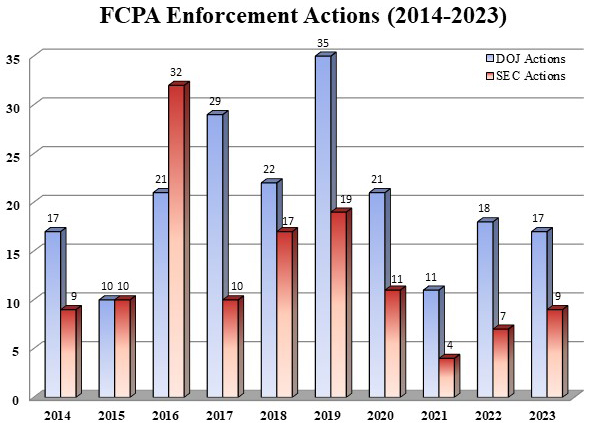
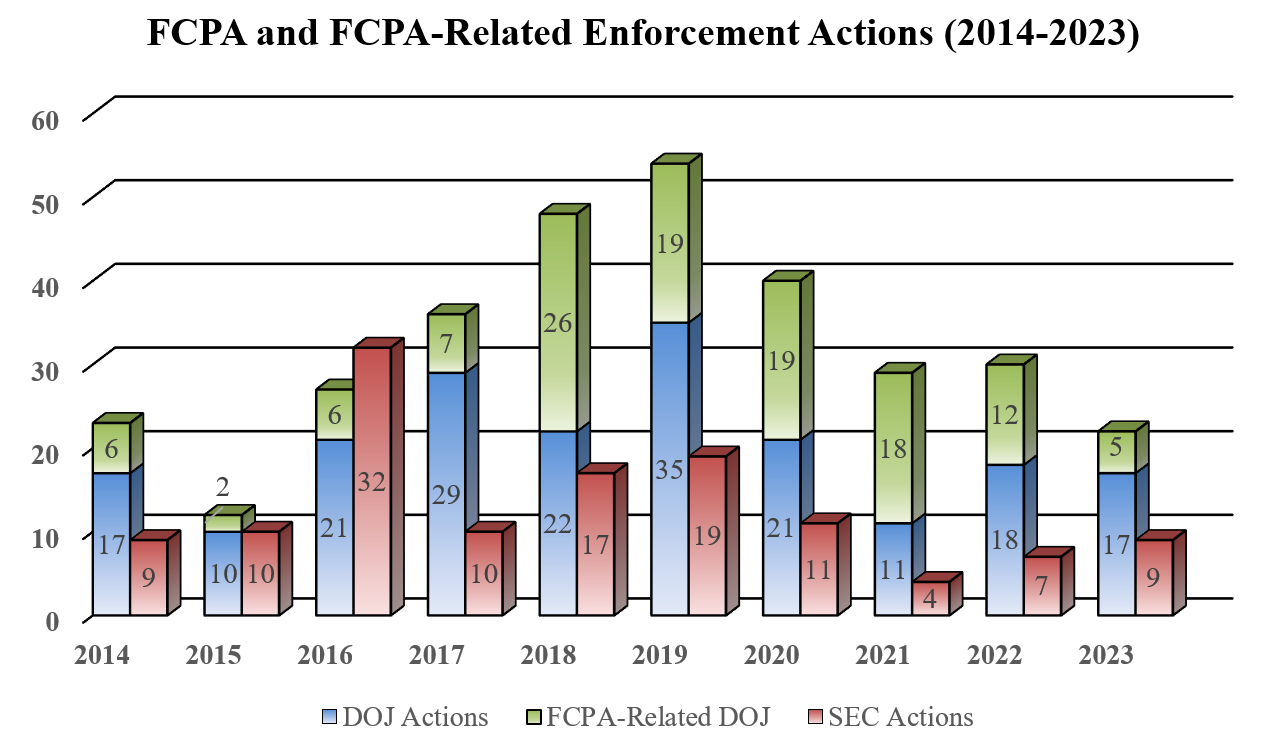
But as our readers know, the number of enforcement actions predicated on substantive FCPA charges represents only a portion of the full scope of international anti-corruption enforcement efforts by DOJ. This publication has remarked on the increasing proportion of “FCPA-related” charges for years, which can sometimes equal or even exceed criminal FCPA charges, although the relative percentage of such cases brought in 2023 was less pronounced than in recent years. The past 10 years of FCPA plus FCPA-related enforcement activity is illustrated in the following table and graph.

2023 FCPA-RELATED ENFORCEMENT TRENDS
As our readers know, our year-end FCPA updates endeavor not only to describe the year’s FCPA enforcement actions, but also to explain the patterns and trends underlying this enforcement activity. For 2023, we have identified five notable patterns from the year in FCPA enforcement, though whether they represent longer-term trends or only single-year aberrations varies by the pattern in question and may require additional time to determine:
- Tracking early returns in DOJ Corporate Enforcement Policy discounts;
- DOJ’s new forfeiture practice continues;
- A year of DOJ deferred and non-prosecution agreements;
- The FCPA’s dual enforcers largely go it alone; and
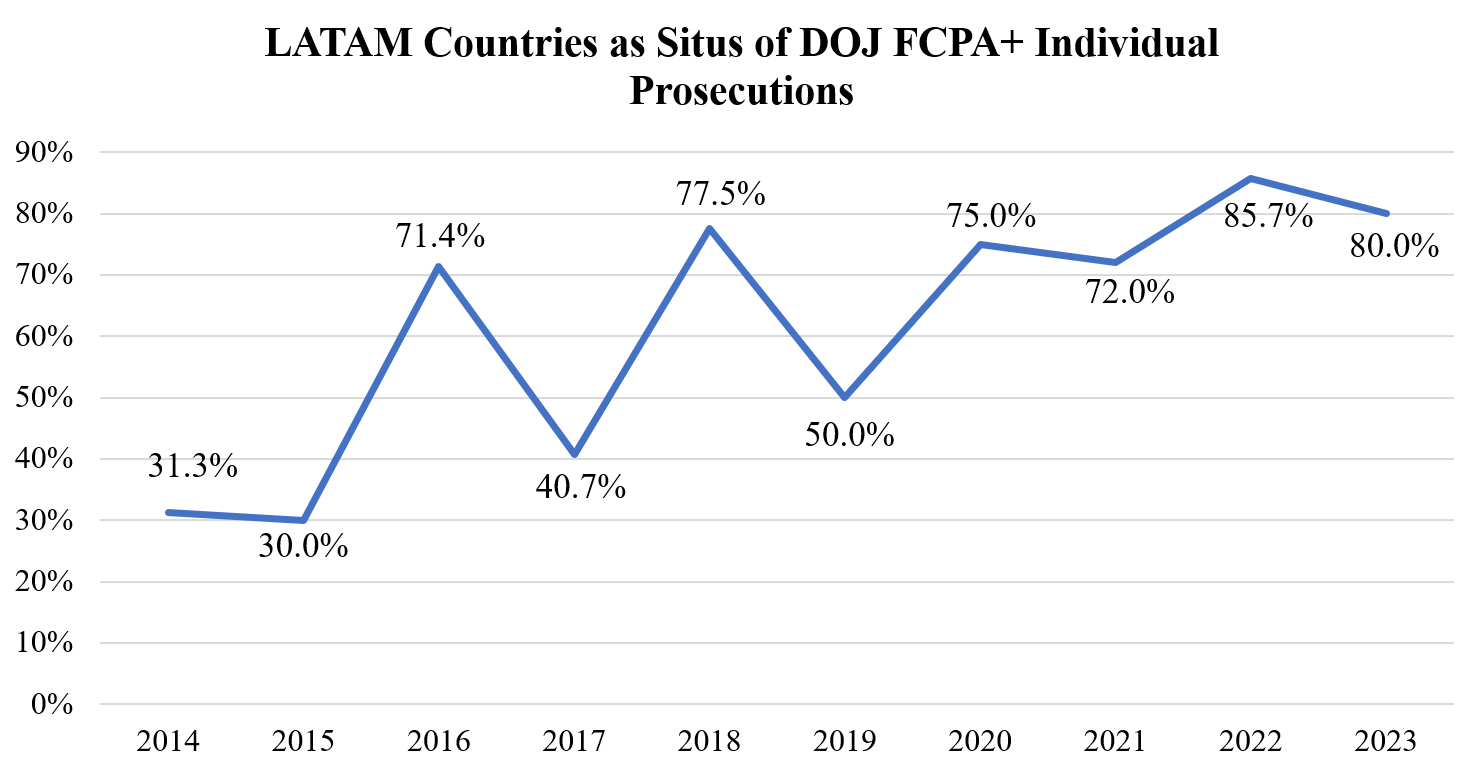
- LATAM continues to dominate FCPA-plus individual prosecutions.
1. Tracking Early Returns in DOJ Corporate Enforcement Policy Discounts
In a “bonus” supplement to our 2022 Year-End FCPA Update, accelerated for coverage there even though DOJ announced the policy on January 17, 2023, we covered the issuance of an updated Criminal Division Corporate Enforcement & Voluntary Self-Disclosure Policy (“Corporate Enforcement Policy”). We refer our readers to that prior update for a more fulsome analysis of this important development. But one key aspect that we have followed closely throughout the year 2023 for discussion here is DOJ’s ability to grant enhanced cooperation and remediation credit pursuant to the updated Corporate Enforcement Policy.
As covered in our 2022 Year-End FCPA Update, perhaps the most significant update to the Corporate Enforcement Policy was to substantially increase the discount from criminal penalties that companies can receive as credit for cooperating in DOJ investigations and remediating from prior compliance lapses. Under the Corporate Enforcement Policy, DOJ can now grant up to a 75% discount in voluntary disclosure cases, and 50% in non-voluntary disclosure cases, up from 50% and 25%, respectively. In most instances, this discount is applied from the bottom of the U.S. Sentencing Guidelines (“USSG” or “Guidelines”) range, although the Corporate Enforcement Policy includes enhanced guidance for increasing the point-of-departure for so-called “recidivists.”
An interesting thought exercise that becomes more and more relevant in an age of enhanced DOJ assertions of jurisdiction over even foreign-sited companies is how DOJ would treat a voluntary disclosure to a non-U.S. regulator with primary cognizance over the entity. The Corporate Enforcement Policy states that although voluntary disclosures “must ordinarily be to the Criminal Division . . . , the Criminal Division will also apply the provisions of this Policy where a company made a good faith disclosure to another office or component of the Department of Justice.” This leaves silent how DOJ would treat voluntary disclosure to a foreign regulator that only later comes to the attention of DOJ.
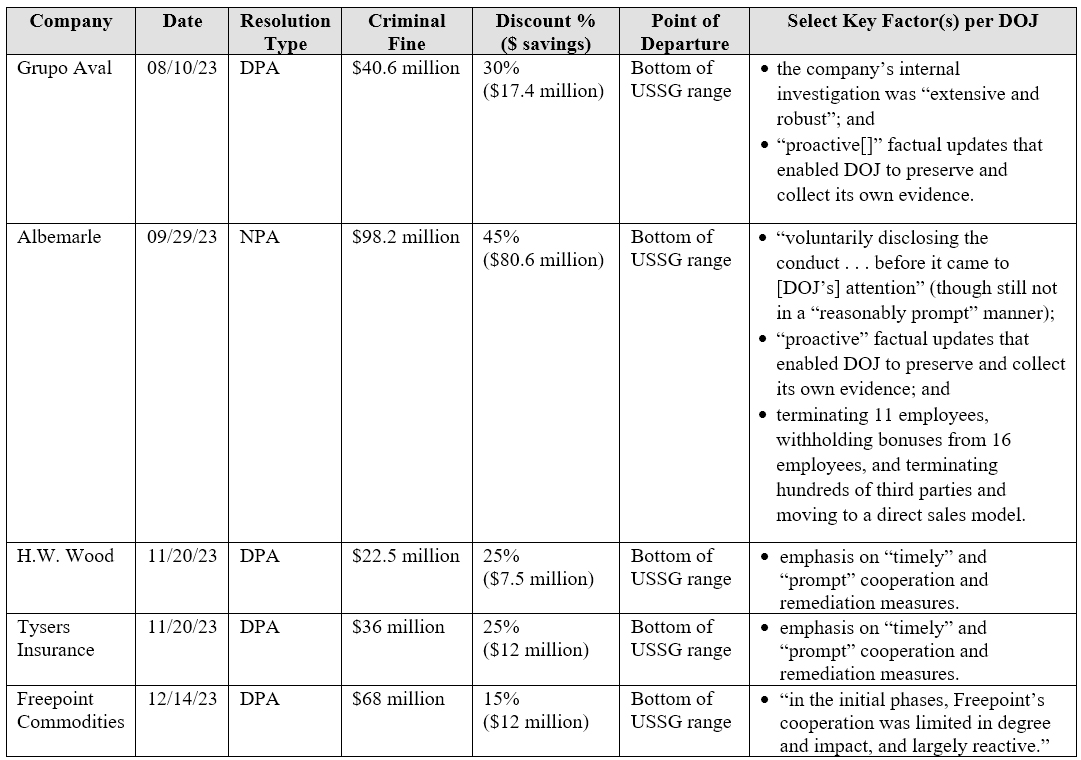
In 2023, there were five corporate FCPA enforcement actions resolved with criminal fines pursuant to DOJ’s Corporate Enforcement Policy. None of the five cases involved “voluntary disclosures” eligible for the enhanced 75% discount (but see the Albemarle discussion below), and indeed typically such cases are resolved as “declinations with disgorgement” where there is no criminal fine as in the Corsa Coal and Lifecore Biomedical cases discussed separately herein. In all five cases, the discount was applied from the bottom of the Guidelines range. But consistent with DOJ’s prognostication in announcing the enhanced discounts, the maximum 50% credit available in non-disclosure cases has not become “the new norm”—indeed, there is yet to be a 50% credit granted under the Corporate Enforcement Policy. The discounts awarded to date have ranged from a low of 15% to a high of 45% in corporate FCPA enforcement actions. The average discount across the five FCPA cases is 28%, which translates to an average $25.9 million in savings to the five companies.
To explain the basis for its varied discounts, DOJ has taken in each case to including a detailed list of “Relevant Considerations.” In all cases, this includes statements regarding the seriousness of the underlying offense, a recitation of the various ways in which the company cooperated, in which the company remediated, and the company’s criminal and regulatory history. Standard cooperation comments common to the five corporate FCPA prosecutions of 2023 include, among others, that the defendant:
- responded to DOJ requests;
- made factual presentations to DOJ on the company’s internal investigation findings;
- produced relevant documents (typically noting that the documents were produced from foreign jurisdictions in manner that complied with local data privacy laws, and frequently further noting that courtesy translations were provided); and
- facilitated DOJ interviews of relevant employees (frequently noting the retention of separate counsel to represent these employees).
Standard remediation comments common to the resolutions include, among others, that the defendant:
- conducted a root cause analysis of the illegal conduct identified during the investigation;
- invested in improving its compliance program governance and resources;
- took appropriate disciplinary action against employees found to have been involved in misconduct; and
- committed to continue enhancing its compliance program and internal controls, consistent with the minimum elements set forth in the standard Attachment C (Corporate Compliance Program) to the resolution agreement.
Where companies appear to have distinguished themselves in this early set of cases is on the cooperation side by providing “proactive” updates to DOJ, especially where it enabled DOJ to preserve and collect further evidence on its own, and on the remediation side by terminating and/or withholding bonuses from numerous culpable employees, and also by restructuring the company’s go-to-market strategy to reduce reliance on third parties. Below is a chart summarizing the Corporate Enforcement Policy discount details across the five DOJ corporate FCPA resolutions of 2023, followed by descriptions of the first two cases (with the remaining three covered in the following section):
Grupo Aval S.A.
In the first corporate criminal FCPA prosecution announced under the new Corporate Enforcement Policy, Colombian financial holding company and U.S. issuer Grupo Aval reached a joint FCPA resolution with DOJ and the SEC on August 10, 2023. According to the charging documents, a senior executive of a minority-owned joint venture established by Grupo Aval to bid on the largest highway construction project in Colombia’s history (Ruta del Sol II) became aware of bribes that the majority joint venture partner agreed to pay government officials to obtain additional work in connection with the project. In total, the executive caused the joint venture to pay more than $20 million in corrupt payments to Colombian officials between 2014 and 2016, funded through sham invoices.
To resolve the matter, Grupo Aval subsidiary Corficolombiana entered into a deferred prosecution agreement with DOJ charging a conspiracy to violate the FCPA’s anti-bribery provisions and agreed to pay a $40.6 million criminal penalty, which as noted above reflected a 30% Corporate Enforcement Policy discount from the bottom of the Guidelines range. But DOJ agreed to credit up to half of that amount to a penalty imposed by Colombia’s Superintendencia de Industria y Comercio, so long as the subsidiary dropped its appeal of this penalty in Colombia, leading DOJ to proclaim this as the first coordinated anti-corruption resolution of its kind with Colombian authorities. As part of the three-year agreement, Corficolombiana agreed to provide periodic reports to DOJ regarding its remedial efforts, but there was no compliance monitor imposed. Simultaneously, Grupo Aval consented to an SEC order finding FCPA bribery and accounting violations and imposing more than $40.2 million in disgorgement plus prejudgment interest, bringing the combined financial resolution to greater than $80 million. DOJ alleged that the majority joint venture partner who coordinated much of the alleged bribery was Brazilian construction company Odebrecht S.A., whose multi-country anti-corruption resolution covered in our 2016 Year-End FCPA Update continues to reverberate the better part of a decade later.
Albemarle Corporation
In the only other joint FCPA enforcement action of the year, on September 29, 2023 DOJ and the SEC announced FCPA resolutions with North Carolina-based specialty chemicals manufacturing company Albemarle. The charging documents collectively allege that Albemarle engaged in a conspiracy to make millions of dollars in corrupt payments to government officials in India, Indonesia, and Vietnam between 2009 and 2017 to obtain business from state-owned entities in these countries, including by structuring tender requirements to favor Albemarle, providing confidential information about competitors, and to keep the company from being blacklisted. The SEC then alone extended its allegations to contend that the company additionally engaged in private-sector bribery in India and failed to maintain adequate controls and accurate and complete records regarding third-party payments in China and the United Arab Emirates.
To resolve DOJ’s allegations of conspiracy to violate the FCPA’s anti-bribery provision, Albemarle entered into a three-year non-prosecution agreement and agreed to pay a criminal fine of $98.2 million plus forfeiture of $98.5 million, the former of which reflected a 45% Corporate Enforcement Policy discount from the bottom of the Guidelines range and the latter of which was substantially offset by the SEC disgorgement resolution. To resolve the SEC’s charges of FCPA bribery and accounting violations, Albemarle consented to the filing of an administrative cease-and-desist proceeding and to pay $103.6 million in disgorgement plus prejudgment interest, with no penalty assessed in light of the DOJ criminal fine. After offsets between the two resolutions, the total resolution amount was approximately $218 million.
Far and away the most controversial aspect of the Albemarle resolution was DOJ’s refusal to credit the company’s voluntary disclosure as such. There was no dispute that Albemarle voluntarily disclosed the conduct to DOJ and the SEC prior to either agency being aware of it. But DOJ took the position that the voluntary disclosure was not “reasonably prompt,” a prerequisite for getting voluntary disclosure treatment under the Corporate Enforcement Policy. Specifically, DOJ alleged that Albemarle learned of the initial allegations in Vietnam 16 months prior to disclosure, and was able to confirm the conduct at least nine months prior to the disclosure. The company then took remedial action and expanded the investigation to cover other geographies, but did not disclose the initial conduct in Vietnam until it disclosed four geographies all at once 16 months after the initial allegations. Reminiscent of the ABB resolution covered in our 2022 Year-End FCPA Update—where DOJ refused to credit a disclosure as voluntary where counsel had contacted DOJ to schedule a disclosure meeting without naming the subject matter, and then after the initial contact but before the meeting the underlying allegations were reported in the press—DOJ refused to treat Albemarle’s disclosure as voluntary for purposes of the Corporate Enforcement Policy, which would have entitled the company to a presumption of a declination. Nonetheless, DOJ did purport to give “significant weight” to the disclosure, including in determining the appropriate disposition (non-prosecution agreement) and Corporate Enforcement Policy discount (45% below the bottom of the Guidelines range), the latter of which is the highest figure granted to date under the Corporate Enforcement Policy and its predecessors.
Of final note from the Albemarle resolution is that it represented the first credit pursuant to Part II of the Criminal Division’s Compensation Incentives and Clawbacks Pilot Program from March 2023, discussed below. Specifically, DOJ reduced Albemarle’s criminal fine by $763,453 as dollar-for-dollar credit in bonuses the company withheld from employees deemed by the company to be culpable for the misconduct. These credits can under the right circumstances have a double impact, in that companies may both save the bonus (assuming litigation does not ensue and overtake the benefit) and get the reduction from their penalty. But the fact that the credit amounts to a fraction of one percent of the overall resolution, or even just the criminal penalty, underscores the commentary that this program has received as not being meaningful in most cases.
2. DOJ’s New Forfeiture Practice Continues.
In our 2022 Mid-Year FCPA Update, we noted an unusual and even unprecedented aspect of the May 2022 Glencore FCPA enforcement action. Specifically, Glencore was the first corporate defendant in the history of the FCPA (to our knowledge) to agree to pay a gain-based criminal forfeiture judgment on top of a criminal fine that was itself premised on gain. To be sure, there have been many other examples of modest forfeiture components of FCPA corporate criminal enforcement actions, as well as certain DOJ components (e.g., the U.S. Attorney’s Office for the Southern District of New York) that have a history of imposing forfeiture on top of gain-based criminal fines in non-FCPA cases. Further, our readers will be familiar with the fact that issuers have long been required to disgorge profits to the SEC on top of gain-based criminal fines imposed by DOJ in joint FCPA enforcement actions. But our research shows that in the first 45 years of the FCPA—and across nearly 50 different cases against non-issuer companies pre-Glencore—DOJ did not impose gain-based forfeiture on top of a gain-based criminal fine.
At the time, Glencore was just a single example, and DOJ made no announcement to suggest it had changed its approach in FCPA cases. Indeed, quite to the contrary as covered in these updates, DOJ’s corporate FCPA enforcement policy announcements of recent years had been heavily seasoned with the flavor of all the benefits companies may receive from disclosure, cooperation, and remediation. But DOJ’s final three corporate FCPA prosecutions of 2023 (all against non-issuers) continued the “Glencore trend,” imposing sizeable gain-based forfeiture on top of sizeable criminal penalties. And then finally, at the ACI FCPA Conference in November 2023, Acting Assistant Attorney General Nicole M. Argentieri confirmed the practice by stating that in non-issuer cases DOJ is now “requiring . . . that, in addition to paying any required criminal penalty, companies must pay appropriate forfeiture” such that “issuers and non-issuers [will be treated] alike” in “both pay[ing] applicable fines and forego[ing] the proceeds of their criminal activity.” DOJ has yet to issue an official policy to this effect, which stands in stark contrast to the proliferation of more “corporate-friendly” policies issued in 2023 as discussed herein, but clearly this appears to be DOJ’s position until it is challenged.
H.W. Wood Ltd. & Tysers Insurance Brokers Ltd.
On November 20, 2023, DOJ announced separate but related FCPA conspiracy charges against UK reinsurance brokers H.W. Wood and Tysers Insurance. DOJ alleged that each company paid millions of dollars to an intermediary between 2013 and 2017 while knowing the intermediary would bribe various Ecuadorian government officials to secure insurance and reinsurance business with state-owned insurance companies Seguros Sucre S.A. and Seguros Rocafuerte S.A.
To resolve the charges, each company entered into a three-year deferred prosecution agreement. H.W. Wood agreed to a criminal fine of $22.5 million and $2.3 million in forfeiture, but established an inability to pay under DOJ policy that reduced the financial penalty to only a $508,000 fine. Tysers Insurance agreed to pay a criminal fine of $36 million plus approximately $10.5 million in forfeiture. Both companies’ criminal fines reflected a 25% Corporate Enforcement Policy discount for cooperation and remediation, and neither company received a compliance monitor.
Both of these resolutions arise out of the same matter in which Gibson Dunn negotiated a “declination with disgorgement” resolution for Jardine Lloyd Thompson Group Holdings Ltd., as reported in our 2022 Year-End FCPA Update. There and in prior updates we also covered separate criminal FCPA and money laundering charges brought against eight individual defendants, including the former chairman of Seguros Sucre and Seguros Rocafuerte who allegedly received the H.W. Wood and Tysers insurance bribes, as well as intermediary Esteban Merlo Hidalgo who allegedly paid them.
Freepoint Commodities LLC
In the final corporate FCPA enforcement action of the year, on December 14, 2023 DOJ and the Commodity Futures Trading Commission (“CFTC”) announced a joint resolution with Connecticut-based commodities trading company Freepoint Commodities arising out of allegations that it paid bribes to secure business with Brazilian state-owned oil company, Petróleo Brasileiro S.A. – Petrobras (“Petrobras”). The government alleged that between 2012 and 2018, Freepoint made nearly $4 million in corrupt payments to Petrobras officials in exchange for confidential information about pricing and bids submitted to Petrobras by Freepoint’s competitors.
To resolve the corruption allegations, Freepoint entered into a deferred prosecution agreement with DOJ and agreed to pay a $68 million criminal fine, reflecting a 15% Corporate Enforcement Policy discount from the bottom of the Guidelines range, and additionally pay $30.5 million in criminal forfeiture. In parallel, Freepoint also entered into a civil resolution with the CFTC agreeing to pay a $61 million civil penalty and $30.5 million in disgorgement, but the civil penalty was completely offset by the DOJ criminal fine and DOJ and the CFTC agreed to offsetting credits between the forfeiture and disgorgement such that 75% went to DOJ and 25% to the CFTC. In total, Freepoint paid $98.5 million between the two U.S. settlements, and DOJ has provisioned for a credit of up to $22.4 million off of the criminal fine for a resolution with Brazilian authorities, although no such resolution has yet been announced. The joint DOJ / CFTC corruption-related resolution in Freepoint—in which the corruption is charged by the latter as “manipulative and deceptive conduct” under the Commodity Exchange Act—is the third of its kind following Glencore (discussed in our 2022 Year-End FCPA Update) and Vitol (discussed in our 2020 Year-End FCPA Update).
Related to the Freepoint Commodities case, in 2023 DOJ announced criminal charges against three individual defendants: Gary Oztemel, Glenn Oztemel, and Eduardo Innecco. An indictment charging Freepoint trader Glenn Oztemel and third-party agent Innecco with FCPA and money laundering arising out of the alleged Petrobras corruption scheme was unsealed on February 17. Glenn’s brother Gary Oztemel, who works at another oil trading company, was subsequently indicted on similar charges on August 29. The two Oztemel brothers have been released on bail, pending a September 2024 trial date. Innecco has yet to make an appearance and appears to be outside of the United States. In a final case connection, it appears that one of the officials who allegedly received the corrupt payments was Rodrigo Berkowitz, who worked at Petrobras’ U.S. arm in Houston, Texas, and previously pleaded guilty to conspiracy to commit money laundering as covered in our 2020 Year-End FCPA Update.
3. A Year of DOJ Deferred and Non-Prosecution Agreements.
The careful reader of our Corporate Enforcement Policy chart in Section 1 above will note that all of the new corporate FCPA prosecutions of 2023 were resolved (at least at the top level) as deferred and non-prosecution agreements. In a vacuum, this may seem in tension with pronouncements by DOJ officials purporting to scrutinize more carefully the grant of these so-called pretrial diversion agreements under the various memoranda issued by Deputy Attorney General Lisa O. Monaco discussed in our 2021 and 2022 year-end FCPA updates. Time will tell whether 2023 was an aberration or the start of a more permissive trend in corporate enforcement. But it is notable that the one parent-level guilty plea in an FCPA case from 2023 was a breach declaration from a 2019 deferred prosecution agreement.
We discuss this, and the two “declination with disgorgement” letters issued in 2023, below.
Telefonaktiebolaget LM Ericsson DPA Breach
On March 2, 2023, DOJ announced that Swedish multinational telecommunications company Ericsson had agreed to plead guilty in connection with its 2019 FCPA resolution following DOJ’s determination that the Company had breached its prior deferred prosecution agreement. As covered in our 2019 Year-End FCPA Update, Ericsson entered into the earlier deferred prosecution agreement to resolve FCPA charges with DOJ arising out of alleged corruption in China, Djibouti, Indonesia, Kuwait, Saudi Arabia, and Vietnam. In 2023, DOJ revoked the 2019 deferred prosecution agreement and Ericsson agreed to plead guilty to the original criminal charges, pay a fine of $206,728,848, and agreed to extend its pre-existing monitorship and associated term of probation by one year, through June 2024.
The Ericsson breach declaration demonstrates DOJ’s focus on corporate compliance with post-resolution terms imposed by deferred prosecution and other “pretrial diversion” agreements. Notably, DOJ does not charge or even allege new criminal conduct (which is why this case is not reflected in the 2023 statistics above). Rather, DOJ asserts that Ericsson violated the cooperation and disclosure provisions of the 2019 agreement by failing to disclose promptly all evidence related to the previously charged conduct in Djibouti and China, as well as failing to disclose adequately certain other activities in Iraq. Of further note, DOJ alleged that company leadership instructed its counsel to disclose to DOJ the conduct in Iraq, but that “prior outside counsel omitted material facts and information” in their reporting. DOJ credited Ericsson for “significantly enhanc[ing] its cooperation and information sharing efforts” after this matter came to light. Gibson Dunn represented the company in the 2023 resolution (but was not “prior outside counsel”).
The Ericsson case is only one of two cases in which DOJ has revoked a deferred prosecution agreement and demanded a guilty plea in a corporate FCPA case. As reported in our 2008 Year-End FCPA Update, in November 2008 DOJ alleged a breach of Aibel Group’s 2007 deferred prosecution agreement arising out of alleged corruption in Nigeria, after which Aibel Group pleaded guilty to the underlying charges. Further, as discussed in our 2017 Mid-Year FCPA Update, DOJ once entered into a second deferred prosecution agreement based in part on allegations of breaches arising during the term of the first agreement in the January 2017 Zimmer Biomet case.
Corsa Coal Corp. Declination with Disgorgement
On March 8, 2023, DOJ issued its first “declination with disgorgement” letter of the year to Pennsylvania coal company Corsa Coal. The letter alleges that between 2016 and 2020, Corsa Coal employees paid $4.8 million to a consultant while knowing that portions of those fees would be used to make corrupt payments to officials of an Egyptian state-owned coke and chemical production company, including its chairman. Corsa Coal allegedly secured $143 million in contracts as a result of these payments, and earned $32.7 million in illicit profits.
In conjunction with DOJ’s declination, Corsa Coal agreed to pay $1.2 million in disgorgement, an amount substantially reduced from realized gains based on DOJ’s Inability-to-Pay Guidance and a determination that further payment would “substantially threaten” the company’s ongoing viability. In declining to prosecute Corsa Coal, DOJ noted the company’s voluntary disclosure, cooperation, and remediation efforts.
We covered the guilty plea of former Corsa Coal International Sales Head Frederick Cushmore, Jr. and indictment of former Vice President Charles Hunter Hobson, respectively, in our 2021 Year-End and 2022 Mid-Year FCPA updates. As of this writing, there is yet to be a trial date set in the Hobson case.
Lifecore Biomedical, Inc. Declination with Disgorgement
In the year’s second of two “declinations with disgorgement,” on November 16, 2023 DOJ announced that it was declining to prosecute Lifecore for allegedly corrupt payments made in 2018 and 2019 by a former subsidiary to Mexican government officials to secure a wastewater discharge permit and avoid various wastewater discharge expenses. Notably, the alleged payments began prior to Lifecore’s acquisition of the subsidiary, were affirmatively hidden from Lifecore during due diligence, and then were discovered during post-acquisition integration as the payments continued under the ownership of Lifecore. Relevant to the Albemarle disclosure discussion above, DOJ made a point of noting that Lifecore reported the matter to DOJ within three months of discovering the possible misconduct, and within hours of the internal investigation confirming the alleged corruption. This was deemed to be a “reasonably prompt” report qualifying as a “voluntary disclosure” for purposes of the Corporate Enforcement Policy.
To resolve the matter, Lifecore agreed to DOJ’s statement of facts and consented to disgorge just over $400,000. The disgorgement amount was set based on the costs Lifecore allegedly avoided having to pay to Mexican regulatory authorities through the purported corrupt payments, with credits for remediation costs Lifecore already had paid after discovering the misconduct.
4. The FCPA’s Dual Enforcers Largely Go it Alone in 2023.
Several of the principal authors of this update have been known to say on more than one occasion that DOJ and the SEC—the FCPA’s dual enforcers—”work hand in glove.” The closeness of the working relationship between the specialized FCPA Units of each agency has historically been borne out in a heavy overlap in enforcement actions—especially corporate enforcement actions. But that was not the case in 2023.
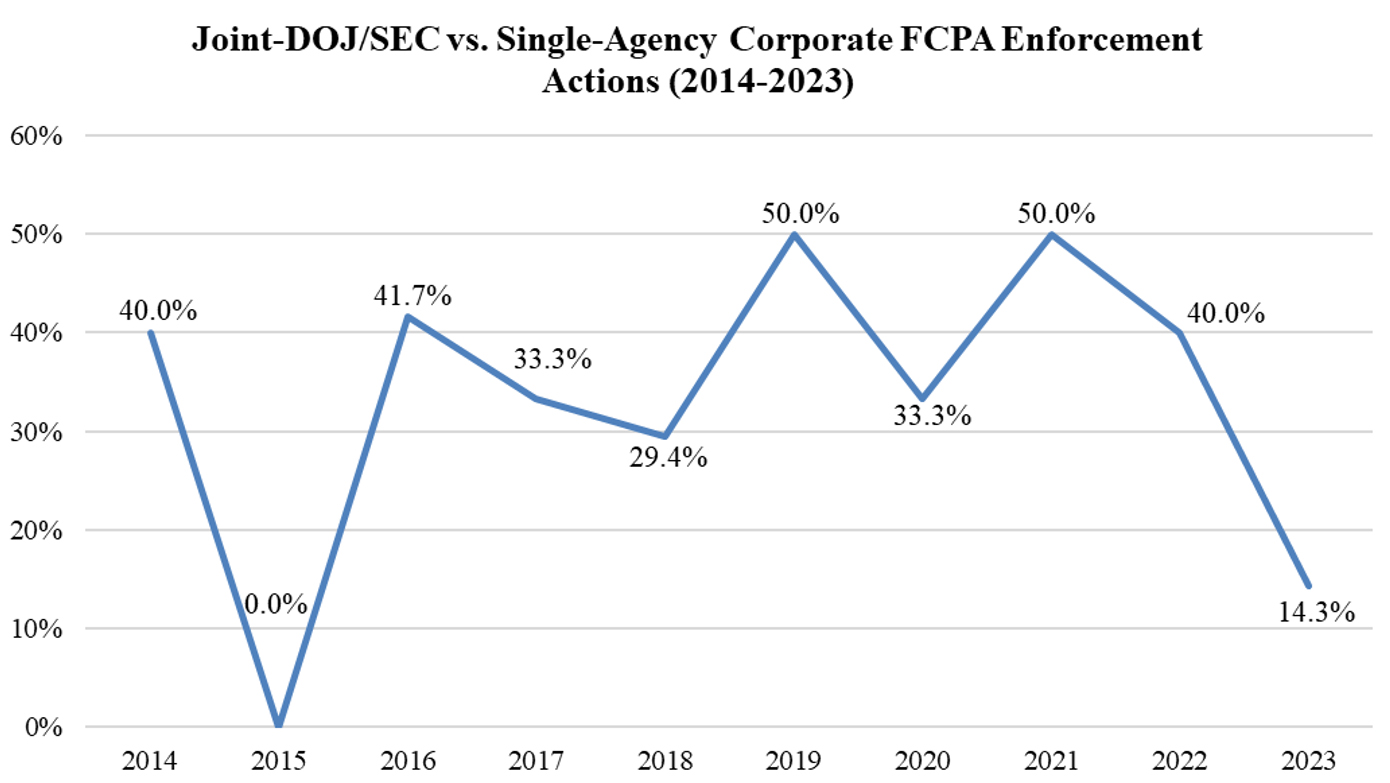
In 2023, only 2 of 14 corporate FCPA enforcement actions were dually brought by DOJ and the SEC. That is substantially lower than historical averages, and indeed is the lowest percentage of overlap in corporate enforcement actions since 2015, where we also noted the lack of duality in our 2015 Year-End FCPA Update. There will always be corporate cases that cannot, or should not, be brought jointly by both agencies, such as prosecutions against non-issuers or where the evidence of non-compliant conduct does not meet the higher standard required for criminal prosecution. Nonetheless, those dynamics have been static over the years studied and the departure in 2023 enforcement numbers is noteworthy, though we expect more a blip than a trend.
A line graph summarizing the percentage of overlap in DOJ / SEC corporate FCPA enforcement actions over the past 10 years follows. The two examples of joint actions in 2023 (Albemarle and Grupo Aval) are covered above, and the seven SEC-only actions are covered below the graph. We will continue to study the degree of overlap in corporate FCPA enforcement in the year ahead to see if this is a blip or a trend.
Flutter Entertainment plc
The first SEC-only FCPA enforcement action of the year came on March 6, 2023, when Irish sports betting and gaming company Flutter resolved a corruption case arising out of Russia. According to the SEC’s order, Flutter (then operating as The Stars Group, Inc.) paid nearly $9 million to Russian consultants between 2015 and 2020 in an apparently unsuccessful effort to legalize online poker in the country. The SEC alleged that Flutter failed to perform risk-based diligence prior to hiring the consultants, entered into contracts that did not contain anti-corruption provisions, and failed to review expense reimbursements submitted by the consultants, which caused the company to reimburse expenses that did not comply with its own policies.
To resolve the FCPA books-and-records and internal controls charges, and without admitting or denying the findings, Flutter agreed to pay a $4 million civil penalty. The SEC noted the company’s cooperation and remediation efforts, which included exiting the Russian market following Russia’s invasion of Ukraine, and did not require any further, forward-looking compliance undertakings. The status of any DOJ investigation, if there is one, is not known.
Rio Tinto plc
Also on March 6, 2023, the SEC announced FCPA books-and-records and internal controls charges against global mining and metals company and ADS issuer Rio Tinto arising out of its iron ore operations in Guinea. According to the SEC’s order, Rio Tinto hired a consultant who had no experience in the industry or country because he was a former classmate with close connections to a senior Guinean official who had influence over a disputed mining concession belonging to Rio Tinto. Without substantial evidence of services performed, the company allegedly paid the consultant $10.5 million, several days after which the consultant attempted to transfer over $800,000 to a Hong Kong company purportedly owned by someone with ties to the senior government official and other Guinean officials. The processing bank blocked that payment, but thereafter the same Hong Kong company allegedly commissioned $200,000 worth of t-shirts to support the senior Guinean official’s reelection campaign.
To resolve the charges, Rio Tinto agreed to pay a $15 million civil penalty. There was no disgorgement because the company did not ultimately develop the mining concession. The SEC credited Rio Tinto’s cooperation and remedial efforts, and did not require any further, forward-looking compliance undertakings. There is no indication that DOJ will take separate action. For its part, the UK Serious Fraud Office has announced the closure of its investigation, in part due to the company’s resolution with the SEC and a separate enforcement action described below against the consultant who allegedly made the payment to the senior Guinean official by the French National Financial Prosecutor’s Office.
Frank’s International N.V.
On April 26, 2023, the SEC announced a resolved FCPA enforcement action against Dutch oilfield services provider Frank’s International. The SEC alleged that Frank’s International retained and paid substantial commissions to an agent while allegedly knowing the agent had close relationships with officials of Angola’s state-owned oil company Sonangol, and further that the agent did not have any relevant technical expertise. Notably, the company retained the agent prior to listing on the New York Stock Exchange, but allegedly continued the commission payments after becoming an issuer. The SEC also asserted that Frank’s International did not perform any due diligence on the agent, and only created a backdated agreement long after engaging the agent.
Without admitting or denying the SEC’s allegations, Frank’s International agreed to pay a $3 million civil penalty plus nearly $5 million in disgorgement and prejudgment interest. The SEC acknowledged the company’s self-reporting and cooperation, which appear to have occurred after Frank’s was acquired by another company, and did not require any further, forward-looking compliance undertakings. Frank’s International’s successor has reported that DOJ has closed its parallel investigation without charges against the company.
Koninklijke Philips N.V.
In another SEC-only FCPA enforcement action, on May 11, 2023, Dutch medical supplier Koninklijke Philips agreed to resolve books-and-records and internal controls charges arising from the company’s use of distributors in China. According to the SEC’s order, between 2014 and 2019, Koninklijke Phillips subsidiaries in China provided special price discounts to distributors, which allegedly “created a corruption risk that the increased margins could be used to fund improper payments to employees of government-owned hospitals.” The SEC further alleged that these subsidiaries engaged in improper bidding practices, such as influencing hospital officials to tailor specifications to favor the companies’ products and preparing false “complementary bids” to provide an inaccurate sense of competition.
To resolve the allegations, and without admitting or denying the SEC’s findings, Koninklijke Philips agreed to pay approximately $62.2 million, consisting of a $15 million civil penalty and the balance to disgorgement and prejudgment interest. The company also agreed to self-report to the SEC on the status of its FCPA compliance program for a two-year period. The SEC noted that it had previously charged Koninklijke Philips in 2013 for alleged FCPA misconduct in Poland, as covered in our 2013 Mid-Year FCPA Update. The company announced that DOJ has closed its parallel investigation into the more recent matter without filing any charges.
Gartner, Inc.
On May 26, 2023, Connecticut-headquartered technological research and consulting company Gartner resolved FCPA bribery and accounting charges with the SEC. The SEC’s order alleged that, from roughly December 2014 through August 2015, Gartner entered into subcontracts with a South African IT consulting company and subagents that allegedly had close ties to officials in the South Africa Revenue Service. The SEC claimed that Gartner knew or consciously disregarded the risk that all or part of the money it paid to the consulting company would be used to bribe revenue officials to influence the award of sole-source contracts to Gartner, and that the justification for using this consultant was false because neither it nor its subagents qualified for the Broad-Based Black Economic Empowerment legislation that was the purported basis for the consultant’s retention. The SEC further alleged that the company maintained false records and deficient controls relating to the retention of consultants.
Without admitting or denying the SEC’s findings, Gartner agreed to pay a $1.6 million civil penalty and pay $856,764 in disgorgement plus prejudgment interest. The SEC recognized Gartner’s self-disclosure, following press reports in South Africa, as well as the company’s cooperation, and did not require any additional, forward-looking compliance undertakings.
U.S.-Based Multinational Company
On August 25, 2023, the SEC announced a settled FCPA resolution with a U.S.-based multinational conglomerate. According to the SEC’s order, between approximately 2014 and 2018, employees of the company’s Chinese subsidiary allegedly arranged for influential Chinese healthcare officials from various state-owned entities to attend overseas conferences, healthcare facility visits, and other educational events, including to the United States. The SEC suggested that the true purpose of the trips was to encourage the officials to purchase the company’s products, though it seemed unable to establish a quid pro quo connection between the trips and any business awarded to the entity. Still, the SEC’s theory was that employees allegedly submitted one set of travel itineraries emphasizing the educational purposes of the trips for compliance review, while at the same time maintaining secret, alternate itineraries for the government officials that included tourism and entertainment activities unrelated to the company’s business operations, thus falsifying corporate books and records. Finally, the SEC alleged that the employees submitted vaguely described payments to travel agencies to obtain reimbursement of otherwise non-reimbursable expenses associated with the trips.
To resolve the matter, and without admitting or denying the SEC’s allegations concerning FCPA books-and-records and internal controls charges, the company agreed to pay nearly $4.6 million in disgorgement and prejudgment interest, plus a $2 million civil penalty. The SEC credited the company for its prompt and voluntary self-reporting and cooperation, as well as undertaking substantial remedial measures. It appears that DOJ’s investigation into the matter has been closed.
Clear Channel Outdoor Holdings Inc.
In the year’s final SEC-only FCPA enforcement action, on September 28, 2023 Texas-based out-of-home advertising company Clear Channel agreed to resolve charges arising out of alleged corruption in China. According to the SEC’s order, from 2012 to 2017, Clear Channel’s Chinese subsidiary made improper payments and gifts to Chinese government officials in an effort to obtain advertising display contracts with local Chinese government transport authorities. These payments and other items of value were allegedly provided directly and by inflating third-party vendor contracts to maintain the outdoor advertising displays. The subsidiary also allegedly created a so-called “off-book fund” by creating false invoices used to justify employee cash withdrawals that were then provided to un-diligenced third parties with whom the subsidiary had no contracts in order to facilitate business development activities. Finally, the SEC alleged that these activities occurred at the subsidiary despite multiple internal audits flagging various bribery risks in China, and that the control deficiencies continued throughout 2019.
To resolve the matter, and without admitting or denying the allegations, Clear Channel consented to the filing of FCPA bribery and accounting charges and to pay a total of $26.2 million in penalties, disgorgement, and prejudgment interest. Reportedly in part due to its inability to remediate the issues raised in the SEC order, Clear Channel divested its interest in the Chinese subsidiary in 2020. The SEC credited Clear Channel’s cooperation with the SEC and remediation, and did not require any post-resolution reporting. According to the company, DOJ has closed its investigation without filing any charges.
5. LATAM Continues to Dominate FCPA-Plus Individual Prosecutions.
Latin America collectively makes up about 5% of global gross domestic product, but many multiples of that as a percentage of criminal FCPA and related anti-corruption enforcement by DOJ. This is particularly the case in individual prosecutions for which, in 2023, 80% of criminal FCPA and FCPA-related prosecutions arose out of fact patterns involving Latin American countries. And this figure is not aberrant as compared to recent years in anti-corruption enforcement. Over the past 10 years, nearly 65% of criminal FCPA and FCPA-related charges brought by DOJ had a nexus to conduct occurring in Latin American countries.
There are many reasons for this, and we do not count among them that Latin America is particularly corrupt as compared to other parts of the developing world—it is not. One principal reason has to do with the degree of integration between the U.S. economy and those of its neighbors across the Americas. This is true both because of the diaspora of immigrants who have set up businesses in the United States focused on their home countries, as well as a reflection of flight to the stability of the U.S. Dollar from markets with less stable currencies, of which there are several across Latin America. Another principal reason has to do with the relationships that DOJ has established over the past decade with prosecutors across the region, starting in Brazil with the “Operation Car Wash” investigation, but also prominently with Colombian and several Central American enforcers. Finally, there can be no escaping the unique significance of the collapse of the Venezuelan economy and the looting of state-owned oil company Petróleos de Venezuela, S.A. (“PDVSA”), among other corruption-related fact patterns that have found their way into U.S. court filings.
These factors influence corporate anti-corruption enforcement as well, particularly the second relating to DOJ’s cross-border partnerships with Latin American enforcement agencies. But our experience shows that as a whole the above dynamics influence individual prosecutions to a much greater degree. This is because individuals are far more likely than companies to press their cases to indictment and beyond, and when assessing the prospect of trial, a case that involves meetings in Miami and bank accounts in Houston is far more compelling than an Africa or Asian-based fact pattern where the only U.S. touchpoints are correspondent banking account transfers. The greater degree of travel—both directly to the United States and indirectly to extradition-friendly countries—within the Americas also makes it far more likely that individuals within the region will be picked up on a warrant and have their indictment unsealed.
As noted above, 80% (12 of 15) individual FCPA enforcement actions in 2023 arose from Latin America-based fact patterns. The Brazilian (Petrobras) case involving the Oztemel brothers and Innecco is covered above together with the corporate case of Freepoint , and the remainder follow. Consistent with our standard practice, we discuss both actual FCPA charges and FCPA-related charges brought by DOJ’s FCPA Unit, most frequently under the money laundering statute as illustrated below.
Maikel Jose Moreno Perez (Venezuela)
The first FCPA-related case of 2023 was made public on January 26, when DOJ announced an indictment on money laundering charges returned against Maikel Jose Moreno Perez, a sitting justice on Venezuela’s Supreme Tribunal of Justice and former President of the Court. The indictment, which tracks a criminal complaint filed in 2020, alleges that between 2014 and 2019 Moreno accepted more than $10 million in bribes for taking various actions in his role on the Court, including dismissing criminal charges or arrest warrants, sentencing defendants leniently, and even approving the judicial seizure of an auto plant owned by a U.S. car manufacturer.
Moreno, who also has been designated as a Specially Designated National by the Treasury Department’s Office of Foreign Asset Controls, has been declared a fugitive by the U.S. District Court for the Southern District of Florida.
George Walther-Meade & Juan Gonzalez Ruiz (Mexico)
In another FCPA-related case, on February 9, 2023, a grand jury sitting in the Southern District of California returned an indictment charging a former division manager of a U.S. defense contractor, George Walther-Meade, and third-party consultant Juan Gonzalez Ruiz, with wire fraud and money laundering arising out of an embezzlement scheme tied up in an FCPA investigation. According to the indictment, Walther-Meade arranged for his employer to retain Gonzalez’s company as a subcontractor in Mexico and caused the defense contractor to pay the subcontractor more than $3 million between 2012 and 2021 for work that was never performed. In return, Gonzalez allegedly kicked back portions of the defense contractor’s payments to Walther-Meade by, among other avenues, issuing credit cards to Walther-Meade and his family members that they used to pay for personal expenses. Separate civil litigation between the defense contractor and Walther-Meade (which has since been stayed pending the criminal cases) makes clear that the matter is part of a broader FCPA investigation disclosed by the defense contractor, which also is consistent with the presence of DOJ FCPA Unit prosecutors on the docket sheet.
On June 15, 2023, Ruiz reached a plea agreement and entered a guilty plea to one count each of money laundering and wire fraud. He was sentenced on December 22 to 314 days (time served) and ordered to make $3.2 million in restitution to the defense contractor. Sadly, under the weight of the charges and prospect of a cooperating co-defendant, Walther-Meade reportedly took his own life on November 6, 2023. This was tragically the second FCPA defendant to take their life in 2023, as in a heartbreaking scene Juan Manuel Gonzalez Testino (whose 2019 FCPA-related guilty plea was covered in our 2020 Year-End FCPA Update) was found shot to death together with his three-year-old son in their South Florida apartment in March, weeks before the father’s sentencing hearing, in what was reported as a murder-suicide.
Samuel Bankman-Fried (China)
The FCPA and crypto worlds collided for the first time on March 28, 2023, when DOJ unsealed a fifth superseding indictment adding an FCPA bribery conspiracy count to the blockbuster prosecution of disgraced cryptocurrency mogul Samuel Bankman-Fried. The FCPA charge against the FTX.com and Alameda Research founder concerned an alleged bribe of approximately $40 million in cryptocurrency paid to a Chinese government official in November 2021 to unfreeze the trading accounts of Alameda Research, which contained over $1 billion in cryptocurrency and had been frozen in connection with an ongoing investigation by the Chinese government.
Bankman-Fried subsequently filed a motion to dismiss the FCPA charge, among others that were not filed prior to his extradition from the Bahamas in the underlying crypto fraud case, arguing that the “rule of specialty” prohibited the United States from extraditing a defendant on one set of charges only to subsequently indict the defendant on additional charges that were not approved in the extradition process. Of potentially greater interest to FCPA enthusiasts, Bankman-Fried separately moved to dismiss the FCPA count on the ground that the indictment did not sufficiently allege the “obtain or retain business” element of the FCPA in that lobbying a government to unfreeze corporate assets is not sufficiently related to obtaining or retaining business from that government. Finally, Bankman-Fried challenged venue for the FCPA charge in the Southern District of New York. The Honorable Lewis A. Kaplan of the U.S. District Court for the Southern District of New York denied the motion in an omnibus order issued on June 29, 2023, finding in a brief analysis that the minimal requirements required at the indictment stage were met.
DOJ did agree, however, to sever the five new charges, including the FCPA bribery count, to allow more time for discussions with the Bahamian government regarding extradition, resulting in the severance of the new charges and a separate trial date in March 2024. In the meantime, in November 2023 a jury found Bankman-Fried guilty of the original crypto-related market manipulation, wire fraud, and money laundering charges. On December 29, 2023, DOJ filed a letter with the Court advising that it did not intend to proceed to trial on the severed counts, including the FCPA charge. DOJ noted that The Bahamas still had not consented to the new charges, and that the delay required for a second trial would not be in the interests of justice given the interests in finality to the first verdict as well as, it contended, the ability of the Court to consider the additional charges as “relevant conduct” at sentencing for the first set of convictions. Sentencing for the crypto fraud convictions is scheduled for March 2024.
Alvaro Ledo Nass (Venezuela)
On March 29, 2023, the former general counsel of Venezuela’s PDVSA, Alvaro Ledo Nass, pleaded guilty to one count of conspiracy to launder bribes linked to various foreign currency exchange schemes involving PDVSA loan contracts that we have been covering regularly since our 2018 Year-End FCPA Update. According to Ledo’s factual proffer, between 2012 and 2017 he and a variety of previously-charged individuals exploited Venezuela’s fixed foreign currency exchange rate that artificially pegged the value of the bolivar above prevailing rates, selling the rights to exchange Venezuelan bolivars for U.S. dollars at inflated rates in exchange for bribes. Ledo admitted personally to accepting more than $11.5 million in payments associated with corrupt currency schemes valued at more than $1 billion.
On June 12, 2023, the Honorable Kathleen M. Williams of the U.S. District Court for the Southern District of Florida sentenced Ledo to three years in prison, coupled with an order of forfeiture.
Carlo Alloni (Djibouti)
We frequently make the point that FCPA enforcement is greater than what is reported, as many cases are filed and remain under seal for years for a variety of reasons, ranging from ongoing cooperation to extradition efforts. An excellent example of this phenomena is the case of former Ericsson regional manager Carlo Alloni, who pleaded guilty in 2018 to a single count of FCPA bribery conspiracy, had his case remain under seal until 2021 as he cooperated with the government, and then had the case publicized only with the appearance of an FCPA prosecutor in connection with his June 28, 2023 sentencing.
According to court documents, Alloni, an Italian citizen living in England who previously worked for Ericsson in Africa, was first approached by federal agents in 2017 when he landed at a U.S. airport. Although he initially denied having knowledge of the alleged corruption, he subsequently approached prosecutors with counsel and agreed to cooperate in what would become the Djibouti allegations resolved by the company in 2019. Because of “the substantial nature and significance of [his] cooperation,” at the June 28, 2023 sentencing the Honorable George B. Daniels of the U.S. District Court for the Southern District of New York sentenced Alloni to time served on probation pending sentencing, with no further sanction following the hearing.
Amadou Kane Diallo (Senegal)
On September 20, 2023, a grand jury in the Central District of California returned a superseding indictment against California businessman Amadou Kane Diallo, adding an FCPA charge to wire fraud and money laundering charges filed earlier in the year arising from an alleged investment fraud scheme. According to the indictment, from 2015 to 2020 Diallo executed a scheme to defraud investors in two companies that he owned by using a false appearance of wealth to fraudulently solicit investments, then using those investments to further his appearance of wealth rather on the businesses as represented to prior investors. But where this scheme took an FCPA turn is when Diallo allegedly attempted to corruptly obtain a land grant involved in the investment scheme from Senegalese government officials by providing or promising to provide them with gifts. This included allegedly chartering a helicopter to take one Senegalese official to an NBA basketball game while the official was visiting the United States, and then offering to purchase five motor vehicles for a second official during a trip to Senegal to discuss the land grant.
Diallo, who has been detained pretrial, has pleaded not guilty to all charges and is currently facing a March 2024 trial date.
Christian Julian Cazarin Meza (Mexico)
On October 27, 2023, Mexican construction company owner Christian Julian Cazarin Meza pleaded guilty in the U.S. District Court for the Eastern District of New York to one count of conspiracy to violate the FCPA. Cazarin admitted that between 2017 and 2020 he participated in a bribery scheme with former Vitol Group trader Javier Alejandro Aguilar Morales and others to provide more than $600,000 to Gonzalo Guzman Manzanilla and Carlos Espinosa Barba, both officials of the U.S. procurement subsidiary of Mexican state-owned oil company Petróleos Mexicanos (“PEMEX”), in exchange for confidential information that Vitol used to win contracts from the PEMEX subsidiary. We last covered the charges against Cazarin’s co-defendants in the PEMEX scheme in our 2022 Mid-Year FCPA Update.
Cazarin is currently awaiting sentencing, which has not yet been scheduled.
Orlando Alfonso Contreras Saab (Venezuela)
On November 2, 2023, Venezuelan businessman Orlando Alfonso Contreras Saab pleaded guilty to a one-count information charging him with conspiracy to violate the FCPA. According to the information, Contreras participated in a scheme to bribe the then-governor of the Venezuelan state of Táchira, Jose Gregorio Vielma Mora, in connection with Comité Local de Abastecimiento y Producción (“CLAP”), a Venezuelan food and medicine distribution program. Between 2016 and 2019, Contreras allegedly took bribe payments from co-conspirator Alvaro Pulido Vargas associated with inflated food contracts received by Pulido’s company under CLAP and passed them on to Vielma, after keeping a cut for himself. We previously reported on DOJ’s charges against Vielma, Pulido, and others, in our 2021 Year-End FCPA Update.
Contreras is scheduled to be sentenced in February 2024. His co-conspirators have been designated fugitives by the U.S. District Court for the Southern District of Florida and are not before the Court.
Carl A. Zaglin, Francisco Roberto Cosenza Centeno, Aldo N. Marchena (Honduras)
The final FCPA case of 2023 was made public on December 22, when DOJ announced the unsealing of a five-count indictment charging Carl A. Zaglin, owner of a Georgia-based manufacturer of law enforcement uniforms and equipment, with bribing co-defendant Francisco Roberto Cosenza Centeno, the former director of a Honduran governmental entity known as “TASA” that procured goods for the Honduran National Police, through companies owned by Florida resident Aldo N. Marchena. According to the indictment, Zaglin and Marchena conspired to pay more than $166,000 in bribes to Cosenza and other TASA officials to corruptly influence the award of more than $10 million in law enforcement equipment contracts to the Honduran National Police.
Zaglin and Marchena are charged with substantive FCPA and/or FCPA conspiracy offenses and all three defendants are charged with money laundering offenses. According to recent court filings, only Zaglin is currently before the Court, but both Cosenza and Marchena are in custody and undergoing extradition proceedings, from Honduras and Colombia, respectively. In the meantime, trial has been scheduled for November 2024.
2023 FCPA-RELATED ENFORCEMENT LITIGATION
As our readership knows, following the filing of FCPA or FCPA-related charges, criminal and civil enforcement proceedings can take years to wind their way through the courts. The substantial number of enforcement cases from prior years, especially involving contested criminal indictments of individual defendants, has led to an active year in enforcement litigation beyond the cases initiated in 2023 as covered above. A selection of key 2023 FCPA-related enforcement litigation developments follows.
DOJ Drops 2018 Money Laundering Charges Against Acosta y Lara
Although most indicted FCPA cases result in conviction, that is not always the case. Occasionally criminal defendants prevail in convincing a jury to acquit at trial, a judge to dismiss the charges before, during, or after trial, and sometimes DOJ even seeks to dismiss the case itself. That happened on November 22, 2023 to Uruguayan banker Marcello Federico Gutierrez Acosta y Lara, whose 2018 indictment on PDVSA-related money laundering charges was dismissed with prejudice by the Honorable Kathleen M. Williams of the U.S. District Court for the Southern District of Florida, on DOJ motion, on November 16, 2023. DOJ gave no explanation on the reason for the requested dismissal in its one-sentence motion, but Acosta y Lara’s counsel told reporters at Global Investigations Review that the “case never should have been brought and the government had a moral responsibility to dismiss it” due to exculpatory evidence.
Fifth Circuit Affirms Dismissal of Casqueiro Murta PDVSA Bribery Charges
In our 2022 Year-End FCPA Update, we covered the Fifth Circuit’s February 2023 decision reversing the dismissal of PDVSA-related FCPA and money laundering charges against wealth management advisors Daisy Teresa Rafoi Bleuler and Paulo Jorge Da Costa Casqueiro Murta. As is the typical practice, on remand the case was sent back to the judge who dismissed the indictments in the first place, which in this case was the Honorable Kenneth M. Hoyt of the U.S. District Court for the Southern District of Texas.
Post-remand proceedings as to Rafoi have been quiet, as she has yet to be extradited and make an appearance before the District Court. But as to Casqueiro Murta, Judge Hoyt once again dismissed the case with prejudice on May 17, 2023, this time finding a violation of the defendant’s right to a speedy trial under both the Sixth Amendment and Speedy Trial Act. In a subsequent memorandum and order issued on June 6, 2023, the Court found, among other things, that DOJ engaged in “intentional and protracted delay” in first bringing to the Court’s attention, and then failing to disclose details regarding, certain classified national security information that DOJ knew to be irrelevant to Casqueiro Murta in the first place. Judge Hoyt concluded “that the government intentionally used non-discoverable, irrelevant material as a faux pas basis for delaying trial because it was unprepared.” DOJ appealed and the Fifth Circuit expedited briefing.
On November 28, 2023, the Fifth Circuit affirmed the dismissal of charges against Casqueiro Murta on Speedy Trial Act grounds, but reversed the Sixth Amendment basis for dismissal as well as Judge Hoyt’s determination that the Speedy Trial Act dismissal should be with prejudice. Then, on January 5, 2024, the Fifth Circuit retracted the original opinion and substituted a new opinion for the same holding. In the substituted opinion, the Honorable Jacques L. Wiener, Jr. writing for the Fifth Circuit panel held that the District Court erred in its balancing of factors leading to the determination that the Speedy Trial Act violation weighed in favor of dismissal with prejudice. Chief among the errors found was that the District Court in weighing the dismissal factors improperly elevated the interests of Portuguese citizens in potential charges against Casqueiro Murta in Portugal (which the District Court errantly referred to as actual charges, when in fact there was only an investigation) above the interests of the United States in charges here. The Fifth Circuit likewise found in error the District Court’s Sixth Amendment basis for dismissal.
The Fifth Circuit remanded the case back to the District Court, but in an unusual move—premised on “the history of this case and some findings by the district judge not discussed” in the opinion—ordered that the case be reassigned to a different judge on remand. On remand, Chief Judge Randy Crane assigned the case to himself and the matter is currently set for a March 2024 evidentiary hearing on whether the Speedy Trial Act violation merits dismissal with or without prejudice.
Saab Moran Granted Clemency in Prisoner Swap with Venezuela
As we first covered in our 2019 Year-End FCPA Update, joint Colombian and Venezuelan citizen Alex Nain Saab Moran was indicted on money laundering offenses in connection with an alleged $350 million construction-related bribery scheme in Venezuela. After he was detained in the Republic of Cape Verde on a U.S. extradition request, Saab Moran filed a motion to enter a special appearance and challenge the indictment from abroad. The motion was denied by the Honorable Robert N. Scola, Jr. of the U.S. District Court for the Southern District of Florida and Saab Moran’s appeal was dismissed as moot by the Eleventh Circuit after he was successfully extradited to the United States. On December 23, 2022, Judge Scola denied the motion to dismiss the indictment, as we reported in our 2022 Year-End FCPA Update.
Saab Moran took another interlocutory appeal to the Eleventh Circuit from Judge Scola’s denial of the motion to dismiss, which was in the process of being briefed when on December 21, 2023, White House officials announced that Saab Moran had been granted clemency by President Biden. Saab Moran was part of prisoner swap between the governments of the United States and Venezuela, in which he was sent back to Venezuela in exchange for the release of 10 U.S. citizens held in Venezuela plus infamous contractor fugitive Leonard Glenn Francis (“Fat Leonard”), the latter of whom had sought asylum in Venezuela after escaping home detention prior to reporting to prison after being convicted of non-FCPA-related bribery charges in the Southern District of California. Following the inter-governmental deal, Saab Moran’s lawyer issued a statement that the swap “allows an innocent Venezuelan diplomat to return home after serving over three and a half years in custody.”
Chang Extradited; Motion to Dismiss Denied; Trial Scheduled for July 2024
In our 2019 Year-End FCPA Update, we covered the indictment of former Mozambique Minister of Finance Manuel Chang—along with seven other defendants—on FCPA-related wire fraud, securities fraud, and money laundering charges. In what is known as the “Tuna Bonds” scandal, Chang allegedly signed guarantees on behalf of the Mozambique government falsely representing its financial solvency, which caused foreign banks to issue loans to Mozambique state-owned companies for maritime projects that ultimately failed, in exchange for receiving approximately $18 million in alleged kickbacks. Chang was arrested in South Africa on a U.S. extradition request in December 2018, but extradition proceedings lasted four-and-one-half years—due in large part to a competing extradition request filed by the Government of Mozambique—and Chang was not extradited to the United States until July 2023.
On August 8, 2023, Chang filed a motion to dismiss the indictment on speedy trial grounds. Co-defendant Najib Allam, an executive of the shipbuilding company that allegedly paid the bribes, followed with his own speedy trial motion to dismiss, even though he is still in Lebanon. On December 21, 2023, the motions were denied by the Honorable Nicholas Garaufis of the U.S. District Court for the Eastern District of New York. As to Chang, Judge Garaufis found that the defendant’s own actions in resisting extradition were responsible for the majority of the pretrial delay. As to Allam, Judge Garaufis held that a defendant who stays in a country with no extradition treaty (such as Lebanon) cannot complain of the delay caused by his refusal to leave the country and face prosecution in the United States.
Trial for Chang is currently set to begin on July 29, 2024.
Schulman Motions to Dismiss Denied; Trial Scheduled for March 2024
In our 2020 Year-End FCPA Update, we reported on the FCPA-related bank, mail, and wire fraud and money laundering indictment of Maryland attorney Jeremy Wyeth Schulman arising from his alleged role in a six-year conspiracy to misappropriate $12.5 million in Somali sovereign assets frozen in U.S. financial institutions. DOJ contends that Schulman forged paperwork purporting to show that he was acting on the authority of the Central Bank of Somalia in repatriating these assets, when in fact there reportedly was no such authorization. Schulman, for his part, contends he was acting on the valid instruction of a client associated with a key member of the transitional Somali government, and notes that roughly three-quarters of the $12.5 million recovered was repatriated to the Central Bank of Somalia. Pretrial litigation has been, to put it mildly, contentious.
On September 28, 2023, the Honorable Paula Xinis of the U.S. District Court for the District of Maryland denied four different motions to dismiss filed by Schulman in a 63-page memorandum opinion. First, Judge Xinis denied the motion to dismiss for pre-indictment delay—even though she found that Schulman established prejudice based on witnesses who became unavailable with the passage of time—because the Court did not believe it appropriate to second-guess DOJ’s decision to wait up to six years to build its case before indicting, and found that ultimately DOJ acted diligently. Second, Judge Xinis denied Schulman’s motion to dismiss pursuant to the “act of state doctrine,” finding that the true question for trial was not whether Schulman actually had authority to repatriate the assets under Somali law, but whether he believed he had authority. Third, the Court denied Schulman’s “political question” motion to dismiss for similar reasons. Finally, Judge Xinis denied Schulman’s motions to dismiss various counts of the indictment for failure to state a claim, as duplicitous, or barred by the applicable statute of limitations, finding that Schulman at most presented factual questions to be resolved by the jury.
Trial in Schulman’s case is presently scheduled to begin on March 4, 2024. In the meantime, pre-trial motion practice continues apace as in early February Schulman filed yet another motion to dismiss the indictment based on allegedly exculpatory evidence withheld by DOJ.
Cognizant’s Outside Counsel Not a Government Actor for Garrity Purposes; Trial for Coburn & Schwartz Delayed Over Foreign Witness’s Availability
When we last checked in on the upcoming trial of former Cognizant Technology Solutions President Gordon Coburn and Chief Legal Officer Steven Schwartz, in our 2022 Mid-Year FCPA Update, the Honorable Kevin McNulty of the U.S. District Court for the District of New Jersey compelled the company to turn over materials associated with various internal investigation interviews, finding a waiver of privilege from the company disclosing aspects of those interviews to DOJ. On July 20, 2023, Judge McNulty issued another important opinion on an oft-recurring issue in corporate internal investigations, this time denying a “Garrity” motion to suppress the defendants’ statements to corporate counsel based on a finding that counsel was not acting at DOJ’s behest.
In Garrity v. New Jersey, the U.S. Supreme Court held that prosecutors cannot use a compelled interview statement taken by a government employer in a subsequent criminal prosecution. As we covered in our 2019 Year-End FCPA Update in connection with the momentous Connolly decision out of the U.S. District Court for the Southern District of New York, Garrity has in limited circumstances been extended to private employers “where the actions of [the] private employer in obtaining [the] statements are ‘fairly attributable to the government.’”
In this case, Judge McNulty agreed with defendants that the interviews conducted by outside counsel as part of the internal investigation were “compelled” due to the company’s policy requiring employees to cooperate in internal investigations or face disciplinary action and the fact that the defendants were specifically directed to attend the interviews in question. But still the Court denied the defendants’ Garrity motion because of insufficient evidence that the company’s internal investigation, and interviews, were directed by DOJ. Even though Judge McNulty observed that Cognizant was motivated by DOJ’s then-operative “FCPA Pilot Program,” pursuant to which the company did receive a “declination with disgorgement” as reported in our 2019 Year-End FCPA Update, he held that “[g]overnment policies alone do not entail that a company’s action in furtherance of such policies amounts to state action.”
Based on similar reasoning, the Court also denied defendants’ motion to require Cognizant to search its files for potential exculpatory evidence under Brady v. Maryland. Because Judge McNulty found that “Cognizant did not act on behalf of or under the control of the Government,” he concluded that the company’s files were not in the “constructive possession” of DOJ.
The trial for Coburn and Schwartz was set to commence on October 2, 2023, but the week before DOJ notified the Court that an “essential witness” for the government, located in India, had been ordered to turn his passport over to Indian authorities in connection with their own investigation of the same conduct. The issue was resolved, but not in time to hold the trial date, which now has been reset to May 6, 2024. In the midst of the delay, presiding Judge McNulty announced his retirement, and the case has now been transferred for trial to the Honorable Michael E. Farbiarz.
Cherrez Miño Still a Fugitive; But $72 Million Sought in Civil Forfeiture
In our 2021 Year-End FCPA Update, we covered charges against three defendants for an alleged bribery scheme involving the Instituto de Seguridad Social de la Policia Nacional (“ISSPOL”), Ecuador’s public police pension fund, whereby investment advisor Jorge Cherrez Miño paid more than $2.6 million in bribes to ISSPOL officials, including John Luzuriaga Aguinaga, in exchange for the right to manage ISSPOL funds. Luzuriaga pleaded guilty to money laundering charges, was originally sentenced to 58 months, but was then released early after serving only 40 months in November 2023 based on DOJ’s Rule 35 motion in light of his post-conviction cooperation. (The other cooperating co-defendant, Luis Alvarez Villamar, has been sentenced to six months for his role in the money laundering scheme.) But Cherrez Miño remains a fugitive outside of the United States.
One disadvantage of fugitive status is that it can prevent one’s ability to defend against the civil forfeiture of assets while a fugitive. On September 29, 2023, DOJ filed an in rem forfeiture complaint in the U.S. District Court for the Southern District of Florida against $72 million in accounts held by or for the benefit of Cherrez Miño. ISSPOL has since filed a statement of interest and a scheduling conference is scheduled for February 20, 2024.
Fifth Circuit Affirms Sealing of Ahsani Sentencing Documents
We covered the guilty pleas of Unaoil CEO and COO Cyrus and Saman Ahsani, as well as related cases associated with the sprawling corruption scheme that spanned over 15 years, dozens of companies, and close to 10 countries, in our 2019 Year-End FCPA Update. Although the Ahsani brothers’ sentencing hearings were repeatedly delayed after their guilty pleas to account for their continued cooperation with the government, Saman’s hearing ultimately took place on January 30, 2023. The Honorable Andrew Hanen of the U.S. District Court for the Southern District of Texas handed Saman a comparably favorable sentence of 12 months and one day, one year of supervised release, and $1.5 million in forfeiture.
The significance of the case, coupled with extensive sealing of proceedings before the district court, garnered the interest of media organizations The Financial Times, Global Investigations Review, and The Guardian, who, represented by The Reporters’ Committee for Freedom of the Press, jointly moved to intervene and unseal. The court granted the press outlets intervenor status and unsealed much of record leading up to the sentencing. But the sentencing memoranda and a portion of the sentencing hearing itself (taking place in chambers the morning of the public hearing) were not only sealed, but docketed only as “Sealed Events” such that the intervenors were unable effectively to challenge the court’s closure of proceedings. Still, intervenors were able to garner enough information to challenge the sealings, which the district court denied on February 23, 2023.
On appeal, the Honorable Jerry E. Smith wrote for a unanimous panel of the U.S. Court of Appeals for the Fifth Circuit on August 4, 2023. The Court was critical of the district court’s failure to create a record capable of scrutiny through more transparent docketing of the full sentencing proceedings, but ultimately affirmed the merits of the ruling to seal. Specifically, Judge Smith agreed that the need to protect the defendants, their families, and the integrity of ongoing investigative activities by the government justified the sealing, even with the passage of time and fact that the defendants’ general cooperation was a matter of public knowledge.
Saman Ahsani’s case is now complete, but brother Cyrus’s sentencing is set for November 2024.
Aguilar Gets FCPA Count Severed; Now Faces Indictments in Two Districts
As we last covered in the 2022 Year-End FCPA Update, former Vitol Group oil trader Javier Alejandro Aguilar Morales was the subject of a superseding indictment in December 2022, which supplemented 2020 charges relating to alleged bribery in Ecuador with new charges that he allegedly bribed officials of Mexican state-owned oil company PEMEX. (These charges are related to those against Christian Julian Cazarin Meza discussed above.) On March 3 and April 27, 2023, Aguilar twice moved to sever and dismiss the PEMEX-related charges, arguing that venue for these charges did not lie in the Eastern District of New York, where the original and superseding indictments were returned.
On May 31, 2023, the Honorable Eric N. Vitaliano of the U.S. District Court for the Eastern District of New York dismissed the two FCPA counts (substantive and conspiracy) associated with the PEMEX scheme for lack of venue in that district, but without prejudice such that DOJ was authorized to refile the same charges in an appropriate district. With respect to the money laundering conspiracy count, however, Judge Vitaliano declined to “splice” the conduct and observed that the indictment was sufficient on its face to allege a single scheme to launder funds associated with bribery in Ecuador and Mexico. The Court thus denied Aguilar’s motion as to the money laundering conspiracy count without prejudice to refile at trial.
On August 3, 2023, a grand jury sitting in the Southern District of Texas returned a five-count indictment relating to the PEMEX corruption scheme, including FCPA bribery, conspiracy, money laundering and Travel Act counts. In response to the Texas indictment, Aguilar again moved to dismiss the PEMEX-related aspects of the money laundering conspiracy count in the New York case as duplicitous. On September 19, 2023, Judge Vitaliano denied the motion to dismiss, finding again that there was evidence to demonstrate that the money laundering conspiracy charge consisted of a single overarching conspiracy across both countries.
As we write, Aguilar is currently undergoing a lengthy trial in the Eastern District of New York, which began on January 3, 2024. Trial in the Southern District of Texas is currently scheduled to begin on April 15, 2024. We expect there will much to report on regarding this significant trial (or these trials) in our next update.
2023 FCPA-RELATED LEGISLATIVE DEVELOPMENTS
It has been years, if not decades, since there has been a consequential legislative development pertinent to the FCPA. But that changed on December 22, 2023, when as part of the annual omnibus National Defense Authorization Act President Biden signed into law the Foreign Extortion Prevention Act (“FEPA”).
FEPA amends the federal domestic bribery statute (18 U.S.C. § 201) to prohibit “any foreign official or person selected to be a foreign official to corruptly demand, seek, receive, accept, or agree to accept, directly or indirectly, anything of value” from a “person” as defined under the FCPA, using the instrumentalities of interstate commerce, in exchange for “being influenced in the performance of any official act,” “being induced to do or omit to do any act in violation” of their duties, or “conferring any improper advantage” “in connection with obtaining or retaining business.” Foreign officials who violate this provision face criminal penalties of up to 15 years in prison and fines of up to $250,000 and/or three times the monetary equivalent of the thing of value.
Now at first blush this may seem like a significant event, in that it criminalizes the “demand side” of bribery, which as interpreted by the courts the FCPA does not. Indeed, Transparency International U.S. issued a statement upon the passage of FEPA, calling this “the most important foreign bribery law in half a century.” But our readers will immediately recognize that years ago DOJ implemented a practice of charging government official bribe recipients in FCPA investigations under the existing money laundering laws, which criminalize engaging in monetary transactions through the U.S. financial system with the proceeds of various “specified unlawful activities,” which include violations of the FCPA and bribery under the laws of foreign countries. We have been covering this development for years, and indeed you cannot have gotten to this point of our update without reading about several examples of such charges in 2023 alone.
The practical enforcement significance of FEPA remains to be seen. Although the existing money laundering statutes are likely to cover many FEPA fact patterns, there are aspects of FEPA that are broader. Most notably, FEPA covers solicitations and demands for bribes by foreign officials and expressly applies extraterritorially, meaning that even a refused bribe could be prosecuted, which is not true under the money laundering statute. The same is true of bribes that are accepted abroad and not then laundered back through the U.S. financial system. But keep in mind that there is a requirement that DOJ show use of the facilities of interstate commerce, which may be a limiting factor in wholly foreign conduct. There are also diplomatic and political sensitivities involved with prosecuting a foreign government officials, and those sensitivities are likely to be enhanced the further DOJ stretches FEPA to its limits.
Because U.S. criminal laws apply only prospectively, and foreign corruption matters typically take years to investigate, it is likely to be some time before we get a sense of the practical import of FEPA. But in the meantime, an interesting aspects of the statute is that it requires DOJ to file annual reports each December “focusing [] on demands by foreign officials for bribes from entities domiciled [] in the United States, “the efforts of foreign governments to prosecute such cases,” and U.S. “diplomatic efforts to protect [U.S. entities] from foreign bribery.” We will follow these reports and other FEPA developments carefully and report back in the years to come.
2023 FCPA-RELATED POLICY DEVELOPMENTS
The issuance of DOJ’s updated Corporate Enforcement Policy on January 17, 2023 was undoubtedly the most consequential FCPA-related policy development of the year. Because of its significance, we covered this already as a “bonus” feature of our 2022 Year-End FCPA Update and refer our readers there for our analysis. But DOJ did not stop its important FCPA-related policy updates in January.
On March 3, 2023, DOJ issued a series of updates to its Evaluation of Corporate Compliance Programs and monitor selection guidance, as well as an entirely new policy encouraging companies to embed compliance principles in their employee compensation and clawback programs. We discuss this trio of updates below, but also refer our readers to our separate client alert on the subject, “DOJ Updates Its Guidance on Corporate Compliance Programs.” Also discussed below is an important speech setting forth DOJ policy on FCPA successor liability in voluntary disclosure cases.
Updated DOJ Memo re Evaluation of Corporate Compliance Programs
As discussed in our 2017 Mid-Year FCPA Update, in February 2017 DOJ published the initial version of a guidance document, “Evaluation of Corporate Compliance Programs,” setting forth a helpful insider’s view of how DOJ evaluates corporate compliance programs. This guidance has been updated periodically over the years, most recently in March 2023. The most significant changes in this year’s revision to DOJ’s guidance concern two points, both echoing the September 15, 2022 “Monaco Memorandum”: (1) establishing compliance incentives within corporate compensation policies; and (2) corporate regulation of ephemeral messaging applications.
Regarding the first point, the updated evaluation guidance instructs prosecutors to consider in corporate charging decisions whether a company has positively incentivized compliance by designing compensation systems that defer or escrow discretionary compensation and tie it to compliance standards, as well as the company’s efforts to recoup compensation previously awarded to individuals who are responsible for corporate wrongdoing. The guidance also encourages companies to establish career advancement opportunities for employees engaged in compliance roles.
Regarding the second point, the updated evaluation guidance instructs prosecutors to consider in corporate charging decisions how a company regulates (and then, importantly, enforces) limitations on the use of third-party messaging platforms for company-related communications. As our readers know well, the use of third-party communications platforms—from WhatsApp to WeChat to many more—is ingrained in modern communication norms, especially in certain geographic regions and generational demographics. The updated guidance does not call for an outright ban on such communications, but does encourage companies to create and then enforce policies governing their use. The greatest challenge our clients typically face, and to the disappointment of many not addressed in this guidance, is the application of myriad privacy laws that vary from jurisdiction to jurisdiction and can render it very difficult to enforce compliance in the “Bring Your Own Device” culture that dominates multinational companies.
Revised DOJ Monitor Selection Process
As discussed in our 2018 Year-End FCPA Update, on October 12, 2018, then-Criminal Division Assistant Attorney General Brian A. Benczkowski issued a memorandum including guidance on the selection of monitors in Criminal Division matters. This memorandum, in the tradition of DOJ guidance documents, became known as the “Benczkowski Memorandum,” and was itself an update on the so-called “Morford Memorandum” from a different Assistant Attorney General 10 years prior. The latest iteration, announced in March 2023, is entitled “Revised Memorandum on Selection of Monitors in Criminal Division Matters.” As with the corporate compliance program evaluation guidance above, much of this update was foretold in the 2022 Monaco Memorandum.
The updated monitor guidance makes clear that there is no presumption for or against the imposition of a compliance monitor in corporate criminal resolutions. Instead, the memorandum directs prosecutors to consider 10 non-exhaustive factors, which may be summarized by noting that a monitorship is more likely to be recommended where the company’s compliance program and controls are deemed to be “untested, ineffective, inadequately resourced, or not fully implemented at the time of a resolution.” The monitor memorandum further provides: (1) the qualifications and conflict requirements for the named monitor also apply to others on the monitorship team; (2) monitor selections will be made with an eye toward diversity, equity, and inclusion; and (3) the cooling-off period for monitors is increased from two to three years from the date of the monitorship’s termination.
Pilot Program Regarding Compensation Incentives & Clawbacks
The third March 2023 DOJ compliance program update is the most novel of the trio. Although the substantive guidance in this document substantially overlaps with the compliance program evaluation guidance in encouraging companies to consider compliance factors in incentive compensation structures, this memorandum establishes a clawback pilot program for the next three years in Criminal Division matters. Specifically, the program allows companies facing a criminal resolution to reduce their fines dollar-for-dollar by “clawing back” past compensation paid to employees who engaged in the underlying misconduct, as well as the supervisors who failed adequately to supervise them. Further, in a seeming nod to the labor law difficulties that may arise in the pursuit of clawbacks—especially outside of the United States—the policy allows for up to a 25% credit for amounts sought by the company in good faith but not successfully collected.
The pilot program also makes clear that the Criminal Division will require all companies resolving cases to “implement compliance-related compensation criteria in their [employee] compensation and bonus system.” True to form, we saw the first instance of this new language embedded in Attachment C (Corporate Compliance Program) to the Grupo Aval subsidiary DPA described above, with a revised section and two new paragraphs describing DOJ’s “Compensation Structures and Consequence Management” requirements of creating incentives for compliant behavior and then disciplinary procedures for non-compliance. The new language is enhanced especially on the incentives point, but not entirely new in kind from what was in the “Enforcement and Discipline” section previously. The same requirements then appeared in the resolution documents for the Albemarle, H.W. Wood, Tysers, and Freepoint Commodities matters described above, reflecting that these new requirements are now standard practice in corporate FCPA resolutions.
As covered above, the Albemarle resolution included the first example of a company receiving “clawback credit” under the pilot program. Albemarle received a credit of $763,453 on the resolution amount for withholding bonuses during the course of its internal investigation from employees it deemed culpable (either directly or through supervision) based on its investigation. One can certainly imagine circumstances involving substantial recoveries from senior and highly compensated executives who have clawback language built into their employment agreements, as was recently required of Section 16 officers of U.S. issuers pursuant to a new SEC rule covered in our client alerts “SEC Releases Final Clawback Rules“ and “NYSE and Nasdaq Allow More Time for Companies to Adopt Rule 10D-1 Clawback Policies: What to Do Now.” But for the run-of-the-mill FCPA matter, in our experience, the misconduct (and even the supervision of the misconduct) is concentrated at lower levels of the organization involving more modestly-compensated individuals whose employment contracts are held by entities subject to protective labor law regimes. Under such circumstances, “the juice may not be worth the squeeze.” The Albemarle resolution crediting a fraction of one percent of the settlement amount underscores this point. In any event, we will continue to monitor this program and report on developments.
“Safe Harbor Policy” for Voluntary Disclosures in Mergers & Acquisitions
When Deputy Attorney General Lisa O. Monaco spoke at the annual Compliance & Ethics Institute for the Society of Corporate Compliance and Ethics on October 4, 2023, her prepared remarks announced a new “Safe Harbor Policy for Voluntary Self-Disclosures Made in Connection with Mergers and Acquisitions.” Stating that the “last thing the Department wants to do is discourage companies with effective compliance programs from lawfully acquiring companies with ineffective compliance programs,” Monaco announced the new policy to incentivize acquiring companies to disclose misconduct uncovered during the process of mergers and acquisitions. In essence, Monaco stated that DOJ was seeking to codify as a broader policy the concepts set forth in the momentous FCPA Opinion Release 2008-02, covered in our 2008 Mid-Year FCPA Update.
Under the new “Safe Harbor Policy,” acquiring companies will have six months from the date of closing to report misconduct and still qualify for voluntary disclosure credit, which applies even to the acquired company, even if the conduct had been discovered pre-acquisition provided it was not public or otherwise known to DOJ. The acquiror will then “have a baseline of one year from the date of closing to fully remediate” misconduct at the acquired company—though that timeline may be extended in the discretion of DOJ under the particular facts and circumstances of the transaction. Finally, DOJ has made clear that the recidivism analysis will apply differently in the context of acquisitions, such that the misconduct of the acquired company will not be attributed to the acquiring company for future recidivism purposes.
There is, predictably, certain caveat language in the “Safe Harbor Policy.” The transaction must, for example, be a “bona fide, arms-length M&A transaction[],” and DOJ emphasizes that to gain the benefit of the Policy, “Compliance must have a prominent seat that the deal table” and “perform effective due diligence.” We will closely follow the implementation of this Policy in the years ahead, but the message for now is to underscore the critical importance of pre-acquisition anti-corruption due diligence and post-acquisition anti-corruption compliance integration.
2023 FCPA OPINION PROCEDURE RELEASES
By statute, DOJ is obligated to provide a written opinion on the request of an “issuer” or “domestic concern” concerning whether DOJ would prosecute the requestor under the FCPA’s anti-bribery provisions for prospective (not hypothetical) conduct that it is considering taking. DOJ publishes these opinions on its FCPA website, which helpfully organizes the releases into 18 subject matter areas, from “Audit Rights” to the “Written Laws Affirmative Defense.”
Although only parties who join in the requests may authoritatively rely upon them, these releases provide valuable insights into how DOJ interprets the statute. And although the SEC does not itself issue these releases, it has opted as a matter of policy not to prosecute issuers that obtain clean opinions from DOJ.
Usage of the opinion procedure release process waned notably in the 2010s, not coincidentally following publication of the comprehensive joint DOJ / SEC FCPA Resource Guide covered in our 2012 Year-End FCPA Update. But recently we have started to see a modest trickle again, and 2023 saw the first two-opinion year in a decade, the 64th and 65th in the history of the statute.
FCPA Opinion Procedure Release Regarding Adoption Services (23-01)
On August 14, 2023, DOJ issued FCPA Opinion Procedure Release 23-01. Here the requestor was a U.S.-based adoption service provider organizing travel for foreign officials from a country that required that its officials visit certain families that have adopted children from the country to ensure the success of the adoption. The requestor represented, among other facts, that the officials would be chosen not by it but by the government agency, that the requestor had no non-routine business before the government agency, that travel and recreation costs would be limited and paid directly to the providers rather than paid by providing cash or stipends to the officials, and that the requestor would not host spouses or other family members of the officials.
Based on these representations, DOJ concluded that the proposed expenses “reflect no corrupt intent of the Requestor” and appear to be “reasonable and bona fide expenses” with a legitimate business purpose. Although there are certain limiting circumstances underlying this opinion procedure release—namely, that the travel is required by the foreign country’s law and the requestor had no other business before the relevant government agency—DOJ’s analysis is nonetheless instructive for companies considering sponsoring travel for foreign officials under other circumstances. Specifically, and consistent with prior opinion procedure releases, excluding spouses and family members, ensuring that costs that are reasonable and consistent with internal policies, and making payments directly to providers remain appropriate best practices.
FCPA Opinion Procedure Release Regarding Logistical Support for Foreign Government Officials (23-02)
On October 25, 2023, DOJ issued FCPA Opinion Procedure Release 23-02. Here the requestor was a company in the business of providing training events and logistical support, which had been awarded a contract with a U.S. government agency to support training events that included foreign government officials. Among other things, the requestor was required to provide stipend payments to the foreign officials for meals and transportation. The requestor represented that they took various steps to mitigate potential anti-corruption risks, including: making the stipend payments through a U.S. government official; calculating the stipends in accordance with U.S. Department of State guidelines in limited amounts of between $8 and $40 per day depending on the location; maintaining accounting records documenting the payments; and further represented that it was not made aware of the identities of the foreign officials at the time it bid for the contract. The requestor also represented that the U.S. agency responsible for this project confirmed that the stipends were authorized by the Foreign Assistance Act of 1961.
In approving the payments, DOJ first reasoned that the facts and circumstances as represented by the requestor “reflect[ed] no corrupt intent” and indeed were authorized by U.S. law. Secondly, DOJ explained that “the payments themselves do not appear to be for the purpose of assisting” the requestor obtaining and retaining business. Although the specific facts of this release are rather bespoke, the release nonetheless offers useful guidance of mitigation measures companies can take to reduce anti-corruption risks associated with subsidizing foreign officials’ travel expenses.
2023 FCPA SPEAKER’S CORNER
Once again, U.S. government anti-corruption enforcement personnel were active on the speaking circuit in 2023, trumpeting their priorities and setting expectations for the companies that will appear before the agencies. A selection of relevant speeches of note include the following.
DOJ Deputy Attorney General Lisa O. Monaco
At the same Society of Corporate Compliance and Ethics event at which she announced the “Mergers & Acquisitions Safe Harbor” policy described above, on October 4, 2023, Deputy Attorney General Monaco proclaimed that across its various recent policy and enforcement developments, DOJ is working to create an “enormous gulf between outcomes for companies that do the right thing – that step up and own up – and companies that do the opposite.”
DOJ Criminal Division, Acting Assistant Attorney General Nicole M. Argentieri
On November 29, 2023, during the same keynote address at the annual ACI Conference on the FCPA at which she made the comments on applying forfeiture against non-issuers as described above, Argentieri emphasized DOJ’s focus on bringing “high impact” cases. Then turning to the updated Corporate Enforcement Policy, Argentieri made clear that companies start with zero credit and have to work their way up toward the maximum of 50%, and also encouraged companies not to forget that this credit is based on only on cooperation, but also remediation. As to what sets companies apart within the range, Argentieri underscored that often it “is the speed of a company’s action.” Finally, Argentieri promoted DOJ’s formation of the International Corporate Anti-Bribery Initiative (“ICAB”), pursuant to which the Department will assign three experienced prosecutors to focus on building new and improving existing bilateral and multilateral enforcement partnerships around the globe to develop new case referrals.
DOJ Criminal Division, Fraud Section Chief Glenn Leon
During a fireside chat at the Compliance Week National Conference on May 16, 2023, DOJ Fraud Section Chief Glenn Leon sent a sigh of relief throughout the audience by acknowledging that the recent Evaluation of Corporate Compliance Programs guidance does not require companies to outright ban the use of ephemeral messaging applications by employees. Himself a former Chief Ethics & Compliance Officer of a major U.S. multinational, Leon acknowledged the complexity of the situation—including due to applicable data privacy regulations—and encouraged the audience members to work in good faith to design policies with care and the company’s specific risk profile in mind, and then apply them and adjust if needed.
2023 FCPA-RELATED PRIVATE CIVIL LITIGATION
As we have been reporting for years, although the FCPA does not provide for a private right of action, civil litigants employ various causes of action in connection with losses allegedly associated with FCPA-related conduct, often through shareholder litigation. A selection of matters with material developments in 2023 follows.
Shareholder Lawsuits / Class Actions
- Ericsson – On May 25, 2023, the Honorable William Kuntz of the U.S. District Court for the Eastern District of New York granted Ericsson’s motion to dismiss a putative shareholder class action suit filed against Ericsson and three top executives. The suit alleged that Ericsson’s public filings misrepresented growth in the company’s compliance program, as well as outstanding litigation risks, in view of the alleged misconduct in Iraq that led, in part, to the revocation of Ericsson’s 2019 DPA and guilty plea in March 2023 as described above. But in dismissing the lawsuit, Judge Kuntz found that the company’s public statements were either immaterial as a matter of law or not false when they were made, and further that the company’s statements regarding DPA compliance included “ubiquitous warnings to investors regarding the possibility of future compliance failures and investigations.” Plaintiffs have noted an appeal to the U.S. Court of Appeals for the Second Circuit.
Select Civil Fraud / RICO Actions
- PDVSA v. Lukoil – On March 13, 2023, the U.S. Court of Appeals for the Eleventh Circuit affirmed the dismissal of a civil fraud lawsuit filed on behalf of PDVSA against Lukoil and other international oil companies and traders. PDVSA claimed that the defendants engaged in corrupt schemes with PDVSA employees to obtain insider information about PDVSA to the detriment of the Venezuelan state-owned oil company. But the Honorable Darrin P. Gayles of the U.S. District Court for the Southern District of Florida dismissed the lawsuit under the political question doctrine. Writing for the Eleventh Circuit, the Honorable William Pryor agreed, holding that the political question of who has the right to represent the Venezuelan government, in light of U.S. policy not to recognize the regime of President Nicolas Maduro, presents a nonjusticiable political question about which the federal courts may not inquire. On October 30, 2023, the U.S. Supreme Court declined to take up PDVSA’s petition for certiorari.
- Petrobras America v. Samsung Heavy Industries – We last checked in on a civil RICO and common law fraud lawsuit filed by Petrobras America against Samsung Heavy Industries in our 2021 Year-End FCPA Update, where the U.S. Court of Appeals for the Fifth Circuit revived the case after finding that Samsung Heavy Industries’ statute-of-limitations defense used to dismiss the case presented a question of fact. Back before the district court, the Petrobras affiliate continued to allege that Samsung Heavy Industries bribed Petrobras officials to secure a drilling services contract. On August 11, 2023, the Honorable Lee H. Rosenthal of the U.S. District Court for the Southern District of Texas issued an opinion granting cross-motions for summary judgment filed by both sides, dismissing each party’s claims against the other. Although the alleged corruption scheme resulted in a $200 million arbitral judgment against Samsung Heavy Industries and criminal convictions of the Petrobras employees who allegedly took the bribes, Judge Rosenthal ruled that Petrobras’s harm was too attenuated from the scheme to support a RICO claim under U.S. law. The court also rejected Samsung Heavy Industries’ counterclaim, which argued that Petrobras America should pay a portion of the arbitration award. Petrobras has once again appealed to the U.S. Court of Appeals for the Fifth Circuit.
2023 INTERNATIONAL ANTI-CORRUPTION DEVELOPMENTS
World Bank
As we frequently report in these updates, multilateral development banks (“MDBs”), most notably the World Bank, continue to be quite active in global anti-corruption enforcement as part of their wider mandate to investigate and take appropriate action vis-à-vis “sanctionable practices,” including investigating alleged improprieties associated with the procurement processes of Bank-funded projects and implementing debarments through internal proceedings. Notably, the umbrella of sanctionable practices enforced by MDBs extends beyond corrupt or fraudulent practices to “coercive,” “collusive,” and “obstructive” practices, as those terms are defined in Bank Private Sector Anti-Corruption Guidelines.
Under the banner of this mandate, MDBs have increasingly scrutinized corporate compliance programs, as evidenced by the March 2023 release of “MDB General Principles for Business Integrity Programmes.” Much like the DOJ and SEC FCPA Resource Guide, DOJ’s “Evaluation of Corporate Compliance Programs” memorandum, and other guidance on agency expectations for compliance programs, this joint guidance from several participating MDBs reflects the current MDB expectations for entities seeking to work on MDB-funded contracts. Many of the controls principles covered in this guidance will be familiar to experienced practitioners, including regular risk assessments; the role of senior management in instilling a culture of compliance; robust due diligence regarding employees, business partners, and government interactions; close monitoring of gifts, hospitality and travel expenses, and charitable or political contributions; the maintenance of accurate books and records; and the establishment of sound reporting, investigation, remediation, and training procedures.
On the enforcement side, in 2023 the World Bank announced seven debarments resulting from agreements to settle allegations of “corrupt practices” in violation of the Bank’s Procurement Guidelines. These cases illustrate a range of anti-corruption priorities, which range from addressing run-of-the-mill procurement fraud and bribery to incentivizing investigation cooperation and compliance with more complex disclosure requirements:
- Bidding Process Fraud: In March 2023, the World Bank announced a 24-month debarment of Kenyan engineering and construction company Burhani Engineers Ltd. According to the settlement, the company made misrepresentations about its experience during the selection process for contracts related to a project in Uganda. Similarly, in October 2023, the Bank debarred Vietnamese construction firm HTC Construction and Advanced Technology Joint Stock Company for 41 months for allegedly inflating the value of its past awards and misrepresenting its finances during the bidding process for multiple sustainable development and sanitation contracts in Vietnam. Lastly, in December 2023, the World Bank debarred Botswana-based civil engineering company Multi-Tech Consult (PTY) Ltd. and its Managing Director Peter Lambileki for 42 months for allegedly misrepresenting the company’s prior experience in three bids for Bank projects.
- Invoicing Fraud: In March 2023, the World Bank announced a 15-month debarment of PCS Limited, a power and communication company based in Vanuatu, for alleged fraudulent practices in connection with a project in the South Pacific nation. The Bank alleged that PCS claimed reimbursement for non-reimbursed items and “knowingly misled” the Project Implementation Unit to obtain a financial benefit. A subsequent 22-month debarment in November 2023 of Bangladeshi engineering consulting company BETS Consulting Services Limited also involved invoicing a Bank project for expenses not incurred, but with a more direct corruption allegation as the Bank alleged BETS directed its lead consultant to bribe officials in return for their influence on contract decisions.
- Disclosure Requirements: In April 2023, the World Bank announced a 24-month debarment of Turkish national Selçuk Yorgancioğlu in connection with alleged fraudulent practices in an International Finance Corporation investment project in Turkey. The Bank alleged that Yorgancioğlu failed to sufficiently disclose the financial condition of one of the investee companies involved in the project. Six months later, in October 2023, the World Bank debarred Honduran engineering consulting firm Consultores en Ingeniería S.A. de C.V. for 18 months due to failure to disclose an actual conflict of interest.
- Cooperation Requirements: The World Bank emphasized in announcing the HTC debarment described above the company’s lack of cooperation with Bank investigators and its consistent refusal to submit to examinations by the Bank in accordance with its contractual inspection and audit rights.
The World Bank also publishes uncontested sanctions determinations entered by the Chief Suspension and Debarment Officer. Uncontested determinations take place when the party against whom allegations are made does not engage with the World Bank sanctions process to resolve or contest the Bank’s allegations. The following examples of uncontested sanctions determinations involve similar characteristics to debarments entered by the Bank, but resulted in more significant periods of debarment:
- In April 2023, the World Bank entered a debarment of nearly nine years (six years from an earlier debarment imposed in 2021 plus an addition of nearly three years) against Getinsa Ingeniería Vietnam Co. Ltd., a Vietnamese company. The Bank also entered into a nearly three-year debarment of Tran Thi Hoan, a Vietnamese national. The Bank alleged that Getinsa Vietnam and Hoan engaged in “collusive or corrupt practices” in relation to a development project in Vietnam by coordinating with two other companies to manipulate the preparation of technical specifications for contracts and by negotiating a commission from one of the other companies in exchange for helping it win contracts. The Bank also found the company liable for obstructive practices during the Bank’s subsequent efforts to audit the company’s records.
- In October 2023, the World Bank entered a 43-month debarment of M/S Gul Construction Co., a Pakistani construction company. The Bank alleged that the company bribed project officials and misrepresented a commitment not to pay commissions, its experience, and its financials by submitting falsified documents.
The contrast in consequences between companies that engage with the World Bank to enter into negotiated resolutions, on the one hand, and uncontested sanctions determinations, on the other, illustrate that companies electing to cooperate with the World Bank Integrity Vice Presidency and enter into settlement agreements—which typically include provisions regarding future cooperation and voluntary remedial actions, such as implementing compliance program enhancements—are more likely to receive reduced debarment periods and other benefits relative to those companies that decline to engage with the Bank’s sanctions process.
As we noted most recently in our 2022 Year-End FCPA Update, the consequences of sanctions imposed by the World Bank (or another MDB) can often be compounded by a cross-debarment—a tool of inter-MDB cooperation that allows one MDB to recognize and enforce sanctions imposed by another MDB. Indeed, several of the longest World Bank debarment penalties assessed in 2023 were the result of another MDB’s sanctions proceedings. Yet, the Bank recognized 32% fewer cross-debarments in FY 2023 (49 cross-debarments) than FY 2022 (72 cross-debarments). Similarly, the number of World Bank debarments eligible for recognition by other MDBs declined 43% between FY 2022 (30 cross-debarments) and FY 2023 (17 cross-debarments).
United Kingdom
SFO Charges Three in Sierra Leone Mining Bribery Scheme
On June 16, 2023, the UK Serious Fraud Office (“SFO”) announced the filing of UK Bribery Act (“UKBA”) charges against Graeme Hossie and Rachel Rhodes, respectively the former CEO and CFO of collapsed mining company London Mining Plc, as well as Ariel Armon, a third-party agent utilized by the company. The charges relate to two alleged schemes to bribe public officials in Sierra Leone, the first of which involved bribes allegedly paid to public officials in Sierra Leone between 2009 and 2012 to help secure a license for London Mining to operate an iron ore mine. The SFO also alleges Hossie and Rhodes retained Armon as their third-party “fixer” in connection with a second bribery scheme between 2010 and 2014 to obtain an additional environmental license for the mine, more land for the project, and access to local roads.
On October 6, 2023, all three individuals pleaded not guilty to the charges. The next hearing in the case is scheduled for June 30, 2024, and the trial is scheduled for January 2025.
Charges Announced Regarding Gemstone Bribery Solicitation in Madagascar
On August 14, 2023, the UK National Crime Agency (“NCA”) announced the filing of UKBA charges against Romy Andrianarisoa and Philippe Tabuteau, respectively the Chief of Staff to the President of Madagascar and her associate. The NCA, in cooperation with the UK Crown Prosecution Service (“CPS”), alleges that the two attempted to secure a bribe from a UK-based gemstone mining and marketing company, in exchange for mining licenses to operate in Madagascar. The NCA acknowledged the unnamed company’s prompt reporting of the bribe solicitation and cooperation with the ongoing investigation.
In a hearing in September 2023, Andrianarisoa pleaded not guilty to the charges, and Tabuteau did not enter a plea, but later pleaded guilty. Andrianarisoa’s trial began in February 2024 and is underway as of this publication.
NCA Charges Three in Nigerian Oil Bribery Scheme
On August 22, 2023, the NCA announced UKBA charges against Diezani Alison-Madueke, Nigeria’s former Minister for Petroleum Resources and former president of the Organization of the Petroleum Exporting Countries. Then, on October 2, 2023, charges were added against her brother Doyé Agama and Nigerian oil executive Olatimbo Ayinde. The charges arise out of an alleged scheme in which Alison-Madueke purportedly steered oil and gas contracts valued in the billions of dollars in exchange for benefits that ranged from the use of a number of properties in London, £100,000 in cash, private jet flights, jewellery, and designer goods. Agama allegedly accepted bribes to influence his sister’s conduct in her former role, and Ayinde allegedly bribed Alison-Madueke with luxury goods in an attempt to secure job opportunities for her husband.
All defendants have pleaded not guilty and trial has been adjourned to November 2025.
Indonesia to Challenge UK Settlement with Airbus
On September 25, 2023, the Republic of Indonesia announced that its planning to sue the UK to annul the UKBA settlement the SFO reached with Airbus SE in 2020. As reported in our 2020 Mid-Year FCPA Update, Airbus reached a multi-billion-dollar coordinated resolution with authorities in France, the United Kingdom, and the United States regarding alleged improper payments to government officials in more than a dozen countries, including Indonesia, as well as export controls-related charges in the United States. The allegations included kickbacks purportedly paid to executives at Indonesia’s state-owned airline, Garuda, to secure contracts.
In an interview, Indonesia’s Minister of Law and Human Rights said his country seeks to force a renegotiation to give Indonesia a share of the €991 million (~ $1.1 billion) portion of the global settlement paid to the SFO in recognition of Indonesia’s provision of “crucial evidence” to support the investigation. However, as of this writing, it does not appear a formal claim has yet been filed.
Entain plc Reaches Deferred Prosecution Agreement for Failure to Prevent Bribery
On December 5, 2023, the CPS reached a £615 million (~ $787 million) resolution with sports betting and gambling company Entain to resolve an investigation by HM Revenue and Customs into failure to prevent bribery at a former Turkish subsidiary of the company between 2011 and 2017 in violation of UKBA Section 7. Entain will pay a financial penalty of £465 million, £120 million in disgorgement of profits, and a further £10 million towards investigation costs. The company will also make a £20 million donation to various charities.
Entain received a 50% discount in the penalty due to its significant cooperation and remediation, but still the deferred prosecution agreement is the second-largest corporate criminal settlement ever reached in the UK, second only to the 2020 Airbus agreement mentioned above. It is also the first deferred prosecution agreement ever reached with the CPS. In presiding over the settlement, the judge noted that a DPA was warranted in light of Entain’s significant and ongoing cooperation with the SFO investigation and the fact that Entain had welcomed a “wholesale change of senior management and approach” along with acknowledgement by the company of the need to “overhaul its culture and practices.” The judge also cited the potential loss of thousands of jobs, as well as losses to shareholders, as a reason the deferred prosecution agreement was in the interests of justice.
Notable Forfeiture Actions
In addition to the above prosecutions, the SFO also seized several properties and other valuable assets in corruption-related proceedings in 2023, including:
- On March 17, 2023, Westminster Magistrates’ Court approved the SFO’s seizure of almost $7.7 million from a UK bank account belonging to Mario Ildeu de Miranda, a former Petrobras employee, based on a finding that the funds were likely the proceeds of crime. Miranda was previously convicted in Brazil on 37 counts of money laundering for using a fake consultancy business to launder bribes to Petrobras officials on behalf of companies seeking to secure lucrative oil contracts with Petrobras, including Brazilian conglomerate Odebrecht. On April 13, 2023, Miranda filed an appeal at Southwark Crown Court against the judgment.
- On July 14, 2023, the High Court approved the SFO’s seizure of a property worth approximately £200,000 (~ $260,000), plus associated rental profits, allegedly linked to Guang Jiang, an agent whom the SFO contends facilitated the corrupt acts of Sarclad Ltd. leading to the company’s deferred prosecution agreement reported in our 2019 Year-End FCPA Update. Jiang reportedly fled to China in 2014 in alleged breach of his release conditions after being charged by UK prosecutors, but the SFO continues to pursue his assets in his absence.
- On August 8, 2023, the High Court issued a preliminary order that paves the way for the SFO to seize multiple properties valued at approximately £34 million (~ $43 million) that belonged to Gulnara Karimova, the embattled daughter of the former president of Uzbekistan who herself is serving a prison sentence in Uzbekistan and has been indicted separately by U.S. prosecutors as reported in our 2020 Mid-Year and 2019 Year-End FCPA updates. The Court’s order focused on the fact that the British Virgin Islands companies that held title to the properties had been dissolved, which under UK law vests property with the Crown, but the underlying context of the proceedings arises from long-running efforts to identify and seize the proceeds of Karimova’s alleged corrupt dealings.
Economic Crime and Corporate Transparency Act
Although not solely relevant to anti-corruption enforcement, we note that on October 26, 2023, the Economic Crime and Corporate Transparency Act (“ECCTA”) received Royal Assent and passed into law. Among several notable provisions is the creation of a new offense called “failure to prevent fraud” under Section 199 of the statute, which will allow large organizations to be held criminally liable if a member of staff commits fraud from which they intend the organization to benefit, following a structure akin to Section 7 of the UK Bribery Act’s “failure to prevent bribery” offense. At present, this provision applies to eight types of fraud, including false representations, false accounting, false statements by company directors, and tax fraud, or aiding, abetting, counseling or procuring the commission of covered offenses.
The new offense will apply to large organizations satisfying two of three of the following criteria: (1) annual turnover of more than £36 million; (2) total assets of more than £18 million; or (3) an average of more than 250 employees. The statute, like the UKBA, allows covered organization to defend against charges with a showing that they had “reasonable procedures” in place at the time of the fraud to prevent fraud, or that it was not reasonable in the circumstances to expect such procedures to be in place. On the other hand, amendments to the “identification doctrine,” a common law test for attributing actions of a natural person to an organization, seek to reduce the ability of large corporations to rely on the “directing mind and will” doctrine, under which corporations can only be held liable for the actions of an individual who was the “directing mind and will” of the corporation, and allow a company to be held culpable if one of its “senior managers” commits the offense while acting within the actual or apparent scope of their authority. A “senior manager” is defined as an individual who plays a significant role in either (1) the making of decisions about how the whole or a substantial part of a covered organization’s activities will be managed or organized; or (2) the actual managing or organizing of all or a substantial part of the covered organization’s activities.
The amendments to the “identification doctrine,” which came into force on December 26, 2023, applies to all organisations, regardless of size, and could result in a significant increase in corporate prosecutions in the UK. Initially, this amendment will only apply to selected “relevant offenses,” which includes offenses under Section 1 of the UKBA (bribing another person). The ECCTA also extends the SFO’s power to compel the production of information before the launch of a formal investigation, previously limited to investigations involving potential bribery, to the types of fraud covered by the new Section 199.
Europe
European Union
On May 3, 2023, the European Commission released a proposal for a new directive on combating corruption at the European Union level, which endeavors to harmonize corruption offenses, sanctions, related prevention, and enforcement across EU member states. The proposal includes so-called “minimum rules”—in other words, rules that, if adopted by the European Parliament and Council, member states would be required to implement into national law within 18 months, though member states may choose to adopt stricter anti-corruption rules than those set forth in the proposed directive. Areas of harmonization covered by this proposed framework include the definitions of and penalties for active and passive bribery in both the public and private sectors, the circumstances pursuant to which an organization may be held liable for the acts of its officers, and mitigating circumstances that prosecutors would be required to consider, such as the company’s internal controls framework and cooperation. For more detailed analysis of this important proposal, please see our separate client alert, “EU Commission Proposes Harmonized Framework to Combat Corruption.”
In another update that is not specific to anti-corruption enforcement, but given its multi-lateral enforcement nature may certainly influence it in the future, we draw attention to an important judgment of the European Court of Justice rendered on September 14, 2023. In the case of Volkswagen Group Italia SpA and Volkswagen AG, the Court held in a preliminary ruling that the fundamental right of ne bis in idem (roughly equivalent to the common law doctrine of double jeopardy) precludes the Italian Competition and Markets Authority from imposing a fine on Volkswagen AG for conduct relating to the diesel emissions scandal in view of a €1 billion fine previously imposed by the Public Prosecutor’s Office of Braunschweig in Germany. The Court held that the fine, although classified as an administrative penalty under national law, constituted a criminal penalty for the purposes of ne bis in idem as it had a punitive purpose as well as a high degree of severity. Furthermore, the Court set out that duplicative proceedings or penalties concerning the same facts are permissible only if: (i) such duplication does not represent an excessive burden for the person concerned, (ii) there are clear and precise rules making it possible to predict which acts or omissions are liable to be subject to a duplication, and (iii) the multiple proceedings in question have been conducted in a sufficiently coordinated manner and within a proximate timeframe. We expect that the third requirement in particular will encourage member-state authorities to coordinate enforcement proceedings even more closely going forward to avoid running afoul of this new precedent.
Austria
On September 1, 2023, the Corruption Criminal Law Amendment Act 2023 came into force in Austria. The law was passed in response to the so-called “Ibiza affair,” which was triggered by a video that showed Austria’s then-Vice Chancellor Heinz-Christian Strache seeming to offer to influence future state contracts in exchange for financial support ahead of the 2017 parliamentary elections and ultimately led to Strache’s resignation. The Act introduces the new criminal offense of “mandate buying,” which criminalizes the provision of remuneration to representatives of a political party in exchange for influencing the placement of a candidate on that party’s slate of candidates, and also expands the scope of criminal liability to persons who aspire to become public officials, as well as incumbents, provided the candidates actually become a public official. Finally, the Act increases the maximum penalties for individuals to up to 15 years imprisonment and for companies to a fine of up to €5.4 million, and sentences of greater than six months’ imprisonment also result in the temporary loss of eligibility to hold national or European public office.
Belgium
As reported in our 2022 Year-End FCPA Update, former Vice President of the European Parliament Eva Kaili was arrested by Belgian authorities on December 9, 2022, and charged with corruption and money laundering offenses, as well as participation in a criminal organization, for allegedly accepting corrupt payments in exchange for favorable treatment of a “gulf country” before the European Parliament. Further arrests in the expanding investigation have since included Kaili’s life partner Francesco Giorgi, former member of the European Parliament Pier Antonio Panzeri, and two other members of the European Parliament, Marc Tarabella and Andrea Cozzolino. The charges center around allegations that the nation states of Qatar and Morocco corruptly sought to influence votes and other official proceedings before the European Parliament, a charge that representatives of both countries have denied. Investigators have seized more than €1.5 million in cash across a series of raids. All three current members of the European Parliament have had their committee positions stripped away, but as of this writing remain sitting members of the legislative body, though Kaili’s lawyer announced in February 2024 that she would not seek reelection.
In response to the so-called “Qatargate” scandal, on September 13, 2023 the European Parliament approved a series of reforms of the Parliament’s internal rules aimed at promoting greater integrity, transparency, and accountability among Members of the European Parliament. Among other things, the new rules reinforce a prohibition on engaging in activities that would constitute lobbying, require members to declare if their input to legislative initiatives is based on suggestions received from external actors, and introduce harsher penalties for breaches of the code of conduct.
France
On March 14, 2023, the Parquet National Financier (“PNF”) and the French Anti-Corruption Agency (“AFA”) published a guide on best practices in conducting internal investigations into corruption allegations. The guide, which finalizes a draft version circulated for public comment in March 2022, carries no legal force, but nonetheless is a useful reference source for those handling matters before the PNF. It discusses the conditions, structure, and manner in which anti-corruption investigations should be initiated and conducted. Specific recommendations include that companies should draft and adopt an internal investigation protocol as part of their policies and procedures, assemble investigation teams that are free from conflicts of interest and then hire separate counsel to handle the criminal defense (a recommendation that is contrary to local bar guidance and for which the guide provides no explanation), adhere to EU data protection legislation as interpreted by French data protection law, and draft a comprehensive investigation report after concluding the investigation.
On June 28, 2023, a French court approved a corruption settlement between the PNF and two subsidiaries of UK oil and gas company TechnipFMC plc. The subsidiaries will collectively pay nearly €209 million (~ $229 million) pursuant to a judicial public interest agreement (“CJIP”) to resolve allegations that between 2008 and 2012 the companies paid bribes to government officials in Equatorial Guinea and Ghana. The agreements also resolve certain legacy allegations concerning the former parent company in Angola. TechnipFMC and its predecessor companies previously entered into separate resolutions with the DOJ and Brazilian authorities in June 2019 related to activities in Brazil and Iraq (discussed in our 2019 Year-End FCPA Update) and a 2010 resolution with U.S. authorities arising from its involvement in the corruption scheme in Bonny Island, Nigeria (discussed in our 2010 Mid-Year FCPA Update).
Furthermore, in a 2022 development only reported publicly in August 2023 (with thanks to our friends at Global Investigations Review), we have learned that in April 2022, PNF secured the conviction on money laundering, tax evasion, and misuse of corporate assets charges of François Polge de Combret, the French banker who allegedly served as the intermediary to the senior Guinean official used by Rio Tinto as reflected in its SEC settlement discussed above. Polge de Combret reportedly received a suspended prison sentence and was ordered to pay €1 million in confiscation after pleading guilty. The PNF reportedly could not charge him with bribing a public official because French law did not contain such an offense when the consulting fee was paid.
Germany
On May 12, 2023, Germany passed the Whistleblower Protection Act to implement the Whistleblower Directive 2019/1937 of the European Union. Although the law was passed later than the stipulated deadline of December 17, 2021, Germany (like many other EU member states) went beyond the minimum scope set forth in the directive by extending protected whistleblowing to cover any conduct punishable under the German penal code, administrative offenses concerning employees, and any other actions which, though not illegal, undermine the purpose of the legal provisions. The Act sets forth three different channels for reporting potential violations: internal reporting within an organization, external reporting to an appropriate government agency, or public disclosure. Although, as mandated by the directive, the German law does not stipulate a clear priority amongst the three reporting channels, the law explicitly encourages employees to make use of internal reporting channels first, and directs companies with 50 or more employees in Germany to establish internal reporting mechanisms for whistleblowers and assign functions to review and address reports. Finally, the law prohibits retaliation against whistleblowers acting in good faith, allows for damage claims by those claiming they experienced retaliation for reports, and even establishes a rebuttable presumption that adverse actions taken after a report are retaliatory in nature. For additional details regarding this law, please consult our separate client alert, “German Whistleblower Protection Act Brings New Obligations for Companies.”
The Netherlands
On February 16, 2023, the Dutch Public Prosecution Service (“OM”) asked a court to levy fines of €15,000 and €50,000 against two unidentified employees of Dutch medical company DRC International B.V. for allegedly attempting to bribe a former World Bank consultant in order to obtain information about government contracts. Prosecutors further sought a fine of €225,000 against DRC. In a decision published in March 2023, the judge ordered much-reduced fines of €750 for each of the two employees and €4,000 for DRC. The court ruled that the OM failed to specify whether the consultant who received the bribe acted in a position of a civil servant or as a non-civil servant employee of an international organization, and consequently dismissed the bribery charges. The defendants were convicted of possessing false contracts, but acquitted of creating the false contracts due to insufficient evidence.
The DRC allegations concern World Bank consultant Wassim Tappuni, who, as reported in our 2017 Year-End FCPA Update, was sentenced to six years in prison after being found guilty of receiving €2 million worth of gifts in exchange for his assistance with contracts with medical equipment suppliers. In 2016, two other unnamed DRC employees settled with the OM for fines of €5,000 and €20,000, and in 2020, the OM entered into settlement agreements with two other Dutch medical companies — Simed International and Dutchmed International—as well as with several of their employees for suspected involvement in the scheme. DRC, Simed, and Dutchmed also received debarments from the World Bank in 2014, 2015, and 2017, respectively.
On February 17, 2023, the OM confirmed a separate settlement with the Dutch member of the PwC global network, pursuant to which the auditor agreed to pay €150,000 to resolve allegations of misstated audits of Econosto Mideast, which itself entered into a 2021 resolution of foreign bribery in the Middle East and Asia.
Norway
In April 2023, the Norwegian National Authority for Investigation and Prosecution of Economic and Environmental Crime (“Økokrim”) indicted the longtime former President of the International Biathlon Union, Anders Besseberg, on charges of aggravated corruption. Økokrim issued a statement on April 17, 2023, saying that there was sufficient evidence to prove that from 2009 to 2018 Besseberg accepted bribes that included watches, hunting trips and trophies, prostitutes, and a leased BMW. According to a separate External Review Commission report issued in November 2018 in response to the allegations, the alleged bribes were in return for favorable decisions toward Russia in the anti-doping context.
Poland
In September 2023, media reported that Polish consulate employees may have issued hundreds of thousands of temporary work visas to migrants from Asia and Africa since 2021 in return for bribes of several thousand dollars each. After the European Commission asked the Polish government to comment on the allegations, Poland’s Prosecutor General admitted that an investigation by the Anti-Corruption Agency in Poland into this matter had been ongoing since July 2022, but that only one deputy foreign minister had been dismissed and seven people taken into custody for questioning. The European Commission did not consider the answer to be sufficient and asked Poland for further clarification, but the status of the inquiry is unclear in the wake of Poland’s seismic parliamentary election resulting in a change of political power shortly thereafter. (In January 2024, the Anti-Corruption Agency arrested the former deputy head of the Ministry of Foreign Affairs for his alleged role in the scheme, and we will follow-up on these developments in our next update.)
Portugal
On November 7, 2023, Portugal’s Prime Minister Antonio Costa resigned from his position after the Public Prosecutor’s Office announced it was investigating Costa and several members of his cabinet. In connection with the inquiry, prosecutors detained Costa’s chief of staff, Vitor Escaria, and four other persons and also searched private residences and two governmental agencies. This investigation concerns allegations of bribery and corruption in connection with lithium exploration concessions, a green hydrogen project, and a major data center investment. While the authorities found tens of thousands of euros in envelopes in Escaria’s office, news outlets later reported that the only evidence linking Costa to the allegations—the transcript of a wiretapped telephone conversation—had reportedly been misinterpreted by prosecutors confusing the name of Prime Minister Antonio Costa with that of Economy Minister Antonio Costa Silva.
Switzerland
On March 28, 2023, the Swiss Court of Appeals in Geneva upheld a corruption verdict against Israeli mining magnate Beny Steinmetz and two other defendants for bribing foreign public officials in Guinea in order to obtain exploration permits for Guinea’s vast iron ore deposits. As discussed in our 2021 Year-End FCPA Update, the 2021 verdict found that Steinmetz and the other defendants paid bribes to acquire mining permits for the world’s richest untapped deposits of iron ore in Guinea’s southeastern Simandou mountain range, and then forged documents to cover it up. Although the bribery convictions of Steinmetz and his associates were upheld, the Court of Appeals overturned their forgery convictions. The court also upheld the CHF 50 million (~ $56.5 million) fine against Steinmetz, but reduced his five-year prison sentence to three years—of which only 18 months must be served given the passage of time. The sentences against the other two defendants were fully suspended.
On April 25, 2023, the Office of the Attorney General of Switzerland (“OAG”) announced the indictment of two unnamed executives of Saudi oil company PetroSaudi for conduct arising from the now-infamous 1MDB scandal. The charges, covering alleged conduct from 2009 to 2015, include counts of commercial fraud, aggravated criminal mismanagement, and aggravated money laundering. The two executives allegedly colluded with two senior managers from 1MDB as well as Jho Low, a confidant to the Malaysian Prime Minister and informal consultant to 1MDB, to have 1MDB pay $1 billion for purported PetroSaudi assets in Turkmenistan that did not actually exist, after which $700 million were allegedly transferred to an account that was beneficially owned by Low, who in turn diverted $85 million to the two defendants.
On April 27, 2023, OAG announced that it had ordered security ink company SICPA SA to pay CHF 81 million (~ $90.6 million) in connection with alleged acts of corruption in Brazil, Colombia, and Venezuela. A former sales manager at SICPA was also found guilty of bribing high-ranking Colombian and Venezuelan officials between 2009 and 2011 and was sentenced to a conditional prison term of 170 days. Proceedings were discontinued without charges against SICPA’s CEO and main shareholder, though the OAG ordered this individual to bear a portion of the costs of the proceedings.
On September 28, 2023, the OAG filed an indictment against Gulnara Karimova, daughter of Uzbekistan’s former president and a defendant in numerous other jurisdictions as reported in our 2020 Mid-Year and 2019 Year-End FCPA updates. The instant Swiss charges accuse Karimova of participating in a criminal organization known as “The Office,” from which she allegedly engaged in money laundering, acceptance of bribes as foreign public official, and forgery of documents between 2001 and 2013. Foreign companies allegedly paid bribes to “The Office” in exchange for access to the Uzbek telecommunications market. Swiss authorities have seized assets totalling CHF 780 million (~ $857 million) and seek the forfeiture of additional assets valued at CHF 440 million (~ $497 million).
On December 6, 2023, the OAG announced that it had filed charges against the commodities trader Trafigura AG with the Federal Criminal Court in Belinzona for allegedly failing to take reasonable measures to prevent its employees from paying bribes. Prosecutors allege that between April 2009 and October 2011 Trafigura employees paid approximately $5 million in bribes to the former CEO of a subsidiary of the Angolan state oil company in exchange for securing ship chartering and oil bunkering contracts worth $142.7 million. OAG also charged Trafigura’s former Chief Operating Officer Mike Wainwright, the Angolan public official, and a former Trafigura intermediary for their involvement in the alleged bribe scheme. Trafigura has stated that it will defend itself at court and present evidence regarding the strength of its internal control system.
Russia & Former CIS
Kazakhstan
In May 2023, the Anti-Corruption Agency of the Republic of Kazakhstan (“ANTIKOR”) announced that it had partnered with other anti-corruption services in Central Asia to create a regional platform to coordinate priorities and accelerate the mutual exchange of information and training, technical assistance, and knowledge management. The fruits of this partnership appeared to be reflected in ANTIKOR’s November 2023 announcement that over the preceding 10 months it had recovered KZT 857 billion (~ $1.8 billion) in cash and assets derived from corruption schemes. ANTIKOR also reported that 1,500 corruption crimes were registered during the same period, involving over 1,100 individuals, including former Minister of Justice Marat Beketaev, who was detained in October 2023 for alleged abuse of power in steering state contracts to a company with which he was affiliated and overseeing payouts for unnecessary services.
In another high-profile case, Kazakhstan’s former Prime Minister and former Head of the National Security Committee, Karim Masimov, was convicted of high treason, attempting to seize power by force, and abuse of office and power for his alleged role in the January 2022 Zhanaozen mass protests that left at least 238 people dead. In April 2023, Masimov was sentenced to 18 years in prison for allegedly helping to orchestrate protests over a fuel price hike, which rapidly escalated to broader civil unrest against corruption and widespread injustice under the rule of former President Nursultan Nazarbaev. On the same charges, the court also convicted Masimov’s deputies, Anuar Sadyqulov and Daulet Erghozhin, and sentenced them to 16 years and 15 years in prison, respectively. In November 2023, the government announced additional charges against Masimov for allegedly laundering money and taking a bribe.
Russia
The Russian government has made a string of arrests and prosecutions of public officials this year on allegations of corruption, including:
- Valery Serov, Mayor of the city of Pechora, was arrested in September 2023 and charged with allegedly accepting a bribe. According to investigators, Serov and his former First Deputy Andrey Kanishchev helped an entrepreneur obtain municipal construction contracts in return for RUB 4 million (~ $43,000); and
- Andrey Boldorev, Head of Investment and Strategic Development at Federal State Unitary Enterprise “Rosmorport,” was also arrested in September 2023 for allegedly accepting bribes. According to the Investigation Department for Transport of the Investigative Committee of the Russian Federation, Boldorev accepted bribes in the form of wages for fictitious employment at a mining company.
On the legislative front, in July, the State Duma Committee on Security and Anti-Corruption introduced a bill to increase liability for petty public official bribery and petty commercial bribery involving less than RUB 10,000 (~ $108). The bill would double the maximum penalty from one to two years of imprisonment, and it would further allow for a one-year sentence enhancement if certain criteria are met, such as the additional presence of extortion or a prior criminal history.
Ukraine
Although defending against and repelling Russia’s invasion remains the primary focus of lawmakers and law enforcement agencies alike, the Ukrainian government nonetheless has continued to take steps aimed at rooting out corruption on a national level. One significant motivation behind these efforts is moving the country closer to European Union membership, as the preconditions to reaching that objective include meeting certain anti-corruption benchmarks.
To that end, Ukrainian President Volodymyr Zelenskyy’s administration dismissed several high-ranking officials amid a wave of corruption scandals in January 2023. Following that flurry, President Zelenskyy appointed a new director for the country’s National Anti-Corruption Bureau—Semen Kryvonos—to address international corruption concerns. Corruption related charges brought since have included:
- President of the Ukrainian Supreme Court Vsevolod Kniaziev was arrested in May 2023 for allegedly accepting a bribe worth approximately UAH 99.2 million (~ $2.7 million);
- Former judge of the Dnipro District Court in Kyiv Mykola Chaus was convicted and sentenced to 10 years in prison by the High Anti-Corruption Court in June 2023 for taking bribes in exchange for making favorable court decisions; and
- Former Deputy Head of the Presidential Administration Kyrylo Tymoshenko had an administrative case opened against him in August 2023 for allegedly accepting gifts and engaging in other misuses of his public office, although these charges were quickly dismissed by a court in September 2023.
On the legislative front, the Ukrainian government has also made significant headway on President Zelenskyy’s anti-corruption agenda, including approving a draft law on the ratification of the country’s agreement with the OECD and a draft law that brings Ukrainian anti-money laundering legislation up to the standards set forth by the Financial Action Task Force in September 2023. Finally, in December 2023, Ukraine passed the four remaining legislation requirements necessary for the European Commission to make a final recommendation that the European Council begin accession negotiations, three of which relate to anti-corruption priorities.
The Americas
Brazil
On May 5, 2023, the Brazilian subsidiary of Swiss medical device company Medartis AG signed a leniency agreement with the municipality of São Paulo’s Office of the Comptroller General (“CGM”), pursuant to which it agreed to pay 10 million reais (~ $2 million) to resolve charges under Brazil’s Clean Company Act. This is believed to be the first corporate settlement with a local government body under the 2013 statute. The São Paulo CGM alleged that between 2011 and 2017 Medartis employees provided “undue advantages” to doctors of state-run hospitals to improperly influence them to purchase the company’s medical products. The CGM confirmed that Medartis self-reported the conduct, actively cooperated with the investigation, and agreed to make further enhancements to its compliance program. This first-of-its-kind resolution is indicative of the broadening range of agencies responsible for anti-corruption investigations and enforcement in jurisdictions around the world.
On July 21, 2023, the Office of the Comptroller General of Brazil (“CGU”) announced that it had settled a corruption case against the Brazilian subsidiary of German chemicals distribution company Helm AG. The CGU alleged that between 2015 and 2017 the company made four payments to Brazilian officials totaling about 28,000 reais (~ $5,750) to buy confidential import and export data from Brazil’s federal revenue services. The subsidiary agreed to pay 696,700 reais (~ $143,000), corresponding to 0.1% of Helm do Brasil’s revenue the year prior to the investigation. The settlement took the form of a summary judgment, which under Brazilian law requires companies to admit their wrongdoing. In announcing the enforcement action, the CGU said this is just one of more than 10 companies (though the first international company) to have been penalized so far in the alleged scheme to buy confidential import and export data.
On September 6, 2023, Judge Dias Toffoli of the Brazilian Federal Supreme Court ruled that evidence stemming from Odebrecht S.A.’s leniency agreement, part of its record-breaking 2016 anti-corruption resolution covered in our 2016 Year-End FCPA Update, is inadmissible in other proceedings. The decision came as part of a 2020 lawsuit filed by Brazilian President Luiz Inácio Lula da Silva to obtain access to materials from the investigation into leaked messages between the lead prosecutor and judge overseeing the prolific Operation Car Wash investigation. Writing for the Court, Judge José Antonio Dias Toffoli expressed concerns that public officials had “subverted evidence, acted with bias … and outside their sphere of competence,” and that prosecutors did not comply with chain of custody rules with respect to evidence collected as part of the leniency agreement. Brazil’s National Association of Public Prosecutors appealed the decision to a broader panel of the Federal Supreme Court, which in February 2024 suspended the BRL 8.5 billion (~ $1.7 billion) fine imposed on Odebrecht. This decision generates substantial uncertainty regarding the consequences for the dozens of other corporate penalties and convictions based on evidence collected as part of Odebrecht’s leniency agreement, which we will continue to cover in our future updates.
Canada
Most recently in our 2022 Year-End FCPA Update we reported on the Canadian Corruption of Foreign Public Officials Act (“CFPOA”) prosecution of Ultra Electronics Forensic Technology Inc., along with four former executives—Robert Walsh, René Bélanger, Philip Heaney, and Michael McLean—on bribery and fraud charges associated with the alleged use of local agents in the Philippines to bribe foreign public officials in an effort to influence and expedite the award of a contract to supply a ballistic identification system to the national police force. On May 17, 2023, the Public Prosecution Service of Canada announced that the Superior Court of Quebec had approved a four-year remediation agreement with the Ultra Electronics subsidiary, pursuant to which the company agreed to pay a penalty of CAD 6.6 million (~ $4.9 million) plus a CAD 659,000 (~ $484,700) victim “surcharge” and the disgorgement of CAD 3.3 million (~ $2.4 million). The agreement also requires the company to implement an anti-bribery and anti-corruption compliance program “under the supervision of an external auditor.”
In another consequential CFPOA case, on January 16, 2023, the Ontario Supreme Court of Justice acquitted Damodar Arapakota, the former CEO of Toronto-based electronics company Imex Systems, finding him not guilty of charges associated with the sponsorship of a $40,000 trip from New York to Orlando for a Botswanan government official and his family. Justice Rita-Jean Maxwell reasoned that the prosecution failed to show a “material economic advantage” to Imex and thus found the required quid pro quo lacking. Although accepting that the payment of travel expenses for the Botswanan official and his family constituted an advantage for the official, the Court found that the fact that this benefit was conferred while Imex was in the process of attempting to secure a contract from the agency the official worked for did not, without more, meet the necessary mens rea required by the CPFOA. On March 7, 2023, Arapakota successfully defended against the Crown Prosecution Service’s appeal, securing the first acquittal ever rendered in a case prosecuted under CPFOA.
Colombia
On July 30, 2023, Colombian authorities arrested Nicolas Petro, the eldest son of incumbent Colombian President Gustavo Petro, on charges of money laundering and illicit enrichment relating to his father’s 2022 presidential campaign. Prosecutors allege that the younger Petro received money or properties valued at approximately $400,000 from, among others, persons convicted and extradited to the United States on drug trafficking charges, in exchange for participation in his father’s peace plans. The younger Petro, a legislator in Colombia’s Atlantico province, resigned from his seat following his arrest, but despite pleading not guilty has signaled a willingness to cooperate. His trial has been set for the end of April. Colombian authorities also brought charges against Nicolas Petro’s ex-wife, Daysuris Vasquez, for her role in the alleged scheme. In December 2023, the Commission of Accusations of Colombia’s House of Representative announced that it was opening an investigation against President Gustavo Petro arising out of the same investigation.
Ecuador
On February 22, 2023, the Attorney General of Ecuador announced that her office would bring corruption charges against 37 defendants, including former President Lenín Moreno and former Chinese Ambassador to Ecuador Cai Runguo, in connection with an alleged bribery scheme related to the construction of the $2.5 billion Coca Codo Sinclair hydroelectric dam. The charges relate to an alleged scheme in which Chinese state-owned company Sinohydro purportedly paid $76 million in bribes to Ecuadorian public officials between 2009 and 2018, which Ecuador began investigating in 2019 after a leak of documents regarding the scheme, known as the “Ina Papers,” were published online. The Attorney General explained that “[t]hose tens of millions of USD in bribes would have been delivered by Sinohydro and channeled through third parties, concealing the payments using a false image of consulting and representation services and paid through gifts, checks[,] and transfers.” In addition to Moreno and Runguo, other parties to be charged include four of Sinohydro’s former “legal representatives” and four ex-directors at Comercial Recorsa, a local infrastructure company.
Separately, on May 15, 2023, the Office of the Attorney General announced that it had arrested Xavier Vera, the country’s former minister of energy and mines, as part of a corruption investigation. Vera resigned his post in October 2022 amid an investigation into accusations that he had helped to arrange jobs at state oil company Petroecuador in exchange for bribes.
Middle East & Africa
South Africa
In September 2023, prosecutors from South Africa’s National Prosecuting Authority (“NPA”) blocked a request to obtain a copy of its corporate corruption settlement with ABB Ltd. As we covered in the 2022 Year-End FCPA Update, in December 2022, ABB entered into a resolution with DOJ and the SEC as well as authorities in South Africa and Switzerland to resolve allegations of bribery in South Africa. Following this resolution, Global Investigations Review and Corruption Watch requested access to the resolution documents pursuant to South Africa’s transparency laws. The NPA refused the request, citing ABB’s withheld consent for the disclosure and the resolution’s inclusion of evidence relating to ongoing criminal proceedings.
On November 21, 2023, the Middleburg Specialised Commercial Crimes Court stuck the criminal corruption case against former acting Eskom CEO Matshela Koko and his co-defendants. Koko was alleged to have received bribes as part of a corruption scheme involving ABB. The Court determined there had been an “unreasonable delay” in the investigation and dismissed the case, finding that the defendants’ rights to a timely trial had been violated. This loss on what the NPA had listed as one of its “seminal” state-capture cases follows acquittals in another recent corruption case and an unsuccessful extradition in 2022 discussed immediately below. Nevertheless, the NPA prosecutors stated that they were confident that the case could be brought in the future or “re-enrolled, citing unanticipated complexities as the reason for the delay.
United Arab Emirates
In February 2023, Abu Dhabi’s government-owned International Petroleum Investment Company and a subsidiary agreed to pay $1.8 billion to the government of Malaysia to settle a lawsuit and related arbitration proceedings filed in the UK concerning their involvement with the massive 1MDB fraud scheme. The settlement resolved Malaysia’s contention that an earlier, smaller settlement negotiated in 2017 with former Malaysian Prime Minister Najib Razak—who has since been convicted and sentenced to 12 years in prison on 1MDB-related corruption allegations as discussed below—was procured by fraud.
In April 2023, a court in Dubai informed South Africa of its denial of the latter’s request to extradite Atul Gupta and Rajesh Gupta, who were arrested in the UAE in June 2022, for charges of political corruption in connection to bribes allegedly paid to former South African President Jacob Zuma. According to the response from the UAE to South Africa, the Dubai court ruled that the UAE also had jurisdiction to prosecute the alleged crimes because the Guptas were alleged to have engaged in money laundering activity in both the UAE and South Africa. However, it is unclear whether the UAE intends to prosecute the Guptas, who were released after the court’s decision and whose present whereabouts are unknown. The UAE has publicly claimed that the court denied the requests because they did not contain copies of current arrest warrants, as required under the extradition treaty between the UAE and South Africa. The South African authorities have strongly criticized the Dubai court’s ruling, which they claim did not comply with the countries’ bilateral extradition treaty and has significantly hampered, if not eliminated, the country’s ability to bring two of its most notorious corruption suspects to justice.
Asia
China
In January 2023, the Central Commission for Discipline Inspection (“CCDI”) of the Chinese Communist Party held a plenary session during which President Xi Jinping reiterated the Party’s “zero tolerance” policy against corruption and the need to address “both the symptoms and the root causes” of corruption. Subsequently, in March 2023, the CCDI launched another campaign to investigate dishonest and disloyal officials within its ranks. As just one example of related enforcement, in April 2023 former Supreme Court Judge Meng Xiang was sentenced to 12 years in prison and fined RMB 2 million (~ $290,000) by the Zhengzhou City People’s Intermediate Court for accepting bribes totaling RMB 22.7 million (~ $3.3 million) between 2003 and 2020. More recently, in November 2023, former vice-chairman of the Guizhou Provincial Committee of the Chinese People’s Political Consultative Conference, Li Zaiyong, was removed from public office after allegedly accepting banquets and travel arrangements, which enforcement authorities determined could compromise his impartiality when performing his official duties. Further, Li was also found to have solicited bribes from others and improperly used his authority to influence the selection and appointment of Party and government cadres.
The financial sector remains a focus of China’s anti-corruption efforts. In February 2023, the Supreme People’s Procuratorate charged Tian Huiyu, former President of the China Merchants Bank, with accepting bribe payments and engaging in insider trading. A year later in February 2024, the Intermediate People’s Court of Changde issued a suspended death sentence to Tian, which may be commuted to a life imprisonment if he does not commit any serious crimes during the next two years. Other investigations have been announced for senior officials of other Chinese banks, such as Wang Bin, the former chairman of China Life Insurance, who also received a suspended death sentence, by the Intermediate People’s Court of Jinan for receiving RMB 325 million (~ $44.6 million) in bribes between 1997 and 2021.
We also continue to see anti-corruption efforts and enforcement in China’s healthcare sector. In May 2023, 14 Central Government ministries jointly issued the 2023 Key Tasks on Safeguarding the Integrity of Medical Procurement and Medical Services, which updated existing guidance originally issued in 2022 (as discussed in our 2022 Mid-Year FCPA Update). The updated guidance directs local governments to combat all forms of bribery and kickbacks in the healthcare sector, such as bribes disguised as donations or academic conference fees. This guidance echoes the themes found in recent anti-corruption enforcement actions in the healthcare sector, including the February 2023 prosecution of Tong Wei, the former Party Secretary of Nanxian People’s Hospital in Hunan Province, for allegedly favoring certain pharmaceutical companies and distributors in public procurement decisions in exchange for RMB 9.665 million (~ $1.359 million) in bribes. On July 21, 2023, the National Health Commission, together with nine other government agencies, jointly held a conference to launch a one-year campaign targeting corruption issues in the healthcare industry. One week later, the CCDI issued a statement of support, stating that the campaign will be a comprehensive and systematic approach that covers “all areas and all chains.”
Hong Kong
As reported in our 2022 Year-End FCPA Update, the Independent Commission Against Corruption (“ICAC”) commenced several enforcement actions connected to the construction of a runway at Hong Kong International Airport. In February 2023, the ICAC charged eight persons for accepting, offering, and “handling” bribes totaling HKD 4.3 million (~ $550,000) from 2017 to 2022. The defendants include Yin Kek-Kiong and Ricky Lee, respectively the former General Manager and former Principal Manager of the Airport Authority Hong Kong, who allegedly received corrupt payments from contractors Goldwave Steel Structure Engineering Limited, Carol Engineering Limited, and Joint Field Engineering Limited. Lee’s wife, Diana Kok-tan Chan, is also charged with laundering criminal proceeds totaling HKD 6 million (~ $766,000), including the alleged bribes described above. The other defendants worked for suppliers and sub-contractors of the airport project.
In September 2023, the ICAC charged 23 individuals for allegedly offering and accepting bribes totaling more than HKD 6.5 million (~ $832,000) in relation to building renovation contracts. According to the ICAC, several middlemen conspired with project contractors to offer bribes to members of a building owners’ committee in exchange for renovation and project management contracts in the building.
India
India’s National Financial Reporting Authority (“NFRA”) has reiterated that statutory auditors of Indian companies are required to report instances of fraud and suspected fraud to the Government of India even if the fraud has already been reported to the government by the Company or another entity. The NFRA circular clarifies an existing requirement that statutory auditors of Indian companies must report any instance of fraud, which involves or is expected to involve an amount of INR 10,000,000 (~ $120,000) or more, to the Indian Government. Consistent with judicial precedents, the NFRA circular also notes that a statutory auditor cannot be absolved of its duty to report such fraud by resigning from its role as the statutory auditor.
Indonesia
As reported in our 2022 Year-End FCPA Update, the Corruption Eradication Commission (“KPK”) detained former Supreme Court judge Sudrajad Dimyati for allegedly accepting IDR 800 million (~ $53,000) in bribes in exchange for a favorable ruling for a lending cooperative. On May 30, 2023, an Indonesian court found Dimyati guilty and sentenced him to eight years imprisonment, in addition to a fine of IDR 1 billion (~ $66,693). Other corruption cases involving high-ranking government officials include a 15-year sentence issued by the Jakarta Corruption Crime Court against Johnny G. Plate, the Communications and Information Technology Minister, for corruption related to a telecommunications project, and Lukas Enembe, the former Governor of Papua, who was indicted for accepting bribes in relation to infrastructure projects. Enembe was convicted and received an eight-year sentence, but passed away shortly thereafter.
Japan
As reported in our 2022 Year-End FCPA Update, the Tokyo District Public Prosecutors Office indicted a number of individuals in connection with the 2020 Olympic Games, including Olympic and Paralympic Organizing Committee Executive Board Member Haruyuki Takahashi, on charges that Takahashi accepted bribes in exchange for awarding sponsorship rights. Takahashi pleaded not guilty in December 2023. In related cases, Shinichi Ueno, former President of marketing and creative content company ADK Holdings Inc.; Taiji Sekiguchi, the former President of a stuffed-toy maker Sun Arrow Inc.; his father and also former Sun Arrow executive Yoshihiro Sekiguchi; and Toshiyuki Yoshihara, an executive at the Japanese publishing house Kadokawa, were all convicted and sentenced for providing Takahashi with bribes.
On September 7, 2023, Tokyo prosecutors arrested former parliamentary vice foreign minister and Liberal Democratic Party lawmaker Masatoshi Akimoto on suspicion of accepting bribes totaling JPY 61 million (~ $410,000) from a wind power company. Akimoto allegedly received the funds in exchange for requesting the government to review assessment standards when awarding contracts for offshore wind power projects, which was in favor of the offshore wind power company as it was vying for offshore wind power projects in Aomori Prefecture and other areas. Amidst the allegations, Akimoto departed from the ruling Liberal Democratic Party and stepped down from his role as parliamentary vice foreign minister.
Malaysia
As noted above and reported in our 2020 Year-End and 2022 Mid-Year FCPA updates, former Malaysian Prime Minister Najib Razak was sentenced to 12 years imprisonment in 2020 in connection with the 1MDB corruption scheme, which was upheld by Malaysia’s highest court in 2022. On March 3, 2023, Razak was separately acquitted of charges related to tampering with an audit report to cover up misconduct. On March 31, 2023, the court dismissed Najib’s bid to review his corruption-related convictions, effectively ending his avenues for appeal. However, in February 2024, Malaysia’s pardons board reduced Razak’s sentence to 6 years.
On February 1, 2023, Malaysia’s Anti-Corruption Commission (“MACC”) confirmed that it had frozen two bank accounts held by the Parti Pribumi Bersatu Malaysia (“Bersatu”) political party. In April 2023, the MACC confirmed that the accounts that were previously frozen had been seized. These actions were taken in connection into a probe into whether Bersatu misappropriated public funds that had been earmarked to battle the COVID-19 pandemic. In connection with the same investigation, the MACC arrested former Prime Minister Muhyiddin Yassin, the leader of Bersatu, on March 9, 2023, and charged him with corruption and money laundering. Yassin has claimed that the prosecution was politically motivated and an attempt to discredit Bersatu ahead of elections in July 2023. On August 15, 2023, the Malaysian high court overturned the charges for abuse of power, but Yassin still faces three charges of money laundering.
On July 12, 2023, the MACC announced the arrest of former 1MDB General Counsel Jasmine Loo Ai Swan on further charges arising from the 1MDB scandal. Loo has been described as a close confidant of Jho Low, the fugitive businessman and alleged mastermind of the scam, leading some to speculate that Malaysian authorities are getting closer in their hunt for Low.
Singapore
On August 16, 2023, Singapore’s Corrupt Practices Investigations Bureau (“CPIB”) charged Balakrishnan A/L Govindasamy, a former commercial executive of oil rig construction company Sembcorp Marine, with 14 counts of corruption under the country’s Prevention of Corruption Act. Govindasamy allegedly received (or sought to receive) cash bribes totaling at least S$202,877 (~ $150,000) from nine contractors between 2015 and 2021. According to the CPIB, the contractors paid the bribes in exchange for contracts with a Sembcorp Marine subsidiary. The Singapore investigation commenced in March 2023, following an investigation by Brazil’s CGM, and is reportedly an extension of Brazil’s long-running “Operation Car Wash” anti-corruption investigation.
South Korea
On December 27, 2022, President Suk-Yeol Yoon granted a presidential pardon to former President Myung-Bak Lee. As reported in our 2018 Year-End FCPA Update, the Seoul Central District Court originally convicted Lee of bribery and embezzlement in 2018. In 2020, the Supreme Court upheld a 17-year prison sentence and a KRW 13 billion (~ $10 million) fine for Lee. The subsequent pardon in December 2022 voided 14.5 years of Lee’s prison term and his unpaid fine of KRW 8.2 billion (~ $6 million). President Yoon also issued pardons to over 1,300 former civil servants, politicians, and public officials convicted of corruption, bribery, and other similar crimes. Those receiving pardons include senior staff members of former President Geun-Hye Park’s administration. The Yoon administration described the pardons as an effort to foster “national unity.”
Australia
On August 2, 2023, the High Court of Australia ruled that a 2020 penalty imposed upon an Australian engineering company for alleged corruption in the Philippines and Vietnam must be recalculated. The Court upheld the prosecution’s appeal of the penalty, finding that “the value of the benefit” received for the alleged corrupt payments—which presents one measure of setting the maximum penalty—means the absolute value of the contracts received rather than the profits on those contracts. The High Court said that the value of the benefit that a company obtains from bribes should amount to “no more and no less than the sum of the money in fact received” because the law offers “no hint” that the value should be calculated “by some specific process of valuation.” This decision runs counter to sentencing practices in numerous other countries, including the United States.
Gibson Dunn’s lawyers are available to assist in addressing any questions you may have regarding these issues. We have more than 110 attorneys with FCPA experience, including a number of former federal prosecutors and SEC officials, spread throughout the firm’s domestic and international offices. Please contact the Gibson Dunn lawyer with whom you usually work, the authors, or any of the following leaders and members of the firm’s Anti-Corruption & FCPA practice group:
Washington, D.C.
F. Joseph Warin (+1 202.887.3609, fwarin@gibsondunn.com)
David P. Burns (+1 202.887.3786, dburns@gibsondunn.com)
Stephanie Brooker (+1 202.887.3502, sbrooker@gibsondunn.com)
Courtney M. Brown (+1 202.955.8685, cmbrown@gibsondunn.com)
John W.F. Chesley (+1 202.887.3788, jchesley@gibsondunn.com)
Daniel P. Chung (+1 202.887.3729, dchung@gibsondunn.com)
M. Kendall Day (+1 202.955.8220, kday@gibsondunn.com)
Michael S. Diamant (+1 202.887.3604, mdiamant@gibsondunn.com)
Melissa L. Farrar (+1 202.887.3579, mfarrar@gibsondunn.com)
Judith A. Lee (+1 202.887.3591, jalee@gibsondunn.com)
Adam M. Smith (+1 202.887.3547, asmith@gibsondunn.com)
Patrick F. Stokes (+1 202.955.8504, pstokes@gibsondunn.com)
Oleh Vretsona (+1 202.887.3779, ovretsona@gibsondunn.com)
Ella Alves Capone (+1 202.887.3511, ecapone@gibsondunn.com)
Lora Elizabeth MacDonald (+1 202.887.3738, lmacdonald@gibsondunn.com)
Bryan Parr (+1 202.777.9560, bparr@gibsondunn.com)
Pedro G. Soto (+1 202.955.8661, psoto@gibsondunn.com)
Nicole Lee (+1 202.887.3717, nlee@gibsondunn.com)
Alexander “Sandy” Moss (+ 1 202.887.3615, amoss@gibsondunn.com)
Allison Lewis (+ 1 202.887.3693, alewis@gibsondunn.com)
New York
Zainab N. Ahmad (+1 212.351.2609, zahmad@gibsondunn.com)
Lisa A. Alfaro (+55 11 3521 7160, lalfaro@gibsondunn.com)
Reed Brodsky (+1 212.351.5334, rbrodsky@gibsondunn.com)
Karin Portlock (+1 212.351.2666, kportlock@gibsondunn.com)
Alexander H. Southwell (+1 212.351.3981, asouthwell@gibsondunn.com)
Jaclyn Neely (+1 212.351.2692, jneely@gibsondunn.com)
M. Jonathan Seibald (+1 212.351.6216, mseibald@gibsondunn.com)
Denver
Kelly Austin (+1 303.298.5980, kaustin@gibsondunn.com)
Ryan T. Bergsieker (+1 303.298.5774, rbergsieker@gibsondunn.com)
Robert C. Blume (+1 303.298.5758, rblume@gibsondunn.com)
John D.W. Partridge (+1 303.298.5931, jpartridge@gibsondunn.com)
Laura M. Sturges (+1 303.298.5929, lsturges@gibsondunn.com)
Los Angeles
Michael M. Farhang (+1 213.229.7005, mfarhang@gibsondunn.com)
Douglas Fuchs (+1 213.229.7605, dfuchs@gibsondunn.com)
Nicola T. Hanna (+1 213.229.7269, nhanna@gibsondunn.com)
Marcellus McRae (+1 213.229.7675, mmcrae@gibsondunn.com)
Debra Wong Yang (+1 213.229.7472, dwongyang@gibsondunn.com)
Poonam G. Kumar (+1 213.229.7554, pkumar@gibsondunn.com)
Rommy L. Conklin (+1 213.229.7966, rconklin@gibsondunn.com)
Chris R. Jones (+1 213.229.7786, crjones@gibsondunn.com)
San Francisco
Winston Y. Chan (+1 415.393.8362, wchan@gibsondunn.com)
Thad A. Davis (+1 415.393.8251, tadavis@gibsondunn.com)
Charles J. Stevens (+1 415.393.8391, cstevens@gibsondunn.com)
Zachariah J. Lloyd (+1 415.393.8319, zlloyd@gibsondunn.com)
Palo Alto
Benjamin Wagner (+1 650.849.5395, bwagner@gibsondunn.com)
London
Patrick Doris (+44 20 7071 4276, pdoris@gibsondunn.com)
Charlie Falconer (+44 20 7071 4270, cfalconer@gibsondunn.com)
Sacha Harber-Kelly (+44 20 7071 4205, sharber-kelly@gibsondunn.com)
Michelle Kirschner (+44 20 7071 4212, mkirschner@gibsondunn.com)
Matthew Nunan (+44 20 7071 4201, mnunan@gibsondunn.com)
Philip Rocher (+44 20 7071 4202, procher@gibsondunn.com)
Paris
Benoît Fleury (+33 1 56 43 13 00, bfleury@gibsondunn.com)
Bernard Grinspan (+33 1 56 43 13 00, bgrinspan@gibsondunn.com
Munich
Katharina Humphrey (+49 89 189 33 155, khumphrey@gibsondunn.com)
Benno Schwarz (+49 89 189 33 110, bschwarz@gibsondunn.com)
Mariam Pathan (+49 89 189 33 228, mpathan@gibsondunn.com)
Hong Kong
Kelly Austin (+1 303.298.5980, kaustin@gibsondunn.com)
Oliver D. Welch (+852 2214 3716, owelch@gibsondunn.com)
Ning Ning (+852 2214 3763, nning@gibsondunn.com)
Becky Chung (+ +852 2214 3837, bchung@gibsondunn.com)
Singapore
Oliver D. Welch (+852 2214 3716, owelch@gibsondunn.com)
Karthik Ashwin Thiagarajan (+65 6507 3636, kthiagarajan@gibsondunn.com)
*Nicole Waddick, a recent law graduate in the San Francisco office, is not admitted to practice law.
© 2024 Gibson, Dunn & Crutcher LLP. All rights reserved. For contact and other information, please visit us at www.gibsondunn.com.
Attorney Advertising: These materials were prepared for general informational purposes only based on information available at the time of publication and are not intended as, do not constitute, and should not be relied upon as, legal advice or a legal opinion on any specific facts or circumstances. Gibson Dunn (and its affiliates, attorneys, and employees) shall not have any liability in connection with any use of these materials. The sharing of these materials does not establish an attorney-client relationship with the recipient and should not be relied upon as an alternative for advice from qualified counsel. Please note that facts and circumstances may vary, and prior results do not guarantee a similar outcome.
2022 marked another year of robust enforcement of the Foreign Corrupt Practices Act (“FCPA”) and other anti-corruption laws by enforcers in the United States and globally. In particular, the U.S. Department of Justice (“DOJ” or the “Department”) continues to indict, try, and convict individual defendants in FCPA and money laundering cases at a vigorous pace, even as it reworks corporate enforcement policies to rebuild the robust pipeline of corporate cases seen in prior years. Additionally, the network of anti-corruption enforcers at home and abroad continues to expand, leading to a complex decision tree for any general counsel and chief compliance officer facing a serious anti-corruption matter.
This client update provides an overview of the FCPA and other domestic and international anti-corruption enforcement, litigation, and policy developments from 2022 and select developments from early 2023, as well as the trends we see from this activity. Gibson Dunn has the privilege of helping our clients navigate anti-corruption-related challenges every day, and we are honored to have once again been ranked Number 1 in the Global Investigations Review “GIR 30” ranking of the world’s top investigations practices—Gibson Dunn’s fifth consecutive year and seventh in the last eight years to have been so honored in this top spot.
For more analysis on anti-corruption enforcement and related developments over the past year, we invite you to join us for our upcoming complimentary webcast presentation on March 28, 2023: FCPA 2022 Year-End Update.
FCPA OVERVIEW
The FCPA’s anti-bribery provisions make it illegal to corruptly offer or provide money or anything else of value to officials of foreign governments, foreign political parties, or public international organizations with the intent to obtain or retain business. These provisions apply to “issuers,” “domestic concerns,” and those acting on behalf of issuers and domestic concerns, as well as to “any person” who acts while in the territory of the United States. The term “issuer” covers any business entity that is registered under 15 U.S.C. § 78l or that is required to file reports under 15 U.S.C. § 78o(d). In this context, foreign issuers whose American Depositary Receipts (“ADRs”) or American Depositary Shares (“ADSs”) are listed on a U.S. exchange are “issuers” for purposes of the FCPA. The term “domestic concern” is even broader and includes any U.S. citizen, national, or resident, as well as any business entity that is organized under the laws of a U.S. state or that has its principal place of business in the United States.
In addition to the anti-bribery provisions, the FCPA also has “accounting provisions” that apply to issuers and those acting on their behalf. First, there is the books-and-records provision, which requires issuers to make and keep accurate books, records, and accounts that, in reasonable detail, accurately and fairly reflect the issuer’s transactions and disposition of assets. Second, the FCPA’s internal accounting controls provision requires that issuers devise and maintain reasonable internal accounting controls aimed at preventing and detecting FCPA violations. Prosecutors and regulators frequently invoke these latter two sections when they cannot establish the elements for an anti-bribery prosecution or as a mechanism for compromise in settlement negotiations. Because there is no requirement that a false record or deficient control be linked to an improper payment, even a payment that does not constitute a violation of the anti-bribery provisions can lead to prosecution under the accounting provisions if inaccurately recorded or attributable to an internal accounting controls deficiency.
International corruption also may implicate other U.S. criminal laws. Prosecutors from DOJ’s FCPA Unit also charge non-FCPA crimes such as money laundering, mail and wire fraud, Travel Act violations, tax violations, and false statements, in addition to or instead of FCPA charges. Without question, the most prevalent amongst these “FCPA-related” charges is money laundering—a generic term used as shorthand for statutory provisions that generally criminalize conducting or attempting to conduct a transaction involving proceeds of “specified unlawful activity” or transferring funds to or from the United States, in either case to promote the carrying on of specified unlawful activity, to conceal or disguise the nature, location, source, ownership or control of the proceeds, or to avoid a transaction reporting requirement. “Specified unlawful activity” includes over 200 enumerated U.S. crimes and certain foreign crimes, including the FCPA, fraud, and corruption offenses under the laws of foreign nations. Although this has not always been the case, in recent history, DOJ has frequently deployed the money laundering statutes to charge “foreign officials” who are not themselves subject to the FCPA. It is not unusual for DOJ to charge the alleged provider of a corrupt payment under the FCPA and the alleged recipient with money laundering violations.
FCPA AND FCPA-RELATED ENFORCEMENT STATISTICS
The below table and graph detail the number of FCPA enforcement actions initiated by DOJ and the Securities and Exchange Commission (“SEC”), the statute’s dual enforcers, during the past 10 years.

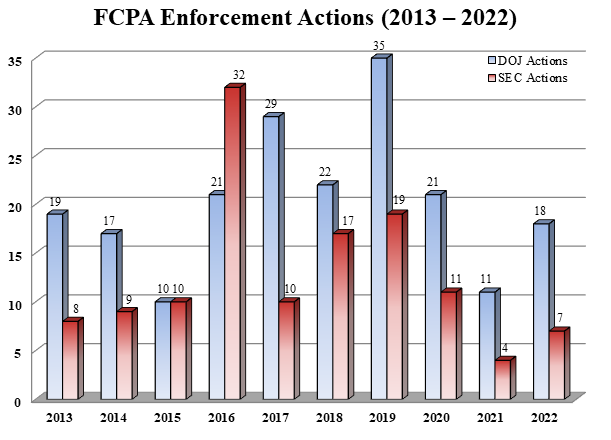
But as our readers know, the number of FCPA enforcement actions represents only a piece of the robust pipeline of international anti-corruption enforcement efforts by DOJ. Indeed, the increasing proportion of “FCPA-related” charges in the overall enforcement docket of FCPA prosecutors is a trend we have been remarking upon for years. In total, DOJ brought 12 such FCPA-related actions in 2022, bringing the overall count to 30 cases that DOJ’s FCPA unit filed, unsealed, or otherwise joined since the beginning of the year. The past 10 years of FCPA plus FCPA-related enforcement activity is illustrated in the following table and graph.

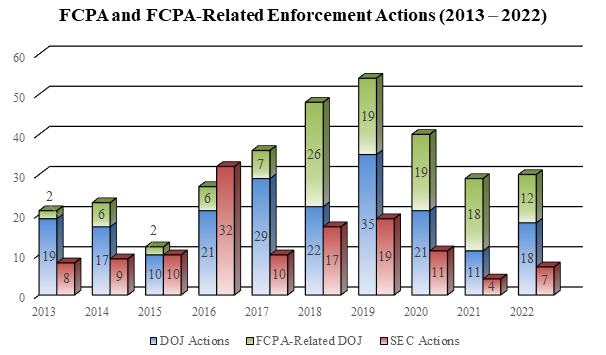
2022 FCPA-RELATED ENFORCEMENT TRENDS
In each of our year-end FCPA updates, we seek not merely to report on the year’s FCPA enforcement actions, but also to distill the thematic trends we see stemming from these individual events. For 2022, we have identified three key enforcement developments that we believe stand out from the rest, although the first two will likely require more time to see if they develop into longer-term trends:
- A rebound in corporate FCPA enforcement actions;
- Revitalized interest in corporate monitorships; and
- Individual FCPA and FCPA-related enforcement continues apace.
Rebound in Corporate FCPA Enforcement Actions
As we reported in our 2021 Year-End FCPA Update, corporate FCPA enforcement fell off of the proverbial cliff in 2021 with the lowest total of corporate enforcement actions (6) in modern FCPA enforcement history. 2022 saw a rebound back toward normalcy, with a total of 14 corporate enforcement actions—more than a 100% increase over 2021. In addition, the financial significance of these cases increased over those brought in 2021, with three 2022 cases topping the $100 million mark in combined disgorgement and penalties, one of which joined the all-time Corporate FCPA Top Ten list. That was Glencore, with over $700 million in FCPA-related penalties, as discussed in our 2022 Mid-Year FCPA Update. A chart of corporate FCPA enforcement actions for the past decade is set forth below, followed by our updated Corporate FCPA Top 10 List and then a discussion of corporate enforcement cases from the last four months of the year.
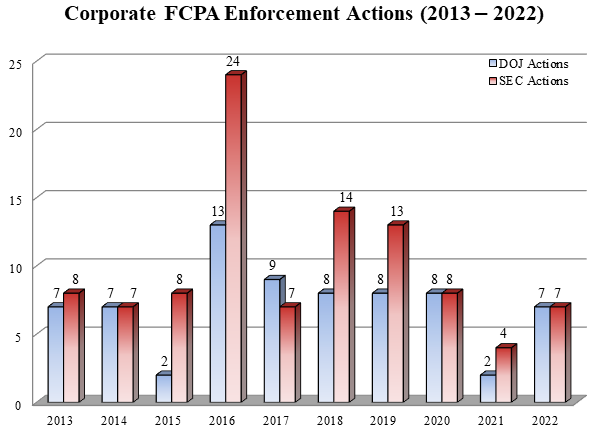
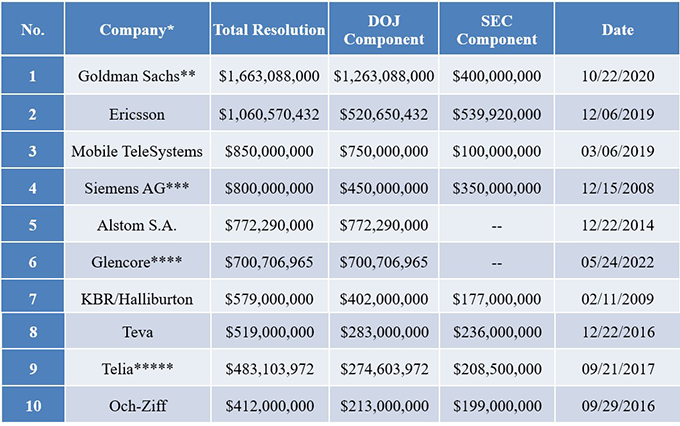
* Our figures do not include the 2018 FCPA case against Petróleo Brasileiro S.A. – Petrobras (“Petrobras”), even though some sources have reported the resolution as high as $1.78 billion, because the first-of-its kind resolution negotiated by Gibson Dunn offset the vast majority of payments against a shareholders’ class action lawsuit and foreign regulatory proceeding, leaving only $170.6 million fairly attributable to the DOJ / SEC FCPA resolution.
** Goldman agreed to pay several billion to authorities in the United States, United Kingdom, Singapore, Hong Kong, and Malaysia.
*** Siemens’s U.S. FCPA resolutions were coordinated with a €395 million ($569 million) anti-corruption settlement with the Munich Public Prosecutor.
**** Glencore negotiated a coordinated resolution of market manipulation charges with the U.S. Commodity Futures Trading Commission and anti-corruption authorities in the UK, Netherlands, and Switzerland, with a total anticipated price tag of approximately $1.5 billion to resolve all matters.
***** Telia agreed to pay a total of $965,603,972 in criminal penalties and disgorgement to authorities in the United States, the Netherlands, and Sweden.
ABB Ltd.
The second-largest corporate FCPA action of 2022 was announced on December 2, 2022, against Swiss-based global technology company and U.S. issuer ABB. According to the charging documents, between 2014 and 2017 ABB paid bribes to a high-ranking official of a state-owned energy company in South Africa to maintain and secure engineering contracts at a power plant in Witbank. It did so by hiring subcontractors associated with the government official, one of which was owned by a member of the official’s family, even though these subcontractors were allegedly unqualified to do the work and more expensive than other options, with the expectation that portions of the subcontractor payments would benefit the government official. In exchange, ABB allegedly received various types of preferential treatment by the government official in the contracting process, including confidential bid information about competitors and inflated purchase orders paid to ABB.
To resolve the matter, ABB entered into coordinated resolutions with DOJ and the SEC in the United States and criminal authorities in South Africa and Switzerland. The DOJ resolution took the form of a deferred prosecution agreement (“DPA”) with parent ABB, as well as guilty pleas by two subsidiaries, involving FCPA bribery and books-and-records charges and a criminal penalty of $315 million, although portions are offset against other resolutions. The SEC brought FCPA bribery and accounting charges and imposed a $75 million civil penalty, plus just over $72.5 million in disgorgement and prejudgment interest that was deemed satisfied by a 2020 civil restitution agreement with the South African government. In addition, ABB reached coordinated criminal resolutions with South African and Swiss authorities, and is reportedly in talks with German authorities. The total 2022 resolutions amounted to over $315 million; including the prior civil settlement with South Africa brings the total price tag to approximately $460 million.
There are several notable aspects of the ABB resolution. First, this is the first coordinated anti-corruption resolution between DOJ, the SEC and South African authorities, which DOJ in particular heralded as it seeks continuously to expand its network of law enforcement partners across the globe.
Second, the settlement papers outline an intriguing (and for others, informative) chain of events leading to the initiation of the investigation. According to the DPA, shortly after becoming aware of the South Africa allegations, ABB contacted DOJ to schedule a meeting at which it planned to disclose the conduct to DOJ, but without describing the content of that disclosure in its initial contact. Between the initial call and the scheduled meeting with DOJ, the media reported on the subject-matter of the investigation, making DOJ aware of it prior to ABB’s disclosure. Accordingly, DOJ did not grant ABB voluntary disclosure credit under the FCPA Corporate Enforcement Policy, although it asserts that it considered ABB’s “demonstrated intent to disclose the misconduct” in fashioning other aspects of the resolution, including by allowing the company to resolve via DPA rather than requiring a guilty plea.
Finally, ABB is now a three-time FCPA offender, having previously resolved separate criminal and civil FCPA enforcement matters with DOJ and the SEC in 2004 and 2010, as reported in our 2010 FCPA Year-End Update. The principal consequence of this recidivism is that the 25% discount DOJ granted to ABB based on its substantial cooperation and remediation was taken not from the bottom of the U.S. Sentencing Guidelines (“Guidelines”) range as is customary, but rather from the mid-point between the middle- and high-ends of the Guidelines. In announcing DOJ’s subsequent Criminal Division Corporate Enforcement Policy on January 17, 2023, covered in more detail below, Criminal Division Assistant Attorney General Kenneth A. Polite cited ABB as the example of DOJ not applying discounts from the bottom of the Guidelines range—but rather higher points in the range—for so-called “recidivists.”
Honeywell International, Inc.
The third-largest FCPA resolution of 2022 came on December 19, 2022, when North Carolina-based manufacturing and technology company Honeywell International, Inc. agreed to pay $202.7 million to resolve parallel anti-corruption investigations by DOJ, the SEC, and Brazilian prosecutors. The DOJ matter was resolved by way of an FCPA bribery conspiracy DPA with Honeywell subsidiary Honeywell UOP—with certain guarantees by the parent company—which alleged that between 2010 and 2014 the subsidiary paid $4 million to an official of Brazilian state oil company Petrobras in exchange for a contract to design and build an oil refinery. The resolution with Brazil’s Office of the Attorney General, Comptroller General, and Federal Prosecution Service concerned the same conduct. The SEC cease-and-desist proceeding also included the Petrobras conduct, but further added allegations that in 2011 and 2012 Honeywell’s Belgian subsidiary paid $75,000 to obtain a contract with Algerian state oil company Sonatrach.
The three-year DPA with DOJ included a $79.2 million criminal penalty, reflecting what was then the maximum 25% discount from the bottom of the Guidelines range for Honeywell’s substantial cooperation and remediation, as well as $105.7 million in forfeiture. But the full forfeiture amount and half the criminal penalty were credited against other resolutions. The SEC resolution included $81.2 million in disgorgement and prejudgment interest, but credited nearly half to payments made in the Brazilian resolutions and did not impose a penalty in light of the DOJ resolution. Finally, the Brazilian resolutions, resolved by way of leniency agreements, added an incremental $42.3 million in additional payments bringing the total to $202.7 million.
Gibson Dunn served as co-counsel to Honeywell in connection with aspects of the investigations.
GOL Linhas Aéreas Inteligentes S.A.
On September 15, 2022, Brazilian airline and U.S. issuer GOL resolved corruption-related charges with DOJ, the SEC, and Brazilian authorities. According to the charging documents, in 2012 and 2013, a member of GOL’s Board of Directors agreed to pay Brazilian officials approximately $3.8 million to secure favorable legislation that reduced payroll and aviation fuel taxes specific to the airline industry. The alleged bribes were paid through consulting companies, using sham contracts, and then recorded in GOL’s books as legitimate advertising or other expenses.
In its DPA with DOJ, GOL received maximum cooperation and remediation credit that reduced its fine to $87 million—25% below the bottom of the Guidelines range—but then DOJ further reduced the fine to $17 million after GOL demonstrated an inability to pay the full amount. A further $1.7 million of this amount was then credited against the $3.4 million paid to Brazilian authorities. The SEC cease-and-desist order, which charged FCPA bribery and accounting violations, imposed $70 million in disgorgement plus prejudgment interest, then waived all but $24.5 million, which will be paid over the next two years, based on the financial condition of GOL.
Oracle Corp.
Two weeks later, on September 27, 2022, Texas-headquartered information technology company Oracle resolved FCPA books-and-records and internal controls charges with the SEC. According to the cease-and-desist order, between 2014 and 2019, Oracle subsidiaries in India, Turkey, and the UAE entered into a variety of schemes with indirect channel resellers to pass along improper benefits to government officials. The schemes generally involved Oracle employees authorizing excess discounts to value-added distributors and resellers, which then pooled portions of these extra discounts and used them to fund customer travel and entertainment that did not meet Oracle policies and even, in certain instances, may have been used to make improper payments.
Without admitting or denying the allegations, Oracle agreed to pay a total of close to $23 million, including a $15 million penalty and $7.9 million in disgorgement plus prejudgment interest. As discussed in our 2012 Year-End FCPA Update, the SEC previously sanctioned Oracle for similar “slush fund”-based FCPA allegations in India in 2012. In this case, the SEC acknowledged Oracle’s full cooperation with the investigation and substantial remedial actions.
Safran S.A.
The final corporate FCPA enforcement event of 2022 was a “declination with disgorgement” issued by DOJ to French defense company Safran on December 21, 2022. According to DOJ’s declination letter, two current subsidiaries of Safran, one based in the U.S. and one in Germany, paid millions of dollars to a consultant in China between 1999 and 2015 while knowing that the consultant was a close relative of a high-ranking Chinese government official who favorably influenced the award of train lavatory contracts to these businesses. Safran did not own these businesses at the time of the misconduct, but subsequently acquired them, identified the conduct during post-acquisition due diligence, and took appropriate remedial action, including voluntarily disclosing the matter to DOJ. As a condition of the declination, Safran agreed to disgorge nearly $17.2 million in allegedly ill-gotten gains from the pre-acquisition misconduct, and also committed to resolving a parallel investigation in Germany.
Rounding Out the 2022 Corporate Enforcement Docket
Other corporate FCPA enforcement events discussed in our 2022 Mid-Year FCPA Update include those involving Jardine Lloyd Thompson Group Holdings Ltd. (DOJ declination with disgorgement), KT Corp. (SEC only), Stericycle, Inc. (DOJ and SEC), and Tenaris, S.A. (SEC only).
Revitalized Interest in Corporate Monitorships
The practice of imposing a compliance monitor as a condition of resolution has ebbed and flowed over the years of corporate FCPA enforcement. Following a two-year hiatus in any FCPA cases involving monitors—likely influenced by the 2018 “Benczkowski Memo,” wherein then-Assistant Attorney General Brian A. Benczkowski stated that monitors should only be used “where there is a demonstrated need for, and clear benefit to be derived from, a monitorship relative to the projected costs and burden”—2022 saw the return of this practice in two FCPA resolutions. Those two cases are Glencore and Stericycle, both discussed in our 2022 Mid-Year FCPA Update. It is no coincidence that current Deputy Attorney General Lisa O. Monaco retracted any presumption against corporate monitorships that could be read from the Benczkowski Memo in guidance she issued in interim form in October 2021, and then final form in September 2022 (the “Monaco Memorandum”), as discussed below and in our separate client alerts: Deputy Attorney General Announces Important Changes to DOJ’s Corporate Criminal Enforcement Policies and From the Broader Perspective: Deputy Attorney General Announces Additional Revisions to DOJ’s Corporate Criminal Enforcement Policies.
The current guidance according to the latest Monaco Memorandum is that there is no presumption in favor or against corporate monitorships, and that each case is to be weighed on its own merits. However, DOJ prosecutors are not to seek to impose a monitor if a company has implemented and tested an effective compliance program. Consistent with this guidance, the January 2023 Criminal Division Corporate Enforcement Policy discussed below reiterates that generally, monitors will not be necessary in voluntary disclosure cases where, by the time of the resolution, the company “has implemented and tested an effective compliance program and remediated the root cause of the misconduct.”
Against this background, it is too soon to tell whether the two corporate monitorships imposed in 2022 FCPA cases represent a blip or a trend upward. We will continue to monitor these developments and report in future updates. For now, the below chart illustrates the frequency with which monitors (including hybrids, where a monitor is imposed for a shorter period with a self-reporting period thereafter) have been imposed in corporate FCPA enforcement actions over the past seven years:
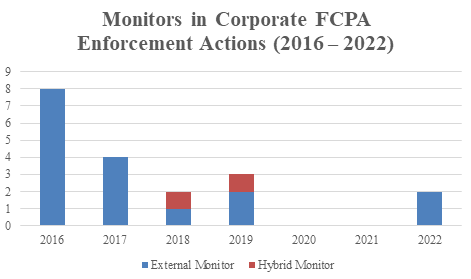
Individual FCPA and FCPA-related Enforcement Continues Apace
DOJ has for years been stating that “individual accountability” is its top priority. The statistics bear this out, and the current question is whether we have passed beyond “trend” and into the realm of the “new normal.” In the September 2022 Monaco Memorandum, DOJ implemented additional guidance requiring prosecutors to analyze warranted criminal charges against individuals as part of every corporate charging memorandum, with a preference for bringing individual cases first or simultaneously, and later only if supported by a detailed plan.
There were at least 23 FCPA and FCPA-related charges filed or unsealed, or in which DOJ FCPA prosecutors first entered an appearance, in 2022. We note that many charges against individuals are initially filed under seal, and only become publicly known months or even years later after being unsealed, often in connection with an arrest or other enforcement development. We covered 19 of those defendants in our 2022 Mid-Year FCPA Update, and discuss the remaining four from the last four months of the year below.
Cary Yan & Gina Zhou
On September 2, 2022, DOJ unsealed a 2020 indictment charging Yan and Zhou with FCPA and money laundering offenses arising out of alleged bribe payments to officials of the Republic of the Marshall Islands. The indictment alleges that between 2016 and 2020, Yan and Zhou paid tens of thousands of dollars to these officials in exchange for legislation that would create a semi-autonomous region within the Republic of the Marshall Islands to the benefit of Yan and Zhou’s business interests. Illustrating the long tail of these cases, Yan and Zhou were originally charged in August 2020, and the case was unsealed upon their extradition to the United States from Thailand more than two years later.
On December 1, 2022, each of Yan and Zhou pleaded guilty to a single count of conspiracy to violate the FCPA’s anti-bribery provision. Sentencing before the Honorable Naomi Reice Buchwald of the U.S. District Court for the Southern District of New York is currently set for March 2023.
Asante Kwaku Berko
On November 3, 2022, Berko, a dual U.S. and Ghanaian citizen and former executive director of a UK subsidiary of Goldman Sachs, was arrested as he landed at Heathrow Airport and United States authorities unsealed a six-count indictment from 2020. The indictment alleges that between 2014 and 2017 Berko paid more than $700,000 to Ghanaian government officials to assist a Turkish energy company client in securing required approvals to build an electric power plant in Ghana.
What is most interesting about Berko’s case is that, as discussed in our 2020 Mid-Year FCPA Update, the SEC filed a civil complaint against Berko for FCPA violations relating to the same conduct in 2020. Then, in June 2021, without admitting or denying the charges and without appearing physically in court, Berko agreed to resolve the SEC enforcement action via an injunction and the payment of approximately $330,000. Berko is still undergoing extradition proceedings in the United Kingdom.
Nilsen Arias Sandoval
On January 19, 2022, Arias pleaded guilty to a single count of money laundering, though the connection to DOJ’s FCPA Unit was not solidified until the entry of an appearance by a FCPA Unit attorney in October 2022. The information charges that between 2010 and 2021 Arias, a former senior manager of Ecuadorian state oil company Empresa Publica de Hidrocarburos del Ecuador (“Petroecuador”), received millions of dollars in bribe payments from a series of energy, asphalt, and transportation companies in exchange for influencing the award of Petroecuador contracts. This is part of the Petroecuador investigation we have been covering for years, which led to a sprawling array of charges against individuals and companies, as most recently covered in our 2022 Mid-Year FCPA Update.
On December 2, 2022, prosecutors also filed a superseding indictment against Javier Aguilar, a former Vitol Group oil trader whom the government alleges caused approximately $920,000 in bribes to be paid to Arias. We covered the original charges against Aguilar in our 2020 Year-End FCPA Update. Aguilar has pleaded not guilty.
2022 FCPA-RELATED ENFORCEMENT LITIGATION (with an Early 2023 Bonus)
As our readership knows, following the filing of FCPA or FCPA-related charges, criminal and civil enforcement proceedings can take years to wind their way through the courts. The substantial number of enforcement cases from prior years, especially involving contested criminal indictments of individual defendants, has led to an active year in enforcement litigation. In addition to the matters discussed in our 2022 Mid-Year FCPA Update, a selection of 2022 matters that saw material enforcement litigation developments follows (in addition to one matter from early 2023).
Former Venezuelan National Treasurer and Husband Convicted of Money Laundering
On December 13, 2022, a federal jury sitting in the Southern District of Florida found ex-Venezuelan National Treasurer Claudia Patricia Diaz Guillen and her husband Adrian Jose Velasquez Figueroa guilty of conspiracy to commit money laundering, as well as two counts of substantive money laundering for Velasquez Figueroa, and one count for Diaz Guillen (who was acquitted of the other count). We first covered this case in our 2020 Year-End FCPA Update. According to the evidence presented to the jury, the defendants received more than $100 million in bribes from Venezuelan billionaire and media mogul Raul Gorrín Belisario in exchange for Diaz Guillen allowing him access to favorable exchange rates on Venezuelan treasury bonds. Gorrín Belisario remains a fugitive, reportedly living in Venezuela.
Diaz Guillen and Velasquez Figueroa have filed a motion to set aside the verdict, or in the alternative for a new trial, which remains pending before the Honorable William P. Dimitrouleas. Sentencing has been scheduled for March 28, 2023.
Saab Moran’s Motion to Dismiss Indictment Based on Diplomatic Immunity Denied
As we first covered in our 2019 Year-End FCPA Update, joint Colombian and Venezuelan citizen Alex Nain Saab Moran was indicted on money laundering offenses in connection with an alleged $350 million construction-related bribery scheme in Venezuela. After he was detained in the Republic of Cape Verde on an INTERPOL “red notice” request by U.S. authorities, Saab Moran filed a motion to enter a special appearance and challenge the indictment from abroad. The motion was denied by the Honorable Robert N. Scola, Jr. of the U.S. District Court for the Southern District of Florida, as reported in our 2021 Year-End FCPA Update. Saab Moran’s appeal was dismissed as moot by the Eleventh Circuit after he was successfully extradited to the United States, as reported in our 2022 Mid-Year FCPA Update. On December 23, 2022, with both Saab Moran and his motion to dismiss squarely before the Court, Judge Scola denied the motion to dismiss the indictment in a 15-page order.
Saab Moran argued that at the time of his arrest in Cape Verde he was a Venezuelan diplomat with immunity under the Vienna Convention on Diplomatic Relations, incorporated into U.S. law by the Diplomatic Relations Act, such that his arrest and subsequent extradition were improper. Judge Scola rejected the argument that Saab Moran was a “special envoy” sent on a trade mission by Nicholas Maduro, as well as the significance of Saab Moran’s post-arrest appointment as an “Alternative Permanent Representative [] to the African Union,” the timing of which the Court found “only added more cause for suspicion.” In addition to finding that Saab Moran doctored evidence submitted to the Court in a “post hoc [effort] to imprint upon Saab Moran a diplomatic status that he did not factually possess” at the time of his arrest, the Court further held that because the U.S. Government does not recognize the regime of President Maduro, Saab Moran could not be a recognized diplomat. Saab Moran already has filed a notice of appeal with the Eleventh Circuit.
Second Circuit Affirms Money Laundering Convictions of Donville Inniss
As discussed in our 2020 Mid-Year FCPA Update, in January 2020 a federal jury in the Eastern District of New York found Donville Inniss, the one-time Minister of Industry and member of the Parliament of Barbados, guilty of one count of conspiracy to commit money laundering and two counts of substantive money laundering. The charges stemmed from a scheme in which Inniss conspired with Insurance Corporation of Barbados Ltd. (“ICBL”) executives to increase ICBL’s portion of a governmental agency’s business in exchange for $36,000 in bribes. ICBL received a “declination with disgorgement” letter from DOJ, as discussed in our 2018 Year-End FCPA Update. Inniss, for his part, appealed.
On October 5, 2022, the U.S. Court of Appeals for the Second Circuit issued a summary order affirming the convictions. The Court rejected Inniss’s arguments that the evidence was insufficient to support a money laundering conviction because he only received the illicit proceeds, without further laundering them after receipt, as foreclosed by Circuit precedent. The Circuit also held that the District Court properly instructed the jury on various witness issues, as well as on the law on intent and what constitutes a “specified unlawful activity” for purposes of money laundering.
Fifth Circuit Reinstates Venezuelan FCPA / Money Laundering Indictment (2023)
We covered in our 2021 Year-End and 2022 Mid-Year FCPA Updates the dismissal of FCPA and money laundering indictments against Swiss wealth management advisors Daisy Teresa Rafoi Bleuler and Paulo Jorge Da Costa Casqueiro Murta by the Honorable Kenneth M. Hoyt of the U.S. District Court for the Southern District of Texas. Rafoi Bleuler and Casqueiro Murta were charged with setting up accounts used to launder bribes associated with alleged corrupt business dealings with the Venezuela state-owned oil company Petróleos de Venezuela, S.A. (“PDVSA”). Judge Hoyt dismissed both indictments on jurisdictional grounds, finding that the U.S. contact allegations set forth in the indictment were insufficient as a matter of law as to each defendant, and further that for Casqueiro Murta the indictment was untimely. DOJ appealed and the cases were consolidated for argument. Although the opinion came down in 2023, its significance warrants coverage here.
On February 8, 2023, the Fifth Circuit rejected all aspects of Judge Hoyt’s decisions below, reinstated the indictment, and remanded the case back to the Southern District of Texas for further proceedings. (The panel withdrew and reissued its opinion with inconsequential changes on February 28, 2023.) Writing for the unanimous panel, the Honorable Kurt D. Engelhardt first found that it was error to dismiss the indictment for lack of subject-matter jurisdiction because in federal criminal cases the only subject matter needed is for the indictment to state an offense against the United States—the question of extraterritoriality goes to the merits of the case at trial. As to the FCPA counts, the Court held that the indictment sufficiently alleged that both defendants were agents of a domestic concern and that Casqueiro Murta additionally engaged in a corrupt act while within the territory of the United States. The Fifth Circuit panel further held that the “agency” allegations were not unconstitutionally vague on their face because, although the term is not defined in the FCPA, a person of common intelligence can understand its meaning. With respect to the money laundering counts, the Court held that there is “no physical-presence requirement” under the applicable money laundering statutes, and therefore, it is sufficient for the government to allege that the unlawful transactions occurred, in part, in the United States. The Court was clear that its holding was limited to the facial sufficiency of the indictment, and that the defendants may be able to argue as a matter of fact at trial that the evidence is insufficient to establish jurisdiction or agency.
The panel also rejected the District Court’s holding regarding the untimeliness of the indictment as to Casqueiro Murta. The statute of limitations for Casqueiro Murta’s alleged offenses is five years, and Casqueiro Murta argued that his indictment was not handed down until more than five years after his involvement in the conspiracy ended. The government sought to remedy this issue by arguing that the statute was tolled for a sufficient period under 18 U.S.C. § 3292 while DOJ sought evidence located abroad pursuant to Mutual Legal Assistance Treaty (“MLAT”) requests to the Swiss and Portuguese governments. The District Court agreed with Casqueiro Murta, holding that because Casqueiro Murta was not the subject of DOJ’s initial MLAT request or the initial indictment, and because § 3292 refers an application for tolling “filed before return of an indictment,” the return of the first indictment after the first MLAT request ended the tolling period. The Fifth Circuit reversed, holding in a case of first impression that “before return of the indictment” means the indictment in which a defendant is charged, and thus the earlier indictment that did not name Casqueiro Murta did not stop tolling as to him.
2022 FCPA-RELATED POLICY DEVELOPMENTS (with a 2023 Bonus)
In addition to enforcement developments, 2022 and early 2023 saw important developments in FCPA-related policy areas.
Monaco Memorandum Update
As discussed in our 2021 Year-End FCPA Update, in October 2021 Deputy Attorney General Lisa O. Monaco made an important announcement modifying certain corporate criminal enforcement policies generally applicable to white collar crime. Those updates were coupled with the creation of a Corporate Crime Advisory Group with the mandate to study and make recommendations for further updates regarding Department policy in this area.
On September 15, 2022, Deputy Attorney General Monaco issued a further memorandum (“Monaco Memorandum”) updating the prior guidance concerning DOJ’s corporate criminal enforcement policies with the benefit of the Corporate Crime Advisory Group’s work. We cover this important update more thoroughly in our separate client alert From the Broader Perspective: Deputy Attorney General Announces Additional Revisions to DOJ’s Corporate Criminal Enforcement Policies, but in brief, the announcement covers six key areas generally relevant to white collar corporate crime: (1) expressing a clear priority for individual prosecutions;
(2) evaluating companies’ history of misconduct; (3) requiring all corporate criminal enforcement components of DOJ to develop voluntary self-disclosure policies; (4) evaluating corporate cooperation; (5) evaluating corporate compliance programs; and (6) evaluating the imposition of corporate compliance monitors.
In some respects, the core thrust of the Monaco Memorandum is to take the best practices developed in FCPA enforcement and expand them Department-wide. For example, Deputy Attorney General Monaco cited the voluntary disclosure and cooperation credit guidance from the FCPA Corporate Enforcement Policy as a model for replication across DOJ’s corporate prosecution components. Further, designating individual accountability as the “number one priority” is nothing new to FCPA enforcers, although FCPA practitioners would do well to note the Monaco Memorandum’s admonitions regarding the focus on timeliness regarding reporting on evidence relating to individual misconduct. What is new across the board, with implementation still an outstanding question, is the novel statement that companies should shift the burden of financial penalties from shareholders to executives via compensation clawbacks, in effect expanding the concept of SOX 404 clawbacks well beyond that provision. We direct our readers to our separate client alert on this important subject for more detailed discussion and analysis.
Criminal Division Corporate Enforcement & Voluntary Self-Disclosure Policy (2023)
In another significant early 2023 development, on January 17, Criminal Division Assistant Attorney General Kenneth A. Polite, Jr. issued a new Criminal Division Corporate Enforcement & Voluntary Self-Disclosure Policy (“Corporate Enforcement Policy”). This is an update that replaces the FCPA Corporate Enforcement Policy discussed in our 2019 Year-End, 2017 Year-End, and (in its pilot form) 2016 Mid-Year FCPA Updates. But importantly, it also expressly applies the guidance throughout the Criminal Division for the first time.
The most significant update to the Corporate Enforcement Policy is to substantially increase the discounts available to companies for voluntary disclosure, cooperation, and remediation. Under the old FCPA Corporate Enforcement Policy, the maximum credit a company could get if prosecution was appropriate in a voluntary disclosure case—where the company disclosed misconduct before DOJ was aware of it, then fully cooperated and remediated—was a 50% discount below the Guidelines range, and in non-voluntary disclosure cases the maximum was 25%. Under the Corporate Enforcement Policy, the presumption in voluntary disclosure cases is still a “declination with disgorgement” if the relevant requirements are met, but now if a case is brought companies are eligible for up to a 75% discount below the Guidelines range. In non-voluntary disclosure cases, companies may now receive up to a 50% discount.
Whereas the overall policy standards are much the same as before, the new watchword for cooperation and remediation is “extraordinary.” In announcing the new policy at his alma mater Georgetown University Law Center, also the alma mater of numerous senior DOJ officials and a number of the authors of this update, Assistant Attorney General Polite made clear that 50% is not “the new norm” that companies can expect for cooperation and remediation. Rather, raising the ceiling to 50% credit in non-voluntary disclosures is meant to provide room to distinguish between cooperation that is merely “full” and that which is “truly extraordinary.” The latter and tougher standard requires companies to go “above and beyond” and deliver evidence that DOJ simply could not have gotten on its own. This may include producing overseas evidence, consensual recordings, or immediate images of electronic devices as the case warrants, with the ultimate standard for prosecutors likely being “I know it when I see it.”
The other key development in the revised Corporate Enforcement Policy is enhanced guidance on the point in the applicable Sentencing Guidelines range from which the cooperation and remediation discount is taken. As FCPA practitioners know, these discounts (like the Guidelines themselves) present a math problem: in addition to knowing the discount, it is important to know the figure to which the discount applies. The Corporate Enforcement Policy makes clear that in most cases involving cooperating companies, it will be appropriate to apply the discount from the bottom of the Guidelines range. But for non-cooperating companies, not only is there no presumption of a discount, but there is also no presumption that DOJ’s sentencing recommendation will be at the bottom of the range. And for cooperating companies that are “recidivists,” the Corporate Enforcement Policy directs prosecutors to consider taking the appropriate discount from a different and higher point within the Guidelines range. As discussed above, this is what happened to three-time FCPA offender ABB—it received a 25% discount (at the time, the maximum in a non-disclosure case), but because of its criminal history the discount was taken from a midpoint between the middle- and high-end of the Guidelines range rather than the bottom. Notably, the term “recidivist” is not defined, and although the application to those with recent prior FCPA convictions may be straightforward, it is less clear how this has and will be applied to companies with prior enforcement actions for non-FCPA conduct.
2022 FCPA SPEAKER’S CORNER
U.S. anti-corruption enforcement personnel stayed active on the speaking circuit in the last months of 2022, offering a glimpse into DOJ and SEC priorities and expectations for the companies that appear before them. In addition to the notable speeches from the first eight months of 2022, covered in our 2022 Mid-Year FCPA Update, we offer the below for our readers’ attention, all of which come from the 39th American Conference Institute International Conference on the FCPA.
Acting Principal Deputy Assistant Attorney General Nicole M. Argentieri
Delivering the Conference’s keynote address, Argentieri emphasized DOJ’s coordination efforts with international anti-corruption partners. She noted that in recent years DOJ has worked closely in FCPA matters with the governments of the United Kingdom, Brazil, Malaysia, Switzerland, Ecuador, France, the Netherlands, Singapore, and others, which, as noted above in our discussion of the ABB matter, now also includes South Africa. Argentieri also highlighted DOJ’s efforts to repatriate the proceeds of international corruption to the people of the country harmed by the bribery, whether by transferring monies forfeited in criminal resolutions or allowing companies to offset penalties owed to DOJ against those paid to the foreign governments in coordinated settlements pursuant to the “Anti-Piling On” Policy.
DOJ Fraud Section Chief Glenn S. Leon
In response to critiques regarding a drop in corporate enforcement, Leon trumpeted the Fraud Section’s record of over 160 individuals prosecuted, as well as 65 trials, in 2022—well above prior-year numbers. As for corporate cases, Leon emphasized that it is important to look not only at the numbers, “but are we doing the right cases, are we bringing the right results, are we having the right impact?” And by that measure, Leon stated that he felt quite confident DOJ’s Fraud Section is doing its job.
SEC FCPA Unit Chief Charles E. Cain
Discussing the knotty challenge of ephemeral messaging, Cain emphasized that if companies implement third-party application messaging policies, they are expected to consistently follow them. “You either prohibit it and actually prohibit it or you don’t. . . . [If you have a policy and do not enforce it] it’s going to have unintended consequences.” According to DOJ officials speaking at the conference, the Criminal Division is preparing additional guidance on ephemeral messaging, which is expected to be released in 2023.
2022 FCPA-RELATED PRIVATE CIVIL LITIGATION
We continue to note that although the FCPA does not provide for a private right of action, civil litigants pursue a variety of causes of action in connection with FCPA-related conduct, with varying degrees of success. In addition to the matters discussed in our 2022 Mid-Year FCPA Update, a selection of noteworthy developments in the last several months of the year follows.
Select Shareholder Lawsuits / Class Actions
- Goldman Sachs Group Inc. – On September 16, 2022, the Honorable Vernon S. Broderick of the U.S. District Court for the Southern District of New York issued an order of preliminary approval for a May 2022 settlement agreement between Goldman Sachs and derivative plaintiffs who alleged that bank officers and directors breached their fiduciary duties in connection with the 1Malaysia Development Bhd (“1MDB”) matter leading to a DOJ / SEC FCPA settlement as previously reported in our 2020 Year-End FCPA Update. Pursuant to the agreement, which was finally approved on January 20, 2023, Goldman Sachs agreed to use $79.5 million (minus a 25% attorneys’ fee award) to improve its compliance and governance measures, establish an anonymous hotline for employee tips, and expand the powers of its Chief Compliance Officer.
- Cognizant Technology Solutions Corp. – On September 27, 2022, the Honorable Kevin McNulty of the U.S. District Court for the District of New Jersey dismissed derivative claims filed on behalf of shareholders of Cognizant arising from the company’s resolution of an FCPA matter with the SEC (as well as a “declination with disgorgement” from DOJ) as reported in our 2019 Year-End FCPA Update. Judge McNulty granted the motion based on “an unexcused failure to make a demand on the Board,” and also commented that the lawsuit lacked plausible allegations that current or former board members ignored red flags about Cognizant’s overseas business practices. Shareholders have appealed to the U.S. Court of Appeals for the Third Circuit, which appeal remains pending as of publication.
2022 INTERNATIONAL ANTI-CORRUPTION DEVELOPMENTS
World Bank
In his foreword to the World Bank Group’s FY 2022 Sanctions System Annual Report, World Bank Group President David Malpass wrote that the World Bank “must be continually vigilant against corruption” in Bank-supported projects, and must work to “send a clear message: corruption has no place in development.” The World Bank’s actions in 2022 did indeed send a clear message, as the Bank sanctioned 35 companies and individuals for corrupt practices and other sanctionable conduct, debarring the vast majority with conditional release—a requirement that the firm or individual sanctioned must satisfy certain conditions in order to be released from debarment and regain eligibility to participate in Bank-funded projects. One notable recent enforcement action from the last months of 2022 is:
- On November 16, 2022, the World Bank announced a three-year debarment with conditional release of Spanish national Carlos Barberán Diez and two companies he controls, AC Oil & Gas SL and AC Oil & Gas Emirates LLC, for corrupt practices related to a Bank-funded project to aid in the development of Guyana’s legal framework and institutional capacity to manage its oil and gas sector. The debarment is based on allegations that Barberán Diez solicited four consulting companies for payments in return for offers to give them preferential treatment in the project procurement process. Notably, the Bank reduced the duration of its debarment in recognition of Barberán Diez’s cooperation with the Bank investigation and his agreement to take remedial steps, including “corporate ethics training.”
An important characteristic of interactions between multilateral development banks (“MDBs”) is the cross-debarment agreements between them, whereby sanctions by one MDB are recognized by other MDBs such that sanctioned parties are barred from doing business with multiple MDBs. In Fiscal Year 2022, the World Bank recognized 72 cross-debarments by other MDBs, and 30 World Bank debarments were eligible for recognition by other MDBs. In one particularly interesting example from the second half of 2022:
- On August 11, 2022, the Inter-American Development Bank (“IDB”) debarred Brazilian construction company Sociedad Anónima de Obras y Servicios Copasa do Brasil (“Copasa”) for 18 months for corrupt and fraudulent practices related to a Brazilian road construction project. Copasa was sanctioned not for engaging in corrupt conduct itself, but for failing to report suspected bribery it became aware of by a consortium partner when it had a chance to prevent it. Copasa cooperated with the IDB investigation and did not contest its responsibility for failing to act to prevent bribery from occurring. This debarment—as with the July 2022 debarment of the consortium partner directly responsible for the alleged bribes (Construcap)—qualified for cross-debarment by the World Bank, the Asian Development Bank, the European Bank for Reconstruction and Development, and the African Development Bank.
Europe
United Kingdom
Glencore Energy UK Limited
On November 3, 2022, Glencore UK was ordered to pay nearly £281 million in fines and costs to resolve the UK portion of the global anti-corruption settlement (also including U.S., Brazilian, and Swiss authorities) reported in our 2022 Mid-Year FCPA Update. The UK resolution involved corrupt payments in Cameroon, Equatorial Guinea, Ivory Coast, Nigeria, and South Sudan, and represents the largest-ever penalty handed out for a corporate criminal conviction in the UK, consisting of a fine of £182.9 million, a confiscation order of £93.5 million for the profits obtained from bribes, and payment of £4.5 million in investigation costs.
This is the first-ever conviction of a company on substantive charges of authorizing bribery, rather than purely a failure to prevent it, obtained by the UK Serious Fraud Office (“SFO”) since the introduction of the UK Bribery Act 2010. In total, Glencore UK admitted to seven bribery counts. According to press reports, as many of 17 individuals, including 11 former Glencore employees, are being investigated by the SFO for their role in this conduct, but as of this writing no charging decisions have been announced.
New Economic Crime Bill Introduced That Could Expand SFO Powers
On September 22, 2022, the UK government introduced a new Economic Crime and Corporate Transparency Bill, which includes provisions that would expand the SFO’s Section 2A pre-investigative powers under the Criminal Justice Act 1987. These powers allow the SFO to compel suspected criminals and financial institutions to share information in relation to a suspected crime. Under the existing legislation, the SFO can only employ Section 2A powers to cases of suspected international bribery and corruption. The new bill would expand the SFO’s Section 2A authority to encompass cases involving allegations of domestic bribery and corruption, as well as fraud. These expanded powers would help expedite the information gathering process, enabling the SFO to reduce its reliance on voluntary cooperation by third parties, open investigations more quickly, and prevent the destruction of relevant evidence of criminal activity. As of this writing, the bill has advanced through the House of Commons and is under consideration by the House of Lords.
Belgium
As 2022 came to a close, the EU was shaken by a scandal involving corruption charges against European Parliament Vice President Eva Kaili, among others. On December 9 and 10, 2022, Belgian authorities raided more than 20 homes and offices across Europe and seized considerable amounts of cash as well as assets such as computers and mobile devices. According to a statement from the Belgian federal prosecutor’s office, a Gulf country has allegedly sought to influence decisions at the European Parliament through paying large sums of money or offering substantial gifts to people with a significant political and/or strategic position. Several media reported that Qatar may be the country said to be involved in providing money and gifts, leading the investigation to be dubbed “Qatargate.”
Kaili recently made positive comments about Qatar’s labor rights record, in tension with reports of harsh labor conditions for construction workers involved in building facilities for the World Cup. On December 1, 2022, Kaili also voted in favor of an EU visa liberalization process for Qatari nationals during a parliamentary committee meeting. On December 15, 2022, the European Public Prosecutor’s Office requested the lifting of parliamentary immunity for Kaili.
France
Idemia
On July 7, 2022, the French National Financial Prosecutor’s Office (“PNF”) announced that it had entered into a deferred prosecution agreement (“CJIP”) with digital security company Idemia, which was ordered to pay just under €8 million ($9.4 million) to resolve charges arising from its alleged improper payment to an official in Bangladesh in order to secure a contract to create identity cards for the Bangladesh Election Commission. Under the CJIP, Idemia is required to undergo audits and verifications conducted by the French Anti-Corruption Agency (“AFA”) and implement certain compliance program enhancements over a three-year period.
Doris Group SA
On the same day, the PNF announced a second, unrelated CJIP with oil and gas engineering company Doris Group. Based on allegations that a subsidiary in Angola had made improper payments to officials of state-oil provider Sonangol, Doris Group was required to pay nearly €3.5 million ($4.1 million) and undergo audits and verifications by the AFA and implement compliance program enhancements over a three-year period.
The Idemia and Doris CJIPs are examples of the increasing cooperation between international enforcement agencies, as the French investigations were commenced after authorities received information from their counterparts in the UK (Idemia) and the United States (Doris).
Airbus SE
On November 30, 2022, the PNF announced a “limited extension” of the wide-ranging 2020 global corruption settlement discussed in our 2020 Mid-Year FCPA Update. The instant charges were resolved by CJIP and involved the use of intermediaries in connection with the sale of jets to the Gaddafi regime in Libya in 2007 and the sale of helicopters and satellites to the Kazakh government in 2009. These matters were reportedly known at the time of the prior resolution, but because of a procedural matter could not be charged at that time. To resolve the 2022 case, Airbus paid an additional €15.9 million ($16.5 million).
Italy
In October 2022, the OECD Working Group on Bribery published its Phase 4 Report on Italy’s implementation and enforcement of the OECD Convention on Combating Bribery of Foreign Public Officials in International Business Transactions and related instruments. The report concluded that Italy has strengthened its legislative framework to fight foreign bribery since the Phase 3 report in 2011, including by lengthening the statute of limitations for foreign bribery offenses by natural persons, increasing prison terms and disqualification sanctions, and introducing whistleblower protections. Further, the report acknowledged that Italy has shown an increase in enforcement actions since 2011 and complimented Italy for process improvements to its judiciary system to improve the efficiency of case processing, improvements to its mutual legal assistance and extradition framework, and improved cooperation between law enforcement and tax authorities.
Despite these improvements, the report expressed concern about the high number of dismissals of litigated foreign bribery cases with almost all foreign bribery convictions being secured through non-trial resolution. Recommendations by the Working Group instruct Italy to (1) develop a comprehensive national strategy to fight foreign bribery, (2) strengthen its monitoring of Italian and foreign media to identify potential instances of corruption, (3) raise awareness of foreign bribery and the Convention among Italian officials, accountants and auditors, and small- and medium-sized enterprises, (4) encourage companies to adopt anti-corruption compliance programs, and (5) strengthen the sanctions imposed for foreign bribery offenses. Italy has until October 2024 to make a written submission addressing all of the Working Group’s recommendations and providing an update regarding its enforcement efforts.
Russia & Former CIS
Kazakhstan
In September 2022, Kairat Satybaldy, a former high-ranking public official and nephew of Kazakhstan’s former president Nursultan Nazarbayev, was sentenced to six years in prison and banned from holding public office for 10 years for embezzling funds from and causing property damage to state-owned companies Kazakhtelekom and Transport Service Center. Satybaldy admitted to embezzling over $58 million and causing property damage worth over $25 million. The Kazakh Anti-Corruption Agency reports that it has recovered over $700 million in assets as part of its investigation into Satybaldy and four other suspects.
Russia
The state crackdown on all forms of dissent, which has intensified since Russia’s invasion of Ukraine, continues to impact the anti-corruption domain. In August, Russian federal agents arrested a number of Telegram channel administrators engaged in anti-corruption reporting work, on charges that have been widely decried as pretextual. For example, journalist Alexandra Bayazitova has been charged with extortion of an executive at the state-owned Promsvyazbank, but maintains her innocence and attributes her wrongful detention to her publication of evidence that, in fact, Promsvyazbank executives themselves had engaged in embezzlement of state funds.
In early December 2022, Russian Prosecutor General Igor Krasnov estimated that corruption had caused around 37.6 billion rubles (~ $520 million) of damage to the Russian state through the first nine months of 2022. Krasnov asserted, however, that law enforcement authorities had recovered over 62 billion rubles (~ $900 million) worth of property to compensate for the damage. This report followed an earlier announcement by Krasnov, in October, that efforts to investigate and weed out corruption had resulted in the dismissal of 800 malfeasant state officials over the preceding 18 months.
Ukraine
As Russia’s war of aggression shows no signs of abating, Ukraine has sought to shore up support from the West. In June 2022, the European Commission granted Ukraine candidate status for membership in the European Union. To move down the path to full EU membership, Ukraine must implement a list of anti-corruption initiatives. Ukraine has wasted no time in getting its house in order, as reflected by its National Anti-Corruption Bureau’s June 2022 decision to go to trial on charges initially filed in 2020 against the Chairman of the Kyiv District Administrative Court, Pavlo Vovk, two of his deputies, and four judges for soliciting bribes in exchange for favors related to judicial processes. Then, in December, just days after the United States announced sanctions against Vovk, Ukraine’s parliament voted to disband the Kyiv District Administrative Court altogether, noting that it had become a “criminal organization.”
Ukraine has also been working toward implementing the specific reforms required by the European Commission, enacting all of the anti-corruption legislation that the EU had required Ukraine to pass continuing EU membership talks. Among those reforms, the legislature passed a law that met with some controversy related to changes to the selection process for Constitutional Court judges. Additional reforms implemented in recent months have included laws strengthening Ukraine’s anti-corruption measures, harmonizing media regulation with EU standards, and protecting national minorities.
The Americas
Argentina
On December 6, 2022, sitting Vice President of Argentina Cristina Fernández de Kirchner was found guilty of “fraudulent administration” over the awarding of some 51 fraudulent public works contracts to a friend while she served as President (2007 – 2015), and a three-judge panel sentenced her to six years in prison. Prosecutors alleged the kickback scheme had caused the Argentine state a loss of at least $1 billion. Many legal observers note she is unlikely to serve time, in part due to legal immunity she enjoys as head of the Senate in Argentina. Even though Kirchner has been banned for life from holding public office as part of her sentence, she continues to serve as Vice President during the pendency of her appeal, which could take years to resolve.
Brazil
On July 12, 2022, the Brazilian government issued Decree No. 11,129/2022, a new regulation on the Brazilian Clean Company Act that, among other things, establishes procedures regarding the entry of leniency agreements and updates the methods of calculating penalties and consequences for their breach. In addition, the Decree enhances the regulations around corporate integrity programs, including providing further guidance on requirements regarding: (1) tone from the top and the proper allocation of resources to compliance functions; (2) ongoing compliance communications; (3) the need for periodic risk assessments to ensure continuous monitoring and improvement; (4) due diligence of third parties; (5) due diligence for sponsorships and donations; and (6) complaint hotline procedures, among other topics.
On December 19, 2022, Brazil’s Comptroller General and its Attorney General’s Office announced a leniency agreement with Keppel Offshore & Marine, five years after the company reached a resolution on the same facts with U.S. and Singaporean authorities, as well as a different Brazilian authority (the Federal Prosecution Service) as reported in our 2017 Year-End FCPA Update. The 2022 settlement required the payment of an additional $64.9 million payment, but is reported to resolve the matter completely for Keppel.
Canada
On September 21, 2022, the Royal Canadian Mounted Police (“RCMP”) announced that Ultra Electronics Forensic Technology Inc., along with four former executives, are facing charges of bribery and fraud under the Corruption of Foreign Public Officials Act and the Criminal Code. The company and each of the four individuals were charged with two counts of bribery of a foreign public official and one of defrauding the public arising from allegations that the defendants directed local agents in the Philippines to bribe foreign public officials in an effort to influence and expedite the award of a multi-million-dollar contract.
Eight days later, on September 29, Ultra Electronics announced that it had agreed to a remediation agreement—akin to U.S. and UK deferred prosecution agreements—with the Public Prosecution Service of Canada to resolve the claims. Details of the settlement still have not been made public as the agreement is subject to approval by the Quebec Superior Court. The settlement does not resolve the matter for the four former Ultra Electronics executives, whom the company said would be tried separately.
Panama
In June 2022, a Panamanian court provisionally dismissed money laundering charges against more than 40 defendants charged in the long-running Lava Jato (“Operation Car Wash”) cases, including the founders of Mossack Fonseca, the Panamanian law firm at the epicenter of the “Panama Papers” leak in 2016. The court found that prosecutors had not sufficiently established the precise amount of funds the defendants allegedly received from offshore sources. But then in mid-October 2022, Panama’s Superior Court of Settlement of Criminal Cases overturned the provisional dismissal of charges against 32 of those individuals, resetting their cases for trial.
Peru
In October 2022, prosecutors in Peru filed a constitutional complaint against then-President Pedro Castillo, alleging that he was operating a de facto “criminal organization” within the Peruvian government in order to corruptly benefit himself and his allies, also detaining five of his associates. As Peru’s Congress prepared to pursue its third impeachment against Castillo since he assumed office in July 2021, on December 7, 2022, Castillo declared that he was replacing Congress with an “exceptional emergency government.” Hours later, lawmakers called an emergency impeachment session, voting to remove Castillo immediately from the presidency, setting off a wave of protests by his supporters that left more than 20 dead. The same day, Castillo was also arrested and charged with rebellion, and he is being held in pretrial detention while his investigation proceeds. Following Castillo’s ouster, Vice President Dina Boluarte was elevated to the presidency to complete the term through 2026. Given recent corruption scandals, President Boluarte is Peru’s fifth president since 2020. On February 17, 2023, Peru’s Congress passed a constitutional complaint alleging corruption charges against Castillo, allowing the Attorney General’s office to open a formal criminal investigation.
Asia
China
In October 2022, the Twentieth Congress of the Chinese Communist Party (“CCP”) concluded in Beijing with a strong reiteration of the Party’s commitment to combating corruption within its ranks. Subsequently, on December 9, 2022, the Supreme People’s Procuratorate issued its Guiding Opinions on Strengthening the Handling of Bribery Criminal Cases, which emphasize its enforcement focus on both bribe givers and receivers. The Guiding Opinions provide further guidance to the lower-level procuratorates and reiterate some of the key points mentioned in the synopses of five bribery prosecutions reported in our 2022 Mid-Year FCPA Update.
The last year brought an increase in anti-corruption enforcement actions in China’s technology manufacturing and financial sectors. For example, the Central Commission for Discipline Inspection (“CCDI”) investigated a number of high-profile figures of Sino IC Capital, which manages the state-backed China Integrated Circuit Industry Investment Fund, and brought corruption-related charges against senior officials of the Bank of East Asia, China Merchants Bank, and People’s Bank of China.
Hong Kong
On August 19, 2022, the Independent Commission Against Corruption (“ICAC”) indicted Ricky Lee, the principal manager of the Hong Kong Airport Authority, and Ng Kai-on of Carol Engineering for allegedly accepting and offering bribes totaling approximately HKD 3.8 million (~ USD 490,000) in connection with the Hong Kong International Airport third-runway project. According to the ICAC, Carol Engineering was a subcontractor on the project and made payments to Lee in exchange for being awarded works and materials supply contracts, and for assistance in securing the release of payments due to Carol Engineering by the general contractors on the project. On February 15, 2023, the ICAC announced charges against eight additional defendants for their roles in offering, accepting, or handling bribes related to the third-runway project scheme. The new defendants include the former General Manager of the Hong Kong Airport Authority, Ricky Lee’s wife, four individuals related to subcontractors Carol Engineering and Goldwave Steel Structure Engineering, and two operators of a supplier for the third-runway project.
India
In June 2022, India’s Central Bureau of Investigation (“CBI”) arrested an officer of India’s drug regulator (the Central Drugs Standard Control Organization), and an employee of Biocon Biologics (a subsidiary of the well-known Indian biotechnology company Biocon Limited), on allegations of corruption. The CBI alleged that the arrested official accepted a bribe from a middle-man representing Biocon Biologics in exchange for a clinical trial waiver for a new drug being manufactured by the company. The CBI also arrested another public official from the drug regulator and employees of two private firms that were liaising with the drug regulator on behalf of Biocon Biologics.
Also in June 2022, India’s anti-corruption ombudsman (the “Lokpal”) announced that it had received 5,680 corruption-related complaints through its publicly available reporting channels between April 2021 and March 2022. In response to a Right to Information petition, the Lokpal also disclosed that it has yet to commence formal investigations into more than 5,100 of these complaints. Directors of inquiry and prosecution have not yet been appointed and we are not aware of any significant anti-corruption actions undertaken by the Lokpal. Further, two judicial member positions in the eight person Lokpal have remained vacant and unfilled for more than two years.
In a significant court decision issued in August 2022, the High Court of Karnataka quashed a 2016 executive order issued by the state government creating the state’s Anti-Corruption Bureau (“ACB”). The executive order had created the ACB under the supervision of the state’s Chief Minister and had empowered it to probe corruption allegations involving state public officials. In invalidating the executive order, the High Court found that the state government had sought to usurp the powers of the state’s Lokayukta—an anti-corruption watchdog that is empowered to investigate and prosecute corruption cases involving public officials. The court also found that the executive order did not explicitly stipulate the authority that is empowered to investigate corruption cases involving the Chief Minister, other ministers, or members of the state legislature. Historically, the Lokayukta has been responsible for the most significant anti-corruption enforcements in Karnataka and is viewed as less prone to political influence.
Finally, a court of appeal in Delhi recently upheld the right of enforcement agencies to intercept telephone conversations of a person suspected to have violated provisions of India’s Prevention of Corruption Act. The court recognized the right of the Indian Government to approve such “phone tapping” on public security grounds, though the Indian Government did not provide elaborate reasons as to why the interception was required for public security.
Indonesia
On August 15, 2022, Indonesia’s Attorney General’s Office announced that businessman Surya Darmadi voluntarily surrendered after eight years on the run from corruption charges. Indonesia’s Corruption Eradication Commission (known locally as the “KPK”) alleged that Darmadi paid 3 billion rupiah (~ $200,000) in bribes to the then-governor of Riau province, Annas Maamum, to amend a forestry regulation that allowed Darmadi’s Duta Palma Group to convert 91,000 acres of forest into palm oil estates. The corruption allegedly cost the country IDR 78 trillion rupiah (~$5 billion), making it the largest corruption case in the country’s history. On February 23, 2023, a court sentenced Darmadi to fifteen years in prison, in addition to a 39 billion rupiah (~$2.6 million) fine.
On September 25, 2022, the KPK announced that it had detained Supreme Court judge Sudrajad Dimyati, and six other individuals, for involvement in an alleged scheme to pay IDR 2.2 billion
(~ $141,430) in bribes to secure a favorable rulings in an appeal by a lending cooperative facing insolvency.
Japan
In November 2022, the Tokyo District Public Prosecutors Office filed indictments against former 2020 Tokyo Olympic and Paralympic Organizing Committee Executive Board Member Haruyuki Takahashi, Aoki Holdings founder Hironori Aoki, former Aoki executive Katsuhisa Ueda, and twelve other individuals. The indictments alleged that Takahashi accepted a total of ¥196 million (~ $11.2 million) in bribes from five companies, including Aoki Holdings and the Kadowaka publishing firm, in exchange for awarding them sponsorship rights at the Olympics. On December 22, 2022, Takahashi, Aoki, and Ueda all pleaded guilty to the allegations at the same trial. Prosecutors are continuing to investigate the executives of the five companies, as well as former Prime Minister Yoshiro Mori, in relation to the alleged bribery.
Korea
Recent amendments to the Improper Solicitation and Graft Act, also widely known as the Kim Young-Ran Act, went into effect on June 8, 2022. Among other things, the amendments now prohibit providing improper payments and other benefits to persons reviewing scholarship, thesis, and internship applications, such as professors and company employees. Moreover, the amendment enhances protections for those who report violations. For example, individuals may now report anonymously through attorneys to further protect their identities. Furthermore, if the individual making the report has violated the Act, the amendments allow for reduced liability, including potential non-prosecution or exemption from fines, in exchange for information regarding potential violations committed by the reporter or others. Lastly, the amendment allows for compensation of reporters who incur medical expenses in connection with submitting reports, such as mental distress.
On August 12, 2022, South Korea’s President Suk-Yeol Yoon administered National Liberation Day special pardons to nearly 1,700 people, including Samsung Electronics Co.’s Chairman Jae-Yong Lee and Lotte Group’s Chairman Dong-Bin Shin. As previously reported in our 2019 Year-End and 2018 Mid-Year FCPA Updates, respectively, Lee was convicted of bribing former president Geun-Hye Park in exchange for securing government support during a merger between two Samsung affiliates in 2015, and Shin was convicted of bribing the former president in exchange for assistance in securing a license for his duty-free business. Importantly, through the special pardons, Lee and Shin are no longer subject to Korean laws that prohibit employers from re-hiring individuals who committed certain crimes (such as bribery) for five years following a term of imprisonment, making it possible for Lee and Shin to resume leadership positions within their former companies.
2022 also saw the first trial and judgment arising from case brought by Korea’s Corruption Investigation Office for High-Ranking Officials (“CIO”), which we reported on in our 2021 Year-End FCPA Update. On November 9, 2022, the Seoul Central District Court’s 1st Criminal Division acquitted a former chief prosecutor, Hyung-Jun Kim, who was charged with receiving a bribe from a lawyer in exchange for leniency during investigations in 2015 and 2016. In acquitting Kim, the Court found that part of the alleged bribe was a loan from the lawyer, and that there was insufficient evidence to conclude that the remainder of the funds were provided in exchange for favors during the investigations. The CIO has suggested that it may appeal the ruling.
Australia
In September 2022, Australian prosecutors charged Panjak Patel and Sornalingam Ragavan, two former senior managers of engineering firm SMEC International, with conspiring to bribe public officials in Sri Lanka in connection with a bid to win contracts for a pair of infrastructure projects in the country worth a combined AUD 14 million (~ $8.8 million). The pair are alleged to have paid roughly AUD 304,000 (~ $200,000) in bribes to the Sri Lankan officials between 2009 and 2016.
On November 30, 2022, Australia’s parliament passed legislation creating a new National Anti-Corruption Commission (“NACC”) to investigate public corruption and empowering it to act independently of political authorities, with broad jurisdiction to investigate and prosecute corrupt conduct across Australia’s public sector. The legislation also creates strong protections for whistleblowers who report corrupt conduct and exemptions allowing journalists to protect the identity of their sources.
Africa
Democratic Republic of the Congo
On December 5, 2022, Glencore plc announced that it will pay $180 million to the Democratic Republic of the Congo as part of an agreement to resolve alleged corruption between 2007 and 2018. This settlement relates to the same underlying conduct in the Democratic Republic of the Congo that formed part of the FCPA settlement with the company as reported in our 2022 Mid-Year FCPA Update, and illustrates the increasing risk of follow-on claims by local governments after companies resolve FCPA cases.
South Africa
In September 2022, South Africa’s National Prosecuting Agency charged the South African subsidiary of McKinsey & Company in connection with the consulting company’s work for state railway company Transnet. McKinsey’s prosecution is connected to an ongoing criminal case against five former Transnet executives charged with fraud, corruption, and money laundering over a bribery scheme allegedly designed to assist a Chinese state company in winning a contract to supply 1,300 trains for South Africa’s railways. A previous commission had found that Transnet awarded tenders to McKinsey due in part to its connections to the Gupta family, who have drawn scrutiny for using connections to former president Jacob Zuma to embezzle state funds. McKinsey previously agreed to pay back over 870 million rand (~ $63 million) in connection with the fees it received, but did not admit any wrongdoing.
In October 2022, South African President Cyril Ramaphosa announced that the government will establish a permanent and independent agency to combat corruption and fraud. The proposed Permanent Anti-Corruption Commission and Public Procurement Anti-Corruption Agency are consequences of the recommendations of the Commission of Inquiry into State Capture, also known as the Zondo Commission, created in 2018 to investigate widespread corruption allegations against former President Jacob Zuma’s government. Legislation connected to the Commission’s recommendations is set to be finalized in Parliament in March 2023.
The following Gibson Dunn lawyers participated in preparing this client update: F. Joseph Warin, John Chesley, Richard Grime, Patrick Stokes, Kelly Austin, Patrick Doris, Katharina Humphrey, Matthew Nunan, Oleh Vretsona, Oliver Welch, Brian Anderson, Hadhy Ayaz, Anthony Balzofiore, Joerg Biswas-Bartz, Ella Alves Capone, Peter Chau, Josiah Clarke, Rommy Lorena Conklin, Angela Coco, Bobby DeNault, Andreas Dürr, Kate Goldberg, Sarah Hafeez, Kathryn Harris, Michael Kutz, Nicole Lee, Allison Lewis, Ramona Lin, Lora MacDonald, Nikita Malevanny, Andrei Malikov, Jacob McGee, Megan Meagher, Katie Mills, Su Moon, Sandy Moss, Jaclyn Neely, Ning Ning, Bryan Parr, Mariam Pathan, Julian Reichert, Jasmine Robinson, Hayley Smith, Jason Smith, Pedro Soto, Laura Sturges, Karthik Ashwin Thiagarajan, Katie Tomsett, Alyse Ullery-Glod, Tim Velenchuk, Dillon Westfall, Edward Zhang, Yan Zhao, and Caroline Ziser Smith.
Gibson Dunn’s lawyers are available to assist in addressing any questions you may have regarding these issues. We have more than 100 attorneys with FCPA experience, including a number of former federal prosecutors and SEC officials, spread throughout the firm’s domestic and international offices. Please contact the Gibson Dunn attorney with whom you work, or any of the following:
Washington, D.C.
F. Joseph Warin (+1 202-887-3609, fwarin@gibsondunn.com)
Richard W. Grime (+1 202-955-8219, rgrime@gibsondunn.com)
Patrick F. Stokes (+1 202-955-8504, pstokes@gibsondunn.com)
Judith A. Lee (+1 202-887-3591, jalee@gibsondunn.com)
David P. Burns (+1 202-887-3786, dburns@gibsondunn.com)
David Debold (+1 202-955-8551, ddebold@gibsondunn.com)
Michael S. Diamant (+1 202-887-3604, mdiamant@gibsondunn.com)
John W.F. Chesley (+1 202-887-3788, jchesley@gibsondunn.com)
Daniel P. Chung (+1 202-887-3729, dchung@gibsondunn.com)
Stephanie Brooker (+1 202-887-3502, sbrooker@gibsondunn.com)
M. Kendall Day (+1 202-955-8220, kday@gibsondunn.com)
Adam M. Smith (+1 202-887-3547, asmith@gibsondunn.com)
Oleh Vretsona (+1 202-887-3779, ovretsona@gibsondunn.com)
Courtney M. Brown (+1 202-955-8685, cmbrown@gibsondunn.com)
Ella Alves Capone (+1 202-887-3511, ecapone@gibsondunn.com)
Bryan Parr (+1 202-777-9560, bparr@gibsondunn.com)
Pedro G. Soto (+1 202-955-8661, psoto@gibsondunn.com)
Jason H. Smith (+1 202-887-3576, jsmith@gibsondunn.com)
New York
Zainab N. Ahmad (+1 212-351-2609, zahmad@gibsondunn.com)
Lisa A. Alfaro (+55 11 3521 7160, lalfaro@gibsondunn.com)
Reed Brodsky (+1 212-351-5334, rbrodsky@gibsondunn.com)
Alexander H. Southwell (+1 212-351-3981, asouthwell@gibsondunn.com)
Karin Portlock (+1 212-351-2666, kportlock@gibsondunn.com)
Denver
Kelly Austin (+1 303-298-5980, kaustin@gibsondunn.com)
Robert C. Blume (+1 303-298-5758, rblume@gibsondunn.com)
John D.W. Partridge (+1 303-298-5931, jpartridge@gibsondunn.com)
Ryan T. Bergsieker (+1 303-298-5774, rbergsieker@gibsondunn.com)
Laura M. Sturges (+1 303-298-5929, lsturges@gibsondunn.com)
Los Angeles
Debra Wong Yang (+1 213-229-7472, dwongyang@gibsondunn.com)
Marcellus McRae (+1 213-229-7675, mmcrae@gibsondunn.com)
Michael M. Farhang (+1 213-229-7005, mfarhang@gibsondunn.com)
Douglas Fuchs (+1 213-229-7605, dfuchs@gibsondunn.com)
Nicola T. Hanna (+1 213-229-7269, nhanna@gibsondunn.com)
San Francisco
Winston Y. Chan (+1 415-393-8362, wchan@gibsondunn.com)
Thad A. Davis (+1 415-393-8251, tadavis@gibsondunn.com)
Charles J. Stevens (+1 415-393-8391, cstevens@gibsondunn.com)
Michael Li-Ming Wong (+1 415-393-8333, mwong@gibsondunn.com)
Palo Alto
Benjamin Wagner (+1 650-849-5395, bwagner@gibsondunn.com)
London
Patrick Doris (+44 20 7071 4276, pdoris@gibsondunn.com)
Charlie Falconer (+44 20 7071 4270, cfalconer@gibsondunn.com)
Sacha Harber-Kelly (+44 20 7071 4205, sharber-kelly@gibsondunn.com)
Michelle Kirschner (+44 20 7071 4212, mkirschner@gibsondunn.com)
Matthew Nunan (+44 20 7071 4201, mnunan@gibsondunn.com)
Philip Rocher (+44 20 7071 4202, procher@gibsondunn.com)
Paris
Benoît Fleury (+33 1 56 43 13 00, bfleury@gibsondunn.com)
Bernard Grinspan (+33 1 56 43 13 00, bgrinspan@gibsondunn.com)
Munich
Katharina Humphrey (+49 89 189 33 155, khumphrey@gibsondunn.com)
Benno Schwarz (+49 89 189 33 110, bschwarz@gibsondunn.com)
Mark Zimmer (+49 89 189 33 115, mzimmer@gibsondunn.com)
Hong Kong
Kelly Austin (+852 2214 3788, kaustin@gibsondunn.com)
Oliver D. Welch (+852 2214 3716, owelch@gibsondunn.com)
© 2023 Gibson, Dunn & Crutcher LLP
Attorney Advertising: The enclosed materials have been prepared for general informational purposes only and are not intended as legal advice. Please note, prior results do not guarantee a similar outcome.
U.S. anti-corruption enforcement has continued apace through the first eight months of 2022. Although some will point to declining numbers of Foreign Corrupt Practices Act (“FCPA”) enforcement actions in 2022 to date, particularly against corporations, as compared to the heights of recent years, our view from the trenches is that enforcement is evolving, not fading. As evidenced by the bevvy of activity catalogued in the pages that follow, our experience is prosecutors at the U.S. Department of Justice (“DOJ”) and enforcers at the U.S. Securities and Exchange Commission (“SEC”) remain acutely focused on international anti-corruption enforcement and that the compliance challenges faced by global corporations are as complicated today as they have ever been. In addition, the expanded employment of money laundering charges has broadened prosecutors’ reach.
This client update provides an overview of the FCPA and other domestic and international anti-corruption enforcement, litigation, and policy developments from the first eight months of 2022. In January 2023, we will publish our comprehensive year-end update on 2022 FCPA developments.
FCPA OVERVIEW
The FCPA’s anti-bribery provisions make it illegal to corruptly offer or provide money or anything else of value to officials of foreign governments, foreign political parties, or public international organizations with the intent to obtain or retain business. These provisions apply to “issuers,” “domestic concerns,” and those acting on behalf of issuers and domestic concerns, as well as to “any person” who acts while in the territory of the United States. The term “issuer” covers any business entity that is registered under 15 U.S.C. § 78l or that is required to file reports under 15 U.S.C. § 78o(d). In this context, foreign issuers whose American Depositary Receipts (“ADRs”) or American Depositary Shares (“ADSs”) are listed on a U.S. exchange are “issuers” for purposes of the FCPA. The term “domestic concern” is even broader and includes any U.S. citizen, national, or resident, as well as any business entity that is organized under the laws of a U.S. state or that has its principal place of business in the United States.
In addition to the anti-bribery provisions, the FCPA also has “accounting provisions” that apply to issuers and those acting on their behalf. First, there is the books-and-records provision, which requires issuers to make and keep accurate books, records, and accounts that, in reasonable detail, accurately and fairly reflect the issuer’s transactions and disposition of assets. Second, the FCPA’s internal accounting controls provision requires that issuers devise and maintain reasonable internal accounting controls aimed at preventing and detecting FCPA violations. Prosecutors and regulators frequently invoke these latter two sections when they cannot establish the elements for an anti-bribery prosecution or as a mechanism for compromise in settlement negotiations. Because there is no requirement that a false record or deficient control be linked to an improper payment, even a payment that does not constitute a violation of the anti-bribery provisions can lead to prosecution under the accounting provisions if inaccurately recorded or attributable to an internal accounting controls deficiency.
International corruption also may implicate other U.S. criminal laws. Frequently, prosecutors from DOJ’s FCPA Unit charge non-FCPA crimes such as money laundering, mail and wire fraud, Travel Act violations, tax violations, and even false statements, in addition to or instead of FCPA charges. Without question, the most prevalent amongst these “FCPA-related” charges is money laundering—a generic term used as shorthand for statutory provisions that generally criminalize conducting or attempting to conduct a transaction involving proceeds of “specified unlawful activity” or transferring funds to or from the United States, in either case to promote the carrying on of specified unlawful activity, to conceal or disguise the nature, location, source, ownership or control of the proceeds, or to avoid a transaction reporting requirement. “Specified unlawful activity” includes over 200 enumerated U.S. crimes and certain foreign crimes, including the FCPA, fraud, and corruption offenses under the laws of foreign nations. Although this has not always been the case, in recent history, DOJ has frequently deployed the money laundering statutes to charge “foreign officials” who are not themselves subject to the FCPA. It is not unusual for DOJ to charge the alleged provider of a corrupt payment under the FCPA and the alleged recipient with money laundering violations.
FCPA AND FCPA-RELATED ENFORCEMENT STATISTICS
The below table and graph detail the number of FCPA enforcement actions initiated by DOJ and the SEC, the statute’s dual enforcers, during the past 10 years.

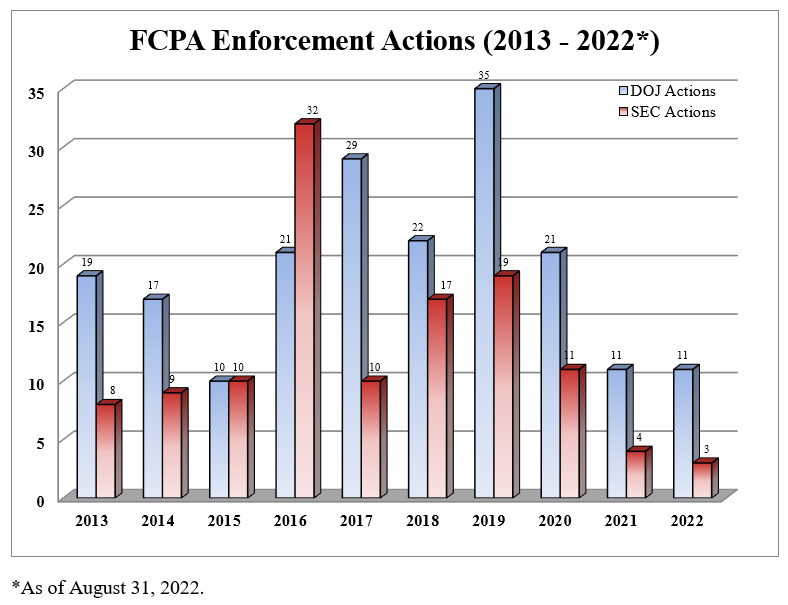
But as our readers know, the number of FCPA enforcement actions represents only a piece of the robust pipeline of international anti-corruption enforcement efforts by DOJ. Indeed, the increasing proportion of “FCPA-related” charges in the overall enforcement docket of FCPA prosecutors is a trend we have been remarking upon for years. In total, DOJ brought 11 such FCPA-related actions in the first eight months of 2022, bringing the overall count to 22 cases that DOJ’s FCPA unit filed, unsealed, or otherwise joined since the beginning of the year. The past 10 years of FCPA plus FCPA-related enforcement activity is illustrated in the following table and graph.
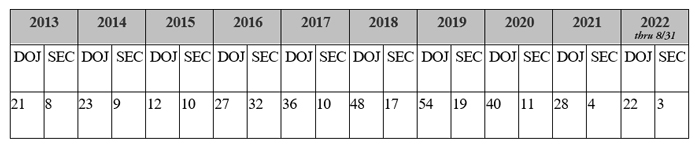
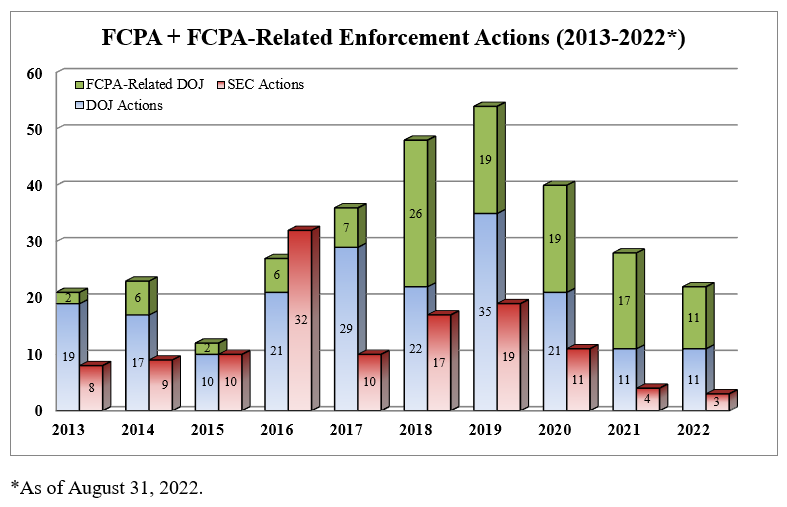
2022 MID-YEAR FCPA + FCPA-RELATED ENFORCEMENT ACTIONS
CORPORATE ENFORCEMENT ACTIONS
Through August, there were three corporate FCPA enforcement actions from each of DOJ and the SEC in 2022, which is on par with the corporate enforcement activity for all of 2021 but still down from recent historical trends. There have been additional resolutions in September not covered herein, and we will continue tracking the pace of corporate FCPA enforcement in our forthcoming year-end update and beyond to see if this is a momentary lull or a longer-term trend. In the meantime, the five companies subject to FCPA enforcement in the year to date follow.
Tenaris S.A.
Most recently, on June 2, 2022, Luxemburg-based global steel pipe supplier Tenaris, an ADR-issuer, consented to the entry of an administrative cease-and-desist order by the SEC to resolve FCPA bribery, books and records, and internal controls charges. According to the SEC’s Order, between 2008 and 2013, agents and employees of Tenaris’s Brazilian subsidiary paid approximately $10.4 million in bribes to a high-ranking procurement manager at Brazil’s state-owned oil and gas company Petróleo Brasileiro S.A. (“Petrobras”) to persuade the procurement manager not to open up the subsidiary’s ongoing pipe supply project to competition, ultimately leading to the award of over $1 billion in contracts. To resolve the charges, Tenaris agreed to pay more than $78 million, consisting of approximately $42.84 million in disgorgement, $10.26 million in prejudgment interest, and a $25 million civil money penalty. Tenaris also agreed to self-report to the SEC for two years on the status of its remediation and implementation of compliance measures related to its compliance program and accounting controls. As we have discussed in earlier updates, Gibson Dunn represented Petrobras and successfully negotiated a non-prosecution agreement with DOJ and an SEC resolution and navigated seamlessly a three-year self-monitorship.
According to a statement released by Tenaris, DOJ closed its investigation into this matter without taking action. Notably, this is Tenaris’s second brush with the FCPA, having resolved dual FCPA enforcement actions with DOJ and the SEC in 2011 arising out of alleged corruption in Uzbekistan.
Glencore International A.G.
Undoubtedly the bombshell FCPA enforcement matter of 2022-to-date came on May 24, when Swiss multinational commodity trading and mining company Glencore resolved criminal FCPA bribery charges in seven African and Latin American countries. Simultaneously, Glencore entered into a parallel criminal and civil market manipulation resolution with a different unit of DOJ’s Fraud Section and the U.S. Commodity Futures Trading Commission (“CFTC”) founded, in part, on the same conduct, in addition to separate anti-corruption resolutions with Brazilian and UK authorities. According to the corruption-related allegations, from 2007 to 2018, Glencore provided more than $100 million in payments and other items of value to intermediaries for the purpose of bribing foreign officials in Brazil, Cameroon, the Democratic Republic of the Congo, Equatorial Guinea, Ivory Coast, Nigeria, and Venezuela to obtain contracts and other benefits.
The assessment of criminal and civil penalties against Glencore for the web of related resolutions involves a complex set of credits and offsets, but in total Glencore is expected to pay approximately $1.5 billion to resolve all of the matters. The total payment to U.S. enforcement agencies is expected to be $1.02 billion, of which approximately $700.7 million is allocable to the FCPA case comprised of a criminal fine of $428.521 million and criminal forfeiture of $272.186 million. On top of that, Glencore agreed to pay $39.6 million to the Brazilian Federal Prosecutor’s Office, and as discussed below in our UK Enforcement Update, a subsidiary pleaded guilty to UK Bribery Act charges and is scheduled to be sentenced in November 2022. Glencore has stated that the resolution in the UK, and other pending proceedings in the Netherlands and its home country of Switzerland, are together expected to increase the overall resolution to $1.5 billion. Additionally, Glencore agreed to a three-year compliance monitor in connection with the FCPA resolution and a separate three-year compliance monitor in connection with the market manipulation resolution, the scope of which are still being negotiated.
Beyond the sheer size of the matter, there are numerous notable aspects to the Glencore resolution:
- First, Glencore is neither a U.S. company nor issuer (hence, no SEC resolution), and DOJ’s FCPA jurisdiction appears to be premised loosely on the approval of certain payments by employees (including former West African oil trader Anthony Stimler, who pleaded guilty to FCPA charges as covered in our 2021 Year-End FCPA Update) while in the United States, the transmittal of at least one email from the United States by Stimler, and the use of U.S. correspondent banking accounts for at least some of the alleged bribe payments. The details of DOJ’s allegations and jurisdictional theories are not fully fleshed out in the corporate charging documents, but DOJ’s approach seems to be that a multi-country corruption conspiracy taking place largely outside of the United States may be brought within U.S. jurisdiction in its entirety due to correspondent banking transactions or through a single act taken by one co-conspirator while in the United States, potentially even a low-level trader involved in one spoke of the alleged conspiracy.
- Second, although there is precedent in corporate FCPA enforcement actions for relatively modest criminal forfeiture actions to accompany criminal fines, generally offset in the criminal fine calculation, Glencore is the first of which we are aware in which the amount of gain was used by DOJ both as the primary input for the Guidelines fine and, on top of that, disgorged by DOJ through parallel forfeiture. In this manner, DOJ not only applied a criminal penalty, which is customary, but it also disgorged all allegedly tainted profits, which is not customary in a non-issuer case (i.e. where the SEC is not involved). While DOJ has applied forfeiture in a limited way in some FCPA cases, this appears to be the first time it has required a company to disgorge all ill-gotten gain in the absence of a parallel SEC action. This practice has precedent in other types of white collar corporate cases, particularly by prosecutors in the Southern District of New York, but not to our knowledge in the FCPA cases.
- Third, as noted above, a part of the CFTC’s charges were founded on the same alleged corruption conduct covered in the DOJ FCPA resolution, making this the second time that the CFTC has charged corruption as “manipulative and deceptive conduct” under the Commodity Exchange Act. The first instance was the case against Vitol, Inc., covered in our 2020 Year-End FCPA Update, which arose out of the same fact pattern.
Stericycle, Inc.
The only dual FCPA enforcement action to date in 2022 came on April 20, when Illinois-based waste management company Stericycle resolved FCPA bribery and accounting charges with DOJ and the SEC arising from allegations of corruption in Argentina, Brazil, and Mexico. The charging documents collectively allege that, between 2011 and 2016, Stericycle representatives paid approximately $10.5 million in bribes to government officials to obtain contracts and other benefits that cumulatively netted the company approximately $21.5 million in profits.
To resolve the criminal charges, Stericycle entered into a deferred prosecution agreement with a $52.5 million penalty and requiring the imposition of a compliance monitor for a two-year term. The SEC resolution requires the disgorgement of approximately $28 million in profits and prejudgment interest, together with the imposition of the same compliance monitor. In addition, Stericycle entered into a parallel $9.3 million resolution with Brazil’s Controladoria-Geral da União and the Advocacia-Geral de União, which after offsets in the DOJ / SEC resolutions will net out to a total resolution of approximately $84 million. Parallel United States and Brazilian enforcement actions, such as seen here, have become commonplace.
Jardine Lloyd Thompson Group Holdings Ltd.
On March 18, 2022, DOJ announced its first “declination with disgorgement” FCPA resolution in nearly two years, with UK insurance company JLT Group. DOJ’s declination letter asserted that it had found evidence that JLT Group, through an employee and its agents, paid approximately $3.15 million in alleged bribes to Ecuadorian officials between 2014 and 2016, through an intermediary based in Florida, in order to obtain or retain insurance contacts with Ecuadorian state-owned surety Seguros Sucre. The underlying conduct is the same covered in our 2020 Mid-Year FCPA Update where we reported on the prosecution of four defendants—including former JLT Group executive Felipe Moncaleano Botero—in the Southern District of Florida for money laundering conspiracy.
DOJ declined to prosecute based on JLT Group’s voluntary disclosure of the misconduct, full and proactive cooperation, prompt and comprehensive remediation, and agreement to disgorge just over $29 million in alleged improper gains. JLT Group affiliates also reached resolutions with Colombian and UK authorities, as covered below in our international enforcement developments section. Gibson Dunn represented JLT Group in obtaining the DOJ declination, and in the international resolutions.
KT Corporation
First in but last up, the initial FCPA corporate enforcement action of 2022 came on February 17, when Korea’s largest telecommunications operator and ADS issuer KT Corporation resolved FCPA books-and-records and internal controls charges with the SEC. According to the administrative cease and desist order, KT Corporation maintained multiple “slush funds” between 2009 and 2017, from which it made illegal contributions to legislative officials in Korea who sat on committees with influence over the telecommunications industry and also to Vietnamese government officials to receive contracts.
Without admitting or denying the allegations, KT Corporation agreed to settle with a $3.5 million civil penalty and the disgorgement of $2.8 million in profits plus prejudgment interest. KT Corporation also will self-report on FCPA compliance remediation for a two-year term. There is no indication to date of a parallel DOJ enforcement action.
INDIVIDUAL ENFORCEMENT ACTIONS
There were FCPA and FCPA-related charges filed or unsealed, or in which DOJ FCPA prosecutors first entered an appearance, against 19 individual defendants during the first eight months of 2022.
Additional PDVSA Charges
In recent years, we have covered numerous corruption-related fact patterns arising out of international business dealings with Venezuela’s state-owned and state-controlled oil company, Petróleos de Venezuela, S.A. (“PDVSA”). The first eight months of 2022 was no exception to this longstanding trend.
On March 8, 2022, a grand jury sitting in the Southern District of Florida indicted two former senior prosecutors from the anti-corruption division of the Venezuelan Attorney General’s Office, Daniel D’Andrea Golindano and Luis Javier Sanchez Rangel, for allegedly laundering $1 million in bribes through a bank account in Florida. The indictment asserts that Rangel and Golindano accepted payments from a contractor that was itself under investigation by the Attorney General’s Office for allegedly receiving over $150 million in contracts from PDVSA entities, in exchange for closing the investigation without seeking criminal charges against the contractor. The defendants have yet to make an appearance in court and have been transferred to fugitive status.
In a separate alleged PDVSA-related scheme, on June 23, 2022, Jhonnathan Marin, former Mayor of Guanta, Venezuela, pleaded guilty to a single count of money laundering conspiracy. According to the criminal information, between 2015 and 2017, Marin accepted $3.8 million in bribes from an unnamed PDVSA contractor to influence several PDVSA joint ventures operated in the port town area to award tens of millions of dollars’ worth of business to the contractor. Marin currently awaits a September 2022 sentencing date before the Honorable Robert N. Scola, Jr. of the U.S. District Court for the Southern District of Florida.
In a third case involving PDVSA, on July 12, 2022 a grand jury sitting in the Southern District of Florida returned an indictment charging financial asset managers—Ralph Steinmann and Luis Fernando Vuteff—with participating in the $1.2 billion “Operation Money Flight” PDVSA currency conversion / embezzlement scheme that we first covered in our 2018 Year-End FCPA Update. The genesis of the scheme arises from the substantial difference between the official and unofficial rates at which Venezuelan bolivars could be exchanged for U.S. dollars, with members of the scheme causing PDVSA to enter into contracts to convert bolivars at the “unofficial rate” of 60:1, then back into dollars at the official rate of 6:1, thereby instantly increasing the outside investment tenfold at the expense of PDVSA and with the assistance of corrupt payments. For their part, Steinmann and Vuteff are each charged with one count of money laundering, with the indictment alleging that between 2014 and 2018 they laundered more than $200 million in proceeds from the scheme, including by opening bank accounts on behalf of Venezuelan government officials to receive the alleged bribe payments. Vuteff has reportedly been arrested and is pending extradition from Switzerland. Steinmann is not before the court and DOJ has asserted that he is a fugitive.
Finally, in yet another case involving a still different PDVSA corruption fact pattern, on August 24, 2022, a grand jury sitting in the Southern District of Florida returned an indictment charging Venezuelan businessman Rixon Rafael Moreno Oropeza with money laundering offenses in connection with an alleged bribery scheme involving Petropiar, a joint venture between PDVSA and a U.S. oil company. Moreno is alleged to have paid millions in bribes from bank accounts in Florida to a senior Venezuelan government official and senior Petropiar employees to obtain as much as $30 million in contracts from Petropiar at prices that were inflated as much as 100-times market value. Based on public records, it does not appear that Moreno is yet in U.S. custody.
Additional Vitol & Sargeant Marine Defendants
We have been covering ongoing, and at times overlapping, investigations in Latin America involving energy trading firm Vitol Inc. and asphalt company Sargeant Marine, Inc., as well as numerous individual defendants, since our 2020 Year-End Update. In March 2022, there were several additional developments, including new charges and new FCPA Unit connections to existing charges.
On March 16, 2022, DOJ charged Dutch citizen and former Vitol trader Lionel Hanst with a single count of conspiracy to commit money laundering alleging that, from November 2014 to September 2020, Hanst laundered bribes from and on behalf of Vitol for the benefit of officials at Ecuadorian, Mexican, and Venezuelan state oil companies Empresa Publica de Hidrocarburos del Ecuador (“PetroEcuador”), Petróleos Mexicanos (“PEMEX”), and PDVSA. Hanst pleaded guilty and is awaiting sentencing before the Honorable Eric N. Vitaliano of the U.S. District Court for the Eastern District of New York.
Right around the same time, from March through May 2022, DOJ FCPA Unit prosecutors involved in the Hanst case entered appearances in several ongoing cases. Although these cases were filed in earlier years, there were no press releases nor entries of appearance by FCPA Unit members to identify them as FCPA-related enforcement actions—until this year.
In May 2021, Eastern District of New York prosecutors charged Gonzalo Guzman Manzanilla and Carlos Espinosa Barba, former employees of PEMEX’s procurement subsidiary, with conspiracy to commit money laundering in connection with the Vitol bribery scheme. The allegations are that, between 2017 and 2020, Guzman and Espinosa agreed to provide a Vitol trader with confidential, inside information on PEMEX-related bids in exchanges for bribes. Both have pleaded guilty to single counts of conspiracy to commit money laundering and also await sentencing before Judge Vitaliano.
The same DOJ FCPA Unit prosecutors entered their appearances in March 2022 in 2020 cases against brothers Antonio and Enrique Ycaza, who have each been charged with conspiracy to violate the FCPA and money laundering statutes in connection with alleged bribery that straddles the Sargeant Marine and Vitol investigations. The allegations are that, between 2011 and 2019, the brothers operated purported consulting companies that were used to funnel approximately $22 million in bribes to PetroEcuador officials on behalf of Sargeant Marine and Vitol. Like the others, the Ycaza brothers have pleaded guilty and await sentencing before Judge Vitaliano.
Finally, in May 2022, FCPA Unit prosecutors entered their appearances in additional 2020 cases against a different set of brothers, Bruno and Jorge Luz. The Luz brothers have each pleaded guilty to a single count of conspiracy to violate the FCPA’s anti-bribery provisions, associated with a scheme to create shell companies that were allegedly used to launder more than $5 million in bribes to Petrobras officials on behalf of Sargeant Marine. Like the others, the Luz brothers await sentencing before Judge Vitaliano.
Additional Odebrecht-Related Charges
We have been covering an ongoing stream of corruption charges arising from the 2016 blockbuster FCPA resolution with Brazilian construction conglomerate Odebrecht S.A. since our 2016 Year-End FCPA Update, including most recently in our 2021 Year-End FCPA Update. On March 24, 2022, another case was added to the pile with the indictment of former Comptroller General of Ecuador Carlos Ramon Polit Faggioni on six counts of money laundering. According to the indictment, between 2010 and 2016, Polit solicited and received over $10 million in bribes from Odebrecht in exchange for using his political position to benefit Odebrecht’s business in Ecuador. Although the bribery scheme took place substantially outside of the United States, the U.S. nexus is that Polit allegedly directed a member of the conspiracy to launder certain of the payments through Florida-based companies to be used to purchase and renovate properties in Florida.
Polit has pleaded not guilty and currently awaits a May 2023 trial date in the U.S. District Court for the Southern District of Florida.
Additional Corsa Coal Defendant
We covered in our 2021 Year-End FCPA Update the FCPA guilty plea of Frederick Cushmore, Jr., former Head of International Sales for an unnamed Pennsylvania-based coal company. That coal company has since identified itself as Corsa Coal, and on March 31, 2022 further charges were announced. On that date, a grand jury sitting in the U.S. District Court for the Western District of Pennsylvania indicted former Vice President Charles Hunter Hobson on seven counts of FCPA bribery, money laundering, and wire fraud conspiracy. The indictment alleges that Hobson participated in a scheme to pay $4.8 million to an agent with the intention that a portion would be used to pay bribes to officials of state-owned Egyptian company Al Nasr Company for Coke and Chemicals to procure $143 million in coal delivery contracts, and also sought to procure a percentage of the illicit payments as kickbacks for his own benefit. The indictment further alleges that Hobson and his co-conspirators communicated via encrypted messaging services, such as WhatsApp, and personal email addresses in an effort to conceal the scheme.
Hobson has pleaded not guilty and no trial date has yet been set. Corsa Coal has reported that it is cooperating with DOJ and also the Royal Canadian Mounted Police, but no public charges have yet been filed against the entity as of the date of publication.
Additional Seguros Sucre Defendants
We covered above DOJ’s ongoing investigation of suspected corruption involving Seguros Sucre, Ecuador’s state-owned insurance company, with the corporate JLT Group declination with disgorgement. Seemingly independent of that matter, at least in part, we saw developments in two other Seguros Sucre-related corruption cases during the first eight months of 2022.
First, on March 24, 2022, financial advisor Fernando Martinez Gomez pleaded guilty to one count of money laundering associated with alleged corrupt payments to officials of Seguros Sucre and Seguros Rocafuerte, another Ecuadorian state-owned insurer, as well as a separate wire fraud scheme involving the misuse of client assets held by Martinez’s employer, Biscayne Capital, in a pyramid scheme that ultimately led to the liquidation of Biscayne. The FCPA-related money laundering charge arises out of the same scheme leading to the charges against four individuals—including Chairman of Seguros Sucre and Rocafuerte Juan Ribas Domenech—covered in our 2020 Mid-Year FCPA Update. Martinez awaits sentencing before the Honorable Carol Bagley Amon of the U.S. District Court for the Eastern District of New York.
On July 14, 2022, in another seemingly separate Seguros Sucre investigation, a grand jury sitting in the Southern District of Florida returned an indictment against three insurance brokers—Luis Lenin Maldonado Matute, Esteban Eduardo Merlo Hidalgo, and Christian Patricio Pintado Garcia—charging them each with seven counts of FCPA and money laundering violations associated with alleged bribes paid to officials of Seguros Sucre and Seguros Rocafuerte. Merlo, a Florida resident, has been arrested and currently faces a September 2022 trial date. Maldonado and Pintado, both Ecuadorian citizens residing in Costa Rica, have been transferred to fugitive status, although Pintado has made an appearance through counsel.
2022 MID-YEAR CHECK-IN ON FCPA-RELATED ENFORCEMENT LITIGATION
As our readership knows, following the filing of FCPA or FCPA-related charges, criminal and civil enforcement proceedings can take years to wind their way through the courts. The substantial number of enforcement cases from prior years, especially involving contested criminal indictments of individual defendants, has led to an active first eight months of enforcement litigation in 2022. A selection of prior-year matters that saw material enforcement litigation developments follows.
Second Circuit Affirms Dismissal of Hoskins FCPA Charges
For years, we have been following the case of Lawrence Hoskins, the UK citizen working for a UK subsidiary of French multinational Alstom S.A. on a project in Indonesia without ever setting foot in the United States and who yet somehow ended up in U.S. court answering FCPA and money laundering charges. Most recently, in our 2020 Mid-Year FCPA Update, we covered the grant of Hoskins’s Rule 29 Motion for a Judgment of Acquittal on the FCPA charges, but denial as to the money laundering charges, by the Honorable Janet Bond Arterton of the U.S. District Court for the District of Connecticut, following the jury trial conviction on all of those counts in November 2019. Cross-appeals followed and the case wound its way back to the U.S. Court of Appeals for the Second Circuit for a second time.
On August 12, 2022, in an opinion authored by the Honorable Rosemary S. Pooler, a split panel of the Second Circuit affirmed the district court’s ruling rejecting the jury’s FCPA convictions but affirming the jury’s money laundering convictions. To understand this opinion, however, one must go back to the first time Hoskins’s case was before the Second Circuit. As covered in our 2018 Year-End FCPA Update, the Second Circuit in large part affirmed the lower court’s pretrial ruling that DOJ could not charge a defendant under the FCPA based on conspiracy or aiding-and-abetting theories if that defendant does not himself fall within one of the “three clear categories of persons who are covered by [the FCPA’s anti-bribery] provisions,” which Hoskins as a foreign national acting outside of the United States did not himself fall into. The Second Circuit did, however, hold that the government should be permitted to make a showing that Hoskins acted as an agent of a domestic concern (namely, Alstom’s U.S. subsidiary), which would bring him within the statute’s reach. That set the stage for the 2019 trial, where DOJ persuaded the jury that Hoskins acted on behalf of Alstom Power, Inc. (the U.S. entity), but could not then get over the hurdle of Judge Arterton’s searching exegesis of the FCPA on Rule 29. This was the decision now up for review by the Second Circuit.
Fundamentally, the Second Circuit majority agreed with Judge Arterton that there was no agency relationship as between Hoskins and the U.S. Alstom entity. There was no real question after the trial as to whether corrupt payments were made to Indonesian government officials to assist Alstom obtain a major power plant contract, or whether Hoskins participated in procuring the agents through which those payments were made, knowing the purpose of those payments. The question, rather, was whether under common law principles of agency, the U.S. subsidiary and Hoskins established a fiduciary relationship whereby Hoskins would act as an agent on behalf of the U.S. entity as the principal. And the Second Circuit majority found that “[c]onspicuously missing from the evidence is anything indicating that [Alstom Power] representatives actually controlled Hoskins’s actions as Hoskins and his [] counterparts operated under separate, parallel employment structures.” Although Hoskins received certain tasks from Alstom Power representatives, the Second Circuit found insufficient evidence for the jury to find beyond a reasonable doubt that Hoskins had authority to act on behalf of the U.S. entity or that the U.S. entity was able to hire, fire, or otherwise control him. The one dissenting vote, from the Honorable Raymond J. Lohier, Jr., focused principally on the deference accorded to jury verdicts coupled with a belief that there was sufficient (if not uncontroverted) evidence of agency in this case.
Although the case represents an important affirmance of the limits of FCPA jurisdiction and agency law, for Hoskins himself it must not be lost that the money laundering counts were affirmed by all three judges on the panel. The Second Circuit turned away his Speedy Trial Act and related Sixth Amendment claims, finding that although more than six years elapsed from indictment to trial, the vast majority of that time was properly excludable for Speedy Trial Act purposes and insufficient prejudice was shown from the delay. And the Court affirmed the jury instructions on withdrawal from conspiracy and venue for the money laundering counts. On that last point, as DOJ’s money laundering appetite grows it is noteworthy that the Second Circuit held that for venue purposes a multi-part wire transfer (in this case from Alstom Power in Connecticut to the agent in Maryland and then on to Indonesia) may be prosecuted as a single, continuing transaction in any of the U.S. districts through which the transaction traversed.
Roger Ng Trial Conviction
On April 8, 2022, following a nearly two-month trial and three days of deliberation, a federal jury in Brooklyn returned a guilty verdict on all three counts against former Goldman Sachs affiliate managing director Ng Chong Hwa (“Roger Ng”). The convictions of conspiracy to commit FCPA bribery, conspiracy to commit money laundering, and knowing circumvention of the FCPA’s internal controls provision, arose from the massive corruption scheme involving 1Malaysia Development Bank (“1MDB”) that we have been following for years.
According to the Government’s trial evidence, between 2009 and 2014, Ng participated in a scheme to launder billions of dollars from the Malaysian state-controlled economic development fund, including by misleading his firm into backing three bond transactions that were, in part, procured through the payment of more than $1 billion in bribes to government officials in Malaysia and the United Arab Emirates. The fund proceeds were allegedly laundered through the U.S. banking system, including famously for backing Hollywood blockbuster “The Wolf of Wall Street,” and other high-profile investments. Ng himself reportedly received $35 million for his role in the scheme.
As discussed in our 2021 Year-End FCPA Update, the Court previously denied Ng’s pretrial motion to dismiss the internal controls count, which argued that Ng could not have circumvented issuer Goldman Sachs’s internal accounting controls because the alleged bribes used 1MDB (and not bank) funds. The Honorable Margo K. Brodie of the U.S. District Court for the Eastern District of New York affirmed that ruling in denying Ng’s Rule 29 motion for a judgment of acquittal from the bench at the close of DOJ’s case, and explained her reasoning in a written post-trial opinion issued on April 8, the day of the jury’s verdict. Judge Brodie explained that the trial evidence was sufficient to show beyond a reasonable doubt that Ng and cooperating co-defendant Timothy Leissner, who testified against Ng, purposefully hid from various approval committees within the bank the involvement of well-known politically exposed person Low Taek Jho (“Jho Low”) in the 1MDB investment, as well as that the approval of various government officials in the investment was procured through bribery. While acknowledging that the term “internal accounting controls” could be read literally to apply only to safeguards concerning an issuer’s own accounting entries, the Court held that such a narrow reading would frustrate the overall intent of the statute and read out the explicit requirement in the statute that issuers establish controls to authorize specific transactions.
Ng is currently scheduled to be sentenced in November 2022.
Baptiste and Boncy FCPA Charges Dismissed on the Eve of Retrial
We covered in our 2021 Year-End FCPA Update the reversal of FCPA jury trial convictions of retired U.S. Army colonel Joseph Baptiste and businessperson Roger Richard Boncy, premised on an FBI sting simulating a bribery scheme involving Haitian port project investments, based on the ineffective assistance of Baptiste’s counsel infecting the fundamental fairness of the joint trial. The retrial was set to begin in July, but on June 27, 2022 DOJ moved to dismiss all charges with prejudice, and DOJ’s motion was granted by the Honorable Allison D. Burroughs of the U.S. District Court for the District of Massachusetts the following day.
The cause for the collapse of the prosecution stems from a December 2015 phone call with Boncy that an undercover FBI agent recorded during the investigation. The FBI inadvertently did not preserve the recording, which became a flashpoint during the initial trial as Boncy insisted that he made exculpatory statements during that conversation that would show he did not believe the investment in question was corrupt. That claim found late vindication when, leading up to the second trial, the FBI discovered text messages on an FBI server that contemporaneously described the contents of the December 2015 phone call, including a statement by Boncy that the money at issue would not be used to pay bribes. Aggressive discovery requests were the key driver to achieve this dismissal.
Baptiste and Boncy are now discharged and free from charges.
Eleventh Circuit Remands Case to Address Foreign Diplomat Immunity Defense
In our 2021 Year-End FCPA Update we covered the denial of motion to make a special appearance and challenge the money laundering indictment facing Alex Nain Saab Moran, a joint Colombian and Venezuelan national charged with money laundering offenses in connection with a $350 million construction-related bribery scheme in Venezuela. The Honorable Robert N. Scola, Jr. of the U.S. District Court for the Southern District of Florida rejected the motion on the basis of the fugitive disentitlement doctrine, given that Saab was not present in the United States himself.
On June 2, 2022, the U.S. Court of Appeals for the Eleventh Circuit in a per curiam order declined to address the merits of Saab’s appeal. With respect to the request to make a special appearance to challenge the indictment, the issue had been mooted by Saab’s interceding extradition from Cabo Verde. But with respect to Saab’s claim that he was a foreign diplomat immune from prosecution, the Eleventh Circuit remanded the case for the district court to address that issue in the first instance. Saab’s renewed motion to dismiss is now set for a week-long evidentiary hearing back before Judge Scola, beginning in October 2022.
District Court Finds Broad Privilege Waiver From Cooperation with DOJ
In our 2019 Year-End and 2020 Mid-Year FCPA updates, we covered the FCPA charges against and extensive post-indictment litigation involving the former Cognizant Technology Solutions President and Chief Legal Officer. The case is currently set for trial in the U.S. District Court for the District of New Jersey in October 2022, but the pretrial disputes continue apace. The individual defendants have moved to compel discovery on a number of issues, which the Honorable Kevin McNulty addressed in five separate memorandum opinions dated January 24 (two), March 23, April 27, and July 19, 2022.
Chief among the issues in dispute concerns the recurring dilemma of how companies are to navigate cooperation with government investigations without waiving the attorney-client privilege. Here, as part of its substantial cooperation efforts that ultimately led to a criminal declination, Cognizant provided DOJ with “detailed accounts” of numerous company employee witness interviews conducted by outside counsel. The individual defendants sought access to all materials associated with those interviews, which Judge McNulty in large part granted. The Court held that by disclosing privileged information to DOJ, Cognizant waived attorney-client privilege and work product protection “as to all memoranda, notes, summaries, or other records of the interviews themselves,” regardless of whether the interview summaries were conveyed orally or in writing. Further, “to the extent the summaries directly conveyed the contents of documents or communications, those underlying documents or communications themselves are within the scope of the waiver.” Finally, Judge McNulty held that “the waiver extends to documents and communications that were reviewed and formed any part of the basis of any presentation, oral or written, to the DOJ in connection with this investigation.”
As noted above, the former executives are currently scheduled to go to trial in October 2022. But this date may be imperiled by defendants’ recent motion to conduct numerous Rule 15 depositions in India, including through the compulsion of letters rogatory. We will undoubtedly return to this matter in future FCPA updates.
SEC Obtains Default Judgment in 2019 Case
In another development this year in a case initiated in 2019, on June 27, 2022 the Honorable J. Paul Oetken of the U.S. District Court for the Southern District of New York issued a default judgment against Yanliang “Jerry” Li. As discussed in our 2019 Year-End FCPA Update, Li, the former China Managing Director of a “multi-level marketing company,” later identified as Herbalife Nutrition Ltd., was indicted by DOJ and charged by the SEC for FCPA bribery and accounting violations arising from an alleged scheme to bribe Chinese government officials to obtain direct sales licenses and stifle negative media coverage about the company. Li has yet to make an appearance in U.S. court, even though he was served with the SEC’s complaint in China, and Judge Oetken assessed an Exchange Act Tier II penalty (ranging from $80,000 to $97,523) for each of five violations—(1) falsifying an expense report; (2) falsifying a SOX sub-certification; (3) endorsing a false audit report; (4) submitting a second false SOX certification; and (5) giving false testimony to the SEC—for a total of $550,092 in penalties.
PDVSA-related Defendants Move to Dismiss Indictments on Jurisdictional Grounds
We covered in our 2021 Year-End FCPA Update the seismic grant of Daisy Teresa Rafoi Bleuler’s motion to dismiss the FCPA and money laundering charges against her in the U.S. District Court for the Southern District of Texas by the Honorable Kenneth M. Hoyt. Judge Hoyt found that, as a matter of law, the indictment was deficient in alleging the actions abroad by Swiss citizen Rafoi, who did not set foot in the territory of the United States during the alleged PDVSA-related corruption scheme (and was challenging her indictment from abroad), were insufficient to bring her within the scope of U.S. jurisdiction. DOJ has appealed this dismissal, arguing that “a foreign national who actively participated in a US-linked scheme to pay bribes, can be liable for FCPA conspiracy even if she is not an enumerated FCPA actor who is liable as a principal,” and further that whether Rafoi qualified as an agent was a question of fact for a jury to decide.
On the heels of Judge Hoyt’s decision in the Rafoi case, co-defendant Paulo Jorge Da Costa Casqueiro Murta filed a motion to dismiss his own charges, raising many of the same jurisdictional arguments. On July 11, 2022, Judge Hoyt granted the motion for much the same reasoning as in the Rafoi case, but additionally on statute-of-limitations grounds and also granting a motion to suppress statements made by Casqueiro during a custodial interview in Spain. With respect to the statute-of-limitations matter, the Court waded through the complexities of multiple 28 U.S.C. § 3292 tolling orders and found that the return of an indictment against a co-defendant in 2017 ended the tolling period as to the subsequently indicted Casqueiro even though a later tolling order was issued and further Mutual Legal Assistance Treaty responses were filed by Swiss authorities. With respect to the suppression of statements, Judge Hoyt found that the circumstances of Casqueiro’s interview were impermissibly coercive where the defendant was summoned to the interview in Portugal by a local prosecutor, did not feel like he was permitted to leave the interview under Portuguese law, and was not advised of his protections under the U.S. constitution by the U.S. Department of Homeland Security agents who conducted the interview.
DOJ immediately filed a motion to stay the Casqueiro dismissal pending appeal, arguing that the defendant had been extradited to the United States to face these charges and would likely leave the United States if he was not maintained on pretrial release pending appeal. Judge Hoyt denied the stay request at the district court level, but on August 3, 2022 the U.S. Court of Appeals issued a stay pending resolution of the merits appeal, coupled with an order to expedite that appeal. On DOJ’s request, the Casqueiro and Rafoi appeals were then consolidated for argument, which is currently scheduled for October 2022. We expect these appeals will lead to a further important appellate ruling on the breadth of FCPA and money laundering statutes’ jurisdiction over foreign nationals, supplementing the Second Circuit’s decision in Hoskins discussed above.
Finally, a third co-defendant in the same sprawling case—Nervis Gerardo Villalobos Cárdenasg—filed his own motion to dismiss the indictment in February 2022, like Rafoi doing so from abroad. For reasons that may only be explained in a series of sealed orders, the Villalobos motion has proceeded on a slower track than the Casqueiro motion. DOJ makes many of the same arguments opposing dismissal as in the other cases, including renewing the same “fugitive disentitlement” challenge to the propriety of a court addressing a motion to dismiss filed by a so-called fugitive not before the court as it made (and was rejected) in Rafoi’s case. The motion to dismiss remains pending as of the date of publication.
Former Venezuelan National Treasurer Extradited; Motion to Dismiss Denied
On May 24, 2022, former Venezuelan National Treasurer Claudia Patricia Díaz Guillén made her initial appearance in the U.S. District Court for the Southern District of Florida and entered a not guilty plea to the money laundering charges against her. As described in our 2020 Year-End FCPA Update, Díaz is alleged to have accepted bribes to facilitate more favorable rates for foreign exchange transactions. Promptly following her extradition, Díaz moved to dismiss the charges on jurisdictional grounds similar to those raised by the PDVSA defendants in Houston described above. But the Honorable William P. Dimitrouleas, unpersuaded by Judge Hoyt’s rulings in Rafoi and Casqueiro, made short work of the motion by disposing of the matter as an issue for the jury in a two-page opinion dated July 12, 2022. Díaz currently faces an October 2022 trial date.
Fourth Circuit Affirms Lambert FCPA Trial Conviction
In our 2019 Year-End FCPA Update we covered the trial conviction of former Transport Logistics International, Inc. President Mark T. Lambert. On July 21, 2022, the U.S. Court of Appeals for the Fourth Circuit, in a per curiam opinion, affirmed the FCPA bribery and wire fraud convictions. The court found no error by the trial court in ruling on various evidentiary exclusions, nor in issuing an Allen charge when the jury initially could not agree on a verdict. On the substance of the charges, the Fourth Circuit found sufficient evidence to support the wire fraud convictions based on DOJ’s evidence that Lambert actively concealed material facts from the victim customer by virtue of quoting inflated costs that secretly included the costs of bribing one of the customer’s representatives, Vadim Mikerin, who also was prosecuted by DOJ.
Fifth Circuit Declares SEC Practice of Imposing Civil Monetary Penalties in Administrative Proceedings Unconstitutional
Those who have followed our client updates over the years may recall that many of the SEC’s settled FCPA enforcement actions for the first three decades of the statute were filed as civil complaints in federal district court. That all changed with the Dodd-Frank Wall Street Reform Act of 2010 (“Dodd-Frank”), which among many other important reforms granted the SEC authority to impose civil monetary penalties in administrative proceedings in which the SEC seeks a cease-and-desist order. Soon thereafter, the vast majority of settled enforcement actions (in FCPA and other cases) began being filed as administrative cease-and-desist proceedings.
Potentially imperiling that practice, on May 18, 2022 a three-judge panel from the U.S. Court of Appeals for the Fifth Circuit held in Jarkesy v. SEC that the SEC imposing civil monetary penalties in administrative proceedings is unconstitutional because Congress delegated its legislative power to the SEC without providing an intelligible principle by which the SEC could exercise that power. The Honorable Jennifer Walker Elrod, writing for the Court, recognized that Congress had authority to assign disputes to agency adjudication in “special circumstances,” but here found that Congress had given the SEC “exclusive authority and absolute discretion to decide whether to bring securities fraud enforcement actions within the agency instead of in an Article III court” while saying “nothing at all indicating how the SEC should make that call.” The Fifth Circuit further concluded that the SEC’s in-house adjudication violated the Petitioners’ Seventh Amendment right to a jury trial.
This decision does not involve FCPA enforcement directly, but its reverberations will certainly be felt in FCPA as well as other SEC enforcement areas until the law settles. For more on the Jarkesy decision, please see our separate article, “Jarkesy Wins Relief from ALJ Control After Years of Fighting for his Right to a Jury Trial.”
Continued Deferred Prosecution Agreement Scrutiny
We covered in our 2021 Year-End FCPA Update Deputy Attorney General Lisa O. Monaco’s October 2021 announcement that DOJ was modifying certain of its corporate criminal enforcement policies, and simultaneously highlighting increasing scrutiny that DOJ was giving to companies’ compliance with pretrial diversion (deferred and non-prosecution) agreements. The thrust of Monaco’s statements in the latter category was to express a concern that some companies continued to violate the law or otherwise failed to live up to their obligations during the period of their deferred and non-prosecution agreements. As we noted in our last update, close in time to this speech a number of companies announced that DOJ was conducting so-called “breach investigations,” including in the FCPA context such as the following example (among others):
- On March 3, 2022, Mobile TeleSystems Public Joint Stock Company (“MTS”) announced a one-year extension of its 2019 FCPA deferred prosecution agreement (also covered in our 2019 Year-End FCPA Update), together with the monitorship that accompanied it. MTS reported that there had been no determination that it had breached the terms of its agreement, but that the extension was due to a variety of factors, including the COVID-19 pandemic and to allow sufficient time for MTS to implement enhancements to its anti-corruption compliance program and have those enhancements reviewed by the monitor.
There is no question that DOJ and the SEC are applying increased scrutiny to companies under the supervision (active as in a monitorship, or passive as in self-reporting) that comes with deferred and non-prosecution agreements. We expect additional developments in this area in the months and years to come.
CEO and CCO Certifications of Compliance Programs
When the May 2022 Glencore FCPA resolution described above required the company’s Chief Executive Officer and Chief Compliance Officer each to certify at the conclusion of the three-year term of the monitorship that the company’s compliance program is reasonably designed and implemented to meet the requirements of the plea agreement the compliance industry sat up and took notice. Compliance-focused advocacy organizations have argued that imposing this requirement on CCOs puts them in an untenable position, and, in effect, puts a target on their back for any imperfections in the corporate compliance program they oversee.
DOJ officials have gone on the speaking circuit in defense of this new policy. On May 26, 2022, Deputy Attorney General Monaco asserted at a SIFMA event that this was in fact DOJ’s “effort to empower the gatekeepers” and ensure that CCOs are kept in the loop on compliance matters. Echoing this sentiment, DOJ FCPA Unit Chief David Last said at a June 14, 2022 International Bar Association event that this certification “is not meant to be a gotcha game,” but rather designed to “incentivize” CEOs and CCOs to “make sure they’re checking that [their] compliance program is up to snuff.” And DOJ Fraud Section Assistant Chief Lauren Kootman said at a Women’s White Collar Defense Association event on June 22, 2022 that “[t]he intention is not to put a target on the back of a chief compliance officer,” but rather to ensure that companies appropriately resource their compliance departments. These assurances have provided cold comfort to many in the compliance industry, and likely this will be a continuing source of discussion as the policy is implemented more broadly. On that note, Kootman has confirmed that this requirement “most likely” will be incorporated into all corporate FCPA resolutions going forward.
2022 MID-YEAR FCPA-RELATED LEGISLATIVE AND POLICY DEVELOPMENTS
In addition to the enforcement developments covered above, the first eight months of 2022 saw numerous important developments in FCPA-related legislative and policy areas.
DOJ Issues Increasingly Rare FCPA Opinion Procedure Release (22-01)
By statute, DOJ must provide a written opinion at the request of an issuer or domestic concern stating whether DOJ would prosecute the requestor under the anti-bribery provisions for prospective (not hypothetical) conduct it is considering. Once a common staple of FCPA practice, this procedure has seen seldom use in recent years. Indeed, DOJ’s last opinion procedure release (covered in our 2020 Year-End FCPA Update) was issued in August 2020, and was itself then the first since 2014. On January 21, 2022, DOJ issued a new opinion procedure release (its 63rd overall) interpreting how the FCPA applies to payments made under physical duress in response to extortionate demands by foreign officials.
Requestor is a U.S. domestic concern that owns and operates maritime vessels. While awaiting entry to the port of Country B, one of Requestor’s vessels inadvertently anchored in the territorial waters of Country A, where it was intercepted by that country’s navy. The vessel’s captain was detained in a local jail without access to care needed to address his “serious medical conditions,” at which point a third party who claimed to be acting on behalf of Country A’s navy contacted Requestor and demanded $175,000 in cash in exchange for the captain’s release and permission to leave Country A’s territorial waters. After unsuccessfully trying to obtain formal documentation explaining the legal basis for the payment, and failed attempts at obtaining intervention by other agencies of the U.S. government, Requestor sought DOJ’s opinion that it would not be prosecuted for making the payment to obtain the release of its vessel’s captain and crew.
In light of the exigent, life-threatening circumstances, DOJ acted swiftly and issued an initial response within two days of the October 2021 request, following up with the full opinion in January 2022 upon the submission of additional information. DOJ concluded that it would not pursue an enforcement action on these facts because “Requestor would not be making the payment ‘corruptly’ or to ‘obtain or retain business.’” With respect to the “corrupt intent” element of the FCPA, DOJ concluded it would not be met here because Requestor’s primary motivation in making this payment was to “avoid imminent and potentially serious harm to the captain and the crew.” Notably, DOJ distinguished this circumstance of physical duress from the more commonly experienced circumstance of economic duress—where companies are “shaken down” for corrupt payments at the risk of unjust financial consequences—observing that payments made in response to financially coercive demands may well be illegal under the FCPA. With respect to the “obtain or retain business” element of the FCPA, DOJ concluded that it would not be met here because Requestor had no ongoing or anticipated business in Country A. DOJ further noted Requestor’s transparent efforts to address this situation in response to the payment demand, which did not evince a corrupt intent.
While FCPA Opinion Procedure Release 2022-01 does not break any genuinely new ground and, like other opinion releases, is expressly limited to the specific facts at hand, it does nonetheless offer useful guidance to companies and practitioners alike regarding DOJ’s interpretation of these two important elements of the FCPA. In particular, the ability to make even a large cash payment under questionable circumstances to preserve the physical safety and wellbeing of employees is genuinely helpful. Nonetheless, we must caution our readers to exercise caution in expanding the logic of this opinion into the realm of economic coercion, which DOJ does treat differently as expressed in its opinion.
FinCEN Advisory Regarding Kleptocracy and Foreign Public Corruption
On April 14, 2022, the Department of Treasury’s Financial Crimes Enforcement Network (“FinCEN”) released its “Advisory on Kleptocracy and Foreign Public Corruption,” which was developed to provide guidance to financial institutions in identifying and disclosing transactions involving the proceeds of foreign public corruption. As detailed in our 2021 Year-End FCPA Update and standalone client alert, “U.S. Strategy on Countering Corruption Signals Focus on Enforcement,” in December 2021, the Biden Administration—which previously identified the fight against corruption as a “core national security interest of the United States”—released a United States Strategy on Countering Corruption, articulating an ambitious, whole-of-government approach to combating corruption and its downstream societal effects. FinCEN describes this latest Advisory as part of the Biden Administration’s broader anti-corruption efforts.
Unsurprisingly, the Advisory describes Russia as a jurisdiction of “particular concern” in this area given “the nexus between corruption, money laundering, malign influence and armed interventions abroad, and sanctions evasion,” which is consistent with the United States’ broader efforts to combat and disrupt Russia-related financial activity following its invasion of Ukraine, including asset freezes and seizures conducted through Task Force KleptoCapture, discussed further in our separate client alert “United States Responds to the Crisis in Ukraine with Additional Sanctions and Export Controls.” The Advisory describes two typologies and patterns of activity associated with kleptocracy and foreign public corruption. First, “wealth extraction,” or the “siphoning off” of national resources by oligarchs and elites, is characterized as being conducted through bribery and extortion schemes involving foreign public officials or the misappropriation of embezzlement of public assets for private enrichment, which can commonly be accomplished through public procurement in the defense and health sectors or through bribes and kickbacks paid in the context of large infrastructure or development projects. Second, the Advisory notes that kleptocrats and other corrupt public officials will engage in similar activity to drug traffickers or other criminal actors to launder the proceeds of corruption, such as through the use of complex networks of shell companies or offshore accounts or the conversion of ill-gotten gains into the purchase of high-value assets such as luxury real estate, private jets and yachts, art and antiquities, or hotels.
The Advisory concludes with a set of 10 common “red flag” indicators that financial institutions should look out for in an effort to identify, prevent, and report potentially suspicious transactions involving the proceeds of kleptocracy or foreign public corruption. These include transactions involving multiple government contracts being awarded to the same entity or entities with common ownership, transactions in which government business is being conducted through personal accounts, transactions involving foreign public officials and the purchase of high-value or luxury assets and/or jurisdictions with which the officials do not have known ties, the use of third parties or shell companies to obscure the involvement of foreign public officials, transactions involving excessive charges or inconsistent or incomplete documentation, and transactions involving entities beneficially owned by individuals connected to known kleptocrats or their family members.
2022 MID-YEAR CHECK-IN ON THE FCPA SPEAKER’S CORNER
U.S. government anti-corruption enforcement personnel were active on the speaking circuit in the first eight months of 2022, offering a glimpse into DOJ and SEC priorities and expectations for the companies that appear before them. In many instances, these statements are more broadly focused on white collar crime in general, but the lessons may be applied in the FCPA context. We will cover the September 15, 2022 speech by U.S. Deputy Attorney General Lisa Monaco in a separate, forthcoming client alert.
Attorney General Merrick Garland
Speaking to the ABA Institute on White Collar Crime in Washington D.C. on March 3, 2022, Attorney General Merrick Garland made clear that DOJ’s first priority in corporate criminal cases is the prosecution of individuals who “commit and profit from corporate malfeasance.” Garland stated that DOJ’s focus on individual accountability is the best way to deter corporate crimes in the first place because corporations are only able to act through individuals. In addition, Garland argued that the prosecution of individuals is necessary because it bolsters Americans’ trust in the rule of law. Toward the end of his remarks, Garland noted that over the long course of his career he has seen DOJ’s interest in prosecuting corporate crime “wax and wane,” and concluded that “today, it is waxing again.”
Assistant Attorney General Kenneth Polite
In a March 25, 2022 speech before NYU Law’s Program on Corporate Compliance and Enforcement, Assistant Attorney General for the Criminal Division Kenneth Polite provided details on how DOJ evaluates corporate compliance programs. He stated that DOJ’s goal with such evaluations is to ensure that “companies are designing and implementing effective compliance systems and controls, creating a culture of compliance, and promoting ethical values.” First, according to Polite, a company’s compliance program must be well-suited to the company’s specific risk profile. Second, a compliance program must demonstrate a company’s commitment to compliance at all levels of the company. Third, DOJ wants to see evidence that the corporate compliance program actually works in practice. Finally, Polite emphasized that companies should be able to demonstrate an “ethical culture” that permeates all areas of the corporate structure.
Principal Deputy Assistant Attorney General Nicholas McQuaid
In a speech delivered at a forum hosted by the American Conference Institute on January 27, 2022, Criminal Division Principal Deputy Assistant Attorney General Nicholas McQuaid admonished attendees to not focus on the number of prosecutions of FCPA violations in the last year. Although as noted in our 2021 Year-End FCPA Update, FCPA resolutions in 2021 fell to their lowest level since 2015, McQuaid stated that DOJ entered 2022 with a “robust pipeline” of cases and that he expects there to be “significant resolutions” over the next year.
2022 MID-YEAR CHECK-IN ON FCPA-RELATED PRIVATE CIVIL LITIGATION
Although the FCPA does not provide for a private right of action, our readership knows well that civil litigants have pursued a variety of causes of action in connection with FCPA-related conduct, with varying degrees of success. A selection of matters with material developments in the first eight months of 2022 follows.
Select Shareholder Lawsuits / Class Actions
- Mobile TeleSystems PJSC – As covered in our 2021 Year-End FCPA Update, shortly following MTS’s 2019 joint FCPA resolution with DOJ and the SEC for alleged corruption in Uzbekistan, the company found itself a defendant in a class action suit filed in the U.S. District Court for the Eastern District of New York, alleging that the company issued false and misleading statements about the its inability to predict the outcome of the U.S. government’s investigations, the effectiveness of its internal controls and compliance systems, and its cooperation with U.S. regulatory agencies. In March 2021, the Honorable Ann M. Donnelly dismissed the lawsuit, finding that the plaintiffs did not demonstrate that the challenged claims were false or misleading, that MTS could have predicted the outcome of the investigation, or that its disclosures about the existence of the investigation were insufficient. Just over a year later, on March 31, 2022, the U.S. Court of Appeals for the Second Circuit issued a summary order affirming Judge Donnelly’s dismissal. The Second Circuit held that the complaint was “devoid of any factual allegations that with particularity establish that MTS executives knew that they could reasonably estimate their potential liability arising from the government investigations but opted not to do so.”
Select Civil Fraud / RICO Actions
- Stryker / Zimmer Biomet – In March 2022, Mexican government healthcare agency Instituto Mexican del Seguro Social (“IMSS”) lost two appeals of lawsuits involving alleged bribery of foreign officials. In both suits, one in the Sixth Circuit (Stryker) and the other in the Seventh Circuit (Zimmer Biomet), the Circuit Court affirmed the respective district court’s decision to grant a motion to dismiss on forum non conveniens grounds in cases where the relevant agents, evidence, and injury were all found to be based in Mexico and there was no showing that the Mexican court system was an inadequate forum.
- Olympus Latin America – IMSS suffered another litigation defeat, this time for different reasons and in the U.S. District Court for the Southern District of Florida, when on August 31, 2022 the Honorable Kathleen M. Williams dismissed with prejudice the Mexican state agency’s fraud claim against Olympus arising from a portion of the facts that led to Olympus’s 2016 FCPA resolution described in our 2016 Year-End FCPA Update. Judge Williams determined that IMSS’s 2021 complaint was untimely because it was filed more than four years after Olympus’s 2016 deferred prosecution agreement. The Court rejected IMSS’s arguments that it did not know that its contracts with Olympus were covered in the FCPA resolution because they were not named specifically, holding that there was a duty to exercise diligence upon the public release of the deferred prosecution agreement.
- Odebrecht S.A. – We last caught up on the bevvy of civil litigation filed against Brazilian construction conglomerate Odebrecht in the wake of its 2016 anti-corruption settlements with U.S., Brazilian, and Swiss authorities in our 2018 Year-End FCPA Update. On July 19, 2022, in a civil fraud case brought by bond purchasers that was allowed to proceed to discovery, U.S. Magistrate Judge Barbara Moses of the U.S. District Court for the Southern District of New York imposed severe sanctions on Odebrecht for discovery violations. The Court had previously ordered Odebrecht to provide discovery to the bondholders concerning materials previously provided to U.S. and Brazilian authorities but, without seeking a protective order or otherwise objecting, Odebrecht simply failed for more than a year to turn over the documents on the grounds that they were prohibited from doing so under Brazilian law. As a consequence, Judge Moses imposed Rule 37 sanctions establishing as a fact in the matter that the Odebrecht defendants made material misrepresentations to plaintiff bondholders with scienter. One week later the parties requested a settlement conference with Judge Moses.
Select Anti-Terrorism Act Suits
- Certain Pharmaceutical and Medical Device Companies – We reported in our 2020 Year-End FCPA Update on a decision by the Honorable Richard J. Leon of the U.S. District Court for the District of Columbia dismissing a lawsuit brought by U.S. service members and their families alleging that certain pharmaceutical and medical device companies violated the Anti-Terrorism Act (“ATA”) by paying bribes to officials at the Iraqi Ministry of Health, which was controlled by the terrorist group Jaysh al-Mahdi (“JAM”), which JAM then used to fund attacks against the plaintiffs. Judge Leon ruled that the Court lacked personal jurisdiction over the foreign defendants, and the plaintiffs had failed to adequately plead a violation under the ATA as to the rest. On January 4, 2022, the U.S. Court of Appeals for the District of Columbia, in an opinion by Honorable Cornelia T.L. Pillard, reversed the dismissal and revived the case, finding that causation was adequately alleged and the district court’s jurisdictional analysis was “unduly restrictive.” Defendants have petitioned for a rehearing en banc, which remains pending as of the date of publication.
Other Civil Lawsuits
- Cicel (Beijing) Science & Tech. Co. – We last covered the breach-of-contract lawsuit brought by Cicel against Misonix, Inc. in our 2017 Year-End FCPA Update. Cicel claimed wrongful termination of a distribution contract with Misonix, which then defended by arguing that it terminated only after discovering potentially corrupt conduct and disclosing it to DOJ and the SEC. On October 7, 2017, the Honorable Arthur D. Spatt of the S. District Court for the Eastern District of New York denied Misonix’s motion to dismiss, allowing the case to proceed to discovery. But earlier this year, on January 20, 2022, the Honorable Gary R. Brown granted Misonix’s motion for summary judgment, finding that undisputed facts conclusively proved Cicel’s involvement in illegal conduct, which Misonix moved swiftly to remediate upon discovery by conducting an internal investigation, terminating the relationship, and disclosing the matter to DOJ and the SEC. No prosecution was brought against Misonix, as both DOJ and the SEC closed their investigations in 2019.
2022 MID-YEAR INTERNATIONAL ANTI-CORRUPTION DEVELOPMENTS
World Bank
The World Bank has been quite active during the first eight months of 2022 in debarring companies and individuals for corrupt practices:
- On January 4, 2022, the World Bank announced a 12-month debarment followed by a 12-month conditional non-debarment of ADP International S.A., a French-based airport developer, operator, and manager, for allegedly attending improper meetings with government officials during the tender for a contract and failing to disclose that fees paid to a retained agent were partially transferred to a non-contracted consultant. Colas Madagascar S.A. was also debarred for two years for arranging the improper meetings with government officials, and Bouygues Bâtiment Int’l was sanctioned with conditional non-debarment for 12 months for attending the meetings.
- On February 23, 2022, the World Bank announced a 34-month debarment followed by an 18-month conditional non-debarment of AIM Consultants Limited, a consultancy company based in Nigeria, and its managing director, Amin Moussali. According to the World Bank, AIM through Moussali paid approximately $45,500 in kickbacks to various project officials after receiving payment for a service contract in connection with a $908 million World Bank-funded project designed to reduce soil vulnerability and erosion in certain sub-watersheds in Nigeria. As part of a settlement agreement, Moussali agreed to complete corporate ethics training, and AIM agreed to implement an integrity compliance program in accordance with the principles set out in the World Bank Group’s Integrity Compliance Guidelines.
- On March 30, 2022, the World Bank debarred a Nigerian technology consulting company and its managing director for 50 months and 5 years, respectively, for acting as a consultant and making “appreciation” payments to project officials. According to the World Bank, SofTech IT Solutions and Services Ltd., under the direction of its managing director Isah Salihu Kantigi, served as a conduit through which he and other consultants made illegal payments to project officials in connection with a $1.8 billion project funded by the World Bank, which was designed to provide targeted cash transfers to poor and vulnerable households under an expanded national social safety net. As part of a settlement, Kantigi committed to taking corporate ethics training that demonstrates a commitment to personal integrity and business ethics, and SoftTech committed to implementing a corporate ethics training program.
- On April 14, 2022, the World Bank sanctioned Germany-based Voith Hydro Holding GmbH & Co. KG and two subsidiaries for their alleged corrupt practices in power projects in the Democratic Republic of The Congo and Pakistan. According to the World Bank, between 2012 and 2016, Voith Hydro took actions to gain unfair tender advantages, including making improper payments to a commercial agent to gain favorable decisions in contract executions and failing to disclose those payments. The Voith Hydro entities face a range of 15-34 months of debarment, followed by conditional non-debarment terms.
Inter-American Development Bank
On March 18, 2022, The Inter-American Development Bank (“IDB”), which provides financing in Latin America, announced a three-year debarment of Brazilian construction company Construtora COESA and 26 subsidiaries for simulating competition for a contract, failing to act upon knowledge of corruption, and making illicit payments totaling $1.7 million to public officials involved in supervising and managing the contracts. In 2019, an affiliated entity settled with Brazilian authorities in relation to these and other matters for $460 million. The IDB credited the prior fine and Construtora COESA’s cooperation for a reduced sanction.
Europe
United Kingdom
JLT Specialty Limited
On June 22, 2022, the UK Financial Conduct Authority (“FCA”) announced a resolution with JLT Specialty, a UK subsidiary of JLT Group which, as noted above, reached a declination with disgorgement resolution with the U.S. DOJ and, as covered below, also reached a resolution with Colombian authorities. JLT Specialty agreed to pay the FCA £7.8 million for alleged failings concerning the risk management systems that it had in place between 2013 and 2017 that were responsible for countering the risks of bribery and corruption, which fine was reduced based on the assistance the company provided throughout the investigation, as well its self-report to relevant authorities and remediation. The FCA also commented that this was its second anti-corruption enforcement action against JLT Specialty, with the first occurring in 2013 as covered in our 2013 Year-End FCPA Update. Gibson Dunn represented JLT Group in connection with the FCA and U.S. investigations.
Glencore Energy (UK) Limited
On June 21, 2022, UK Glencore subsidiary Glencore Energy pleaded guilty to seven counts of bribery in connection with the same coordinated, multi-jurisdictional resolution with the U.S. DOJ and Brazilian authorities described above, but with the slightly different five-country line-up of Cameroon, Equatorial Guinea, Ivory Coast, Nigeria, and South Sudan. The SFO alleged that Glencore Energy paid over $28 million in bribes for preferential access to oil in these countries, including increased cargoes, valuable grades of oil, and preferable dates of delivery. Sentencing is currently scheduled to take place in November 2022.
KPMG Audit plc and Anthony Sykes
On May 24, 2022, the UK Financial Reporting Council (“FRC”) announced that it had imposed sanctions against a KPMG network firm in the United Kingdom and the responsible Audit Engagement Partner Anthony Sykes, in relation to the 2010 statutory audit of Rolls-Royce Group plc. According to the FRC, the respondents did not adequately respond to matters arising during the audit that indicated a risk of corruption by Rolls-Royce, including payments made by Rolls-Royce to agents in India that formed part of the company’s 2017 resolution with the Serious Fraud Office (“SFO”) and other authorities as covered in our 2017 Mid-Year FCPA Update.
Petrofac-Related Seizures
On April 28, 2022, the SFO recovered over £567,000 from three personal bank accounts linked to deceased UAE businessman Basim Al Shaikh, who allegedly paid bribes to secure contracts for Petrofac while working as a so-called “fixer agent.” As covered in our 2021 Year-End FCPA Update, in October 2021 Petrofac admitted to failing to prevent former senior executives of the group’s subsidiaries from using agents to pay bribes of £32 million to win oil contracts worth approximately £2.6 billion in Iraq, Saudi Arabia, and the United Arab Emirates between 2011 and 2017 and was ordered to pay over £77 million to settle the claims.
Unaoil Defendants Convictions Overturned
We covered most recently in our 2021 Year-End FCPA Update the several individual prosecutions arising out of the SFO’s Unaoil-related investigation of corruption in Iraq. For example, SBM Offshore Sales Manager Paul Bond was convicted in March 2021, though that conviction was then called into question when the conviction of co-defendant and former Unaoil Manager Ziad Akle was overturned in December 2021. The issue leading to the conviction reversal was the interaction between senior SFO officials and a “fixer” working on behalf of Unaoil founders Cyrus Allen Ahsani and Saman Ahsani, who themselves pleaded guilty to FCPA charges in the United States as discussed in our 2019 Year-End FCPA Update and hired the so-called fixer to place pressure on other defendants, unbeknownst to their lawyers, to likewise plead guilty. On March 24, 2022, the Court of Appeal of England and Wales also overturned Bond’s conviction. Then, on July 21, 2022, a third defendant, former SBM Offshore Vice President Stephen Whiteley, had his conviction overturned.
The same day as the reversal of Whiteley’s conviction, the UK Attorney General’s Office released a 100-plus-page report it commissioned by former high court judge Sir David Calvert-Smith detailing the lapses in the SFO’s handling of the case and making recommendations for enhanced controls going forward, which enhancements the SFO has said are in the process of being implemented. Notably, the report includes the nugget that Ata Ahsani—father to Cyrus and Saman—himself reached a non-prosecution agreement with the U.S. DOJ pursuant to which he agreed to a penalty of $2.25 million but suffer no further sanction. This non-prosecution agreement with Ata Ahsani has not been made public nor, to our knowledge, been confirmed by DOJ.
UK Government Guidance regarding Bribery and Corruption in Trade
On May 20, 2022, the UK government published new guidance for international businesses to demonstrate that their business and supply chain is free from bribery and corruption in order to trade with UK partners. The guidance notes that UK businesses must comply with the UK Bribery Act 2010, which extends to trading relationships and supply chains. Therefore, UK businesses expect international partners to be “aware of the risks of bribery and corruption” and “committed to communicating awareness to [their] employees and business partners.” To avoid bribery and corruption, businesses are advised to assess their risks; conduct thorough due diligence on potential trading partners; train staff to identify and avoid the risks of bribery and corruption; and keep records of avoidance, training, and mitigation procedures as proof that appropriate action has been taken where necessary.
European Union
European Public Prosecutor`s Office
The European Public Prosecutor’s Office (“EPPO”), the newly established authority charged with investigating criminal offenses affecting the financial interests of the European Union, has left its mark in its first year. Since its inception in June 2021, it has processed more than 4,000 crime reports and opened more than 900 investigations. Its efforts have led to 28 indictments, four convictions, and several orders to freeze assets valued at €259 million. One of the EPPO’s first anti-corruption cases concerned an official of the Bulgarian State Agriculture Fund who was indicted for accepting bribes. Further investigations in Bulgaria led to the arrest of several politicians in March 2022, including the former Prime Minister of Bulgaria.
Germany
The so-called “COVID-19 mask scandal” has been a source of great controversy in Germany, where it is alleged that politicians of federal and state parliaments used their influence and their connections to have ministries buy protective masks at inflated costs, allegedly in return for personal commissions. In several decisions, the Federal Court of Justice and the Higher Regional Court of Munich has held that the conduct did not meet the definition of elected officials taking bribes because it was not sufficiently clear that the defendants were acting in their capacity as members of parliament. The judges in unusually clear words called upon the legislature to change the law.
New Plans on Corporate Sanctions, Compliance, and Internal Investigations
Although the recently proposed Corporate Criminal Sanctions bill did not pass, the coalition agreement of the new federal government still plans to reform corporate criminal sanctions law. In this context, the coalition is also determined to enhance legal certainty with respect to compliance duties and to establish a precise legal framework for internal investigations. In a recent media statement, Federal Minister of Justice Marco Buschmann stated that the government intends to systematically revise the Criminal Code and Criminal Procedure Code in 2023, specifically highlighting changes relating to corporate criminal liability.
Russia & Former CIS
Kazakhstan
In June 2022, the Council of Europe’s Group of States Against Corruption (“GRECO”) published its first evaluation report on Kazakhstan. The report found that corruption in Kazakhstan remains a serious concern and is not limited to a specific sector or sphere. Although Kazakhstan’s Agency for Civil Service Affairs and Corruption was transformed into the Anti-Corruption Agency in 2019, and this agency has undertaken a number of positive initiatives such as establishing a hotline where the public can report allegations of corruption, much remains to be done. The report pointed to a flawed anti-corruption framework, state control of the media, and lack of responsiveness in policymaking as the key issues prohibiting Kazakhstan’s advancement on the anti-corruption front. GRECO will reevaluate Kazakhstan’s progress at the end of 2023.
Kyrgyzstan
In January 2022, the head of Kyrgyzstan’s State Customs Service, Adilet Kubanychbekov, was arrested on accusations of corruption. The State Committee for National Security announced that Kubanychbekov and his subordinates accepted bribes from certain private companies in exchange for allowing favorable conditions on the import of these companies’ goods. The Customs Service has been criticized for widespread corruption and this arrest occurred only three years after the disclosure of an estimated $700-million bribery scheme that implicated the former deputy chief of the Customs Service in allegations of bribery, evasion of customs fees, and money laundering.
Russia
Following Russia’s invasion of Ukraine, as part of its effort to quell dissent, the Russian government initiated an aggressive crackdown on essentially all independent media outlets, blocking access in Russia to websites of key investigative journalism outfits. As a side effect of these actions, access to independent information about anti-corruption efforts in Russia has been curtailed, particularly as the remaining media outlets devote much of their coverage to the war.
Russia’s General Prosecutor’s Office reported 12,000 corruption-related crimes in the first three months of 2022, roughly flat as compared to the same period a year ago, with bribery accounting for more than half of all corruption-related offenses. The total reported damage from all crimes in this period was 77.8 billion rubles (approximately $113 million).
On the legislative front, on February 16, 2022 the Russian Duma adopted an amendment to the laws “On Banks and Banking Activities” and “On Combating Corruption.” Under this amendment, the government is empowered to confiscate funds from government officials or employees of state-owned entities—as well as their spouses and minor children—if the legality of the source of these funds cannot be confirmed and if the amount in the account exceeds the income of the official for the past three years.
Ukraine
The focus of the Ukrainian government in the first part of 2022 has been on repelling the Russian invasion. Accordingly, progress on domestic policies—including with regards to rooting out corruption—has come to a halt except where those policies have a direct impact on the war effort. Certain anti-corruption policies have, however, become part of the war effort as they are conditions of Ukraine’s potential entry into the European Union—which Ukraine views as vital to its future success.
On June 17, 2022, the European Commission praised Ukraine for its progress in ensuring political and economic stability, but outlined seven steps that Ukraine should take in order to be further considered for acceptance into the European Union. Those steps include implementing laws that Ukraine has already passed, such as by appointing a new head of the Specialized Anti-Corruption Prosecutor’s office and by applying the Anti-Oligarch law to limit the excessive influence of oligarchs in economic, political, and public life. Other steps require Ukraine to further enact new legislation which would guarantee an independent media and judiciary. Although before the war, President Zelensky struggled to pursue his anti-corruption agenda with only 30% public support, the president now enjoys 90% approval among Ukrainians and appears to be highly motivated to take all steps that will allow Ukraine to prevail in the war and rebuild after, including through EU membership.
The Americas
Argentina
On April 25, 2022, the Transparency Policy Planning Directorate of Argentina’s Anti-Corruption Office approved a sweeping new System for Monitoring Private and Public Activities Before and After the Exercise of Public Function (“MAPPAP,” per its initials in Spanish). The purpose of the MAPPAP is collating and verifying compliance with public ethics regulations of individuals who enter and leave high-ranking public positions in the National Executive Branch. One of the stated goals of the MAPPAP is to limit potentially improper information sharing and the possible lack of impartiality that comes from so-called “revolving-door” employment in the private sector of former public sector officials.
Brazil
Our prior updates have covered at length the ongoing saga of Operation Car Wash, or Lava Jato, undoubtedly the most influential anti-corruption probe in Brazil’s history and one of the most significant globally as well. Perhaps the highest-profile target of the probe was former Brazilian President Luiz Inácio Lula da Silva, who was initially convicted and sentenced to nine years in prison in 2017. But then in 2021, Lula’s conviction was vacated by the Supreme Federal Court on the grounds that the original judge lacked jurisdiction to investigate and try the cases, and further was not considered to be impartial.
In the latest chapter, Lula brought his case to the U.N. Office of the High Commissioner on Human Rights, which in April 2022 found that “[t]he investigation and prosecution of former President Lula da Silva violated his right to be tried by an impartial tribunal, his right to privacy and his political rights,” and “that the actions and public statements by the former judge and the prosecutors violated his right to presumption of innocence.” The Commission further concluded that a prohibition against a future run for another presidential term was “arbitrary” and “urged Brazil to ensure that any further criminal proceedings against Lula comply with due process guarantees and to prevent similar violations in the future.”
Lula announced his pre-candidacy for president on May 7, 2022, and was officially nominated in July 2022 as Brazil’s Workers Party candidate to run against Brazil’s incumbent president in the October election.
Canada
As reported in our 2021 Year-End FCPA Update, Montreal-based engineering and construction firm SNC-Lavalin was charged together with two of its executives—Normand Morin and Kamal Francis—by the Royal Canadian Mounted Police (“RCMP”) with fraud and forgery in connection with a $100 million contract to refurbish a significant bridge in Montreal. At the time, SNC-Lavalin’s CEO reported it was the first company to receive an offer to negotiate for the settlement of charges under the new deferred prosecution agreement legislation passed in Canada, which was confirmed when, on May 6, 2022, the company announced that it agreed to a settlement and remediation agreement with the Quebec Crown Prosecutors’ Office. Pursuant to the deferred prosecution agreement, which was approved by Quebec’s Superior Court a week later, SNC-Lavalin will pay approximately $29.5 million and undergo a three-year compliance monitorship. The case against Morin and Francis remains ongoing.
Colombia
As discussed above, in March 2022 DOJ announced a declination with disgorgement resolution with British multinational insurance corporation JLT Group arising from alleged corruption involving Ecuadorian state surety company Seguros Sucre. Affiliated company Carpenter Marsh Fac Colombia agreed to a settlement with Colombian authorities pursuant to which it agreed to pay $2.1 million to resolve allegations arising from the same conduct.
Asia
China
In January 2022, the Nineteenth Central Commission for Discipline Inspection (“CCDI”) of the Chinese Communist Party held its Sixth Plenary Session, which emphasized the Party’s continued commitment to combating corruption. In particular, the communiqué of the plenary session highlighted anti-corruption efforts involving state-owned entities and in the financial and the public infrastructure sectors.
In March 2022, the National Supervisory Commission and the Supreme People’s Procuratorate (“SPP”) published synopses of five recent prosecutions as illustrative cases, each of which was focused on criminal liability of those providing bribe payments. The publication is in line with the ongoing shift in the government enforcement focus to the “supply side” of bribery. The cases concerned bribe-giving in various sectors, such as public procurement and healthcare, and all individual bribe-givers in these cases were found criminally liable. In addition, a precious metal company in Zhejiang province was found criminally liable for a bribe payment provided by its legal representative, with the Procuratorate arguing that the representative made the improper payment for the entity’s benefit and the funds for bribe-giving were generated from the entity’s operating business.
We continue to see active anti-corruption enforcement actions in China’s financial sector. Dozens of government officials and senior executives of state-owned banks have been investigated, charged, and/or penalized since the beginning of 2022. For example, in April 2022, enforcement authorities announced a corruption probe into Tian Huiyu, the former president of China Merchants Bank, and arrested Zeng Changhong, a former official at the China Securities Regulatory Commission, on suspicion of accepting bribes. In May 2022, Sun Guofeng, the former head of the monetary policy department at the People’s Bank of China, was removed from office and investigated on suspicion of accepting bribes. In the same month, the Beijing Municipal People’s Procuratorate charged He Xingxiang, the former vice president of China Development Bank, for allegedly accepting bribe payments, and in August 2022, he pleaded guilty to accepting bribe payments and valuables worth over $9.6 million.
The healthcare sector likewise remains at the center of China’s anti-corruption campaign. In May 2022, nine ministries of the Chinese Central Government jointly issued the 2022 Key Tasks on Safeguarding the Integrity of Medical Procurement and Medical Services. This document instructs local governments to identify and rectify misconduct in the healthcare sector and highlights the government’s focus on combating corruption in the healthcare sector, including illegal kickbacks and commercial bribery. In June 2022, the National Healthcare Security Administration added five medical device and pharmaceutical companies to a “blacklist” as a result of kickbacks and other improper payments allegedly provided to hospital employees through sales representative. Companies added to the “blacklist” may be prohibited or restricted from participating in the government’s public procurement process.
Finally, as reported in our 2021 Year-End FCPA Update, China’s SPP, along with other national authorities, launched the Third-Party Supervision and Evaluation Mechanism under which the SPP can refer a company that qualifies for the program to a third-party organization to investigate, evaluate, supervise, and inspect compliance commitments made by the company. In 2022, additional national authorities, including the China Securities Regulatory Commission, joined the Third-Party Supervision and Evaluation Mechanism. As of June 2022, the mechanism has been applied in over 1,000 cases involving both entities and individuals.
India
In January 2022, India’s Central Bureau of Investigation (“CBI”) arrested six executives of the Gas Authority of India Limited (“GAIL”), a state-owned natural gas explorer and producer. The executives are alleged to have demanded and received bribes from private companies in return for providing them with discounts on products sold by GAIL. The bribe payments are reported to be valued at INR 5 million (approximately $64,000).
In April 2022, the CBI arrested former Home Minister of the State of Maharashtra Anil Deshmukh in connection with allegations of corruption and money laundering. The case is one of the most high-profile corruption enforcement actions involving action by the CBI against a former member of the state cabinet. In June, the CBI filed a 59-page charge sheet with the special court, alleging that the former minister directed senior police officers in Mumbai to extort large sums of money from bars and restaurants.
Also in April 2022, the CBI registered its first anti-corruption case based on directions from the Lokpal, India’s anticorruption ombudsman tasked with investigating complaints of corruption against public servants. Despite enabling legislation for the Lokpal being passed in 2014, its functioning has been stalled by a lack of political will. Members of the Lokpal were only appointed in 2019 and key officers in its prosecution wing are still yet to be appointed. The allegations in this first Lokpal’s anti-corruption case involve irregularities in the tender, award, and execution of a construction contract between VK Singh Construction Company and the National Research Laboratory for Conservation of Cultural Property. The case was filed against the former director-general of the NRLC and the owner of the construction company.
Finally, on February 21, 2022, the Supreme Court of India reiterated that conclusive proof of demand and acceptance of a bribe by a public servant is essential in order convict that public servant for the offense of taking bribes under India’s Prevention of Corruption Act. The case involved a commercial tax officer who was arrested after undercover officers offered her cash in exchange for the favourable assessment. But the Supreme Court held that she could not be convicted of the offence of accepting a bribe since the prosecution had not established that the defendant had demanded a bribe in the first place.
Indonesia
In June 2022, Indonesia’s Corruption Eradication Commission (“KPK”) launched a grass-roots program to fight corruption nationwide. Under the pilot scheme, the KPK selected 10 pilot villages, each from a different province, to take part in the Village Anti-Corruption Program, which aims to educate participants about the importance of integrity and increase participation of rural communities in efforts to prevent and eradicate corruption. Speaking at the launch event, the KPK’s Deputy for Education and Community Participation noted that from 2015 to 2021, the Indonesian central government disbursed IDR 468.9 trillion (~ $32 million) to villages throughout Indonesia, and that much of these funds were misused as a result of corrupt practices by village officials. According to a KPK press release, there were 601 corruption cases involving village funds with a total of 686 suspects during the period from 2015 to 2021.
Japan
In June 2022, amendments to Japan’s Whistleblower Protection Act came into force, creating a mandatory obligation for companies with over 300 regular employees to establish an internal whistleblowing system. Under the amended law, covered companies must designate personnel to receive whistleblowing reports, investigate allegations, take corrective measures, and establish an internal report response system. Japan’s Consumer Affairs Agency will have authority to, inter alia: (i) make inquiries; (ii) give guidance to business operators who fail to meet the requirements; and (iii) publish the names of business operators who fail to follow their recommendations. By contrast, companies with 300 employees or less must “make efforts” to establish a whistleblowing system, but are not required to do so.
Malaysia
In January 2022, the Malaysian Anti-Corruption Commission (“MACC”) charged Mohd Yusof Ab Rahman, a manager of Aker Solutions, an engineering company listed on the Oslo Stock Exchange, for allegedly submitting false documents to Petronas, a Malaysian state-owned energy company, to secure a license renewal. Rahman pleaded not guilty to the allegations. The charge followed a similar case against an Aker manager in June 2021, which was ultimately dropped.
As reported in our 2020 Year-End FCPA Update, in 2020, former Prime Minister Najib Razak was found guilty of three counts of money laundering, three counts of breach of trust, and one count of abuse of power and sentenced to 12 years imprisonment in connection with the 1MDB corruption scheme. After two years of appeals, in August 2022, Malaysia’s highest court upheld his convictions, and Razak began his sentence. On September 1, 2022, Razak’s wife, Rosmah Mansor, was found guilty of three charges of soliciting and receiving bribes and sentenced to 10 years imprisonment arising from a matter unrelated to 1MDB in which Mansor allegedly assisted a company in receiving government contracts. Mansor also faces 17 charges of money laundering and tax evasion in a separate matter linked to 1MDB that has not yet begun. Mansor has pleaded not guilty to those charges.
South Korea
In May 2022, Korea’s new Act on the Prevention of Public Officials’ Conflict of Interest came into force. The key purpose of the law is to prohibit public officials from using their official authority or confidential information gained in the course of their public duties for personal gain. The law was passed following a string of high-profile conflicts of interest cases in South Korea, including a scandal involving Korea’s state run housing developer, Korea Land & Housing Corporation. In addition to the prohibition on the use of confidential confirmation, the new law creates requirements for public officials to disclose and report their ownership of real estate assets, their private sector work, and any contact with retired public officials. The maximum penalties under the law are seven years in prison or a fine of KRW 70 million ($55,000).
Africa
South Africa
South Africa’s Judicial Commission of Inquiry into Allegations of State Capture, Corruption, and Fraud in the Public Sector including Organs of State, also known as the “Zondo Commission,” released its report in 2022. The Commission was established in 2018 to investigate allegations of high-level corruption in the administration of former president Jacob Zuma. After more than 400 days of formal hearings, over 300 witness testimonies, and more than 1.7 million pages of documentary evidence, the Commission’s work has culminated in a five-part report.
The Zondo Commission report accuses high-ranking officials, including Zuma, of adversely interfering in the operations of important government departments and state-owned enterprises to make them amenable to their private interests and those of close allies. Among these allies is the Gupta family, whose many businesses held lucrative contracts with the South African government and state-owned enterprises. The Commission alleges that members of the Gupta family exerted significant influence over Zuma and played a central role in the state-capture of South Africa. While the Commission does not hold prosecutorial powers, it recommends that Zuma, members of the Gupta family, and several senior government officials be subjected to further investigations and prosecution. The report prescribes various reforms to address corruption in South Africa, including major changes to the public procurement system and strengthened protections for whistleblowers. Notably, it recommends the establishment of an independent anti-corruption body dedicated to combating misconduct and corruption.
The following Gibson Dunn lawyers participated in preparing this client update: F. Joseph Warin, John Chesley, Richard Grime, Patrick Stokes, Kelly Austin, Patrick Doris, Matthew Nunan, Oleh Vretsona, Oliver Welch, Claire Aristide, Ella Alves Capone, Josiah Clarke, Bobby DeNault, Andreas Dürr, Nathan Eagan, Derek Kraft, Nicole Lee, Allison Lewis, Ramona Lin, Andrei Malikov, Jacob McGee, Megan Meagher, Katie Mills, Sandy Moss, Jaclyn Neely, Ning Ning, Rick Roeder, Jason Smith, Hayley Smith, Pedro Soto, Laura Sturges, Karthik Ashwin Thiagarajan, Katie Tomsett, Alyse Ullery-Glod, Dillon Westfall, and Caroline Ziser Smith.
Gibson Dunn’s lawyers are available to assist in addressing any questions you may have regarding these issues. We have more than 110 attorneys with Anti-Corruption and FCPA experience, including a number of former federal prosecutors and SEC officials, spread throughout the firm’s domestic and international offices. Please contact the Gibson Dunn attorney with whom you work, or any of the following:
Washington, D.C.
F. Joseph Warin (+1 202-887-3609, fwarin@gibsondunn.com)
Richard W. Grime (+1 202-955-8219, rgrime@gibsondunn.com)
Patrick F. Stokes (+1 202-955-8504, pstokes@gibsondunn.com)
Judith A. Lee (+1 202-887-3591, jalee@gibsondunn.com)
David P. Burns (+1 202-887-3786, dburns@gibsondunn.com)
David Debold (+1 202-955-8551, ddebold@gibsondunn.com)
Michael S. Diamant (+1 202-887-3604, mdiamant@gibsondunn.com)
John W.F. Chesley (+1 202-887-3788, jchesley@gibsondunn.com)
Daniel P. Chung (+1 202-887-3729, dchung@gibsondunn.com)
Stephanie Brooker (+1 202-887-3502, sbrooker@gibsondunn.com)
M. Kendall Day (+1 202-955-8220, kday@gibsondunn.com)
Robert K. Hur (+1 202-887-3674, rhur@gibsondunn.com)
Adam M. Smith (+1 202-887-3547, asmith@gibsondunn.com)
Oleh Vretsona (+1 202-887-3779, ovretsona@gibsondunn.com)
Courtney M. Brown (+1 202-955-8685, cmbrown@gibsondunn.com)
Ella Alves Capone (+1 202-887-3511, ecapone@gibsondunn.com)
Pedro G. Soto (+1 202-955-8661, psoto@gibsondunn.com)
Jason H. Smith (+1 202-887-3576, jsmith@gibsondunn.com)
New York
Zainab N. Ahmad (+1 212-351-2609, zahmad@gibsondunn.com)
Reed Brodsky (+1 212-351-5334, rbrodsky@gibsondunn.com)
Joel M. Cohen (+1 212-351-2664, jcohen@gibsondunn.com)
Alexander H. Southwell (+1 212-351-3981, asouthwell@gibsondunn.com)
Karin Portlock (+1 212-351-2666, kportlock@gibsondunn.com)
Denver
Robert C. Blume (+1 303-298-5758, rblume@gibsondunn.com)
John D.W. Partridge (+1 303-298-5931, jpartridge@gibsondunn.com)
Ryan T. Bergsieker (+1 303-298-5774, rbergsieker@gibsondunn.com)
Laura M. Sturges (+1 303-298-5929, lsturges@gibsondunn.com)
Los Angeles
Debra Wong Yang (+1 213-229-7472, dwongyang@gibsondunn.com)
Marcellus McRae (+1 213-229-7675, mmcrae@gibsondunn.com)
Michael M. Farhang (+1 213-229-7005, mfarhang@gibsondunn.com)
Douglas Fuchs (+1 213-229-7605, dfuchs@gibsondunn.com)
Nicola T. Hanna (+1 213-229-7269, nhanna@gibsondunn.com)
San Francisco
Winston Y. Chan (+1 415-393-8362, wchan@gibsondunn.com)
Thad A. Davis (+1 415-393-8251, tadavis@gibsondunn.com)
Charles J. Stevens (+1 415-393-8391, cstevens@gibsondunn.com)
Michael Li-Ming Wong (+1 415-393-8333, mwong@gibsondunn.com)
Palo Alto
Benjamin Wagner (+1 650-849-5395, bwagner@gibsondunn.com)
London
Patrick Doris (+44 20 7071 4276, pdoris@gibsondunn.com)
Charlie Falconer (+44 20 7071 4270, cfalconer@gibsondunn.com)
Sacha Harber-Kelly (+44 20 7071 4205, sharber-kelly@gibsondunn.com)
Michelle Kirschner (+44 20 7071 4212, mkirschner@gibsondunn.com)
Matthew Nunan (+44 20 7071 4201, mnunan@gibsondunn.com)
Philip Rocher (+44 20 7071 4202, procher@gibsondunn.com)
Paris
Benoît Fleury (+33 1 56 43 13 00, bfleury@gibsondunn.com)
Bernard Grinspan (+33 1 56 43 13 00, bgrinspan@gibsondunn.com)
Munich
Benno Schwarz (+49 89 189 33 110, bschwarz@gibsondunn.com)
Michael Walther (+49 89 189 33 180, mwalther@gibsondunn.com)
Mark Zimmer (+49 89 189 33 115, mzimmer@gibsondunn.com)
Hong Kong
Kelly Austin (+852 2214 3788, kaustin@gibsondunn.com)
Oliver D. Welch (+852 2214 3716, owelch@gibsondunn.com)
São Paulo
Lisa A. Alfaro (+55 11 3521 7160, lalfaro@gibsondunn.com)
Singapore
Joerg Biswas-Bartz (+65 6507 3635, jbiswas-bartz@gibsondunn.com)
© 2022 Gibson, Dunn & Crutcher LLP
Attorney Advertising: The enclosed materials have been prepared for general informational purposes only and are not intended as legal advice.
On the heels of a record-setting 2020, the year 2021 saw a more modest pace of Foreign Corrupt Practices Act (“FCPA”) enforcement, particularly as it relates to corporate actions. The inevitable slowdown from any changeover in presidential administrations, combined with the lingering impacts of the global pandemic, undoubtedly contributed to this phenomenon. But with the Biden Administration doubling down on the strategic importance of global anti-corruption enforcement, and with continuing robust FCPA-related enforcement against individuals, we fully anticipate a return to substantial corporate FCPA enforcement in the years to come.
This client update provides an overview of the FCPA and other domestic and international anti-corruption enforcement, litigation, and policy developments from 2021, as well as the trends we see from this activity. Gibson Dunn has the privilege of helping our clients navigate anti-corruption-related challenges every day, and we are honored to have been ranked again this year Number 1 in the Global Investigations Review “GIR 30” ranking of the world’s top investigations practices—Gibson Dunn’s fourth consecutive year and sixth in the last seven years to have been so honored. For more analysis on anti-corruption enforcement and related developments over the past year, we invite you to join us for our upcoming complimentary webcast presentations:
- “FCPA 2021 Year-End Update” on February 1, 2022 (to register, Click Here)
- “Corporate Compliance and U.S. Sentencing Guidelines” on March 30, 2022 (to register, Click Here)
FCPA OVERVIEW
The FCPA’s anti-bribery provisions make it illegal to corruptly offer or provide money or anything else of value to officials of foreign governments, foreign political parties, or public international organizations with the intent to obtain or retain business. These provisions apply to “issuers,” “domestic concerns,” and those acting on behalf of issuers and domestic concerns, as well as to “any person” who acts while in the territory of the United States. The term “issuer” covers any business entity that is registered under 15 U.S.C. § 78l or that is required to file reports under 15 U.S.C. § 78o(d). In this context, foreign issuers whose American Depositary Receipts (“ADRs”) or American Depositary Shares (“ADSs”) are listed on a U.S. exchange are “issuers” for purposes of the FCPA. The term “domestic concern” is even broader and includes any U.S. citizen, national, or resident, as well as any business entity that is organized under the laws of a U.S. state or that has its principal place of business in the United States.
In addition to the anti-bribery provisions, the FCPA also has “accounting provisions” that apply to issuers and those acting on their behalf. First, there is the books-and-records provision, which requires issuers to make and keep accurate books, records, and accounts that, in reasonable detail, accurately and fairly reflect the issuer’s transactions and disposition of assets. Second, the FCPA’s internal controls provision requires that issuers devise and maintain reasonable internal accounting controls aimed at preventing and detecting FCPA violations. Prosecutors and regulators frequently invoke these latter two sections when they cannot establish the elements for an anti-bribery prosecution or as a mechanism for compromise in settlement negotiations. Because there is no requirement that a false record or deficient control be linked to an improper payment, even a payment that does not constitute a violation of the anti-bribery provisions can lead to prosecution under the accounting provisions if inaccurately recorded or attributable to an internal controls deficiency.
International corruption also may implicate other U.S. criminal laws. Increasingly, prosecutors from the FCPA Unit of the Department of Justice (“DOJ”) have been charging non-FCPA crimes such as money laundering, mail and wire fraud, Travel Act violations, tax violations, and even false statements, in addition to or instead of FCPA charges. Without question, the most prevalent amongst these “FCPA-related” charges is money laundering—a generic term used as shorthand for statutory provisions that generally criminalize conducting or attempting to conduct a transaction involving proceeds of “specified unlawful activity” or transferring funds to or from the United States, in either case to promote the carrying on of specified unlawful activity, to conceal or disguise the nature, location, source, ownership or control of the proceeds, or to avoid a transaction reporting requirement. “Specified unlawful activity” includes over 200 enumerated U.S. crimes and certain foreign crimes, including the FCPA, fraud, and corruption offenses under the laws of foreign nations. Although this has not always been the case, in recent years, DOJ has frequently deployed the money laundering statutes to charge “foreign officials” who are not themselves subject to the FCPA. It is now commonplace for DOJ to charge the alleged provider of a corrupt payment under the FCPA and the alleged recipient with money laundering violations.
FCPA AND FCPA-RELATED ENFORCEMENT STATISTICS
The below table and graph detail the number of FCPA enforcement actions initiated by DOJ and the Securities and Exchange Commission (“SEC”), the statute’s dual enforcers, during the past 10 years.
| 2012 | 2013 | 2014 | 2015 | 2016 | 2017 | 2018 | 2019 | 2020 | 2021 | ||||||||||
|
DOJ |
SEC |
DOJ |
SEC |
DOJ |
SEC |
DOJ |
SEC |
DOJ |
SEC |
DOJ |
SEC |
DOJ |
SEC |
DOJ |
SEC |
DOJ |
SEC |
DOJ |
SEC |
|
11 |
12 |
19 |
8 |
17 |
9 |
10 |
10 |
21 |
32 |
29 |
10 |
22 |
17 |
35 |
19 |
21 |
11 |
11 |
4 |
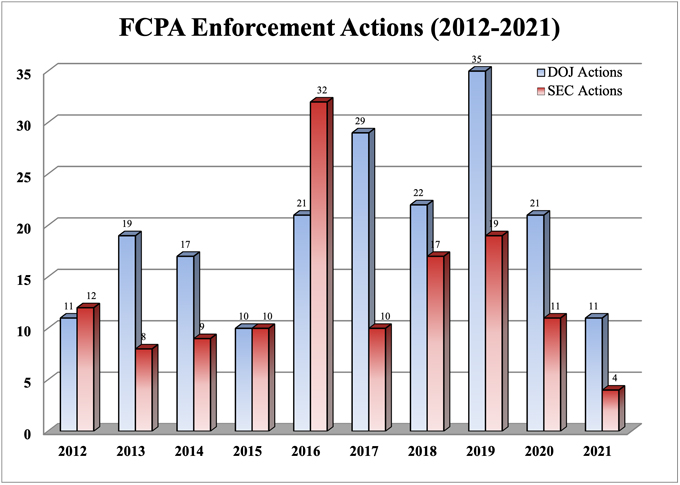
But as our readers know, the number of FCPA enforcement actions represents only a piece of the robust pipeline of international anti-corruption enforcement efforts by DOJ. Indeed, the increasing proportion of “FCPA-related” charges in the overall enforcement docket of FCPA prosecutors is a trend we have been remarking upon for years. In total, DOJ brought 17 such FCPA-related actions in 2021, bringing the overall anti-corruption figures for the past year to 28 cases filed or unsealed by DOJ. The past 10 years of FCPA plus FCPA-related enforcement activity is illustrated in the following table and graph.
| 2012 | 2013 | 2014 | 2015 | 2016 | 2017 | 2018 | 2019 | 2020 | 2021 | ||||||||||
|
DOJ |
SEC |
DOJ |
SEC |
DOJ |
SEC |
DOJ |
SEC |
DOJ |
SEC |
DOJ |
SEC |
DOJ |
SEC |
DOJ |
SEC |
DOJ |
SEC |
DOJ |
SEC |
|
12 |
12 |
21 |
8 |
23 |
9 |
12 |
10 |
27 |
32 |
36 |
10 |
48 |
17 |
54 |
19 |
40 |
11 |
28 |
4 |
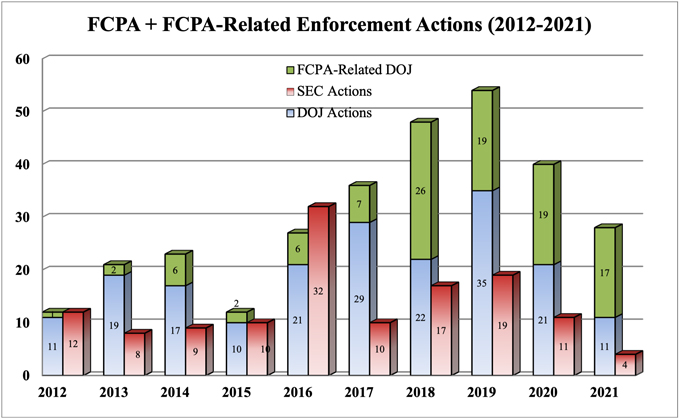
2021 FCPA-RELATED ENFORCEMENT TRENDS
In each of our year-end FCPA updates, we seek not merely to report on the year’s FCPA enforcement actions, but also to distill the thematic trends we see stemming from these individual events. For 2021, we have identified three key enforcement trends that we believe stand out from the rest:
- Sharp downturn in corporate FCPA enforcement actions and financial penalties;
- DOJ continues substantial FCPA and FCPA-related enforcement against individuals; and
- Biden Administration policies foreshadow a return to robust corporate anti-corruption enforcement in the coming years.
Sharp Downturn in Corporate FCPA Enforcement Actions and Financial Penalties
The modern era of FCPA enforcement (often described as beginning with the blockbuster Siemens resolution in 2008) may certainly be characterized by its penchant for setting enforcement records in one year, and then breaking them the next. But this overall trend has not always been linear, and indeed, frequently, there is a drop-off in cases in the years that presidential administrations change. So, it is accurate to say that corporate FCPA enforcement—after reaching new heights of penalties imposed in 2019 ($2.66 billion in corporate penalties on 21 enforcement actions) and 2020 ($2.79 billion in corporate penalties on 16 enforcement actions)—fell off the proverbial cliff in 2021 ($259.5 million on 6 enforcement actions). But we would not go nearly so far as to foretell the demise of corporate anti-corruption enforcement in the years to come. Indeed, based on what we are seeing at DOJ and the SEC, we counsel against such predictions.
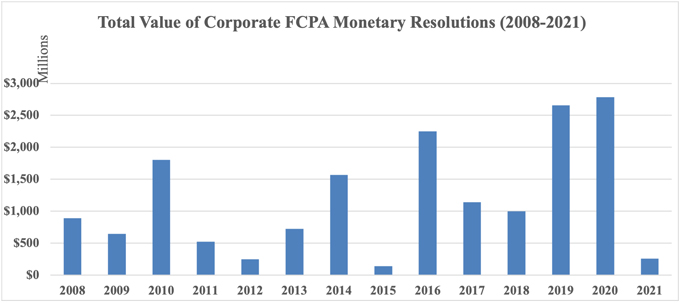
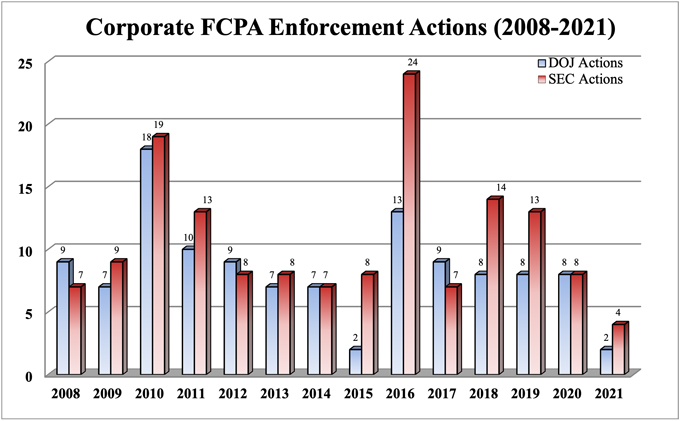
The first corporate FCPA enforcement action of 2021 was with German financial institution and U.S.-issuer Deutsche Bank AG, which on January 8 reached a coordinated FCPA resolution with DOJ and the SEC to resolve allegations of internal control deficiencies and inaccurate record-keeping associated with the use of third-party business development consultants between 2009 and 2016. The DOJ allegations focused on consultants in Abu Dhabi and Saudi Arabia, each of which was allegedly known by Deutsche Bank employees to be relatives or close associates of government officials who would pass portions of their consulting payments on to the officials in exchange for business awarded to the bank. The SEC resolution additionally identified purportedly questionable consulting relationships in China and Italy.
To resolve the criminal charges, Deutsche Bank entered into a three-year deferred prosecution agreement with DOJ alleging conspiracy to violate each of the FCPA’s books-and-records and internal controls provisions, as well as a separate wire fraud conspiracy charge associated with an unrelated commodities trading scheme that was charged together with the FCPA matter. For the FCPA misconduct, the bank paid a criminal penalty of $79.6 million, which represented a 25% discount from the middle of the U.S. Sentencing Guidelines range—this was the maximum discount for cooperation (in a non-voluntary disclosure case), but the discount was taken from the middle rather than the bottom of the range because of a prior criminal antitrust resolution in 2016. To resolve the SEC charge, Deutsche Bank consented to the entry of an administrative cease-and-desist order charging FCPA accounting violations and agreed to pay $43.3 million in disgorgement and prejudgment interest. Gibson Dunn represented Deutsche Bank in these matters.
On June 25, 2021, global engineering firm Amec Foster Wheeler Ltd. (“AFW”), which during the relevant period was principally based in the UK but traded on a U.S. exchange, reached a $177 million coordinated resolution with anti-corruption authorities in Brazil, the United Kingdom, and the United States. The U.S. charging documents allege that between 2011 and 2014, an AFW subsidiary used several agents—including one that failed AFW’s due diligence process based on compliance concerns, but nonetheless continued working “unofficially” on the project—to make more than $1 million in improper payments to win a contract with state-owned oil company Petróleo Brasileiro S.A. (“Petrobras”).
On the U.S. front, to resolve the SEC’s investigation, AFW consented to the entry of an administrative cease-and-desist order charging FCPA bribery and accounting violations and ordering $22.76 million in disgorgement and prejudgment interest. To resolve a criminal FCPA bribery conspiracy charge, a UK subsidiary of AFW entered into a three-year deferred prosecution agreement with DOJ and agreed to a criminal penalty of $18.375 million. Both the SEC and DOJ applied offsetting credits for payments to authorities in Brazil and the UK in connection with the coordinated resolution, bringing the total due to the SEC to $10.13 million and $7.66 million to the United States. The Petrobras-related allegations were only a part of a larger anti-corruption resolution reached by the UK AFW subsidiary and the SFO, which as described in our UK section below imposed the USD-equivalent of $142.7 million in penalties and disgorgement for alleged improper payments in India, Malaysia, Nigeria, and Saudi Arabia, as well as Brazil, as part of its own, separate three-year deferred prosecution agreement. The U.S. resolutions, which were coordinated by Gibson Dunn, acknowledged AFW’s cooperation and remediation by applying the maximum available 25% discount from the bottom of the U.S. Sentencing Guidelines range and not requiring an independent compliance monitor.
The third corporate FCPA enforcement action of 2021, and the only one that was resolved solely with civil SEC charges, was with WPP Plc, the world’s largest advertising group and an ADS issuer. On September 24, 2021, the SEC announced that WPP consented to the entry of a cease-and-desist order charging FCPA bribery and accounting violations, and agreed to pay $10.1 million in disgorgement, $1.1 million in prejudgment interest, and an $8 million civil penalty, without admitting or denying the SEC’s allegations.
According to the SEC’s charging document, prior to 2018, WPP deployed a global growth strategy by which it entered markets through acquisitions of smaller advertising agencies, frequently with an “earn-out provision” that deferred a portion of the purchase price pending the accomplishment of future financial goals, which in many cases the acquired agency’s founder stayed on to achieve. These newly acquired agencies and their founders were the focus of this enforcement action, with the SEC alleging improper payments in Brazil, China, India, and Peru. A DOJ investigation reportedly is ongoing, and it is not clear whether additional charges are forthcoming.
Closing out the year in corporate FCPA enforcement, on October 19, 2021 Swiss financial institution and ADR issuer Credit Suisse Group AG agreed to an FCPA resolution with the SEC and a related non-FCPA, wire fraud resolution with DOJ. The DOJ and SEC allegations concern the same Mozambique loan bribery and kickback scheme that we first reported in our 2019 Year-End FCPA Update, wherein we described FCPA and FCPA-related charges against three Credit Suisse bankers, two former Mozambican government officials and a business consultant, as well as two Lebanese former executives of a UAE shipbuilding company. The allegations are that between 2013 and 2016, the defendants structured three syndicated loan and securities offerings worth $2 billion involving Mozambican state-owned entities, from which at least $200 million was allegedly misappropriated for bribes and kickbacks to the scheme participants.
To resolve the SEC’s charges, Credit Suisse consented to an administrative cease-and-desist proceeding alleging violations of the FCPA’s accounting provisions, as well as fraud-based securities violations, and agreed to pay combined disgorgement and prejudgment interest of $34 million plus a $65 million civil penalty. To resolve the criminal investigation, Credit Suisse entered into a three-year deferred prosecution agreement with DOJ concerning, and a UK subsidiary pleaded to, wire fraud charges, and agreed to pay a cumulative criminal fine of $247.5 million, plus $10.34 million in criminal forfeiture. After applying a variety of offsets, Credit Suisse ultimately agreed to pay $99 million to the SEC, $175 million to DOJ, and $200 million to the UK Financial Conduct Authority (“FCA”) in a related resolution. The bank also agreed to forgive $200 million in debt owed by the Government of Mozambique, which the prosecutors and regulators considered, together with Credit Suisse’s remediation and cooperation efforts, in setting the $475 million combined resolution amount.
DOJ Continues Substantial FCPA and FCPA-Related Enforcement Against Individuals
DOJ filed or unsealed FCPA or FCPA-related charges against 25 individual defendants in 2021, which may be grouped as follows.
Ecuadorian Police Pension Fund Defendants
On March 2, 2021, DOJ announced the arrest of Ecuadorian citizens John Luzuriaga Aguinaga and Jorge Cherrez Miño for their alleged roles in a long-running bribery scheme involving the Instituto de Seguridad Social de la Policia Nacional (“ISSPOL”), Ecuador’s public police pension fund. DOJ alleges that from 2014 to 2020, Cherrez, an investment advisor with operations in Florida and Panama, paid more than $2.6 million in bribes to ISSPOL officials, including now-former ISSPOL Risk Director Luzuriaga, in exchange for the right to manage ISSPOL funds. Two-and-a-half months later, on May 19, 2021, Ecuadorian investment company manager Luis Alvarez Villamar pleaded guilty to money laundering conspiracy for his role in accepting funds from Cherrez in connection with the ISSPOL corruption scheme. Luzuriaga is currently scheduled for trial on money laundering charges in the Southern District of Florida in February 2022, and Cherrez is considered a fugitive on his pending FCPA bribery and money laundering charges.
Additional PDVSA (Citgo) Charges
For years, we have been covering a multi-faceted corruption investigation by DOJ with the common nucleus being Venezuelan state-owned oil company Petróleos de Venezuela S.A. (“PDVSA”). One of the investigation strands has involved a pay-to-play corruption scheme at Citgo Petroleum Corporation, PDVSA’s U.S. subsidiary, as covered most recently in our 2020 Year-End FCPA Update. On March 12, 2021, DOJ unsealed money laundering conspiracy charges initially filed two years earlier against another defendant, former Citgo buyer Laymar Giosse Pena-Torrealba. According to the charging documents, Pena-Torrealba accepted bribes from Juan Manuel Gonzalez (who himself pleaded guilty in May 2019) in exchange for helping Gonzalez’s companies to secure contracts with Citgo. Pena-Torrealba pleaded guilty to one count of money laundering conspiracy and was sentenced in November 2021 to three years of probation.
Additional PetroEcuador Charges
We also have been reporting for several years now on a multi-agency investigation into alleged corruption at Ecuador’s state-owned oil company, Empresa Publica de Hidrocarburos del Ecuador (“PetroEcuador”). This has included coordinated charges brought by DOJ and the Commodity Futures Trading Commission (“CFTC”) against energy trading firm Vitol, Inc., as well as several of its traders, as covered in our 2020 Year-End FCPA Update. On April 6, 2021, DOJ unsealed an August 2020 criminal complaint against Canadian citizen Raymond Kohut, a now-former employee of a different Swiss energy trading firm. According to the charges, two Asian state-owned entities contracted to provide loans to PetroEcuador backed by periodic oil deliveries, and Kohut’s employer negotiated with the Asian entities to market and sell those oil products. Starting in 2012, Kohut and his co-conspirators allegedly made more than $22 million in corrupt payments to PetroEcuador officials to award contracts to the Asian entities under favorable terms so that Kohut’s company could then enter related, advantageous trading agreements with the Asian entities. Kohut and his co-conspirators allegedly met to discuss the conspiracy in Florida, and some of the payments flowed through New York correspondent bank accounts. Kohut pleaded guilty to a single count of money laundering on April 6, 2021, and awaits sentencing.
Additional Odebrecht-Related Charges
The blockbuster multinational anti-corruption resolution with Odebrecht S.A. in 2016, first covered in our 2016 Year-End FCPA Update, continues to be a recurring source of FCPA and FCPA-related charges against individual defendants. On May 20, 2021, DOJ unsealed money laundering charges against Austrian citizens and bank executives Peter Weinzierl and Alexander Waldstein. The indictment alleges that Weinzierl and Waldstein moved more than $170 million through a series of fraudulent transactions and sham agreements from Odebrecht’s New York bank accounts, through Weinzierl’s and Waldstein’s Austrian bank, into accounts at an Antiguan bank allegedly used by Odebrecht as a slush fund used to pay bribes to Brazilian, Mexican, and Panamanian officials. Weinzierl was arrested on May 25, 2021 in the United Kingdom, where he is currently undergoing extradition proceedings. Waldstein remains at large.
Chadian Oil Rights Defendants
On May 24, 2021, DOJ announced the indictment of two diplomats from Chad—Mahamoud Adam Bechir and Youssouf Hamid Takane—Bechir’s wife Nouracham Bechir Niam, and the founder of a Canadian energy company, Naeem Riaz Tyab, all on FCPA or FCPA-related charges stemming from an alleged bribery scheme relating to the award of oil rights in the Republic of Chad. According to the indictment, while serving in Washington, D.C. as Chad’s Ambassador to the United States and Canada and Deputy Chief of Mission, respectively, Bechir and Takane collectively solicited and accepted $2 million in bribes, plus corporate shares, in exchange for awarding Tyab’s company oil rights worth tens of millions of dollars. Bechir’s wife Niam was allegedly brought into the scheme when Tyab received legal advice not to enter a consulting contract with a company owned by Bechir, and so instead, entered into substantially the same consulting contract with a company owned by Niam, in addition to awarding Niam substantial shares in Tyab’s company. Tyab and Niam were both charged with conspiracy to violate the FCPA, and all four defendants were charged with conspiracy to commit money laundering.
The indictment was initially handed down in February 2019, shortly before Tyab was arrested in New York City. According to court documents, Tyab immediately began cooperating and pleaded guilty in April 2019. But the case remained sealed as DOJ sought to obtain custody of the other three defendants. More than two years later, in May 2021, DOJ acknowledged that its efforts to arrest the other defendants were unlikely to be successful in the near term and moved to unseal the indictment. Further illustrating the long tail of these corruption cases, Tyab’s company—Griffiths Energy International Inc.—pleaded guilty to violations of Canada’s Corruption of Foreign Public Officials Act in 2013 as covered in our 2013 Year-End FCPA Update. Bechir, Takane, and Niam all remain at large, and Tyab is currently scheduled to be sentenced in February 2022.
Bolivian Military Equipment Defendants
Also in May 2021, DOJ announced charges against five individuals in an alleged pay-to-play bribery scheme involving the sale of tactical defense equipment to the Bolivian Ministry of Defense. DOJ alleges that Bryan Berkman, the owner of Bravo Tactical Solutions LLC, his father Luis Berkman, and his business associate Philip Lichtenfeld, all conspired to make over $600,000 in corrupt payments to former Bolivian Minister of Government Arturo Carlos Murillo Prijic and his former Chief of Staff Sergio Rodrigo Mendez Mendizabal in exchange for a $5.6 million contract to supply tear gas and other non-lethal riot equipment to the Ministry of Defense. Four of the five defendants have pleaded guilty—Bryan Berkman and Lichtenfeld to FCPA conspiracy charges and Luis Berkman and Mendez to money laundering conspiracy charges. Murillo is currently set for a May 2022 trial date on a superseding eight-count money laundering indictment.
Nigeria Oil Contract Defendant
On July 26, 2021, DOJ filed a criminal information charging Anthony Stimler, a former West Africa-based oil trader for a Swiss commodity trading and mining firm, with one count each of conspiracy to violate the FCPA’s anti-bribery provisions and money laundering conspiracy. According to the charging document, between 2007 and 2018, Stimler participated in a scheme to bribe employees of the state-owned Nigerian National Petroleum Corporation to obtain contracts for more lucrative grades of oil on better delivery schedules for the commodity trading firm. Stimler has pleaded guilty and is cooperating with DOJ on the ongoing investigation of Stimler’s former employer.
CASA Corruption Defendant
On August 4, 2021, DOJ announced the arrest of Florida businessman Naman Wakil on charges that between 2010 and 2017 he allegedly bribed officials of both PDVSA and Venezuelan state-owned food company Corporación de Abastecimiento y Servicios Agrícola (“CASA”) to secure approximately $250 million in contracts for his companies. Wakil faces substantive and conspiracy FCPA and money laundering charges. He has pleaded not guilty and is currently set for a November 2022 trial date.
Ericsson Djibouti Defendant
On September 8, 2021, DOJ announced the unsealing of a June 2020 FCPA and money laundering conspiracy indictment of former Telefonaktiebolaget LM Ericsson Horn of Africa Account Manager Afework Bereket. According to the indictment, between 2010 and 2014, Bereket participated in a scheme to pay approximately $2.1 million to two high-ranking officials in Djibouti’s executive branch and one employee of a Djibouti state-owned telecommunications company to secure a €20.3 million contract with the state-owned entity. The indictment further alleges that Bereket concealed the bribes by entering a sham consulting contract with a company owned by the spouse of one of the officials, and concealing that ownership interest from others at Ericsson. As first reported in our 2019 Year-End FCPA Update, in 2019, Ericsson entered into an FCPA resolution with DOJ and the SEC that included the Djibouti scheme. Bereket remains at large.
CLAP Corruption Defendants
On October 21, 2021, DOJ announced a money laundering indictment returned against five defendants stemming from alleged corruption involving Comité Local de Abastecimiento y Producción (“CLAP”), a Venezuelan state-owned and state-controlled food and medicine distribution program. The indictment alleges a scheme involving a staggering $1.6 billion in food and medicine contracts obtained by Colombian businessmen Alvaro Pulido Vargas, Emmanuel Enrique Rubio Gonzalez, and Carlos Rolando Lizcano Manrique, and Venezuelan businesswoman Ana Guillermo Luis obtained through corrupt payments to the then-governor of Venezuelan State Táchira, Jose Gregorio Vielma-Mora. All five defendants are considered fugitives. Pulido—who additionally faces money laundering charges stemming from a separate pay-to-play scheme described in our 2019 Year-End FCPA Update—along with Rubio and Vielma-Mora also were sanctioned by the Office of Foreign Assets Control in 2019 for alleged CLAP-related corruption.
Egyptian Coal Sale Defendant
On November 3, 2021, DOJ charged Frederick Cushmore Jr., the now-former Head of International Sales for a Pennsylvania-based coal mining company, with one count of conspiracy to violate the FCPA’s anti-bribery provisions. According to the criminal information, between 2016 and 2020, Cushmore and others at his company engaged an Egyptian sales agent to secure $143 million in coal contracts with an Egyptian state-owned company, knowing that the agent would provide a portion of his $4.8 million in commissions to officials at the state-owned entity. The information further alleges that Cushmore and others used encrypted messaging applications and commercial email accounts in an effort to avoid detection of their corruption scheme. Cushmore is currently scheduled to be sentenced in the Western District of Pennsylvania in March 2022, but the limited information available publicly suggests additional charges may be forthcoming, which would likely impact that sentencing date.
Biden Administration Policies Foreshadow Return to Robust Corporate Anti-Corruption Enforcement in the Coming Years
As noted above, there may be a slowdown in government enforcement actions that takes place with any change in presidential administrations. Although most prosecutors and enforcement lawyers at DOJ and the SEC are career attorneys who holdover across administrations, the senior political leadership often changes, and that can cause a delay in necessary approvals or willingness to move more significant cases forward until new leadership is in place. This is particularly true for high-profile enforcement activities such as corporate FCPA actions. If there was any lingering doubt, further tempering overreliance on last year’s comparatively low corporate FCPA enforcement rate, the Biden Administration took several notable steps in 2021 that lead us to anticipate a return to robust corporate enforcement in the years to come.
Biden Administration Announces U.S. Strategy on Countering Corruption
On June 3, 2021, the White House published a National Security Study Memorandum that identifies “countering corruption as a core United States national security interest.” The memorandum emphasizes the significant costs of corruption, estimated at between two and five percent of global GDP, as well as its associated impacts on less tangible (but equally important) societal goods, such as rule of law, inequality, trust in government, and national security. The memorandum directed the National Security Advisor and Assistants to the President for Economic Policy and Domestic Policy to conduct a review across numerous government agencies to devise a comprehensive anti-corruption strategy report and recommendations within 200 days.
On December 6, 2021, the Biden Administration released its first-ever “United States Strategy on Countering Corruption.” This 38-page Strategy Memorandum is structured around five “pillars”: (1) “modernizing, coordinating, and resourcing U.S. Government efforts to fight corruption”;
(2) “curbing illicit finance”; (3) “holding corrupt actors accountable”; (4) “preserving and strengthening the multilateral anti-corruption architecture”; and (5) “improving diplomatic engagement and leveraging foreign assistance to advance policy goals.” The Strategy Memorandum further emphasizes that the Biden Administration will pursue “aggressive enforcement action” in support of its anti-corruption objectives through enforcement of the FCPA and other statutes by U.S. enforcers in coordination with foreign law enforcement partners. It also suggests that the Biden Administration will seek additional tools to broaden the reach of its anti-corruption enforcement powers, including through enhanced legislation to target the “demand side” of bribery. The Strategy Memorandum further recognizes the need for increased coordination and synergy between the U.S.’s anti-corruption and anti-money laundering efforts and to address “deficiencies in the U.S. anti-money laundering regime” through the extension of regulatory compliance and reporting requirements to non-financial institution “gatekeepers,” such as lawyers, accountants, and trust and company service providers.
For additional details regarding the Strategy Memorandum, please consult our recent Client Alert, “U.S. Strategy on Countering Corruption Signals Focus on Enforcement.” And for further details on the Biden Administration’s overall approach to anti-corruption enforcement, please consult our Client Alert “Big Changes Afoot for FCPA and Anti-Bribery Enforcement?“
Deputy Attorney General Announces Changes to DOJ Criminal Enforcement Policies
In a sign of an increasingly tough approach to corporate enforcement generally, on October 28, 2021, Deputy Attorney General Lisa O. Monaco announced that DOJ is modifying certain corporate criminal enforcement policies. Specifically, these policy changes: (1) restore prior guidance concerning the need for corporations to provide non-privileged information about all individuals involved in misconduct (not just those substantially involved) in order to receive cooperation credit; (2) require prosecutors to consider a corporation’s full criminal, civil, and regulatory record in making charging decisions (not just conduct related to the misconduct at issue in the present case); and (3) make clear that there is no general presumption against monitorships and prosecutors are free to require the imposition of a corporate monitor whenever they determine it appropriate. Further, Monaco highlighted DOJ’s increasing scrutiny of companies that have received pretrial diversion (such as deferred or non-prosecution agreements) in the past, including to determine whether they continue their criminal conduct during the period of those agreements. Close in time to Monaco’s speech, several companies announced that DOJ is investigating breach allegations, including in the FCPA context an announcement by Telefonaktiebolaget LM Ericsson that DOJ determined the company breached its obligations under its deferred prosecution agreement covered in our 2019 Year-End FCPA Update.
Although these policy changes concern general corporate criminal enforcement, they touch closely upon corporate FCPA matters. For further details on Deputy Attorney General Monaco’s speech, please see our recent Client Alert, “Deputy Attorney General Announces Important Changes to DOJ’s Corporate Criminal Enforcement Policies.”
2021 FCPA-RELATED ENFORCEMENT LITIGATION
Following the filing of FCPA or FCPA-related charges, criminal and civil enforcement proceedings can often take years to wind through the courts. A selection of prior-year matters that saw material enforcement litigation developments during 2021 follows.
Two Alleged Fugitives Challenge Their Indictments from Abroad
A recurring theme in FCPA investigations is indictments returned and sometimes unsealed while the defendant is abroad. A frequently litigated issue that arises in these circumstances is whether the defendant is able to challenge the charges—frequently on jurisdictional grounds—from abroad without submitting themselves physically to the Court’s jurisdiction. Courts have reached differing conclusions on whether these challenges are barred by the so-called “fugitive disentitlement” doctrine, including two district court decisions from different circuit courts of appeal going in opposite directions in 2021.
On March 18, 2021, the Honorable Robert N. Scola, Jr. of the U.S. District Court for the Southern District of Florida denied a motion to enter a special appearance and challenge the indictment filed by Alex Nain Saab Moran, a joint Colombian and Venezuelan national charged with money laundering offenses in connection with a $350 million construction-related bribery scheme in Venezuela as covered in our 2019 Year-End FCPA Update. In January 2021, 18 months after the indictment was returned, Saab moved to vacate his fugitive status with leave to challenge his indictment on the grounds that he is a Venezuelan diplomat entitled to absolute immunity under the Vienna Convention on Diplomatic Relations, as well as that the indictment does not state an offense given Saab’s lack of connection to the United States. Saab’s motion followed his arrest in the Republic of Cape Verde, where he was detained as his plane stopped for refueling en route from Venezuela to Iran based on an INTERPOL “red notice” request filed by the United States.
Saab argued that the fugitive disentitlement doctrine should not apply because he was not in the United States when the indictment was returned—indeed he asserted he had not been to the United States in nearly three decades, long before the alleged criminal activity—and therefore he could not be correctly described as a fugitive who fled the charges. But Judge Scola disagreed, holding that a defendant who is aware of an indictment and does not appear in court to answer the charges is a fugitive regardless of whether they affirmatively fled the United States to avoid the charges—this concept is known in the Eleventh Circuit as “constructive flight.” The Court denied the motion for a special appearance and declined to consider the substantive motion to dismiss.
Saab has appealed the district court’s ruling, and DOJ has moved to dismiss the appeal. Meanwhile, the Republic of Cabo Verde granted the extradition request and transferred Saab to the United States, where he is now being detained pending trial. To fulfill a condition of the extradition, DOJ dismissed seven of the eight counts against Saab to ensure that the maximum term of imprisonment is consistent with Cabo Verde law.
The case of Daisy Teresa Rafoi Bleuler—a Swiss citizen and wealth manager charged with FCPA and money laundering offenses arising from the transfer of allegedly corrupt proceeds associated with a PDVSA-related bribery scheme covered in our 2019 Year-End FCPA Update—turned out very differently under Fifth Circuit law. Rafoi was arrested by Italian authorities, again on a U.S.-initiated INTERPOL red notice request, as she vacationed with family in Lake Como. As she underwent extradition proceedings, first in Italy and then in Switzerland, Rafoi filed a motion to dismiss the indictment on jurisdictional grounds.
In an opinion dated November 10, 2021, the Honorable Kenneth M. Hoyt of the U.S. District Court for the Southern District of Texas made short work of the government’s argument that Rafoi’s motion should not be heard under the fugitive disentitlement doctrine. The Court held that fugitive disentitlement is a discretionary doctrine, and found that where a foreign national challenges the applicability of U.S. law to their actions, without having affirmatively fled the United States, they should be permitted to do so from abroad. Moving to the merits of the motion to dismiss, Judge Hoyt fond that as a matter of law the indictment was deficient in alleging any action by Rafoi in the territory of the United States such as to bring her within the scope of 15 U.S.C. § 78dd-3, that she acted as an agent of U.S. persons under 15 U.S.C. § 78dd-2, or that she engaged in any financial transactions subject to U.S. jurisdiction under the money laundering statutes. Fundamentally, the Court found that neither the FCPA nor the money laundering statutes should be read so broadly as to apply to foreign nationals acting completely outside the United States, and that any other interpretation would lead to serious constitutional due process concerns under the “void for vagueness” doctrine.
On December 7, 2021, DOJ noticed an appeal to the U.S. Court of Appeals for the Fifth Circuit. We expect this appeal could lead to an important appellate court ruling on the breadth of the FCPA and money laundering statutes as applied to foreign nationals in 2022, likely to be joined by the heavily-anticipated revisitation of the Hoskins case by the Second Circuit Court of Appeals, covered in our 2020 Mid-Year FCPA Update and still pending after an August 17, 2021 argument.
Roger Ng Motion to Dismiss Denied
We reported in our 2018 Year-End FCPA Update on the indictment of former Goldman Sachs banker “Roger” Ng Chong Hwa on FCPA bribery and money laundering conspiracy charges arising from the 1Malaysia Development Berhad (“1MDB”) scandal in Malaysia. In October 2020, after being extradited to the United States to face these charges, Ng filed a comprehensive motion to dismiss, arguing: (1) the superseding indictment returned after his extradition from Malaysia violated the “rule of specialty,” which prohibits material changes to charges post-extradition; (2) venue in the Eastern District of New York was insufficiently alleged in the indictment; (3) the indictment did not meet the requirement of alleging that he was an “agent of an issuer” because the “U.S. Financial Institution #1” described in the indictment—meant to refer to Goldman Sachs—was in fact an “artificial combination” between various Goldman Sachs entities; (4) he could not have circumvented Goldman Sachs’s internal accounting controls because the alleged bribes were paid with 1MDB funds, rather than money from Goldman Sachs; (5) the money laundering count was deficient because it did not specify the particular Malaysia bribery statute alleged to have been violated as the requisite specified unlawful activity; (6) the so-called “silence provision” in Goldman Sachs’s deferred prosecution agreement—a standard term that prohibits companies from contracting the admitted statement of facts—violated his constitutional right to call witnesses in his defense; and (7) he was entitled to Brady disclosures from Goldman Sachs because the bank’s cooperation with DOJ made it a part of the “prosecution team.”
In September 2021, the Honorable Margo Brodie of the U.S. District Court for the Eastern District of New York denied Ng’s motion to dismiss in its entirety in an equally comprehensive, 160-page memorandum opinion. Trial is currently scheduled to commence in February 2022.
SEC Imposes $35,000 Civil Penalty—In a Case from 2016
We reported in our 2016 Year-End FCPA Update on the SEC’s enforcement action against former Och-Ziff CFO Joel M. Frank in which, without admitting or denying the SEC’s findings, Frank agreed to cease and desist from future violations of the FCPA’s books-and-records and internal controls provisions. The parties further agreed that Frank would pay a civil penalty, but in an unusual move left for another day the determination of the penalty amount. That other day came four-and-a-half years later, on March 16, 2021, when the SEC published a new cease-and-desist order imposing a $35,000 civil penalty. The new order also softened some of the allegations against Frank, acknowledging that he “expressed objections” regarding certain of the payments in question, while still taking the position that because Frank allegedly “had final signing authority” for all expenditures he was responsible for causing the company’s accounting violations.
Baptiste and Boncy FCPA Convictions Reversed for Ineffective Assistance of Counsel
We reported in our 2019 Year-End and then 2020 Mid-Year FCPA updates on the jury trial convictions of retired U.S. Army colonel Joseph Baptiste and businessperson Roger Richard Boncy on conspiracy to violate the FCPA and the Travel Act arising from an FBI sting simulating a bribery scheme involving Haitian port project investments, followed by the post-trial grant of a new trial to both defendants based on the ineffective assistance of Baptiste’s counsel infecting the fundamental fairness of the joint trial. DOJ appealed the new trial grants but, on August 9, 2021, the U.S. Court of Appeals for the First Circuit affirmed the district court’s ruling.
On appeal DOJ did not contest the lower court’s deficient-performance findings—which included that Baptiste’s counsel did not open discovery files or share them with his client, did not obtain independent translations of Haitian-Creole audio recordings even after learning of deficiencies in the government’s translations, and did not subpoena any defense witnesses, including experts who could have testified about Haitian law or business practices. Instead, DOJ argued that the “overwhelming” evidence against both defendants was so strong that there was no prejudice based on the deficient performance of Baptiste’s counsel, and even if there was that prejudice did not extend to Boncy, whose counsel was competent. Writing for the First Circuit panel, the Honorable O. Rogeriee Thompson disagreed and held that the focus of Fifth and Sixth Amendment rights to due process and counsel is on the fundamental fairness of the proceeding, which clearly was undermined for both defendants based on the deficient performance of one defendant’s counsel. Both cases have been remanded to the district court and a joint retrial is currently set for July 2022.
2021 FCPA-RELATED LEGISLATIVE AND POLICY DEVELOPMENTS
In addition to the enforcement developments covered above, 2021 saw numerous important developments in FCPA-related legislative and policy areas.
Congress Strengthens SEC Disgorgement Authority
On January 1, 2021, Congress passed the National Defense Authorization Act (“NDAA”) for the 60th consecutive year, overriding a presidential veto from then-President Trump. Included within the nearly 1,500 pages of omnibus legislation, at Section 6501, is an expansion of the SEC’s statutory authority to seek disgorgement. These revisions are clearly a response to recent Supreme Court decisions in Kokesh v. SEC and Liu v. SEC, both of which narrowed the scope of the SEC’s disgorgement power, which (as our readership knows) is a critical driver of the SEC’s ability to penalize corporate and individual misconduct, including in FCPA cases. The Section 6501 changes explicitly authorize the SEC to seek disgorgement in cases filed in federal court, eliminating any residual doubt after Liu. They also extend the statute of limitations from five years to ten years for SEC enforcement actions based on scienter-based claims, a change which applies to both pending cases and enforcement actions initiated after the passage of the NDAA. For further details regarding the impact of Section 6501, please consult our separate Client Alert “Congress Buries Expansion of SEC Disgorgement Authority in Annual Defense Budget.”
Congress Passes Comprehensive Anti-Money Laundering Legislation
The NDAA also included the Anti-Money Laundering Act of 2020 (“AMLA”), which enacted the most consequential set of anti-money laundering reforms since the passage of the USA PATRIOT Act in 2001. As our readership knows, U.S. enforcers increasingly use the money laundering laws to prosecute and pursue proceeds of corruption passed through the U.S. financial system. The AMLA strengthens the government’s ability to investigate and prosecute corruption-related money laundering. Specifically, to limit the practice of using shell companies to launder ill-gotten gains, the AMLA implemented beneficial ownership reporting requirements for certain U.S. entities and foreign entities registered to do business in the United States and tasked the Department of Treasury’s Financial Crimes Enforcement Network (“FinCEN”) with maintaining a beneficial ownership registry of such reported information, which will be available for use by law enforcement agencies. Other changes made by the AMLA include enhancing the government’s ability to investigate money laundering, including by expanding DOJ’s authority to subpoena foreign banks with U.S.-based correspondent banking accounts. For a detailed summary of the most significant changes enacted by the AMLA, please see our separate Client Alert, “The Top 10 Takeaways for Financial Institutions from the Anti-Money Laundering Act of 2020.”
FinCEN Identifies Corruption as a Key National Priority
On June 30, 2021, FinCEN announced its first set of government-wide anti-money laundering and countering the financing of terrorism priorities, which will be updated every four years pursuant to the AMLA. FinCEN developed these priorities in consultation with federal and state regulators, law enforcement, and national security agencies. In its announcement, FinCEN explained that these priorities were meant to identify and describe the most significant money laundering and terrorist financing threats currently facing the United States to both signal FinCEN’s upcoming regulatory priorities and to provide guidance to covered institutions in developing and updating their compliance programs. Although FinCEN’s announcement stated that the priorities were listed in no particular order, it bears noting that corruption was the first priority listed. Consistent with other statements by the U.S. government in 2021, as reported herein, FinCEN identified anti-corruption as “a core national security interest of the United States,” in which anti-money laundering regulation and enforcement plays a crucial role.
New IRS Treatment of FCPA Disgorgement Payments
The U.S. Internal Revenue Service (“IRS”) has long prohibited tax deductions for fines or penalties paid to the government for unlawful conduct, including violations of the FCPA. But a question has arisen over the years as to whether disgorgement and forfeiture constitute a fine or penalty such that it is non-deductible. As covered in our 2017 Year-End FCPA Update, the IRS answered that question in the affirmative, issuing an advice memorandum opining that consistent with the Supreme Court’s decision in Kokesh v. SEC, disgorgement is equivalent to a penalty. The December 2017 Tax Cuts and Jobs Act, however, revised the Internal Revenue Code to make an exception for amounts paid to the government for restitution, remediation, or to come into compliance with the law. In January 2021, the IRS issued a finalized rule in response to this law, which sets out a multi-factored inquiry to determine whether an amount paid in disgorgement or forfeiture is deductible as restitution or remediation. The requirements are quite stringent and generally inconsistent with DOJ / SEC practice in FCPA resolutions, including a requirement that the payments must be made directly to victims rather than to the U.S. Treasury, potentially continuing to limit the ability of companies to deduct amounts paid as disgorgement or forfeiture in an FCPA enforcement action.
2021 FCPA-RELATED PRIVATE CIVIL LITIGATION
Although the FCPA does not provide for a private right of action, civil litigants have pursued a variety of causes of action in connection with FCPA-related conduct, with varying degrees of success. A selection of matters with material developments in 2021 follows.
Shareholder Lawsuits / Class Actions
- MTS – As covered in our 2019 Year-End FCPA Update, Russian telecommunications company and U.S. issuer Mobile TeleSystems PJSC (“MTS”) reached an $850 million joint FCPA resolution with the SEC and DOJ to resolve allegations of corrupt payments to the daughter of the late Uzbek president, to facilitate access to the telecommunications market in Uzbekistan. Shortly after the announcement of this settlement, a class action suit was filed against MTS and several individual defendants in the U.S. District Court for the Eastern District of New York, alleging that MTS issued false and misleading statements about the company’s inability to predict the outcome of the U.S. government’s investigations into its Uzbekistan operations, the effectiveness of the company’s internal controls and compliance systems, and its level of cooperation with U.S. regulatory agencies. On March 1, 2021, the Honorable Ann M. Donnelly dismissed the lawsuit, finding that the plaintiffs did not demonstrate that the challenged statements were false or misleading, that MTS could not have predicted the outcome of the investigation, and that its disclosures about the existence of the investigation were not insufficient. Plaintiffs have appealed the dismissal to the Second Circuit Court of Appeals, and the case is currently set for argument in March 2022.
- VEON – We covered in our 2016 Mid-Year FCPA Update an FCPA resolution by then-VimpelCom Ltd. (now VEON Ltd.) in connection with the same Uzbek fact pattern described above for MTS. VEON also found itself faced with a putative class action arising from alleged material omissions in securities filings relating to the adequacy of its internal controls, which also was dismissed in 2021. Specifically, on March 11, the Honorable Andrew L. Carter of the U.S. District Court for the Southern District of New York granted VEON’s motion to dismiss finding that the plaintiffs failed to establish that the company omitted material facts that it had a duty to disclose. This mooted the case as to lead plaintiffs, but the Court reopened the lead plaintiff appointment process, which remains ongoing.
- IFF – In 2018, following an acquisition of Israel-based Frutarom Industries Ltd, International Flavors & Fragrances, Inc. (“IFF”) disclosed that during the integration process it learned that pre-acquisition Frutarom executives had made improper payments in Russia and Ukraine, and that IFF had disclosed the matter to DOJ. Shareholders brought suit against IFF, Frutarom, and certain executives, claiming they lost millions of dollars when the news became public and IFF’s share price dropped. On March 30, 2021, the Honorable Naomi Reice Buchwald of the U.S. District Court for the Southern District of New York dismissed the lawsuit, explaining that the investors failed to show how they were misled by IFF, failed to allege improper conduct during the putative class period, and failed even to adequately allege how the payments by the Israeli company Frutarom violated U.S. law. The plaintiff shareholders have appealed aspects of the decision to the Second Circuit, with oral arguments scheduled for February 2022.
- 500.com – In 2020, shareholders brought suit against Chinese online gaming company and U.S. issuer 500.com Ltd., alleging that company executives made improper payments to Japanese government officials to secure a lucrative gaming license, and then made misrepresentations concerning the same in the company’s public filings, including filings containing the text of its code of conduct. On September 20, 2021, the Honorable Gary R. Brown of the U.S. District Court for the Eastern District of New York granted 500.com’s motion to dismiss, adopting the report and recommendation of Magistrate Judge A. Kathleen Tomlinson. The two decisions together note that only in rare circumstances have courts permitted statements in a code of conduct to survive motions to dismiss and in those rare cases, the statements were made in response to inquiries or challenges to the company’s conduct rather than general, aspirational statements about how the company expects its employees to act. Regarding the alleged misstatements or omissions unrelated to the code of conduct, Judge Tomlinson found that the plaintiff failed to allege scienter adequately and that 500.com was not obligated to disclose uncharged wrongdoing.
- OSI – As reported in our 2019 Year-End FCPA Update, OSI Systems, Inc. succeeded in dismissing a putative class action lawsuit that arose from a short-seller’s report relating to alleged corruption in connection with an Albanian scanning contract (the underlying conduct of which was declined for prosecution by DOJ and the SEC), but plaintiffs were given leave to amend. Amend they did, and on October 22, 2021, OSI agreed to a $12.5 million settlement to resolve the matter. The October 2021 settlement agreement has received preliminary approval from the Honorable Fernando M. Olguin of the U.S. District Court for the Central District of California, and a final fairness hearing is scheduled for May 2022.
- Cognizant – Another FCPA enforcement case we covered in our 2019 Year End FCPA Update that wound its way towards a private civil resolution in 2021 concerns Cognizant Technology Solutions Corporation. Following an SEC FCPA resolution and DOJ declination with disgorgement arising from an alleged bribery scheme in India, a putative class of investors sued Cognizant in the U.S. District Court for the District of New Jersey. On September 7, 2021, Cognizant reached an agreement-in-principle to a $95 million settlement of the matter, which was approved by the Honorable Esther Salas on December 20, 2021.
Civil Fraud / RICO Actions
- Samsung – We covered in our 2019 Year-End FCPA Update a DOJ FCPA resolution reached by Samsung Heavy Industries Co., Ltd. arising from alleged corruption of Petrobras officials in the “Operation Car Wash” investigation. Also in 2019, Petrobras’s U.S. subsidiary filed a RICO / common-law fraud complaint against Samsung in Texas state court, which Samsung removed to federal district court and moved to dismiss. In June 2020, the district court dismissed the complaint on statute-of-limitation grounds, but on August 11, 2021 the U.S. Court of Appeals for the Fifth Circuit revived the case, finding that when Petrobras learned (or should have learned) of the corruption allegations such as to begin the clock was a dispute of fact and that Samsung had not conclusively established that Petrobras’s claims accrued before Petrobras filed its complaint. Following the Fifth Circuit’s remand, the case is now back before the Honorable Lee H. Rosenthal of the U.S. District Court for the Southern District of Texas.
- Ericsson – In an unfiled (but still quite noteworthy) action, on May 12, 2021 Telefonaktiebolaget LM Ericsson announced that it had reach an agreement to pay competitor Nokia Corporation $97 million to settle potential damages claims arising from the events that were the subject of Ericsson’s FCPA 2019 resolution with DOJ and the SEC. That resolution, covered in our 2019 Year-End FCPA Update, resulted in more than $1 billion in fines for alleged FCPA violations in China, Djibouti, Indonesia, Kuwait, Saudi Arabia, and Vietnam. There are no public details about Nokia’s claims, but it would seem that the case was predicated on Nokia losing out on competitive bids due to Ericsson’s alleged corruption.
Whistleblower Actions
- Western Digital – On June 25, 2021, Chief Judge Richard Seeborg of the U.S. District Court for the Northern District of California granted Western Digital Corp.’s motion to dismiss a bribery-related whistleblower lawsuit for lack of jurisdiction and failure to state a claim. The lawsuit was brought by a Brazilian citizen formerly employed by Western Digital’s Brazilian subsidiary, who alleged that he was terminated in retaliation for raising bribery and tax fraud concerns in violation of the Dodd-Frank Wall Street Reform and Consumer Protection Act of 2010 (“Dodd-Frank”). In dismissing the case, the Court held that Dodd-Frank’s anti-retaliation provision does not apply to overseas conduct. Moreover, the Court held that, even if the claim alleged domestic wrongdoing, the former employee “failed to allege sufficient facts to give rise to a plausible inference that he suffered adverse employment actions in retaliation for whistleblowing” given the length of time between his report and his termination and the fact that he caused the company to be victimized by a phishing scam close in time to his firing.
2021 INTERNATIONAL ANTI-CORRUPTION DEVELOPMENTS
Multilateral Development Banks
U.S. Federal Court Reinforces World Bank Sovereign Immunity
In our 2016 Year-End FCPA Update, we discussed the landmark Canadian Supreme Court decision in World Bank Group v. Wallace, which concluded that the Bank had not waived its privileges and immunities by providing evidence gathered in a Bank investigation to national law enforcement authorities. On April 5, 2021, Chief Judge Beryl A. Howell of the U.S. District Court for the District of Columbia reached a similar conclusion in a lawsuit filed by businessmen Noah J. Rosenkrantz and Christopher Thibedeau against the Inter-American Development Bank (“IDB”) asserting that the internal sanctions proceedings against their company failed to comply with the sanctions procedures governing such procedures, in violation of its contractual obligations. In dismissing the lawsuit, the Court held that the IDB is immune from suit in U.S. federal court as a sovereign entity and emphasized, like the Canadian court in Wallace, that a contrary ruling would undermine the Bank’s ability to carry out its mission. The plaintiffs have appealed the dismissal to the U.S. Court of Appeals for the District of Columbia Circuit.
Europe
United Kingdom
WGPSN (Holdings)
On March 16, 2021, Scotland’s Crown Office and Procurator Fiscal Service announced that WGPSN, a subsidiary of John Wood Group PLC, agreed to pay £6.46 million to Scotland’s Civil Recovery Unit to resolve allegations that PSNA Limited, a company WGPSN had acquired, benefitted from improper payments to secure contracts in Kazakhstan. These payments were allegedly made between 2012 and 2015, all prior to WGPSN’s acquisition, and when discovered by WGPSN were voluntarily reported to Scottish authorities.
GPT Special Project Management Ltd.
On April 28, 2021, the UK Serious Fraud Office (“SFO”) announced that Airbus subsidiary GPT Special Project Management pleaded guilty to corruption in violation of section 1 of the Prevention of Corruption Act 1906 and was ordered to pay a confiscation order of £20,603,000, a fine of £7,521,920, and costs of £2,200,000. The charges arise from alleged improper payments involving the Saudi Arabian National Guard. In setting the penalty, Justice Bryan at Southwark Crown Court considered GPT’s guilty plea, the fact that it no longer is in operation, the company’s cooperation with the SFO’s investigation, and the UK government’s role in facilitating the conduct. Also relevant was the fact that parent company Airbus entered into a $3.9 billion deferred prosecution agreement in January 2020 (as covered in our 2020 Mid-Year FCPA Update).
Amec Foster Wheeler Energy Ltd.
As covered above, on June 25, 2021 Amec Foster Wheeler reached a coordinated anti-corruption resolution with UK, U.S., and Brazilian authorities. The U.S. and Brazilian cases related to only to Brazil, while the UK case brought by the SFO is broader and covers alleged corrupt payments between 1996 and 2014 in India, Nigeria, Saudi Arabia, and Malaysia, as well as Brazil. Pursuant to a three-year deferred prosecution agreement approved by Lord Justice Edis, sitting at the Royal Courts of Justice, Amec Foster Wheeler agreed to pay £103 million in connection with a 10-count indictment, including nine counts of violating Section 1 of the Criminal Law Act 1977 and Section 1 of the Prevention of Corruption Act 1906 and one count of failure to prevent bribery under Section 7 of the Bribery Act 2010.
Petrofac Ltd.
On October 1, 2021, the SFO secured the conviction of Petrofac for seven separate counts of failure to prevent bribery between 2011 and 2017. Petrofac admitted to failing to prevent former senior executives of the group’s subsidiaries from using agents to pay bribes of £32 million to win oil contracts in Iraq, Saudi Arabia, and the United Arab Emirates worth approximately £2.6 billion. Petrofac will pay a confiscation order of £22.8 million; a fine of approximately £47.2 million; and the SFO’s investigation costs of £7 million. On the same day, Petrofac’s former Global Head of Sales David Lufkin was sentenced to a two-year custodial sentence, suspended for 18 months, as a result of his January 14, 2021, guilty plea admitting to three individual counts of bribery related to corrupt offers and payments made between 2012 and 2018 to influence the award of contracts to Petrofac in the United Arab Emirates. Lufkin had previously pleaded guilty in February 2019 to 11 counts of bribery already brought by the SFO (as discussed in our 2019 Year-End FCPA Update).
Unaoil Individual Prosecutions
On February 24, 2021, the SFO secured the conviction of former SBM Offshore executive Paul Bond arising out of his role in allegedly conspiring to bribe public officials to secure oil contracts from Iraq’s South Oil Company in the years following the overthrow of Saddam Hussain in 2003. A jury found the former senior sales manager guilty on two counts of conspiracy to give corrupt payments following a retrial of his case. On March 1, 2021, Bond was sentenced to three-and-a-half years in prison, making him the fourth individual to be sentenced in the case involving Iraq’s South Oil Company, which forms part of the SFO’s broader investigation into bribery at Unaoil. As covered in our 2020 Year-End FCPA Update, Bond’s three co-defendants have been sentenced to a collective total of 11 years and four months in prison.
On June 17, 2021, the SFO secured an approximately £402,000 confiscation order by consent against former Unaoil executive Basil Al Jarah. And on November 3, 2021, Stephen Whiteley, former Vice President at SBM Offshore and Unaoil’s territory manager for Iraq, was ordered to repay criminal gains of £100,000.
In a judgement handed down on December 10, 2021, the UK Court of Appeal quashed the conviction of Ziad Akle, another Unaoil executive who was convicted in 2020 of conspiracy to give corrupt payments as covered in our 2020 Year-End FCPA Update. The Court criticized the SFO for its contact with a U.S.-based “fixer” who had offered to assist in obtaining the convictions of related parties. The Court also found that the SFO had failed to disclose material relating to that contact, which was necessary for the defense to properly bring its case. The Court refused an application for a retrial on the grounds of the SFO’s misconduct. The UK Attorney General has since announced an independent review into the matter. Bond has appealed his conviction on the same grounds as Akle.
SFO Deferred Prosecution Agreements with Two Unidentified Companies
On July 19, 2021, the SFO entered into separate deferred prosecution agreements with two UK-based companies for bribery offenses. The SFO did not identify the companies because the investigations are ongoing, but confirmed that the criminal conduct saw bribes paid in relation to multi-million pound UK contracts. The two companies will pay more than £2.5 million between them, representing disgorgement of profits along with a financial penalty, and the SFO acknowledged that both companies fully cooperated. We will report back on these agreements when the companies names are made public.
France
A bill to strengthen the fight against corruption in France was registered at the French National Assembly on October 19, 2021. The bill outlines several proposals concerning the French Anti-Corruption Agency (“AFA”), the extension of anti-corruption obligations of public and private actors, the regulation of lobbying, and negotiated justice. Among other things, the bill would extend anti-corruption obligations to subsidiaries of large foreign organizations. The text also would make companies and public entities (other than the French State) criminally liable if a lack of supervision led to the commission of one or more offenses by an employee.
Italy
After more than three years of proceedings, in March 2021 an Italian court acquitted oil companies Royal Dutch Shell and Eni SpA, as well as a number of individuals, including the Eni CEO, of charges that they paid more than $1 billion to acquire the license to an offshore block in Nigeria. Prosecutors alleged that the money was intended as bribes, while the companies successfully defended with evidence that the payment was legitimate and intended to resolve long-running disputes as to the block’s ownership.
Kyrgyzstan
On May 31, 2021, Kyrgyzstan’s State Committee for National Security announced the arrest of former Prime Minister Omurbek Babanov as part of an investigation into corruption involving a gold mine project in Kumtor. The project was operated by Canadian company Centerra Gold until the Kyrgyz government took it over, citing a new law allowing it to take control of a project for up to three months due to environmental or safety violations. The Kumtor mine accounts for more than 12% of the national economy, according to Centerra, which has denounced the Kyrgyz government’s seizure.
Norway
In our 2015 Year-End FCPA Update, we reported that several senior level officers of Norwegian fertilizer manufacturer Yara International ASA were sentenced to prison in Norway for their role in an alleged scheme to pay bribes to government officials in India, Libya, and Russia. The former chief legal officer in particular, U.S. citizen Kendrick Wallace, received a two-and-a-half year prison sentence for his role. In 2017 the Norwegian appeals court upheld Wallace’s conviction and revised his sentence to seven years, finding that his conduct had been “very central” to the alleged scheme.
Norway subsequently submitted a request for extradition of Wallace. On June 11, 2021, the Honorable Sean P. Flynn, Magistrate Judge of the U.S. District Court for the Middle District of Florida, denied the request. The Court found that “Wallace cannot be extradited because the prosecution for the offense of which extradition is sought has become barred by lapse of time according to the laws of the United States.” Specifically, the Court found that while Wallace’s crimes were committed in 2007, he was indicted in 2014, exceeding the applicable five-year statute of limitations in the United States. The DOJ provided evidence that Norway sought evidence pursuant to Mutual Legal Assistance Treaty requests—which would toll the statute of limitations in the United States pursuant to 18 U.S.C. § 3292—but the Court found the specific evidentiary showing lacking, and ordered Wallace’s release from custody.
Russia
The Russian Federation Prosecutor General’s office reported nearly 30,000 corruption-related crimes in the first nine months of 2021, a 12.7% increase as compared to the same period a year ago, with bribery accounting for more than half of all corruption-related offenses. The reported damage caused by corruption-related crimes also increased from 45 billion rubles (approximately $612 million) to 53 billion rubles (approximately $719 million). In 2020, the number of corruption-related convictions of Russian officials was at an eight-year low of just under 7,000, continuous decline from a high of approximately 11,500 in 2015, but the number of convictions stemming from large-scale bribes, defined as greater than one million rubles (approximately $13,700), has increased 12-fold since 2012.
On the legislative front, on October 1, 2021, the Russian Duma approved the National Plan For Countering Corruption through 2024. This plan prioritizes prohibiting anyone who has been fined for corrupt activities from holding government positions, improving the procedures for the submission and auditing of government employees’ asset declarations, implementing technology to combat corruption, instituting anti-corruption regulations involving the purchase of goods and services for government/municipal use, monitoring international agreements for cooperation in fighting corruption, and employing Duma deputies to participate in an inter-parliamentary organization aimed at preventing corruption.
And on the judicial front, on June 9, 2021, a Moscow court issued a decision classifying activist Alexei Navalny’s political organization, the Anti-Corruption Foundation (“ACF”), as an “extremist” movement. Under the applicable “anti-extremism” law, authorities can jail ACF members and freeze their assets, and those associated with the group cannot run for public office. On August 10, 2021, Russia’s financial watchdog—the Federal Financial Monitoring Service—also added ACF to its blacklist of groups accused of extremist activities or terrorism, which freezes the organization’s bank account and prevents ACF from opening new accounts.
Sweden
In our 2019 Year-End FCPA Update, we covered the trial acquittal in Sweden of three former Telia executives—former CEO Lars Nyberg, former deputy CEO and head of Eurasia unit Tero Kivisaari, and former general counsel for the Eurasia unit Olli Tuohimaa—on charges of bribing Uzbek’s then-first daughter Gulnara Karimova in exchange for telecommunications contracts in Uzbekistan. In February 2021, a Swedish appeals court upheld the acquittals, agreeing that Karimova, the daughter of Uzbekistan’s former president, was not a government official under Swedish law.
Switzerland
In January 2021, a Swiss court convicted Beny Steinmetz of 2019 charges (discussed in our 2019 Year-End FCPA Update) of paying bribes to the wife of former-Guinean President Lansana Conté and of related forgery to obtain a mining concession. He was sentenced to five years in prison and ordered to pay a CHF 50 million fine (~ $56.5 million).
In November 2021, three Swiss subsidiaries of Netherlands-based SBM Offshore were ordered to pay more than CHF 7 million (~ $7.6 million) for failing to prevent the bribery of public officials in Angola, Equatorial Guinea, and Nigeria between 2006 and 2012. The Office of the Attorney General of Switzerland found that these companies had entered into sham contracts with shell companies to pay more than $22 million in bribes. The Office of the Attorney General alleged that in light of the “extent and duration of the acts of corruption,” the companies’ risk assessment measures and anti-corruption controls were allegedly “either non-existent, or wholly inadequate.” This order is in addition to the more than $800 million that SBM Offshore has already paid to resolve corruption probes dating back to its 2017 FCPA resolutions reported in our 2017 Year-End FCPA Update.
Ukraine
Ukrainian President Zelensky’s focus in the first half of 2021 was on securing the release of the remainder of a $5-billion IMF loan to bolster Ukraine’s economy. After a six-week virtual mission to Ukraine in the beginning of 2021, the IMF refused to release the funds in what some viewed as an indication that Ukraine had not met the IMF’s expectations for tackling corruption. Following this refusal, in June 2021, Ukraine’s parliament, the Verkhovna Rada, passed two bills: the first reestablished the High Judicial Council, a special commission on appointing judges that will be majority-comprised of international experts; and pursuant to the second bill, public officials who fail to submit or submit false income or asset declarations could face prison sentences. Additionally, on November 8, 2021, President Zelensky signed into law amendments to legislation that provide for the independence of the anti-corruption bureau (“NABU”). Subsequently, on November 22, 2021, following a review by its Executive Board, the IMF announced that Ukrainian authorities would be allowed to draw on an additional $699 million.
The Americas
Brazil
In February 2021, President Bolsonaro disbanded Operation Car Wash, one of the most prolific anti-corruption investigations of all time and a staple of these updates for years. Operation Car Wash led to dozens of convictions, many prominent enforcement actions, and hundreds of millions of dollars in penalties within Brazil and billions of dollars globally. Still, the ripples of Operation Car Wash continued throughout the year. For example, on February 22, 2021, Korean engineering company Samsung Heavy Industries Co., Ltd. entered into a leniency agreement in Brazil to resolve allegations concerning contracts with Petróleo Brasileiro S.A. (Petrobras). Samsung Heavy Industries, as covered in our 2019 Year-End FCPA Update, previously in November 2019 entered into a deferred prosecution agreement with DOJ and agreed to pay a $75.5 million criminal fine to resolve FCPA anti-bribery conspiracy charges arising from the company’s alleged provision of $20 million to an intermediary, while knowing that some or all of that amount would be paid to officials at Petrobras. Half of the U.S. criminal fine was to be credited to a parallel resolution with Brazilian authorities. In connection with the Brazilian leniency agreement, Samsung Heavy Industries agreed to pay approximately R$ 706 million in damages to Petrobras together with R$ 106 million in fines. And on April 15, 2021, Brazil’s Supreme Court upheld a ruling annulling one of the most notable convictions resulting from Operation Car Wash—that of former President Luiz Inácio Lula da Silva, on grounds that the lower court in which Lula was tried did not have jurisdiction. The case was transferred to a federal court for retrial and, should no conviction follow, Lula will be able to run for presidential office in the upcoming 2022 election.
In August 2021, Brazil’s Federal Prosecution Service (“MPF”) filed a criminal complaint against two executives at French engineering company Doris Group over allegedly corrupt activity concerning platform vessel contracts totaling more than $200 million. The MPF also charged a former treasurer of Brazil’s Workers’ Party and two associates for active and passive money laundering. The executives allegedly paid bribes via a financial operator to a former manager of Petrobras and the former treasurer. The financial operator and Petrobras manager both signed collaboration agreements with the MPF in which they confessed to their roles in the scheme and cooperated by providing relevant documents and information.
In September 2021, a review body within the São Paulo prosecutor’s office vacated a resolution prosecutors reached with EcoRodovias in 2020. The now-nullified agreement was the culmination of a two-year bribery investigation into EcoRodovias and its subsidiaries concerning allegations that the companies engaged in a cartel that bribed public officials to obtain road concessions contracts between 1998 and 2015. In signing the 2020 agreement, EcoRodovias admitted to paying bribes and agreed to pay a fine of $113.72 million. The review body threw out the agreement due to a lack of evidence of illegal conduct.
And on October 27, 2021, Rolls Royce signed an agreement with Brazil’s Office of the Comptroller and Attorney General’s Office to pay $27.8 million to settle allegations that it bribed Brazilian public officials in connection with its contracts with Petrobras. As covered in our 2017 Mid-Year FCPA Update, the company in 2017 previously agreed to pay more than $800 million through a global resolution with the SFO, DOJ, and MPF. Under the new agreement, Brazilian officials will credit the $25.6 million that Rolls Royce paid to the MPF, leaving the company to pay another $2.2 million.
Canada
As reported in our 2019 Year-End FCPA Update, in September 2018 Canada passed legislation allowing deferred prosecution agreements for corporate offenders. In 2019, following a long-running investigation into alleged bribery of Libyan officials, engineering and construction giant SNC-Lavalin became one of the first major companies to seek such an agreement. Canadian prosecutors, however, reportedly were unwilling to negotiate with the company, and in 2021, prosecutors charged the company with several offenses, including fraud against the government. The Royal Canadian Mounted Police also arrested two former executives and charged them with fraud and forgery offenses tied to the investigation. The company has publicly stated that it is cooperating with the investigation and that prosecutors have invited it to negotiate a settlement. According to SNC-Lavalin, it is the first company to receive such an offer.
In August 2021, the Court of Appeal for Ontario threw out the bribery convictions of two former employees of Cryptometrics. As discussed in our 2019 Year-End FCPA Update, following trial in 2018, U.S. citizen Robert Barra and UK citizen Shailesh Govindia were sentenced to two-and-a-half years in prison for agreeing to bribe Indian aviation officials, including employees of Air India. But the appellate court found a “reasonable possibility” that prosecutors delayed disclosing emails they exchanged with a principal witness—the former Cryptometrics COO—and that such delay unduly impacted the trial’s fairness. The appellate court further found that the prosecution’s slow production of potentially exculpatory information, only after repeated requests from the defense, deprived the defense of the opportunity to conduct further lines of inquiry or obtain additional evidence.
Costa Rica
Costa Rican officials have been investigating an alleged scheme known as “Cochinilla,” involving allegations that certain construction companies bribed government officials to secure contracts to build public roads, resulting in approximately $125 million in misappropriated funds. On June 14, 2021, the Costa Rican Judicial Investigation Police executed 57 search warrants and made 28 arrests in connection with the investigation, including at the Casa Presidencial, the National Highway Council, the Ministry of Public Works and Transport, and the Public Transport Council, as well as at private homes and at the offices of several construction companies. In August 2021, the Judicial Investigation Police unearthed a trove of invoices apparently related to the investigation buried in a municipal cemetery.
Additionally, on November 16, 2021, six mayors—including the current mayors of San José, Escazú, Alajuela, Osa, and San Carlos—were arrested in connection with the “Diamante” investigation into public works corruption. The Diamante investigators conducted more than 80 raids across the country in connection with the probe.
Ecuador
In April 2021, Ecuador’s Comptroller General Pablo Celi, former Oil Minister José Augusto Briones, and several others were arrested as part of the long-running investigation concerning Ecuador’s state-owned oil company Empresa Pública de Hidrocarburos del Ecuador (“PetroEcuador”). The alleged scheme, covered previously in these pages, allegedly allowed contracting companies to charge PetroEcuador artificially inflated prices to supply fuel, with a percentage of the profits then kicked back to PetroEcuador executives. Augusto died in his jail cell by apparent suicide while awaiting trial.
El Salvador
In July 2021, prosecutors in El Salvador issued an arrest warrant for former president Salvador Sánchez Cerén in connection to the “Public Looting” scam that allegedly occurred while Sánchez Cerén was serving as Vice President from 2009 to 2014. The scandal allegedly involved $351 million in government funds illegally used to pay bonuses to government employees and their associates. Two weeks after the warrant was issued, Sánchez Cerén and his family fled to Nicaragua.
Peru
In an offshoot of the Odebrecht investigation (covered in our 2019 Year-End FCPA Update), in May 2021 Peru’s Attorney General and National Public Prosecution Office announced a plea agreement with Peruvian real estate and construction company Aenza (formerly Graña y Montero), to resolve allegations that the company, two subsidiaries, and certain former employees were involved in corruption in connection with several public infrastructure projects in the country. Under the agreement, Aenza will pay approximately $126 million to the state over several years.
Earlier, in March 2021, prosecutors charged former presidential candidate Keiko Fujimori with money laundering following a multi-year investigation into allegations that she received more than $1 million in bribes from Odebrecht during a prior presidential run. Prosecutors are seeking a sentence of 30 years in prison, while Fujimori denies any wrongdoing. In June 2021, Fujimori’s opponent in the presidential race claimed victory, which Fujimori disputed before conceding in August 2021. The first hearing related to Fujimori’s trial began in late August 2021.
Finally, on September 28, 2021, Magistrate Judge Thomas Hixson of the U.S. District Court for the Northern District of California granted Peru’s request to extradite former Peruvian President Alejandro Toledo. Peru had been seeking Toledo’s extradition since May 2018, and Toledo was arrested in 2019, in connection with alleged corruption and money laundering in an Odebrecht project for the construction of the Peru-Brazil Southern Interoceanic Highway. In his ruling, Judge Hixson found that there was enough evidence to “establish probable cause to believe that Toledo committed collusion and money laundering.” The Court said that this included testimony from Odebrecht’s former executive director in Peru, and Mr. Toledo’s admission during the extradition proceeding that he had received approximately $500,000 in Odebrecht bribes.
Asia
China
In 2020, China’s Supreme People’s Procuratorate (“SPP”) launched the first phase of a pilot program focusing on corporate criminal compliance. Although China does not have a mechanism equivalent to a U.S.-style deferred prosecution agreement, the pilot program encourages local procuratorates to decline prosecutions or arrests for corporate criminal cases, or to propose lighter or suspended sentences, where companies are committed to making compliance enhancements and implementing remediation plans. In April 2021, the SPP published the Work Plan on Launching the Pilot Program for Corporate Compliance Reform, which signals the launch of the second phase of the pilot program and its expansion to 10 provinces and cities, including Beijing, Shanghai, and Guangdong. In June 2021, the SPP, along with eight other national authorities, issued the Guiding Opinions on Establishing a Third-Party Supervision and Evaluation Mechanism for the Compliance of Enterprises Involved in Criminal Cases (for Trial Implementation). Under these guiding opinions, the SPP can refer a company that qualifies for the pilot program to a yet-unspecified third-party organization to investigate, evaluate, supervise, and inspect compliance commitments made by the company. The SPP confirmed in a press release in June 2021 that bribery-related cases may qualify for leniency under the pilot program, citing an example concerning Shenzhen Y Technology Co., Ltd, an audio equipment supplier whose employee was suspected of bribing customers to secure advantages in the procurement process, but which the SPP decided not to prosecute in lieu of a compliance supervision agreement.
On September 20, 2021, the Supervision Law of the People’s Republic of China came into effect, with implementing regulations issued by the National Supervision Commission. The National Supervision Commission was established in 2018 and is primarily responsible for supervising China’s anti-corruption efforts. The Supervision Law seeks to standardize the National Supervision Commission’s work by setting forth the scope, jurisdiction, procedures, and oversight of China’s anti-corruption agencies. In the same month, the National Supervision Commission, the Central Commission for Discipline Inspection (“CCDI”), and the SPP, among other government agencies, jointly issued a document titled “Opinions on Further Promoting the Investigation of Bribery and Acceptance of Bribes.” These opinions emphasize the importance of investigating those offering bribes, which marks a turn for an enforcement regime that historically has focused predominately on those who accept improper payments. These opinions also suggest that enforcement authorities should explore the implementation of a “blacklist” that would impose market restrictions on those that make improper payments, although implementing guidance on this “blacklist” proposal has yet to be issued.
Last but not least, 2021 saw a seismic shift in China’s data and privacy protection laws, with the developments likely to have far-reaching implications for cross-border investigations and litigation. The Standing Committee of the National People’s Congress first passed the Data Security Law, which took effect on September 1, 2021. Among other things, Article 36 of the Data Security Law prohibits “provid[ing] data stored within the People’s Republic of China to foreign judicial or law enforcement bodies without the approval of the competent authority of the People’s Republic of China.” In August 2021, the Standing Committee of China’s National People’s Congress passed the Personal Information Protection Law (“PIPL”), which came into effect on November 1, 2021. The PIPL is China’s first comprehensive legislation regulating personal data processing activities, and it shares many similarities with the EU’s General Data Protection Regulation, including, among other things, its extraterritorial reach, restrictions on data transfer, compliance obligations, and sanctions for non-compliance. In October 2021, the Cyberspace Administration of China (“CAC”) published the “Draft Measures for Data Export Security Assessment” to regulate the export of data in accordance with the Cybersecurity Law, the Data Security Law, and the PIPL. Under the Draft Measures, data processors must apply to the CAC for a “security assessment” of the outbound data in certain circumstances. For a detailed analysis of these new legislative developments, please see our separate Client Alerts, “China Constricts Sharing of In-Country Corporate and Personal Data Through New Legislation“ and “China Passes the Personal Information Protection Law, to Take Effect on November 1.”
Hong Kong
In May 2019, the Independent Commission Against Corruption (“ICAC”) charged Catherine Leung Kar-cheung, a former senior banker at JPMorgan Chase & Co., in connection with the long-running “Sons and Daughters” investigation. The ICAC accused Leung of offering a job to the son of a logistics company chairperson in an effort to win a mandate for an initial public offering. In January 2021, the district court acquitted Leung of the charges, finding that there was insufficient evidence that she corruptly sought to secure the IPO mandate by making the job offer.
India
The Indian Government has issued standard operating procedures that must be followed by Indian police before commencing any investigation against Indian public officials for alleged violations of India’s Prevention of Corruption Act, 1988. One of these standards is to require additional approvals to open an investigation, which have been criticized as erecting barriers to bringing enforcement actions against public officials.
In November 2021, India’s Enforcement Directorate arrested a former cabinet minister of the State of Maharashtra, Anil Deshmukh, on allegations involving money laundering and extortion. Deshmukh, who stepped down from his post earlier this year, is accused of using police officials to extort various hotels, restaurants, and bars in Mumbai, and of using shell companies to siphon the funds received for personal use. He is accused of extorting up to INR 100 crore (~ $13.4 million) per month while in office.
Indonesia
In August 2021, former Indonesian social affairs minister Juliari Batubara was sentenced to 12 years in prison by the Jakarta Corruption Court over a multi-million dollar COVID-19 graft scandal. A judge found the former politician “convincingly guilty of corruption” for receiving IDR 32.4 billion (~ $2.25 million) in kickbacks related to procurement intended for COVID-19 social assistance packages. The Court also fined Batubara IDR 500 million (~ $350,000) and ordered him to return IDR 14.5 billion (~ $1 million) in funds. As a result of his sentence, Batubara also will be banned from public office for four years after serving his prison term.
In 2021, Indonesia’s Corruption Eradication Commission (Komisi Pemberantasan Korupsi Republik Indonesia) (“KPK”) removed 57 of its graft investigators and personnel, while subjecting two dozen more to re-training, after 75 of its personnel failed a tailor-made civil service exam implemented as part of an effort to fold the body into the civil service. Controversy has surrounded the composition of the test: the National Commission on Human Rights has said that the test was plagued with “baseless stigmatization” and “illegal conduct,” while the Indonesian Ombudsman found that the document that set forth the legal basis for organizing the test was signed by officials who did not attend the meeting to discuss it. The KPK has defended the exam, which was taken by 1,300 staff. Dozens of the employees plan to appeal their dismissals.
Japan
In May 2021, the Japanese Ministry of Economy, Trade and Industry (“METI”) revised the Guidelines for the Prevention of Bribery of Foreign Public Officials. These revised Guidelines include a new subsection on mergers and acquisitions and provide additional guidance on third-party due diligence, facilitation payments, and applicability of the “agreement system” under the Japanese Criminal Procedure Code to bribery offenses. The due diligence provisions closely track the recommendations made by DOJ and the SEC in the FCPA Resource Guide. In addition, the revised Guidelines urge Japanese companies to prohibit small facilitation payments, noting that such payments could be made “in order to obtain a wrongful gain in business” in violation of the Unfair Competition Prevention Act.
Malaysia
The Malaysian government reached two corporate resolutions in 2021 in connection with the 1Malaysia Development Berhad (“1MDB”) scandal. First, in February 2021, the Malaysian banking group AMMB Holdings Berhad agreed to pay MYR 2.83 billion (~ $682.3 million) to settle outstanding claims and actions related to AMMB’s involvement in the 1MDB scandal, although the specifics of that involvement were not reported. Second, in March 2021, Deloitte PLT agreed to pay $80 million to the Malaysian government to settle claims related to its auditing of reports issued by 1MDB and a former 1MDB subsidiary. Also related to 1MDB, on August 5, 2021, DOJ announced that it had repatriated to Malaysia an additional $452 million in funds in connection with the scandal, bringing the total repatriated to more than $1.2 billion.
In other enforcement developments, we reported in our 2020 Year-End FCPA Update on amendments to the Malaysia Anti-Corruption Commission Act 2009 that took effect in June 2020, allowing for corporate liability. Under Section 17A, a commercial organization commits a criminal offense if a person associated with the organization corruptly gives any gratification with intent to obtain or retain any business or advantage for the commercial organization. In March 2021, Pristine Offshore Sdn Bhd became the first organization charged by the Malaysia Anti-Corruption Commission (“MACC”) under Section 17A, for allegedly having paid MYR 321,350 (~ $78,000) to the chief operating officer of Deleum Primera Sdn Bhd to secure a subcontract for the supply of workboats Both Pristine Offshore and its former director have pleaded not guilty.
Singapore
In February 2021, Singapore’s Corrupt Practices Investigation Bureau charged three former employees of a Singaporean subsidiary of Royal Dutch Shell with bribing shipping inspectors in exchange for assistance in stealing millions of metric tons of fuel from the company. In May 2021, Daewoo Engineering and Construction executives Ro Sung-Young and Kim Young-Gyu pleaded guilty to conspiring to bribe a Singapore Land Transport Authority official in exchange for contracts with the authority. Prosecutors also charged the official, alleging that he received bribes totaling SGD 1.2 million (~ $893,300) between 2014 and 2019. Also in May, a Singapore court sentenced Chang Peng Hong Clarence, a former Regional Director for Marine Fuels at BP plc’s Singapore subsidiary, to 4.5 years in prison for receiving bribes of almost $4 million from Koh Seng Lee, the executive director of a Singaporean petroleum and petroleum products wholesaler, in exchange for promoting that company’s business within BP. The court also ordered Chang to pay a SGD 6.2 million (~ $4.7 million) penalty.
South Korea
In January 2021, the Korean government launched the Corruption Investigation Office for High-Ranking Officials (“CIO”), an independent investigative agency with jurisdiction to prosecute corruption cases involving high-ranking public officials. The creation of the CIO, which has exclusive prosecution authority over financial crimes involving certain categories of senior officials (as well as private parties involved in the investigations), fulfills a key campaign promise of President Moon Jae-In, who came to power in 2017 following a corruption scandal that resulted in the impeachment of his predecessor (as discussed in our 2020 Year-End FCPA Update). The CIO was active throughout 2021, conducting multiple investigations that even extended to searches of the Supreme Prosecutor’s Office and offices of National Assembly members. Perhaps predictably, these measures have led to claims that the CIO is acting too aggressively.
On the legislative front, in November and December 2021 the Korean National Assembly passed a series of amendments to the Improper Solicitation and Graft Act (“Anti-Graft Act”) and the Act on the Prevention of Corruption and the Establishment and Management of the Anti-Corruption and Civil Rights Commission. These amendments expand the law and its proscriptions to include additional improper advantages such as employment and internship opportunities, selection of scholarship recipients, positive reviews of dissertations and granting of degrees, and activities of prison guards. The amendments also increase the threshold for permissible agricultural gifts given to public officials during public holidays, and allow for anonymous reporting of Anti-Graft Act violations through attorneys.
The Middle East and Africa
Israel
Months after the corruption trial of Benjamin Netanyahu restarted following delays due to COVID-19, Netanyahu’s election loss ended his 12 years as Israeli Prime Minister. As covered most recently in our 2020 Year-End FCPA Update, the Israeli Attorney General announced indictments in February 2019 stemming from three separate allegations of wrongdoing. On February 8, 2021, Netanyahu pleaded not guilty, and the trial then was postponed again due to a disagreement over certain documents. One former media adviser to Netanyahu and his family recently testified regarding regulatory favors Netanyahu allegedly awarded to media tycoons in return for positive press coverage and gifts. The witness, who previously was charged and signed a cooperation deal with the government, also provided investigators with recordings of conversations with Netanyahu and his family.
Namibia
In 2021, state-owned National Fishing Corporation of Namibia (“Fishcor”), and several executives including former CEO Mike Nghipunya, were charged with racketeering, conspiracy, fraud, money laundering, tax evasion, and obstruction of justice. The investigation began in 2019, after Wikileaks published more than 30,000 documents from a former managing director of Icelandic seafood company Samherji’s Namibian operations. According to prosecutors, Fishcor illegally sold quotas to Samherji for $11.1 million, with funds then being provided to others, including a former Namibian fisheries minister. Pretrial hearings are scheduled for January 2022.
South Africa
The trial of former South African President Jacob Zuma for allegedly accepting bribes related to a 1994 arms purchase spent most of 2021 plagued with delays. The National Prosecuting Authority accuses Zuma of accepting bribes on hundreds of occasions. Zuma was first charged in 2005, but the charges have been dropped and reinstated many times over the years amid allegations of political interference, and recent delays have been caused by the unexplained simultaneous resignation of Zuma’s entire legal team and Zuma’s application to remove the chief prosecutor on alleged bias grounds. Zuma’s trial is currently set to begin in April 2022.
The following Gibson Dunn lawyers and alumnae participated in preparing this client update: F. Joseph Warin, John Chesley, Richard Grime, Patrick Stokes, Kelly Austin, Patrick Doris, Matthew Nunan, Oleh Vretsona, Oliver Welch, Christopher Sullivan, Anna Aguillard, Claire Aristide, Anthony Balzofiore, Junghyun Baek, Sean Brennan, Alexandra Buettner, Lizzy Brilliant, Ella Alves Capone, Josiah Clarke, Priya Datta, Bobby DeNault, Nathan Eagan, Amanda Kenner, Derek Kraft, Michael Kutz, Caroline Leahy, Nicole Lee, Allison Lewis, Jenny Lotova, Andrei Malikov, Megan Meagher, Katie Mills, Erin Morgan, Sandy Moss, Monica Murphy, Jaclyn Neely, Ning Ning, Kareen Ramadan, Hayley Smith, Jason Smith, Pedro Soto, Laura Sturges, Karthik Ashwin Thiagarajan, Katie Tomsett, Dillon Westfall, Sophie White, Terry Wong, and Caroline Ziser Smith.
Gibson Dunn’s lawyers are available to assist in addressing any questions you may have regarding these issues. We have more than 110 attorneys with FCPA experience, including a number of former federal prosecutors and SEC officials, spread throughout the firm’s domestic and international offices. Please contact the Gibson Dunn attorney with whom you work, or any of the following:
Washington, D.C.
F. Joseph Warin (+1 202-887-3609, fwarin@gibsondunn.com)
Richard W. Grime (+1 202-955-8219, rgrime@gibsondunn.com)
Patrick F. Stokes (+1 202-955-8504, pstokes@gibsondunn.com)
Judith A. Lee (+1 202-887-3591, jalee@gibsondunn.com)
David P. Burns (+1 202-887-3786, dburns@gibsondunn.com)
David Debold (+1 202-955-8551, ddebold@gibsondunn.com)
Michael S. Diamant (+1 202-887-3604, mdiamant@gibsondunn.com)
John W.F. Chesley (+1 202-887-3788, jchesley@gibsondunn.com)
Daniel P. Chung (+1 202-887-3729, dchung@gibsondunn.com)
Stephanie Brooker (+1 202-887-3502, sbrooker@gibsondunn.com)
M. Kendall Day (+1 202-955-8220, kday@gibsondunn.com)
Robert K. Hur (+1 202-887-3674, rhur@gibsondunn.com)
Adam M. Smith (+1 202-887-3547, asmith@gibsondunn.com)
Oleh Vretsona (+1 202-887-3779, ovretsona@gibsondunn.com)
Courtney M. Brown (+1 202-955-8685, cmbrown@gibsondunn.com)
Jason H. Smith (+1 202-887-3576, jsmith@gibsondunn.com)
Ella Alves Capone (+1 202-887-3511, ecapone@gibsondunn.com)
Pedro G. Soto (+1 202-955-8661, psoto@gibsondunn.com)
New York
Zainab N. Ahmad (+1 212-351-2609, zahmad@gibsondunn.com)
Matthew L. Biben (+1 212-351-6300, mbiben@gibsondunn.com)
Reed Brodsky (+1 212-351-5334, rbrodsky@gibsondunn.com)
Joel M. Cohen (+1 212-351-2664, jcohen@gibsondunn.com)
Lee G. Dunst (+1 212-351-3824, ldunst@gibsondunn.com)
Mark A. Kirsch (+1 212-351-2662, mkirsch@gibsondunn.com)
Alexander H. Southwell (+1 212-351-3981, asouthwell@gibsondunn.com)
Lawrence J. Zweifach (+1 212-351-2625, lzweifach@gibsondunn.com)
Karin Portlock (+1 212-351-2666, kportlock@gibsondunn.com)
Denver
Robert C. Blume (+1 303-298-5758, rblume@gibsondunn.com)
John D.W. Partridge (+1 303-298-5931, jpartridge@gibsondunn.com)
Ryan T. Bergsieker (+1 303-298-5774, rbergsieker@gibsondunn.com)
Laura M. Sturges (+1 303-298-5929, lsturges@gibsondunn.com)
Los Angeles
Nicola T. Hanna (+1 213-229-7269, nhanna@gibsondunn.com)
Debra Wong Yang (+1 213-229-7472, dwongyang@gibsondunn.com)
Marcellus McRae (+1 213-229-7675, mmcrae@gibsondunn.com)
Michael M. Farhang (+1 213-229-7005, mfarhang@gibsondunn.com)
Douglas Fuchs (+1 213-229-7605, dfuchs@gibsondunn.com)
San Francisco
Winston Y. Chan (+1 415-393-8362, wchan@gibsondunn.com)
Thad A. Davis (+1 415-393-8251, tadavis@gibsondunn.com)
Charles J. Stevens (+1 415-393-8391, cstevens@gibsondunn.com)
Michael Li-Ming Wong (+1 415-393-8333, mwong@gibsondunn.com)
Palo Alto
Benjamin Wagner (+1 650-849-5395, bwagner@gibsondunn.com)
London
Patrick Doris (+44 20 7071 4276, pdoris@gibsondunn.com)
Charlie Falconer (+44 20 7071 4270, cfalconer@gibsondunn.com)
Sacha Harber-Kelly (+44 20 7071 4205, sharber-kelly@gibsondunn.com)
Michelle Kirschner (+44 20 7071 4212, mkirschner@gibsondunn.com)
Matthew Nunan (+44 20 7071 4201, mnunan@gibsondunn.com)
Philip Rocher (+44 20 7071 4202, procher@gibsondunn.com)
Steve Melrose (+44 20 7071 4219, smelrose@gibsondunn.com)
Paris
Benoît Fleury (+33 1 56 43 13 00, bfleury@gibsondunn.com)
Bernard Grinspan (+33 1 56 43 13 00, bgrinspan@gibsondunn.com)
Munich
Benno Schwarz (+49 89 189 33-110, bschwarz@gibsondunn.com)
Michael Walther (+49 89 189 33-180, mwalther@gibsondunn.com)
Mark Zimmer (+49 89 189 33-130, mzimmer@gibsondunn.com)
Hong Kong
Kelly Austin (+852 2214 3788, kaustin@gibsondunn.com)
Oliver D. Welch (+852 2214 3716, owelch@gibsondunn.com)
São Paulo
Lisa A. Alfaro (+5511 3521-7160, lalfaro@gibsondunn.com)
Fernando Almeida (+5511 3521-7093, falmeida@gibsondunn.com)
Singapore
Joerg Bartz (+65 6507 3635, jbartz@gibsondunn.com)
© 2022 Gibson, Dunn & Crutcher LLP
Attorney Advertising: The enclosed materials have been prepared for general informational purposes only and are not intended as legal advice.